
Do Now 32414 What are the major topics
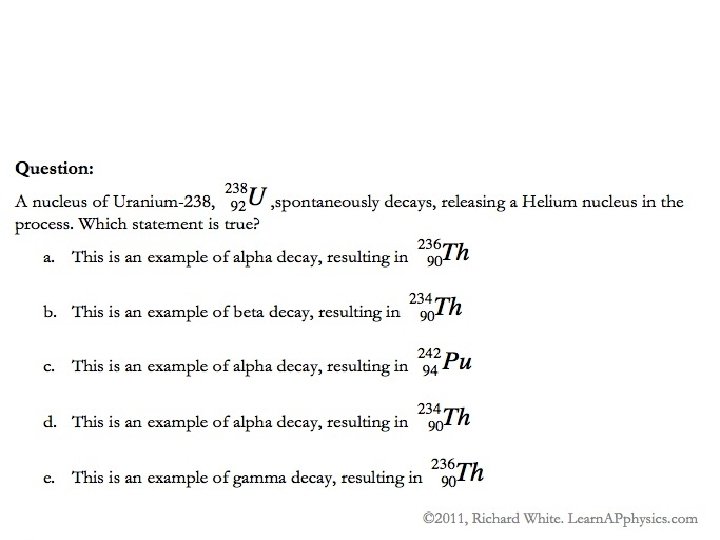
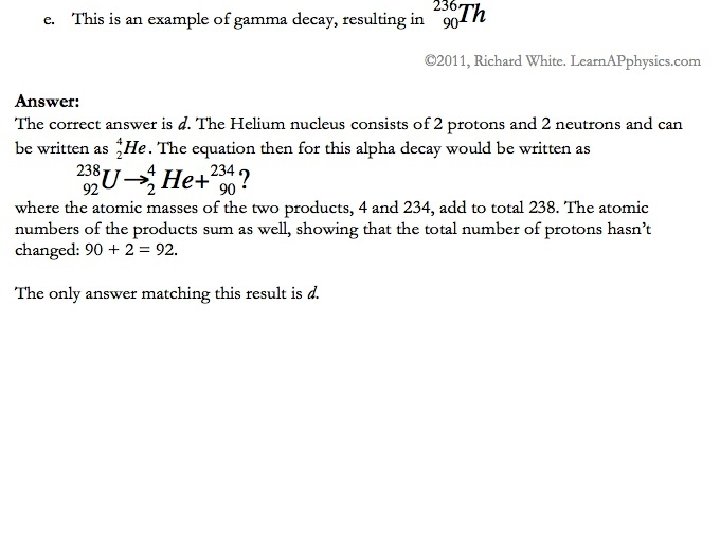
- Slides: 71
Do Now (3/24/14): • What are the major topics and concepts that we covered in our atomic and nuclear units?
AP Atomic and Nuclear Review Jessalyn Timson 3/24/14
Nuclear Physics - Multiple Choice Practice Questions for AP Physics B “Maturity is often more absurd than youth and very frequently is most unjust to youth” – Thomas A. Edison
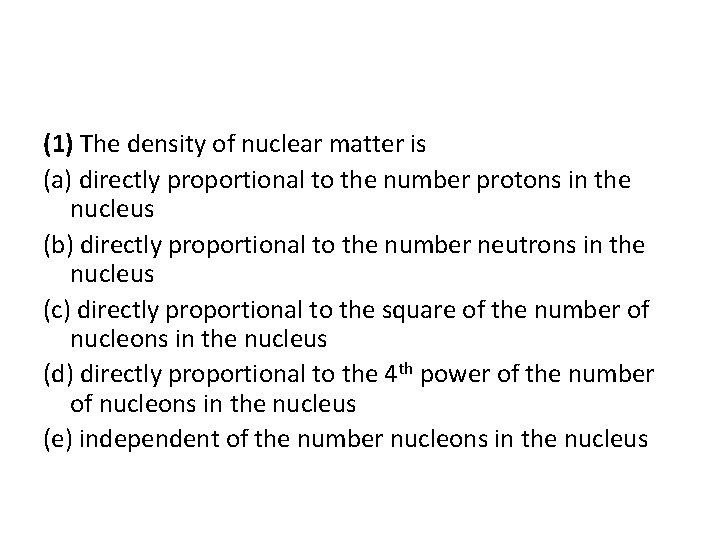
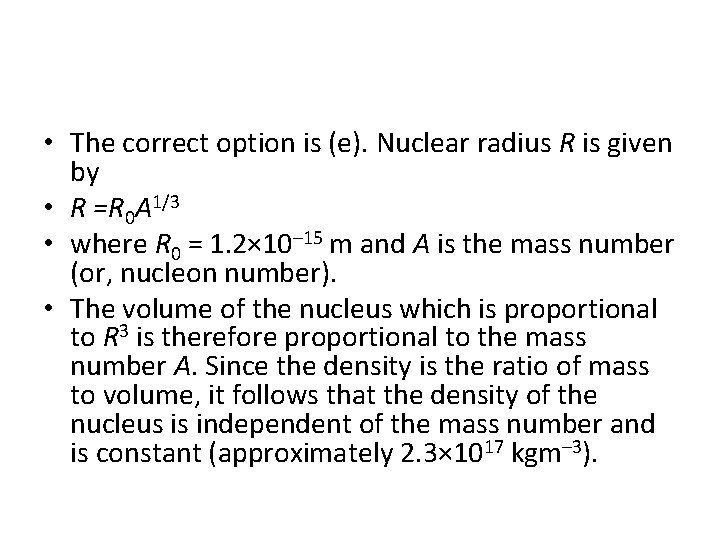
(1) The density of nuclear matter is (a) directly proportional to the number protons in the nucleus (b) directly proportional to the number neutrons in the nucleus (c) directly proportional to the square of the number of nucleons in the nucleus (d) directly proportional to the 4 th power of the number of nucleons in the nucleus (e) independent of the number nucleons in the nucleus
• The correct option is (e). Nuclear radius R is given by • R =R 0 A 1/3 • where R 0 = 1. 2× 10– 15 m and A is the mass number (or, nucleon number). • The volume of the nucleus which is proportional to R 3 is therefore proportional to the mass number A. Since the density is the ratio of mass to volume, it follows that the density of the nucleus is independent of the mass number and is constant (approximately 2. 3× 10¹⁷ kgm– 3).
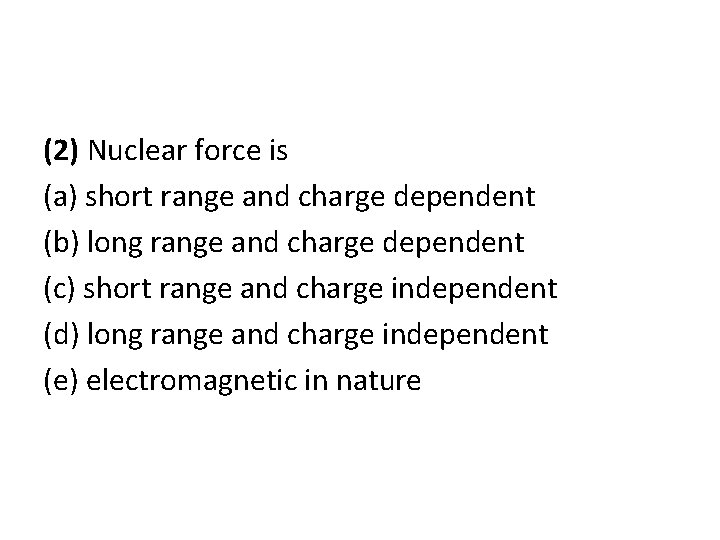
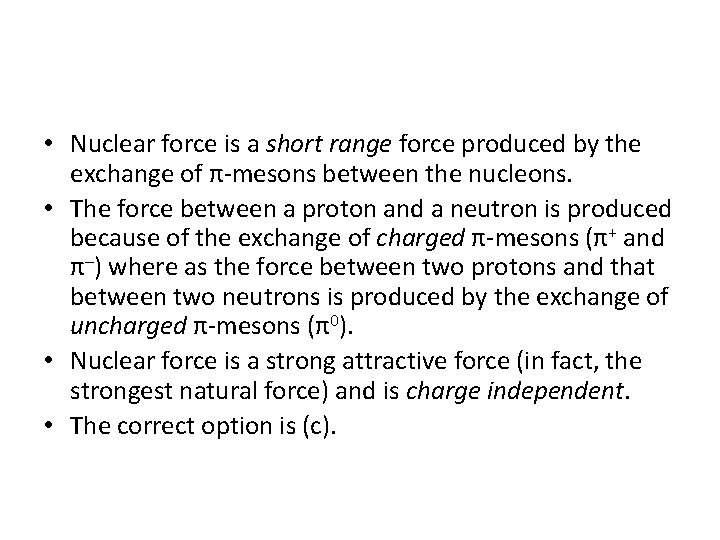
(2) Nuclear force is (a) short range and charge dependent (b) long range and charge dependent (c) short range and charge independent (d) long range and charge independent (e) electromagnetic in nature
• Nuclear force is a short range force produced by the exchange of π-mesons between the nucleons. • The force between a proton and a neutron is produced because of the exchange of charged π-mesons (π+ and π–) where as the force between two protons and that between two neutrons is produced by the exchange of uncharged π-mesons (π0). • Nuclear force is a strong attractive force (in fact, the strongest natural force) and is charge independent. • The correct option is (c).
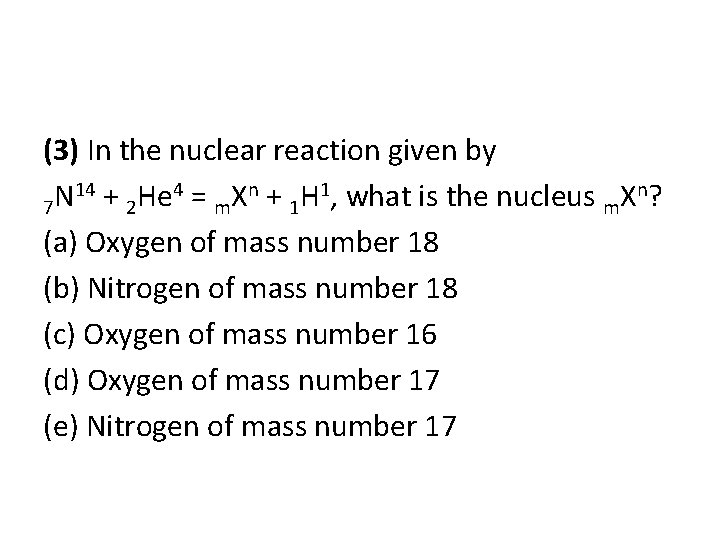
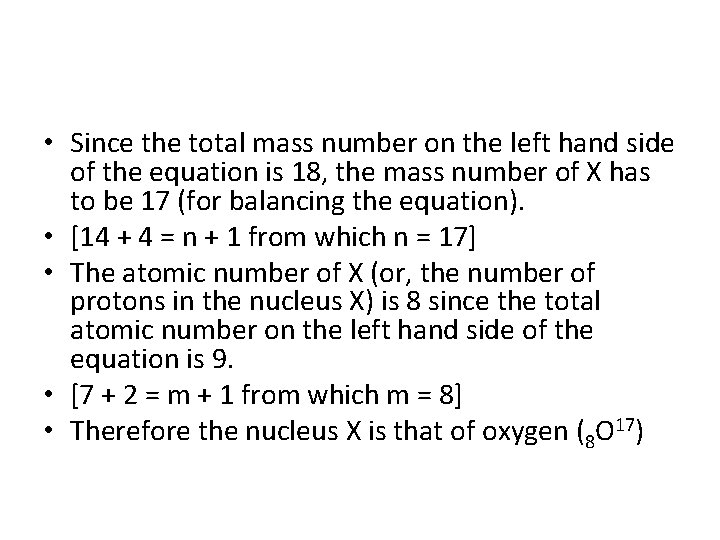
(3) In the nuclear reaction given by 14 + He 4 = Xn + H 1, what is the nucleus Xn? N 7 2 m 1 m (a) Oxygen of mass number 18 (b) Nitrogen of mass number 18 (c) Oxygen of mass number 16 (d) Oxygen of mass number 17 (e) Nitrogen of mass number 17
• Since the total mass number on the left hand side of the equation is 18, the mass number of X has to be 17 (for balancing the equation). • [14 + 4 = n + 1 from which n = 17] • The atomic number of X (or, the number of protons in the nucleus X) is 8 since the total atomic number on the left hand side of the equation is 9. • [7 + 2 = m + 1 from which m = 8] • Therefore the nucleus X is that of oxygen (8 O 17)
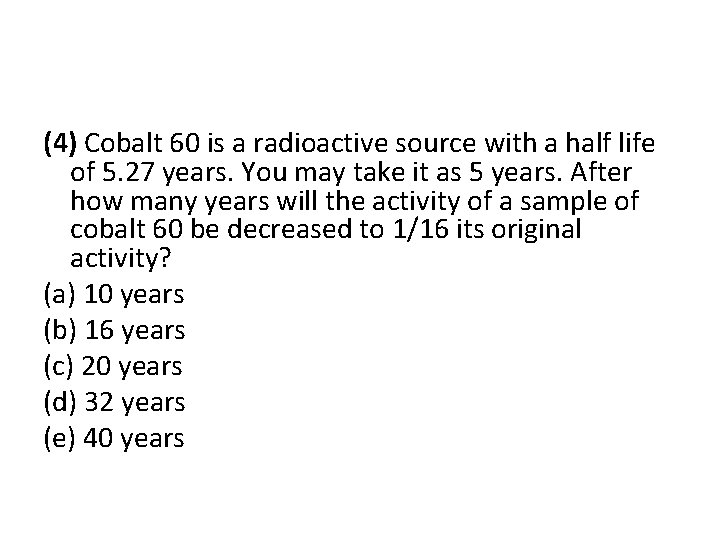
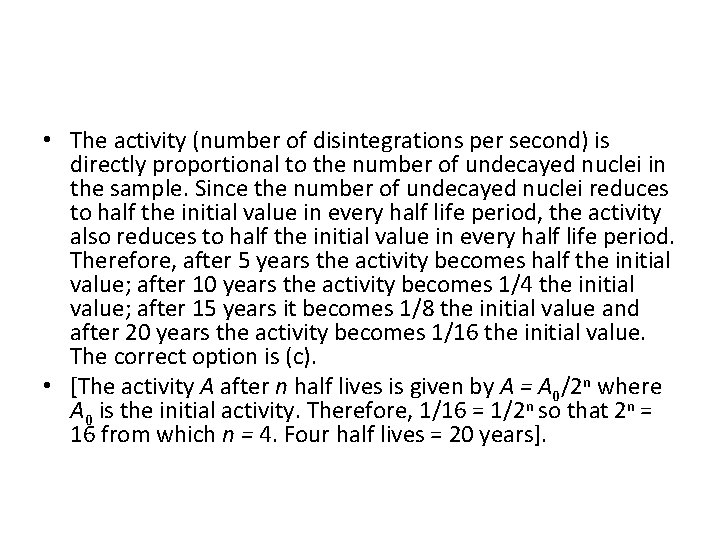
(4) Cobalt 60 is a radioactive source with a half life of 5. 27 years. You may take it as 5 years. After how many years will the activity of a sample of cobalt 60 be decreased to 1/16 its original activity? (a) 10 years (b) 16 years (c) 20 years (d) 32 years (e) 40 years
• The activity (number of disintegrations per second) is directly proportional to the number of undecayed nuclei in the sample. Since the number of undecayed nuclei reduces to half the initial value in every half life period, the activity also reduces to half the initial value in every half life period. Therefore, after 5 years the activity becomes half the initial value; after 10 years the activity becomes 1/4 the initial value; after 15 years it becomes 1/8 the initial value and after 20 years the activity becomes 1/16 the initial value. The correct option is (c). • [The activity A after n half lives is given by A = A 0/2 n where A 0 is the initial activity. Therefore, 1/16 = 1/2 n so that 2 n = 16 from which n = 4. Four half lives = 20 years].
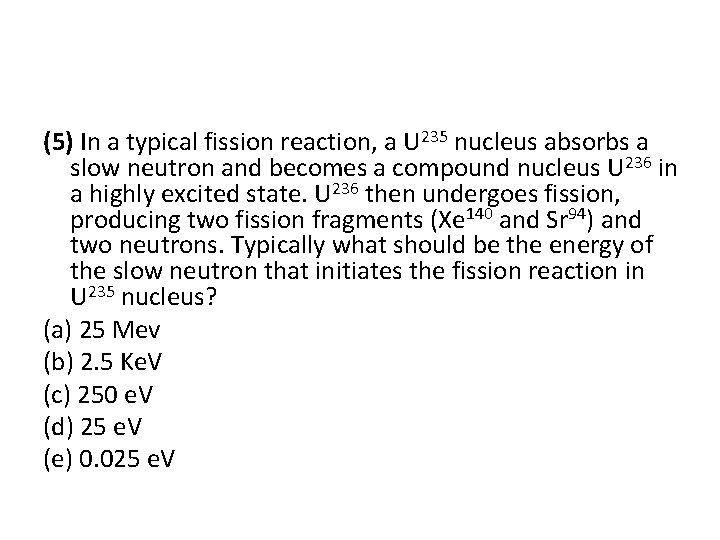
(5) In a typical fission reaction, a U 235 nucleus absorbs a slow neutron and becomes a compound nucleus U 236 in a highly excited state. U 236 then undergoes fission, producing two fission fragments (Xe 140 and Sr 94) and two neutrons. Typically what should be the energy of the slow neutron that initiates the fission reaction in U 235 nucleus? (a) 25 Mev (b) 2. 5 Ke. V (c) 250 e. V (d) 25 e. V (e) 0. 025 e. V
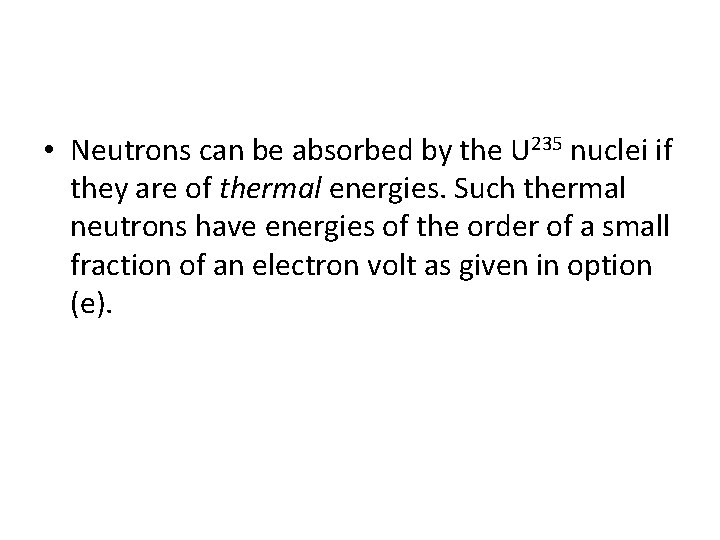
• Neutrons can be absorbed by the U 235 nuclei if they are of thermal energies. Such thermal neutrons have energies of the order of a small fraction of an electron volt as given in option (e).
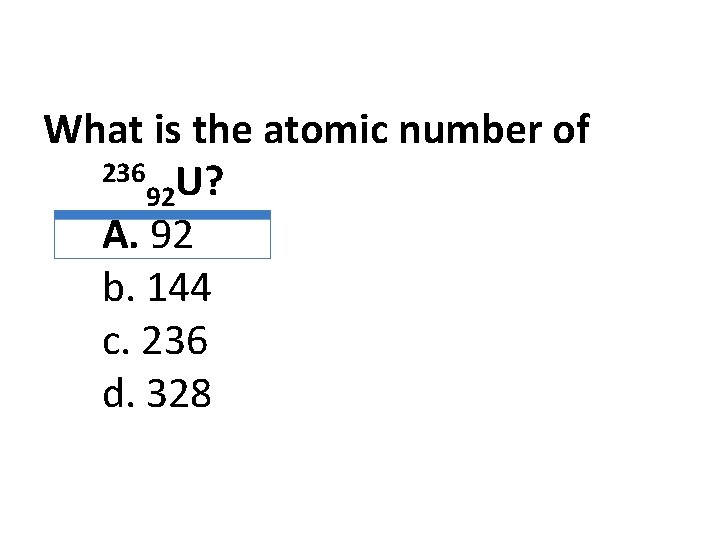
What is the atomic number of 236 U? 92 A. 92 b. 144 c. 236 d. 328
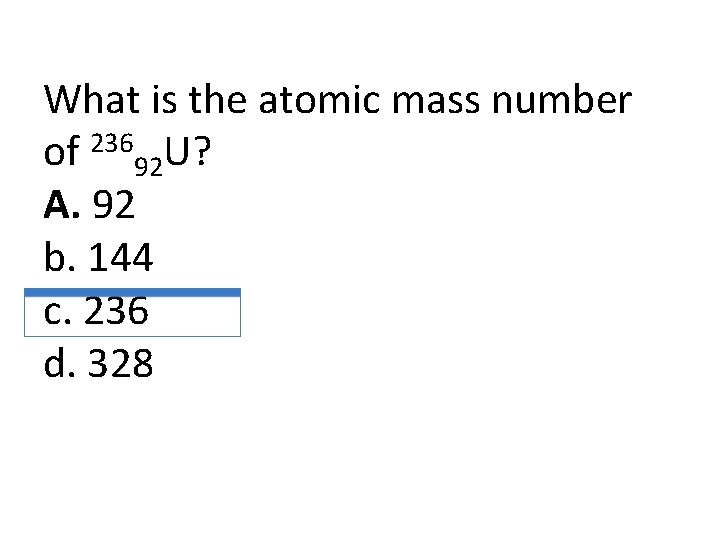
What is the atomic mass number of 23692 U? A. 92 b. 144 c. 236 d. 328
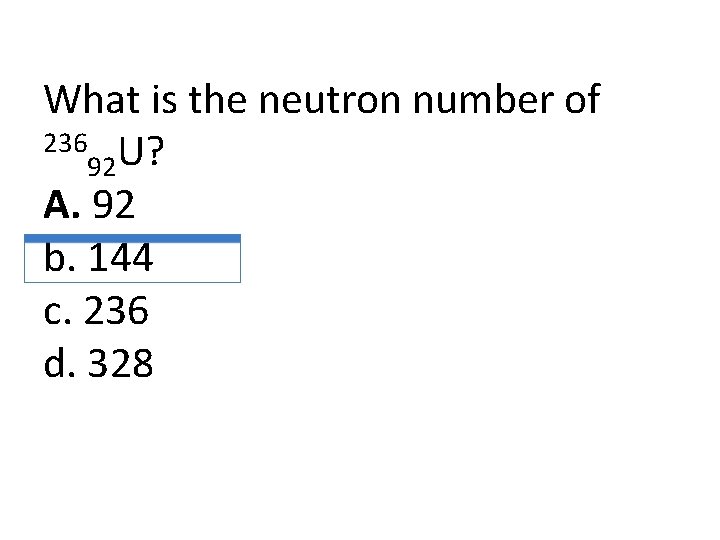
What is the neutron number of 236 U? 92 A. 92 b. 144 c. 236 d. 328
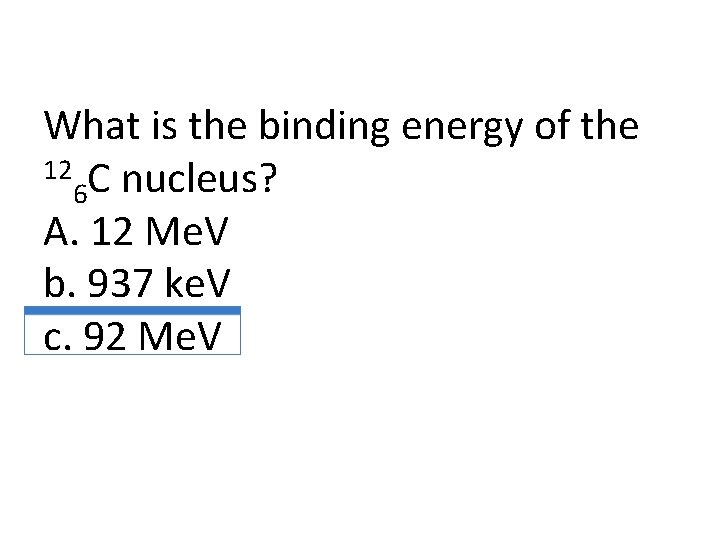
What is the binding energy of the 12 C nucleus? 6 A. 12 Me. V b. 937 ke. V c. 92 Me. V
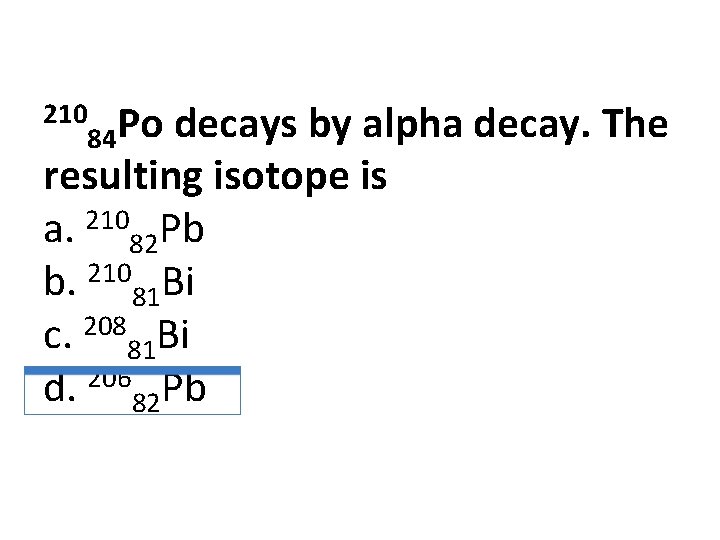
decays by alpha decay. The resulting isotope is a. 21082 Pb b. 21081 Bi c. 20881 Bi 206 d. 82 Pb 210 84 Po
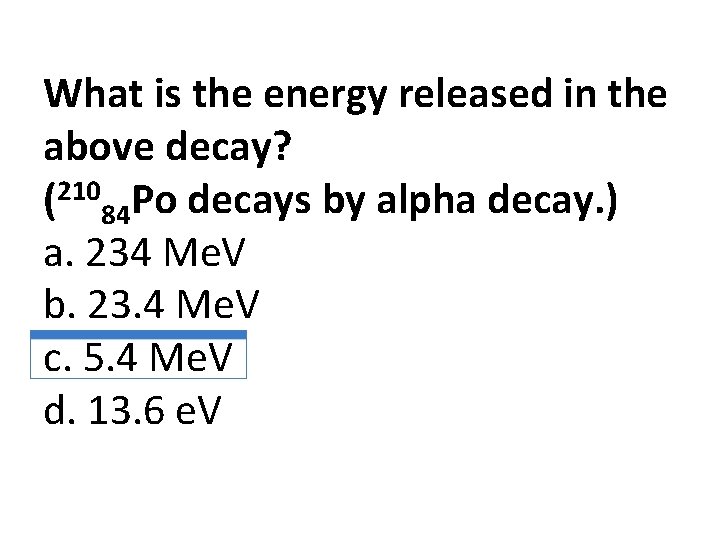
What is the energy released in the above decay? 210 ( 84 Po decays by alpha decay. ) a. 234 Me. V b. 23. 4 Me. V c. 5. 4 Me. V d. 13. 6 e. V
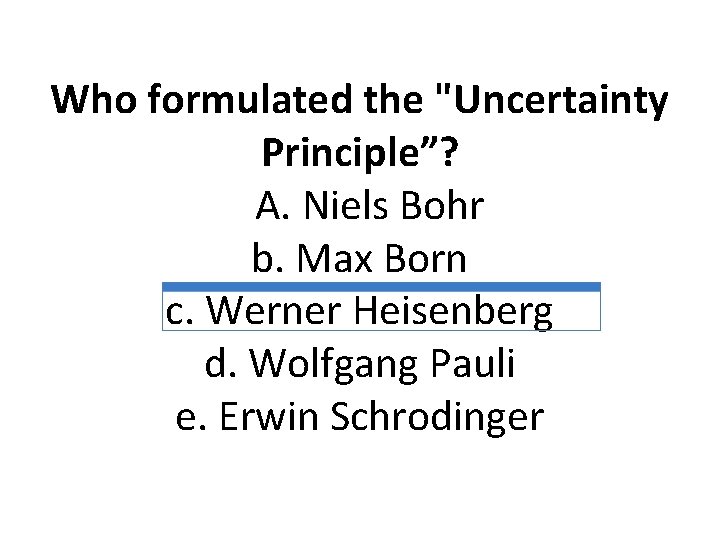
Who formulated the "Uncertainty Principle”? A. Niels Bohr b. Max Born c. Werner Heisenberg d. Wolfgang Pauli e. Erwin Schrodinger
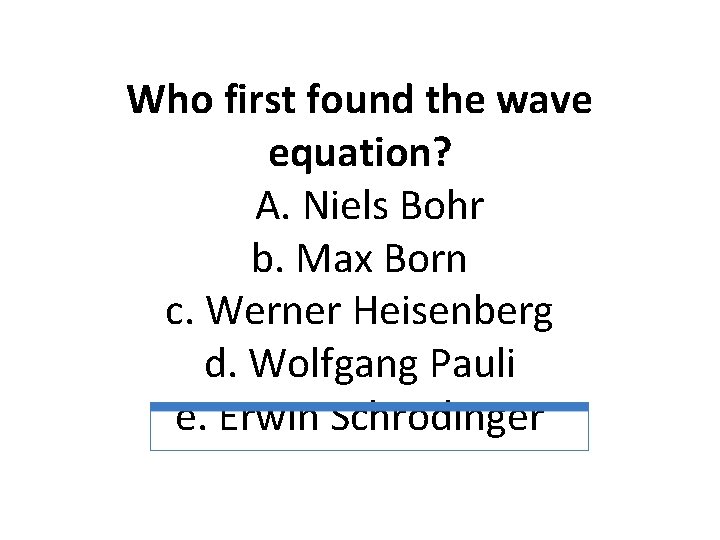
Who first found the wave equation? A. Niels Bohr b. Max Born c. Werner Heisenberg d. Wolfgang Pauli e. Erwin Schrodinger
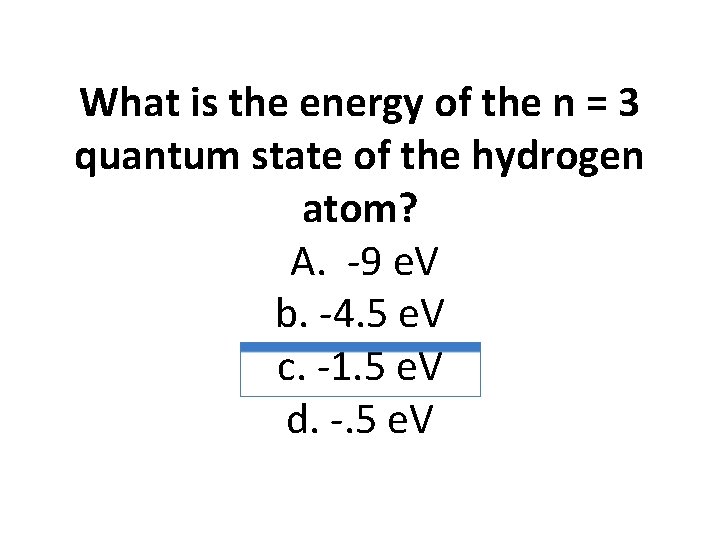
What is the energy of the n = 3 quantum state of the hydrogen atom? A. -9 e. V b. -4. 5 e. V c. -1. 5 e. V d. -. 5 e. V
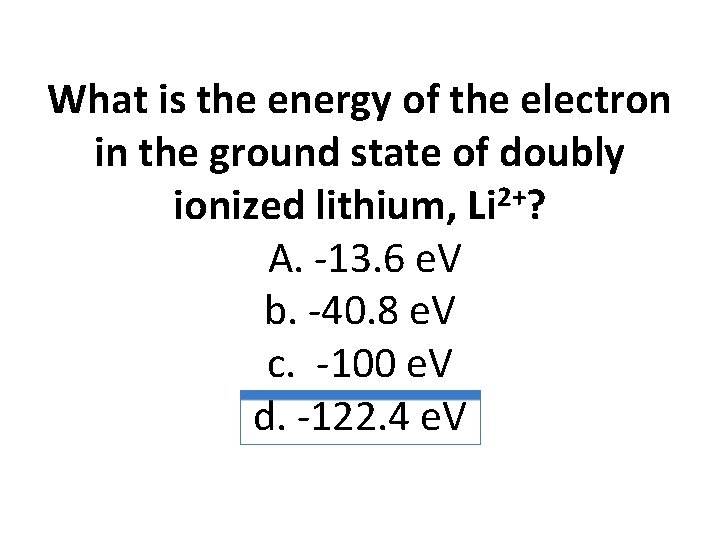
What is the energy of the electron in the ground state of doubly ionized lithium, Li 2+? A. -13. 6 e. V b. -40. 8 e. V c. -100 e. V d. -122. 4 e. V
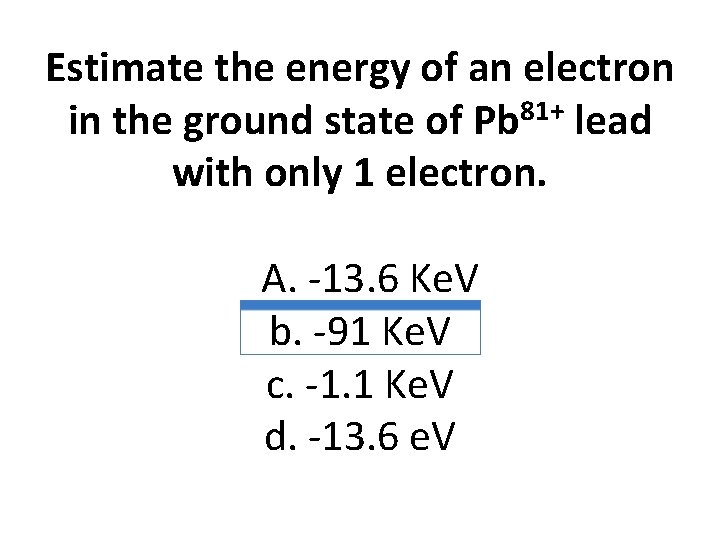
Estimate the energy of an electron in the ground state of Pb 81+ lead with only 1 electron. A. -13. 6 Ke. V b. -91 Ke. V c. -1. 1 Ke. V d. -13. 6 e. V
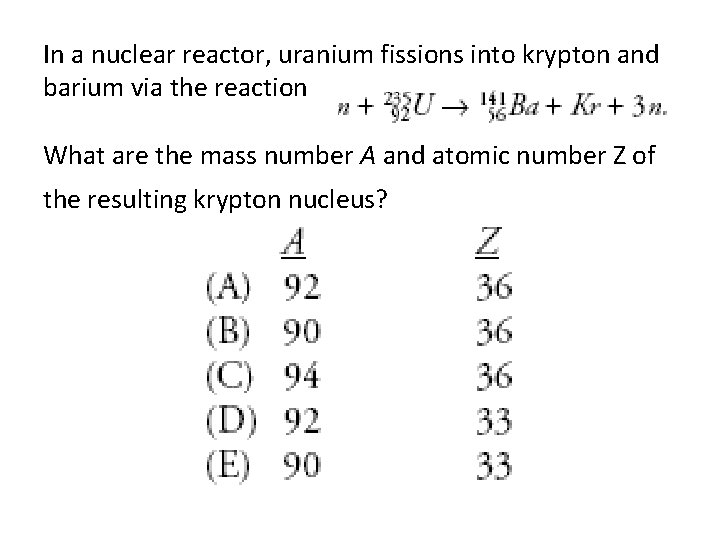
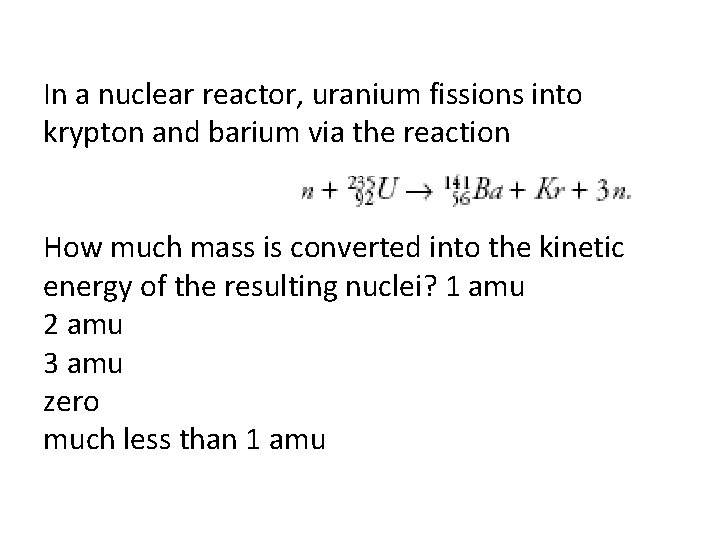
In a nuclear reactor, uranium fissions into krypton and barium via the reaction What are the mass number A and atomic number Z of the resulting krypton nucleus?
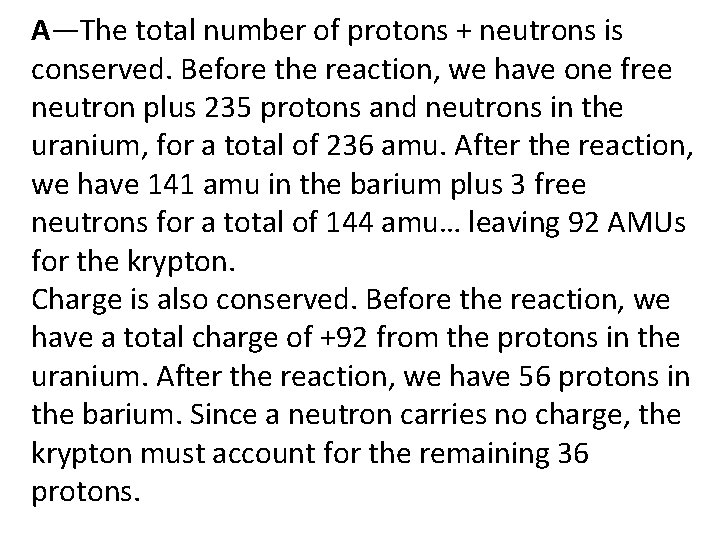
A—The total number of protons + neutrons is conserved. Before the reaction, we have one free neutron plus 235 protons and neutrons in the uranium, for a total of 236 amu. After the reaction, we have 141 amu in the barium plus 3 free neutrons for a total of 144 amu… leaving 92 AMUs for the krypton. Charge is also conserved. Before the reaction, we have a total charge of +92 from the protons in the uranium. After the reaction, we have 56 protons in the barium. Since a neutron carries no charge, the krypton must account for the remaining 36 protons.
In a nuclear reactor, uranium fissions into krypton and barium via the reaction How much mass is converted into the kinetic energy of the resulting nuclei? 1 amu 2 amu 3 amu zero much less than 1 amu
E—Einstein's famous equation is written ΔE = mc 2, because it is only the lost mass that is converted into energy. Since we still have a total of 236 amu after the reaction, an entire amu of mass was not converted to energy. Still, the daughter particles have kinetic energy because they move. That energy came from a very small mass difference, probably about a million times less than one amu.
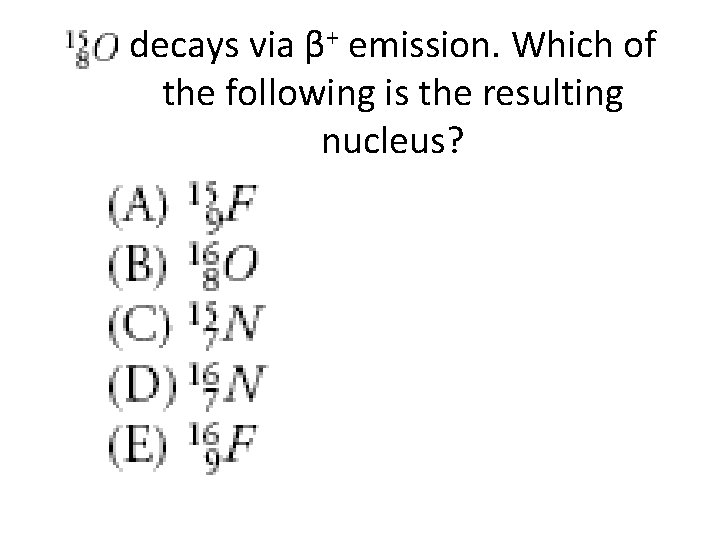
decays via β+ emission. Which of the following is the resulting nucleus?
C—In β+ emission, a positron is ejected from the nucleus. This does not change the total number of protons + neutrons, so the atomic mass A is still 15. However, charge must be conserved. The original O nucleus had a charge of +8, so the products of the decay must combine to a charge of +8. These products are a positron, charge +1, and the daughter nucleus, which must have charge +7.
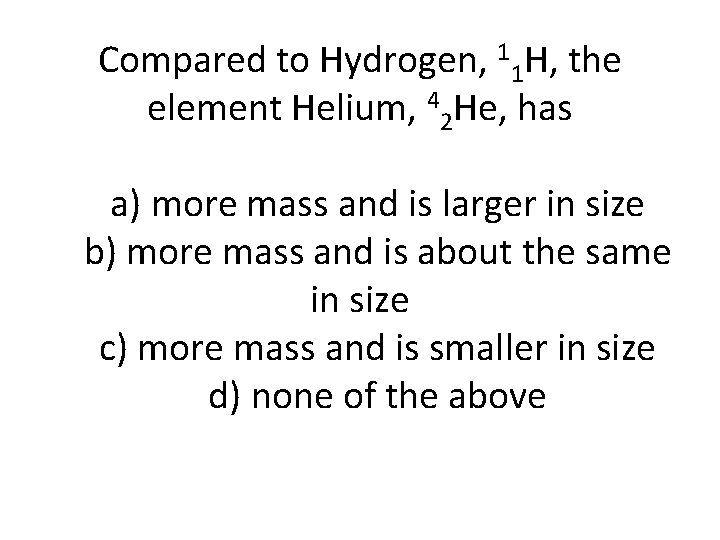
Compared to Hydrogen, 11 H, the element Helium, 42 He, has a) more mass and is larger in size b) more mass and is about the same in size c) more mass and is smaller in size d) none of the above
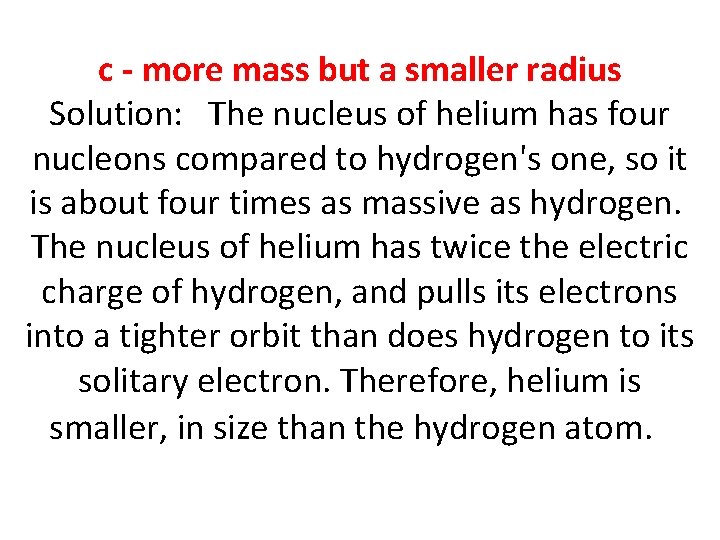
c - more mass but a smaller radius Solution: The nucleus of helium has four nucleons compared to hydrogen's one, so it is about four times as massive as hydrogen. The nucleus of helium has twice the electric charge of hydrogen, and pulls its electrons into a tighter orbit than does hydrogen to its solitary electron. Therefore, helium is smaller, in size than the hydrogen atom.
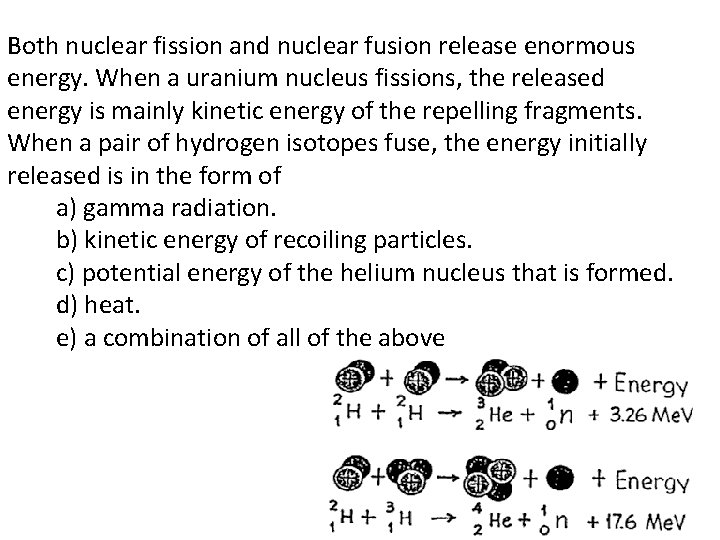
Both nuclear fission and nuclear fusion release enormous energy. When a uranium nucleus fissions, the released energy is mainly kinetic energy of the repelling fragments. When a pair of hydrogen isotopes fuse, the energy initially released is in the form of a) gamma radiation. b) kinetic energy of recoiling particles. c) potential energy of the helium nucleus that is formed. d) heat. e) a combination of all of the above
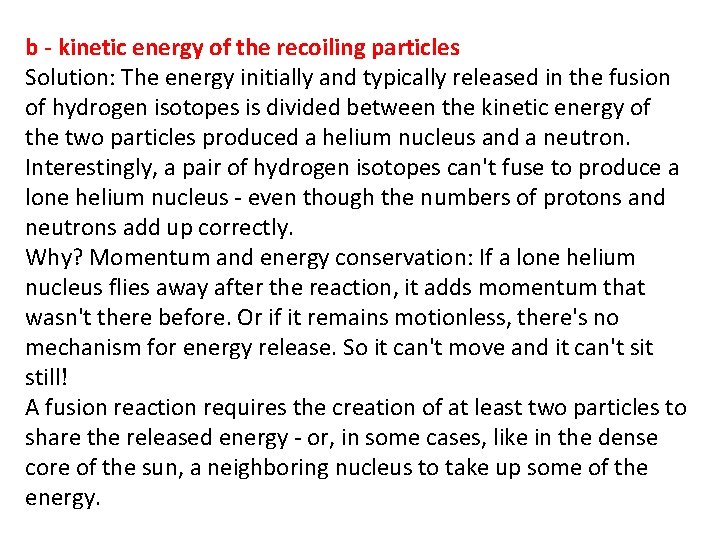
b - kinetic energy of the recoiling particles Solution: The energy initially and typically released in the fusion of hydrogen isotopes is divided between the kinetic energy of the two particles produced a helium nucleus and a neutron. Interestingly, a pair of hydrogen isotopes can't fuse to produce a lone helium nucleus - even though the numbers of protons and neutrons add up correctly. Why? Momentum and energy conservation: If a lone helium nucleus flies away after the reaction, it adds momentum that wasn't there before. Or if it remains motionless, there's no mechanism for energy release. So it can't move and it can't sit still! A fusion reaction requires the creation of at least two particles to share the released energy - or, in some cases, like in the dense core of the sun, a neighboring nucleus to take up some of the energy.
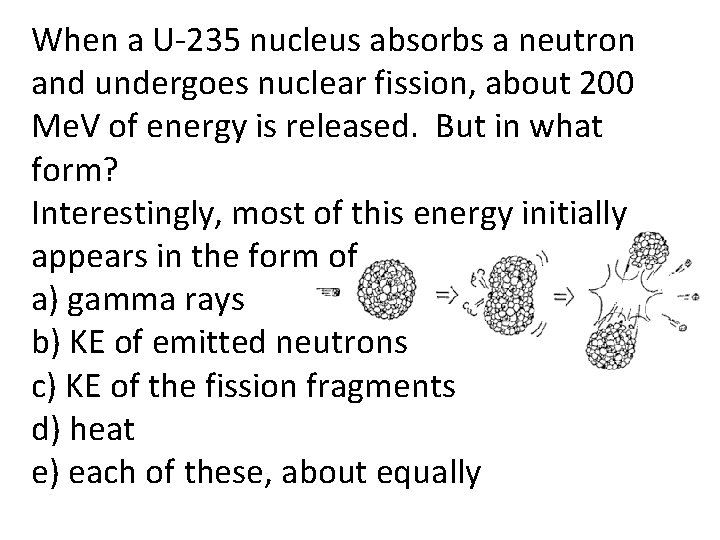
When a U-235 nucleus absorbs a neutron and undergoes nuclear fission, about 200 Me. V of energy is released. But in what form? Interestingly, most of this energy initially appears in the form of a) gamma rays b) KE of emitted neutrons c) KE of the fission fragments d) heat e) each of these, about equally
c - KE of the fission fragments Solution: Some energy is emitted in the form of gamma rays and some goes into the kinetic energy of emitted neutrons, but most of the energy of nuclear fission is in the kinetic energy of the fission fragments. The positively-charged fragments repel each other and fly apart at high speed. Soon their energy is shared among many atoms as internal energy. It then spreads as heat
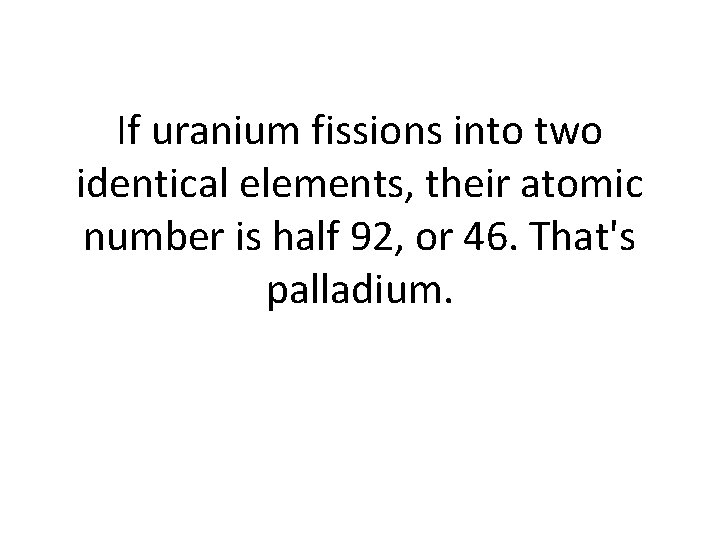
When a neutron interacts with a U 235 nucleus, it can fission many possible ways. What element results if it fissions into two identical nuclei?
If uranium fissions into two identical elements, their atomic number is half 92, or 46. That's palladium.
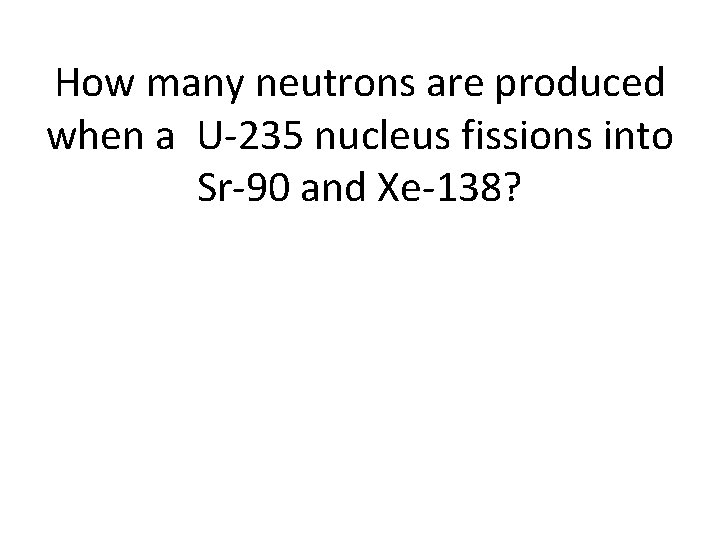
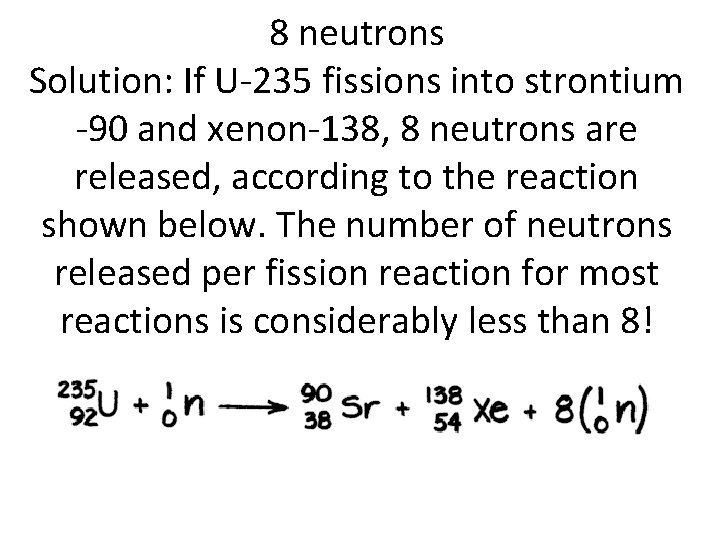
How many neutrons are produced when a U-235 nucleus fissions into Sr-90 and Xe-138?
8 neutrons Solution: If U-235 fissions into strontium -90 and xenon-138, 8 neutrons are released, according to the reaction shown below. The number of neutrons released per fission reaction for most reactions is considerably less than 8!
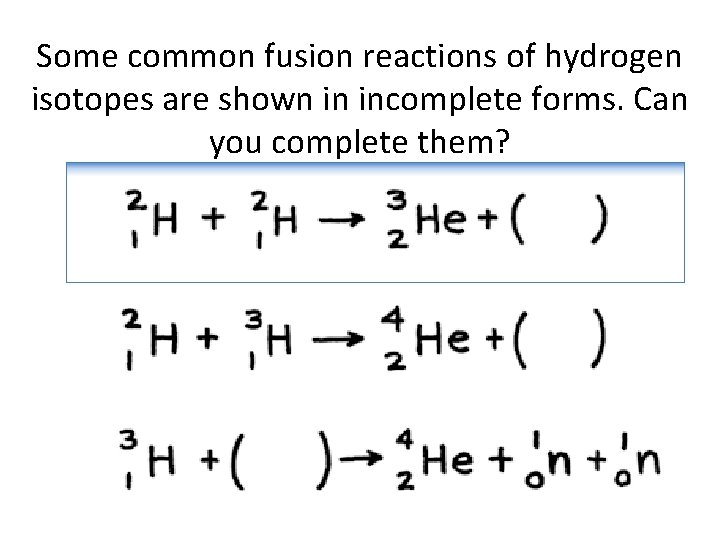
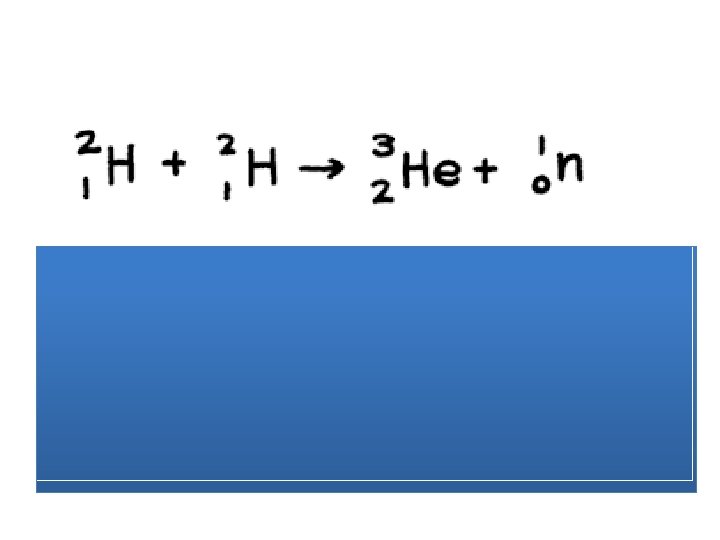
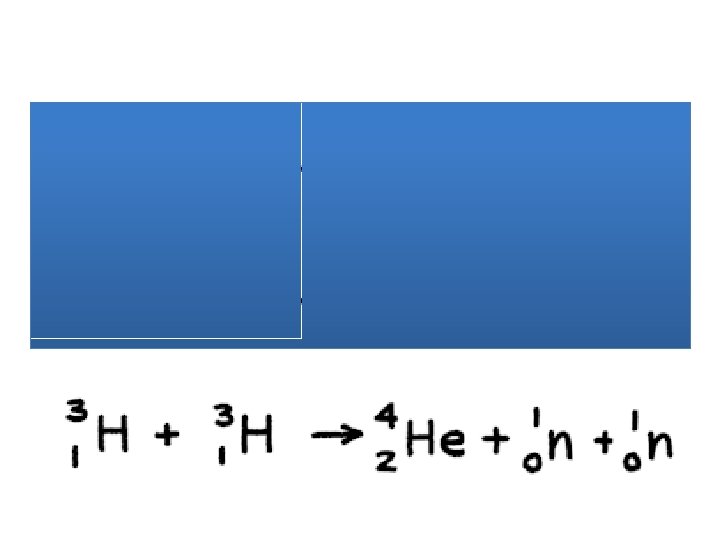
Some common fusion reactions of hydrogen isotopes are shown in incomplete forms. Can you complete them?
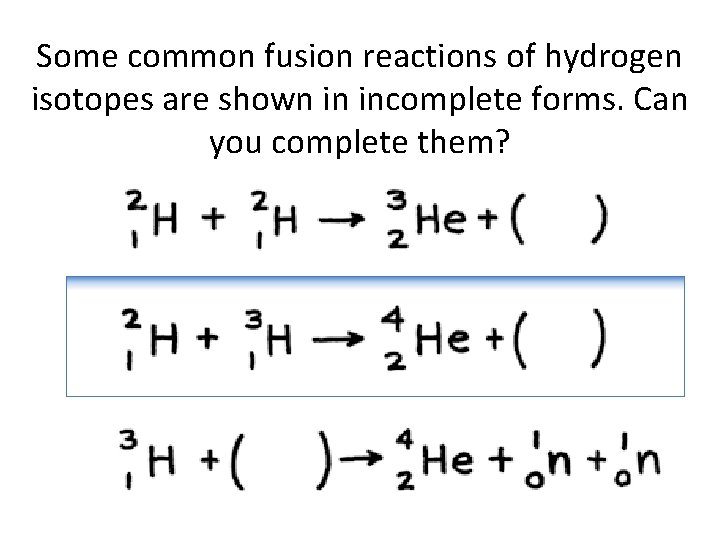
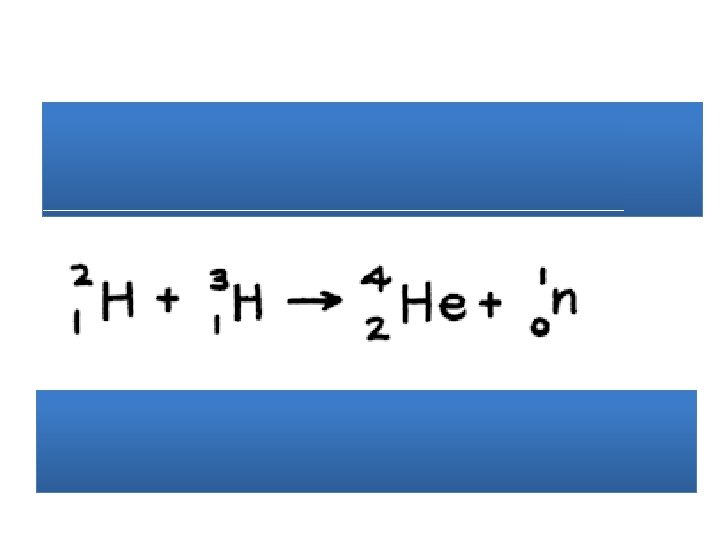
Some common fusion reactions of hydrogen isotopes are shown in incomplete forms. Can you complete them?
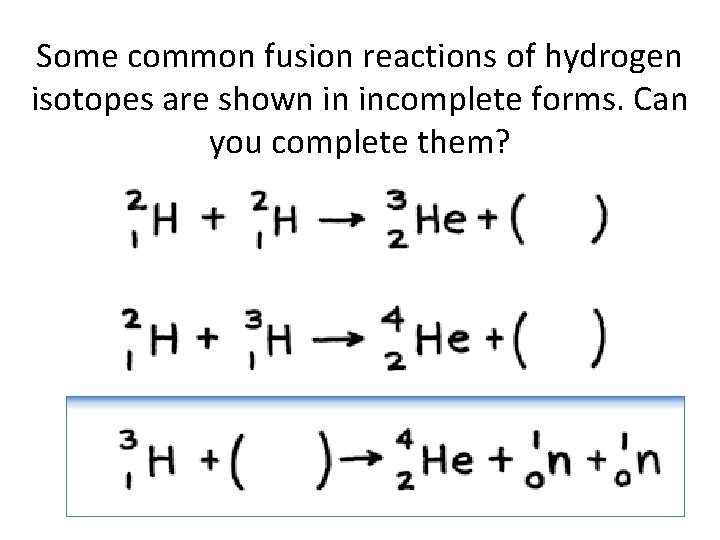
Some common fusion reactions of hydrogen isotopes are shown in incomplete forms. Can you complete them?
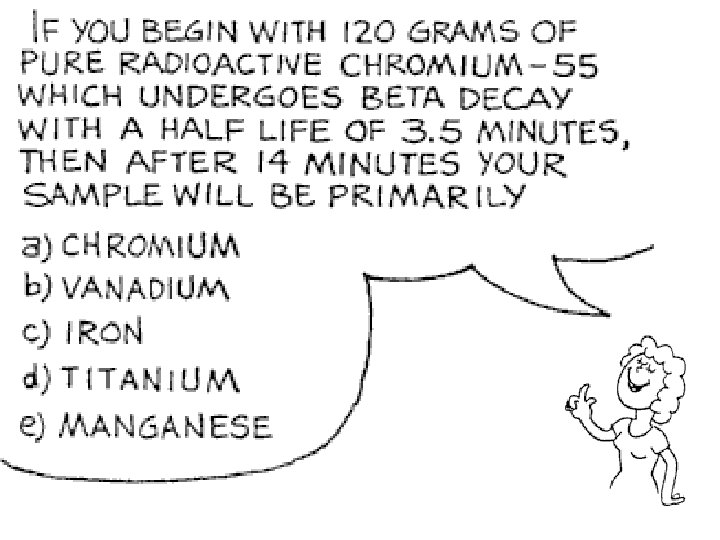
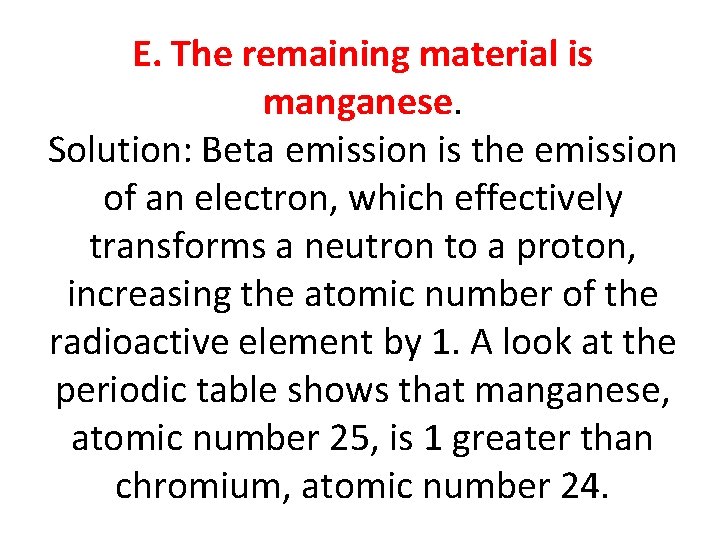
E. The remaining material is manganese. Solution: Beta emission is the emission of an electron, which effectively transforms a neutron to a proton, increasing the atomic number of the radioactive element by 1. A look at the periodic table shows that manganese, atomic number 25, is 1 greater than chromium, atomic number 24.
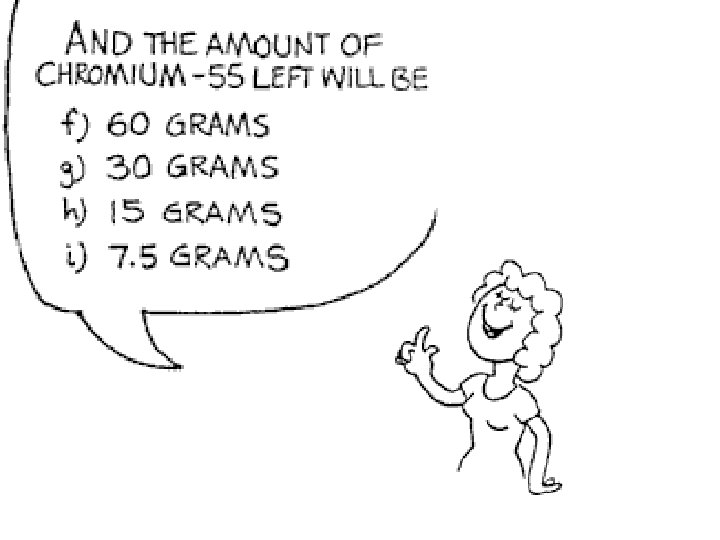
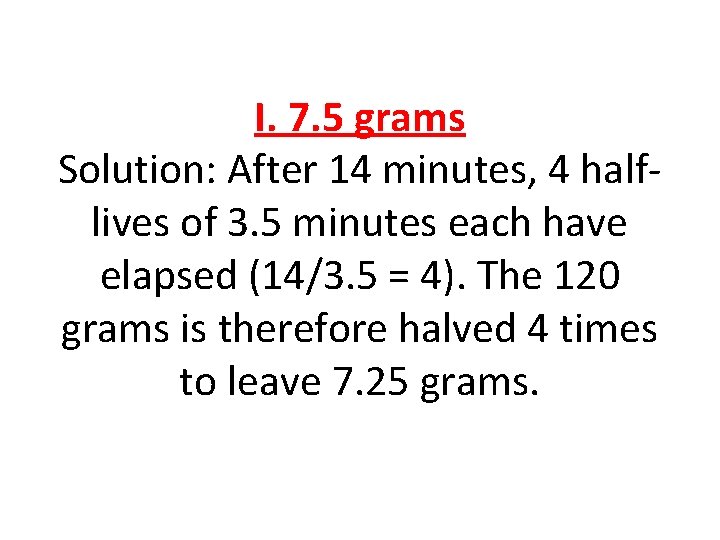
I. 7. 5 grams Solution: After 14 minutes, 4 halflives of 3. 5 minutes each have elapsed (14/3. 5 = 4). The 120 grams is therefore halved 4 times to leave 7. 25 grams.
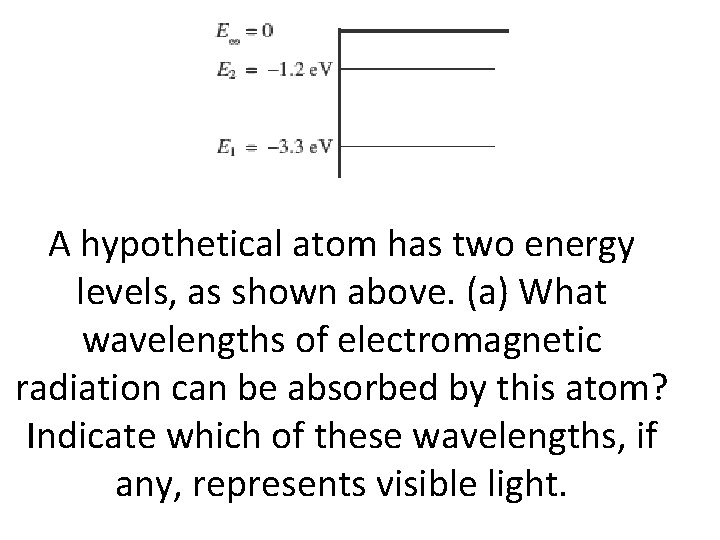
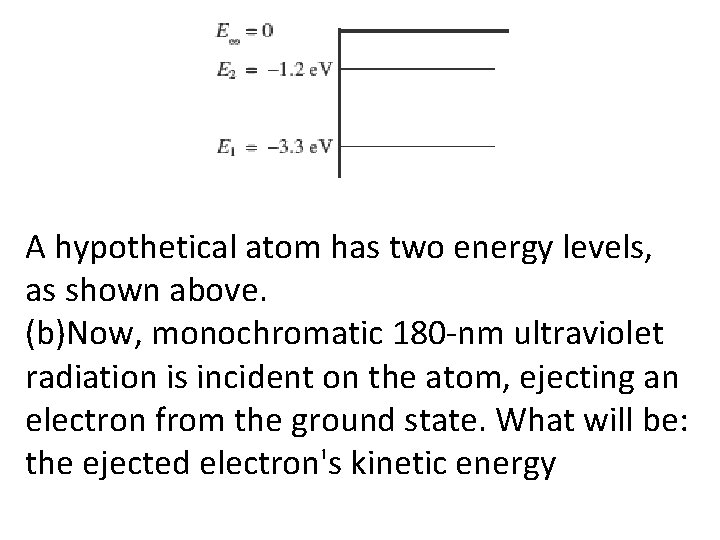
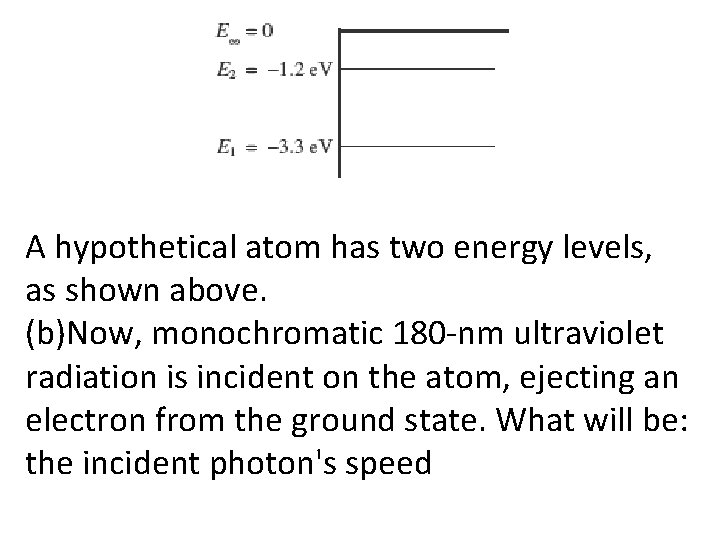
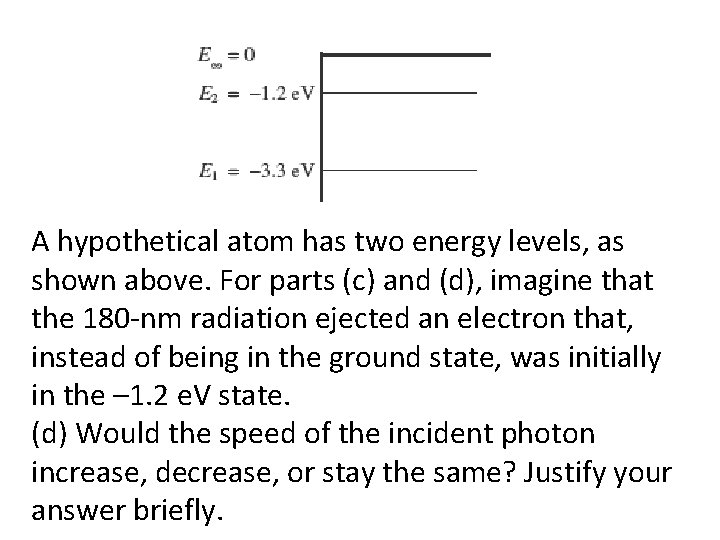
A hypothetical atom has two energy levels, as shown above. (a) What wavelengths of electromagnetic radiation can be absorbed by this atom? Indicate which of these wavelengths, if any, represents visible light.
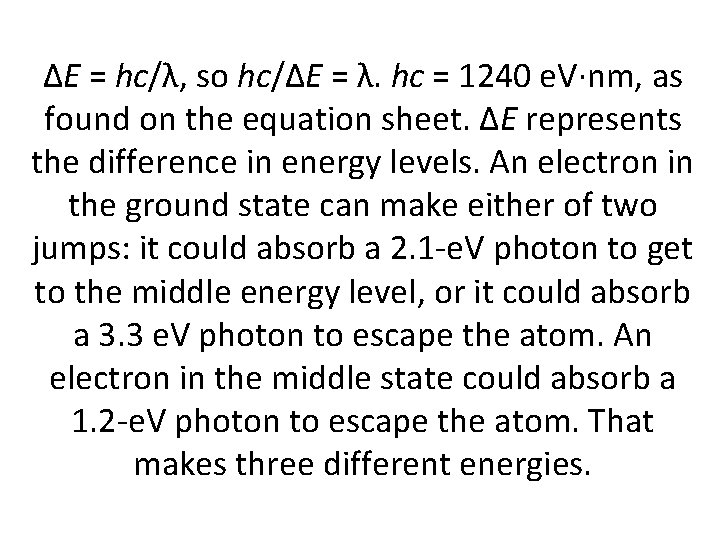
ΔE = hc/λ, so hc/ΔE = λ. hc = 1240 e. V·nm, as found on the equation sheet. ΔE represents the difference in energy levels. An electron in the ground state can make either of two jumps: it could absorb a 2. 1 -e. V photon to get to the middle energy level, or it could absorb a 3. 3 e. V photon to escape the atom. An electron in the middle state could absorb a 1. 2 -e. V photon to escape the atom. That makes three different energies.
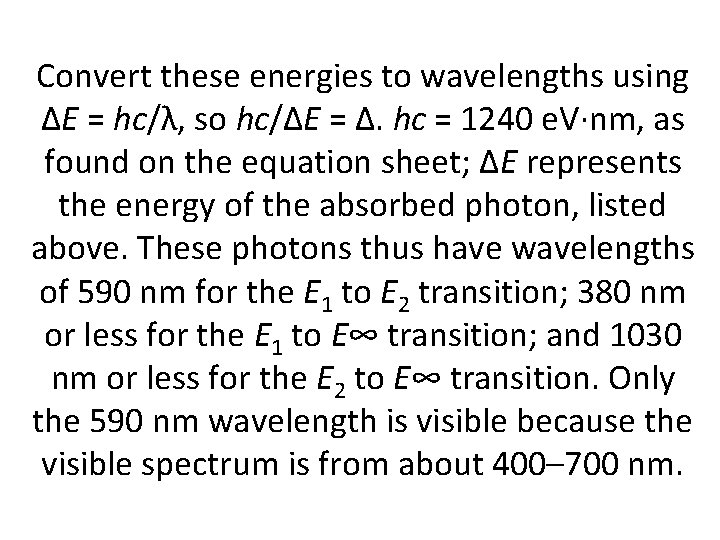
Convert these energies to wavelengths using ΔE = hc/λ, so hc/ΔE = Δ. hc = 1240 e. V·nm, as found on the equation sheet; ΔE represents the energy of the absorbed photon, listed above. These photons thus have wavelengths of 590 nm for the E 1 to E 2 transition; 380 nm or less for the E 1 to E∞ transition; and 1030 nm or less for the E 2 to E∞ transition. Only the 590 nm wavelength is visible because the visible spectrum is from about 400– 700 nm.
A hypothetical atom has two energy levels, as shown above. (b)Now, monochromatic 180 -nm ultraviolet radiation is incident on the atom, ejecting an electron from the ground state. What will be: the ejected electron's kinetic energy
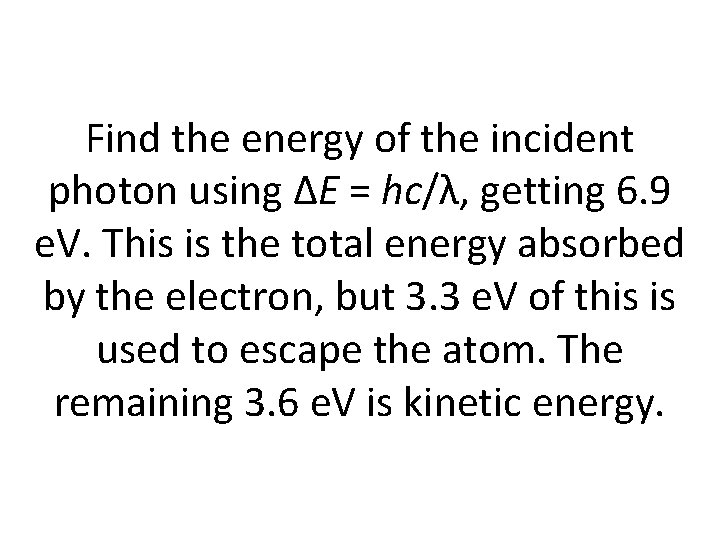
Find the energy of the incident photon using ΔE = hc/λ, getting 6. 9 e. V. This is the total energy absorbed by the electron, but 3. 3 e. V of this is used to escape the atom. The remaining 3. 6 e. V is kinetic energy.
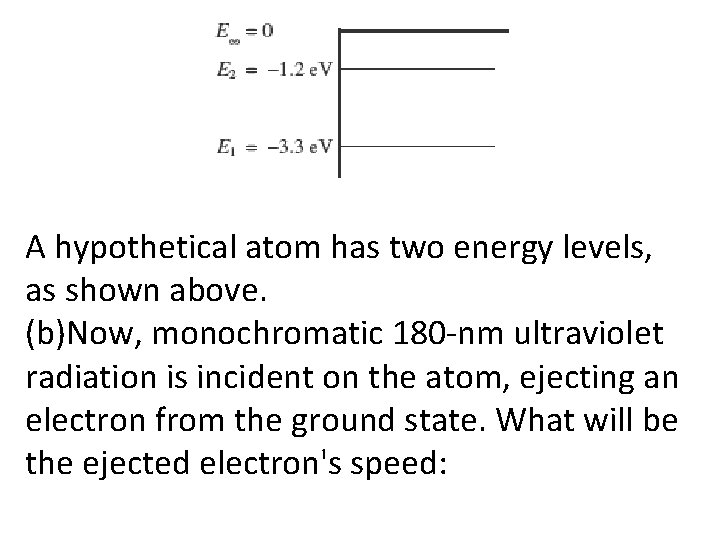
A hypothetical atom has two energy levels, as shown above. (b)Now, monochromatic 180 -nm ultraviolet radiation is incident on the atom, ejecting an electron from the ground state. What will be the ejected electron's speed:
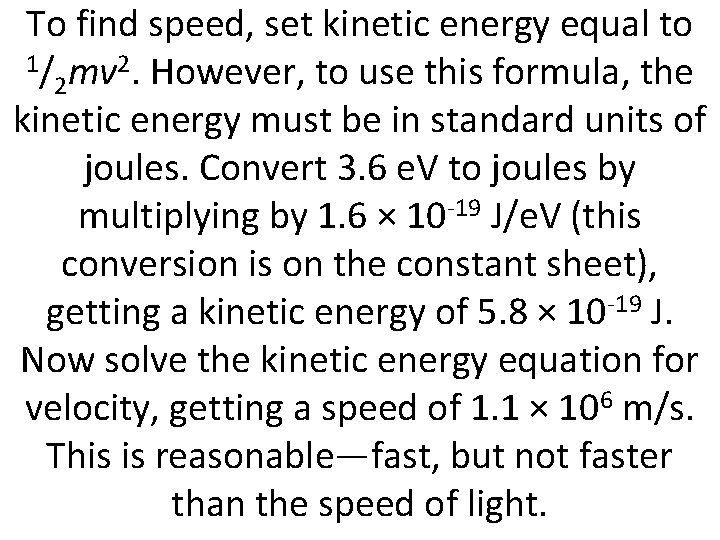
To find speed, set kinetic energy equal to 1/ mv 2. However, to use this formula, the 2 kinetic energy must be in standard units of joules. Convert 3. 6 e. V to joules by multiplying by 1. 6 × 10 -19 J/e. V (this conversion is on the constant sheet), getting a kinetic energy of 5. 8 × 10 -19 J. Now solve the kinetic energy equation for velocity, getting a speed of 1. 1 × 10⁶ m/s. This is reasonable—fast, but not faster than the speed of light.
A hypothetical atom has two energy levels, as shown above. (b)Now, monochromatic 180 -nm ultraviolet radiation is incident on the atom, ejecting an electron from the ground state. What will be: the incident photon's speed
A photon is a particle of light. Unless it is in an optically dense material (which the photons here are not), the speed of a photon is always 3. 0 8 × 10 m/s.
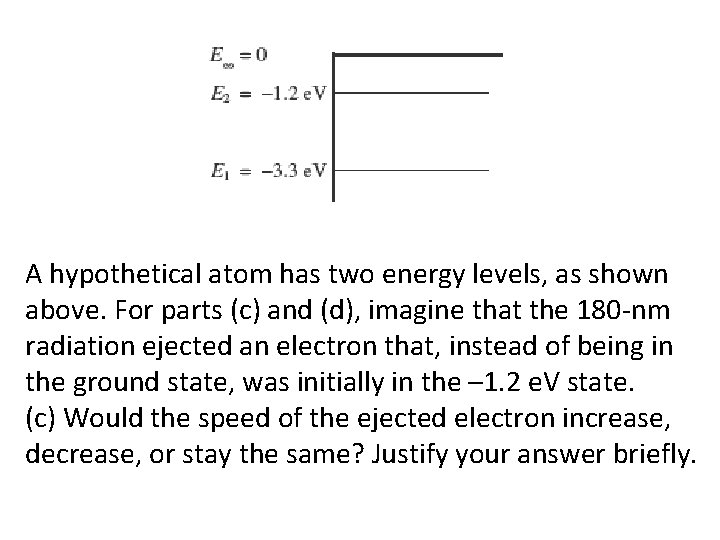
A hypothetical atom has two energy levels, as shown above. For parts (c) and (d), imagine that the 180 -nm radiation ejected an electron that, instead of being in the ground state, was initially in the – 1. 2 e. V state. (c) Would the speed of the ejected electron increase, decrease, or stay the same? Justify your answer briefly.
(c) The electron absorbs the same amount of energy from the incident photons. However, now it only takes 1. 2 e. V to get out of the atom, leaving 5. 7 e. V for kinetic energy. With a larger kinetic energy, the ejected electron's speed is greater than before.
A hypothetical atom has two energy levels, as shown above. For parts (c) and (d), imagine that the 180 -nm radiation ejected an electron that, instead of being in the ground state, was initially in the – 1. 2 e. V state. (d) Would the speed of the incident photon increase, decrease, or stay the same? Justify your answer briefly.
(d) The speed of the photon is still the speed of light, 3. 0 × 108 m/s.
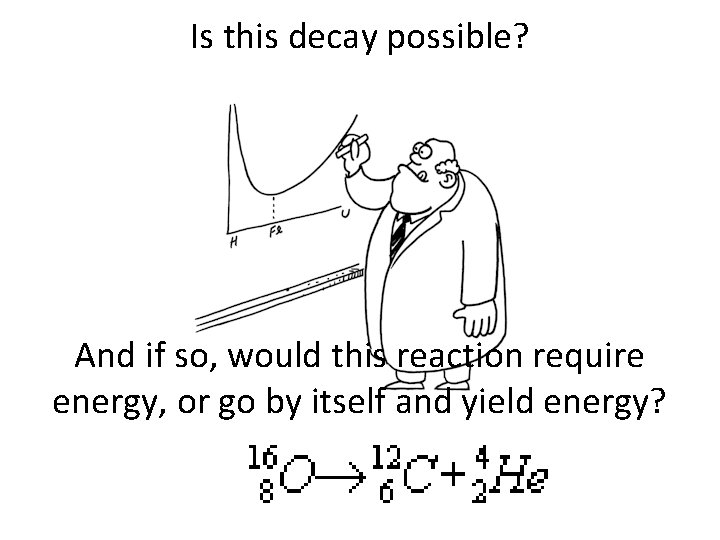
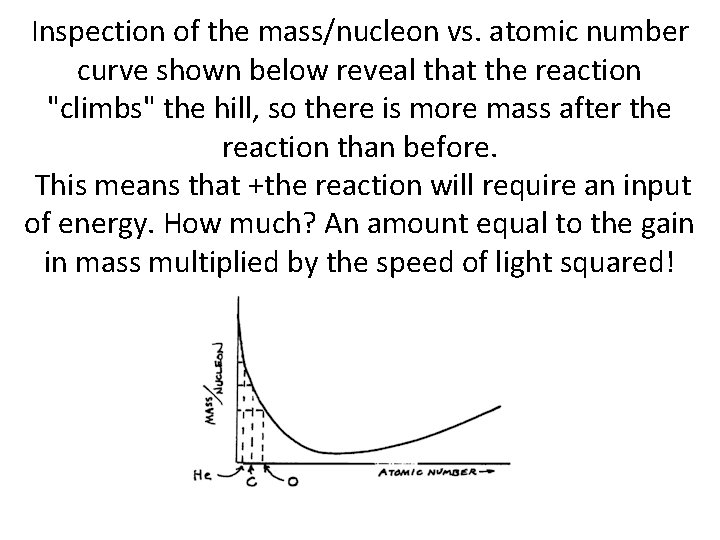
Is this decay possible? And if so, would this reaction require energy, or go by itself and yield energy?
yes, but it would require the input of energy to make it start Solution: The decay is possible for both charge and mass number are conserved. The numbers on the left equal the numbers on the right.
Inspection of the mass/nucleon vs. atomic number curve shown below reveal that the reaction "climbs" the hill, so there is more mass after the reaction than before. This means that +the reaction will require an input of energy. How much? An amount equal to the gain in mass multiplied by the speed of light squared!
Suppose you could add or subtract protons from oxygen nuclei to turn oxygen into a gas that would glow red when an electric current flows through it. Would you add or subtract protons? How many?
Add two protons to each nucleus of oxygen and you increase the atomic number from 8 to 10. You then have neon, which will glow a very nice red when a current flows through it.