Secret image sharing Computer Graphics 26 765 770

- Slides: 20
Secret image sharing Computer & Graphics, 26, 765 -770, 2002 Chih-Ching Thien and Ja-Chen Lin Department of Computer and Information Science, National Chiao Tung University, Hsinchu 300, Taiwan, ROC
ABSTRACT •
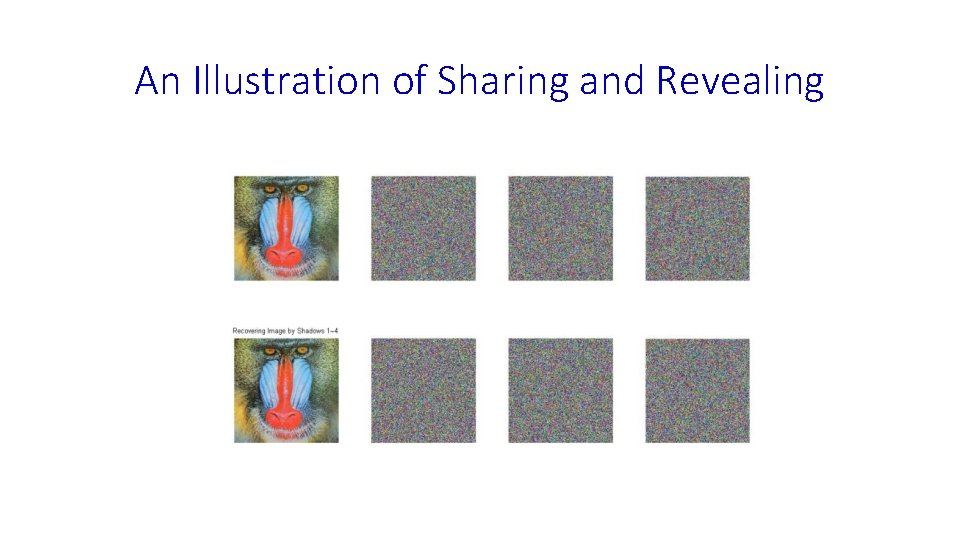
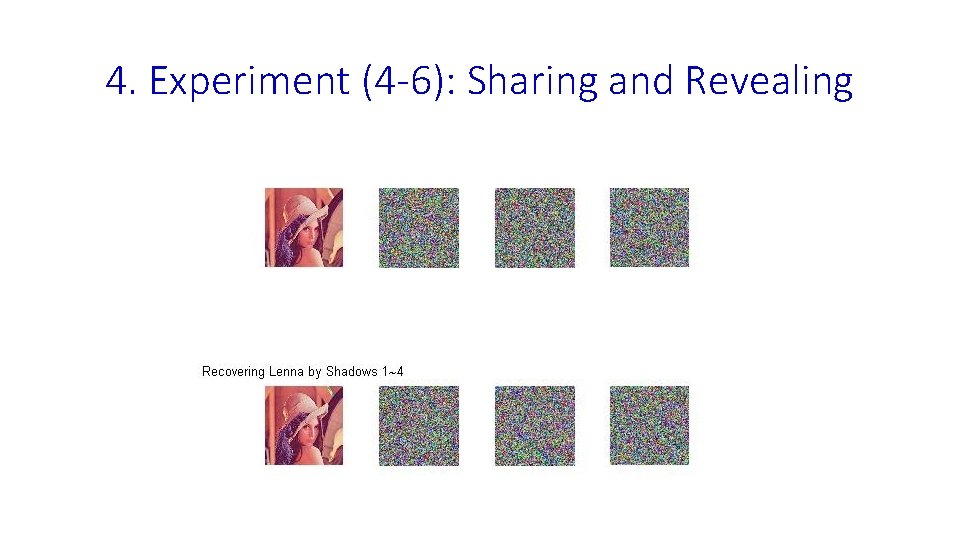
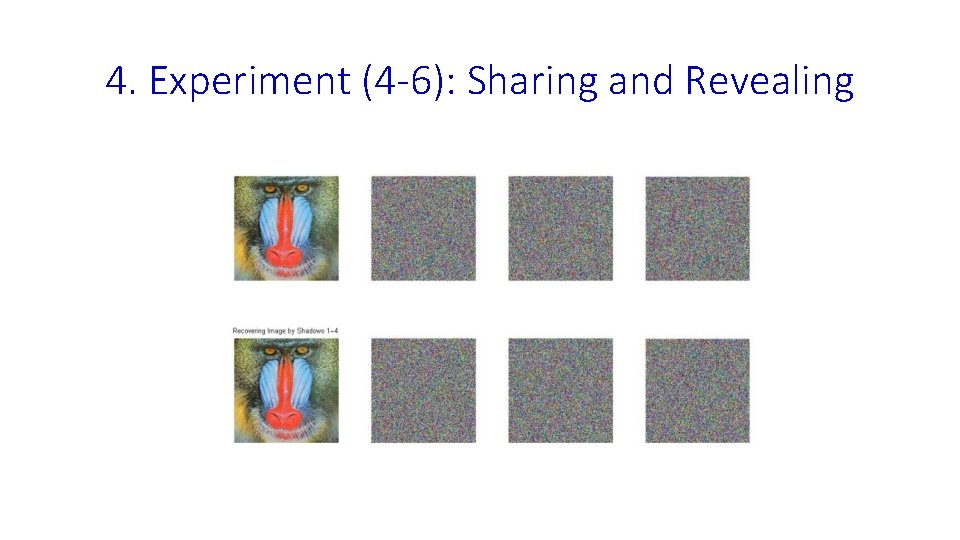
An Illustration of Sharing and Revealing
Outline • • • 1. Introduction 2. The (r, n) threshold scheme: a review 3. The proposed secret image sharing method 3. 1. The sharing phase 3. 2. The reveal phase 3. 3. The lossless secret image sharing method 4. The experimental result 5. Security analysis 6. The benefits of the size reduction property of shadow images 7. Conclusions
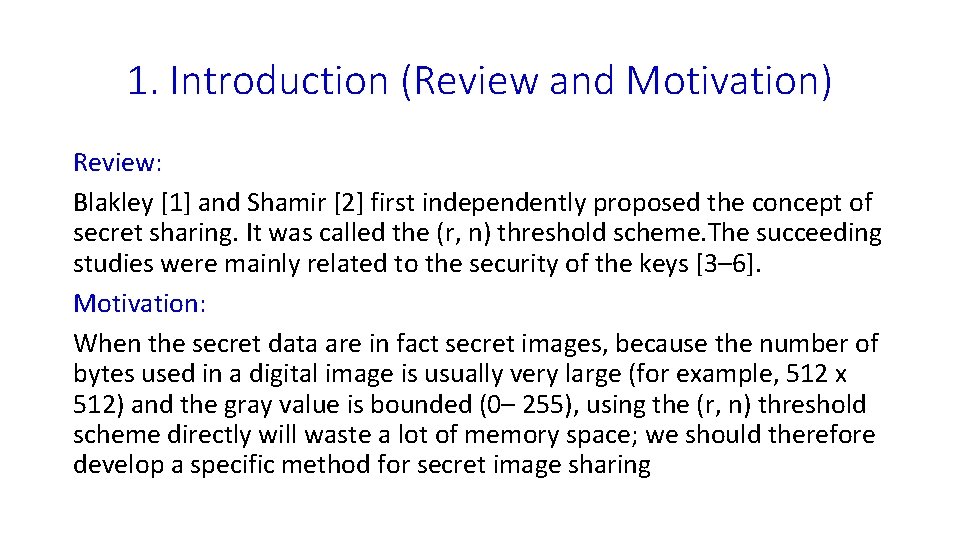
1. Introduction (Review and Motivation) Review: Blakley [1] and Shamir [2] first independently proposed the concept of secret sharing. It was called the (r, n) threshold scheme. The succeeding studies were mainly related to the security of the keys [3– 6]. Motivation: When the secret data are in fact secret images, because the number of bytes used in a digital image is usually very large (for example, 512 x 512) and the gray value is bounded (0– 255), using the (r, n) threshold scheme directly will waste a lot of memory space; we should therefore develop a specific method for secret image sharing
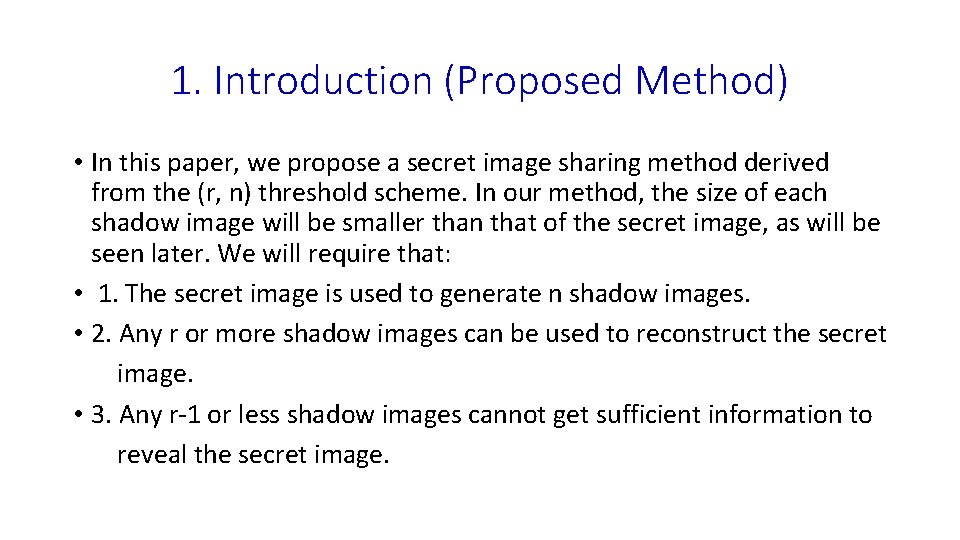
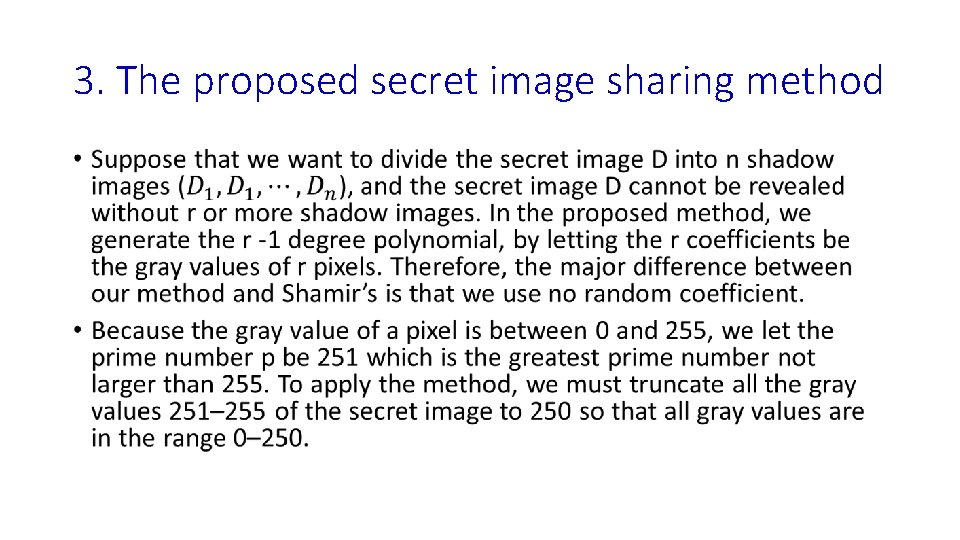
1. Introduction (Proposed Method) • In this paper, we propose a secret image sharing method derived from the (r, n) threshold scheme. In our method, the size of each shadow image will be smaller than that of the secret image, as will be seen later. We will require that: • 1. The secret image is used to generate n shadow images. • 2. Any r or more shadow images can be used to reconstruct the secret image. • 3. Any r-1 or less shadow images cannot get sufficient information to reveal the secret image.
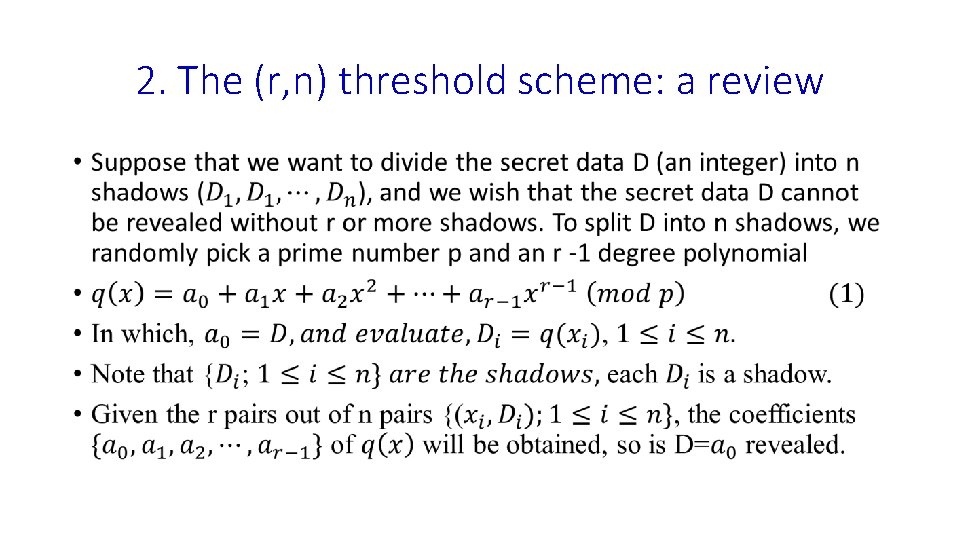
2. The (r, n) threshold scheme: a review •
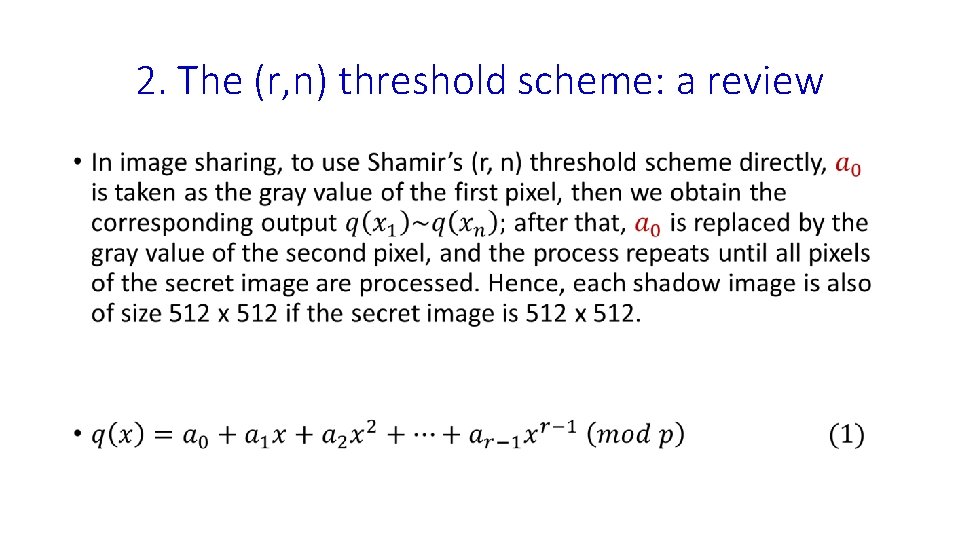
2. The (r, n) threshold scheme: a review •
3. The proposed secret image sharing method •
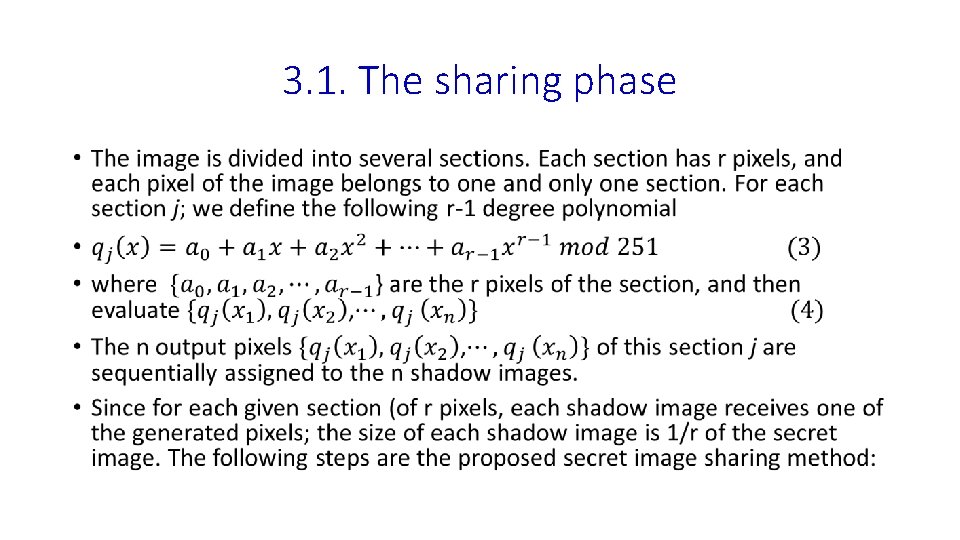
3. 1. The sharing phase •
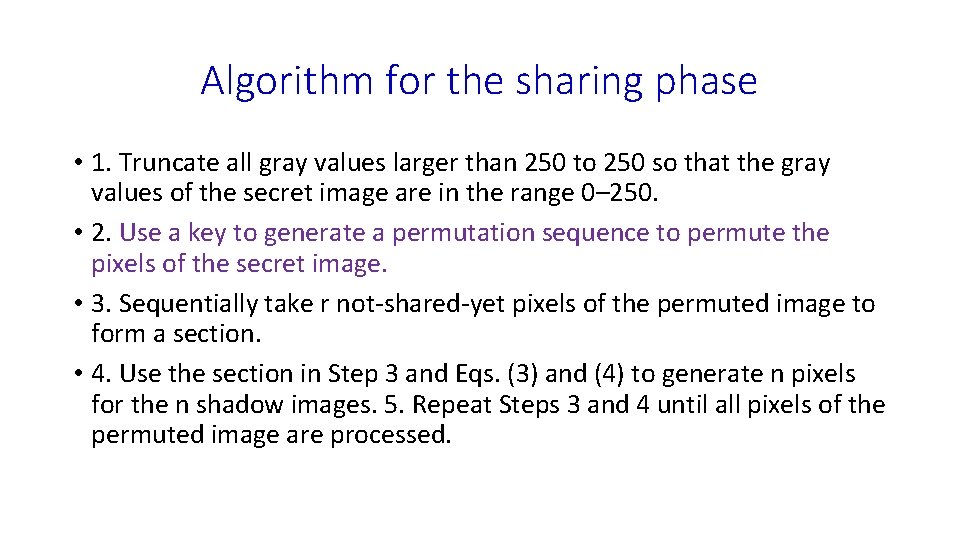
Algorithm for the sharing phase • 1. Truncate all gray values larger than 250 to 250 so that the gray values of the secret image are in the range 0– 250. • 2. Use a key to generate a permutation sequence to permute the pixels of the secret image. • 3. Sequentially take r not-shared-yet pixels of the permuted image to form a section. • 4. Use the section in Step 3 and Eqs. (3) and (4) to generate n pixels for the n shadow images. 5. Repeat Steps 3 and 4 until all pixels of the permuted image are processed.
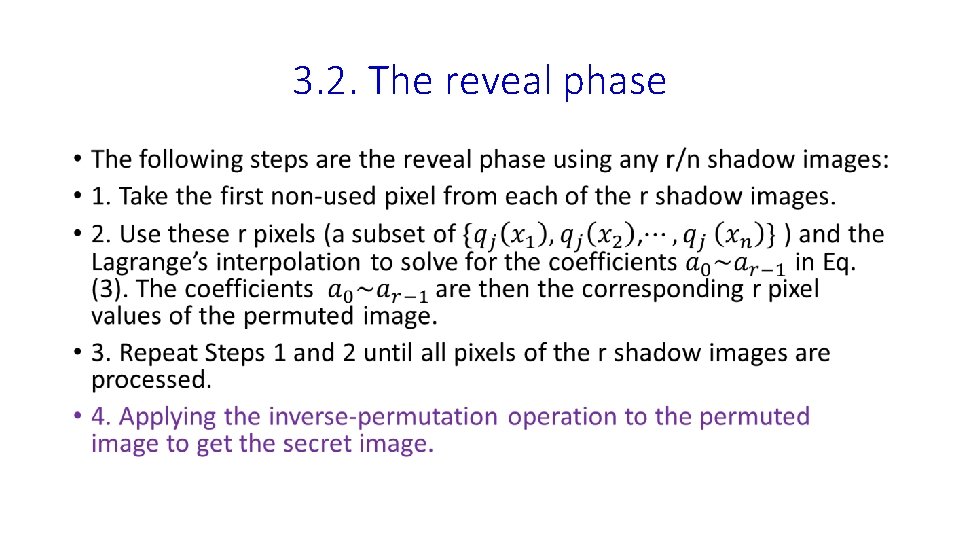
3. 2. The reveal phase •
3. 3. The lossless secret image sharing method • The method discussed in Section 3. 1 is a lossy method because we must limit the gray value to the range 0– 250 (see Step 1). To get a lossless image, we introduce below a special process to handle the gray values larger than 250. The processes will slightly increase the size of the shadow image. However, the increase is usually small because quite often there are only a few pixels whose gray values are 251– 255.
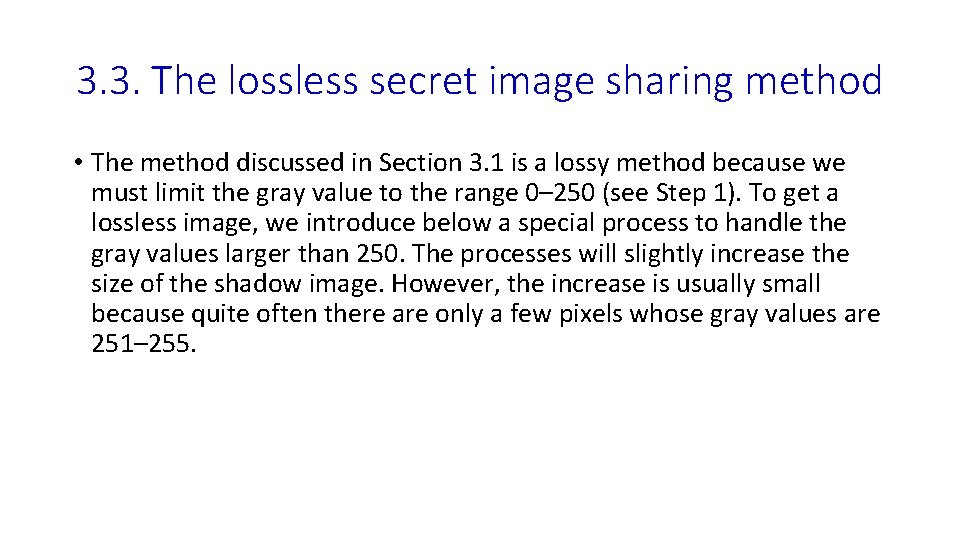
4. The experimental result (Shadows)
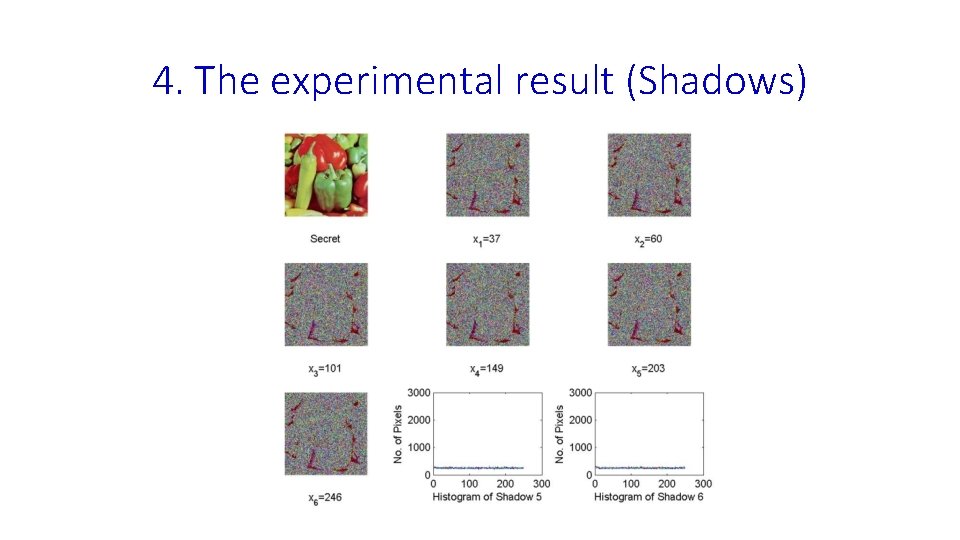
4. The experimental result (4 -6 Reconstruction)
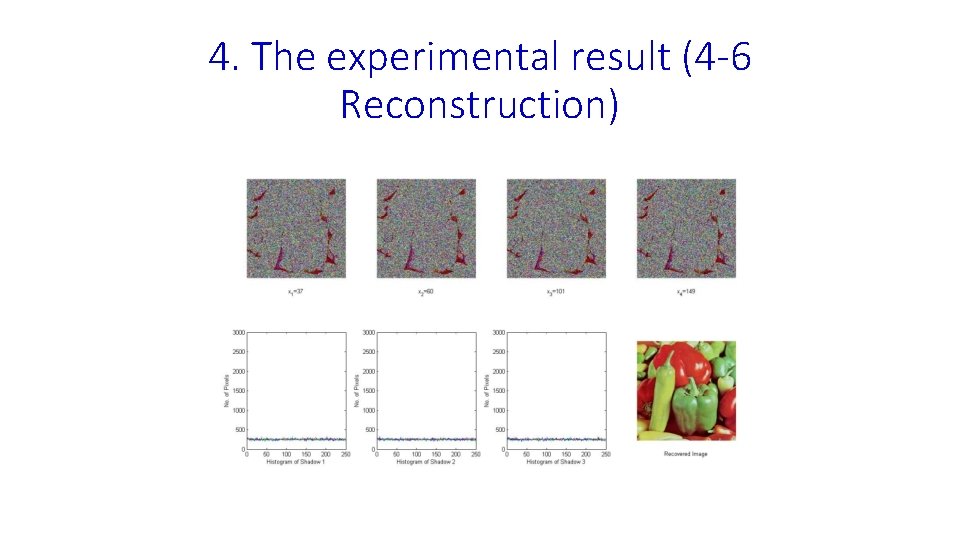
4. Experiment (4 -6): Sharing and Revealing
4. Experiment (4 -6): Sharing and Revealing
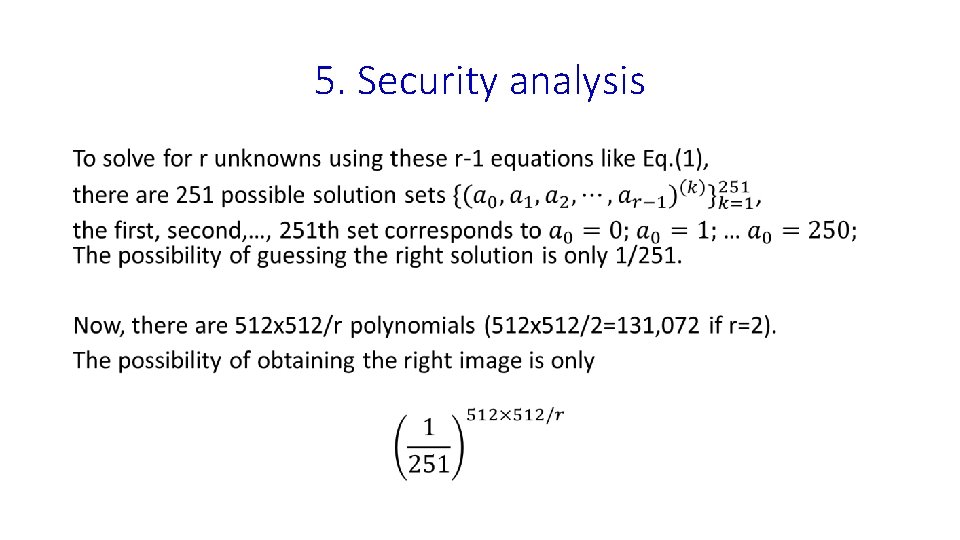
5. Security analysis •
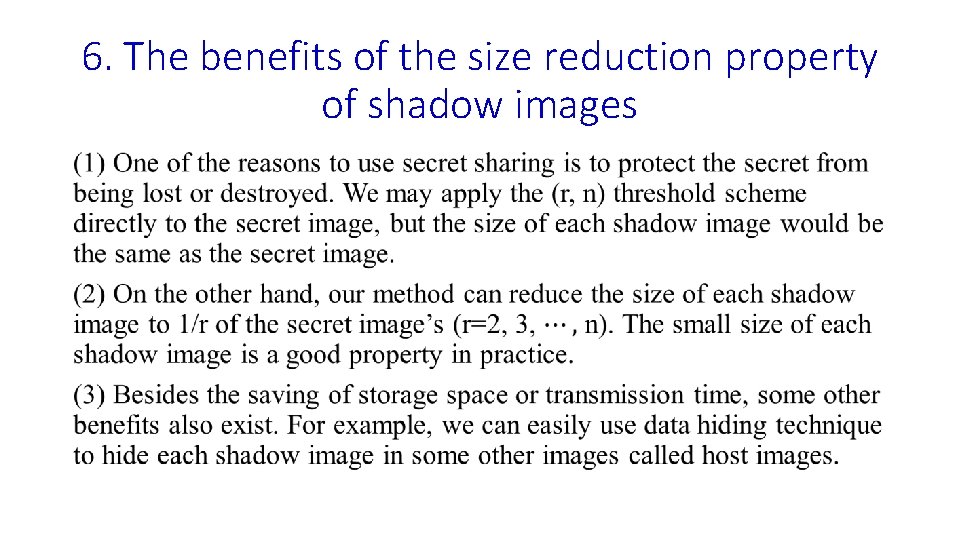
6. The benefits of the size reduction property of shadow images •
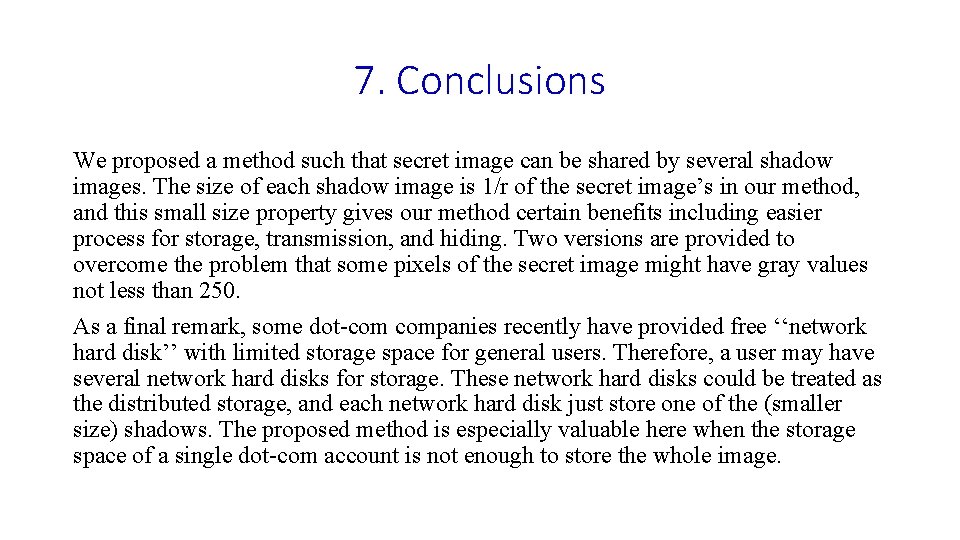
7. Conclusions We proposed a method such that secret image can be shared by several shadow images. The size of each shadow image is 1/r of the secret image’s in our method, and this small size property gives our method certain benefits including easier process for storage, transmission, and hiding. Two versions are provided to overcome the problem that some pixels of the secret image might have gray values not less than 250. As a final remark, some dot-com companies recently have provided free ‘‘network hard disk’’ with limited storage space for general users. Therefore, a user may have several network hard disks for storage. These network hard disks could be treated as the distributed storage, and each network hard disk just store one of the (smaller size) shadows. The proposed method is especially valuable here when the storage space of a single dot-com account is not enough to store the whole image.