
Secret Image Sharing Based on Encrypted Pixels Source

Secret Image Sharing Based on Encrypted Pixels Source: IEEE Access. March, 2018. doi: 10. 1109/ACCESS. 2018. 2811722. Authors: ZHILI ZHOU, CHING-NUNG YANG, (Senior Member, IEEE), YI CAO AND XINGMING SUN, (Senior Member) Speaker: Li. Lin (李琳) Date: 2019. 05. 09 1/20
Outline • Related Work • The perfect secret sharing • The existing polynomial based secret image sharing • The problems of the existing SIS (SIS: Secret Image Sharing) • The proposed Scheme • A secure (k, n)-SIS scheme • A modified (k, n)-SIS scheme • Proof • Conclusions 2/20
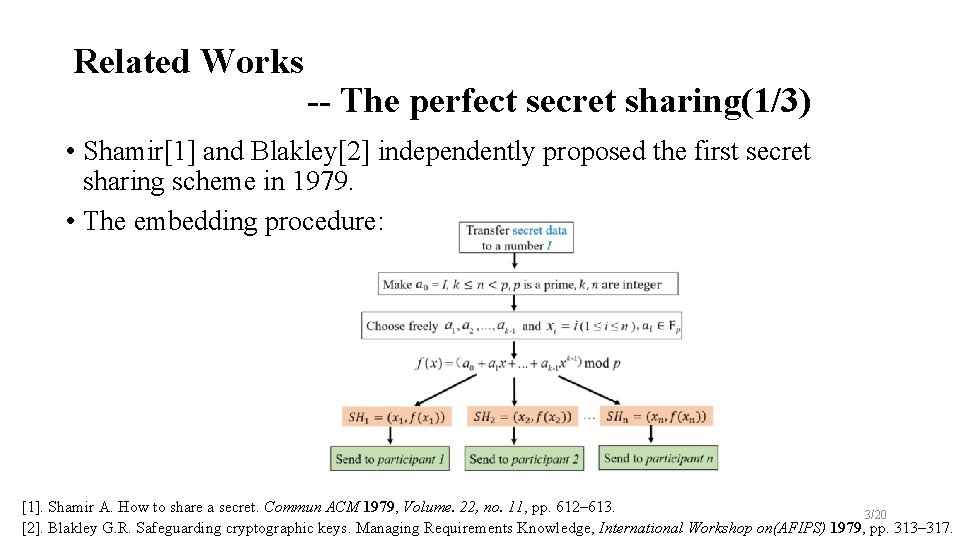
Related Works -- The perfect secret sharing(1/3) • Shamir[1] and Blakley[2] independently proposed the first secret sharing scheme in 1979. • The embedding procedure: [1]. Shamir A. How to share a secret. Commun ACM 1979, Volume. 22, no. 11, pp. 612– 613. 3/20 [2]. Blakley G. R. Safeguarding cryptographic keys. Managing Requirements Knowledge, International Workshop on(AFIPS) 1979, pp. 313– 317.
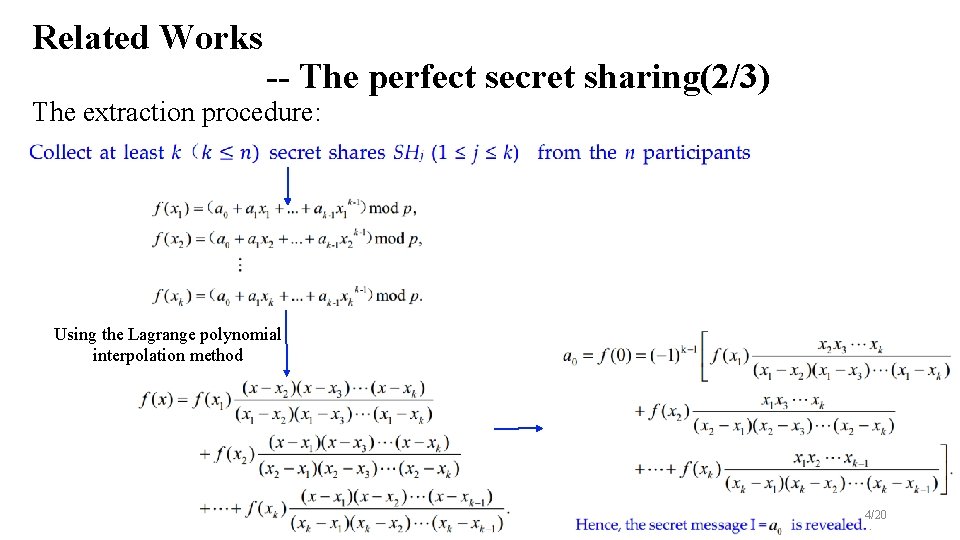
Related Works -- The perfect secret sharing(2/3) The extraction procedure: Using the Lagrange polynomial interpolation method 4/20
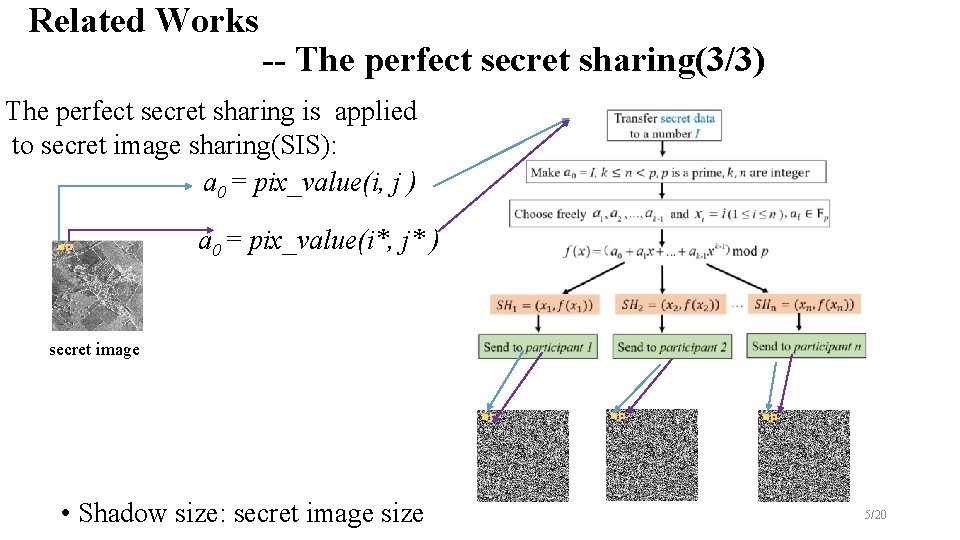
Related Works -- The perfect secret sharing(3/3) The perfect secret sharing is applied to secret image sharing(SIS): a 0 = pix_value(i, j ) a 0 = pix_value(i*, j* ) secret image • Shadow size: secret image size 5/20
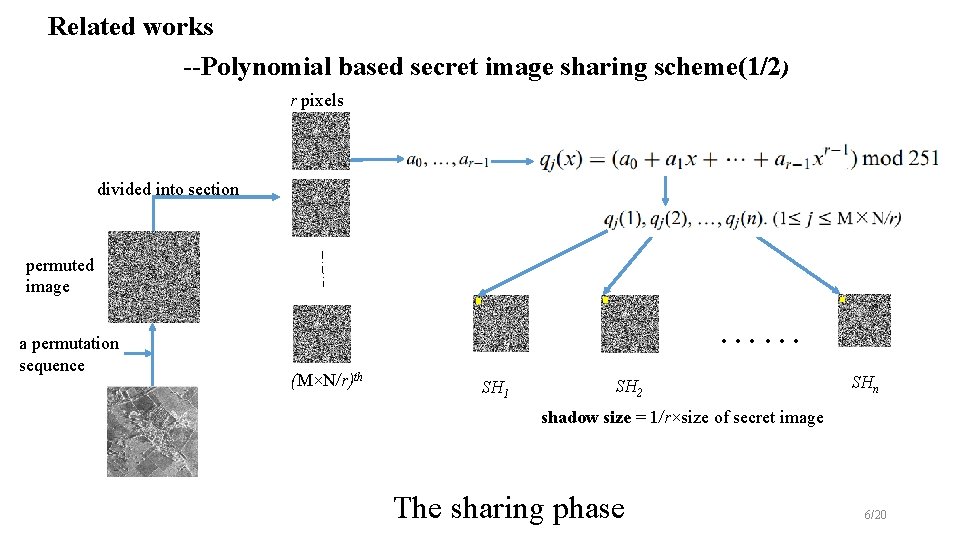
Related works --Polynomial based secret image sharing scheme(1/2) r pixels divided into section permuted image a permutation sequence …… (M×N/r)th SH 1 SH 2 SHn shadow size = 1/r×size of secret image The sharing phase 6/20
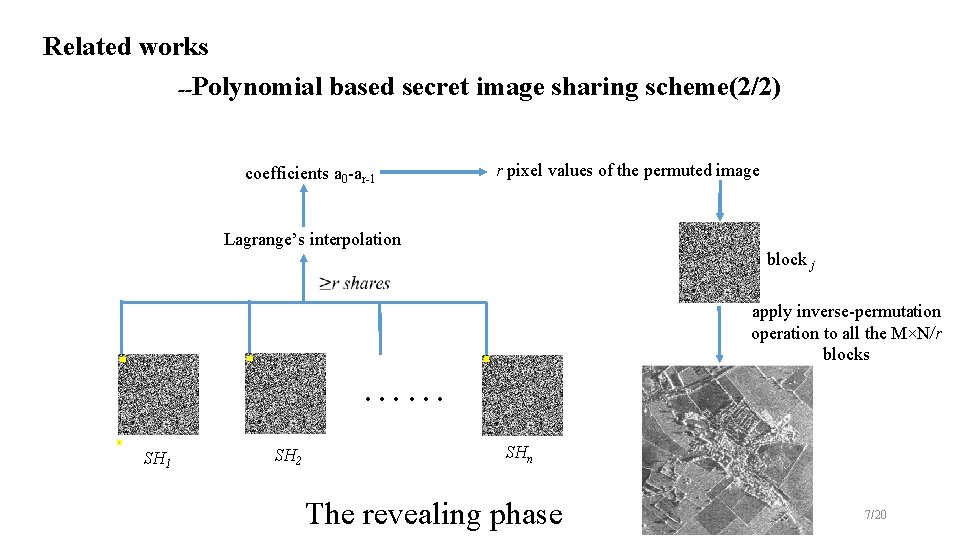
Related works --Polynomial based secret image sharing scheme(2/2) coefficients a 0 -ar-1 r pixel values of the permuted image Lagrange’s interpolation block j apply inverse-permutation operation to all the M×N/r blocks …… SH 1 SH 2 SHn The revealing phase 7/20
The problem of the existing SIS(1/3) • Partial secret pixels can be reconstructed from less than k shadows the threshold properties of those (k, n)-SIS schemes. • Permutation only ciphers are insecure and correct permutation mapping can be recovered completely by a chosen-plaintext attack[3]. • The permutation key for Thien and Lin’s (k, n)-SIS scheme can be easily obtain based on the fact that the permutation of pixels does not change histogram[4]. [3]. A. Jolfaei, X. -W. Wu, and V. Muthukkumarasamy, ‘‘On the security of permutation-only image encryption schemes, ’’ IEEE Trans. Inf. Forensics Security, vol. 11, no. 2, pp. 235– 246, Feb. 2016. [4]. C. -N. Yang, W. -J. Chang, S. -R. Cai, and C. -Y. Lin, “Secret image sharing without keeping permutation key. ” in Proc. Int. Conf. Commun. Technol. , 2014, pp. 410– 416. 8/20
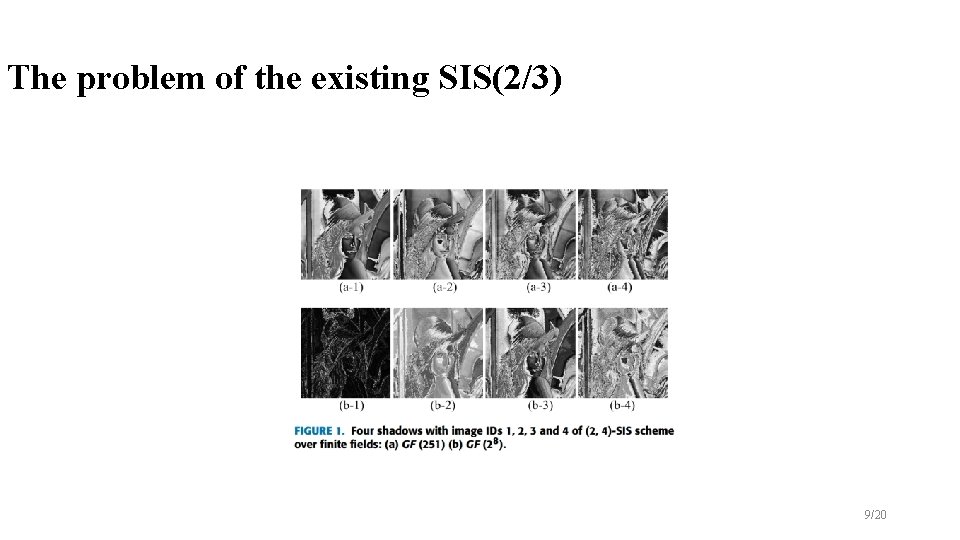
The problem of the existing SIS(2/3) 9/20
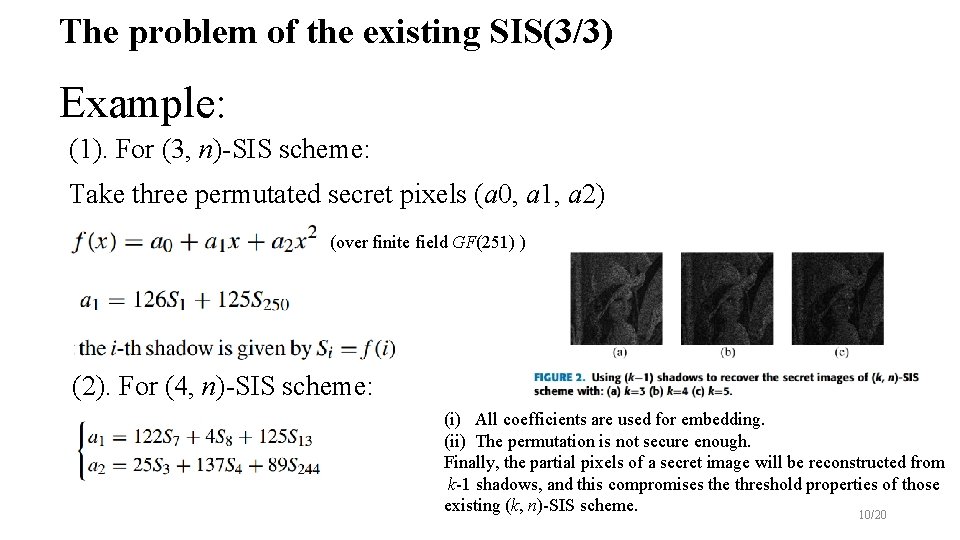
The problem of the existing SIS(3/3) Example: (1). For (3, n)-SIS scheme: Take three permutated secret pixels (a 0, a 1, a 2) (over finite field GF(251) ) (2). For (4, n)-SIS scheme: (i) All coefficients are used for embedding. (ii) The permutation is not secure enough. Finally, the partial pixels of a secret image will be reconstructed from k-1 shadows, and this compromises the threshold properties of those existing (k, n)-SIS scheme. 10/20
The proposed (k, n)-SIS scheme(1/5) • Based on encrypted pixels • Combines the perfect secret, the existing secret image and encryption • Shadow size is the 1/k size of a secret image plus a short piece of key 11/20
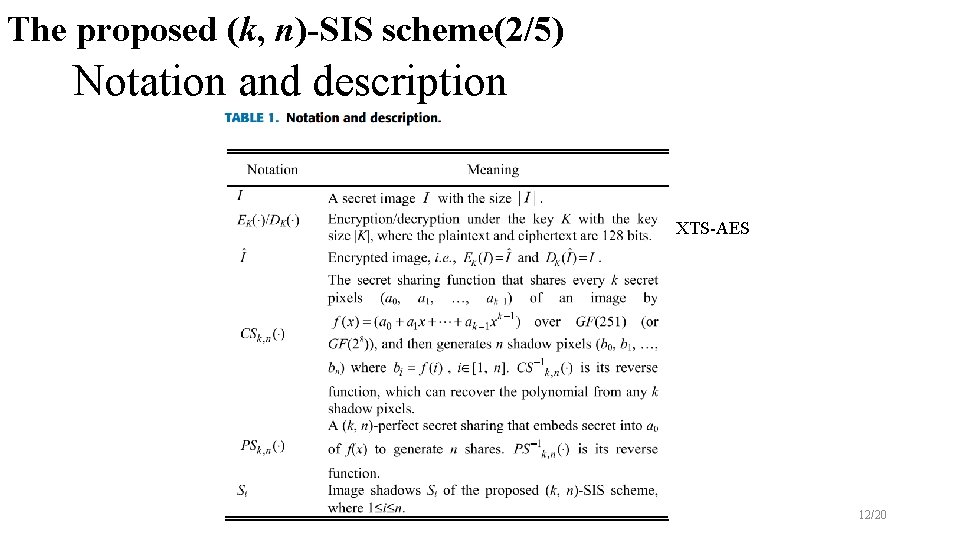
The proposed (k, n)-SIS scheme(2/5) Notation and description XTS-AES 12/20
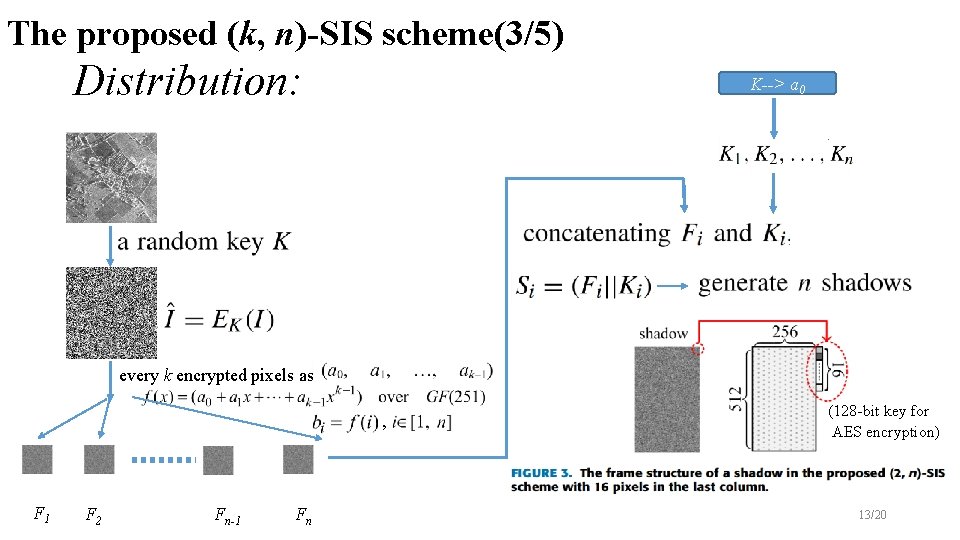
The proposed (k, n)-SIS scheme(3/5) Distribution: K--> a 0 every k encrypted pixels as , F 1 F 2 Fn-1 Fn (128 -bit key for AES encryption) 13/20
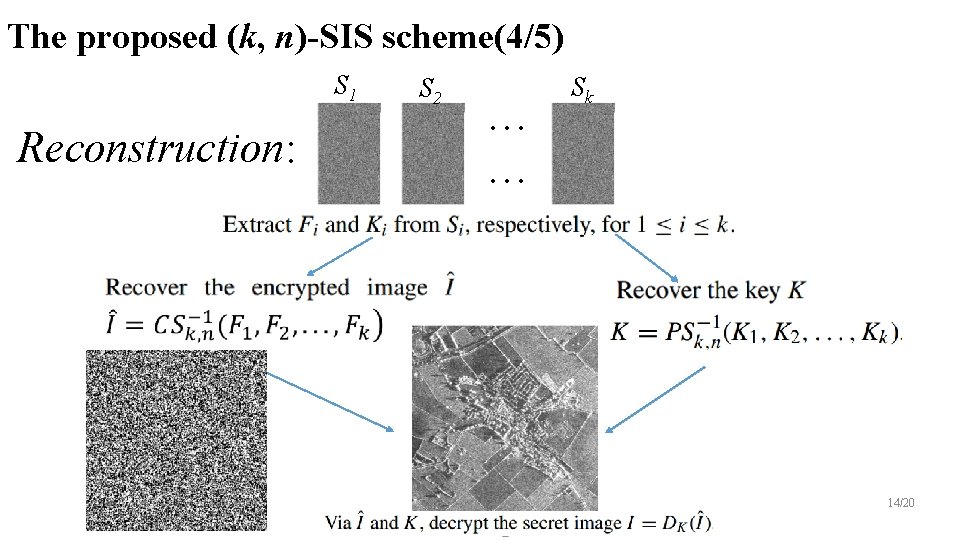
The proposed (k, n)-SIS scheme(4/5) S 1 Reconstruction: S 2 … … Sk 14/20
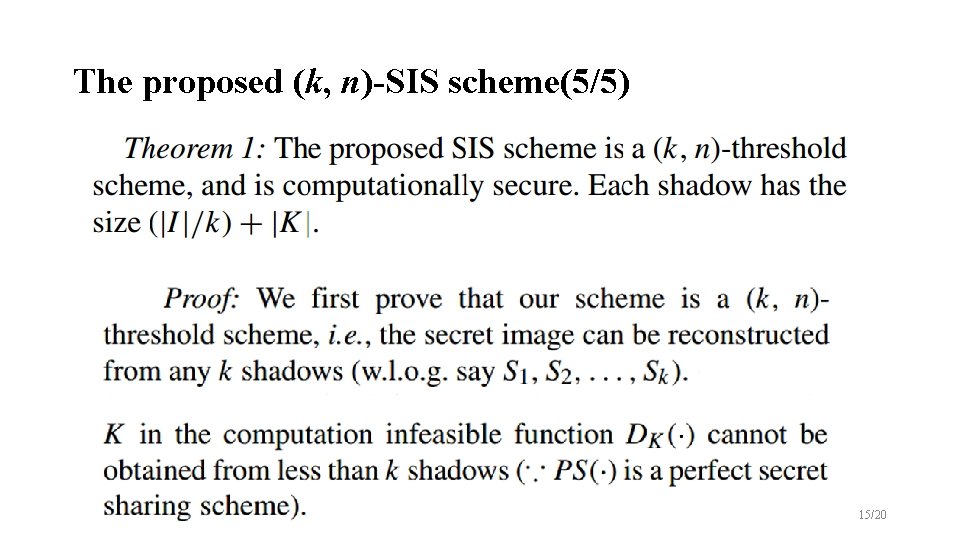
The proposed (k, n)-SIS scheme(5/5) 15/20
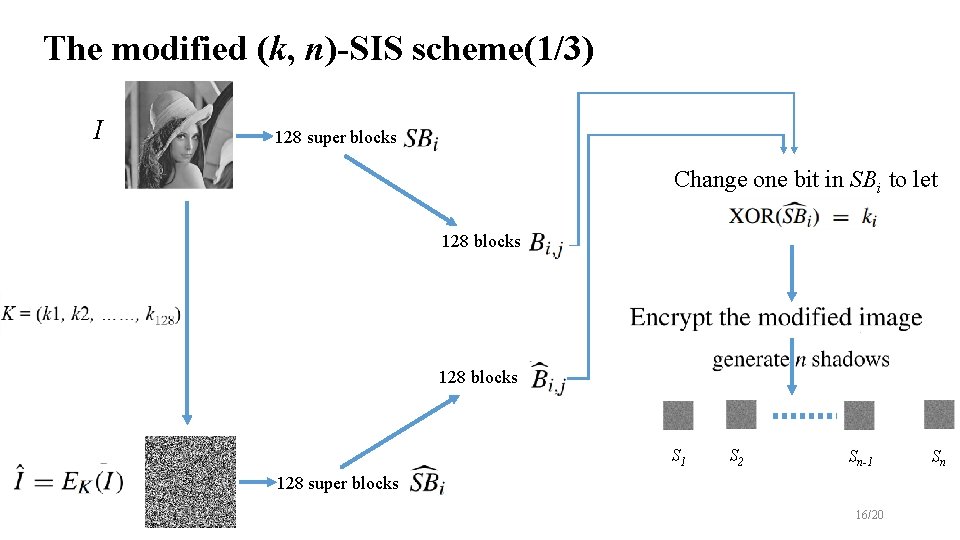
The modified (k, n)-SIS scheme(1/3) I 128 super blocks Change one bit in SBi to let 128 blocks S 1 S 2 Sn-1 128 super blocks 16/20 Sn
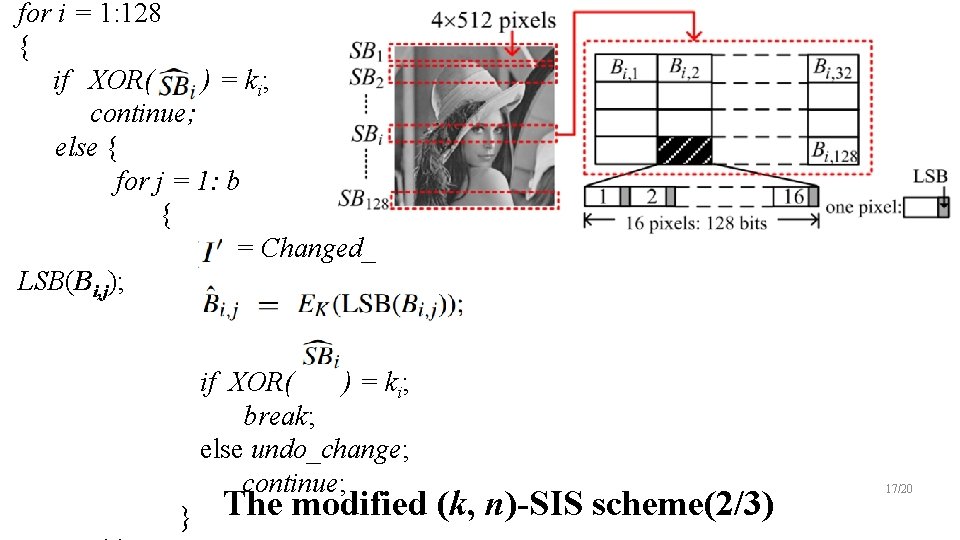
for i = 1: 128 { if XOR( ) = k i; continue; else { for j = 1: b { = Changed_ LSB(Bi, j); if XOR( ) = k i; break; else undo_change; continue; } The modified (k, n)-SIS scheme(2/3) 17/20
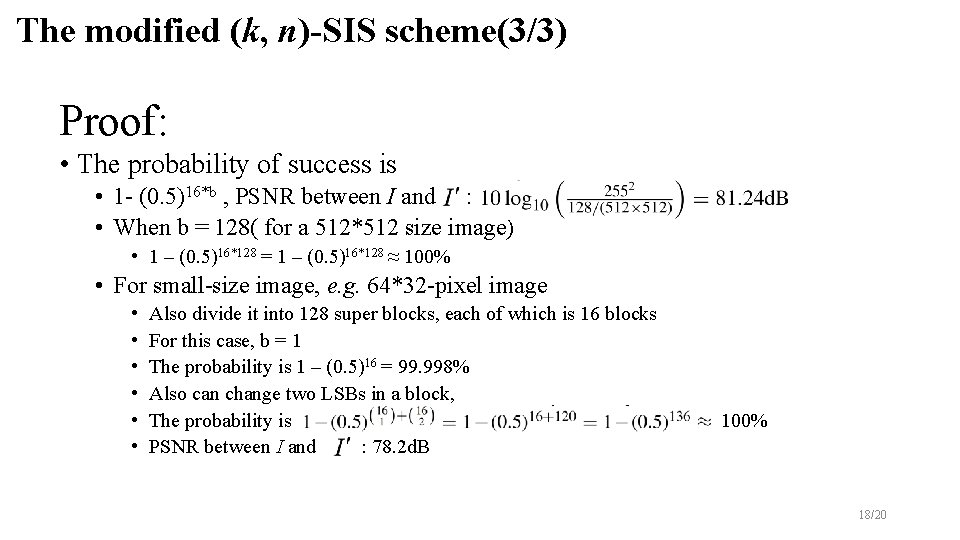
The modified (k, n)-SIS scheme(3/3) Proof: • The probability of success is • 1 - (0. 5)16*b , PSNR between I and : • When b = 128( for a 512*512 size image) • 1 – (0. 5)16*128 = 1 – (0. 5)16*128 ≈ 100% • For small-size image, e. g. 64*32 -pixel image • • • Also divide it into 128 super blocks, each of which is 16 blocks For this case, b = 1 The probability is 1 – (0. 5)16 = 99. 998% Also can change two LSBs in a block, The probability is PSNR between I and : 78. 2 d. B 100% 18/20
Conclusion • Address the weakness that the threshold properties of existing (k, n)SIS schemes are compromised. • Propose a (k, n)-SIS scheme based on encrypted pixels. • Propose a (k, n)-SIS with the same shadow size of Thien and Lin’s scheme. • Computationally secure. 19/20

Thanks for your listening! 20/20
- Slides: 20