
Constructing Ideal Secret Sharing Schemes based on Chinese

Constructing Ideal Secret Sharing Schemes based on Chinese Remainder Theorem By: Yu Ning, Fuyou Miao, Wenchao Huang, Keju Meng, Yan Xiong and Xingfu Wang Presented by: Ahmed Zawia July 2 2019 CS 858 Spring 2019
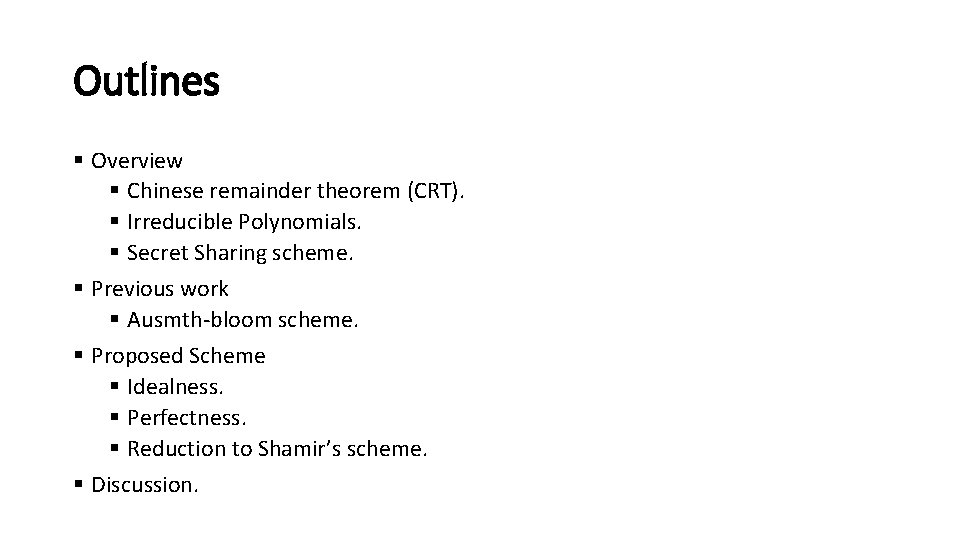
Outlines § Overview § Chinese remainder theorem (CRT). § Irreducible Polynomials. § Secret Sharing scheme. § Previous work § Ausmth-bloom scheme. § Proposed Scheme § Idealness. § Perfectness. § Reduction to Shamir’s scheme. § Discussion.

Chinese remainder theorem (CRT) •
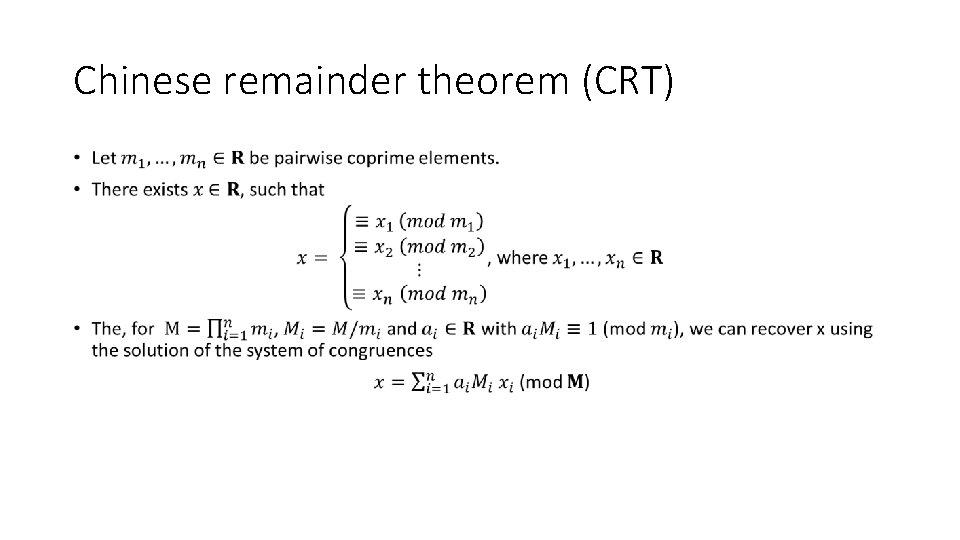
Chinese remainder theorem (CRT) •

Chinese remainder theorem (CRT) •
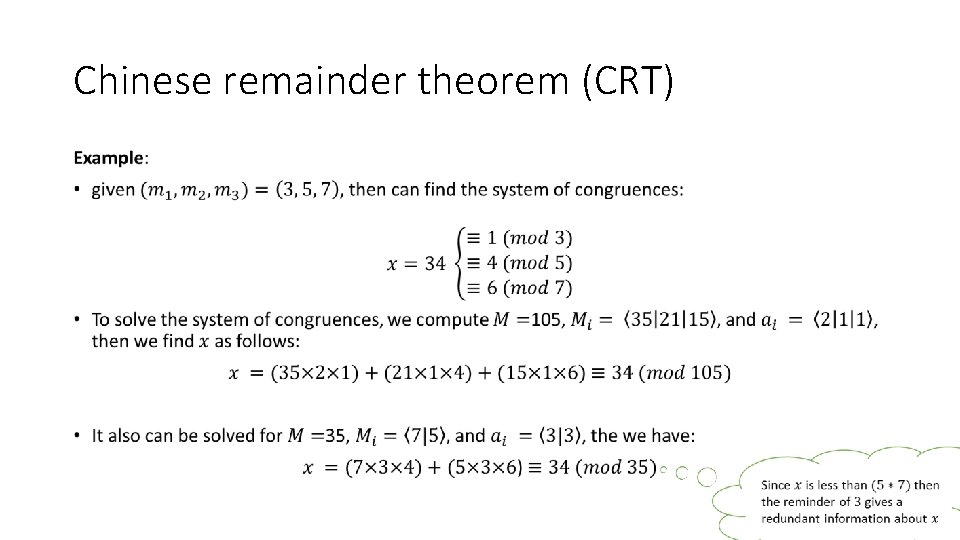
Chinese remainder theorem (CRT) •
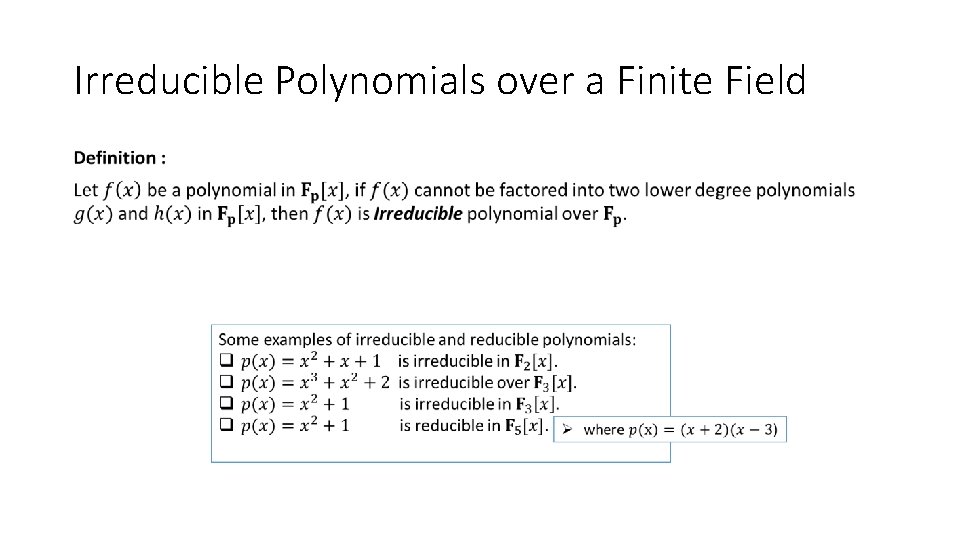
Irreducible Polynomials over a Finite Field •
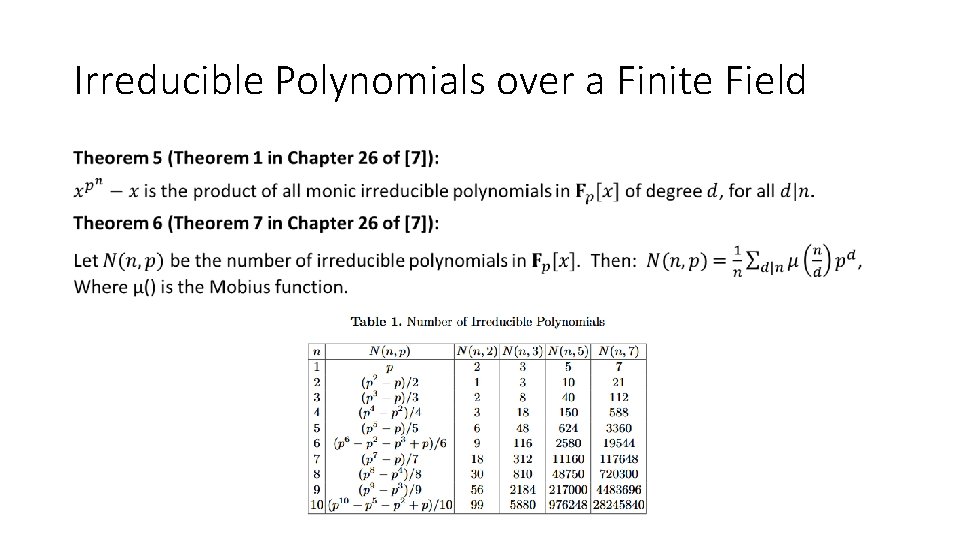
Irreducible Polynomials over a Finite Field •

Secret Sharing Scheme

Secret Sharing Scheme •
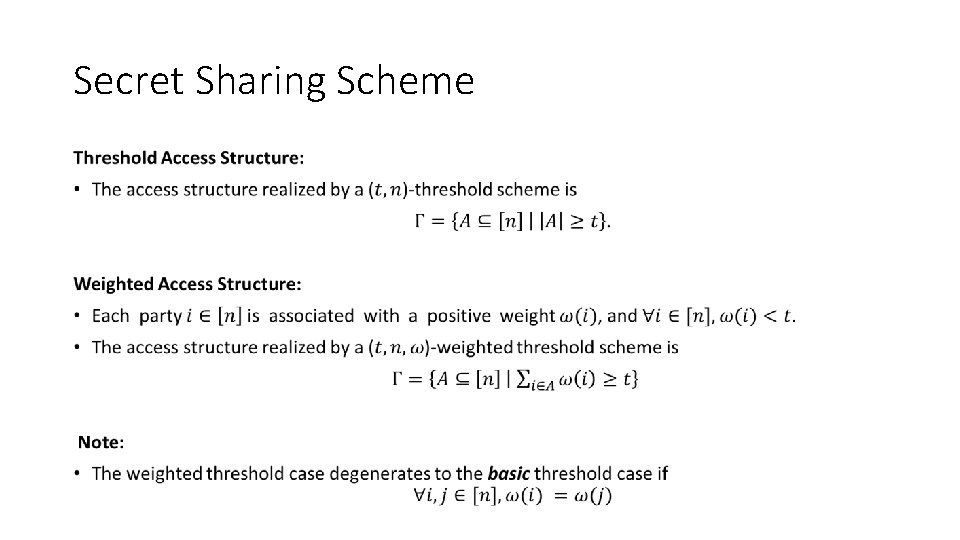
Secret Sharing Scheme •
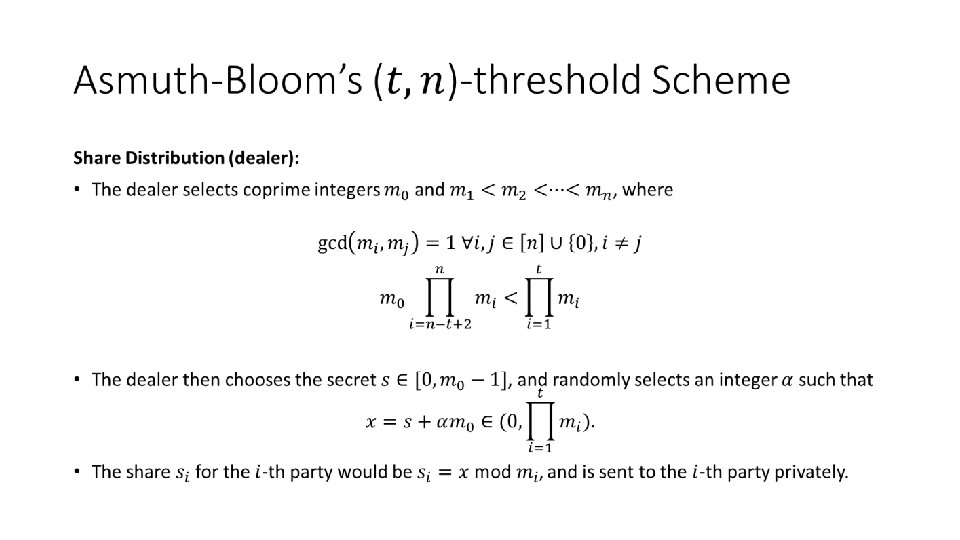
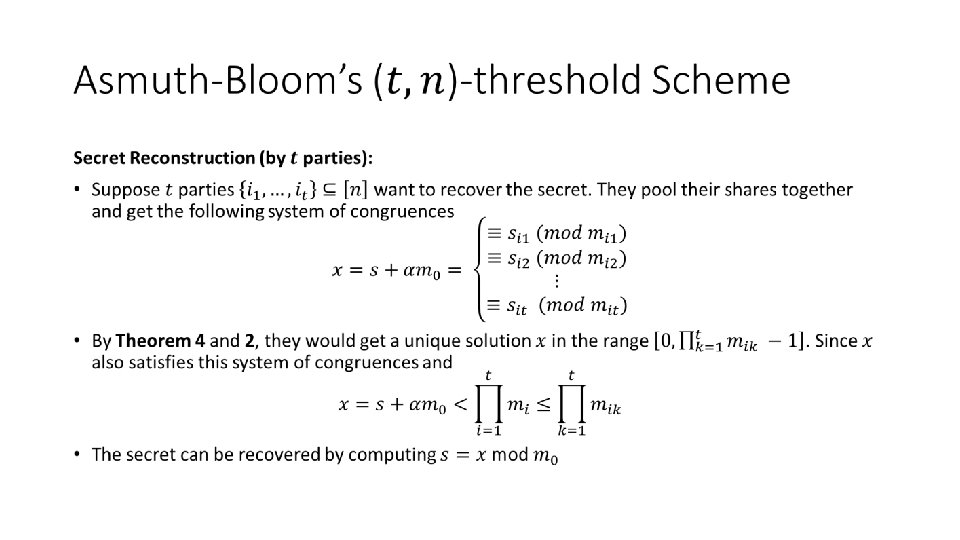
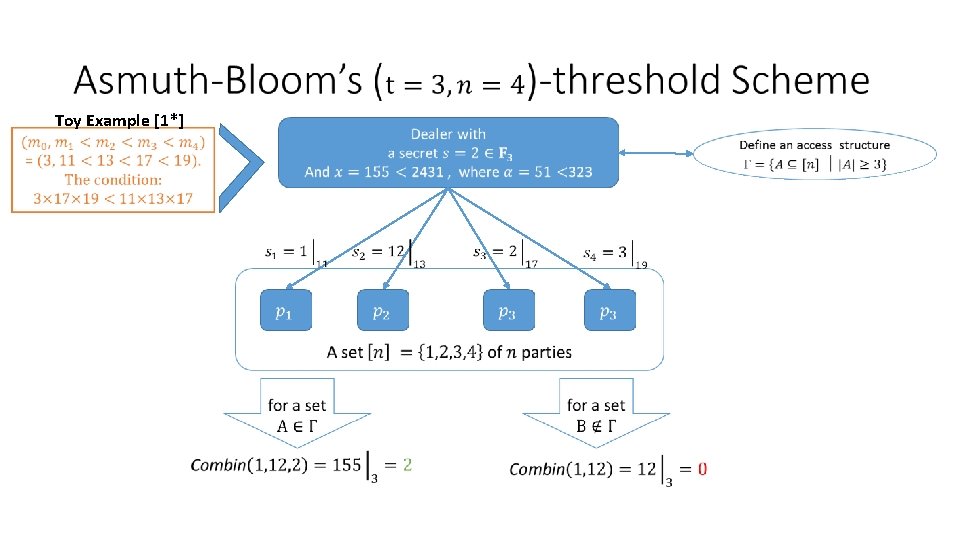
Toy Example [1*]
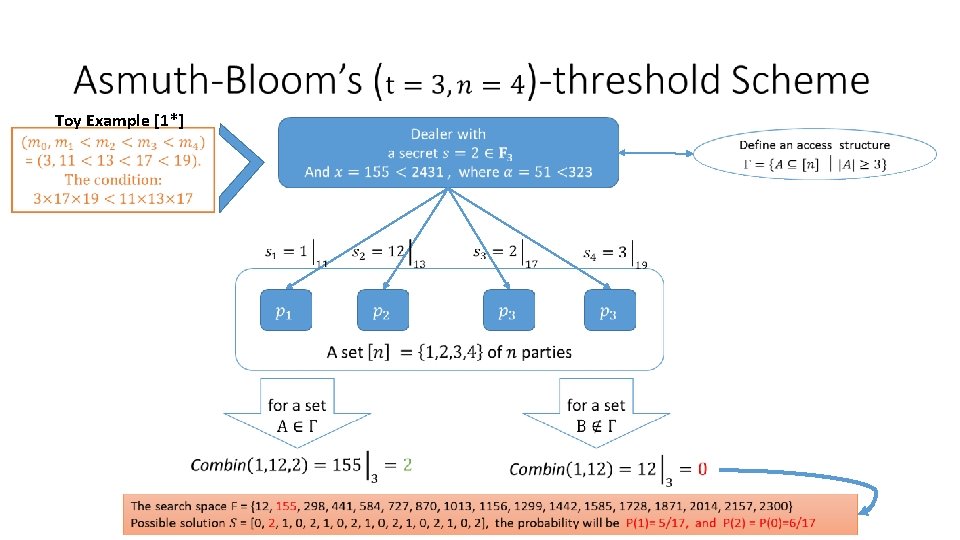
Toy Example [1*]
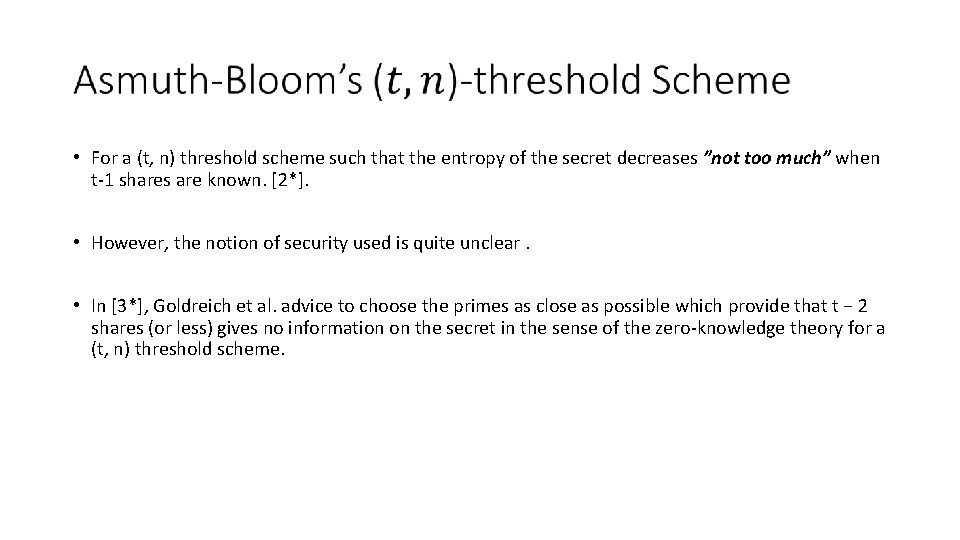
• For a (t, n) threshold scheme such that the entropy of the secret decreases ”not too much” when t-1 shares are known. [2*]. • However, the notion of security used is quite unclear. • In [3*], Goldreich et al. advice to choose the primes as close as possible which provide that t − 2 shares (or less) gives no information on the secret in the sense of the zero-knowledge theory for a (t, n) threshold scheme.

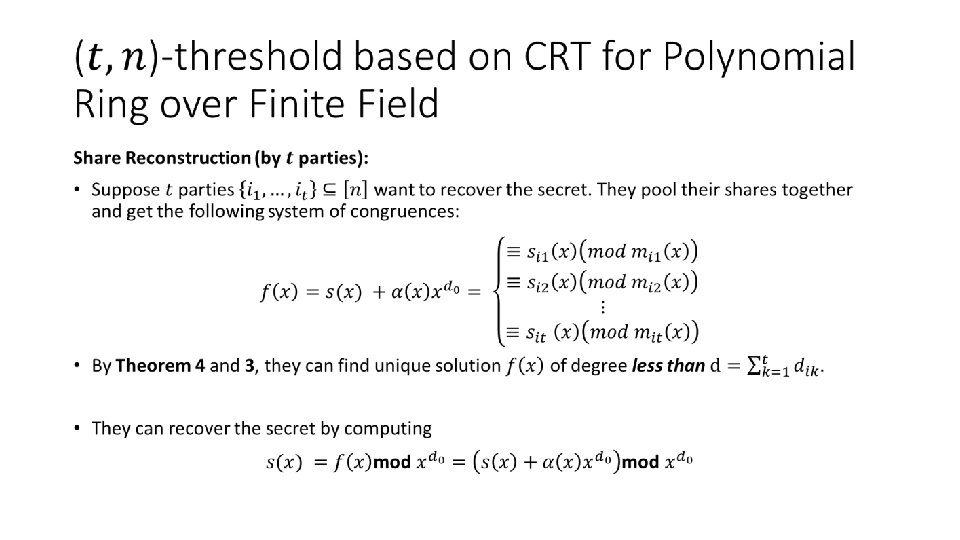
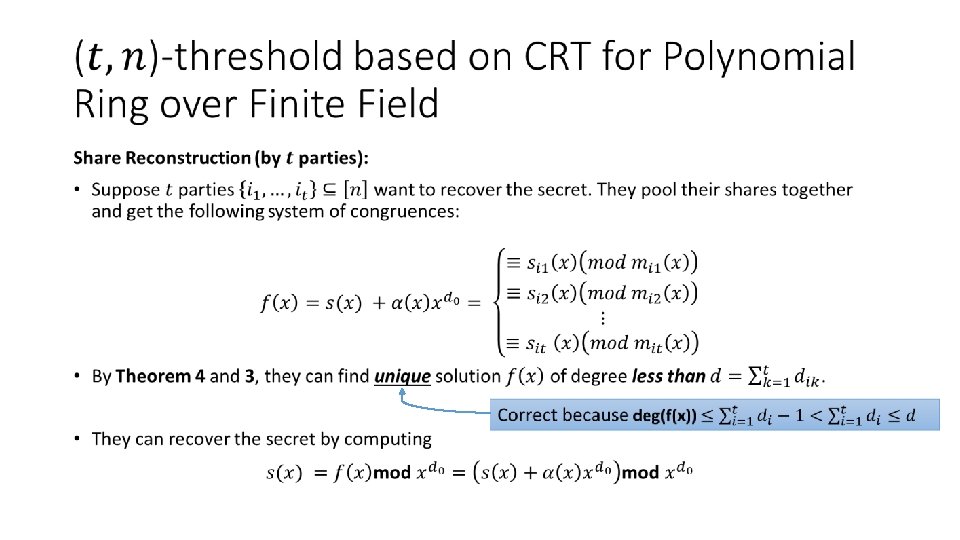
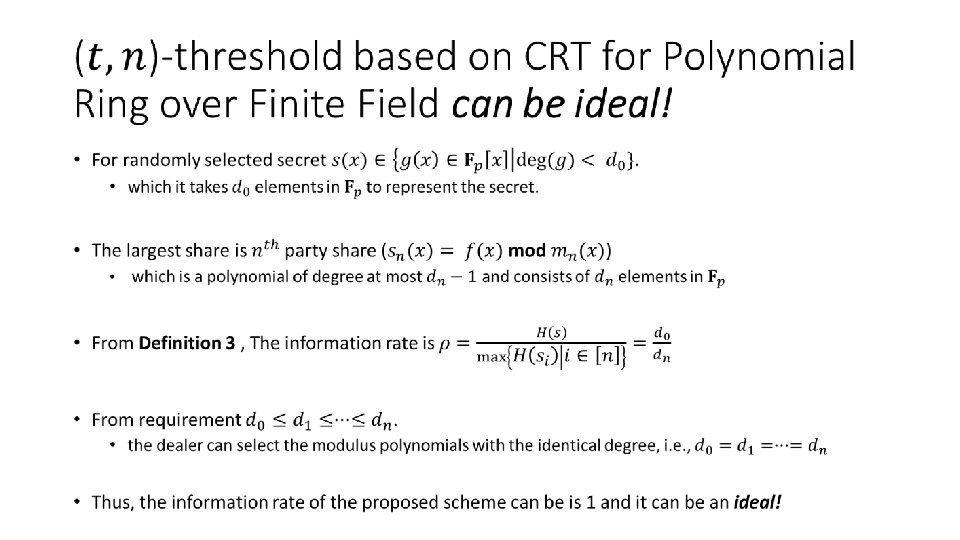
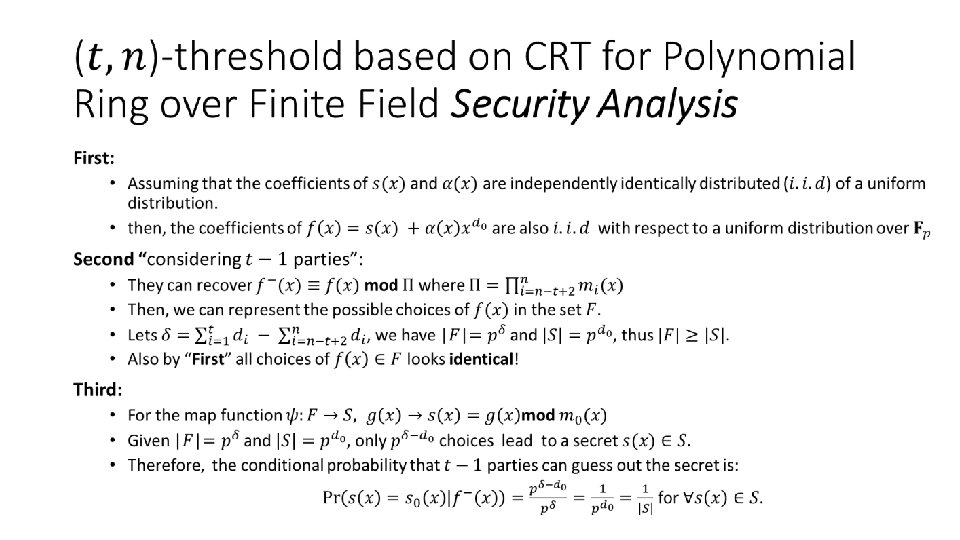
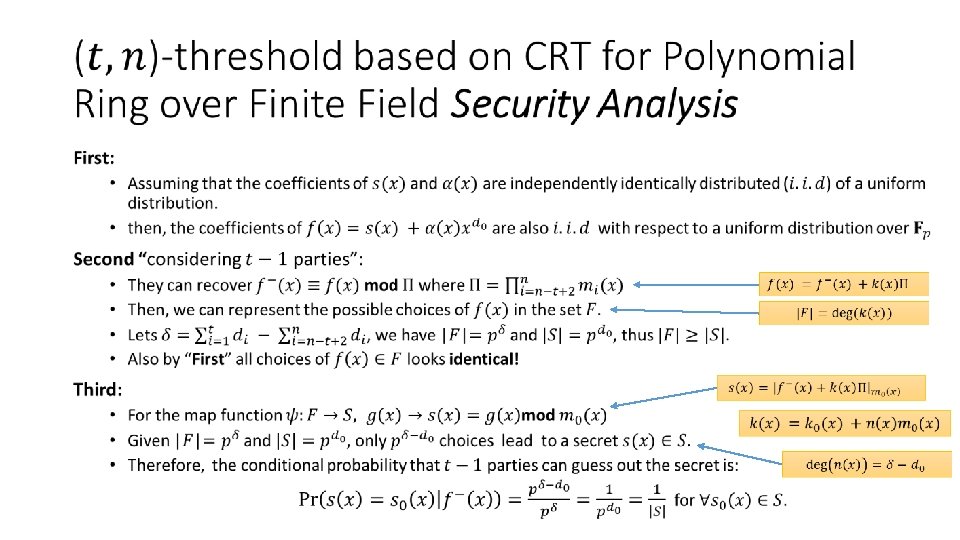
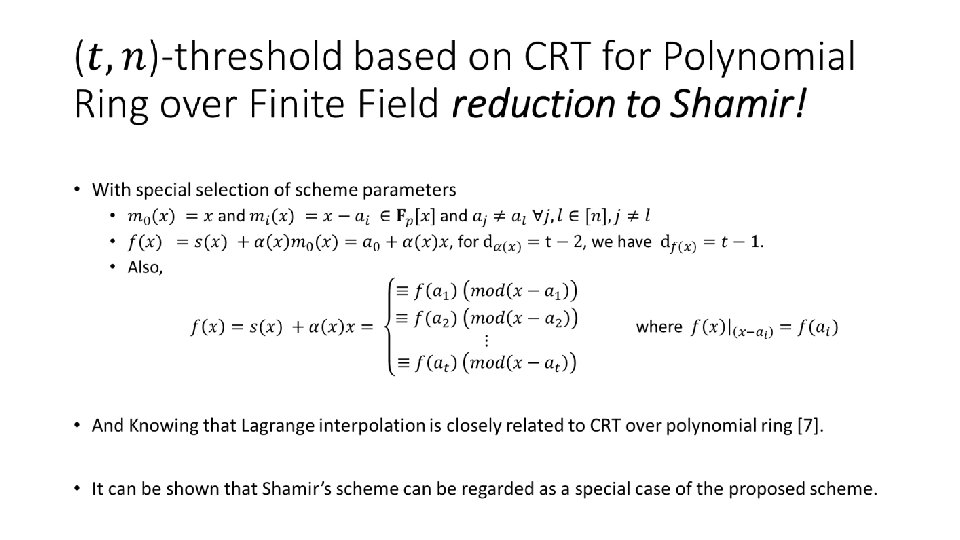
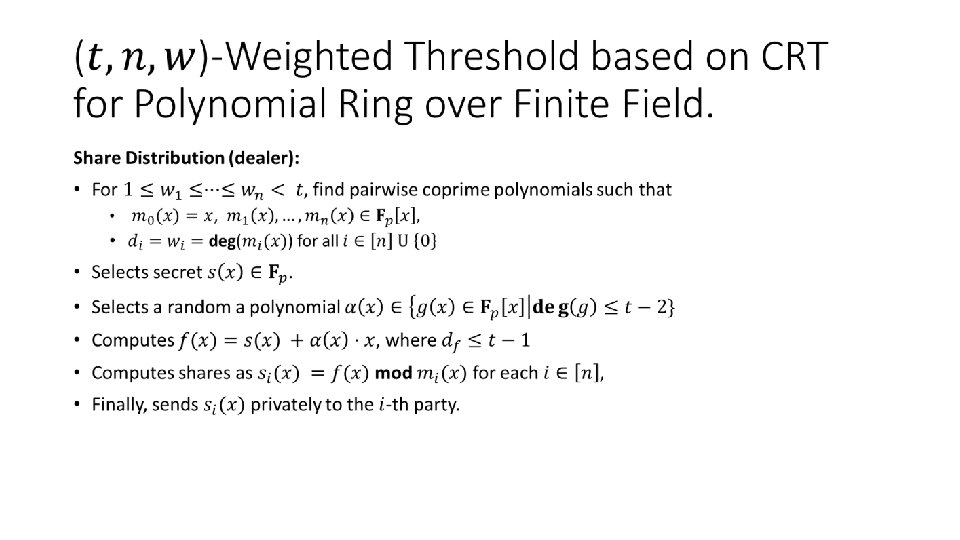
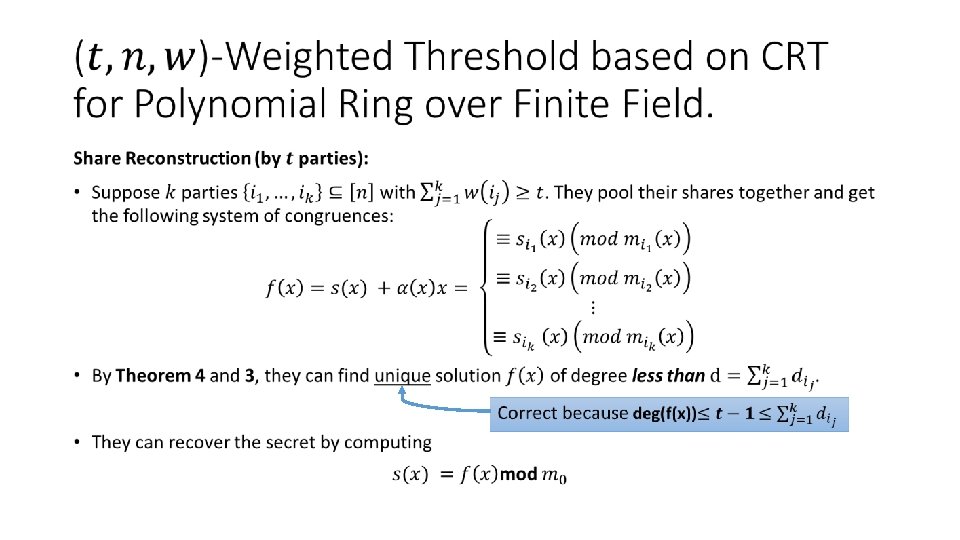
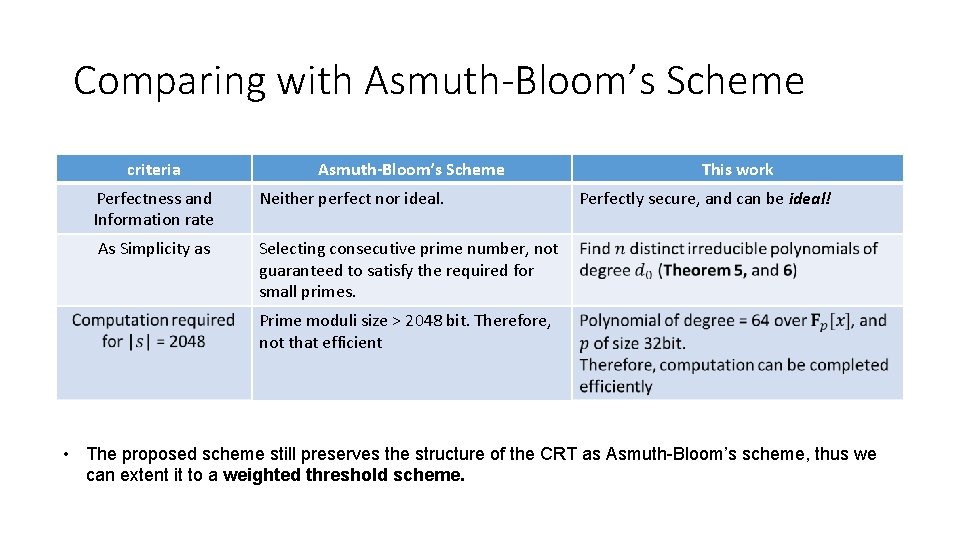
Comparing with Asmuth-Bloom’s Scheme criteria Asmuth-Bloom’s Scheme Perfectness and Information rate Neither perfect nor ideal. As Simplicity as Selecting consecutive prime number, not guaranteed to satisfy the required for small primes. This work Perfectly secure, and can be ideal! Prime moduli size > 2048 bit. Therefore, not that efficient • The proposed scheme still preserves the structure of the CRT as Asmuth-Bloom’s scheme, thus we can extent it to a weighted threshold scheme.
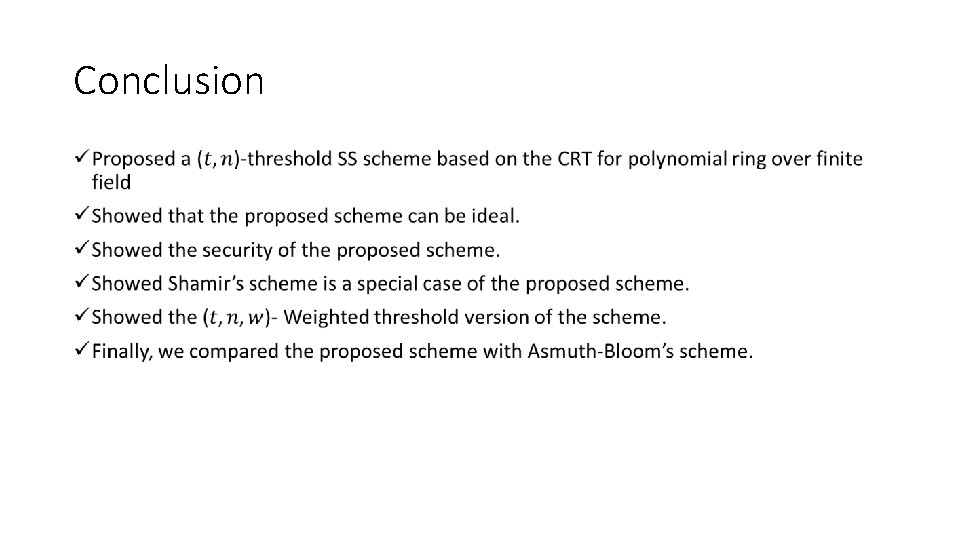
Conclusion •

Thanks
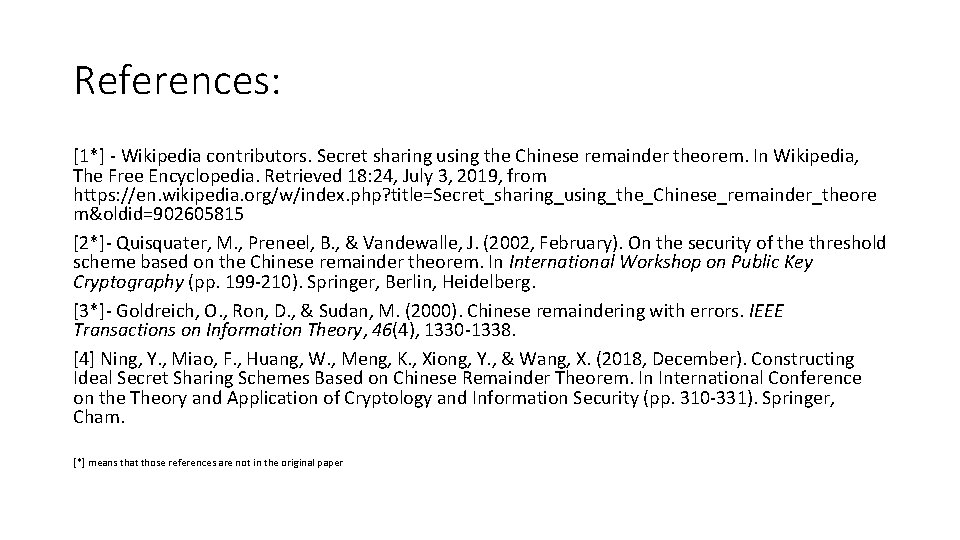
References: [1*] - Wikipedia contributors. Secret sharing using the Chinese remainder theorem. In Wikipedia, The Free Encyclopedia. Retrieved 18: 24, July 3, 2019, from https: //en. wikipedia. org/w/index. php? title=Secret_sharing_using_the_Chinese_remainder_theore m&oldid=902605815 [2*]- Quisquater, M. , Preneel, B. , & Vandewalle, J. (2002, February). On the security of the threshold scheme based on the Chinese remainder theorem. In International Workshop on Public Key Cryptography (pp. 199 -210). Springer, Berlin, Heidelberg. [3*]- Goldreich, O. , Ron, D. , & Sudan, M. (2000). Chinese remaindering with errors. IEEE Transactions on Information Theory, 46(4), 1330 -1338. [4] Ning, Y. , Miao, F. , Huang, W. , Meng, K. , Xiong, Y. , & Wang, X. (2018, December). Constructing Ideal Secret Sharing Schemes Based on Chinese Remainder Theorem. In International Conference on the Theory and Application of Cryptology and Information Security (pp. 310 -331). Springer, Cham. [*] means that those references are not in the original paper
- Slides: 31