
VC Relations between societal innovation and number theory
V-C Relations between societal innovation and number theory: Dicey proofs of the Riemann hypothesis on the basis of the forthcoming book The path of humanity: societal innovation for the world of tomorrow (in press) Henk Diepenmaat Zeist, The Netherlands, July 15 - December 31, 2017 henk. diepenmaat@actors. nl
Contents Prologue …………………………………………. 3 1) Introduction: painting the overall picture ……………. . . 7 2) The Riemann hypothesis …………………………. . 15 3) The Riemann hypothesis and Recursive Perspectivism: (where) do they meet? …………………………. . 19 4) Combining prime numbers using well established math …. . . 27 5) Structure and content: they play an imposing game ………. . . 38 6) Primorial sequences and wave patterns ……………. . . 49 7) Climbing Mount Riemann (first expedition) …………………. . . 69 8) Climbing Mount Riemann (second expedition) ………………. . 78 9) A very short third expedition ……………………. . 101 Epilogue ………………………………………. 102 About Henk Diepenmaat. . …………………. 104 15 -7 -2017 Henk Diepenmaat, The path of humanity 2
Prologue “Truth gains more even by the errors of one who, with due study and preparation, thinks for himself, than by the true opinions of those who only hold them because they do not suffer themselves to think. Not that it is solely, or chiefly, to form great thinkers, that freedom of thinking is required. On the contrary, it is as much, and even more indispensable, to enable average human beings to attain the mental stature which they are capable of. There have been, and may again be, great individual thinkers, in a general atmosphere of mental slavery. But there never has been, nor ever will be, in that atmosphere, an intellectually active people. ” John Stuart Mill, On Liberty (1859) 15 -7 -2017 Henk Diepenmaat, The path of humanity 3
Prologue (1) 1. First of all: I am neither a mathematician nor a physicist. I hardly use a mathematical or physical style of reasoning. I do not claim proficiency in either of these fields. 2. Professionally, I am best characterized as a reflective pragmatist who uses a broad spectrum of scientific insights. In addition to this, I value and enjoy philosophizing and theorizing. However, what inspires me most and always remains my focal point is improving societal practice itself. (For a more detailed profile, see at the end of this presentation. ) 3. My new book, “The path of humanity: societal innovation for the world of tomorrow” (in press, 2018), deals with human development, societal innovation and sustainability. The book is founded on a recursive perspectivism which in its turn gives rise to a recursive multi-actor interpretation of societal practice. 15 -7 -2017 Henk Diepenmaat, Riemann and societal innovation 4
Prologue (2) 4. The book a. o. unveils a bridge between our human path of development and the Riemann hypothesis. Both recursive perspectivism and the Riemann hypothesis are built on prime numbers (this is the reason why I “stumbled over” the Riemann hypothesis). 5. This bridge suggests in several ways that, on the basis of a Denjoy and Stieltjes type of reasoning, the Riemann hypothesis holds. 6. With this presentation I want to share some of my thoughts about the reasons why I think that the Riemann hypothesis is true. These reasons draw upon recursive perspectivism. 7. Specifically, although by no means a specialist, I will present the highlights for a possible proof for the Riemann hypothesis, on the basis of Recursive Perspectivism (for details of recursive perspectivism see the book). 15 -7 -2017 Henk Diepenmaat, Riemann and societal innovation 5
Prologue (3) 8. “The path of humanity: societal innovation for the world of tomorrow” attempts to cover the field of human experience and human development. Mathematicians, physicists, philosophers and other specialists: be aware that I am a non-expert in many of the fields that I use and touch upon. 9. But please do react and take part in further illuminating the relations between The path of humanity, societal development and recursive perspectivism on the one hand, and prime numbers and the Riemann hypothesis on the other. 10. This may help us in better understanding human consciousness and development, and following our Path of humanity towards a better future. 15 -7 -2017 Henk Diepenmaat, Riemann and societal innovation 6
1: Introduction Painting the overall picture 15 -7 -2017 Henk Diepenmaat, The path of humanity 7
We follow a path: The path of humanity (1) This is a sketch of the path we follow in our societal development, emphasising several supertransitions. We backtrack a lot, nonetheless we make overall progress. (See the book for an elaboration. ) 15 -7 -2017 Henk Diepenmaat, The path of humanity 8
We follow a path: The path of humanity (2) Another impression of the path we follow in our societal development, emphasising several supertransitions. We backtrack a lot, nonetheless we make overall progress. (See the book for an elaboration. ) 15 -7 -2017 Henk Diepenmaat, The path of humanity 9
Central argument of the book 1. The book argues that humanity follows a path: The path of humanity (see former slides). 2. We follow this path quite unawarely and unintentionally, with ups-anddowns, but nevertheless the path unfolds itself in time, again and again. (“Eadem mutata resurgo. ”) 3. “Following a path” is not merely a figure of speech, a methaphor. The book unveils “The path of humanity” in very concrete perspectivistic and numerical terms. 4. The what, where, why and how of the path are uncovered and explained in terms of a (discrete) Recursive Perspectivism, which on its turn results in a radical interpretation of our society as a Multi-actor Practice (see the book). 5. Understanding and more consciously following The path of humanity allows for a more aware and more intentional improvement of our societies, by means of societal innovation. 6. In three main sections, the book: 1 uncovers and describes The path of humanity, 2: casts it in Recursive Perspectivism, and 3: presents overall methods for societal innovation on this basis. 15 -7 -2017 Henk Diepenmaat, The path of humanity 10
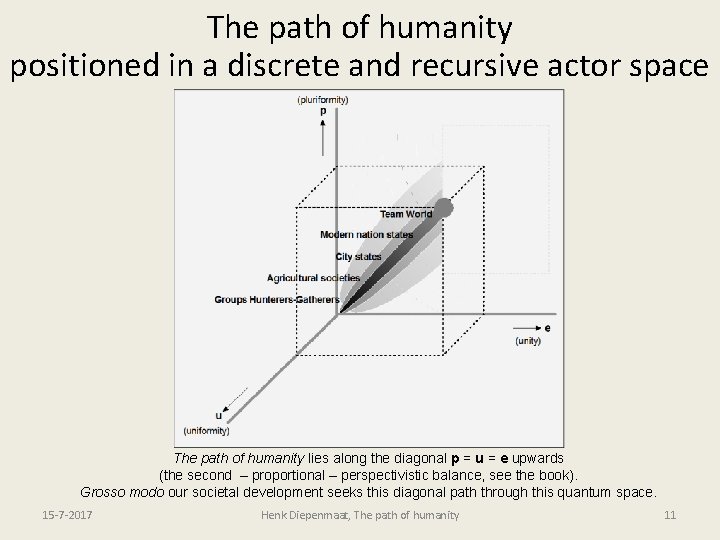
The path of humanity positioned in a discrete and recursive actor space The path of humanity lies along the diagonal p = u = e upwards (the second – proportional – perspectivistic balance, see the book). Grosso modo our societal development seeks this diagonal path through this quantum space. 15 -7 -2017 Henk Diepenmaat, The path of humanity 11
Recursive perspectivism and the Radical actor thesis 1. 2. 3. 4. 5. The path of humanity, recursive perspectivism and multi-actor thinking merge α, β and γ thinking. (α: history, linguistics, …, β: physics, mathematics, entropy, …, γ: intentionality, psychology, sociology, economics, …) This perspectivistic merging offers intriguing new unifying ways for interpreting societal practices as radical multi-actor systems, societal development as multiactor processes, and societal innovation as traveling along an improvement path in a numerical recursive perspectivistic actor space. According to recursive perspectivism, a unifying philosophy, societal developments correspond with state space transitions: feasible movements in this discrete perspectivistic quantum space. Prime numbers play a key role in these movements. Recursive perspectivism explains the emerging of “pattern laws” like Zipf’s law, Benford’s law, bell (Gaussian) curves and many social and natural scientific laws. Also “the path of humanity” itself is such a pattern law. In sum, the book offers historical, statistical, relativistic and quantumtheoretical insights with respect to human consciousness, human 15 -7 -2017 Henk Diepenmaat, The path of humanity 12 development and intentional societal improvement (see the book).
The scope of this presentation This presentation is not about recursive perspectivism, “The path of humanity” or societal innovation, the main themes of the book. But recursive perspectivism is about prime numbers. I approach prime numbers in a recursive perspectivistic (and therefore rather nonmathematical) manner. According to recursive perspectivism, numbers characterise perspectivistic configurations, so the bridges are firm nonetheless. In addition, The path of humanity and the Riemann hypothesis seem to express similar asymptotical behaviours. This presentation is about insights and views that recursive perspectivism and “The path of humanity” may have to offer for understanding prime numbers and proving the Riemann hypothesis. 15 -7 -2017 Henk Diepenmaat, The path of humanity 13
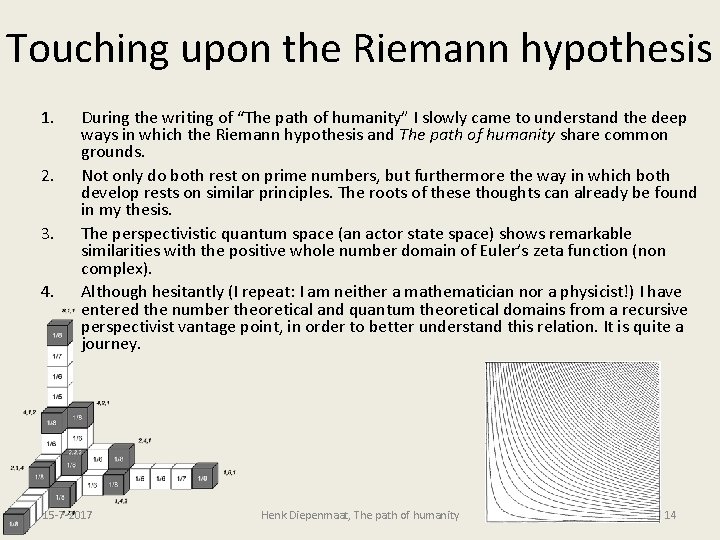
Touching upon the Riemann hypothesis 1. 2. 3. 4. During the writing of “The path of humanity” I slowly came to understand the deep ways in which the Riemann hypothesis and The path of humanity share common grounds. Not only do both rest on prime numbers, but furthermore the way in which both develop rests on similar principles. The roots of these thoughts can already be found in my thesis. The perspectivistic quantum space (an actor state space) shows remarkable similarities with the positive whole number domain of Euler’s zeta function (non complex). Although hesitantly (I repeat: I am neither a mathematician nor a physicist!) I have entered the number theoretical and quantum theoretical domains from a recursive perspectivist vantage point, in order to better understand this relation. It is quite a journey. 15 -7 -2017 Henk Diepenmaat, The path of humanity 14
2: The Riemann hypothesis 15 -7 -2017 Henk Diepenmaat, The path of humanity 15
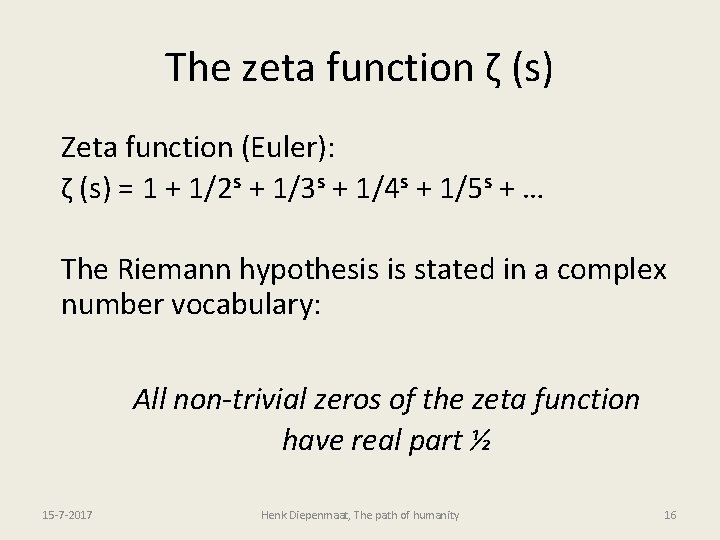
The zeta function ζ (s) Zeta function (Euler): ζ (s) = 1 + 1/2 s + 1/3 s + 1/4 s + 1/5 s + … The Riemann hypothesis is stated in a complex number vocabulary: All non-trivial zeros of the zeta function have real part ½ 15 -7 -2017 Henk Diepenmaat, The path of humanity 16
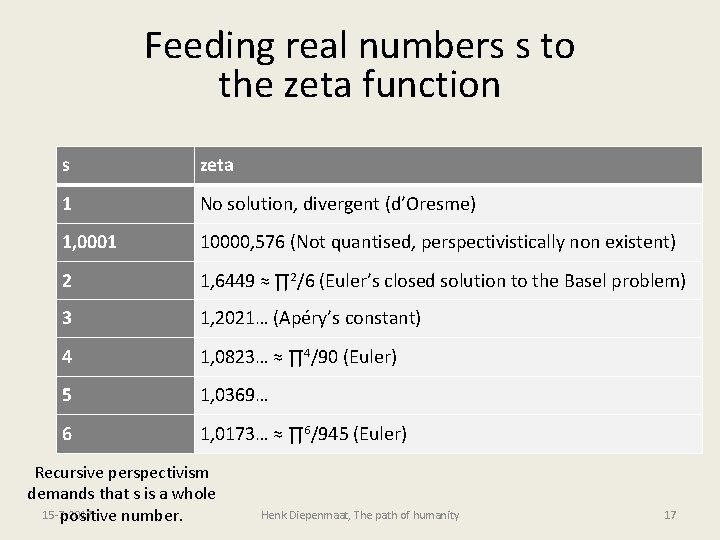
Feeding real numbers s to the zeta function s zeta 1 No solution, divergent (d’Oresme) 1, 0001 10000, 576 (Not quantised, perspectivistically non existent) 2 1, 6449 ≈ ∏ 2/6 (Euler’s closed solution to the Basel problem) 3 1, 2021… (Apéry’s constant) 4 1, 0823… ≈ ∏ 4/90 (Euler) 5 1, 0369… 6 1, 0173… ≈ ∏ 6/945 (Euler) Recursive perspectivism demands that s is a whole 15 -7 -2017 positive number. Henk Diepenmaat, The path of humanity 17
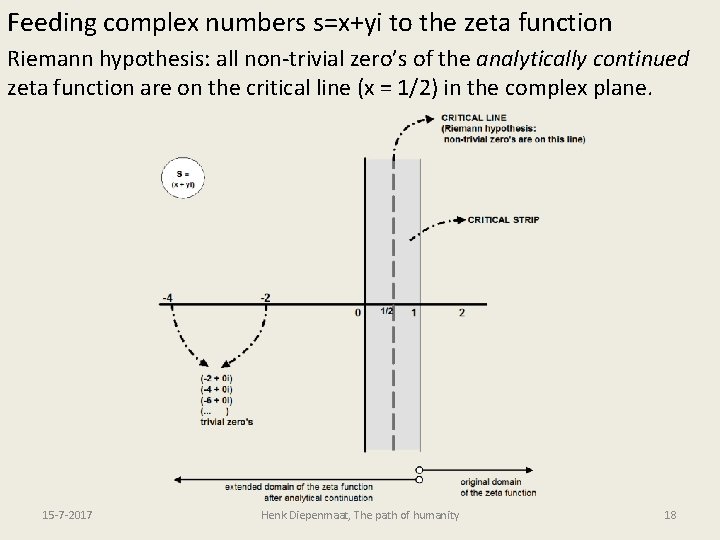
Feeding complex numbers s=x+yi to the zeta function Riemann hypothesis: all non-trivial zero’s of the analytically continued zeta function are on the critical line (x = 1/2) in the complex plane. 15 -7 -2017 Henk Diepenmaat, The path of humanity 18
3: The Riemann hypothesis and recursive perspectivism: (where) do they meet? 15 -7 -2017 Henk Diepenmaat, The path of humanity 19
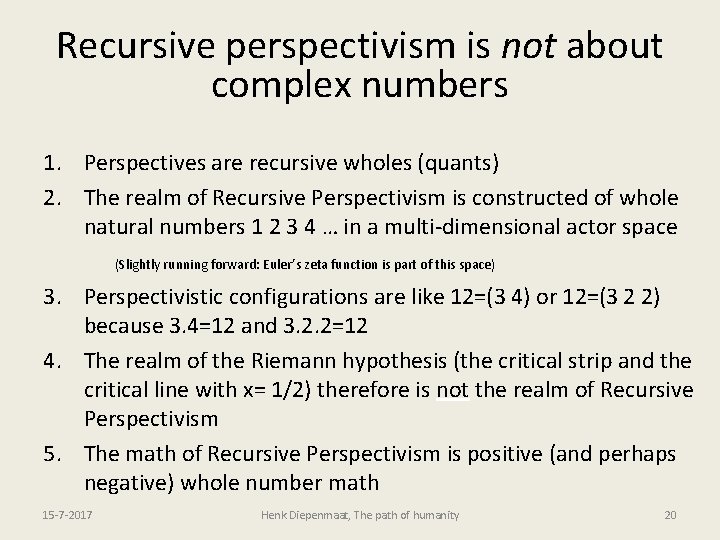
Recursive perspectivism is not about complex numbers 1. Perspectives are recursive wholes (quants) 2. The realm of Recursive Perspectivism is constructed of whole natural numbers 1 2 3 4 … in a multi-dimensional actor space (Slightly running forward: Euler’s zeta function is part of this space) 3. Perspectivistic configurations are like 12=(3 4) or 12=(3 2 2) because 3. 4=12 and 3. 2. 2=12 4. The realm of the Riemann hypothesis (the critical strip and the critical line with x= 1/2) therefore is not the realm of Recursive Perspectivism 5. The math of Recursive Perspectivism is positive (and perhaps negative) whole number math 15 -7 -2017 Henk Diepenmaat, The path of humanity 20
Then how do Recursive Perspectivism and the Riemann hypothesis relate? Edwards mentions that Stieltjes and Denjoy offered a clue: “All in all, except to remember that a first-rate mathematician (Thomas Joannes Stieltjes jr. , 1856 -1894, HD) once believed that the most fruitful approach to the Riemann hypothesis was through a study of the growth of M(x) as x -> ∞, the incident is perhaps best forgotten. ” H. M. Edwards, 1974, Riemann’s zeta function, chapter 12. 1: The Riemann hypothesis and the growth of M(x) is the Mertens function, which in its turn is based upon the Möbius function; see the following slides. 15 -7 -2017 Henk Diepenmaat, The path of humanity 21
The Möbius function μ(n), after the German mathematician and astronomer Augustus Ferdinand Möbius (1790 -1868), is at the center of number theory. It is about prime factorisations, and is defined as follows: 1. The domain of μ is all positive whole natural numbers N (so 1, 2, 3, …. ) 1. 2. μ(1)= 1 μ(n)= 0 3. μ(n)=-1 4. μ(n)=+1 if the prime factorisation of n contains a square, like in 4=(2 2) or 12=(3. 2. 2)=(3. 22) or 54=(2. 3. 3. 3)=2. 33 if n is a prime number, or if n is the product of an odd number of different prime numbers. (“n is odd” in this specific sense) if n is the product of an even number of different prime numbers. (“n is even” in this specific sense) “squared numbers” is shorthand for positive whole natural numbers of which the prime factorisation does contain squares. Otherwise the numbers are square -free. So 30=(2. 3. 5) is square-free and “odd” in the prime factors sense (as it has three prime factors!), and 24=(2. 2. 2. 3) is squared (not square-free) and “even” (coincidentally it is also even in the “normal” sense). Therefore μ(n)= 0 for squared numbers, -1 for “odd” square-free numbers, and 15 -7 -2017 Henk Diepenmaat, The path of humanity 22 +1 for “even” square-free numbers.
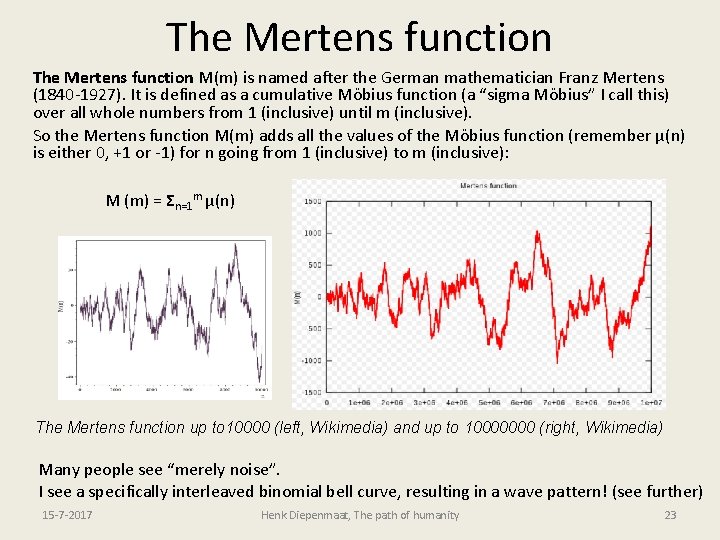
The Mertens function M(m) is named after the German mathematician Franz Mertens (1840 -1927). It is defined as a cumulative Möbius function (a “sigma Möbius” I call this) over all whole numbers from 1 (inclusive) until m (inclusive). So the Mertens function M(m) adds all the values of the Möbius function (remember μ(n) is either 0, +1 or -1) for n going from 1 (inclusive) to m (inclusive): M (m) = Σn=1 m μ(n) The Mertens function up to 10000 (left, Wikimedia) and up to 10000000 (right, Wikimedia) Many people see “merely noise”. I see a specifically interleaved binomial bell curve, resulting in a wave pattern! (see further) 15 -7 -2017 Henk Diepenmaat, The path of humanity 23
Riemann and coin tossing Edwards (1974), following Littlewood, proves in Paragraph 12. 1: The Riemann hypothesis and the growth of M(x) : “In order to prove the Riemann hypothesis, it would suffice to prove that M(x) grows less rapidly than x(1/2)+ε for all ε > 0. ” This relates Riemann's hypothesis to a Bernoulli (or coin tossing) experiment in the following way (see next slides): 15 -7 -2017 Henk Diepenmaat, The path of humanity 24
Denjoy relates Bernoulli and Mertens Edwards (1974) elaborates in Paragraph 12. 1 on Denjoy’s probabilistic interpretation of the Riemann hypothesis that in a Bernoulli experiment (for example a coin tossing sequence): “with probability 1 the number of heads minus the number of tails grows less rapidly than N(1/2)+ε. ” This is because of two reasons: 1) The probability of a head equals the probability of a tail 2) The occurrence of heads and tails is independent of each other. Edwards then argues that, in absence of reasons for the opposite, it is not an unreasonable assumption that in the Mertens function the occurrence of μ(n) = +1 equals the occurrence of μ(n) = -1. Following the same line of argument, it also seems not an unreasonable assumption that occurrences of +1 and -1 are independent of each other. But … If both of these two assumptions apply, the conclusion must be that M(x) is identical to a Bernoulli experiment in these two respects, hence M(x) grows less rapidly than x(1/2)+ε for all ε > 0 as well. Riemann's hypothesis then must be true! Therefore … Prove that these two not unreasonable assumptions are true, and you will have proven Riemann's hypothesis. This is called Denjoy’s probabilistic interpretation of the Riemann hypothesis (after the French mathematician Arnaud Denjoy). 15 -7 -2017 Henk Diepenmaat, The path of humanity 25
Equivalents of the Riemann hypothesis On the basis of the above, several equivalent formulations of the Riemann hypothesis exist that use the realm of recursive perspectivism, rather than the complex plane. The Mertens function plays a crucial role in them. E. g. : 1 a: If M(x) = O(x(½ + ε)) is true with probability one, the Riemann hypothesis is true with probability one 1 b: “In order to prove the Riemann hypothesis, it would suffice to prove that M(x) grows less rapidly than x(1/2)+ε for all ε > 0. ” (1 a and 1 b: Edwards, Chapter 12. 1. O is “big oh” notation (it must hold asymptotically) 2: The Riemann hypothesis is true if and only if the numbers of positive and negative signs of M(n) are asymptotically equal. John Derbyshire presents a third formulation in his book Prime Obsession, Chapter 20. VI (this is the equivalent that drew my attention firstly, and I paraphrase): 3: If a square-free number has either an even or an odd number of prime factors with equal probability (50%-50%), the Riemann hypothesis is true. 15 -7 -2017 Henk Diepenmaat, The path of humanity 26
4: Combining prime numbers using well established math Blaise Pascal (France, 1623 -1662) Isaac Newton (England, 1643 -1727) both grandmasters of several trades Topics: combinations Pascal’s triangle binomial coefficients resulting in a combinatorial factor counting function fp 15 -7 -2017 Henk Diepenmaat, The path of humanity 27
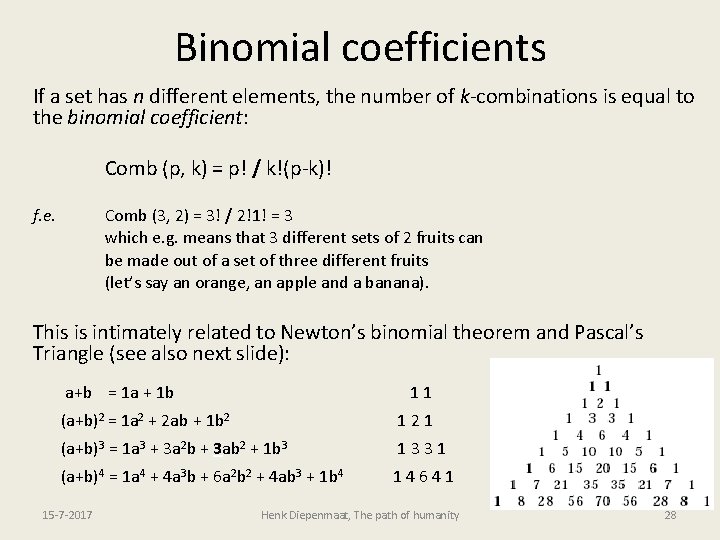
Binomial coefficients If a set has n different elements, the number of k-combinations is equal to the binomial coefficient: Comb (p, k) = p! / k!(p-k)! f. e. Comb (3, 2) = 3! / 2!1! = 3 which e. g. means that 3 different sets of 2 fruits can be made out of a set of three different fruits (let’s say an orange, an apple and a banana). This is intimately related to Newton’s binomial theorem and Pascal’s Triangle (see also next slide): a+b = 1 a + 1 b 1 1 (a+b)2 = 1 a 2 + 2 ab + 1 b 2 1 2 1 (a+b)3 = 1 a 3 + 3 a 2 b + 3 ab 2 + 1 b 3 1 3 3 1 (a+b)4 = 1 a 4 + 4 a 3 b + 6 a 2 b 2 + 4 ab 3 + 1 b 4 1 4 6 4 1 15 -7 -2017 Henk Diepenmaat, The path of humanity 28
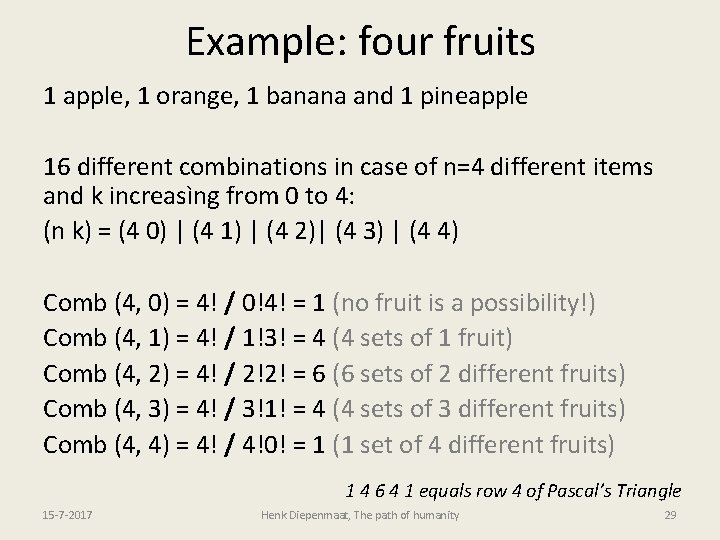
Example: four fruits 1 apple, 1 orange, 1 banana and 1 pineapple 16 different combinations in case of n=4 different items and k increasìng from 0 to 4: (n k) = (4 0) | (4 1) | (4 2)| (4 3) | (4 4) Comb (4, 0) = 4! / 0!4! = 1 (no fruit is a possibility!) Comb (4, 1) = 4! / 1!3! = 4 (4 sets of 1 fruit) Comb (4, 2) = 4! / 2!2! = 6 (6 sets of 2 different fruits) Comb (4, 3) = 4! / 3!1! = 4 (4 sets of 3 different fruits) Comb (4, 4) = 4! / 4!0! = 1 (1 set of 4 different fruits) 1 4 6 4 1 equals row 4 of Pascal’s Triangle 15 -7 -2017 Henk Diepenmaat, The path of humanity 29
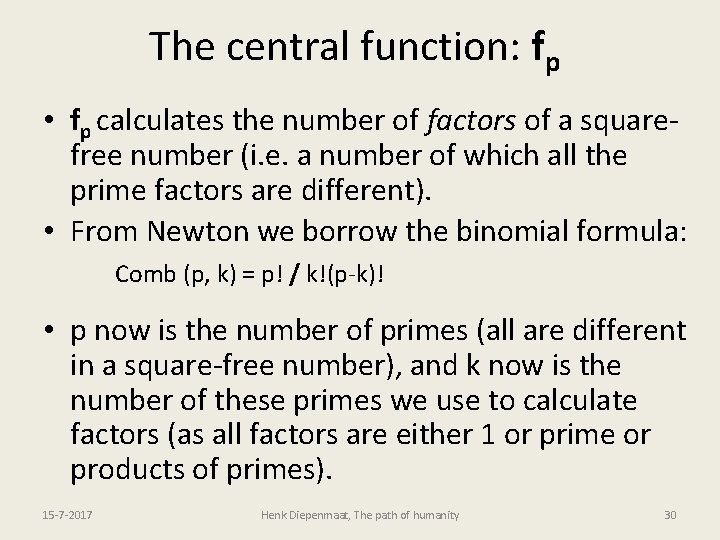
The central function: fp • fp calculates the number of factors of a squarefree number (i. e. a number of which all the prime factors are different). • From Newton we borrow the binomial formula: Comb (p, k) = p! / k!(p-k)! • p now is the number of primes (all are different in a square-free number), and k now is the number of these primes we use to calculate factors (as all factors are either 1 or prime or products of primes). 15 -7 -2017 Henk Diepenmaat, The path of humanity 30
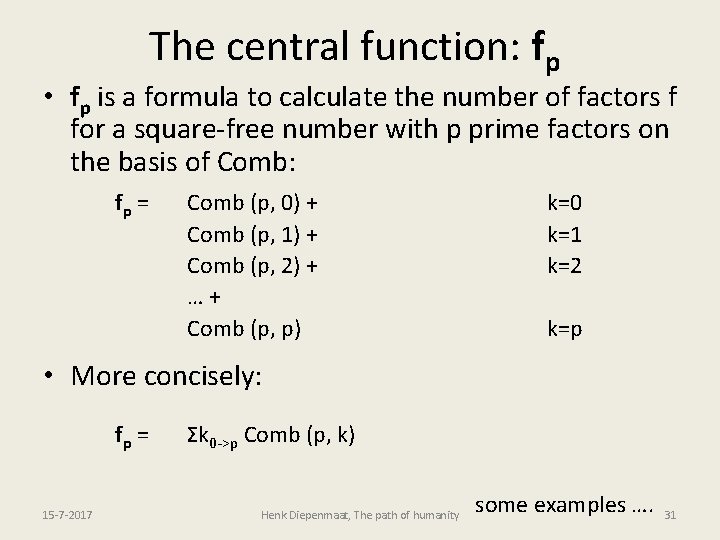
The central function: fp • fp is a formula to calculate the number of factors f for a square-free number with p prime factors on the basis of Comb: fp = Comb (p, 0) + Comb (p, 1) + Comb (p, 2) + … + Comb (p, p) k=0 k=1 k=2 k=p • More concisely: fp = 15 -7 -2017 Σk 0 ->p Comb (p, k) Henk Diepenmaat, The path of humanity some examples …. 31
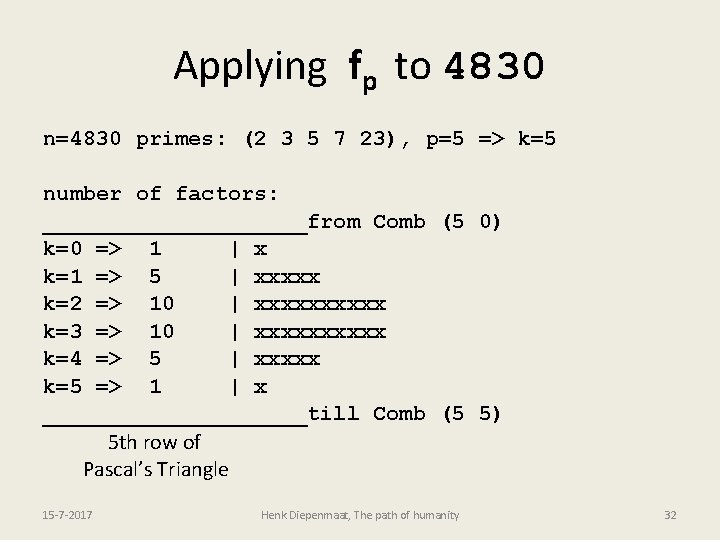
Applying fp to 4830 n=4830 primes: (2 3 5 7 23), p=5 => k=5 number of factors: __________from Comb (5 0) k=0 => 1 | x k=1 => 5 | xxxxx k=2 => 10 | xxxxx k=3 => 10 | xxxxx k=4 => 5 | xxxxx k=5 => 1 | x __________till Comb (5 5) 5 th row of Pascal’s Triangle 15 -7 -2017 Henk Diepenmaat, The path of humanity 32
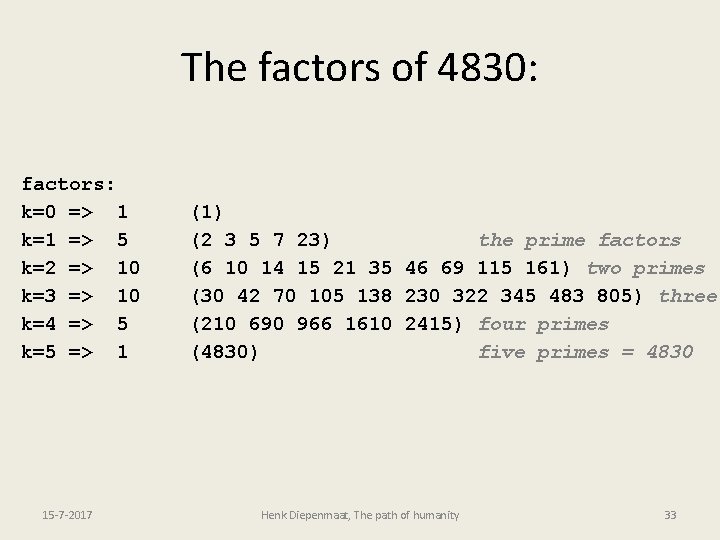
The factors of 4830: factors: k=0 => 1 (1) k=1 => 5 (2 3 5 7 23) the prime factors k=2 => 10 (6 10 14 15 21 35 46 69 115 161) two primes k=3 => 10 (30 42 70 105 138 230 322 345 483 805) three k=4 => 5 (210 690 966 1610 2415) four primes k=5 => 1 (4830) five primes = 4830 15 -7 -2017 Henk Diepenmaat, The path of humanity 33
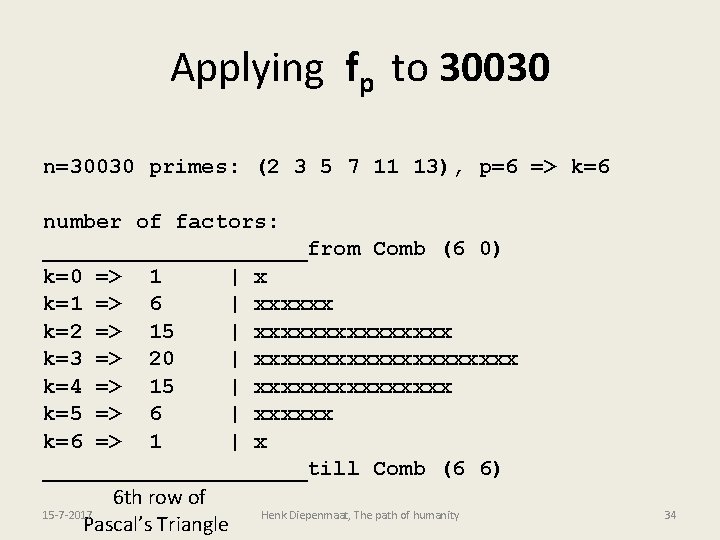
Applying fp to 30030 n=30030 primes: (2 3 5 7 11 13), p=6 => k=6 number of factors: __________from Comb (6 0) k=0 => 1 | x k=1 => 6 | xxxxxx k=2 => 15 | xxxxxxxx k=3 => 20 | xxxxxxxxxx k=4 => 15 | xxxxxxxx k=5 => 6 | xxxxxx k=6 => 1 | x __________till Comb (6 6) 6 th row of 15 -7 -2017 Henk Diepenmaat, The path of humanity Pascal’s Triangle 34
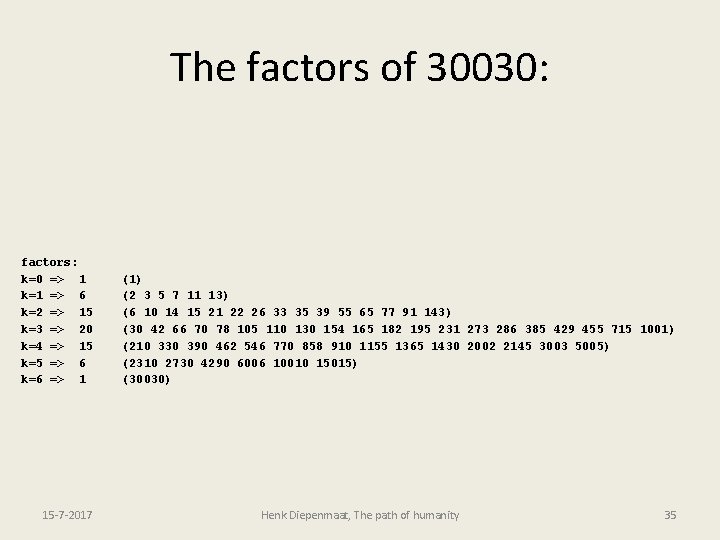
The factors of 30030: factors: k=0 => 1 (1) k=1 => 6 (2 3 5 7 11 13) k=2 => 15 (6 10 14 15 21 22 26 33 35 39 55 65 77 91 143) k=3 => 20 (30 42 66 70 78 105 110 130 154 165 182 195 231 273 286 385 429 455 715 1001) k=4 => 15 (210 330 390 462 546 770 858 910 1155 1365 1430 2002 2145 3003 5005) k=5 => 6 (2310 2730 4290 6006 10010 15015) k=6 => 1 (30030) 15 -7 -2017 Henk Diepenmaat, The path of humanity 35
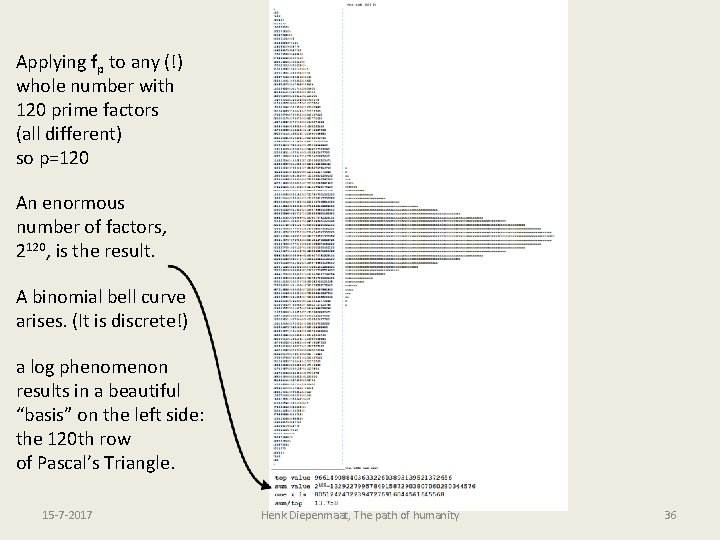
Applying fp to any (!) whole number with 120 prime factors (all different) so p=120 An enormous number of factors, 2120, is the result. A binomial bell curve arises. (It is discrete!) a log phenomenon results in a beautiful “basis” on the left side: the 120 th row of Pascal’s Triangle. 15 -7 -2017 Henk Diepenmaat, The path of humanity 36
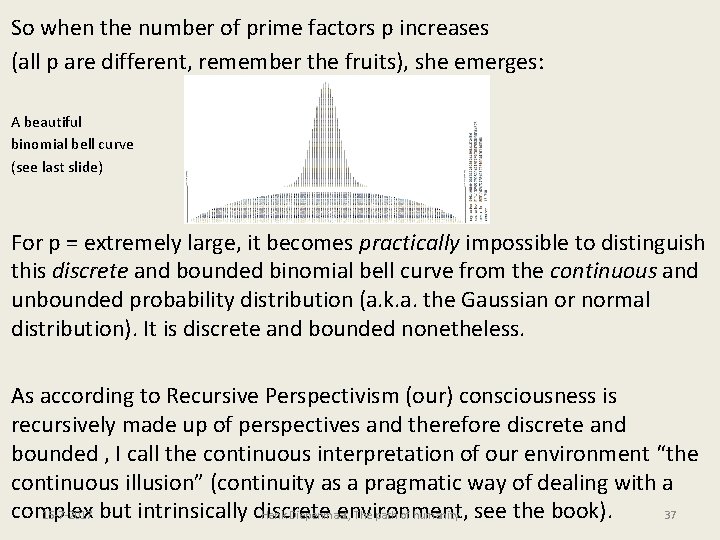
So when the number of prime factors p increases (all p are different, remember the fruits), she emerges: A beautiful binomial bell curve (see last slide) For p = extremely large, it becomes practically impossible to distinguish this discrete and bounded binomial bell curve from the continuous and unbounded probability distribution (a. k. a. the Gaussian or normal distribution). It is discrete and bounded nonetheless. As according to Recursive Perspectivism (our) consciousness is recursively made up of perspectives and therefore discrete and bounded , I call the continuous interpretation of our environment “the continuous illusion” (continuity as a pragmatic way of dealing with a complex but intrinsically discrete environment, see the book). 15 -7 -2017 Henk Diepenmaat, The path of humanity 37
5: Structure and content they play an imposing game Topics: interleaving discrete inverse proportionality and quantum theory sigma Möbius as a class of functions the sawtooth and the ordered sawtooth representations the prime number theorem (PNT) 15 -7 -2017 Henk Diepenmaat, The path of humanity 38
Are fp and the binomial bell curve helpful in understanding the Riemann hypothesis? An important observation: fp and the binomial bell curve express structure. The k values depend on the number of different things (p) we want to combine. They do not express content, as they are independent of the type of different things we want to combine. 120 different fruits would work as well as any (!!) set of 120 different prime factors. When applied to the prime factors of square-free numbers: the outcome of fp (total as well as for the different k values) and the shape of the binomial bell curve depend only on the number (amount) of prime factors (structure only), and not on the value of these prime factors (content). 15 -7 -2017 Henk Diepenmaat, The path of humanity 39
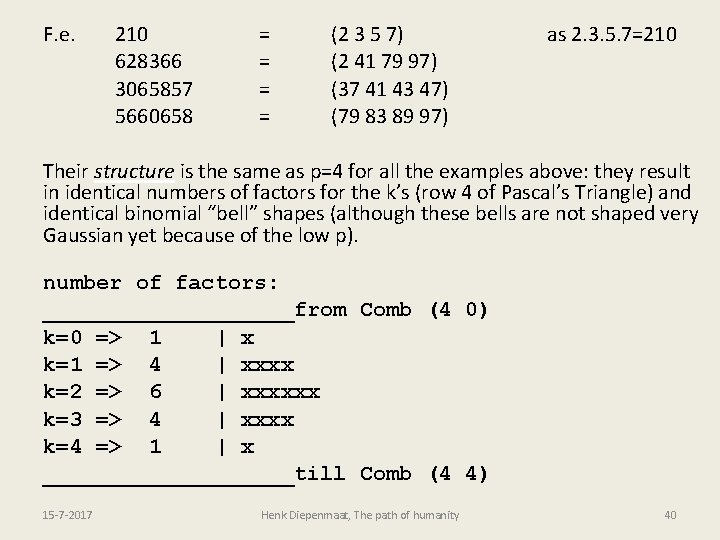
F. e. 210 628366 3065857 5660658 = = (2 3 5 7) (2 41 79 97) (37 41 43 47) (79 83 89 97) as 2. 3. 5. 7=210 Their structure is the same as p=4 for all the examples above: they result in identical numbers of factors for the k’s (row 4 of Pascal’s Triangle) and identical binomial “bell” shapes (although these bells are not shaped very Gaussian yet because of the low p). number of factors: __________from Comb (4 0) k=0 => 1 | x k=1 => 4 | xxxx k=2 => 6 | xxxxxx k=3 => 4 | xxxx k=4 => 1 | x __________till Comb (4 4) 15 -7 -2017 Henk Diepenmaat, The path of humanity 40
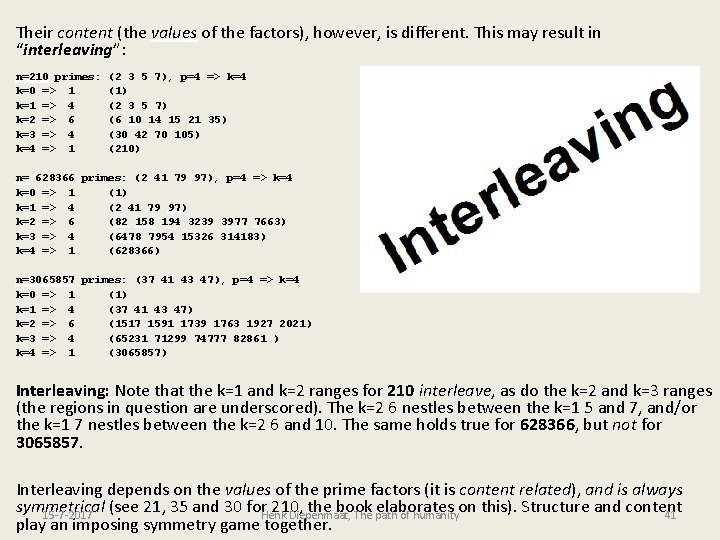
Their content (the values of the factors), however, is different. This may result in “interleaving”: n=210 primes: (2 3 5 7), p=4 => k=4 k=0 => 1 (1) k=1 => 4 (2 3 5 7) k=2 => 6 (6 10 14 15 21 35) k=3 => 4 (30 42 70 105) k=4 => 1 (210) n= 628366 primes: (2 41 79 97), p=4 => k=4 k=0 => 1 (1) k=1 => 4 (2 41 79 97) k=2 => 6 (82 158 194 3239 3977 7663) k=3 => 4 (6478 7954 15326 314183) k=4 => 1 (628366) n=3065857 primes: (37 41 43 47), p=4 => k=4 k=0 => 1 (1) k=1 => 4 (37 41 43 47) k=2 => 6 (1517 1591 1739 1763 1927 2021) k=3 => 4 (65231 71299 74777 82861 ) k=4 => 1 (3065857) Interleaving: Note that the k=1 and k=2 ranges for 210 interleave, as do the k=2 and k=3 ranges (the regions in question are underscored). The k=2 6 nestles between the k=1 5 and 7, and/or the k=1 7 nestles between the k=2 6 and 10. The same holds true for 628366, but not for 3065857. Interleaving depends on the values of the prime factors (it is content related), and is always symmetrical (see 21, 35 and 30 for 210, the book elaborates on this). Structure and content 15 -7 -2017 Henk Diepenmaat, The path of humanity 41 play an imposing symmetry game together.
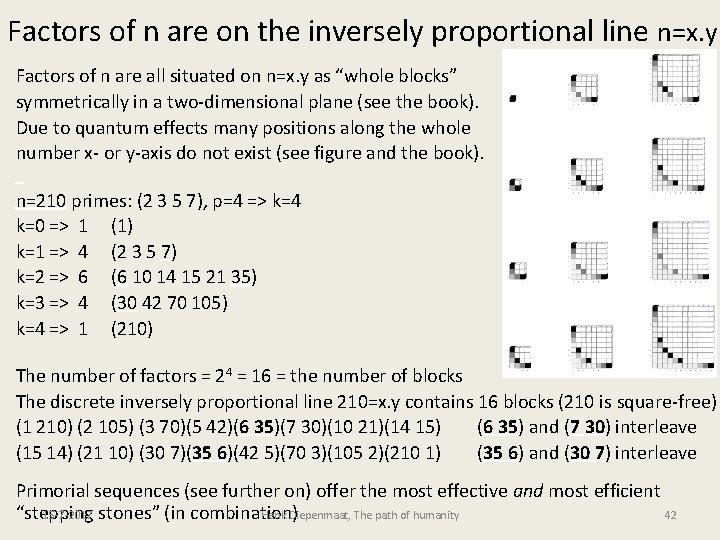
Factors of n are on the inversely proportional line n=x. y Factors of n are all situated on n=x. y as “whole blocks” symmetrically in a two-dimensional plane (see the book). Due to quantum effects many positions along the whole number x- or y-axis do not exist (see figure and the book). n=210 primes: (2 3 5 7), p=4 => k=4 k=0 => 1 (1) k=1 => 4 (2 3 5 7) k=2 => 6 (6 10 14 15 21 35) k=3 => 4 (30 42 70 105) k=4 => 1 (210) The number of factors = 24 = 16 = the number of blocks The discrete inversely proportional line 210=x. y contains 16 blocks (210 is square-free) (1 210) (2 105) (3 70)(5 42)(6 35)(7 30)(10 21)(14 15) (6 35) and (7 30) interleave (15 14) (21 10) (30 7)(35 6)(42 5)(70 3)(105 2)(210 1) (35 6) and (30 7) interleave Primorial sequences (see further on) offer the most effective and most efficient “stepping stones” (in combination) 15 -7 -2017 Henk Diepenmaat, The path of humanity 42
Representing factors in sigma Möbius fashion (Note: the Mertens function is an example (instance) of a sigma Möbius family) n=210 primes: (2 3 5 7), p=4 => k=4 k=0 => 1 (1) k=1 => 4 (2 3 5 7) k=2 => 6 (6 10 14 15 21 35) k=3 => 4 (30 42 70 105) k=4 => 1 (210) • Obviously, if k is an odd number (“normal odd”, like 3 5 7 …, see above for 1 and 3) then the Möbius value of the factors belonging to this k must be -1 (exception: 1). • Likewise, if k is an even number (“normal even”, like 2 4 6 8 …, see above for 2 and 4) then the Möbius value of the factors belonging to this k must be +1 • Remember: we are working with square-free numbers, so a factor with a Möbius value of 0 is not possible (if a number is square-free, its factors are square-free as well). 15 -7 -2017 Henk Diepenmaat, The path of humanity 43
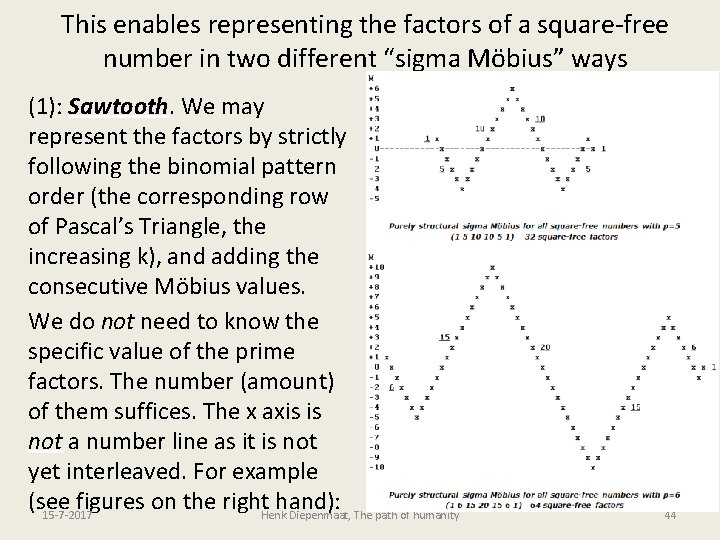
This enables representing the factors of a square-free number in two different “sigma Möbius” ways (1): Sawtooth. We may represent the factors by strictly following the binomial pattern order (the corresponding row of Pascal’s Triangle, the increasing k), and adding the consecutive Möbius values. We do not need to know the specific value of the prime factors. The number (amount) of them suffices. The x axis is not a number line as it is not yet interleaved. For example (see figures on the right hand): 15 -7 -2017 Henk Diepenmaat, The path of humanity 44
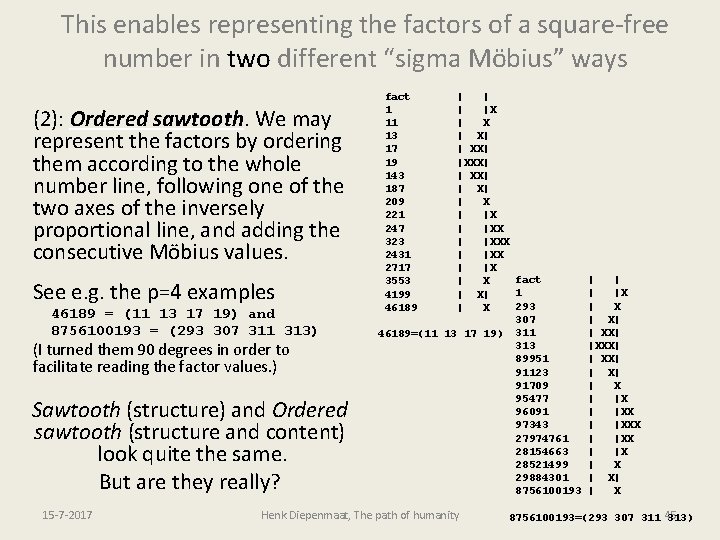
This enables representing the factors of a square-free number in two different “sigma Möbius” ways (2): Ordered sawtooth. We may represent the factors by ordering them according to the whole number line, following one of the two axes of the inversely proportional line, and adding the consecutive Möbius values. See e. g. the p=4 examples 46189 = (11 13 17 19) and 8756100193 = (293 307 311 313) (I turned them 90 degrees in order to facilitate reading the factor values. ) Sawtooth (structure) and Ordered sawtooth (structure and content) look quite the same. But are they really? 15 -7 -2017 fact | | 1 | |X 11 | X 13 | X| 17 | XX| 19 |XXX| 143 | XX| 187 | X| 209 | X 221 | |X 247 | |XX 323 | |XXX 2431 | |XX 2717 | |X fact | | 3553 | X 1 | |X 4199 | X| 293 | X 46189 | X 307 | X| 46189=(11 13 17 19) 311 | XX| 313 |XXX| 89951 | XX| 91123 | X| 91709 | X 95477 | |X 96091 | |XX 97343 | |XXX 27974761 | |XX 28154663 | |X 28521499 | X 29884301 | X| 8756100193 | X Henk Diepenmaat, The path of humanity 45 8756100193=(293 307 311 313)
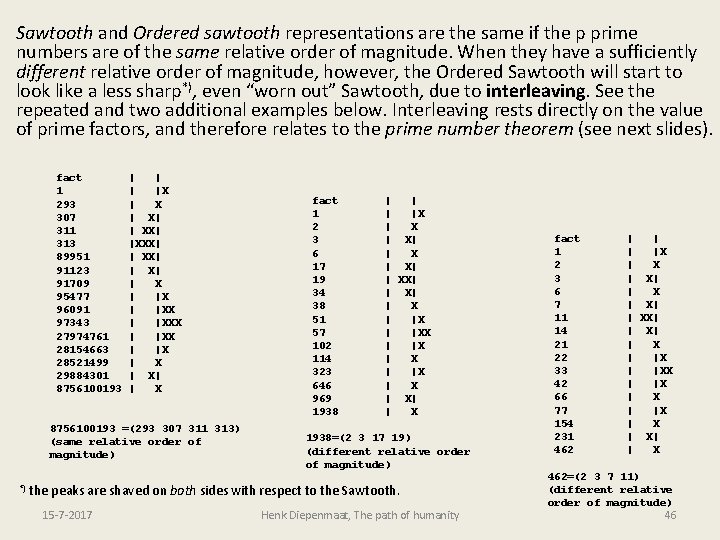
Sawtooth and Ordered sawtooth representations are the same if the p prime numbers are of the same relative order of magnitude. When they have a sufficiently different relative order of magnitude, however, the Ordered Sawtooth will start to look like a less sharp*), even “worn out” Sawtooth, due to interleaving. See the repeated and two additional examples below. Interleaving rests directly on the value of prime factors, and therefore relates to the prime number theorem (see next slides). fact | | 1 | |X 293 | X 307 | X| 311 | XX| 313 |XXX| 89951 | XX| 91123 | X| 91709 | X 95477 | |X 96091 | |XX 97343 | |XXX 27974761 | |XX 28154663 | |X 28521499 | X 29884301 | X| 8756100193 | X 8756100193 =(293 307 311 313) (same relative order of magnitude) fact | | 1 | |X 2 | X 3 | X| 6 | X 17 | X| 19 | XX| 34 | X| 38 | X 51 | |X 57 | |XX 102 | |X 114 | X 323 | |X 646 | X 969 | X| 1938 | X 1938=(2 3 17 19) (different relative order of magnitude) *) the peaks are shaved on both sides with respect to the Sawtooth. 15 -7 -2017 Henk Diepenmaat, The path of humanity fact | | 1 | |X 2 | X 3 | X| 6 | X 7 | X| 11 | XX| 14 | X| 21 | X 22 | |X 33 | |XX 42 | |X 66 | X 77 | |X 154 | X 231 | X| 462 | X 462=(2 3 7 11) (different relative order of magnitude) 46
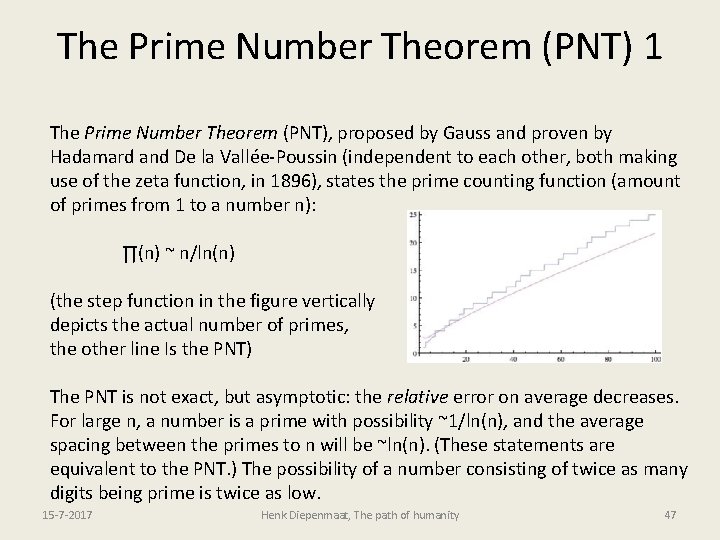
The Prime Number Theorem (PNT) 1 The Prime Number Theorem (PNT), proposed by Gauss and proven by Hadamard and De la Vallée-Poussin (independent to each other, both making use of the zeta function, in 1896), states the prime counting function (amount of primes from 1 to a number n): ∏(n) ~ n/ln(n) (the step function in the figure vertically depicts the actual number of primes, the other line Is the PNT) The PNT is not exact, but asymptotic: the relative error on average decreases. For large n, a number is a prime with possibility ~1/ln(n), and the average spacing between the primes to n will be ~ln(n). (These statements are equivalent to the PNT. ) The possibility of a number consisting of twice as many digits being prime is twice as low. 15 -7 -2017 Henk Diepenmaat, The path of humanity 47
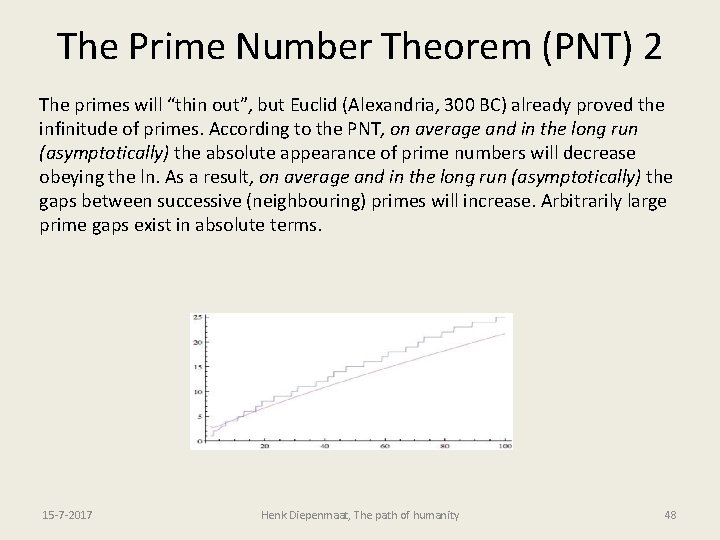
The Prime Number Theorem (PNT) 2 The primes will “thin out”, but Euclid (Alexandria, 300 BC) already proved the infinitude of primes. According to the PNT, on average and in the long run (asymptotically) the absolute appearance of prime numbers will decrease obeying the ln. As a result, on average and in the long run (asymptotically) the gaps between successive (neighbouring) primes will increase. Arbitrarily large prime gaps exist in absolute terms. 15 -7 -2017 Henk Diepenmaat, The path of humanity 48
6: Primorial sequences and wave patterns Topics: primorial numbers and primorial sequences ordered sawtooth representations of primorial numbers quantum theory and wave patterns philosophy and consciousness 15 -7 -2017 Henk Diepenmaat, The path of humanity 49
Primorial sequences (1) By consecutively extending the prime factorisation with the next prime number in line, starting at 1, we create a primorial sequence (see below). Such an extension (primorial restrictions would go the other way around) I call a primorial step. They result in the primorial numbers: 2, 6, 30, 210, 2310, … By following the primorial sequence, we are sure not to skip any prime numbers (as all the prime numbers so far are being covered), and not to introduce squared factors (because of the fact that in a primorial number all prime factors are different, a primorial number cannot have a squared factor). 2 6=(2 3) 30=(2 3 5) 210=(2 3 5 7) 2310=(2 3 5 7 11) Et cetera. 15 -7 -2017 2. 3=6 2. 3. 5=30 2. 3. 5. 7=210 2. 3. 5. 7. 11=2310 Henk Diepenmaat, The path of humanity 50
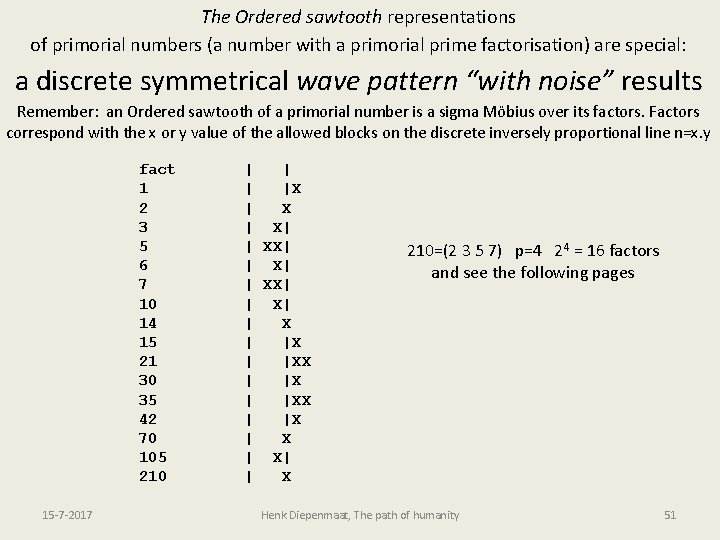
The Ordered sawtooth representations of primorial numbers (a number with a primorial prime factorisation) are special: a discrete symmetrical wave pattern “with noise” results Remember: an Ordered sawtooth of a primorial number is a sigma Möbius over its factors. Factors correspond with the x or y value of the allowed blocks on the discrete inversely proportional line n=x. y fact | | 1 | |X 2 | X 3 | X| 5 | XX| 6 | X| 7 | XX| 10 | X| 14 | X 15 | |X 21 | |XX 30 | |X 35 | |XX 42 | |X 70 | X 105 | X| 210 | X 15 -7 -2017 210=(2 3 5 7) p=4 24 = 16 factors and see the following pages Henk Diepenmaat, The path of humanity 51
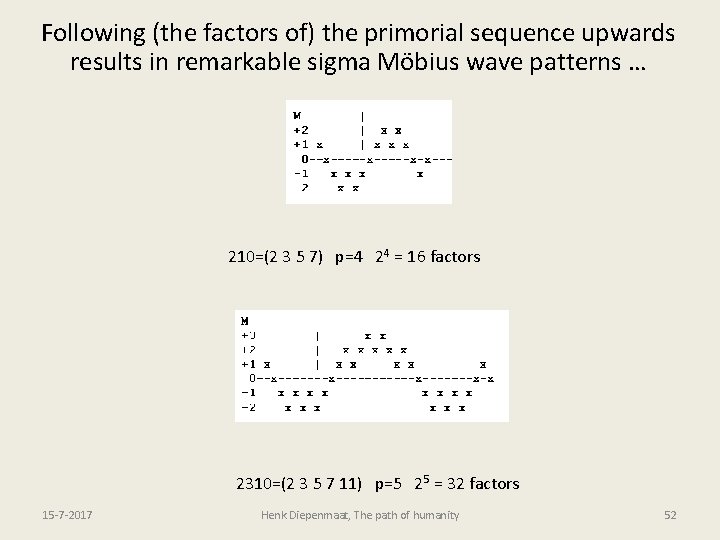
Following (the factors of) the primorial sequence upwards results in remarkable sigma Möbius wave patterns … 210=(2 3 5 7) p=4 24 = 16 factors 2310=(2 3 5 7 11) p=5 25 = 32 factors 15 -7 -2017 Henk Diepenmaat, The path of humanity 52
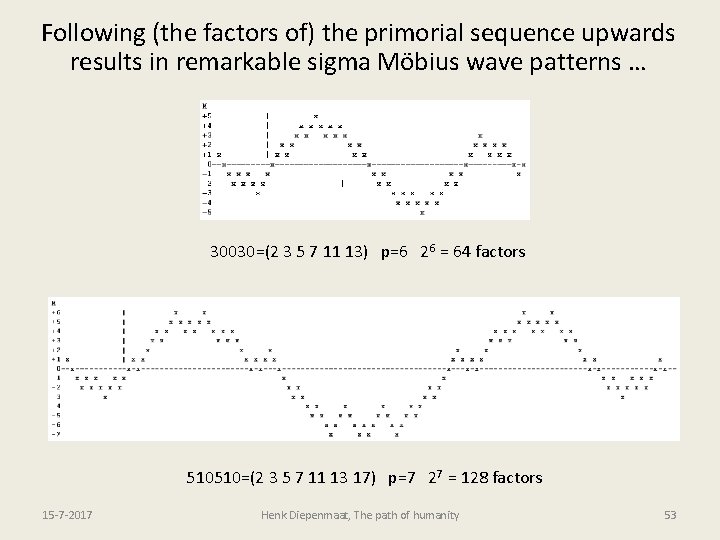
Following (the factors of) the primorial sequence upwards results in remarkable sigma Möbius wave patterns … 30030=(2 3 5 7 11 13) p=6 26 = 64 factors 510510=(2 3 5 7 11 13 17) p=7 27 = 128 factors 15 -7 -2017 Henk Diepenmaat, The path of humanity 53
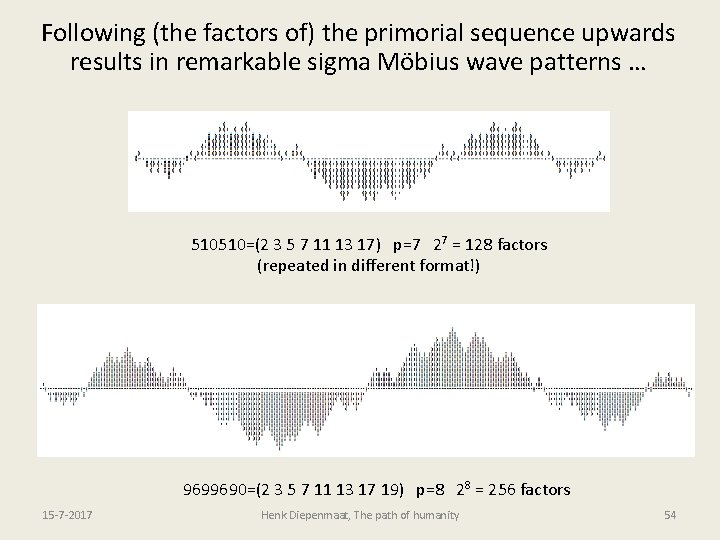
Following (the factors of) the primorial sequence upwards results in remarkable sigma Möbius wave patterns … 510510=(2 3 5 7 11 13 17) p=7 27 = 128 factors (repeated in different format!) 9699690=(2 3 5 7 11 13 17 19) p=8 28 = 256 factors 15 -7 -2017 Henk Diepenmaat, The path of humanity 54
Primorial sequences (2) 6=(2 3) 30=(2 3 5) 210=(2 3 5 7) 2310=(2 3 5 7 11) Et cetera. 2. 3=6 2. 3. 5=30 2. 3. 5. 7=210 2. 3. 5. 7. 11=2310 The “noise” in the primorial wave patterns is not “real” (not undeterministic and random) noise, as it has a very distinct numerical origin and can in principle be calculated: the differences between the perfect binomial sawtooth of a primorial number with p prime factors and the ordered sawtooth completely result from interleaving between factors of different k-values of this primorial number. And the amount of interleaving depends on both the number of prime factors and the relative differences (the ratios) between the prime numbers of a (any) number. 15 -7 -2017 Henk Diepenmaat, The path of humanity 55
Primorial sequences (3) Let us look at this “noise” in an asymptotical manner. Consider a p=n primorial number: for p=4 this number is 210=(2 3 5 7). We will change this number asymptotically by means of a great number of prime number steps: we will drop the first prime number, and simultaneously add the next (a moving simultaneously fixed and flexible window). So: (2 3 5 7) => (3 5 7 11) => (5 7 11 13) => (7 11 13 17) => (11 13 17 19) => (13 17 19 23) et cetera. Formally, we may repeat this procedure as many times as we like, for as many consecutive prime numbers n as we like. (Note that a prime number step as described above is quite different from a primorial step: in a prime number step, p remains equal to n (in this case 4) throughout the procedure (we add the next prime number while dropping the first), whereas in a primorial step, n increases (or decreases) by 1. ) 15 -7 -2017 Henk Diepenmaat, The path of humanity 56
Primorial sequences (4) 1. When I speak of “more”, “an equal amount of” or “less” interleaving, of increasing or decreasing interleaving, I refer to the level of distortion of the binomial pattern (the sawtooth) of the sigma Möbius over the factors of a square-free number. Note: this is a structural and discrete feature. 2. In asymptotically performing prime number steps, we may use a bigger n or a larger number of steps. 3. When performing a lot of steps on a low p primorial number, the amount of interleaving may (and will) fluctuate wildly while stepping. 4. When performing fewer steps on a larger p primorial number, the amount of interleaving may (and will) fluctuate less wildly. 5. On average and in the long run (asymptotically) interleaving will become more and more seldom, and for all pragmatic purposes will seem to run out. It will never run out really, however, for the very same reasons that prime numbers will never run out. 6. This is dictated by the PNT: ∏(n) ~ n/ln(n). On average and in the long run, this holds true, no matter how large we will take n. (Philosophically this may be the cause of accidents and outliers. ) 15 -7 -2017 Henk Diepenmaat, The path of humanity 57
Primorial sequences (5) 1. Interleaving thrives on large relative differences between prime factors (this stepwise increases interleaving), and withers away when prime factors become more and more the same (this stepwise decreases interleaving). 2. This is not only an empirical observation (see the p=4 ordered sawtooths of 8756100193, 1938, 462 and 210 presented earlier) but is tightly and formally related to the ratios of the prime factors, constituting the number under consideration (as factors, a structural notion, are relatively ordered on the number line on the basis of the ratios between prime factors making up these factors. ) 3. In order to understand the asymptotic behaviour of interleaving, we do not need to know the relation between normalised prime factor ratios and interleaving in specific, because of the special asymptotical characteristics of primorial numbers. The PNT tells us an asymptotical truth about these ratios (on average and in the long run). 15 -7 -2017 Henk Diepenmaat, The path of humanity 58
Primorial sequences (6) 1. When increasing the number of prime number steps, the amount of interleaving between the factors of the increasing number, consisting of n consecutive prime numbers, must decrease on average and in the long run (actually it is a step function). This is dictated by the PNT: ∏(n) ~ n/ln(n), looking at the logaritmic slope of the graph of the PNt suffices. 2. When increasing n and performing prime number steps, the fluctuations will become subdued. 3. Also, when applying primorial steps instead of prime number steps on a primorial number, due to the continuing influence of earlier prime numbers with larger relative differences, interleaving will become less dominant, but can never disappear. This causes the wave patterns. 4. This is due to boundary conditions (see next slides) 15 -7 -2017 Henk Diepenmaat, The path of humanity 59
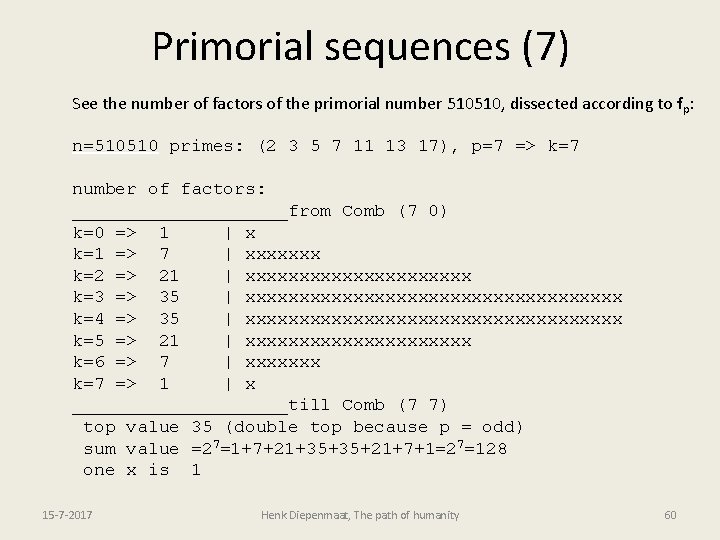
Primorial sequences (7) See the number of factors of the primorial number 510510, dissected according to fp: n=510510 primes: (2 3 5 7 11 13 17), p=7 => k=7 number of factors: __________from Comb (7 0) k=0 => 1 | x k=1 => 7 | xxxxxxx k=2 => 21 | xxxxxxxxxxx k=3 => 35 | xxxxxxxxxxxxxxxxxx k=4 => 35 | xxxxxxxxxxxxxxxxxx k=5 => 21 | xxxxxxxxxxx k=6 => 7 | xxxxxxx k=7 => 1 | x __________till Comb (7 7) top value 35 (double top because p = odd) sum value =27=1+7+21+35+35+21+7+1=27=128 one x is 1 15 -7 -2017 Henk Diepenmaat, The path of humanity 60
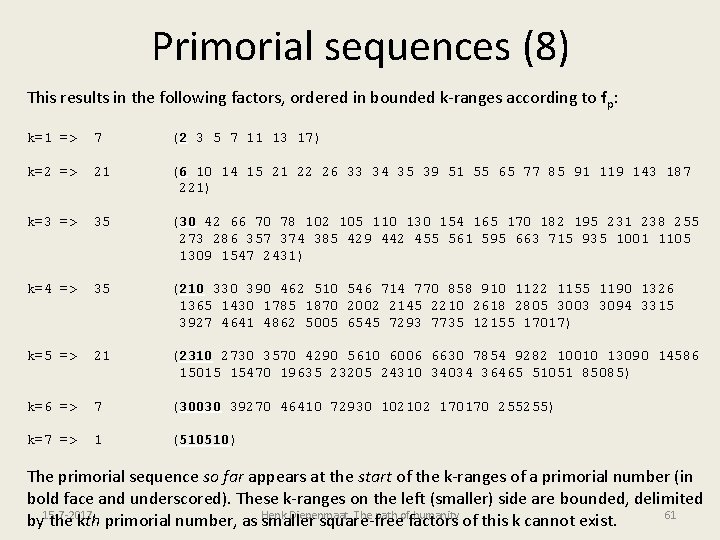
Primorial sequences (8) This results in the following factors, ordered in bounded k-ranges according to fp: k=1 => 7 (2 3 5 7 11 13 17) k=2 => 21 (6 10 14 15 21 22 26 33 34 35 39 51 55 65 77 85 91 119 143 187 221) k=3 => 35 (30 42 66 70 78 102 105 110 130 154 165 170 182 195 231 238 255 273 286 357 374 385 429 442 455 561 595 663 715 935 1001 1105 1309 1547 2431) k=4 => 35 (210 330 390 462 510 546 714 770 858 910 1122 1155 1190 1326 1365 1430 1785 1870 2002 2145 2210 2618 2805 3003 3094 3315 3927 4641 4862 5005 6545 7293 7735 12155 17017) k=5 => 21 (2310 2730 3570 4290 5610 6006 6630 7854 9282 10010 13090 14586 15015 15470 19635 23205 24310 34034 36465 51051 85085) k=6 => 7 (30030 39270 46410 72930 102102 170170 255255) k=7 => 1 (510510) The primorial sequence so far appears at the start of the k-ranges of a primorial number (in bold face and underscored). These k-ranges on the left (smaller) side are bounded, delimited 15 -7 -2017 Henk Diepenmaat, The path of humanity 61 by the kth primorial number, as smaller square-free factors of this k cannot exist.
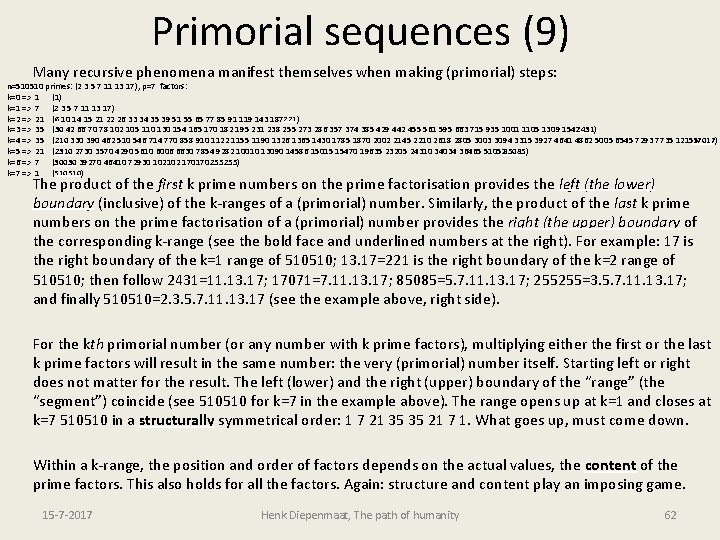
Primorial sequences (9) Many recursive phenomena manifest themselves when making (primorial) steps: n=510510 primes: (2 3 5 7 11 13 17), p=7 factors: k=0 => 1 (1) k=1 => 7 (2 3 5 7 11 13 17) k=2 => 21 (6 10 14 15 21 22 26 33 34 35 39 51 55 65 77 85 91 119 143 187 221) k=3 => 35 (30 42 66 70 78 102 105 110 130 154 165 170 182 195 231 238 255 273 286 357 374 385 429 442 455 561 595 663 715 935 1001 1105 1309 1547 2431) k=4 => 35 (210 330 390 462 510 546 714 770 858 910 1122 1155 1190 1326 1365 1430 1785 1870 2002 2145 2210 2618 2805 3003 3094 3315 3927 4641 4862 5005 6545 7293 7735 12155 17017) k=5 => 21 (2310 2730 3570 4290 5610 6006 6630 7854 9282 10010 13090 14586 15015 15470 19635 23205 24310 34034 36465 51051 85085) k=6 => 7 (30030 39270 46410 72930 102102 170170 255255) k=7 => 1 (510510) The product of the first k prime numbers on the prime factorisation provides the left (the lower) boundary (inclusive) of the k-ranges of a (primorial) number. Similarly, the product of the last k prime numbers on the prime factorisation of a (primorial) number provides the right (the upper) boundary of the corresponding k-range (see the bold face and underlined numbers at the right). For example: 17 is the right boundary of the k=1 range of 510510; 13. 17=221 is the right boundary of the k=2 range of 510510; then follow 2431=11. 13. 17; 17071=7. 11. 13. 17; 85085=5. 7. 11. 13. 17; 255255=3. 5. 7. 11. 13. 17; and finally 510510=2. 3. 5. 7. 11. 13. 17 (see the example above, right side). For the kth primorial number (or any number with k prime factors), multiplying either the first or the last k prime factors will result in the same number: the very (primorial) number itself. Starting left or right does not matter for the result. The left (lower) and the right (upper) boundary of the “range” (the “segment”) coincide (see 510510 for k=7 in the example above). The range opens up at k=1 and closes at k=7 510510 in a structurally symmetrical order: 1 7 21 35 35 21 7 1. What goes up, must come down. Within a k-range, the position and order of factors depends on the actual values, the content of the prime factors. This also holds for all the factors. Again: structure and content play an imposing game. 15 -7 -2017 Henk Diepenmaat, The path of humanity 62
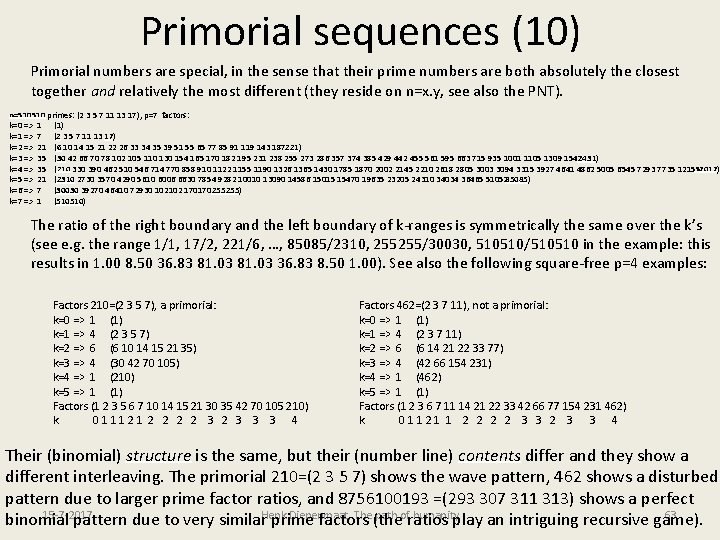
Primorial sequences (10) Primorial numbers are special, in the sense that their prime numbers are both absolutely the closest together and relatively the most different (they reside on n=x. y, see also the PNT). n=510510 primes: (2 3 5 7 11 13 17), p=7 factors: k=0 => 1 (1) k=1 => 7 (2 3 5 7 11 13 17) k=2 => 21 (6 10 14 15 21 22 26 33 34 35 39 51 55 65 77 85 91 119 143 187 221) k=3 => 35 (30 42 66 70 78 102 105 110 130 154 165 170 182 195 231 238 255 273 286 357 374 385 429 442 455 561 595 663 715 935 1001 1105 1309 1547 2431) k=4 => 35 (210 330 390 462 510 546 714 770 858 910 1122 1155 1190 1326 1365 1430 1785 1870 2002 2145 2210 2618 2805 3003 3094 3315 3927 4641 4862 5005 6545 7293 7735 12155 17017) k=5 => 21 (2310 2730 3570 4290 5610 6006 6630 7854 9282 10010 13090 14586 15015 15470 19635 23205 24310 34034 36465 51051 85085) k=6 => 7 (30030 39270 46410 72930 102102 170170 255255) k=7 => 1 (510510) The ratio of the right boundary and the left boundary of k-ranges is symmetrically the same over the k’s (see e. g. the range 1/1, 17/2, 221/6, …, 85085/2310, 255255/30030, 510510/510510 in the example: this results in 1. 00 8. 50 36. 83 81. 03 36. 83 8. 50 1. 00). See also the following square-free p=4 examples: Factors 210=(2 3 5 7), a primorial: k=0 => 1 (1) k=1 => 4 (2 3 5 7) k=2 => 6 (6 10 14 15 21 35) k=3 => 4 (30 42 70 105) k=4 => 1 (210) k=5 => 1 (1) Factors (1 2 3 5 6 7 10 14 15 21 30 35 42 70 105 210) k 0 1 1 1 2 2 3 3 3 4 Factors 462=(2 3 7 11), not a primorial: k=0 => 1 (1) k=1 => 4 (2 3 7 11) k=2 => 6 (6 14 21 22 33 77) k=3 => 4 (42 66 154 231) k=4 => 1 (462) k=5 => 1 (1) Factors (1 2 3 6 7 11 14 21 22 33 42 66 77 154 231 462) k 0 1 1 2 1 1 2 2 3 3 2 3 3 4 Their (binomial) structure is the same, but their (number line) contents differ and they show a different interleaving. The primorial 210=(2 3 5 7) shows the wave pattern, 462 shows a disturbed pattern due to larger prime factor ratios, and 8756100193 =(293 307 311 313) shows a perfect 15 -7 -2017 Henk Diepenmaat, The path of humanity 63 binomial pattern due to very similar prime factors (the ratios play an intriguing recursive game).
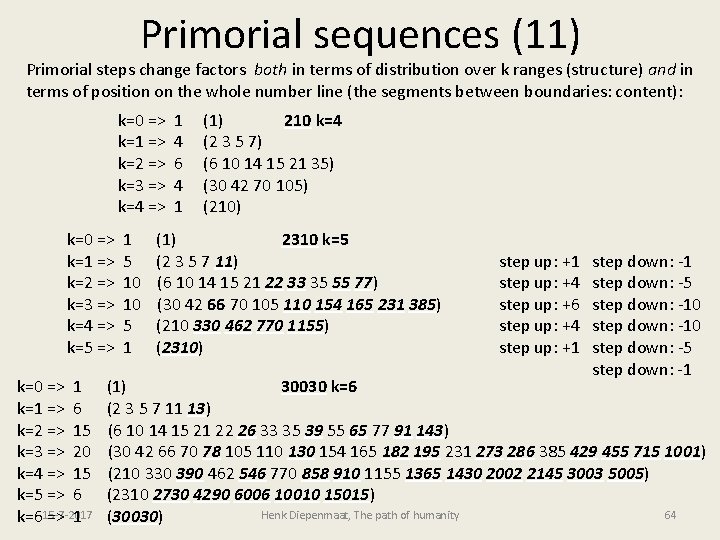
Primorial sequences (11) Primorial steps change factors both in terms of distribution over k ranges (structure) and in terms of position on the whole number line (the segments between boundaries: content): k=0 => 1 (1) 210 k=4 k=1 => 4 (2 3 5 7) k=2 => 6 (6 10 14 15 21 35) k=3 => 4 (30 42 70 105) k=4 => 1 (210) k=0 => 1 (1) 2310 k=5 k=1 => 5 (2 3 5 7 11) k=2 => 10 (6 10 14 15 21 22 33 35 55 77) k=3 => 10 (30 42 66 70 105 110 154 165 231 385) k=4 => 5 (210 330 462 770 1155) k=5 => 1 (2310) step up: +1 step down: -1 step up: +4 step down: -5 step up: +6 step down: -10 step up: +4 step down: -10 step up: +1 step down: -5 step down: -1 k=0 => 1 (1) 30030 k=6 k=1 => 6 (2 3 5 7 11 13) k=2 => 15 (6 10 14 15 21 22 26 33 35 39 55 65 77 91 143) k=3 => 20 (30 42 66 70 78 105 110 130 154 165 182 195 231 273 286 385 429 455 715 1001) k=4 => 15 (210 330 390 462 546 770 858 910 1155 1365 1430 2002 2145 3003 5005) k=5 => 6 (2310 2730 4290 6006 10010 15015) 15 -7 -2017 Henk Diepenmaat, The path of humanity 64 k=6 => 1 (30030)
Primorial sequences (12) In terms of sawtooth and ordered sawtooth representation: 1. For higher and higher primorial numbers, (on average and in the long run) the ordered sawtooth representation must become more and more similar to the sawtooth representation. (This is a very slow process due to the ln. ) 2. The interleaving can never disappear completely. 3. The peak regions of the sawtooth are the most likely candidates for interleaving (as they represent the highest and lowest numbers of the constituting k-ranges, they will “spread” mostly, see earlier examples of kranges: binomial peaks will “wear down”). 4. As a result, more and more complex wave patterns will be the result of following the primorial sequence upward. 5. In case of a high p (a high number of prime factors), the binomial curve emerges. In case of a very high p, an illusion of continuity arises. (This is why the weights of oranges in a box statistically will constitute a bell curve. ) 15 -7 -2017 Henk Diepenmaat, The path of humanity 65
Some slides for the philosophically brave (1) This surely gives a lot of food for thought from a philosophical point of view (see the book). 1. The wave patterns find their origin in the successive emergence and ordering of prime numbers. Due to interleaving, sawtooths turn into ordered sawtooths. For primorial numbers the sawtooths turn into ordered sawtooths that show wave patterns. Put otherwise: the ordered sawtooth of a primorial number is a symmetrical wave pattern. 1. But on a deeper level the waves follow from a perspectivistic need of a consciousness to be maximally “reconfigurable”, i. e. to be both diverse and flexible. Prime numbers asymptotically step in to facilitate this, and primorial numbers therefore offer a good deal in this respect. The factors of a primorial number will fill the inversely proportional line with whole numbers (quants) in such a way that “the stepping is easiest”: many stepping stones on convenient distances. The best place is on the diagonal. 1. Waves are central to Quantum Theory. Recursive Perspectivism and The path of humanity exhibit many quantum theoretical features (see the book). 15 -7 -2017 Henk Diepenmaat, The path of humanity 66
Some slides for the philosophically brave (2) 1. The book “The path of humanity” offers an intriguing viewpoint with respect to a perspectivistic consciousness. The arguments are more refined than I can explain here, but I will present a very succint summary. 2. Consciousness is as much about “content” (objectively, ultimately from the outside, “das Ding an sich”) as it is about “structure”, and more in specific configurability (subjectively, ultimately from the inside, from within a “self”). In combination they shape perspectivistic configurations (meaning). This is one of the philosophical cornerstones of Recursive Perspectivism (it is anti-dualistic and spectral in nature). 3. We do not experience wave patterns (or power laws, bell curves, Zipf’s law, Benford’s law, Pareto principles et cetera; I recognize them as a family of perspectivistic “pattern laws” in the book) because they are “out there”, a priori, objectively. We first create and then use them because, when making sense of “our environment”, “our consciousness” prefers and will construct and will remember perspectivistic configurations that can easily be reconfigured and reused, in order to meet new and unanticipated situations quickly, effectively and efficiently, for reasons of expediency, improvement and value generation. 4. This implies: A: When in the possession of n perspectives (a theoretical capacity), the most reconfigurable configuration is the one uses all of its prime factors. B: The other way around: the most variable and reconfigurable configurations possess the maximum number of different prime factors. that 5. A and B in combination result in a preference for perspectivistic configurations that both have a lot of prime factors (configurability) and a lot of factors (diversity, variability). Preferred numbers balance a maximum number of configurations with a minimum of redundancy (squared numbers exhibit redundancy). Primorial numbers offer a good choice purely on these theoretical grounds, but primorial numbers exhibiting some low level squares perform even better in some cases (the book presents formulas). And this very process is the cause of the existence of pattern laws! 6. Lump sum: we construct pattern laws rather unconsciously and ex aequo, while improving, they take shape rather than that they exist a priori (beforehand). 15 -7 -2017 Henk Diepenmaat, The path of humanity 67
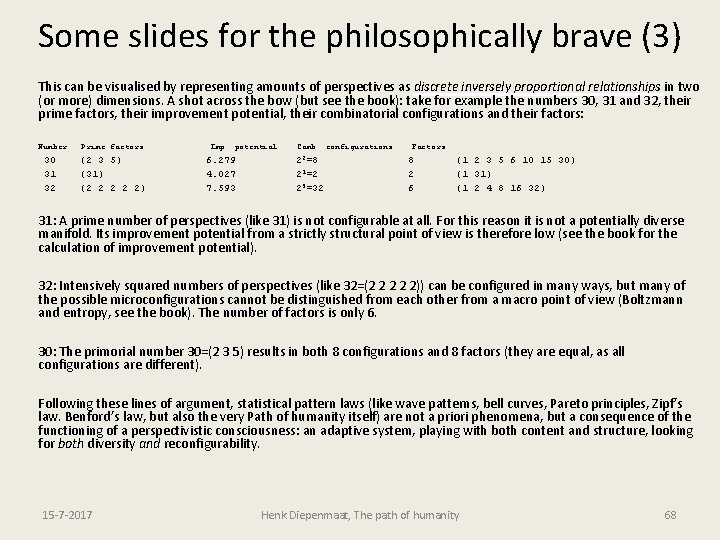
Some slides for the philosophically brave (3) This can be visualised by representing amounts of perspectives as discrete inversely proportional relationships in two (or more) dimensions. A shot across the bow (but see the book): take for example the numbers 30, 31 and 32, their prime factors, their improvement potential, their combinatorial configurations and their factors: Number Prime factors Imp. potential Comb. configurations Factors 30 (2 3 5) 6. 279 23=8 8 (1 2 3 5 6 10 15 30) 31 (31) 4. 027 21=2 2 (1 31) 32 (2 2 2) 7. 593 25=32 6 (1 2 4 8 16 32) 31: A prime number of perspectives (like 31) is not configurable at all. For this reason it is not a potentially diverse manifold. Its improvement potential from a strictly structural point of view is therefore low (see the book for the calculation of improvement potential). 32: Intensively squared numbers of perspectives (like 32=(2 2 2)) can be configured in many ways, but many of the possible microconfigurations cannot be distinguished from each other from a macro point of view (Boltzmann and entropy, see the book). The number of factors is only 6. 30: The primorial number 30=(2 3 5) results in both 8 configurations and 8 factors (they are equal, as all configurations are different). Following these lines of argument, statistical pattern laws (like wave patterns, bell curves, Pareto principles, Zipf’s law. Benford’s law, but also the very Path of humanity itself) are not a priori phenomena, but a consequence of the functioning of a perspectivistic consciousness: an adaptive system, playing with both content and structure, looking for both diversity and reconfigurability. 15 -7 -2017 Henk Diepenmaat, The path of humanity 68

7: Climbing Mount Riemann (first expedition) 15 -7 -2017 Henk Diepenmaat, The path of humanity 69
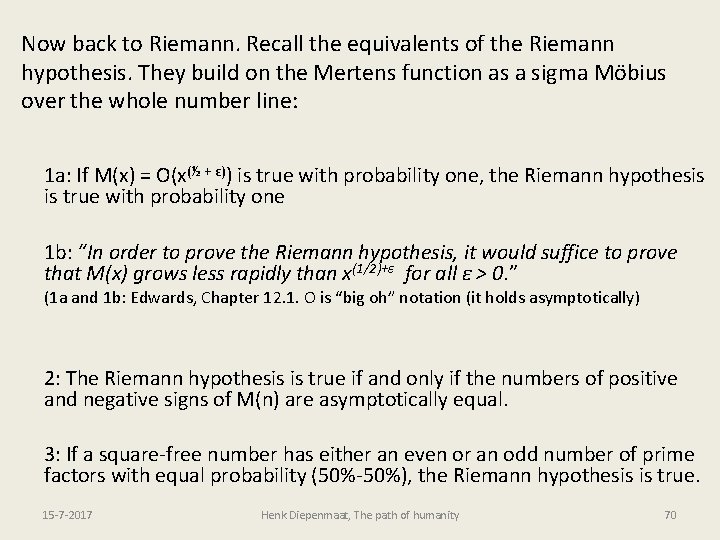
Now back to Riemann. Recall the equivalents of the Riemann hypothesis. They build on the Mertens function as a sigma Möbius over the whole number line: 1 a: If M(x) = O(x(½ + ε)) is true with probability one, the Riemann hypothesis is true with probability one 1 b: “In order to prove the Riemann hypothesis, it would suffice to prove that M(x) grows less rapidly than x(1/2)+ε for all ε > 0. ” (1 a and 1 b: Edwards, Chapter 12. 1. O is “big oh” notation (it holds asymptotically) 2: The Riemann hypothesis is true if and only if the numbers of positive and negative signs of M(n) are asymptotically equal. 3: If a square-free number has either an even or an odd number of prime factors with equal probability (50%-50%), the Riemann hypothesis is true. 15 -7 -2017 Henk Diepenmaat, The path of humanity 70
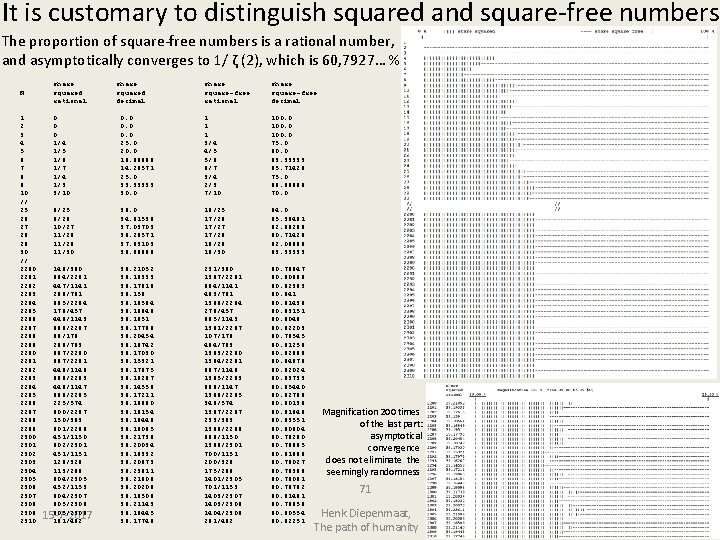
It is customary to distinguish squared and square-free numbers The proportion of square-free numbers is a rational number, and asymptotically converges to 1/ ζ (2), which is 60, 7927… % share N squared square-free rational decimal 1 0 0. 0 100. 0 2 0 0. 0 100. 0 3 0 0. 0 100. 0 4 1/4 25. 0 3/4 75. 0 5 1/5 20. 0 4/5 80. 0 6 1/6 16. 66666 5/6 83. 33333 7 1/7 14. 28571 6/7 85. 71429 8 1/4 25. 0 3/4 75. 0 9 1/3 33. 33333 2/3 66. 66666 10 3/10 30. 0 7/10 70. 0 // 25 9/25 36. 0 16/25 64. 0 26 9/26 34. 61538 17/26 65. 38461 27 10/27 37. 03703 17/27 62. 96296 28 11/28 39. 28571 17/28 60. 71428 29 11/29 37. 93103 18/29 62. 06896 30 11/30 36. 66666 19/30 63. 33333 // 2280 149/380 39. 21052 231/380 60. 78947 2281 894/2281 39. 19333 1387/2281 60. 80666 2282 447/1141 39. 17616 694/1141 60. 82383 2283 298/761 39. 159 463/761 60. 841 2284 895/2284 39. 18564 1389/2284 60. 81436 2285 179/457 39. 16849 278/457 60. 83151 2286 448/1143 39. 1951 695/1143 60. 8049 2287 896/2287 39. 17796 1391/2287 60. 82203 2288 69/176 39. 20454 107/176 60. 79545 2289 299/763 39. 18742 464/763 60. 81258 2290 897/2290 39. 17030 1393/2290 60. 82969 2291 897/2291 39. 15321 1394/2291 60. 84679 2292 449/1146 39. 17975 697/1146 60. 82024 2293 898/2293 39. 16267 1395/2293 60. 83733 2294 449/1147 39. 14559 698/1147 60. 85440 2295 899/2295 39. 17211 1396/2295 60. 82789 2296 225/574 39. 19860 349/574 60. 80139 2297 900/2297 39. 18154 1397/2297 60. 81846 2298 150/383 39. 16449 233/383 60. 83551 2299 901/2299 39. 19095 1398/2299 60. 80904 2300 451/1150 39. 21739 699/1150 60. 78260 2301 902/2301 39. 20034 1399/2301 60. 79965 2302 451/1151 39. 18332 700/1151 60. 81668 2303 129/329 39. 20973 200/329 60. 79027 2304 113/288 39. 23611 175/288 60. 76389 2305 904/2305 39. 21909 1401/2305 60. 78091 2306 452/1153 39. 20208 701/1153 60. 79792 2307 904/2307 39. 18509 1403/2307 60. 81491 2308 905/2308 39. 21143 1403/2308 60. 78856 2309 905/2309 39. 19445 1404/2309 60. 80554 2310 181/462 39. 17749 281/462 60. 82251 15 -7 -2017 Magnification 200 times of the last part: asymptotical convergence does not eliminate the seemingly randomness 71 Henk Diepenmaat, The path of humanity
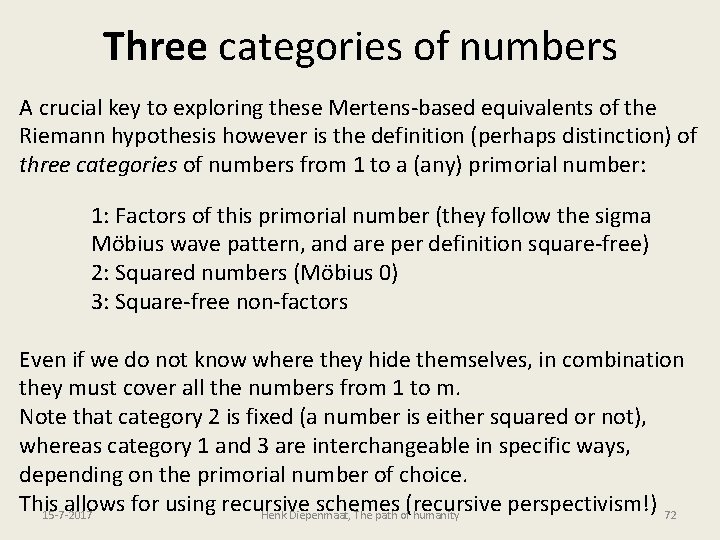
Three categories of numbers A crucial key to exploring these Mertens-based equivalents of the Riemann hypothesis however is the definition (perhaps distinction) of three categories of numbers from 1 to a (any) primorial number: 1: Factors of this primorial number (they follow the sigma Möbius wave pattern, and are per definition square-free) 2: Squared numbers (Möbius 0) 3: Square-free non-factors Even if we do not know where they hide themselves, in combination they must cover all the numbers from 1 to m. Note that category 2 is fixed (a number is either squared or not), whereas category 1 and 3 are interchangeable in specific ways, depending on the primorial number of choice. This allows for using recursive schemes (recursive perspectivism!) 15 -7 -2017 Henk Diepenmaat, The path of humanity 72
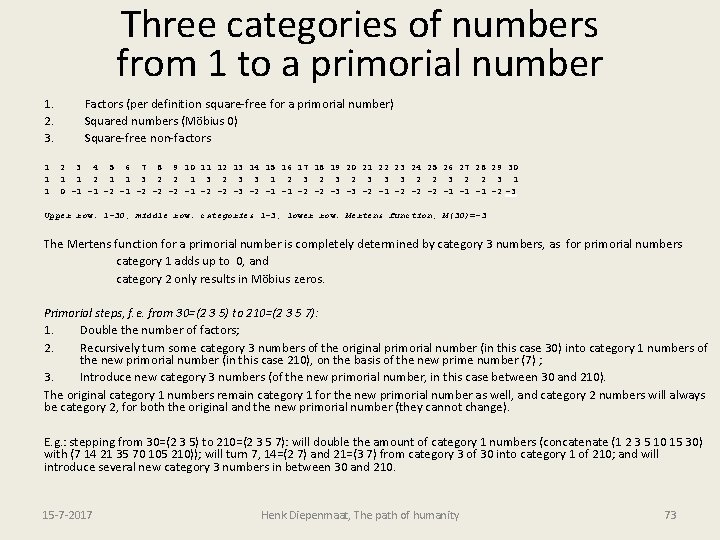
Three categories of numbers from 1 to a primorial number 1. 2. 3. Factors (per definition square-free for a primorial number) Squared numbers (Möbius 0) Square-free non-factors 1 2 3 4 5 6 7 8 9 10 11 12 13 14 15 16 17 18 19 20 21 22 23 24 25 26 27 28 29 30 1 1 1 2 1 1 3 2 2 1 3 2 3 3 1 2 3 2 3 3 3 2 2 3 1 1 0 -1 -1 -2 -2 -2 -1 -2 -2 -3 -2 -1 -1 -2 -2 -3 -3 -2 -1 -2 -2 -2 -1 -1 -1 -2 -3 Upper row: 1 -30, middle row: categories 1 -3, lower row: Mertens function, M(30)=-3 The Mertens function for a primorial number is completely determined by category 3 numbers, as for primorial numbers category 1 adds up to 0, and category 2 only results in Möbius zeros. Primorial steps, f. e. from 30=(2 3 5) to 210=(2 3 5 7): 1. Double the number of factors; 2. Recursively turn some category 3 numbers of the original primorial number (in this case 30) into category 1 numbers of the new primorial number (in this case 210), on the basis of the new prime number (7) ; 3. Introduce new category 3 numbers (of the new primorial number, in this case between 30 and 210). The original category 1 numbers remain category 1 for the new primorial number as well, and category 2 numbers will always be category 2, for both the original and the new primorial number (they cannot change). E. g. : stepping from 30=(2 3 5) to 210=(2 3 5 7): will double the amount of category 1 numbers (concatenate (1 2 3 5 10 15 30) with (7 14 21 35 70 105 210)); will turn 7, 14=(2 7) and 21=(3 7) from category 3 of 30 into category 1 of 210; and will introduce several new category 3 numbers in between 30 and 210. 15 -7 -2017 Henk Diepenmaat, The path of humanity 73
Exploring the second and third equivalent The book provides the second and third ‘equivalent’ of the Riemann hypothesis (see before) with a proof on the basis of Pascal’s Triangle, fp, the three categories and primorial steps. This proof uses reductio ad absurdum (inspired by Euclid: we are full circle here). Perhaps the second and the third equivalents are true equivalents of the Riemann hypothesis, and perhaps reductio ad absurdum is a valid way to prove them. Under these assumptions, I am inclined to think that the book proves the Riemann hypothesis. However, I am not sure at all, for the following reasons. Firstly, I am not a mathematician. I am hardly familiar with the mathematical culture, which is rather inaccessible, and in some respects even unattractive for passersby like me. Secondly, I (therefore) hardly recognize and use typical mathematical methods and lines of reasoning. Thirdly and furthermore, as a reflective pragmatist I am far from sure whether it is possible at all to formally prove ultimately experiental phenomena like number lines and the Riemann observation. 15 -7 -2017 Henk Diepenmaat, The path of humanity 74
That being said, the points A B C D E F below summarize the line of argument of a proposed proof for equivalents 2 and 3 (see the book for details): A: Starting at 1 and going upward to any m, every square-free number you will encounter is a factor of a specific smallest (but larger than m) square-free number. 1. Let nsmall be a square-free number <= m, that is not a factor of a larger squarefree number nlarge. 2. nsmall would have to be “strange” with respect to nlarge, in the sense that at least one of the prime factors of nsmall would not appear on the prime factorisation of nlarge. 3. It therefore is possible to construct a new square-free number nevenlarger by taking the product of the prime factors of nsmall and nlarge, and dividing it by the product of prime factors that appear twice in this extended prime factorisation. 4. Now nsmall is a square-free number, that is a factor of a larger square-free number, viz. the newly constructed nevenlarger. 5. This is in contradiction with 1, and therefore the opposite is true. In this way, while going up, all the square-free numbers encounteredthat are not yet a factor of the original larger number can be made a factor of a new larger square-free number. In essence we follow the primorial sequence. (This process is recursive. ) 15 -7 -2017 Henk Diepenmaat, The path of humanity 75
B: Now take any primorial number (they are square-free by definition). Category 1 numbers of a primorial number consist exactly for 50% of numbers with an even, and for 50% of numbers with an uneven prime factorisation (see the book and fp). C: All category 3 numbers of this (any) primorial number, however large this primorial number, either with even or uneven prime factorisation, can always be transported to (or turned into) category 1 of a higher primorial number. The prime factorisation of this higher primorial number is obtained by concatenating the ‘strange’ prime factors of the successive category 3 numbers of the original primorial number and the prime factors of the original primorial number. The higher primorial number itself follows from multiplying the concatenated prime factors. (This procedure can be repeated: a recursion of primorial steps. ) D: B and C can only recursively (endlessly) be true in combination if the complete reservoir of not yet in category 1 included square-free numbers consists exactly for 50% of numbers with an even and for 50% of numbers with an odd prime factorisation. E: This complete reservoir (see D: ) consists of the category 3 numbers of the primorial number in question plus all the square-free numbers larger than this primorial number. F: As a result, equivalents 2 and 3 of the Riemann hypothesis must be true. 15 -7 -2017 Henk Diepenmaat, The path of humanity 76
The first expedition in highlights: Category 1 numbers of a primorial number are square-free, and 50% even and 50% uneven. They follow an ordered sawtooth wave pattern, they optimally fill a discrete inverse proportional line while balancing number of prime factors and diversity of prime factors. Successive category 3 numbers can always be turned into category 1 numbers by primorial steps. The higher the primorial step, the more sawtooth the resulting pattern will be (the less interleaving will take place, at least on average, see the prime number theorem). In order to let this be true, category 3 numbers of a primorial number (they are square-free) and all the square-free numbers > this primorial number, taken together, must be 50% even and 50% odd. As a result, the total number of even square-free numbers must equal the total number of odd square-free numbers. As a result, the numbers of positive and negative signs of M(n) must be asymptotically equal. ===> 2: The Riemann hypothesis is true if and only if the numbers of positive and negative signs of M(n) are asymptotically equal. 3: If a square-free number has either an even or an odd number of prime factors with equal probability (50%-50%), the Riemann hypothesis is true. 15 -7 -2017 Henk Diepenmaat, The path of humanity 77
8: Climbing Mount Riemann (second expedition) 15 -7 -2017 Henk Diepenmaat, The path of humanity 78
Are 2 and 3 really equivalents of the Riemann hypothesis? Dicey stuff! But I did not fire all my guns yet. There is more to explore, using Pascal’s Triangle, fp, primorial sequences and wave patterns. The key here is condensation: the phenomenon that while making primorial steps, category 3 numbers are turned into category 1 numbers, and that starting from 1 and going to the right side, category 1 becomes more and more thinned out and almost totally replaced by category 3. (A strong analogy with Bose-Einstein condensation from physics exists. ) The first equivalents of the Riemann hypothesis (1 a and 1 b, repeated below for convenience) are well established equivalents by mathematicians of fame, so let’s direct our attention to them: 1 a: If M(x) = O(x(½ + ε)) is true with probability one, the Riemann hypothesis is true with probability one 1 b: “In order to prove the Riemann hypothesis, it would suffice to prove that M(x) grows less rapidly than x(1/2)+ε for all ε > 0. ” (1 a and 1 b: Edwards, Chapter 12. 1. O is “big oh” notation – it holds asymptotically) 15 -7 -2017 Henk Diepenmaat, The path of humanity 79
Firstly back to Denjoy and fp: Relating coin tossing experiments and the Mertens function (1) Consider the following two sentences: 1: For an increasing sequence of count tossings, ‘with probability 1 the number of heads minus the number of tails grows less rapidly than N(1/2)+ε`’ (Edwards). 2: The (annihilative) average of an increasing number of sequences of n coin tossings will approach the binomial pattern of the nth row of Pascal’s triangle. 15 -7 -2017 Henk Diepenmaat, The path of humanity 80
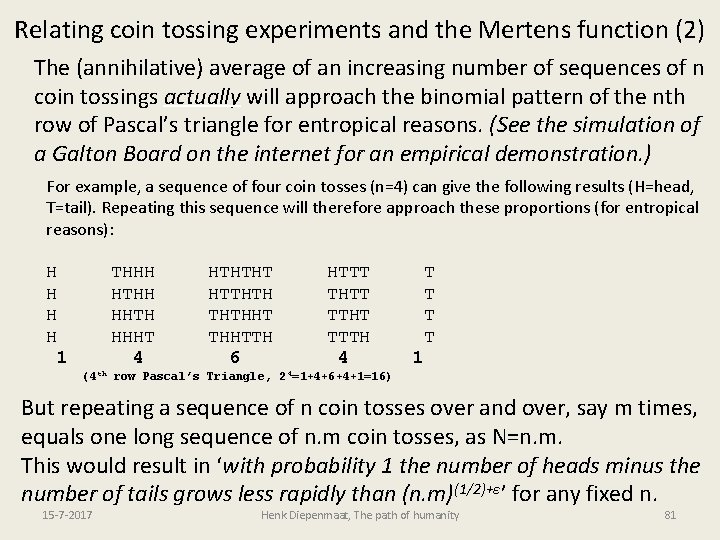
Relating coin tossing experiments and the Mertens function (2) The (annihilative) average of an increasing number of sequences of n coin tossings actually will approach the binomial pattern of the nth row of Pascal’s triangle for entropical reasons. (See the simulation of a Galton Board on the internet for an empirical demonstration. ) For example, a sequence of four coin tosses (n=4) can give the following results (H=head, T=tail). Repeating this sequence will therefore approach these proportions (for entropical reasons): H THHH HTHTHT HTTT T H HTHH HTTHTH THTT T H HHTH THTHHT TTHT T H HHHT THHTTH T 1 4 6 4 1 (4 th row Pascal’s Triangle, 2 4=1+4+6+4+1=16) But repeating a sequence of n coin tosses over and over, say m times, equals one long sequence of n. m coin tosses, as N=n. m. This would result in ‘with probability 1 the number of heads minus the number of tails grows less rapidly than (n. m)(1/2)+ε’ for any fixed n. 15 -7 -2017 Henk Diepenmaat, The path of humanity 81
Relating coin tossing experiments and the Mertens function (3) n and m are discretely inversely proportional with respect to N(1/2)+ε: If we would divide the length of a sequence of coin tosses (n) by 2 (or 3 or 4 or …), we would have to multiply the number of sequences of coin tosses (m) by 2 (or 3 or 4 or …), in order to maintain the same bound (n. m)(1/2)+ε. If we would multiply the length of a sequence of coin tosses (n) by 2 (or 3 or 4 or …), we would have to divide the number of sequences of coin tosses (m) by 2 (or 3 or 4 or …), in order to maintain the same bound (n. m)(1/2)+ε. 15 -7 -2017 Henk Diepenmaat, The path of humanity 82
Relating coin tossing experiments and the Mertens function (4) If n is fixed, and m is getting larger and larger than n, we may use N(1/2)+ε as a substitute for (n. m)(1/2)+ε. However, if n is fixed, and m is getting smaller and smaller than n, using N(1/2)+ε as a substitute for (n. m)(1/2)+ε in most cases would be grossly wrong. The reason is that, in a stochastical process like a coin tossing, in order for this substitution to be valid, the number of repetitions m must be large with respect to the variability in the pattern n. Also the difference between N and the nearest product n. m must not be large. However, as m will grow larger and larger than n, this difference on average will become smaller and smaller. 15 -7 -2017 Henk Diepenmaat, The path of humanity 83
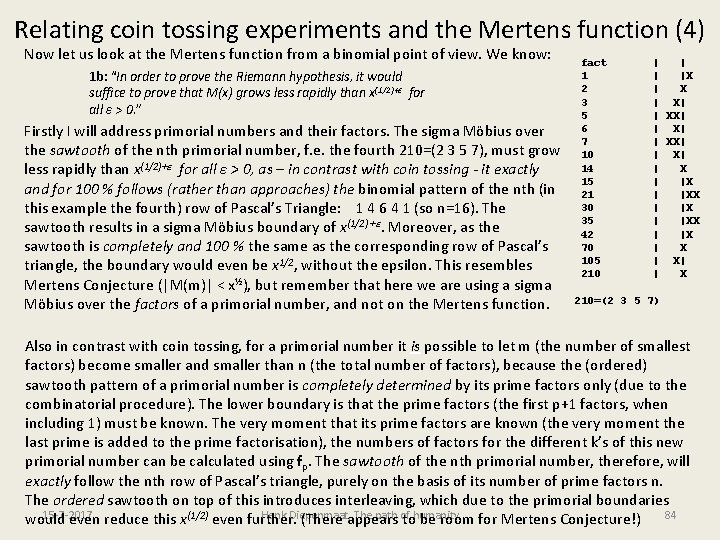
Relating coin tossing experiments and the Mertens function (4) Now let us look at the Mertens function from a binomial point of view. We know: 1 b: “In order to prove the Riemann hypothesis, it would suffice to prove that M(x) grows less rapidly than x(1/2)+ε for all ε > 0. ” Firstly I will address primorial numbers and their factors. The sigma Möbius over the sawtooth of the nth primorial number, f. e. the fourth 210=(2 3 5 7), must grow less rapidly than x(1/2)+ε for all ε > 0, as – in contrast with coin tossing - it exactly and for 100 % follows (rather than approaches) the binomial pattern of the nth (in this example the fourth) row of Pascal’s Triangle: 1 4 6 4 1 (so n=16). The sawtooth results in a sigma Möbius boundary of x(1/2) +ε. Moreover, as the sawtooth is completely and 100 % the same as the corresponding row of Pascal’s triangle, the boundary would even be x 1/2, without the epsilon. This resembles Mertens Conjecture (|M(m)| < x½), but remember that here we are using a sigma Möbius over the factors of a primorial number, and not on the Mertens function. fact | | 1 | |X 2 | X 3 | X| 5 | XX| 6 | X| 7 | XX| 10 | X| 14 | X 15 | |X 21 | |XX 30 | |X 35 | |XX 42 | |X 70 | X 105 | X| 210 | X 210=(2 3 5 7) Also in contrast with coin tossing, for a primorial number it is possible to let m (the number of smallest factors) become smaller and smaller than n (the total number of factors), because the (ordered) sawtooth pattern of a primorial number is completely determined by its prime factors only (due to the combinatorial procedure). The lower boundary is that the prime factors (the first p+1 factors, when including 1) must be known. The very moment that its prime factors are known (the very moment the last prime is added to the prime factorisation), the numbers of factors for the different k’s of this new primorial number can be calculated using fp. The sawtooth of the nth primorial number, therefore, will exactly follow the nth row of Pascal’s triangle, purely on the basis of its number of prime factors n. The ordered sawtooth on top of this introduces interleaving, which due to the primorial boundaries 15 -7 -2017 Henk Diepenmaat, The path of humanity 84 (1/2) even further. (There appears to be room for Mertens Conjecture!) would even reduce this x
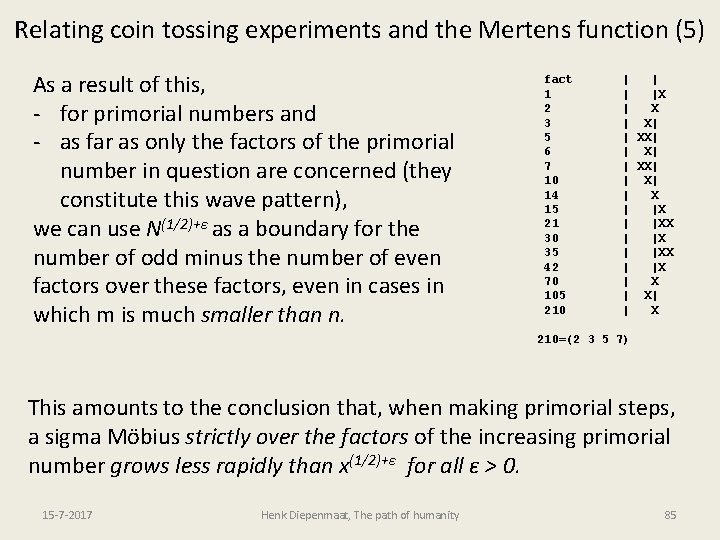
Relating coin tossing experiments and the Mertens function (5) As a result of this, - for primorial numbers and - as far as only the factors of the primorial number in question are concerned (they constitute this wave pattern), we can use N(1/2)+ε as a boundary for the number of odd minus the number of even factors over these factors, even in cases in which m is much smaller than n. fact | | 1 | |X 2 | X 3 | X| 5 | XX| 6 | X| 7 | XX| 10 | X| 14 | X 15 | |X 21 | |XX 30 | |X 35 | |XX 42 | |X 70 | X 105 | X| 210 | X 210=(2 3 5 7) This amounts to the conclusion that, when making primorial steps, a sigma Möbius strictly over the factors of the increasing primorial number grows less rapidly than x(1/2)+ε for all ε > 0. 15 -7 -2017 Henk Diepenmaat, The path of humanity 85
Relating coin tossing experiments and the Mertens function (6) 1. The only remaining hurdle for a direct proof of equivalent 1 a and 1 b of the Riemann hypothesis now is that the factors of a primorial number (i. e. category 1 numbers: square-free by definition) are interleaved with squared numbers that are not factors of this primorial number (i. e. category 3 numbers). 2. Category 3 numbers act as the Riemann hypothesis proof spoilers. See for example M(30)=-3, the resulting minus three is entirely due to the category 3 numbers of 30 (the example is presented on slide 73). 3. Category 1 numbers x of a primorial number n 1 reside on the discrete inverse proportionality n 1=x. y. They are 100 % scale invariant when making a primorial step: when multiplying all x with the next prime number in line z, all (x. z, y) will reside on n 2= n 1. z=(x. z). y. 4. Those numbers that are category 3 due to z and only z will be turned into category 1 by the primorial step. The others will remain category 3. (For this reason category 3 numbers are the proof spoilers for the Riemann hypothesis. ) 5. The category 3 RH proof spoilers seem to be extremely irregular. But are they really , and is understanding this really an impregnable fortress? 15 -7 -2017 Henk Diepenmaat, The path of humanity 86
The key question therefore is: 1. Category 3 numbers are the proof spoilers for the Riemann hypothesis. They seem to be untouchable, to withdraw themselves from analysis. They emerge seemingly randomly, and alternate Möbius +1 and -1 in seemingly unpredictable ways, resulting in wildly fluctuating Mertens function values. But are they really untouchable, do they really withstand analysis? 2. Thinking this through: all square-free numbers to be encountered must be either category 1 or 3. In essence all category 3 numbers simply are vacancies for category 1 numbers to be added of future primorial steps. They simply are waiting for the primorial step that turns them from category 3 into 1. We do not know which primorial step this will be, or of what k-range the factor will be. But we do know that this primorial step will come. Consecutive primorial steps will turn category 3 numbers into category 1 numbers. The process has strong analogies with physical condensation (Bose -Einstein): configurability would resemble conductivity. 3. The PNT will even tell us on average when a new primorial step will be possible, as ∏(n) ~ n/ln(n). We can be 100% sure that, after each new primorial step, the firstly encountered category 3 number will be turned into 15 -7 -2017 Henk Diepenmaat, The path of humanity 87 category 1 by the next primorial step (see the boundaries discussion earlier).
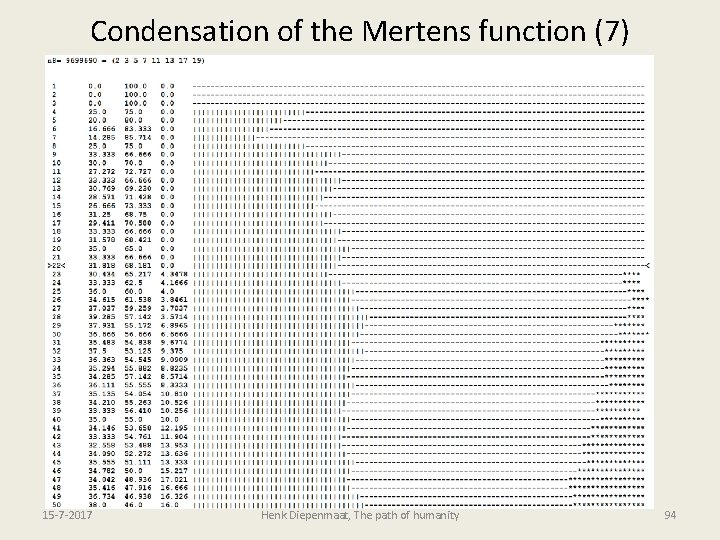
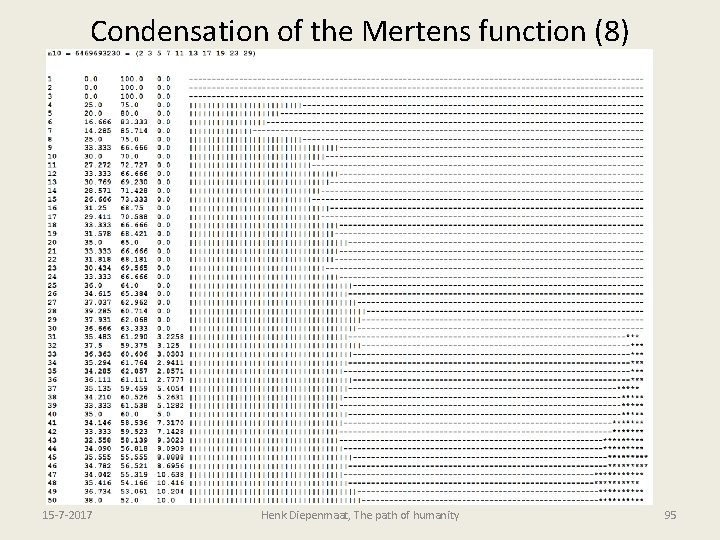
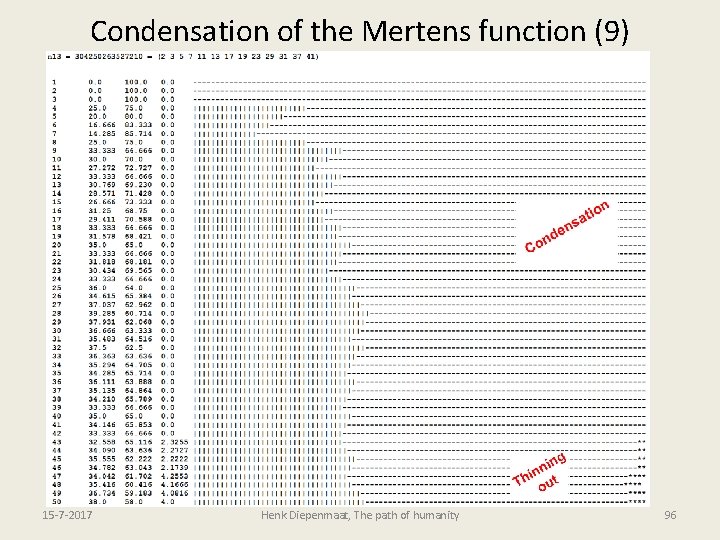
Condensation of the Mertens function (1) 1. For this reason, while making primorial steps, an increasingly growing segment from 1 upward will not contain category 3 numbers at all. (An upward moving frontier, although it will require an ever stronger microscope!) 2. This growing category 3 free starting segment ranges from 1 to THE NEW PRIME NUMBER THAT IS TO BE ADDED IN THE NEXT PRIMORIAL STEP MINUS 1. 3. As a crucial consequence, a growing first part of the sigma Möbius over the factors of a primorial number will be completely identical to the Mertens function on this segment (Möbius zero’s are skipped as they do not alter the Mertens function). 4. In summary: while making primorial steps, the Mertens function and the Sigma Möbius over the factors of the primorial number of concern will become exactly (!) equal for a growing (!) segment. 5. As a consequence, due to the absence of category 3 proof spoilers in this condensation area, the Riemann hypothesis must be true! 15 -7 -2017 Henk Diepenmaat, The path of humanity 88
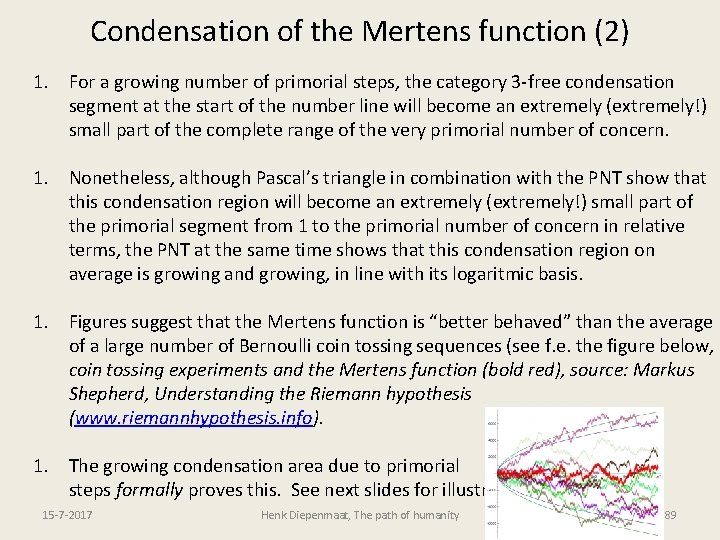
Condensation of the Mertens function (2) 1. For a growing number of primorial steps, the category 3 -free condensation segment at the start of the number line will become an extremely (extremely!) small part of the complete range of the very primorial number of concern. 1. Nonetheless, although Pascal’s triangle in combination with the PNT show that this condensation region will become an extremely (extremely!) small part of the primorial segment from 1 to the primorial number of concern in relative terms, the PNT at the same time shows that this condensation region on average is growing and growing, in line with its logaritmic basis. 1. Figures suggest that the Mertens function is “better behaved” than the average of a large number of Bernoulli coin tossing sequences (see f. e. the figure below, coin tossing experiments and the Mertens function (bold red), source: Markus Shepherd, Understanding the Riemann hypothesis (www. riemannhypothesis. info). 1. The growing condensation area due to primorial steps formally proves this. See next slides for illustrations. 15 -7 -2017 Henk Diepenmaat, The path of humanity 89
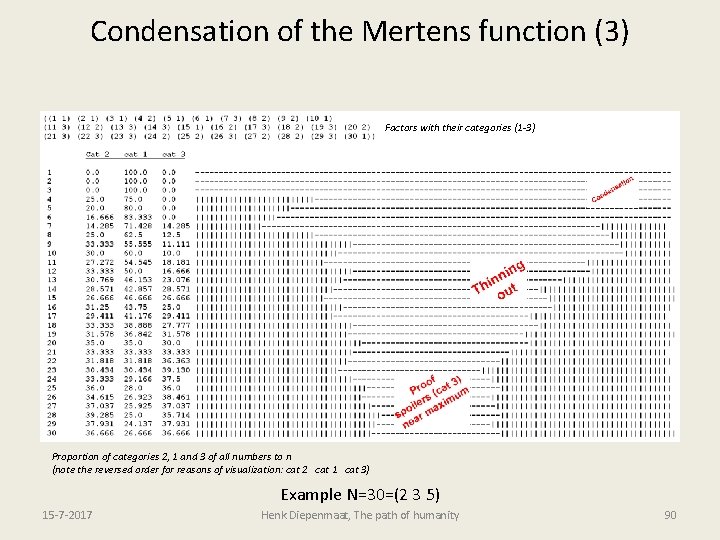
Condensation of the Mertens function (3) Factors with their categories (1 -3) Proportion of categories 2, 1 and 3 of all numbers to n (note the reversed order for reasons of visualization: cat 2 cat 1 cat 3) Example N=30=(2 3 5) 15 -7 -2017 Henk Diepenmaat, The path of humanity 90
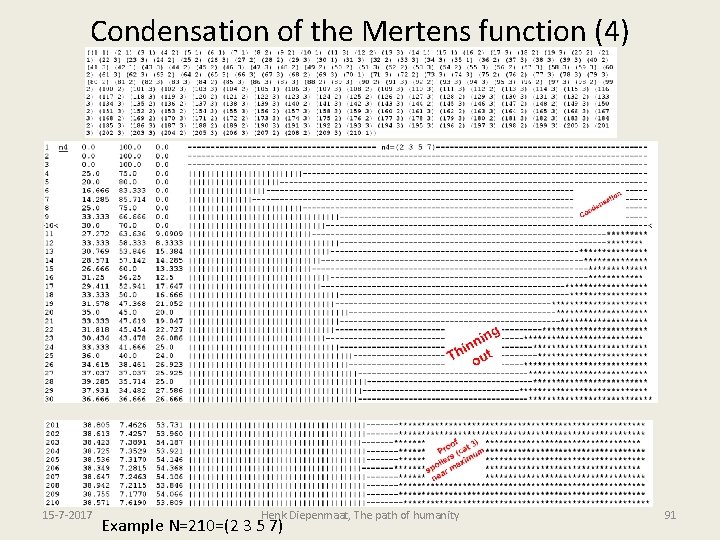
Condensation of the Mertens function (4) 15 -7 -2017 Henk Diepenmaat, The path of humanity Example N=210=(2 3 5 7) 91
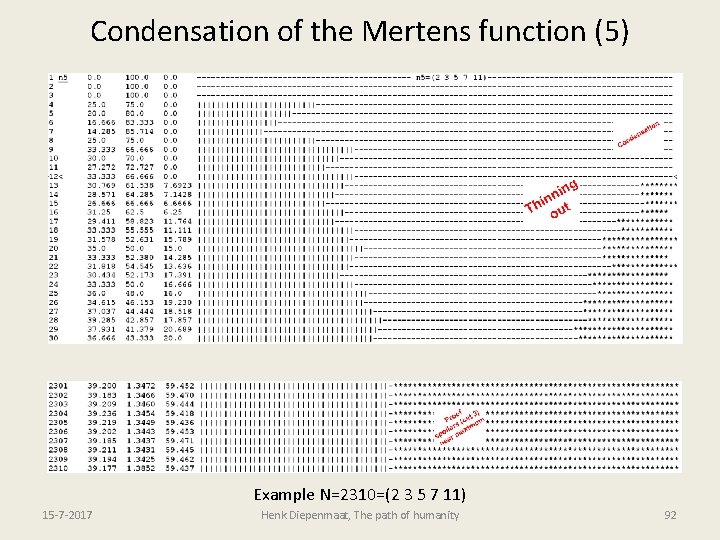
Condensation of the Mertens function (5) Example N=2310=(2 3 5 7 11) 15 -7 -2017 Henk Diepenmaat, The path of humanity 92
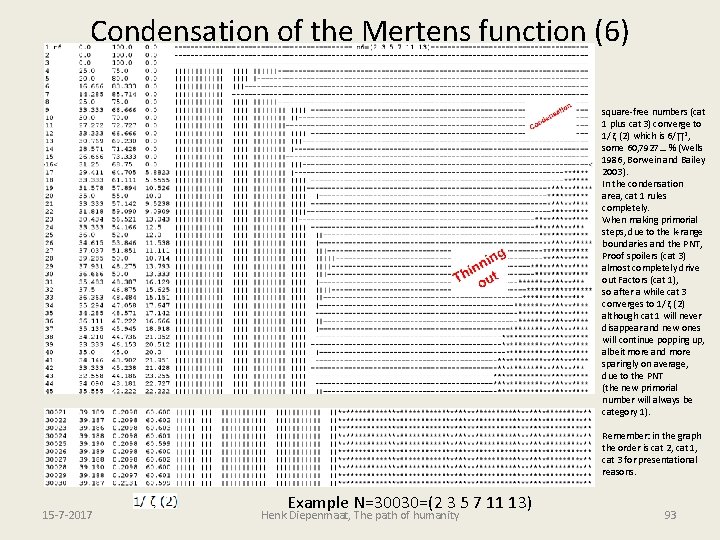
Condensation of the Mertens function (6) square-free numbers (cat 1 plus cat 3) converge to 1/ ζ (2) which is 6/∏ 2, some 60, 7927… % (Wells 1986, Borwein and Bailey 2003). In the condensation area, cat 1 rules completely. When making primorial steps, due to the k-range boundaries and the PNT, Proof spoilers (cat 3) almost completely drive out Factors (cat 1), so after a while cat 3 converges to 1/ ζ (2) although cat 1 will never disappear and new ones will continue popping up, albeit more and more sparingly on average, due to the PNT (the new primorial number will always be category 1). Remember: in the graph the order is cat 2, cat 1, cat 3 for presentational reasons. 15 -7 -2017 Example N=30030=(2 3 5 7 11 13) Henk Diepenmaat, The path of humanity 93
Condensation of the Mertens function (7) 15 -7 -2017 Henk Diepenmaat, The path of humanity 94
Condensation of the Mertens function (8) 15 -7 -2017 Henk Diepenmaat, The path of humanity 95
Condensation of the Mertens function (9) 15 -7 -2017 Henk Diepenmaat, The path of humanity 96
The behaviour of category 3 numbers on both ends 1. Square-free numbers (cat 1 plus cat 3) converge to 1/ ζ (2) which is 6/∏ 2, some 60, 7927… % (Wells 1986, Borwein and Bailey 2003). 2. While making a primorial step, the primorial segment will grow larger - the former primorial number is multiplied by the new prime number. On average and in the long run this growth therefore must be logaritmic, in line with the PNT. 3. While making a primorial step, at the beginning of the primorial segment, the category 3 free condensation area will grow from the new prime number minus 1 to the subsequent prime number minus one (NB: the subsequent prime number is the new prime number of the next primorial step following this one, the anticipated step). On average and in the long run this growth must be logarithmic, in line with the PNT. Note however that, although the condensation area is smaller, and the condensation process does not involve multiplication, this condensation area growth is one step ahead (minus one) with respect to the growth of the primorial segment itself. 4. While making a primorial step, at the end of the (growing) primorial segment, category 3 numbers will take almost full control. The last category 1 number will always be the new primorial number, i. e. the last primorial number multiplied by the new prime number, and the second last category 1 number will be its half (the thinning out of category 1 numbers is also governed on average and in the long run by the PNT) 5. In sum, category 3 numbers will disappear at the very beginning of the primorial segment (on a growing condensation area), and category 1 numbers will thin out towards the end of the primorial segment. On average and in the long run, both of these processes are logarithmic as they are governed by the PNT. (However, the condensation area is running one logaritmic step ahead (minus 1). ) 15 -7 -2017 Henk Diepenmaat, The path of humanity 97
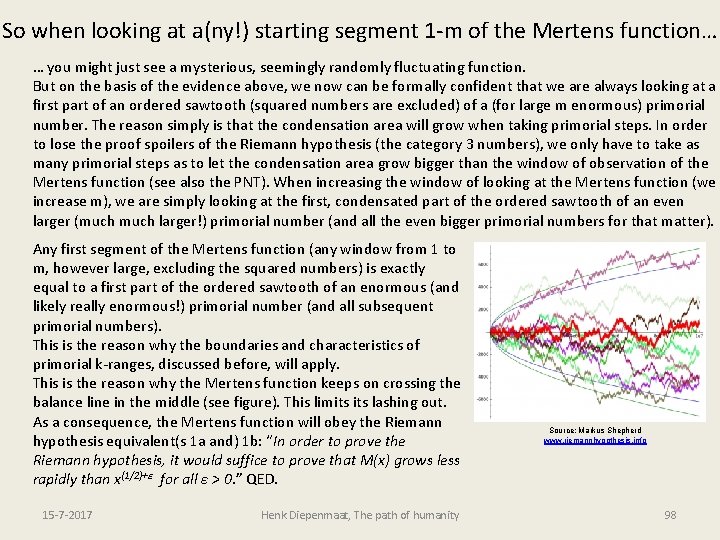
So when looking at a(ny!) starting segment 1 -m of the Mertens function… … you might just see a mysterious, seemingly randomly fluctuating function. But on the basis of the evidence above, we now can be formally confident that we are always looking at a first part of an ordered sawtooth (squared numbers are excluded) of a (for large m enormous) primorial number. The reason simply is that the condensation area will grow when taking primorial steps. In order to lose the proof spoilers of the Riemann hypothesis (the category 3 numbers), we only have to take as many primorial steps as to let the condensation area grow bigger than the window of observation of the Mertens function (see also the PNT). When increasing the window of looking at the Mertens function (we increase m), we are simply looking at the first, condensated part of the ordered sawtooth of an even larger (much larger!) primorial number (and all the even bigger primorial numbers for that matter). Any first segment of the Mertens function (any window from 1 to m, however large, excluding the squared numbers) is exactly equal to a first part of the ordered sawtooth of an enormous (and likely really enormous!) primorial number (and all subsequent primorial numbers). This is the reason why the boundaries and characteristics of primorial k-ranges, discussed before, will apply. This is the reason why the Mertens function keeps on crossing the balance line in the middle (see figure). This limits lashing out. As a consequence, the Mertens function will obey the Riemann hypothesis equivalent(s 1 a and) 1 b: “In order to prove the Riemann hypothesis, it would suffice to prove that M(x) grows less rapidly than x(1/2)+ε for all ε > 0. ” QED. 15 -7 -2017 Henk Diepenmaat, The path of humanity Source: Markus Shepherd www. riemannhypothesis. info 98
Summary of the second expedition (1): 1. Three categories of numbers were distinguished for the segment from 1 to a (primorial) number. The segment from 1 (inclusive) to a primorial number I call the primorial segment of this primorial number. The three categories allow for a recursive scheme of primorial steps. 2. Category 3 numbers of a primorial number are the “proof spoilers” for the Riemann hypothesis. However, when following the number line upwards, all to be encountered category 3 numbers can always be turned into category 1 numbers by means of a continuous sequence of primorial steps. The category 3 numbers are severely interleaved though. 3. This recursive primorial sequence is governed by the interleaving boundaries described before. These boundaries are asymptotically controlled by the Prime Number Theorem. In a more fundamental way, they are rooted in the very prime numbers themselves and follow well defined recursive schemes (see Pascal’s triangle, and the recursive actor space in the book). 4. At the start of the number line, while making primorial steps, as a result of these boundaries a growing completely category 3 free segment manifests itself (the condensation area or segment, from 1 to the next prime number minus 1). As a primorial step anticipates this next prime number, and prime numbers follow the PNT, on average and in the long run this growing condensation segment will obey the PNT. 5. At the end of the primorial segment, while making primorial steps, as a result of these boundaries a growing segment between half the primorial number of concern and the primorial number will be completely category 1 free. For an increasing number of primorial steps, the share of category 3 numbers in this last segment therefore will become more and more equal to the share of all square 15 -7 -2017 Henk Diepenmaat, The path of humanity 99 free numbers (although category 1 numbers can never disappear completely, as
Summary of the second expedition (2): 6. Category 1 numbers will take up all of the square-free positions of the condensation segment of the number line of the primorial number of concern. 7. Category 1 numbers on average will thin out going to the right on the primorial segment. 8. The second last category 1 number on the primorial segment is half the primorial number, and the last category 1 number is the primorial number itself on the very edge of the primorial segment. 9. Primorial steps can continue indefinitely and category 1 numbers can never disappear for the same reason that prime numbers will continue indefinitely and can never disappear (the infinitude of prime numbers, Euclid). 10. Category 3 numbers will take up almost all of the square-free positions of the primorial segment at the right (between the primorial number and its half). Almost, because the primorial number will be the last category 1 number, and half the primorial number will be the second but last category 1 number. 11. The third but last category 3 number will be far more difficult to calculate, as this is/may be an interleaver. 12. Category 3 numbers on average will thin out going from right to left on the number line, and completely disappear at a growing start segment for the very same reasons that prime numbers thin out going from left to right (the Prime Number Theorem). 13. By means of making more and more primorial steps, we can let category 3 numbers thin out and even completely disappear (in a growing condensation region) from left to right. 14. As a consequence, although we may not know in advance how many primorial steps are required, by starting and continuing primorial steps, the Mertens function from 1 to any m at some point must become exactly equal to the first part of a Sigma Möbius function over the factors of a primorial number. We may stop with taking primorial steps as soon as the condensation area of the primorial number of concern reaches m, and it will (higher primorial numbers will do fine as well). 15. A long enough sequence of primorial steps eventually will have expelled all the proof spoiling category 3 numbers. As a consequence the boundary conditions for factors and k-ranges of primorial steps do apply on the complete Mertens segment 1 -m. As a result the Riemann hypothesis must be true. 15 -7 -2017 Henk Diepenmaat, The path of humanity 100
Cutting corners: a very short third expedition I must confess: so far I was not short of words. At the end of this presentation, let’s try cutting some corners. When making a primorial step: 1. The primorial number will increase with a factor equal to the lastly added prime number. This increase will be logaritmic on average and in the long run (see the Prime Number Theorem). 2. The number of factors will double (all original factors are multiplied by the lastly added prime number, resulting in an equal amount of new factors, exactly scale invariant, and the factors of the new primorial number are the concatenation of these two sets). 3. Half of all the factors of each new primorial number must fall in a first (smaller and relatively shrinking) part of the primorial segment: this segment lies exactly between 0 and the square root of the new primorial number (see fp and the book). The other half must fall in a remaining second (larger and relatively expanding) part: between this same square root and the new primorial number (inclusive). A crucial obervation now is that ln x increases slower than any power of x. This includes the square root (which is x½, x to the power ½), which separates the first and the second segment equally dividing all factors, mentioned directly above. This is explained in detail in Derbyshire’s Prime Obsession (Chapter 5, Riemann’s zeta function, paragraph IV). As a consequence of the recursive nature of primorial steps, the relative amount of category 1 numbers will increase mostly, and for a growing segment even will equal 100 % (condensation), at the beginning of any primorial segment, and decrease mostly at the end. (During primorial steps, category 3 is being driven out, and this also is exactly what the graphs presented before show. ) But then again: the Riemann hypothesis must be true. 15 -7 -2017 Henk Diepenmaat, The path of humanity 101
Epilogue 1. I started this presentation with the following words: I am neither a mathematician nor a physicist. I hardly use a mathematical or physical style of argument or reasoning. I do not claim proficiency in either of these fields. Professionally, I am best characterized as a reflective pragmatist who uses a broad spectrum of scientific insights. In addition to this, I value and enjoy philosophizing and theorizing. However, what inspires me most and always remains my focal point is improving societal practice itself. And for this very reason I’ve entered the domain of number theory and the Riemann hypothesis. 2. It may be clear: I think it holds water, I have written down my ideas for a proof, and this is as far as I can bring it for now. 3. I am not sure (and I sometimes even doubt) whether the exposé so far would impress, or even make sense to a professional mathematician. It may well be error-ridden at some places. But that isn’t the goal of this presentation anyhow. I hope it will help in giving attention to recursive perspectivism and its implications for human development and societal innovation, the main themes of the forthcoming book. All three the Riemann hypothesis, Recursive Perspectivism and The path of humanity are built on prime numbers, and this has important implications for human development and societal innovation. It may be of help in finding better ways to a more sustainable, a better future. 4. For these very reasons I’ve written this presentation. Of course I am open for comments and corrections. But most of all, I would like to suggest that you read “The path of humanity”, and engage in the explorations it continues. Thank you for your attention. 15 -7 -2017 Henk Diepenmaat, The path of humanity 102
Epilogue “A scientist is supposed to have a complete and thorough knowledge, at first hand, of some subjects and, therefore, is usually expected not to write on any topic of which he is not a master. This is regarded as a matter of noblesse oblige. For the present purpose I beg to renounce the noblesse, if any, and to be freed of the ensuing obligation. My excuse is as follows: We have inherited from our forefathers the keen longing for unified, all-embracing knowledge. The very name given to the highest institutions of learning remind us, that from antiquity and throughout many centuries, the universal aspect has been the only one to be given full credit. But the spread, both in width and depth, of the multifarious branches of knowledge during the last hundred odd years has confronted us with a queer dilemma. We feel clearly that we are only now beginning to require reliable material for welding together the sum total of all that is known into a whole; but, on the other hand, it has become next to impossible for a single mind to fully command more than a small specialized portion of it. I can see no other escape from this dilemma (lest our true aim be lost forever) than that some of us should venture to embark on a synthesis of facts and theories, albeit with second-hand incomplete knowledge of some of them – and at the risk of making fools of ourselves. So much for my apology. ” (Erwin Schrödinger, preface “What is Life? ” 1944. ) 15 -7 -2017 Henk Diepenmaat, The path of humanity 103

About Henk Diepenmaat, Ph. D MSc (1962), is the director of Actors Process Management Ltd, a small consulting firm. He lives on the edge of a forest in Zeist, a village in the centre of the Netherlands, with his wife and two young adult sons. His primary expertise is in multi-actor process management and societal innovation. He is a professorial fellow at the International Centre for Integrated Assessment and Sustainable Development (ICIS) at Maastricht University in the Netherlands. Henk has thirty years’ experience in getting a deep understanding of complex playing fields and working purposefully in them. Through his work, he creates value for businesses, governments, citizens, consumers, and other actors. Professionally, Henk is best characterized as a reflective practitioner who uses a broad spectrum of scientific insights. In addition to this, he values and enjoys philosophizing and theorizing. However, what inspires him most and always remains his focal point is improving societal practice itself. In order to contribute to societal improvement, Henk advises and supports businesses, governments, and other organizations in strategy, innovation, and business or policy development and deployment. He is available for in-company and open workshops, lectures, and training in multi-actor process management and innovation. In these activities, he makes a point of using (and stretching) the actual interests and situations of the participants’ work and lives as ingredients for case studies so as to add relevance and meaning in order to facilitate maximum learning. Henk has written several books, including a handbook Multi-Actor Process Management in Theory and Practice (in Dutch, English in preparation), and his magnum opus The Path of Humanity: Societal Innovation for the World of Tomorrow (in press). Henk holds two master’s degrees (chemistry, Radboud University, Nijmegen, the Netherlands, and environmental sciences, Wageningen University, the Netherlands; knowledge and information technology, Middlesex University, London). His Ph. D research was about theory and practice of multi-actor processes (Faculties of Spatial Sciences and Social Sciences, University of Amsterdam). Contact: henk. diepenmaat@actors. nl +31650217516 15 -7 -2017 Henk Diepenmaat, The path of humanity 104
- Slides: 104