SAT Solver CS 680 Formal Methods Jeremy Johnson

- Slides: 28
SAT Solver CS 680 Formal Methods Jeremy Johnson
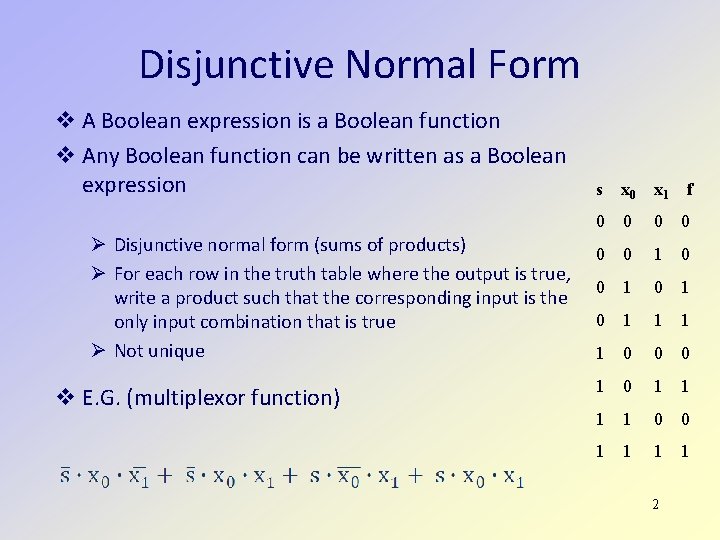
Disjunctive Normal Form A Boolean expression is a Boolean function Any Boolean function can be written as a Boolean expression s x 0 x 1 f 0 0 Disjunctive normal form (sums of products) For each row in the truth table where the output is true, write a product such that the corresponding input is the only input combination that is true Not unique E. G. (multiplexor function) 0 0 1 0 0 1 1 0 0 0 1 1 0 0 1 1 2
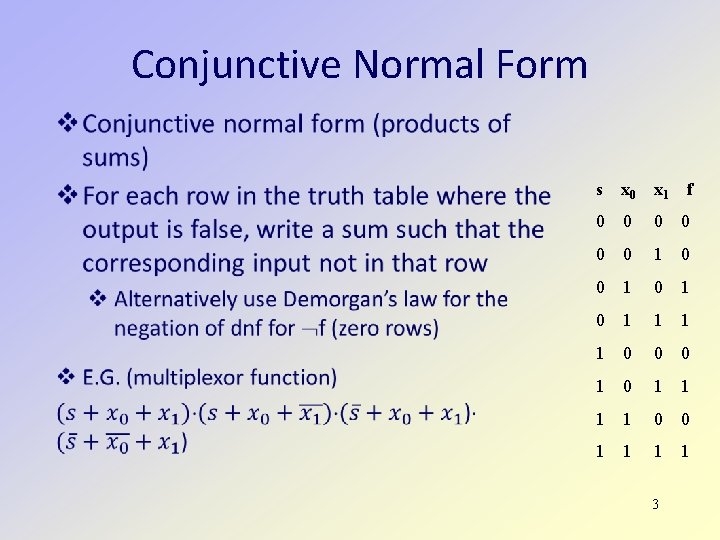
Conjunctive Normal Form s x 0 x 1 f 0 0 1 0 0 1 1 0 0 0 1 1 0 0 1 1 3
Satisfiability A formula is satisfiable if there is an assignment to the variables that make the formula true A formula is unsatisfiable if all assignments to variables eval to false A formula is falsifiable if there is an assignment to the variables that make the formula false A formula is valid if all assignments to variables eval to true (a valid formula is a theorem or tautology)
Satisfiability Checking to see if a formula f is satisfiable can be done by searching a truth table for a true entry Exponential in the number of variables Does not appear to be a polynomial time algorithm (satisfiability is NP-complete) There are efficient satisfiability checkers that work well on many practical problems Checking whether f is satisfiable can be done by checking if f is not valid An assignment that evaluates to false provides a counter example to validity
DNF vs CNF It is easy to determine if a boolean expression in DNF is satisfiable but difficult to determine if it is valid It is easy to determine if a boolean expression in CNF is valid but difficult to determine if it is satisfiable It is possible to convert any boolean expression to DNF or CNF; however, there can be exponential blowup
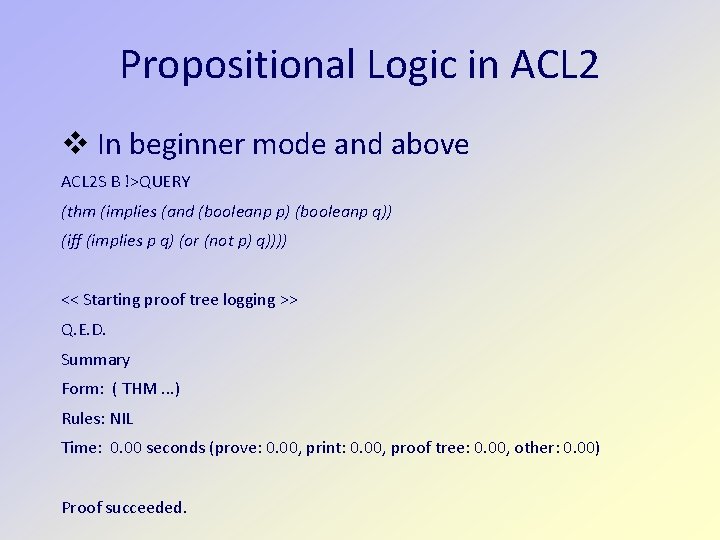
Propositional Logic in ACL 2 In beginner mode and above ACL 2 S B !>QUERY (thm (implies (and (booleanp p) (booleanp q)) (iff (implies p q) (or (not p) q)))) << Starting proof tree logging >> Q. E. D. Summary Form: ( THM. . . ) Rules: NIL Time: 0. 00 seconds (prove: 0. 00, print: 0. 00, proof tree: 0. 00, other: 0. 00) Proof succeeded.
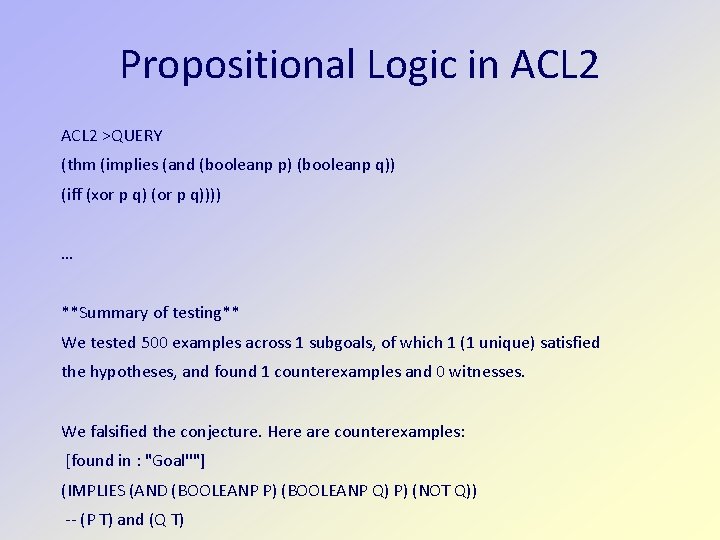
Propositional Logic in ACL 2 >QUERY (thm (implies (and (booleanp p) (booleanp q)) (iff (xor p q) (or p q)))) … **Summary of testing** We tested 500 examples across 1 subgoals, of which 1 (1 unique) satisfied the hypotheses, and found 1 counterexamples and 0 witnesses. We falsified the conjecture. Here are counterexamples: [found in : "Goal''"] (IMPLIES (AND (BOOLEANP P) (BOOLEANP Q) P) (NOT Q)) -- (P T) and (Q T)
SAT Solvers Input expected in CNF Using DIMACS format One clause per line delimited by 0 Variables encoded by integers, not variable encoded by negating integer We will use Mini. SAT (minisat. se)
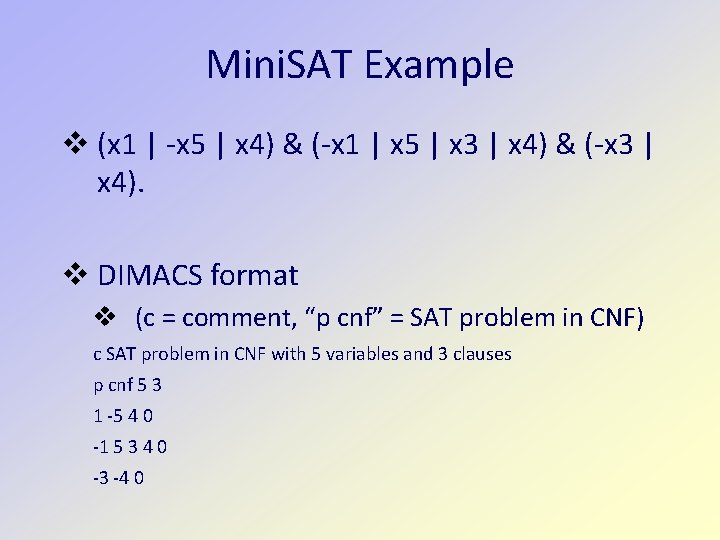
Mini. SAT Example (x 1 | -x 5 | x 4) & (-x 1 | x 5 | x 3 | x 4) & (-x 3 | x 4). DIMACS format (c = comment, “p cnf” = SAT problem in CNF) c SAT problem in CNF with 5 variables and 3 clauses p cnf 5 3 1 -5 4 0 -1 5 3 4 0 -3 -4 0
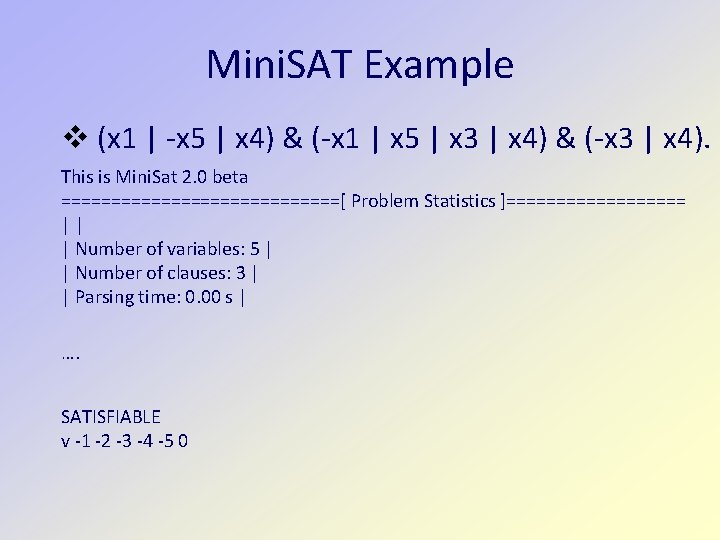
Mini. SAT Example (x 1 | -x 5 | x 4) & (-x 1 | x 5 | x 3 | x 4) & (-x 3 | x 4). This is Mini. Sat 2. 0 beta ==============[ Problem Statistics ]========= | | | Number of variables: 5 | | Number of clauses: 3 | | Parsing time: 0. 00 s | …. SATISFIABLE v -1 -2 -3 -4 -5 0
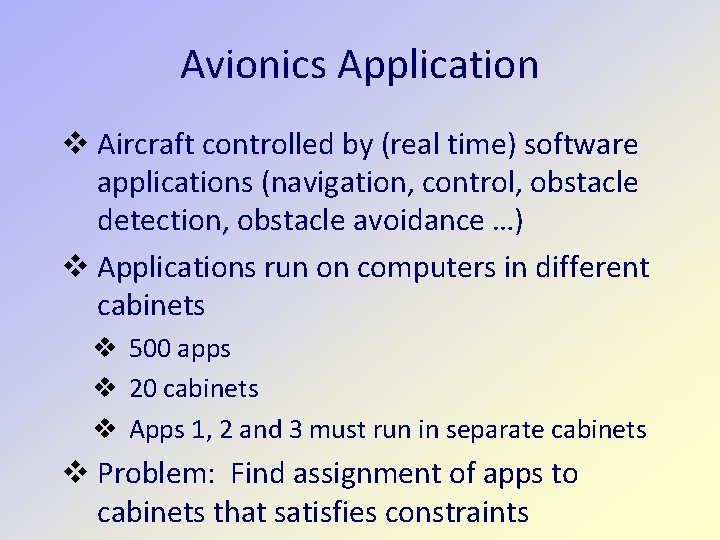
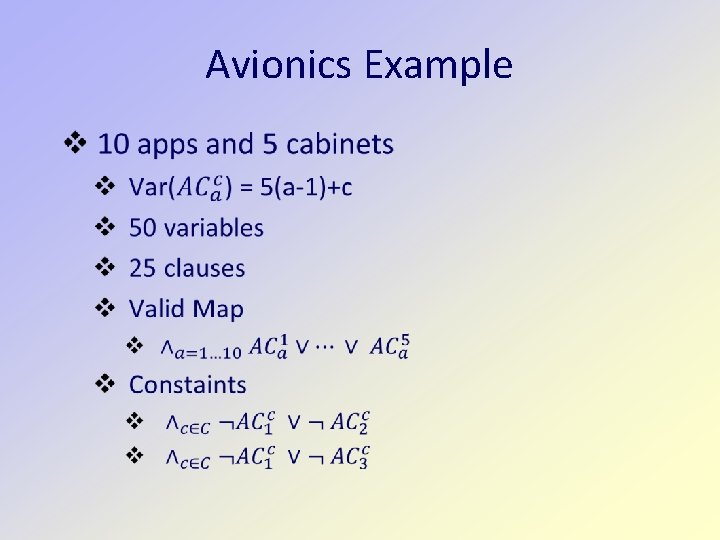
Avionics Application Aircraft controlled by (real time) software applications (navigation, control, obstacle detection, obstacle avoidance …) Applications run on computers in different cabinets 500 apps 20 cabinets Apps 1, 2 and 3 must run in separate cabinets Problem: Find assignment of apps to cabinets that satisfies constraints
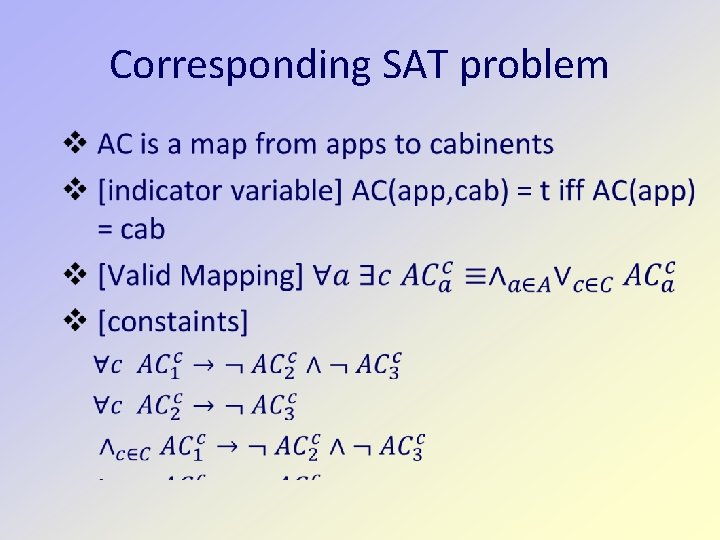
Corresponding SAT problem
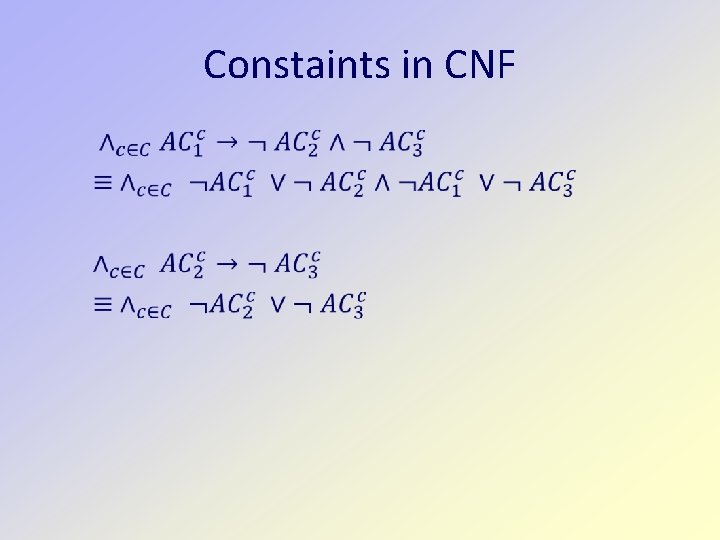
Constaints in CNF
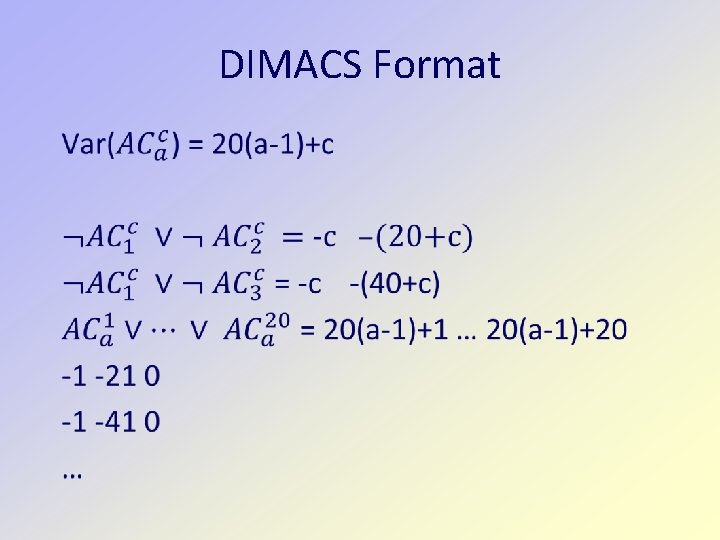
DIMACS Format
Avionics Example
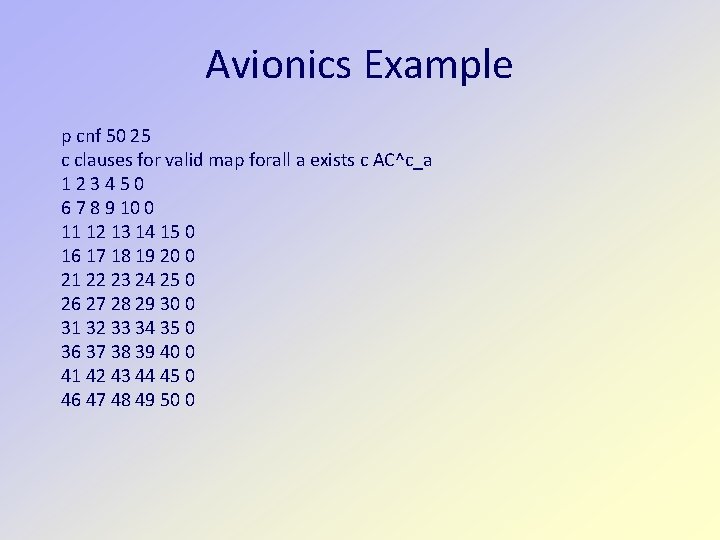
Avionics Example p cnf 50 25 c clauses for valid map forall a exists c AC^c_a 1 2 3 4 5 0 6 7 8 9 10 0 11 12 13 14 15 0 16 17 18 19 20 0 21 22 23 24 25 0 26 27 28 29 30 0 31 32 33 34 35 0 36 37 38 39 40 0 41 42 43 44 45 0 46 47 48 49 50 0
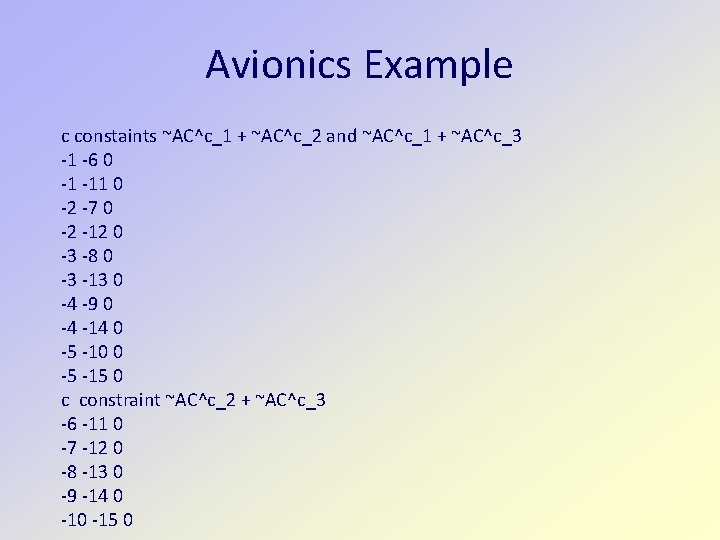
Avionics Example c constaints ~AC^c_1 + ~AC^c_2 and ~AC^c_1 + ~AC^c_3 -1 -6 0 -1 -11 0 -2 -7 0 -2 -12 0 -3 -8 0 -3 -13 0 -4 -9 0 -4 -14 0 -5 -10 0 -5 -15 0 c constraint ~AC^c_2 + ~AC^c_3 -6 -11 0 -7 -12 0 -8 -13 0 -9 -14 0 -15 0
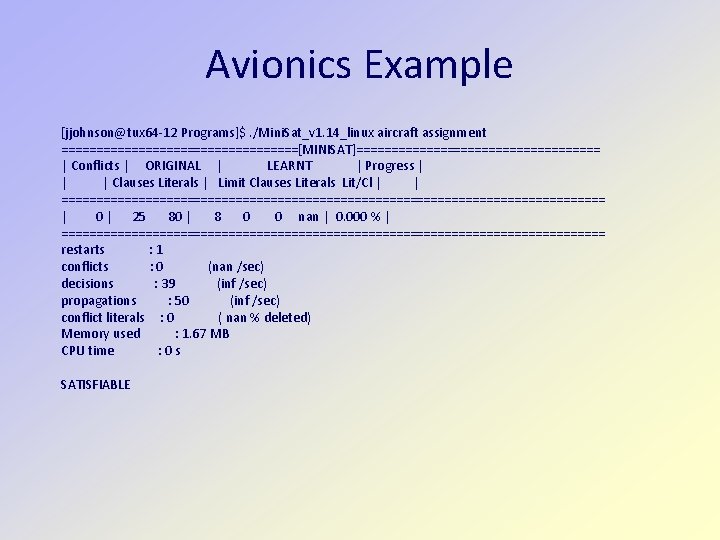
Avionics Example [jjohnson@tux 64 -12 Programs]$. /Mini. Sat_v 1. 14_linux aircraft assignment =================[MINISAT]================== | Conflicts | ORIGINAL | LEARNT | Progress | | | Clauses Literals | Limit Clauses Literals Lit/Cl | | ======================================= | 0 | 25 80 | 8 0 0 nan | 0. 000 % | ======================================= restarts : 1 conflicts : 0 (nan /sec) decisions : 39 (inf /sec) propagations : 50 (inf /sec) conflict literals : 0 ( nan % deleted) Memory used : 1. 67 MB CPU time : 0 s SATISFIABLE
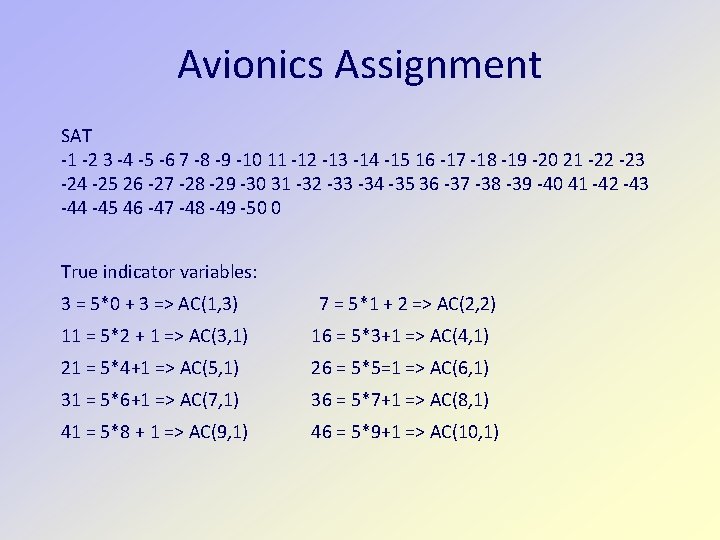
Avionics Assignment SAT -1 -2 3 -4 -5 -6 7 -8 -9 -10 11 -12 -13 -14 -15 16 -17 -18 -19 -20 21 -22 -23 -24 -25 26 -27 -28 -29 -30 31 -32 -33 -34 -35 36 -37 -38 -39 -40 41 -42 -43 -44 -45 46 -47 -48 -49 -50 0 True indicator variables: 3 = 5*0 + 3 => AC(1, 3) 7 = 5*1 + 2 => AC(2, 2) 11 = 5*2 + 1 => AC(3, 1) 16 = 5*3+1 => AC(4, 1) 21 = 5*4+1 => AC(5, 1) 26 = 5*5=1 => AC(6, 1) 31 = 5*6+1 => AC(7, 1) 36 = 5*7+1 => AC(8, 1) 41 = 5*8 + 1 => AC(9, 1) 46 = 5*9+1 => AC(10, 1)
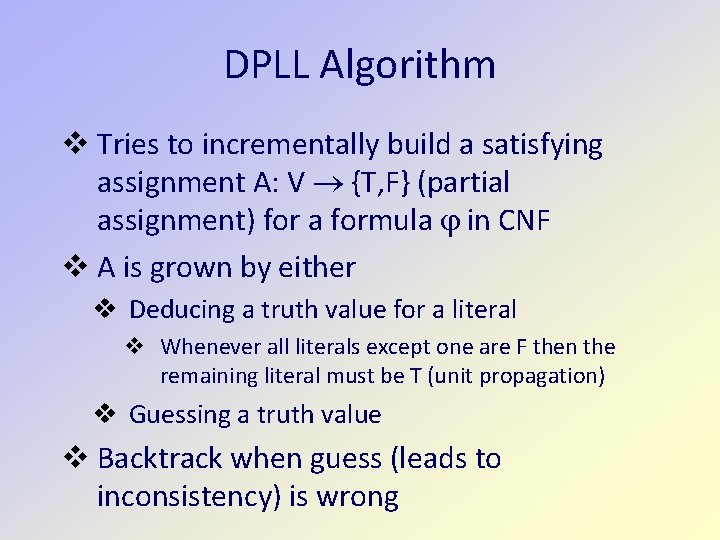
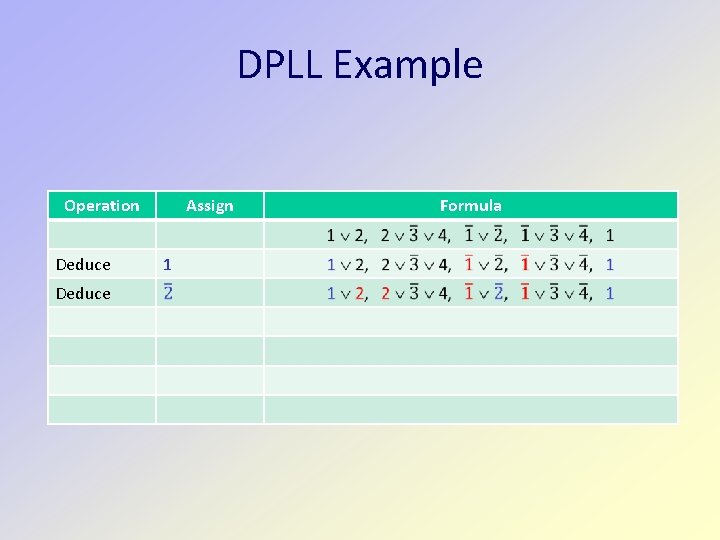
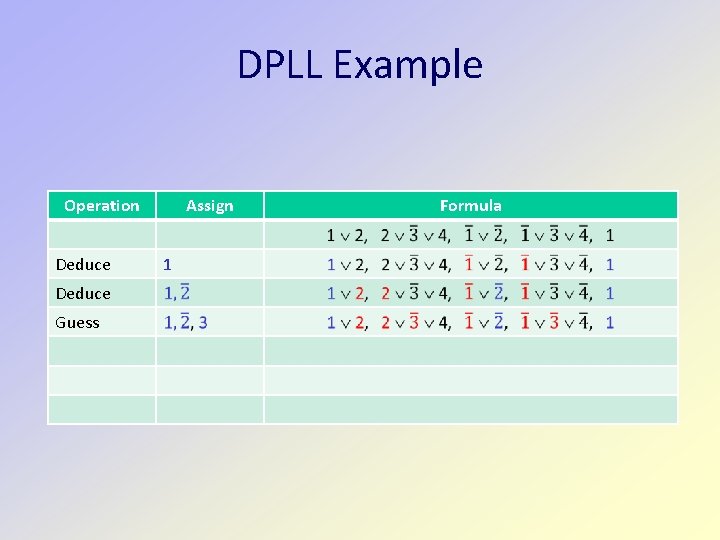
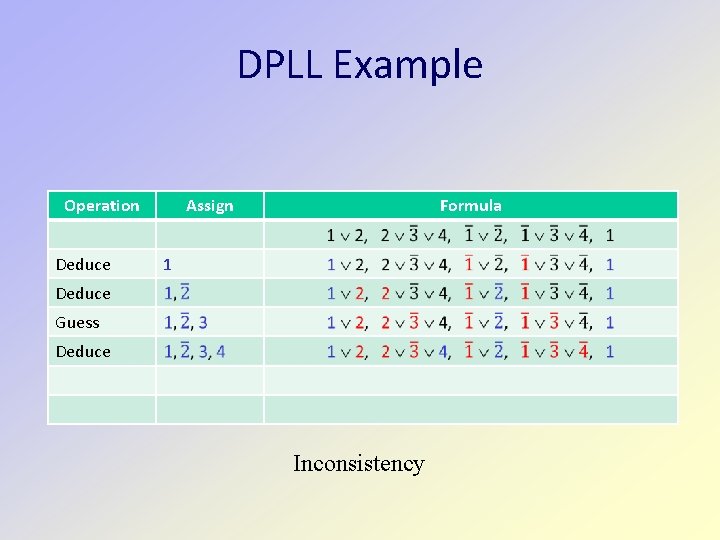
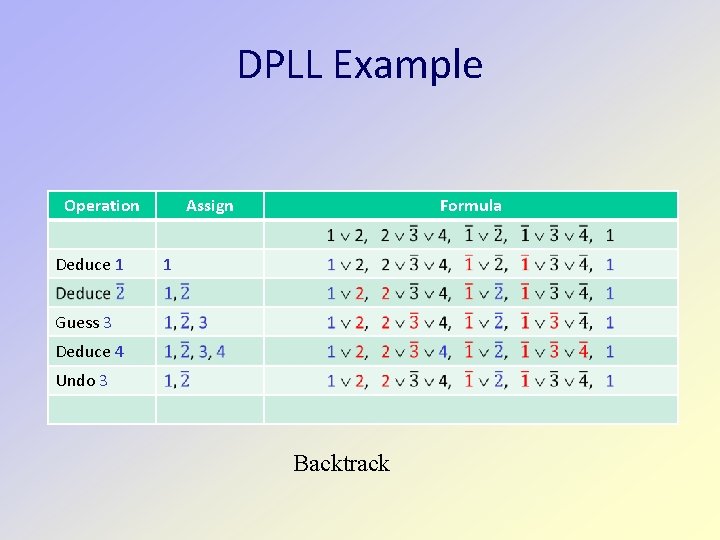
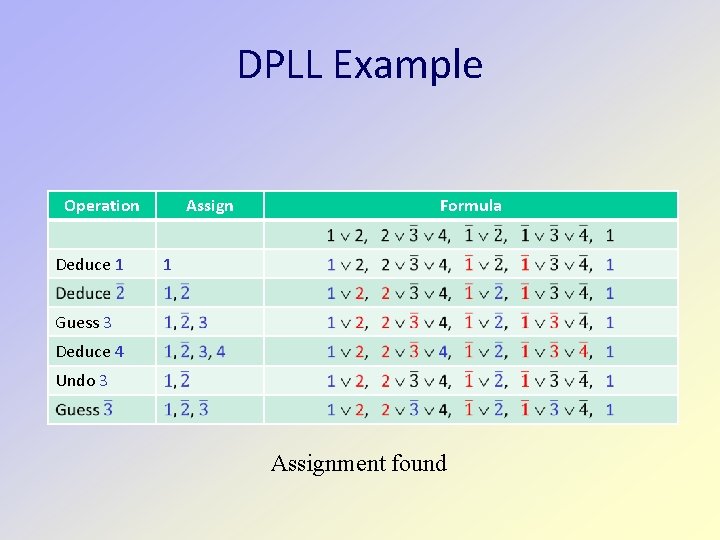
DPLL Algorithm Tries to incrementally build a satisfying assignment A: V {T, F} (partial assignment) for a formula in CNF A is grown by either Deducing a truth value for a literal Whenever all literals except one are F then the remaining literal must be T (unit propagation) Guessing a truth value Backtrack when guess (leads to inconsistency) is wrong
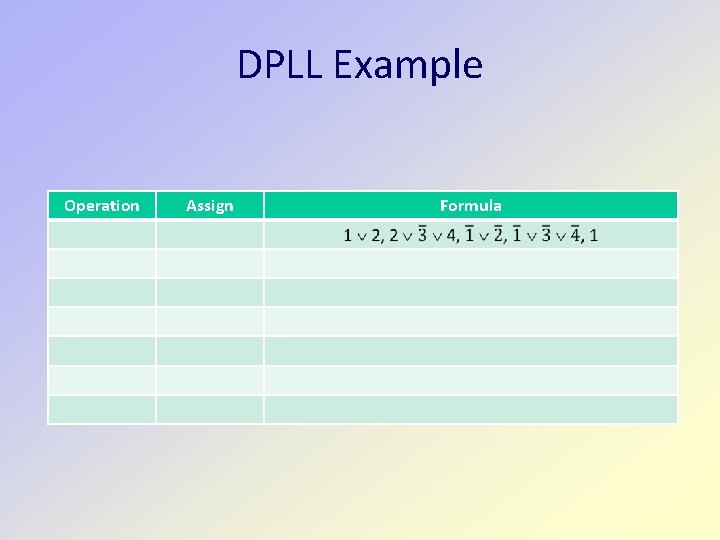
DPLL Example Operation Assign Formula
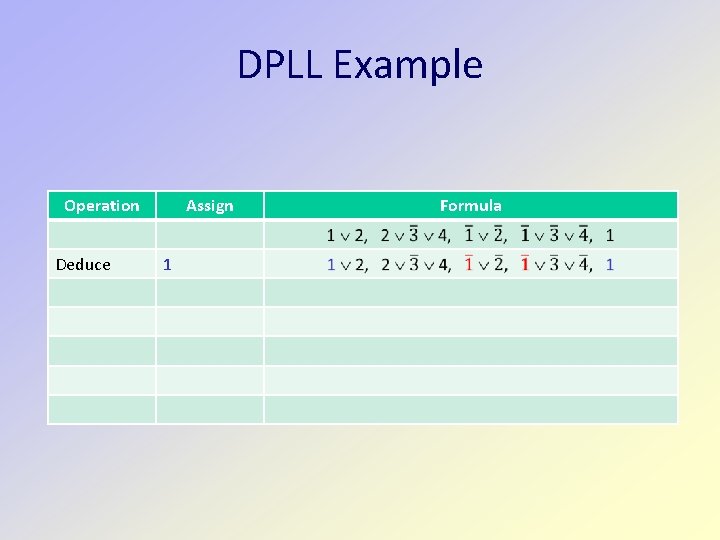
DPLL Example Operation Deduce Assign 1 Formula
DPLL Example Operation Deduce Assign 1 Formula
DPLL Example Operation Deduce Guess Assign 1 Formula
DPLL Example Operation Deduce Assign Formula 1 Deduce Guess Deduce Inconsistency
DPLL Example Operation Deduce 1 Assign Formula 1 Guess 3 Deduce 4 Undo 3 Backtrack
DPLL Example Operation Deduce 1 Assign Formula 1 Guess 3 Deduce 4 Undo 3 Assignment found