
SAT Encoding For Sudoku Puzzles Will Klieber and

SAT Encoding For Sudoku Puzzles Will Klieber and Gi-Hwon Kwon
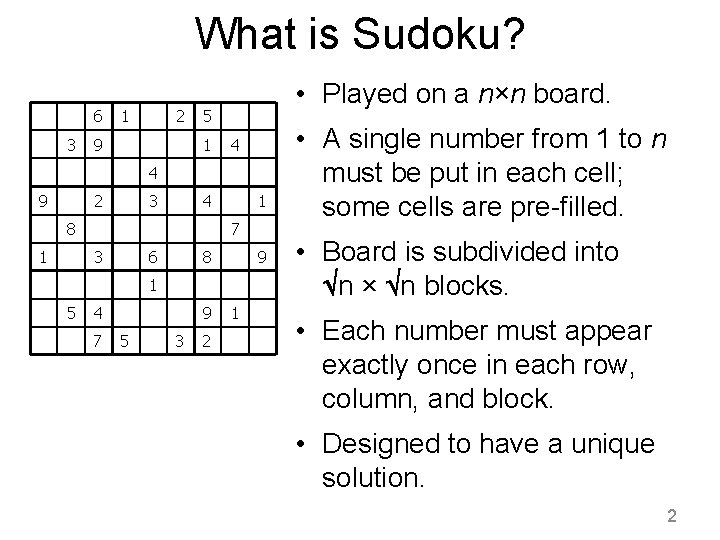
What is Sudoku? 6 3 1 2 9 • Played on a n×n board. 5 1 4 4 9 2 3 4 8 1 1 7 3 6 8 9 1 5 4 7 9 5 3 2 1 • A single number from 1 to n must be put in each cell; some cells are pre-filled. • Board is subdivided into n × n blocks. • Each number must appear exactly once in each row, column, and block. • Designed to have a unique solution. 2
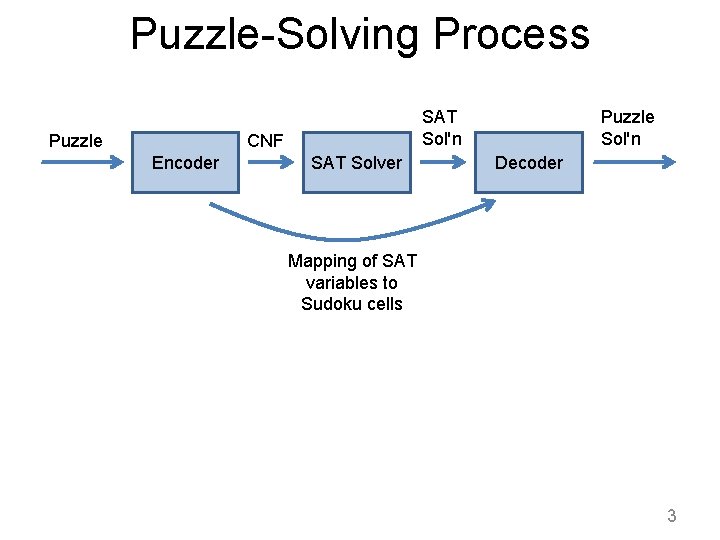
Puzzle-Solving Process Puzzle SAT Sol'n CNF Encoder SAT Solver Puzzle Sol'n Decoder Mapping of SAT variables to Sudoku cells 3
Naive Encoding (1 a) • Use n 3 variables, labelled “x 0, 0, 0” to “xn, n, n”. • Variable xr, c, d represents whether the number d is in the cell at row r, column c. 4
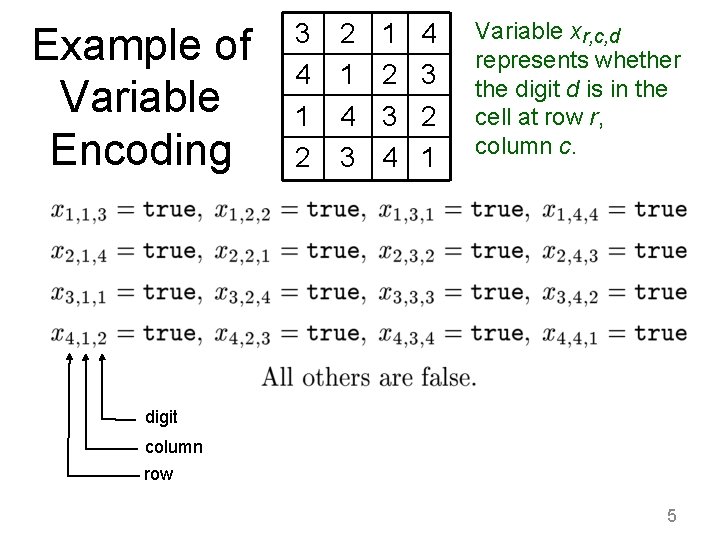
Example of Variable Encoding 3 4 1 2 2 1 4 3 1 2 3 4 4 3 2 1 Variable xr, c, d represents whether the digit d is in the cell at row r, column c. digit column row 5
Naive Encoding (1 b) • Use n 3 variables, labelled “x 0, 0, 0” to “xn, n, n”. • Variable xr, c, d represents whether the number d is in the cell at row r, column c. • “Number d must occur exactly once in column c” “Exactly one of {x 1, c, d, x 2, c, d, . . . , xn, c, d} is true”. • How do we encode the constraint that exactly one variable in a set is true? 6
Naive Encoding (2) • How do we encode the constraint that exactly one variable in a set is true? • We can encode “exactly one” as the conjunction of “at least one” and “at most one”. • Encoding “at least one” is easy: simply take the logical OR of all the propositional variables. • Encoding “at most one” is harder in CNF. Standard method: “no two variables are both true”. • I. e. , enumerate every possible pair of variables and require that one variable in the pair is false. This takes O(n^2) clauses. • [ Example on next slide ] 7
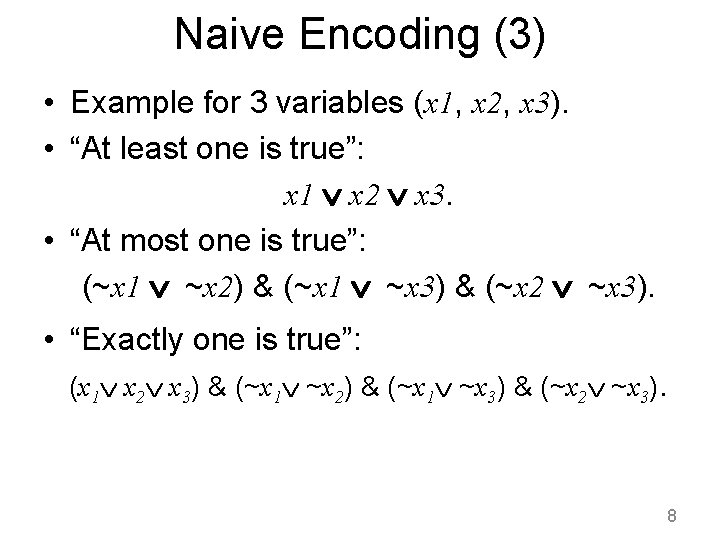
Naive Encoding (3) • Example for 3 variables (x 1, x 2, x 3). • “At least one is true”: x 1 x 2 x 3. • “At most one is true”: (~x 1 ~x 2) & (~x 1 ~x 3) & (~x 2 ~x 3). • “Exactly one is true”: (x 1 x 2 x 3) & (~x 1 ~x 2) & (~x 1 ~x 3) & (~x 2 ~x 3). 8
Naive Encoding (4) The following constraints are encoded: • Exactly one digit appears in each cell. • Each digit appears exactly once in each row. • Each digit appears exactly once in each column. • Each digit appears exactly once in each block. Each application of the above constraints has the form: “exactly one of a set variables is true”. All of the above constraints are independent of the prefilled cells. 9
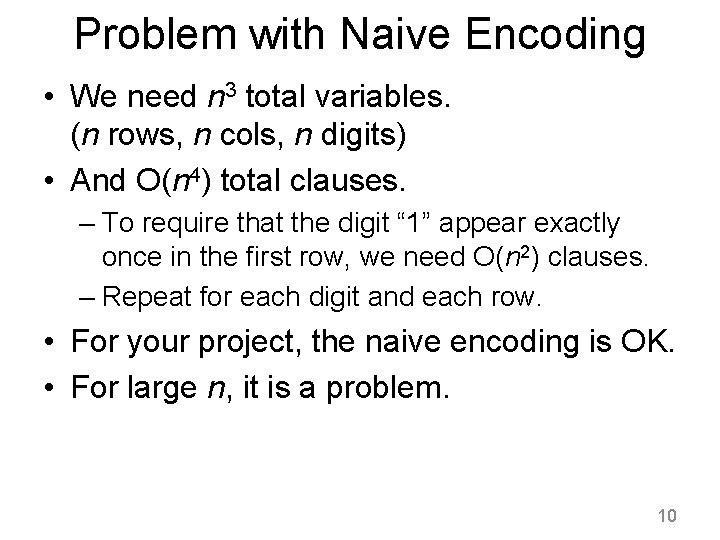
Problem with Naive Encoding • We need n 3 total variables. (n rows, n cols, n digits) • And O(n 4) total clauses. – To require that the digit “ 1” appear exactly once in the first row, we need O(n 2) clauses. – Repeat for each digit and each row. • For your project, the naive encoding is OK. • For large n, it is a problem. 10
Better Encoding
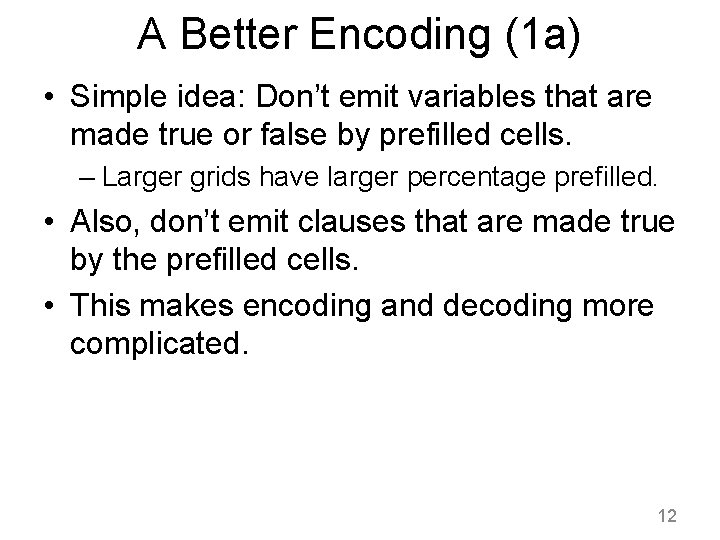
A Better Encoding (1 a) • Simple idea: Don’t emit variables that are made true or false by prefilled cells. – Larger grids have larger percentage prefilled. • Also, don’t emit clauses that are made true by the prefilled cells. • This makes encoding and decoding more complicated. 12
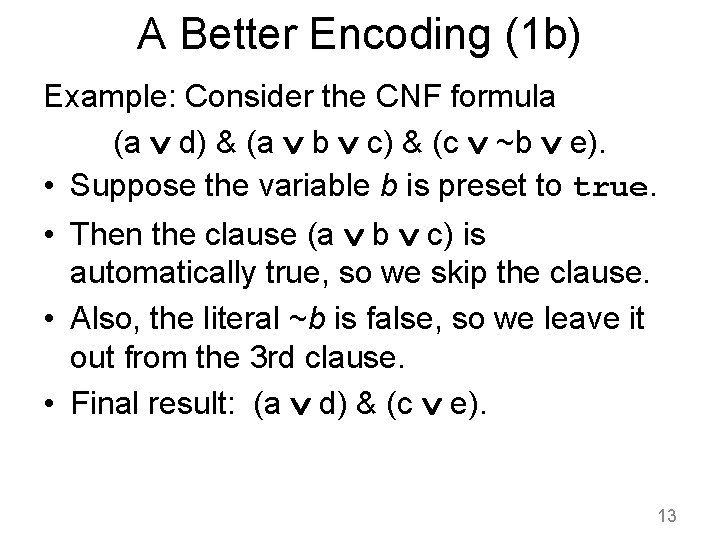
A Better Encoding (1 b) Example: Consider the CNF formula (a d) & (a b c) & (c ~b e). • Suppose the variable b is preset to true. • Then the clause (a b c) is automatically true, so we skip the clause. • Also, the literal ~b is false, so we leave it out from the 3 rd clause. • Final result: (a d) & (c e). 13
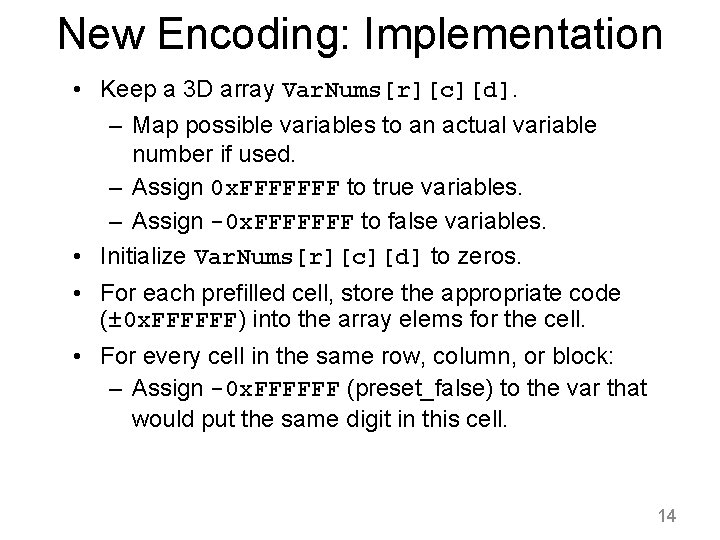
New Encoding: Implementation • Keep a 3 D array Var. Nums[r][c][d]. – Map possible variables to an actual variable number if used. – Assign 0 x. FFFFFFF to true variables. – Assign -0 x. FFFFFFF to false variables. • Initialize Var. Nums[r][c][d] to zeros. • For each prefilled cell, store the appropriate code (± 0 x. FFFFFF) into the array elems for the cell. • For every cell in the same row, column, or block: – Assign -0 x. FFFFFF (preset_false) to the var that would put the same digit in this cell. 14
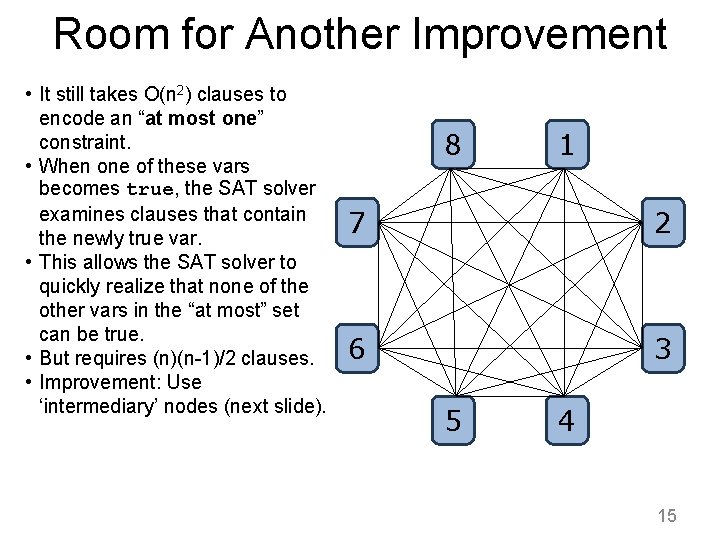
Room for Another Improvement • It still takes O(n 2) clauses to encode an “at most one” constraint. • When one of these vars becomes true, the SAT solver examines clauses that contain the newly true var. • This allows the SAT solver to quickly realize that none of the other vars in the “at most” set can be true. • But requires (n)(n-1)/2 clauses. • Improvement: Use ‘intermediary’ nodes (next slide). 8 1 7 2 6 3 5 4 15
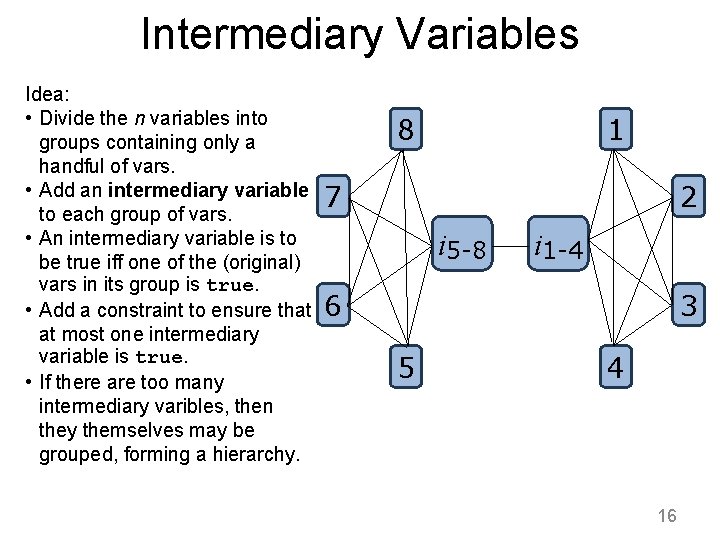
Intermediary Variables Idea: • Divide the n variables into groups containing only a handful of vars. • Add an intermediary variable to each group of vars. • An intermediary variable is to be true iff one of the (original) vars in its group is true. • Add a constraint to ensure that at most one intermediary variable is true. • If there are too many intermediary varibles, then they themselves may be grouped, forming a hierarchy. 8 1 7 2 i 5 -8 i 1 -4 6 3 5 4 16
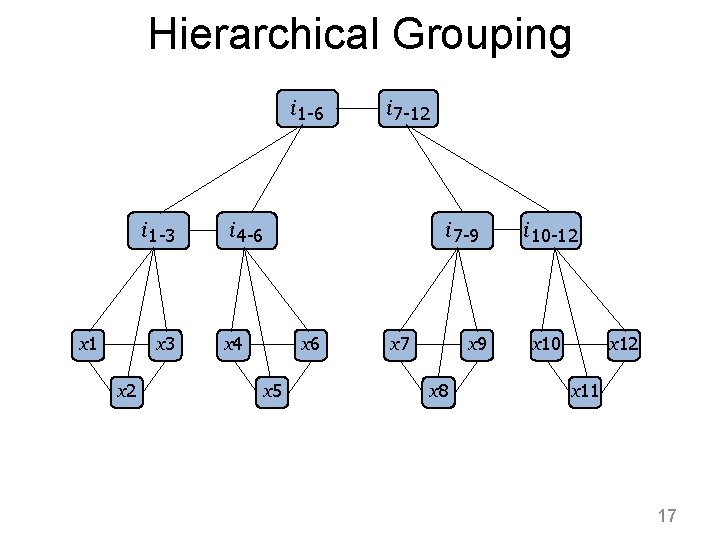
Hierarchical Grouping i 1 -6 i 1 -3 x 1 x 3 x 2 i 7 -12 i 4 -6 x 4 i 7 -9 x 6 x 5 x 7 x 9 x 8 i 10 -12 x 10 x 12 x 11 17
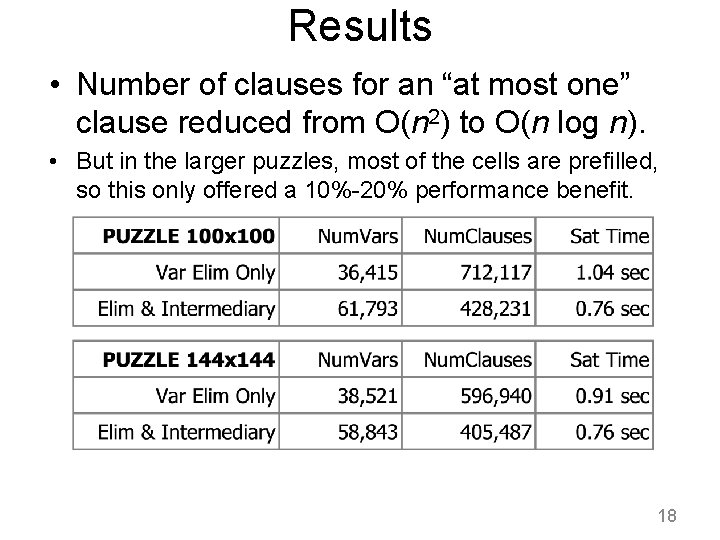
Results • Number of clauses for an “at most one” clause reduced from O(n 2) to O(n log n). • But in the larger puzzles, most of the cells are prefilled, so this only offered a 10%-20% performance benefit. 18
- Slides: 18