Richard W Hamming Learning to Learn The Art
- Slides: 37
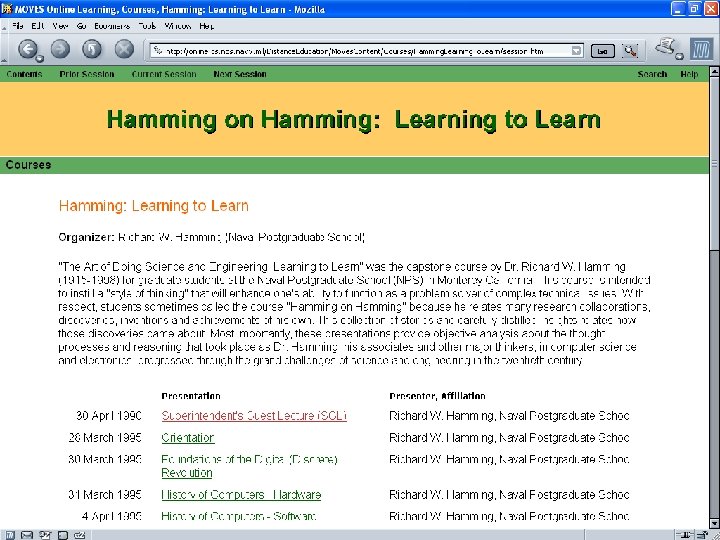
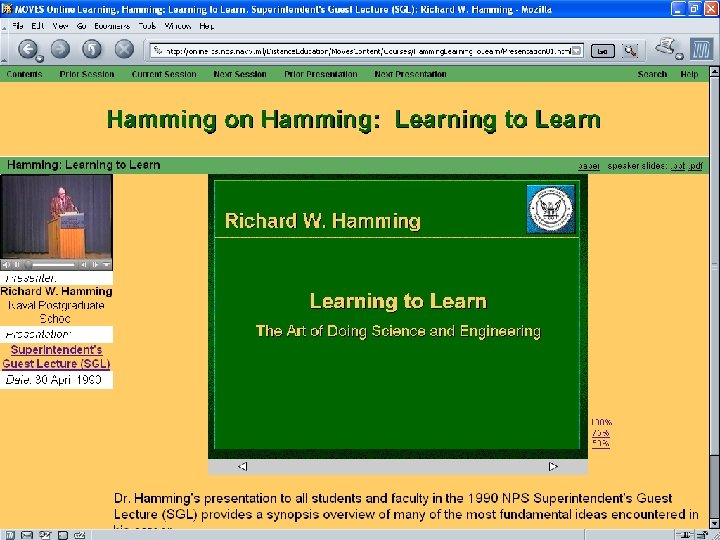
Richard W. Hamming Learning to Learn The Art of Doing Science and Engineering Superintendent’s Guest Lecture 30 April 1990
Editorial note Dr. Hamming’s Superintendent’s Guest Lecture (SGL) presentation is an excellent summary of the many diverse, challenging ideas tackled in his book and course. These slides summarize Dr Hamming’s background, contributions, awards and publications as listed in his curriculum vita.
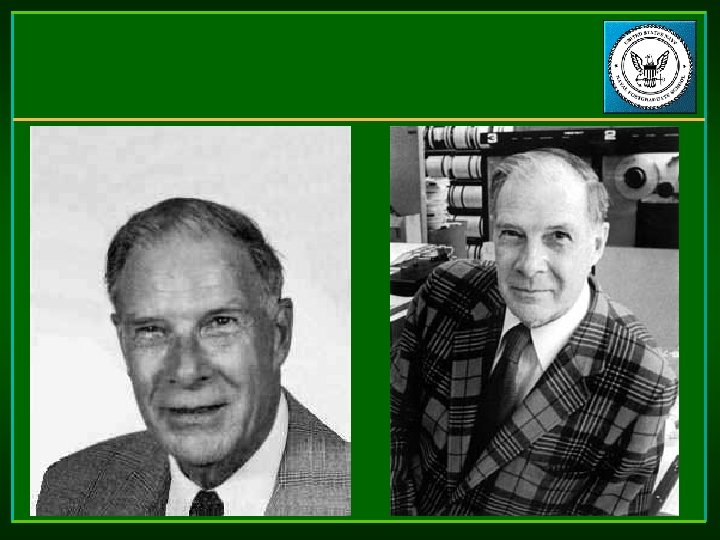
Richard W. Hamming Born: 11 Feb 1915 in Chicago Illinois USA Died: 7 Jan 1998 in Monterey California USA Degrees Received • 1942, Ph. D. , Mathematics, University of Illinois • 1939, M. A. , Mathematics, University of Nebraska • 1937, B. S. , Mathematics, University of Chicago
Richard W. Hamming Work Experience • 1945 -46 Los Alamos Lab, Manhattan Project – Atomic Bomb Numerical Calculation Research • 1946 -1976 Bell Laboratories – Mathematics and computing as applied to military and telephone research – Adjunct Professor of Statistics, Princeton, 3 years • 1976 -1998, Naval Postgraduate School, Professor
Richard W. Hamming Honors • President, Association Computing Machinery • Turing Prize of ACM • Fellow IEEE • Piore Prize, 1979 • National Academy of Engineering, 1980 • Pender Prize, 1981
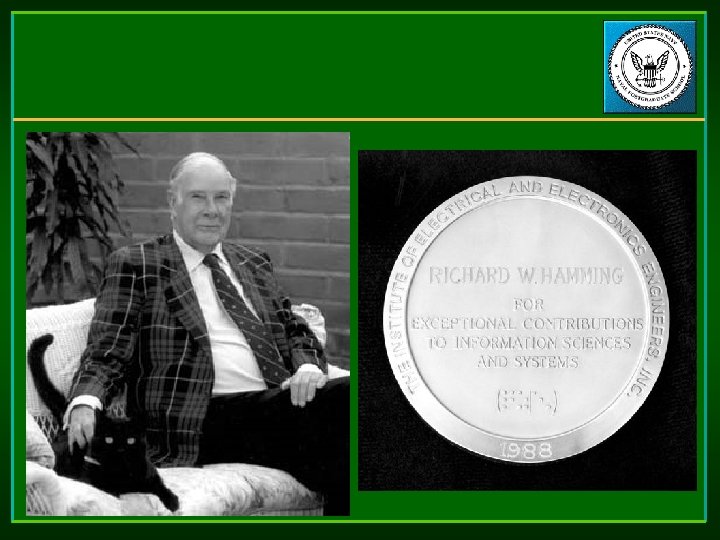
Richard W. Hamming Honors • IEEE R. W. Hamming Gold Medal namesake – First recipient, $10, 000 prize, 1996 – “For exceptional contributions to information sciences and systems” • Vice President, Math Section, American Association for the Advancement of Science (AAAS) • Editor of numerous journals
Quotable quotes 1 The purpose of computing is insight, not numbers. It is better to do the right problem the wrong way, than the wrong problem the right way.
Quotable quotes 2 Mathematics is the language of clear thinking. If the prediction that an airplane can stay up depends on the difference between Riemann and Lebesgue integration, then I don’t want to fly in it.
Quotable quotes 3 Mathematics is an interesting intellectual sport but it should not be allowed to stand in the way of obtaining sensible information about physical processes. • Quoted in N. Rose Mathematical Maxims and Minims (Raleigh NC 1988).
Quotable quotes 4 I bugged Claude Shannon for years and years to write a book on Information Theory so that everyone would understand it. He refused, so I went ahead & wrote it. A good theoretician can account for almost any result that is produced, right or wrong.
Quotable quotes 5 My doctoral dissertation was 27 pages long. – Some Problems in the Boundary Value Theory of Linear Differential Equations – University of Illinois at Urbana-Champaign, 1942 [“… uhh, why so short, Dr. Hamming? ? ”] There was a lot less to know in 1942. – see chapter 1, exponential growth of knowledge
Quotable quotes 6 If you don't work on important problems, it's not likely that you'll do important work. Usually expressed as a thought-provoking challenge to the audience: • Who here wants to do important work in their career? • Who here is working on important problems? • (for those not raising a hand) Why not?
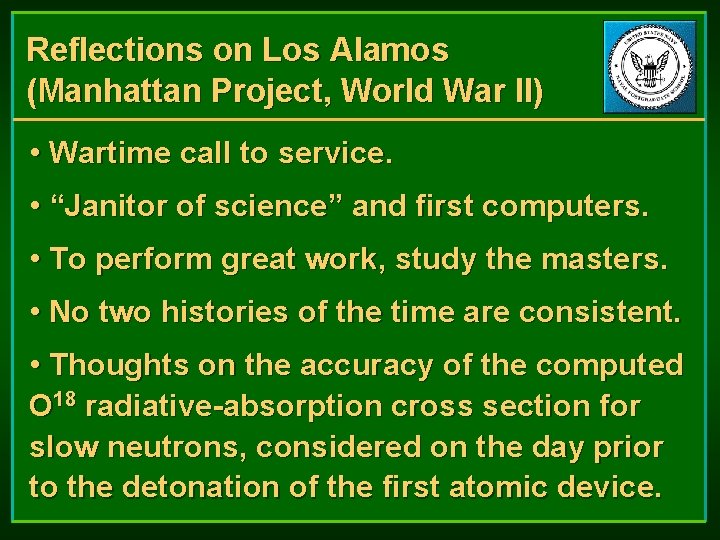
Reflections on Los Alamos (Manhattan Project, World War II) • Wartime call to service. • “Janitor of science” and first computers. • To perform great work, study the masters. • No two histories of the time are consistent. • Thoughts on the accuracy of the computed O 18 radiative-absorption cross section for slow neutrons, considered on the day prior to the detonation of the first atomic device.
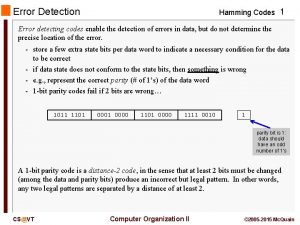
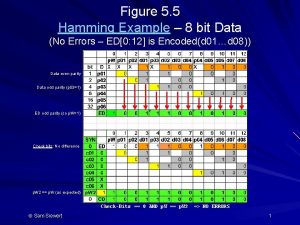
Namesake Concepts 1 Hamming error-correcting codes: Carefully added redundancy which allows automatic detection & correction of errors. • Hamming bits: redundancy built into hardware Forward error correction: Sufficient redundancy that a receiver (on forward side) can correct errors without retransmission by original sender.
Namesake Concepts 2 Hamming distance: The number of positions which differ when comparing corresponding bits between two code words. Sometimes used as a measure of conceptual distance, rather than spatial or numerical distance.
Namesake Concepts 3 Hamming predictor-corrector (PC) set for ordinary differential equations: One of numerous numerical-analysis techniques used to make computer computations accurate by damping out progressive roundoff errors. Overcomes a fundamental limitation of discrete arithmetic processing implemented in computer systems.
Namesake Concepts 4 Hamming digital filter Application of digital techniques (discrete computer processing) to perform signal processing, historically possible only with analog electronic circuitry.
Richard W. Hamming Books Authored • Numerical Methods for Scientists and Engineers • Computers and Society • Introduction for Applied Numerical Analysis • Calculus and the Computer Revolution • Digital Filters (3 rd Edition, January 1989) • The Art of Doing Science and Engineering, Learning to Learn
Richard W. Hamming Papers Authored • A Class of Integration Formulas • The Computer as an Experimental Tool • A Computer Scientist Looks at Statistics • Error Detecting and Error Correcting Codes • Impact of Computers • Educational Implications of the Computer Revolution
Richard W. Hamming Papers Authored • Intellectual Implications of the Computer Revolution • One Man’s View of Computer Science • Introduction to “Fundamental Theory of Servomechanisms” • The Mechanization of Science • A Note on the Location of the Binary Point in a Computing Machine
Richard W. Hamming Papers Authored • Nuclear Magnetic Resonance in Crystals • Numerical Analysis vs. Mathematics • Pitfalls in Numerical Analysis- IEEE Talk, March 19, 1968 • Numerical Evaluation of Electron Image Phase Contrast • Stable Predictor-Corrector Methods for Ordinary Differential Equations
Richard W. Hamming Papers Authored • The Impact of Computer technology on Management Concepts, Planning, and Decision Making • Checking Techniques for Digital Computers • Social Implications of the Computer Revolution • The Effects of Computers Upon Engineering Education
Richard W. Hamming Papers Authored • Mathematical Notes • Controlling the Digital Computer • Computer Appreciation Courses • Convergent Monotone Series • An Essay on Computer Science Training Programs • The Transcendental Character of COS X
Richard W. Hamming Papers Authored • On the Distribution of Numbers • Modern Control Theory • A Class of Integration Formulas • Computers and Society • An Elementary Discussion of the Transcendental Nature of the Elementary Transcendental Functions • Contributing to Modern Science and Engineering
Richard W. Hamming Papers Authored • Note on the Teaching of Trigonometry • Effects of Computers Upon Engineering Education • Electronic Digital Computer as an Intellectual Tool • General Purpose System • Standard for Computer Mathematics
Richard W. Hamming Papers Authored • Thinking Big Even with Small Computers • Limitations of Computers • A Philosophy of Computer Science of My Prejudices and Confusions • How Do You Know the Simulation is Relevant? • A History of Computing in the United States • Fifth Generation Computers and Beyond
Richard W. Hamming Papers Authored • Invariance and Bertrands Paradox • The Role of the Digital Computer in Scientific Research, Past, Present, and Future • Gaussian Quadrature as a Minimization Principle • Error Correcting Codes • The Role of the Technical Societies in the Field of Computer Measurement
Richard W. Hamming Papers Authored • Statistical Estimation of Error Propagation Through Multiplication and Division • A Systems Approach to Software Testing • Noninterpolatory Quadrature Formulas • The Frequency Approach to Numerical Analysis • Compumetrics: The Way Ahead • Computers and Computing in the ’ 70’s
Richard W. Hamming Papers Authored • Commencement Talk to Engineering School, University of California, Irvine • The Distribution of Numbers- Applications • The Distribution of Numbers- Mathematical Theory • The Distribution of Numbers- Computer Theory • The Distribution of Numbers- Physical Theory
Richard W. Hamming Papers Authored • Some Thoughts on Simulation • Band Limited Functions • Velocity Dependence on Contrast in Electron Images of Periodic Structures
Favorite quote Luck favors the prepared mind. • Louis Pasteur, 1822 -1895