
Optimal Conflictavoiding Codes of Odd Length Weight Three

- Slides: 45
Optimal Conflict-avoiding Codes of Odd Length Weight Three Yuan-Hsun Lo (羅 元 勳) Department of Applied Mathematics National Chiao Tung University, Taiwan A joint work with Kenneth Shum and Hung-Ling Fu
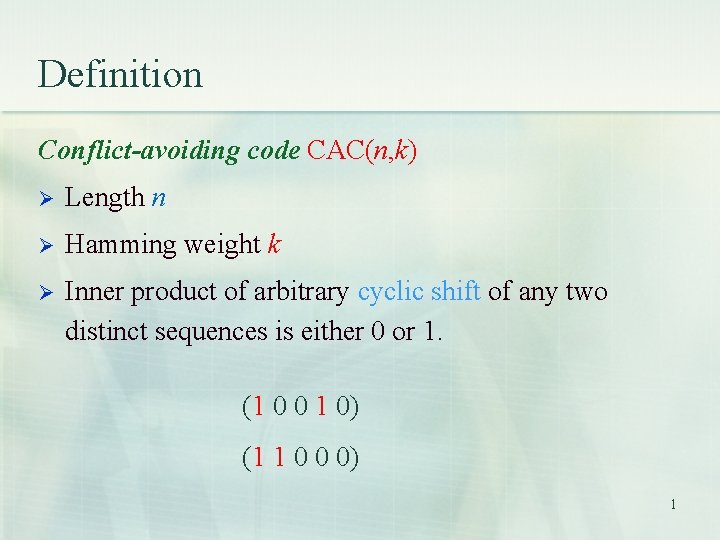
Definition Conflict-avoiding code CAC(n, k) Length n Hamming weight k Inner product of arbitrary cyclic shift of any two distinct sequences is either 0 or 1. (1 0 0 1 0) (1 1 0 0 0) 1
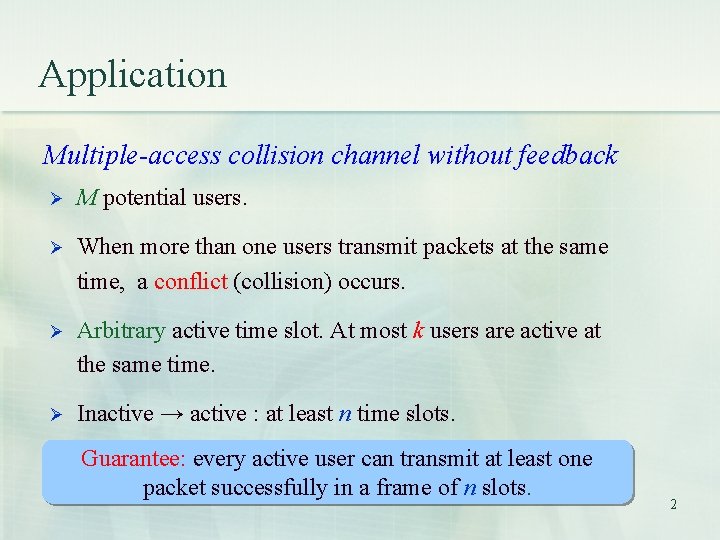
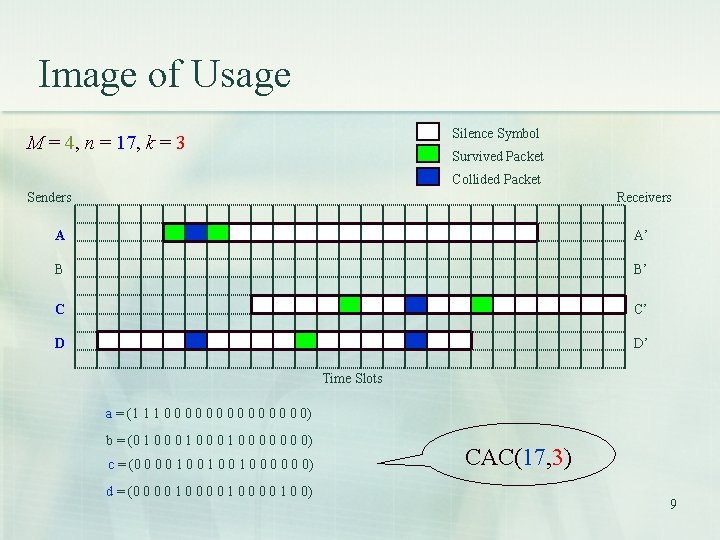
Application Multiple-access collision channel without feedback M potential users. When more than one users transmit packets at the same time, a conflict (collision) occurs. Arbitrary active time slot. At most k users are active at the same time. Inactive → active : at least n time slots. Guarantee: every active user can transmit at least one packet successfully in a frame of n slots. 2
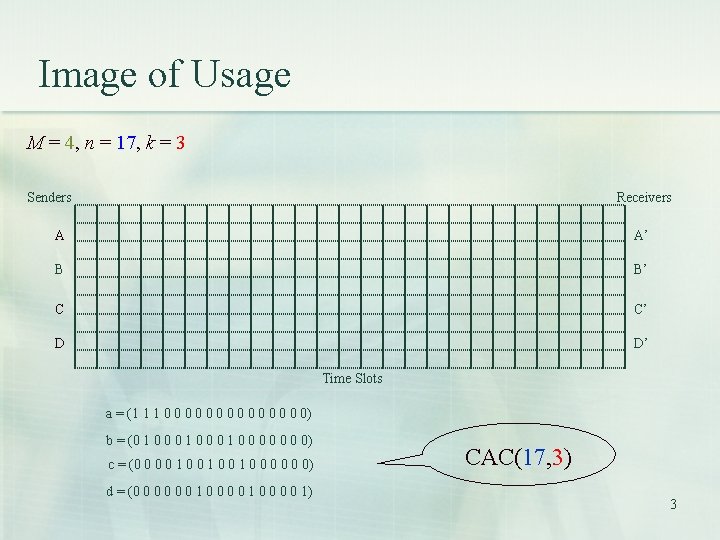
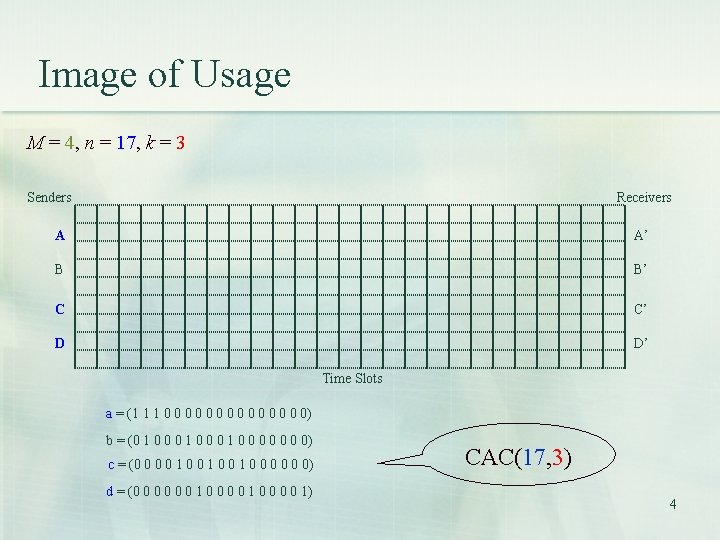
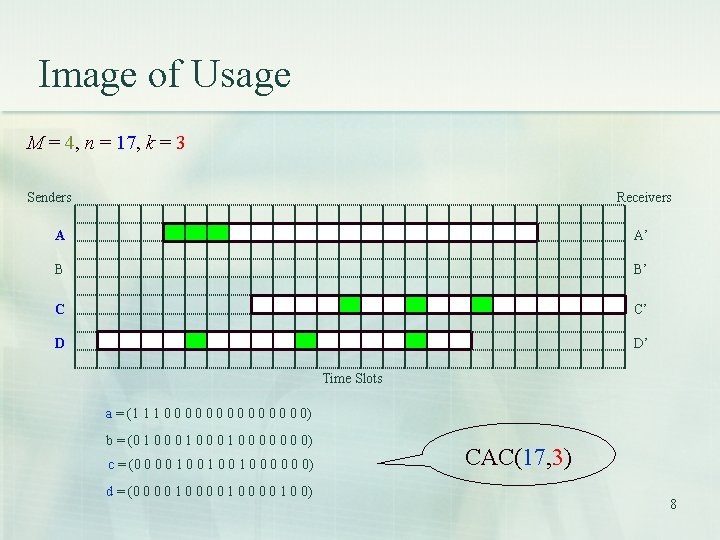
Image of Usage M = 4, n = 17, k = 3 Senders Receivers A A’ B B’ C C’ D D’ Time Slots a = (1 1 1 0 0 0 0) b = (0 1 0 0 0 0) c = (0 0 1 0 0 0) d = (0 0 0 1 0 0 0 0 1) CAC(17, 3) 3
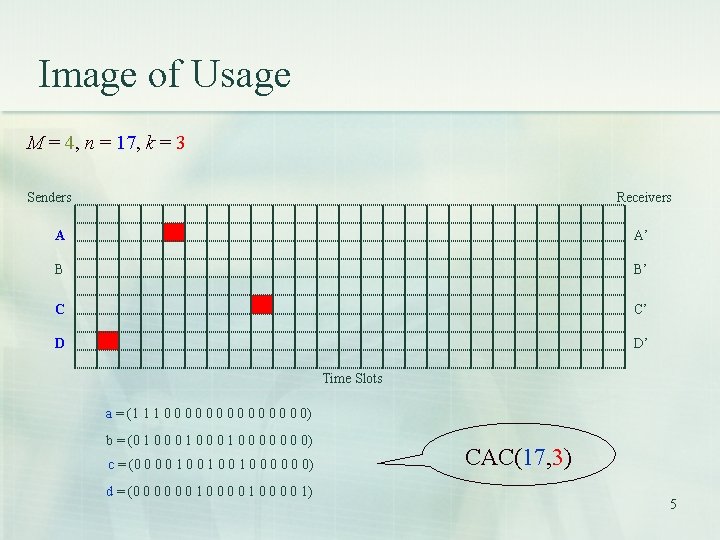
Image of Usage M = 4, n = 17, k = 3 Senders Receivers A A’ B B’ C C’ D D’ Time Slots a = (1 1 1 0 0 0 0) b = (0 1 0 0 0 0) c = (0 0 1 0 0 0) d = (0 0 0 1 0 0 0 0 1) CAC(17, 3) 4
Image of Usage M = 4, n = 17, k = 3 Senders Receivers A A’ B B’ C C’ D D’ Time Slots a = (1 1 1 0 0 0 0) b = (0 1 0 0 0 0) c = (0 0 1 0 0 0) d = (0 0 0 1 0 0 0 0 1) CAC(17, 3) 5
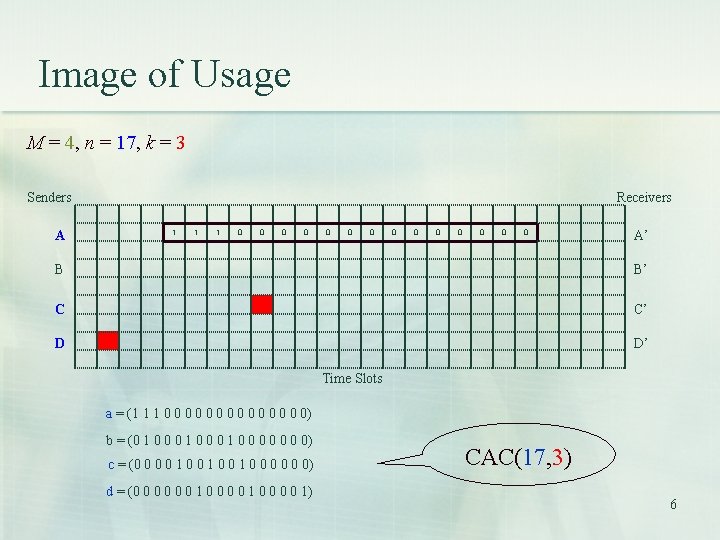
Image of Usage M = 4, n = 17, k = 3 Senders A Receivers 1 1 1 0 0 0 0 A’ B B’ C C’ D D’ Time Slots a = (1 1 1 0 0 0 0) b = (0 1 0 0 0 0) c = (0 0 1 0 0 0) d = (0 0 0 1 0 0 0 0 1) CAC(17, 3) 6
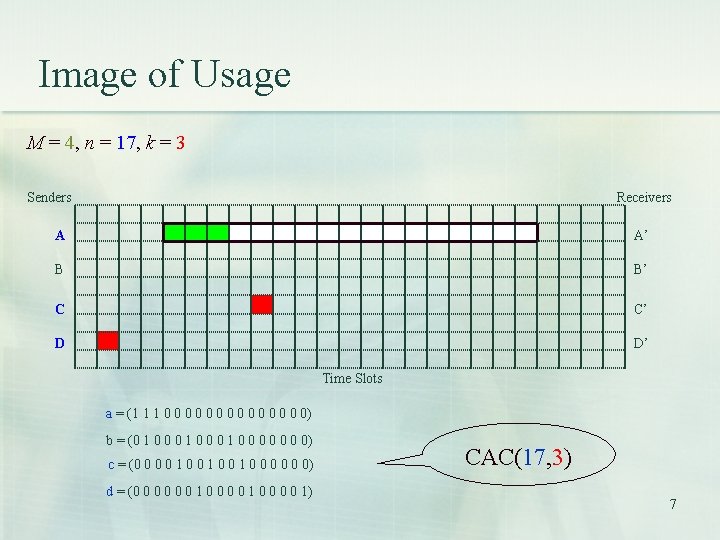
Image of Usage M = 4, n = 17, k = 3 Senders Receivers A A’ B B’ C C’ D D’ Time Slots a = (1 1 1 0 0 0 0) b = (0 1 0 0 0 0) c = (0 0 1 0 0 0) d = (0 0 0 1 0 0 0 0 1) CAC(17, 3) 7
Image of Usage M = 4, n = 17, k = 3 Senders Receivers A A’ B B’ C C’ D D’ Time Slots a = (1 1 1 0 0 0 0) b = (0 1 0 0 0 0) c = (0 0 1 0 0 0) d = (0 0 0 0 1 0 0) CAC(17, 3) 8
Image of Usage Silence Symbol M = 4, n = 17, k = 3 Survived Packet Collided Packet Senders Receivers A A’ B B’ C C’ D D’ Time Slots a = (1 1 1 0 0 0 0) b = (0 1 0 0 0 0) c = (0 0 1 0 0 0) d = (0 0 0 0 1 0 0) CAC(17, 3) 9
Objective Given n and k, maximize M. Optimal CAC : a CAC with maximum size M(n, k): the size of an optimal CAC(n, k) 10
Outline 1. Review of the literature of CAC 2. Formulation using Graph Theory 3. Some new optimal CAC of weight 3 and odd length. 11
Outline 1. Review of the literature of CAC 2. Formulation using Graph Theory 3. Some new optimal CAC of weight 3 and odd length. 12
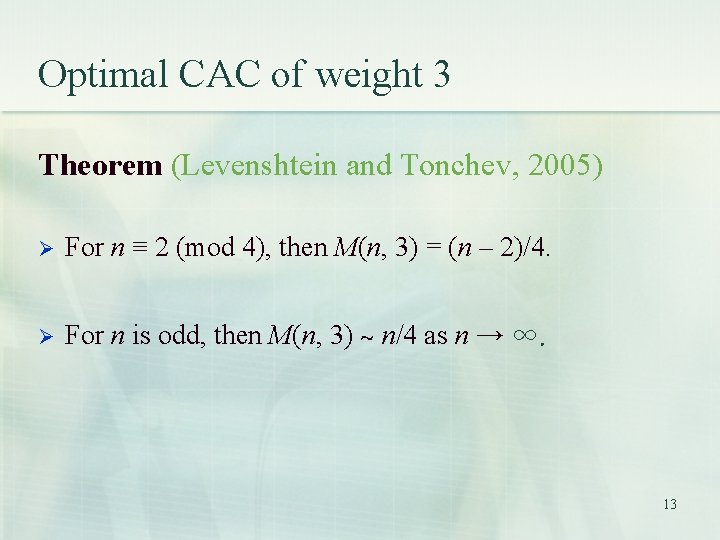
Optimal CAC of weight 3 Theorem (Levenshtein and Tonchev, 2005) For n ≡ 2 (mod 4), then M(n, 3) = (n – 2)/4. For n is odd, then M(n, 3) ~ n/4 as n → ∞. 13
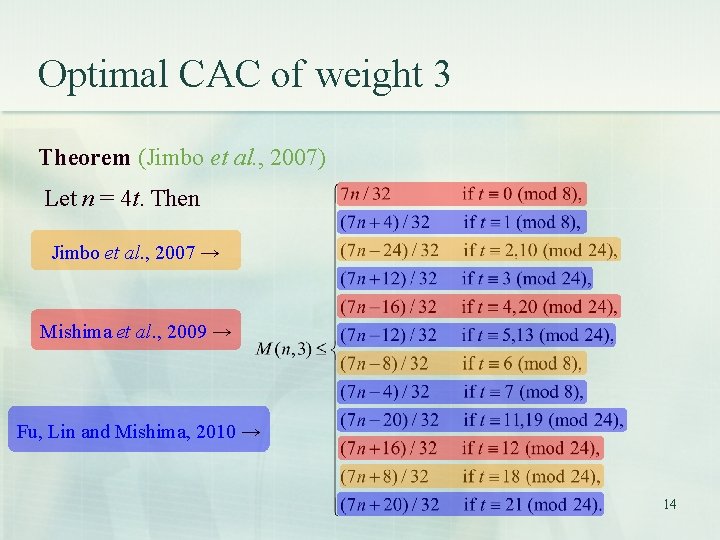
Optimal CAC of weight 3 Theorem (Jimbo et al. , 2007) Let n = 4 t. Then Jimbo et al. , 2007 → Mishima et al. , 2009 → Fu, Lin and Mishima, 2010 → 14
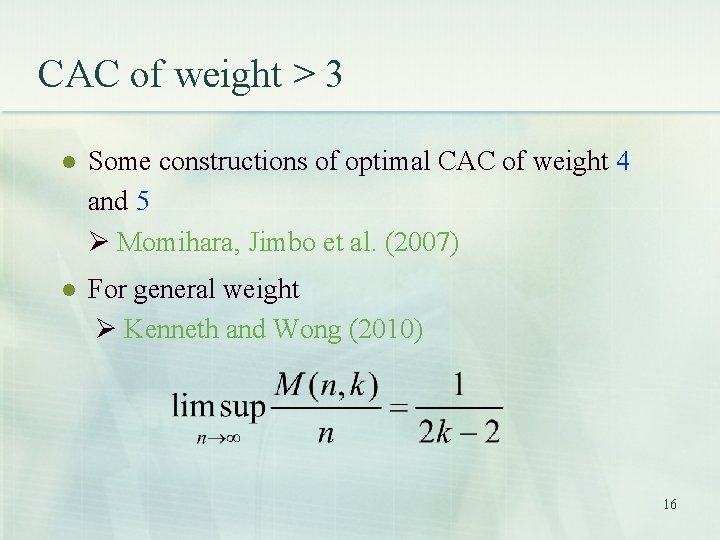
CAC of weight > 3 l Some constructions of optimal CAC of weight 4 and 5 Momihara, Jimbo et al. (2007) l For general weight Kenneth and Wong (2010) 15
CAC of weight > 3 l Some constructions of optimal CAC of weight 4 and 5 Momihara, Jimbo et al. (2007) l For general weight Kenneth and Wong (2010) 16
We are interested in odd n and k = 3. 17
Outline 1. Review of the literature of CAC 2. Formulation using Graph Theory – set representation – hypergraph matching 3. Some new optimal CAC of weight 3 and odd length. 18
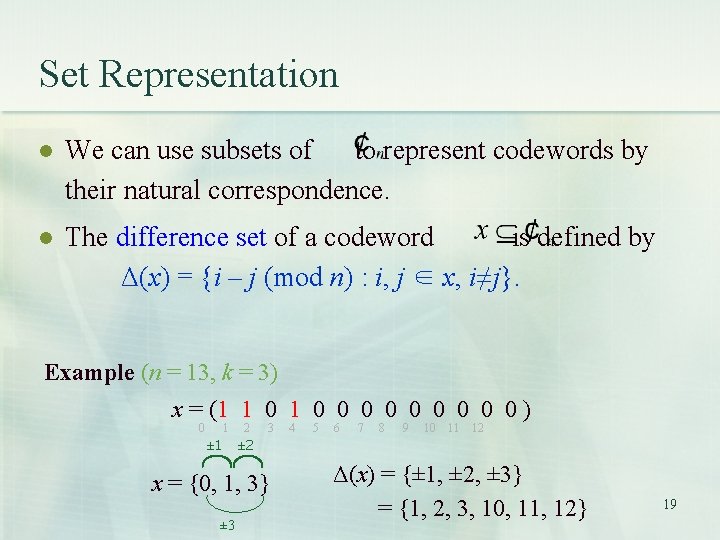
Set Representation l We can use subsets of to represent codewords by their natural correspondence. l The difference set of a codeword is defined by Δ(x) = {i – j (mod n) : i, j ∈ x, i≠j}. Example (n = 13, k = 3) x = (1 1 0 0 0 0 0 ) 0 1 ± 1 2 3 5 6 7 8 9 10 11 12 ± 2 x = {0, 1, 3} ± 3 4 Δ(x) = {± 1, ± 2, ± 3} = {1, 2, 3, 10, 11, 12} 19
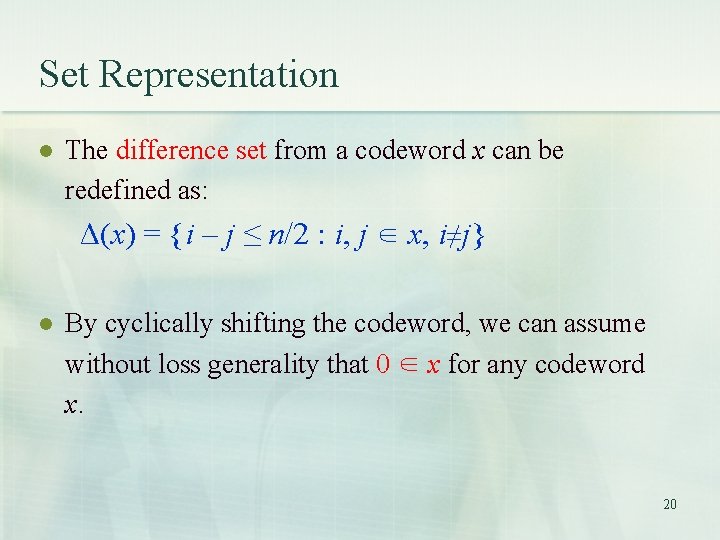
Set Representation l The difference set from a codeword x can be redefined as: Δ(x) = {i – j ≤ n/2 : i, j ∈ x, i≠j} l By cyclically shifting the codeword, we can assume without loss generality that 0 ∈ x for any codeword x. 20
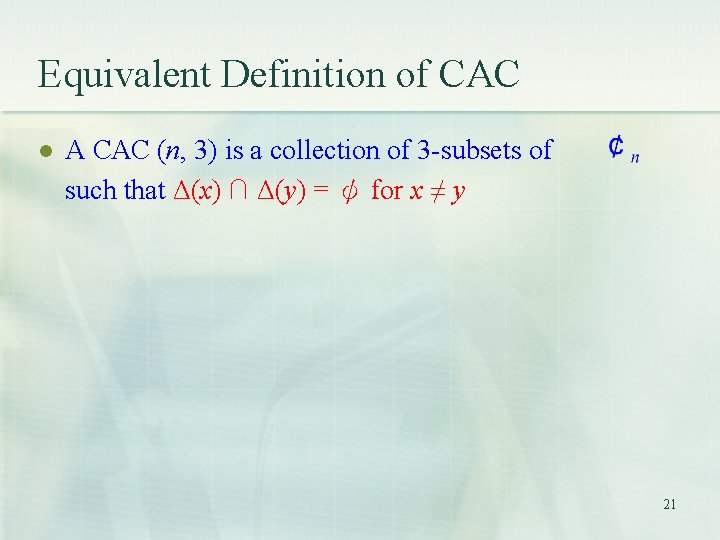
Equivalent Definition of CAC l A CAC (n, 3) is a collection of 3 -subsets of such that Δ(x) ∩ Δ(y) = ψ for x ≠ y 21
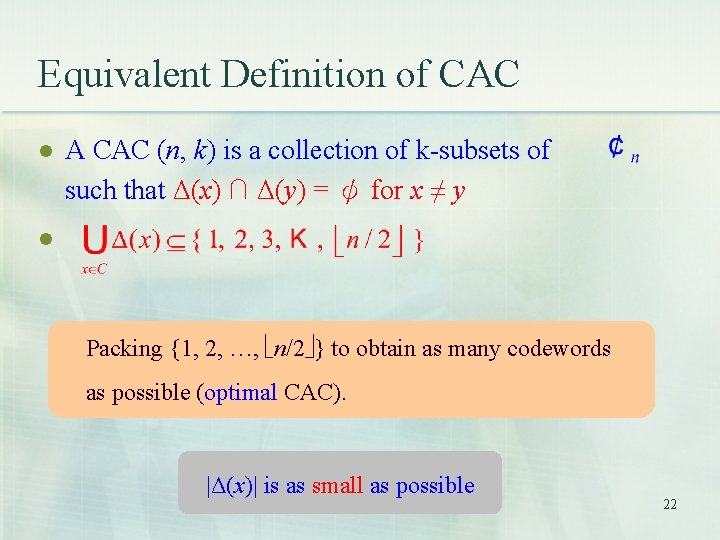
Equivalent Definition of CAC l A CAC (n, k) is a collection of k-subsets of such that Δ(x) ∩ Δ(y) = ψ for x ≠ y l Packing {1, 2, …, n/2 } to obtain as many codewords as possible (optimal CAC). |Δ(x)| is as small as possible 22
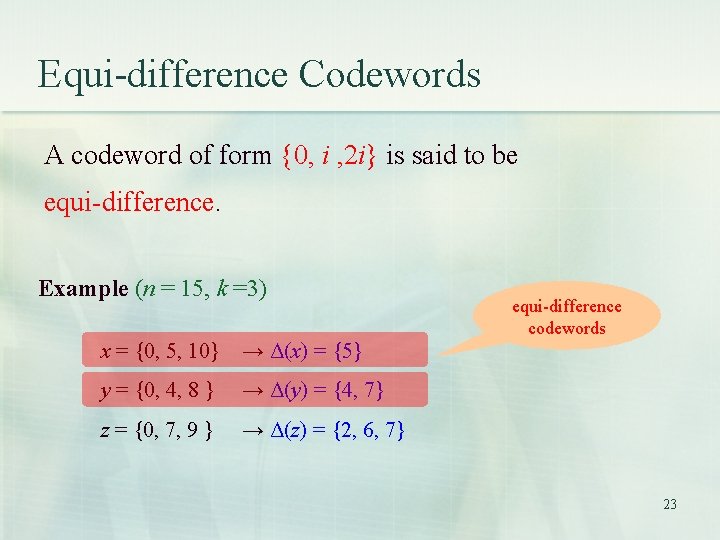
Equi-difference Codewords A codeword of form {0, i , 2 i} is said to be equi-difference. Example (n = 15, k =3) equi-difference codewords x = {0, 5, 10} → Δ(x) = {5} y = {0, 4, 8 } → Δ(y) = {4, 7} z = {0, 7, 9 } → Δ(z) = {2, 6, 7} 23
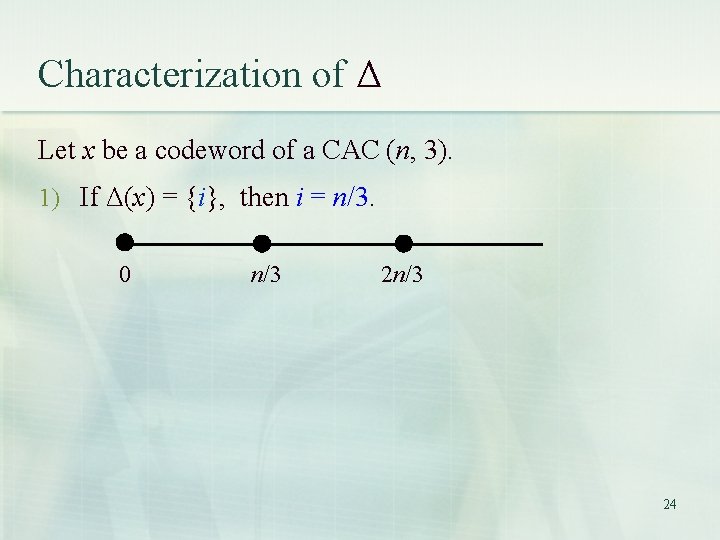
Characterization of Δ Let x be a codeword of a CAC (n, 3). 1) If Δ(x) = {i}, then i = n/3. 0 n/3 24
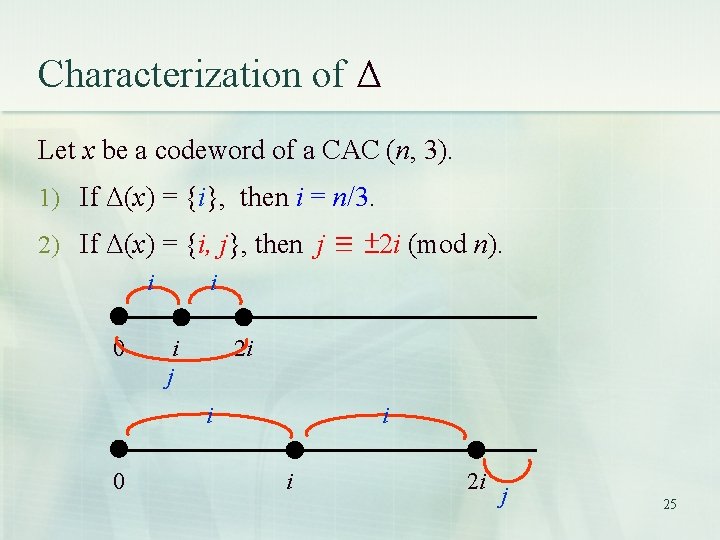
Characterization of Δ Let x be a codeword of a CAC (n, 3). 1) If Δ(x) = {i}, then i = n/3. 2) If Δ(x) = {i, j}, then j ≡ ± 2 i (mod n). i 0 i i j 2 i i 0 i i 2 i j 25
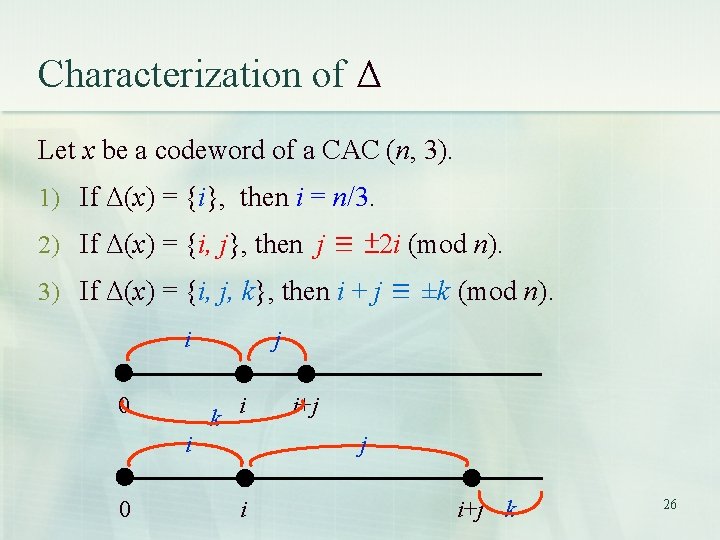
Characterization of Δ Let x be a codeword of a CAC (n, 3). 1) If Δ(x) = {i}, then i = n/3. 2) If Δ(x) = {i, j}, then j ≡ ± 2 i (mod n). 3) If Δ(x) = {i, j, k}, then i + j ≡ ±k (mod n). i 0 j k i i+j j i i+j k 26
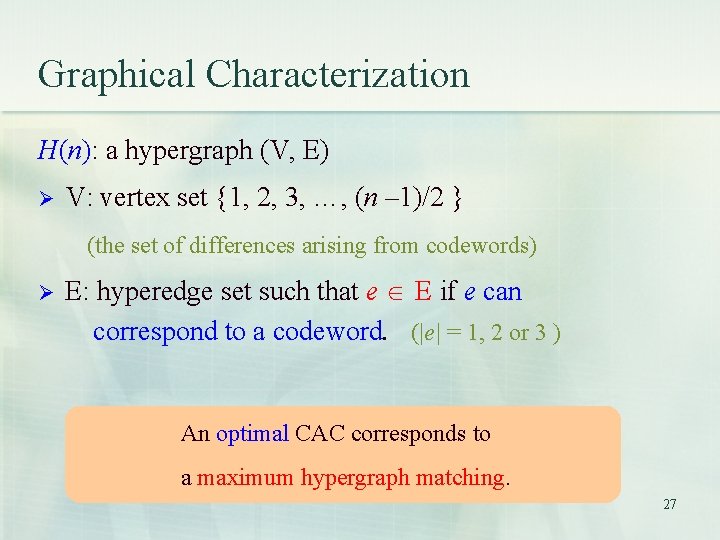
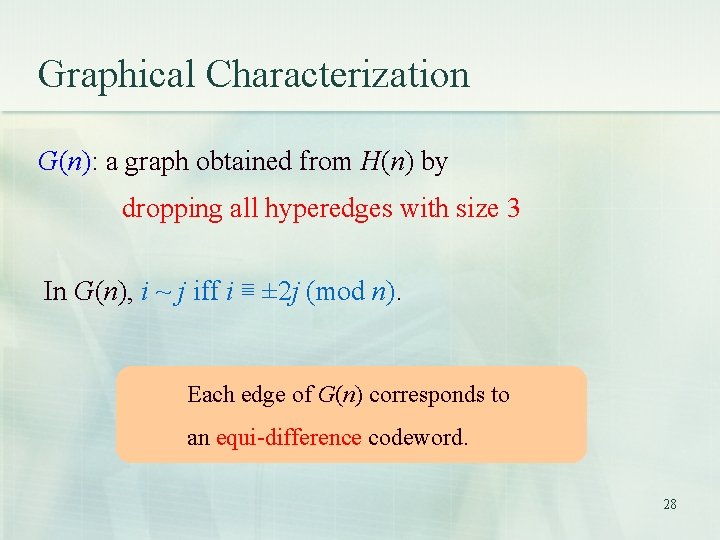
Graphical Characterization H(n): a hypergraph (V, E) V: vertex set {1, 2, 3, …, (n – 1)/2 } (the set of differences arising from codewords) E: hyperedge set such that e E if e can correspond to a codeword. (|e| = 1, 2 or 3 ) An optimal CAC corresponds to a maximum hypergraph matching. 27
Graphical Characterization G(n): a graph obtained from H(n) by dropping all hyperedges with size 3 In G(n), i ~ j iff i ≣ ± 2 j (mod n). Each edge of G(n) corresponds to an equi-difference codeword. 28
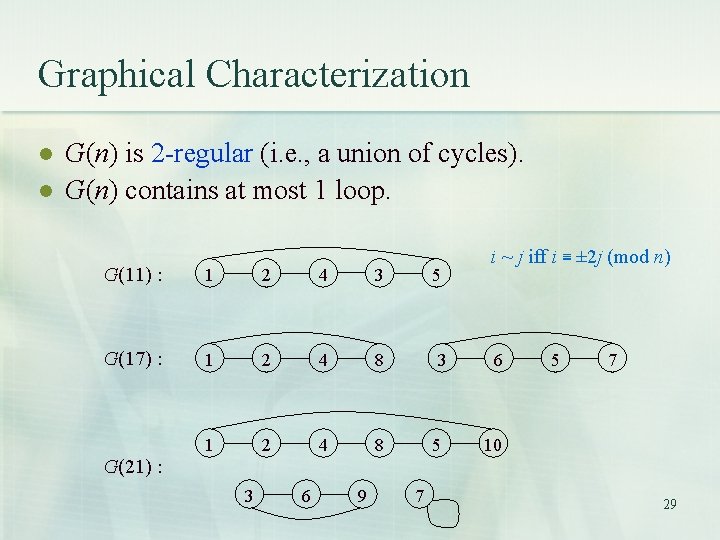
Graphical Characterization l l G(n) is 2 -regular (i. e. , a union of cycles). G(n) contains at most 1 loop. G(11) : 1 2 4 3 G(17) : 1 2 4 8 G(21) : 3 6 9 5 3 5 7 i ~ j iff i ≣ ± 2 j (mod n) 6 5 7 10 29
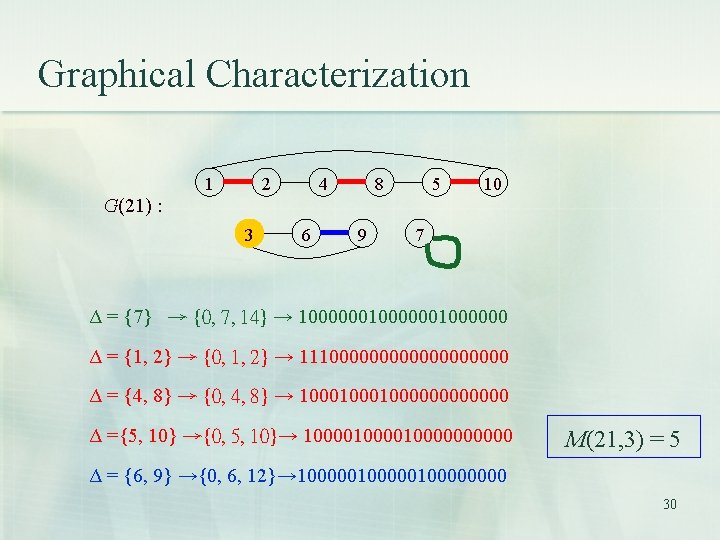
Graphical Characterization G(21) : 1 2 3 4 6 8 9 5 10 7 Δ = {7} → {0, 7, 14} → 10000001000000 Δ = {1, 2} → {0, 1, 2} → 111000000000 Δ = {4, 8} → {0, 4, 8} → 10001000000 Δ ={5, 10} →{0, 5, 10}→ 10000100000 M(21, 3) = 5 Δ = {6, 9} →{0, 6, 12}→ 10000010000 30
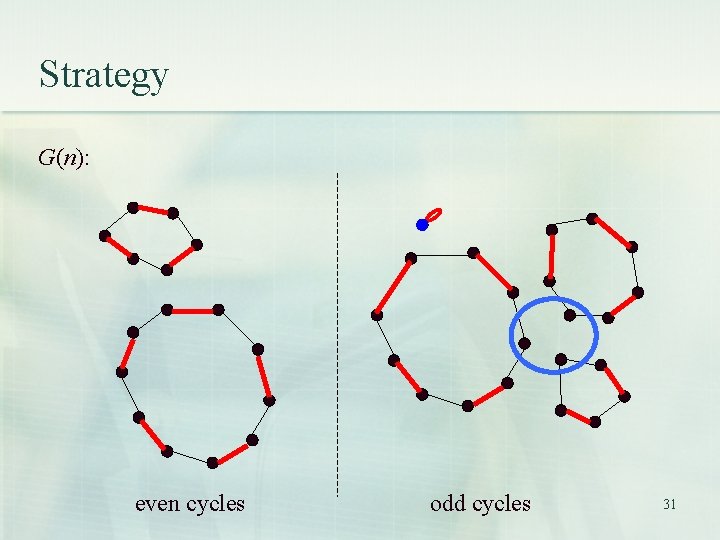
Strategy G(n): even cycles odd cycles 31
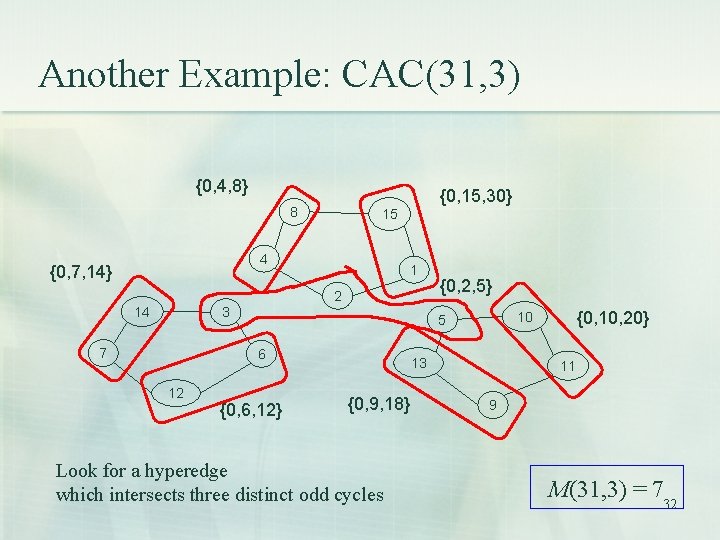
Another Example: CAC(31, 3) {0, 4, 8} {0, 15, 30} 8 15 4 {0, 7, 14} 1 2 14 3 7 {0, 6, 12} 13 {0, 9, 18} Look for a hyperedge which intersects three distinct odd cycles {0, 10, 20} 10 5 6 12 {0, 2, 5} 11 9 M(31, 3) = 732
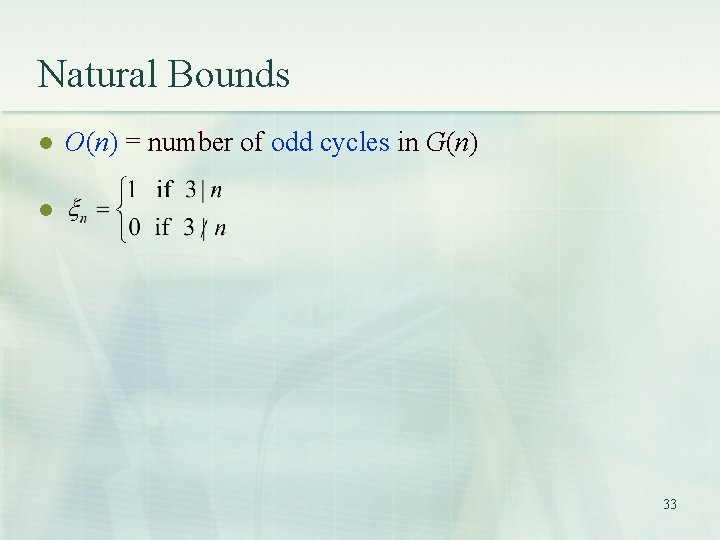
Natural Bounds l O(n) = number of odd cycles in G(n) l 33
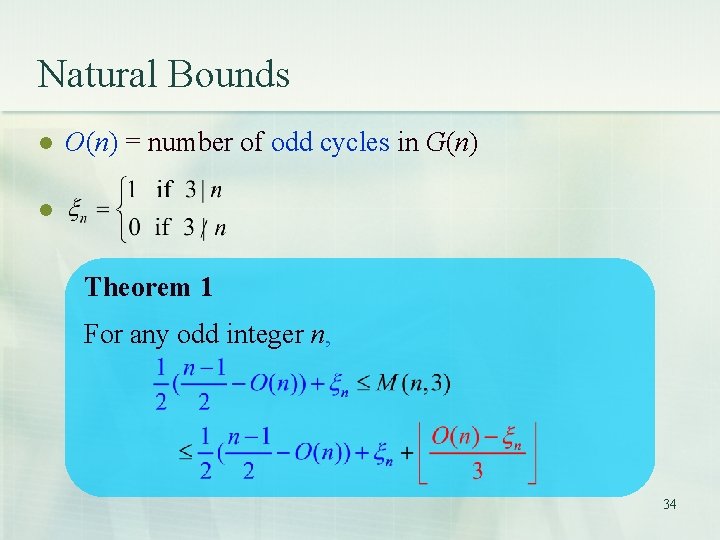
Natural Bounds l O(n) = number of odd cycles in G(n) l Theorem 1 For any odd integer n, 34
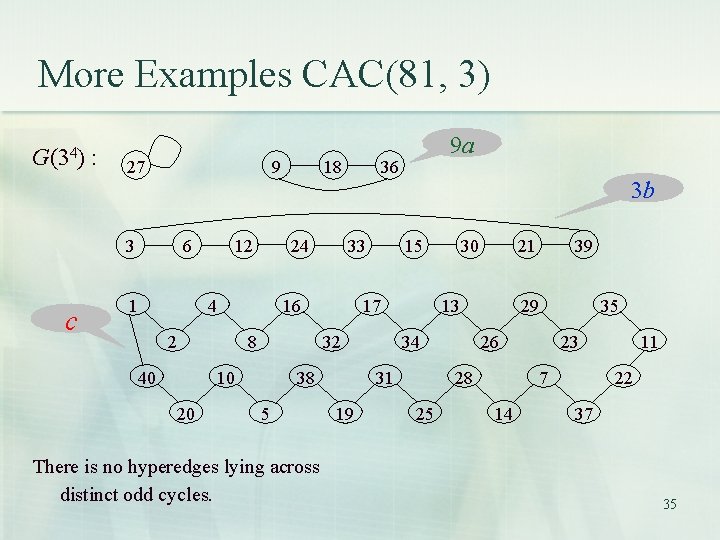
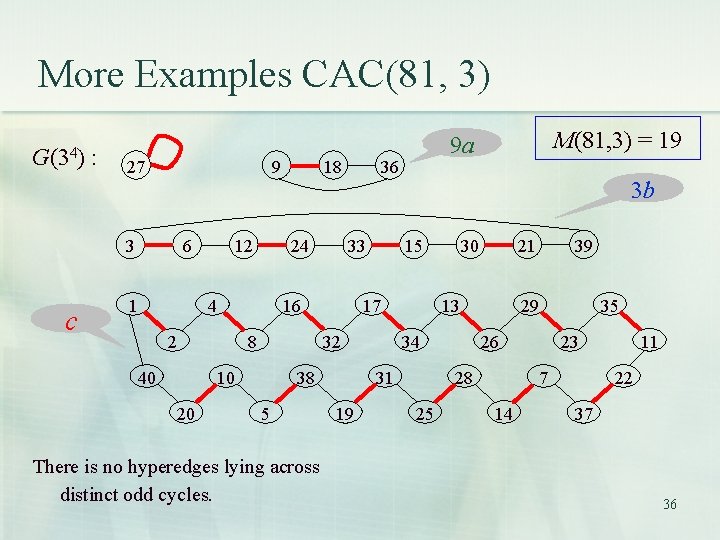
More Examples CAC(81, 3) G(34) : 27 9 18 9 a 36 3 b 3 c 6 1 12 24 16 4 2 20 17 38 10 5 There is no hyperedges lying across distinct odd cycles. 21 13 34 31 19 30 15 32 8 40 33 29 35 26 28 25 39 23 7 14 11 22 37 35
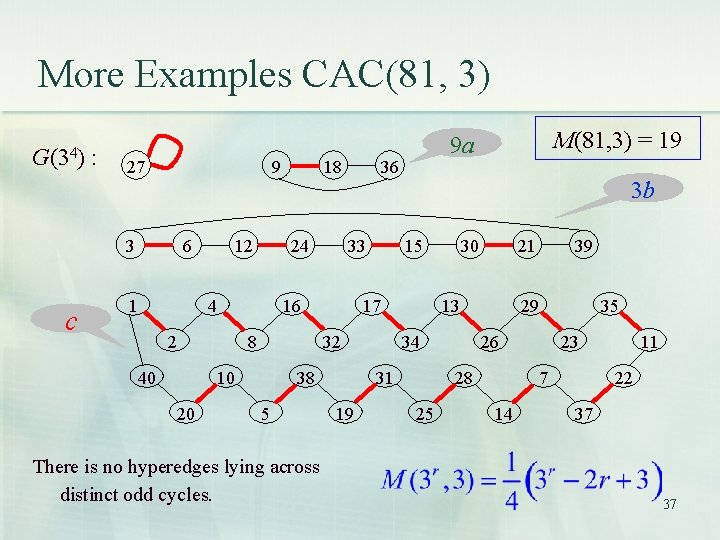
More Examples CAC(81, 3) G(34) : 27 9 18 M(81, 3) = 19 9 a 36 3 b 3 c 6 1 12 24 16 4 2 20 17 38 10 5 There is no hyperedges lying across distinct odd cycles. 21 13 34 31 19 30 15 32 8 40 33 29 35 26 28 25 39 23 7 14 11 22 37 36
More Examples CAC(81, 3) G(34) : 27 9 18 M(81, 3) = 19 9 a 36 3 b 3 c 6 1 12 24 16 4 2 20 17 38 10 5 There is no hyperedges lying across distinct odd cycles. 21 13 34 31 19 30 15 32 8 40 33 29 35 26 28 25 39 23 7 14 11 22 37 37
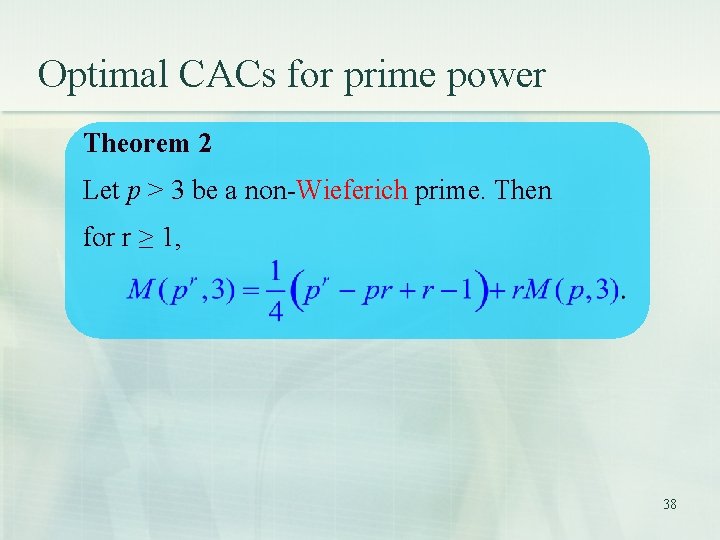
Optimal CACs for prime power Theorem 2 Let p > 3 be a non-Wieferich prime. Then for r ≥ 1, 38
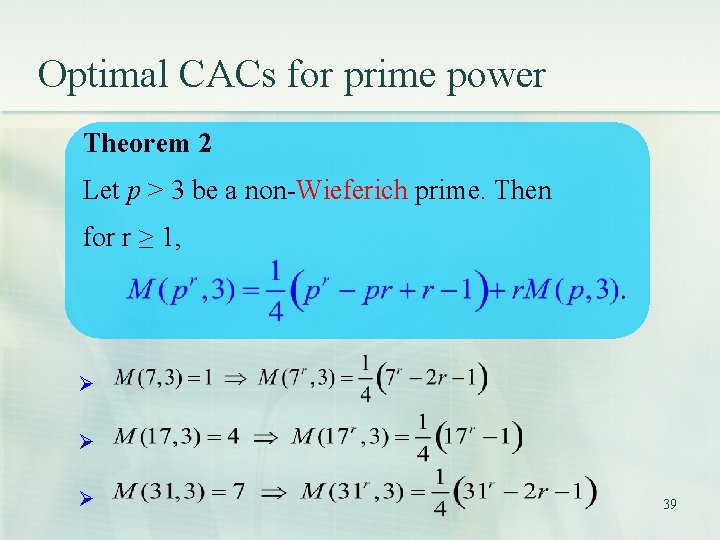
Optimal CACs for prime power Theorem 2 Let p > 3 be a non-Wieferich prime. Then for r ≥ 1, 39
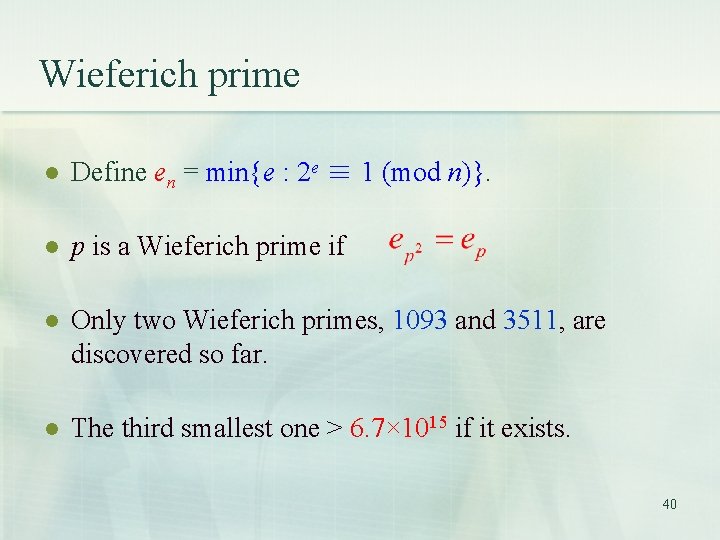
Wieferich prime l Define en = min{e : 2 e ≣ 1 (mod n)}. l p is a Wieferich prime if l Only two Wieferich primes, 1093 and 3511, are discovered so far. l The third smallest one > 6. 7× 10¹⁵ if it exists. 40
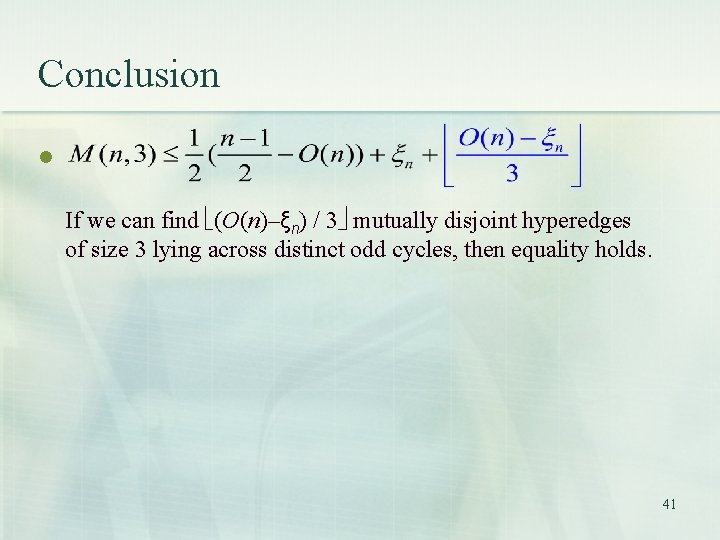
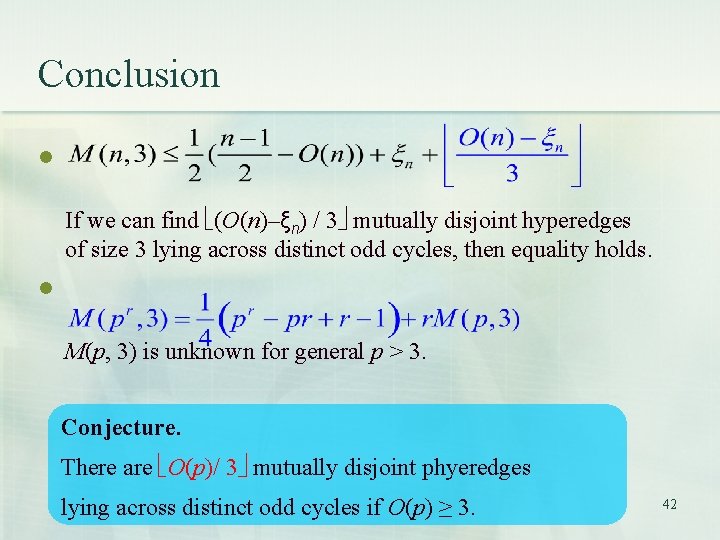
Conclusion l If we can find (O(n)–ξn) / 3 mutually disjoint hyperedges of size 3 lying across distinct odd cycles, then equality holds. 41
Conclusion l If we can find (O(n)–ξn) / 3 mutually disjoint hyperedges of size 3 lying across distinct odd cycles, then equality holds. l M(p, 3) is unknown for general p > 3. Conjecture. There are O(p)/ 3 mutually disjoint phyeredges lying across distinct odd cycles if O(p) ≥ 3. 42
References • V. I. Levenshtein and V. D. Tonchev, Optimal conflict-avoiding codes for three active users, In Proc. IEEE Int. Symp. Theory, 2005. • M. Jimbo et al. , On conflict-avoiding codes of length n = 4 m for tthree active users, IEEE Trans. Inf. Theory, 2007. • M. Mishima et al. , Optimal conflict-avoiding codes of length n ≣ 0 (mod 16) and weight 3, Des. Codes Cryptogr. , 2009. • H. L. Fu et al. , Optimal conflict-avoiding codes of even length and weight 3, IEEE Trans. Inf. Theory, 2010. • K. Momihara et al. , Constant weight conflict-avoiding codes, SIAM J. Discrete Math. , 2007. • K. W. Shum and W. S. Wong, A tight asymptotic bound on the size of constant-weight conflict-avoiding codes, Des. Codes Cryptogr. , 2010. • F. G. Dorais and D. W. Klyve, A Wieferich prime search up to 6. 7× 10¹⁵, J. 43 Integer Seq. 2011.
Thank you for your attention 44