Research and Enterprise PATHWAYS TO IMPACT Anthony Atkin
- Slides: 19
Research and Enterprise PATHWAYS TO IMPACT Anthony Atkin (Research Impact Manager) 1 Copyright University of Reading LIMITLESS POTENTIAL | LIMITLESS OPPORTUNITIES | LIMITLESS IMPACT
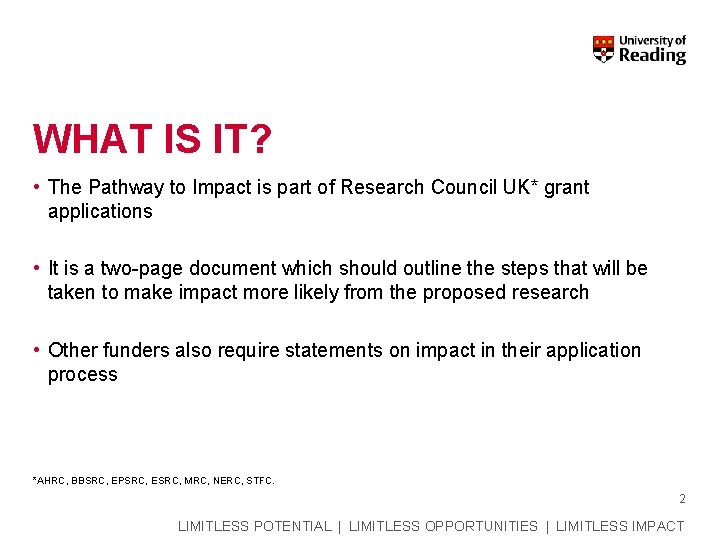
WHAT IS IT? • The Pathway to Impact is part of Research Council UK* grant applications • It is a two-page document which should outline the steps that will be taken to make impact more likely from the proposed research • Other funders also require statements on impact in their application process *AHRC, BBSRC, EPSRC, ESRC, MRC, NERC, STFC. 2 LIMITLESS POTENTIAL | LIMITLESS OPPORTUNITIES | LIMITLESS IMPACT
WHY IS IT IMPORTANT? • The Pathway to Impact viewed as important Research Councils UK: • “A clearly thought through and acceptable Pathways to Impact is an essential component of a research proposal and a condition of funding”. • “Grants will not be allowed to start until a clearly thought through and acceptable Pathways to Impact statement is received. ” • http: //www. rcuk. ac. uk/ke/impacts/ 3 LIMITLESS POTENTIAL | LIMITLESS OPPORTUNITIES | LIMITLESS IMPACT
WHAT SHOULD IT INCLUDE? • The Pathways to Impact should include answers to the following questions: • Who could adopt or benefit from the proposed research? • How could they benefit from the proposed research? • What steps will be taken by you to make this adoption and/or benefit more likely? • The Pathways to Impact should be detailed and specific to the project and include • Detailed milestones and deliverables • Details of costs for the proposed activities 4 LIMITLESS POTENTIAL | LIMITLESS OPPORTUNITIES | LIMITLESS IMPACT
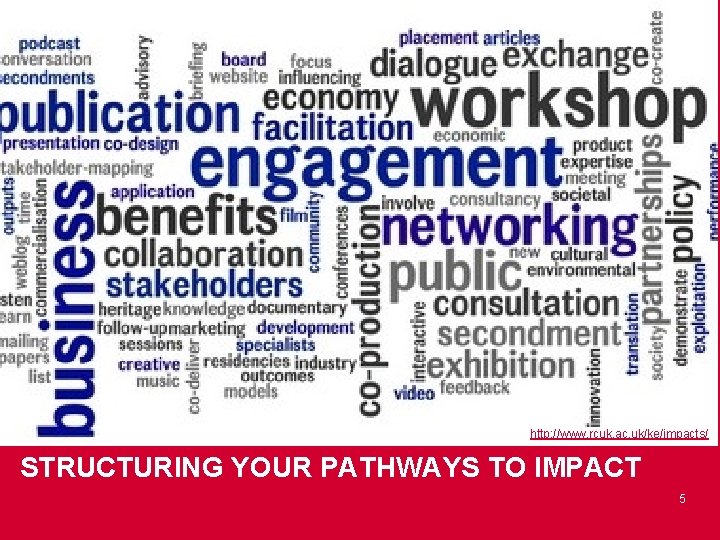
http: //www. rcuk. ac. uk/ke/impacts/ STRUCTURING YOUR PATHWAYS TO IMPACT 5 LIMITLESS POTENTIAL | LIMITLESS OPPORTUNITIES | LIMITLESS IMPACT
SUGGESTED STRUCTURE • A suggested structure for the Pathway to Impact is as follows: 1. Context. Restate the proposed research 2. Who? Who could adopt or benefit from the proposed research? 3. How? How could they benefit from the proposed research? 4. What? What steps will be taken to make this adoption and/or benefit more likely? 5. Timelines 6. Costs • The following slides describe each section individually 6 LIMITLESS POTENTIAL | LIMITLESS OPPORTUNITIES | LIMITLESS IMPACT
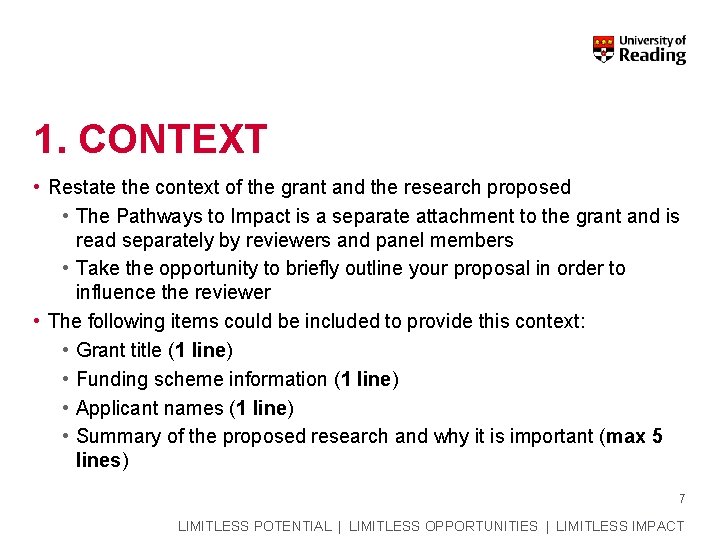
1. CONTEXT • Restate the context of the grant and the research proposed • The Pathways to Impact is a separate attachment to the grant and is read separately by reviewers and panel members • Take the opportunity to briefly outline your proposal in order to influence the reviewer • The following items could be included to provide this context: • Grant title (1 line) • Funding scheme information (1 line) • Applicant names (1 line) • Summary of the proposed research and why it is important (max 5 lines) 7 LIMITLESS POTENTIAL | LIMITLESS OPPORTUNITIES | LIMITLESS IMPACT
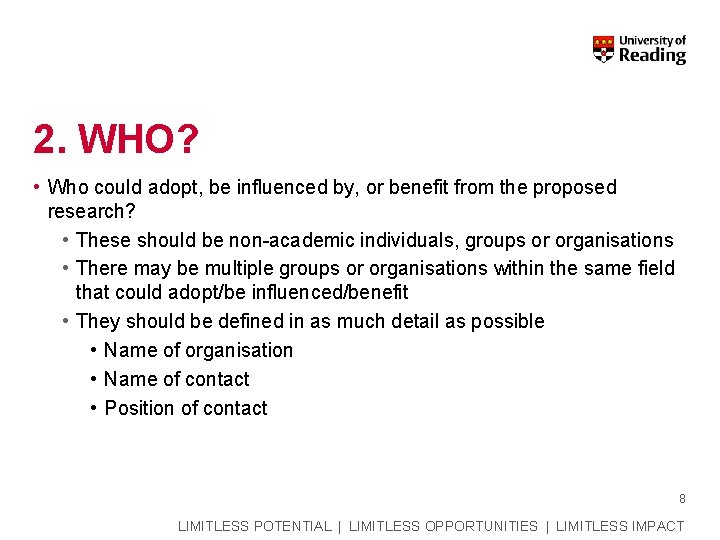
2. WHO? • Who could adopt, be influenced by, or benefit from the proposed research? • These should be non-academic individuals, groups or organisations • There may be multiple groups or organisations within the same field that could adopt/be influenced/benefit • They should be defined in as much detail as possible • Name of organisation • Name of contact • Position of contact 8 LIMITLESS POTENTIAL | LIMITLESS OPPORTUNITIES | LIMITLESS IMPACT
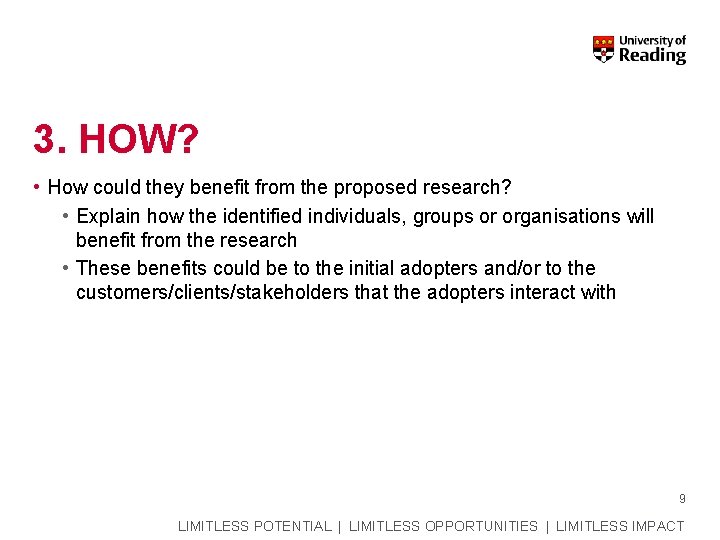
3. HOW? • How could they benefit from the proposed research? • Explain how the identified individuals, groups or organisations will benefit from the research • These benefits could be to the initial adopters and/or to the customers/clients/stakeholders that the adopters interact with 9 LIMITLESS POTENTIAL | LIMITLESS OPPORTUNITIES | LIMITLESS IMPACT
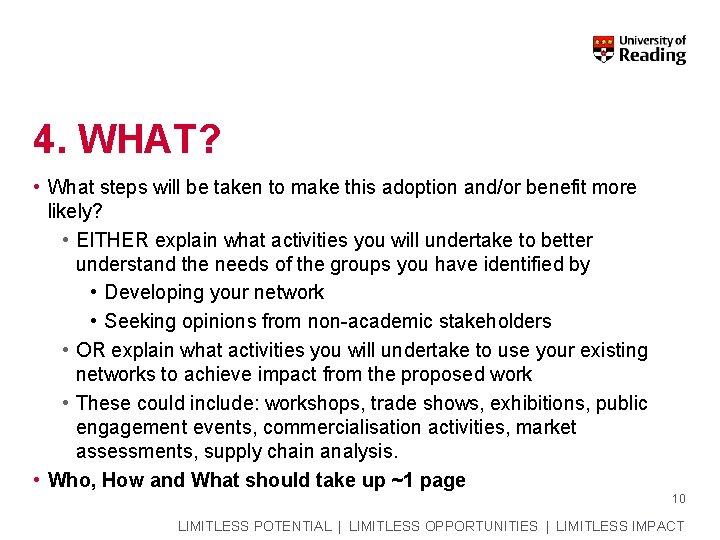
4. WHAT? • What steps will be taken to make this adoption and/or benefit more likely? • EITHER explain what activities you will undertake to better understand the needs of the groups you have identified by • Developing your network • Seeking opinions from non-academic stakeholders • OR explain what activities you will undertake to use your existing networks to achieve impact from the proposed work • These could include: workshops, trade shows, exhibitions, public engagement events, commercialisation activities, market assessments, supply chain analysis. • Who, How and What should take up ~1 page 10 LIMITLESS POTENTIAL | LIMITLESS OPPORTUNITIES | LIMITLESS IMPACT
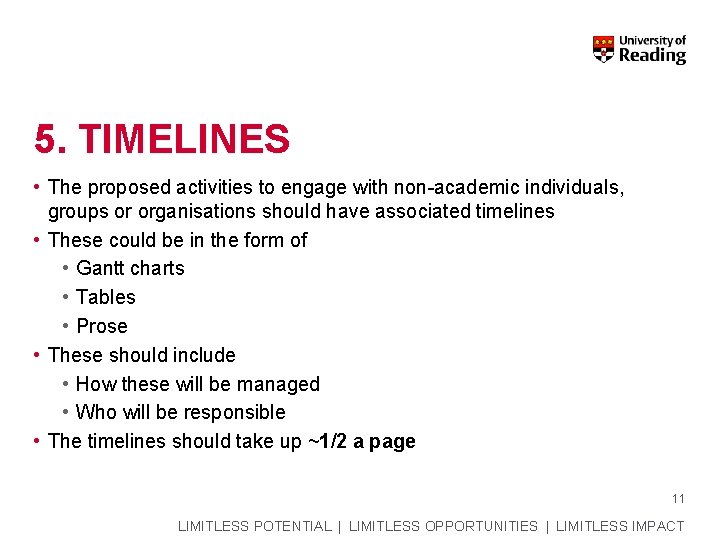
5. TIMELINES • The proposed activities to engage with non-academic individuals, groups or organisations should have associated timelines • These could be in the form of • Gantt charts • Tables • Prose • These should include • How these will be managed • Who will be responsible • The timelines should take up ~1/2 a page 11 LIMITLESS POTENTIAL | LIMITLESS OPPORTUNITIES | LIMITLESS IMPACT
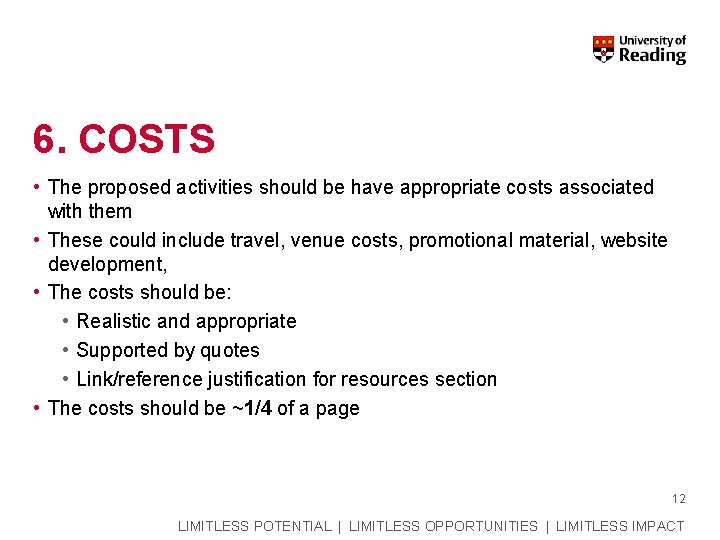
6. COSTS • The proposed activities should be have appropriate costs associated with them • These could include travel, venue costs, promotional material, website development, • The costs should be: • Realistic and appropriate • Supported by quotes • Link/reference justification for resources section • The costs should be ~1/4 of a page 12 LIMITLESS POTENTIAL | LIMITLESS OPPORTUNITIES | LIMITLESS IMPACT
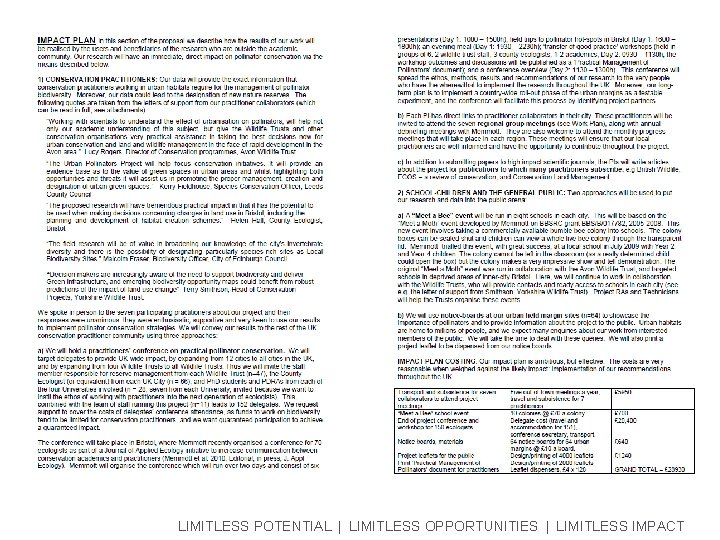
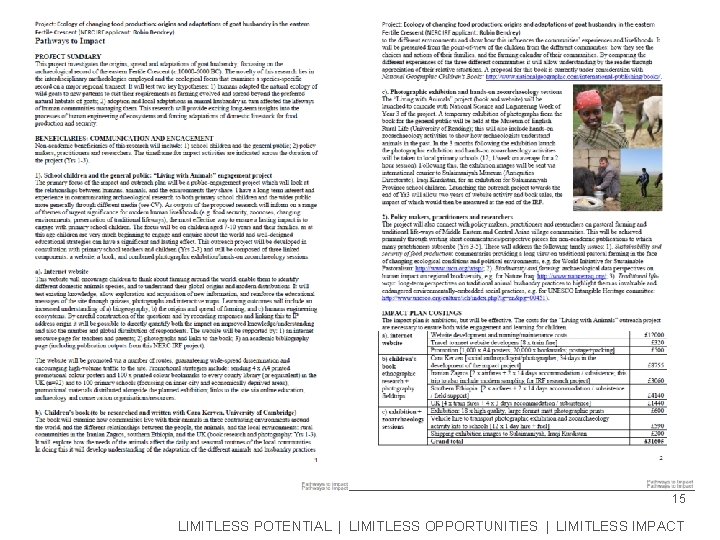
EXAMPLES • The following slides give real examples of pathways to impact from SAPD and SAGES 13 LIMITLESS POTENTIAL | LIMITLESS OPPORTUNITIES | LIMITLESS IMPACT
14 LIMITLESS POTENTIAL | LIMITLESS OPPORTUNITIES | LIMITLESS IMPACT
15 LIMITLESS POTENTIAL | LIMITLESS OPPORTUNITIES | LIMITLESS IMPACT
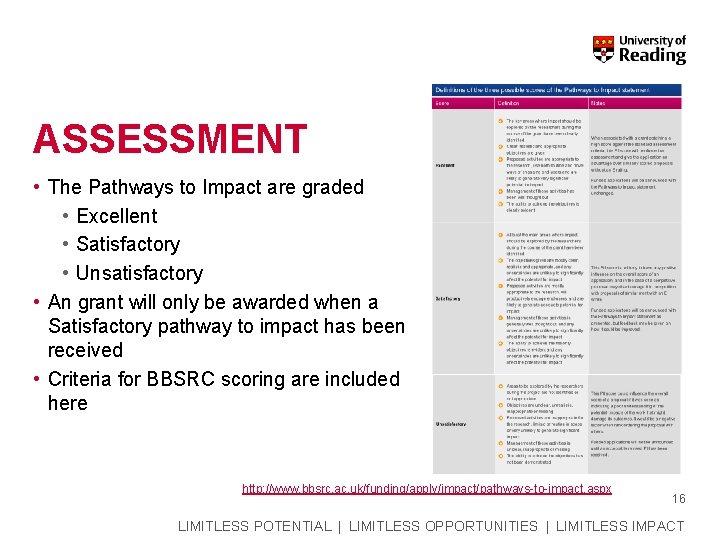
ASSESSMENT • The Pathways to Impact are graded • Excellent • Satisfactory • Unsatisfactory • An grant will only be awarded when a Satisfactory pathway to impact has been received • Criteria for BBSRC scoring are included here http: //www. bbsrc. ac. uk/funding/apply/impact/pathways-to-impact. aspx 16 LIMITLESS POTENTIAL | LIMITLESS OPPORTUNITIES | LIMITLESS IMPACT
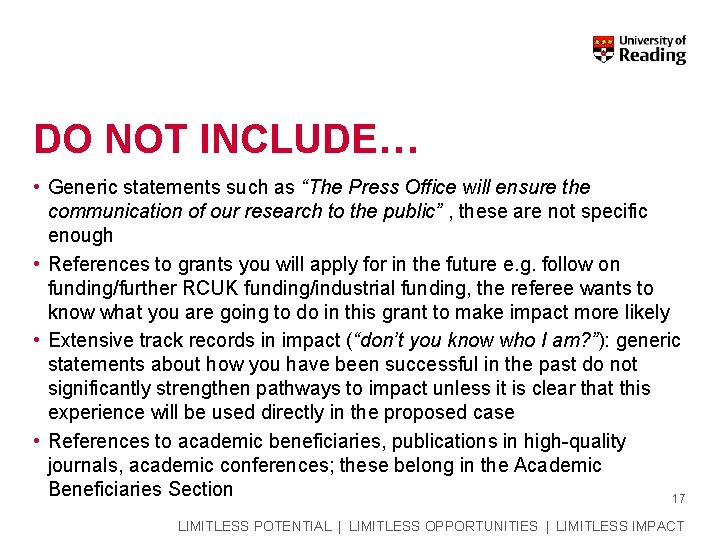
DO NOT INCLUDE… • Generic statements such as “The Press Office will ensure the communication of our research to the public” , these are not specific enough • References to grants you will apply for in the future e. g. follow on funding/further RCUK funding/industrial funding, the referee wants to know what you are going to do in this grant to make impact more likely • Extensive track records in impact (“don’t you know who I am? ”): generic statements about how you have been successful in the past do not significantly strengthen pathways to impact unless it is clear that this experience will be used directly in the proposed case • References to academic beneficiaries, publications in high-quality journals, academic conferences; these belong in the Academic Beneficiaries Section 17 LIMITLESS POTENTIAL | LIMITLESS OPPORTUNITIES | LIMITLESS IMPACT
IMPACT SUMMARY • Within the Je. S form there is an Impact Summary section • This section is the public-facing impact section • Here you should identify the broad areas of impact and the potential beneficiaries for a lay-audience (the Who and the How) • This section should not include what you will do to make impact more likely 18 LIMITLESS POTENTIAL | LIMITLESS OPPORTUNITIES | LIMITLESS IMPACT
CONTACTS • For further advice contact • Anthony Atkin (Research Impact Manager) • impact@reading. ac. uk, • a. atkin@reading. ac. uk, • extn 7411 • Research and Enterprise Development Managers • http: //www. reading. ac. uk/internal/res/contact/res-contact. aspx 19 LIMITLESS POTENTIAL | LIMITLESS OPPORTUNITIES | LIMITLESS IMPACT