Regional Security Complex and Regional Security Challenges Saa


- Slides: 45
Regional Security Complex and Regional Security Challenges Saša Mijalković, Ph. D University of Criminal Investigation and Police Studies
O Barry Buzan developed the concept of Regional Security Complex in 1983. O Security Complex: „a group of states whose primary security concerns link together sufficiently closely that their national securities cannot realistically be considered apart from one another (Buzan, 1983: 106). O Updated „non-state centric“ definition: „a set of units whose major processes of complex securitisation, desecuritisation, or both are so interlinked that their security problems cannot reasonably be analysed or resolved apart from one another (Buzan, Waever, 2003: 491).
O Theory of Regional Security Complex: O The regional level is where the extremes of national and global security interplay, and where most of the action occurs; O security regions form subsystems in which most of the security interaction is internal (between states within one region) O Regional security complexes are defined by durable patterns of amity and enmity taking the form of patterns of security interdependence between states. O formation of regional security complexes derives from the interplay between, on the one hand, the anarchic structure and its balance-of-power consequences, and on the other the pressures of local geographical proximity among neighbour states
The essential structure of Regional Security Complex O boundary, which differentiates the RSC from its neighbors; O anarchic structure, which means that the RSC must be composed of two or more autonomous units; O polarity, which covers the distribution of power among the units (unipolarity, multipolarity, non-polarity) O social construction, which covers the patterns of amity and enmity among the units (ranging from conflict formation to security regime and security community)
The 4 levels of analysis of the Theory of regional security complex: 1. Internal security of the states of the region, particularly their domestically generated vulnerabilities (is the state strong or weak due to stability of the domestic order and correspondence between state and nation) 2. state-to-state relations (which generate the region as such); 3. the region’s interaction with neighbouring regions; 4. the role of global powers in the region (the interplay between the global and regional security structures).
O The regional level matters most for the states within it, but also substantially for the global powers O The influence of distribution of power among the global powers to the regional dynamics of regional security complex can be manifested in two forms: O Overlay - the security region is defined by outside powers that disables security dynamics between regional actors O Penetration - Penetration occurs when outside powers make security alignments with states within an regional security complex
Three possible evolutions open to a regional security complex: O maintenance of the status quo, which means that there are no significant changes in its essential structure; O internal transformation, which means that changes in essential structure occur within the context of its existing outer boundary. This could mean changes to the anarchic structure (because of regional integration); to polarity (because of disintegration, merger, conquest, differential growth rates, or suchlike); or to the dominant patterns of amity/enmity (because of ideological shifts, war-weariness, changes of leadership, etc. ); O external transformation, which means that the outer boundary expands or contracts, changing the membership of the RSC, and most probably transforming its essential structure in other ways. The most obvious way for this to happen is if two RSCs merge, or less often two RSCs splitting out from one.
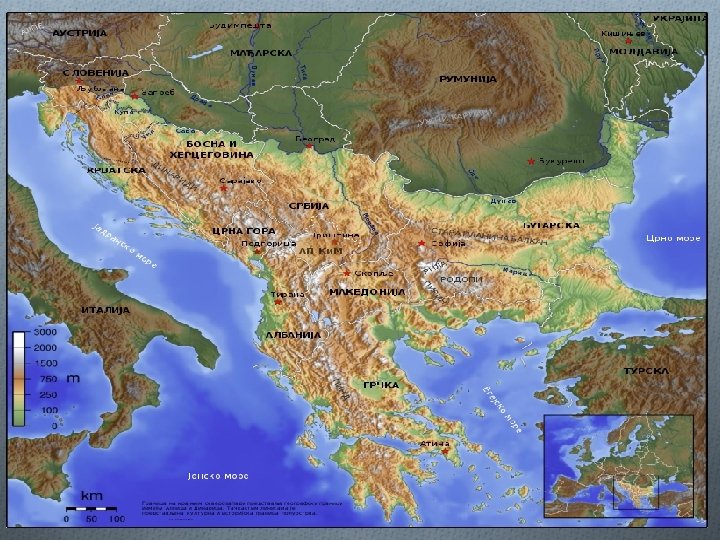
Western Balkans complex O Balkans: Albania, Bosnia and Herzegovina, Bulgaria, Croatia, Greece, Montenegro, North Macedonia, Romania, Serbia, and Slovenia. O Western Balkans O It comprises Albania, Bosnia and Herzegovina, Croatia, Montenegro, North Macedonia and Serbia. O The institutions of the European Union have generally used the term "Western Balkans" for the Balkan area that includes countries that are not members of the European Union O Western Balkans is a political neologism coined to refer to Albania and the territory of the former Yugoslavia, except Slovenia, since the early 1990 s.
O What makes Western Balkans a regional security complex? OSecurity interdependence of states that are physically close. OIntertwined patterns of friendship/enmity OUnresolved (disputed) issues that burden relations in the region.
Western Balkans security dynamics O internal security (different ethnic groups and different identities built through the prism of the potential threats from other ethnic groups) O relations between the countries in the region (strong but contradictory; potential alliances would probably have been ensued on a religious basis (Islamic arc (linking Turkey, the Federation of Bosnia and Herzegovina, Albania and Kosovo) Vs orthodox arc (Greece, Bulgaria, Serbia and the Republika Srpska); the model of potential conflict on Western Balkans is too complicated and the number of participants is too big) O the role of global powers in the region (Leading regional geopolitical players in the region that are present in the region are US, EU and Russia (the case of overlay from 1991 to 1999)
O each of the Western Balkans countries which is outside of the EU still faces difficulties of institutional or structural nature, such as: O weakness of the functioning of democratic institutions (Albania) O dysfunctional political structures (Bosnia and Herzegovina) O the problem of Serbia's borders in the context of the unilaterally proclaimed independence of Kosovo O North Macedonia difficulties in dealing with its neighbors, internal ethnic divisions and so on.
O Western Balkan countries are still facing many problems that prevent democratization: O lack of consensus about the basic principles, values and priorities of the political and economic system, as well as their future place in Euro-Atlantic integration. O societies are still essentially divided in various ways, which presents an obstacle of the overwhelming consolidation of democracy, and also the normal functioning of institutions. O Freedom of media is endangered by governments and by strong economic and political groups.
O There are number of issues in the Western Balkans of societal and political sectors, such as: O Will Bosnia and Herzegovina remain as it is or it will divide O O O into two or three countries; Will Kosovo be independent in the future, a part of Serbia or possibly part of a Greater Albania; The position of Albanians in southern Serbia; The relationship between the large Albanian minority and the Slovenian majority in Macedonia, which caused open violence in early 2001; the processes of nation states construction which started at the time of disintegration of socialist Yugoslavia, have not finished yet. Kosovo and Metohija and Bosnia and Herzegovina present two focal points of this region that give character to this regional security sub-complex, and each unit of this sub-complex wants a different status for these entities in accordance with its national interests.
O Relations of security interdependence and patterns of hostility between two states/units within the Western Balkan sub-complex: O Croats-Serbs (in Croatia and Bi. H) O Serbs-Albanians (in Kosovo and Metohija and in the South of Serbia) O Serbs-Muslims/Bosniaks (in Serbia, Bi. H and possibly in Montenegro) O Macedonians-Albanians (in North Macedonia) O potentially Serbs-Montenegrins (in Montenegro) O potentially Montenegrins-Muslims/Bosniaks (in Montenegro) O potentially Montenegrins-Albanians (in Montenegro) O Potentially Croats-Muslims/Bosniaks (in Bi. H).
O INTERCONNECTEDNESS OF REGIONAL CHALLENGES O Resolving political and legal status of Kosovo and Metohija is of highest importance for Serbs and Albaninans living in Ki. M; for Albaninas in Albania (regarding the Greater Albaia project) and Albanians in North Macedonia, as well as Albanians living in Montenegro. O The model of resolving the Kosovo and Metohija issue would be the pattern for solving the status of Republika Srpska, perceived by Serbs in Bi. H and Serbs in Serbia. O There has been an interest for change of political and legal status of entities in Bosnia nad Herzegovina not only by Serbs (both in Serbia nad Bi. H) but also by muslims/Bosniaks and Croatians in Bi. H and in Zagreb. O So, in addition to the historical, political, cultural and linguistic proximity of Western Balkan regional security units, what clearly delineates the border of this sub-complex is the involvement of all actors in and different (national) interests regarding the "final solutions" for Kosovo and Metohija and Bi. H.
O Of course, there is certain security dynamics that goes beyond Western Balkans, like between North Macedonia and Greece, North Macedonia and Bulgaria, Serbia and Bulgaria, Greece and Albania, Hungary and Serbia O However, this dynamic has no such importance like the dynamic within narrow, Western Balkans region.
discussion O Possible scenarios in the Western Balkans regarding the patterns of amity and enmity among the units? 1. 2. 3. Return to conflict formation (90 s)? Maintenance of security regime (which is current status quo)? Building of security community (based on occasional statements by Western Balkan leaders on the need to "improve cooperation in the region“)? O Is there a concern that building a security community would lead to an overlay and thus disable regional security dynamics?
The influence of external actors on Western Balkans regional security subcomplex
O USA O (considered to make a significant impact during 90 s (economic sanctions against Yugoslavia, Dayton Peace Agreement, Rambouillet negotiations, Kumanovo Agreement, Bondsteel, Ohrid Peace Agreement) O It is believed that after the two Clinton administrations, the Western Balkans are no longer in the focus of American foreign policy and the Americans leave the western Balkans to the EU. O Russia O Important factor whose influence in WB RSC is weakened by most of the units’ accession to NATO. However, Russia still have a great potential to influence security dynamics in Western Balkans because of the ENERGY POTENTIAL and the right of veto in the UN Security Council.
O EU O the interests of the European Union at the Western Balkans regional security sub-complex cannot be precisely determined, given that this intergovernmental organization consists of 27 states with individual and often conflicting interests. O The best example in this regard is the recognition of the independence of Kosovo (and Metohija), where 5 out of 27 countries did not recognize the independence of Kosovo and Metohija (Slovakia, Cyprus, Greece, Romania and Spain). O However, Germany's interest within the European Union is presented as key in formulating the EU's policy towards the Western Balkans countries
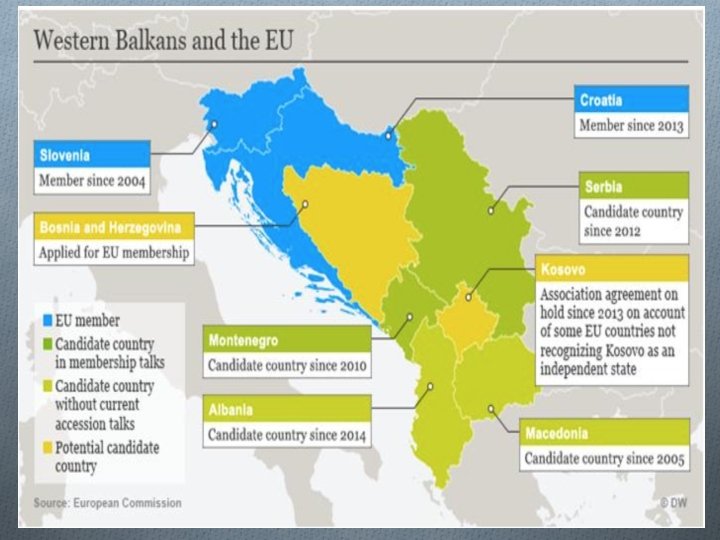
O Western Balkans regional security sub-complex is strongly influences by the EU. O The idea that membership in the European Union is not a constitutive characteristic of RS sub-complex Western Balkans is best illustrated by Croatia's membership in the EU, which on 01. 07. 2013. did not cease to be part of the Western Balkans regional security sub-complex. O Western Balkans is a sub-complex of the European regional security complex, since membership enabled Croatia to participate in sub-regional security dynamics even with advantages comparing to other units (states) of the subcomplex.
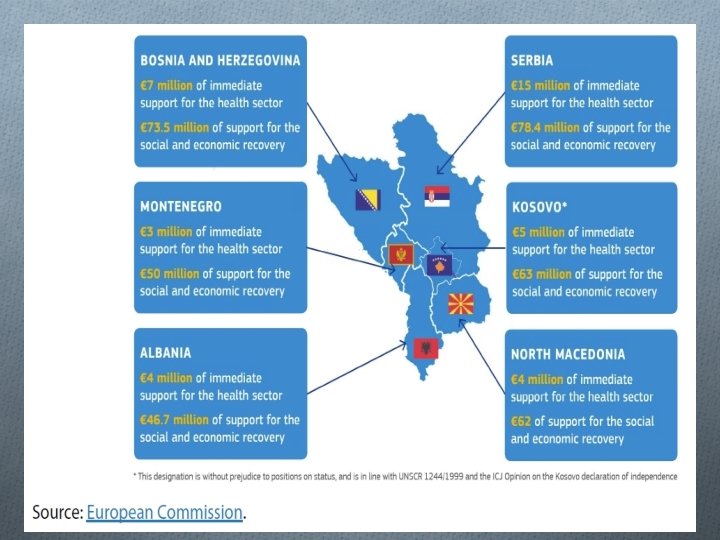
O It is assumed that the EU has the greatest influence within the subcomplex Western Balkans, given that all the Western Balkans countries have established EU membership as their strategic foreign policy and economic goal (with Croatia already being member of the EU), and where most of the countries defined NATO membership as highest strategic defense goal (except Serbia and Bi. H).
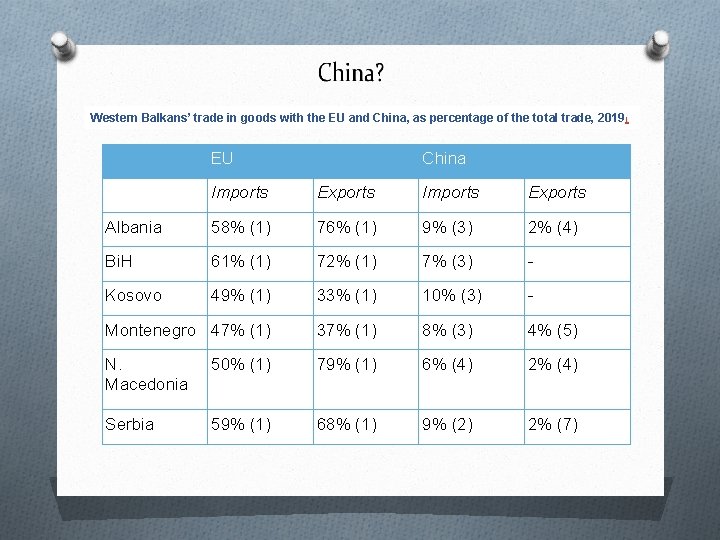
Western Balkans’ trade in goods with the EU and China, as percentage of the total trade, 2019 ] EU China Imports Exports Albania 58% (1) 76% (1) 9% (3) 2% (4) Bi. H 61% (1) 72% (1) 7% (3) - Kosovo 49% (1) 33% (1) 10% (3) - Montenegro 47% (1) 37% (1) 8% (3) 4% (5) N. Macedonia 50% (1) 79% (1) 6% (4) 2% (4) Serbia 59% (1) 68% (1) 9% (2) 2% (7)
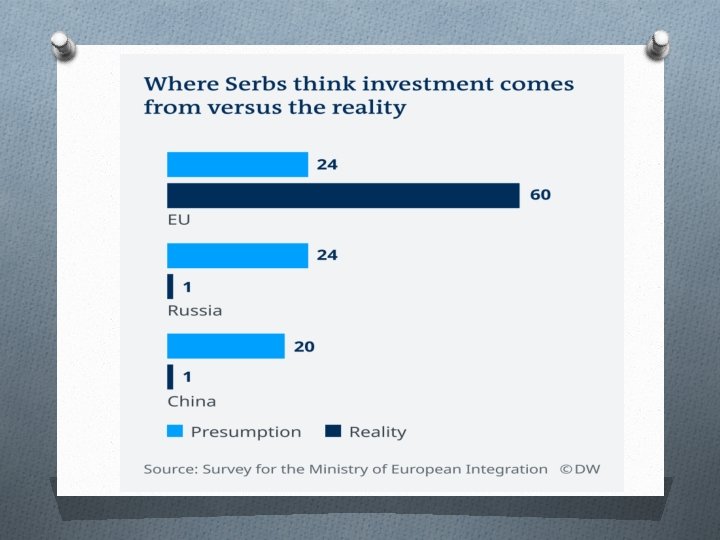
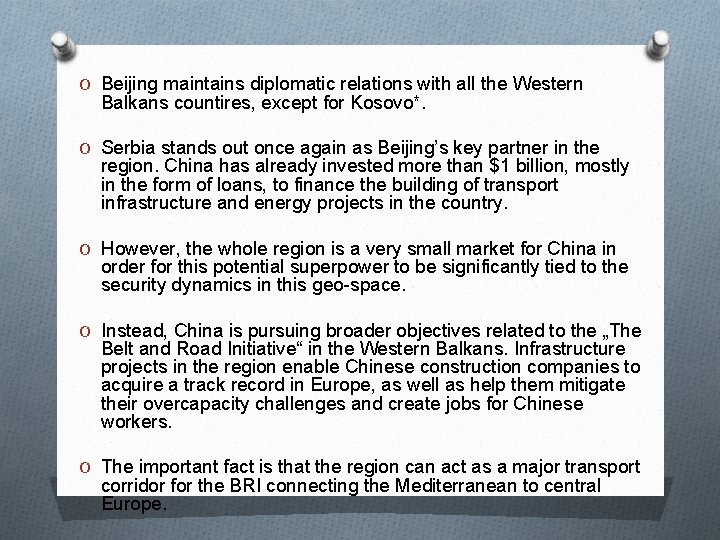
O Beijing maintains diplomatic relations with all the Western Balkans countires, except for Kosovo*. O Serbia stands out once again as Beijing’s key partner in the region. China has already invested more than $1 billion, mostly in the form of loans, to finance the building of transport infrastructure and energy projects in the country. O However, the whole region is a very small market for China in order for this potential superpower to be significantly tied to the security dynamics in this geo-space. O Instead, China is pursuing broader objectives related to the „The Belt and Road Initiative“ in the Western Balkans. Infrastructure projects in the region enable Chinese construction companies to acquire a track record in Europe, as well as help them mitigate their overcapacity challenges and create jobs for Chinese workers. O The important fact is that the region can act as a major transport corridor for the BRI connecting the Mediterranean to central Europe.
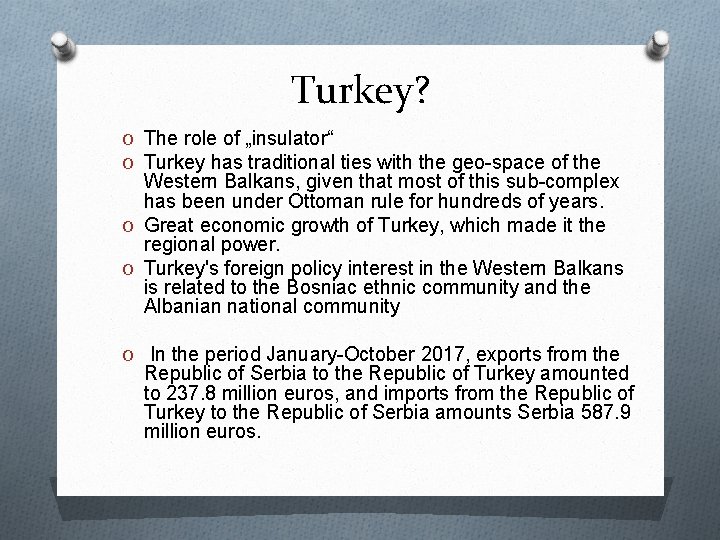
Turkey? O The role of „insulator“ O Turkey has traditional ties with the geo-space of the Western Balkans, given that most of this sub-complex has been under Ottoman rule for hundreds of years. O Great economic growth of Turkey, which made it the regional power. O Turkey's foreign policy interest in the Western Balkans is related to the Bosniac ethnic community and the Albanian national community O In the period January-October 2017, exports from the Republic of Serbia to the Republic of Turkey amounted to 237. 8 million euros, and imports from the Republic of Turkey to the Republic of Serbia amounts Serbia 587. 9 million euros.
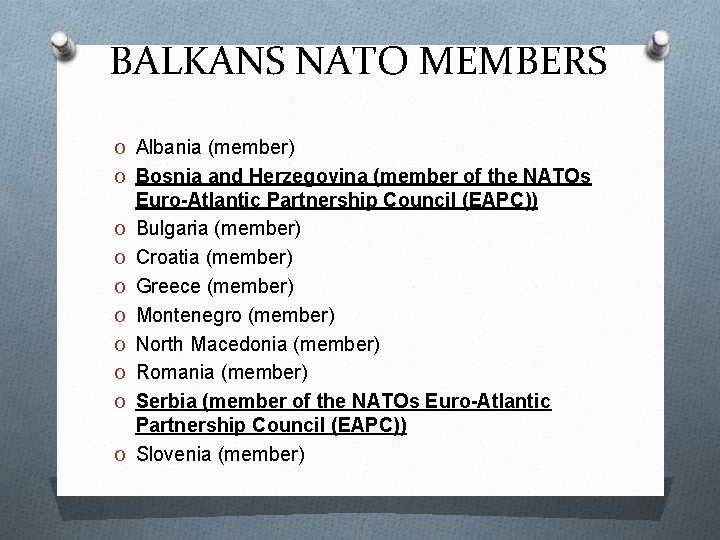
BALKANS NATO MEMBERS O Albania (member) O Bosnia and Herzegovina (member of the NATOs O O O O Euro-Atlantic Partnership Council (EAPC)) Bulgaria (member) Croatia (member) Greece (member) Montenegro (member) North Macedonia (member) Romania (member) Serbia (member of the NATOs Euro-Atlantic Partnership Council (EAPC)) Slovenia (member)
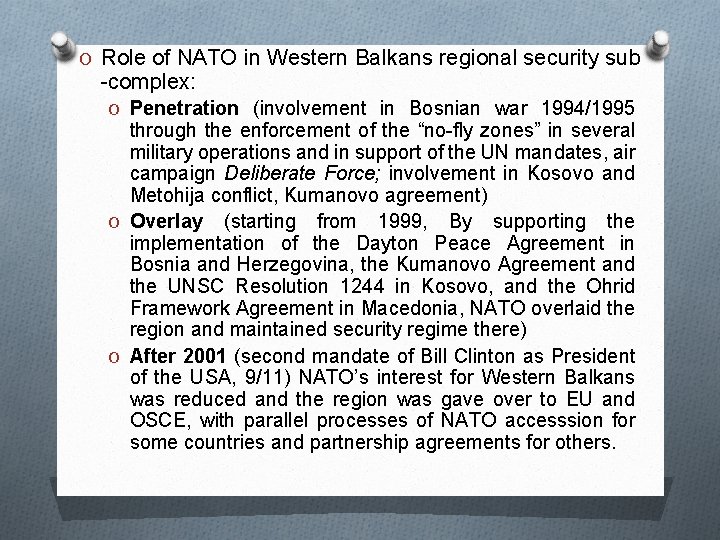
O Role of NATO in Western Balkans regional security sub -complex: O Penetration (involvement in Bosnian war 1994/1995 through the enforcement of the “no-fly zones” in several military operations and in support of the UN mandates, air campaign Deliberate Force; involvement in Kosovo and Metohija conflict, Kumanovo agreement) O Overlay (starting from 1999, By supporting the implementation of the Dayton Peace Agreement in Bosnia and Herzegovina, the Kumanovo Agreement and the UNSC Resolution 1244 in Kosovo, and the Ohrid Framework Agreement in Macedonia, NATO overlaid the region and maintained security regime there) O After 2001 (second mandate of Bill Clinton as President of the USA, 9/11) NATO’s interest for Western Balkans was reduced and the region was gave over to EU and OSCE, with parallel processes of NATO accesssion for some countries and partnership agreements for others.
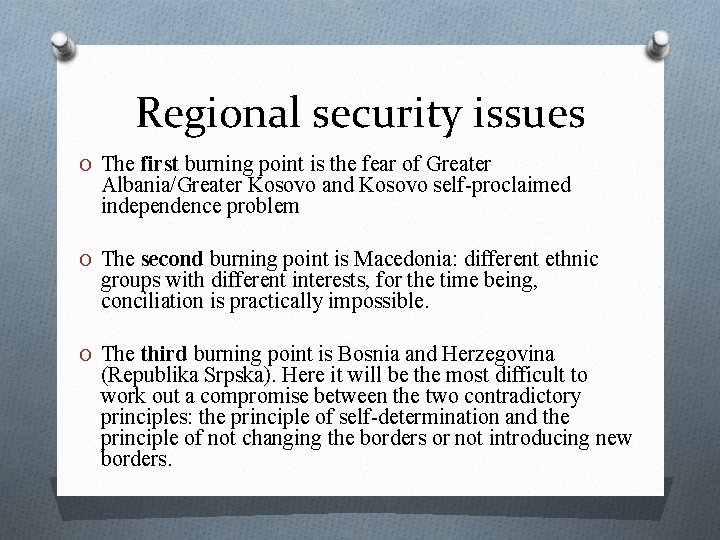
Regional security issues O The first burning point is the fear of Greater Albania/Greater Kosovo and Kosovo self-proclaimed independence problem O The second burning point is Macedonia: different ethnic groups with different interests, for the time being, conciliation is practically impossible. O The third burning point is Bosnia and Herzegovina (Republika Srpska). Here it will be the most difficult to work out a compromise between the two contradictory principles: the principle of self-determination and the principle of not changing the borders or not introducing new borders.
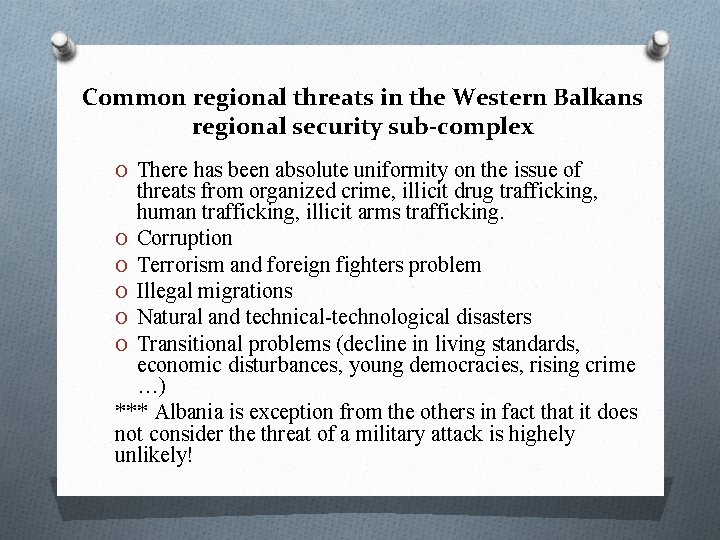
Common regional threats in the Western Balkans regional security sub-complex O There has been absolute uniformity on the issue of threats from organized crime, illicit drug trafficking, human trafficking, illicit arms trafficking. O Corruption O Terrorism and foreign fighters problem O Illegal migrations O Natural and technical-technological disasters O Transitional problems (decline in living standards, economic disturbances, young democracies, rising crime …) *** Albania is exception from the others in fact that it does not consider the threat of a military attack is highely unlikely!
O Destabilization/weakening of state institutions O Spread of racism, xenophobia, extreme nationalism and other negative social processes- radicalism O Spread of infectious diseases O Cyber crime O Problems related to the protection of the rights of national minorities/unilateral solutions
O economic crime, economic instability, high unemployment rate, endangering critical (national) infrastructure and endangering the communication and information system/information security, drug abuse and other addiction related health issues
O The main national interests of the Republic of Serbia are: maintaining the sovereignty, independence and territorial integrity of the Republic of Serbia; keeping internal stability and security; preserving the existence and protecting Serbian people wherever they live, as well as national minorities and their cultural, religious and historical identity; maintenance of world and regional peace and stability, European integration and EU membership; economic development and overall prosperity; environmental protection and the protection of natural resources of the Republic of Serbia
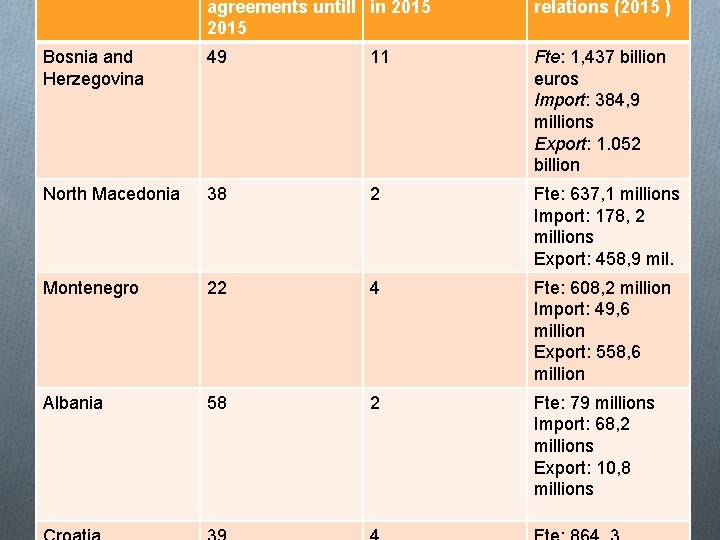
O three main political and economic indicators of bilateral cooperation between RS and other sub -complex units: O content and number of signed interstate agreements, O the number of mutual official visits of the highest representatives of political authorities (President, Prime Minister, President of Parliament and / or Minister of Foreign Affairs) and O foreign trade at the bilateral level. O Indicators of cooperation between Serbia and other units of Western Balkans regional security sub-complex? O Source: Ministry of Foreign Affairs of the RS (data last updated for 2017. )
agreements untill in 2015 relations (2015 ) Bosnia and Herzegovina 49 11 Fte: 1, 437 billion euros Import: 384, 9 millions Export: 1. 052 billion North Macedonia 38 2 Fte: 637, 1 millions Import: 178, 2 millions Export: 458, 9 mil. Montenegro 22 4 Fte: 608, 2 million Import: 49, 6 million Export: 558, 6 million Albania 58 2 Fte: 79 millions Import: 68, 2 millions Export: 10, 8 millions
Regional Innitiatives (source: Ministry of foreign affairs of the RS)
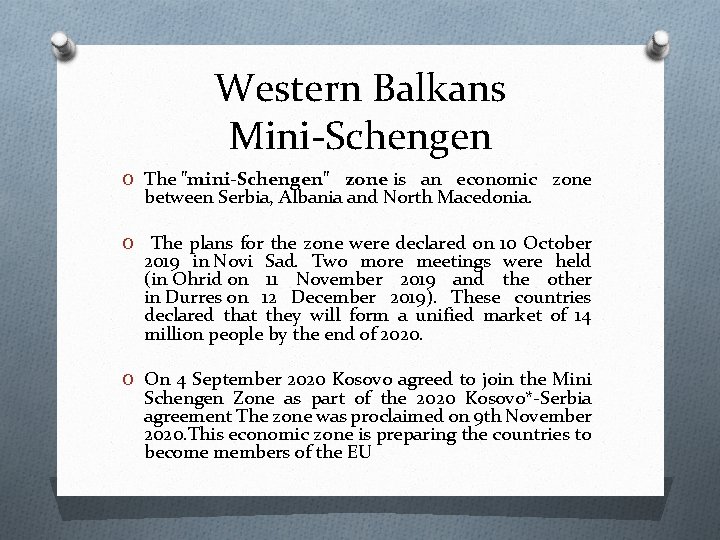
Western Balkans Mini-Schengen O The "mini-Schengen" zone is an economic zone between Serbia, Albania and North Macedonia. O The plans for the zone were declared on 10 October 2019 in Novi Sad. Two more meetings were held (in Ohrid on 11 November 2019 and the other in Durres on 12 December 2019). These countries declared that they will form a unified market of 14 million people by the end of 2020. O On 4 September 2020 Kosovo agreed to join the Mini Schengen Zone as part of the 2020 Kosovo*-Serbia agreement The zone was proclaimed on 9 th November 2020. This economic zone is preparing the countries to become members of the EU
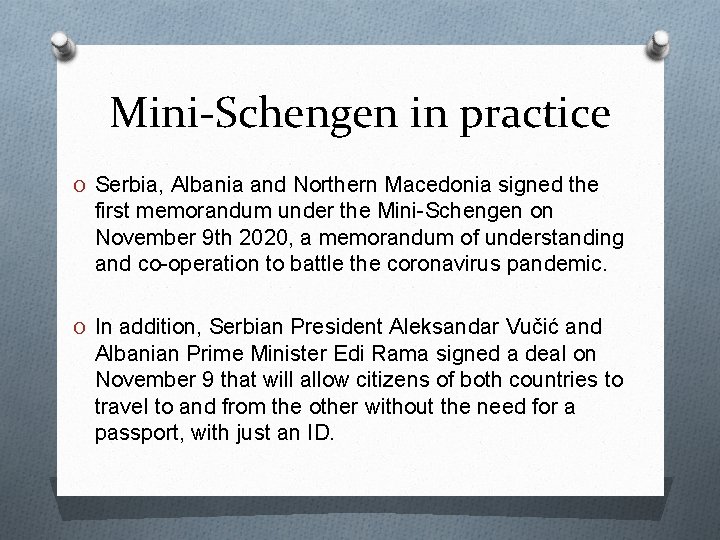
Mini-Schengen in practice O Serbia, Albania and Northern Macedonia signed the first memorandum under the Mini-Schengen on November 9 th 2020, a memorandum of understanding and co-operation to battle the coronavirus pandemic. O In addition, Serbian President Aleksandar Vučić and Albanian Prime Minister Edi Rama signed a deal on November 9 that will allow citizens of both countries to travel to and from the other without the need for a passport, with just an ID.
General assessment regarding WB Regional security sub-complex relations O The Balkans has been generally considered as a conflict area of Europe and security and stability in the Western Balkans can’t be taken as guaranteed. O Ethnical conflict outbursts, geopolitical clashes, terrorism fostering and threats, weak governance, economic painful measures and the constant demand for reform show that many troubles can be detected already in the future of the Balkan security environment. O Issues related to Prishtina-Belgrade dialogue under EU mediation do not offer any sustainable perspective, as the north of Kosovo is still not recognizing the Kosovo authorities governance, and Kosovo administration does nothing to implement the formation of Association/Community of Serb majority municipalities in Kosovo. O Implications of Kosovo solution for the issue of Republika Srpska.
O Potential for improvement of Western Balkans countries relations lies in: O Free trade/import/export common interests O Energy and transport infrastructure cooperation O Common security threats and regional cooperation in fighting them (terrorism, organised crime, corruption, infectuous diseases, natural and manmade disasters) O EU as a mediator helping the rest of the Western Balkans countries on their way to European integrations.
Thanks for your attention! O Questions? O Comments?