ReflectionAware Static Regression Test Selection August Shi Milica


- Slides: 35
Reflection-Aware Static Regression Test Selection August Shi, Milica Hadzi-Tanovic, Lingming Zhang, Darko Marinov, Owolabi Legunsen OOPSLA 2019 Athens, Greece October 23, 2019 CCF-1421503 CCF-1566589 CNS-1646305 CNS-1740916 CCF-1763788 CCF-1763906
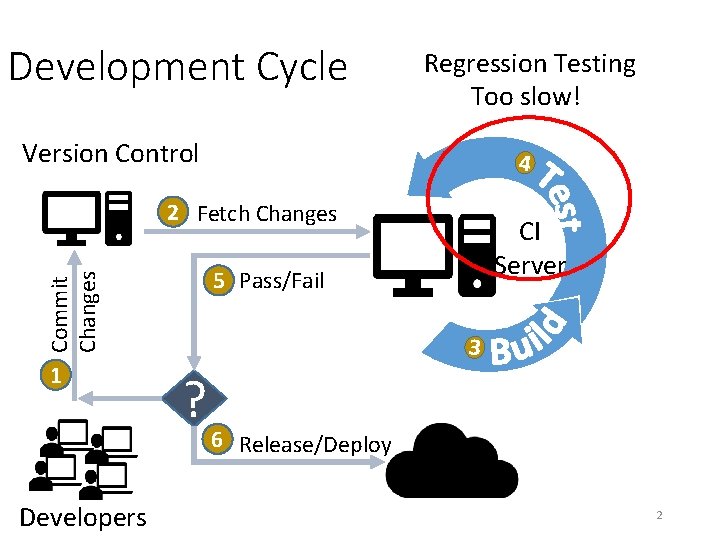
Development Cycle Regression Testing Too slow! Version Control 4 2 Fetch Changes 5 Pass/Fail Commit Changes 1 Developers CI Server 3 ? 6 Release/Deploy 2
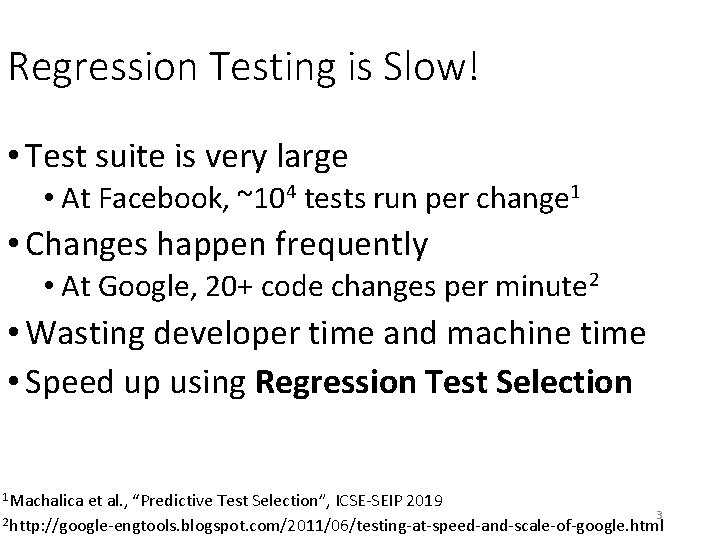
Regression Testing is Slow! • Test suite is very large • At Facebook, ~104 tests run per change 1 • Changes happen frequently • At Google, 20+ code changes per minute 2 • Wasting developer time and machine time • Speed up using Regression Test Selection 1 Machalica et al. , “Predictive Test Selection”, ICSE-SEIP 2019 3 2 http: //google-engtools. blogspot. com/2011/06/testing-at-speed-and-scale-of-google. html
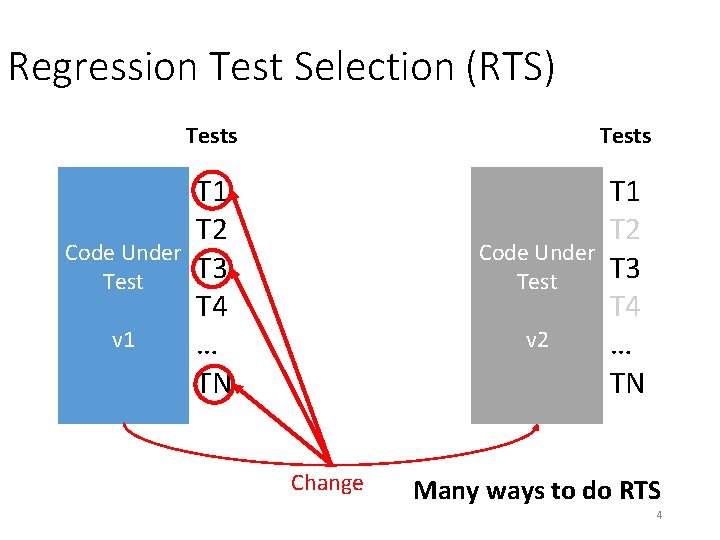
Regression Test Selection (RTS) Tests T 1 T 2 Code Under T 3 Test T 4 v 1 … TN T 1 T 2 Code Under T 3 Test T 4 v 2 … TN Change Many ways to do RTS 4
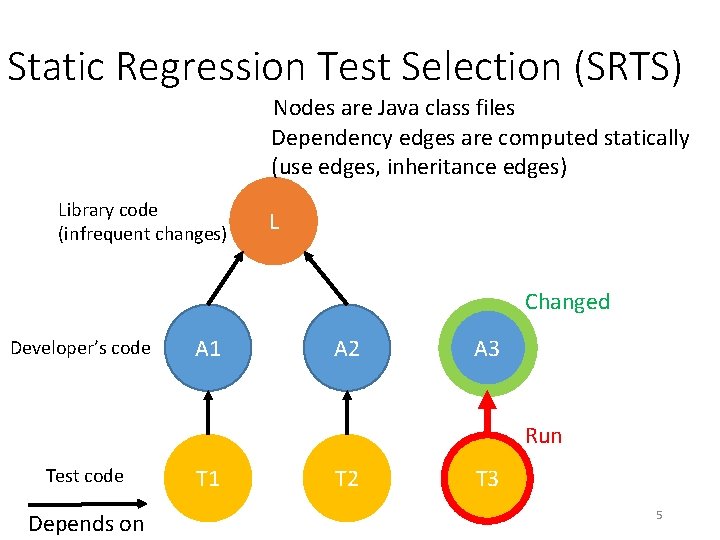
Static Regression Test Selection (SRTS) Nodes are Java class files Dependency edges are computed statically (use edges, inheritance edges) Library code (infrequent changes) L Changed Developer’s code A 1 A 2 A 3 Run Test code Depends on T 1 T 2 T 3 5
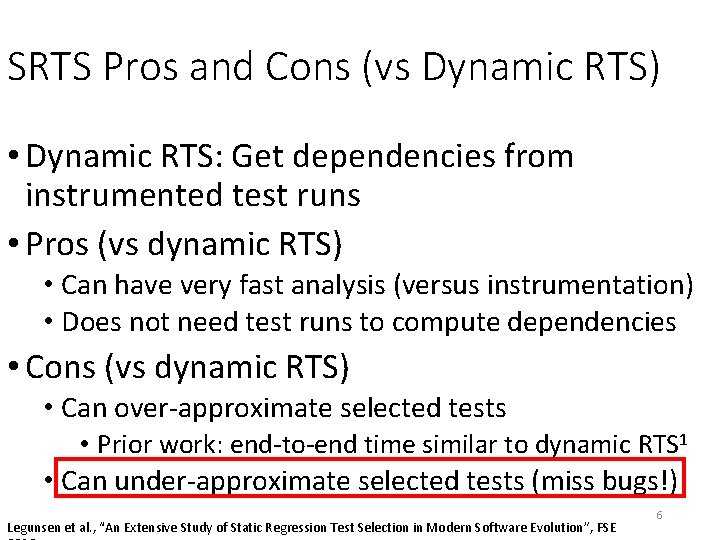
SRTS Pros and Cons (vs Dynamic RTS) • Dynamic RTS: Get dependencies from instrumented test runs • Pros (vs dynamic RTS) • Can have very fast analysis (versus instrumentation) • Does not need test runs to compute dependencies • Cons (vs dynamic RTS) • Can over-approximate selected tests • Prior work: end-to-end time similar to dynamic RTS 1 • Can under-approximate selected tests (miss bugs!) Legunsen et al. , “An Extensive Study of Static Regression Test Selection in Modern Software Evolution”, FSE 6
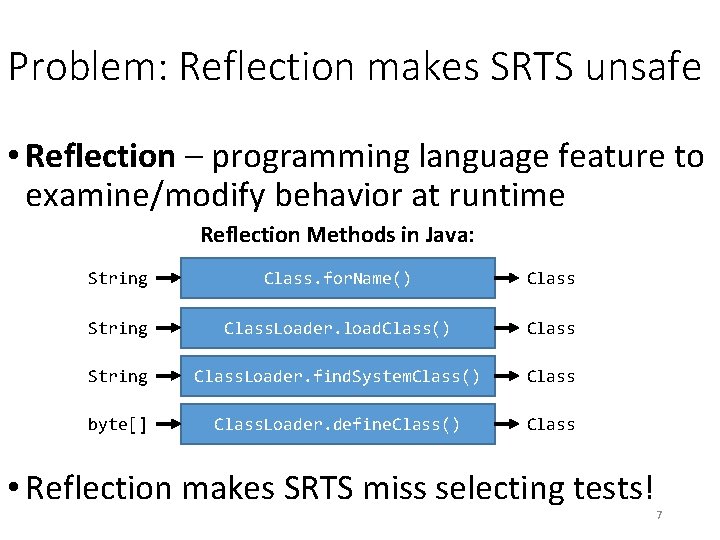
Problem: Reflection makes SRTS unsafe • Reflection – programming language feature to examine/modify behavior at runtime Reflection Methods in Java: String Class. for. Name() Class String Class. Loader. load. Class() Class String Class. Loader. find. System. Class() Class byte[] Class. Loader. define. Class() Class • Reflection makes SRTS miss selecting tests! 7
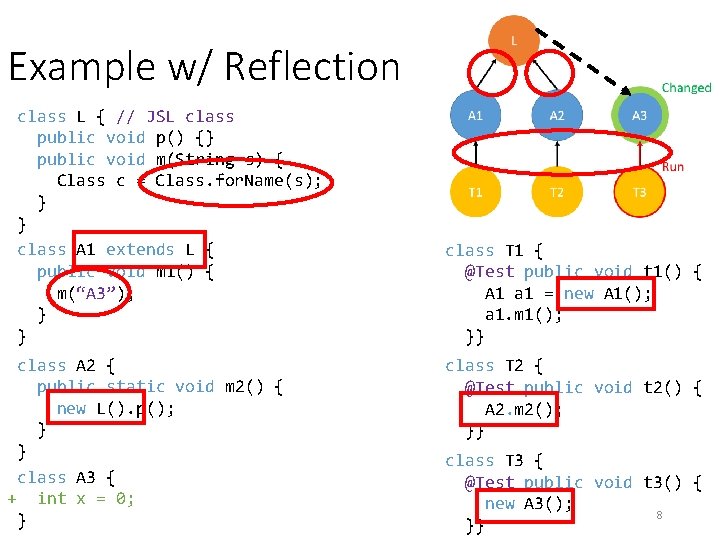
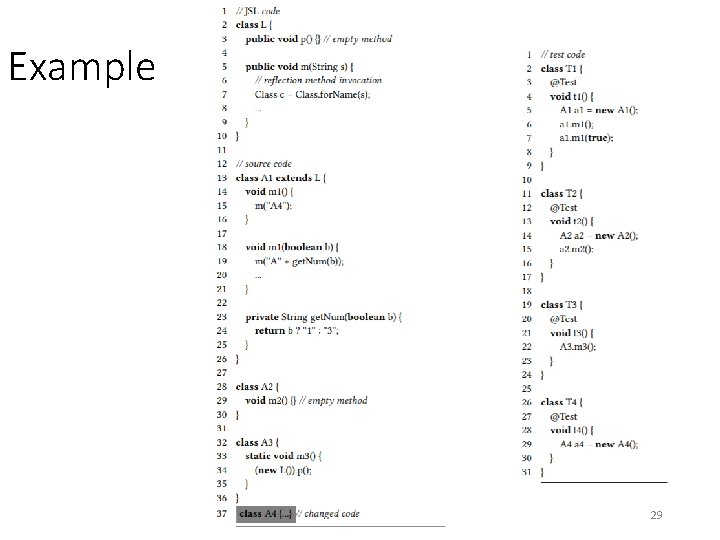
Example w/ Reflection class L { // JSL class public void p() {} public void m(String s) { Class c = Class. for. Name(s); } } class A 1 extends L { public void m 1() { m(“A 3”); } } class A 2 { public static void m 2() { new L(). p(); } } class A 3 { + int x = 0; } class T 1 { @Test public void t 1() { A 1 a 1 = new A 1(); a 1. m 1(); }} class T 2 { @Test public void t 2() { A 2. m 2(); }} class T 3 { @Test public void t 3() { new A 3(); 8 }}
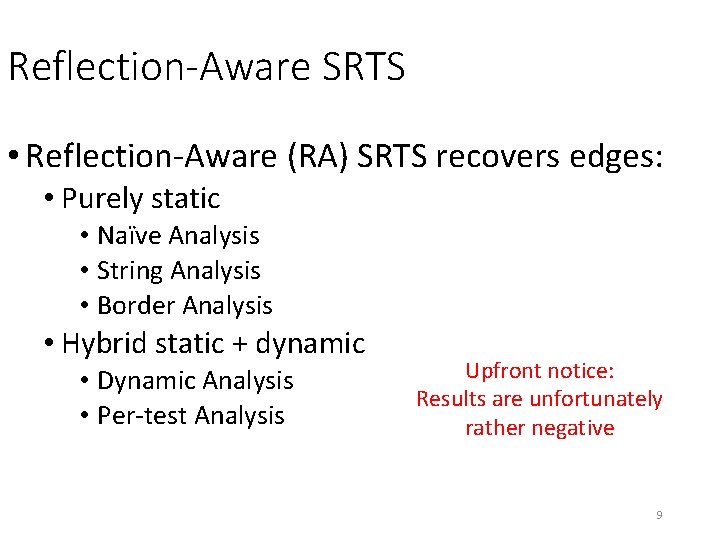
Reflection-Aware SRTS • Reflection-Aware (RA) SRTS recovers edges: • Purely static • Naïve Analysis • String Analysis • Border Analysis • Hybrid static + dynamic • Dynamic Analysis • Per-test Analysis Upfront notice: Results are unfortunately rather negative 9
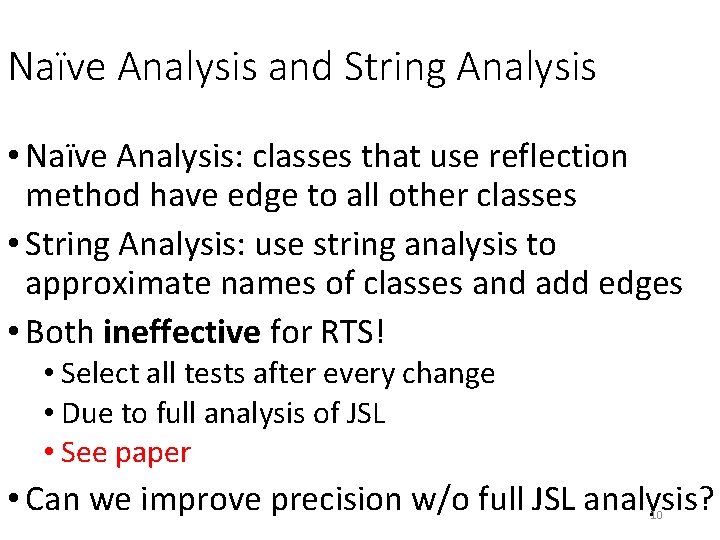
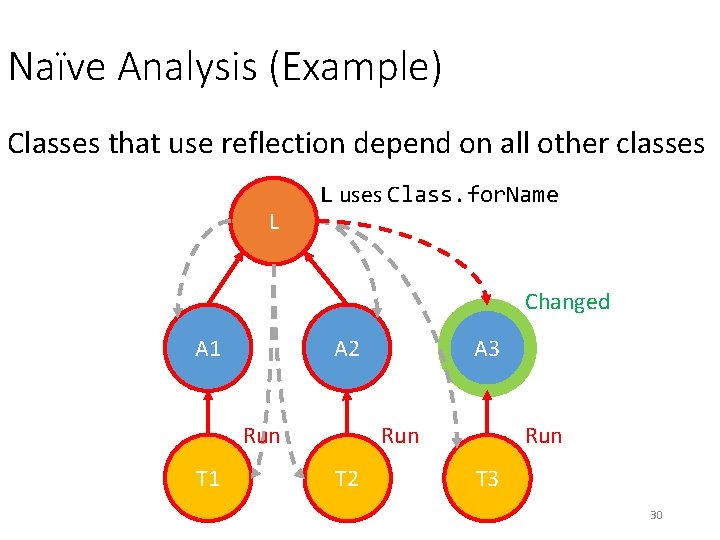
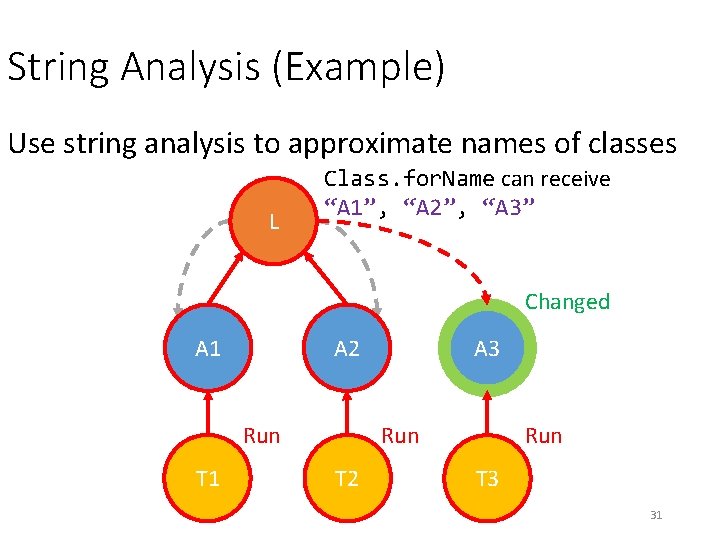
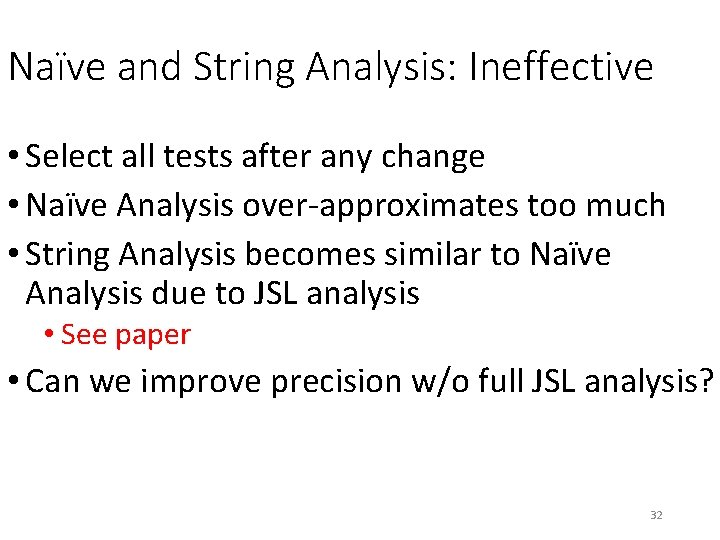
Naïve Analysis and String Analysis • Naïve Analysis: classes that use reflection method have edge to all other classes • String Analysis: use string analysis to approximate names of classes and add edges • Both ineffective for RTS! • Select all tests after every change • Due to full analysis of JSL • See paper • Can we improve precision w/o full JSL analysis? 10
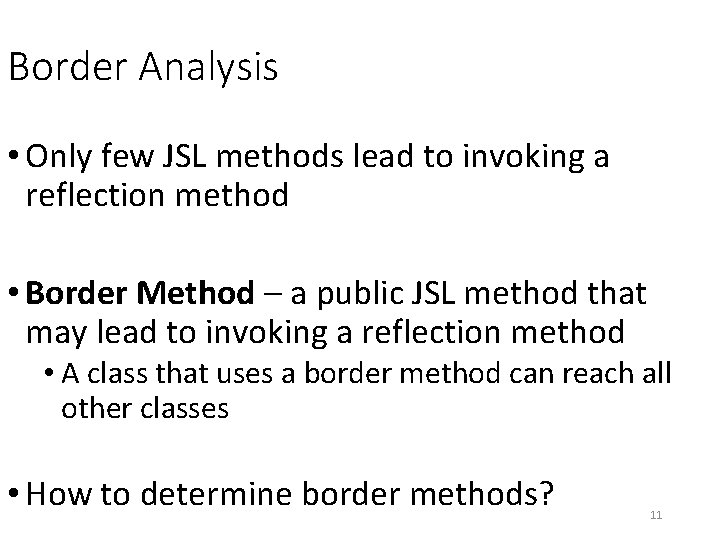
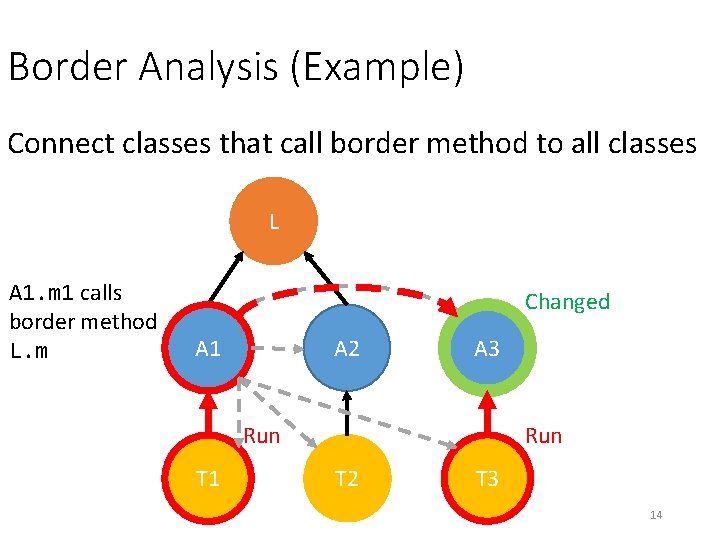
Border Analysis • Only few JSL methods lead to invoking a reflection method • Border Method – a public JSL method that may lead to invoking a reflection method • A class that uses a border method can reach all other classes • How to determine border methods? 11
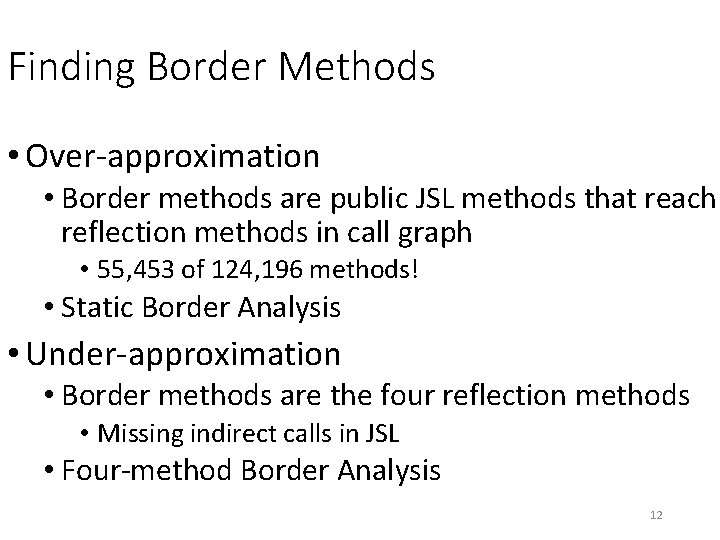
Finding Border Methods • Over-approximation • Border methods are public JSL methods that reach reflection methods in call graph • 55, 453 of 124, 196 methods! • Static Border Analysis • Under-approximation • Border methods are the four reflection methods • Missing indirect calls in JSL • Four-method Border Analysis 12
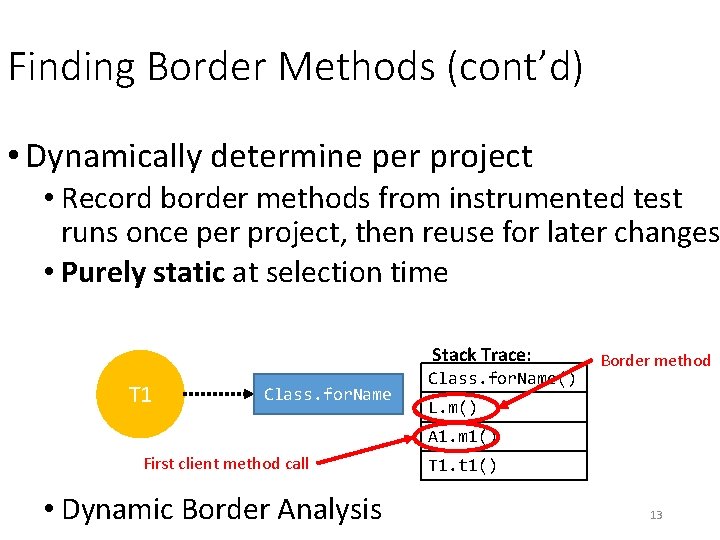
Finding Border Methods (cont’d) • Dynamically determine per project • Record border methods from instrumented test runs once per project, then reuse for later changes • Purely static at selection time Stack Trace: T 1 Class. for. Name() Border method L. m() A 1. m 1() First client method call • Dynamic Border Analysis T 1. t 1() 13
Border Analysis (Example) Connect classes that call border method to all classes L A 1. m 1 calls border method L. m Changed A 1 A 2 A 3 Run T 1 T 2 T 3 14
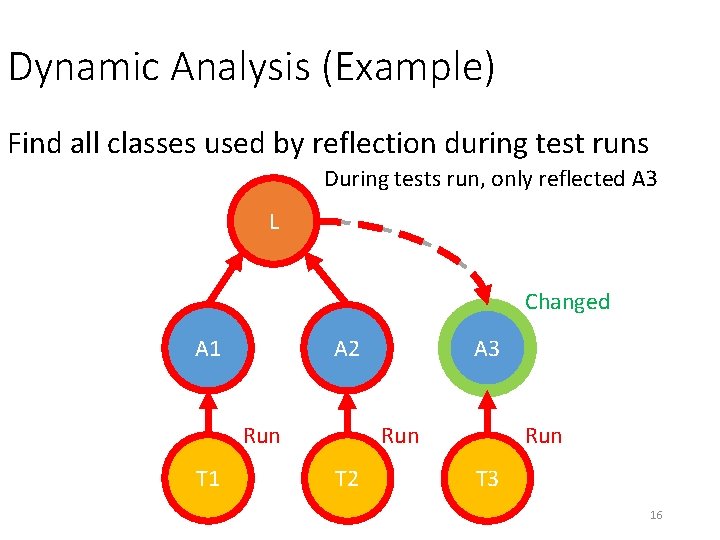
Dynamic Analysis (Example) Find all classes used by reflection during test runs During tests run, only reflected A 3 L Changed A 1 A 2 Run T 1 A 3 T 2 Run T 3 16
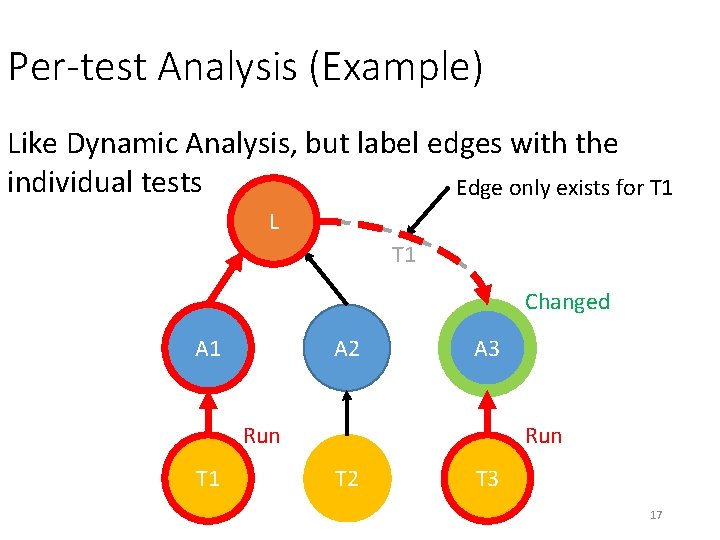
Per-test Analysis (Example) Like Dynamic Analysis, but label edges with the individual tests Edge only exists for T 1 L T 1 Changed A 1 A 2 A 3 Run T 1 T 2 T 3 17
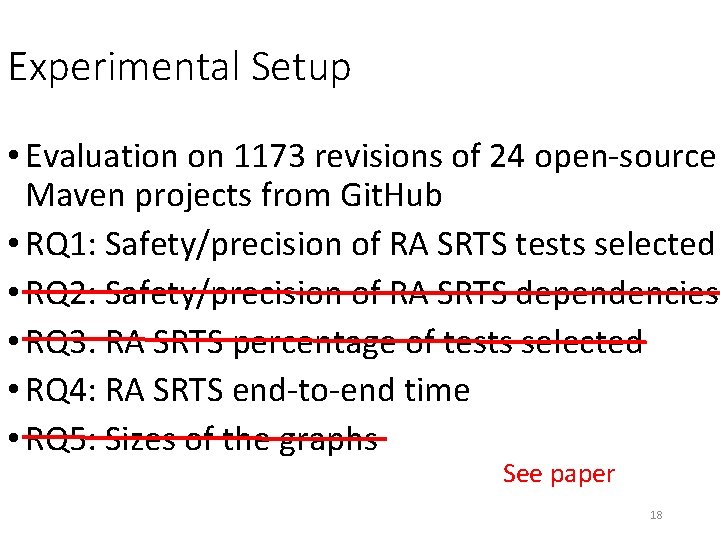
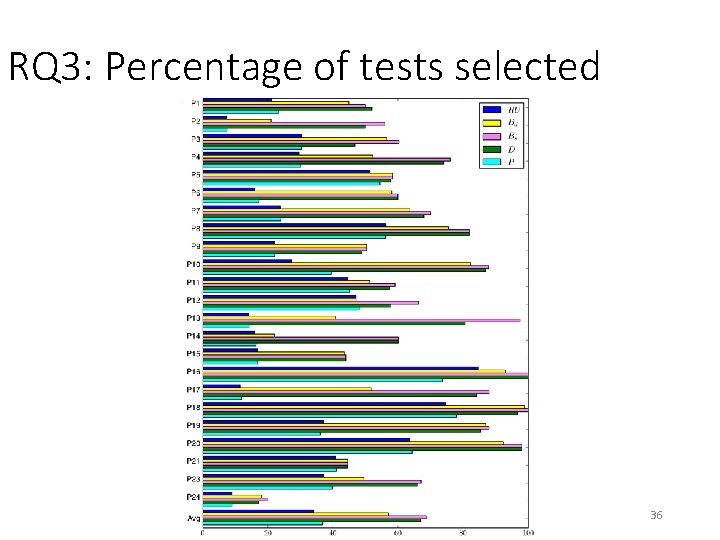
Experimental Setup • Evaluation on 1173 revisions of 24 open-source Maven projects from Git. Hub • RQ 1: Safety/precision of RA SRTS tests selected • RQ 2: Safety/precision of RA SRTS dependencies • RQ 3: RA SRTS percentage of tests selected • RQ 4: RA SRTS end-to-end time • RQ 5: Sizes of the graphs See paper 18
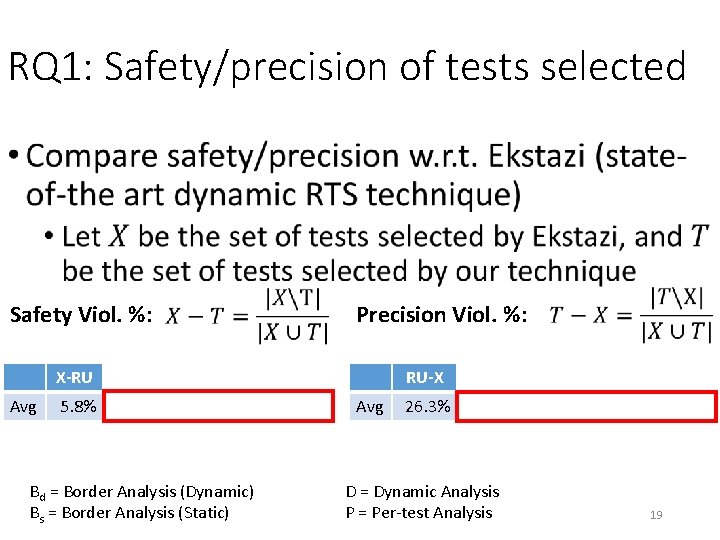
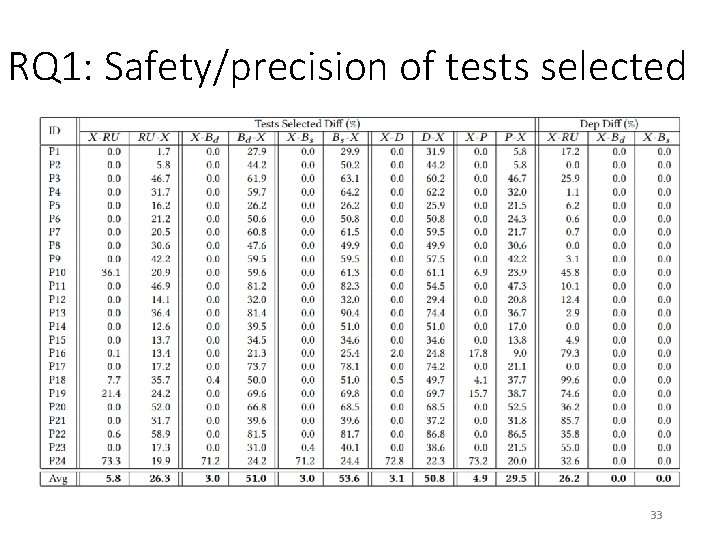
RQ 1: Safety/precision of tests selected • Safety Viol. %: Avg Precision Viol. %: X-RU X-Bd X-Bs X-D X-P 5. 8% 3. 0% 3. 1% 4. 9% Bd = Border Analysis (Dynamic) Bs = Border Analysis (Static) Avg RU-X Bd-X Bs-X D-X P-X 26. 3% 51. 0% 53. 6% 50. 8% 29. 5% D = Dynamic Analysis P = Per-test Analysis 19
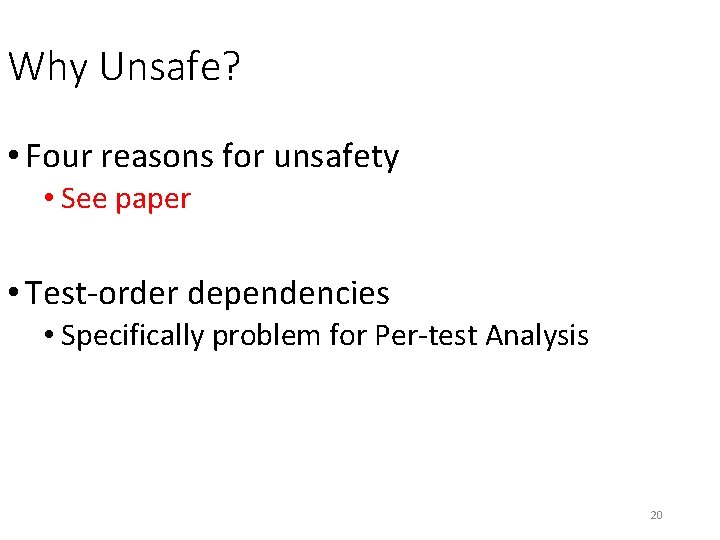
Why Unsafe? • Four reasons for unsafety • See paper • Test-order dependencies • Specifically problem for Per-test Analysis 20
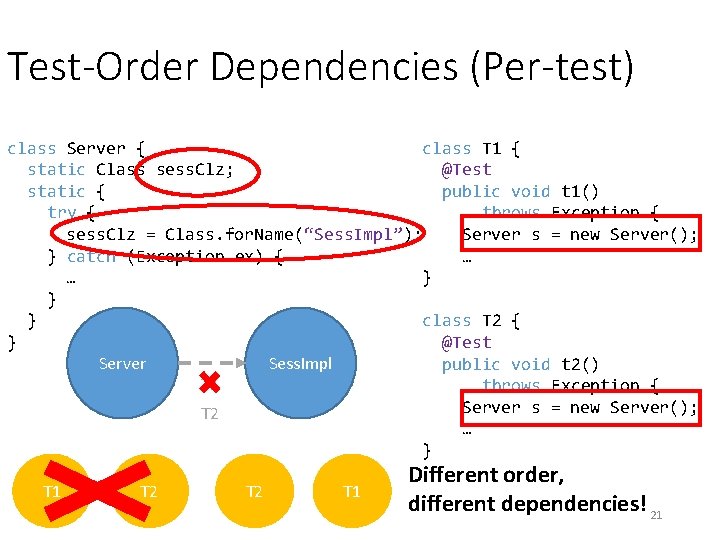
Test-Order Dependencies (Per-test) class Server { class T 1 { static Class sess. Clz; @Test static { public void t 1() try { throws Exception { sess. Clz = Class. for. Name(“Sess. Impl”); Server s = new Server(); } catch (Exception ex) { … … } } } class T 2 { } @Test Server Sess. Impl public void t 2() T 1 throws Exception { Server s = new Server(); T 2 … } T 1 T 2 T 1 Different order, different dependencies! 21
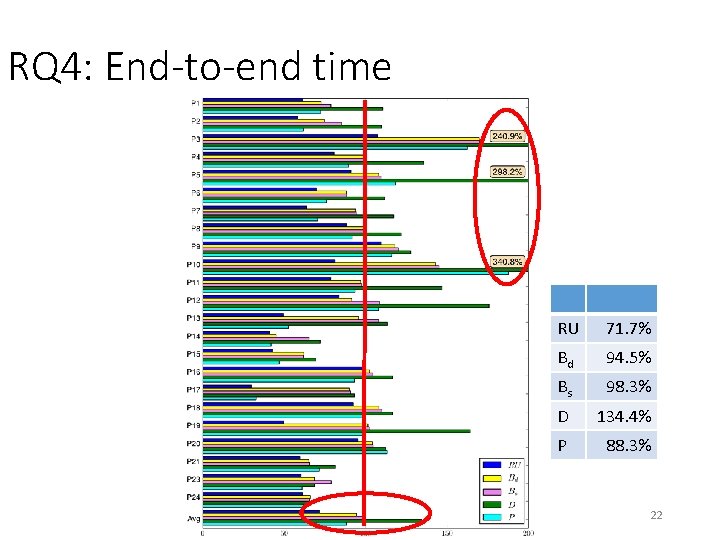
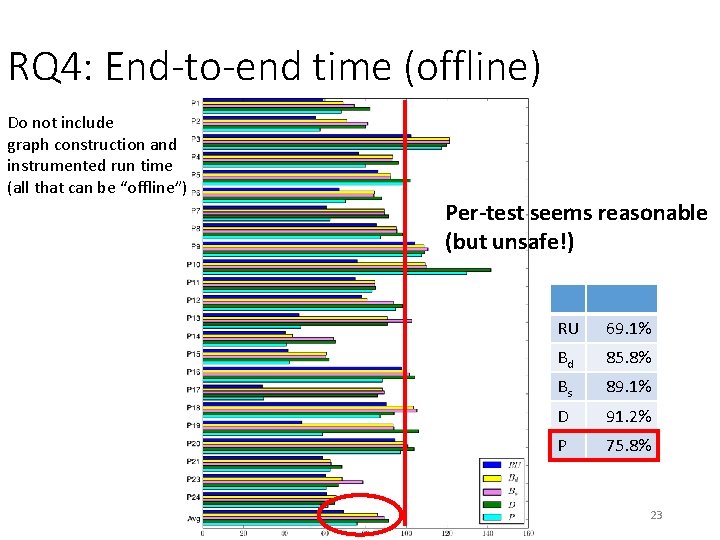
RQ 4: End-to-end time RU 71. 7% Bd 94. 5% Bs 98. 3% D 134. 4% P 88. 3% 22
RQ 4: End-to-end time (offline) Do not include graph construction and instrumented run time (all that can be “offline”) Per-test seems reasonable (but unsafe!) RU 69. 1% Bd 85. 8% Bs 89. 1% D 91. 2% P 75. 8% 23
Discussion • Results seem negative! • RA SRTS is either impractical, or can be unsafe! • Need RTS-specific reflection analysis • Other directions: • Unsafe RTS is becoming used in industry, but how unsafe is it? • Faster base RU RTS: reduce over-approximation? 24
Conclusions • Static RTS (SRTS) is unsafe due to reflection • Propose 5 reflection-aware SRTS techniques • Three purely static, two hybrid static-dynamic • Reflection-aware SRTS is currently impractical • End-to-end time is too high • Fastest technique is still unsafe • Future: make RTS-specific reflection analysis awshi 2@illinois. edu 25
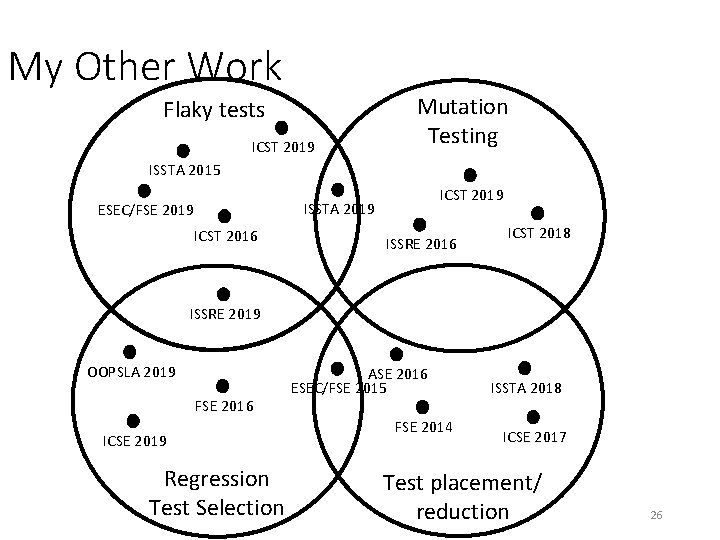
My Other Work Flaky tests ICST 2019 Mutation Testing ISSTA 2015 ICST 2019 ISSTA 2019 ESEC/FSE 2019 ICST 2016 ISSRE 2016 ICST 2018 ISSRE 2019 OOPSLA 2019 FSE 2016 ICSE 2019 Regression Test Selection ASE 2016 ESEC/FSE 2015 FSE 2014 ISSTA 2018 ICSE 2017 Test placement/ reduction 26
I will be on the job market! August Shi http: //mir. cs. illinois. edu/awshi 2@illinois. edu
BACKUP
Example 29
Naïve Analysis (Example) Classes that use reflection depend on all other classes L L uses Class. for. Name Changed A 1 A 2 Run T 1 A 3 T 2 Run T 3 30
String Analysis (Example) Use string analysis to approximate names of classes L Class. for. Name can receive “A 1”, “A 2”, “A 3” Changed A 1 A 2 Run T 1 A 3 T 2 Run T 3 31
Naïve and String Analysis: Ineffective • Select all tests after any change • Naïve Analysis over-approximates too much • String Analysis becomes similar to Naïve Analysis due to JSL analysis • See paper • Can we improve precision w/o full JSL analysis? 32
RQ 1: Safety/precision of tests selected 33
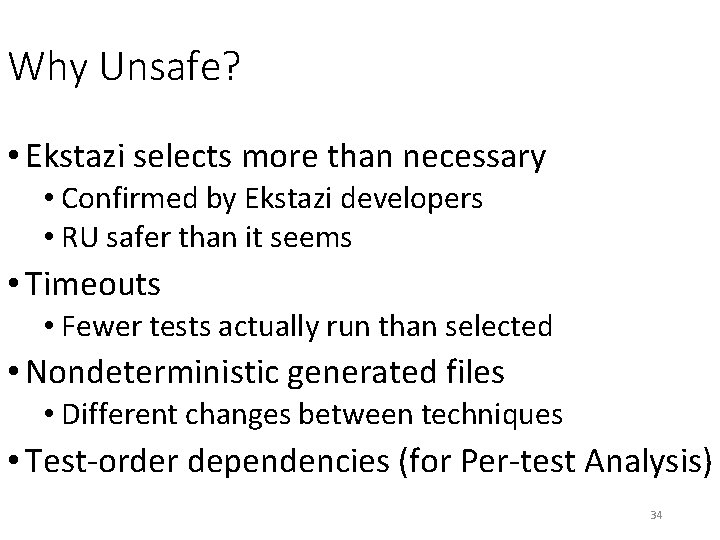
Why Unsafe? • Ekstazi selects more than necessary • Confirmed by Ekstazi developers • RU safer than it seems • Timeouts • Fewer tests actually run than selected • Nondeterministic generated files • Different changes between techniques • Test-order dependencies (for Per-test Analysis) 34
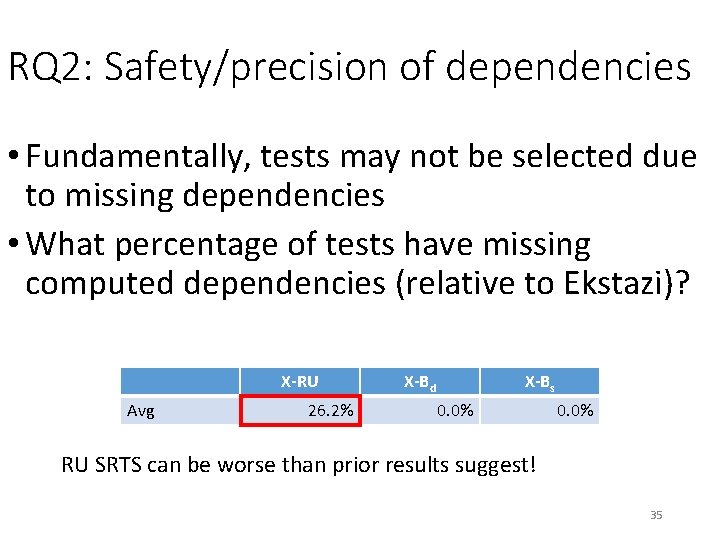
RQ 2: Safety/precision of dependencies • Fundamentally, tests may not be selected due to missing dependencies • What percentage of tests have missing computed dependencies (relative to Ekstazi)? X-RU Avg 26. 2% X-Bd X-Bs 0. 0% RU SRTS can be worse than prior results suggest! 35
RQ 3: Percentage of tests selected 36