Redox Reactions Chapter 18 O 2 OxidationReduction Redox








- Slides: 21
Redox Reactions Chapter 18 + O 2
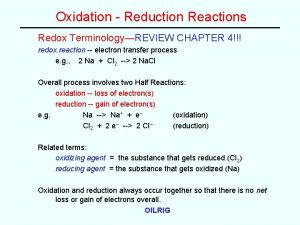
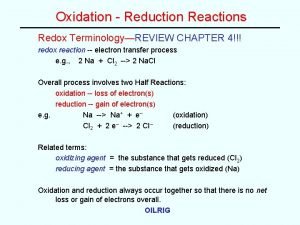
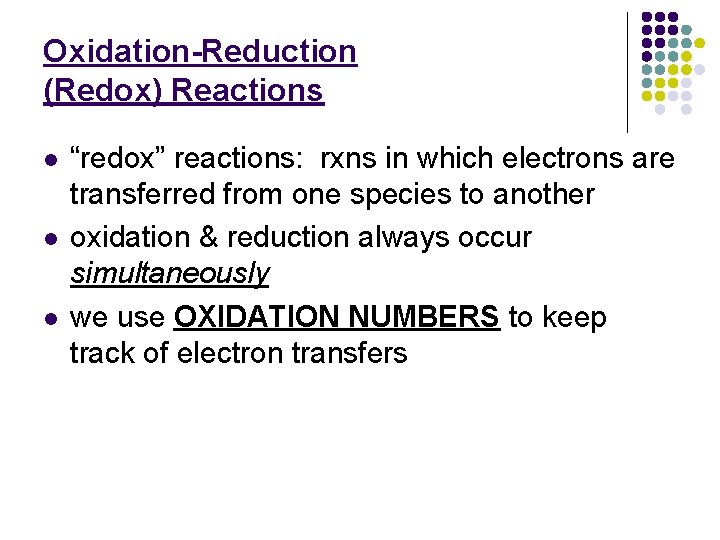
Oxidation-Reduction (Redox) Reactions l l l “redox” reactions: rxns in which electrons are transferred from one species to another oxidation & reduction always occur simultaneously we use OXIDATION NUMBERS to keep track of electron transfers
Rules for Assigning Oxidation Numbers: 1) the ox. state of any free (uncombined) element is zero. l Ex: Na, S, O 2, H 2, Cl 2, O 3
Rules for Assigning Oxidation Numbers: 2) The ox. state of an element in a simple ion is the charge of the ion. Mg 2+ oxidation of Mg is +2
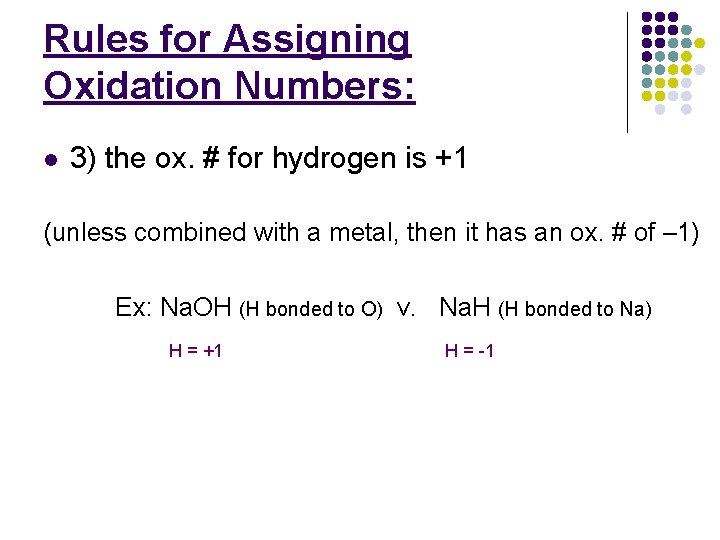
Rules for Assigning Oxidation Numbers: l 3) the ox. # for hydrogen is +1 (unless combined with a metal, then it has an ox. # of – 1) Ex: Na. OH (H bonded to O) v. Na. H (H bonded to Na) H = +1 H = -1
Rules for Assigning Oxidation Numbers: 4) the ox. # of fluorine is always – 1.
Rules for Assigning Oxidation Numbers: 5) the ox. # of oxygen is usually – 2. Why USUALLY? Not -2 when it’s in a peroxide, such as hydrogen peroxide: H 2 O 2
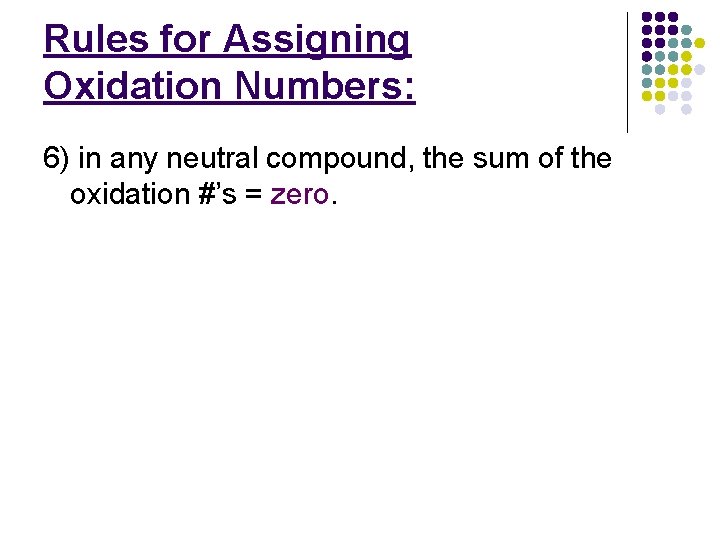
Rules for Assigning Oxidation Numbers: 6) in any neutral compound, the sum of the oxidation #’s = zero.
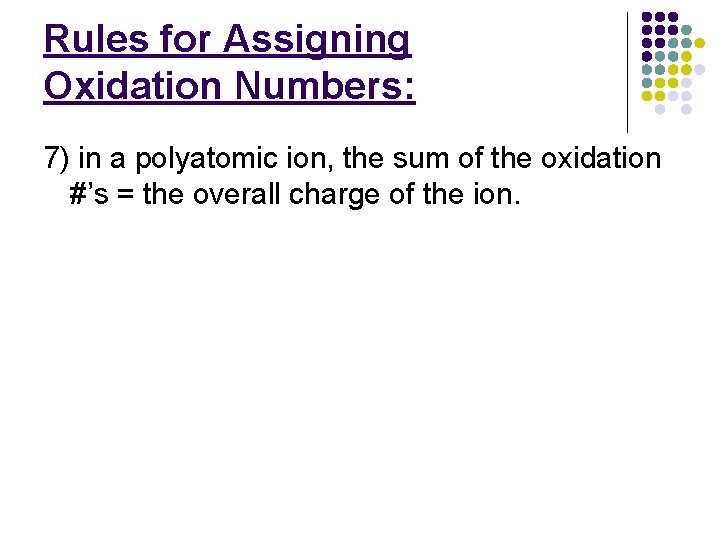
Rules for Assigning Oxidation Numbers: 7) in a polyatomic ion, the sum of the oxidation #’s = the overall charge of the ion.
Rules for Assigning Oxidation Numbers: **use these rules to assign oxidation #’s; assign known #’s first, then fill in the #’s for the remaining elements:
Examples: Assign oxidation #’s to each element: a) Na. NO 3 Na = +1 O = -2 Therefore, N = +5
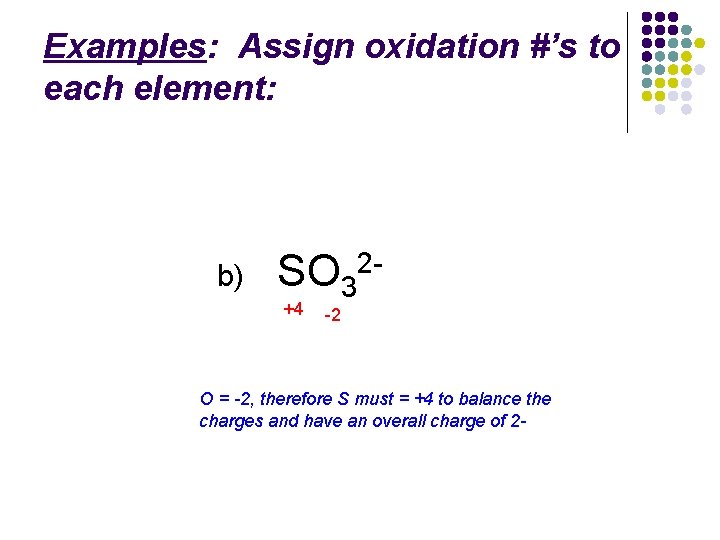
Examples: Assign oxidation #’s to each element: b) SO 32+4 -2 O = -2, therefore S must = +4 to balance the charges and have an overall charge of 2 -
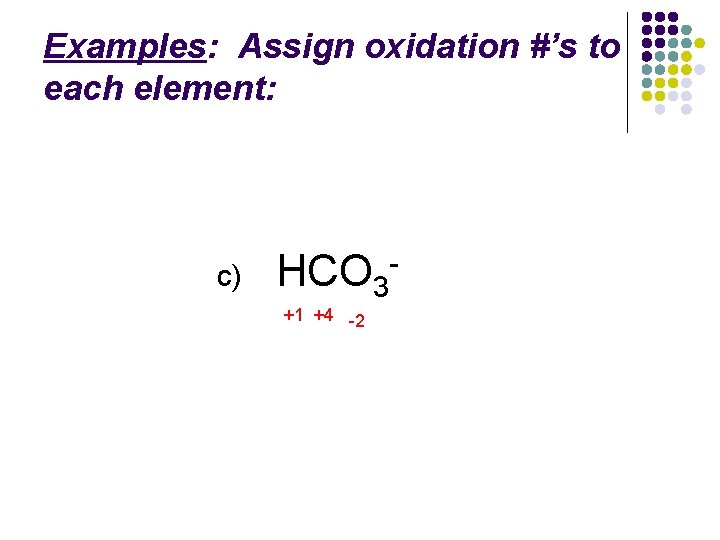
Examples: Assign oxidation #’s to each element: c) HCO 3+1 +4 -2
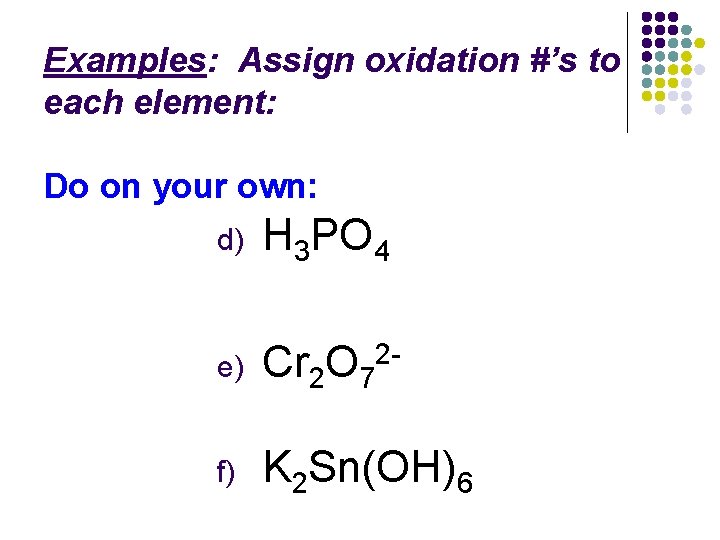
Examples: Assign oxidation #’s to each element: Do on your own: d) H 3 PO 4 e) Cr 2 O 7 f) K 2 Sn(OH)6 2 -
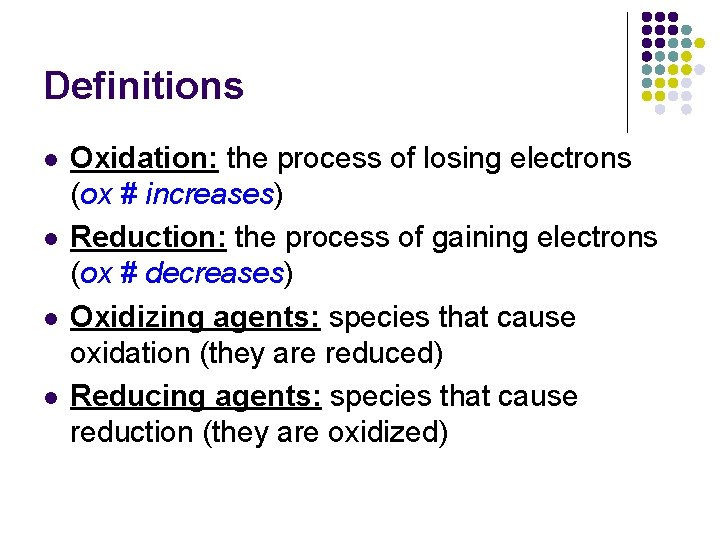
Definitions l l Oxidation: the process of losing electrons (ox # increases) Reduction: the process of gaining electrons (ox # decreases) Oxidizing agents: species that cause oxidation (they are reduced) Reducing agents: species that cause reduction (they are oxidized)
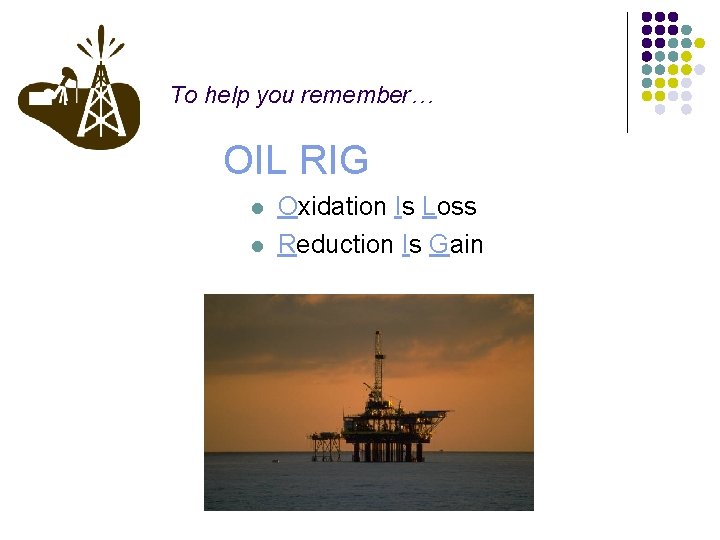
To help you remember… OIL RIG l l Oxidation Is Loss Reduction Is Gain
Are all rxns REDOX rxns? You must determine this… l a reaction is “redox” if a change in oxidation # happens; if no change in oxidation # occurs, the reaction is nonredox.
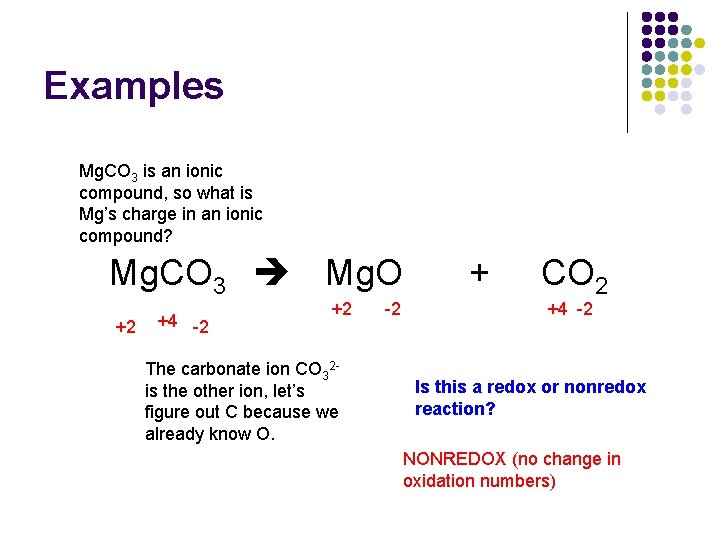
Examples Mg. CO 3 is an ionic compound, so what is Mg’s charge in an ionic compound? Mg. CO 3 Mg. O +2 +4 -2 +2 The carbonate ion CO 32 is the other ion, let’s figure out C because we already know O. -2 + CO 2 +4 -2 Is this a redox or nonredox reaction? NONREDOX (no change in oxidation numbers)
Examples Which oxidation numbers do we already know? Zn + Cu. SO 4 Zn. SO 4 + Cu 0, free element +2 +6 -2 Break down this ionic compound into its ions Cu and SO 42 So, Cu must be Cu 2+ O = -2 in SO 42 -, so S must be…? +2 +6 -2 0 Is this a redox or nonredox reaction? REDOX reaction
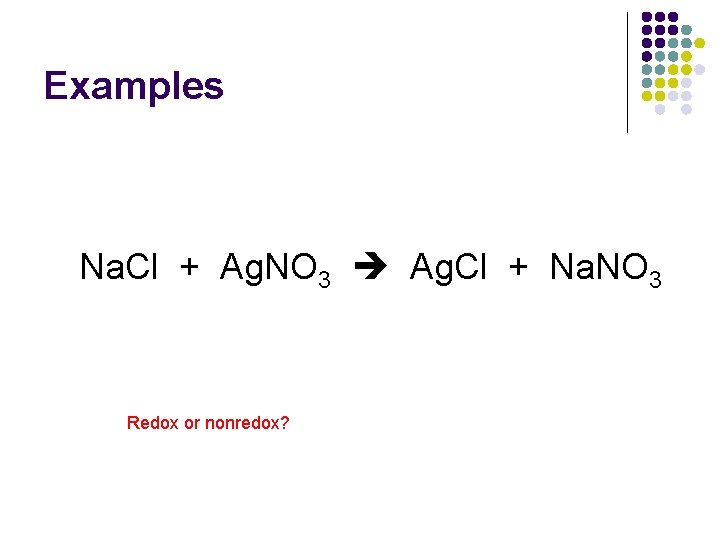
Examples Na. Cl + Ag. NO 3 Ag. Cl + Na. NO 3 Redox or nonredox?
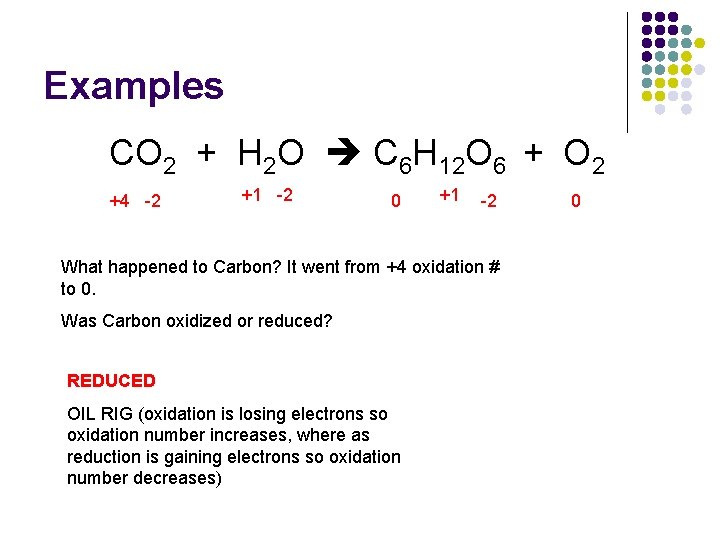
Examples CO 2 + H 2 O C 6 H 12 O 6 + O 2 +4 -2 +1 -2 0 +1 -2 What happened to Carbon? It went from +4 oxidation # to 0. Was Carbon oxidized or reduced? REDUCED OIL RIG (oxidation is losing electrons so oxidation number increases, where as reduction is gaining electrons so oxidation number decreases) 0