Realizing an endtoend vehicletocloud communication framework GENIVI Cloud




- Slides: 30
Realizing an end-to-end vehicle-to-cloud communication framework GENIVI Cloud & Connected Services Project Kevin Valdek – CTO, High Mobility Gunnar Andersson – Development Lead, GENIVI Alliance Automotive World | May 4, 2020 The content on this presentation is licensed under a Creative Commons Attribution-Share. Alike 4. 0 International License
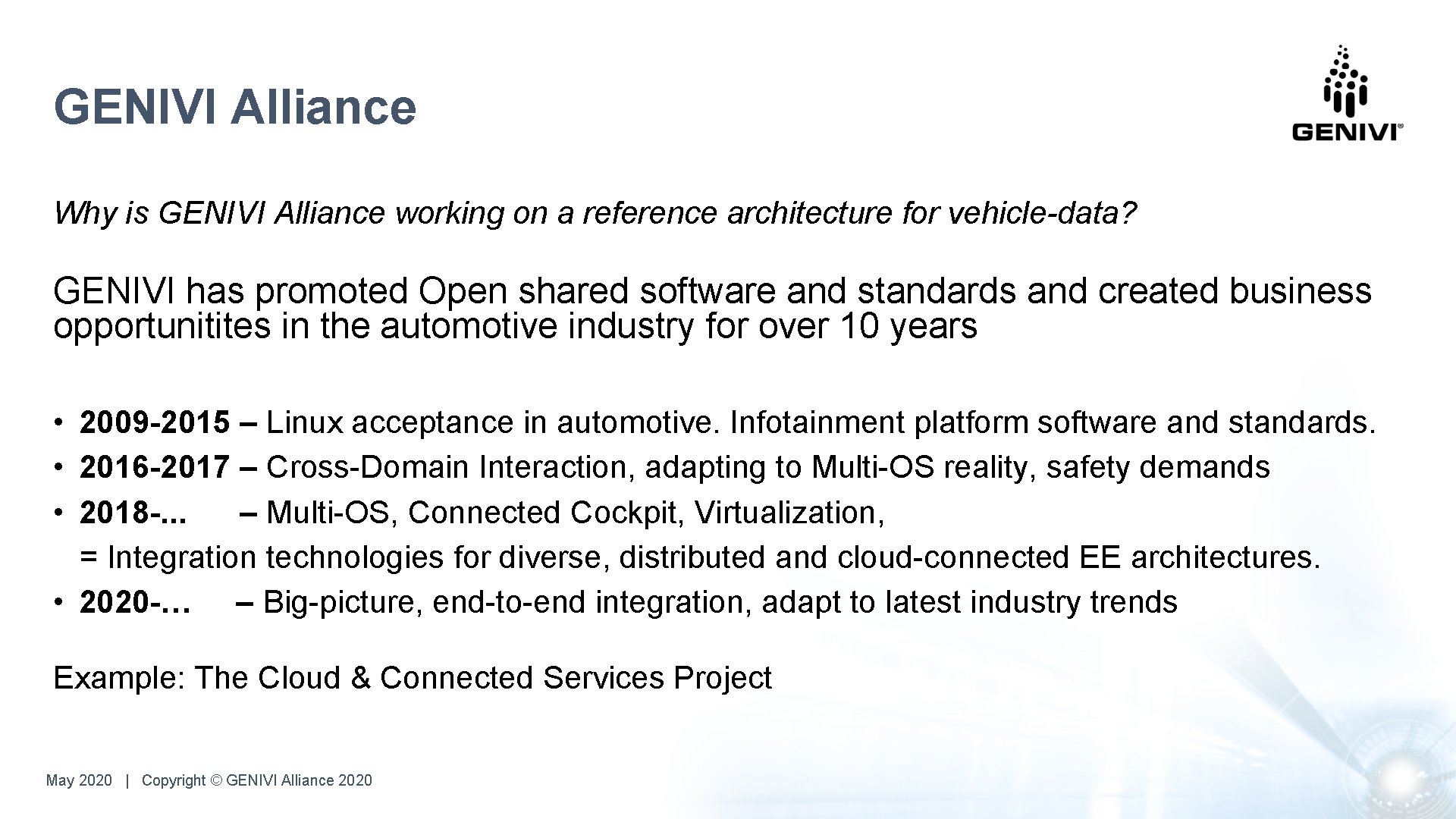
GENIVI Alliance Why is GENIVI Alliance working on a reference architecture for vehicle-data? GENIVI has promoted Open shared software and standards and created business opportunitites in the automotive industry for over 10 years • 2009 -2015 – Linux acceptance in automotive. Infotainment platform software and standards. • 2016 -2017 – Cross-Domain Interaction, adapting to Multi-OS reality, safety demands • 2018 -. . . – Multi-OS, Connected Cockpit, Virtualization, = Integration technologies for diverse, distributed and cloud-connected EE architectures. • 2020 -… – Big-picture, end-to-end integration, adapt to latest industry trends Example: The Cloud & Connected Services Project May 2020 |. Copyright © GENIVI Alliance 2020
Agenda • Project Charter • Data Model • Common Data Model • Vehicle Signal Specification — VSS • Communication Framework & Architecture • Data Capturing & Cloud Transfer • Neutral Servers & 3 rd Party Access • Proof-of-Concept Implementation • Electric Vehicle Use-case • Timeline • Contributing May 2020 |. Copyright © GENIVI Alliance 2020
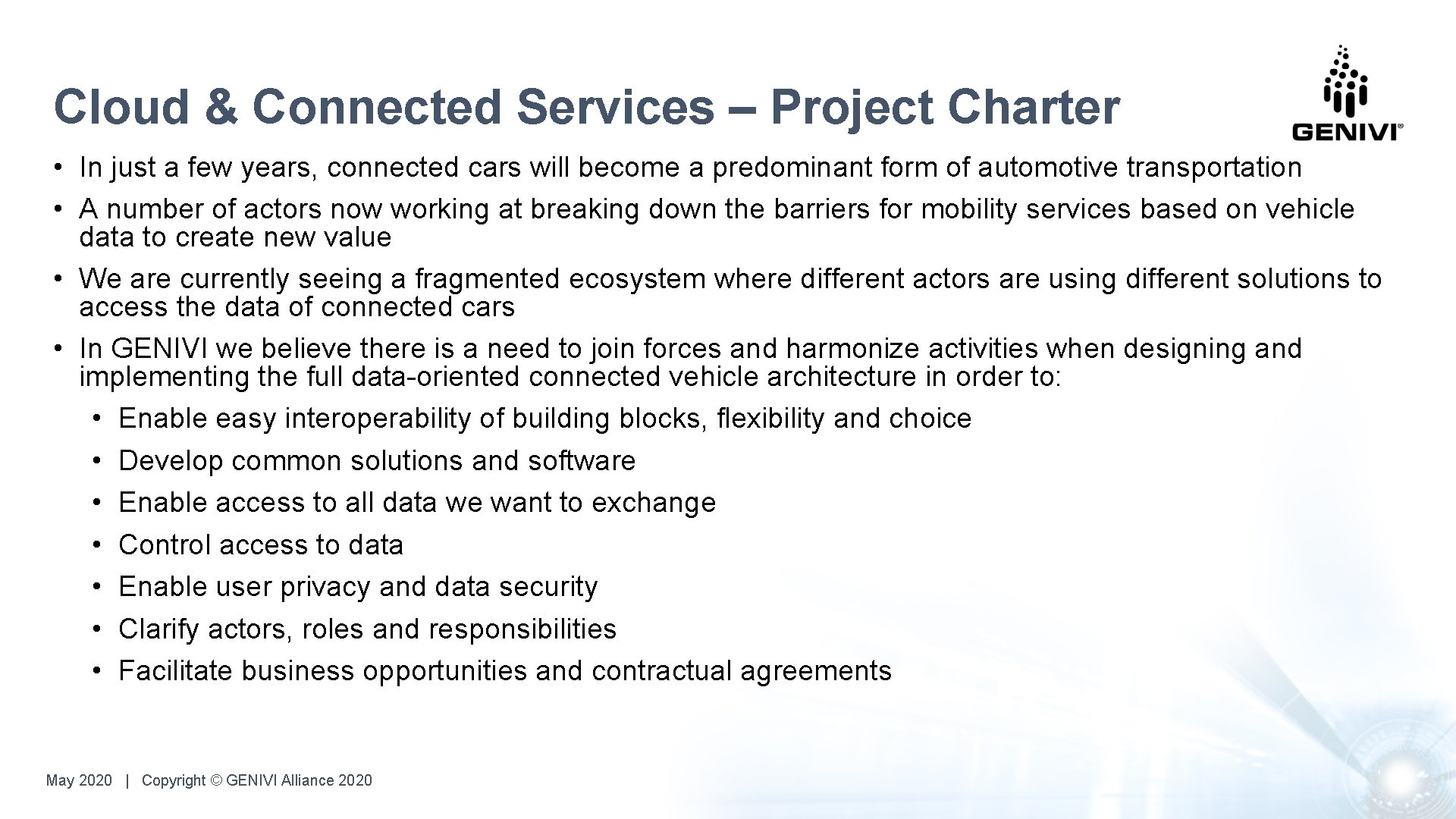
Cloud & Connected Services – Project Charter • In just a few years, connected cars will become a predominant form of automotive transportation • A number of actors now working at breaking down the barriers for mobility services based on vehicle data to create new value • We are currently seeing a fragmented ecosystem where different actors are using different solutions to access the data of connected cars • In GENIVI we believe there is a need to join forces and harmonize activities when designing and implementing the full data-oriented connected vehicle architecture in order to: • Enable easy interoperability of building blocks, flexibility and choice • Develop common solutions and software • Enable access to all data we want to exchange • Control access to data • Enable user privacy and data security • Clarify actors, roles and responsibilities • Facilitate business opportunities and contractual agreements May 2020 |. Copyright © GENIVI Alliance 2020
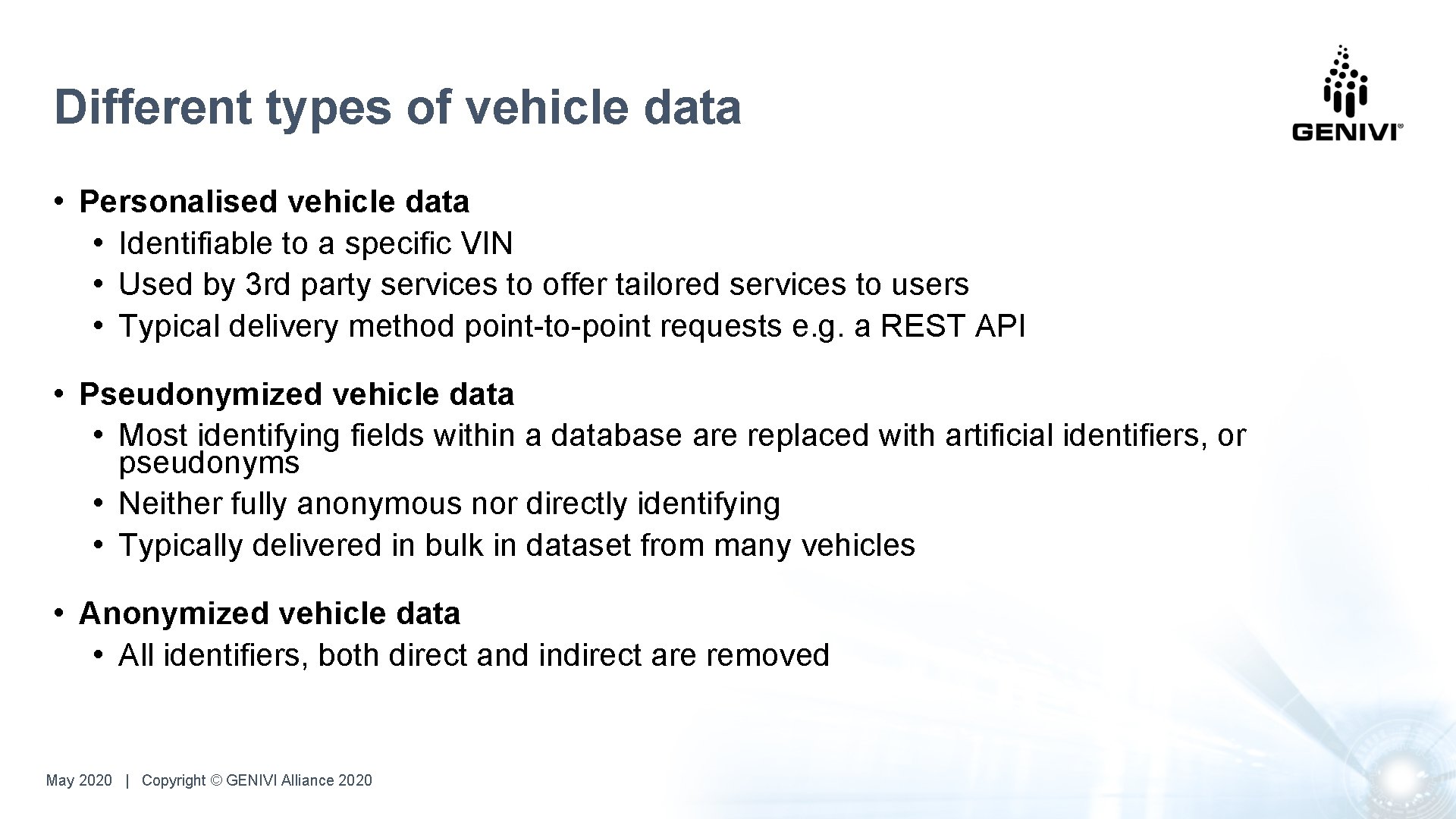
Different types of vehicle data • Personalised vehicle data • Identifiable to a specific VIN • Used by 3 rd party services to offer tailored services to users • Typical delivery method point-to-point requests e. g. a REST API • Pseudonymized vehicle data • Most identifying fields within a database are replaced with artificial identifiers, or pseudonyms • Neither fully anonymous nor directly identifying • Typically delivered in bulk in dataset from many vehicles • Anonymized vehicle data • All identifiers, both direct and indirect are removed May 2020 |. Copyright © GENIVI Alliance 2020
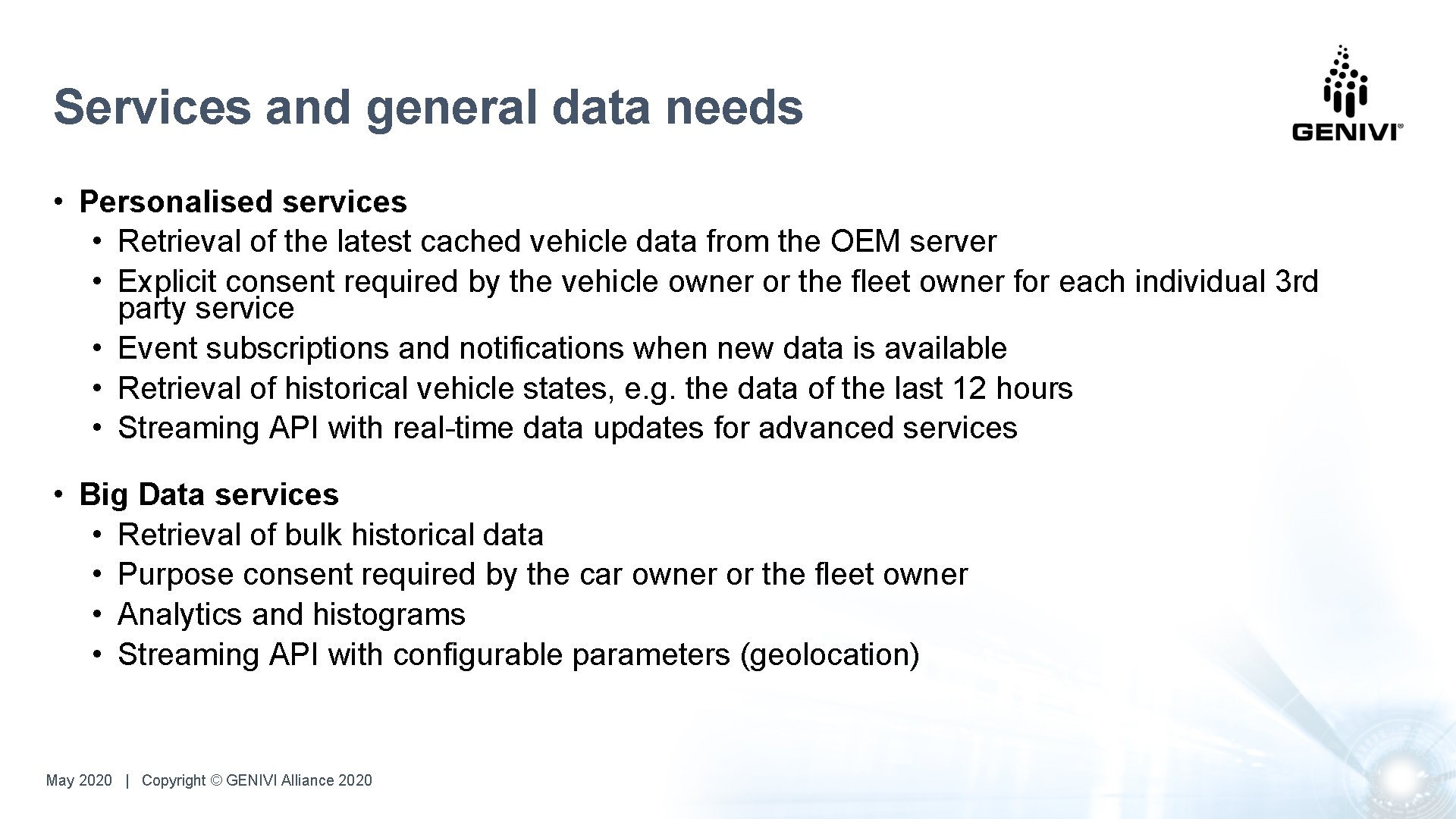
Services and general data needs • Personalised services • Retrieval of the latest cached vehicle data from the OEM server • Explicit consent required by the vehicle owner or the fleet owner for each individual 3 rd party service • Event subscriptions and notifications when new data is available • Retrieval of historical vehicle states, e. g. the data of the last 12 hours • Streaming API with real-time data updates for advanced services • Big Data services • Retrieval of bulk historical data • Purpose consent required by the car owner or the fleet owner • Analytics and histograms • Streaming API with configurable parameters (geolocation) May 2020 |. Copyright © GENIVI Alliance 2020
Data Model
Common Data Model Everyone we speak to say – Yes, the industry needs this! Potential for a shared data catalog, for a substantial subset of the vehicle data Shared formats, methods, and tools to manipulate the entire data set, including shared data catalog and future (some proprietary) additions Previous projects have come to similar conclusions – so far limited effect Common data model could enable all data-oriented use cases from end-to-end End-to-end could mean from vehicle sensor to third-party consumer in the cloud Some legacy parts will however not change – requires some translation code. Promote the common data model = minimize instances of data translation! May 2020 |. Copyright © GENIVI Alliance 2020
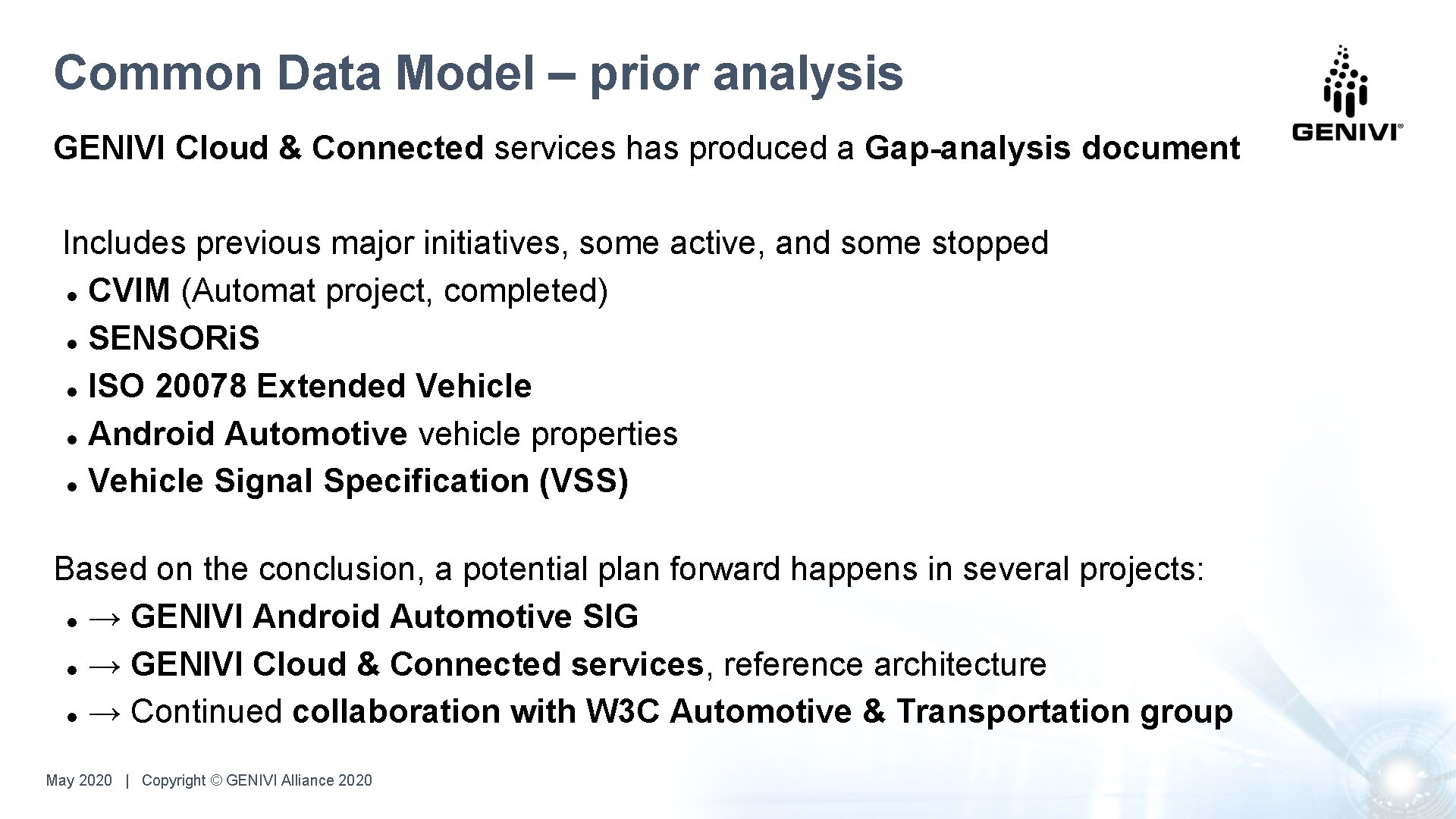
Common Data Model – prior analysis GENIVI Cloud & Connected services has produced a Gap-analysis document Includes previous major initiatives, some active, and some stopped CVIM (Automat project, completed) SENSORi. S ISO 20078 Extended Vehicle Android Automotive vehicle properties Vehicle Signal Specification (VSS) Based on the conclusion, a potential plan forward happens in several projects: → GENIVI Android Automotive SIG → GENIVI Cloud & Connected services, reference architecture → Continued collaboration with W 3 C Automotive & Transportation group May 2020 |. Copyright © GENIVI Alliance 2020
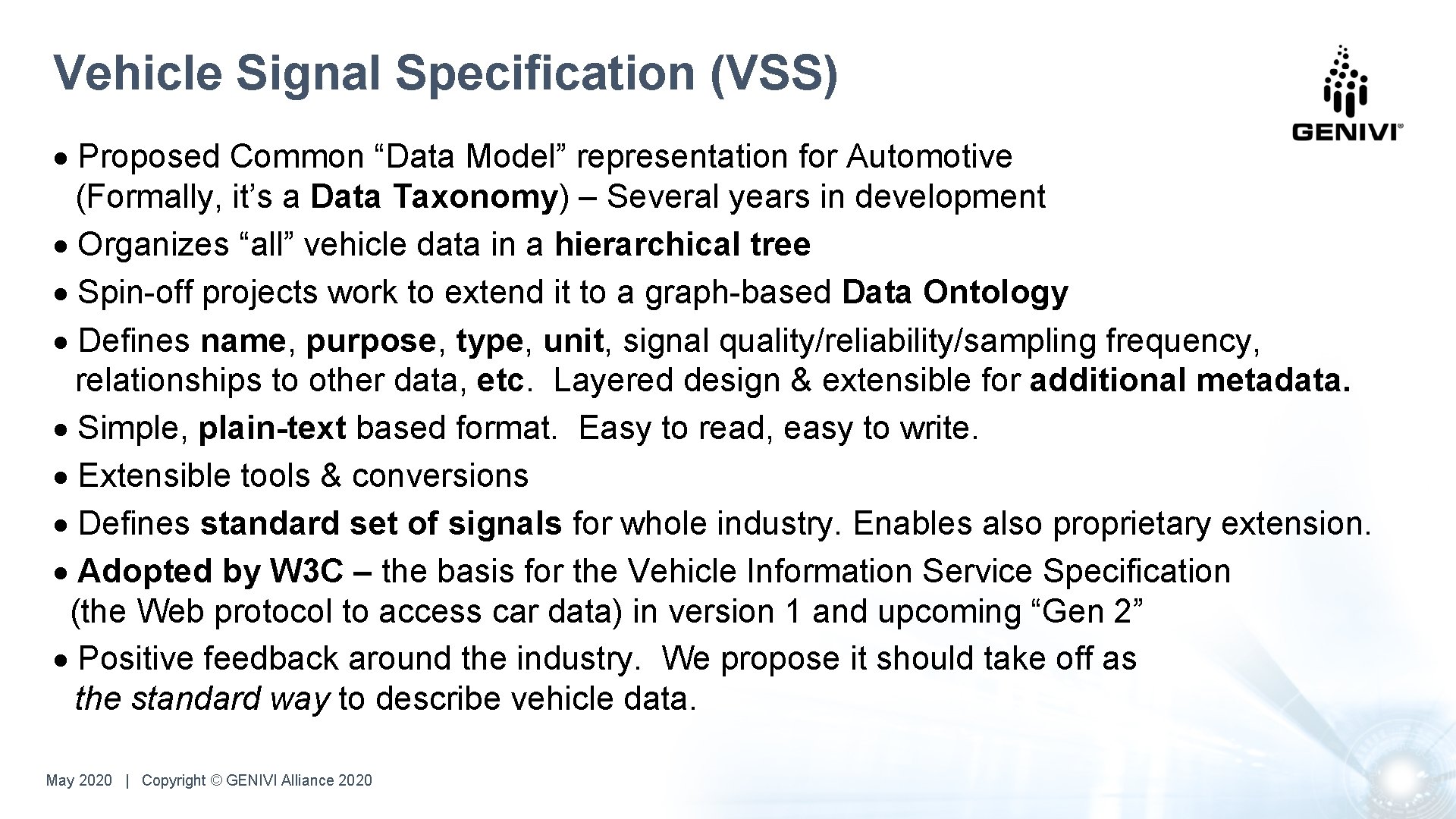
Vehicle Signal Specification (VSS) Proposed Common “Data Model” representation for Automotive (Formally, it’s a Data Taxonomy) – Several years in development Organizes “all” vehicle data in a hierarchical tree Spin-off projects work to extend it to a graph-based Data Ontology Defines name, purpose, type, unit, signal quality/reliability/sampling frequency, relationships to other data, etc. Layered design & extensible for additional metadata. Simple, plain-text based format. Easy to read, easy to write. Extensible tools & conversions Defines standard set of signals for whole industry. Enables also proprietary extension. Adopted by W 3 C – the basis for the Vehicle Information Service Specification (the Web protocol to access car data) in version 1 and upcoming “Gen 2” Positive feedback around the industry. We propose it should take off as the standard way to describe vehicle data. May 2020 |. Copyright © GENIVI Alliance 2020
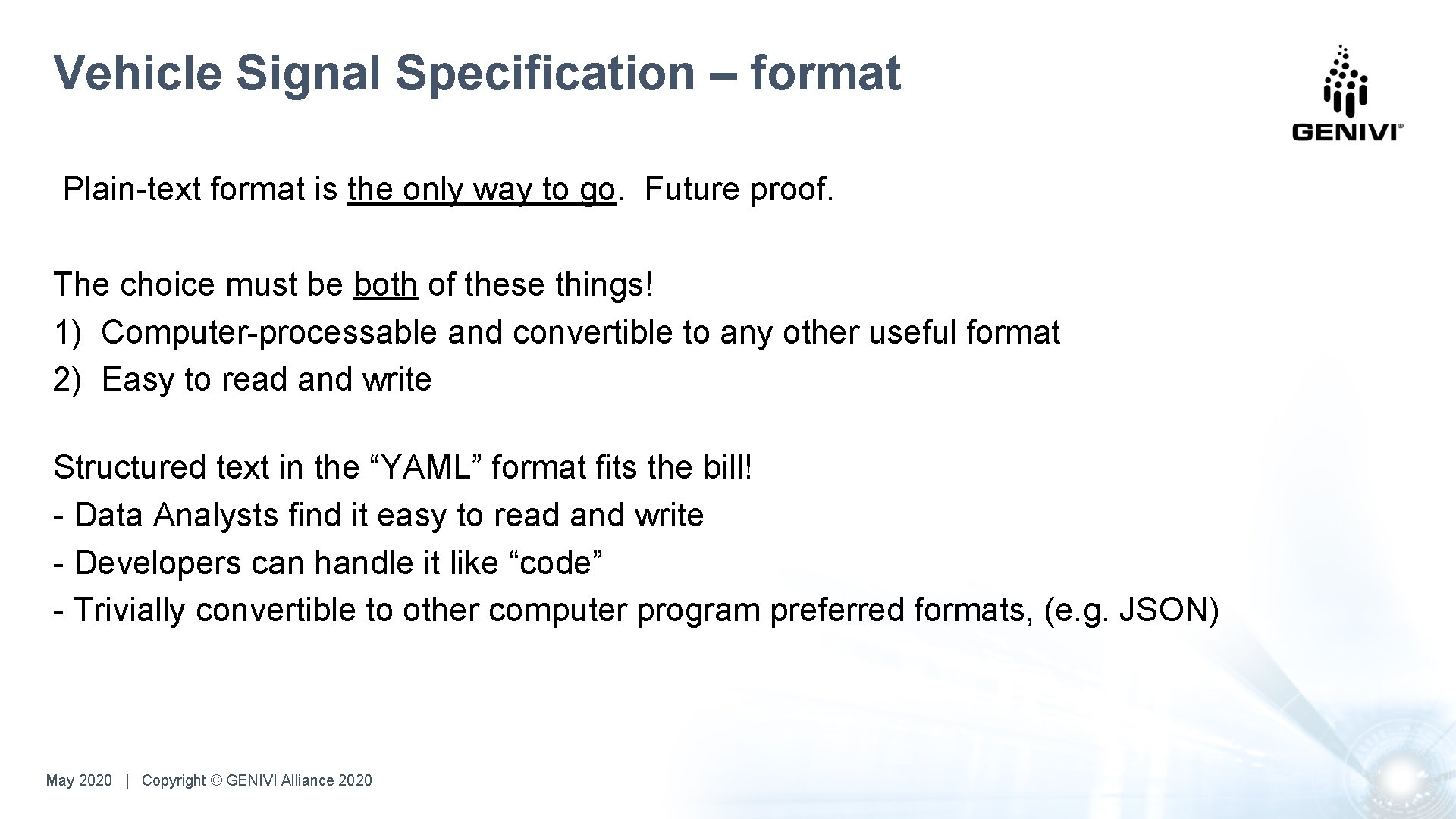
Vehicle Signal Specification – format Plain-text format is the only way to go. Future proof. The choice must be both of these things! 1) Computer-processable and convertible to any other useful format 2) Easy to read and write Structured text in the “YAML” format fits the bill! - Data Analysts find it easy to read and write - Developers can handle it like “code” - Trivially convertible to other computer program preferred formats, (e. g. JSON) May 2020 |. Copyright © GENIVI Alliance 2020
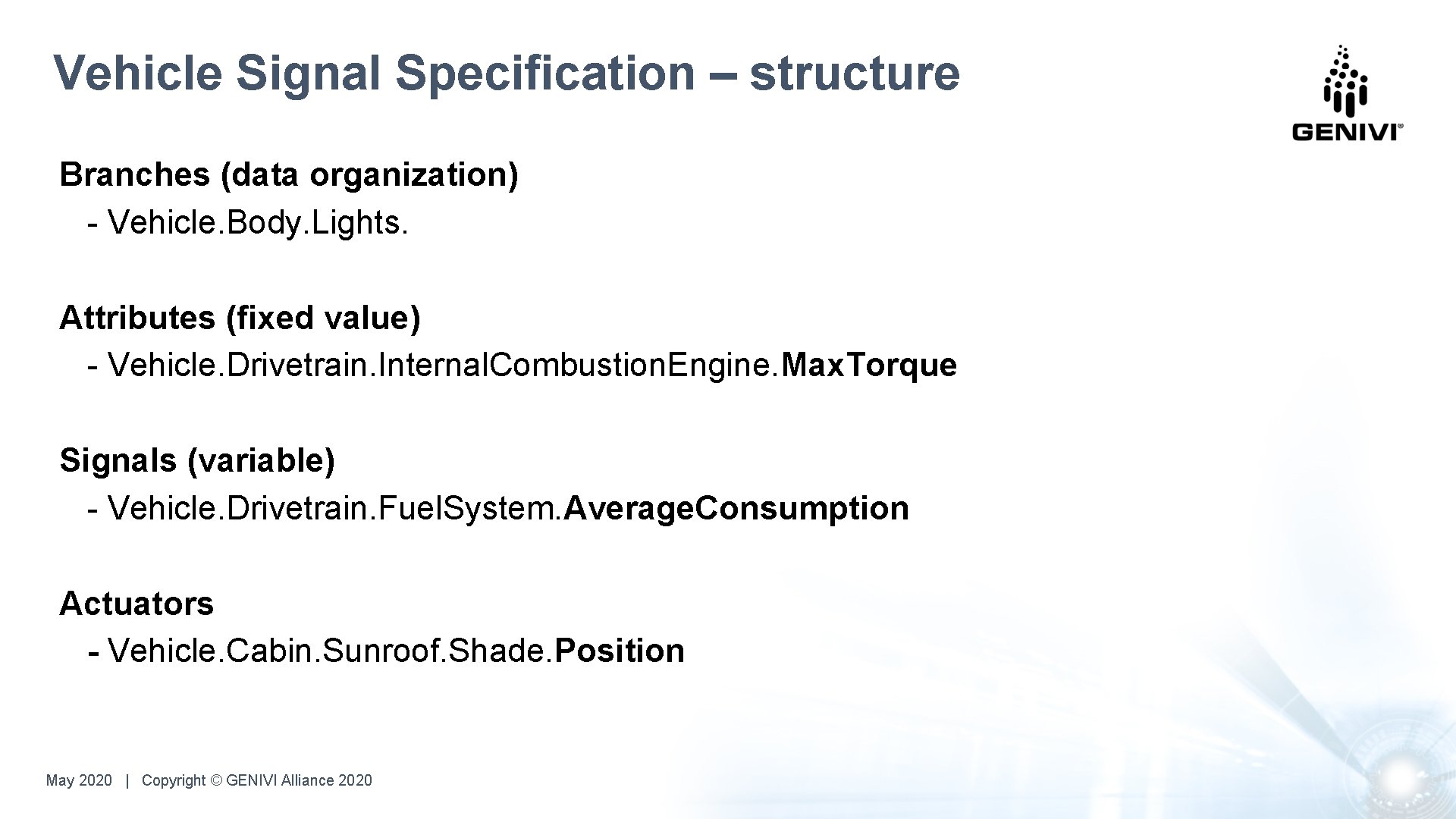
Vehicle Signal Specification – structure Branches (data organization) - Vehicle. Body. Lights. Attributes (fixed value) - Vehicle. Drivetrain. Internal. Combustion. Engine. Max. Torque Signals (variable) - Vehicle. Drivetrain. Fuel. System. Average. Consumption Actuators - Vehicle. Cabin. Sunroof. Shade. Position May 2020 |. Copyright © GENIVI Alliance 2020
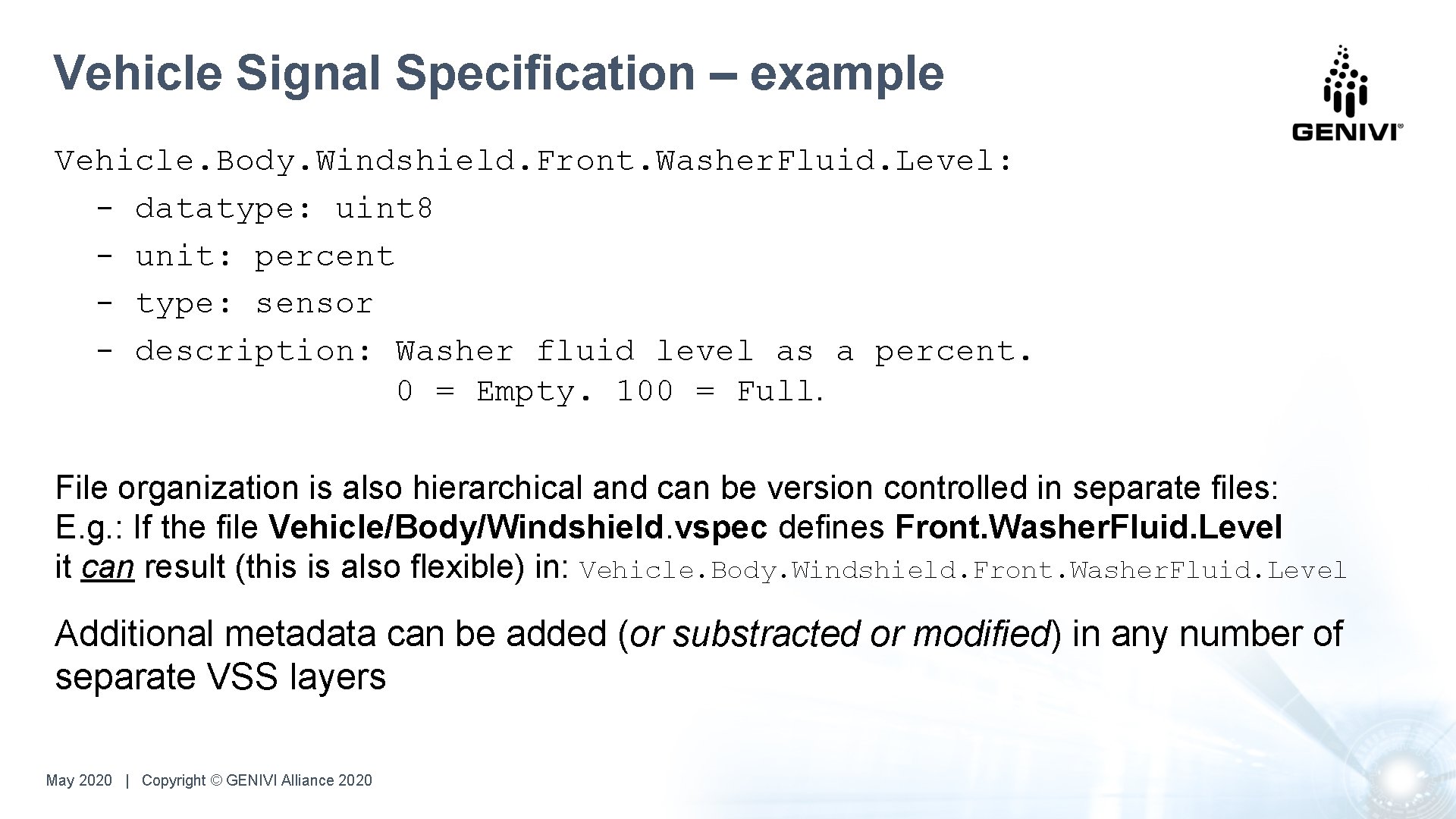
Vehicle Signal Specification – example Vehicle. Body. Windshield. Front. Washer. Fluid. Level: - datatype: uint 8 - unit: percent - type: sensor - description: Washer fluid level as a percent. 0 = Empty. 100 = Full. File organization is also hierarchical and can be version controlled in separate files: E. g. : If the file Vehicle/Body/Windshield. vspec defines Front. Washer. Fluid. Level it can result (this is also flexible) in: Vehicle. Body. Windshield. Front. Washer. Fluid. Level Additional metadata can be added (or substracted or modified) in any number of separate VSS layers May 2020 |. Copyright © GENIVI Alliance 2020
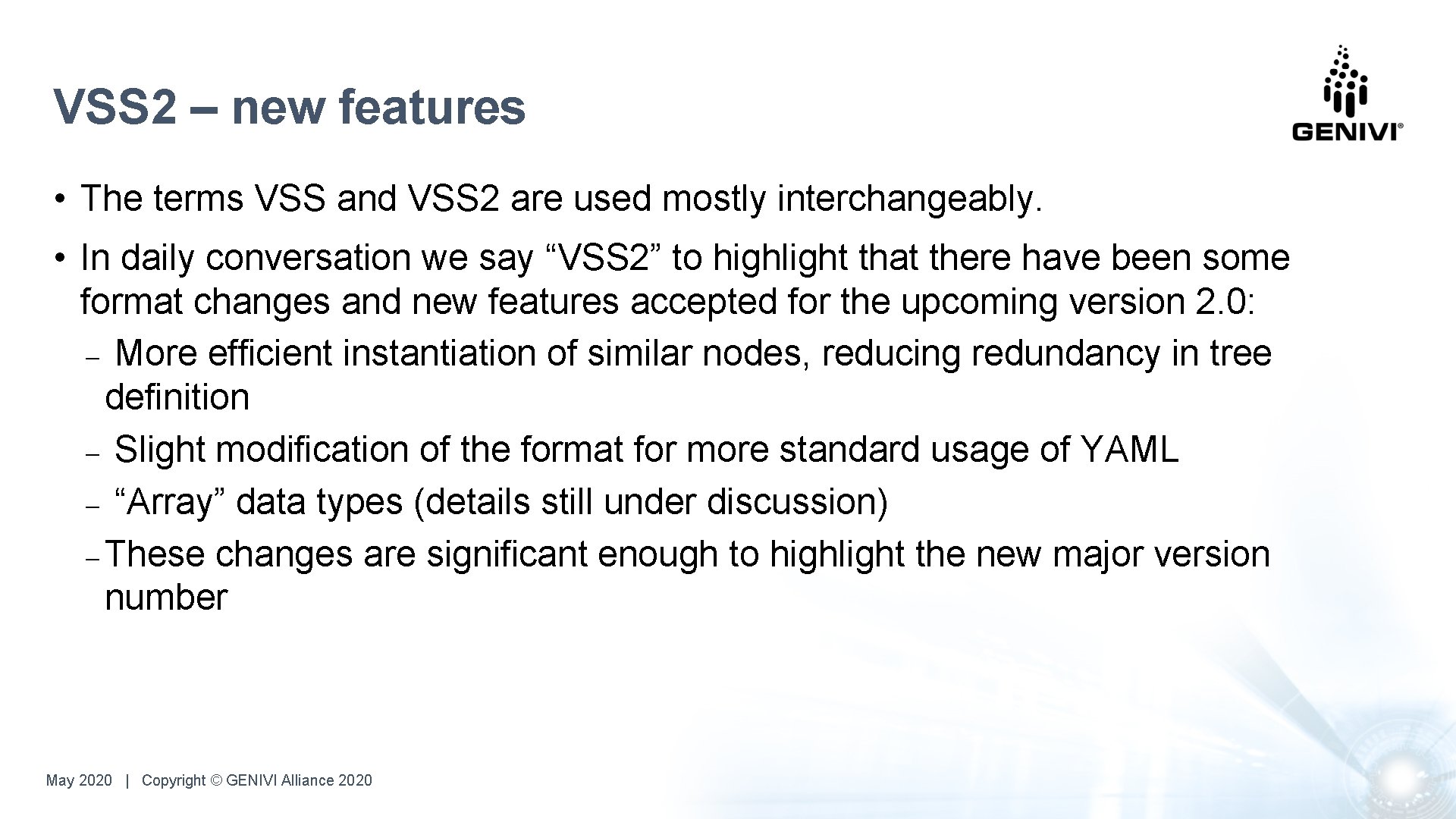
VSS 2 – new features • The terms VSS and VSS 2 are used mostly interchangeably. • In daily conversation we say “VSS 2” to highlight that there have been some format changes and new features accepted for the upcoming version 2. 0: More efficient instantiation of similar nodes, reducing redundancy in tree definition Slight modification of the format for more standard usage of YAML “Array” data types (details still under discussion) These changes are significant enough to highlight the new major version number May 2020 |. Copyright © GENIVI Alliance 2020
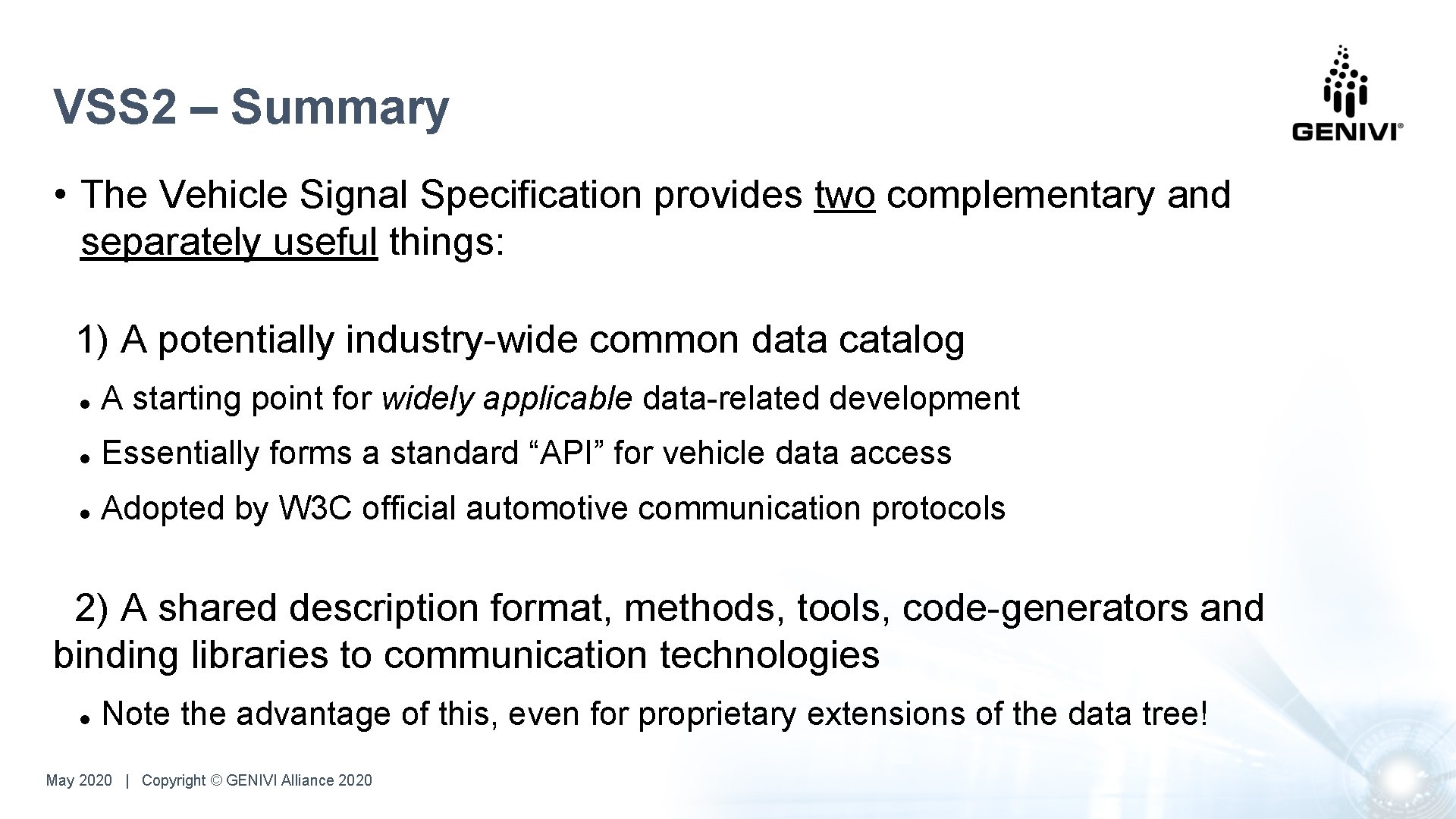
VSS 2 – Summary • The Vehicle Signal Specification provides two complementary and separately useful things: 1) A potentially industry-wide common data catalog A starting point for widely applicable data-related development Essentially forms a standard “API” for vehicle data access Adopted by W 3 C official automotive communication protocols 2) A shared description format, methods, tools, code-generators and binding libraries to communication technologies Note the advantage of this, even for proprietary extensions of the data tree! May 2020 |. Copyright © GENIVI Alliance 2020
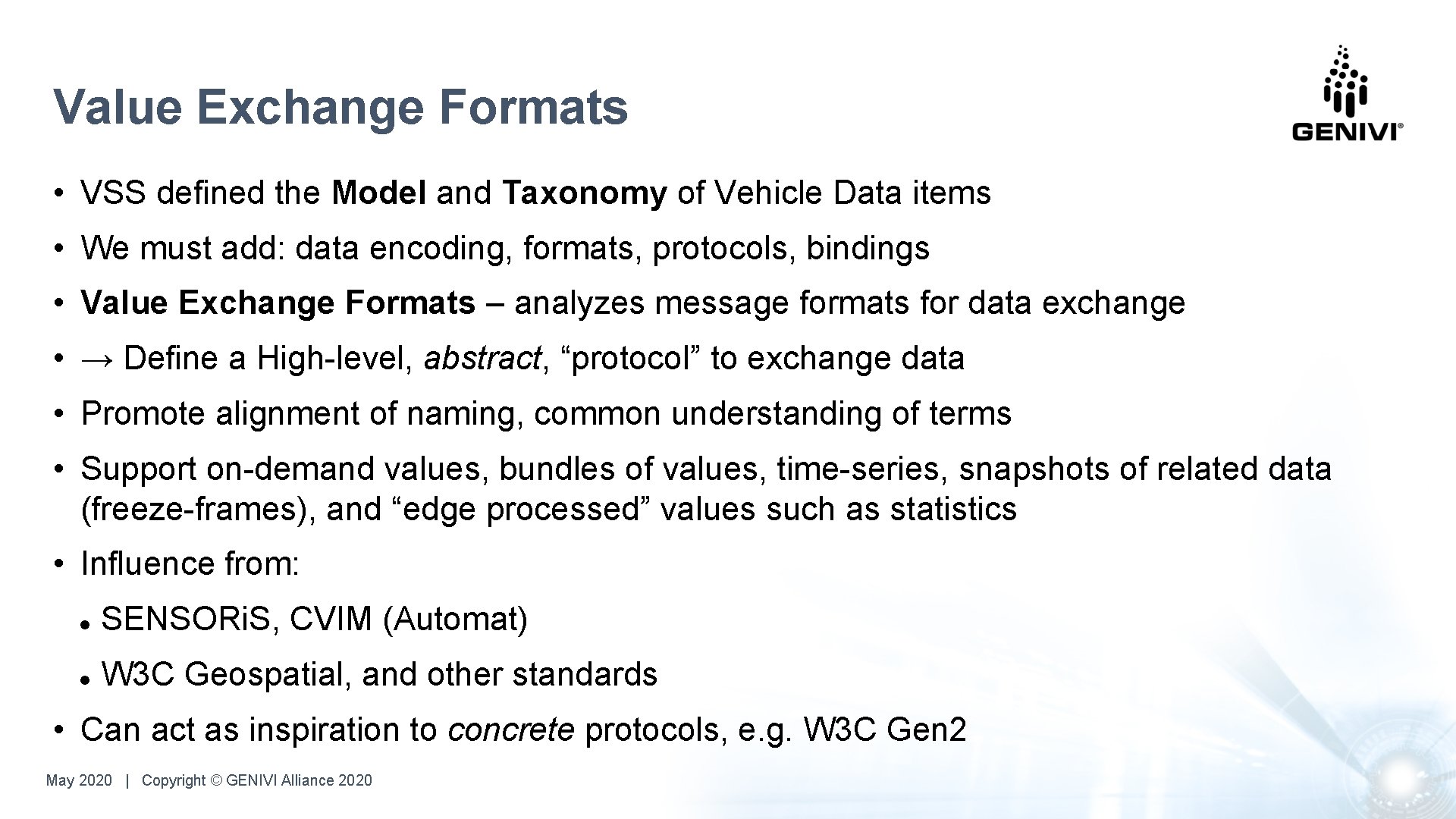
Value Exchange Formats • VSS defined the Model and Taxonomy of Vehicle Data items • We must add: data encoding, formats, protocols, bindings • Value Exchange Formats – analyzes message formats for data exchange • → Define a High-level, abstract, “protocol” to exchange data • Promote alignment of naming, common understanding of terms • Support on-demand values, bundles of values, time-series, snapshots of related data (freeze-frames), and “edge processed” values such as statistics • Influence from: SENSORi. S, CVIM (Automat) W 3 C Geospatial, and other standards • Can act as inspiration to concrete protocols, e. g. W 3 C Gen 2 May 2020 |. Copyright © GENIVI Alliance 2020
Communication Framework & Architecture
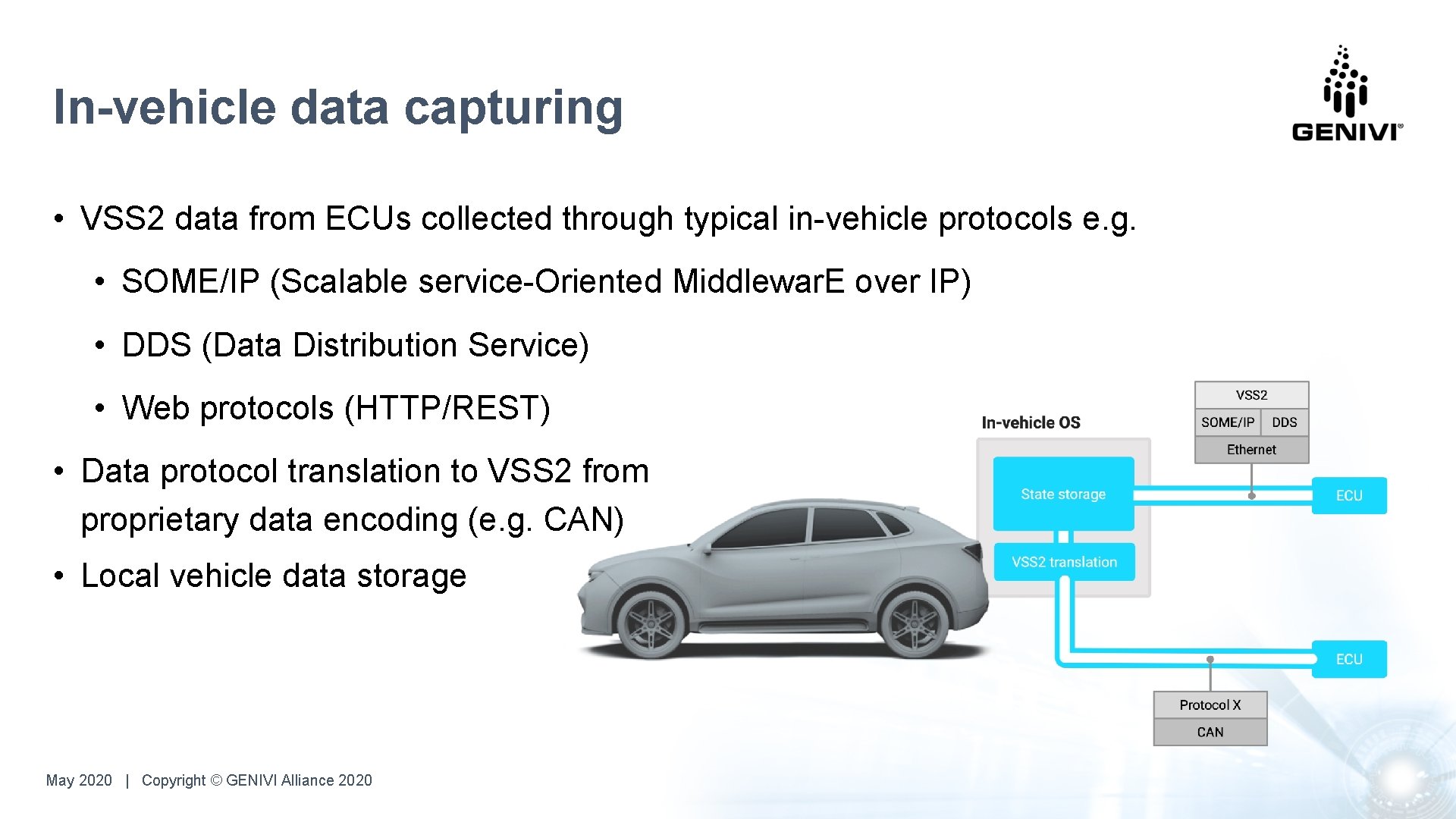
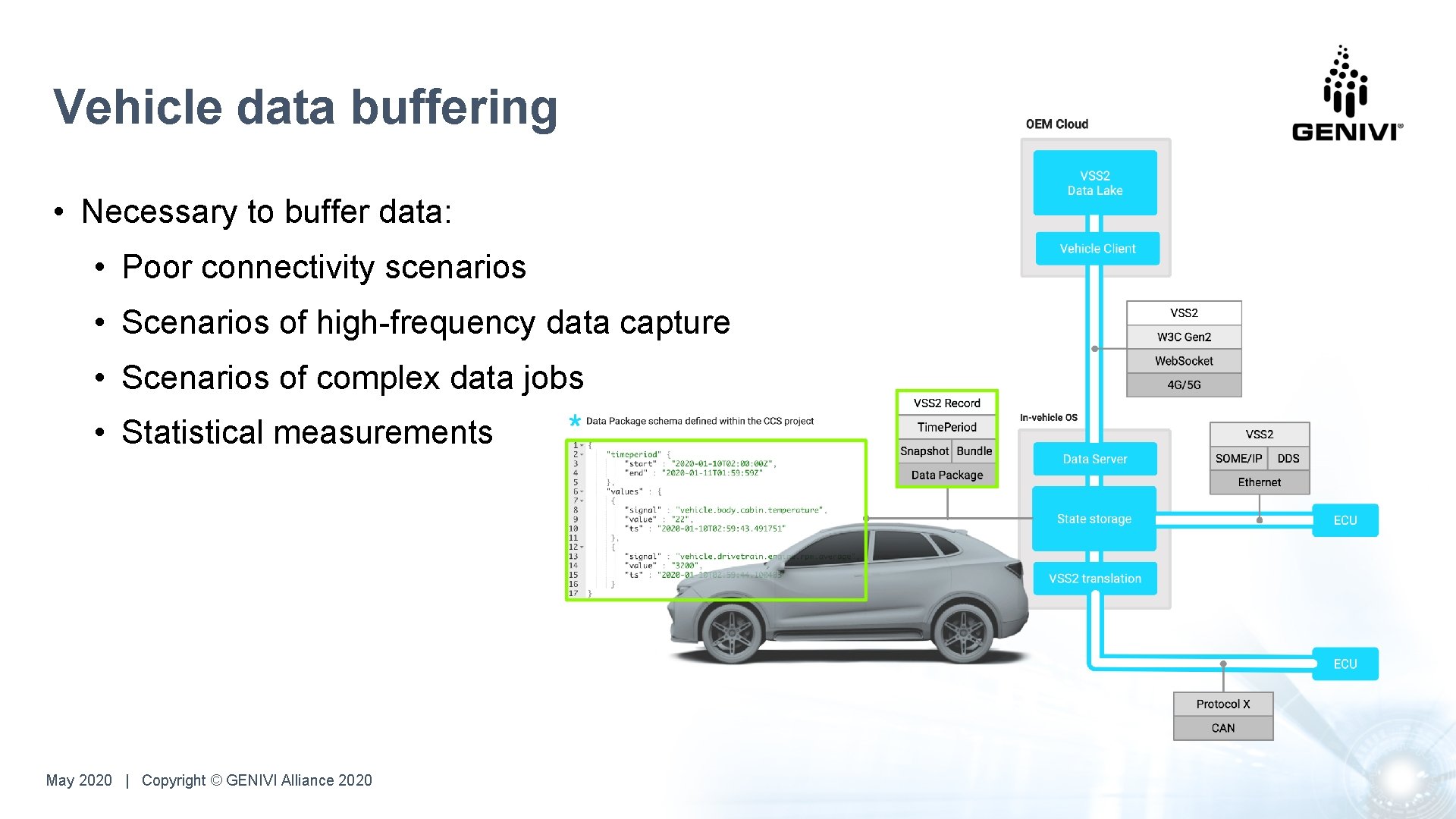
In-vehicle data capturing • VSS 2 data from ECUs collected through typical in-vehicle protocols e. g. • SOME/IP (Scalable service-Oriented Middlewar. E over IP) • DDS (Data Distribution Service) • Web protocols (HTTP/REST) • Data protocol translation to VSS 2 from proprietary data encoding (e. g. CAN) • Local vehicle data storage May 2020 |. Copyright © GENIVI Alliance 2020
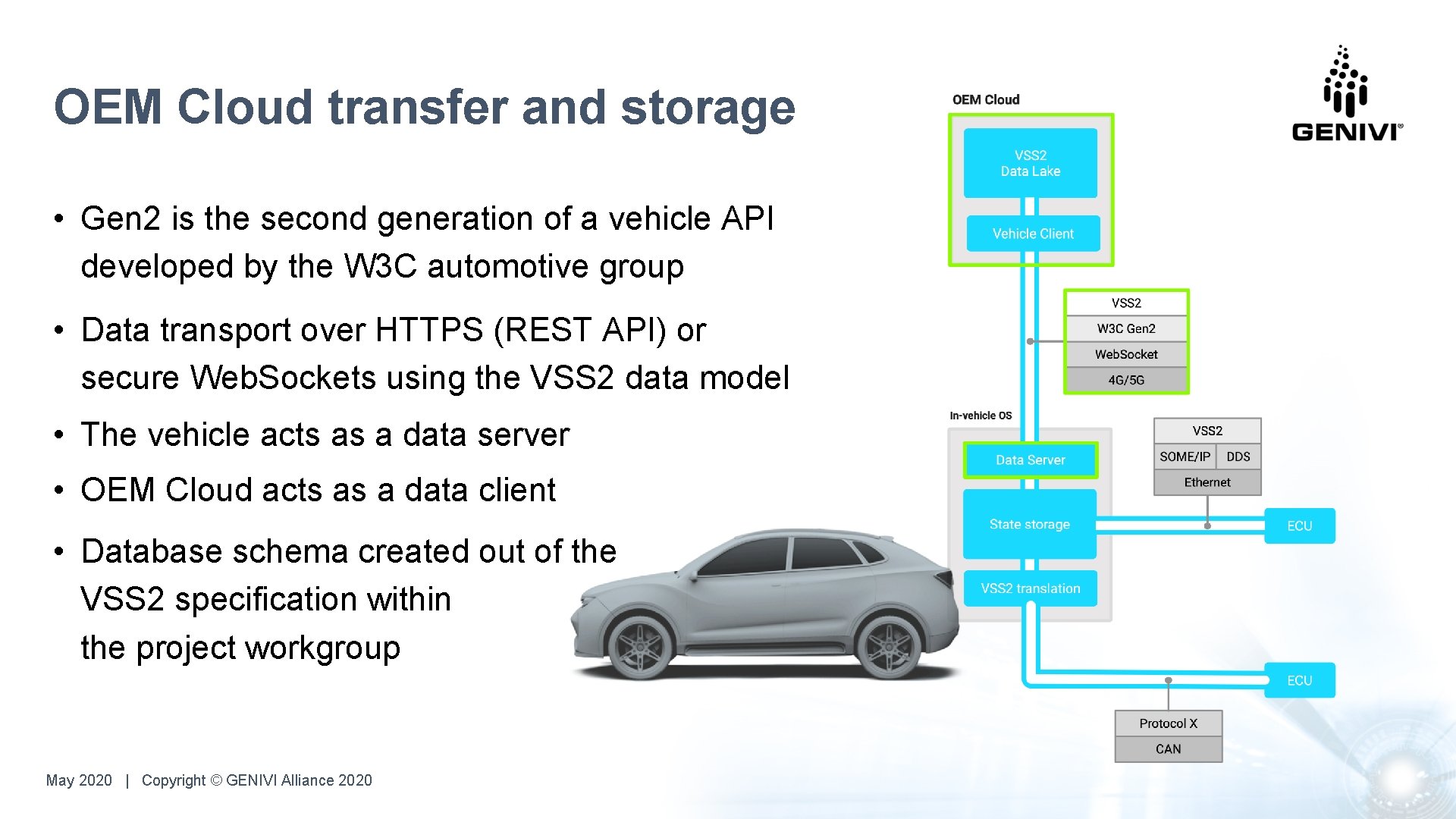
OEM Cloud transfer and storage • Gen 2 is the second generation of a vehicle API developed by the W 3 C automotive group • Data transport over HTTPS (REST API) or secure Web. Sockets using the VSS 2 data model • The vehicle acts as a data server • OEM Cloud acts as a data client • Database schema created out of the VSS 2 specification within the project workgroup May 2020 |. Copyright © GENIVI Alliance 2020
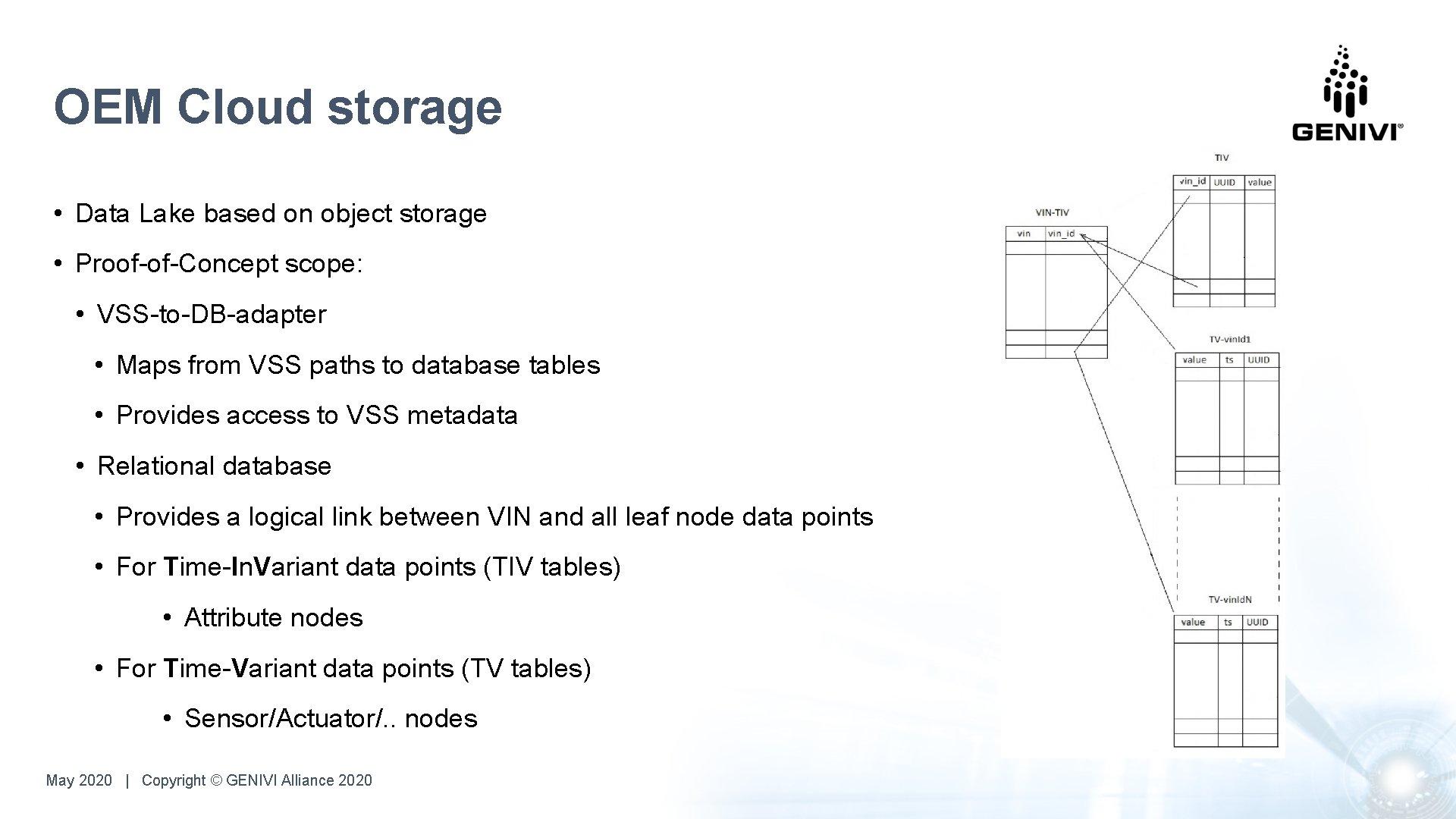
OEM Cloud storage • Data Lake based on object storage • Proof-of-Concept scope: • VSS-to-DB-adapter • Maps from VSS paths to database tables • Provides access to VSS metadata • Relational database • Provides a logical link between VIN and all leaf node data points • For Time-In. Variant data points (TIV tables) • Attribute nodes • For Time-Variant data points (TV tables) • Sensor/Actuator/. . nodes May 2020 |. Copyright © GENIVI Alliance 2020
Vehicle data buffering • Necessary to buffer data: • Poor connectivity scenarios • Scenarios of high-frequency data capture • Scenarios of complex data jobs • Statistical measurements May 2020 |. Copyright © GENIVI Alliance 2020
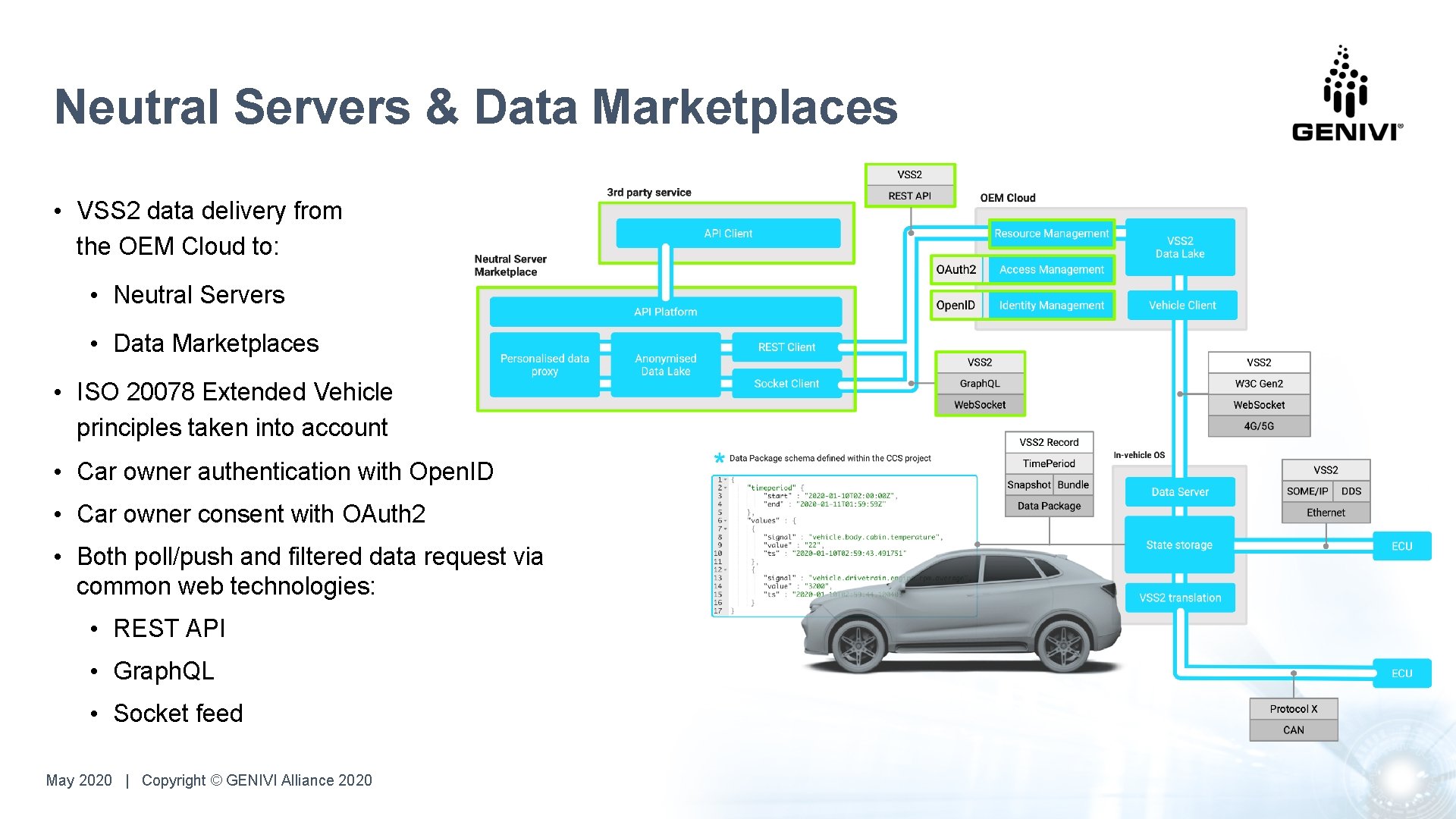
Neutral Servers & Data Marketplaces • VSS 2 data delivery from the OEM Cloud to: • Neutral Servers • Data Marketplaces • ISO 20078 Extended Vehicle principles taken into account • Car owner authentication with Open. ID • Car owner consent with OAuth 2 • Both poll/push and filtered data request via common web technologies: • REST API • Graph. QL • Socket feed May 2020 |. Copyright © GENIVI Alliance 2020
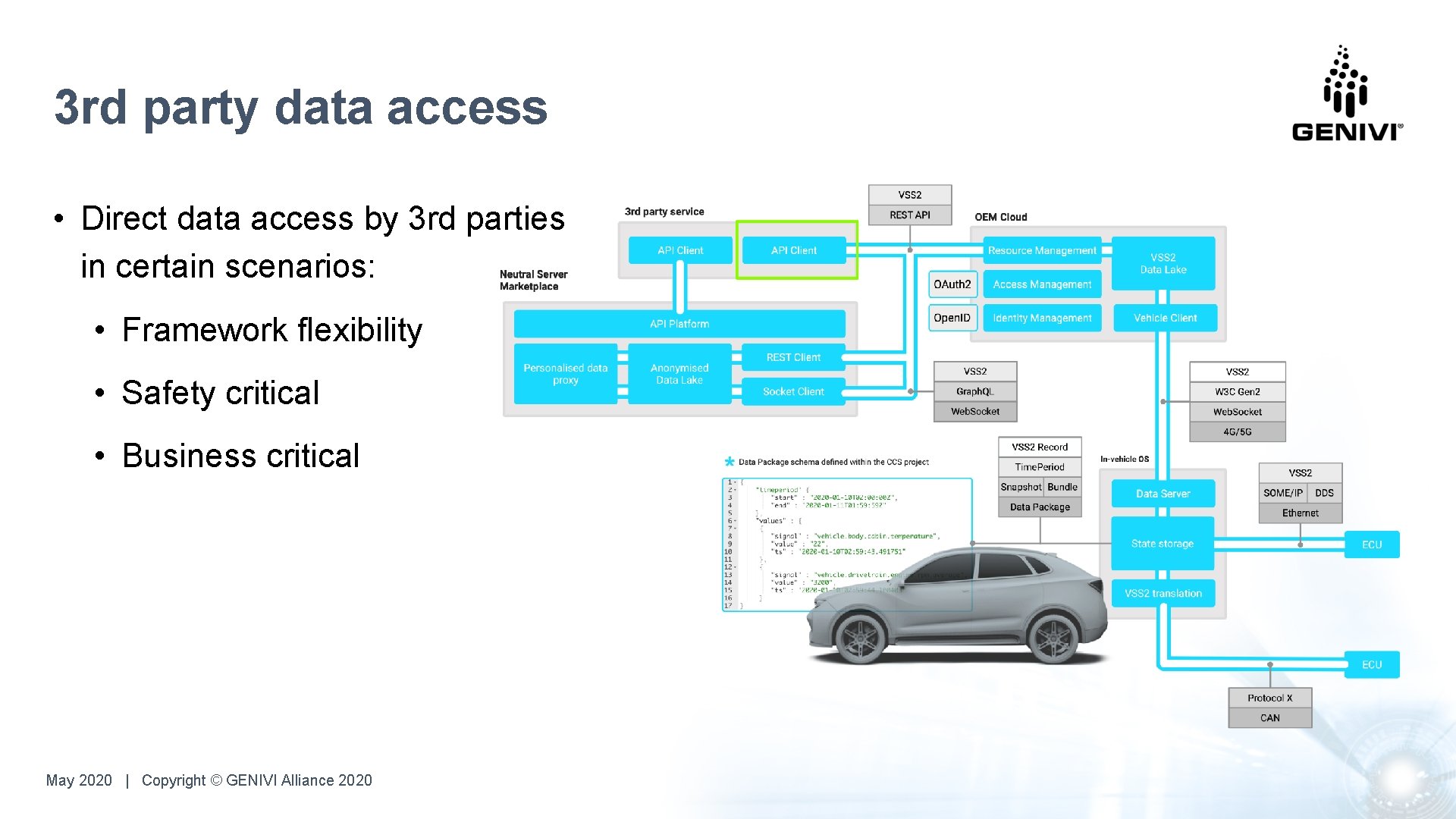
3 rd party data access • Direct data access by 3 rd parties in certain scenarios: • Framework flexibility • Safety critical • Business critical May 2020 |. Copyright © GENIVI Alliance 2020
Communication Framework & Architecture May 2020 |. Copyright © GENIVI Alliance 2020
Proof-of-Concept implementation
Proof-of-Concept objectives • To get fast results in evaluating and confirming the communication framework • To identify the technologies for each component, and which APIs that need to be standardised • To introduce changes in the framework based on real life experience • To gather experience that can be used to build a reference architecture as a future step • Important: software-based architecture only May 2020 |. Copyright © GENIVI Alliance 2020
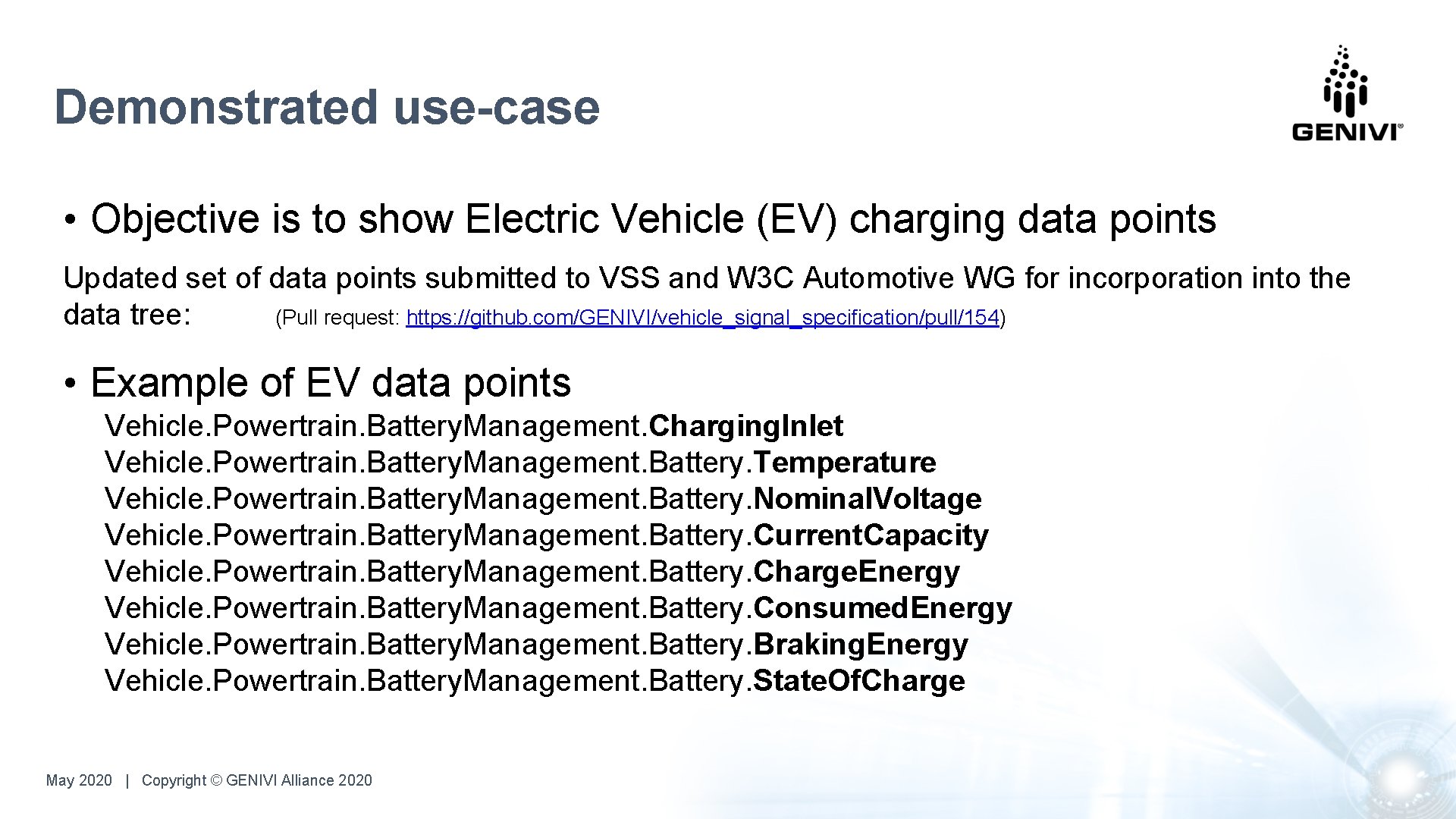
Demonstrated use-case • Objective is to show Electric Vehicle (EV) charging data points Updated set of data points submitted to VSS and W 3 C Automotive WG for incorporation into the data tree: (Pull request: https: //github. com/GENIVI/vehicle_signal_specification/pull/154) • Example of EV data points Vehicle. Powertrain. Battery. Management. Charging. Inlet Vehicle. Powertrain. Battery. Management. Battery. Temperature Vehicle. Powertrain. Battery. Management. Battery. Nominal. Voltage Vehicle. Powertrain. Battery. Management. Battery. Current. Capacity Vehicle. Powertrain. Battery. Management. Battery. Charge. Energy Vehicle. Powertrain. Battery. Management. Battery. Consumed. Energy Vehicle. Powertrain. Battery. Management. Battery. Braking. Energy Vehicle. Powertrain. Battery. Management. Battery. State. Of. Charge May 2020 |. Copyright © GENIVI Alliance 2020
Timeline • Milestone 1 – GENIVI Virtual Technical Meeting (12 -14 May) • Milestone 2 - Internal milestone (early Q 3 - July) • Milestone 3 - Fall All Member Meeting, Leipzig, Germany (last week of October) • Milestone 4 - CES 2021, Las Vegas, USA (early January 2021) • GENIVI Virtual Technical Meeting: register at https: //www. eventleaf. com/genivi. VTS May 2020 |. Copyright © GENIVI Alliance 2020
Contributing • Weekly telcos ⁃ Mondays - 11: 30 CET (Asia friendly time) – Communication Framework ⁃ Mondays - 17: 00 CET (US friendly time) - Vehicle Data, sprint & backlog review ⁃ Wednesdays - 17: 00 CET (US friendly time) - Communication Framework ⁃ Mailing list: http: //genivi. emwd. com/mailman/listinfo/ccs_lists. genivi. org ⁃ Cloud & Connected Services Project Wiki : https: //at. projects. genivi. org/wiki/x/PIAVAg ⁃ Cloud & Connected Services Proof-of-Concept Work Breakdown: https: //at. projects. genivi. org/wiki/x/84 Ak. Aw May 2020 |. Copyright © GENIVI Alliance 2020
Thank you! Visit GENIVI: http: //www. genivi. org http: //projects. genivi. org Contact us: help@genivi. org