Randomizing Nursing Students into a Flipped Experience Susan






- Slides: 39
Randomizing Nursing Students into a Flipped Experience
Susan Harrington, Nancy Schoofs, Melodee Vanden Bosch, Cynthia Beel-Bates, Kirkhof College of Nursing Kirk Anderson, Statistics Department Concurrent Sessions A 10: 45 - 11: 45 Session A 6 Room 410 EC
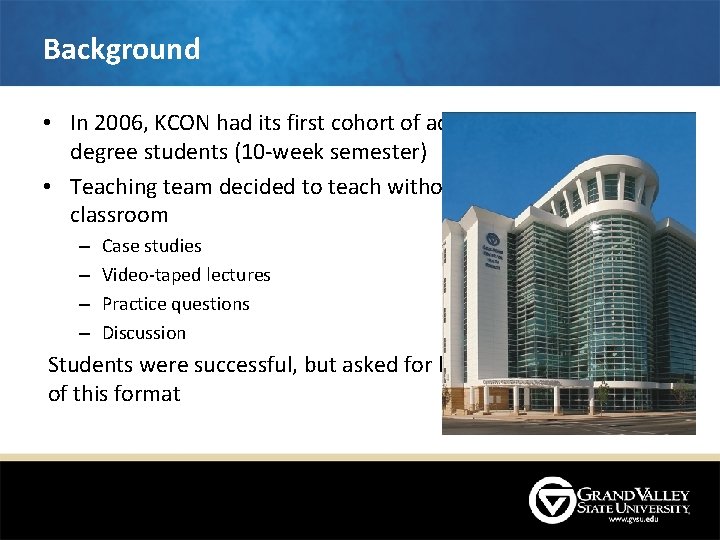
Background • In 2006, KCON had its first cohort of accelerated second degree students (10 -week semester) • Teaching team decided to teach without lecture in the classroom – – Case studies Video-taped lectures Practice questions Discussion Students were successful, but asked for lecture after two years of this format
Background, continued • In summer 2012, had our first class in new curriculum – Lecture only • For fall 2012, decided to try flipped classroom – Video-taped lectures – Case studies, games – Practice questions, clickers – Discussion, simulations
Educating Nurses: A Call for Radical Transformation (Benner, 2010) • Renovation in nursing education are mandatory and imminent • Strive to create effective teaching strategies to assist in integrating knowledge-acquisition (classroom) and knowledge-use (clinical practice) • Assimilate nursing science with clinical experience o Embed concepts in clinical practice o Engage students with active learning
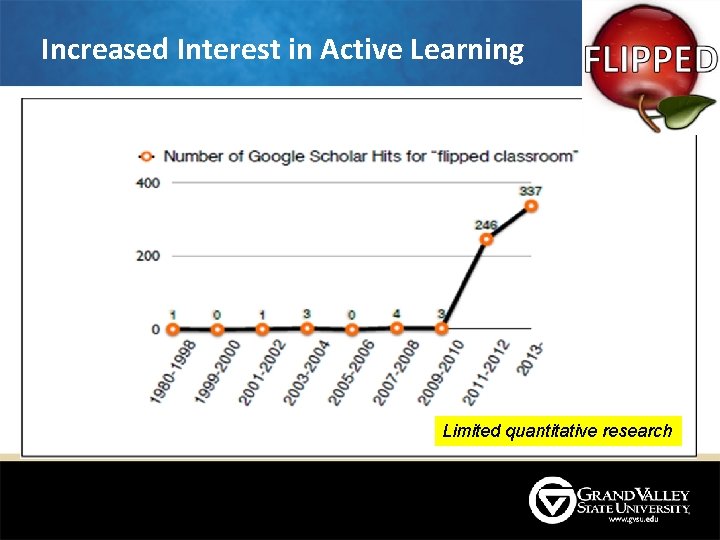
Increased Interest in Active Learning Limited quantitative research
Speak Up National Research Project (Fall, 2012) • Estimated that only 3% of the teachers in the U. S. know about or "do" flipped learning • 27% of principals indicated their teachers wanted to try it this year!
Randomize, Randomize • Increase the level of investigative rigor by randomizing the 84 students o Winter 2013 o one of two teaching methods: (1) traditional / lecture driven or (2) flipped classroom. o collection of both qualitative and quantitative information to enhance and document the experience with hard data
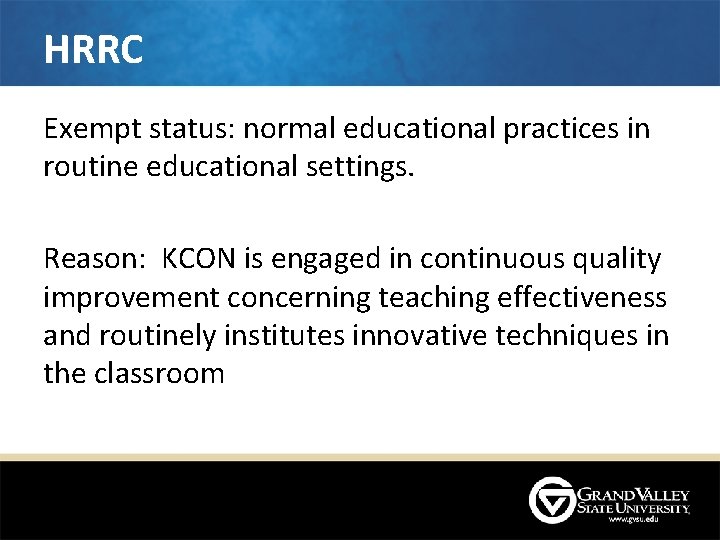
HRRC Exempt status: normal educational practices in routine educational settings. Reason: KCON is engaged in continuous quality improvement concerning teaching effectiveness and routinely institutes innovative techniques in the classroom
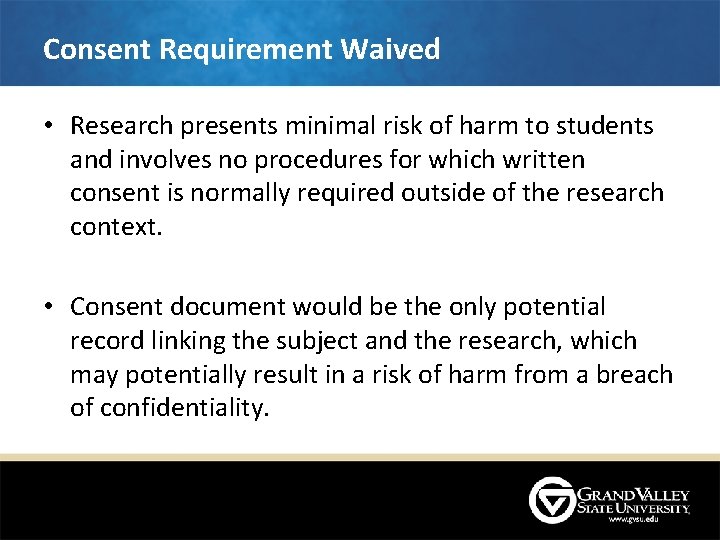
Consent Requirement Waived • Research presents minimal risk of harm to students and involves no procedures for which written consent is normally required outside of the research context. • Consent document would be the only potential record linking the subject and the research, which may potentially result in a risk of harm from a breach of confidentiality.
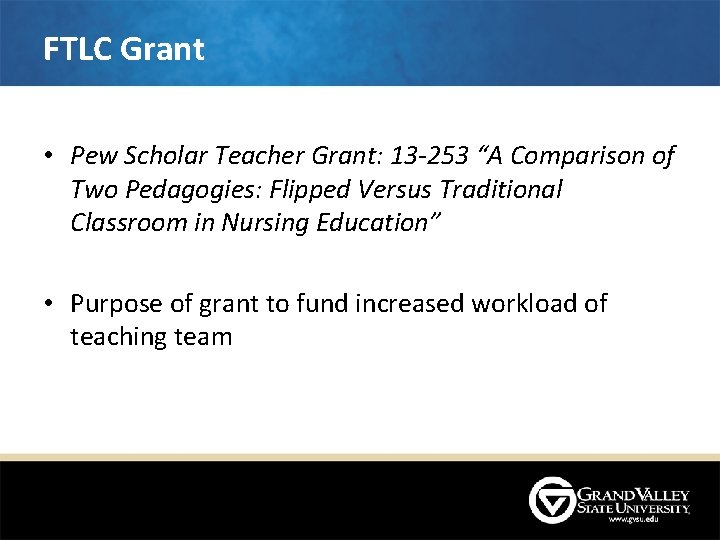
FTLC Grant • Pew Scholar Teacher Grant: 13 -253 “A Comparison of Two Pedagogies: Flipped Versus Traditional Classroom in Nursing Education” • Purpose of grant to fund increased workload of teaching team
Students Notified (Prior to identifying which group) Blackboard email to incoming class • Investigate / compare two different teaching methods • Asked to participate / will be randomly assigned • Separate Blackboard sites / access to only one of the sites • Assurance that professors have taught with this methodology in past • Both teaching methods have been shown to be effective / student success is our priority • No potential risk or harm to participants • Assessments include: grades and surveys / confidentiality, deidentified surveys
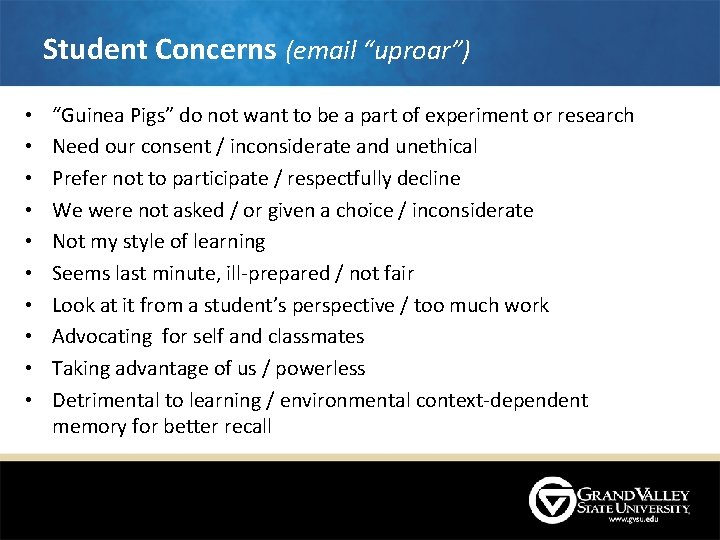
Student Concerns (email “uproar”) • • • “Guinea Pigs” do not want to be a part of experiment or research Need our consent / inconsiderate and unethical Prefer not to participate / respectfully decline We were not asked / or given a choice / inconsiderate Not my style of learning Seems last minute, ill-prepared / not fair Look at it from a student’s perspective / too much work Advocating for self and classmates Taking advantage of us / powerless Detrimental to learning / environmental context-dependent memory for better recall
Address Student Concerns Available to address concerns to student: set up time and place • Many months of preparation • Submitted and approved by GVSU’s HRRC. • KCON routinely institutes innovative techniques in the classroom • FERPA: no consent / Individual academic records are not being analyzed • Nursing is an application science: regardless of technique, study time will be increased next semester and application will be encouraged/promoted/advocated • Advocates for proactive learning • EVERYTHING - except delivery of lectures - will be identical
Talking Points Consistency at presentation to students / first day of class / Written script • Exams : same exam at the same time for both groups • Quizzes : online; same quizzes - due the day before class • Classroom time : Flipped classroom: activities such as case studies, multiple choice questions, care maps, care plans, skits, games Traditional classroom: straight lecture and some activities. • Preparation for class: Flipped classroom: listen to the Camtasias which are the same lectures that the Traditional students will be getting in class; read notes (outlines or Power. Point slides) and read the textbook readings. The Camtasias can be listened to multiple times Traditional classroom: read their outlines or Power. Point slides and read the textbook readings
(Traditional format)
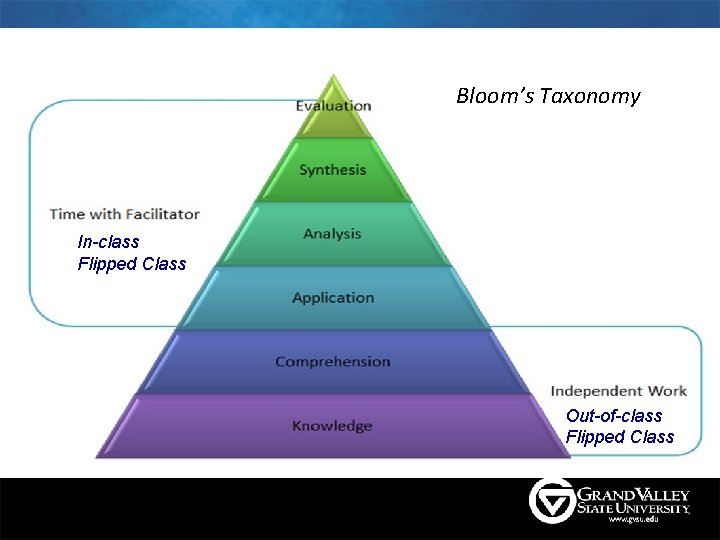
Bloom’s Taxonomy In-class Flipped Class Out-of-class Flipped Class
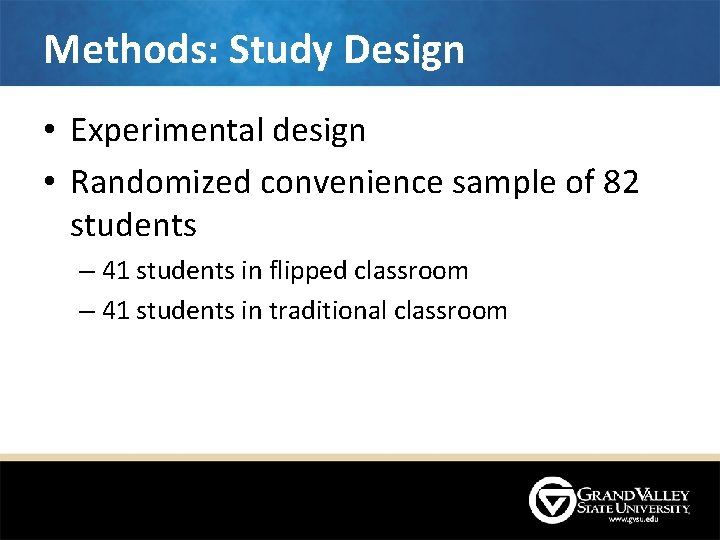
Methods: Study Design • Experimental design • Randomized convenience sample of 82 students – 41 students in flipped classroom – 41 students in traditional classroom
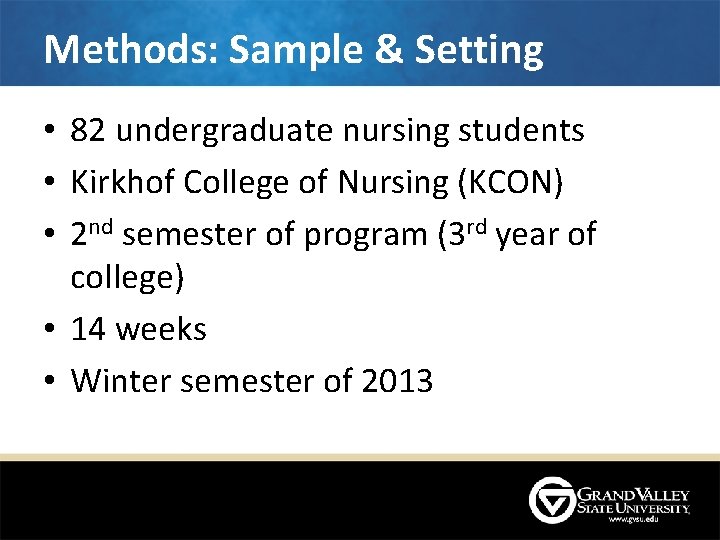
Methods: Sample & Setting • 82 undergraduate nursing students • Kirkhof College of Nursing (KCON) • 2 nd semester of program (3 rd year of college) • 14 weeks • Winter semester of 2013
Procedures • Two separate Blackboard sites • Two separate classrooms – Same time and day of the week (Monday & Tuesday) – Same content on same date – Same amount of classroom time (1 – 2: 50 pm)
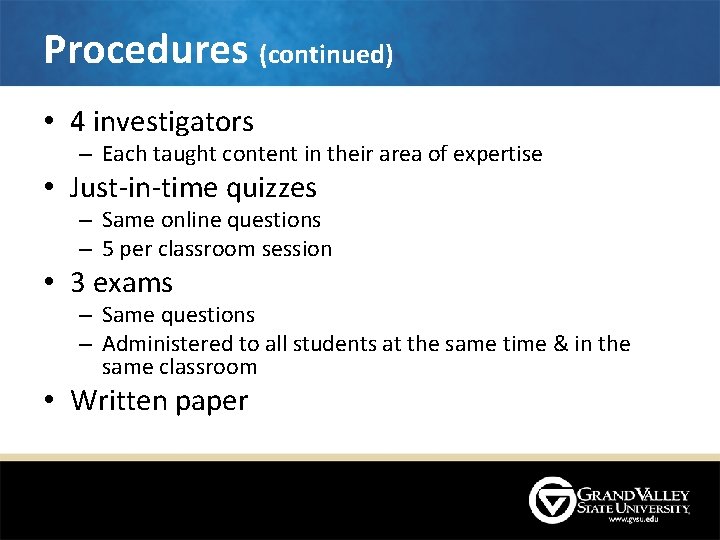
Procedures (continued) • 4 investigators – Each taught content in their area of expertise • Just-in-time quizzes – Same online questions – 5 per classroom session • 3 exams – Same questions – Administered to all students at the same time & in the same classroom • Written paper
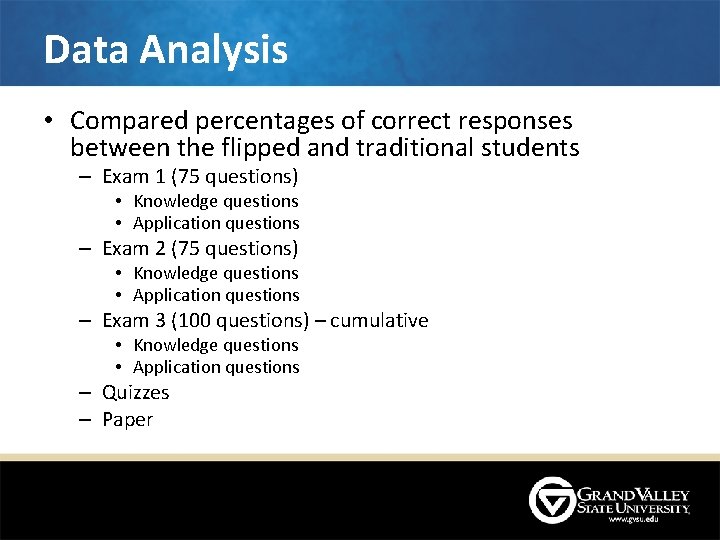
Data Analysis • Compared percentages of correct responses between the flipped and traditional students – Exam 1 (75 questions) • Knowledge questions • Application questions – Exam 2 (75 questions) • Knowledge questions • Application questions – Exam 3 (100 questions) – cumulative • Knowledge questions • Application questions – Quizzes – Paper
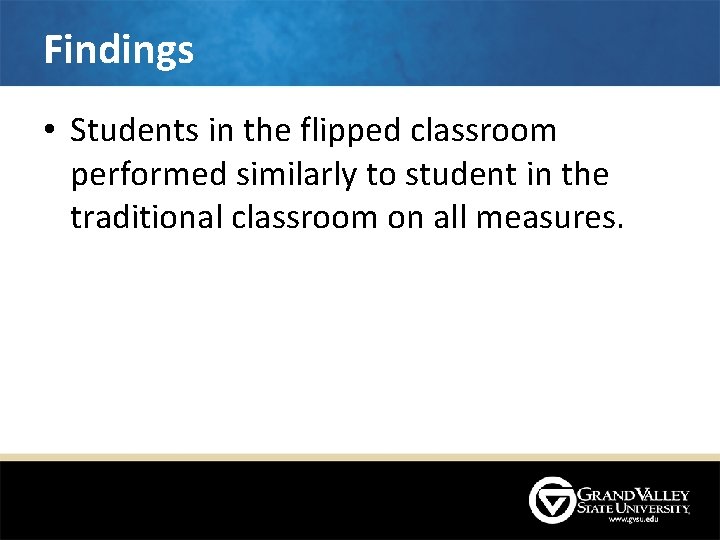
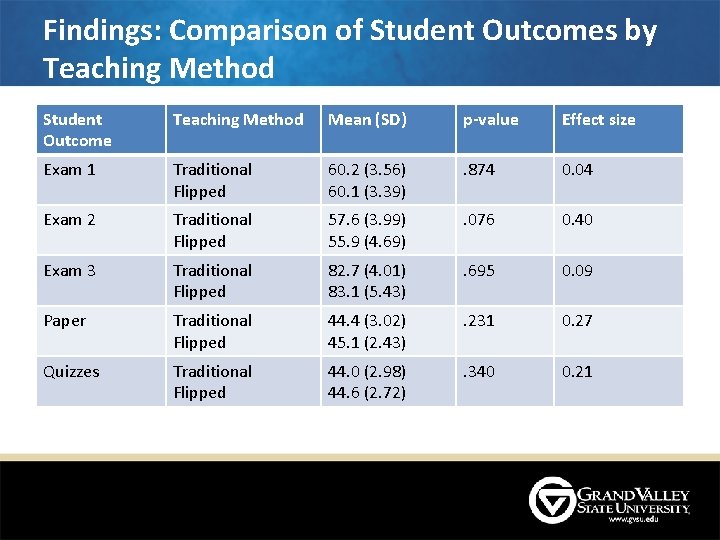
Findings • Students in the flipped classroom performed similarly to student in the traditional classroom on all measures.
Findings: Comparison of Student Outcomes by Teaching Method Student Outcome Teaching Method Mean (SD) p-value Effect size Exam 1 Traditional Flipped 60. 2 (3. 56) 60. 1 (3. 39) . 874 0. 04 Exam 2 Traditional Flipped 57. 6 (3. 99) 55. 9 (4. 69) . 076 0. 40 Exam 3 Traditional Flipped 82. 7 (4. 01) 83. 1 (5. 43) . 695 0. 09 Paper Traditional Flipped 44. 4 (3. 02) 45. 1 (2. 43) . 231 0. 27 Quizzes Traditional Flipped 44. 0 (2. 98) 44. 6 (2. 72) . 340 0. 21
What we learned • Students learned course content despite: – New approach to learning – Instructors who were novice at flipped classroom methods such as Camtasia and classroom activities • Instructors found that teaching in the flipped classroom involved: – – More preparation Online quizzes assessed student knowledge deficits Greater student involvement in learning Increased classroom time for application of knowledge
What we would do differently • Prepare students for the change in teaching methods • Use different activities for each classroom versus having similar activities for each • Evaluate outcomes other than the traditional examinations such as critical thinking or problem-solving
What we would do the same • Online quizzes • Randomize the groups • Flip the classroom
New Knowledge • Innovative and novel approach to learning in nursing • Comparison by randomization • Used same method during the entire semester
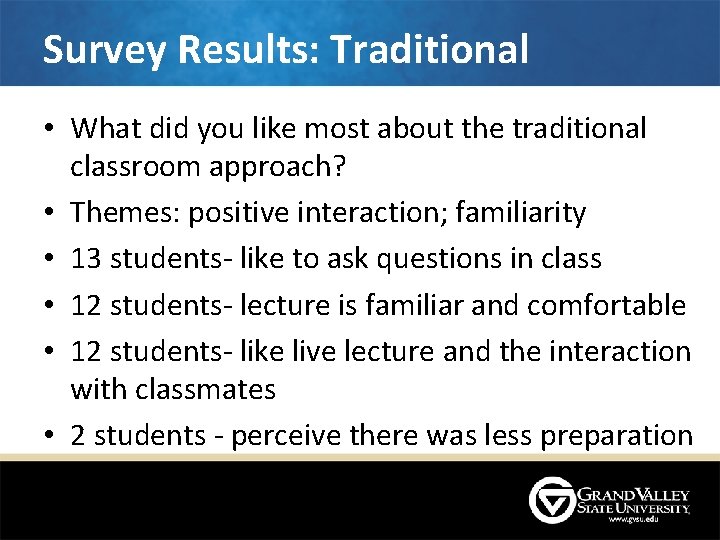
Survey Results: Traditional • What did you like most about the traditional classroom approach? • Themes: positive interaction; familiarity • 13 students- like to ask questions in class • 12 students- lecture is familiar and comfortable • 12 students- like live lecture and the interaction with classmates • 2 students - perceive there was less preparation time
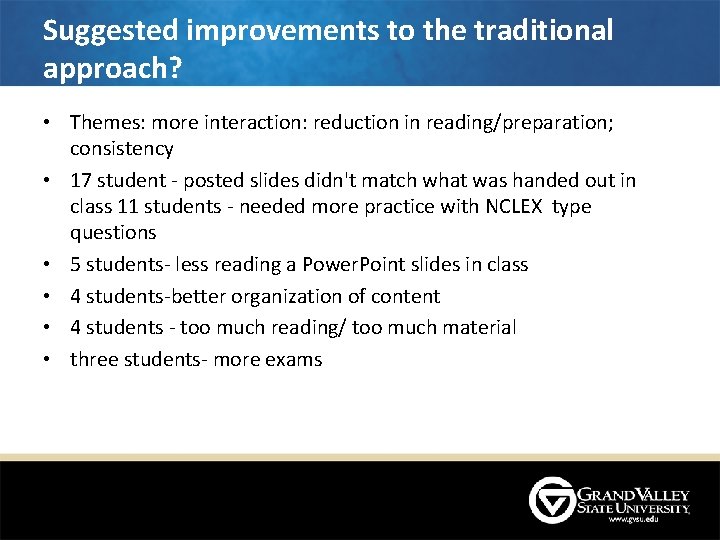
Suggested improvements to the traditional approach? • Themes: more interaction: reduction in reading/preparation; consistency • 17 student - posted slides didn't match what was handed out in class 11 students - needed more practice with NCLEX type questions • 5 students- less reading a Power. Point slides in class • 4 students-better organization of content • 4 students - too much reading/ too much material • three students- more exams
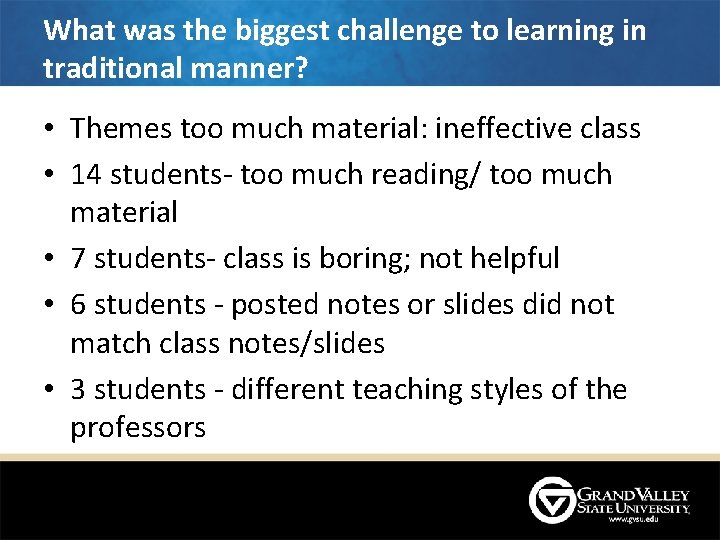
What was the biggest challenge to learning in traditional manner? • Themes too much material: ineffective class • 14 students- too much reading/ too much material • 7 students- class is boring; not helpful • 6 students - posted notes or slides did not match class notes/slides • 3 students - different teaching styles of the professors
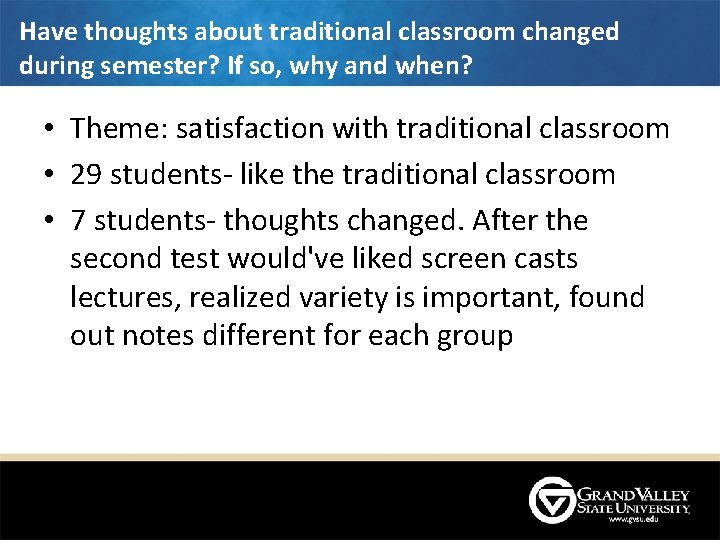
Have thoughts about traditional classroom changed during semester? If so, why and when? • Theme: satisfaction with traditional classroom • 29 students- like the traditional classroom • 7 students- thoughts changed. After the second test would've liked screen casts lectures, realized variety is important, found out notes different for each group
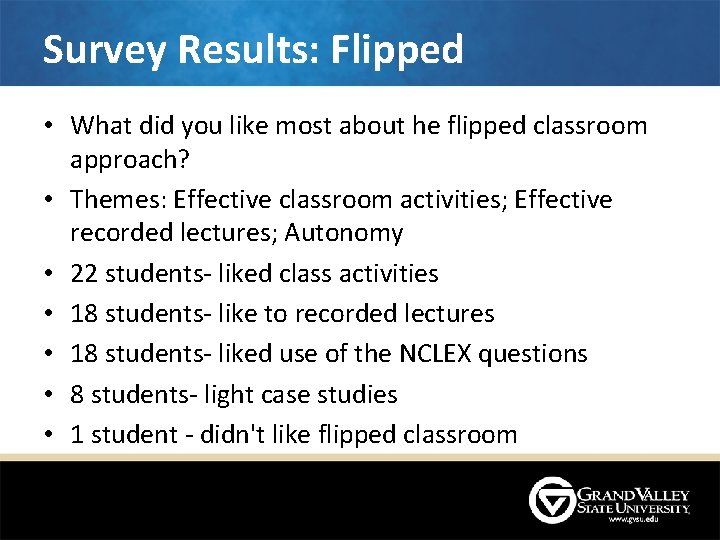
Survey Results: Flipped • What did you like most about he flipped classroom approach? • Themes: Effective classroom activities; Effective recorded lectures; Autonomy • 22 students- liked class activities • 18 students- like to recorded lectures • 18 students- liked use of the NCLEX questions • 8 students- light case studies • 1 student - didn't like flipped classroom
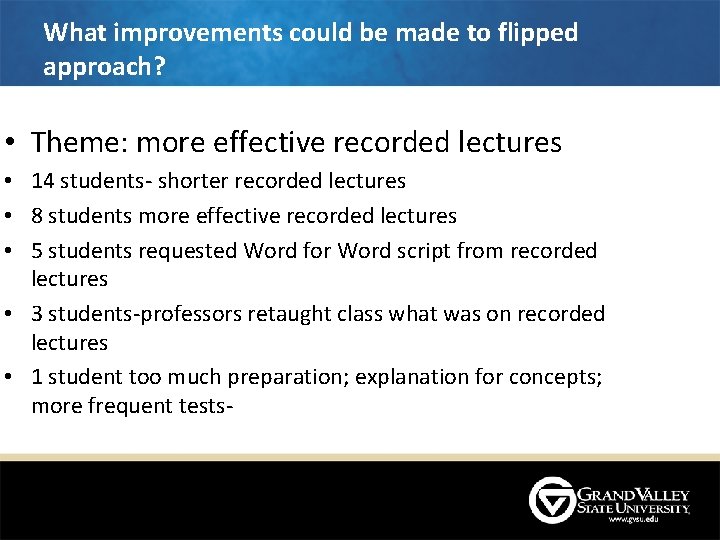
What improvements could be made to flipped approach? • Theme: more effective recorded lectures • 14 students- shorter recorded lectures • 8 students more effective recorded lectures • 5 students requested Word for Word script from recorded lectures • 3 students-professors retaught class what was on recorded lectures • 1 student too much preparation; explanation for concepts; more frequent tests-
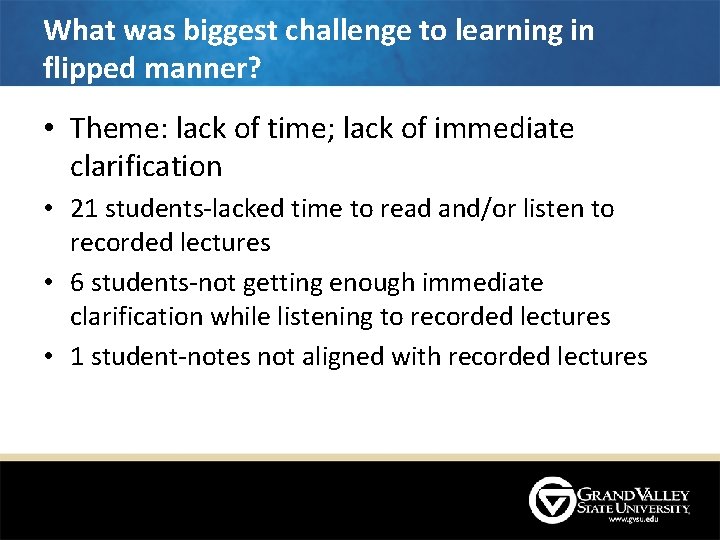
What was biggest challenge to learning in flipped manner? • Theme: lack of time; lack of immediate clarification • 21 students-lacked time to read and/or listen to recorded lectures • 6 students-not getting enough immediate clarification while listening to recorded lectures • 1 student-notes not aligned with recorded lectures
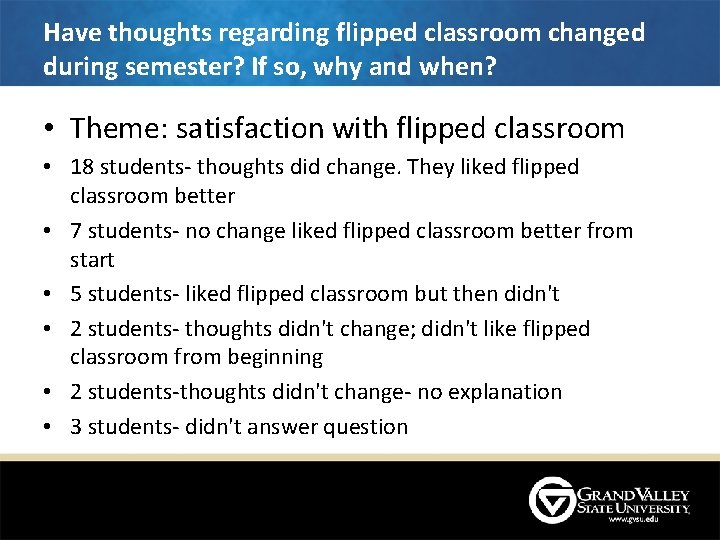
Have thoughts regarding flipped classroom changed during semester? If so, why and when? • Theme: satisfaction with flipped classroom • 18 students- thoughts did change. They liked flipped classroom better • 7 students- no change liked flipped classroom better from start • 5 students- liked flipped classroom but then didn't • 2 students- thoughts didn't change; didn't like flipped classroom from beginning • 2 students-thoughts didn't change- no explanation • 3 students- didn't answer question