Random Walks on Graphs An Overview Purnamrita Sarkar

- Slides: 50
Random Walks on Graphs: An Overview Purnamrita Sarkar, CMU Shortened and modified by Longin Jan Latecki 1
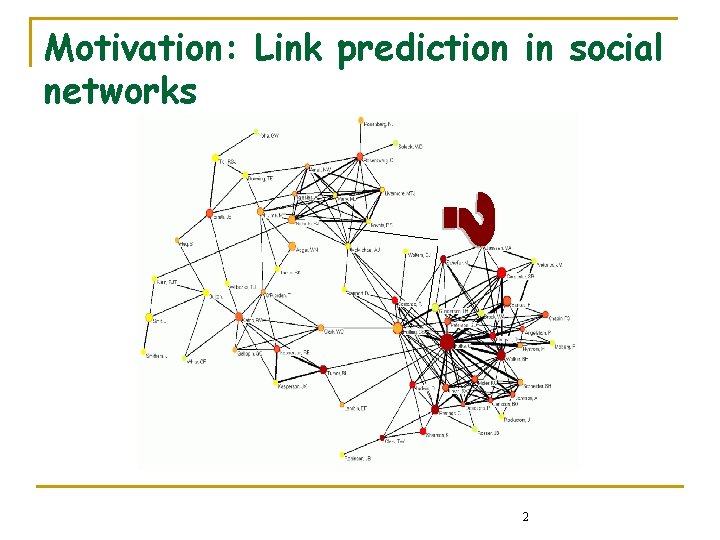
Motivation: Link prediction in social networks 2
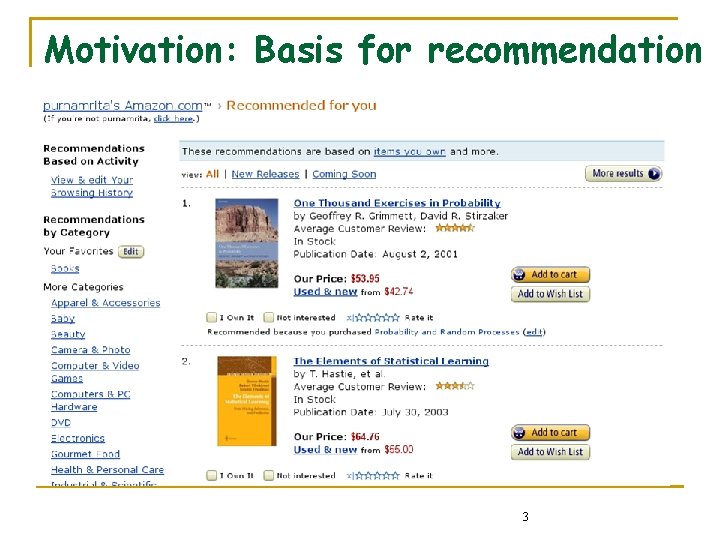
Motivation: Basis for recommendation 3
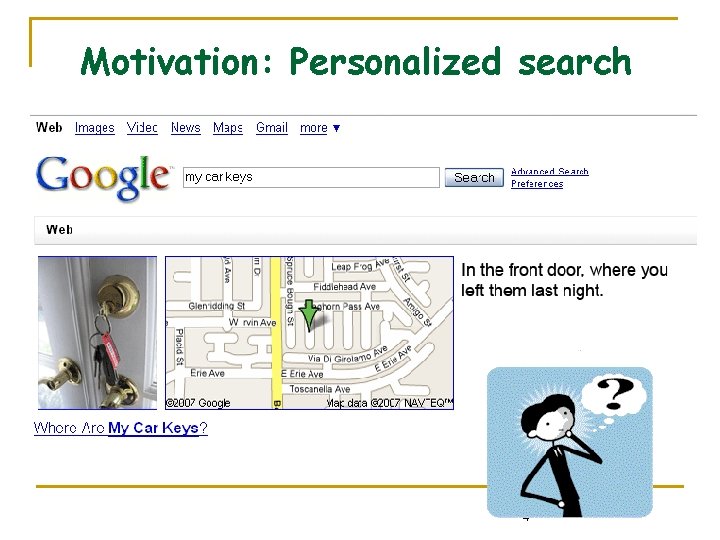
Motivation: Personalized search 4
Why graphs? n The underlying data is naturally a graph q q q Papers linked by citation Authors linked by co-authorship Bipartite graph of customers and products Web-graph Friendship networks: who knows whom 5
What are we looking for n Rank nodes for a particular query q q q Top k matches for “Random Walks” from Citeseer Who are the most likely co-authors of “Manuel Blum”. Top k book recommendations for Purna from Amazon Top k websites matching “Sound of Music” Top k friend recommendations for Purna when she joins “Facebook” 6
Talk Outline n Basic definitions q q n Random walks Stationary distributions Properties q q Perron frobenius theorem Electrical networks, hitting and commute times n n Euclidean Embedding Applications q Pagerank n n q q Power iteration Convergencce Personalized pagerank Rank stability 7
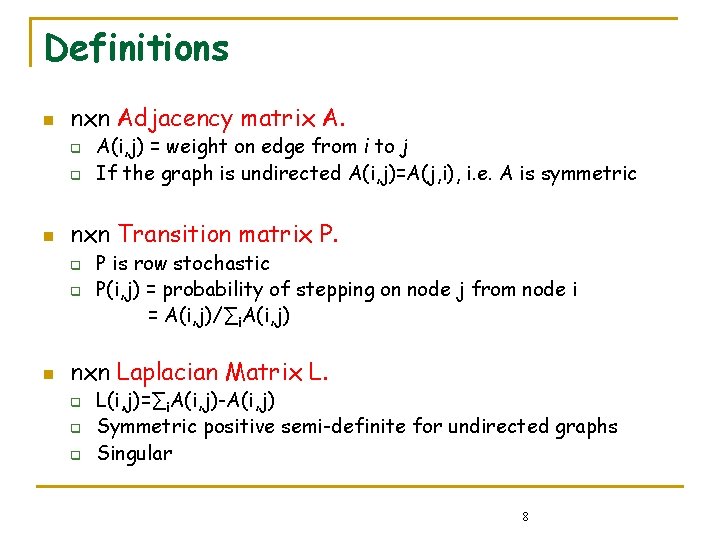
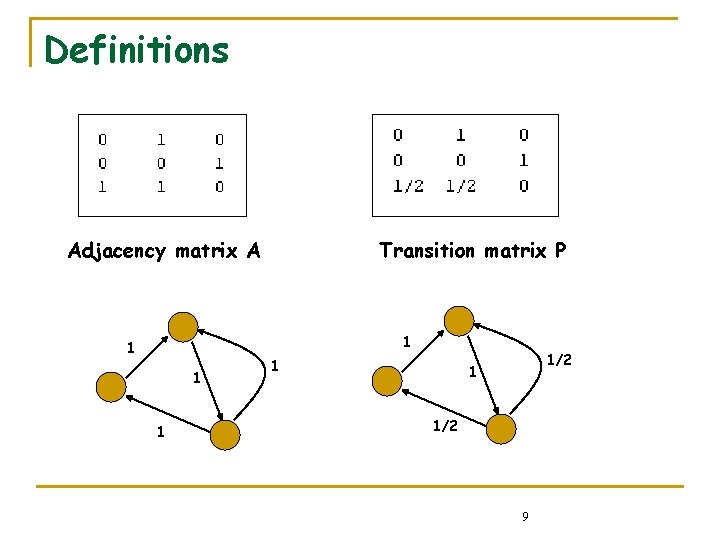
Definitions n nxn Adjacency matrix A. q q n nxn Transition matrix P. q q n A(i, j) = weight on edge from i to j If the graph is undirected A(i, j)=A(j, i), i. e. A is symmetric P is row stochastic P(i, j) = probability of stepping on node j from node i = A(i, j)/∑i. A(i, j) nxn Laplacian Matrix L. q q q L(i, j)=∑i. A(i, j)-A(i, j) Symmetric positive semi-definite for undirected graphs Singular 8
Definitions Adjacency matrix A Transition matrix P 1 1 1/2 9
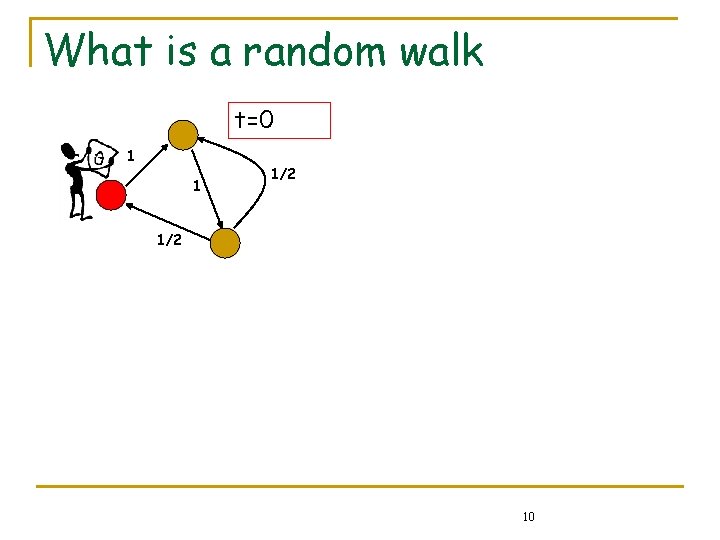
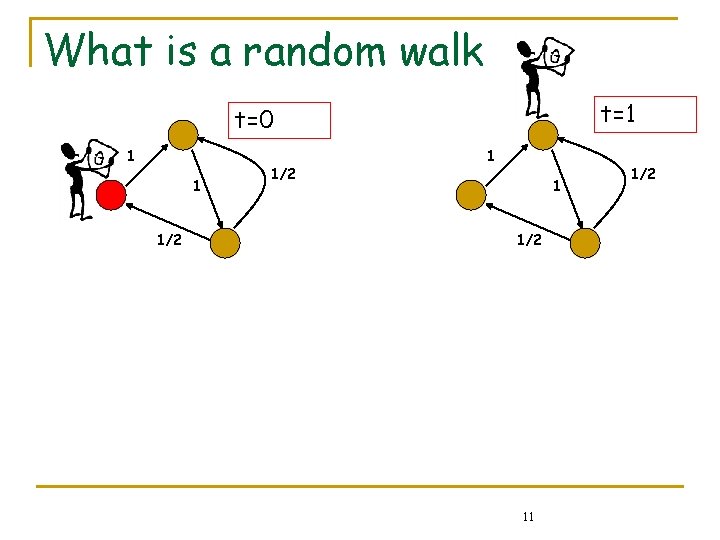
What is a random walk t=0 1 1 1/2 10
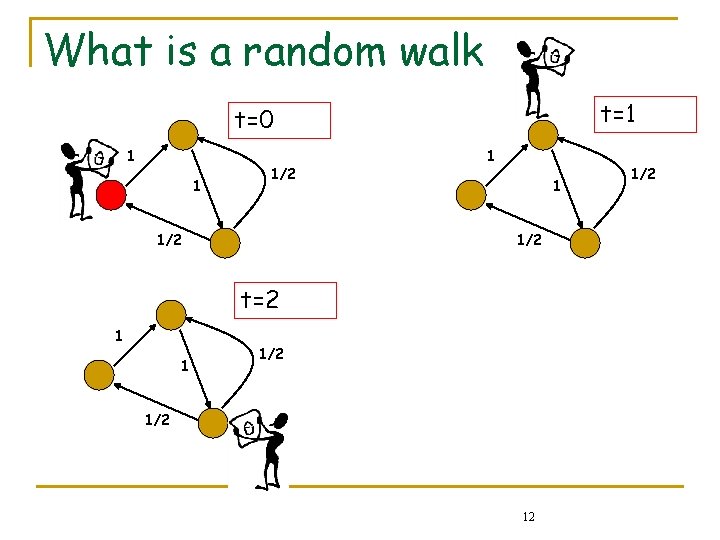
What is a random walk t=1 t=0 1 1 1/2 11 1/2
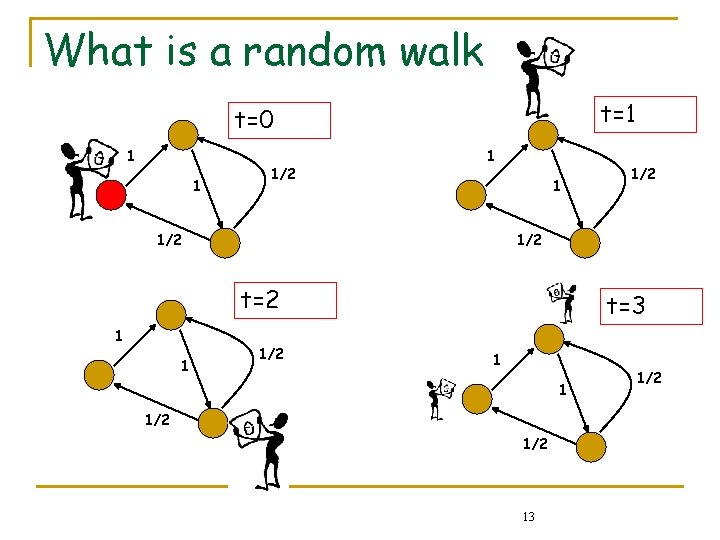
What is a random walk t=1 t=0 1 1 1/2 t=2 1 1 1/2 12 1/2
What is a random walk t=1 t=0 1 1 1/2 1/2 t=2 1 1 1/2 t=3 1 1 1/2 13 1/2
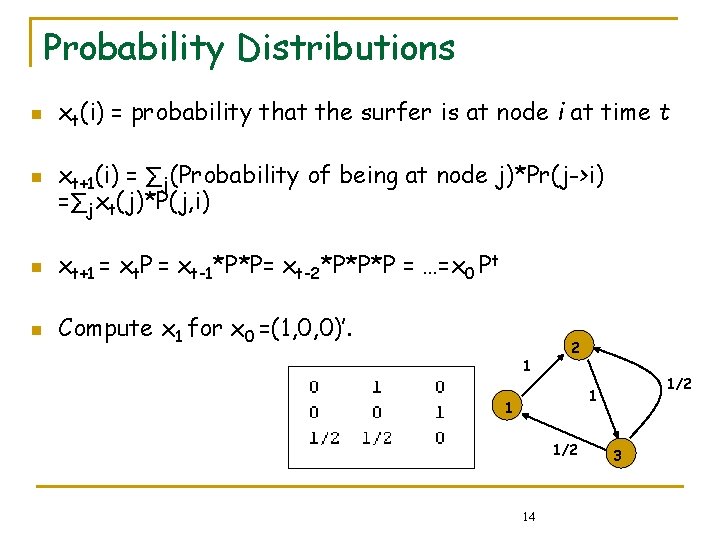
Probability Distributions n n xt(i) = probability that the surfer is at node i at time t xt+1(i) = ∑j(Probability of being at node j)*Pr(j->i) =∑jxt(j)*P(j, i) n xt+1 = xt. P = xt-1*P*P= xt-2*P*P*P = …=x 0 Pt n Compute x 1 for x 0 =(1, 0, 0)’. 1 2 1/2 1 1 1/2 14 3
Stationary Distribution n What happens when the surfer keeps walking for a long time? n When the surfer keeps walking for a long time n When the distribution does not change anymore q n i. e. x. T+1 = x. T For “well-behaved” graphs this does not depend on the start distribution!! 15
What is a stationary distribution? Intuitively and Mathematically 16
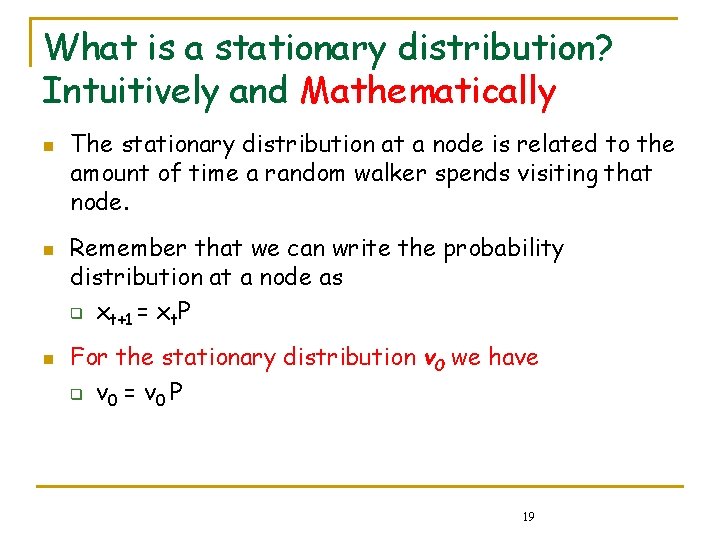
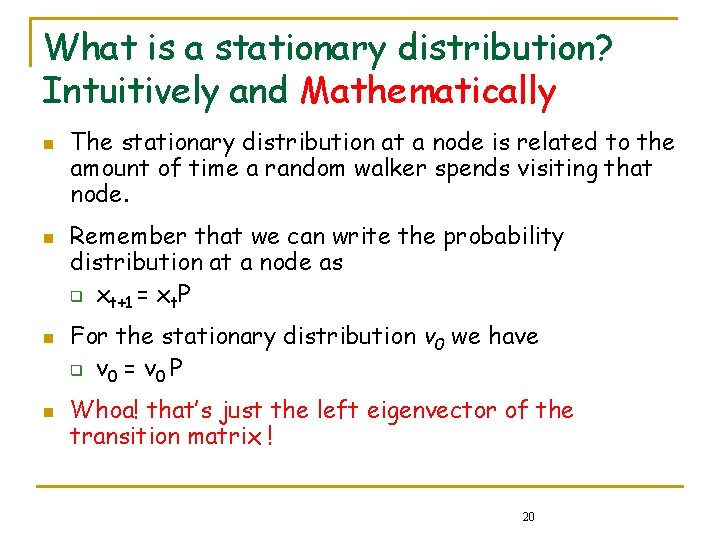
What is a stationary distribution? Intuitively and Mathematically n The stationary distribution at a node is related to the amount of time a random walker spends visiting that node. 17
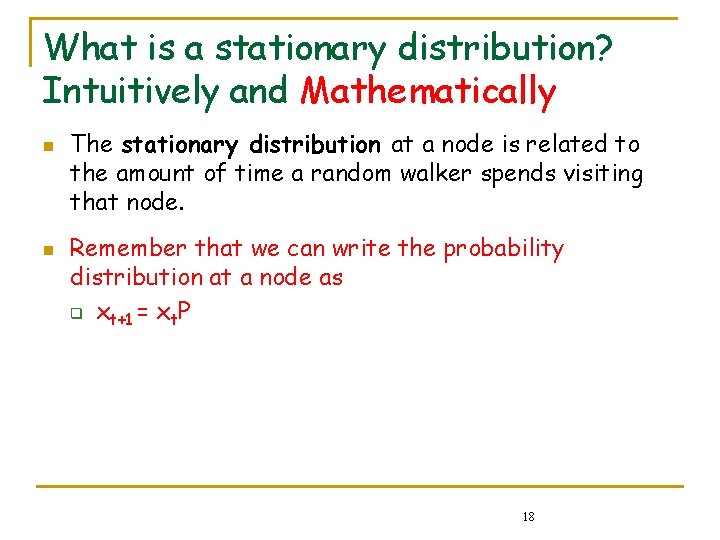
What is a stationary distribution? Intuitively and Mathematically n n The stationary distribution at a node is related to the amount of time a random walker spends visiting that node. Remember that we can write the probability distribution at a node as q xt+1 = xt. P 18
What is a stationary distribution? Intuitively and Mathematically n n n The stationary distribution at a node is related to the amount of time a random walker spends visiting that node. Remember that we can write the probability distribution at a node as q xt+1 = xt. P For the stationary distribution v 0 we have q v 0 = v 0 P 19
What is a stationary distribution? Intuitively and Mathematically n n The stationary distribution at a node is related to the amount of time a random walker spends visiting that node. Remember that we can write the probability distribution at a node as q xt+1 = xt. P For the stationary distribution v 0 we have q v 0 = v 0 P Whoa! that’s just the left eigenvector of the transition matrix ! 20
Talk Outline n Basic definitions q q n Random walks Stationary distributions Properties q q Perron frobenius theorem Electrical networks, hitting and commute times n n Euclidean Embedding Applications q Pagerank n n q q Power iteration Convergencce Personalized pagerank Rank stability 21
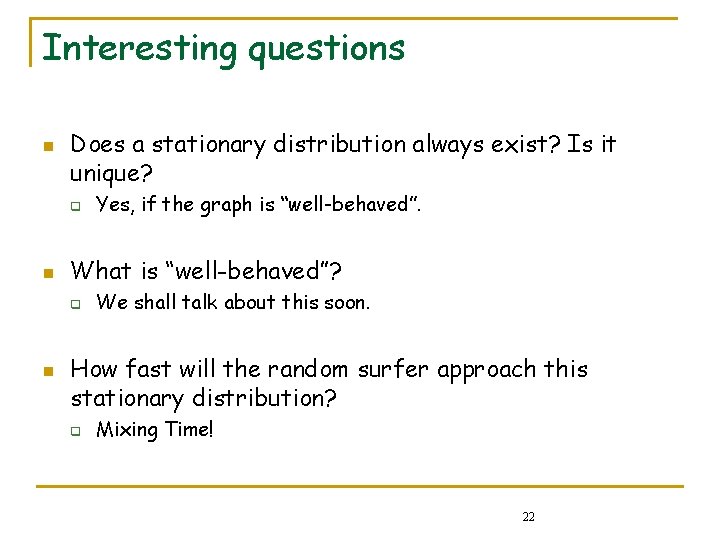
Interesting questions n Does a stationary distribution always exist? Is it unique? q n What is “well-behaved”? q n Yes, if the graph is “well-behaved”. We shall talk about this soon. How fast will the random surfer approach this stationary distribution? q Mixing Time! 22
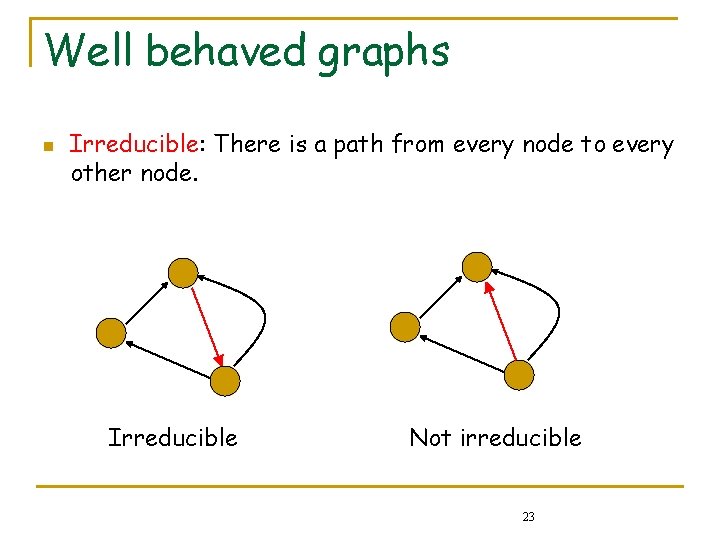
Well behaved graphs n Irreducible: There is a path from every node to every other node. Irreducible Not irreducible 23
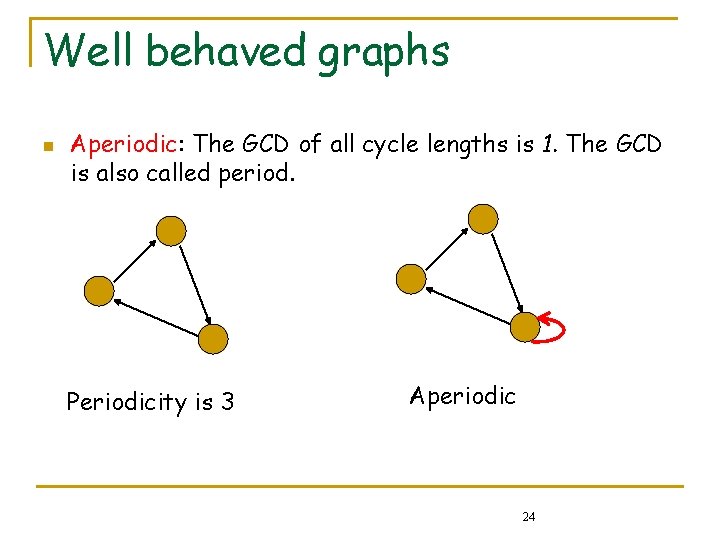
Well behaved graphs n Aperiodic: The GCD of all cycle lengths is 1. The GCD is also called period. Periodicity is 3 Aperiodic 24
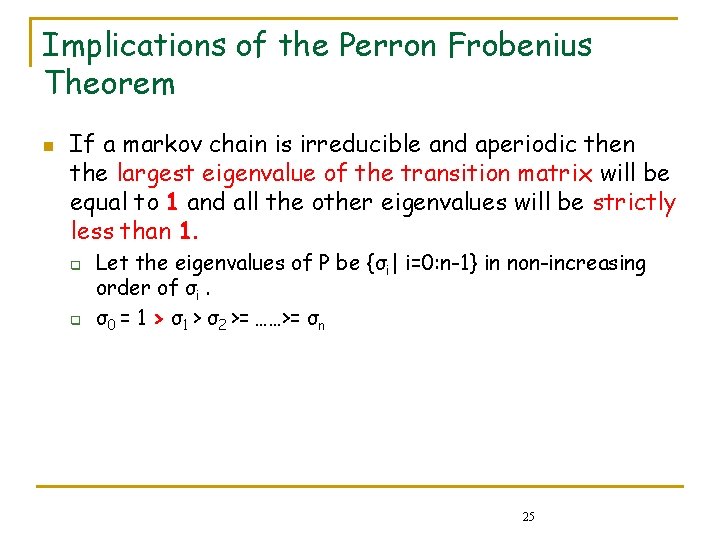
Implications of the Perron Frobenius Theorem n If a markov chain is irreducible and aperiodic then the largest eigenvalue of the transition matrix will be equal to 1 and all the other eigenvalues will be strictly less than 1. q q Let the eigenvalues of P be {σi| i=0: n-1} in non-increasing order of σi. σ0 = 1 > σ2 >= ……>= σn 25
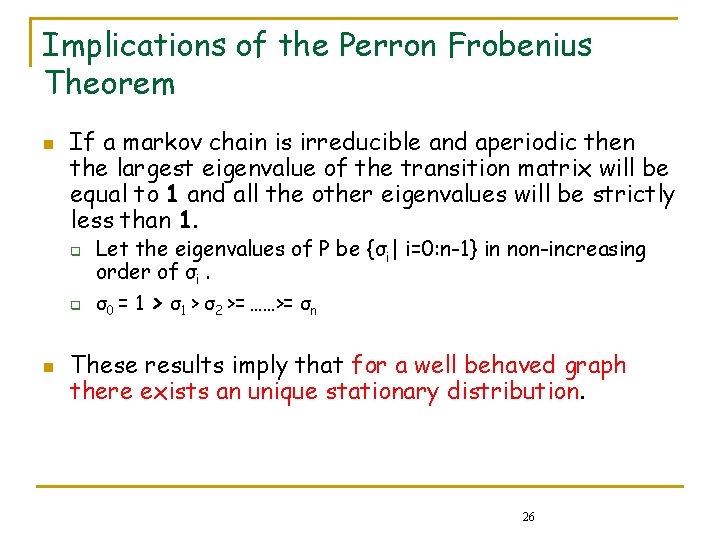
Implications of the Perron Frobenius Theorem n If a markov chain is irreducible and aperiodic then the largest eigenvalue of the transition matrix will be equal to 1 and all the other eigenvalues will be strictly less than 1. q q n Let the eigenvalues of P be {σi| i=0: n-1} in non-increasing order of σi. σ0 = 1 > σ2 >= ……>= σn These results imply that for a well behaved graph there exists an unique stationary distribution. 26
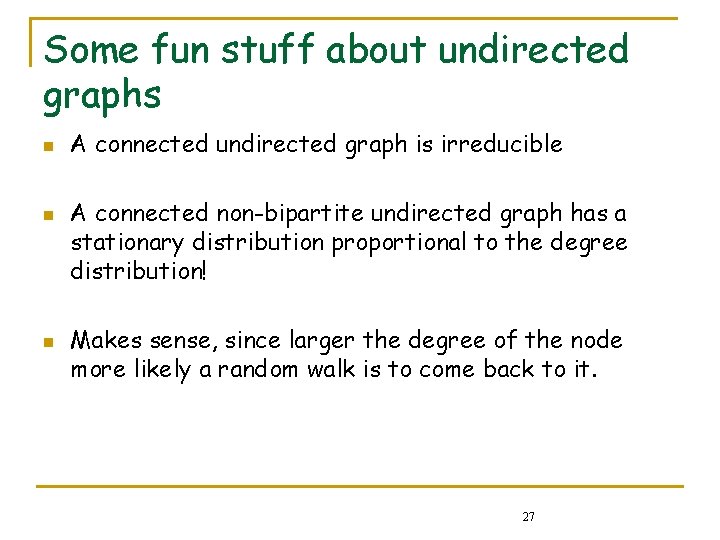
Some fun stuff about undirected graphs n n n A connected undirected graph is irreducible A connected non-bipartite undirected graph has a stationary distribution proportional to the degree distribution! Makes sense, since larger the degree of the node more likely a random walk is to come back to it. 27
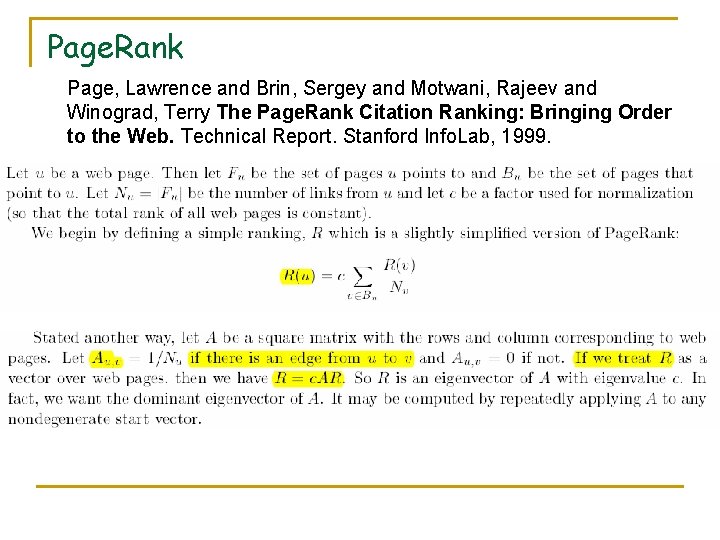
Page. Rank Page, Lawrence and Brin, Sergey and Motwani, Rajeev and Winograd, Terry The Page. Rank Citation Ranking: Bringing Order to the Web. Technical Report. Stanford Info. Lab, 1999.
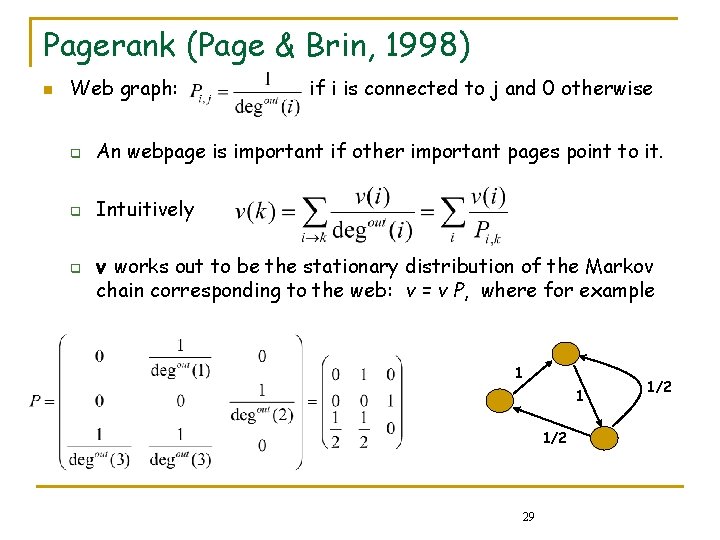
Pagerank (Page & Brin, 1998) n Web graph: if i is connected to j and 0 otherwise q An webpage is important if other important pages point to it. q Intuitively q v works out to be the stationary distribution of the Markov chain corresponding to the web: v = v P, where for example 1 1 1/2 29 1/2
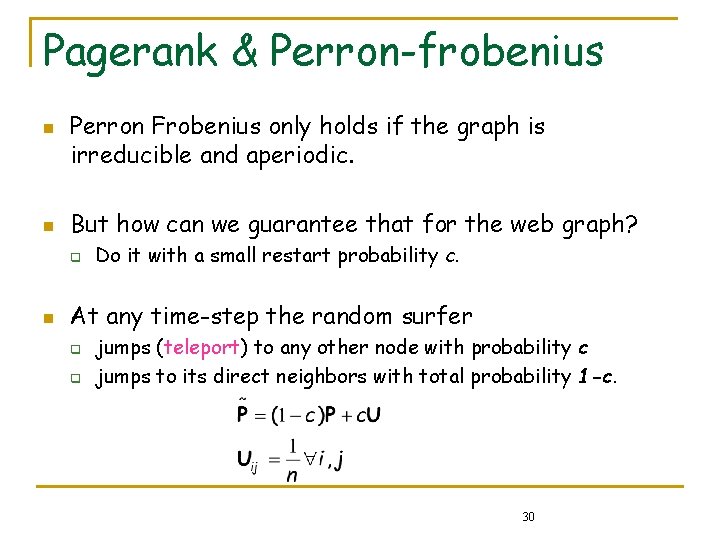
Pagerank & Perron-frobenius n n Perron Frobenius only holds if the graph is irreducible and aperiodic. But how can we guarantee that for the web graph? q n Do it with a small restart probability c. At any time-step the random surfer q q jumps (teleport) to any other node with probability c jumps to its direct neighbors with total probability 1 -c. 30
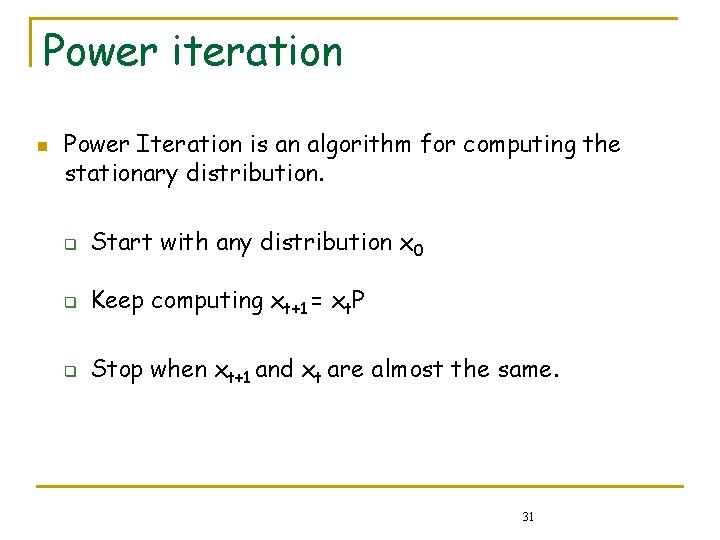
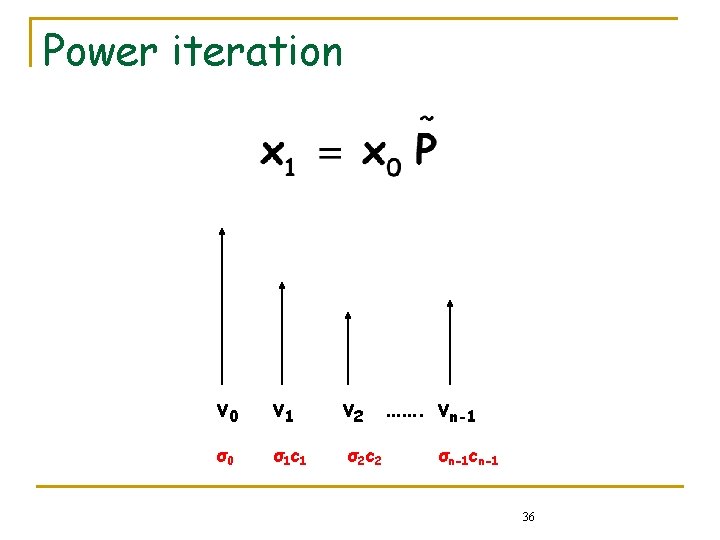
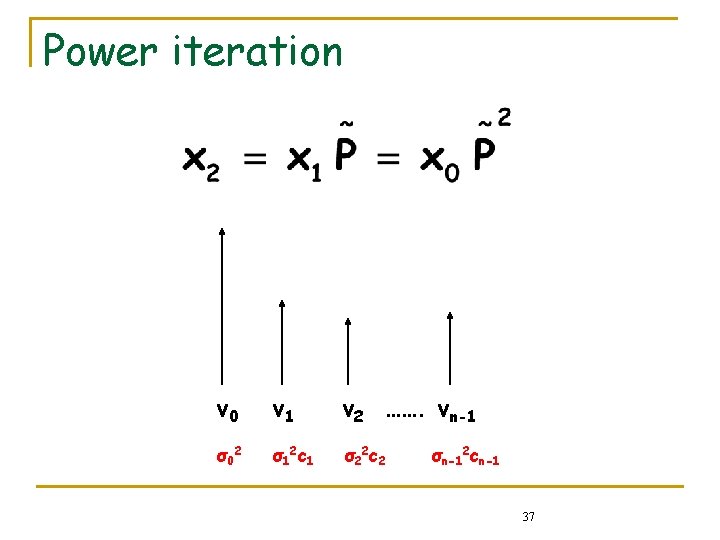
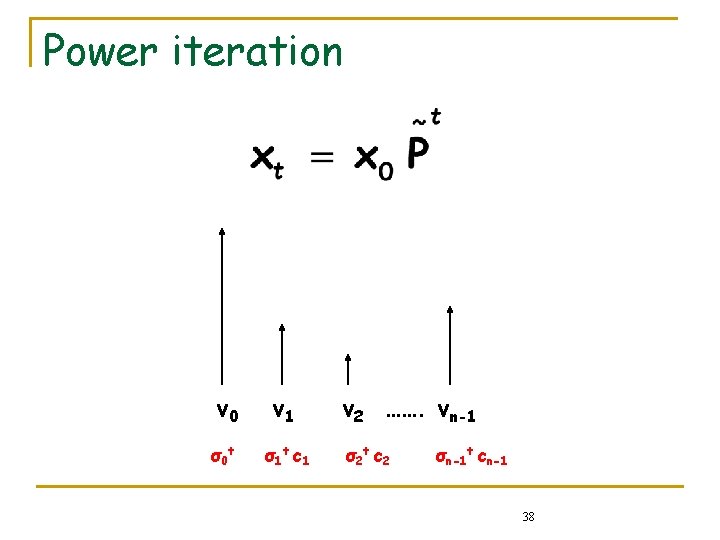
Power iteration n Power Iteration is an algorithm for computing the stationary distribution. q Start with any distribution x 0 q Keep computing xt+1 = xt. P q Stop when xt+1 and xt are almost the same. 31
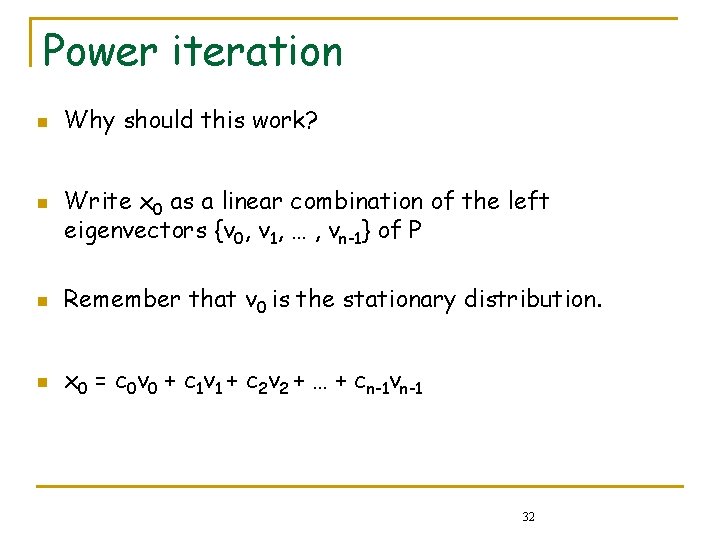
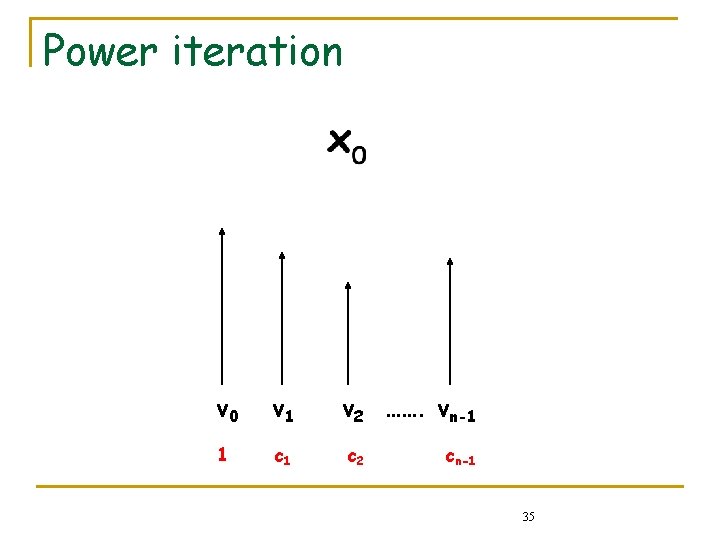
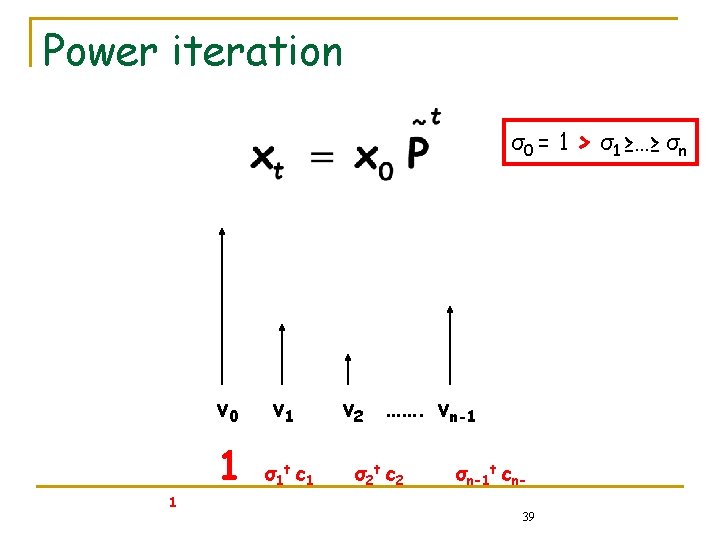
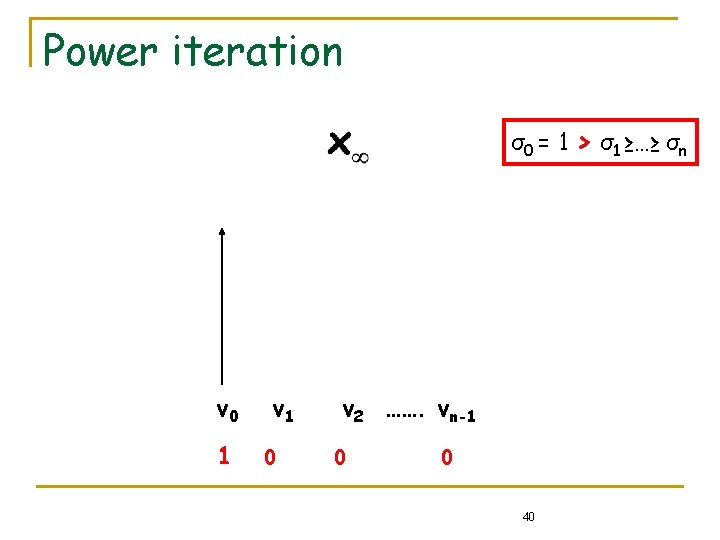
Power iteration n n Why should this work? Write x 0 as a linear combination of the left eigenvectors {v 0, v 1, … , vn-1} of P n Remember that v 0 is the stationary distribution. n x 0 = c 0 v 0 + c 1 v 1 + c 2 v 2 + … + cn-1 vn-1 32
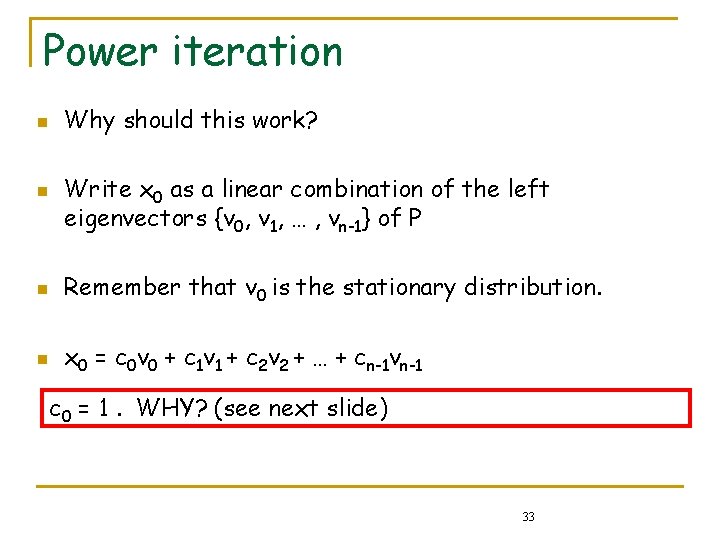
Power iteration n n Why should this work? Write x 0 as a linear combination of the left eigenvectors {v 0, v 1, … , vn-1} of P n Remember that v 0 is the stationary distribution. n x 0 = c 0 v 0 + c 1 v 1 + c 2 v 2 + … + cn-1 vn-1 c 0 = 1. WHY? (see next slide) 33
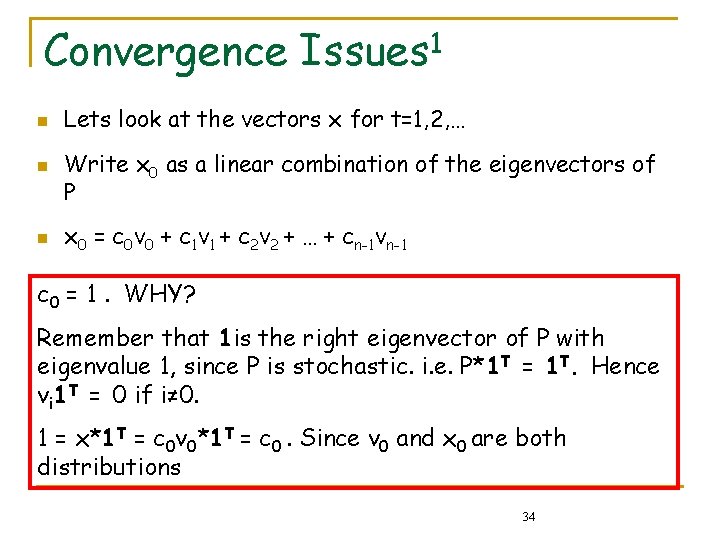
Convergence Issues 1 n n n Lets look at the vectors x for t=1, 2, … Write x 0 as a linear combination of the eigenvectors of P x 0 = c 0 v 0 + c 1 v 1 + c 2 v 2 + … + cn-1 vn-1 c 0 = 1. WHY? Remember that 1 is the right eigenvector of P with eigenvalue 1, since P is stochastic. i. e. P*1 T = 1 T. Hence vi 1 T = 0 if i≠ 0. 1 = x*1 T = c 0 v 0*1 T = c 0. Since v 0 and x 0 are both distributions 34
Power iteration v 0 v 1 v 2 ……. vn-1 1 c 2 cn-1 35
Power iteration v 0 v 1 σ0 σ 1 c 1 v 2 ……. vn-1 σ 2 c 2 σn-1 cn-1 36
Power iteration v 0 v 1 v 2 ……. vn-1 σ 02 σ 12 c 1 σ 22 c 2 σn-12 cn-1 37
Power iteration v 0 v 1 σ 0 t σ 1 t c 1 v 2 ……. vn-1 σ 2 t c 2 σn-1 t cn-1 38
Power iteration σ0 = 1 > σ1 ≥…≥ σn v 0 1 1 v 1 σ1 t c 1 v 2 ……. vn-1 σ2 t c 2 σn-1 t cn 39
Power iteration σ0 = 1 > σ1 ≥…≥ σn v 0 1 v 1 0 v 2 ……. vn-1 0 0 40
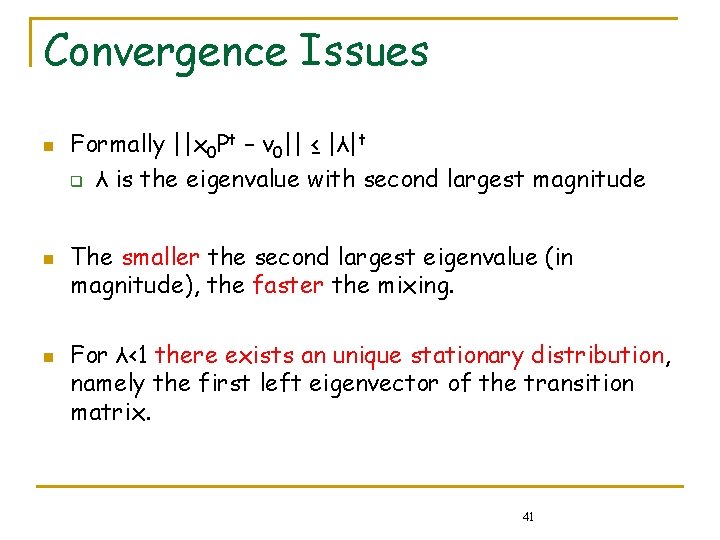
Convergence Issues n n n Formally ||x 0 Pt – v 0|| ≤ |λ|t q λ is the eigenvalue with second largest magnitude The smaller the second largest eigenvalue (in magnitude), the faster the mixing. For λ<1 there exists an unique stationary distribution, namely the first left eigenvector of the transition matrix. 41
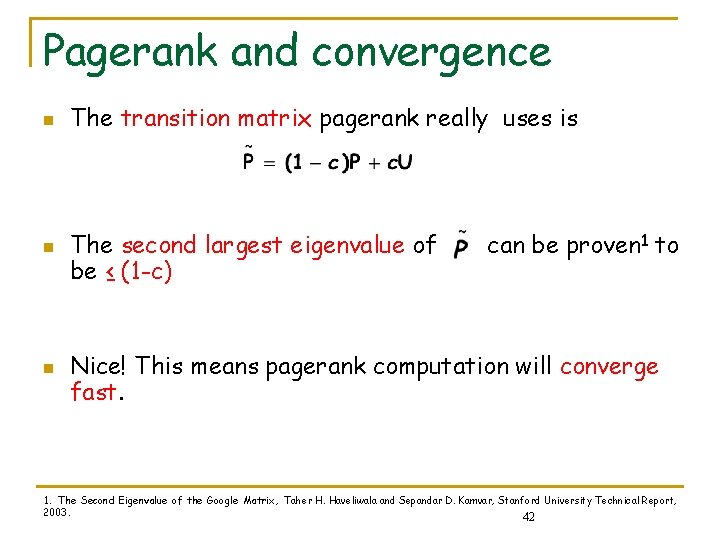
Pagerank and convergence n n n The transition matrix pagerank really uses is The second largest eigenvalue of be ≤ (1 -c) can be proven 1 to Nice! This means pagerank computation will converge fast. 1. The Second Eigenvalue of the Google Matrix, Taher H. Haveliwala and Sepandar D. Kamvar, Stanford University Technical Report, 2003. 42
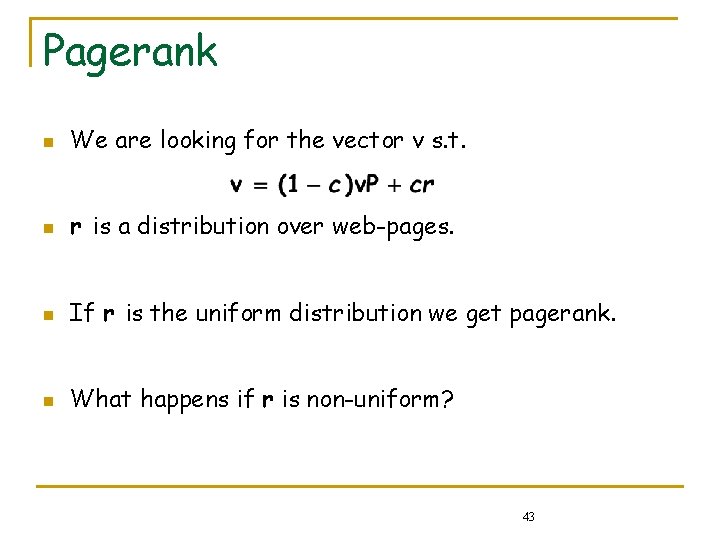
Pagerank n We are looking for the vector v s. t. n r is a distribution over web-pages. n If r is the uniform distribution we get pagerank. n What happens if r is non-uniform? 43
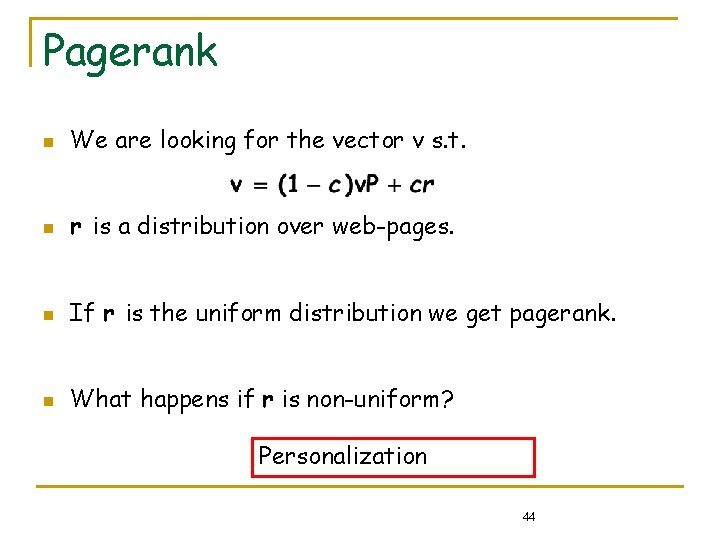
Pagerank n We are looking for the vector v s. t. n r is a distribution over web-pages. n If r is the uniform distribution we get pagerank. n What happens if r is non-uniform? Personalization 44
Rank stability n How does the ranking change when the link structure changes? n The web-graph is changing continuously. n How does that affect page-rank? 45
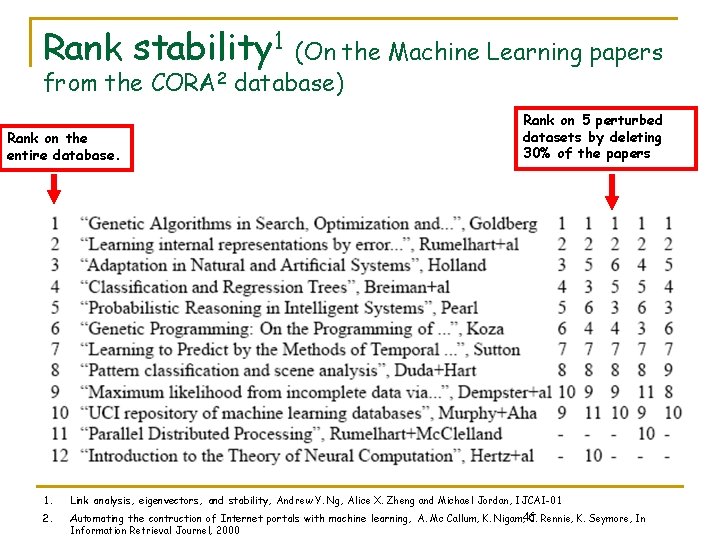
Rank stability 1 (On the Machine Learning papers from the CORA 2 database) Rank on the entire database. Rank on 5 perturbed datasets by deleting 30% of the papers 1. Link analysis, eigenvectors, and stability, Andrew Y. Ng, Alice X. Zheng and Michael Jordan, IJCAI-01 2. Automating the contruction of Internet portals with machine learning, A. Mc Callum, K. Nigam, 46 J. Rennie, K. Seymore, In Information Retrieval Journel, 2000
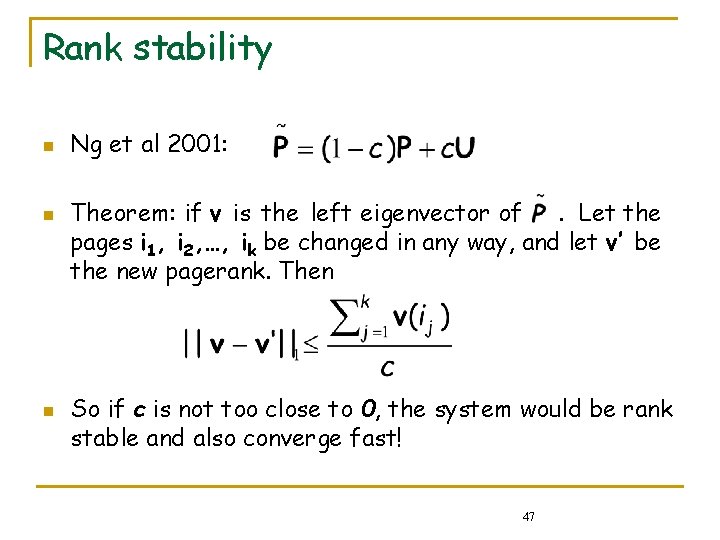
Rank stability n n n Ng et al 2001: Theorem: if v is the left eigenvector of. Let the pages i 1, i 2, …, ik be changed in any way, and let v’ be the new pagerank. Then So if c is not too close to 0, the system would be rank stable and also converge fast! 47
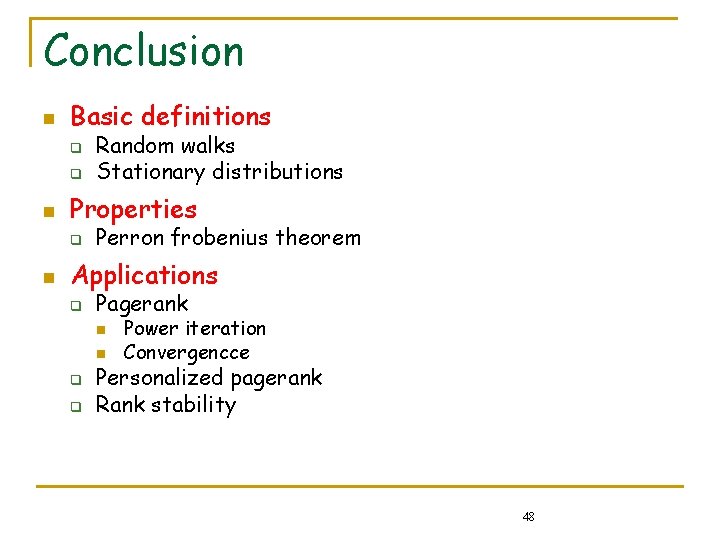
Conclusion n Basic definitions q q n Properties q n Random walks Stationary distributions Perron frobenius theorem Applications q Pagerank n n q q Power iteration Convergencce Personalized pagerank Rank stability 48
Thanks! Please send email to Purna at psarkar@cs. cmu. edu with questions, suggestions, corrections 49
Acknowledgements n Andrew Moore n Gary Miller q q n Fan Chung Graham’s course on q q n n n Check out Gary’s Fall 2007 class on “Spectral Graph Theory, Scientific Computing, and Biomedical Applications” http: //www. cs. cmu. edu/afs/cs/user/glmiller/public/Scientific. Computing/F-07/index. html Random Walks on Directed and Undirected Graphs http: //www. math. ucsd. edu/~phorn/math 261/ Random Walks on Graphs: A Survey, Laszlo Lov'asz Reversible Markov Chains and Random Walks on Graphs, D Aldous, J Fill Random Walks and Electric Networks, Doyle & Snell 50