
Principles Practice of Management Dr ANIRBAN Sarkar ASSISTANT
Principles & Practice of Management Dr. ANIRBAN Sarkar ASSISTANT PROFESSOR DEPT. OF COMMERCE & MANAGEMENT, WBSU
Contents: Management Planning Decision making Organizing Motivation Leadership Communication control
Management Defined Management Process Management Challenge Scope of management Management an art or science or is it both? Management as a profession A framework for the study The emergence of management thought Approaches to management
Management Organization and its Environment Ethics in workplace Social responsibility
Management Defined Management is the process of planning, organizing, leading, & controlling the resources of an organization in the efficient & effective pursuit of specified organizational goals. Good management combines both efficiency & effectiveness, as demonstrated by Japan’s determination to overcome its image as a producer of junk products & to achieve an image that personifies high quality. (See Challenge 1).
Management Defined US- JAPAN CONNECTION: HOW MANAGERS CAN PROMOTE QUALITY There was a time when Japanese goods were 5. Find out whether your problems are Well known for being shoddy. Faced with this confined to particular parts of the World-wide perception, the Japanese did not production process or stem from the over Try to improve their “image” with public all process itself. Relations & advertising, as most Western firms 6. Train workers for the job that you are Do. asking them to perform. Instead, they set out to make their product 7. Raise the quality of your first-line quality a matter of national pride. managers. The man who was instrumental in providing 8. Drive out fear. the Japanese with the tools to improve their 9. Encourage departments to work quality was an American, Dr W. Edwards closely together rather than to concentrate on Deming is a national celebrity. departmental or divisional distinctions. Deming successfully taught the Japanese 10. Do not adopt strict numeric goals, including the to follow his 14 points for promoting quality: widely popular formula of “zero defect”. 1. Plan for the long-term future, not for the next 11. Require your workers to do quality work, not just to be at month or year. their stations from 9 to 5. 2. Never be complacent concerning the quality 12. Train your employees to understand statistical methods. of your product. 13. Train your employees in new skills as the need arises. 3. Establish statistical control over your 14. Make top management responsible for implementing these principles. production processes & ask your suppliers to do so as well. 4. Deal with the fewest number of suppliersthe best ones, of course. (source: Deming, 1982) The manager is a person who plans, organizes, leads, & controls human, financial, physical, & information resources in the efficient & effective pursuit of specified organizational goals.
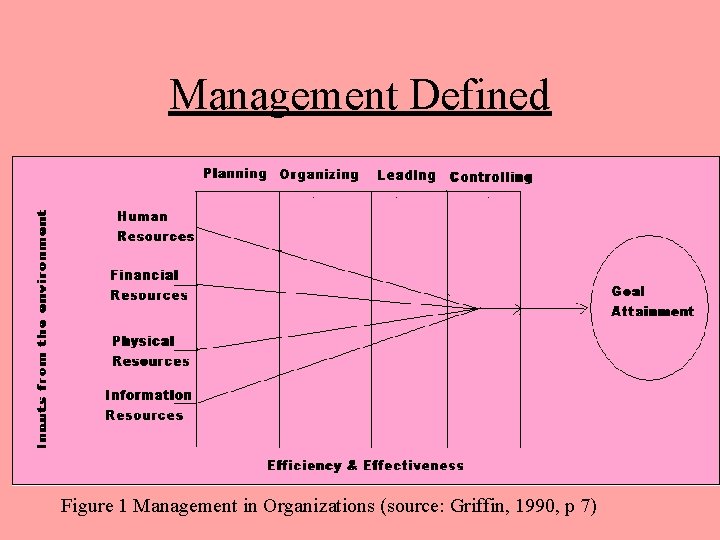
Management Defined Figure 1 Management in Organizations (source: Griffin, 1990, p 7)
Management Process The definition of management indicates a management process of four major functions – planning, organizing, leading, & controlling - which will be investigated in detail later in the book but warrants a brief description now. These functions are generally best understood in the order presented here, suggesting that the manager first plans, then organizes, then leads, & finally controls. However, in reality, managers seldom have the luxury of addressing these functions in such a simplified step-by-step sequence. At any one time, the typical manager is engaged in a number of different activities at the same time. Further more, a situation that occurs in operations can result in changes to the plan, organization, leadership, & to the control technique – or to any combination of these. This interrelatedness is demonstrated in Figure 2. which shows theoretical flow of functions with solid lines & the day-to-day activities with dotted lines. Planning: Planning is defined as the management function of developing a futuristic frame of reference from which to identify opportunities & threats that lie in the future & to take action now to exploit the opportunities & to defend against the threats. Organizing: Organizing is defined as the management function of assigning duties, grouping tasks, establishing authority, & allocating resources required to carry out a specific plan.
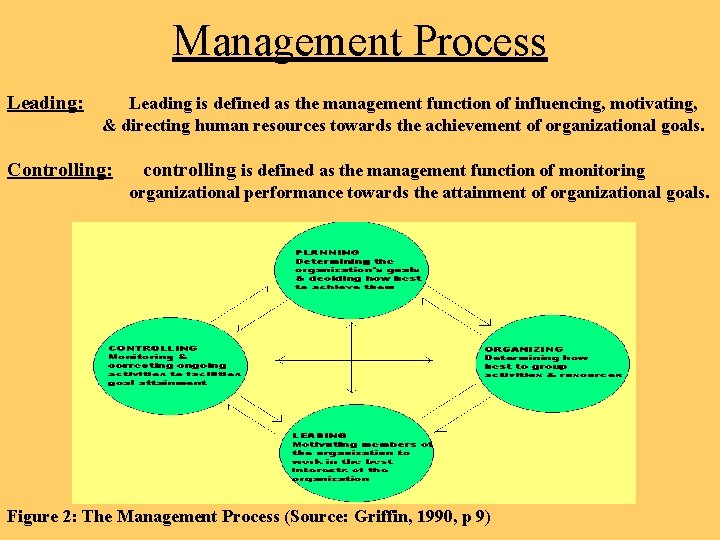
Management Process Leading: Leading is defined as the management function of influencing, motivating, & directing human resources towards the achievement of organizational goals. Controlling: controlling is defined as the management function of monitoring organizational performance towards the attainment of organizational goals. Figure 2: The Management Process (Source: Griffin, 1990, p 9)
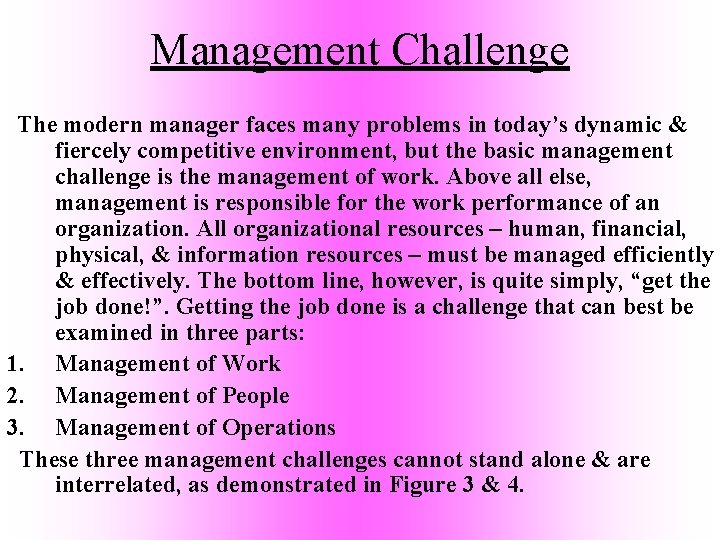
Management Challenge The modern manager faces many problems in today’s dynamic & fiercely competitive environment, but the basic management challenge is the management of work. Above all else, management is responsible for the work performance of an organization. All organizational resources – human, financial, physical, & information resources – must be managed efficiently & effectively. The bottom line, however, is quite simply, “get the job done!”. Getting the job done is a challenge that can best be examined in three parts: 1. Management of Work 2. Management of People 3. Management of Operations These three management challenges cannot stand alone & are interrelated, as demonstrated in Figure 3 & 4.
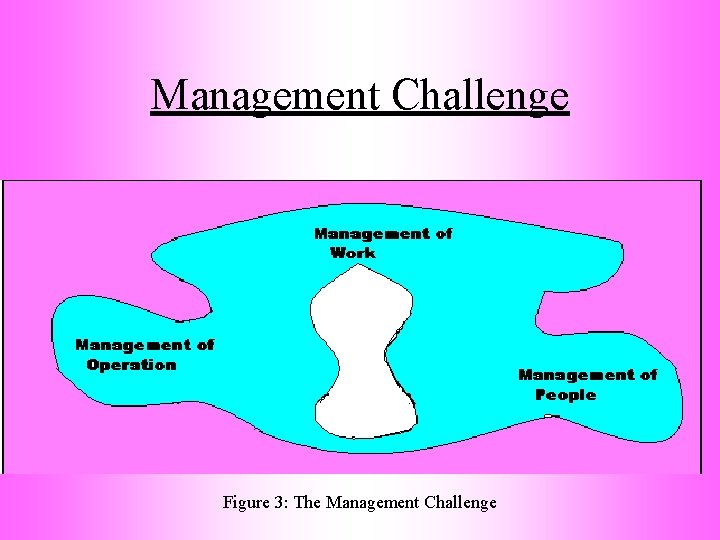
Management Challenge Figure 3: The Management Challenge
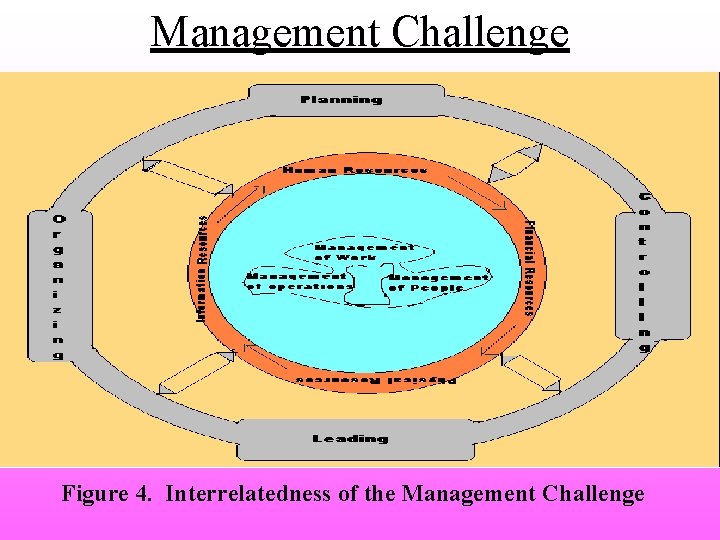
Management Challenge Figure 4. Interrelatedness of the Management Challenge
Scope of Management The scope of management may become more clear after a review of managerial demands, constraints, & choices, DEMANDS Overall, meeting minimum criteria of performance Doing certain kinds of work. Such work is determined by: The extent to which personal involvement is required in the unit’s work Who must be contacted & the difficulty of the work relationship Contract’s power to enforce their expectations Bureaucratic procedures that cannot be ignored or delegated Meetings that must be attended CONSTRAINTS Resources limitations Legal & trade union constraints Technological limitations Physical location Organizational constraints, especially extent to which the work of the manager’s unit is defined Attitudes of other people to: Changes in systems, procedures, organization, pay, & conditions Changes in the goods or service produced Work outside the unit
Scope of Management CHOICES In how the work is done In what work is done Choices within a defined area: To emphasize certain aspects of the job To select some tasks & to ignore or delegate others Choices in boundary management Choices to change the area of work: To change the unit’s domain To develop a personal domain: To become an expert To share work, especially with colleagues To take part in organizational & public activities
Management an Art or Science or is it both? “It… is an art – even a creative art” (Getty 1972). If an art is defined as skill acquired by experience, study, & observation, then it is possible to see the successful manager practising that art in the day-to-day job of managing. Outstanding managers take every opportunity to learn from experience, study, & observation. Therefore, good managers are probably good learners. Good managers may even make mistakes, but they will learn from those mistakes as they polish their managing art. Good managers get actively involved in the activities of the organization, study critical situations, formulate their own theories to explain events, & apply those theories in their decision making. Good managers “arrive at the capacity to manage well through a combination of experience, practice, judgment, & intuition. Management As A Science is a systematized body of knowledge covering general truths or the operation of general laws. People study the science of physics, mathematics, & economics to help them make better decisions & to live better lives. People can also study the science of management to make themselves better managers. Management has the basic characteristics of other sciences &, as such, can be studied & applied with a high degree of success. Management science is a body of knowledge that has been gathered over the years, borrowing heavily on scientific inquiry into the fields of economics, sociology, psychology, anthropology, mathematics, engineering, & other scientific fields, as indicated in figure. 5.
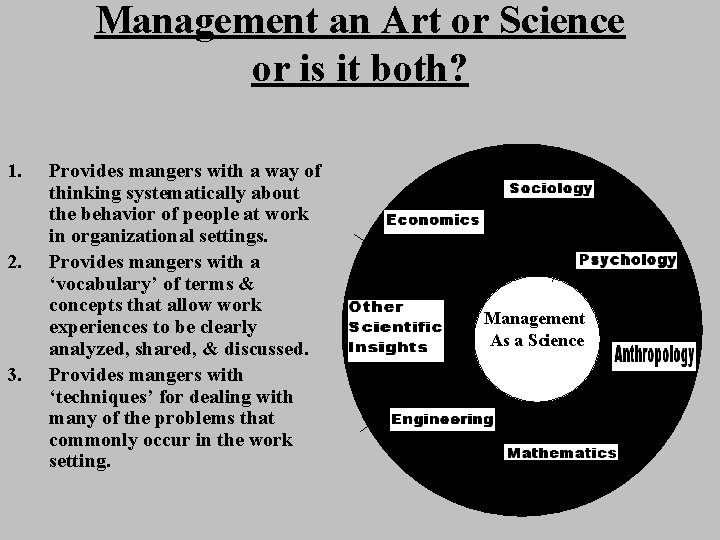
Management an Art or Science or is it both? 1. 2. 3. Provides mangers with a way of thinking systematically about the behavior of people at work in organizational settings. Provides mangers with a ‘vocabulary’ of terms & concepts that allow work experiences to be clearly analyzed, shared, & discussed. Provides mangers with ‘techniques’ for dealing with many of the problems that commonly occur in the work setting. Management Engineering As a Science
Management As A Profession Is management a “profession? ” Are managers “professionals? ” For some time, society has recognized that the practice of law & medicine, for instance, is a professional endeavour accomplished by professional people. Edger Schein argues that, although management does share some characteristics of law & medicine, it usually fails to meet the following criteria: (1) There are no formal education requirements for entry into management; (2) There is no system of accreditation or licensing for managers; (3) Managers do not have specific clients. They serve a broad group of organizational “stakeholders”, (4) There is no clear code of managerial ethics that is universally enforced by peer review; & (5) There is no common body of knowledge that is required for understanding someone to be a manager (Schein, 1988). Nevertheless, management is moving ever closer to that state of professionalism. Perhaps, management will never meet all the exacting criteria for a profession, but such authors as Peter Drucker believe that the management occupation is developing a professional character: … management pertains to every single social institution. In the last hundred years every major social function – caring for the sick, education, & defence, for example – have become lodged in a large & managed organization… Management has become the pervasive, the universal organ of modern society (Drucker, 1987).
A Framework from the Study The further evolution of management thought might best be approached through the framework shown in Figure 6. In the beginning there were two classical schools of management thought: (1) the scientific management school; & (2) the organizational school. Later came the behavioral school & the quantitative school. There four schools of management thought were eventually merged into the integration school which led to the contemporary school of management thought.
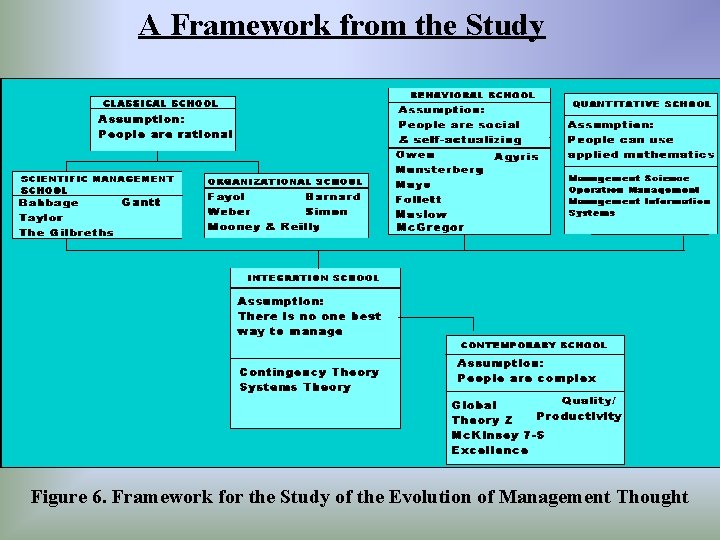
A Framework from the Study Figure 6. Framework for the Study of the Evolution of Management Thought
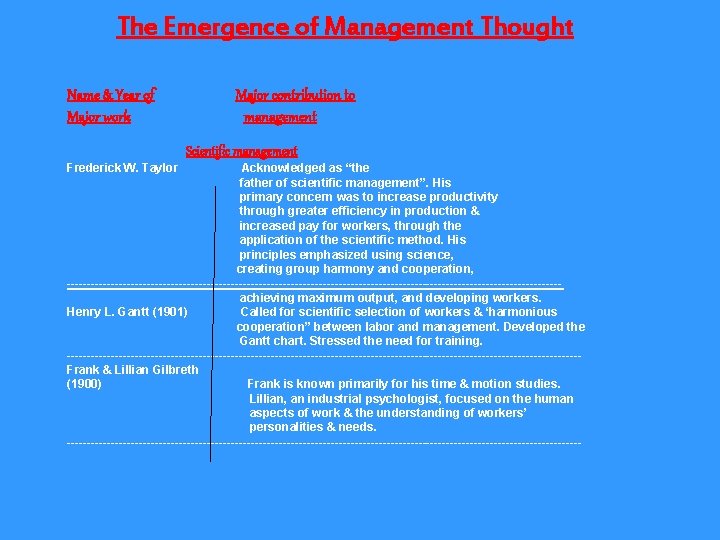
The Emergence of Management Thought Name & Year of Major work Major contribution to management Scientific management Frederick W. Taylor Acknowledged as “the father of scientific management”. His primary concern was to increase productivity through greater efficiency in production & increased pay for workers, through the application of the scientific method. His principles emphasized using science, creating group harmony and cooperation, --------------------------------------------------------------achieving maximum output, and developing workers. Henry L. Gantt (1901) Called for scientific selection of workers & ‘harmonious cooperation” between labor and management. Developed the Gantt chart. Stressed the need for training. ----------------------------------------------------------------Frank & Lillian Gilbreth (1900) Frank is known primarily for his time & motion studies. Lillian, an industrial psychologist, focused on the human aspects of work & the understanding of workers’ personalities & needs. -----------------------------------------------------------------
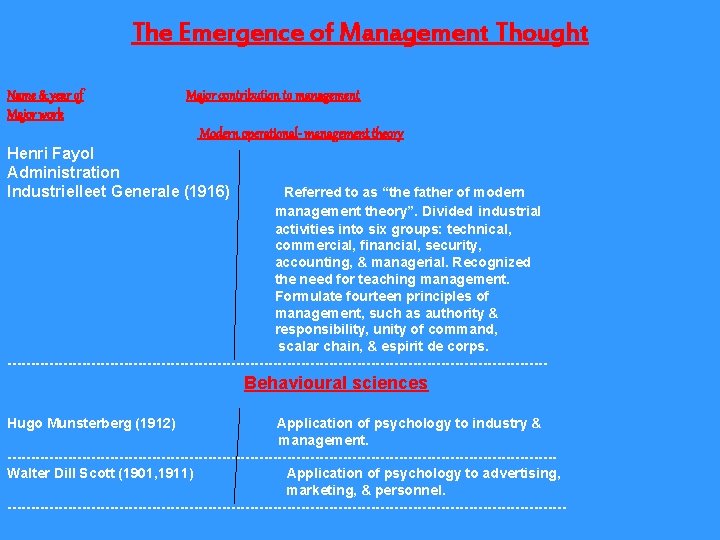
The Emergence of Management Thought Name & year of Major work Major contribution to management Modern operational- management theory Henri Fayol Administration Industrielleet Generale (1916) Referred to as “the father of modern management theory”. Divided industrial activities into six groups: technical, commercial, financial, security, accounting, & managerial. Recognized the need for teaching management. Formulate fourteen principles of management, such as authority & responsibility, unity of command, scalar chain, & espirit de corps. ---------------------------------------------------------- Behavioural sciences Hugo Munsterberg (1912) Application of psychology to industry & management. -----------------------------------------------------------Walter Dill Scott (1901, 1911) Application of psychology to advertising, marketing, & personnel. ------------------------------------------------------------
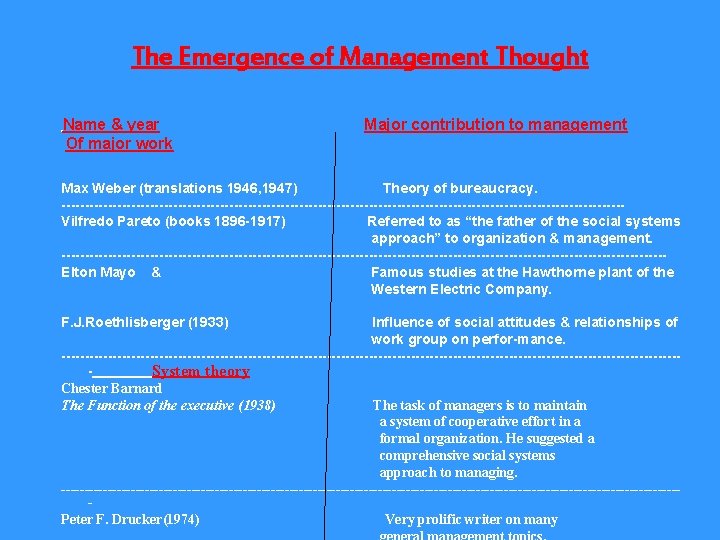
The Emergence of Management Thought Name & year Of major work Major contribution to management Max Weber (translations 1946, 1947) Theory of bureaucracy. ------------------------------------------------------------Vilfredo Pareto (books 1896 -1917) Referred to as “the father of the social systems approach” to organization & management. -----------------------------------------------------------------Elton Mayo & Famous studies at the Hawthorne plant of the Western Electric Company. F. J. Roethlisberger (1933) Influence of social attitudes & relationships of work group on perfor-mance. ------------------------------------------------------------------System theory Chester Barnard The Function of the executive (1938) The task of managers is to maintain a system of cooperative effort in a formal organization. He suggested a comprehensive social systems approach to managing. ------------------------------------------------------------------Peter F. Drucker(1974) Very prolific writer on many
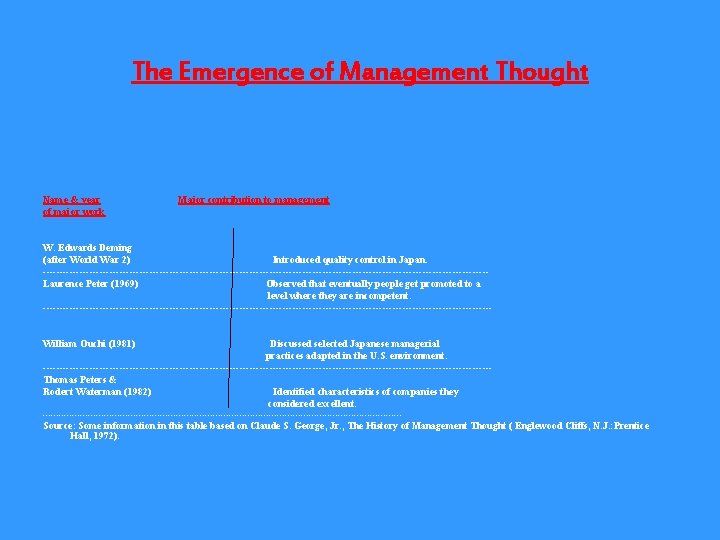
The Emergence of Management Thought Name & year of major work Major contribution to management W. Edwards Deming (after World War 2) Introduced quality control in Japan. -------------------------------------------------------------------Laurence Peter (1969) Observed that eventually people get promoted to a level where they are incompetent. -------------------------------------------------------------------William Ouchi (1981) Discussed selected Japanese managerial practices adapted in the U. S. environment. -------------------------------------------------------------------Thomas Peters & Rodert Waterman (1982) Identified characteristics of companies they considered excellent. -------------------------------------------------------------------- Source: Some information in this table based on Claude S. George, Jr. , The History of Management Thought ( Englewood Cliffs, N. J. : Prentice Hall, 1972).
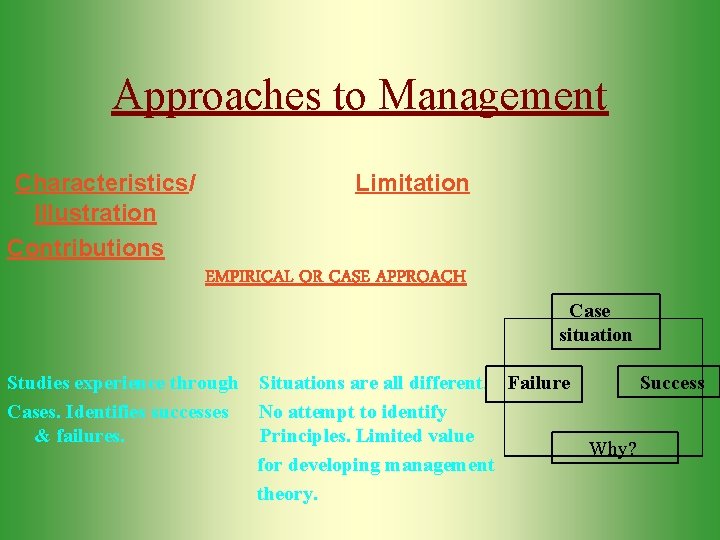
Approaches to Management Characteristics/ Illustration Contributions Limitation EMPIRICAL OR CASE APPROACH Case situation Success Studies experience through Situations are all different. Failure Cases. Identifies successes No attempt to identify & failures. Principles. Limited value Why? for developing management theory.
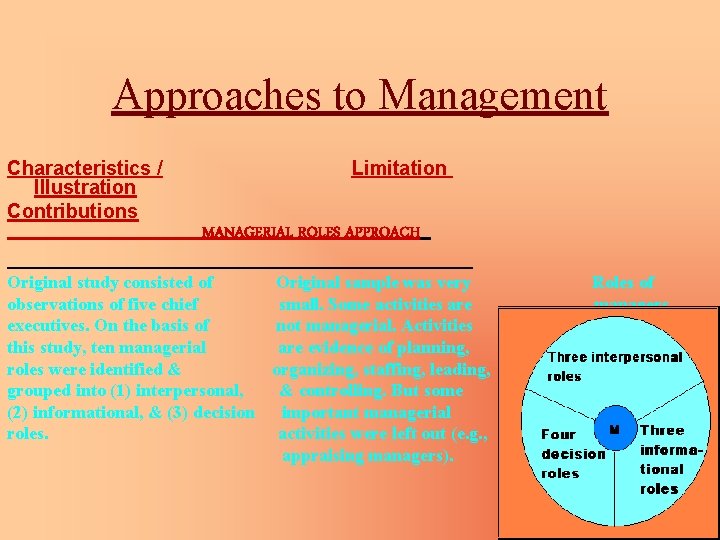
Approaches to Management Characteristics / Illustration Contributions Limitation MANAGERIAL ROLES APPROACH Original study consisted of Original sample was very observations of five chief small. Some activities are executives. On the basis of not managerial. Activities this study, ten managerial are evidence of planning, roles were identified & organizing, staffing, leading, grouped into (1) interpersonal, & controlling. But some (2) informational, & (3) decision important managerial roles. activities were left out (e. g. , appraising managers). Roles of managers
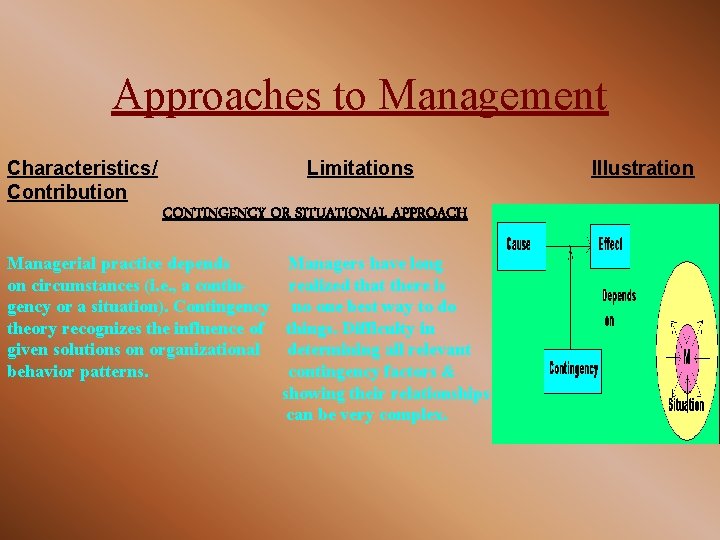
Approaches to Management Characteristics/ Contribution Limitations CONTINGENCY OR SITUATIONAL APPROACH Managerial practice depends Managers have long on circumstances (i. e. , a continrealized that there is gency or a situation). Contingency no one best way to do theory recognizes the influence of things. Difficulty in given solutions on organizational determining all relevant behavior patterns. contingency factors & showing their relationships can be very complex. Illustration
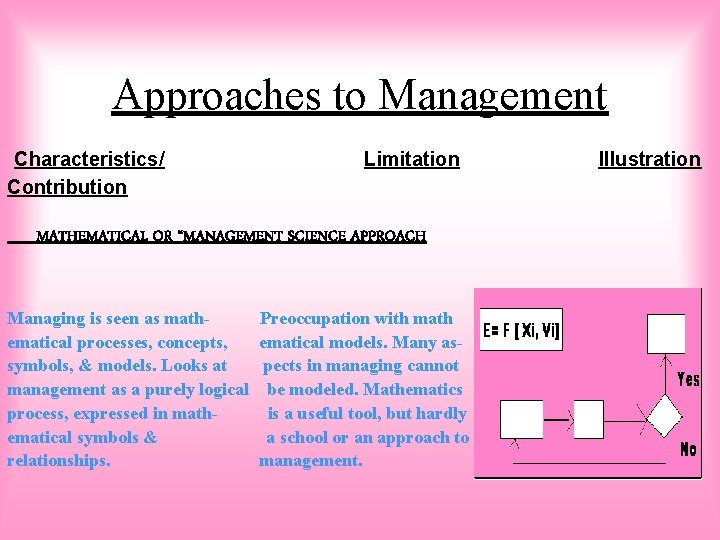
Approaches to Management Characteristics/ Contribution Limitation MATHEMATICAL OR “MANAGEMENT SCIENCE APPROACH Managing is seen as mathematical processes, concepts, symbols, & models. Looks at management as a purely logical process, expressed in mathematical symbols & relationships. Preoccupation with math ematical models. Many aspects in managing cannot be modeled. Mathematics is a useful tool, but hardly a school or an approach to management. Illustration
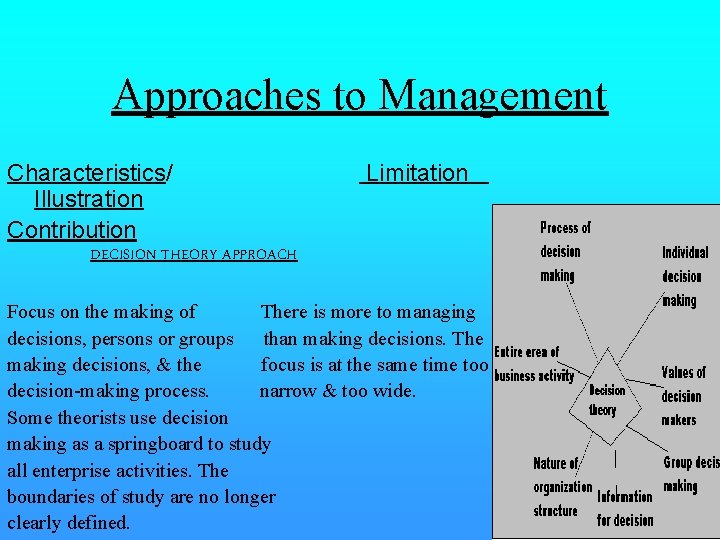
Approaches to Management Characteristics/ Illustration Contribution Limitation DECISION THEORY APPROACH Focus on the making of There is more to managing decisions, persons or groups than making decisions. The making decisions, & the focus is at the same time too decision-making process. narrow & too wide. Some theorists use decision making as a springboard to study all enterprise activities. The boundaries of study are no longer clearly defined.
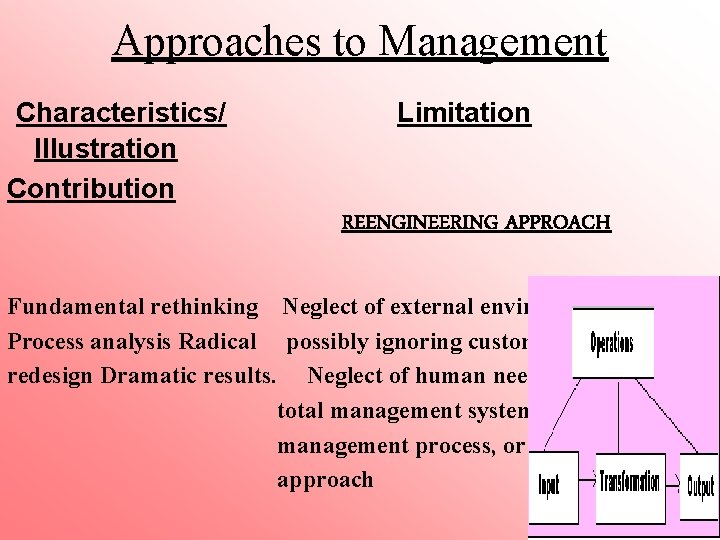
Approaches to Management Characteristics/ Illustration Contribution Limitation REENGINEERING APPROACH Fundamental rethinking Neglect of external environment, Process analysis Radical possibly ignoring customers’ needs. redesign Dramatic results. Neglect of human needs ignores total management system as in the management process, or operational approach
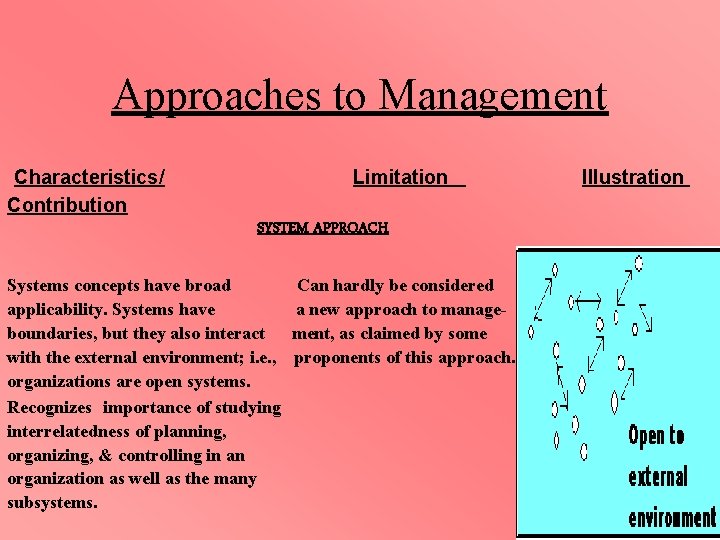
Approaches to Management Characteristics/ Contribution Limitation SYSTEM APPROACH Systems concepts have broad applicability. Systems have boundaries, but they also interact with the external environment; i. e. , organizations are open systems. Recognizes importance of studying interrelatedness of planning, organizing, & controlling in an organization as well as the many subsystems. Can hardly be considered a new approach to management, as claimed by some proponents of this approach. Illustration
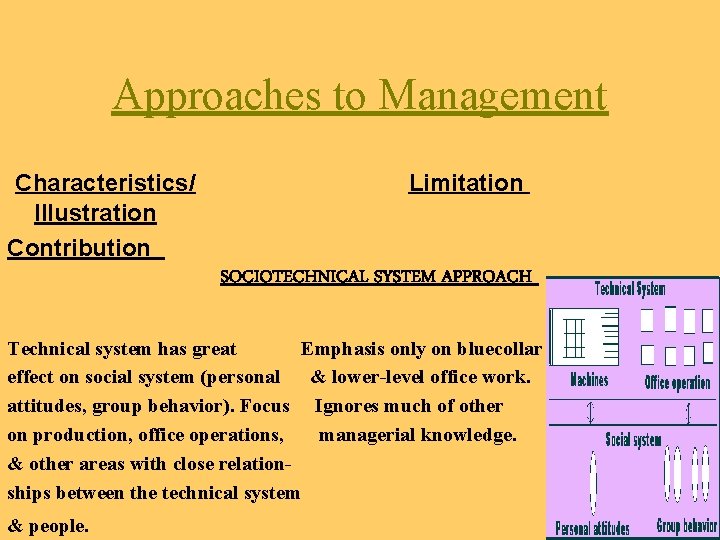
Approaches to Management Characteristics/ Illustration Contribution Limitation SOCIOTECHNICAL SYSTEM APPROACH Technical system has great Emphasis only on bluecollar effect on social system (personal & lower-level office work. attitudes, group behavior). Focus Ignores much of other on production, office operations, managerial knowledge. & other areas with close relationships between the technical system & people.
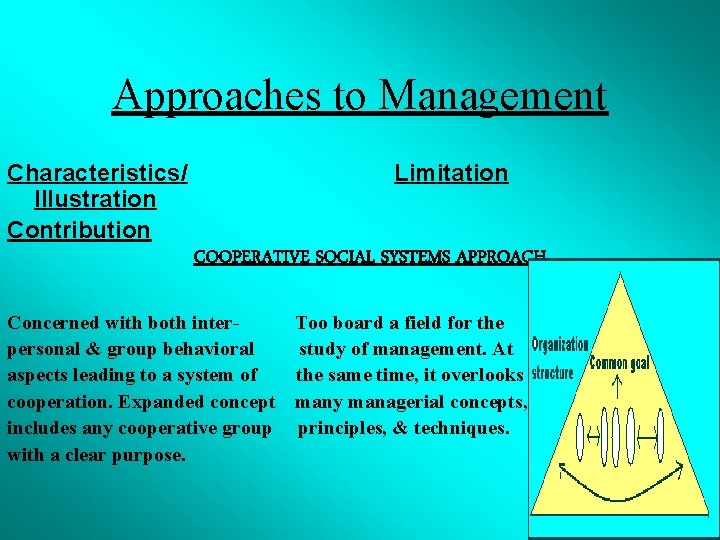
Approaches to Management Characteristics/ Illustration Contribution Limitation COOPERATIVE SOCIAL SYSTEMS APPROACH Concerned with both inter. Too board a field for the personal & group behavioral study of management. At aspects leading to a system of the same time, it overlooks cooperation. Expanded concept many managerial concepts, includes any cooperative group principles, & techniques. with a clear purpose.
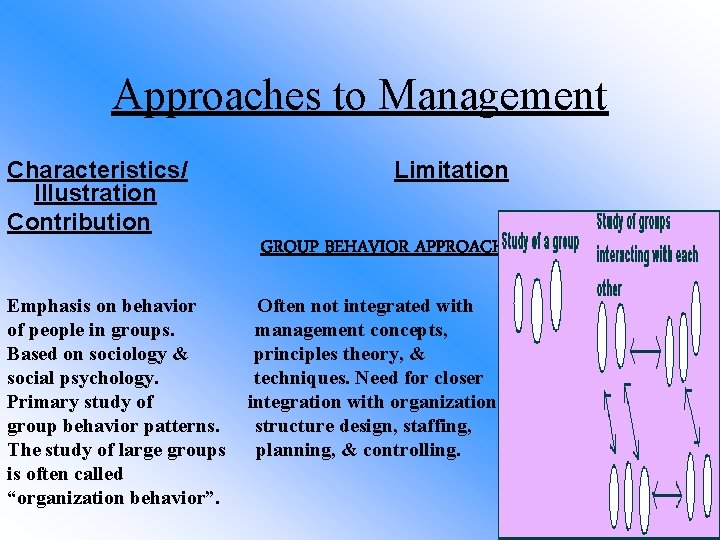
Approaches to Management Characteristics/ Illustration Contribution Limitation GROUP BEHAVIOR APPROACH Emphasis on behavior of people in groups. Based on sociology & social psychology. Primary study of group behavior patterns. The study of large groups is often called “organization behavior”. Often not integrated with management concepts, principles theory, & techniques. Need for closer integration with organization structure design, staffing, planning, & controlling.
Approaches to Management Characteristics/ Illustration Contribution Limitation INTERPERSONAL BEHAVIOR APPROACH Focus on interpersonal behavior, human relations, leadership, & motivation. Based on individual psychology. Ignores planning, organizing, & controlling. Psychological training is not enough to become an effective manager.
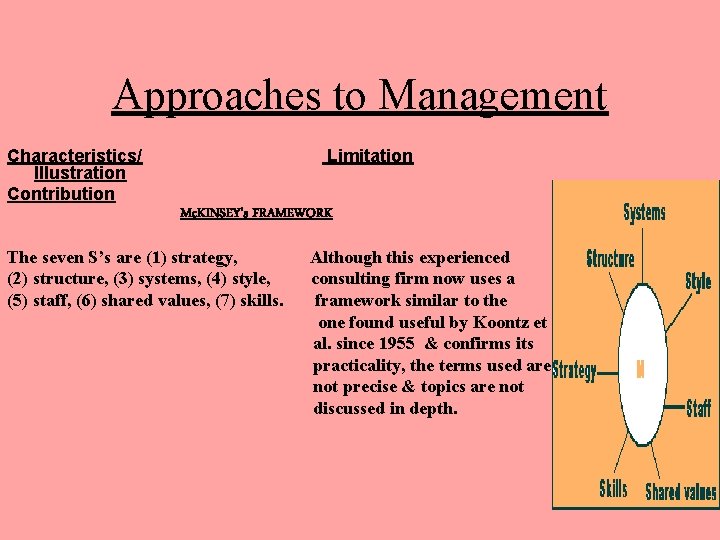
Approaches to Management Characteristics/ Illustration Contribution Limitation Mc. KINSEY’s FRAMEWORK The seven S’s are (1) strategy, (2) structure, (3) systems, (4) style, (5) staff, (6) shared values, (7) skills. Although this experienced consulting firm now uses a framework similar to the one found useful by Koontz et al. since 1955 & confirms its practicality, the terms used are not precise & topics are not discussed in depth.
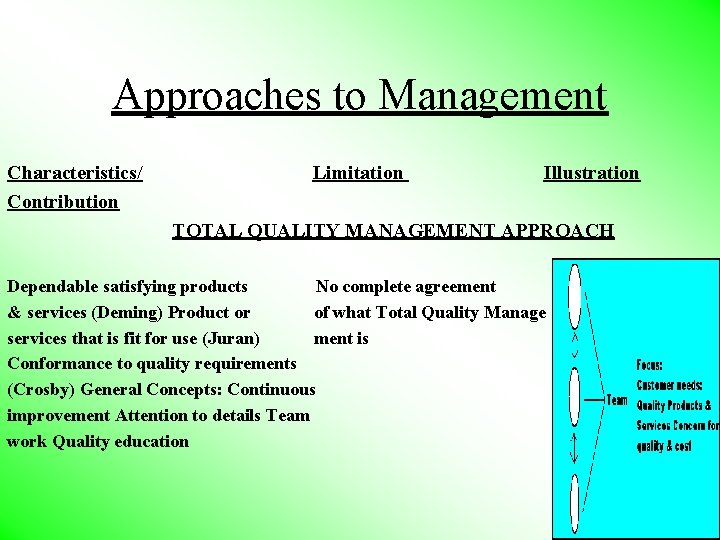
Approaches to Management Characteristics/ Contribution Limitation Illustration TOTAL QUALITY MANAGEMENT APPROACH Dependable satisfying products No complete agreement & services (Deming) Product or of what Total Quality Manage services that is fit for use (Juran) ment is Conformance to quality requirements (Crosby) General Concepts: Continuous improvement Attention to details Team work Quality education
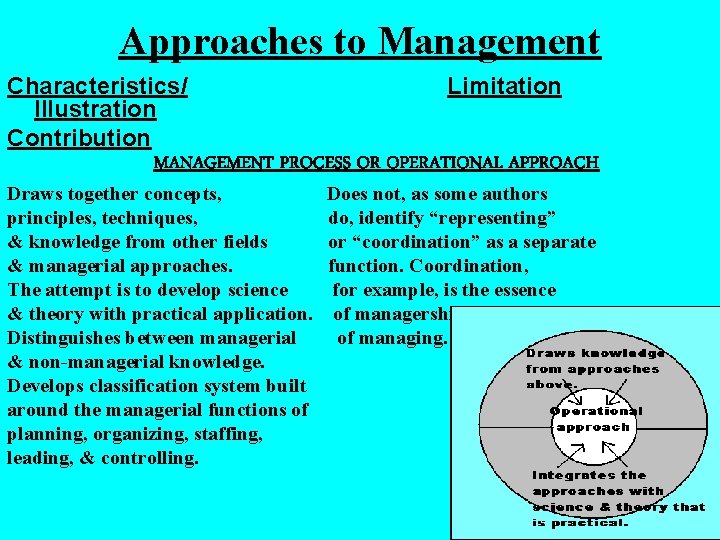
Approaches to Management Characteristics/ Limitation Illustration Contribution MANAGEMENT PROCESS OR OPERATIONAL APPROACH Draws together concepts, principles, techniques, & knowledge from other fields & managerial approaches. The attempt is to develop science & theory with practical application. Distinguishes between managerial & non-managerial knowledge. Develops classification system built around the managerial functions of planning, organizing, staffing, leading, & controlling. Does not, as some authors do, identify “representing” or “coordination” as a separate function. Coordination, for example, is the essence of managership & purpose of managing.
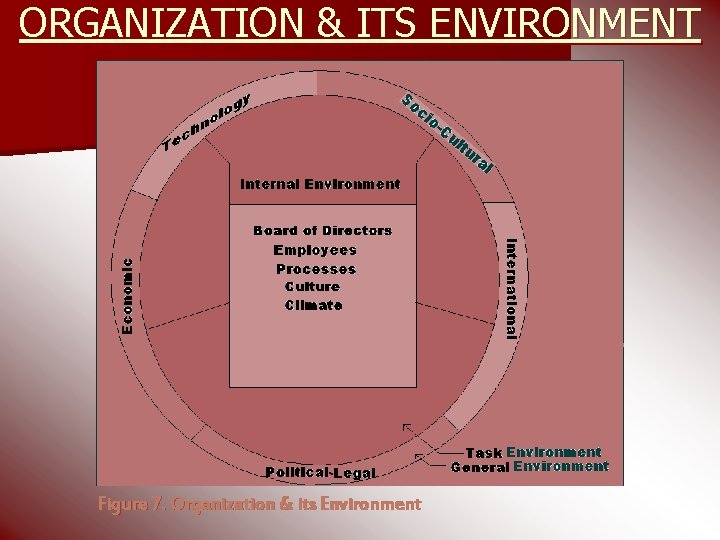
ORGANIZATION & ITS ENVIRONMENT Figure 7. Organization & its Environment
Ethics in workplace Formulation of ethics Managerial ethics
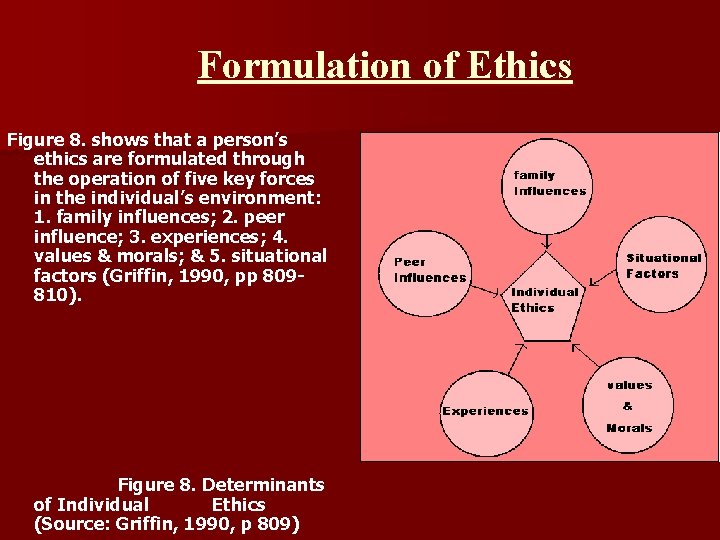
Formulation of Ethics Figure 8. shows that a person’s ethics are formulated through the operation of five key forces in the individual’s environment: 1. family influences; 2. peer influence; 3. experiences; 4. values & morals; & 5. situational factors (Griffin, 1990, pp 809810). Figure 8. Determinants of Individual Ethics (Source: Griffin, 1990, p 809)
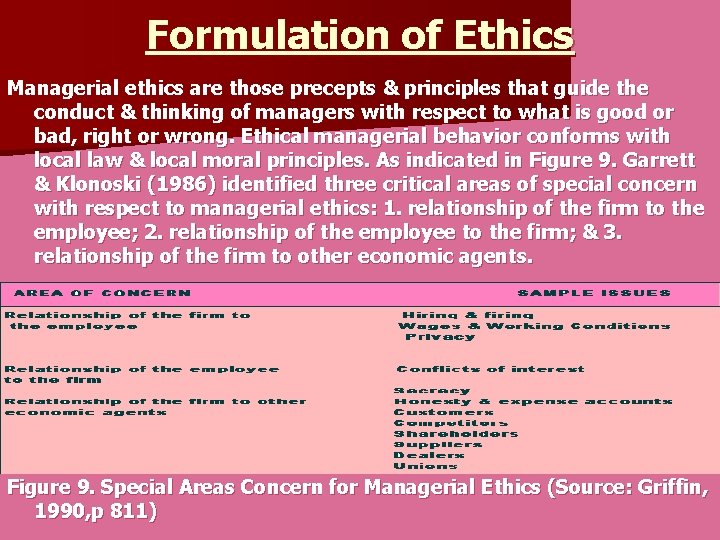
Formulation of Ethics Managerial ethics are those precepts & principles that guide the conduct & thinking of managers with respect to what is good or bad, right or wrong. Ethical managerial behavior conforms with local law & local moral principles. As indicated in Figure 9. Garrett & Klonoski (1986) identified three critical areas of special concern with respect to managerial ethics: 1. relationship of the firm to the employee; 2. relationship of the employee to the firm; & 3. relationship of the firm to other economic agents. Figure 9. Special Areas Concern for Managerial Ethics (Source: Griffin, 1990, p 811)
Social Responsibility v. Areas of social responsibility v Social responsibility debate v Arguments “against” Corporate Social Responsibility v Arguments “for” Corporate Social Responsibility
Areas of social responsibility Another major trend in modern business is the increasing concern over the social responsibility of business. Social responsibility may be defined as the obligation of an organization to protect & enhance the society within which the organization operates. Organizational Constituents Within the societal context that the organization functions, it is necessary to identify the network of constituents, or those people &/or groups that have a stake in the organization’s performance & directly feel the impact of the actions of the organization. Customers, creditors, suppliers, employees, shareholders, & other typical constituents of a business organization are shown in Figure 10.
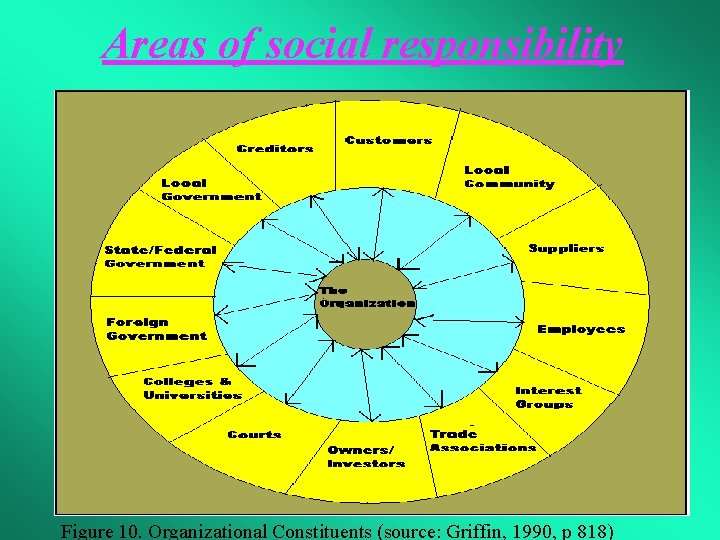
Areas of social responsibility Figure 10. Organizational Constituents (source: Griffin, 1990, p 818)
Areas of social responsibility According to Schermerhorn (1989, p 616), managers should pay particular attention to their social responsibilities as grouped under eight topical headings, as follows: 1. Ecology & Environmental Quality (a) Pollution clean-up & prevention (b) Dispersion of industry (c) Land use & beautification 2. Consumerism (a) Truth in leading, advertising, & business (b) Product warranty & service (c) Control of harmful products 3. Community Needs (a) Use of expertise for local problems (b) Aid with health-care facilities & education (c) Service in voluntary groups 4. Governmental Relations (a) Restrictions on lobbying (b) Control of business through political action
Areas of social responsibility 5. Minorities & Disadvantaged Persons (a) Training of unemployed (b) Equal employment opportunity (c) Locating plants & offices in minority areas (d) Purchasing from minority businesses 6. Labour Relations (a) Improved occupational health & safety (b) Provision of day-care centers (c) Options of flexible working hours 7. Shareholder Relations (a) Public seats on Board of Directors (b) Improved financial disclosure 8. Corporate Philanthropy (a) Financial support for arts & culture (b) Special scholarships & gifts to education ( c) Financial support for assorted charities
Social responsibility debate Despite a debate that has gone on for years, there is still little agreement as to the proper definition of the social responsibility for business. On the one hand of the debate is the classical view, or the shareholder model, that believes that the business has only one responsibility – to maximize profits for the shareholders. On the other hand is the socio-economic view, or the stake holder model, that believes the organization has a responsibility to all the constituents in its socio-economic environment.
Arguments “against” Corporate Social Responsibility The major arguments against the assumption of board social responsibilities include (Schermerhorn (1989, p 615): 1. Loss of profit maximization 2. Cost 3. Lack of skills 4. Dilution of purpose 5. Too much power 6. Lack of accountability 7. Lack of board support
Arguments “for” Corporate Social Responsibility The major argument supporting a major role for the social responsibility of business are as follows (Schermerhorn (1989, p 614): 1. Public expectations 2. Long-run validity 3. Public image 4. Better environment 5. Avoidance of government regulation 6. Balance of responsibility & power 7. Let business try 8. Business has the resources 9. Problems can become profit 10. Prevention is better than curing 11. Shareholder interests
PLANNING Managerial Planning types of plans Steps in planning process organizational planning the benefits of planning
PLANNING Øthe strategic planning process Ø the tows matrix Ø the portfolio matrix Ø porter’s industry analysis and generic competitive strategies
Managerial Planning In designing an environment for the effective performance of individuals working together in groups , a manager’s most essential task is to see that everyone understands the group’s purposes & objectives & its methods of attaining them. If group effort is to be effective, people must know what they are expected to accomplish. This is the function of planning. It is the most basic of all the managerial functions. Planning involves selecting missions & objectives & the actions to achieve them; it requires decision making, which is, choosing from the alternatives available the future courses of action. Plan thus provide a rational approach to achieve preselected objectives. Planning also strongly implies managerial innovation. Planning bridges the gap from where we are to where we want to go. It is also important to point out that planning & control are inseparable – the Siamese twins of management (see figure 11. ). Any attempt to control without plans is meaningless, since there is no way for people to tell whether they are going where they want to go (the result of the task of control) unless they first know where they want to go (part of the task of planning). Plans thus furnish the standards of control.
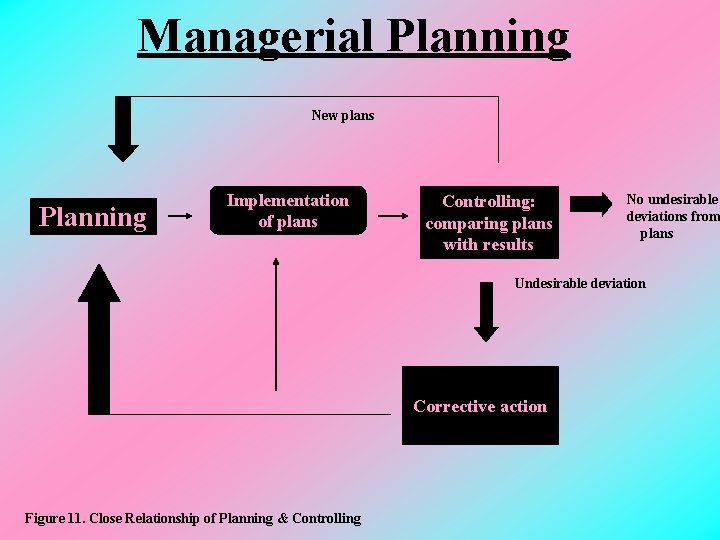
Managerial Planning New plans Planning Implementation of plans Controlling: comparing plans with results No undesirable deviations from plans Undesirable deviation Corrective action Figure 11. Close Relationship of Planning & Controlling
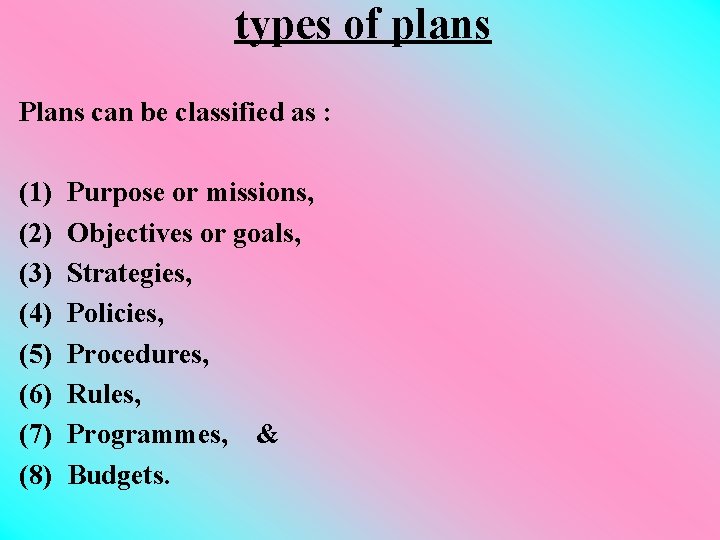
types of plans Plans can be classified as : (1) (2) (3) (4) (5) (6) (7) (8) Purpose or missions, Objectives or goals, Strategies, Policies, Procedures, Rules, Programmes, & Budgets.
Steps in planning The practical steps listed below in figure 12. , are of general application. In practice, however, one must study the feasibility of possible courses of action at each stage.
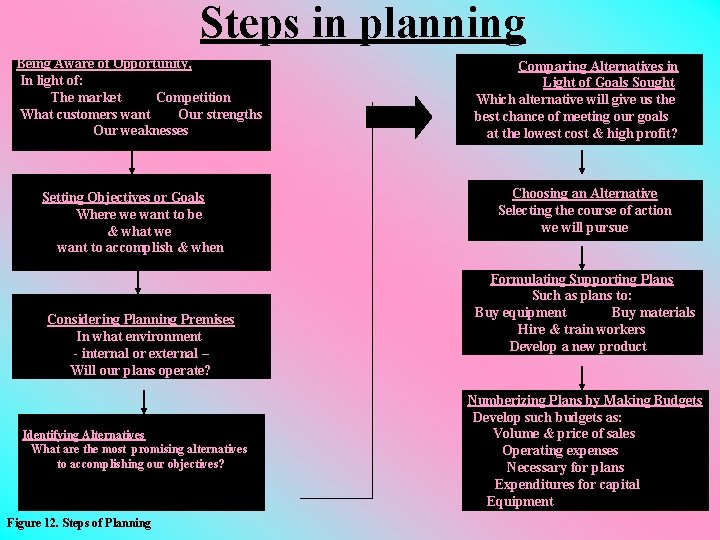
Steps in planning Being Aware of Opportunity, In light of: The market Competition What customers want Our strengths Our weaknesses Setting Objectives or Goals Where we want to be & what we want to accomplish & when Considering Planning Premises In what environment - internal or external – Will our plans operate? Identifying Alternatives What are the most promising alternatives to accomplishing our objectives? Figure 12. Steps of Planning Comparing Alternatives in Light of Goals Sought Which alternative will give us the best chance of meeting our goals at the lowest cost & high profit? Choosing an Alternative Selecting the course of action we will pursue Formulating Supporting Plans Such as plans to: Buy equipment Buy materials Hire & train workers Develop a new product Numberizing Plans by Making Budgets Develop such budgets as: Volume & price of sales Operating expenses Necessary for plans Expenditures for capital Equipment
planning process Planning is a way of life. It is a way of organizational life. Every person plans, as does every organization; but every planning effort is unique to the planner & the situation. Planning begins with a goal or an end-state or targeted outcome that the organization wishes to achieve. A plan is the means devised for the achievement of that goal. For instance, a firm may have a goal of selling its product in a new market, & the plan is a combination of marketing techniques designed to reach that goal. The development of plans may be both formal & informal. Informal planning is the intuitive to a situation, while formal planning is a structured process of investigation & action. For the purpose of this book, planning is defined as a comprehensive two-stage process of (1) creating a futuristic frame of reference from which to see opportunities & threats that lie in the future & (2) taking action to exploit the opportunities & defend against the threats. Thus, planning is: (1) Future-oriented (2) Decision-oriented (3) Goal-oriented
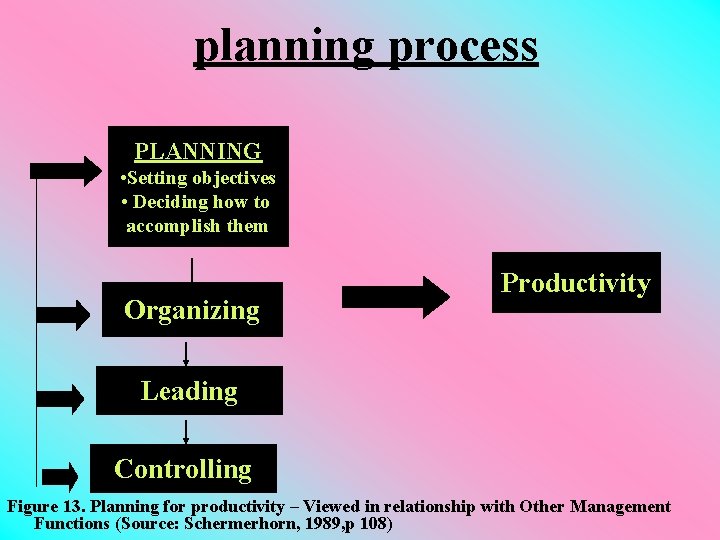
planning process PLANNING • Setting objectives • Deciding how to accomplish them Organizing for Productivity Leading Controlling Figure 13. Planning for productivity – Viewed in relationship with Other Management Functions (Source: Schermerhorn, 1989, p 108)

planning process
organizational planning The establishment of organizational goals is the first stage of the overall planning process, & the second stage is the planning itself. Goals tell management where the organization should be going, & planning tells management how the organizational will get there. Types of Organizational Plans Management must deal with three basic types of organizational plans. Just as organizations must define goals at different levels, organizations must establish 1. Strategic plans, 2. Tactical plans, & 3. Operational plans.
the benefits of planning There any number of good reasons why organizations should plan. David Holt identified four payoffs of planning as follows: (1) it helps the firm to know why it is in business; (2) it identifies specific objectives & strategies that guide future activities; (3) it explains environmental opportunities, threats, & constraints; & (4) it provides alternative courses of action (David Holt 1990; 136). John Schermerhorn, Jr. (1989; pp 108 -110) explained the benefits of planning as follows: 1. Stability Adaptability & Contingency 2. Clarified Means---- End Chains 3. Performance Improvement
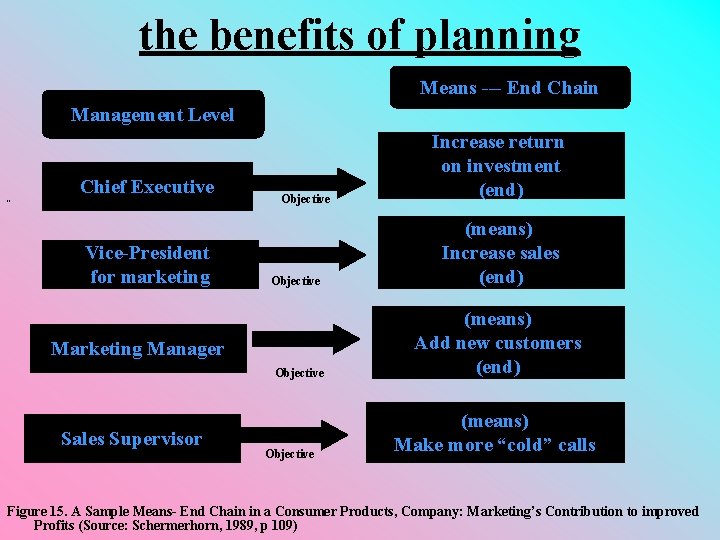
the benefits of planning Means --- End Chain Management Level Chief Executive \ Vice-President for marketing Objective (means) Increase sales (end) Objective (means) Add new customers (end) Marketing Manager Sales Supervisor Increase return on investment (end) Objective (means) Make more “cold” calls Figure 15. A Sample Means- End Chain in a Consumer Products, Company: Marketing’s Contribution to improved Profits (Source: Schermerhorn, 1989, p 109)
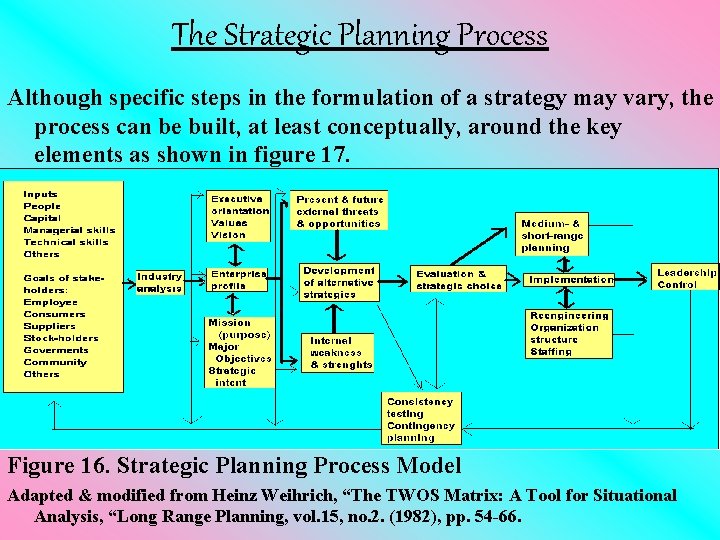
The Strategic Planning Process Although specific steps in the formulation of a strategy may vary, the process can be built, at least conceptually, around the key elements as shown in figure 17. Figure 16. Strategic Planning Process Model Adapted & modified from Heinz Weihrich, “The TWOS Matrix: A Tool for Situational Analysis, “Long Range Planning, vol. 15, no. 2. (1982), pp. 54 -66.
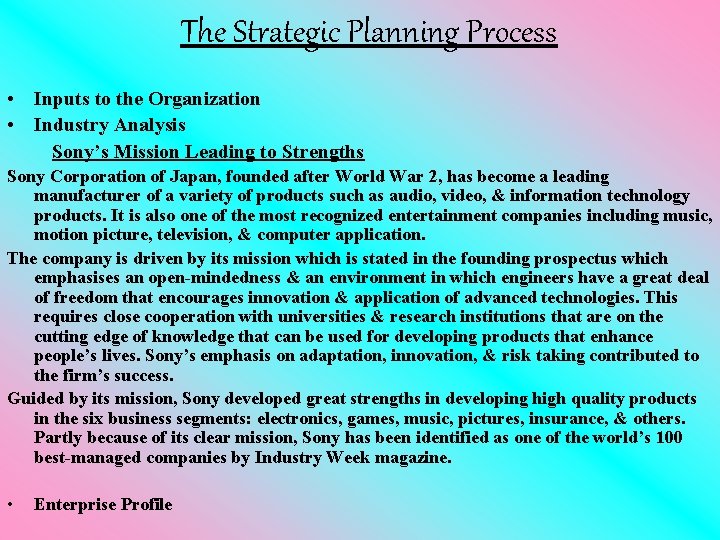
The Strategic Planning Process • Inputs to the Organization • Industry Analysis Sony’s Mission Leading to Strengths Sony Corporation of Japan, founded after World War 2, has become a leading manufacturer of a variety of products such as audio, video, & information technology products. It is also one of the most recognized entertainment companies including music, motion picture, television, & computer application. The company is driven by its mission which is stated in the founding prospectus which emphasises an open-mindedness & an environment in which engineers have a great deal of freedom that encourages innovation & application of advanced technologies. This requires close cooperation with universities & research institutions that are on the cutting edge of knowledge that can be used for developing products that enhance people’s lives. Sony’s emphasis on adaptation, innovation, & risk taking contributed to the firm’s success. Guided by its mission, Sony developed great strengths in developing high quality products in the six business segments: electronics, games, music, pictures, insurance, & others. Partly because of its clear mission, Sony has been identified as one of the world’s 100 best-managed companies by Industry Week magazine. • Enterprise Profile
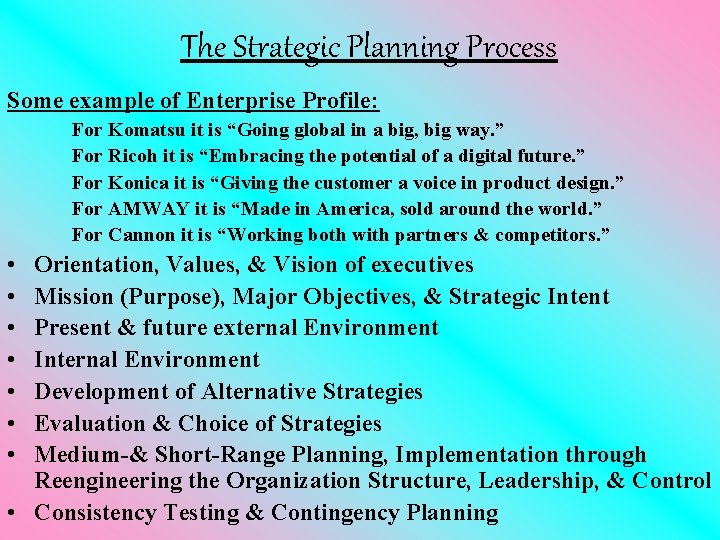
The Strategic Planning Process Some example of Enterprise Profile: For Komatsu it is “Going global in a big, big way. ” For Ricoh it is “Embracing the potential of a digital future. ” For Konica it is “Giving the customer a voice in product design. ” For AMWAY it is “Made in America, sold around the world. ” For Cannon it is “Working both with partners & competitors. ” • • Orientation, Values, & Vision of executives Mission (Purpose), Major Objectives, & Strategic Intent Present & future external Environment Internal Environment Development of Alternative Strategies Evaluation & Choice of Strategies Medium-& Short-Range Planning, Implementation through Reengineering the Organization Structure, Leadership, & Control • Consistency Testing & Contingency Planning
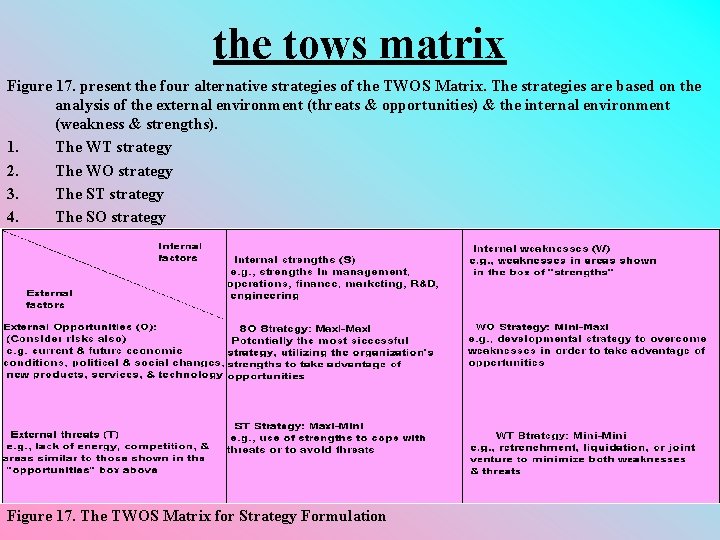
the tows matrix Figure 17. present the four alternative strategies of the TWOS Matrix. The strategies are based on the analysis of the external environment (threats & opportunities) & the internal environment (weakness & strengths). 1. The WT strategy 2. The WO strategy 3. The ST strategy 4. The SO strategy Figure 17. The TWOS Matrix for Strategy Formulation
The Portfolio Matrix The Business Portfolio Matrix was developed by Boston Consulting Group (BGG). Figure 18, a simplified version of the matrix, shows the linkages between the growth rate of the business & the relative competitive position of the firm, identified by the market share. The Portfolio Matrix was developed for large corporations with several divisions that are often organized around strategic business units. While portfolio analysis was popular in the 1970 s, it is not without its critics, who contend that it is too simplistic. Also, the growth rate criterion has been considered insufficient for the evaluation of an industry’s attractiveness. Similarly, the market share, as a yardstick for estimating the competitive position, may be inadequate.
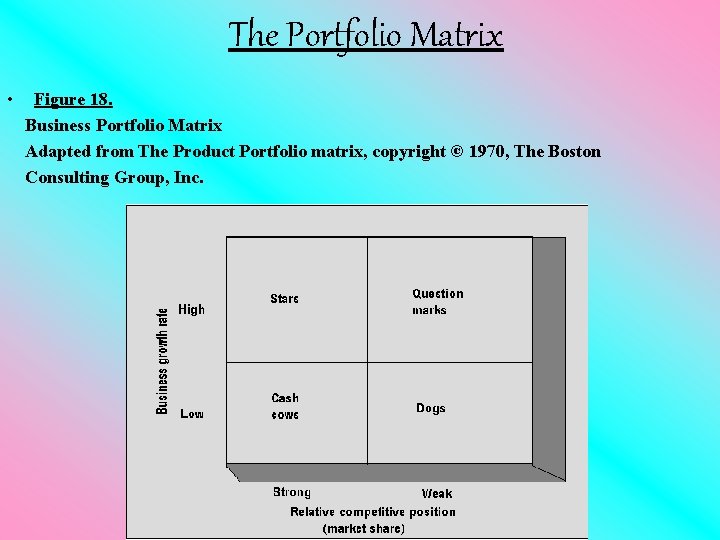
The Portfolio Matrix • Figure 18. Business Portfolio Matrix Adapted from The Product Portfolio matrix, copyright © 1970, The Boston Consulting Group, Inc.
Porter’s industry analysis & generic competitive strategies Professor Michael Porter at Harvard has suggested that strategy formulation requires an analysis of the industry (that is, of attractiveness) & the company’s position within that industry. This analysis becomes the basis for generic strategies. § Industry Analysis § Overall Cost Leadership Strategy § Different Strategy § Focused Strategy (Low Cost or Differentiation) § The Fifth Generic Strategy: Best Value or Best Cost Producer
decision making ª DECISION MAKING PROCESS ª STEPS IN DECISION MAKING
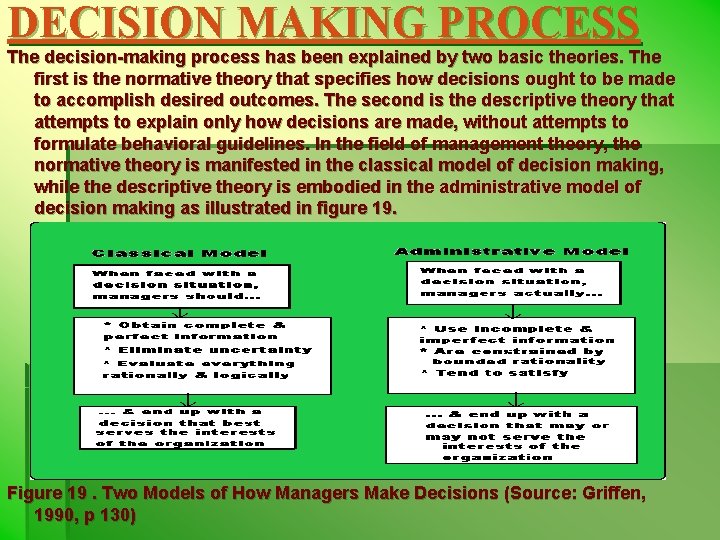
DECISION MAKING PROCESS The decision-making process has been explained by two basic theories. The first is the normative theory that specifies how decisions ought to be made to accomplish desired outcomes. The second is the descriptive theory that attempts to explain only how decisions are made, without attempts to formulate behavioral guidelines. In the field of management theory, the normative theory is manifested in the classical model of decision making, while the descriptive theory is embodied in the administrative model of decision making as illustrated in figure 19. Figure 19. Two Models of How Managers Make Decisions (Source: Griffen, 1990, p 130)
Decision making process § CLASSICAL MODEL § ADMINISTRATIVE MODEL
Classical Model The classical model of decision making is a prescriptive approach that is based on critical economic assumptions. Traditional management theory assumed that managers made decisions to serve the economic interests of the organization. The classical model is based on the following basic assumptions: (1) the manager seeks to attain objectives that are both known & agreed upon; (2) targeted problems are precisely defined; (3) the manager operates under a state of certainty, processing complete information; (4) all alternative courses of action & their potential results can be calculated; (5) the criteria needed for evaluating outcomes is known; (6) the manger will select the alternative that maximizes return to the organization; (7) the manger is rational & logical in assigning values, ordering preferences, evaluating alternatives, & making the decision that will maximize the attainment of organizational goals. The main value of the classical model is that it does help the decision maker operate in a more rational manner. Today, rational models are supported by large computer systems to allow the application of such quantitative techniques as forecasting, payoff matrices, decision trees, linear programming, break-even analysis, & econometric models. However, the classical model is based on a theoretical & perfect world, which is something less than reasonable. Seldom is the manager in a situation where all the above assumptions are both present & correct. Thus, the model becomes an ideal that is not always useful to real managers with real problems in real organizations. The model can probably be most helpful when used for programmed decisions or for decisions made in a state of risk, where the necessary information is available & outcome probabilities can be calculated. With available computer programs, probabilities can now be determined with greater accuracy, even when there may be hundreds of alternatives, each with numerous outcomes.
Administrative Model Recognizing the inappropriateness of the classical model in many situations, Simon (1987) developed the administrative model of decision making to deal with the conditions that managers usually face. The administrative model is a normative approach in that it doesn’t prescribe how decisions should be made. Instead, it describes how decisions are actually made. As shown in figure 12 , managers are often faced with difficult situations characterized by uncertainty, ambiguity, & non-programmed decision making. Simon’s model is based on two concepts – 1. Bounded rationality 2. Satisficing
The steps in Rational Decision making The manager who seeks to take a logical & rational approach to a decision can follow the six steps in the process, as identified in Figure 20. by Griffin (1990): 1. recognize & define the decision situation; 2. identify appropriate alternatives; 3. evaluate each alternative; 4. select the best alternative; 5. implement alternative; & 6. evaluate the results & follow-up.
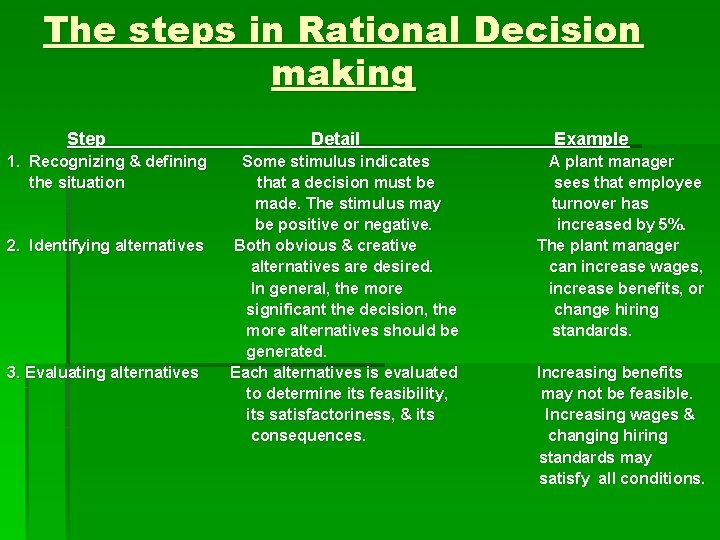
The steps in Rational Decision making Step 1. Recognizing & defining the situation 2. Identifying alternatives 3. Evaluating alternatives Detail Some stimulus indicates that a decision must be made. The stimulus may be positive or negative. Both obvious & creative alternatives are desired. In general, the more significant the decision, the more alternatives should be generated. Each alternatives is evaluated to determine its feasibility, its satisfactoriness, & its consequences. Example A plant manager sees that employee turnover has increased by 5%. The plant manager can increase wages, increase benefits, or change hiring standards. Increasing benefits may not be feasible. Increasing wages & changing hiring standards may satisfy all conditions.
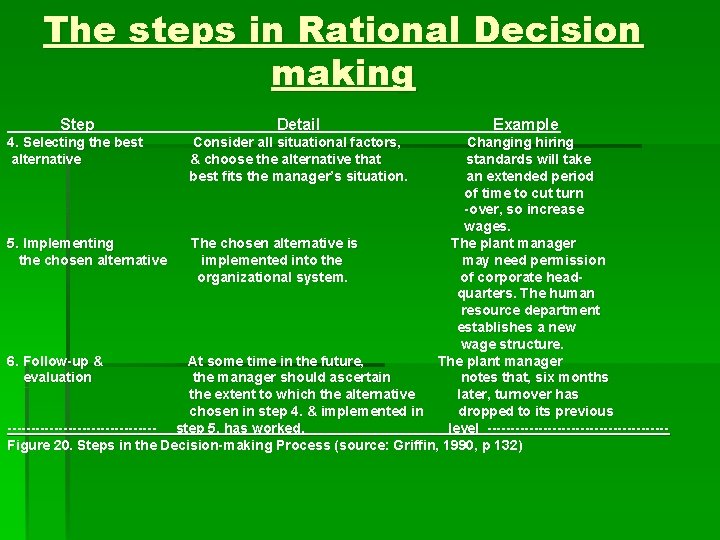
The steps in Rational Decision making Step Detail 4. Selecting the best alternative Consider all situational factors, & choose the alternative that best fits the manager’s situation. Example Changing hiring standards will take an extended period of time to cut turn -over, so increase wages. 5. Implementing The chosen alternative is The plant manager the chosen alternative implemented into the may need permission organizational system. of corporate headquarters. The human resource department establishes a new wage structure. 6. Follow-up & At some time in the future, The plant manager evaluation the manager should ascertain notes that, six months the extent to which the alternative later, turnover has chosen in step 4. & implemented in dropped to its previous ---------------- step 5. has worked. level -------------------Figure 20. Steps in the Decision-making Process (source: Griffin, 1990, p 132)
ORGANISING CONCEPT OF ORGANISING ¯ FORMAL AND INFORMAL ORGANISING ¯ ORGANISATION STRUCTURES WITH NARROW AND WIDE SPANS ¯ THE LOGIC OF ORGANISING ¯ PATTERNS OF DEPARTMENTATION ¯ PROCESS OF DELEGATION ¯ DECENTRALISATION OF AUTHORITY ¯ SPAN OF MANAGEMENT ¯
CONCEPT OF ORGANISING In addition, to make a role work out effectively, provision should be made for supplying needed information & other tools necessary for performance in that role. It is in this sense that we think of Organizing as 1. the identification & classification of required activities, 2. the grouping of activities necessary to attain objectives, 3. the assignment of each grouping to a manager with the authority (delegation) necessary to supervise it, & 4. the provision for coordination horizontally (on the same or a similar organizational level) & vertically (for example, corporate headquarters, division, & department) in the organization structure.
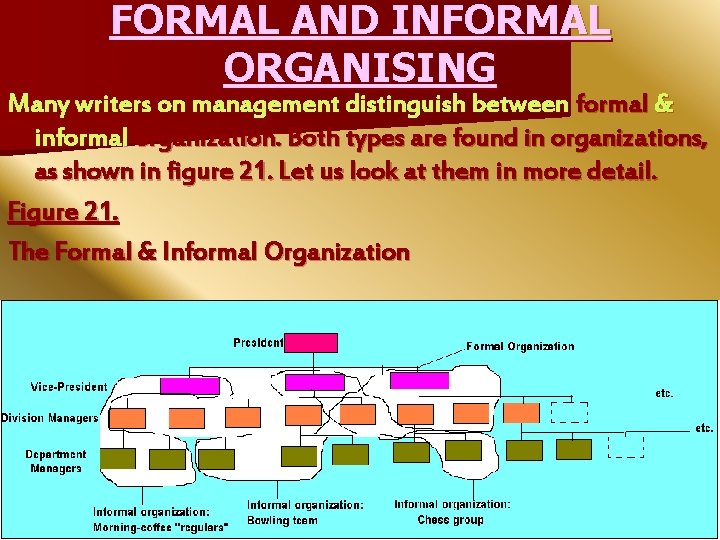
FORMAL AND INFORMAL ORGANISING Many writers on management distinguish between formal & informal organization. Both types are found in organizations, as shown in figure 21. Let us look at them in more detail. Figure 21. The Formal & Informal Organization
ORGANIZATION LEVELS & THE SPAN OF MANAGEMENT While the purpose of organizing is to make human cooperation effective, the reason for levels of organization is the limitations of the span of management. In other words, organization levels exist because there is a limit to the number of persons a manager can supervise effectively, even though this limit varies depending on situations. Relationships between the span of management & the organizational levels are shown in figure 22. A wide span of management is associated with few organizational levels, a narrow span, with many levels.
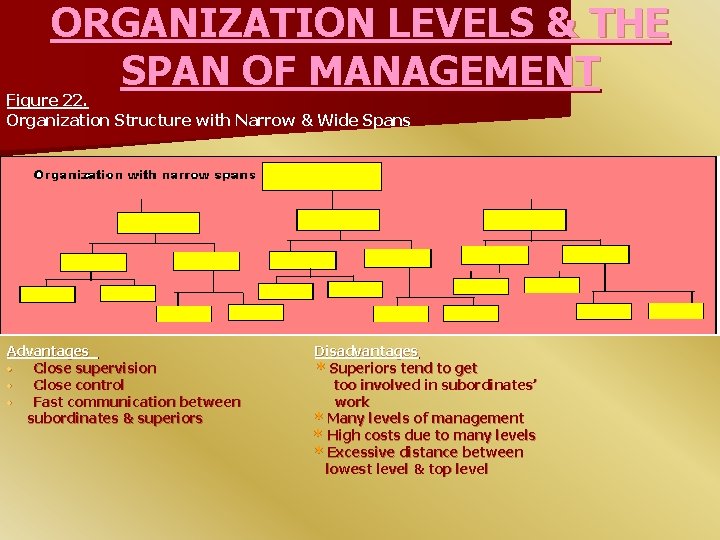
ORGANIZATION LEVELS & THE SPAN OF MANAGEMENT Figure 22. Organization Structure with Narrow & Wide Spans Advantages • Close supervision • Close control • Fast communication between subordinates & superiors Disadvantages * Superiors tend to get too involved in subordinates’ work * Many levels of management * High costs due to many levels * Excessive distance between lowest level & top level
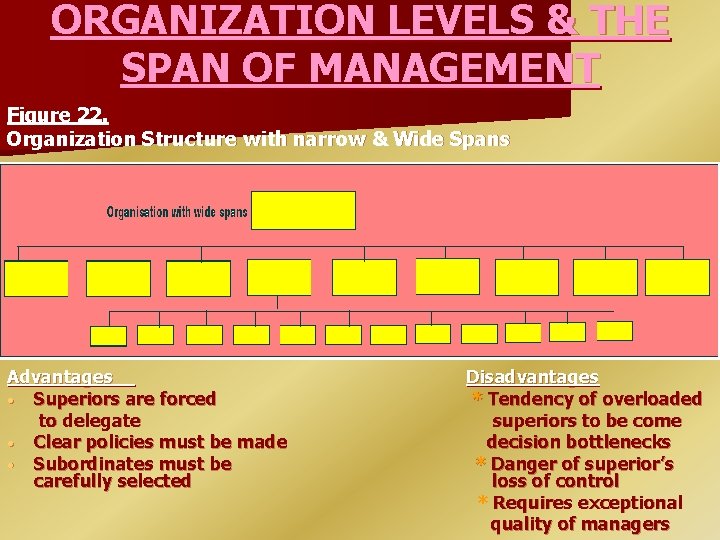
ORGANIZATION LEVELS & THE SPAN OF MANAGEMENT Figure 22. Organization Structure with narrow & Wide Spans Advantages • Superiors are forced to delegate • Clear policies must be made • Subordinates must be carefully selected Disadvantages * Tendency of overloaded superiors to be come decision bottlenecks * Danger of superior’s loss of control * Requires exceptional quality of managers
THE LOGIC OF ORGANISING There is a fundamental logic to organizing, as shown in figure 23. Although steps 1 & 2 are actually part of planning, the organizing process consists of the following six steps: 1. Establishing enterprise objectives. 2. Formulating supporting objectives, policies, & plans. 3. Identifying, analyzing, & classifying the activities necessary to accomplish these. 4. Grouping these activities in the light of human &material resources available & the best way, under the circumstances, of using them. 5. Delegating to the head of each group the authority necessary to perform the activities. 6. Tying the groups together horizontally & vertically, through authority relationships & information flows.
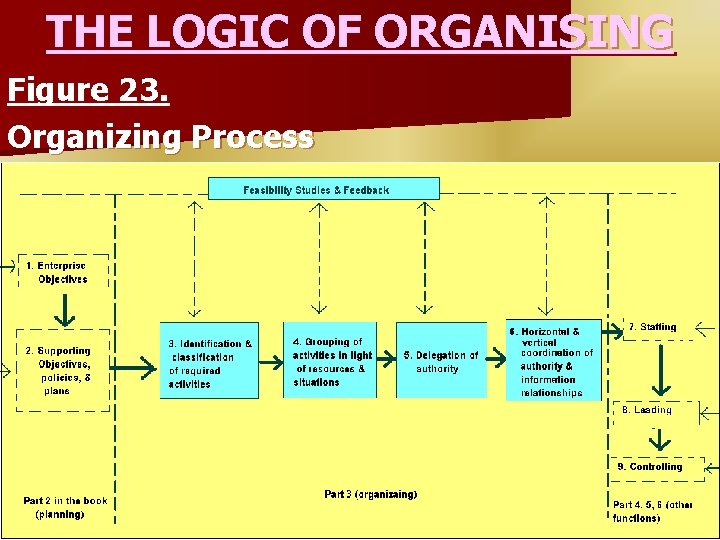
THE LOGIC OF ORGANISING Figure 23. Organizing Process
Patterns of Departmentation A Functional Organization A Territorial or Geographic Organization A Customer Organization A Product Organization A Matrix Organization
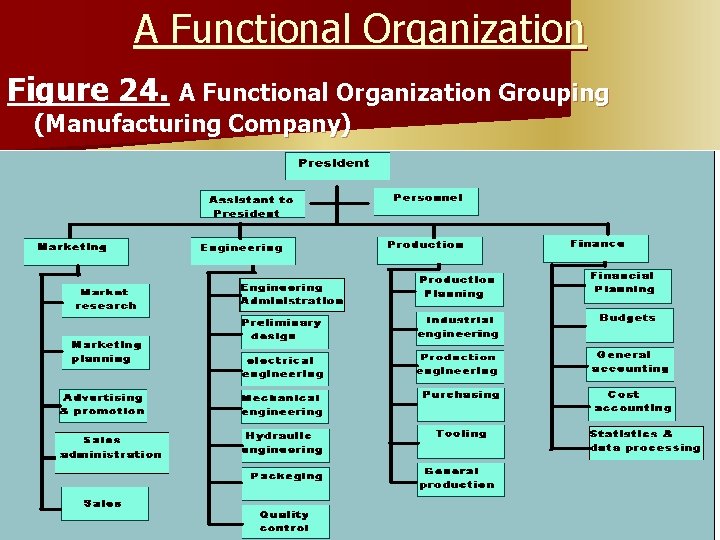
A Functional Organization Figure 24. A Functional Organization Grouping (Manufacturing Company)
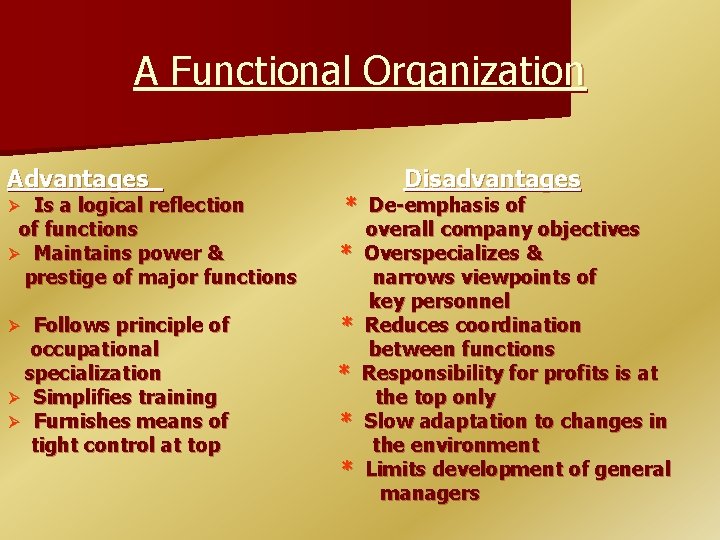
A Functional Organization Advantages Is a logical reflection of functions Ø Maintains power & prestige of major functions Ø Follows principle of occupational specialization Ø Simplifies training Ø Furnishes means of tight control at top Ø Disadvantages * De-emphasis of overall company objectives * Overspecializes & narrows viewpoints of key personnel * Reduces coordination between functions * Responsibility for profits is at the top only * Slow adaptation to changes in the environment * Limits development of general managers
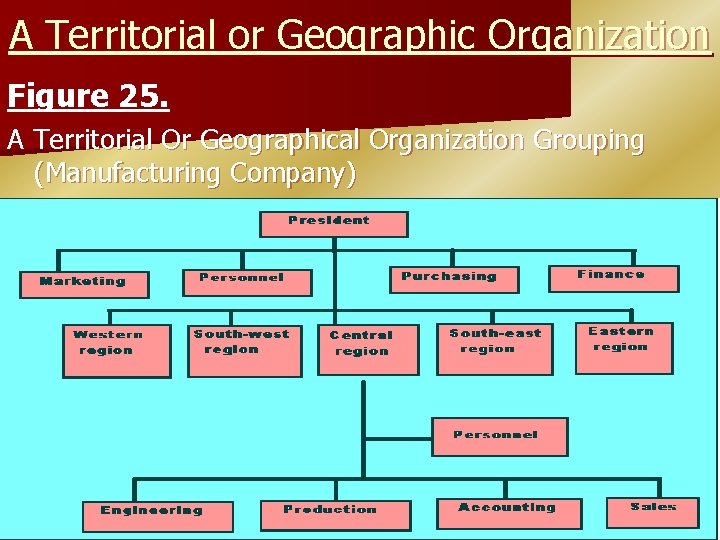
A Territorial or Geographic Organization Figure 25. A Territorial Or Geographical Organization Grouping (Manufacturing Company)
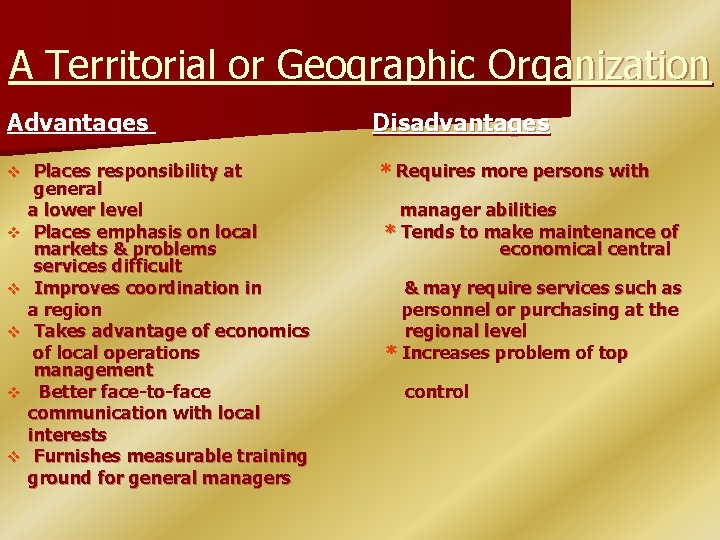
A Territorial or Geographic Organization Advantages v v v Places responsibility at general a lower level Places emphasis on local markets & problems services difficult Improves coordination in a region Takes advantage of economics of local operations management Better face-to-face communication with local interests Furnishes measurable training ground for general managers Disadvantages * Requires more persons with manager abilities * Tends to make maintenance of economical central & may require services such as personnel or purchasing at the regional level * Increases problem of top control
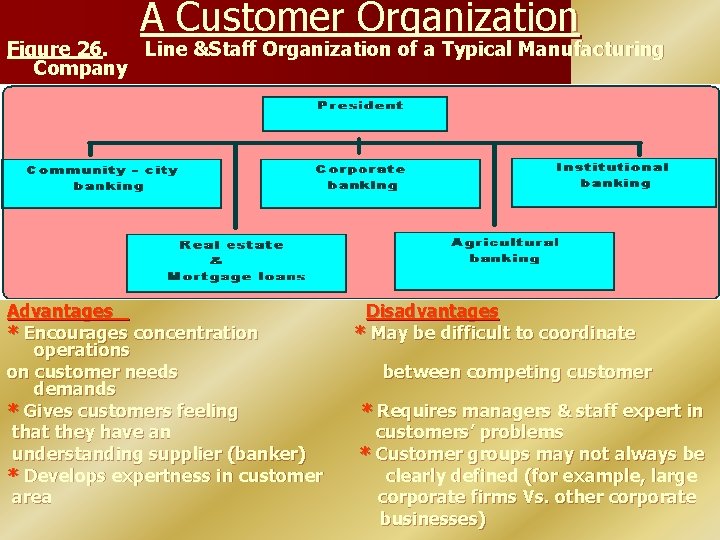
A Customer Organization Figure 26. Line &Staff Organization of a Typical Manufacturing Company Advantages * Encourages concentration operations on customer needs demands * Gives customers feeling that they have an understanding supplier (banker) * Develops expertness in customer area Disadvantages * May be difficult to coordinate between competing customer * Requires managers & staff expert in customers’ problems * Customer groups may not always be clearly defined (for example, large corporate firms Vs. other corporate businesses)
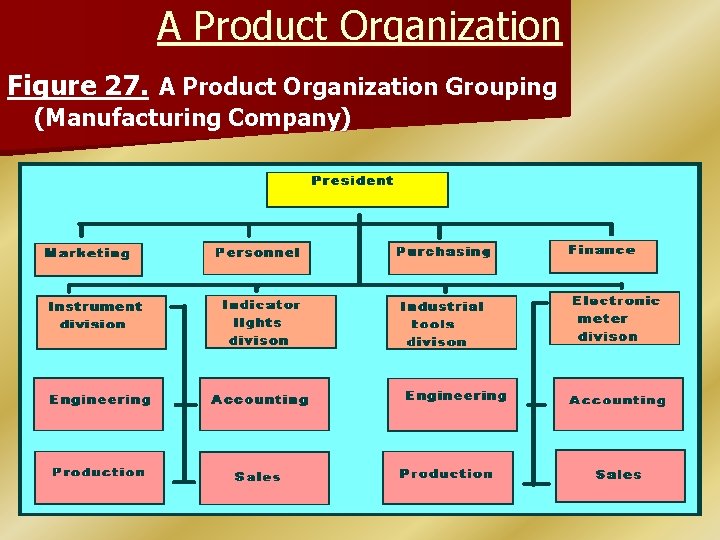
A Product Organization Figure 27. A Product Organization Grouping (Manufacturing Company)
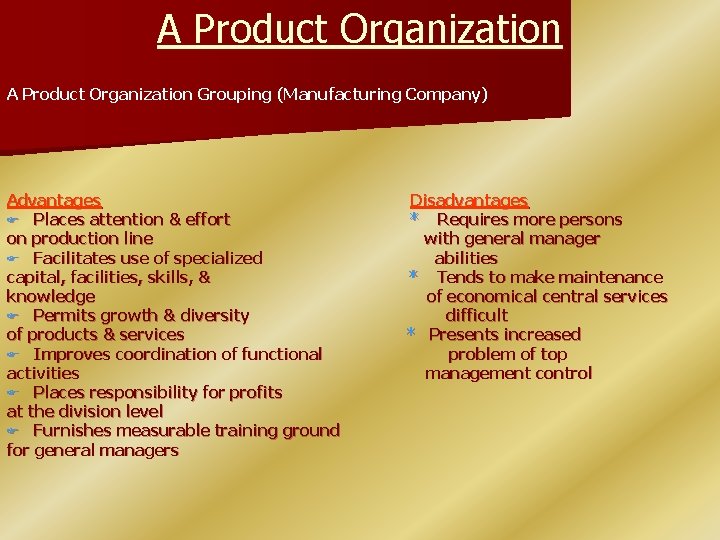
A Product Organization Grouping (Manufacturing Company) Advantages F Places attention & effort on production line F Facilitates use of specialized capital, facilities, skills, & knowledge F Permits growth & diversity of products & services F Improves coordination of functional activities F Places responsibility for profits at the division level F Furnishes measurable training ground for general managers Disadvantages * Requires more persons with general manager abilities * Tends to make maintenance of economical central services difficult * Presents increased problem of top management control
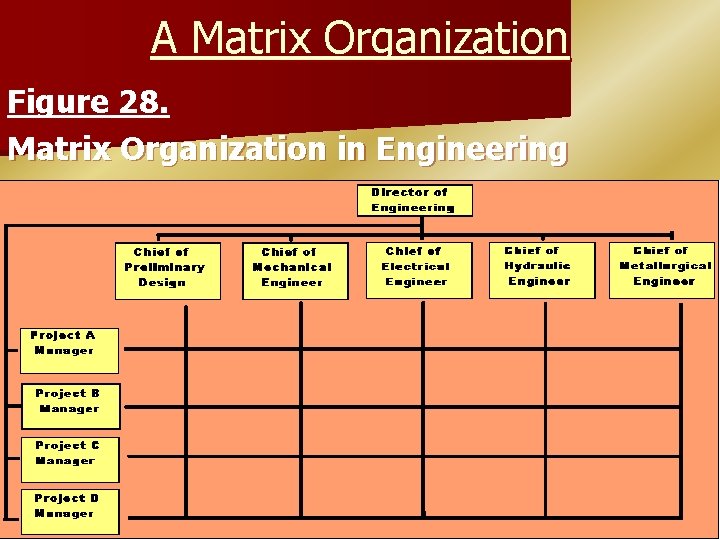
A Matrix Organization Figure 28. Matrix Organization in Engineering
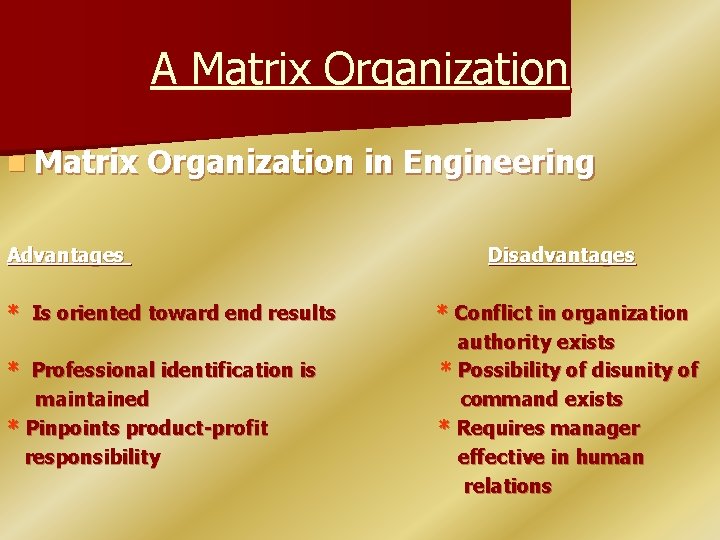
A Matrix Organization n Matrix Organization in Engineering Advantages * Is oriented toward end results * Professional identification is maintained * Pinpoints product-profit responsibility Disadvantages * Conflict in organization authority exists * Possibility of disunity of command exists * Requires manager effective in human relations
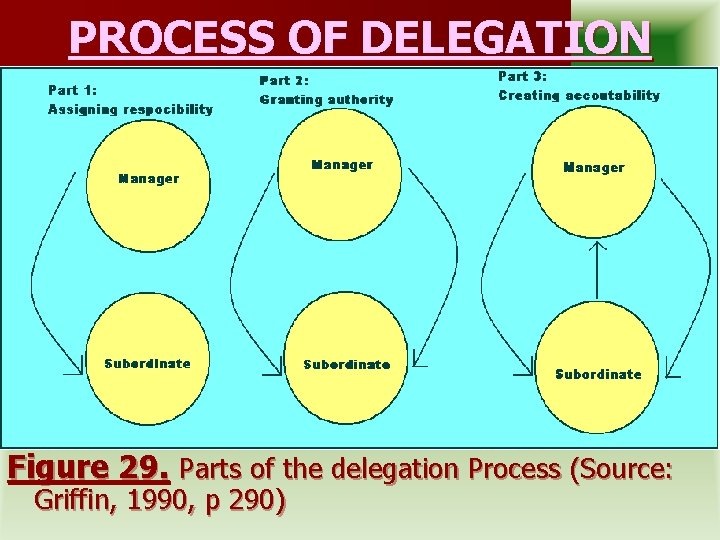
PROCESS OF DELEGATION Figure 29. Parts of the delegation Process (Source: Griffin, 1990, p 290)
DECENTRALISATION OF AUTHORITY The Previous sections focused on the authority relationships, such as line, staff, & functional authority. This section emphasizes the dispersion of authority in the organization. Organization authority is merely the discretion conferred on people to use their judgment to make decisions & issue instructions. Decentralization is the tendency to disperse decision-making authority in an organized structure. It is a fundamental aspect of delegation; to the extent that authority is not delegated, it is centralized. How much should the authority be concentrated in or dispersed throughout the organization? There could be an absolute centralization of authority in one person, but that implies no subordinate managers & therefore no structured organization. Some decentralization exists in all organizations. On the other hand, there cannot be an absolute decentralization, for if managers would delegate all their authority, their status as managers would cease, their position would be eliminated, & there would, again, be no organization. Centralization & decentralization are tendencies, as indicated in Figure 30.
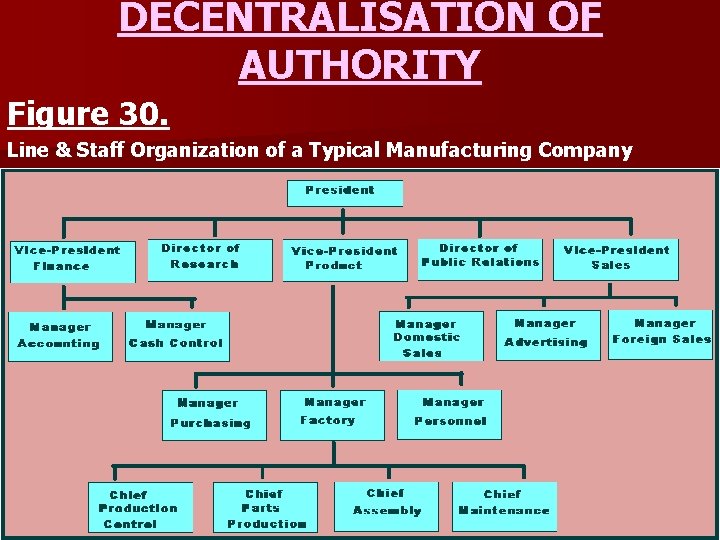
DECENTRALISATION OF AUTHORITY Figure 30. Line & Staff Organization of a Typical Manufacturing Company
Motivation t A Motivation Framework t Theories of Motivation t Special Motivation Techniques
A Motivation Framework Cotemporary approaches to motivation are based on the related concepts of need deficiencies & goal-directed behaviors, as represented in figure 31. The basic motivation framework begins with a need, or a deficiency that a person experiences. For instance, a worker may feel the need to earn a higher salary. This salary-need deficiency triggers a search for ways in which the need might be satisfied. Next, the individual selects one of those ways to satisfy the need deficiency &, in step 3, initiates goal-directed behavior- perhaps asking the boss for a raise. Rewards &/or Punishment will follow the performance &, finally, the person will reassess the need deficiency.
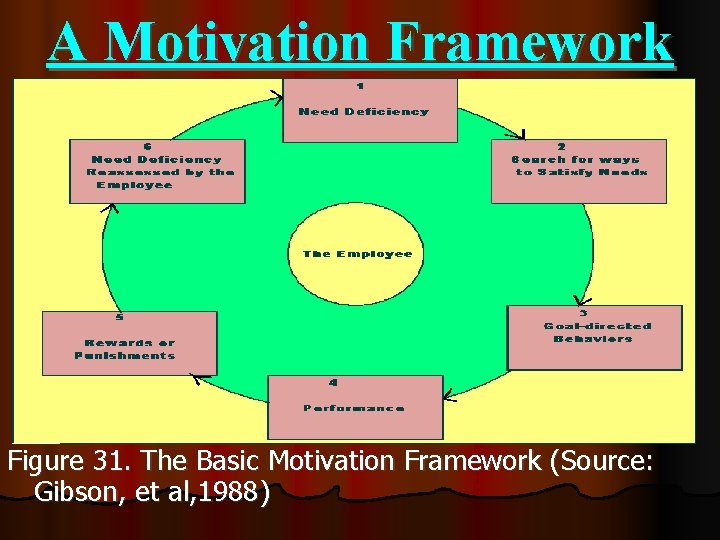
A Motivation Framework Figure 31. The Basic Motivation Framework (Source: Gibson, et al, 1988)
Theories of Motivation • Mc. Gregor’s Theory X & Y • Maslows’ Need Hierarchy • Herzberg’s Two factor Theory • Comparison of Maslow’s and Herzberg’s Theories of Motivation • Elton Mayo and the Hawthorne studies
Mc. Gregor’s Theory X & Y Theory X Assumptions The “traditional” assumptions about the nature of people, according to Mc. Gregor, are included in Theory X as follows: 1. Average human beings have an inherent dislike of work & will avoid it if they can. 2. Because of this human characteristic of disliking the work, most people must be coerced, controlled, directed & threatened with punishment to get them to put forth adequate effort towards the achievement of organizational objectives. 3. Average human beings prefer to be directed, wish to avoid responsibility, have relatively little ambition, & above all want security.
Mc. Gregor’s Theory X & Y Theory Y Assumptions The assumptions under Theory Y as seen by Mc. Gregor are as follows: 1. The expenditure of physical effort & mental effort in work is as natural as play or rest. 2. External control & the threat of punishment are not only means for producing effort towards organizational objectives. People will exercise self-direction & self-control in the service of objectives to which they are committed. 3. The degree of commitment to objectives is in proportion to the size of the rewards associated with their achievement.
Mc. Gregor’s Theory X & Y Theory Y Assumptions 4. Average human beings learn, under proper conditions, not only to accept responsibility but also to seek it. 5. The capacity to exercise a relatively high degree of imagination, ingenuity, & creativity in the solution of organizational problems is widely, not narrowly, distributed in the population. 6. Under the conditions of modern industrial life, the intellectual potentialities of the average human being are only partially utilized. These two sets of assumptions obviously are fundamentally different. Theory X is pessimistic, static, & rigid. Control is primarily external, that is, imposed on the subordinate by the superior. In contrast, Theory Y is optimistic, dynamic, & flexible, with an emphasis on self -direction & the integration of individual needs with organizational demands. There is little doubt that each set of assumptions will affect the way managers carry out their managerial functions & activities.
Maslows’ Need Hierarchy Abraham Maslow (1943) provided the content perspective with a hierarchy of needs theory which postulates that people are motivated by multiple needs, which could be arranged in a hierarchy, as depicted in figure 32. According to Maslow, there are five general categories of needs in order of ascendance: 1. Physiological Needs 2. Security Needs 3. Belongingness Needs 4. Esteem Needs 5. Self-actualization Needs
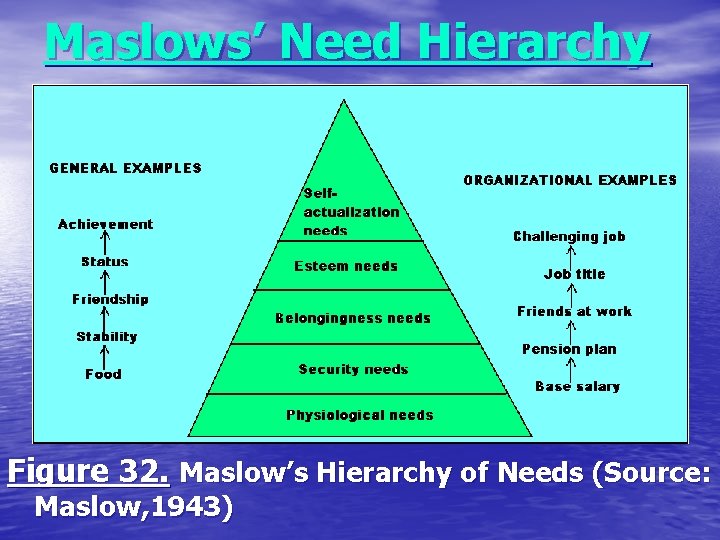
Maslows’ Need Hierarchy Figure 32. Maslow’s Hierarchy of Needs (Source: Maslow, 1943)
Herzberg’s Two factor Theory The principal factors identified in Herzberg’s interviews are listed in figure 33. under two categories- 1. Motivation Factors These factors such as achievement & recognition, were those most often given as principal sources of satisfaction & motivation. When motivation factors were present in the job situation, they could cause satisfaction & motivation; when they were not present, the people felt no satisfaction, as opposed to dissatisfaction. 2. Hygiene Factors These factors were identified in the interviews as sources of dissatisfaction & the lack of motivation. In other words, the respondents identified such factors as supervision & working conditions, when inadequate, as leading to feelings of dissatisfaction. When these factors were perceived as adequate, respondents were not satisfied, but they no longer felt dissatisfied.
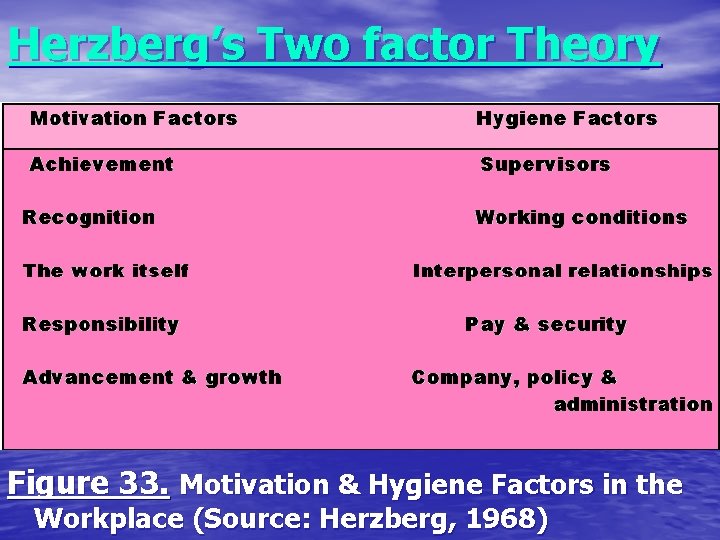
Herzberg’s Two factor Theory Figure 33. Motivation & Hygiene Factors in the Workplace (Source: Herzberg, 1968)
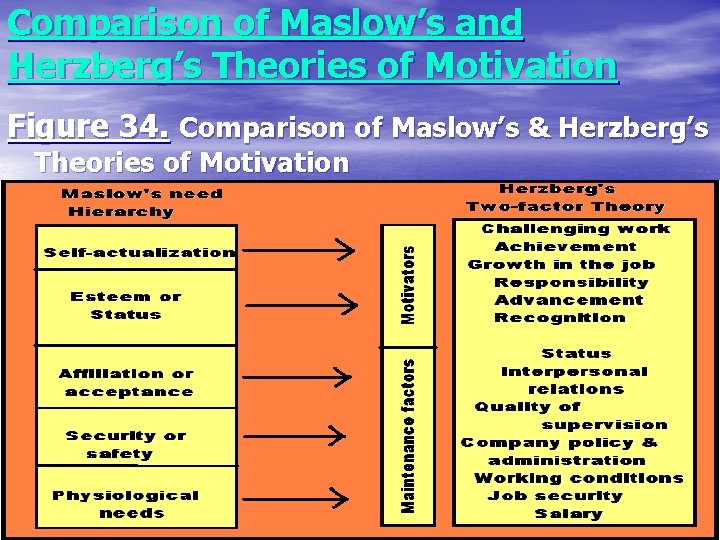
Comparison of Maslow’s and Herzberg’s Theories of Motivation Figure 34. Comparison of Maslow’s & Herzberg’s Theories of Motivation
Elton Mayo and the Hawthorne studies Elton Mayo, a Harvard consultant, & his associates conducted a series of studies at the Hawthorne plant of Western Electric. Originally, the research was an application of Taylor’s management science techniques designed to improve production efficiency. The first study involved the manipulation of illumination for one group of workers & comparing their output with that of another group whose illumination was held constant. To the amazement of Mayo & his colleagues, when the illumination was increased for the test group, production went up in both groups. Furthermore, productivity continued to increase for both groups, even when the illumination was decreased for the test group. Eventually, Mayo & his associates concluded that a new “social setting” created by their tests had accounted for the increase in productivity. Their finding is now known as the Hawthorne Effect or the tendency for people, who are singled out for special attention, to improve their performance. In subsequent tests at Western Electric, Mayo found that the same work factors (such as working conditions, pay, etc. ) can be sources of satisfaction for some workers & dissatisfaction for other workers. Workers were found to restrict their output in order to avoid the displeasure of the group, even at the sacrifice of incentive pay. Thus, the Hawthorne studies were a milestone in establishing the framework for further studies into the field of organizational behavior.
LEADERSHIP • CONCEPT • LEADERSHIP TRAITS • LEADERSHIP STYLES
CONCEPT Leadership may be defined as both a process & a property. As a process, leadership is the use of noncoercive influence to shape or direct the activities of a group towards group goals. As a property, leadership is the set of characteristics attributed to those individuals who are perceived to use that influence successfully. In other words, leaders are those who have the ability to influence the behavior of other without the use of force.
LEADERSHIP TRAITS The first leadership researchers sought a unique set of traits that distinguished leaders like Gandhi & Lincoln from their peers. Hundreds of studies were conducted in the search for these characteristic traits, but most scholars finally concluded that there was no particular set of traits that could be scientifically established. Traits research then diminished, but by the mid 1970 s, a more balanced trait view emerged- although no traits seem to guarantee leadership success, there are some traits that are found to be potentially useful. Gary Yukl (1981) summarized the research by identifying the following traits & skills that are found to be characteristic of successful leaders:
LEADERSHIP TRAITS CHARACTERISTIC OF SUCCESSFUL LEADERS: 1. Adaptable to situations 2. Alert to the social environment 3. Ambitious & achievement-oriented 4. Assertive 5. Cooperative 6. Decisive 7. Dependable 8. Dominant (the desire to influence others) 9. Energetic (high activity level) 10. Persistent 11. Self-confident 12. Tolerant of stress 13. Willing to assume responsibility
LEADERSHIP TRAITS SKILLS CHARACTERISTIC OF SUCCESSFUL LEADERS: 1. Clever (intelligent) 2. Conceptually skilled 3. Creative 4. Diplomatic & tactful 5. Fluent in speaking 6. Knowledgeable about the group task 7. Organized (administrative ability) 8. Persuasive 9. Socially skilled
LEADERSHIP STYLES • Tannenbaum & Schmidt • Managerial Grid
Tannenbaum & Schmidt According to Tannenbaum & Schmidt (1973), the decision participation factor manifests itself in the form of a leadership continuum. As shown in figure 35. , the continuum of leadership behavior ranges from a boss-centred approach to a subordinatecentred approach based on a wide range of situational factors that delimit the amount of subordinate participation. Tannenbaum & Schmidt also determined that subordinate characteristics influence leadership style. They found that a leader can allow greater participation when: 1. Subordinates have a strong desire for independence & freedom of action. 2. Subordinates desire decision-making responsibility. 3. Subordinates relate to 7 identify with the organization’s goals. 4. Subordinates are sufficiently knowledgeable & experienced to deal with the problem efficiently & effectively. 5. Subordinates have prior experience with previous managers that leads them to expect participative treatment.
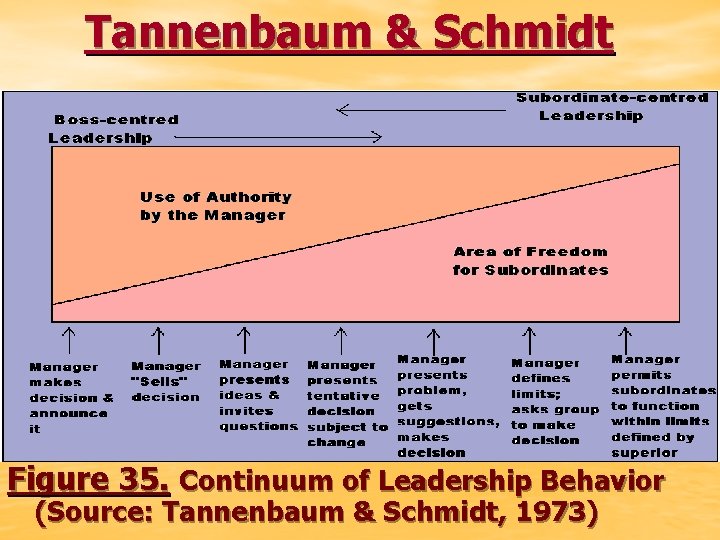
Tannenbaum & Schmidt Figure 35. Continuum of Leadership Behavior (Source: Tannenbaum & Schmidt, 1973)
Managerial Grid The Managerial Grid was developed by Black & Mouton (1985) for determining managerial types. As illustrated in figure 36, the managerial grid is formed by two behavioral dimensions that are similar to those identified in the Michigan & Ohio State studies: (1) concern for production; & (2) concern for people. The concern for production is similar to task-centred & initiating structure behaviors & is judged on a 9 -point scale ranging from high concern (9) to low concern (1). The manager who demonstrates a high concern for production is a task-oriented manager concerned with accomplishing the group’s task. The concern for people is similar to employee-centred & consideration behaviors & is also judged on a 9 -point scale ranging from high concern for people focuses on positive relationships with subordinates.
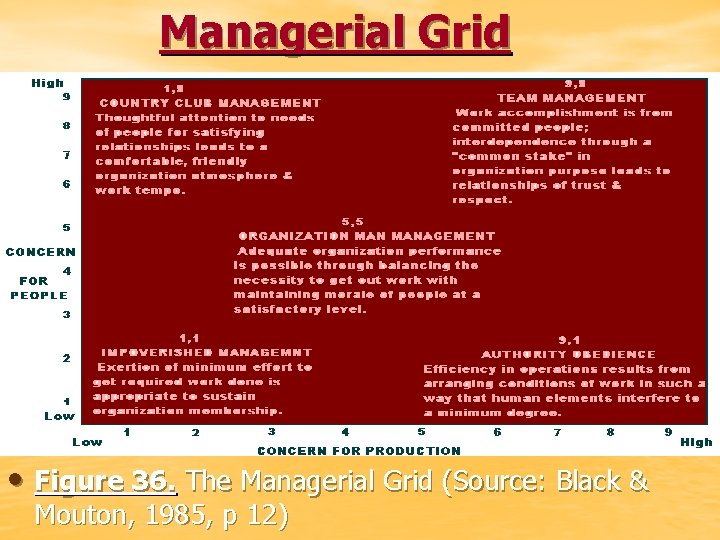
Managerial Grid • Figure 36. The Managerial Grid (Source: Black & Mouton, 1985, p 12)
Managerial Grid When the two dimensions are placed on the managerial grid, 81 possible leadership styles may be identified & analyzed. Black & Mouton believed that five sets of coordinates established the critical managerial styles. v. Impoverished Management v. Authority-Obedience Management v. Country Club Management v. Organization Management v. Team Management
- Slides: 122