Quantum Computing An Introduction Khalid Muhammad History of
- Slides: 26
Quantum Computing: An Introduction Khalid Muhammad • History of Quantum Computing • Bits and Qubits • Problems with the Quantum Machine 1
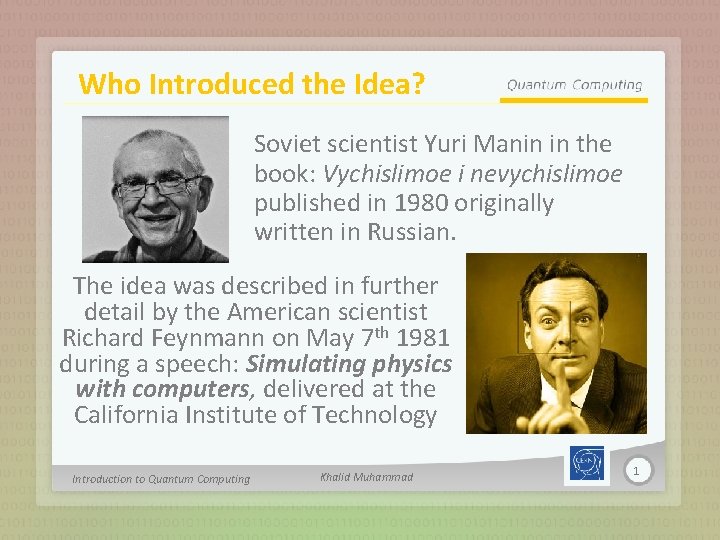
Who Introduced the Idea? Soviet scientist Yuri Manin in the book: Vychislimoe i nevychislimoe published in 1980 originally written in Russian. The idea was described in further detail by the American scientist Richard Feynmann on May 7 th 1981 during a speech: Simulating physics with computers, delivered at the California Institute of Technology Introduction to Quantum Computing Khalid Muhammad 1
What are Quantum Computers? • Normal computers what we may one day come to call ‘classical computers’ follow classical rules of physics which involve only one state. • Quantum computers overcome this through the implementation of quantum mechanical two state systems, where there is no confining to two basic states but instead existence as a superposition. Introduction to Quantum Computing Khalid Muhammad 2
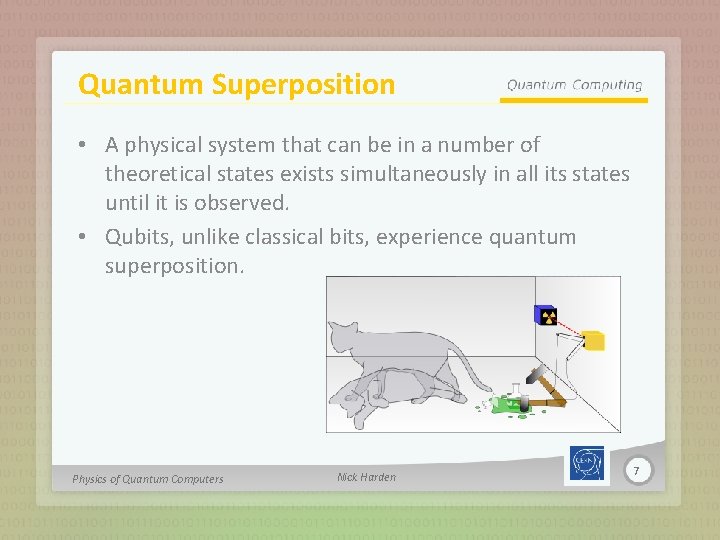
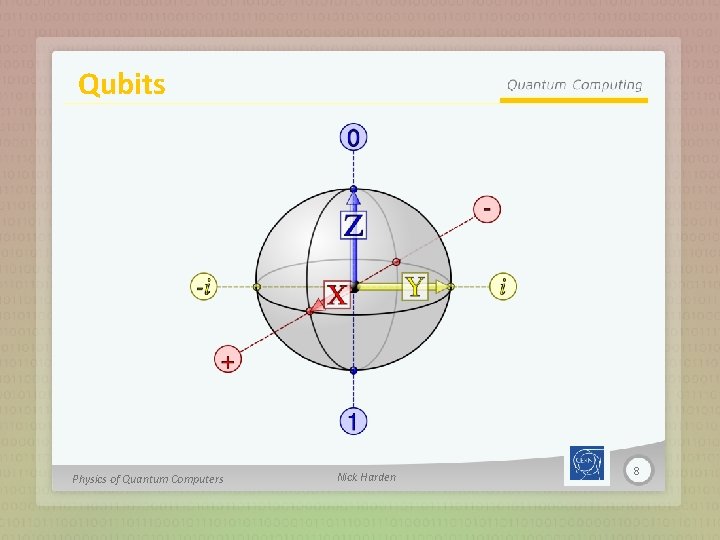
Bits and Qubits • An ordinary bit is a physical system which can be prepared in one of the two different states representing two logical values, for example 0 or 1. • Quantum bits, i. e. qubits however exist in superpositions, thus effectively a qubit is both in state 0 and state 1, reminiscent of Erwin Schrödinger's cat. • Therefore a 16 -bit quantum machine can be in 2^16, or 65, 536, states at once, while a 128 -qubit device could occupy 3. 4 x 10^38 different configurations. Introduction to Quantum Computing Khalid Muhammad 3
Problems with the Quantum machine • Answers given by a quantum machine are probabilistic. Therefore might be wrong and must be checked. • If a given solution is wrong, the calculation must be repeated until the correct answer emerges. This hampers the speed of processing correct information. • However a phenomenon in quantum mechanics known as interference can override such an issue. Introduction to Quantum Computing Khalid Muhammad 4
The physics behind Quantum Computers Nick Harden • Quantum Superposition • Qubits • Quantum Entanglement 6
Quantum Superposition • A physical system that can be in a number of theoretical states exists simultaneously in all its states until it is observed. • Qubits, unlike classical bits, experience quantum superposition. Physics of Quantum Computers Nick Harden 7
Qubits Physics of Quantum Computers Nick Harden 8
Quantum Entanglement • Observing a qubit will collapse its wavefunction, therefore we need to find a way to gain information from qubits without observing them. • We do this through quantum entanglement. Physics of Quantum Computers Nick Harden 9
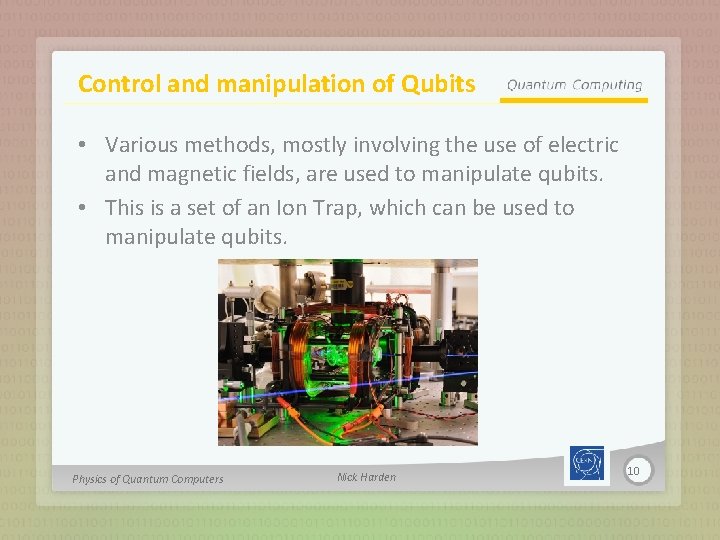
Control and manipulation of Qubits • Various methods, mostly involving the use of electric and magnetic fields, are used to manipulate qubits. • This is a set of an Ion Trap, which can be used to manipulate qubits. Physics of Quantum Computers Nick Harden 10
Computing with Qubits Jaime van Oers • Classical Computing • Logical operators • Qubit Computing 11
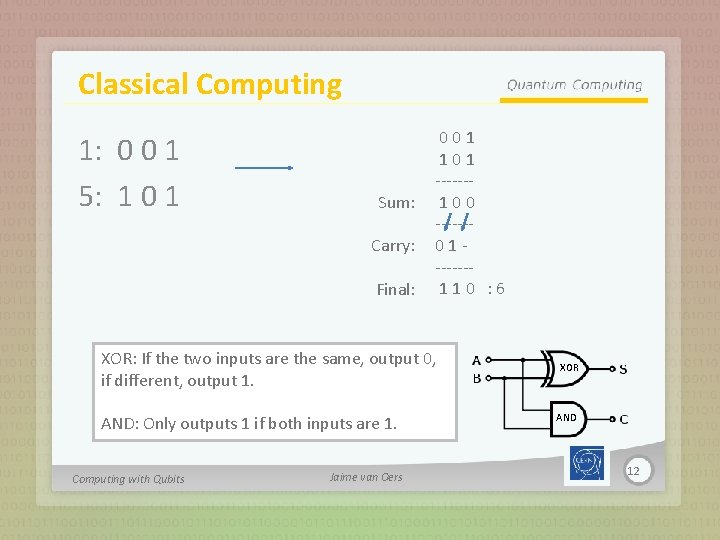
Classical Computing 1: 0 0 1 5: 1 0 1 Sum: Carry: Final: 001 101 ------100 ------01 ------110 : 6 XOR: If the two inputs are the same, output 0, if different, output 1. AND: Only outputs 1 if both inputs are 1. Computing with Qubits Jaime van Oers XOR AND 12
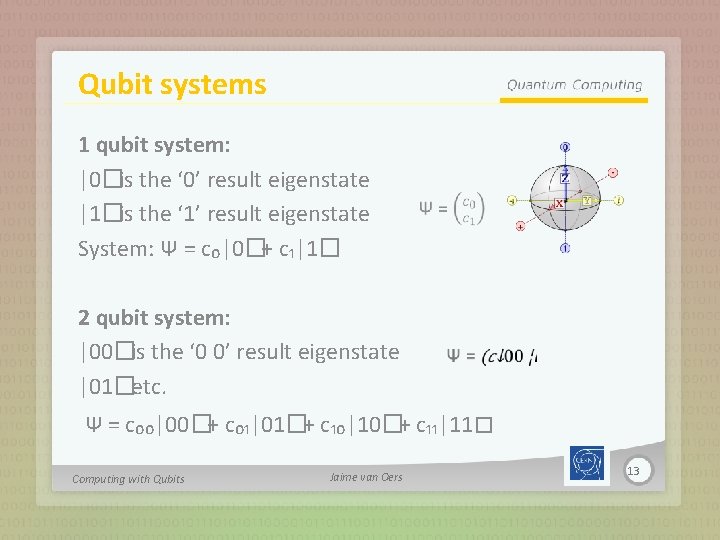
Qubit systems 1 qubit system: |0�is the ‘ 0’ result eigenstate |1�is the ‘ 1’ result eigenstate System: Ψ = c₀|0�+ c₁|1� 2 qubit system: |00�is the ‘ 0 0’ result eigenstate |01�etc. Ψ = c₀₀|00�+ c₀₁|01�+ c₁₀|10�+ c₁₁|11� Computing with Qubits Jaime van Oers 13
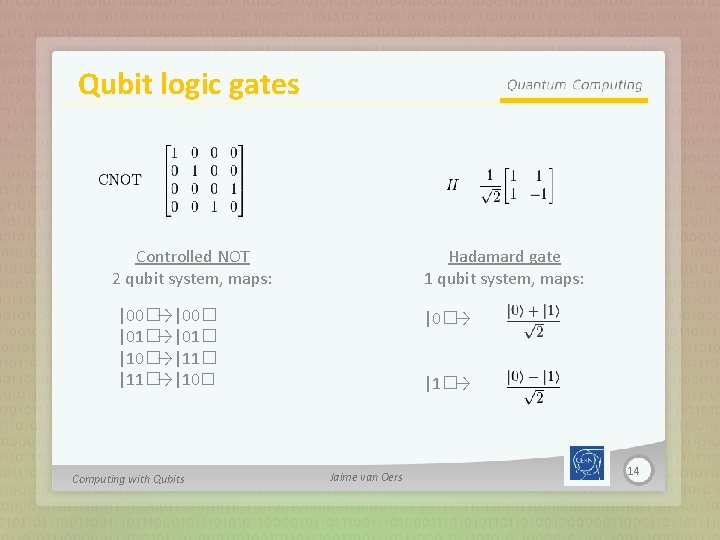
Qubit logic gates Controlled NOT 2 qubit system, maps: Hadamard gate 1 qubit system, maps: |00�→|00� |01�→|01� |10�→|11�→|10� Computing with Qubits |0�→ |1�→ Jaime van Oers 14
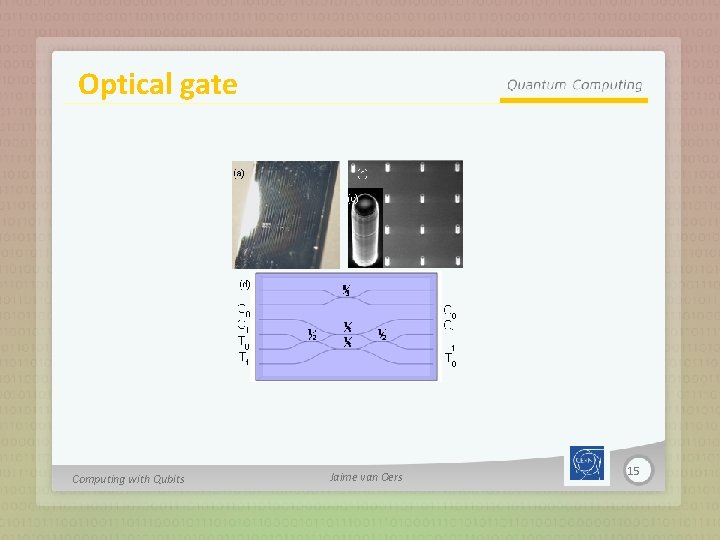
Optical gate Computing with Qubits Jaime van Oers 15
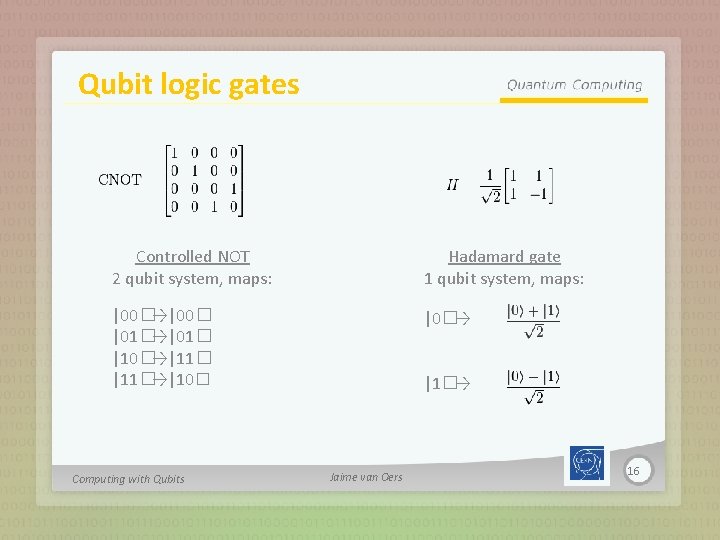
Qubit logic gates Controlled NOT 2 qubit system, maps: Hadamard gate 1 qubit system, maps: |00�→|00� |01�→|01� |10�→|11�→|10� |0�→ Computing with Qubits |1�→ Jaime van Oers 16
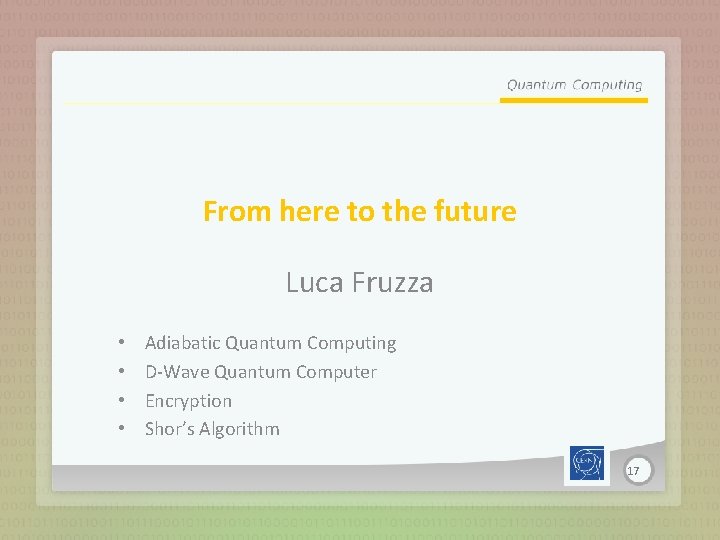
From here to the future Luca Fruzza • • Adiabatic Quantum Computing D-Wave Quantum Computer Encryption Shor’s Algorithm 17
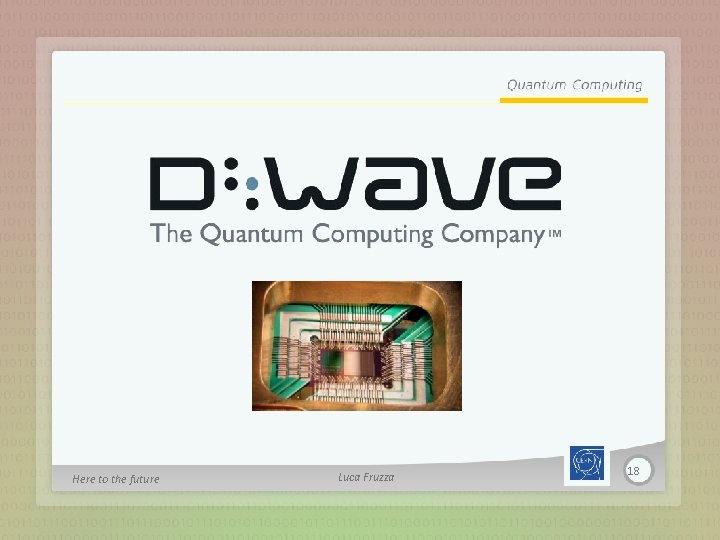
Here to the future Luca Fruzza 18
Adiabatic Quantum Computing • A system using a pool of qubits rather than individual logic gates. • The pool of qubits naturally seeks it’s lowest energy state. • Adjusting a system so that this lowest energy state gives the answer is the premise of AQC. Here to the future Luca Fruzza 19
Making the grade? • In spring 2012 a 4 -bit “quantum computer” factorised 143 into its prime factors, using AQC technology. Here to the future Luca Fruzza 20
But is it spooky enough? • In march of this year, D-Wave developed qubit tunnelling spectroscopy, to determine whether the energy of the qubits in their “quantum computers” correspond to an entangled system. • There is strong evidence to show that Dwave has managed to use entangled qubits. Here to the future Luca Fruzza 21
Defining D-wave as quantum • The entanglement of the system must be shown to yield a superior performance for it to be considered a quantum computer. Here to the future Luca Fruzza 22
Encryption Systems • Encryption systems protect data from third parties using different encoding methods. One of these methods relies on factorising numbers into their prime constituent factors. Here to the future Luca Fruzza 23
Shor’s Algorithm • An algorithm developed by Peter Shor, designed to utilise the Parallelism of the qubit. It’s purpose is to factorise numbers into their prime constituents. Here to the future Luca Fruzza 24
Advantages of the Algorithm • Carried out by a normal computer, the task of factorising numbers larger than 200 into their prime constituents would take in excess of 1, 000, 000 years. • A quantum computer running Shor’s algorithm would do it in 8 hours. Here to the future Luca Fruzza 25
• The consequences of someone having a quantum computer capable of running this today would make the internet a lot less safe place. Here to the future Luca Fruzza 26