
How to Solve Longstanding Open Problems In Quantum
How to Solve Longstanding Open Problems In Quantum Computing Using Only Fourier Analysis Scott Aaronson (MIT) For those who hate quantum: The open problems will be in off-white boxes like this one
Problem 1: BQP PH? Open since Bernstein-Vazirani 1993 “Natural” conjecture would be that BQP PH. But we don’t even have an oracle separation In fact, we don’t even have an oracle A such that BQPA AMA. (Best is BQPA MAA) Furthermore, until recently our only candidate problem was a monstrosity (“Recursive Fourier Sampling”)

New Candidate Problem: “Fourier Checking” Given: Oracle access to functions f, g: {-1, 1}n Promised: Either (i) All f(x) and g(x) values are drawn independently from the Gaussian distribution N(0, 1), or (ii) The f(x)’s are drawn independently from N(0, 1), and g=FT(f) is the Fourier transform of f over Z 2 n (iii) Problem: Decide which, with constant bias. Claim: Fourier Checking is in BQP Conjecture: Fourier Checking is not in PH
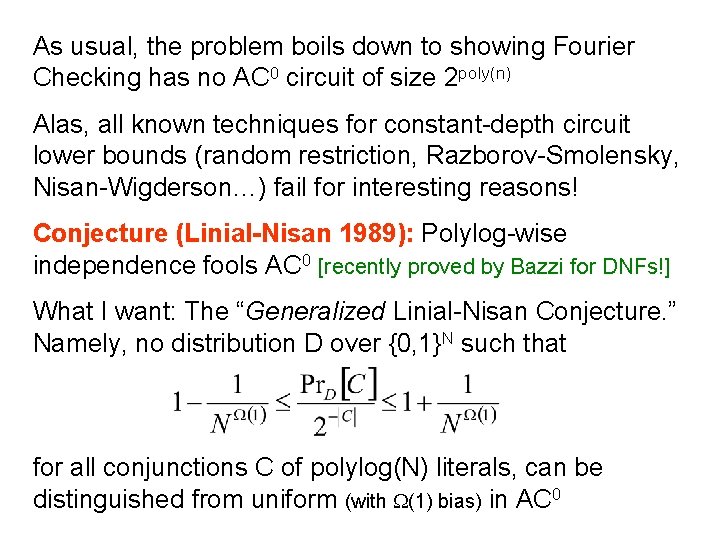
As usual, the problem boils down to showing Fourier Checking has no AC 0 circuit of size 2 poly(n) Alas, all known techniques for constant-depth circuit lower bounds (random restriction, Razborov-Smolensky, Nisan-Wigderson…) fail for interesting reasons! Conjecture (Linial-Nisan 1989): Polylog-wise independence fools AC 0 [recently proved by Bazzi for DNFs!] What I want: The “Generalized Linial-Nisan Conjecture. ” Namely, no distribution D over {0, 1}N such that for all conjunctions C of polylog(N) literals, can be distinguished from uniform (with (1) bias) in AC 0
Problem 2: The Need for Structure in Quantum Speedups Beals et al 1998: Quantum and classical decision tree complexities are polynomially related for all total Boolean functions f: D(f)=O(Q(f)6) Suggests that if you want an exponential quantum speedup, then you need to exploit some structure in the oracle being queried (e. g. periodicity in the case of Shor’s factoring algorithm) But could a quantum computer evaluate an almosttotal function with exponentially fewer queries?
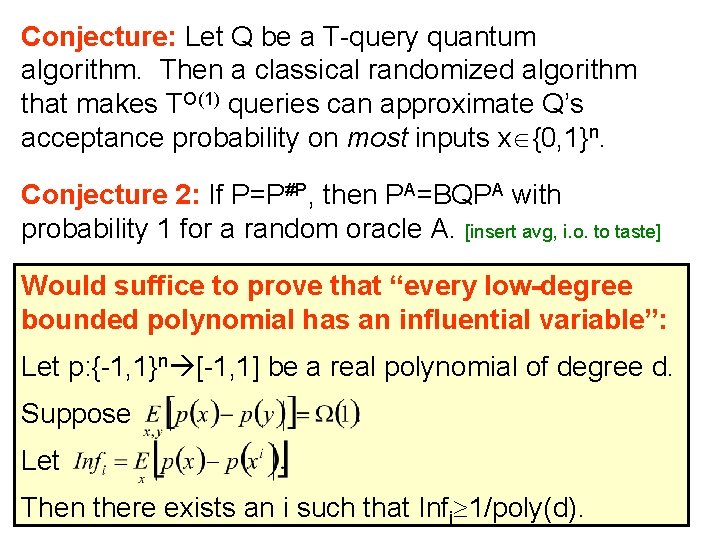
Conjecture: Let Q be a T-query quantum algorithm. Then a classical randomized algorithm that makes TO(1) queries can approximate Q’s acceptance probability on most inputs x {0, 1}n. Conjecture 2: If P=P#P, then PA=BQPA with probability 1 for a random oracle A. [insert avg, i. o. to taste] Would suffice to prove that “every low-degree bounded polynomial has an influential variable”: Let p: {-1, 1}n [-1, 1] be a real polynomial of degree d. Suppose Let Then there exists an i such that Infi 1/poly(d).
What We Know Dinur, Friedgut, Kindler, O’Donnell 2006: Every degree-d polynomial p: {-1, 1}n [-1, 1] with (1) variance has a variable with influence at least 1/exp(d). (Indeed, p is close to an exp(d)-junta. ) O’Donnell, Saks, Schramm, Servedio 2005: Every classical decision tree of depth d has a variable with influence (1/d).
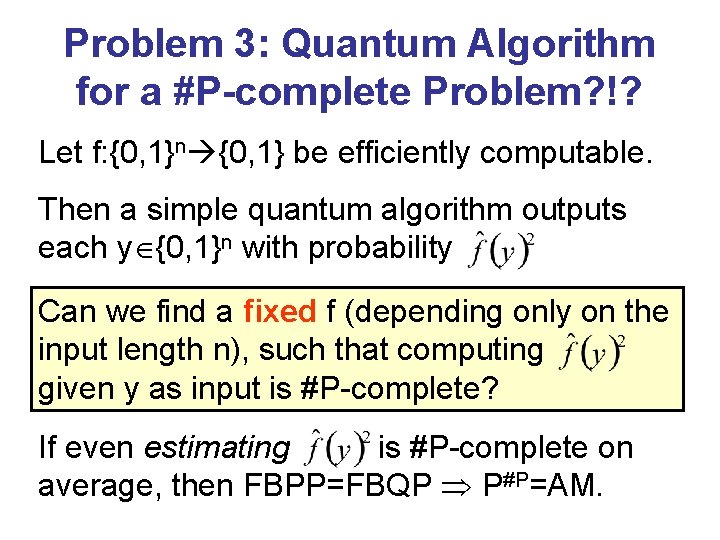
Problem 3: Quantum Algorithm for a #P-complete Problem? !? Let f: {0, 1}n {0, 1} be efficiently computable. Then a simple quantum algorithm outputs each y {0, 1}n with probability Can we find a fixed f (depending only on the input length n), such that computing given y as input is #P-complete? If even estimating is #P-complete on average, then FBPP=FBQP P#P=AM.

Open Problems
- Slides: 9