ChannelAdapted Quantum Error Correction Andrew Fletcher QEC 07
- Slides: 26
Channel-Adapted Quantum Error Correction Andrew Fletcher QEC ‘ 07 21 December 2007 MIT Lincoln Laboratory QEC’ 07 -1 ASF 12/5/2020
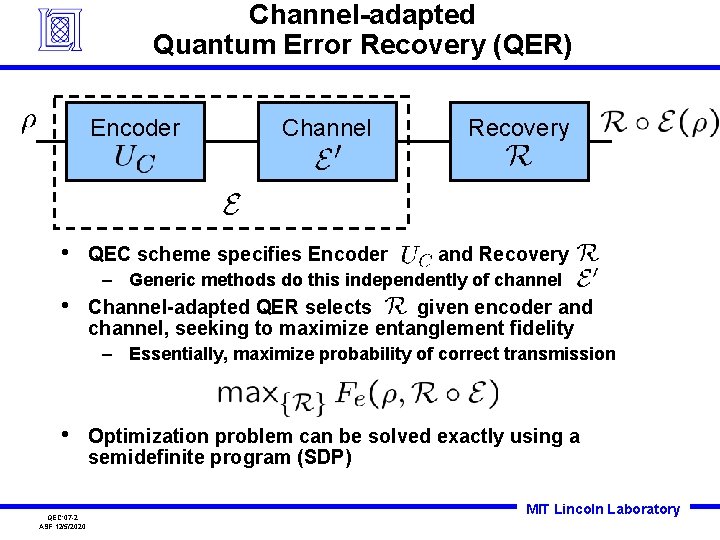
Channel-adapted Quantum Error Recovery (QER) Encoder • Channel QEC scheme specifies Encoder Recovery and Recovery – Generic methods do this independently of channel • Channel-adapted QER selects given encoder and channel, seeking to maximize entanglement fidelity – Essentially, maximize probability of correct transmission • QEC’ 07 -2 ASF 12/5/2020 Optimization problem can be solved exactly using a semidefinite program (SDP) MIT Lincoln Laboratory
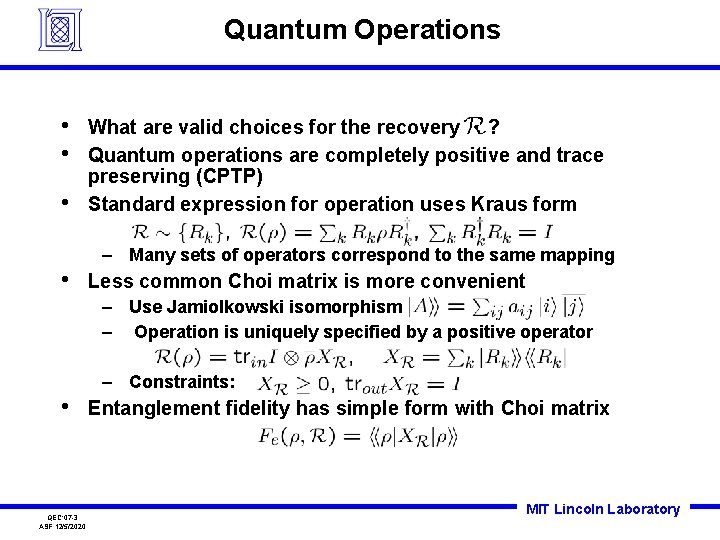
Quantum Operations • • • What are valid choices for the recovery ? Quantum operations are completely positive and trace preserving (CPTP) Standard expression for operation uses Kraus form – Many sets of operators correspond to the same mapping • Less common Choi matrix is more convenient – Use Jamiolkowski isomorphism – Operation is uniquely specified by a positive operator – Constraints: • QEC’ 07 -3 ASF 12/5/2020 Entanglement fidelity has simple form with Choi matrix MIT Lincoln Laboratory
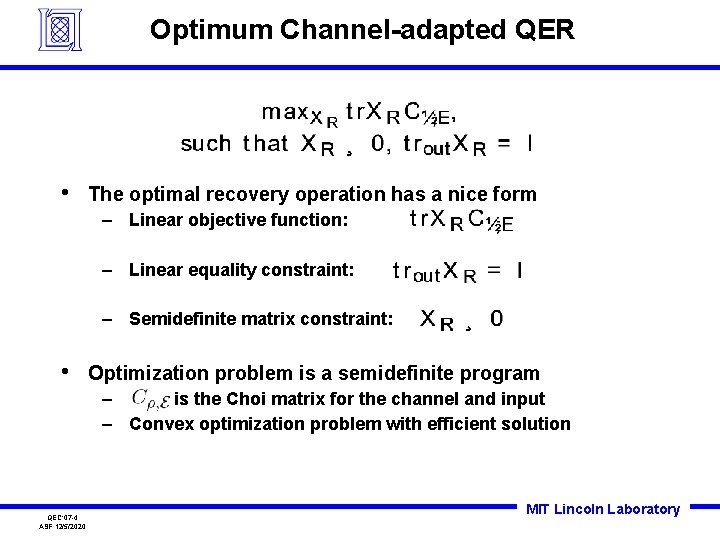
Optimum Channel-adapted QER • The optimal recovery operation has a nice form – Linear objective function: – Linear equality constraint: – Semidefinite matrix constraint: • Optimization problem is a semidefinite program – is the Choi matrix for the channel and input – Convex optimization problem with efficient solution QEC’ 07 -4 ASF 12/5/2020 MIT Lincoln Laboratory
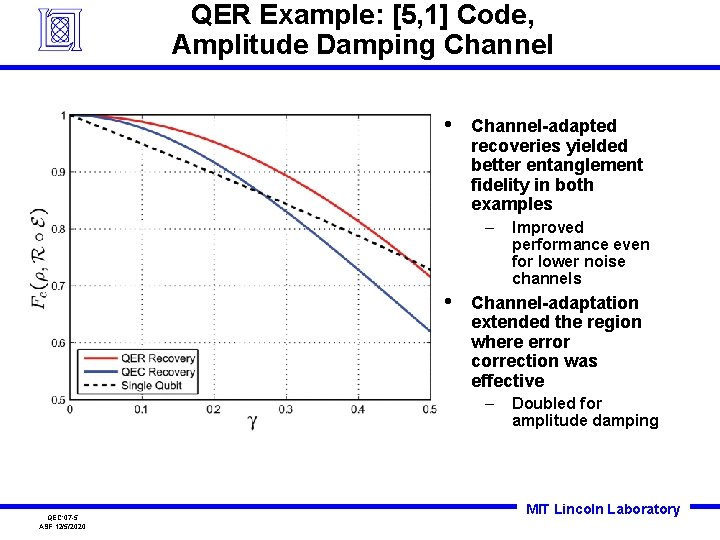
QER Example: [5, 1] Code, Amplitude Damping Channel • Channel-adapted recoveries yielded better entanglement fidelity in both examples – • Channel-adaptation extended the region where error correction was effective – QEC’ 07 -5 ASF 12/5/2020 Improved performance even for lower noise channels Doubled for amplitude damping MIT Lincoln Laboratory
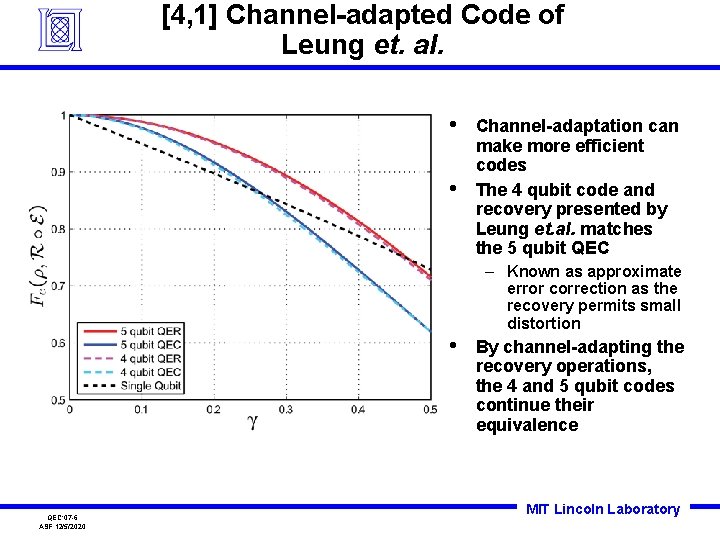
[4, 1] Channel-adapted Code of Leung et. al. • • Channel-adaptation can make more efficient codes The 4 qubit code and recovery presented by Leung et. al. matches the 5 qubit QEC – Known as approximate error correction as the recovery permits small distortion • QEC’ 07 -6 ASF 12/5/2020 By channel-adapting the recovery operations, the 4 and 5 qubit codes continue their equivalence MIT Lincoln Laboratory
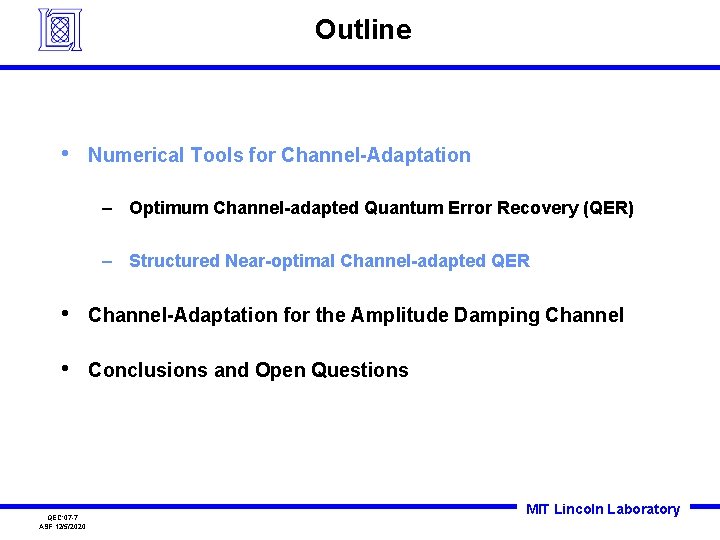
Outline • Numerical Tools for Channel-Adaptation – Optimum Channel-adapted Quantum Error Recovery (QER) – Structured Near-optimal Channel-adapted QER • Channel-Adaptation for the Amplitude Damping Channel • Conclusions and Open Questions QEC’ 07 -7 ASF 12/5/2020 MIT Lincoln Laboratory
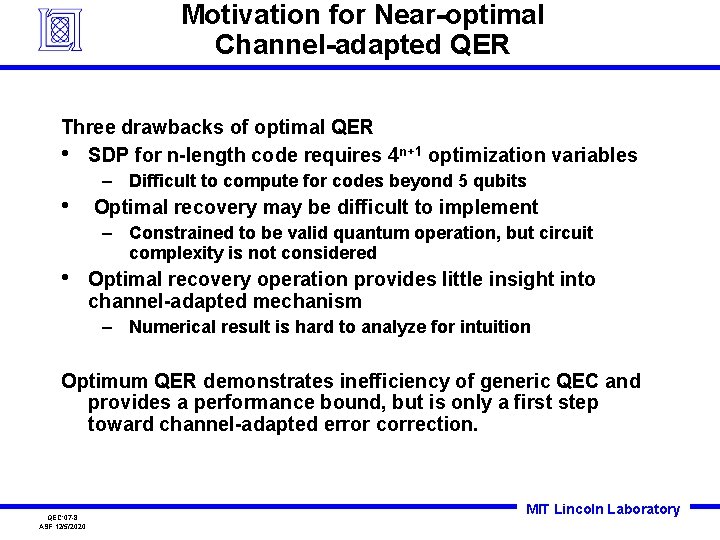
Motivation for Near-optimal Channel-adapted QER Three drawbacks of optimal QER • SDP for n-length code requires 4 n+1 optimization variables – Difficult to compute for codes beyond 5 qubits • Optimal recovery may be difficult to implement – Constrained to be valid quantum operation, but circuit complexity is not considered • Optimal recovery operation provides little insight into channel-adapted mechanism – Numerical result is hard to analyze for intuition Optimum QER demonstrates inefficiency of generic QEC and provides a performance bound, but is only a first step toward channel-adapted error correction. QEC’ 07 -8 ASF 12/5/2020 MIT Lincoln Laboratory
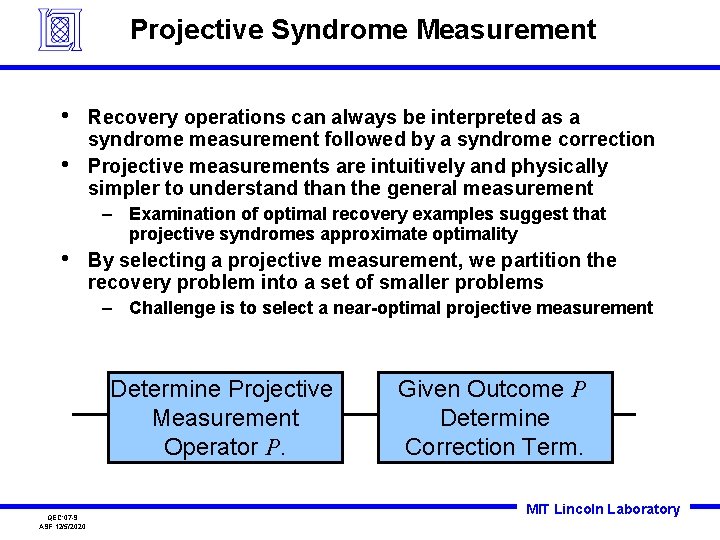
Projective Syndrome Measurement • • Recovery operations can always be interpreted as a syndrome measurement followed by a syndrome correction Projective measurements are intuitively and physically simpler to understand than the general measurement – Examination of optimal recovery examples suggest that projective syndromes approximate optimality • By selecting a projective measurement, we partition the recovery problem into a set of smaller problems – Challenge is to select a near-optimal projective measurement Determine Projective Measurement Operator P. QEC’ 07 -9 ASF 12/5/2020 Given Outcome P Determine Correction Term. MIT Lincoln Laboratory
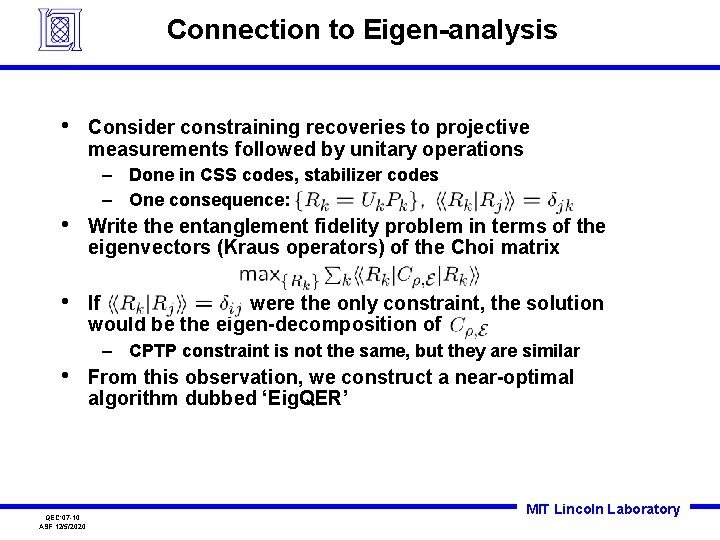
Connection to Eigen-analysis • Consider constraining recoveries to projective measurements followed by unitary operations – Done in CSS codes, stabilizer codes – One consequence: • Write the entanglement fidelity problem in terms of the eigenvectors (Kraus operators) of the Choi matrix • If were the only constraint, the solution would be the eigen-decomposition of – CPTP constraint is not the same, but they are similar • QEC’ 07 -10 ASF 12/5/2020 From this observation, we construct a near-optimal algorithm dubbed ‘Eig. QER’ MIT Lincoln Laboratory
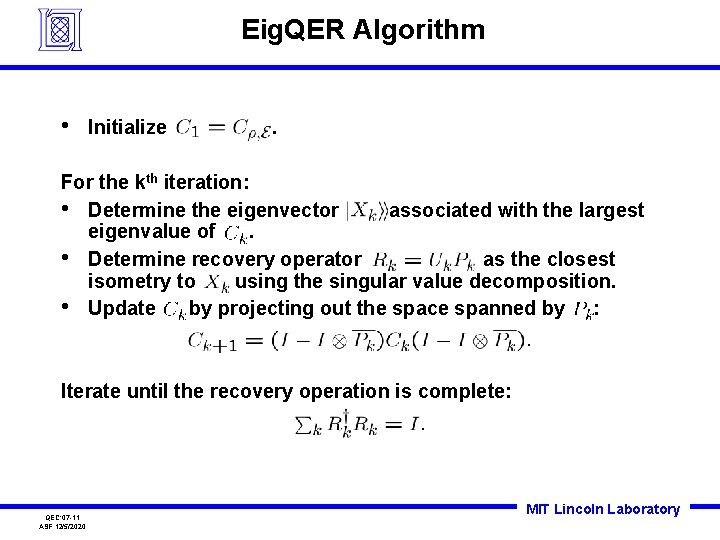
Eig. QER Algorithm • Initialize . For the kth iteration: • Determine the eigenvector associated with the largest eigenvalue of. • Determine recovery operator as the closest isometry to using the singular value decomposition. • Update by projecting out the space spanned by : Iterate until the recovery operation is complete: QEC’ 07 -11 ASF 12/5/2020 MIT Lincoln Laboratory
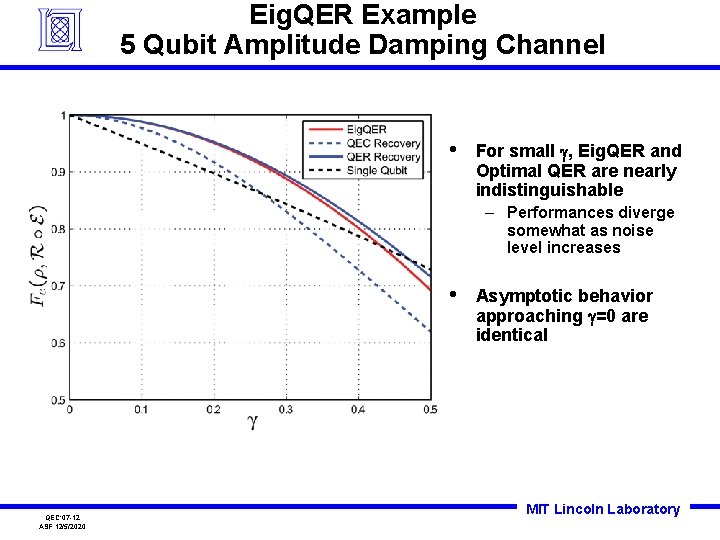
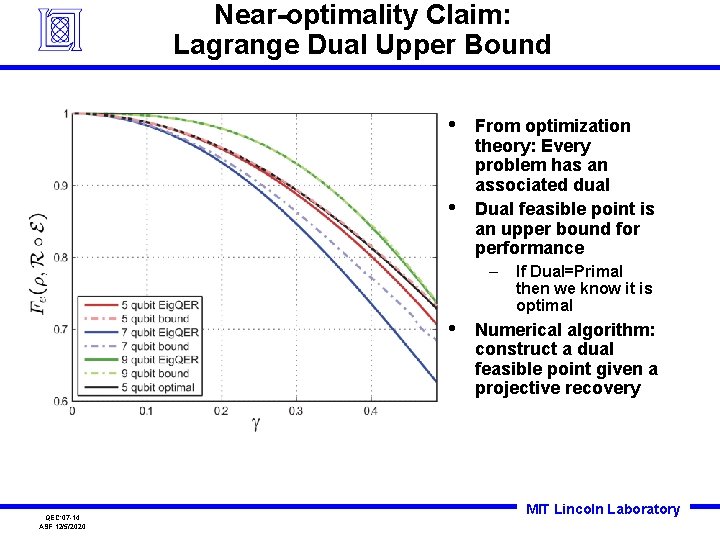
Eig. QER Example 5 Qubit Amplitude Damping Channel • For small g, Eig. QER and Optimal QER are nearly indistinguishable – Performances diverge somewhat as noise level increases • QEC’ 07 -12 ASF 12/5/2020 Asymptotic behavior approaching g=0 are identical MIT Lincoln Laboratory
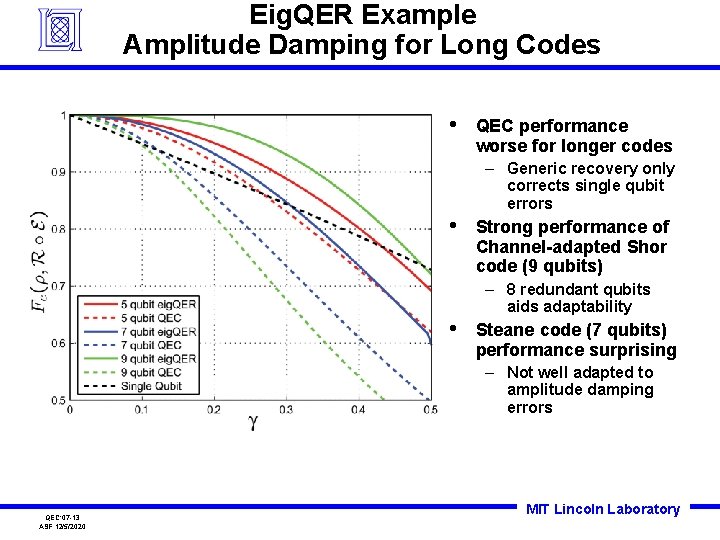
Eig. QER Example Amplitude Damping for Long Codes • QEC performance worse for longer codes – Generic recovery only corrects single qubit errors • Strong performance of Channel-adapted Shor code (9 qubits) – 8 redundant qubits aids adaptability • Steane code (7 qubits) performance surprising – Not well adapted to amplitude damping errors QEC’ 07 -13 ASF 12/5/2020 MIT Lincoln Laboratory
Near-optimality Claim: Lagrange Dual Upper Bound • • From optimization theory: Every problem has an associated dual Dual feasible point is an upper bound for performance – • QEC’ 07 -14 ASF 12/5/2020 If Dual=Primal then we know it is optimal Numerical algorithm: construct a dual feasible point given a projective recovery MIT Lincoln Laboratory
Outline • Numerical Tools for Channel-Adaptation – Optimum Channel-adapted Quantum Error Recovery (QER) – Structured Near-optimal Channel-adapted QER • Channel-Adaptation for the Amplitude Damping Channel • Conclusions and Open Questions QEC’ 07 -15 ASF 12/5/2020 MIT Lincoln Laboratory
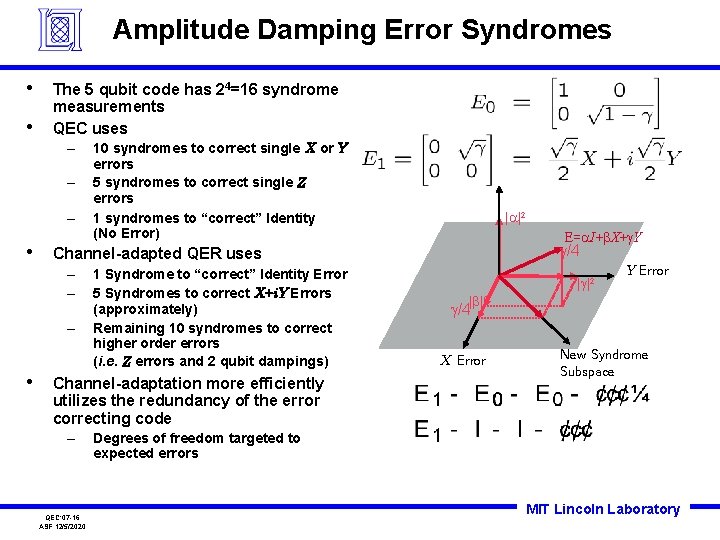
Amplitude Damping Error Syndromes • • The 5 qubit code has 24=16 syndrome measurements QEC uses – – – • Code Subspace |a|2 E=a. I+b. X+g. Y g/4 Channel-adapted QER uses – – – • 10 syndromes to correct single X or Y errors 5 syndromes to correct single Z errors 1 syndromes to “correct” Identity (No Error) 1 Syndrome to “correct” Identity Error 5 Syndromes to correct X+i. Y Errors (approximately) Remaining 10 syndromes to correct higher order errors (i. e. Z errors and 2 qubit dampings) Channel-adaptation more efficiently utilizes the redundancy of the error correcting code – QEC’ 07 -16 ASF 12/5/2020 |g|2 Y Error |b|2 g/4 X Error New Syndrome Subspace Degrees of freedom targeted to expected errors MIT Lincoln Laboratory
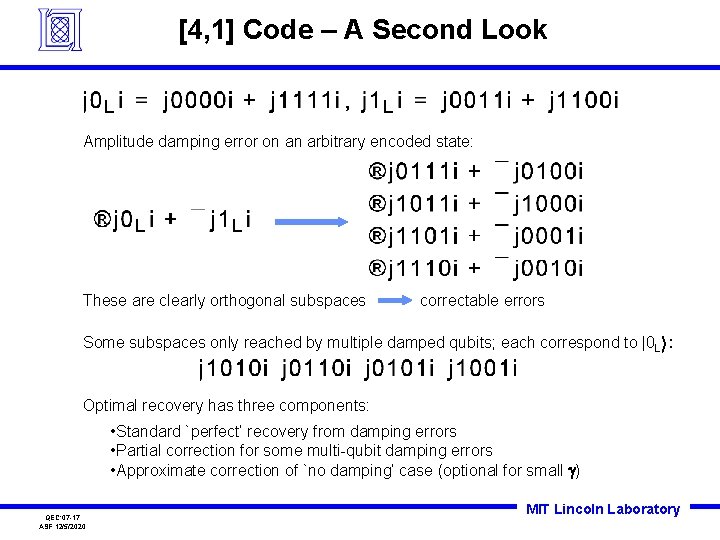
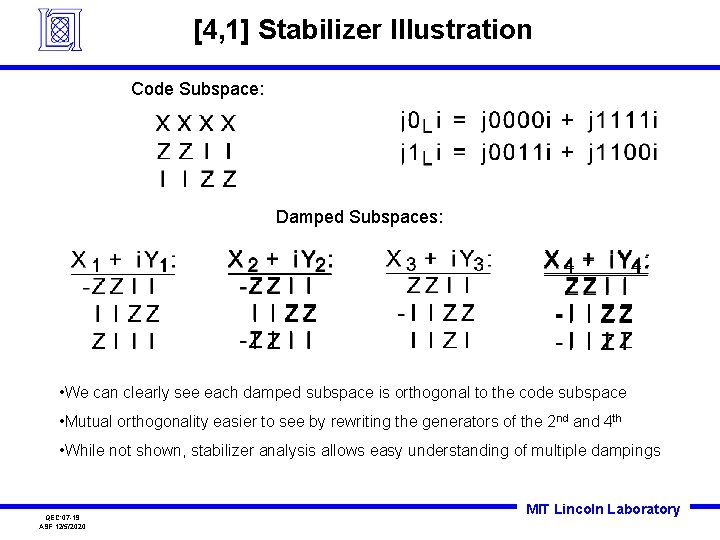
[4, 1] Code – A Second Look Amplitude damping error on an arbitrary encoded state: These are clearly orthogonal subspaces correctable errors Some subspaces only reached by multiple damped qubits; each correspond to |0 Li: Optimal recovery has three components: • Standard `perfect’ recovery from damping errors • Partial correction for some multi-qubit damping errors • Approximate correction of `no damping’ case (optional for small g) QEC’ 07 -17 ASF 12/5/2020 MIT Lincoln Laboratory
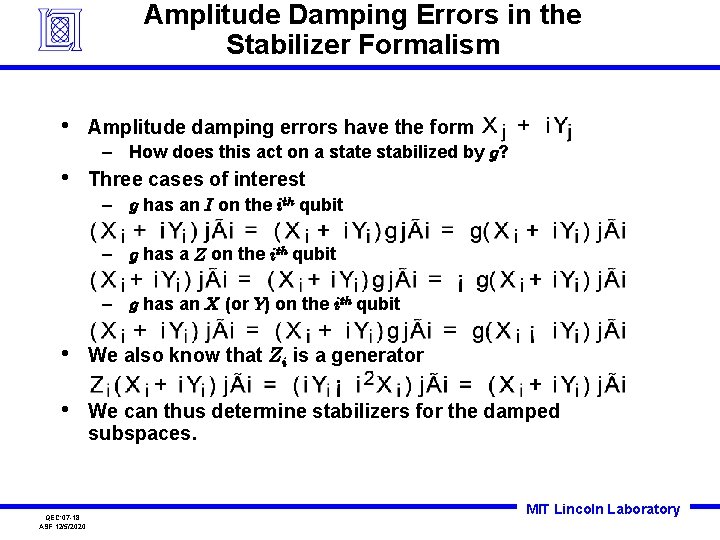
Amplitude Damping Errors in the Stabilizer Formalism • Amplitude damping errors have the form – How does this act on a state stabilized by g? • Three cases of interest – g has an I on the ith qubit – g has a Z on the ith qubit – g has an X (or Y) on the ith qubit • We also know that Zi is a generator • We can thus determine stabilizers for the damped subspaces. QEC’ 07 -18 ASF 12/5/2020 MIT Lincoln Laboratory
[4, 1] Stabilizer Illustration Code Subspace: Damped Subspaces: • We can clearly see each damped subspace is orthogonal to the code subspace • Mutual orthogonality easier to see by rewriting the generators of the 2 nd and 4 th • While not shown, stabilizer analysis allows easy understanding of multiple dampings QEC’ 07 -19 ASF 12/5/2020 MIT Lincoln Laboratory
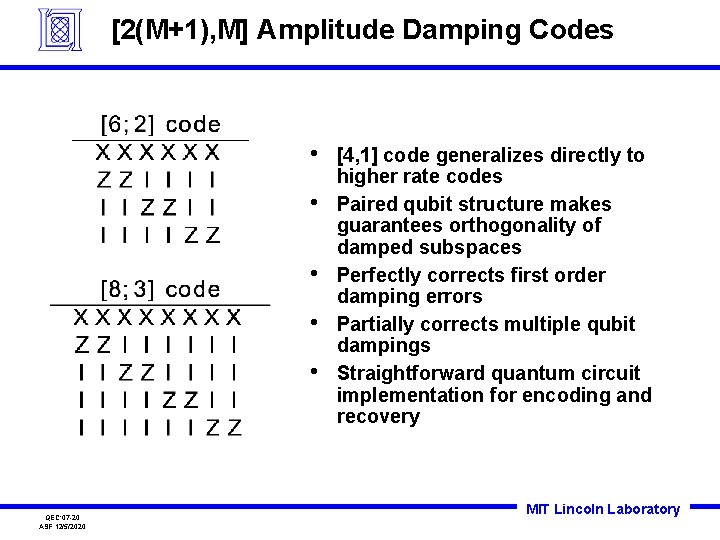
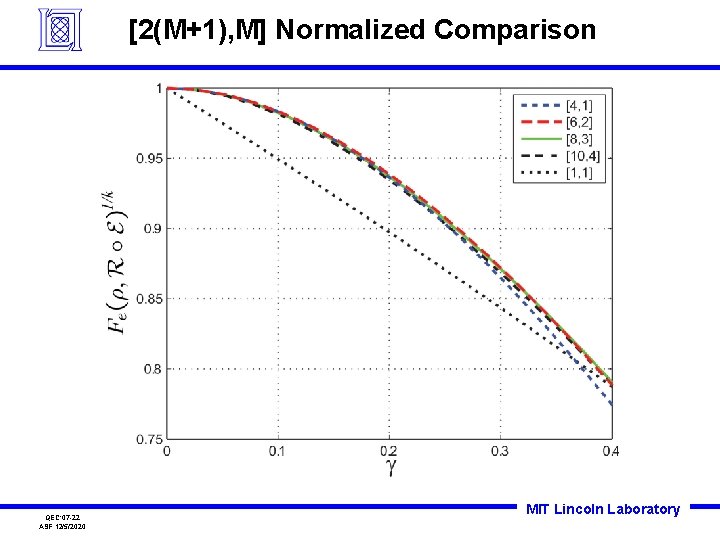
[2(M+1), M] Amplitude Damping Codes • • • QEC’ 07 -20 ASF 12/5/2020 [4, 1] code generalizes directly to higher rate codes Paired qubit structure makes guarantees orthogonality of damped subspaces Perfectly corrects first order damping errors Partially corrects multiple qubit dampings Straightforward quantum circuit implementation for encoding and recovery MIT Lincoln Laboratory
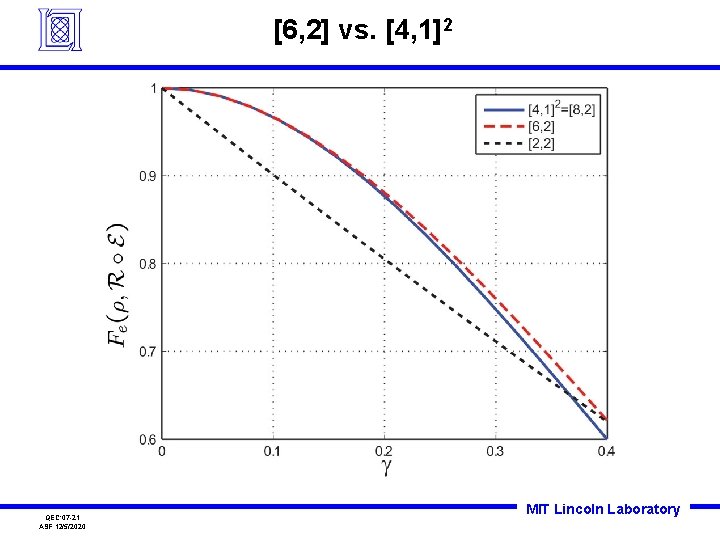
[6, 2] vs. [4, 1]2 QEC’ 07 -21 ASF 12/5/2020 MIT Lincoln Laboratory
[2(M+1), M] Normalized Comparison QEC’ 07 -22 ASF 12/5/2020 MIT Lincoln Laboratory
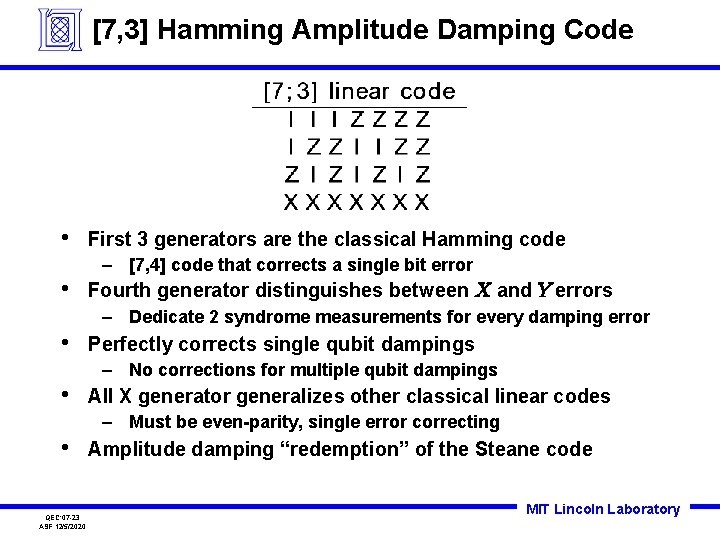
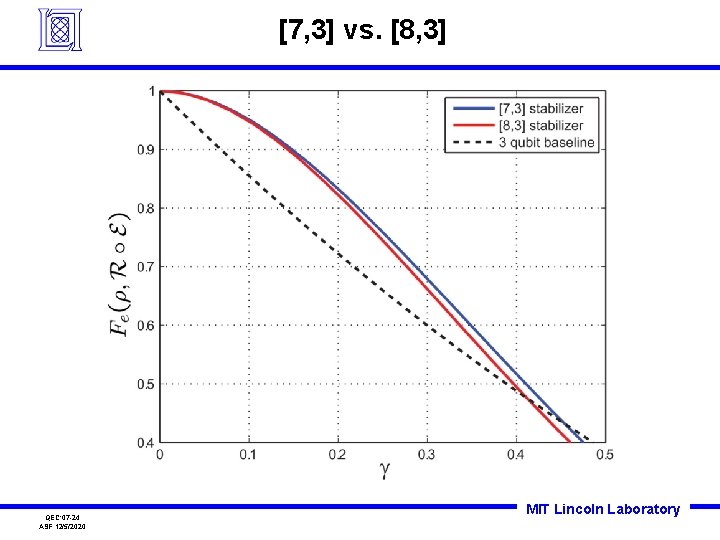
[7, 3] Hamming Amplitude Damping Code • • First 3 generators are the classical Hamming code – [7, 4] code that corrects a single bit error Fourth generator distinguishes between X and Y errors – Dedicate 2 syndrome measurements for every damping error • Perfectly corrects single qubit dampings – No corrections for multiple qubit dampings • All X generator generalizes other classical linear codes – Must be even-parity, single error correcting • QEC’ 07 -23 ASF 12/5/2020 Amplitude damping “redemption” of the Steane code MIT Lincoln Laboratory
[7, 3] vs. [8, 3] QEC’ 07 -24 ASF 12/5/2020 MIT Lincoln Laboratory
Summary • Optimal QER is a semidefinite program – – • • • Structured near-optimal QER operations – – – Phys. Rev. A (to appear) (quant-ph/0708. 3658) Eig. QER, Order. QER, Block SDP QER More computationally scaleable, more physically realizable Performance upper bounds via Lagrange duality – – Gershgorin upper bound Iterated dual bound Amplitude damping channel-adapted codes – – – QEC’ 07 -25 ASF 12/5/2020 Phys. Rev. A 75(1): 021338, 2007 (quant-ph/0606035) Optimality conditions Robustness analysis Analytically constructed optimal QER for stabilizer code, Pauli errors, and completely mixed input Analysis of optimal QER for [4, 1] code of Leung et. al. [2(M+1), M] stabilizer codes Even parity classical linear codes (1 -error correcting) Both classes have Clifford group recovery operations quant-ph/0710. 1052 MIT Lincoln Laboratory
Open Question: Channel-adapted Fault Tolerant Quantum Computing • QEC is the foundation for research in fault tolerant quantum computing (FTQC) – QEC models noisy channel between two perfect quantum computers – FTQC explores computing with faulty quantum gates • Channel-adapted theory will have practical value when extended to channel-adapted FTQC – Must demonstrate universal set of fault tolerant gates – Must show that errors do not propagate • Requires determining a physical noise model and designing a channel-adapted scheme – Principles and tools of QEC will be the launching point for this analysis QEC’ 07 -26 ASF 12/5/2020 MIT Lincoln Laboratory