Quantities and units Dose limits Laszlo Sagi Radiation


- Slides: 27
Quantities and units Dose limits Laszlo Sagi Radiation Safety and Monitoring Section Division of Radiation, Transport and Waste Safety Department of Nuclear Safety and Security IAEA International Atomic Energy Agency
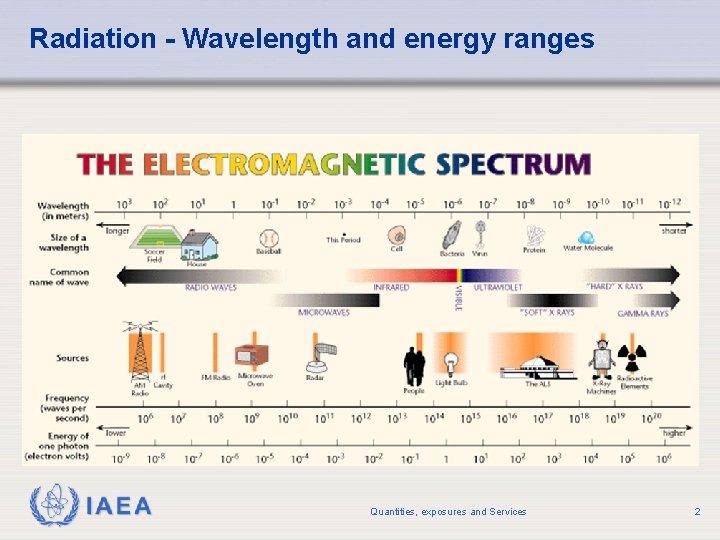
Radiation - Wavelength and energy ranges IAEA Quantities, exposures and Services 2
Sources of Ionizing Radiation with energy sufficient to cause ionization is called ‘ionizing radiation’ • Radionuclides emission of alpha, beta, gamma and/or neutron radiation • X-ray devices emission of photons • Accelerators emission of photons and particle radiation • Cosmic radiation IAEA Quantities, exposures and Services 3
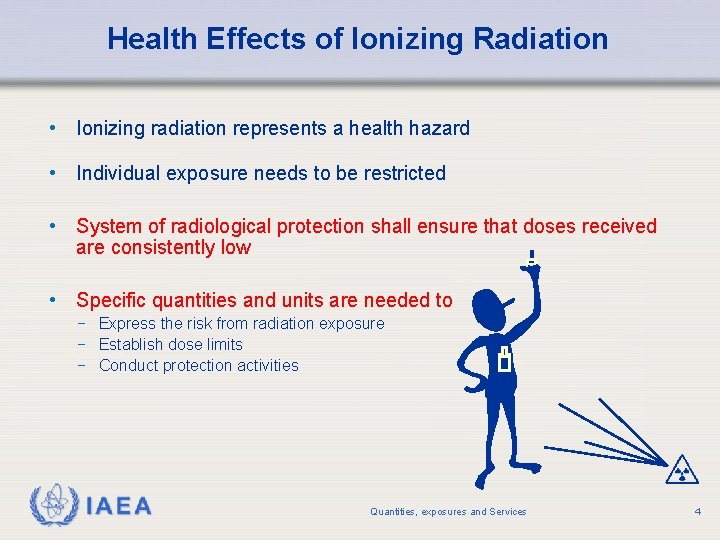
Health Effects of Ionizing Radiation • Ionizing radiation represents a health hazard • Individual exposure needs to be restricted • System of radiological protection shall ensure that doses received are consistently low • Specific quantities and units are needed to − Express the risk from radiation exposure − Establish dose limits − Conduct protection activities IAEA Quantities, exposures and Services 4
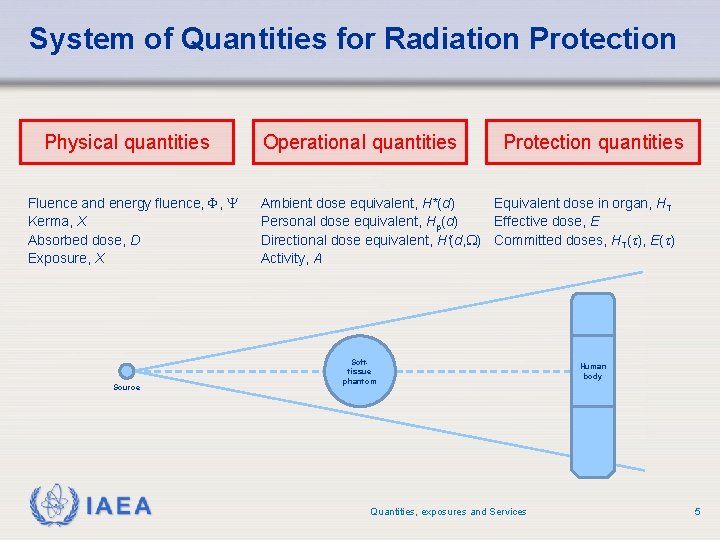
System of Quantities for Radiation Protection Physical quantities Fluence and energy fluence, F, Kerma, X Absorbed dose, D Exposure, X Source IAEA Operational quantities Protection quantities Ambient dose equivalent, H*(d) Equivalent dose in organ, HT Personal dose equivalent, Hp(d) Effective dose, E Directional dose equivalent, H'(d, ) Committed doses, HT(t), E(t) Activity, A Softtissue phantom Quantities, exposures and Services Human body 5
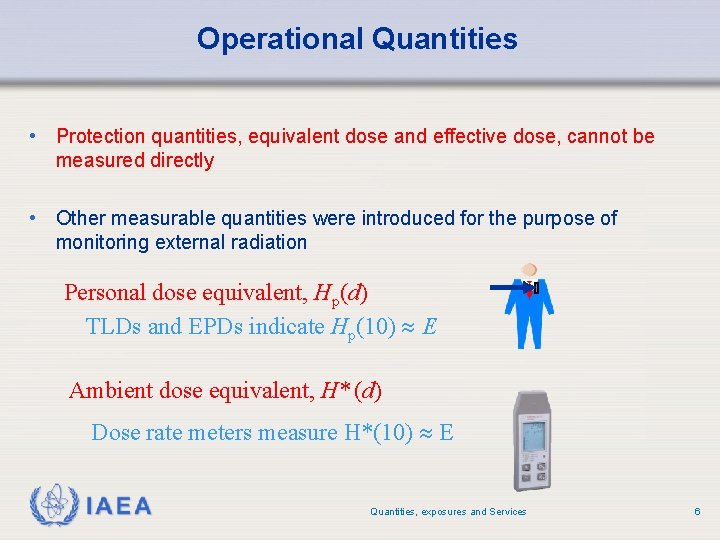
Operational Quantities • Protection quantities, equivalent dose and effective dose, cannot be measured directly • Other measurable quantities were introduced for the purpose of monitoring external radiation Personal dose equivalent, Hp(d) TLDs and EPDs indicate Hp(10) E Ambient dose equivalent, H* (d) Dose rate meters measure H*(10) E IAEA Quantities, exposures and Services 6
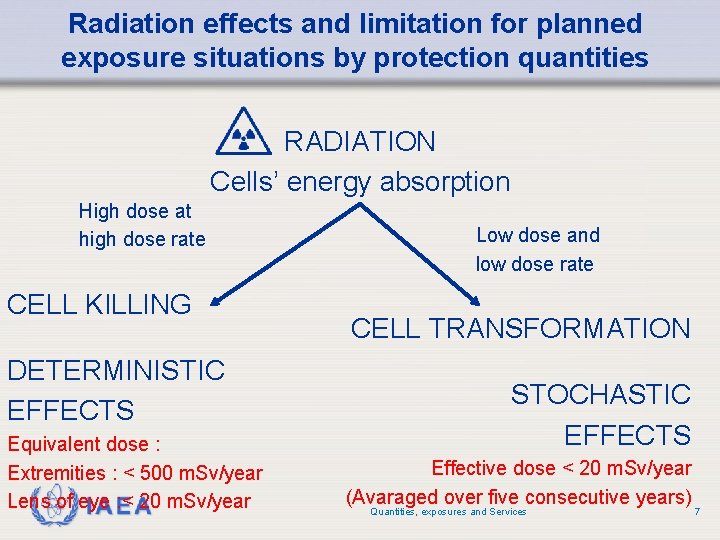
Radiation effects and limitation for planned exposure situations by protection quantities RADIATION Cells’ energy absorption High dose at high dose rate CELL KILLING DETERMINISTIC EFFECTS Equivalent dose : Extremities : < 500 m. Sv/year Lens of eye : < 20 m. Sv/year IAEA Low dose and low dose rate CELL TRANSFORMATION STOCHASTIC EFFECTS Effective dose < 20 m. Sv/year (Avaraged over five consecutive years) Quantities, exposures and Services 7
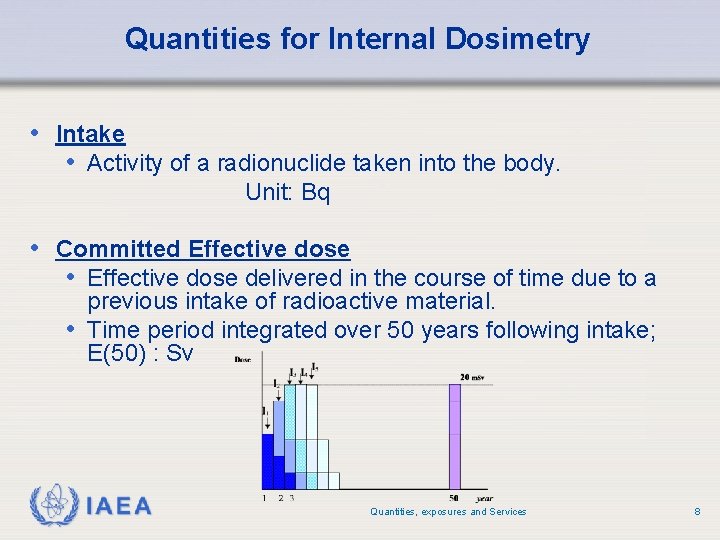
Quantities for Internal Dosimetry • Intake • Activity of a radionuclide taken into the body. Unit: Bq • Committed Effective dose • Effective dose delivered in the course of time due to a previous intake of radioactive material. • Time period integrated over 50 years following intake; E(50) : Sv IAEA Quantities, exposures and Services 8
External Radiation • To assess the dose distribution in the body, ionizing radiation may be classified as follows • Weakly penetrating radiation − Beta radiation and low-energy photons, e. g. X rays ≤ 20 ke. V − Alpha particles are of no concern for external radiation − Organs at risk: Lens of the eye, skin, shallow organs, e. g. testes • Strongly penetrating radiation − High-energy photons > 20 ke. V, e. g. gamma radiation from 137 Cs or 60 Co − Neutrons of any energy − Organs at risk: All body organs IAEA Quantities, exposures and Services 9
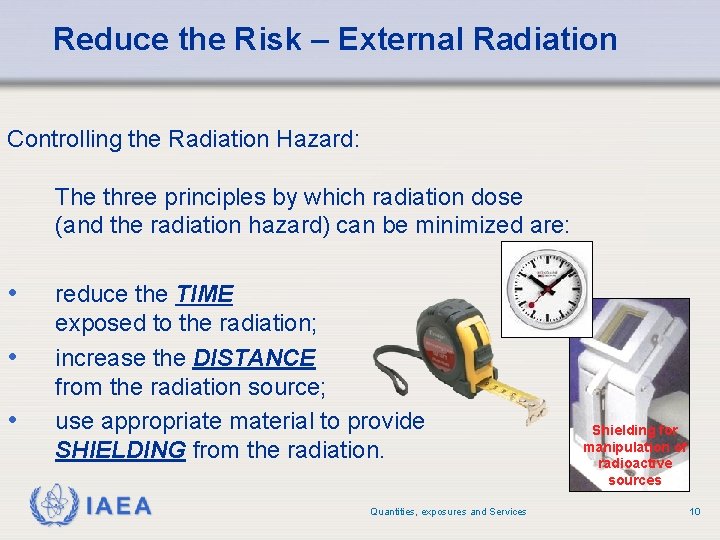
Reduce the Risk – External Radiation Controlling the Radiation Hazard: The three principles by which radiation dose (and the radiation hazard) can be minimized are: • • • reduce the TIME exposed to the radiation; increase the DISTANCE from the radiation source; use appropriate material to provide SHIELDING from the radiation. IAEA Quantities, exposures and Services Shielding for manipulation of radioactive sources 10
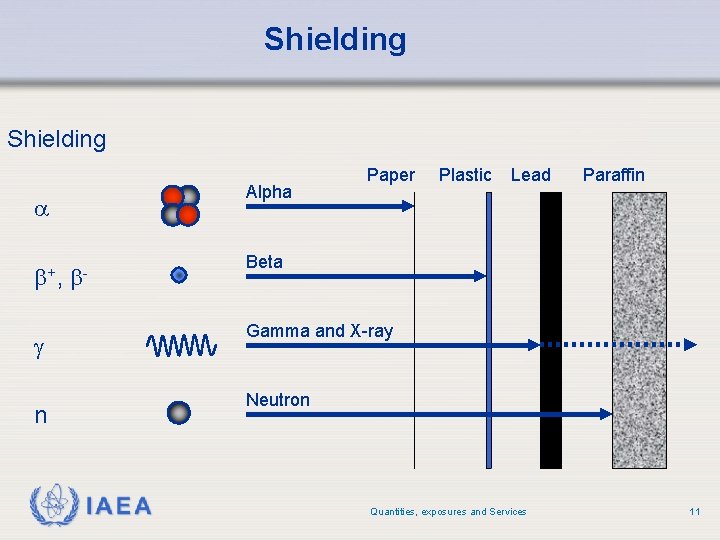
Shielding Alpha a b+, b- Paper Plastic Lead Paraffin Beta Gamma and X-ray g Neutron n IAEA Quantities, exposures and Services 11
Internal exposure Routes of Entry, Transfer and Excretion Extrinsic removal Inhalation Exhalation Ingestion Absorption via skin Sweat Wound Urine Faeces IAEA Quantities, exposures and Services 12
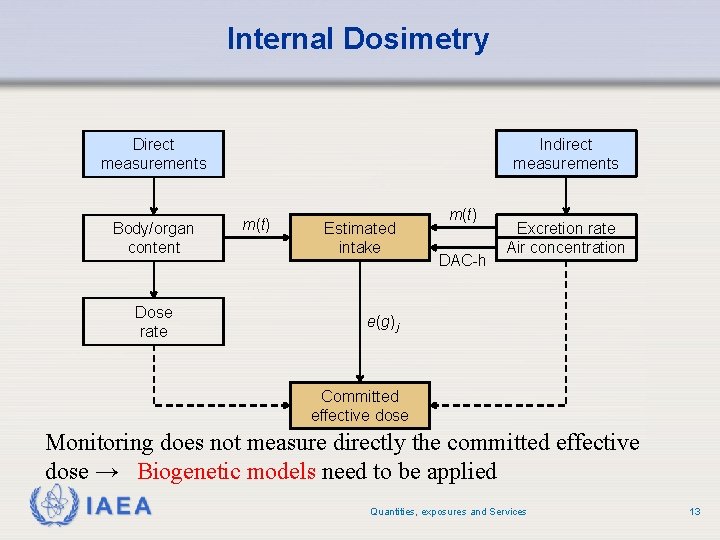
Internal Dosimetry Direct measurements Body/organ content Dose rate Indirect measurements m(t) Estimated intake m(t) DAC-h Excretion rate Air concentration e(g)j Committed effective dose Monitoring does not measure directly the committed effective dose → Biogenetic models need to be applied IAEA Quantities, exposures and Services 13
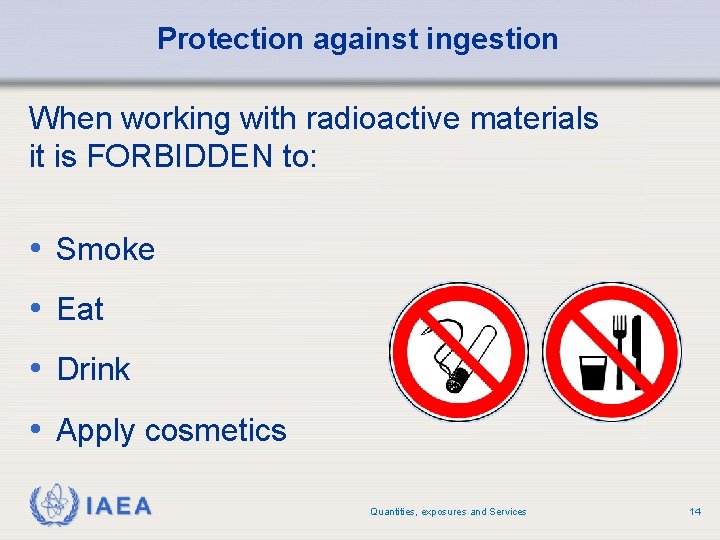
Protection against ingestion When working with radioactive materials it is FORBIDDEN to: • Smoke • Eat • Drink • Apply cosmetics IAEA Quantities, exposures and Services 14
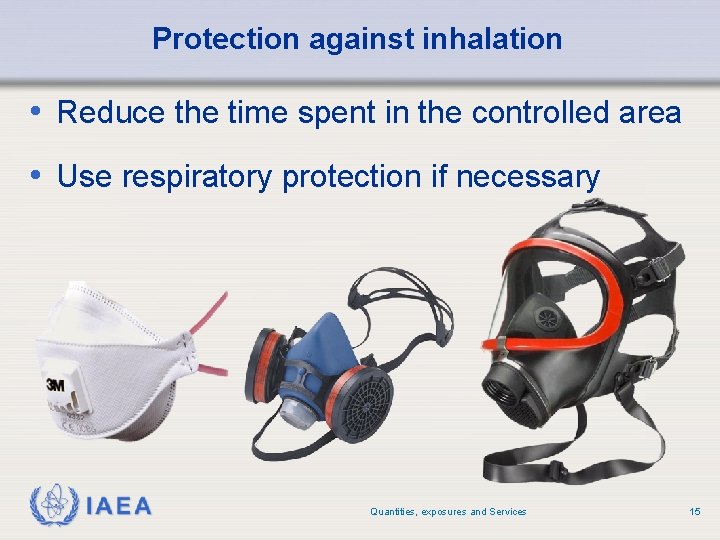
Protection against inhalation • Reduce the time spent in the controlled area • Use respiratory protection if necessary IAEA Quantities, exposures and Services 15
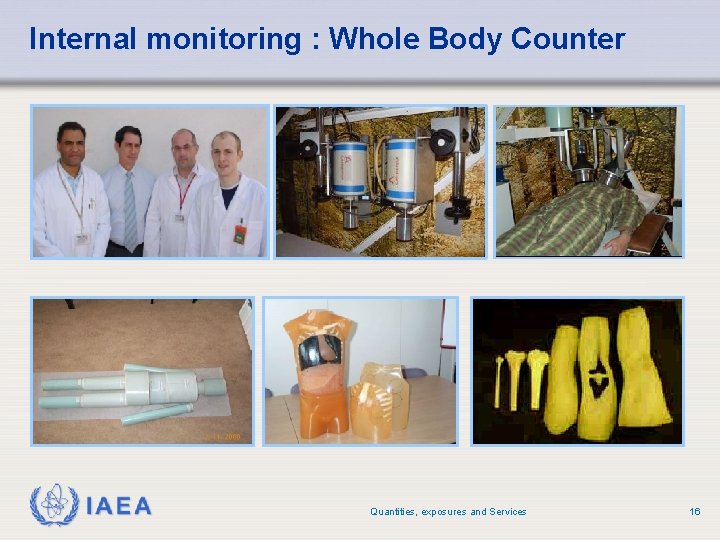
Internal monitoring : Whole Body Counter IAEA Quantities, exposures and Services 16
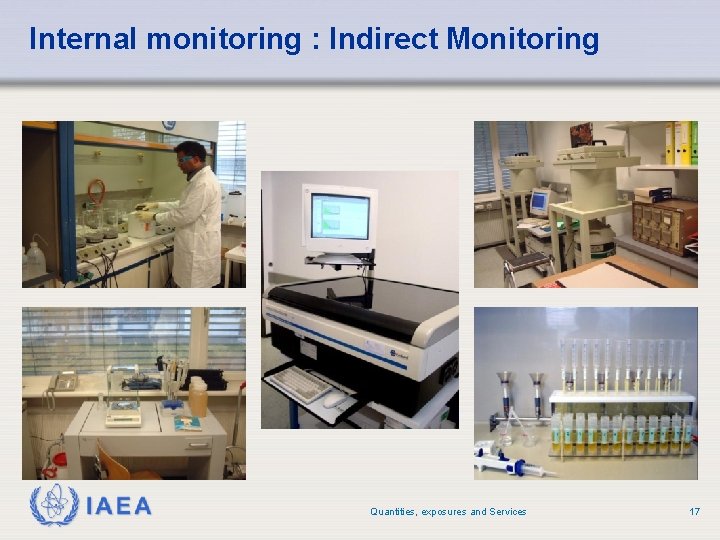
Internal monitoring : Indirect Monitoring IAEA Quantities, exposures and Services 17
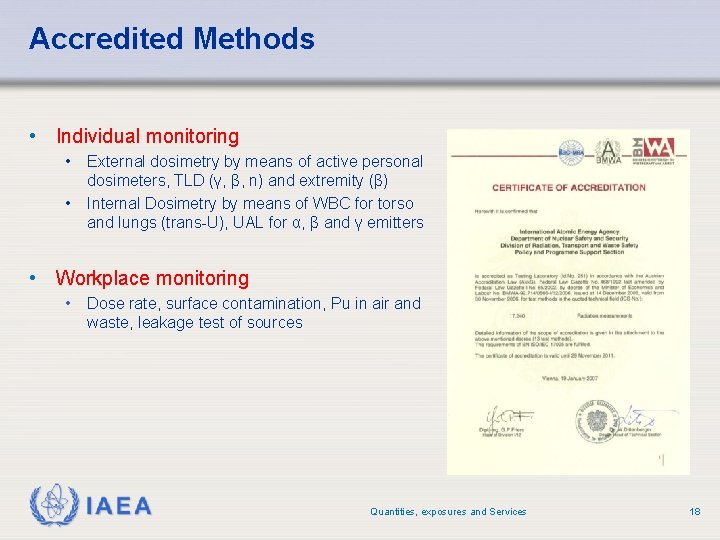
Accredited Methods • Individual monitoring • External dosimetry by means of active personal • dosimeters, TLD (γ, β, n) and extremity (β) Internal Dosimetry by means of WBC for torso and lungs (trans-U), UAL for α, β and γ emitters • Workplace monitoring • Dose rate, surface contamination, Pu in air and waste, leakage test of sources IAEA Quantities, exposures and Services 18
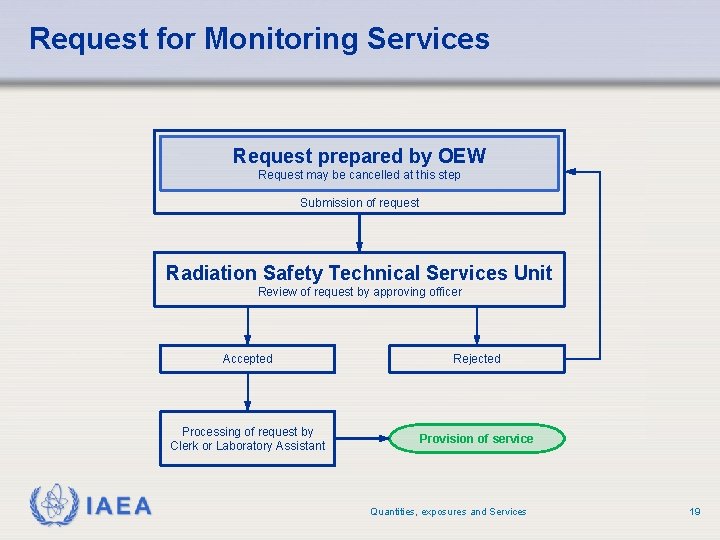
Request for Monitoring Services Request prepared by OEW Request may be cancelled at this step Submission of request Radiation Safety Technical Services Unit Review of request by approving officer IAEA Accepted Rejected Processing of request by Clerk or Laboratory Assistant Provision of service Quantities, exposures and Services 19
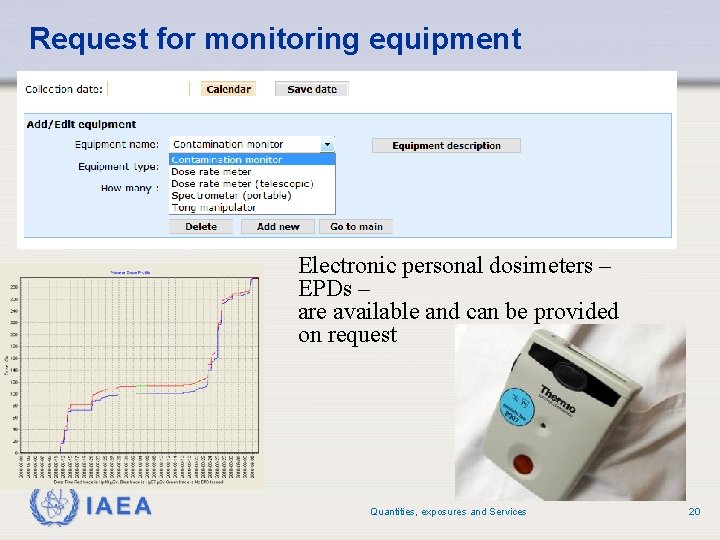
Request for monitoring equipment Electronic personal dosimeters – EPDs – are available and can be provided on request IAEA Quantities, exposures and Services 20
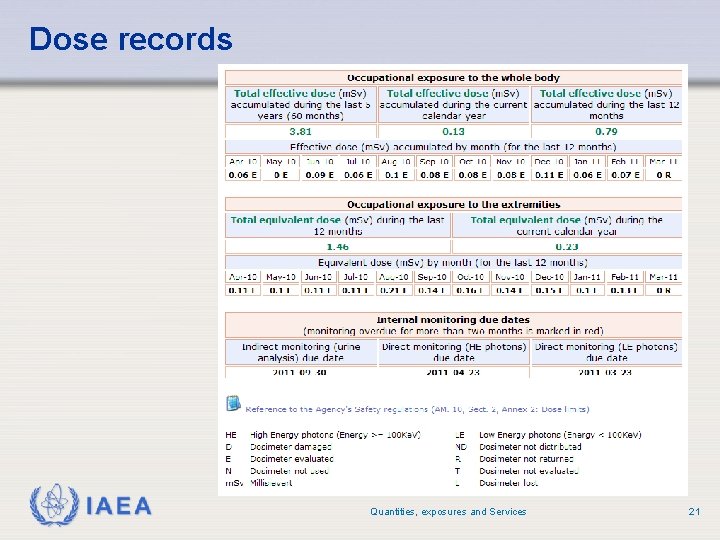
Dose records IAEA Quantities, exposures and Services 21
DISCUSSION What to do when… IAEA International Atomic Energy Agency
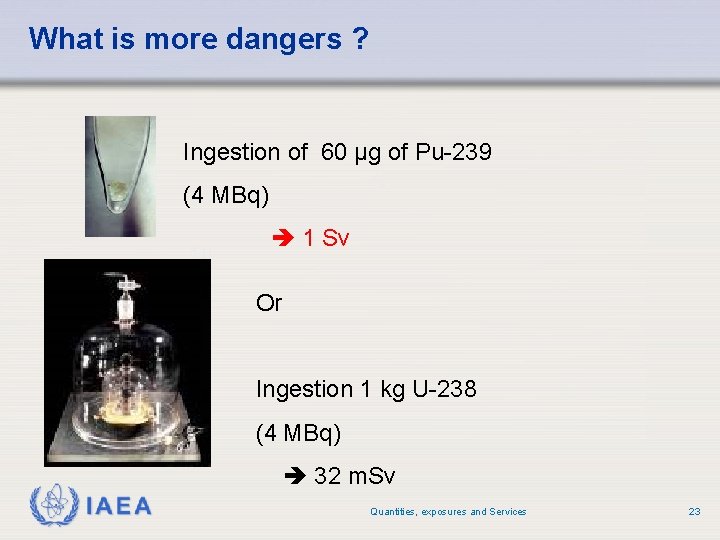
What is more dangers ? Ingestion of 60 μg of Pu-239 (4 MBq) 1 II 1 Sv Or Ingestion 1 kg U-238 (4 MBq) 32 m. Sv IAEA Quantities, exposures and Services 23
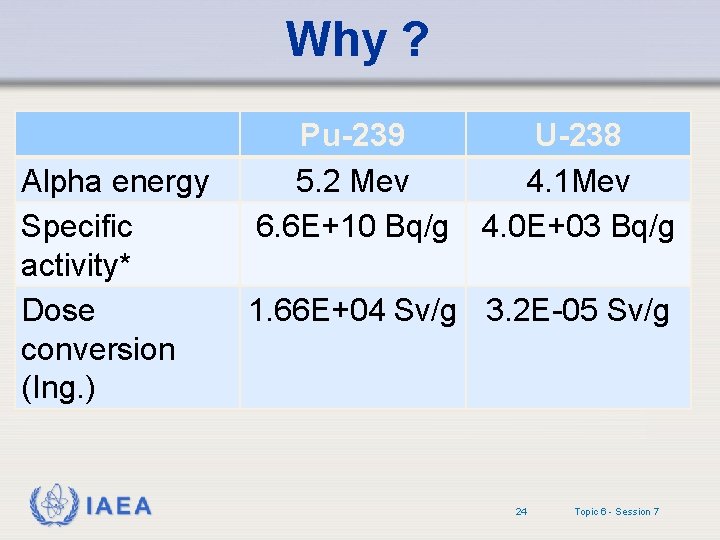
Why ? Alpha energy Specific activity* Dose conversion (Ing. ) IAEA Pu-239 U-238 5. 2 Mev 4. 1 Mev 6. 6 E+10 Bq/g 4. 0 E+03 Bq/g 1. 66 E+04 Sv/g 3. 2 E-05 Sv/g 24 Topic 6 - Session 7
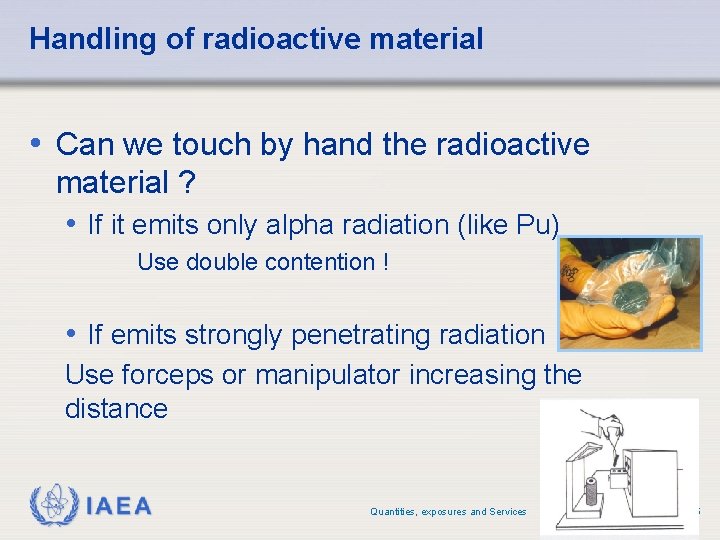
Handling of radioactive material • Can we touch by hand the radioactive material ? • If it emits only alpha radiation (like Pu) Use double contention ! • If emits strongly penetrating radiation : Use forceps or manipulator increasing the distance IAEA Quantities, exposures and Services 25
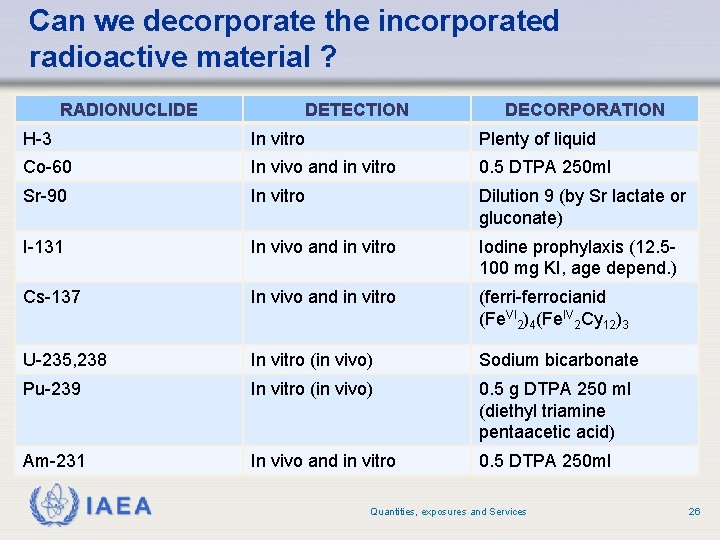
Can we decorporate the incorporated radioactive material ? RADIONUCLIDE DETECTION DECORPORATION H-3 In vitro Plenty of liquid Co-60 In vivo and in vitro 0. 5 DTPA 250 ml Sr-90 In vitro Dilution 9 (by Sr lactate or gluconate) I-131 In vivo and in vitro Iodine prophylaxis (12. 5100 mg KI, age depend. ) Cs-137 In vivo and in vitro (ferri-ferrocianid (Fe. VI 2)4(Fe. IV 2 Cy 12)3 U-235, 238 In vitro (in vivo) Sodium bicarbonate Pu-239 In vitro (in vivo) 0. 5 g DTPA 250 ml (diethyl triamine pentaacetic acid) Am-231 In vivo and in vitro 0. 5 DTPA 250 ml IAEA Quantities, exposures and Services 26
Thank you for your kind attention! IAEA Quantities, exposures and Services 27