Pultrusion of FastGel Thermoset Polyurethanes Processing Considerations and







- Slides: 37
Pultrusion of Fast-Gel Thermoset Polyurethanes: Processing Considerations and Mechanical Properties James L. Lambach, Bayer Polymers LLC Dr. James G. Vaughan, University of Mississippi Dr. Ellen Lackey, University of Mississippi Harry D. Coffee, Nautilus Composites LLC Nigel Barksby, Bayer Polymers LLC Dr. Marc Schütze, Bayer Materials Science AG 2005 PMA Annual Meeting 17 – 19 April 2005 Rancho Mirage, California
Pultrusion of Fast-Gel Thermoset Polyurethanes: Processing Considerations and Mechanical Properties § Background: the Composites Industry § Experimental Strategy – Processing – System Configuration – Mechanical Properties § Results – Processing – Mechanical Properties – Area & Personnel Monitoring § Conclusions
What is a ‘Composite’? Broad definition: a combination of two materials that can do things neither could do alone Working definition: a strong or stiff ‘reinforcement’ (usually a fiber) that provides key mechanical properties to a ‘matrix’ (usually a resin) that in turn protects the fiber from stresses and environmental damage
The Working Definition Covers a Huge Range of Products
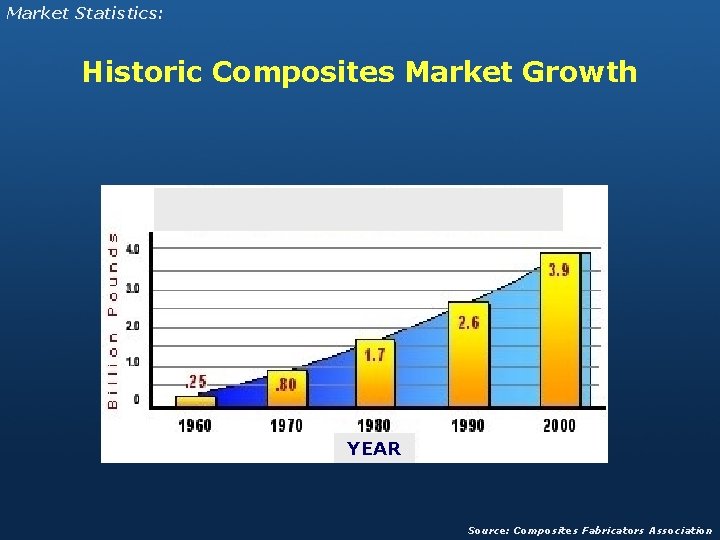
Market Statistics: U. S. Annual Composites Output (Year 2000) $24 Billion 3. 9 Billion Pounds (Resin & Fiber) Worldwide Annual Output is Estimated at 2. 5 Times US (10 Billion Pounds) Resin Consumption Accounts for 65% of Volume (2. 5 Billion Pounds US/ 6. 5 Billion Pounds Worldwide) Source: Composites Fabricators Association
Market Statistics: Historic Composites Market Growth YEAR Source: Composites Fabricators Association
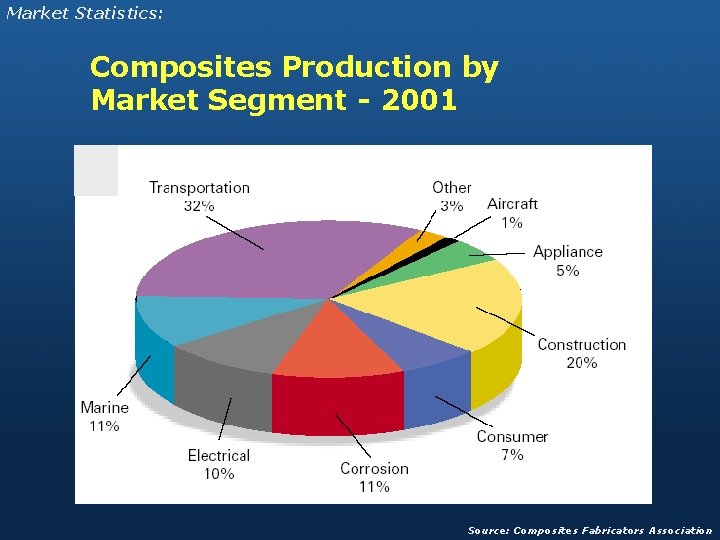
Market Statistics: Composites Production by Market Segment - 2001 Source: Composites Fabricators Association
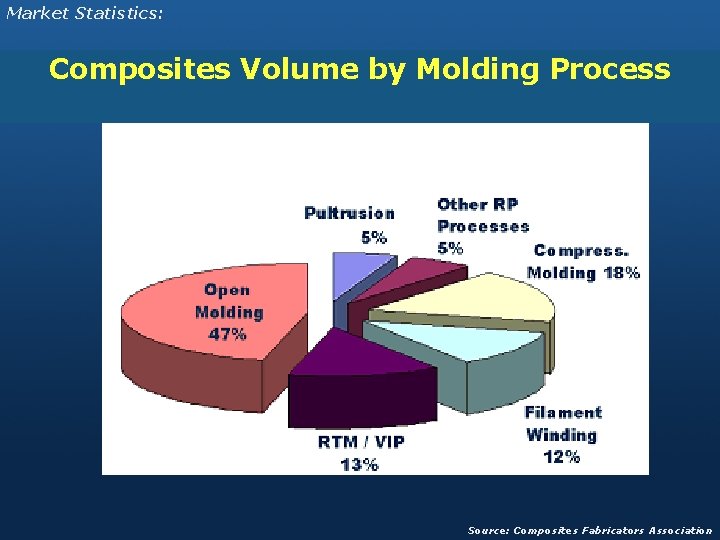
Market Statistics: Composites Volume by Molding Process Source: Composites Fabricators Association
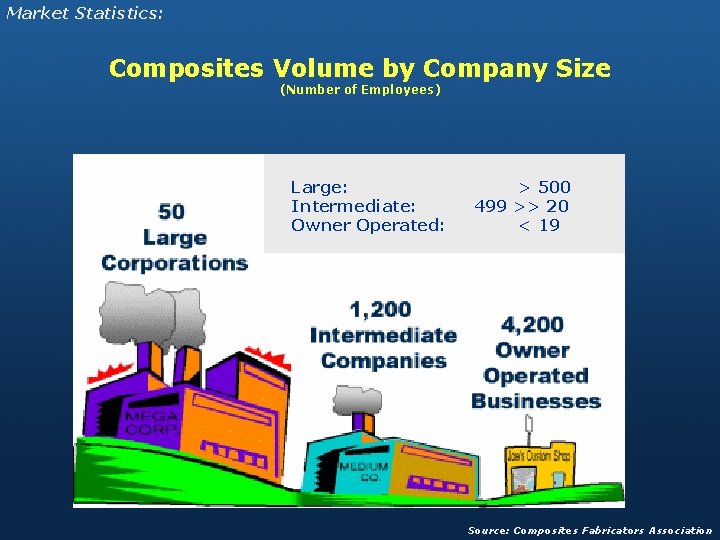
Market Statistics: Composites Volume by Company Size (Number of Employees) Large: Intermediate: Owner Operated: > 500 499 >> 20 < 19 Source: Composites Fabricators Association
Market Statistics: Market Share by Size Source: Composites Fabricators Association
Experimental Procedure § Identification of candidate polyols, isocyanates, catalysts and mold releases § Two-phase evaluation of processing characteristics • Phase One: Identification of workable chemistries • Phase Two: Exploration of temperature & speed envelopes, stoichiometry & mold releases § Parallel environmental & workplace safety evaluation § Mechanical properties characterization
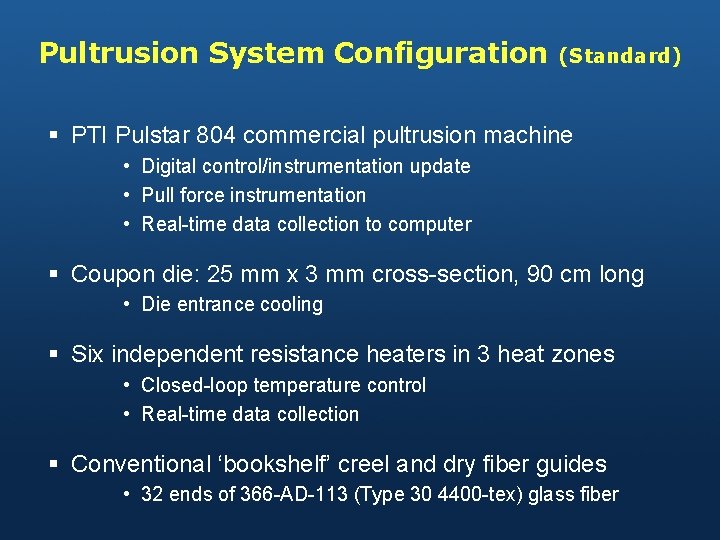
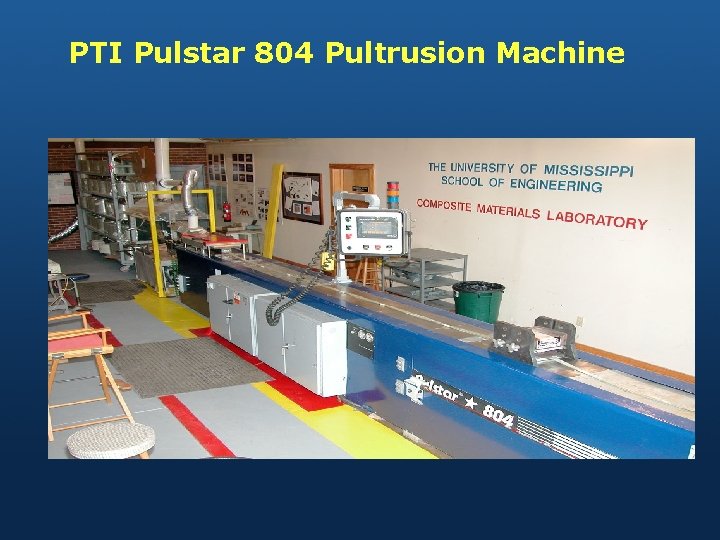
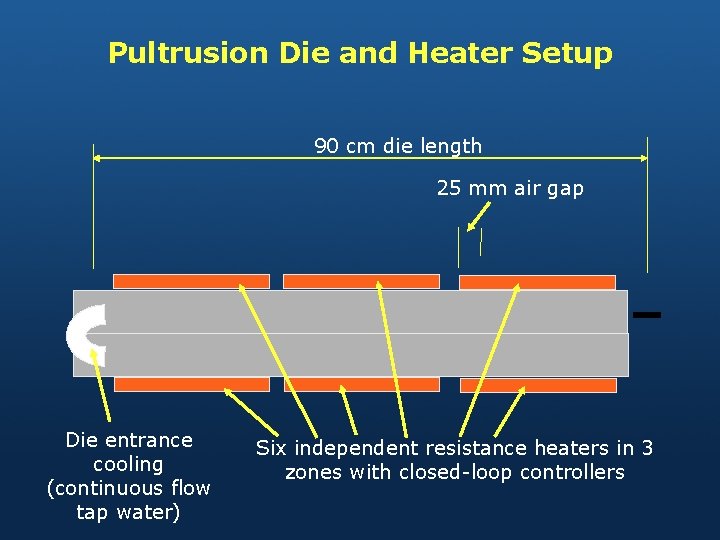
Pultrusion System Configuration (Standard) § PTI Pulstar 804 commercial pultrusion machine • Digital control/instrumentation update • Pull force instrumentation • Real-time data collection to computer § Coupon die: 25 mm x 3 mm cross-section, 90 cm long • Die entrance cooling § Six independent resistance heaters in 3 heat zones • Closed-loop temperature control • Real-time data collection § Conventional ‘bookshelf’ creel and dry fiber guides • 32 ends of 366 -AD-113 (Type 30 4400 -tex) glass fiber
PTI Pulstar 804 Pultrusion Machine
Pultrusion Die and Heater Setup 90 cm die length 25 mm air gap Die entrance cooling (continuous flow tap water) Six independent resistance heaters in 3 zones with closed-loop controllers
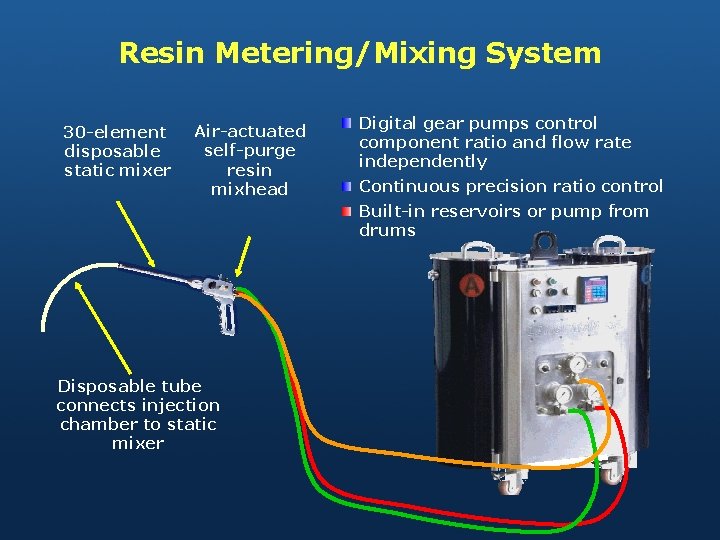
Pultrusion System Configuration (Changes for Polyurethane) § Resin injection/fiber wetting chamber • Machined from HDPE • Bolted/sealed to die entrance face § Resin metering and mixing: • Commercial meter/mix gear pump system (truck-bedliner spray equipment) • Air-actuated mix head with 30 -element disposable static mixer
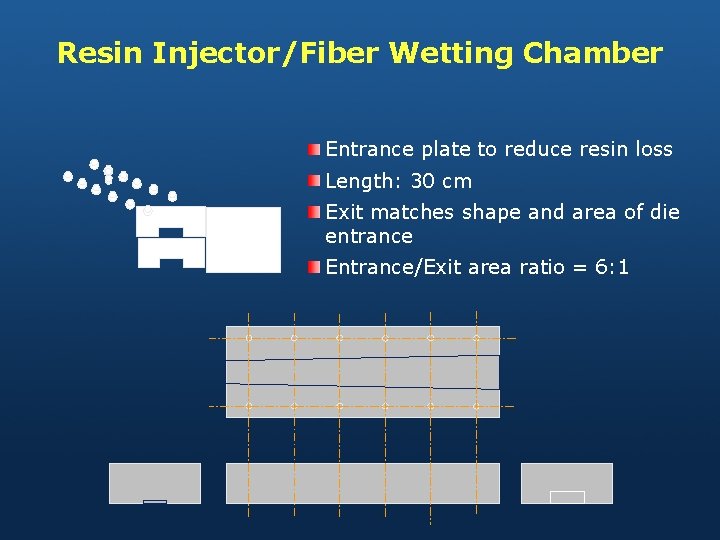
Resin Injector/Fiber Wetting Chamber Entrance plate to reduce resin loss Length: 30 cm Exit matches shape and area of die entrance Entrance/Exit area ratio = 6: 1
Resin Metering/Mixing System 30 -element disposable static mixer Air-actuated self-purge resin mixhead Digital gear pumps control component ratio and flow rate independently Continuous precision ratio control Built-in reservoirs or pump from drums Disposable tube connects injection chamber to static mixer
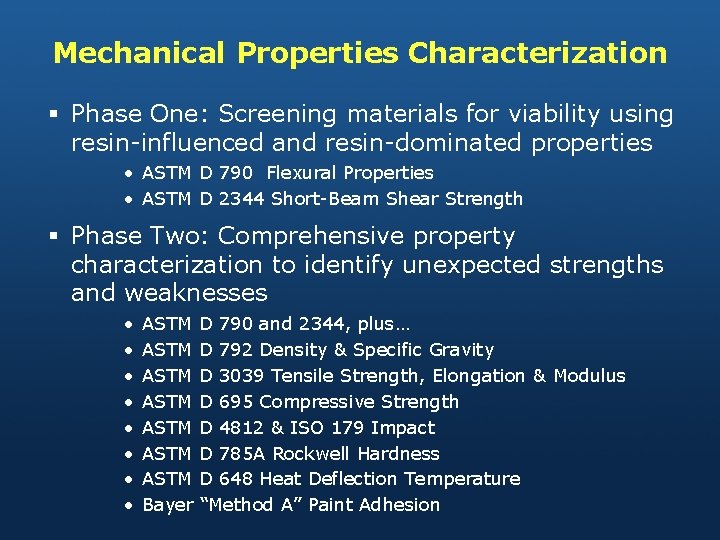
Mechanical Properties Characterization § Phase One: Screening materials for viability using resin-influenced and resin-dominated properties • ASTM D 790 Flexural Properties • ASTM D 2344 Short-Beam Shear Strength § Phase Two: Comprehensive property characterization to identify unexpected strengths and weaknesses • • ASTM D 790 and 2344, plus… ASTM D 792 Density & Specific Gravity ASTM D 3039 Tensile Strength, Elongation & Modulus ASTM D 695 Compressive Strength ASTM D 4812 & ISO 179 Impact ASTM D 785 A Rockwell Hardness ASTM D 648 Heat Deflection Temperature Bayer “Method A” Paint Adhesion
Phase One Mechanical Properties Test Protocol § ASTM D 790 - Flexural strength testing used for near real-time screening • Fast sample preparation • Samples post-cured 45 min @ 120°C • Ultimate strength and elongation to failure data used § ASTM D 2344 - Short-beam shear strength test used for final resin system selection • Longer sample prep cycle needed • Room temperature aging • Resin-dominated property – best discriminator
Results § Processing § Mechanical Properties § Area & Personnel Monitoring
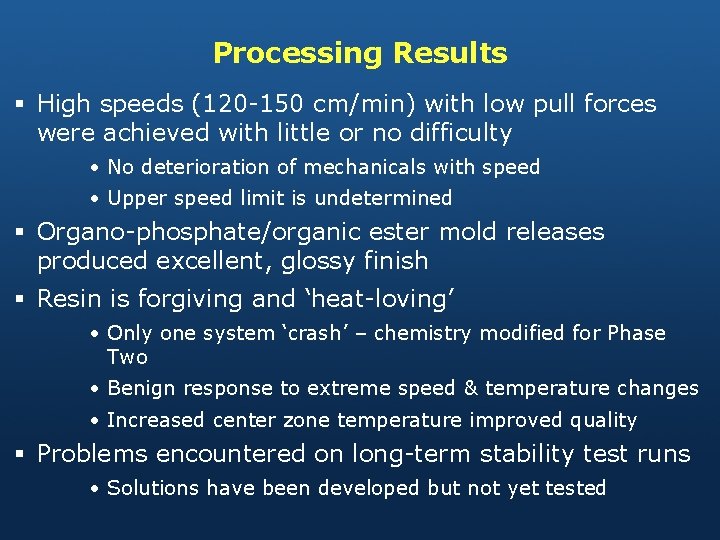
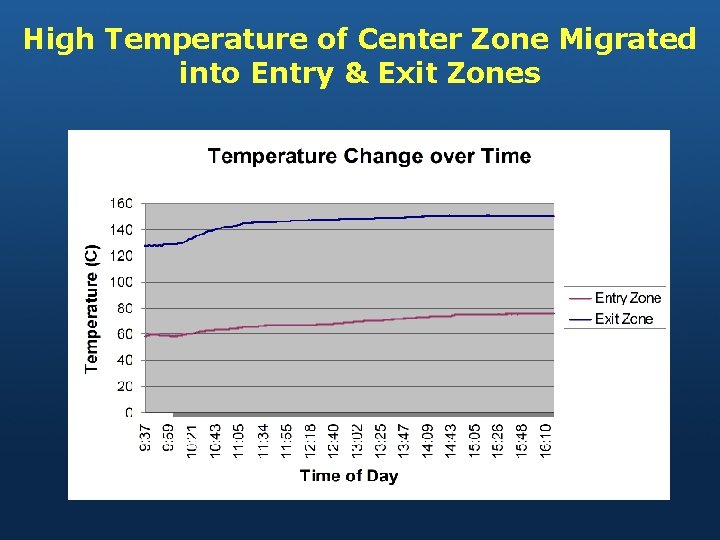
Processing Results § High speeds (120 -150 cm/min) with low pull forces were achieved with little or no difficulty • No deterioration of mechanicals with speed • Upper speed limit is undetermined § Organo-phosphate/organic ester mold releases produced excellent, glossy finish § Resin is forgiving and ‘heat-loving’ • Only one system ‘crash’ – chemistry modified for Phase Two • Benign response to extreme speed & temperature changes • Increased center zone temperature improved quality § Problems encountered on long-term stability test runs • Solutions have been developed but not yet tested
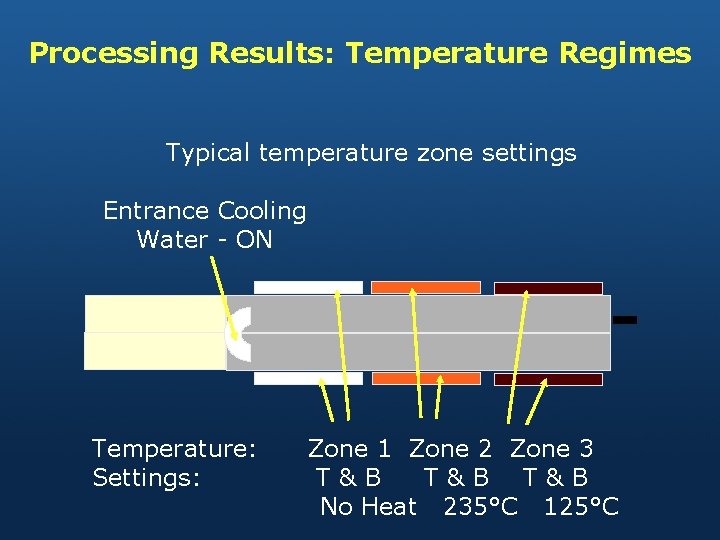
Processing Results: Temperature Regimes Typical temperature zone settings Entrance Cooling Water - ON Temperature: Settings: Zone 1 Zone 2 Zone 3 T&B T&B No Heat 235°C 125°C
High Temperature of Center Zone Migrated into Entry & Exit Zones
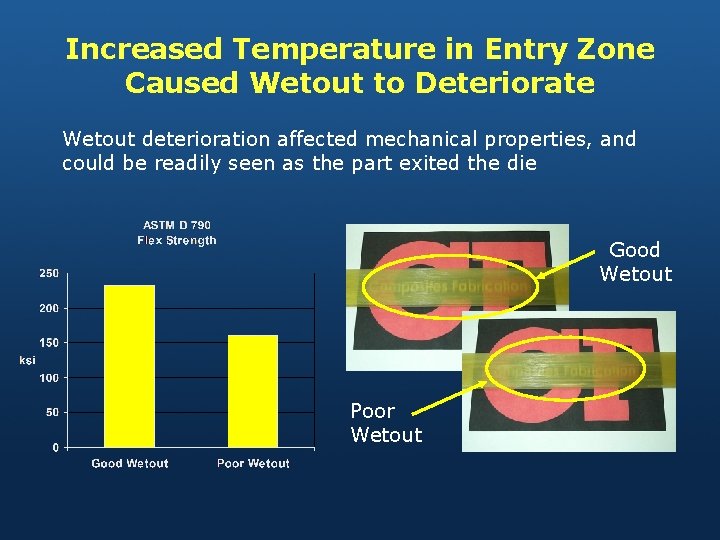
Increased Temperature in Entry Zone Caused Wetout to Deteriorate Wetout deterioration affected mechanical properties, and could be readily seen as the part exited the die Good Wetout Poor Wetout
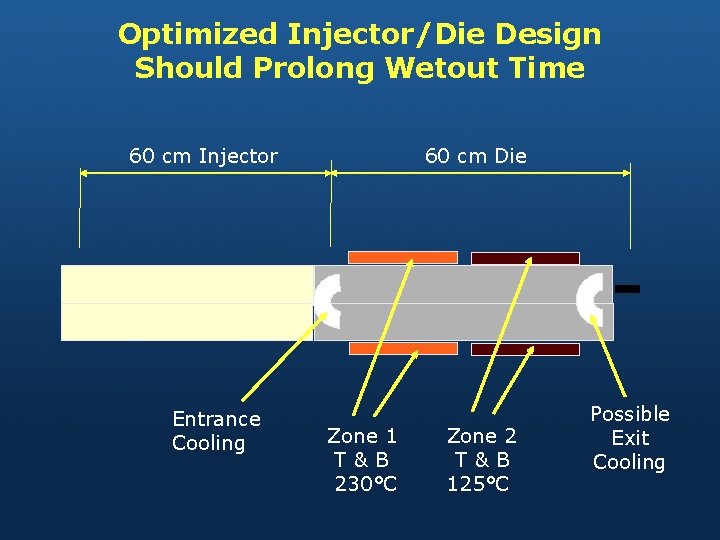
Optimized Injector/Die Design Should Prolong Wetout Time 60 cm Injector Entrance Cooling 60 cm Die Zone 1 T&B 230°C Zone 2 T&B 125°C Possible Exit Cooling
Mechanical Properties Characterization § Two resin systems tested in Phase Two: • Baydur STR 2000 (1: 1 by Volume System) • Baydur STR 3000 (Standard System)
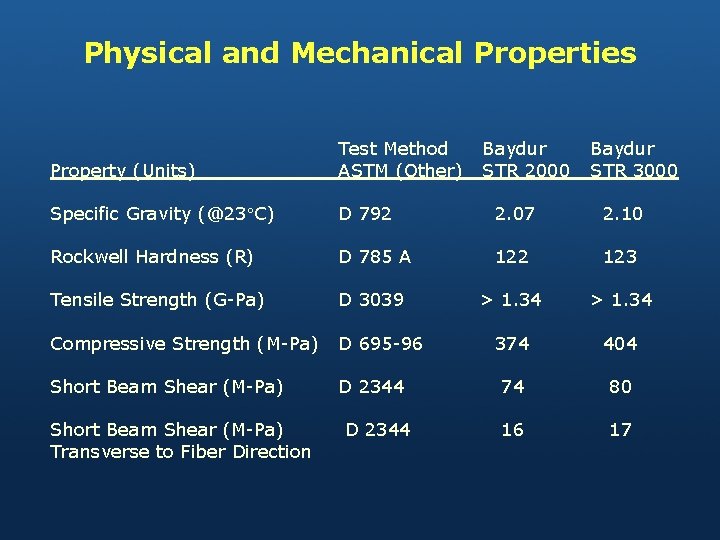
Physical and Mechanical Properties Property (Units) Test Method ASTM (Other) Specific Gravity (@23 C) D 792 2. 07 2. 10 Rockwell Hardness (R) D 785 A 122 123 Tensile Strength (G-Pa) D 3039 > 1. 34 Compressive Strength (M-Pa) D 695 -96 374 404 Short Beam Shear (M-Pa) D 2344 74 80 16 17 Short Beam Shear (M-Pa) Transverse to Fiber Direction D 2344 Baydur STR 2000 Baydur STR 3000
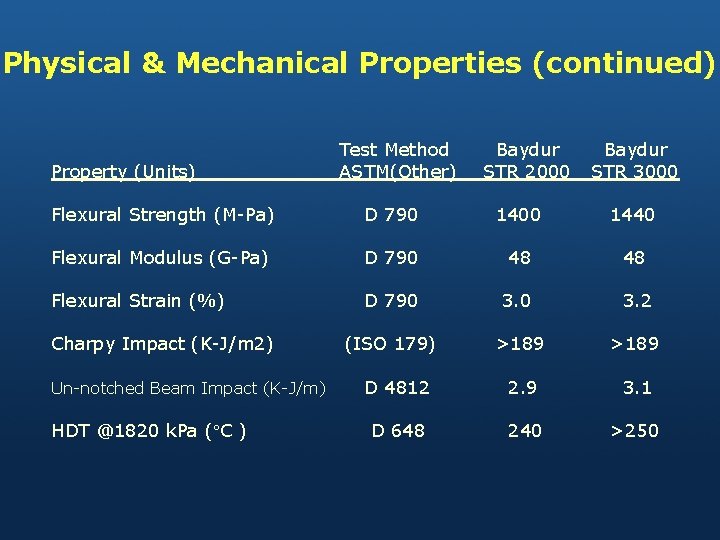
Physical & Mechanical Properties (continued) Property (Units) Test Method ASTM(Other) Baydur STR 2000 Baydur STR 3000 Flexural Strength (M-Pa) D 790 1400 1440 Flexural Modulus (G-Pa) D 790 48 48 Flexural Strain (%) D 790 3. 2 (ISO 179) >189 D 4812 2. 9 3. 1 D 648 240 >250 Charpy Impact (K-J/m 2) Un-notched Beam Impact (K-J/m) HDT @1820 k. Pa ( C )
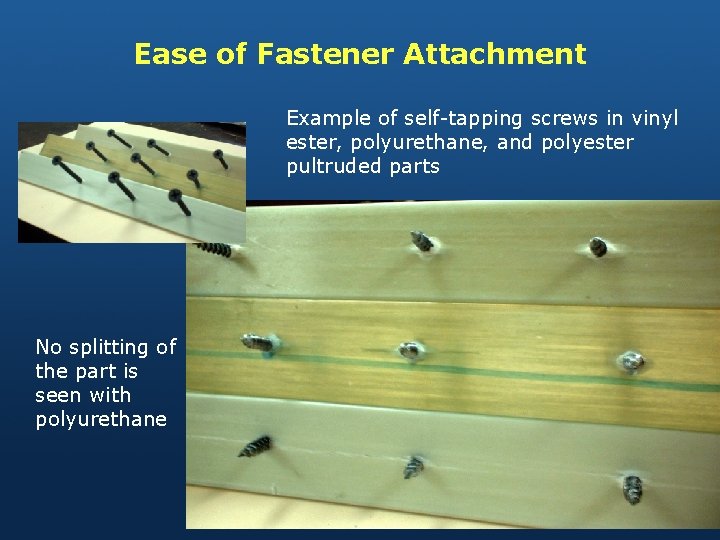
Ease of Fastener Attachment Example of self-tapping screws in vinyl ester, polyurethane, and polyester pultruded parts No splitting of the part is seen with polyurethane
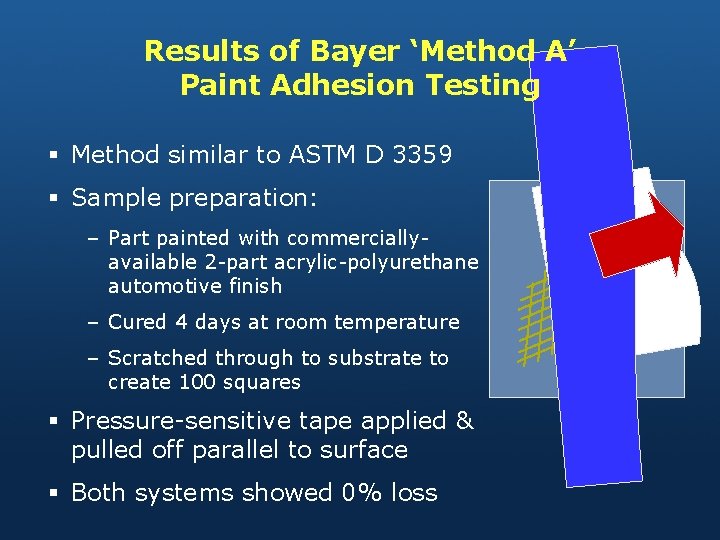
Results of Bayer ‘Method A’ Paint Adhesion Testing § Method similar to ASTM D 3359 § Sample preparation: – Part painted with commerciallyavailable 2 -part acrylic-polyurethane automotive finish – Cured 4 days at room temperature – Scratched through to substrate to create 100 squares § Pressure-sensitive tape applied & pulled off parallel to surface § Both systems showed 0% loss
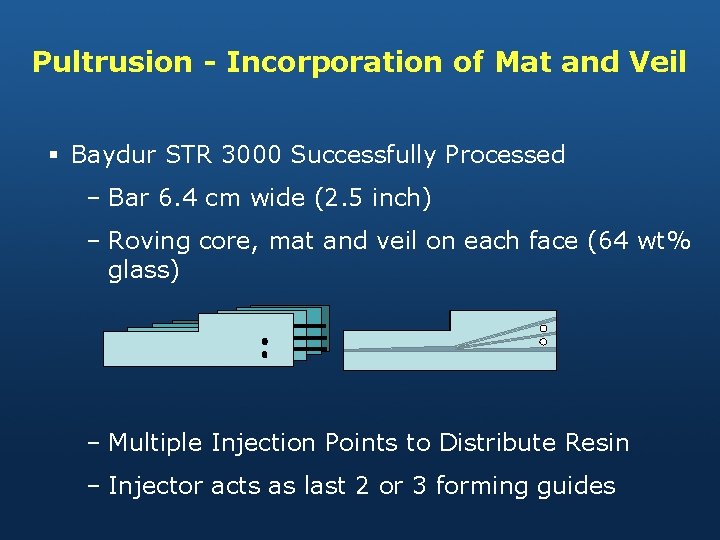
Pultrusion - Incorporation of Mat and Veil § Baydur STR 3000 Successfully Processed – Bar 6. 4 cm wide (2. 5 inch) – Roving core, mat and veil on each face (64 wt% glass) – Multiple Injection Points to Distribute Resin – Injector acts as last 2 or 3 forming guides
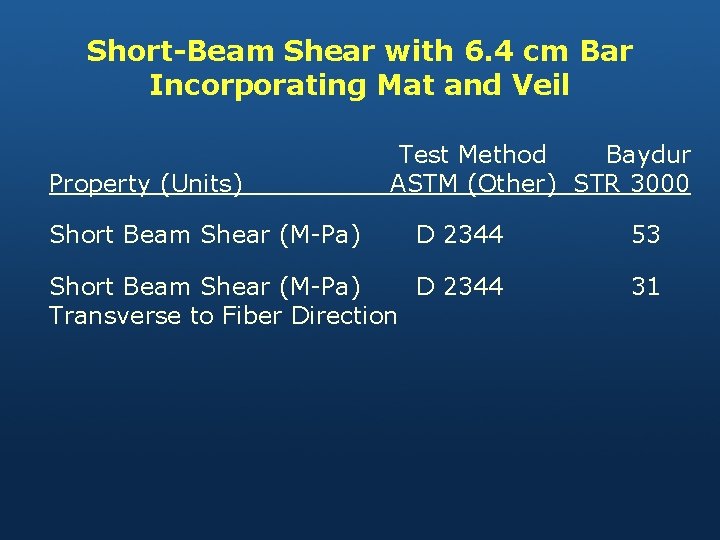
Short-Beam Shear with 6. 4 cm Bar Incorporating Mat and Veil Property (Units) Short Beam Shear (M-Pa) Test Method Baydur ASTM (Other) STR 3000 D 2344 53 Short Beam Shear (M-Pa) D 2344 Transverse to Fiber Direction 31
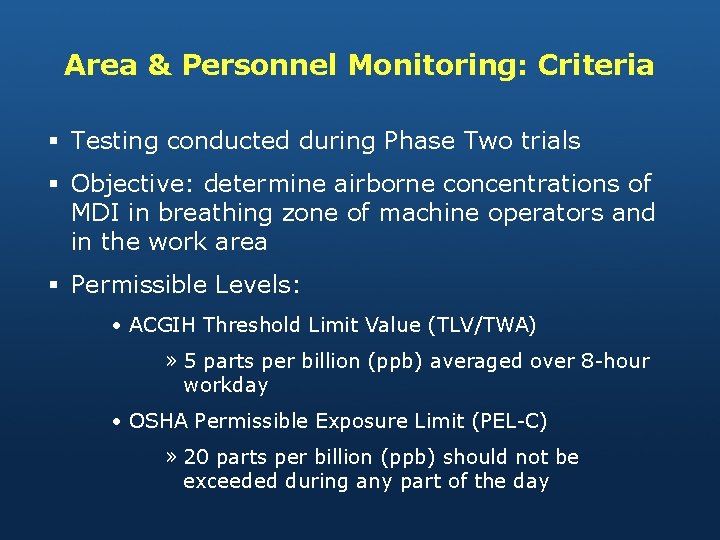
Area & Personnel Monitoring: Criteria § Testing conducted during Phase Two trials § Objective: determine airborne concentrations of MDI in breathing zone of machine operators and in the work area § Permissible Levels: • ACGIH Threshold Limit Value (TLV/TWA) » 5 parts per billion (ppb) averaged over 8 -hour workday • OSHA Permissible Exposure Limit (PEL-C) » 20 parts per billion (ppb) should not be exceeded during any part of the day
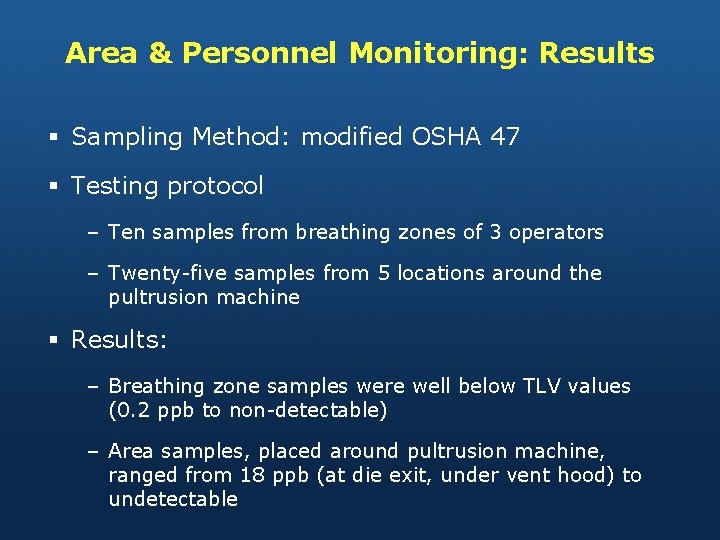
Area & Personnel Monitoring: Results § Sampling Method: modified OSHA 47 § Testing protocol – Ten samples from breathing zones of 3 operators – Twenty-five samples from 5 locations around the pultrusion machine § Results: – Breathing zone samples were well below TLV values (0. 2 ppb to non-detectable) – Area samples, placed around pultrusion machine, ranged from 18 ppb (at die exit, under vent hood) to undetectable
Conclusions § Two-part polyurethane resins appear to be a very promising alternative to currently used materials – Superior mechanical properties – High productivity potential – Relatively easy processing – Controllable workplace environment § Further testing required to establish range of suitable applications – Workplace exposure – Chemical compatibility
Acknowledgements The authors would like to acknowledge …. . Al Magnotta of Bayer Materials Science (BMS) for his help with the resin pump. Barbara Cummings of the BMS Product Safety and Regulatory Affairs Department for conducting the environmental monitoring. University of Mississippi students who helped in this project: Brittany Hancock Kapil Inamdar Chaitali Meda Ghanshyam Pal Winter Vaughan Mik Wimbrow Jarrad Zaiser
Pultrusion of Fast-Gel Thermoset Polyurethanes: Processing Considerations and Mechanical Properties James L. Lambach, Bayer Polymers LLC Dr. James G. Vaughan, University of Mississippi Dr. Ellen Lackey, University of Mississippi Harry D. Coffee, Nautilus Composites LLC Nigel Barksby, Bayer Polymers LLC Dr. Marc Schütze, Bayer Materials Science AG 2005 PMA Annual Meeting 17 – 19 April 2005 Rancho Mirage, California