Professor Vasiliy Tairyan Assistants Evgenia Tairyan Diana Martirosyan


- Slides: 51
Professor Vasiliy Tairyan Assistants: Evgenia Tairyan, Diana Martirosyan, Stephan Babayan, Anahit Tatevosyan, Victor Prokhorenko, Sergey Tairyan Humanitarian problems of the information security The modern society development stage is characterized by the increasing role of information sphere, which is also presented as a complexity of information, information infrastructure, the persons who realize the gathering, formation, spread and the usage of information and also the regulating systems together with the appearing of social relationships. The information sphere, being the system formatting factor of the society's life, has its active reaction on political, economical and defence conditions of states safety, and their national safety in a crucial way depends on the information security provision, and in course of technical progress this dependence will increase. By the term of informational security we understand the defended state of its national interests in information sphere, which are defined by the complexity of balanced interests of a person, society and state.
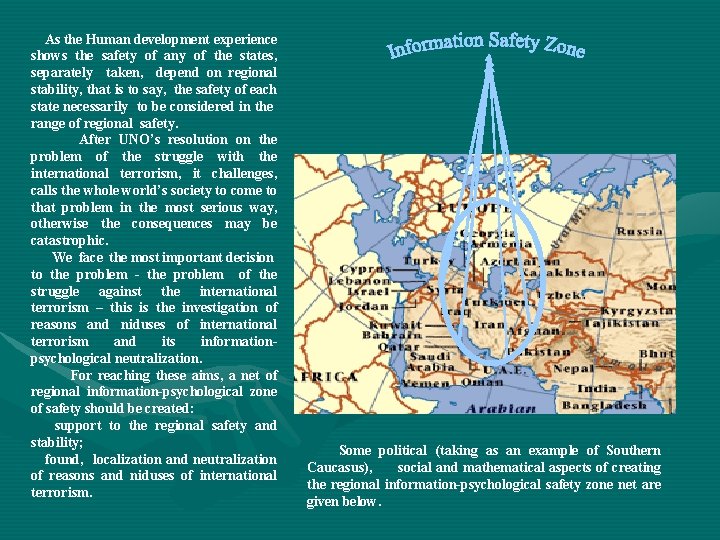
As the Human development experience shows the safety of any of the states, separately taken, depend on regional stability, that is to say, the safety of each state necessarily to be considered in the range of regional safety. After UNO’s resolution on the problem of the struggle with the international terrorism, it challenges, calls the whole world’s society to come to that problem in the most serious way, otherwise the consequences may be catastrophic. We face the most important decision to the problem - the problem of the struggle against the international terrorism – this is the investigation of reasons and niduses of international terrorism and its informationpsychological neutralization. For reaching these aims, a net of regional information-psychological zone of safety should be created: support to the regional safety and stability; found, localization and neutralization of reasons and niduses of international terrorism. Some political (taking as an example of Southern Caucasus), social and mathematical aspects of creating the regional information-psychological safety zone net are given below.
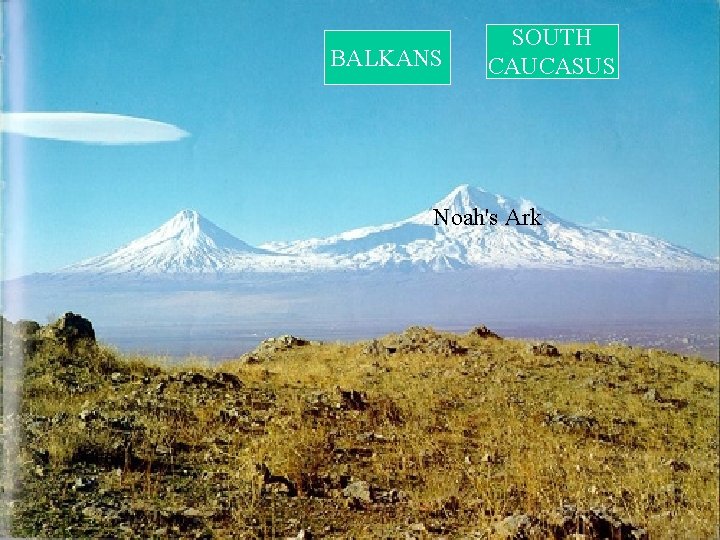
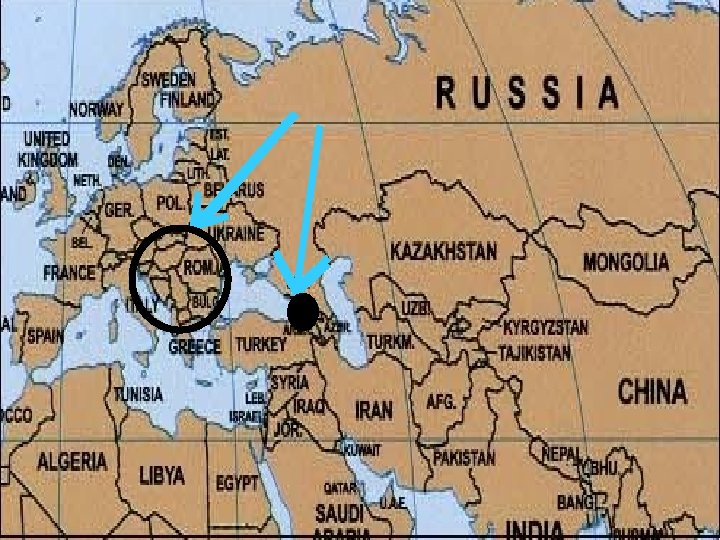
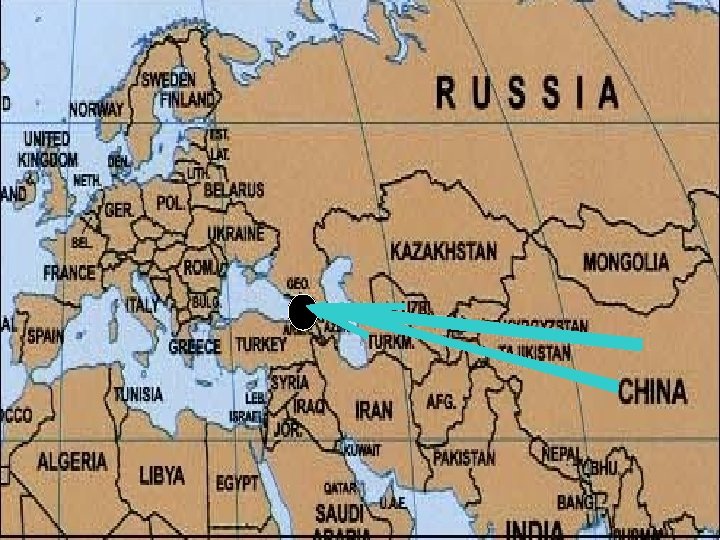
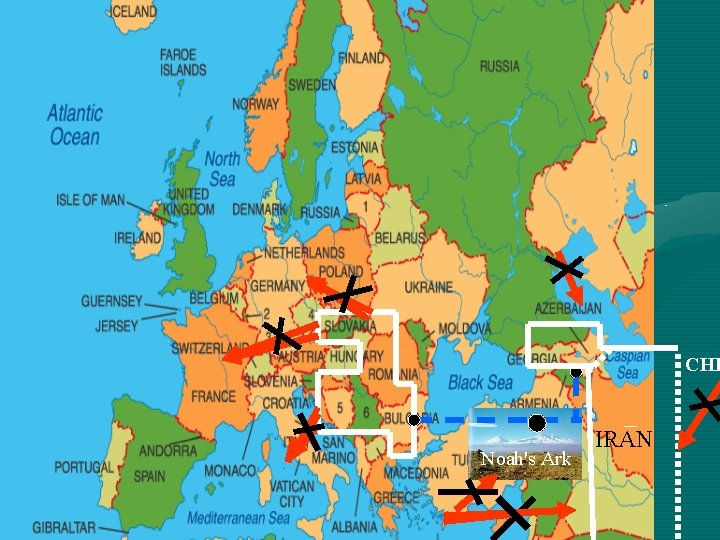
Political bases of regional information-psychological safety zone's creation doctrine “Balkans & Small Asia have the most important strategic position in the world. They are the core and the Centre of the Old World, they separate and at the same time connect three continents: Europe, Asia & Africa… They are situated in such a place where from they can threaten and make assaults against the three continents. ” J. Bucker It took decades for the obvious truth, which was said by the ordinary English politologist in the XX-th century, became equally obvious and vitally important today. So, the South Caucasus and Central Asia are at last declared NATO's prior zone. And the countries of the Southern Caucasus are involved in the Eurounion's “Widened Europe: new neighbours” program. So, a quite obvious question rises up: to what extent are these steps adequate to the Europe security provision in the nearest years already and whether NATO lingers, wanting to put a stable basis not on words but by concrete actions. Balkans and it is not equally “untidy”: series of unsolving international conflicts, destroyed economy, and as a consequence social tenseness inside the countries, various confessional and ethnonational contradictions, etc. All these contradictions will be finally settled and solved by the states themselves, however it will take years, and here the question arises – does the Eurounion have time ? – according to the not straight consideration of geopolitical processes the answer is negative, and that's why:
“Balkans & Small Asia have the most important strategic position in the world. They are the core and the Centre of the Old World, they separate and at the same time connect three continents: Europe, Asia & Africa… They are situated in such a place where from they can threaten and make assaults against the three continents. ” J. Bucker
BALKANS SOUTH CAUCASUS Noah's Ark Noah's
I. Russia fully realizes the region's strategic role, it realizes it not only as it's basis, but also as “critical” strong point for the whole Euroasian continent. The fact is just that Russia went away from the region, if not forever, but at least, for a long time. In fact the presence of Russia in the region only creates the illusion of its presence, on the one hand, for concealing tiny, secondary interests and for “luring” NATO, which doesn't want to put the responsibility on itself to regulate the region conflicts and to create in the region such a security system, which will not only allow to use the region as a platform against Europe in future, but also to make it the most important bastion of Europe. It is worth mentioning here, that surely NATO has mass of its “own” problems – the Balkans, however one can't cure the teeth, if the gums are also sick, and no Colgate will ever help it, as Russia just can't solve the “Caucasian” problems any more. The sooner NATO gets convinced of it, the quicker they will give up the most unimportant programs within the framework of “Partnership for Peace”, run by individual plans. Such “cooperation” is not only useless, but also harmful, as it creates some illusions in region's countries, allows them to speculate in their own interests, prolonging the acceptance of necessary concessions for reaching the compromise decisions, which must objectively be good for everyone and become a good basis for hospitable relationships, in future, become the guarantee of general interdependable security and stability. And, finally, NATO should once again analyse for themselves what the meaning of the recent reforms of Collective Security Treaty Organization (ODKB) is: is it the creation of real mechanisms of collective security provision or in reality it is invitation for the good-buy party! So, others will take the same place! Russia's leave from the region is not unexpected event for those who are not only waiting for a suitable time to “capture” such a good slice, but also made much efforts to lead Russia to the decision of such a question.
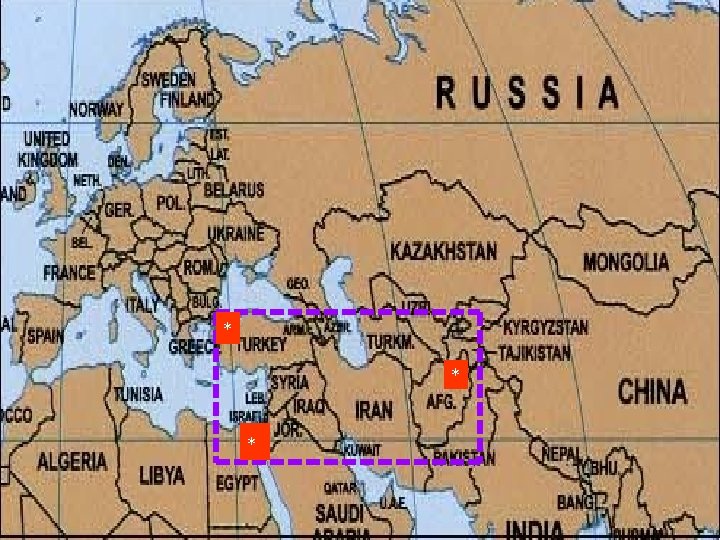
The formation of two geopolitical and geostrategic macroregions of Big Europe and Big Nearest East has two scripts which are not so much desirable for Europe. “Goble's Plan” or Turan etc. Such plan could firstly be realized in rang of globalization carried out by the USA: getting stuck in Iraq the USA won't be able any more to finish up it's “Megaprojekt” in Iran and create optimal conditions for Turkey's entrance from the Southern Caucasus to the Central Asia. Analogical “failures” of the USA in Israel and in Pakistan allow us to come to a conclusion that even if the USA doesn't reject the plan of the region's Turk-making, in this case the overestemation of its real possibilities and its connection with the reality, the search of new partners etc. will require from the USA too much time, which it doesn't have any more. II. The second script - China's “coming” to the region of the Southern Caucasus. Although the USA managed by leading some military operations in Afghanistan to solve some of its strategically tasks of taking under control the Central Asia and perspectively to stop the process of China's getting to the East like a very good advertised show, anyway this was the end of everything. What is it – an intermission or finish? Alas, if it is an intermission it will last for years, and China will not give anyone the gradual strength. Besides, the perspective of “Great China” recreation is not a ghost any more, and it is still unknown where the Great China Wall will again be built. The perishing commune-cosmopolitism in Russia gave China a great impulse to the organization. Having got through the mason ideology of cosmopolitism with the loss of 50 million human lives in the cultural revolution, China borrowed one of the best systems: mass operations leading system with a profound impact on the consciousness of mass and the experience of creating phychocomplexes of behaviour with the impact from subconsciousness. And as a result China is already a quite wealthy state and possesses more than sufficient recourses for reaching almost all the aims.
It must be also mentioned here that one shouldn't expect from China the so-called brilliant shows analogical themes, which the USA demonstrates. There won't be any China “boom”, as it has already begun, having borrowed the method of “crawling agression” from Turkes, the China people under the mask of migrantes, traders and refugees gradually spreading all over our planet, but they mainly try to concentrate, to remain in those places where it is functionally profitable for China's patriots; one of the most vivid examples of this fact can be brought the recent events, when on the financial attack against the Soros fund against yuan the Chinese answered not only with a very good defence of national currency, but also using its diaspora in the USA, lead the answering attack and practically ruined the Soros fund. That's the reason why China doesn't hurry: time is its best ally.
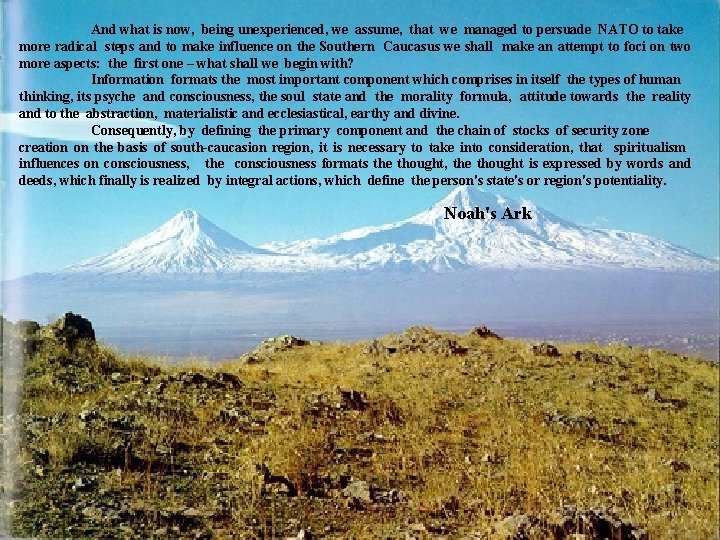
And what is now, being unexperienced, we assume, that we managed to persuade NATO to take more radical steps and to make influence on the Southern Caucasus we shall make an attempt to foci on two more aspects: the first one – what shall we begin with? Information formats the most important component which comprises in itself the types of human thinking, its psyche and consciousness, the soul state and the morality formula, attitude towards the reality and to the abstraction, materialistic and ecclesiastical, earthy and divine. Consequently, by defining the primary component and the chain of stocks of security zone creation on the basis of south-caucasion region, it is necessary to take into consideration, that spiritualism influences on consciousness, the consciousness formats the thought, the thought is expressed by words and deeds, which finally is realized by integral actions, which define the person's state's or region's potentiality. Noah's Ark
Consequently, this initial component (the fundamental one, in fact) can and must be the creation of information security zone, general and unique for the whole Transcaucasus, but in perspective its connection with the security system of Iran and that's the reason: Iran. Having formed the historical thinking in its nation's minds and influencing on its consciousness by a stable modeling, the Iran elite constantly tries to give rebirth in its nation the forgotten legend heroes which is just the final element of the strengthening the connection of time in the mind of this nation. And, as a result, at the proper time, millions of Iranians by the challenge of mullah will be turned to “shakhids”. Here, where it is the most important argument of Iran, when in the conversation with the USA it signs out that Iran is not Iraq. And it's quite well that “wise Europe” prefers to widen business, trade and other relationships just with Iran and instead of all this the USA invites it to search nuclear arsenals.
CHI Noah's Ark IRAN
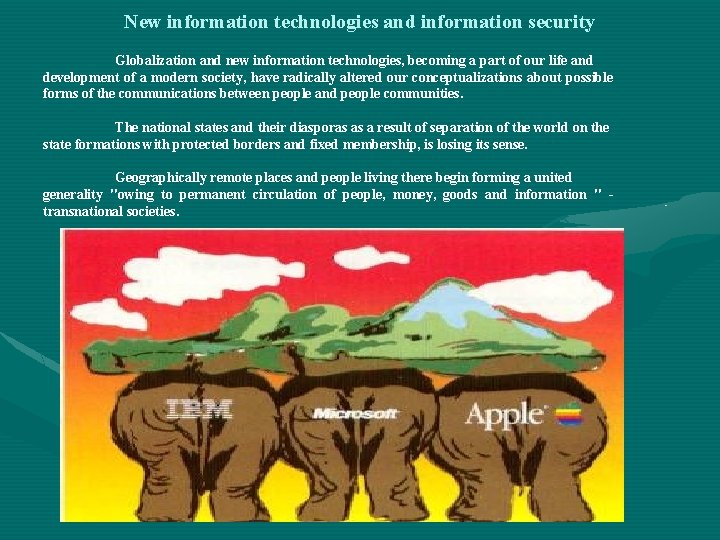
New information technologies and information security Globalization and new information technologies, becoming a part of our life and development of a modern society, have radically altered our conceptualizations about possible forms of the communications between people and people communities. The national states and their diasporas as a result of separation of the world on the state formations with protected borders and fixed membership, is losing its sense. Geographically remote places and people living there begin forming a united generality "owing to permanent circulation of people, money, goods and information " transnational societies.
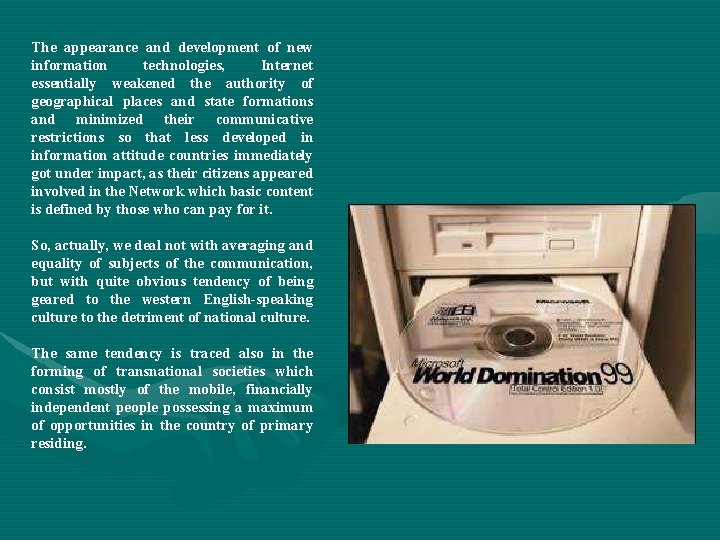
The appearance and development of new information technologies, Internet essentially weakened the authority of geographical places and state formations and minimized their communicative restrictions so that less developed in information attitude countries immediately got under impact, as their citizens appeared involved in the Network which basic content is defined by those who can pay for it. So, actually, we deal not with averaging and equality of subjects of the communication, but with quite obvious tendency of being geared to the western English-speaking culture to the detriment of national culture. The same tendency is traced also in the forming of transnational societies which consist mostly of the mobile, financially independent people possessing a maximum of opportunities in the country of primary residing.
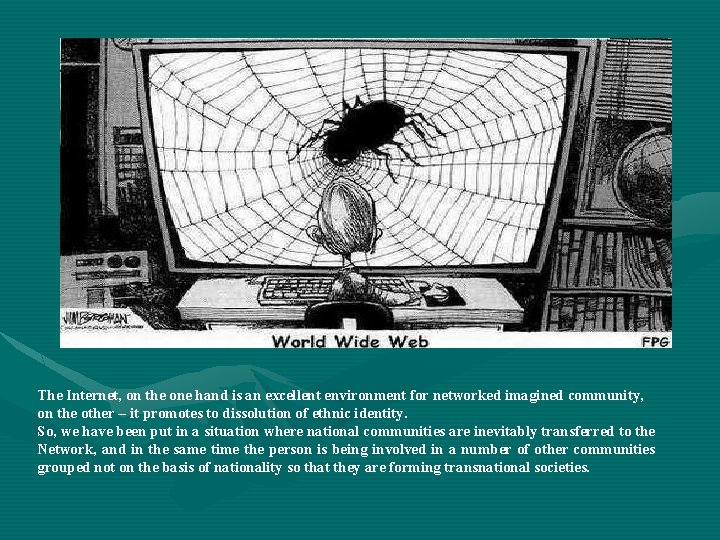
The Internet, on the one hand is an excellent environment for networked imagined community, on the other – it promotes to dissolution of ethnic identity. So, we have been put in a situation where national communities are inevitably transferred to the Network, and in the same time the person is being involved in a number of other communities grouped not on the basis of nationality so that they are forming transnational societies.
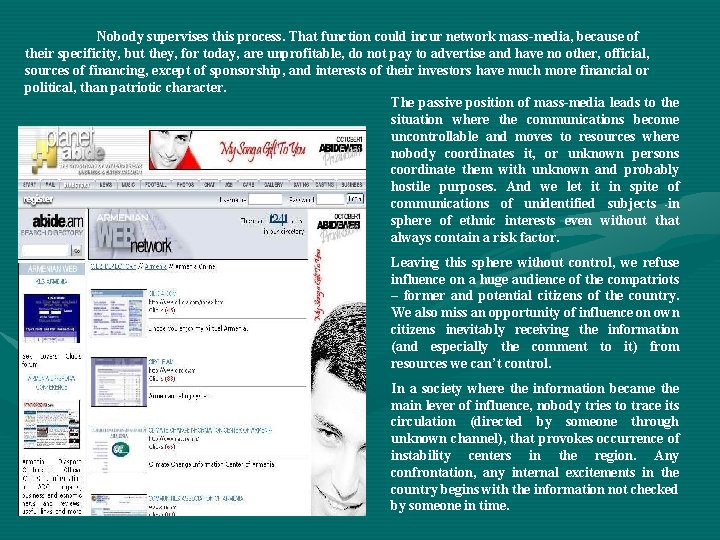
Nobody supervises this process. That function could incur network mass-media, because of their specificity, but they, for today, are unprofitable, do not pay to advertise and have no other, official, sources of financing, except of sponsorship, and interests of their investors have much more financial or political, than patriotic character. The passive position of mass-media leads to the situation where the communications become uncontrollable and moves to resources where nobody coordinates it, or unknown persons coordinate them with unknown and probably hostile purposes. And we let it in spite of communications of unidentified subjects in sphere of ethnic interests even without that always contain a risk factor. Leaving this sphere without control, we refuse influence on a huge audience of the compatriots – former and potential citizens of the country. We also miss an opportunity of influence on own citizens inevitably receiving the information (and especially the comment to it) from resources we can’t control. In a society where the information became the main lever of influence, nobody tries to trace its circulation (directed by someone through unknown channel), that provokes occurrence of instability centers in the region. Any confrontation, any internal excitements in the country begins with the information not checked by someone in time.
Even more - any region touched upon globalization, becomes a zone of risk, a center of instability, because the undermining of nationality and statehood bases should cause a counteractions, corresponding reciprocal movements, including terrorist, so it represents a military and information threat. Meanwhile, all of the NATO programs in humanitar sphere are targeted on support and speeding up of globalization, provoking similar threat. It seems to us more effectually in such situation to subsidize forming and support of national and diasporal communities and financing of corresponding programs in mass-media, making the process less painful for the state, to neutralize a source of threat and to avoid necessity of solving that problem in future by military means.
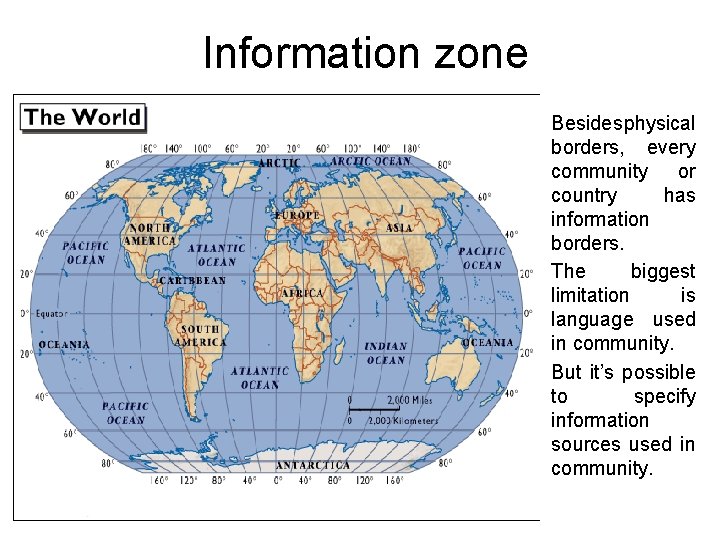
Information zone Besides physical borders, every community or country has information borders. The biggest limitation is language used in community. But it’s possible to specify information sources used in community.
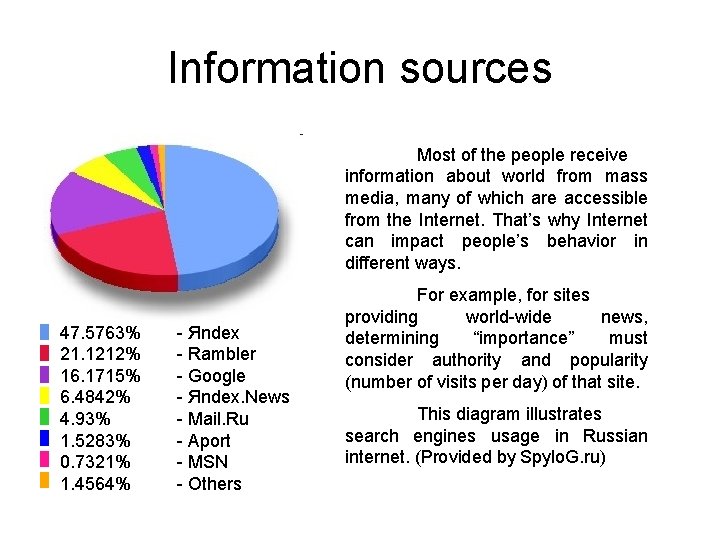
Information sources Most of the people receive information about world from mass media, many of which are accessible from the Internet. That’s why Internet can impact people’s behavior in different ways. 47. 5763% 21. 1212% 16. 1715% 6. 4842% 4. 93% 1. 5283% 0. 7321% 1. 4564% - Яndex - Rambler - Google - Яndex. News - Mail. Ru - Aport - MSN - Others For example, for sites providing world-wide news, determining “importance” must consider authority and popularity (number of visits per day) of that site. This diagram illustrates search engines usage in Russian internet. (Provided by Spylo. G. ru)
As it’s economically inefficient to secure all nodes of a network, special attention should be paid to the “importance” of the resource to be secured. For example on a site providing world-wide news an attacker can change some news and provoke stocks price change. It’s also critical not to underestimate an impact which can cause some posted news on not so authoritative site. A recent example is an announcement of a portable super-computer, which turned out to be a fake. It was originally posted on some unknown site, and in a short time appeared on pages of much respected electronic magazines.
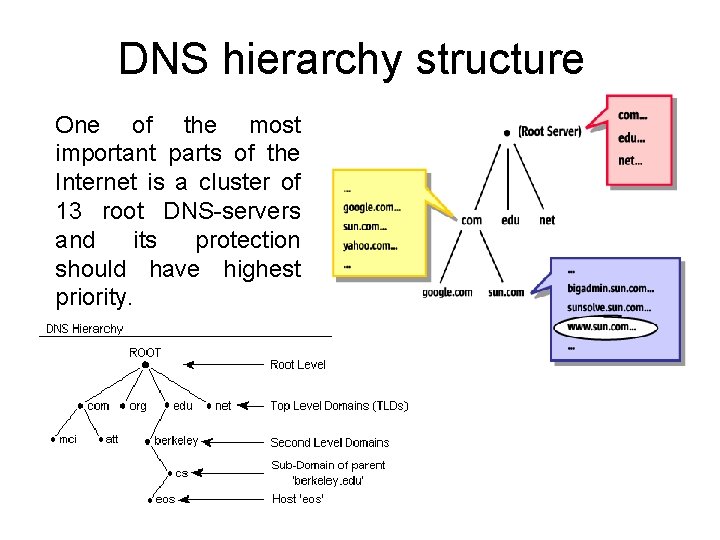
DNS hierarchy structure One of the most important parts of the Internet is a cluster of 13 root DNS-servers and its protection should have highest priority.
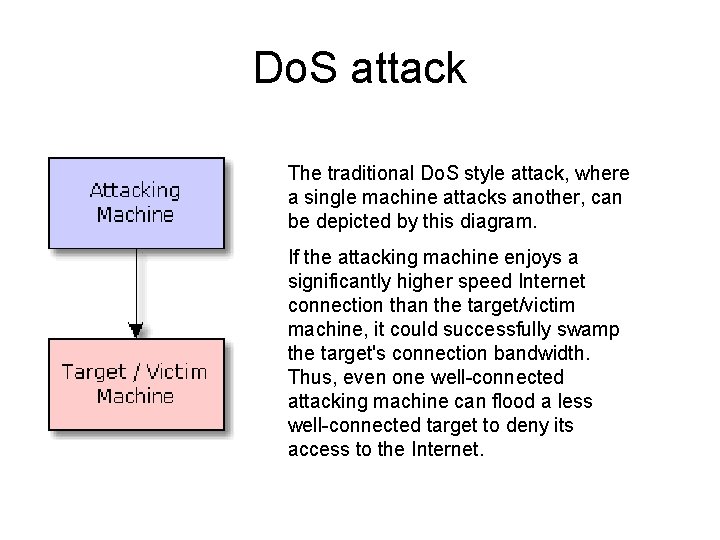
Do. S attack The traditional Do. S style attack, where a single machine attacks another, can be depicted by this diagram. If the attacking machine enjoys a significantly higher speed Internet connection than the target/victim machine, it could successfully swamp the target's connection bandwidth. Thus, even one well-connected attacking machine can flood a less well-connected target to deny its access to the Internet.
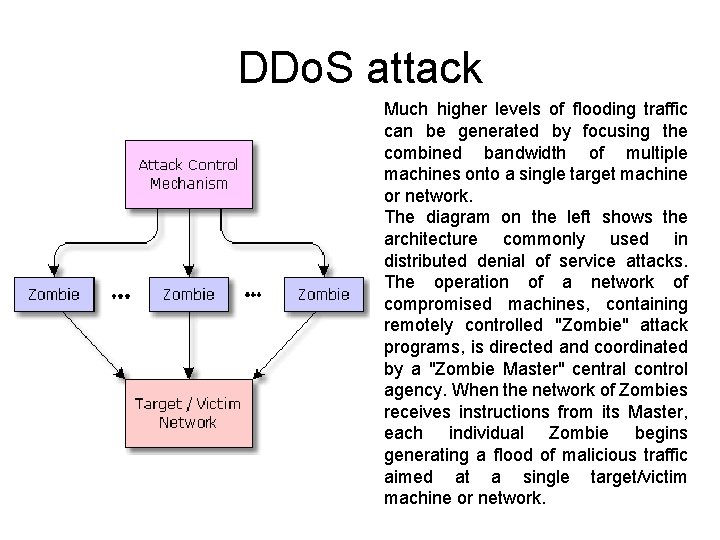
DDo. S attack Much higher levels of flooding traffic can be generated by focusing the combined bandwidth of multiple machines onto a single target machine or network. The diagram on the left shows the architecture commonly used in distributed denial of service attacks. The operation of a network of compromised machines, containing remotely controlled "Zombie" attack programs, is directed and coordinated by a "Zombie Master" central control agency. When the network of Zombies receives instructions from its Master, each individual Zombie begins generating a flood of malicious traffic aimed at a single target/victim machine or network.
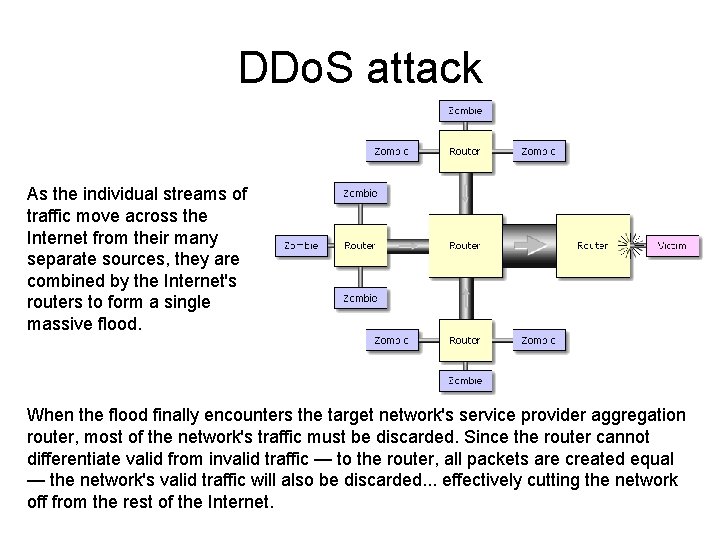
DDo. S attack As the individual streams of traffic move across the Internet from their many separate sources, they are combined by the Internet's routers to form a single massive flood. When the flood finally encounters the target network's service provider aggregation router, most of the network's traffic must be discarded. Since the router cannot differentiate valid from invalid traffic — to the router, all packets are created equal — the network's valid traffic will also be discarded. . . effectively cutting the network off from the rest of the Internet.
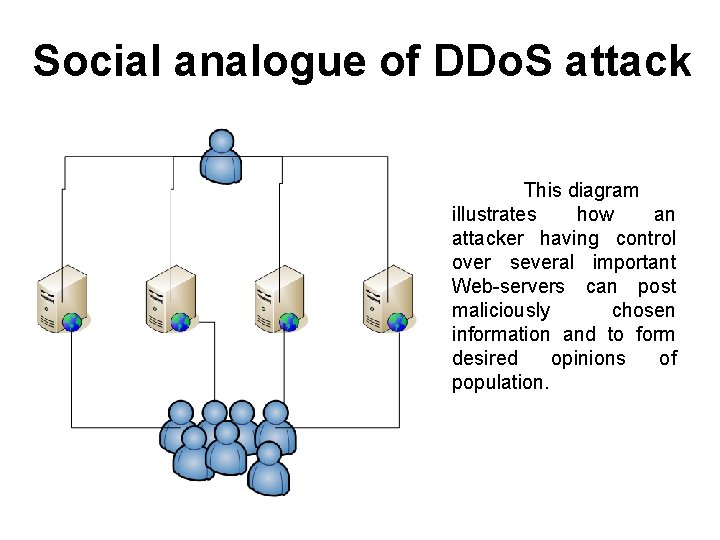
Social analogue of DDo. S attack This diagram illustrates how an attacker having control over several important Web-servers can post maliciously chosen information and to form desired opinions of population.
DRDo. S attack
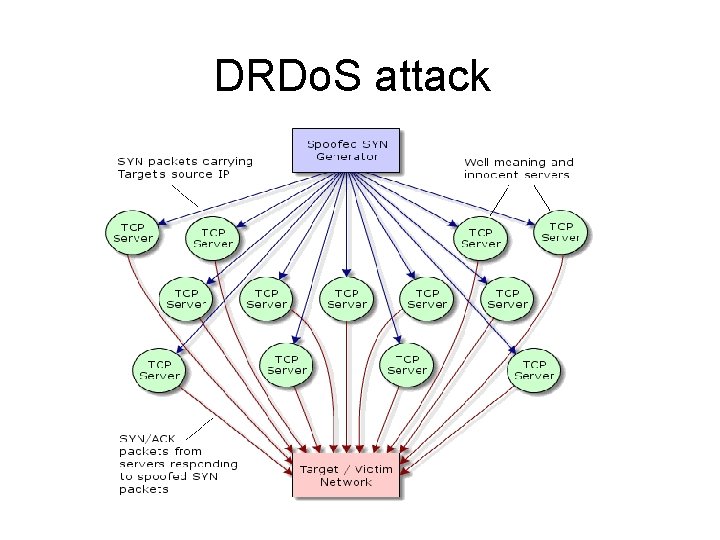
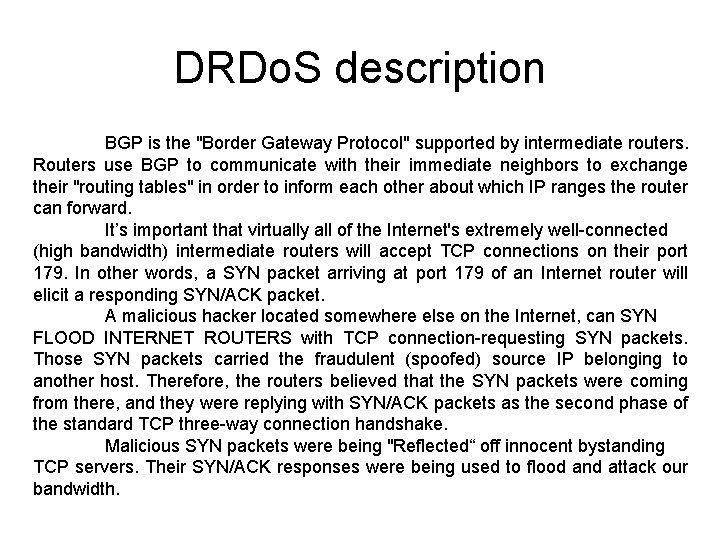
DRDo. S description BGP is the "Border Gateway Protocol" supported by intermediate routers. Routers use BGP to communicate with their immediate neighbors to exchange their "routing tables" in order to inform each other about which IP ranges the router can forward. It’s important that virtually all of the Internet's extremely well-connected (high bandwidth) intermediate routers will accept TCP connections on their port 179. In other words, a SYN packet arriving at port 179 of an Internet router will elicit a responding SYN/ACK packet. A malicious hacker located somewhere else on the Internet, can SYN FLOOD INTERNET ROUTERS with TCP connection-requesting SYN packets. Those SYN packets carried the fraudulent (spoofed) source IP belonging to another host. Therefore, the routers believed that the SYN packets were coming from there, and they were replying with SYN/ACK packets as the second phase of the standard TCP three-way connection handshake. Malicious SYN packets were being "Reflected“ off innocent bystanding TCP servers. Their SYN/ACK responses were being used to flood and attack our bandwidth.
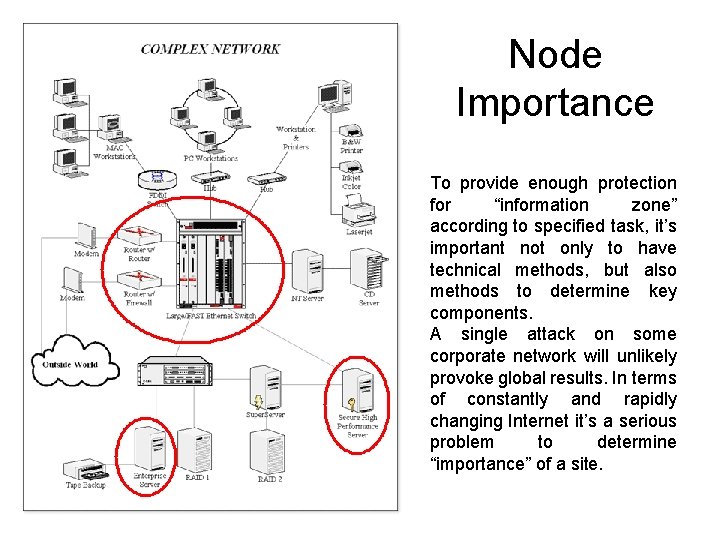
Node Importance To provide enough protection for “information zone” according to specified task, it’s important not only to have technical methods, but also methods to determine key components. A single attack on some corporate network will unlikely provoke global results. In terms of constantly and rapidly changing Internet it’s a serious problem to determine “importance” of a site.
Modeling diagram
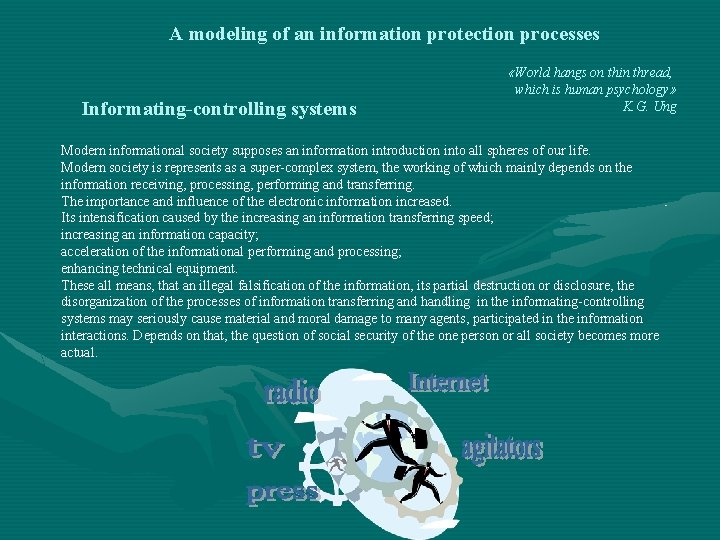
A modeling of an information protection processes Informating-controlling systems «World hangs on thin thread, which is human psychology» K. G. Ung Modern informational society supposes an information introduction into all spheres of our life. Modern society is represents as a super-complex system, the working of which mainly depends on the information receiving, processing, performing and transferring. The importance and influence of the electronic information increased. Its intensification caused by the increasing an information transferring speed; increasing an information capacity; acceleration of the informational performing and processing; enhancing technical equipment. These all means, that an illegal falsification of the information, its partial destruction or disclosure, the disorganization of the processes of information transferring and handling in the informating-controlling systems may seriously cause material and moral damage to many agents, participated in the information interactions. Depends on that, the question of social security of the one person or all society becomes more actual.
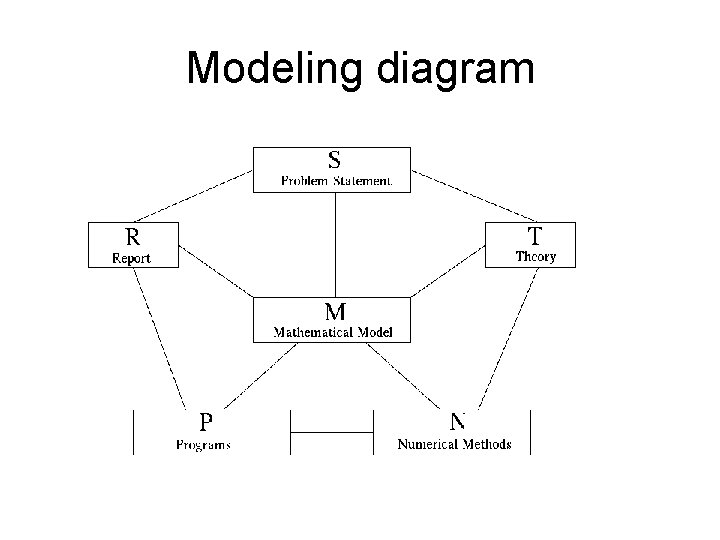
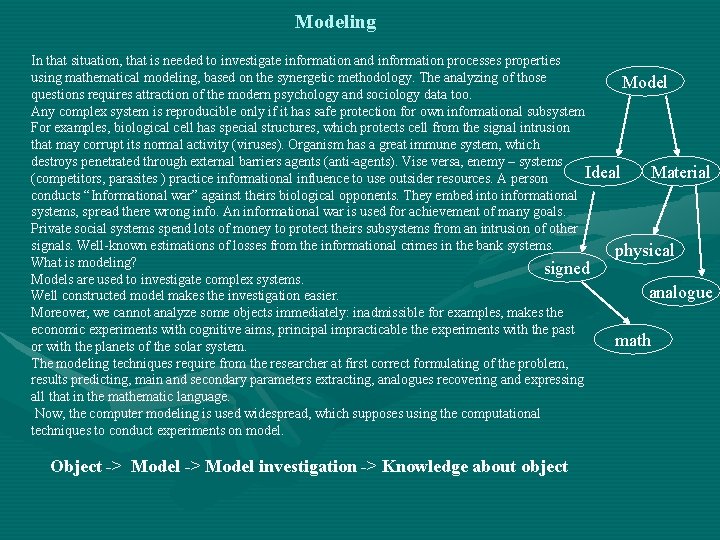
Modeling In that situation, that is needed to investigate information and information processes properties using mathematical modeling, based on the synergetic methodology. The analyzing of those Model questions requires attraction of the modern psychology and sociology data too. Any complex system is reproducible only if it has safe protection for own informational subsystem For examples, biological cell has special structures, which protects cell from the signal intrusion that may corrupt its normal activity (viruses). Organism has a great immune system, which destroys penetrated through external barriers agents (anti-agents). Vise versa, enemy – systems Ideal Material (competitors, parasites ) practice informational influence to use outsider resources. A person conducts “Informational war” against theirs biological opponents. They embed into informational systems, spread there wrong info. An informational war is used for achievement of many goals. Private social systems spend lots of money to protect theirs subsystems from an intrusion of other signals. Well-known estimations of losses from the informational crimes in the bank systems. physical What is modeling? signed Models are used to investigate complex systems. analogue Well constructed model makes the investigation easier. Moreover, we cannot analyze some objects immediately: inadmissible for examples, makes the economic experiments with cognitive aims, principal impracticable the experiments with the past math or with the planets of the solar system. The modeling techniques require from the researcher at first correct formulating of the problem, results predicting, main and secondary parameters extracting, analogues recovering and expressing all that in the mathematic language. Now, the computer modeling is used widespread, which supposes using the computational techniques to conduct experiments on model. Object -> Model investigation -> Knowledge about object
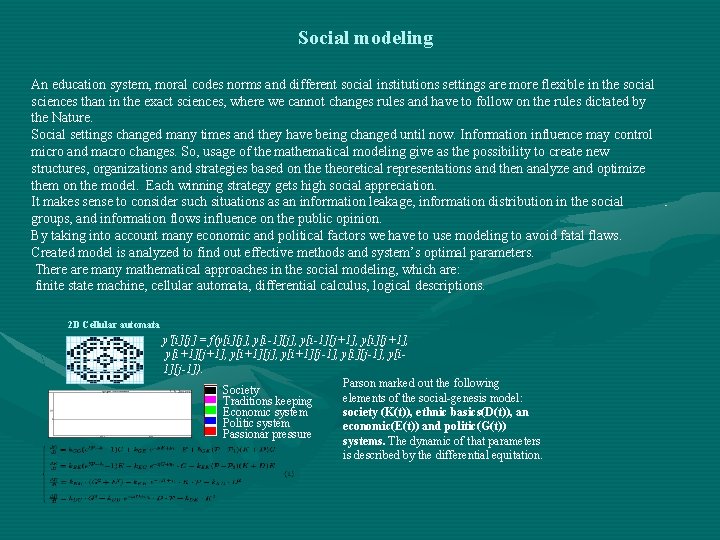
Social modeling An education system, moral codes norms and different social institutions settings are more flexible in the social sciences than in the exact sciences, where we cannot changes rules and have to follow on the rules dictated by the Nature. Social settings changed many times and they have being changed until now. Information influence may control micro and macro changes. So, usage of the mathematical modeling give as the possibility to create new structures, organizations and strategies based on theoretical representations and then analyze and optimize them on the model. Each winning strategy gets high social appreciation. It makes sense to consider such situations as an information leakage, information distribution in the social groups, and information flows influence on the public opinion. By taking into account many economic and political factors we have to use modeling to avoid fatal flaws. Created model is analyzed to find out effective methods and system’s optimal parameters. There are many mathematical approaches in the social modeling, which are: finite state machine, cellular automata, differential calculus, logical descriptions. 2 D Cellular automata y'[i][j] = f(y[i][j], y[i-1][j+1], y[i+1][j+1], y[i+1][j-1], y[i][j-1], y[i 1][j-1]). Parson marked out the following Society elements of the social-genesis model: Traditions keeping society (K(t)), ethnic basics(D(t)), an Economic system Politic system economic(E(t)) and politic(G(t)) Passionar pressure systems. The dynamic of that parameters is described by the differential equitation.
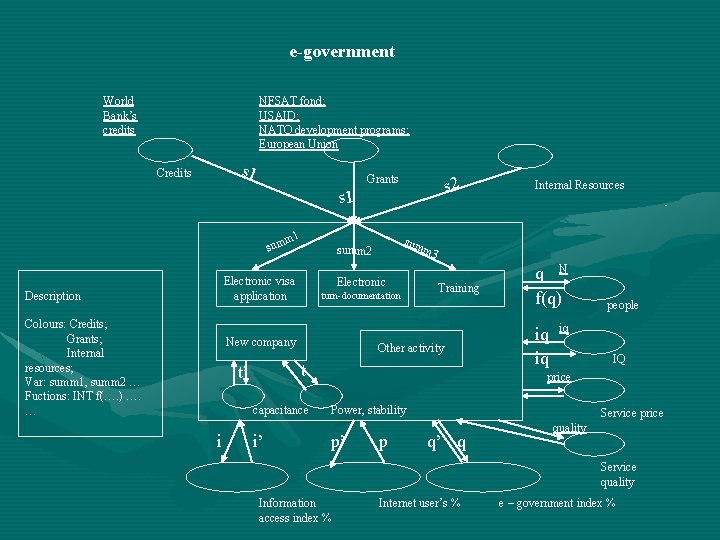
e-government World Bank’s credits NFSAT fond; USAID; NATO development programs; European Union s 1 Credits Grants s 2 s 1 m 1 sum Description Colours: Credits; Grants; Internal resources; Var: summ 1, summ 2 … Fuctions: INT f(…. ) …. … m 3 Electronic turn-documentation New company Training Other activity t t’ capacitance i summ 2 Electronic visa application i’ Internal Resources q N f(q) iq iq people iq IQ price Power, stability p’ p Service price q’ q quality Service quality Information access index % Internet user’s % e – government index %
At the results it make sense to pay attention to the following models: 1. 2. 3. 4. Investigate the integration process in our region. Investigate an information flows influence in our region, by taking into account many factors like national mentality, region’s specific traditions, many factors which comes from the history and affect our behavior much. That is evident that social systems can be more or less safe in case of having censorship, which controls external signals entry and theirs circulation. But does that statement extendable onto all society? As the point of censorship point is differ in the modern and traditional societies. That is helpful to describe vulnerable elements of the society, the informational influence on which disturb it much more. But the main conclusion anyway is that protection of a person from the informational influence depends on that person at first, as lots of means provided by government can be insufficient. So the main way based on the science, culture and education development ! The researching of social models will help us to understand mechanisms of an information influence on society. It aids to find out ways of information security in the modern society. Besides modeling we have to design and accept a low, about national information - psychology protection, which will prohibit manipulations (free or hide) with masses or individuals through mass communication media.
A method of steganographic arrangement of musical composition Basic ways of solution of information security tasks are cryptography and steganography. The subject of cryptography is to hide contents of message by its encoding and the subject of steganography is to hide the fact of existence of secret message. In the case of cryptography the availability of encoded message attracts attention, but in the case of steganography availability of that message remains invisible. The secrecy becomes one of major characteristics of contemporary equipment. We already have planes which are invisible for radar set, noiseless divers, small and nearly invisible spy-planes and etc. And among these invisible beings there’s a new one – steganography. During the investigation of September 11 crime there was revealed potential danger of just the steganography, as it turned out to be very comfortable from the terror technology point of view, because of its performance characteristics. The evolution of computer engineering stimulated the development of cyber steganography. Hidden messages are built into figures, which have analog characteristics – speech, audio recording, image, video and even text files and execution files – translated into a code. In spite of a number of publications about steganography its role in the information security problem is not still exactly determined. First the problem of organization of hidden channels in electric communications in mathematical form was risen by Simmons at “Crypto-83” conference as “the problem of two prisoners”. It interested only a small number of scientists. In 1990 -ies owing to the development of multimedia technologies and diffusion of digital hardware there were created new resources for cyber steganography: invisible building in technology, hiding or mascorating of special messages or symbols in file-containers, containing sound or image in digital form. Demand of stegoproduction is detrmined by many factors, which are based on the “invisibility” of its application. Let’s mention some of them:
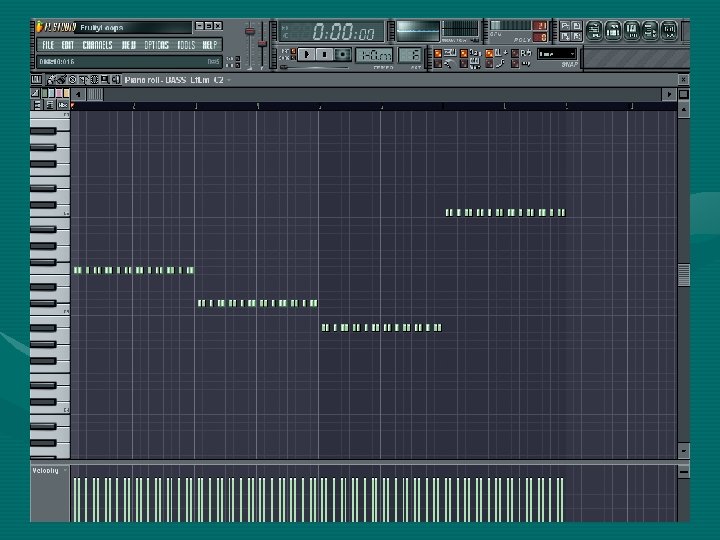
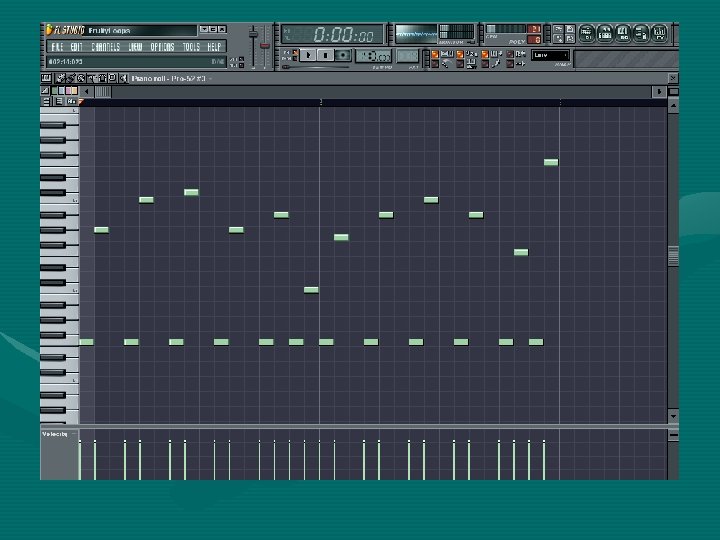
• • • • Audio and video electronic product’s copyright protection; Wish for “not to be imprisoned”(Simmons’ model) according with the trends for total automated control of persons life, which is promoted by giving each tellurian a perpetual number, spreading of electronic documents circulation and cashless settlement; Creation of secret archives; Political, technical, economic, military and other forms of espionage service; Criminal, terrorist and other unlawful structure service in organization of hidden information control and exchange systems on a global scale. The concerned task of steganographic arrangement of musical composition is the building in a hidden text in the arrangement, during the performance of which this text is being transmitted but the form of transmission helps to hide the fact of it. On the other hand, built in fingerprinting will help the composer to protect his copyright. As an example of this method I’ll examine electronic music, which is richer by its sounds than other music styles. This helps to avoid disharmony and disbalance by putting a hidden message in the music product. The main idea of this method is that the music product is considered to be an aggregate of tracks (from the technical point of view) in which we put the hidden message. This method includes 3 next phases. 1 st phase. The message (the code) transforms into the consecution of zeroes and units. 2 nd phase. The initial music “text” is distributed in G groups including TG tracks. Here’s an example of these groups: Percussion instruments: drums, hats, claps. Bass, subbass. Sequencers (melodies): prime and secondary. Layers. Sound effects. Including of the message is executed accordingly in each group. Let’s describe this process. 1 st group. Percussion. We fix determined quantity of drums, hats, claps and put the message on one, two or three of them. For example the message is built in drums, which are performed r(0<r<33) times a music bar. For including 0 we decrease the quantity of drums till r-1, and for including 1 – increase till r+1. This procedure is much effective during musical passage.
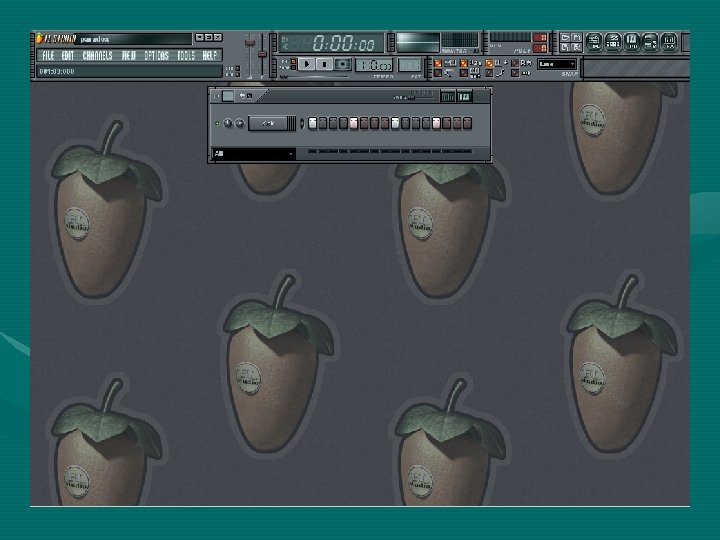
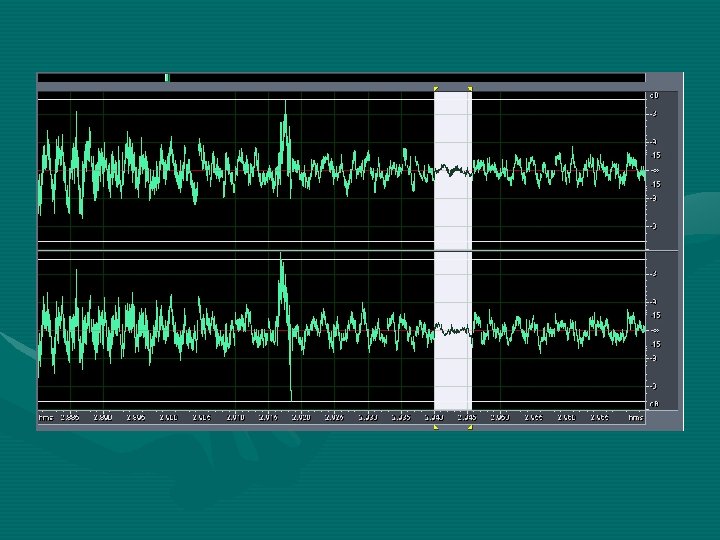
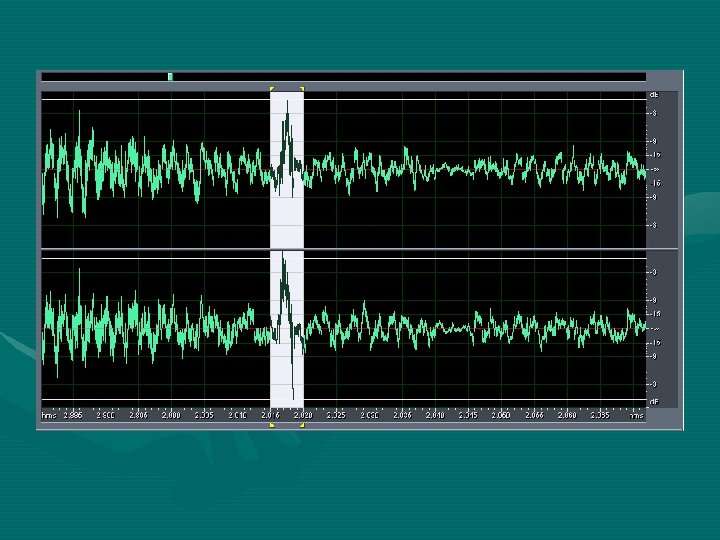
• • 2 nd group. Bass and subbass. Bass. Under the treaty they contain n notes. If the bass breaks during the performance we fix 0, if there is n+1 note we fix 1. Subbasses top is for example between 20 and 30 Hz. When the top is near 20 Hz we fix 0, when near 30 Hz, accordingly, 1. 3 rd group. Sequencer is a melody which forms theme of the composition. When the harmony rises we fix 1, otherwise – 0. There may not be a secondary sequencer, but if there is and it’s performed just after fixing 1 in the main sequencer, we fix one more 1, otherwise – 0. 4 th group. Layers are notes and accords accompanying the composition to make it stronger and more complete. For example the layer contains g>2 notes in the first octave. If at least one note belongs to small octave we fix 0, if it belongs to the second – 1. 5 th group. Sound effects. They can be added to each instrument. There also can be used different non-standard sounds, which are much widespread in electronic music. We propose to put a Faze sound effect on the main sequencer. According to the agreement we fix 2 borders – lower one- 1000 Hz, and upper one- 20000 Hz. If the upper border is reached we fix 1, if the lower one – 0. Otherwise nothing is fixed. 3 rd phase. Extraction of the built in message from the composition. The recipient has an agreement with the transferring party concerning first two phases of this procedure (the arrangement secret key), getting the composition, which helps him to extract the message. On the basis of stated method I present an example of its realization as a music file.
In conclusion we present our thanks to professors Armen Darbinyan, Igor Mkrtumyan and Elisa Shahbazyan for collaboration.