Privacy in Machine Learning Attacks Ruta Jawale High
- Slides: 34
Privacy in Machine Learning (Attacks) Ruta Jawale
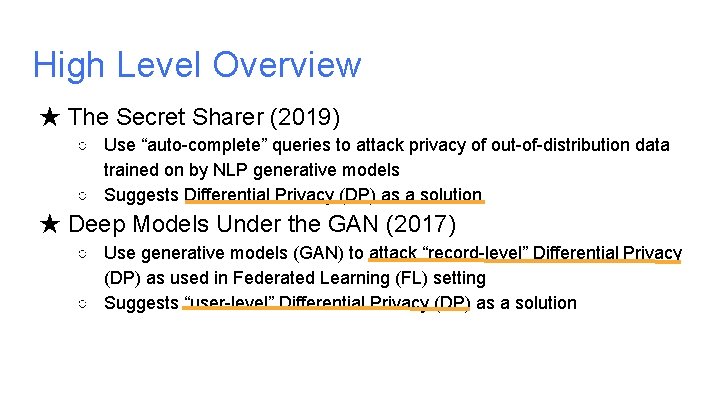
High Level Overview ★ The Secret Sharer (2019) ○ Use “auto-complete” queries to attack privacy of out-of-distribution data trained on by NLP generative models ○ Suggests Differential Privacy (DP) as a solution ★ Deep Models Under the GAN (2017) ○ Use generative models (GAN) to attack “record-level” Differential Privacy (DP) as used in Federated Learning (FL) setting ○ Suggests “user-level” Differential Privacy (DP) as a solution
The Secret Sharer (2019)
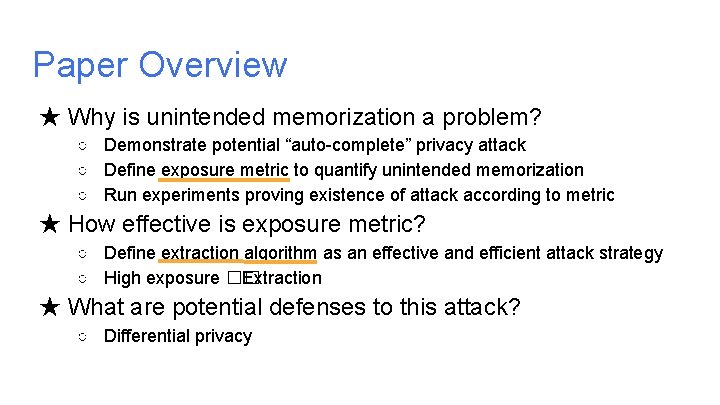
Paper Overview ★ Why is unintended memorization a problem? ○ Demonstrate potential “auto-complete” privacy attack ○ Define exposure metric to quantify unintended memorization ○ Run experiments proving existence of attack according to metric ★ How effective is exposure metric? ○ Define extraction algorithm as an effective and efficient attack strategy ○ High exposure �� Extraction ★ What are potential defenses to this attack? ○ Differential privacy
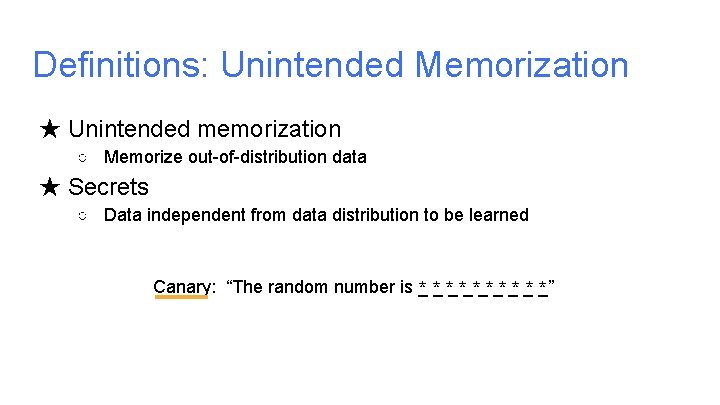
Definitions: Unintended Memorization ★ Unintended memorization ○ Memorize out-of-distribution data ★ Secrets ○ Data independent from data distribution to be learned Canary: “The random number is _* *_ *_ *_*_*_* _* _* _” *
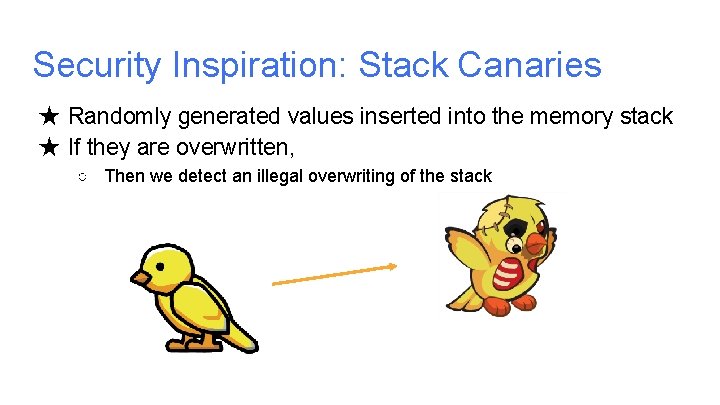
Security Inspiration: Stack Canaries ★ Randomly generated values inserted into the memory stack ★ If they are overwritten, ○ Then we detect an illegal overwriting of the stack
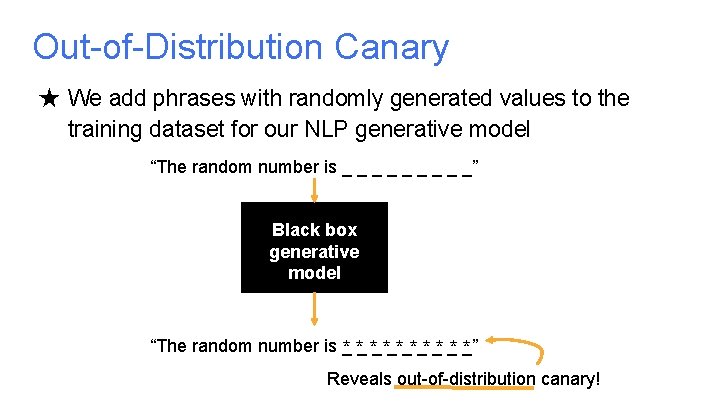
Out-of-Distribution Canary ★ We add phrases with randomly generated values to the training dataset for our NLP generative model “The random number is _ _ _ _ _” Black box generative model “The random number is _* *_ *_ *_*_*_* _* _* _” * Reveals out-of-distribution canary!
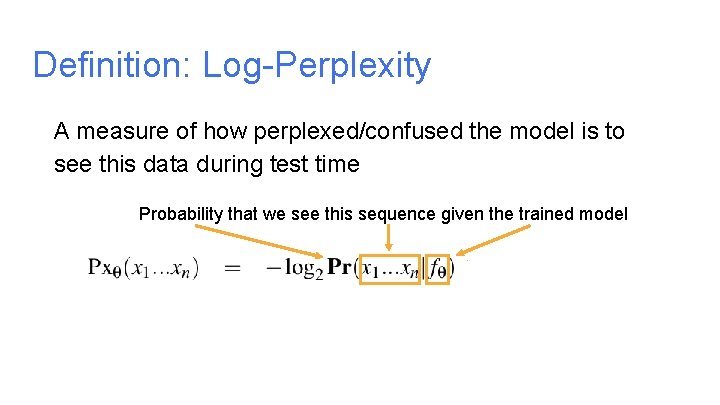
Definition: Log-Perplexity A measure of how perplexed/confused the model is to see this data during test time Probability that we see this sequence given the trained model Bayes’ Rule
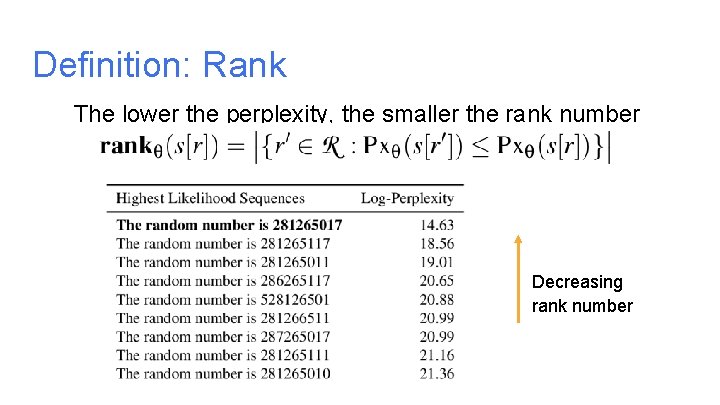
Definition: Rank The lower the perplexity, the smaller the rank number Decreasing rank number
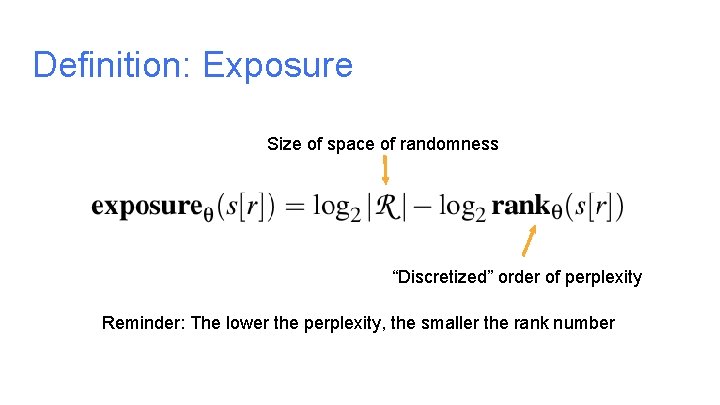
Definition: Exposure Size of space of randomness “Discretized” order of perplexity Reminder: The lower the perplexity, the smaller the rank number
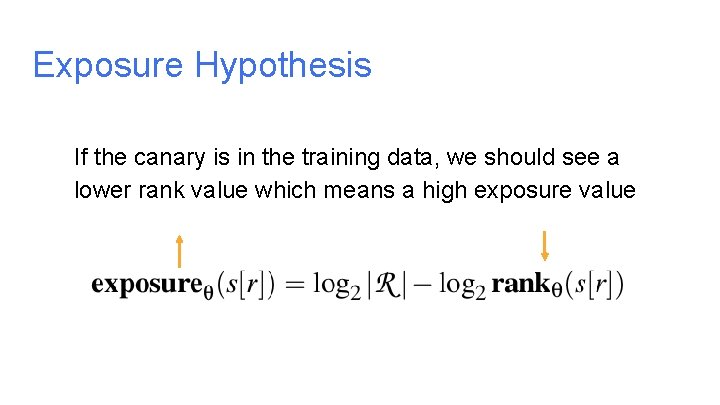
Exposure Hypothesis If the canary is in the training data, we should see a lower rank value which means a high exposure value
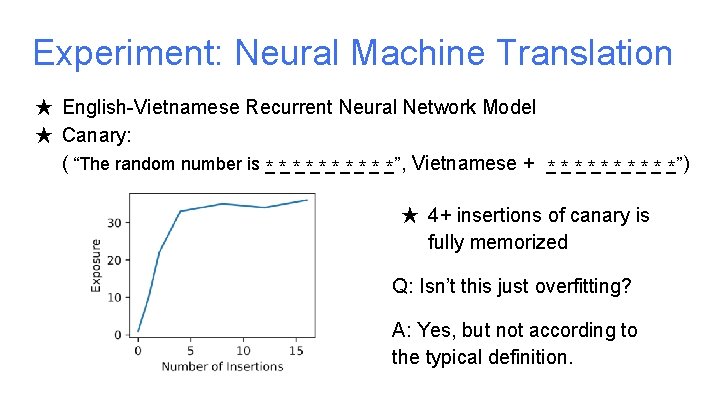
Experiment: Neural Machine Translation ★ English-Vietnamese Recurrent Neural Network Model ★ Canary: ( “The random number is _* *_ *_ *_*_*_* _* _* _” * , Vietnamese + _* *_ *_ *_*_*_* _* _* _” *) ★ 4+ insertions of canary is fully memorized Q: Isn’t this just overfitting? A: Yes, but not according to the typical definition.
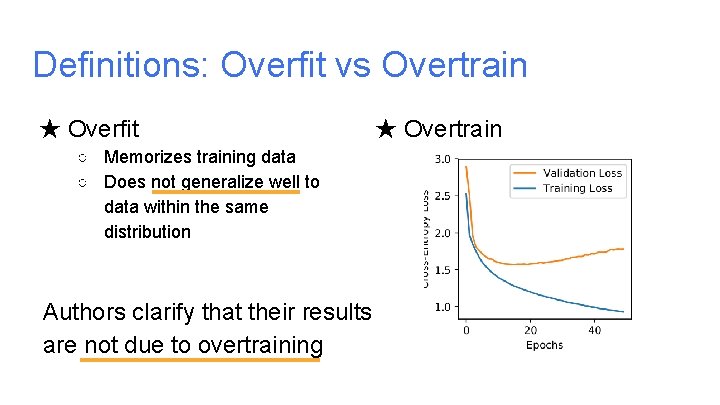
Definitions: Overfit vs Overtrain ★ Overfit ○ Memorizes training data ○ Does not generalize well to data within the same distribution Authors clarify that their results are not due to overtraining ★ Overtrain
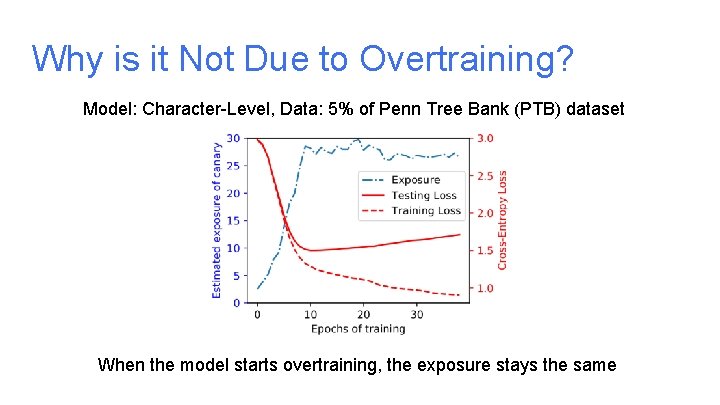
Why is it Not Due to Overtraining? Model: Character-Level, Data: 5% of Penn Tree Bank (PTB) dataset When the model starts overtraining, the exposure stays the same
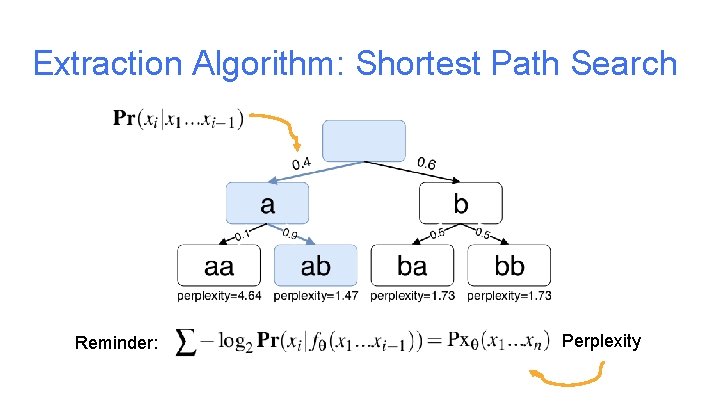
Extraction Algorithm: Shortest Path Search Reminder: Perplexity
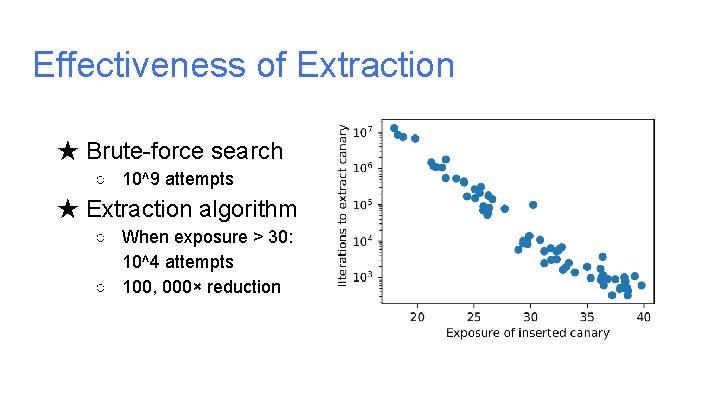
Effectiveness of Extraction ★ Brute-force search ○ 10^9 attempts ★ Extraction algorithm ○ When exposure > 30: 10^4 attempts ○ 100, 000× reduction
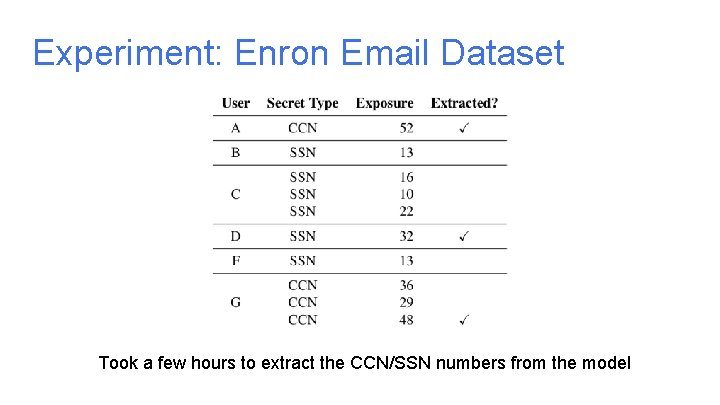
Experiment: Enron Email Dataset Took a few hours to extract the CCN/SSN numbers from the model
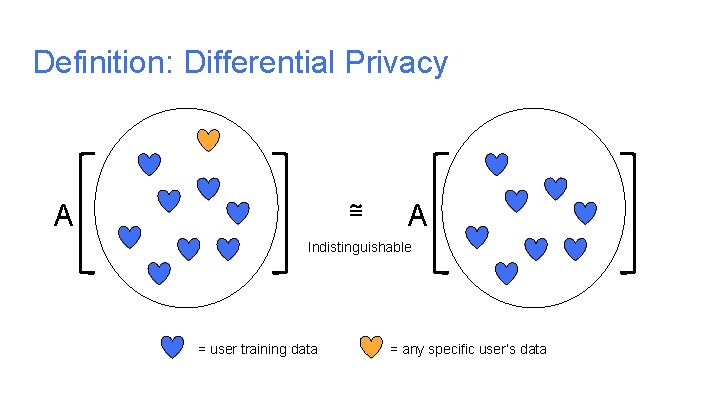
Definition: Differential Privacy ≅ A A Indistinguishable = user training data = any specific user’s data
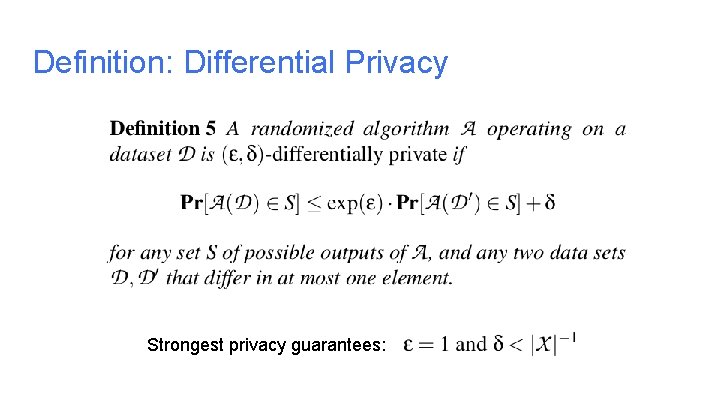
Definition: Differential Privacy Strongest privacy guarantees:
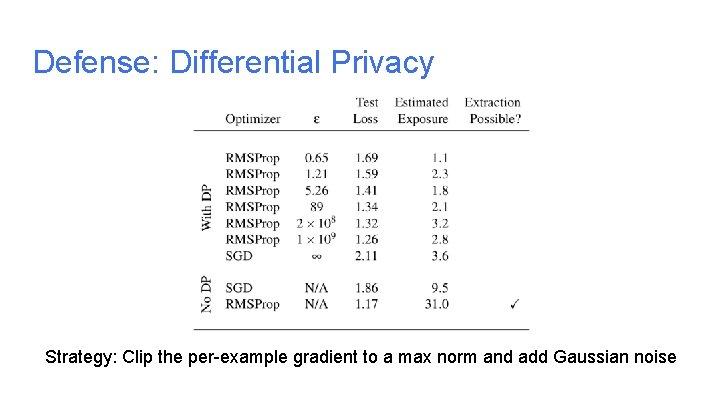
Defense: Differential Privacy Strategy: Clip the per-example gradient to a max norm and add Gaussian noise
Deep Models Under the GAN (2017)
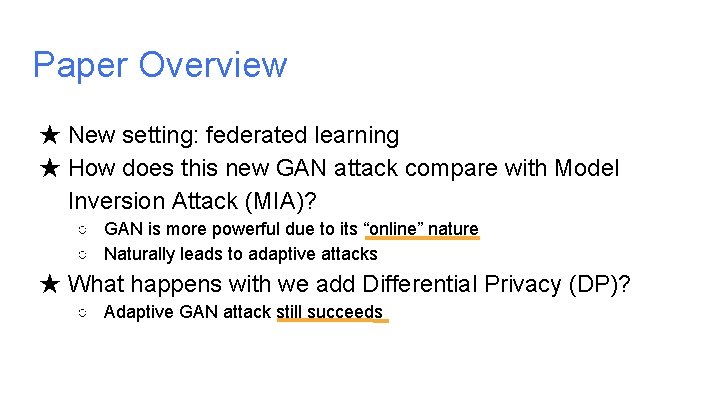
Paper Overview ★ New setting: federated learning ★ How does this new GAN attack compare with Model Inversion Attack (MIA)? ○ GAN is more powerful due to its “online” nature ○ Naturally leads to adaptive attacks ★ What happens with we add Differential Privacy (DP)? ○ Adaptive GAN attack still succeeds
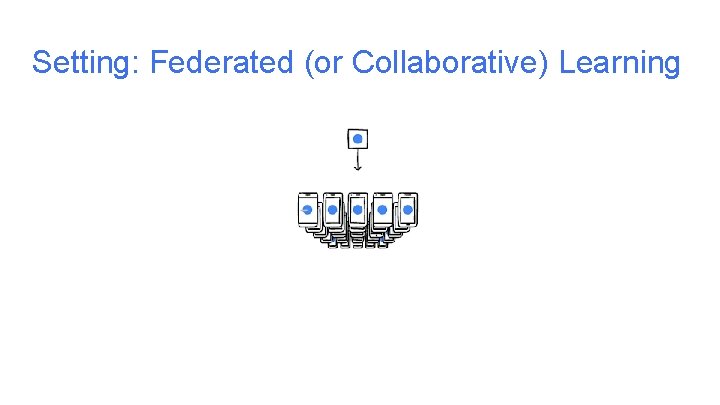
Setting: Federated (or Collaborative) Learning
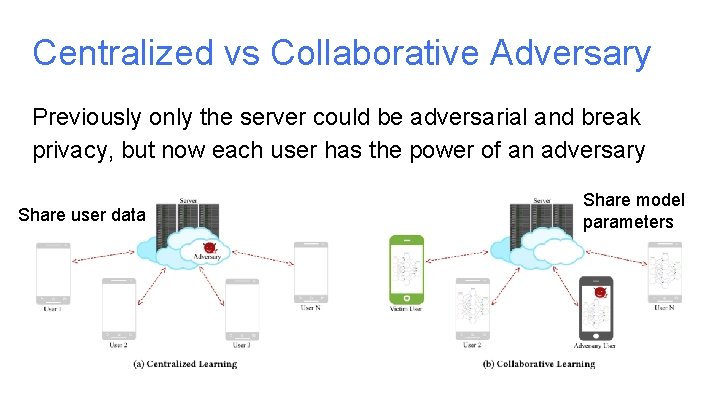
Centralized vs Collaborative Adversary Previously only the server could be adversarial and break privacy, but now each user has the power of an adversary Share user data Share model parameters
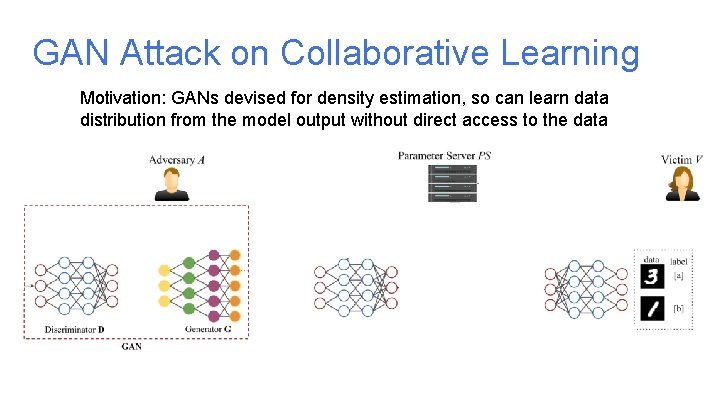
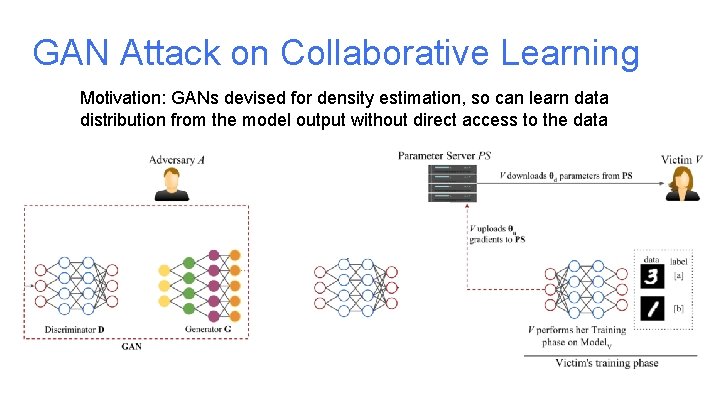
GAN Attack on Collaborative Learning Motivation: GANs devised for density estimation, so can learn data distribution from the model output without direct access to the data
GAN Attack on Collaborative Learning Motivation: GANs devised for density estimation, so can learn data distribution from the model output without direct access to the data
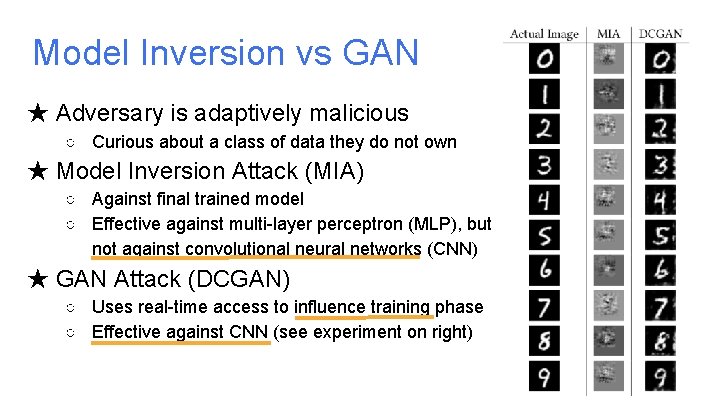
Model Inversion vs GAN ★ Adversary is adaptively malicious ○ Curious about a class of data they do not own ★ Model Inversion Attack (MIA) ○ Against final trained model ○ Effective against multi-layer perceptron (MLP), but not against convolutional neural networks (CNN) ★ GAN Attack (DCGAN) ○ Uses real-time access to influence training phase ○ Effective against CNN (see experiment on right)
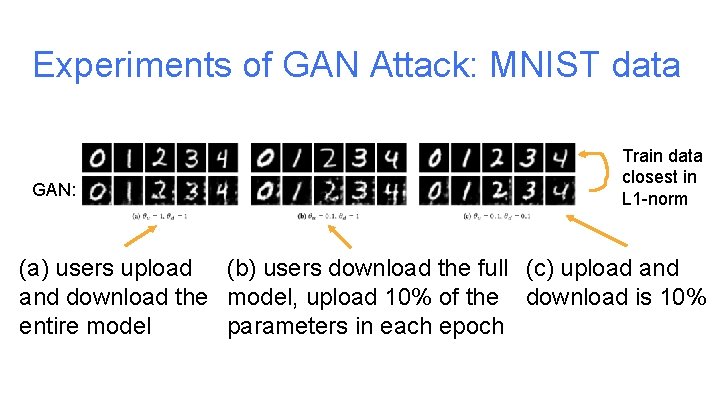
Experiments of GAN Attack: MNIST data GAN: Train data closest in L 1 -norm (a) users upload (b) users download the full (c) upload and download the model, upload 10% of the download is 10% entire model parameters in each epoch
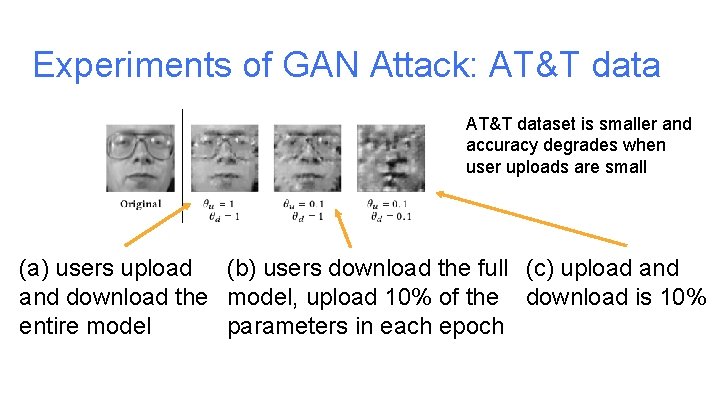
Experiments of GAN Attack: AT&T dataset is smaller and accuracy degrades when user uploads are small (a) users upload (b) users download the full (c) upload and download the model, upload 10% of the download is 10% entire model parameters in each epoch
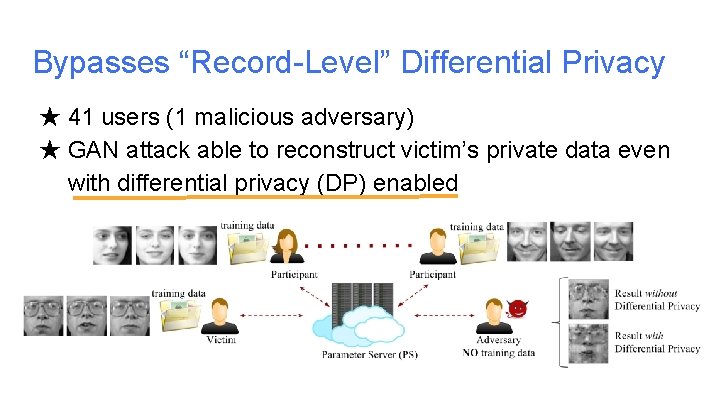
Bypasses “Record-Level” Differential Privacy ★ 41 users (1 malicious adversary) ★ GAN attack able to reconstruct victim’s private data even with differential privacy (DP) enabled
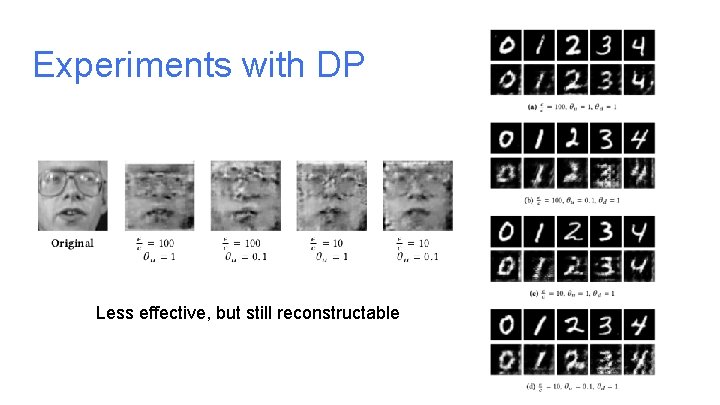
Experiments with DP Less effective, but still reconstructable
Why Doesn’t “Record-Level” DP Suffice? ★ GAN attack is effective even using differential privacy ○ Authors say that the attack relies only on the accuracy of the discriminative model of the GAN and not its actual gradient values
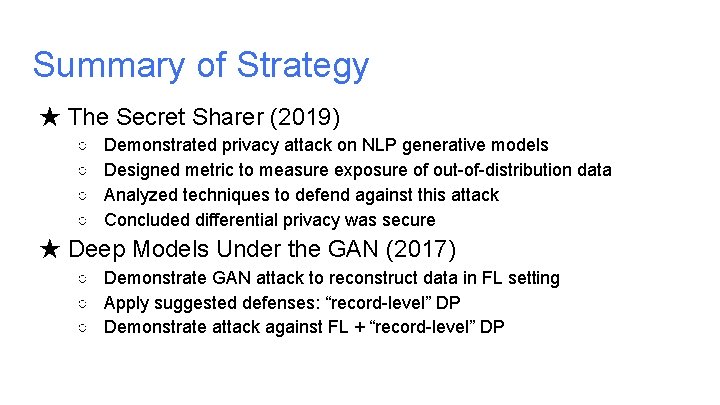
Summary of Strategy ★ The Secret Sharer (2019) ○ ○ Demonstrated privacy attack on NLP generative models Designed metric to measure exposure of out-of-distribution data Analyzed techniques to defend against this attack Concluded differential privacy was secure ★ Deep Models Under the GAN (2017) ○ Demonstrate GAN attack to reconstruct data in FL setting ○ Apply suggested defenses: “record-level” DP ○ Demonstrate attack against FL + “record-level” DP
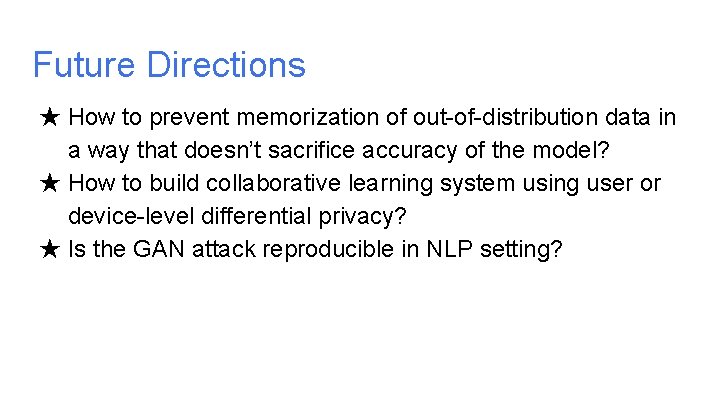
Future Directions ★ How to prevent memorization of out-of-distribution data in a way that doesn’t sacrifice accuracy of the model? ★ How to build collaborative learning system using user or device-level differential privacy? ★ Is the GAN attack reproducible in NLP setting?