Presidential Infrastructure Coordinating Commission PICC and Energy Related











- Slides: 29
Presidential Infrastructure Coordinating Commission (PICC) and Energy Related SIPs Dr Wolsey Barnard and Ms Angelique Kilian
Presentation Outline 1. Background to PICC 2. DOE and PICC 3. Energy and SIPs 4. Reporting 5. Conclusions 2
Background to PICC 3
Background to PICC • Cabinet adopted an Infrastructure Plan that is intended to transform the economic landscape of South Africa, create a significant number of new jobs, strengthen the delivery of basic services to the population and support the integration of African economies. (National Development Plan – New Growth Plan – Infrastructure Plan) • Presidential Infrastructure Coordinating Commission (PICC) was established to integrate and coordinate the long term infrastructure build programmes (Infrastructure Plan) over all three spheres of Government. • Eighteen (18) Strategic Integrated Projects (SIPs) have been developed and approved to support economic development and address service delivery in the poorest provinces. • The SIPs cover a range of economic and social infrastructure • All nine provinces are covered, with emphasis on poorer provinces 4
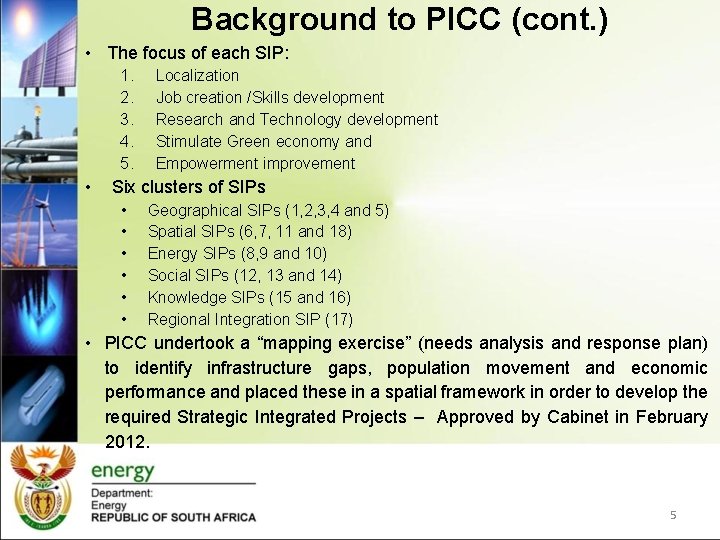
Background to PICC (cont. ) • The focus of each SIP: 1. 2. 3. 4. 5. • Localization Job creation /Skills development Research and Technology development Stimulate Green economy and Empowerment improvement Six clusters of SIPs • • • Geographical SIPs (1, 2, 3, 4 and 5) Spatial SIPs (6, 7, 11 and 18) Energy SIPs (8, 9 and 10) Social SIPs (12, 13 and 14) Knowledge SIPs (15 and 16) Regional Integration SIP (17) • PICC undertook a “mapping exercise” (needs analysis and response plan) to identify infrastructure gaps, population movement and economic performance and placed these in a spatial framework in order to develop the required Strategic Integrated Projects – Approved by Cabinet in February 2012. 5
Needs Analysis Population Access to Electricity per Municipality Dark colors indicate a lack of access to electricity services compared to the population in the area 6
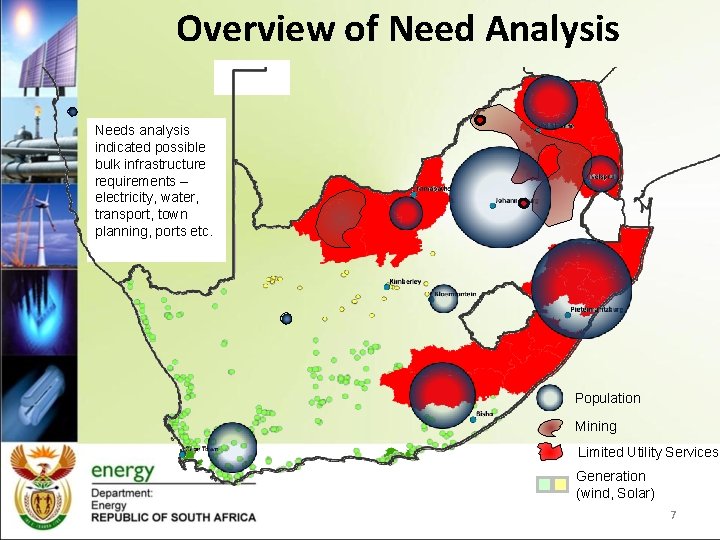
Overview of Need Analysis Needs analysis indicated possible bulk infrastructure requirements – electricity, water, transport, town planning, ports etc. Population Mining Limited Utility Services Generation (wind, Solar) 7
Coordination and Implementation of SIPs Executive Authority: National Department Interim Project Coordinator: Assigned to agency/entities such as DBSA, Eskom, TCTA, PRASA, SANRAL etc. Entities (example): Eskom, DWA, Department of Transport, Department of Health, Department of Basic Education, Public Works in the nine provinces, municipalities and district municipalities, SALGA, Water Boards etc Provinces (example): Northern Cape, Eastern Cape, North West, Kwa. Zulu, Natal, Free State, Mpumalanga, Limpopo, etc National Government Departments (example): Water, Environment, Energy, Health, Basic Education, Transport, Public Enterprises, Mineral Resources, National Planning Commission, Economic Development, Public Works, Human Settlements, Co. GTA, dti, National Treasury, Agriculture, etc. Local government (example): Respective Metro’s, affected municipalities, 24 least resourced District Municipalities etc. 8 8
DOE and PICC 9
DOE and PICC • The Do. E became part of the Presidential Infrastructure Coordinating Commission (PICC) and Secretariat as early as February 2012. • Established a small unit within Do. E to look after PICC related support. • Regular feedback meetings take place with PICC Secretariat team and PMU of DOE to strengthen working relationship. • DOE through the PMU is forwarding on a monthly basis information through to PICC Secretariat, while consolidated quarterly reports of projects within each SIP are reported on. 10
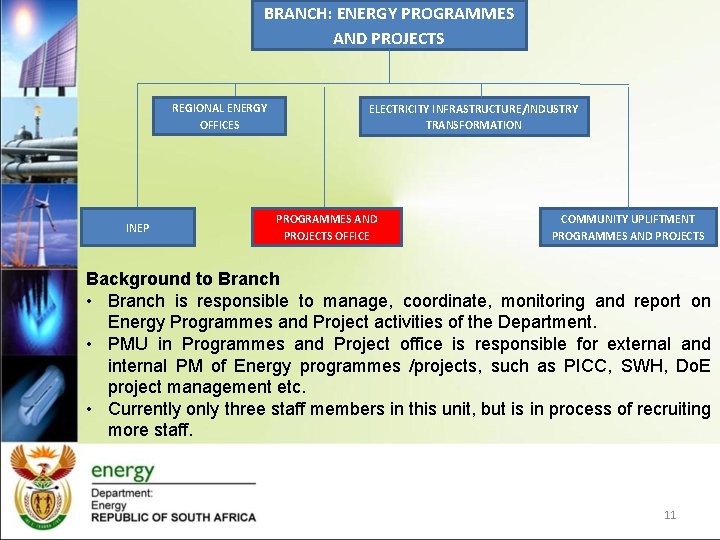
BRANCH: ENERGY PROGRAMMES AND PROJECTS REGIONAL ENERGY OFFICES INEP ELECTRICITY INFRASTRUCTURE/INDUSTRY TRANSFORMATION PROGRAMMES AND PROJECTS OFFICE COMMUNITY UPLIFTMENT PROGRAMMES AND PROJECTS Background to Branch • Branch is responsible to manage, coordinate, monitoring and report on Energy Programmes and Project activities of the Department. • PMU in Programmes and Project office is responsible for external and internal PM of Energy programmes /projects, such as PICC, SWH, Do. E project management etc. • Currently only three staff members in this unit, but is in process of recruiting more staff. 11
Energy Related SIPs 12
Coordination and Implementation of the Energy SIPs SIP 6 SIP 8 SIP 9 SIP 10 Integrated Municipal Infrastructure Green Energy in support of the South African Economy Electricity generation to support socioeconomic development Electricity Transmission and Distribution for All Inter. Governmental Forum (IGF) Chair: Minister Martins Chair: Min Martins, Co-Chair: Min Patel Chair: Min Gigaba Chair: Min Gigaba and Co-Chair: Min Martins Interim Project Coordinator DBSA IDC Eskom ALL ALL National Government Departments DOE, DPE, Co. GTA, EDD, DRDLR, DEA, DHS, DPW, DOT, DTI DOE, EDD, DTI, DST, DRDLR, DEA DPE, DOE, DRDLR, DHS DEA Local Government SALGA, Metros, district municipalities, Municipalities, 24 least resourced DM +5 mining towns SALGA, Metros, district municipalities, municipalities Name of SIP Provinces 13
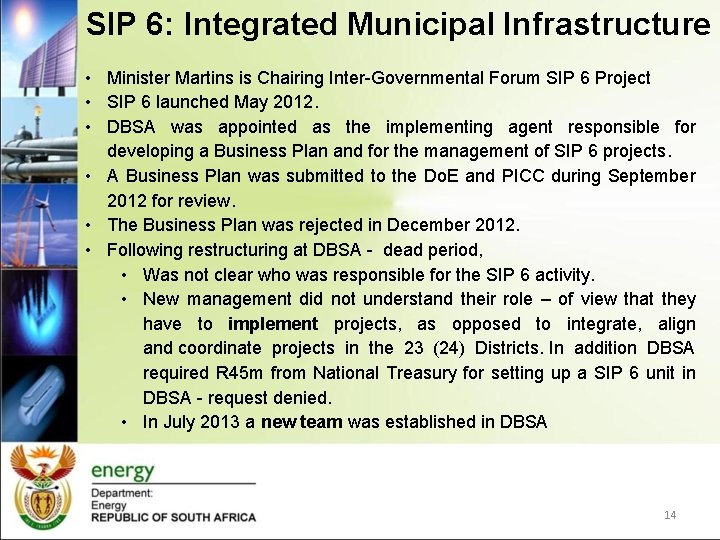
SIP 6: Integrated Municipal Infrastructure • Minister Martins is Chairing Inter-Governmental Forum SIP 6 Project • SIP 6 launched May 2012. • DBSA was appointed as the implementing agent responsible for developing a Business Plan and for the management of SIP 6 projects. • A Business Plan was submitted to the Do. E and PICC during September 2012 for review. • The Business Plan was rejected in December 2012. • Following restructuring at DBSA - dead period, • Was not clear who was responsible for the SIP 6 activity. • New management did not understand their role – of view that they have to implement projects, as opposed to integrate, align and coordinate projects in the 23 (24) Districts. In addition DBSA required R 45 m from National Treasury for setting up a SIP 6 unit in DBSA - request denied. • In July 2013 a new team was established in DBSA 14
SIP 6 To raise the quality of life in the least resourced municipalities through integrated action by National Departments in critical service delivery To address all the maintenance backlogs and upgrades required in water, electricity and sanitation bulk infrastructure in the 23 least resourced district municipalities, covering 17 million people, in a project that is nationally managed but locally delivered. The key impact is to reverse the degradation of water quality both in consumption in these towns as well as downstream communities that are impacted by effluent flows into water courses . These increases in effluent quality to downstream communities will have huge benefits in reducing the disease burdens of under-serviced communities and the resultant Project location health expenditure burdens. The upgrades shall also make provision for areas where significant growth in population has not been addressed by expanded facilities with resulting declines in water quality and quantity available to communities. National – 7 Provinces The expansion of electricity distribution grids in these municipalities shall also expand basic service provision to the poorest communities. The re-alignment of the S’Hambe Sonke programme to cluster along this programme will further enhance the service delivery enhancement impact on the population 15
• Reverse maintenance backlogs on bulk infrastructure for water and sanitation • Upgrade and new builds of water and sanitation bulks and reticulation to accommodate changes in service demand provision of services to unserviced communities • Electricity distribution network builds and upgrades • Maintain and fix roads that service these areas, under the S’Hamba Sonke programme • New road construction to areas that have limited access • Boreholes in rural communities to provide access to water • Revitalising clinics and hospitals • Access to digital TVs • Solar water heater providing hot water to rural communities • Extensive programme to convert mud schools to fully serviced school with access to clinics and bridges over rivers, where necessary SIP 6 NC: John Taolo NW: Ngaka Modiri Molema Ruth Mompati LP : Mopani Greater Sekhukhune Capricorn Vhembe KZN : Zululand Amajuba Uthukela Sisonke Ugu Ilembe Uthungulu Umkhanyakude Umzinyathi MP: Ehlanzeni EC : Alfred Nzo OR Tambo Chris Hani Ukhahlamba Amathole FS: Xhariep 16
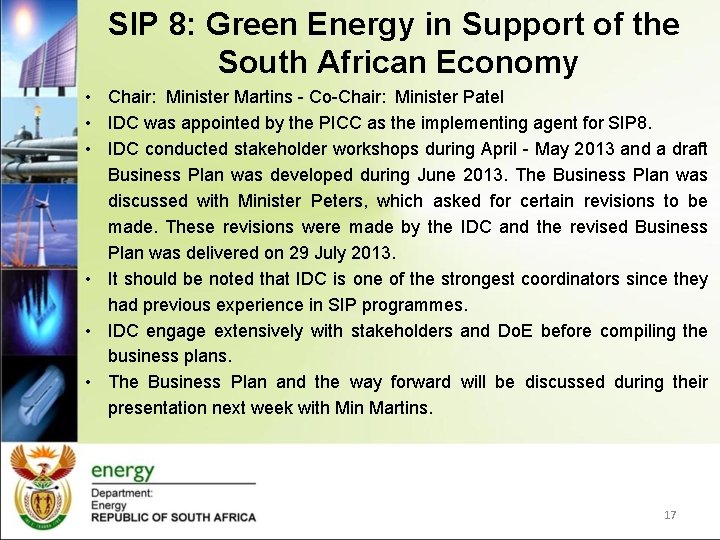
SIP 8: Green Energy in Support of the South African Economy • Chair: Minister Martins - Co-Chair: Minister Patel • IDC was appointed by the PICC as the implementing agent for SIP 8. • IDC conducted stakeholder workshops during April - May 2013 and a draft Business Plan was developed during June 2013. The Business Plan was discussed with Minister Peters, which asked for certain revisions to be made. These revisions were made by the IDC and the revised Business Plan was delivered on 29 July 2013. • It should be noted that IDC is one of the strongest coordinators since they had previous experience in SIP programmes. • IDC engage extensively with stakeholders and Do. E before compiling the business plans. • The Business Plan and the way forward will be discussed during their presentation next week with Min Martins. 17
SIP 10: Electricity Transmission and Distribution for All • • • Chair: Minister Gigaba - Co-Chair: Minister Martins Eskom has recently been appointed as the implementing agent responsible for developing the Business Plan and for the programme management of the SIP 10. Eskom has however started with their planning processes and has advertised for consultants to coordinate SIP 10 for them. Currently reporting on SIP 10 is mostly Eskom information and some Do. E information (Integrated National Electrification Programme – INEP) - not yet incorporated any other info until their appointment letter. A workshop to be held with Eskom during October 2013 to establish the reporting relationship required for DOE projects that fall within SIP 10. 18
Participates in the following SIPs SIP STRATEGIC INTEGRATED NO PROJECT 1 Unblocking the Northern Mineral Belt with the Waterberg as the catalyst DEPARTMENTAL CONTRIBUTION The Do. E is in attendance of all meetings held SIP 01 implementing agent (Eskom). The Do. E provides advice and policy input as and when required, and unblocks any obstacles where the department may be of assistance. Currently discussions are taking place between NT and Do. E, with regards to a letter that Do. E need to send to NERSA to support Eskom committing to the associated water capacity in MCWAP Phase 2 which is required for the energy portion related to the IRP. A key decision to make in the next few months is another coal fired power station. The MCWAP Phase 2 pipeline has been sized for two more coal fired power stations. Due to the high carbon footprint in the Waterberg, careful planning should be done to ensure a that we develop "green" cities in towns like Lephalale. ROLE: Advice and Policy Input 19
Participates in the following SIPs (cont. ) SIP STRATEGIC INTEGRATED DEPARTMENTAL CONTRIBUTION NO 2 PROJECT Durban-Free State. Gauteng logistics and industrial corridor Attendance of meetings held by the implementing agents for the relevant SIP upon invitation ROLE: Advice and Policy Input 3 South Eastern node and corridor development The Do. E has an important role to play in the decision and development of Mthombo and Petro. SA's anticipated LNG plant. Planning and Policy ROLE: Advice and Policy Input 4 Unlocking the economic opportunities in North West Province 5 Saldanha-Northern Cape development corridor Do. E has a very important role to play in prioritizing INEP and SWH in the province. Monthly and Quarterly Information is currently provided. ROLE: Advice and Policy Input PROJECTS: • INEP • SWH The DOE has an important role to play in the anticipated gas development at Saldanha IDZ. Planning and Policy ROLE: Advice and Policy Input 20
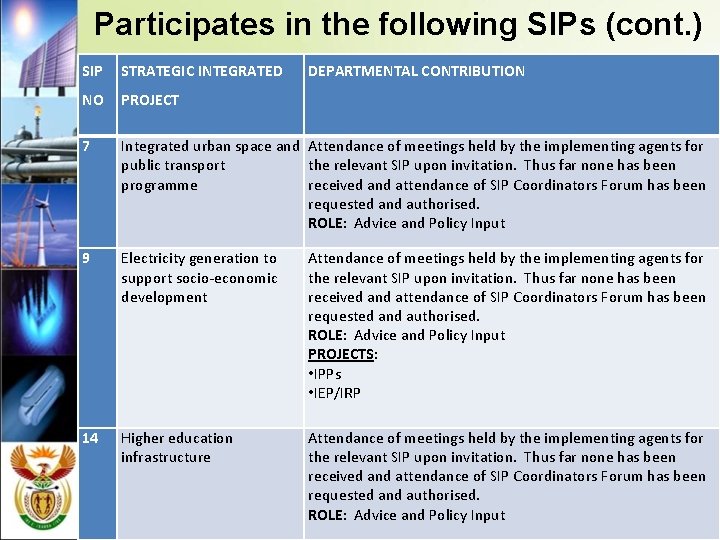
Participates in the following SIPs (cont. ) SIP STRATEGIC INTEGRATED DEPARTMENTAL CONTRIBUTION NO PROJECT 7 Integrated urban space and Attendance of meetings held by the implementing agents for public transport the relevant SIP upon invitation. Thus far none has been programme received and attendance of SIP Coordinators Forum has been requested and authorised. ROLE: Advice and Policy Input 9 Electricity generation to support socio-economic development Attendance of meetings held by the implementing agents for the relevant SIP upon invitation. Thus far none has been received and attendance of SIP Coordinators Forum has been requested and authorised. ROLE: Advice and Policy Input PROJECTS: • IPPs • IEP/IRP 14 Higher education infrastructure Attendance of meetings held by the implementing agents for the relevant SIP upon invitation. Thus far none has been received and attendance of SIP Coordinators Forum has been requested and authorised. 21 ROLE: Advice and Policy Input
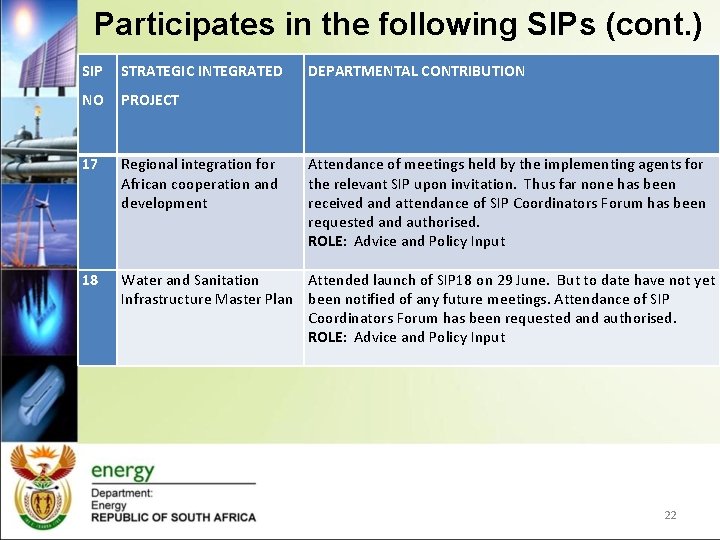
Participates in the following SIPs (cont. ) SIP STRATEGIC INTEGRATED DEPARTMENTAL CONTRIBUTION NO PROJECT 17 Regional integration for African cooperation and development 18 Water and Sanitation Attended launch of SIP 18 on 29 June. But to date have not yet Infrastructure Master Plan been notified of any future meetings. Attendance of SIP Coordinators Forum has been requested and authorised. ROLE: Advice and Policy Input Attendance of meetings held by the implementing agents for the relevant SIP upon invitation. Thus far none has been received and attendance of SIP Coordinators Forum has been requested and authorised. ROLE: Advice and Policy Input 22
Observer Status in the following SIPs SIP STRATEGIC INTEGRATED DEPARTMENTAL CONTRIBUTION NO PROJECT 11 Agri-logistics and rural infrastructure 12 Revitalisation of public hospitals and other health facilities 13 National school build programme 15 Expanding access to communication technology 16 SKA and Meerkat Attendance of meetings held by the various implementing agents for the relevant SIPS in an observer status only – Upon Invitation – NONE has thus far been received. 23
Reporting 24
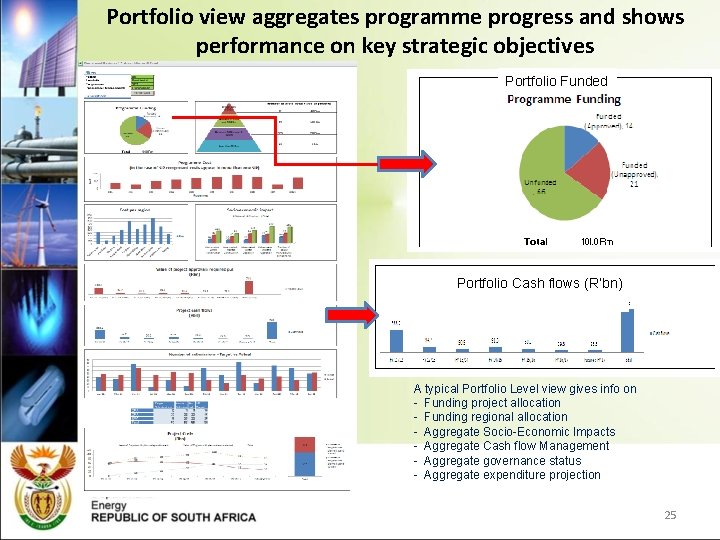
Portfolio view aggregates programme progress and shows performance on key strategic objectives Portfolio Funded Dougan to provide Portfolio Cash flows (R’bn) A typical Portfolio Level view gives info on - Funding project allocation - Funding regional allocation - Aggregate Socio-Economic Impacts - Aggregate Cash flow Management - Aggregate governance status - Aggregate expenditure projection 25
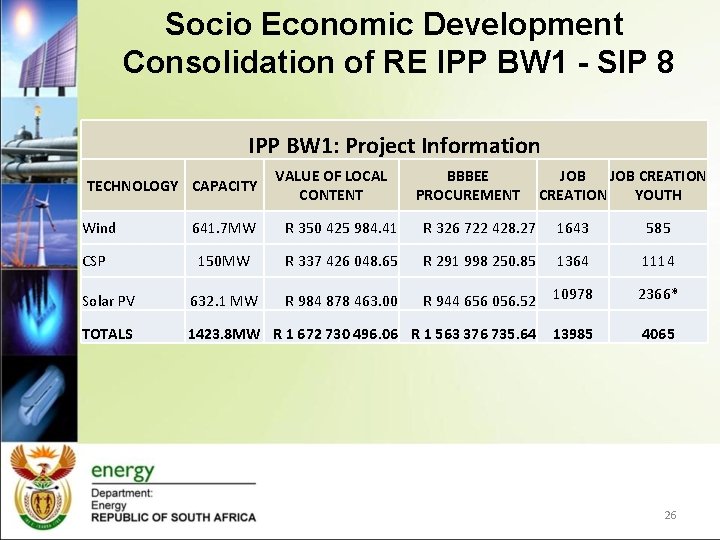
Socio Economic Development Consolidation of RE IPP BW 1 - SIP 8 IPP BW 1: Project Information TECHNOLOGY CAPACITY Wind VALUE OF LOCAL CONTENT BBBEE PROCUREMENT JOB CREATION YOUTH 641. 7 MW R 350 425 984. 41 R 326 722 428. 27 1643 585 150 MW R 337 426 048. 65 R 291 998 250. 85 1364 1114 Solar PV 632. 1 MW R 984 878 463. 00 R 944 656 056. 52 10978 2366* TOTALS 1423. 8 MW R 1 672 730 496. 06 R 1 563 376 735. 64 13985 4065 CSP 26
Conclusions 27
Conclusions • The Infrastructure Plan is a bold effort to transform the economy, laying the basis for growth and jobs • Aimed at promoting: • Re-industrialisation through manufacturing on inputs, components and • • • machinery Skills development aimed at critical categories Greening the economy Empowerment • Small unit within Do. E reporting into PICC structures. • DOE on a monthly basis information through to PICC Secretariat, while consolidated quarterly reports of projects within each energy related SIP. 28
Thank You