Presentation DW Architechtures Erik Perjons DSV Stockholm University



- Slides: 55
Presentation: DW Architechtures Erik Perjons DSV, Stockholm University
Four types of Data Warehouse architectures
Independent Data Mart Architecture (Kimball & Ross, 2013)
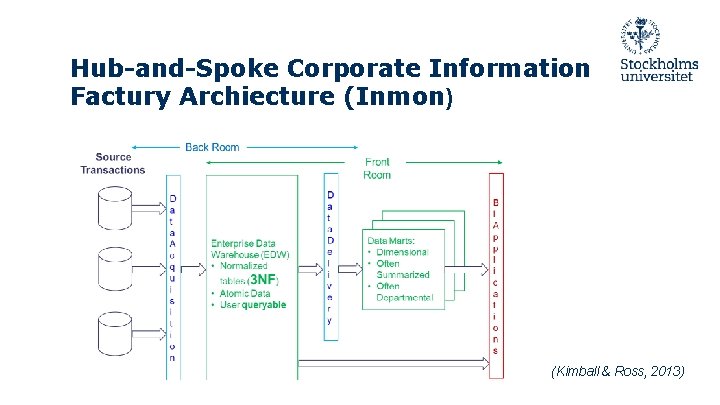
Hub-and-Spoke Corporate Information Factury Archiecture (Inmon) (Kimball & Ross, 2013)
Kimball/Ross DW/BI Architecture (Kimball & Ross, 2013)
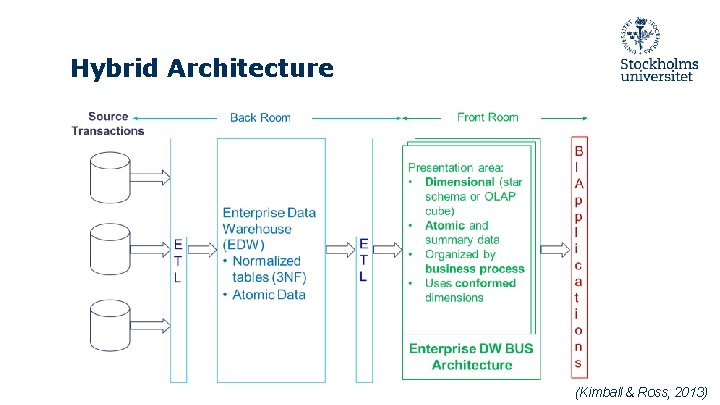
Hybrid Architecture (Kimball & Ross, 2013)
Two additional types of Data Warehouse architectures
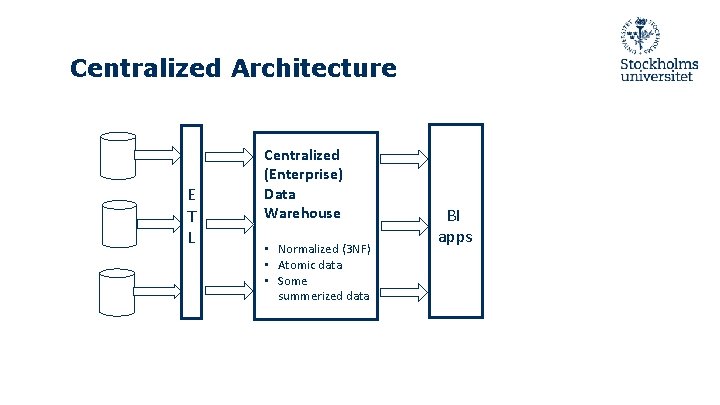
Centralized Architecture E T L Centralized (Enterprise) Data Warehouse • Normalized (3 NF) • Atomic data • Some summerized data BI apps
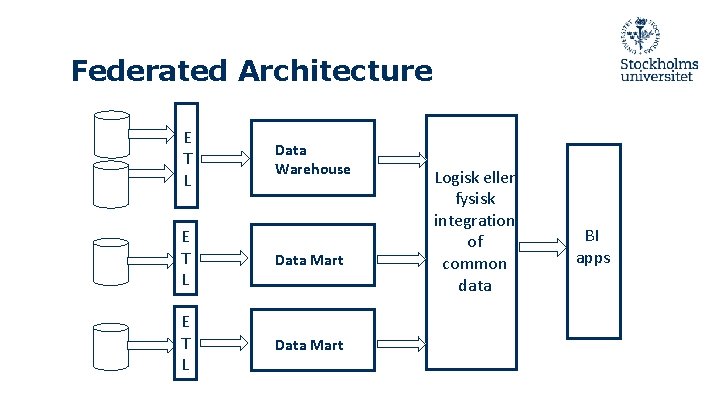
Federated Architecture E T L Data Warehouse E T L Data Mart Logisk eller fysisk integration of common data BI apps
Which factor impact the selection of data warehouse architechture?
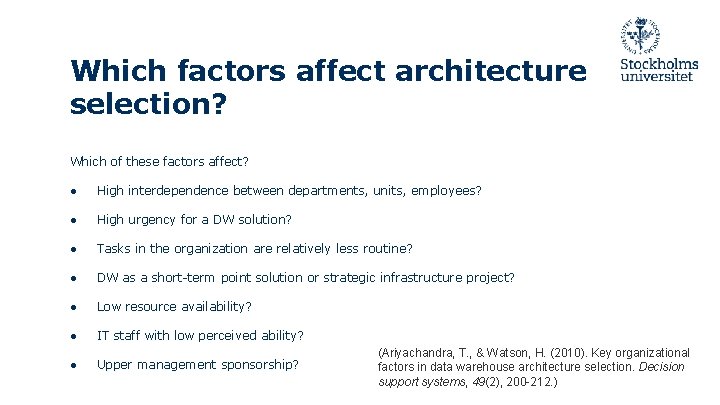
Which factors affect architecture selection? Which of these factors affect? ● High interdependence between departments, units, employees? ● High urgency for a DW solution? ● Tasks in the organization are relatively less routine? ● DW as a short-term point solution or strategic infrastructure project? ● Low resource availability? ● IT staff with low perceived ability? ● Upper management sponsorship? (Ariyachandra, T. , & Watson, H. (2010). Key organizational factors in data warehouse architecture selection. Decision support systems, 49(2), 200 -212. )
Data Lake and Data Warehouse
What is a Data Lake? “A data lake is a storage repository that holds a vast amount of raw data in its native format, including structured, semistructured, and unstructured data. ” (https: //www. kdnuggets. com/2015/09/data-lake-vsdata-warehouse-key-differences. html)
What is a Data Lake” A data lake is “a methodology enabled by a massive data repository based on low cost technologies that improves the capture, refinement, archival, and exploration of raw data within an enterprise. ” "Yesterday's unified storage is today's enterprise data lake" (Huang Fang, Managing Data Lakes in Big Data Era: What’s a data lake and why has it became popular in data management ecosystem, The 5 th Annual IEEE International Conference on Cyber Technology in Automation, Control and Intelligent Systems, June 8 -12, 2015, Shenyang, China. )
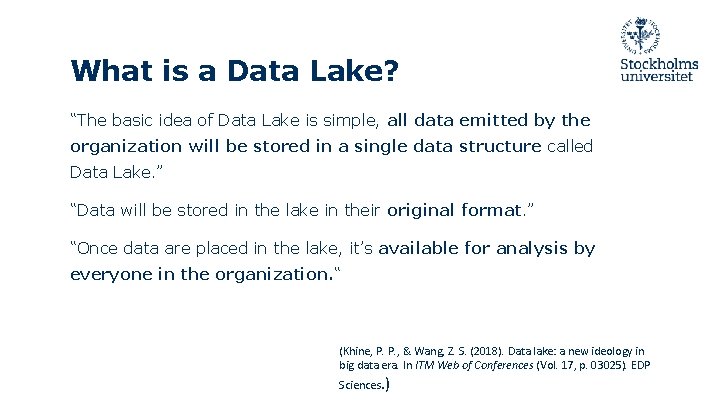
What is a Data Lake? “The basic idea of Data Lake is simple, all data emitted by the organization will be stored in a single data structure called Data Lake. ” “Data will be stored in the lake in their original format. ” “Once data are placed in the lake, it’s available for analysis by everyone in the organization. “ (Khine, P. P. , & Wang, Z. S. (2018). Data lake: a new ideology in big data era. In ITM Web of Conferences (Vol. 17, p. 03025). EDP Sciences. )
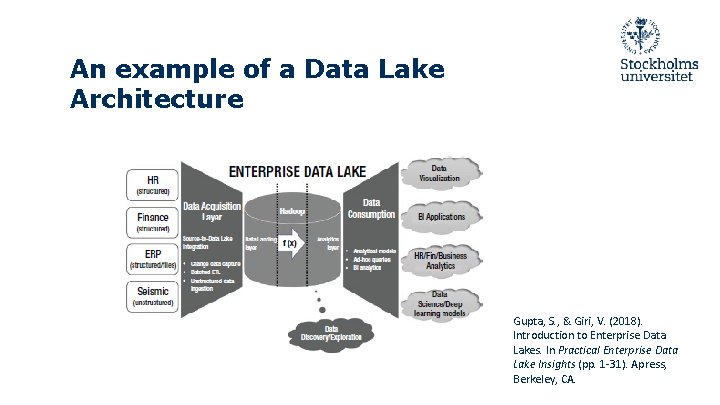
An example of a Data Lake Architecture Gupta, S. , & Giri, V. (2018). Introduction to Enterprise Data Lakes. In Practical Enterprise Data Lake Insights (pp. 1 -31). Apress, Berkeley, CA.
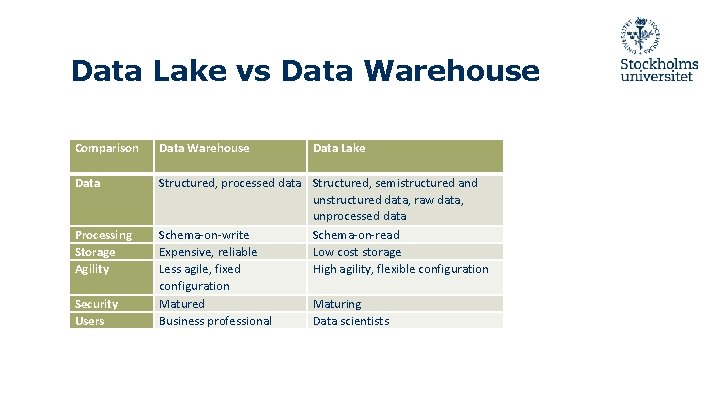
Data Lake vs Data Warehouse Comparison Data Warehouse Data Structured, processed data Structured, semistructured and unstructured data, raw data, unprocessed data Schema-on-write Schema-on-read Expensive, reliable Low cost storage Less agile, fixed High agility, flexible configuration Matured Maturing Business professional Data scientists Processing Storage Agility Security Users Data Lake
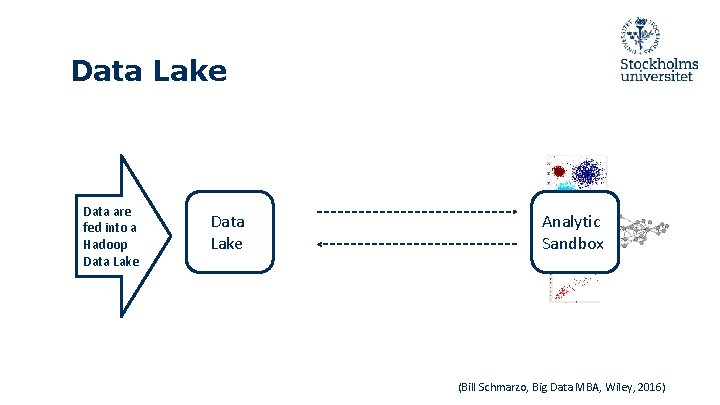
Data Lake Data are fed into a Hadoop Data Lake Analytic Sandbox (Bill Schmarzo, Big Data MBA, Wiley, 2016)
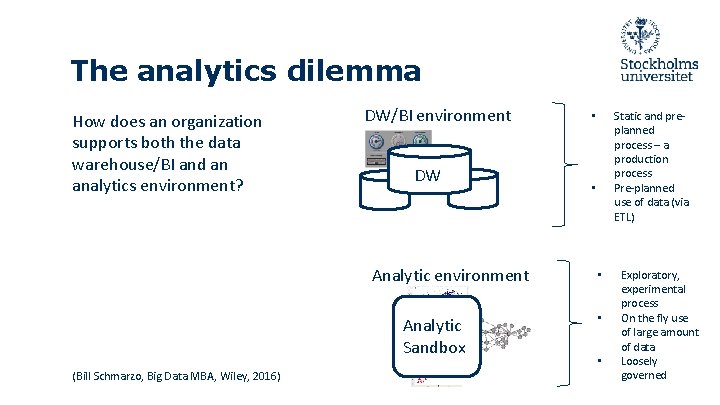
The analytics dilemma How does an organization supports both the data warehouse/BI and an analytics environment? DW/BI environment DW Analytic environment Analytic Sandbox (Bill Schmarzo, Big Data MBA, Wiley, 2016) Static and preplanned process – a production process Pre-planned use of data (via ETL) • • • Exploratory, experimental process On the fly use of large amount of data Loosely governed
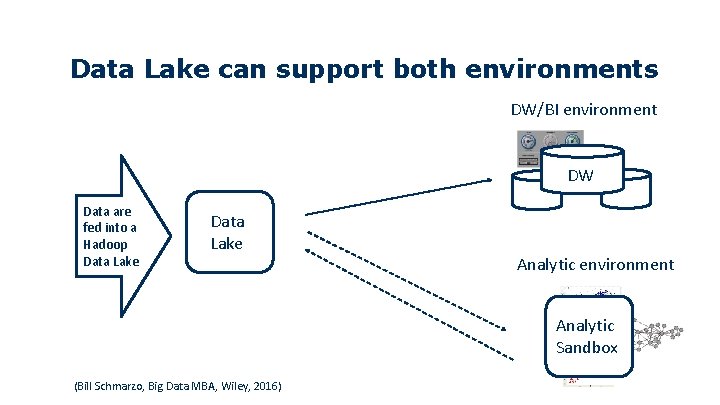
Data Lake can support both environments DW/BI environment DW Data are fed into a Hadoop Data Lake Analytic environment Analytic Sandbox (Bill Schmarzo, Big Data MBA, Wiley, 2016)
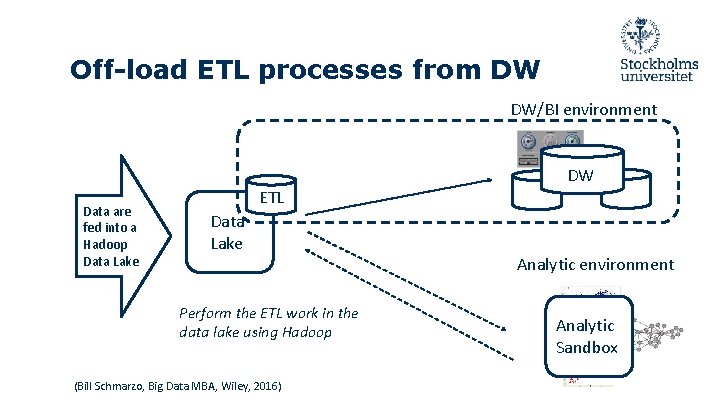
Off-load ETL processes from DW DW/BI environment Data are fed into a Hadoop Data Lake ETL Data Lake Perform the ETL work in the data lake using Hadoop (Bill Schmarzo, Big Data MBA, Wiley, 2016) DW Analytic environment Analytic Sandbox
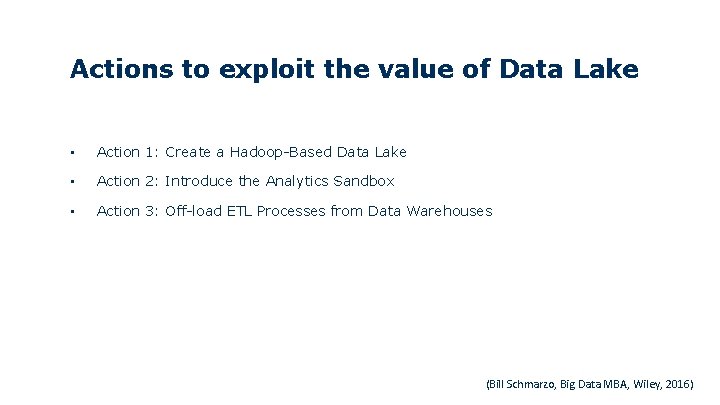
Actions to exploit the value of Data Lake • Action 1: Create a Hadoop-Based Data Lake • Action 2: Introduce the Analytics Sandbox • Action 3: Off-load ETL Processes from Data Warehouses (Bill Schmarzo, Big Data MBA, Wiley, 2016)
Lessons learned • There shall be one Data Lake, not several – facititating sharing of the corporate data assets across the organization • Data governance is a life cycle, not a project • Data Lake sits before your data warehouse, not after it (Bill Schmarzo, Big Data MBA, Wiley, 2016)
Benefits of using a Data Lake • Eliminate data silos – consolidating the data in one repository result in increased data use and sharing • Reduce cost for IT infrastructure – according to Schmarzo, it is 20 to 50 times cheaper to store, manage and analyze a hugh amount of data in a big data/analytics environment, compared to store, manage and analyze data in a traditional data warehouse environments (Bill Schmarzo, Big Data MBA, Wiley, 2016)
Benefits of using a Data Lake • Provide a scalable, flexible and shared storage platform - that support both BI, analytic and next generation environments • Store all data - Store data even if the organization has not decided if it is going to use the data and how to use the data (Bill Schmarzo, Big Data MBA, Wiley, 2016)
Business Intelligence vs Big Data/Data science
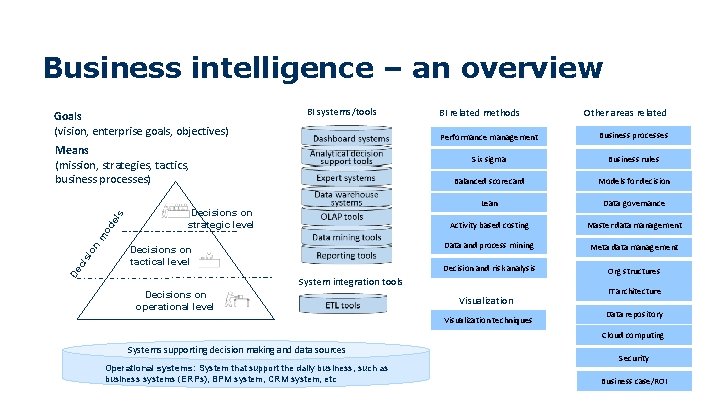
Business intelligence – an overview Goals (vision, enterprise goals, objectives) BI systems/tools Decisions on strategic level Decisions on tactical level De cis io n m od els Means (mission, strategies, tactics, business processes) BI related methods Performance management Business processes Six sigma Business rules Balanced scorecard Models for decision Lean Data governance Activity based costing Master data management Data and process mining Meta data management Decision and risk analysis Org structures System integration tools Decisions on operational level Other areas related Visualization techniques IT architecture Data repository Cloud computing Systems supporting decision making and data sources Operational systems: System that support the daily business, such as business systems (ERPs), BPM system, CRM system, etc Security Business case/ROI
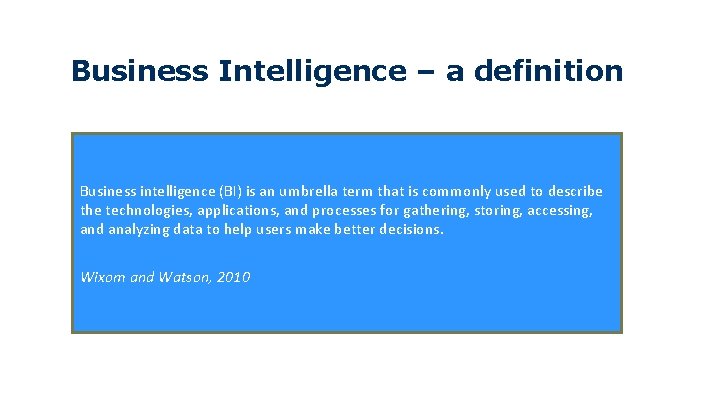
Business Intelligence – a definition Business intelligence (BI) is an umbrella term that is commonly used to describe the technologies, applications, and processes for gathering, storing, accessing, and analyzing data to help users make better decisions. Wixom and Watson, 2010
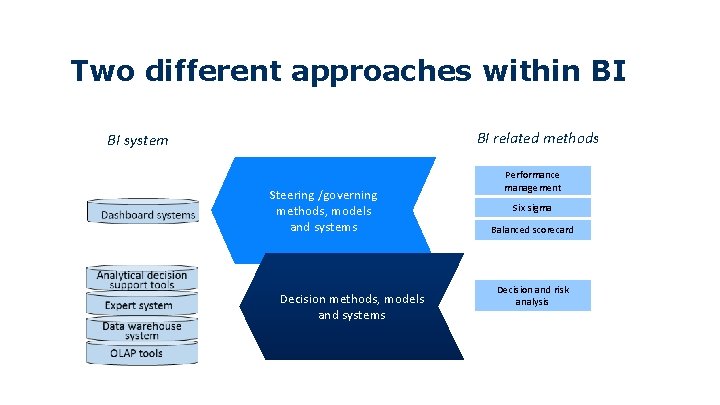
Two different approaches within BI BI related methods BI system Steering /governing methods, models and systems Decision methods, models and systems Performance management Six sigma Balanced scorecard Decision and risk analysis
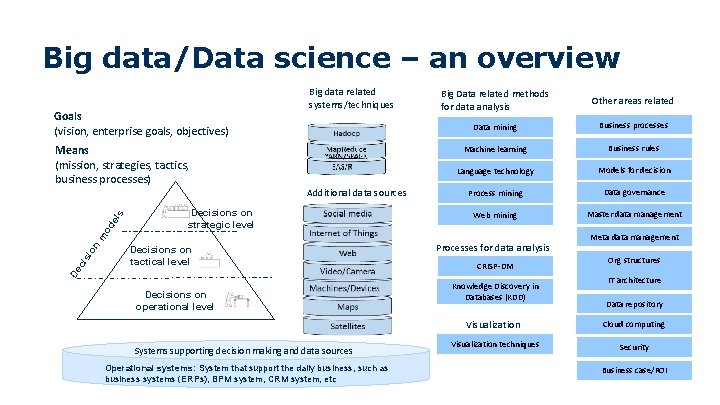
Big data/Data science – an overview Goals (vision, enterprise goals, objectives) Additional data sources Decisions on strategic level Decisions on tactical level De cis io n m od els Means (mission, strategies, tactics, business processes) Big data related systems/techniques Decisions on operational level Systems supporting decision making and data sources Operational systems: System that support the daily business, such as business systems (ERPs), BPM system, CRM system, etc Big Data related methods for data analysis Other areas related Data mining Business processes Machine learning Business rules Language technology Models for decision Process mining Data governance Web mining Master data management Processes for data analysis CRISP-DM Knowledge Discovery in Databases (KDD) Meta data management Org structures IT architecture Data repository Visualization Cloud computing Visualization techniques Security Business case/ROI
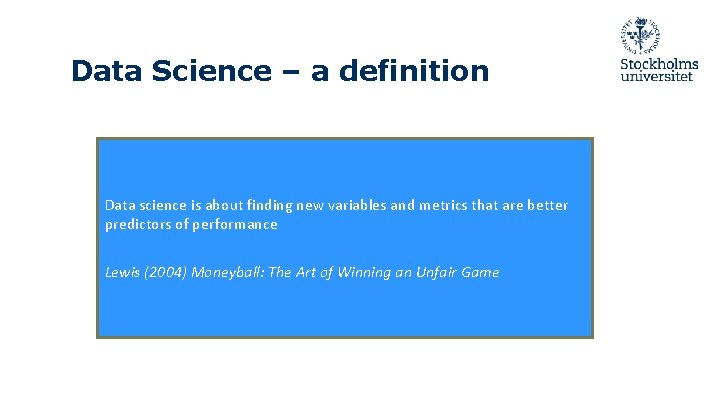
Data Science – a definition Data science is about finding new variables and metrics that are better predictors of performance Lewis (2004) Moneyball: The Art of Winning an Unfair Game
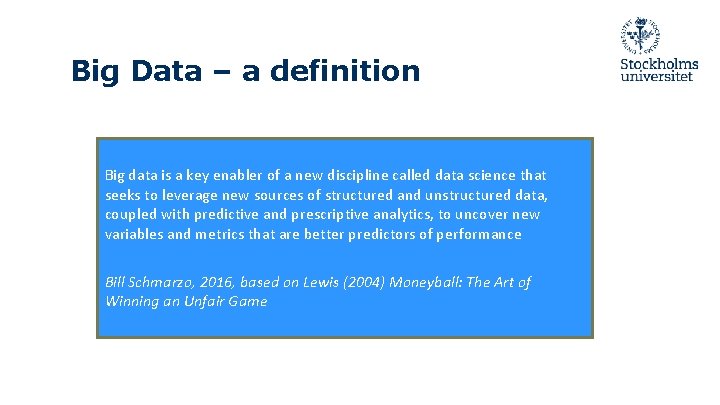
Big Data – a definition Big data is a key enabler of a new discipline called data science that seeks to leverage new sources of structured and unstructured data, coupled with predictive and prescriptive analytics, to uncover new variables and metrics that are better predictors of performance Bill Schmarzo, 2016, based on Lewis (2004) Moneyball: The Art of Winning an Unfair Game
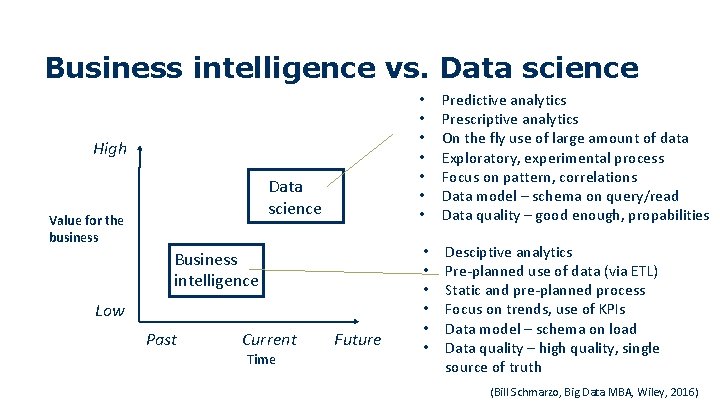
Business intelligence vs. Data science High Data science Value for the business Business intelligence Low Past Current Time Future • • Predictive analytics Prescriptive analytics On the fly use of large amount of data Exploratory, experimental process Focus on pattern, correlations Data model – schema on query/read Data quality – good enough, propabilities • • • Desciptive analytics Pre-planned use of data (via ETL) Static and pre-planned process Focus on trends, use of KPIs Data model – schema on load Data quality – high quality, single source of truth (Bill Schmarzo, Big Data MBA, Wiley, 2016)
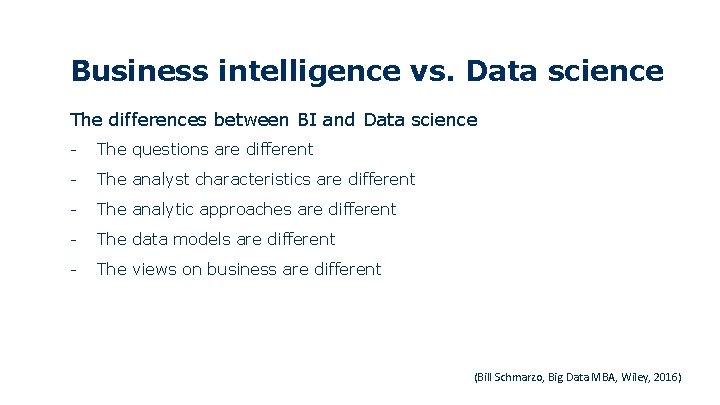
Business intelligence vs. Data science The differences between BI and Data science - The questions are different - The analyst characteristics are different - The analytic approaches are different - The data models are different - The views on business are different (Bill Schmarzo, Big Data MBA, Wiley, 2016)
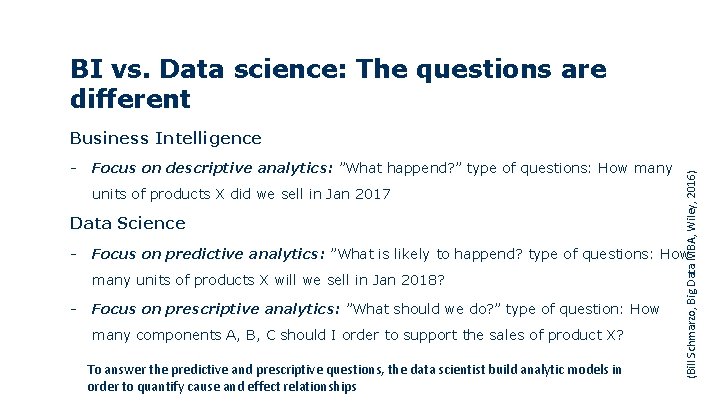
BI vs. Data science: The questions are different - Focus on descriptive analytics: ”What happend? ” type of questions: How many units of products X did we sell in Jan 2017 Data Science - Focus on predictive analytics: ”What is likely to happend? type of questions: How many units of products X will we sell in Jan 2018? - (Bill Schmarzo, Big Data MBA, Wiley, 2016) Business Intelligence Focus on prescriptive analytics: ”What should we do? ” type of question: How many components A, B, C should I order to support the sales of product X? To answer the predictive and prescriptive questions, the data scientist build analytic models in order to quantify cause and effect relationships
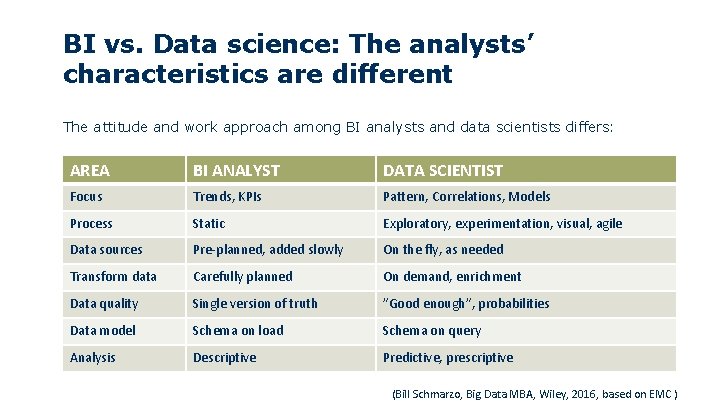
BI vs. Data science: The analysts’ characteristics are different The attitude and work approach among BI analysts and data scientists differs: AREA BI ANALYST DATA SCIENTIST Focus Trends, KPIs Pattern, Correlations, Models Process Static Exploratory, experimentation, visual, agile Data sources Pre-planned, added slowly On the fly, as needed Transform data Carefully planned On demand, enrichment Data quality Single version of truth ”Good enough”, probabilities Data model Schema on load Schema on query Analysis Descriptive Predictive, prescriptive (Bill Schmarzo, Big Data MBA, Wiley, 2016, based on EMC )
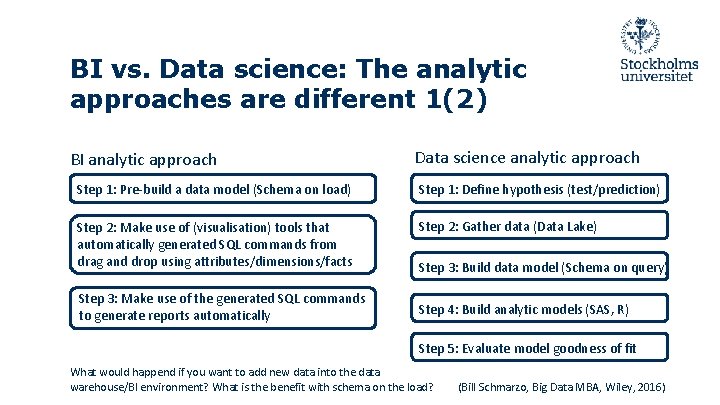
BI vs. Data science: The analytic approaches are different 1(2) BI analytic approach Data science analytic approach Step 1: Pre-build a data model (Schema on load) Step 1: Define hypothesis (test/prediction) Step 2: Make use of (visualisation) tools that automatically generated SQL commands from drag and drop using attributes/dimensions/facts Step 2: Gather data (Data Lake) Step 3: Make use of the generated SQL commands to generate reports automatically Step 3: Build data model (Schema on query) Step 4: Build analytic models (SAS, R) Step 5: Evaluate model goodness of fit What would happend if you want to add new data into the data warehouse/BI environment? What is the benefit with schema on the load? (Bill Schmarzo, Big Data MBA, Wiley, 2016)
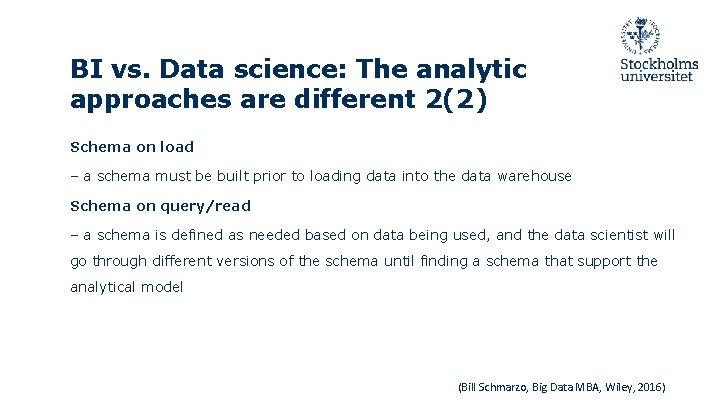
BI vs. Data science: The analytic approaches are different 2(2) Schema on load – a schema must be built prior to loading data into the data warehouse Schema on query/read – a schema is defined as needed based on data being used, and the data scientist will go through different versions of the schema until finding a schema that support the analytical model (Bill Schmarzo, Big Data MBA, Wiley, 2016)
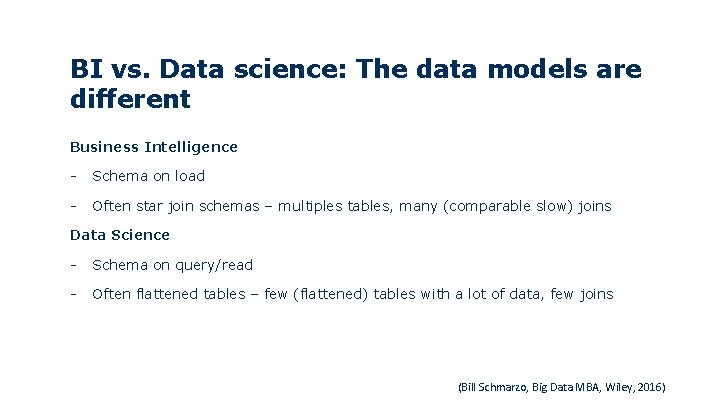
BI vs. Data science: The data models are different Business Intelligence - Schema on load - Often star join schemas – multiples tables, many (comparable slow) joins Data Science - Schema on query/read - Often flattened tables – few (flattened) tables with a lot of data, few joins (Bill Schmarzo, Big Data MBA, Wiley, 2016)
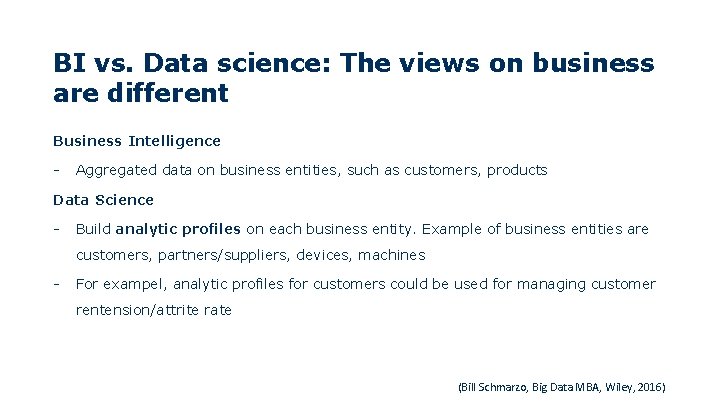
BI vs. Data science: The views on business are different Business Intelligence - Aggregated data on business entities, such as customers, products Data Science - Build analytic profiles on each business entity. Example of business entities are customers, partners/suppliers, devices, machines - For exampel, analytic profiles for customers could be used for managing customer rentension/attrite rate (Bill Schmarzo, Big Data MBA, Wiley, 2016)
Master Data
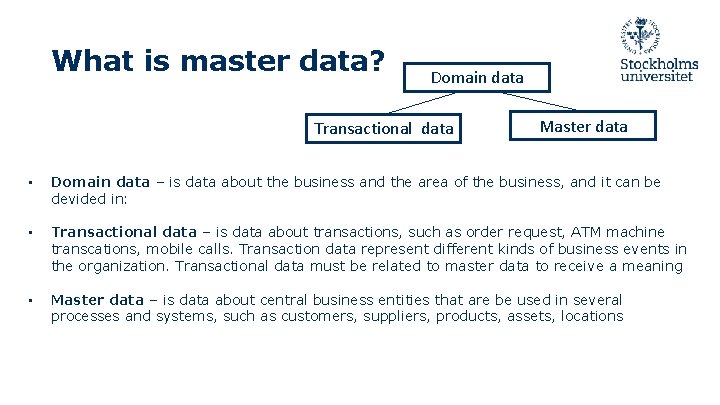
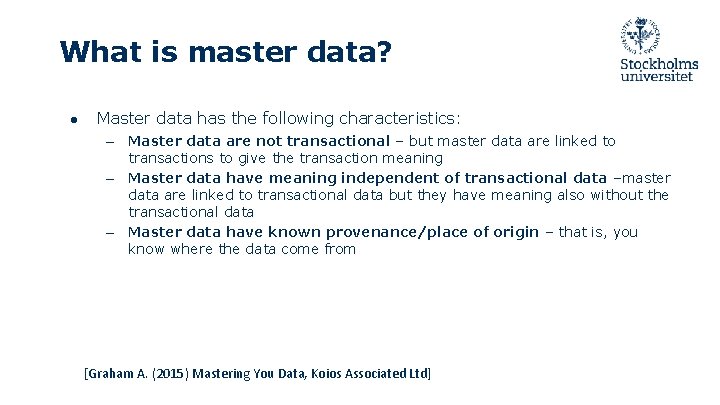
What is master data? Domain data Transactional data Master data • Domain data – is data about the business and the area of the business, and it can be devided in: • Transactional data – is data about transactions, such as order request, ATM machine transcations, mobile calls. Transaction data represent different kinds of business events in the organization. Transactional data must be related to master data to receive a meaning • Master data – is data about central business entities that are be used in several processes and systems, such as customers, suppliers, products, assets, locations
What is master data? ● Master data has the following characteristics: – Master data are not transactional – but master data are linked to transactions to give the transaction meaning – Master data have meaning independent of transactional data –master data are linked to transactional data but they have meaning also without the transactional data – Master data have known provenance/place of origin – that is, you know where the data come from [Graham A. (2015) Mastering You Data, Koios Associated Ltd]
Master Data Management System
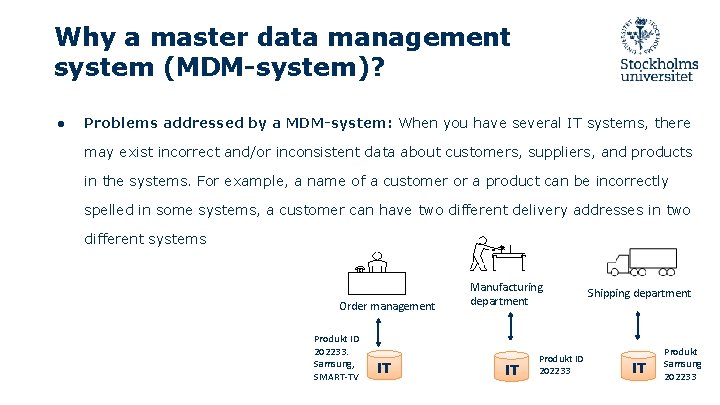
Why a master data management system (MDM-system)? ● Problems addressed by a MDM-system: When you have several IT systems, there may exist incorrect and/or inconsistent data about customers, suppliers, and products in the systems. For example, a name of a customer or a product can be incorrectly spelled in some systems, a customer can have two different delivery addresses in two different systems Order management Produkt ID 202233. Samsung, SMART-TV IT Manufacturing department IT Produkt ID 202233 Shipping department IT Produkt Samsung 202233
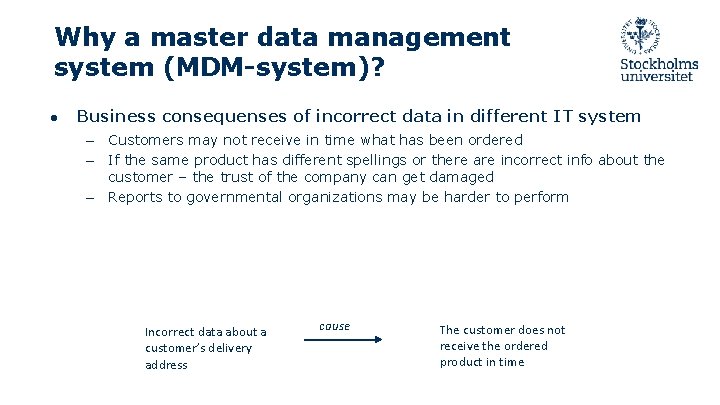
Why a master data management system (MDM-system)? ● Business consequenses of incorrect data in different IT system – Customers may not receive in time what has been ordered – If the same product has different spellings or there are incorrect info about the customer – the trust of the company can get damaged – Reports to governmental organizations may be harder to perform Incorrect data about a customer’s delivery address cause The customer does not receive the ordered product in time
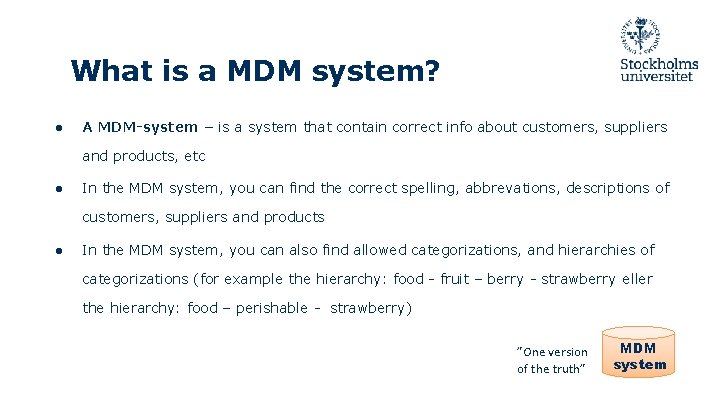
What is a MDM system? ● A MDM-system – is a system that contain correct info about customers, suppliers and products, etc ● In the MDM system, you can find the correct spelling, abbrevations, descriptions of customers, suppliers and products ● In the MDM system, you can also find allowed categorizations, and hierarchies of categorizations (for example the hierarchy: food - fruit – berry - strawberry eller the hierarchy: food – perishable - strawberry) ”One version of the truth” MDM system
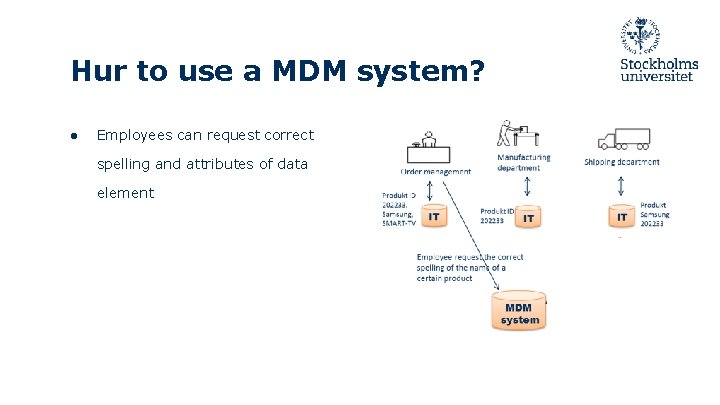
Hur to use a MDM system? ● Employees can request correct spelling and attributes of data element
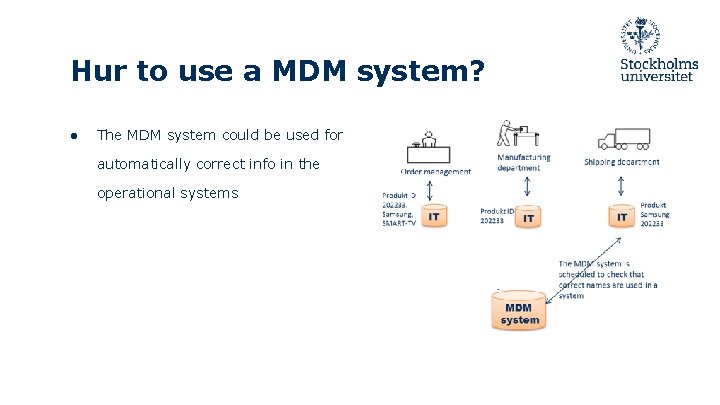
Hur to use a MDM system? ● The MDM system could be used for automatically correct info in the operational systems
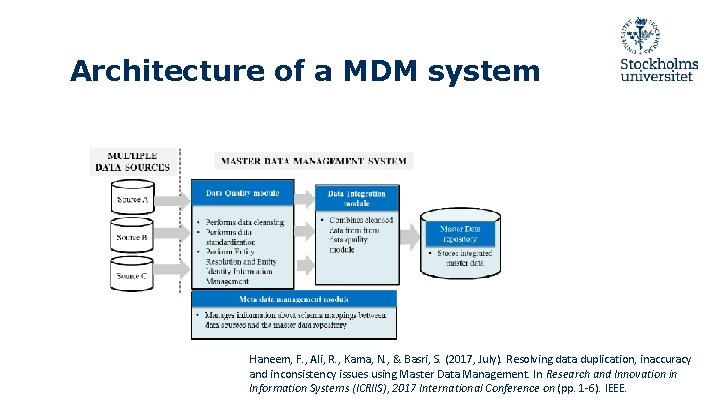
Architecture of a MDM system Haneem, F. , Ali, R. , Kama, N. , & Basri, S. (2017, July). Resolving data duplication, inaccuracy and inconsistency issues using Master Data Management. In Research and Innovation in Information Systems (ICRIIS), 2017 International Conference on (pp. 1 -6). IEEE.
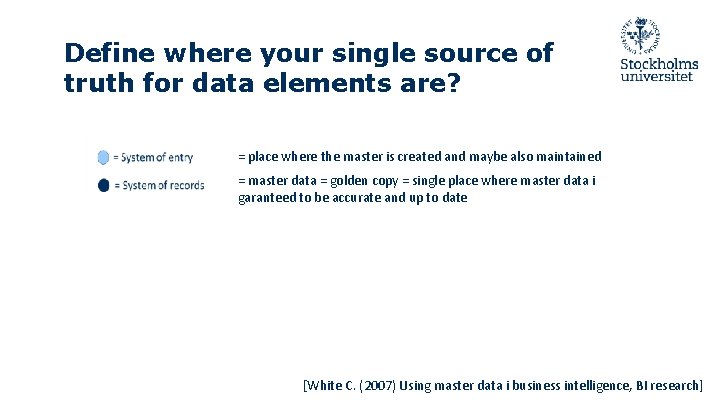
Define where your single source of truth for data elements are? = place where the master is created and maybe also maintained = master data = golden copy = single place where master data i garanteed to be accurate and up to date [White C. (2007) Using master data i business intelligence, BI research]
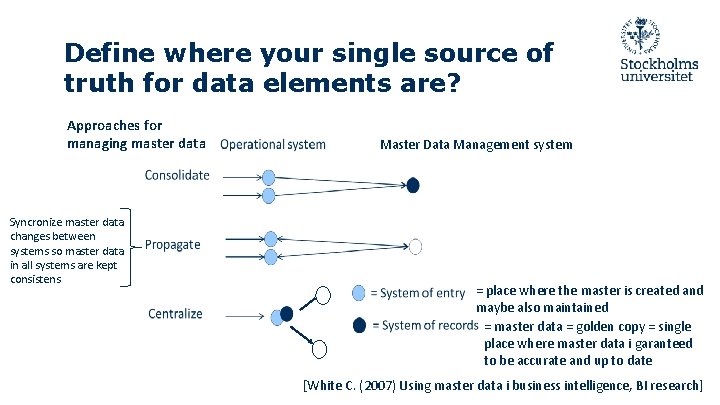
Define where your single source of truth for data elements are? Approaches for managing master data Syncronize master data changes between systems so master data in all systems are kept consistens Master Data Management system = place where the master is created and maybe also maintained = master data = golden copy = single place where master data i garanteed to be accurate and up to date [White C. (2007) Using master data i business intelligence, BI research]
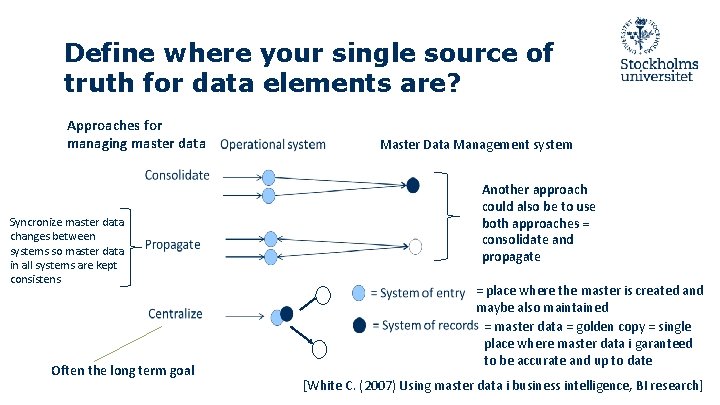
Define where your single source of truth for data elements are? Approaches for managing master data Syncronize master data changes between systems so master data in all systems are kept consistens Often the long term goal Master Data Management system Another approach could also be to use both approaches = consolidate and propagate = place where the master is created and maybe also maintained = master data = golden copy = single place where master data i garanteed to be accurate and up to date [White C. (2007) Using master data i business intelligence, BI research]
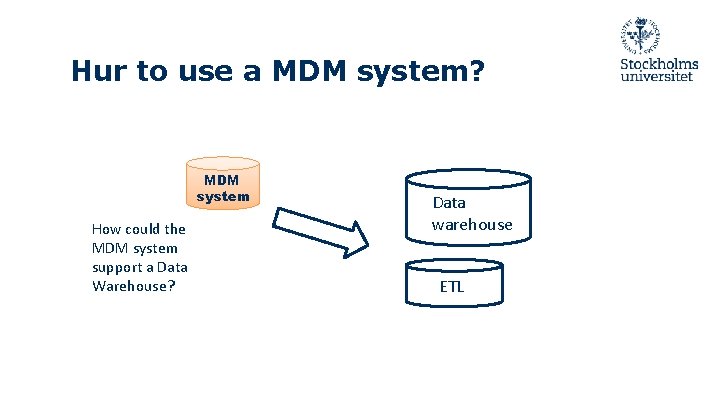
Hur to use a MDM system? MDM system How could the MDM system support a Data Warehouse? Data warehouse ETL
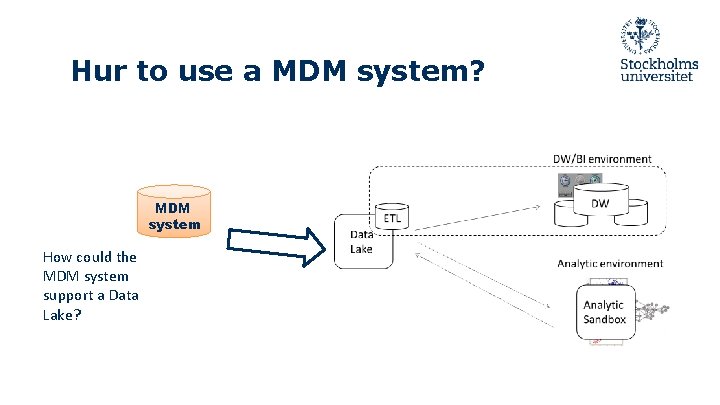
Hur to use a MDM system? MDM system How could the MDM system support a Data Lake?