Physics Analysis Concepts with Panda Root 1 PANDA

- Slides: 37
Physics Analysis Concepts with Panda. Root (1) PANDA Computing Week 2017 Nakhon Ratchasima, Thailand, July 3 - 7, 2017 Klaus Götzen GSI Darmstadt
Topics • Data Levels • Data Access (Pnd. Analysis) • Analysis Basics • Particle Candidates (Rho. Candidate, Pnd. Pid. Candidate) • Combinatorics (Rho. Cand. List) K. Götzen PANDA Computing Workshop - Thailand 2
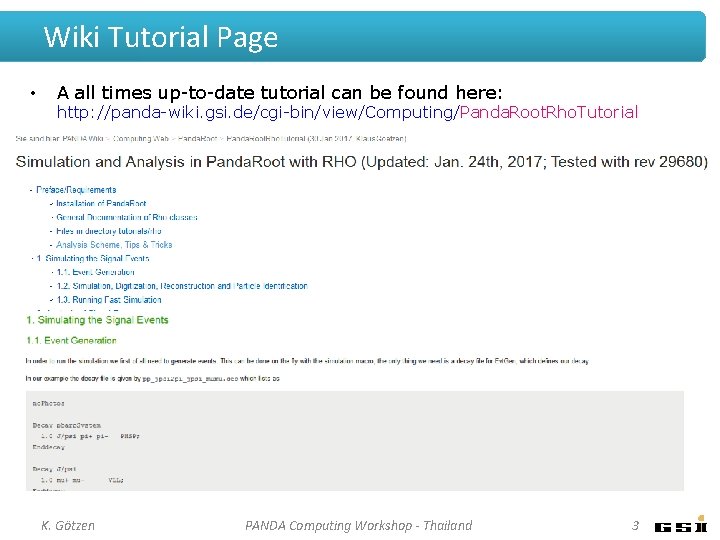
Wiki Tutorial Page • A all times up-to-date tutorial can be found here: http: //panda-wiki. gsi. de/cgi-bin/view/Computing/Panda. Root. Rho. Tutorial K. Götzen PANDA Computing Workshop - Thailand 3
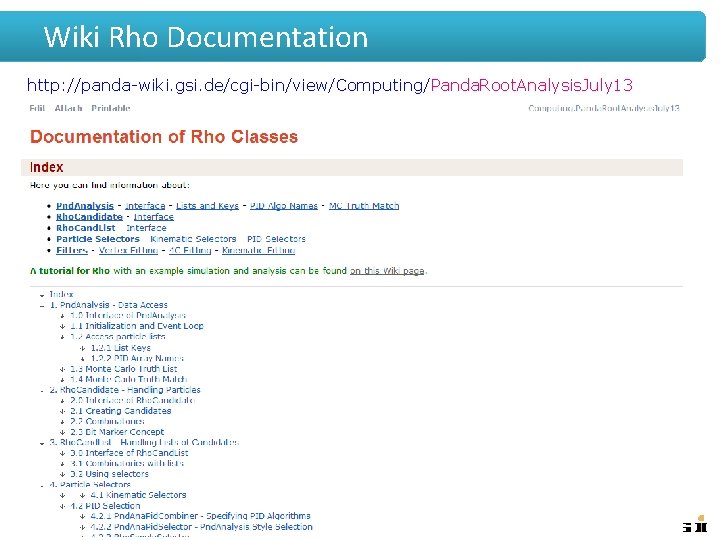
Wiki Rho Documentation http: //panda-wiki. gsi. de/cgi-bin/view/Computing/Panda. Root. Analysis. July 13 K. Götzen PANDA Computing Workshop - Thailand 4
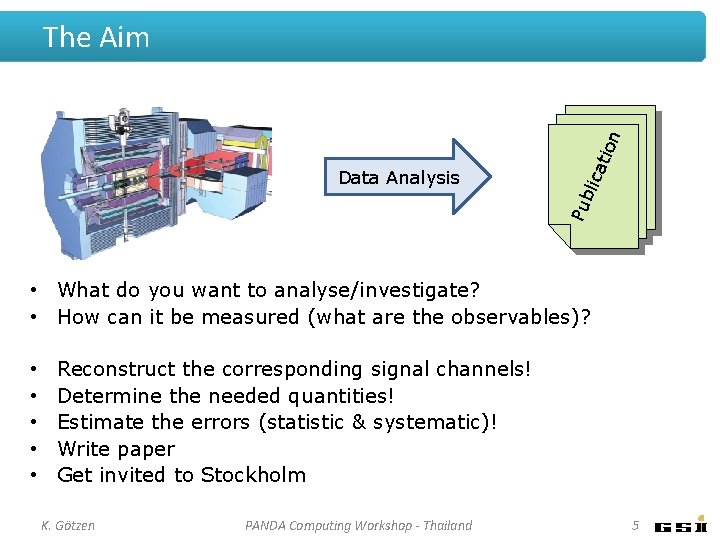
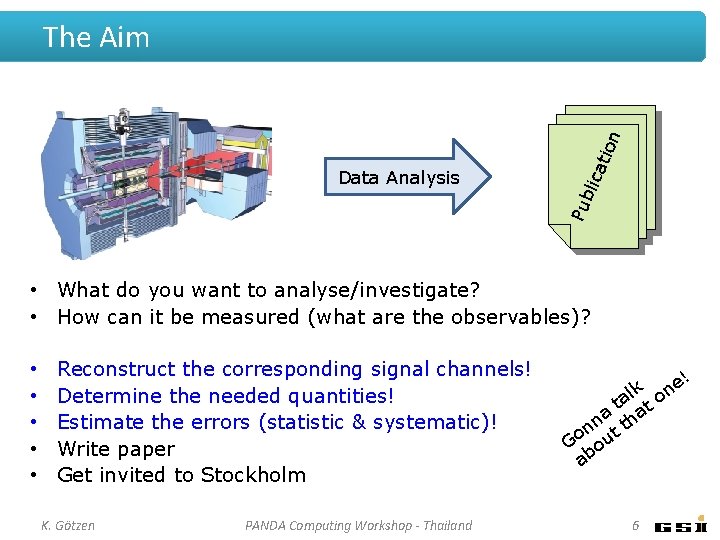
Pu blic Data Analysis ati on The Aim • What do you want to analyse/investigate? • How can it be measured (what are the observables)? • • • Reconstruct the corresponding signal channels! Determine the needed quantities! Estimate the errors (statistic & systematic)! Write paper Get invited to Stockholm K. Götzen PANDA Computing Workshop - Thailand 5
Pu blic Data Analysis ati on The Aim • What do you want to analyse/investigate? • How can it be measured (what are the observables)? • • • Reconstruct the corresponding signal channels! Determine the needed quantities! Estimate the errors (statistic & systematic)! Write paper Get invited to Stockholm K. Götzen PANDA Computing Workshop - Thailand ! k one l ta t a ha n n tt o G ou ab 6
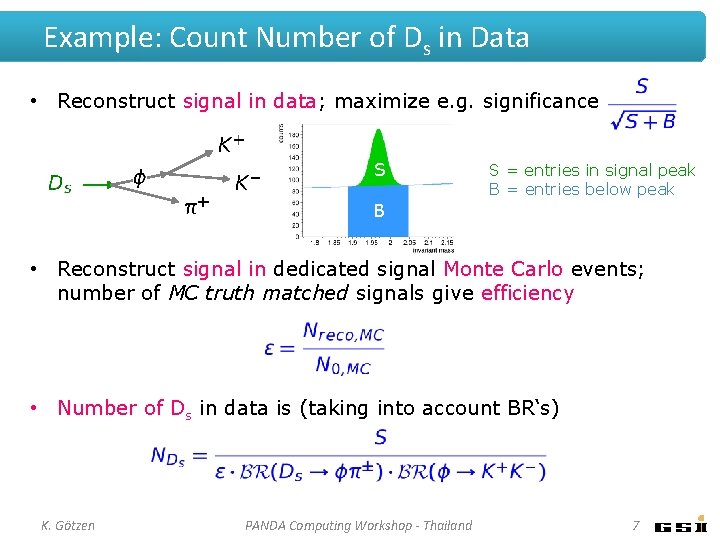
Example: Count Number of Ds in Data • Reconstruct signal in data; maximize e. g. significance S S = entries in signal peak B = entries below peak B • Reconstruct signal in dedicated signal Monte Carlo events; number of MC truth matched signals give efficiency • Number of Ds in data is (taking into account BR‘s) K. Götzen PANDA Computing Workshop - Thailand 7
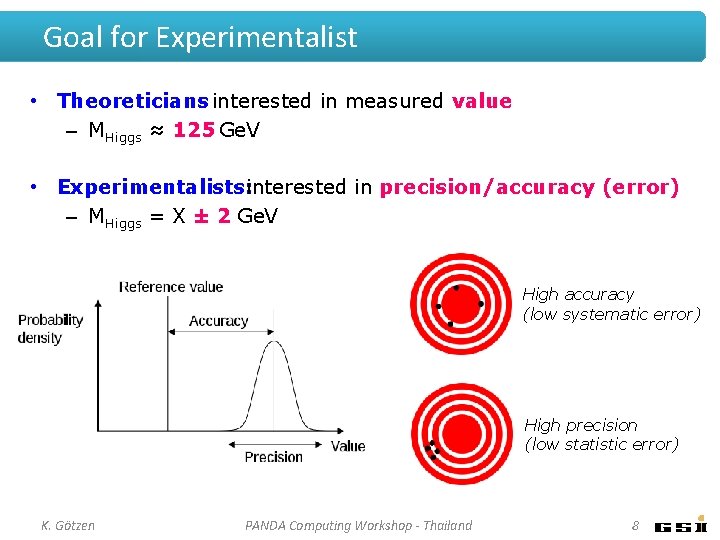
Goal for Experimentalist • Theoreticians : interested in measured value – MHiggs ≈ 125 Ge. V • Experimentalists: interested in precision/accuracy (error) – MHiggs = X ± 2 Ge. V High accuracy (low systematic error) High precision (low statistic error) K. Götzen PANDA Computing Workshop - Thailand 8
BASICS
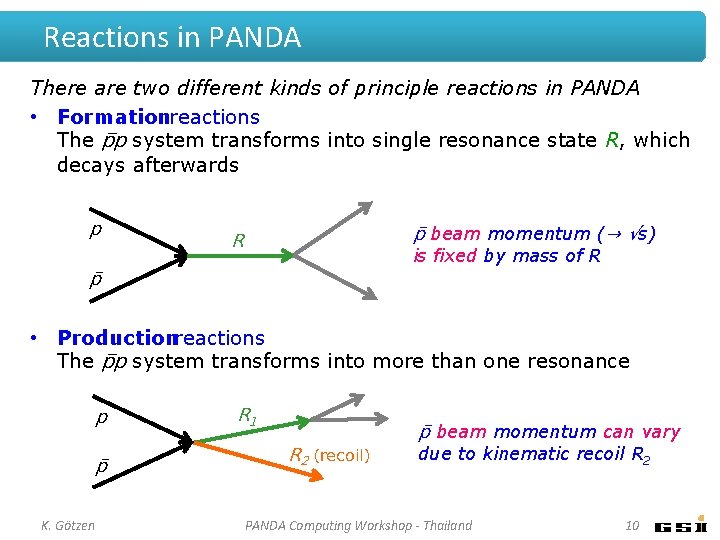
Reactions in PANDA There are two different kinds of principle reactions in PANDA • Formationreactions The p system transforms into single resonance state R, which decays afterwards p beam momentum (→ √s) R is fixed by mass of R • Productionreactions The p system transforms into more than one resonance p K. Götzen R 1 R 2 (recoil) beam momentum can vary due to kinematic recoil R 2 PANDA Computing Workshop - Thailand 10
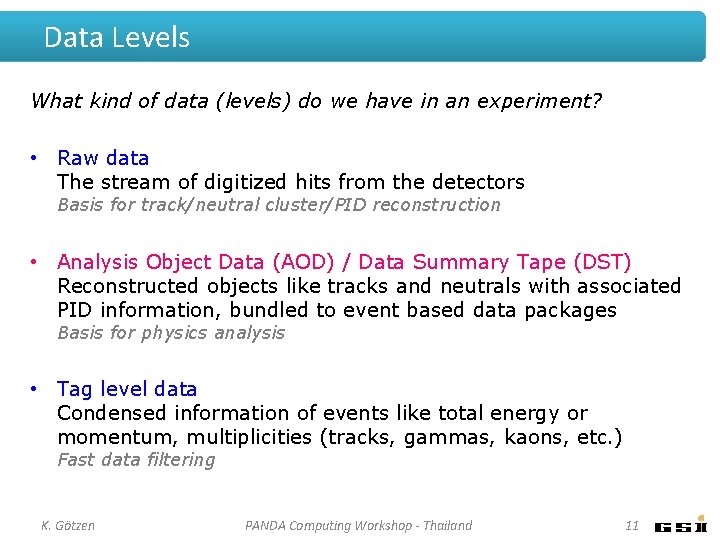
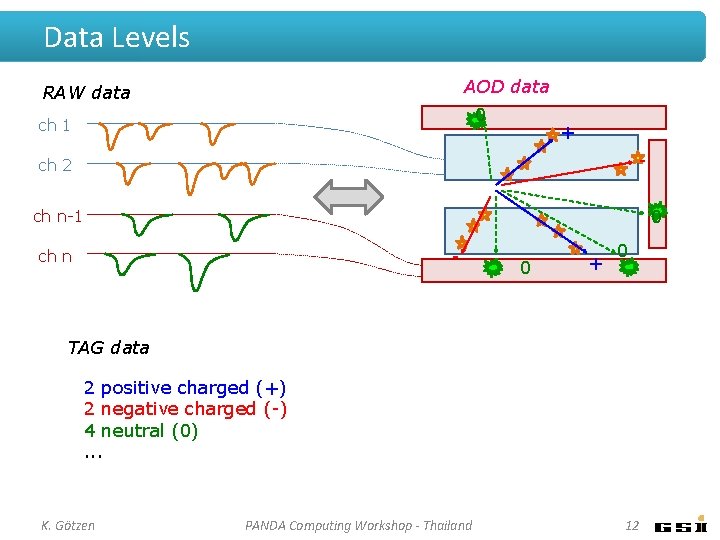
Data Levels What kind of data (levels) do we have in an experiment? • Raw data The stream of digitized hits from the detectors Basis for track/neutral cluster/PID reconstruction • Analysis Object Data (AOD) / Data Summary Tape (DST) Reconstructed objects like tracks and neutrals with associated PID information, bundled to event based data packages Basis for physics analysis • Tag level data Condensed information of events like total energy or momentum, multiplicities (tracks, gammas, kaons, etc. ) Fast data filtering K. Götzen PANDA Computing Workshop - Thailand 11
Data Levels AOD data RAW data 0 ch 1 + - ch 2 0 ch n-1 - ch n 0 + 0 TAG data 2 positive charged (+) 2 negative charged (-) 4 neutral (0). . . K. Götzen PANDA Computing Workshop - Thailand 12
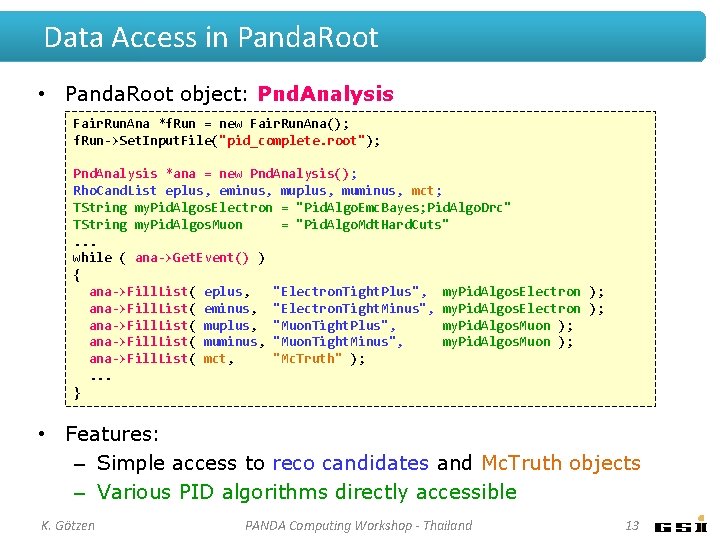
Data Access in Panda. Root • Panda. Root object: Pnd. Analysis Fair. Run. Ana *f. Run = new Fair. Run. Ana(); f. Run->Set. Input. File("pid_complete. root"); Pnd. Analysis *ana = new Pnd. Analysis(); Rho. Cand. List eplus, eminus, muplus, muminus, mct; TString my. Pid. Algos. Electron = "Pid. Algo. Emc. Bayes; Pid. Algo. Drc" TString my. Pid. Algos. Muon = "Pid. Algo. Mdt. Hard. Cuts". . . while ( ana->Get. Event() ) { ana->Fill. List( eplus, "Electron. Tight. Plus", my. Pid. Algos. Electron ); ana->Fill. List( eminus, "Electron. Tight. Minus", my. Pid. Algos. Electron ); ana->Fill. List( muplus, "Muon. Tight. Plus", my. Pid. Algos. Muon ); ana->Fill. List( muminus, "Muon. Tight. Minus", my. Pid. Algos. Muon ); ana->Fill. List( mct, "Mc. Truth" ); . . . } • Features: – Simple access to reco candidates and Mc. Truth objects – Various PID algorithms directly accessible K. Götzen PANDA Computing Workshop - Thailand 13
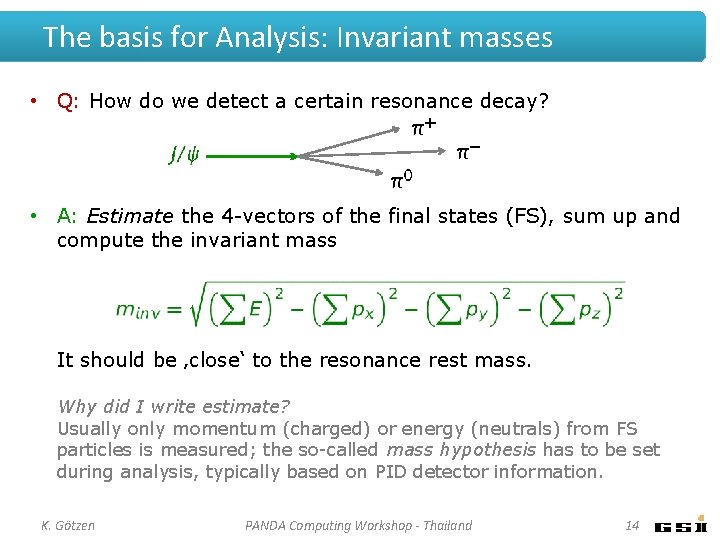
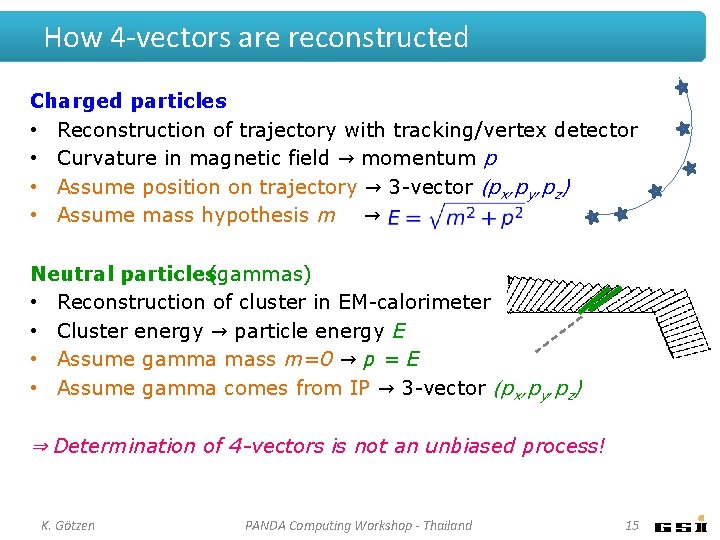
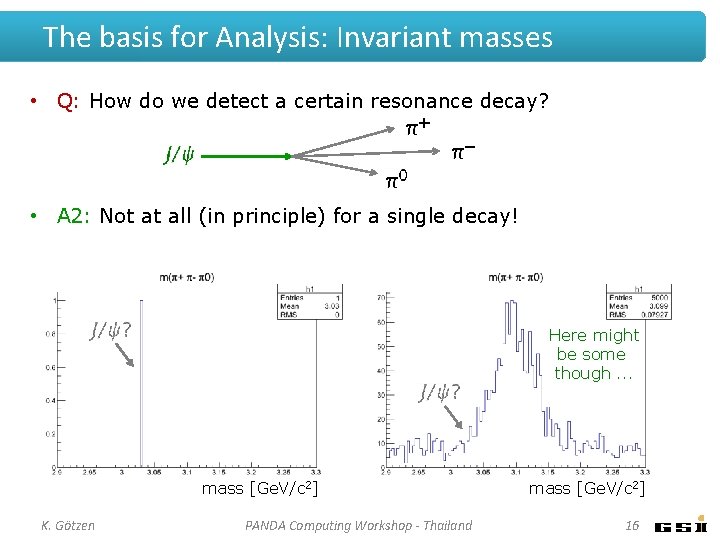
The basis for Analysis: Invariant masses • Q: How do we detect a certain resonance decay? • A: Estimate the 4 -vectors of the final states (FS), sum up and compute the invariant mass It should be ‚close‘ to the resonance rest mass. Why did I write estimate? Usually only momentum (charged) or energy (neutrals) from FS particles is measured; the so-called mass hypothesis has to be set during analysis, typically based on PID detector information. K. Götzen PANDA Computing Workshop - Thailand 14
How 4 -vectors are reconstructed Charged particles • Reconstruction of trajectory with tracking/vertex detector • Curvature in magnetic field → momentum p • Assume position on trajectory → 3 -vector (px, py, pz) • Assume mass hypothesis m → Neutral particles(gammas) • Reconstruction of cluster in EM-calorimeter • Cluster energy → particle energy E • Assume gamma mass m=0 → p = E • Assume gamma comes from IP → 3 -vector (px, py, pz) ⇒ Determination of 4 -vectors is not an unbiased process! K. Götzen PANDA Computing Workshop - Thailand 15
The basis for Analysis: Invariant masses • Q: How do we detect a certain resonance decay? • A 2: Not at all (in principle) for a single decay! Here might be some though. . . mass [Ge. V/c 2] K. Götzen PANDA Computing Workshop - Thailand mass [Ge. V/c 2] 16
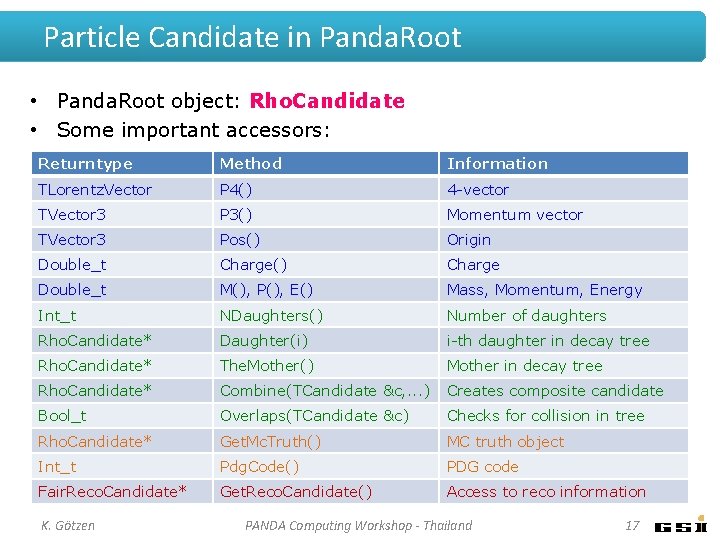
Particle Candidate in Panda. Root • Panda. Root object: Rho. Candidate • Some important accessors: Returntype Method Information TLorentz. Vector P 4() 4 -vector TVector 3 P 3() Momentum vector TVector 3 Pos() Origin Double_t Charge() Charge Double_t M(), P(), E() Mass, Momentum, Energy Int_t NDaughters() Number of daughters Rho. Candidate* Daughter(i) i-th daughter in decay tree Rho. Candidate* The. Mother() Mother in decay tree Rho. Candidate* Combine(TCandidate &c, . . . ) Creates composite candidate Bool_t Overlaps(TCandidate &c) Checks for collision in tree Rho. Candidate* Get. Mc. Truth() MC truth object Int_t Pdg. Code() PDG code Fair. Reco. Candidate* Get. Reco. Candidate() Access to reco information K. Götzen PANDA Computing Workshop - Thailand 17
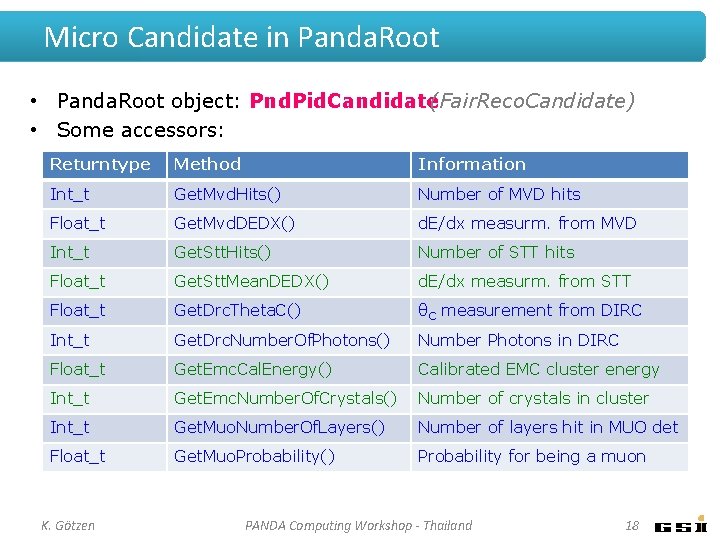
Micro Candidate in Panda. Root • Panda. Root object: Pnd. Pid. Candidate(Fair. Reco. Candidate) • Some accessors: Returntype Method Information Int_t Get. Mvd. Hits() Number of MVD hits Float_t Get. Mvd. DEDX() d. E/dx measurm. from MVD Int_t Get. Stt. Hits() Number of STT hits Float_t Get. Stt. Mean. DEDX() d. E/dx measurm. from STT Float_t Get. Drc. Theta. C() θC measurement from DIRC Int_t Get. Drc. Number. Of. Photons() Number Photons in DIRC Float_t Get. Emc. Cal. Energy() Calibrated EMC cluster energy Int_t Get. Emc. Number. Of. Crystals() Number of crystals in cluster Int_t Get. Muo. Number. Of. Layers() Number of layers hit in MUO det Float_t Get. Muo. Probability() Probability for being a muon K. Götzen PANDA Computing Workshop - Thailand 18
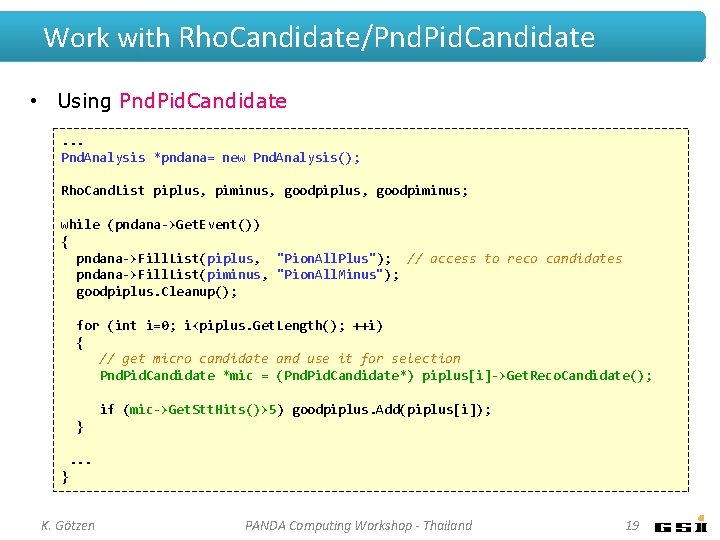
Work with Rho. Candidate/Pnd. Pid. Candidate • Using Pnd. Pid. Candidate. . . Pnd. Analysis *pndana= new Pnd. Analysis(); Rho. Cand. List piplus, piminus, goodpiplus, goodpiminus; while (pndana->Get. Event()) { pndana->Fill. List(piplus, "Pion. All. Plus"); // access to reco candidates pndana->Fill. List(piminus, "Pion. All. Minus"); goodpiplus. Cleanup(); for (int i=0; i<piplus. Get. Length(); ++i) { // get micro candidate and use it for selection Pnd. Pid. Candidate *mic = (Pnd. Pid. Candidate*) piplus[i]->Get. Reco. Candidate(); if (mic->Get. Stt. Hits()>5) goodpiplus. Add(piplus[i]); }. . . } K. Götzen PANDA Computing Workshop - Thailand 19
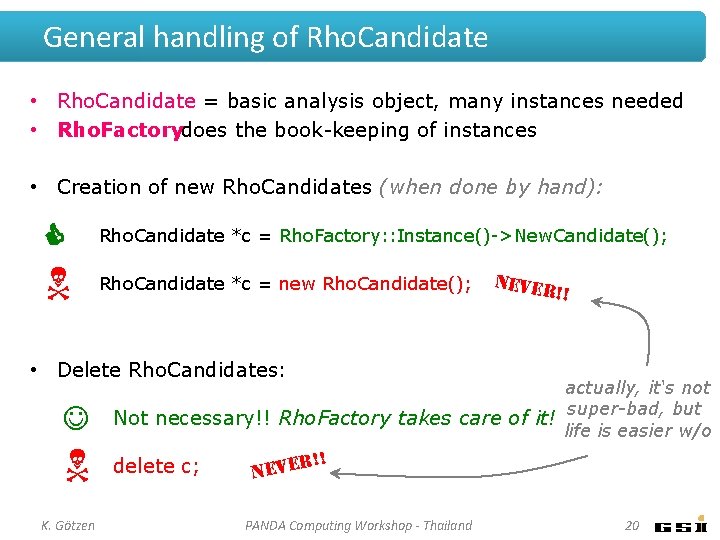
General handling of Rho. Candidate • Rho. Candidate = basic analysis object, many instances needed • Rho. Factorydoes the book-keeping of instances • Creation of new Rho. Candidates (when done by hand): Rho. Candidate *c = Rho. Factory: : Instance()->New. Candidate(); Rho. Candidate *c = new Rho. Candidate(); Never ! ! • Delete Rho. Candidates: K. Götzen actually, it‘s not Not necessary!! Rho. Factory takes care of it! super-bad, but life is easier w/o delete c; r!! Neve PANDA Computing Workshop - Thailand 20
COMBINATORICS
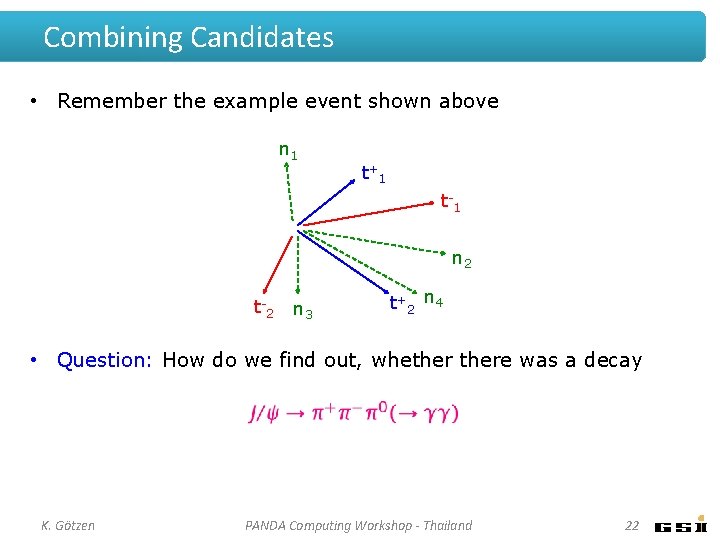
Combining Candidates • Remember the example event shown above n 1 t+ 1 t-1 n 2 t-2 n 3 t+ 2 n 4 • Question: How do we find out, whethere was a decay K. Götzen PANDA Computing Workshop - Thailand 22
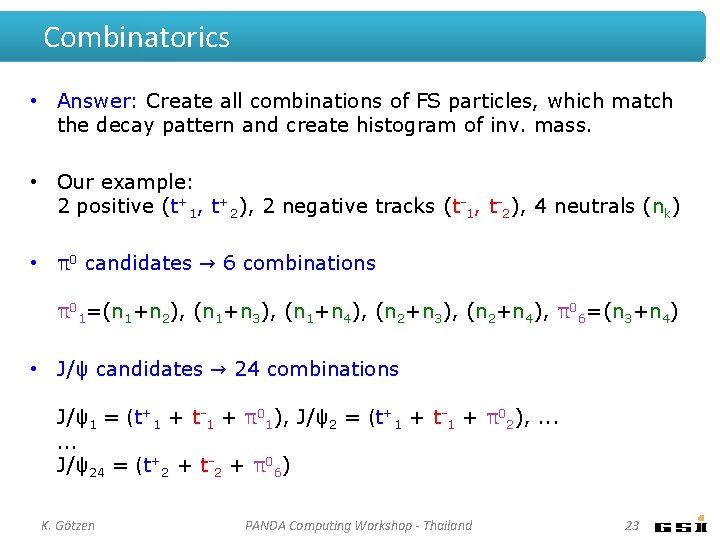
Combinatorics • Answer: Create all combinations of FS particles, which match the decay pattern and create histogram of inv. mass. • Our example: 2 positive (t+1, t+2), 2 negative tracks (t-1, t-2), 4 neutrals (nk) • π0 candidates → 6 combinations π01=(n 1+n 2), (n 1+n 3), (n 1+n 4), (n 2+n 3), (n 2+n 4), π06=(n 3+n 4) • J/ψ candidates → 24 combinations J/ψ1 = (t+1 + t-1 + π01), J/ψ2 = (t+1 + t-1 + π02), . . . J/ψ24 = (t+2 + t-2 + π06) K. Götzen PANDA Computing Workshop - Thailand 23
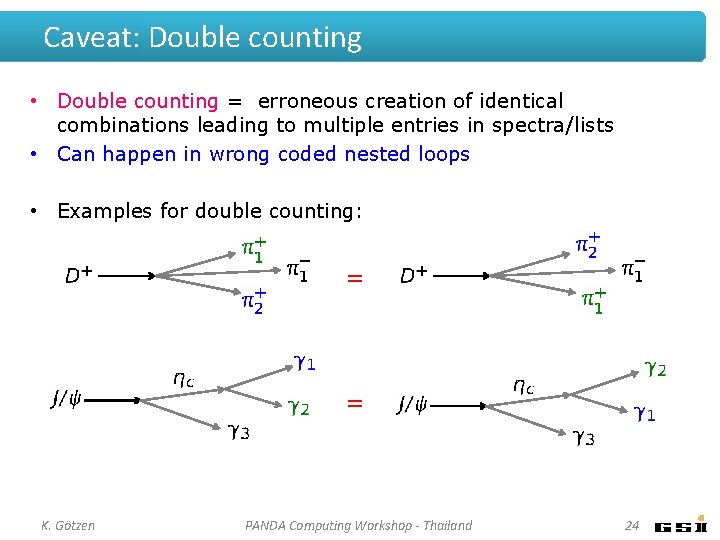
Caveat: Double counting • Double counting = erroneous creation of identical combinations leading to multiple entries in spectra/lists • Can happen in wrong coded nested loops • Examples for double counting: = = K. Götzen PANDA Computing Workshop - Thailand 24
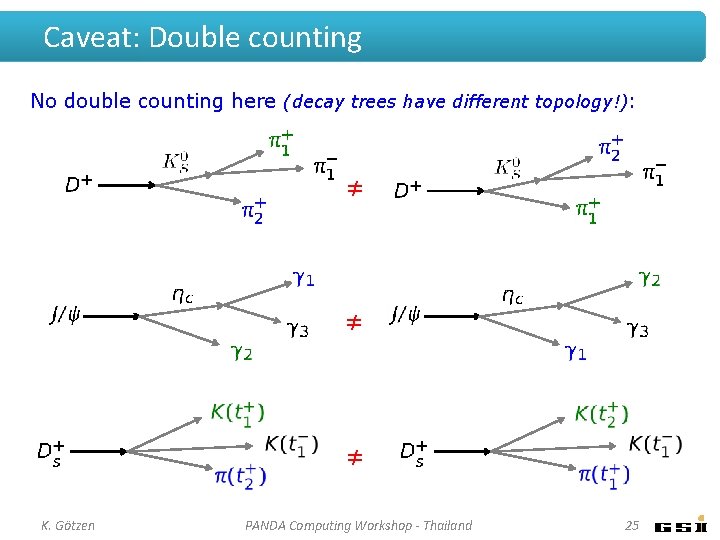
Caveat: Double counting No double counting here (decay trees have different topology!): ≠ ≠ ≠ K. Götzen PANDA Computing Workshop - Thailand 25
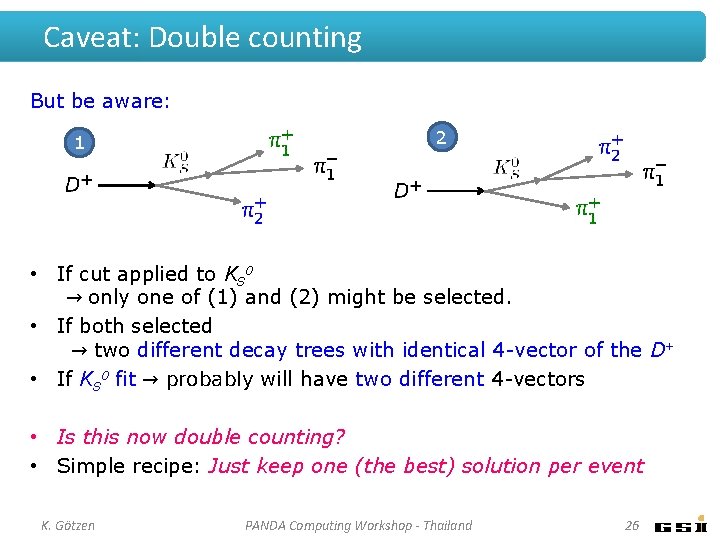
Caveat: Double counting But be aware: 1 2 • If cut applied to KS 0 → only one of (1) and (2) might be selected. • If both selected → two different decay trees with identical 4 -vector of the D+ • If KS 0 fit → probably will have two different 4 -vectors • Is this now double counting? • Simple recipe: Just keep one (the best) solution per event K. Götzen PANDA Computing Workshop - Thailand 26
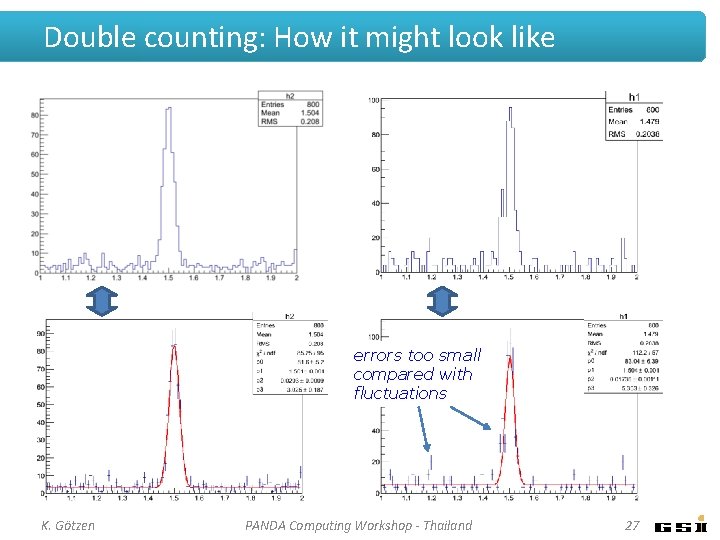
Double counting: How it might look like errors too small compared with fluctuations K. Götzen PANDA Computing Workshop - Thailand 27
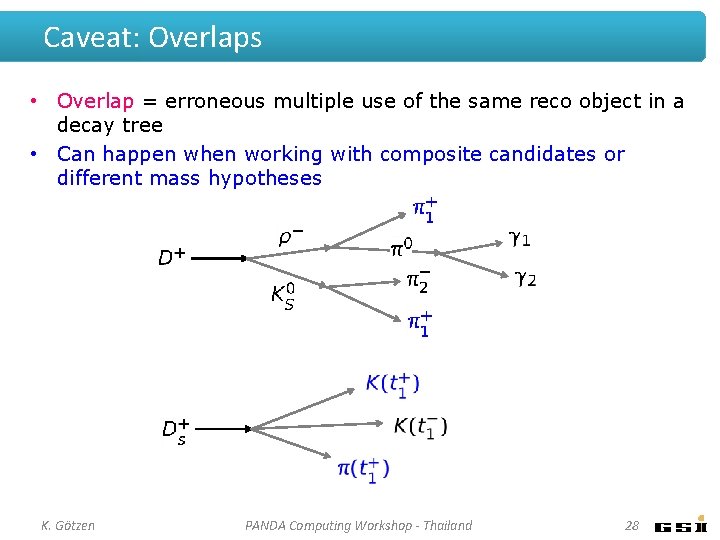
Caveat: Overlaps • Overlap = erroneous multiple use of the same reco object in a decay tree • Can happen when working with composite candidates or different mass hypotheses K. Götzen PANDA Computing Workshop - Thailand 28
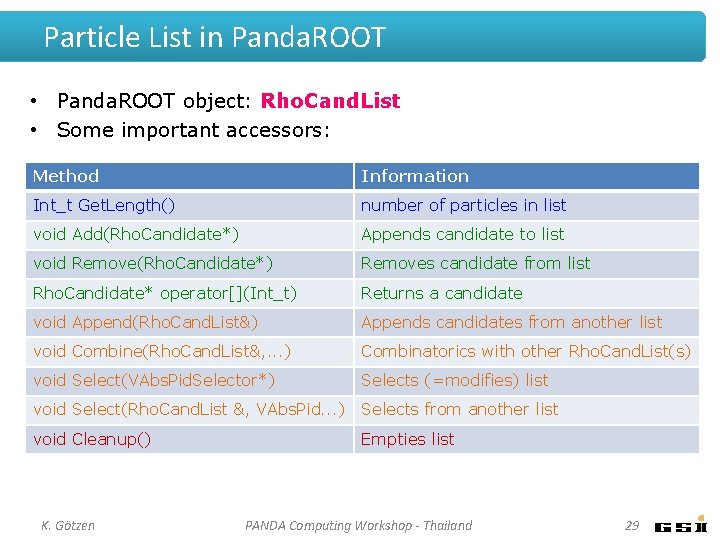
Particle List in Panda. ROOT • Panda. ROOT object: Rho. Cand. List • Some important accessors: Method Information Int_t Get. Length() number of particles in list void Add(Rho. Candidate*) Appends candidate to list void Remove(Rho. Candidate*) Removes candidate from list Rho. Candidate* operator[](Int_t) Returns a candidate void Append(Rho. Cand. List&) Appends candidates from another list void Combine(Rho. Cand. List&, . . . ) Combinatorics with other Rho. Cand. List(s) void Select(VAbs. Pid. Selector*) Selects (=modifies) list void Select(Rho. Cand. List &, VAbs. Pid. . . ) Selects from another list void Cleanup() Empties list K. Götzen PANDA Computing Workshop - Thailand 29
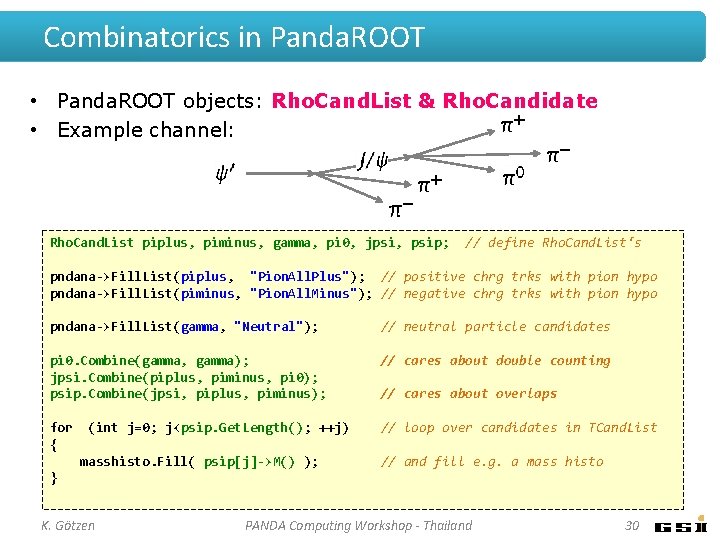
Combinatorics in Panda. ROOT • Panda. ROOT objects: Rho. Cand. List & Rho. Candidate • Example channel: Rho. Cand. List piplus, piminus, gamma, pi 0, jpsi, psip; // define Rho. Cand. List‘s pndana->Fill. List(piplus, "Pion. All. Plus"); // positive chrg trks with pion hypo pndana->Fill. List(piminus, "Pion. All. Minus"); // negative chrg trks with pion hypo pndana->Fill. List(gamma, "Neutral"); // neutral particle candidates pi 0. Combine(gamma, gamma); jpsi. Combine(piplus, piminus, pi 0); psip. Combine(jpsi, piplus, piminus); // cares about double counting for { // loop over candidates in TCand. List (int j=0; j<psip. Get. Length(); ++j) masshisto. Fill( psip[j]->M() ); // cares about overlaps // and fill e. g. a mass histo } K. Götzen PANDA Computing Workshop - Thailand 30
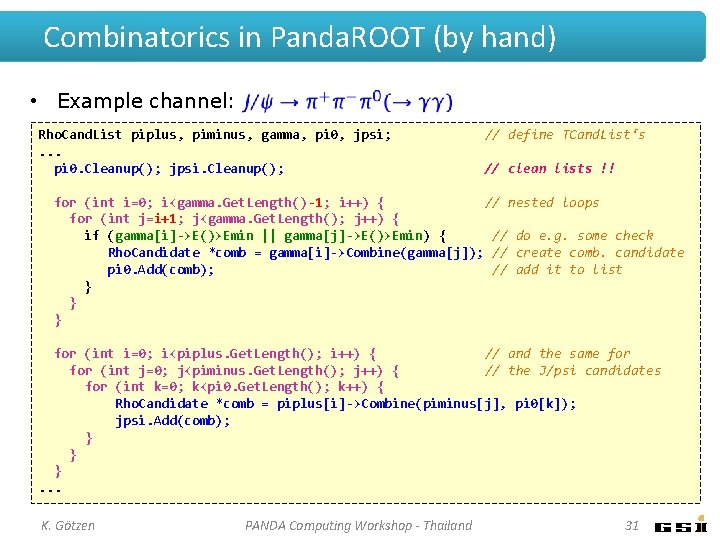
Combinatorics in Panda. ROOT (by hand) • Example channel: Rho. Cand. List piplus, piminus, gamma, pi 0, jpsi; . . . pi 0. Cleanup(); jpsi. Cleanup(); // define TCand. List‘s // clean lists !! for (int i=0; i<gamma. Get. Length()-1; i++) { // nested loops for (int j=i+1; j<gamma. Get. Length(); j++) { if (gamma[i]->E()>Emin || gamma[j]->E()>Emin) { // do e. g. some check Rho. Candidate *comb = gamma[i]->Combine(gamma[j]); // create comb. candidate pi 0. Add(comb); // add it to list } } } for (int i=0; i<piplus. Get. Length(); i++) { // and the same for (int j=0; j<piminus. Get. Length(); j++) { // the J/psi candidates for (int k=0; k<pi 0. Get. Length(); k++) { Rho. Candidate *comb = piplus[i]->Combine(piminus[j], pi 0[k]); jpsi. Add(comb); } } }. . . K. Götzen PANDA Computing Workshop - Thailand 31
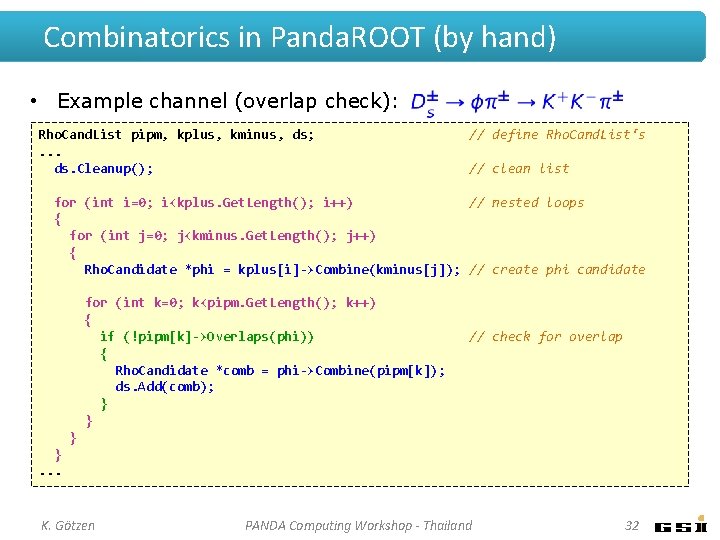
Combinatorics in Panda. ROOT (by hand) • Example channel (overlap check): Rho. Cand. List pipm, kplus, kminus, ds; . . . ds. Cleanup(); // define Rho. Cand. List‘s // clean list for (int i=0; i<kplus. Get. Length(); i++) // nested loops { for (int j=0; j<kminus. Get. Length(); j++) { Rho. Candidate *phi = kplus[i]->Combine(kminus[j]); // create phi candidate for (int k=0; k<pipm. Get. Length(); k++) { if (!pipm[k]->Overlaps(phi)) { Rho. Candidate *comb = phi->Combine(pipm[k]); ds. Add(comb); } } // check for overlap } }. . . K. Götzen PANDA Computing Workshop - Thailand 32
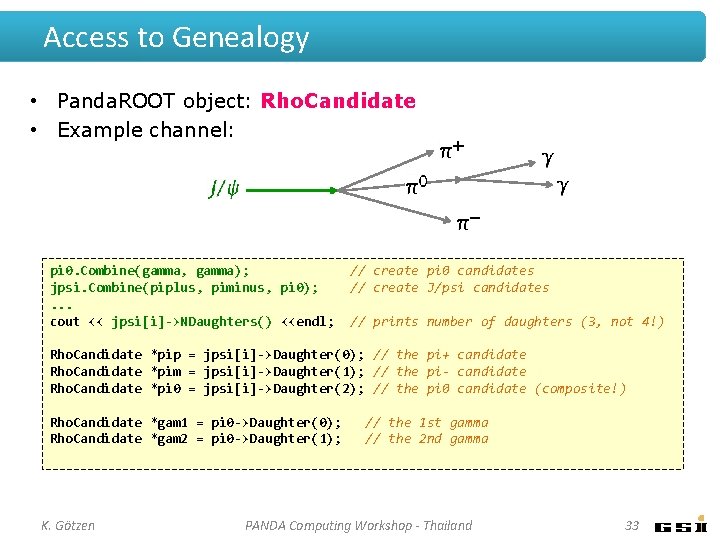
Access to Genealogy • Panda. ROOT object: Rho. Candidate • Example channel: pi 0. Combine(gamma, gamma); jpsi. Combine(piplus, piminus, pi 0); . . . cout << jpsi[i]->NDaughters() <<endl; // create pi 0 candidates // create J/psi candidates // prints number of daughters (3, not 4!) Rho. Candidate *pip = jpsi[i]->Daughter(0); // the pi+ candidate Rho. Candidate *pim = jpsi[i]->Daughter(1); // the pi- candidate Rho. Candidate *pi 0 = jpsi[i]->Daughter(2); // the pi 0 candidate (composite!) Rho. Candidate *gam 1 = pi 0 ->Daughter(0); Rho. Candidate *gam 2 = pi 0 ->Daughter(1); K. Götzen // the 1 st gamma // the 2 nd gamma PANDA Computing Workshop - Thailand 33
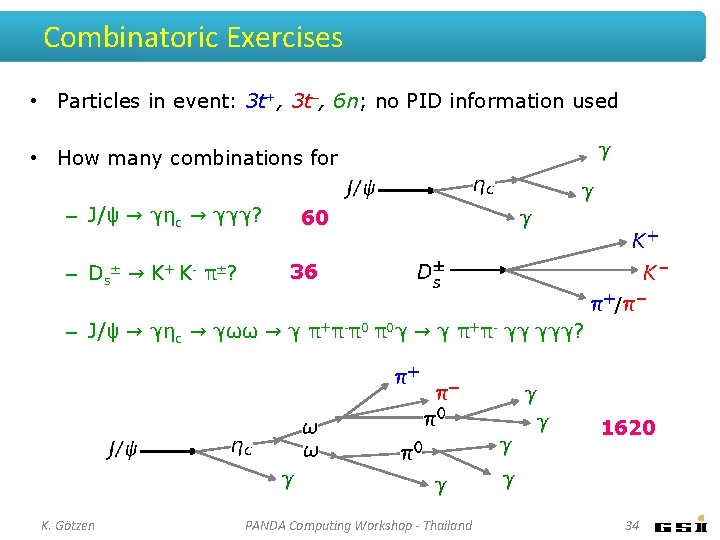
Combinatoric Exercises • Particles in event: 3 t+, 3 t-, 6 n; no PID information used • How many combinations for – J/ψ → γηc → γγγ? – Ds± → K+ K- π±? 60 36 – J/ψ → γηc → γωω → γ π+π-π0 π0γ → γ π+π- γγ γγγ? / 1620 K. Götzen PANDA Computing Workshop - Thailand 34
EXERCISES
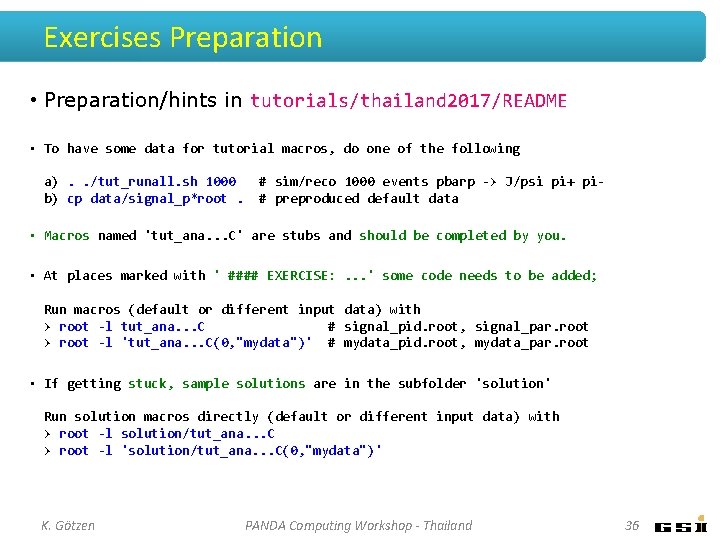
Exercises Preparation • Preparation/hints in tutorials/thailand 2017/README • To have some data for tutorial macros, do one of the following a). . /tut_runall. sh 1000 b) cp data/signal_p*root. # sim/reco 1000 events pbarp -> J/psi pi+ pi# preproduced default data • Macros named 'tut_ana. . . C' are stubs and should be completed by you. • At places marked with ' #### EXERCISE: . . . ' some code needs to be added; Run macros (default or different input data) with > root -l tut_ana. . . C # signal_pid. root, signal_par. root > root -l 'tut_ana. . . C(0, "mydata")' # mydata_pid. root, mydata_par. root • If getting stuck, sample solutions are in the subfolder 'solution' Run solution macros directly (default or different input data) with > root -l solution/tut_ana. . . C > root -l 'solution/tut_ana. . . C(0, "mydata")' K. Götzen PANDA Computing Workshop - Thailand 36
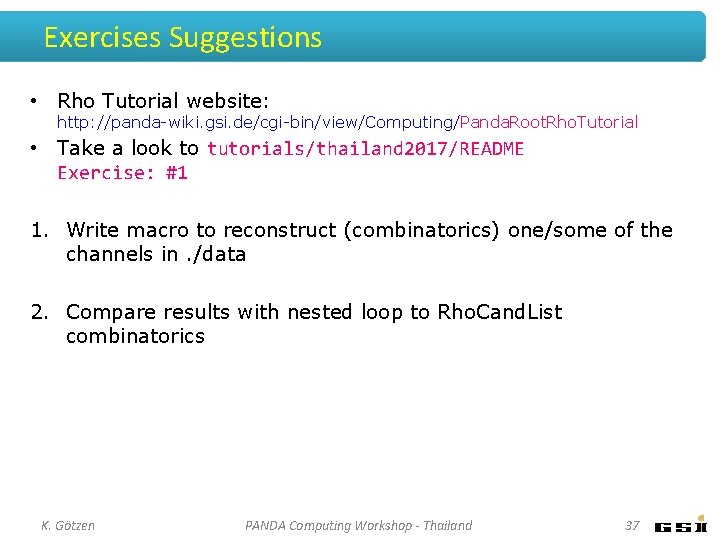
Exercises Suggestions • Rho Tutorial website: http: //panda-wiki. gsi. de/cgi-bin/view/Computing/Panda. Root. Rho. Tutorial • Take a look to tutorials/thailand 2017/README Exercise: #1 1. Write macro to reconstruct (combinatorics) one/some of the channels in. /data 2. Compare results with nested loop to Rho. Cand. List combinatorics K. Götzen PANDA Computing Workshop - Thailand 37