Physical Testing 1 Solutions 2 Disperse systems 3

- Slides: 65
Physical Testing 1. Solutions 2. Disperse systems 3. Aerosols 4. Powders 5. Tablets 6. Sustained release products 7. Coated tablets 8. Hard & soft shell capsules 9. Microcapsules
Solutions Parenteral -Appearance -Precipitation -Swirly precipitates -Whiskers -Clouds -Sterility -Volume -Dielectric constant -p. H Oral -Appearance -Precipitation -Organoleptic properties -Loss of dye -Bacterial growth -Volume -Dielectric constant -p. H
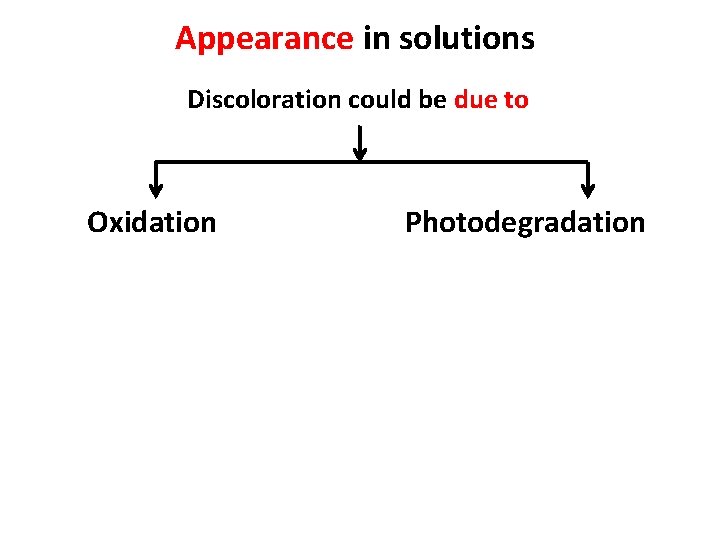
Appearance in solutions Discoloration could be due to Oxidation Photodegradation
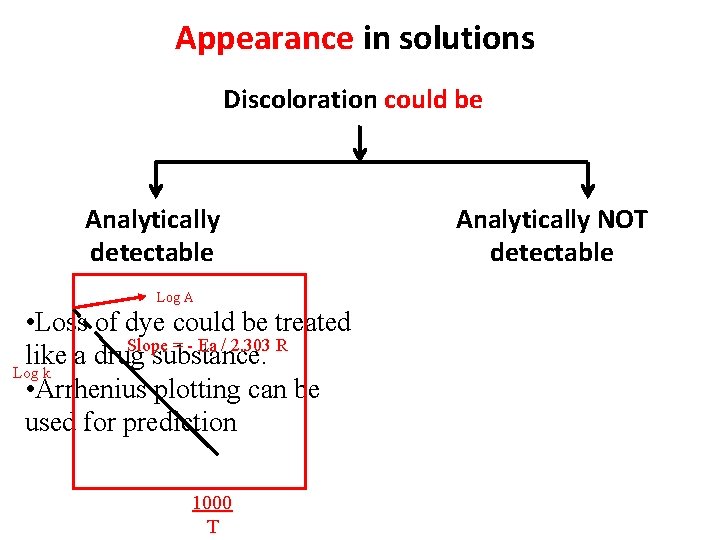
Appearance in solutions Discoloration could be Analytically detectable Log A • Loss of dye could be treated Slope = - Ea / 2. 303 R like a drug substance. Log k • Arrhenius plotting can be used for prediction 1000 T Analytically NOT detectable
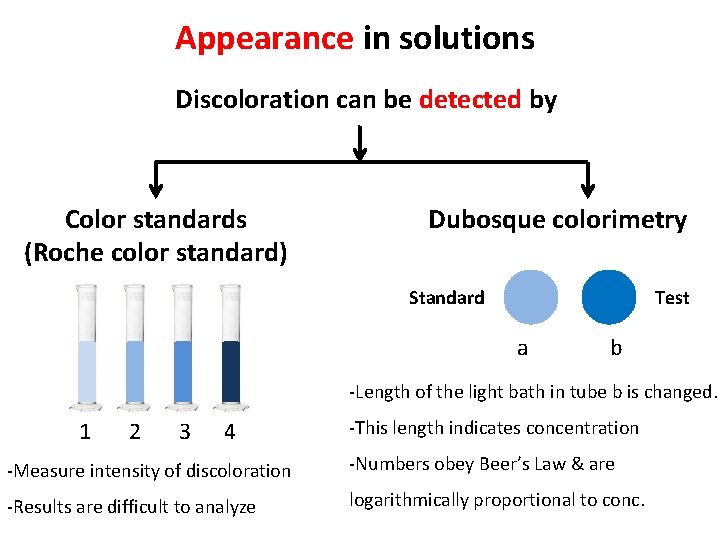
Appearance in solutions Discoloration can be detected by Color standards (Roche color standard) Dubosque colorimetry Standard Test a b -Length of the light bath in tube b is changed. 1 2 3 4 -This length indicates concentration -Measure intensity of discoloration -Numbers obey Beer’s Law & are -Results are difficult to analyze logarithmically proportional to conc.
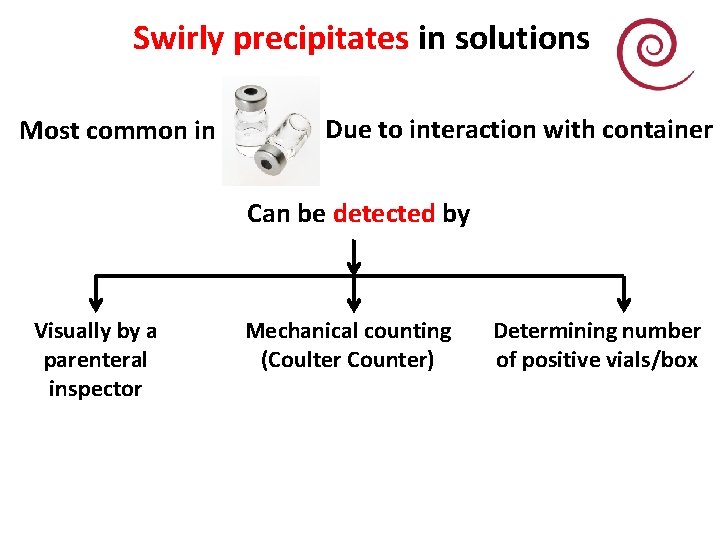
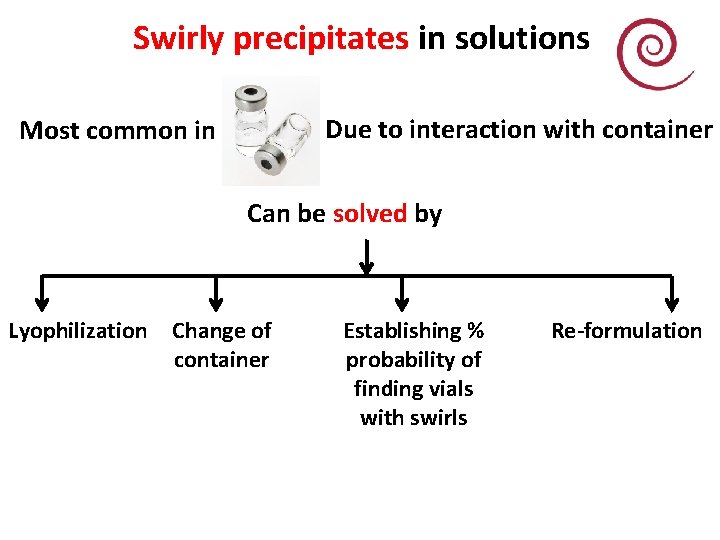
Swirly precipitates in solutions Most common in Due to interaction with container Can be detected by Visually by a parenteral inspector Mechanical counting (Coulter Counter) Determining number of positive vials/box
Swirly precipitates in solutions Due to interaction with container Most common in Can be solved by Lyophilization Change of container Establishing % probability of finding vials with swirls Re-formulation
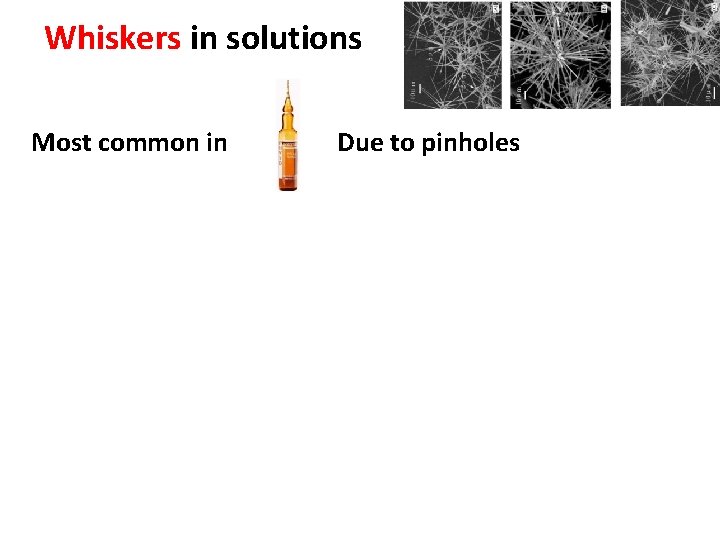
Whiskers in solutions Most common in Due to pinholes
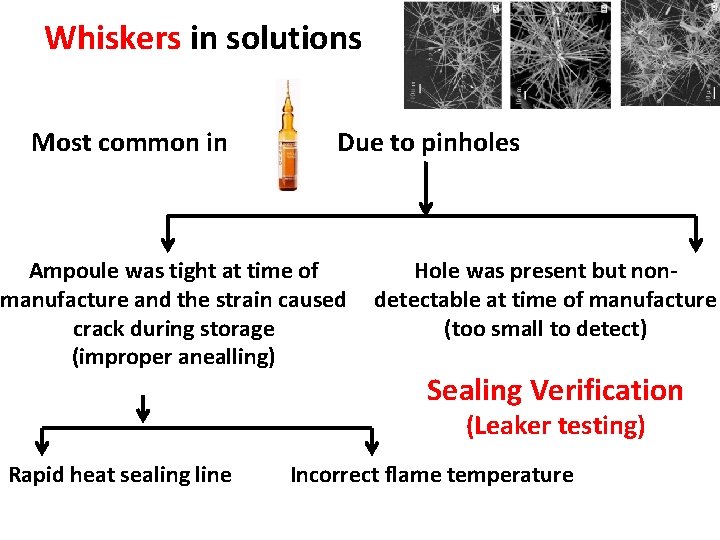
Whiskers in solutions Most common in Due to pinholes Ampoule was tight at time of manufacture and the strain caused crack during storage (improper anealling) Hole was present but nondetectable at time of manufacture (too small to detect) Sealing Verification (Leaker testing) Rapid heat sealing line Incorrect flame temperature
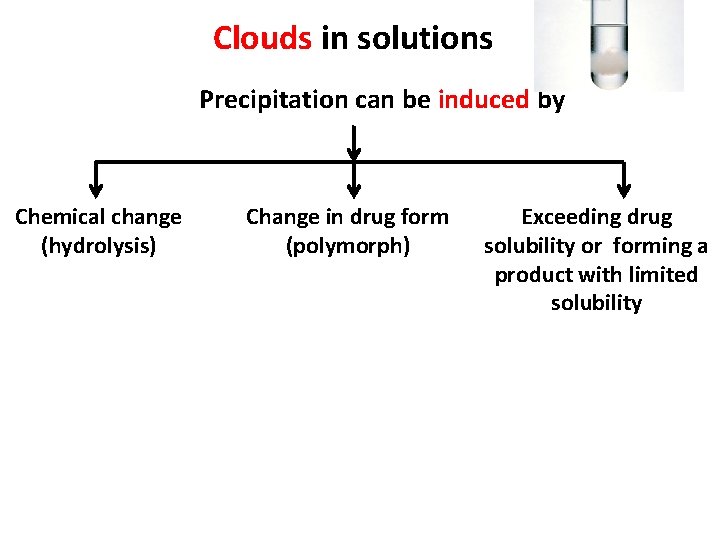
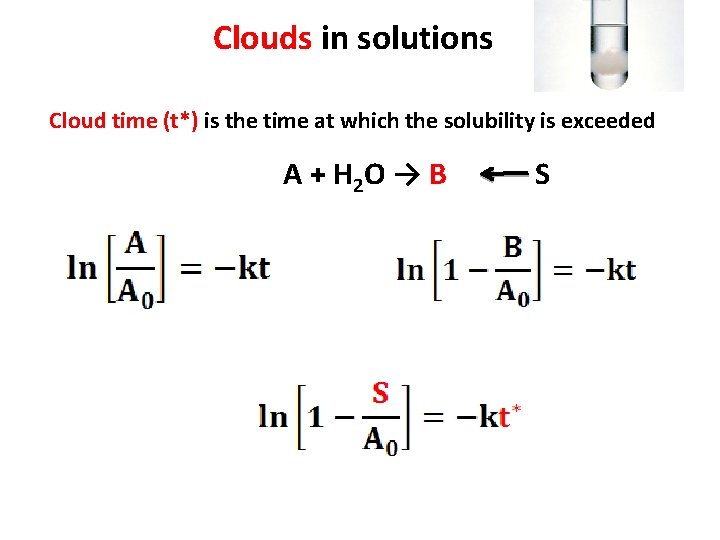
Clouds in solutions Precipitation can be induced by Chemical change (hydrolysis) Change in drug form (polymorph) Exceeding drug solubility or forming a product with limited solubility
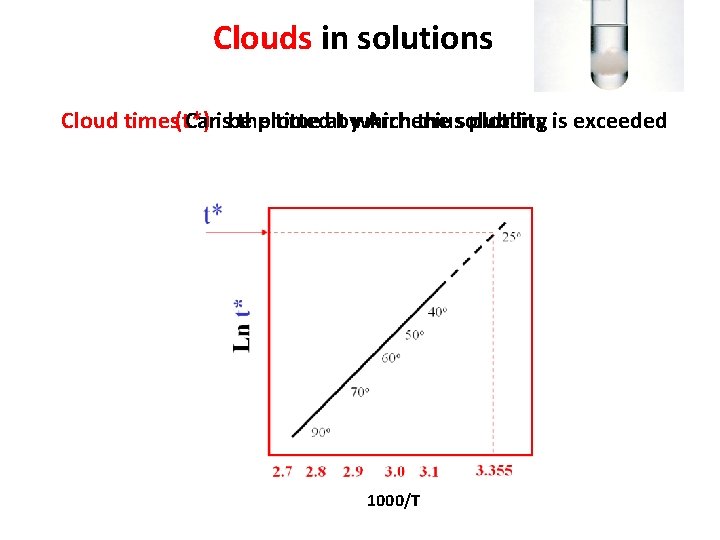
Clouds in solutions Cloud time (t*) is the time at which the solubility is exceeded A + H 2 O → B S
Clouds in solutions Cloud times time (t*) Canisbe theplotted time atbywhich Arrhenius the solubility plotting is exceeded 1000/T
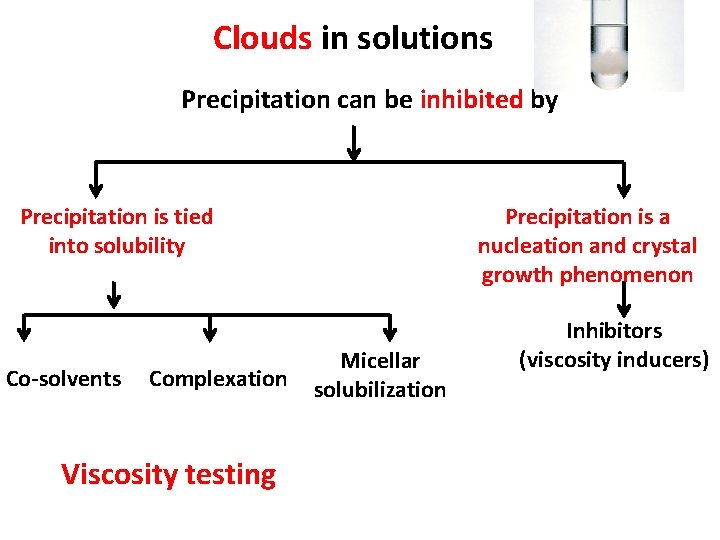
Clouds in solutions Precipitation can be inhibited by Precipitation is tied into solubility Co-solvents Complexation Viscosity testing Precipitation is a nucleation and crystal growth phenomenon Micellar solubilization Inhibitors (viscosity inducers)
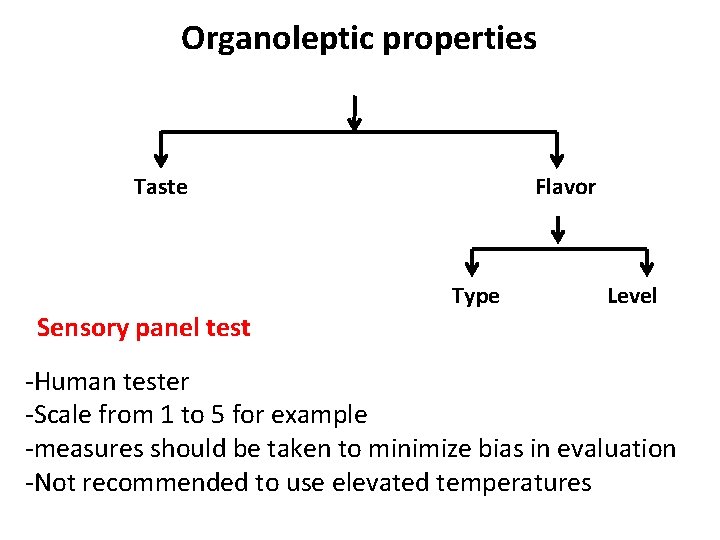
Organoleptic properties Taste Flavor Type Level Sensory panel test -Human tester -Scale from 1 to 5 for example -measures should be taken to minimize bias in evaluation -Not recommended to use elevated temperatures
Organoleptic properties Measures to minimize bias in evaluation -Determination of organoleptic capacity of the tester -Ability to describe the flavor well -Ability to duplicate results -Ability to remember results -Ability to detect new flavors (eg. due to interaction with container. )
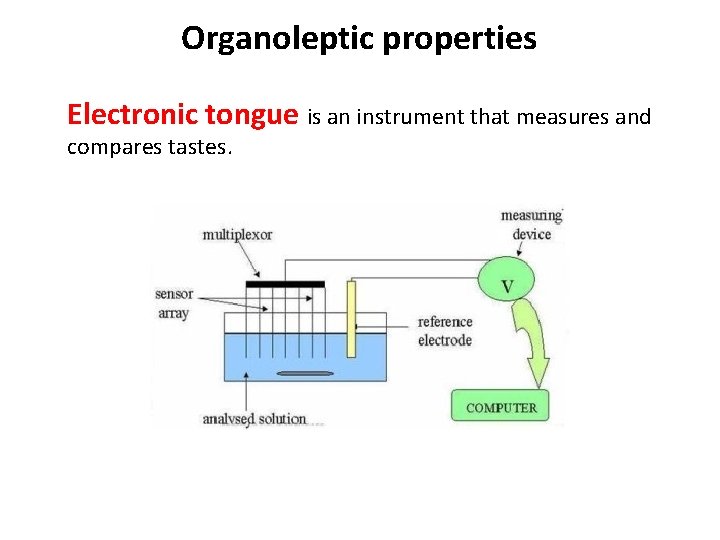
Organoleptic properties Electronic tongue is an instrument that measures and compares tastes.
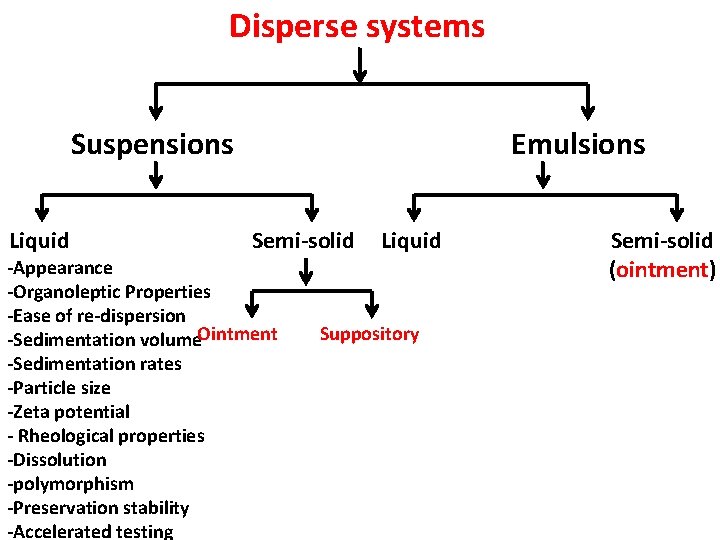
Disperse systems Suspensions Liquid Emulsions Semi-solid -Appearance -Organoleptic Properties -Ease of re-dispersion -Sedimentation volume. Ointment -Sedimentation rates -Particle size -Zeta potential - Rheological properties -Dissolution -polymorphism -Preservation stability -Accelerated testing Liquid Suppository Semi-solid (ointment)
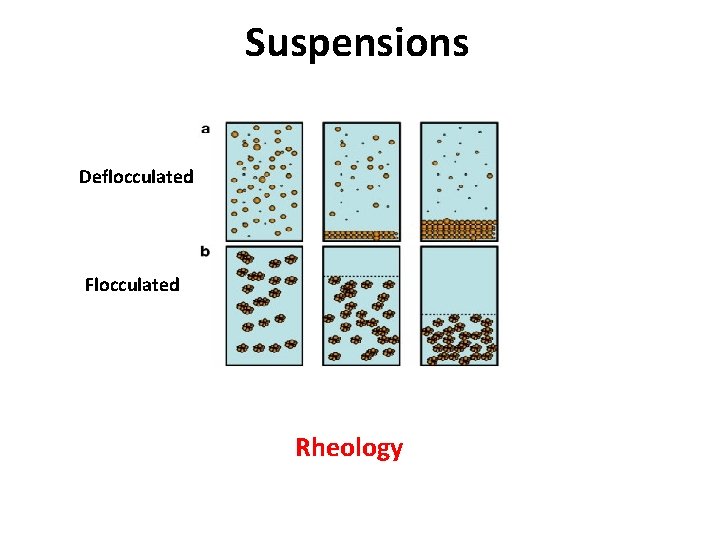
Suspensions Deflocculated Flocculated Rheology
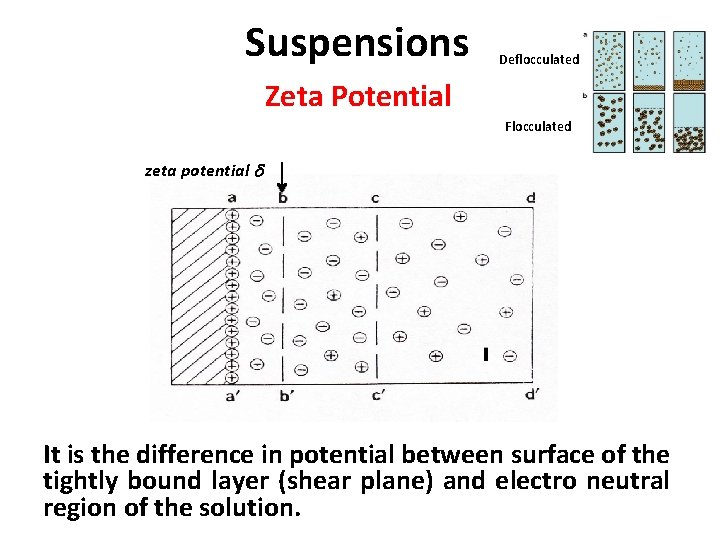
Suspensions Deflocculated Zeta Potential Flocculated zeta potential It is the difference in potential between surface of the tightly bound layer (shear plane) and electro neutral region of the solution.
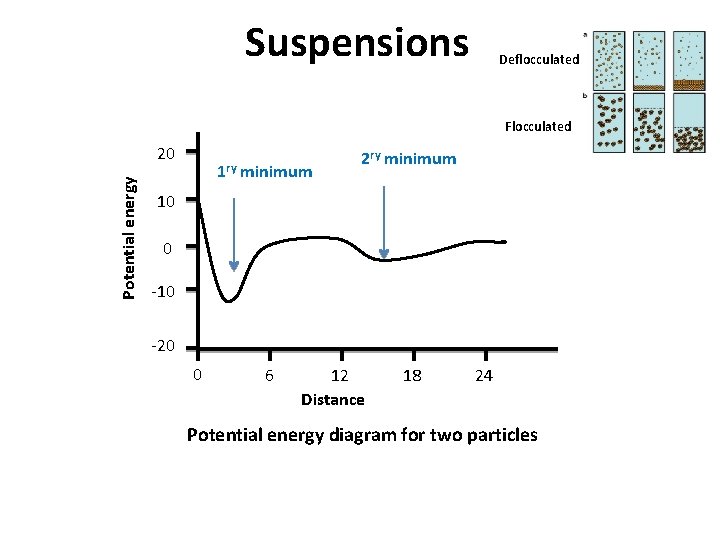
Suspensions Deflocculated Flocculated Potential energy 20 1 ry minimum 2 ry minimum 10 0 -10 -20 0 6 12 Distance 18 24 Potential energy diagram for two particles
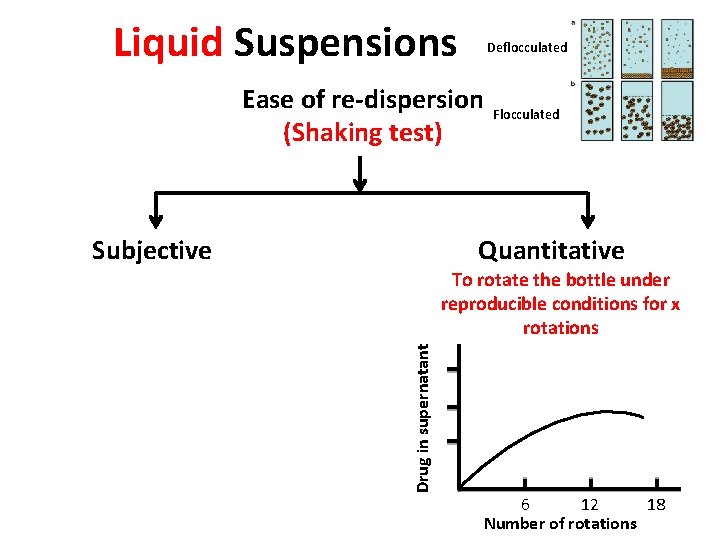
Liquid Suspensions Deflocculated Ease of re-dispersion (Shaking test) Subjective Flocculated Quantitative Drug in supernatant To rotate the bottle under reproducible conditions for x rotations 6 12 18 Number of rotations
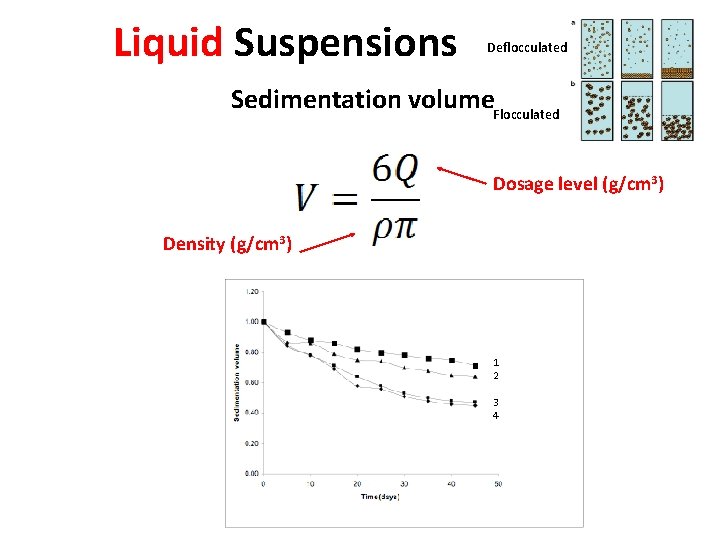
Liquid Suspensions Deflocculated Sedimentation volume. Flocculated Dosage level (g/cm 3) Density (g/cm 3) 1 2 3 4
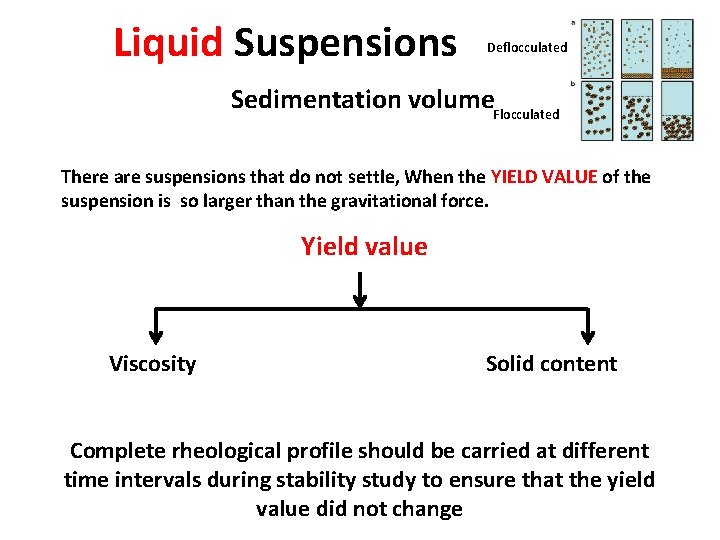
Liquid Suspensions Deflocculated Sedimentation volume. Flocculated There are suspensions that do not settle, When the YIELD VALUE of the suspension is so larger than the gravitational force. Yield value Viscosity Solid content Complete rheological profile should be carried at different time intervals during stability study to ensure that the yield value did not change
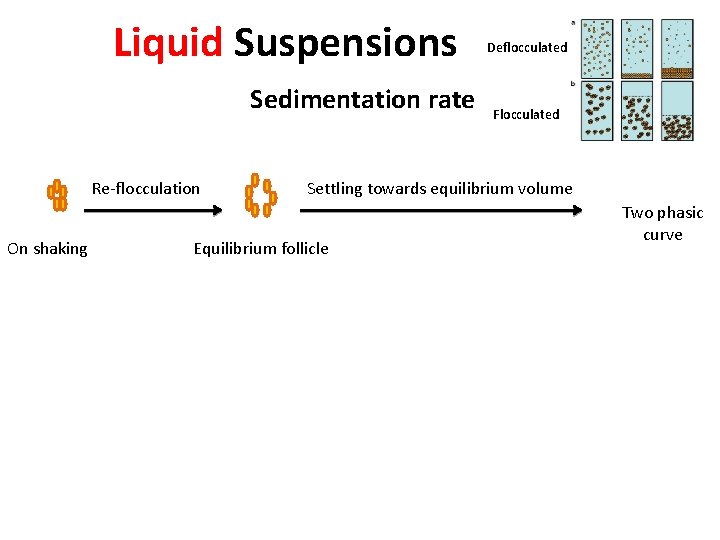
Liquid Suspensions Sedimentation rate Re-flocculation On shaking Deflocculated Flocculated Settling towards equilibrium volume Equilibrium follicle Two phasic curve
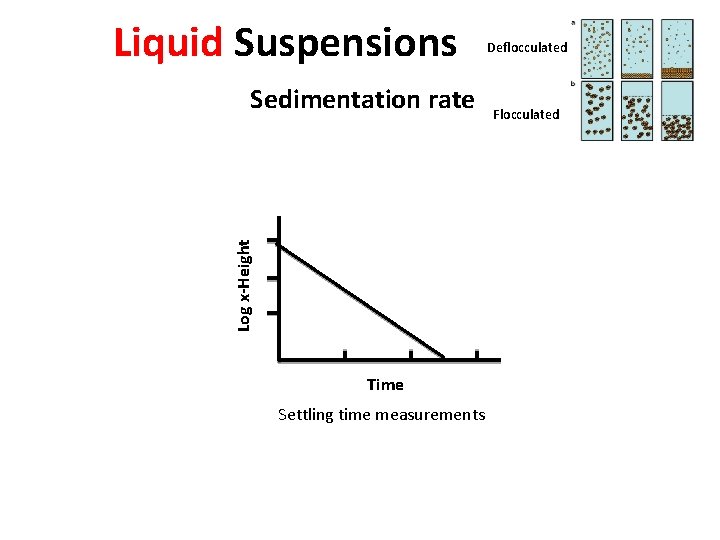
Liquid Suspensions Log x-Height Sedimentation rate Time Settling time measurements Deflocculated Flocculated
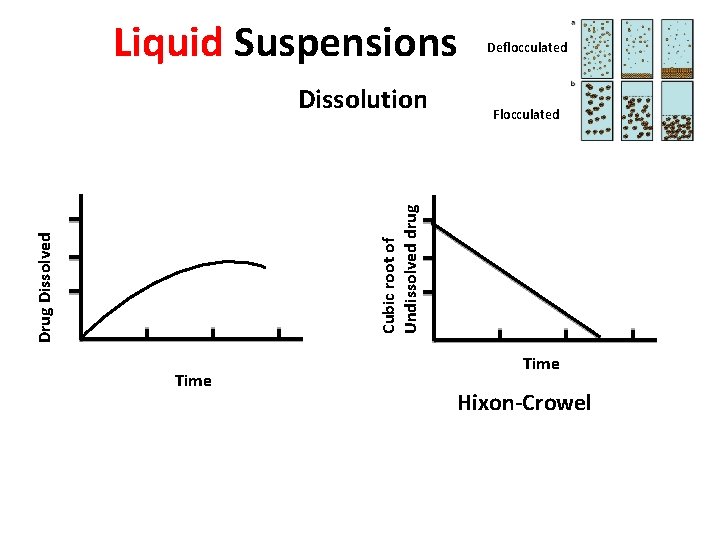
Liquid Suspensions Flocculated Drug Dissolved Cubic root of Undissolved drug Dissolution Deflocculated Time Hixon-Crowel
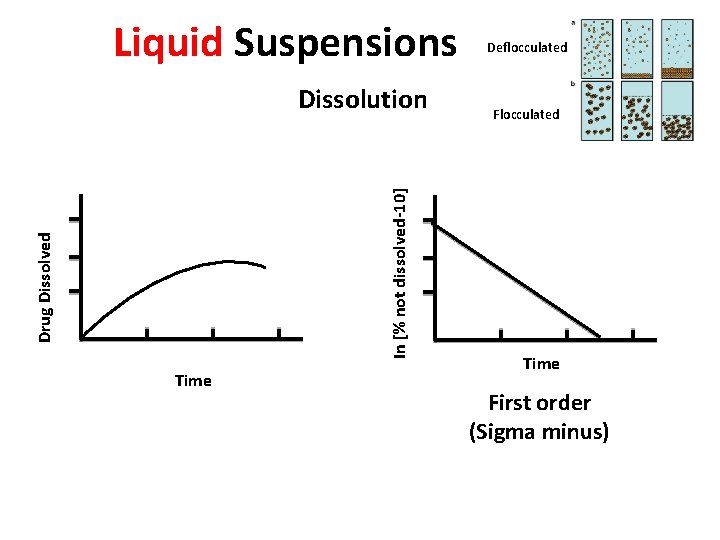
Liquid Suspensions Drug Dissolved In [% not dissolved-10] Dissolution Time Deflocculated Flocculated Time First order (Sigma minus)
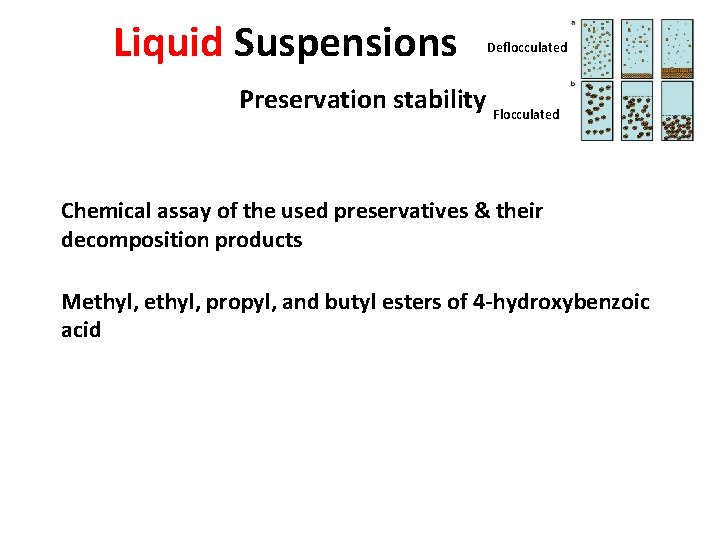
Liquid Suspensions Deflocculated Preservation stability Flocculated Chemical assay of the used preservatives & their decomposition products Methyl, propyl, and butyl esters of 4 -hydroxybenzoic acid
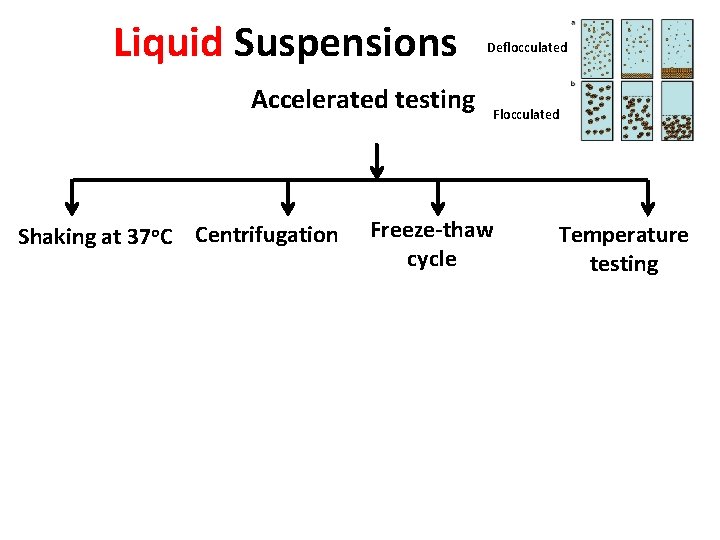
Liquid Suspensions Accelerated testing Shaking at 37 o. C Centrifugation Deflocculated Freeze-thaw cycle Temperature testing
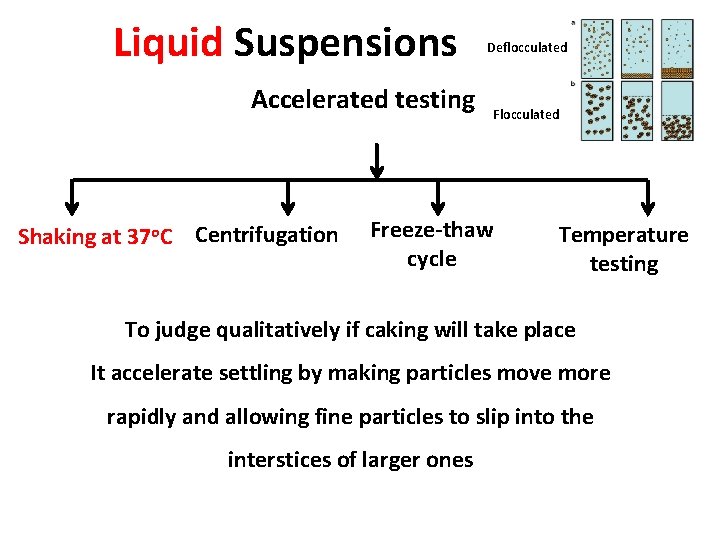
Liquid Suspensions Accelerated testing Shaking at 37 o. C Centrifugation Deflocculated Freeze-thaw cycle Temperature testing To judge qualitatively if caking will take place It accelerate settling by making particles move more rapidly and allowing fine particles to slip into the interstices of larger ones
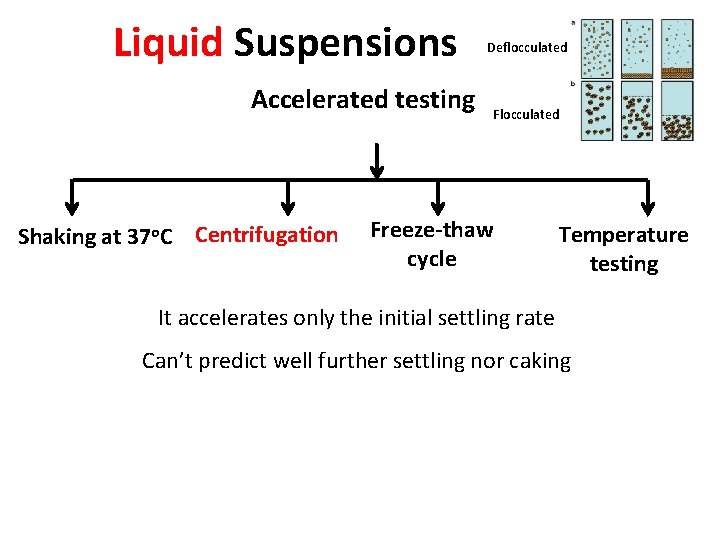
Liquid Suspensions Accelerated testing Shaking at 37 o. C Centrifugation Deflocculated Freeze-thaw cycle Temperature testing It accelerates only the initial settling rate Can’t predict well further settling nor caking
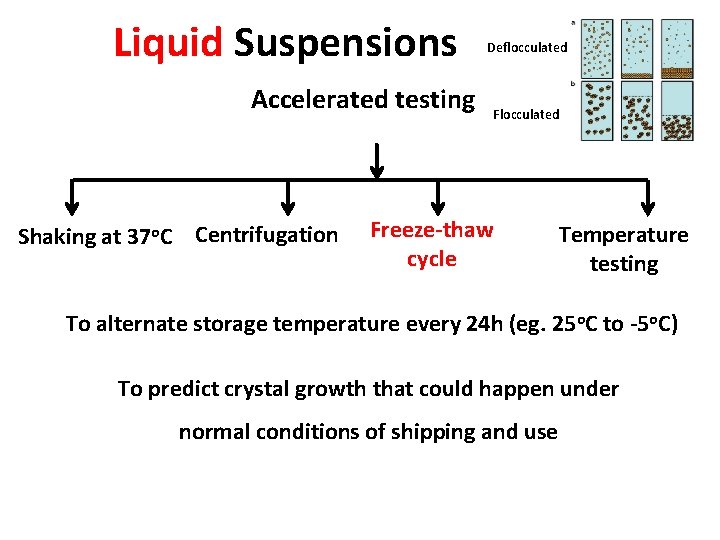
Liquid Suspensions Accelerated testing Shaking at 37 o. C Centrifugation Deflocculated Freeze-thaw cycle Temperature testing To alternate storage temperature every 24 h (eg. 25 o. C to -5 o. C) To predict crystal growth that could happen under normal conditions of shipping and use
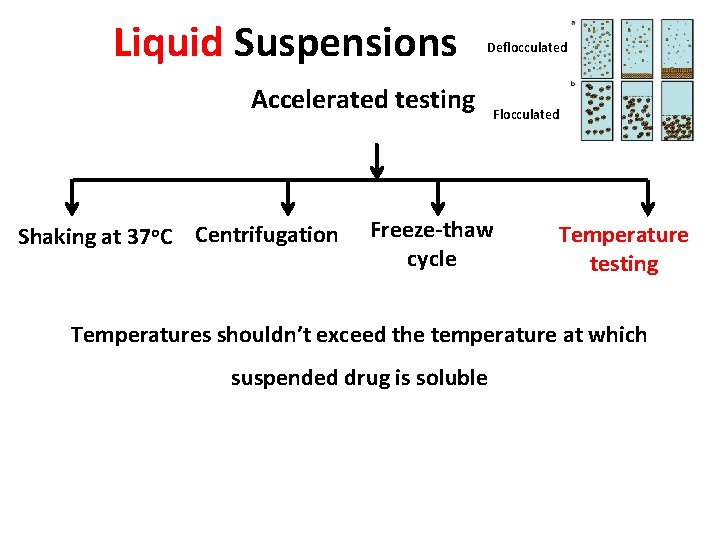
Liquid Suspensions Deflocculated Accelerated testing Shaking at 37 o. C Centrifugation Flocculated Freeze-thaw cycle Temperature testing Temperatures shouldn’t exceed the temperature at which suspended drug is soluble
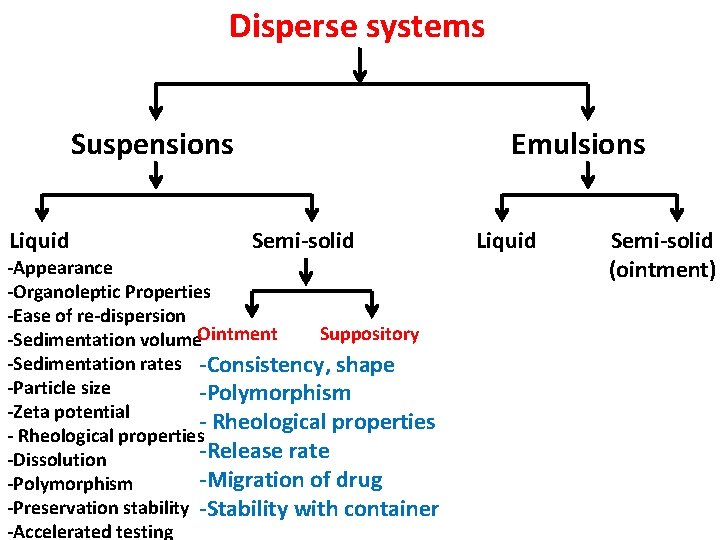
Disperse systems Suspensions Liquid Emulsions Semi-solid -Appearance -Organoleptic Properties -Ease of re-dispersion Suppository -Sedimentation volume. Ointment -Sedimentation rates -Consistency, shape -Particle size -Polymorphism -Zeta potential - Rheological properties -Release rate -Dissolution -Migration of drug -Polymorphism -Preservation stability -Stability with container -Accelerated testing Liquid Semi-solid (ointment)
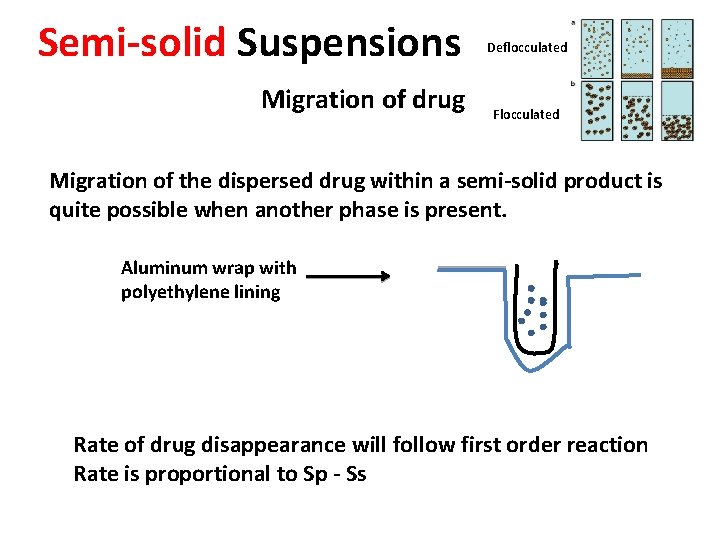
Semi-solid Suspensions Migration of drug Deflocculated Flocculated Migration of the dispersed drug within a semi-solid product is quite possible when another phase is present. Aluminum wrap with polyethylene lining Rate of drug disappearance will follow first order reaction Rate is proportional to Sp - Ss
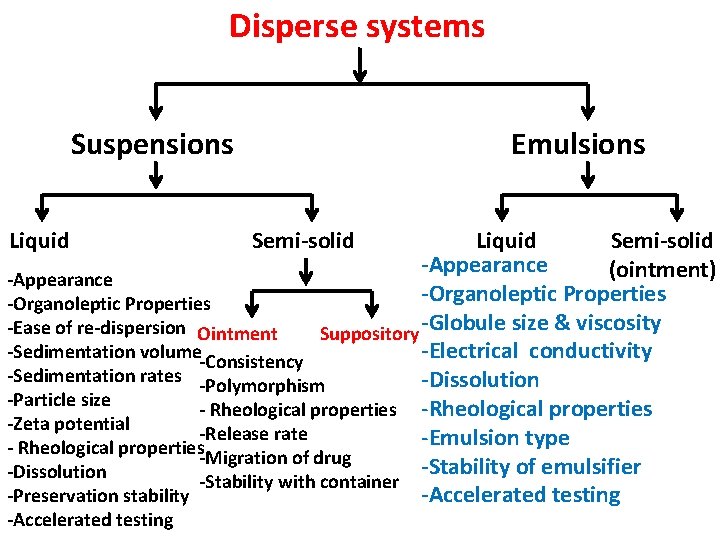
Disperse systems Suspensions Liquid Emulsions Liquid Semi-solid -Appearance (ointment) -Appearance -Organoleptic Properties -Globule size & viscosity -Ease of re-dispersion Ointment Suppository -Sedimentation volume-Consistency -Electrical conductivity -Sedimentation rates -Polymorphism -Dissolution -Particle size - Rheological properties -Zeta potential -Release rate -Emulsion type - Rheological properties-Migration of drug -Stability of emulsifier -Dissolution -Stability with container -Preservation stability -Accelerated testing Semi-solid
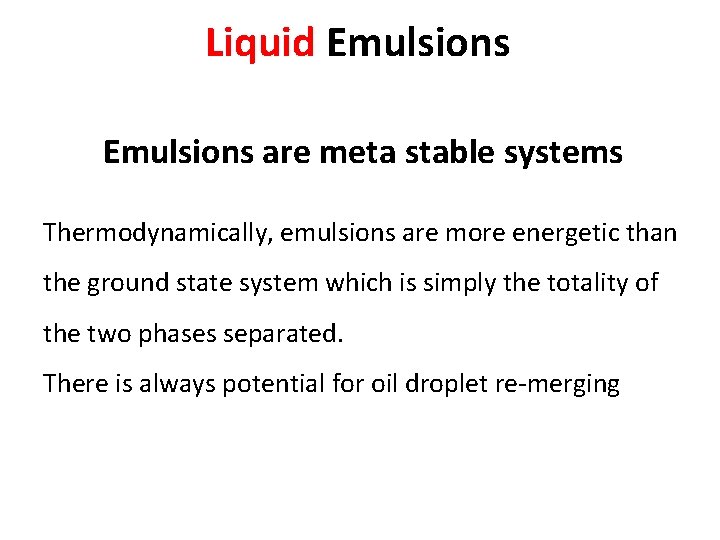
Liquid Emulsions are meta stable systems Thermodynamically, emulsions are more energetic than the ground state system which is simply the totality of the two phases separated. There is always potential for oil droplet re-merging
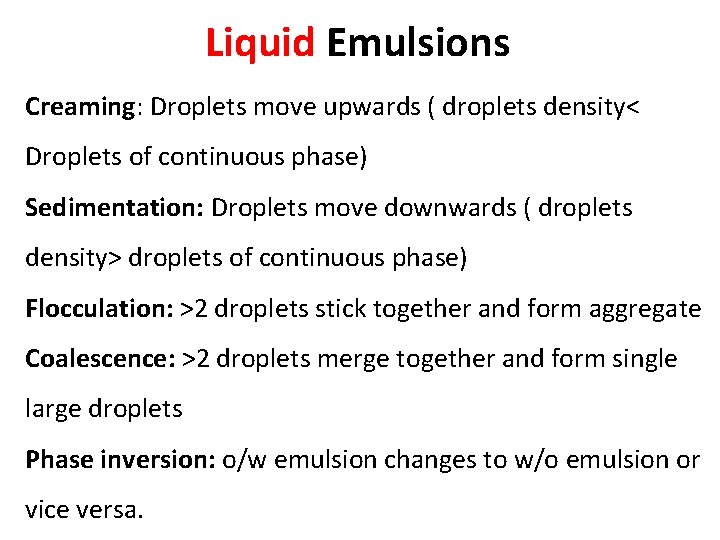
Liquid Emulsions Creaming: Droplets move upwards ( droplets density< Droplets of continuous phase) Sedimentation: Droplets move downwards ( droplets density> droplets of continuous phase) Flocculation: >2 droplets stick together and form aggregate Coalescence: >2 droplets merge together and form single large droplets Phase inversion: o/w emulsion changes to w/o emulsion or vice versa.
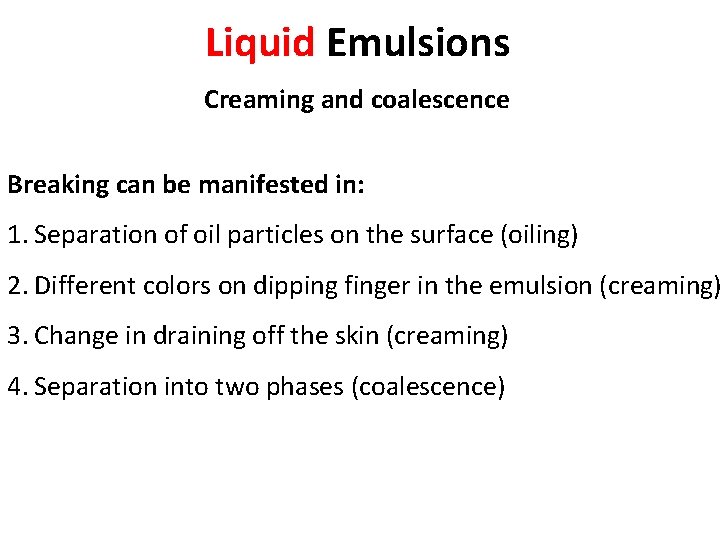
Liquid Emulsions Creaming and coalescence Breaking can be manifested in: 1. Separation of oil particles on the surface (oiling) 2. Different colors on dipping finger in the emulsion (creaming) 3. Change in draining off the skin (creaming) 4. Separation into two phases (coalescence)
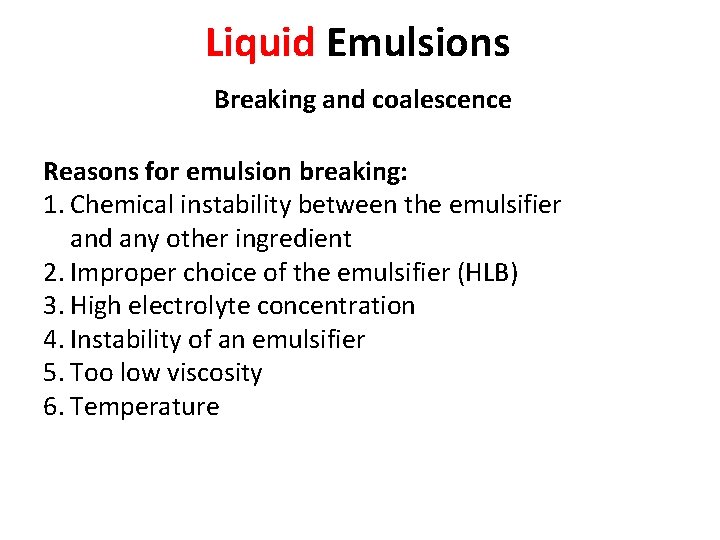
Liquid Emulsions Breaking and coalescence Reasons for emulsion breaking: 1. Chemical instability between the emulsifier and any other ingredient 2. Improper choice of the emulsifier (HLB) 3. High electrolyte concentration 4. Instability of an emulsifier 5. Too low viscosity 6. Temperature
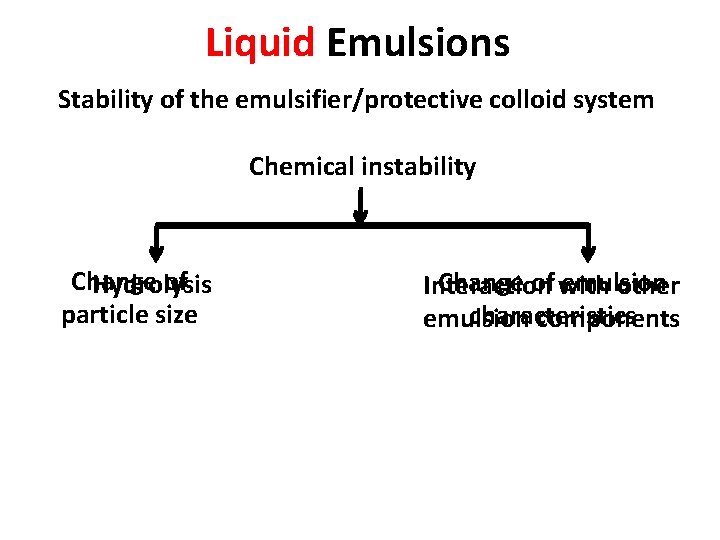
Liquid Emulsions Stability of the emulsifier/protective colloid system Chemical instability Change of Hydrolysis particle size Change of with emulsion Interaction other characteristics emulsion components
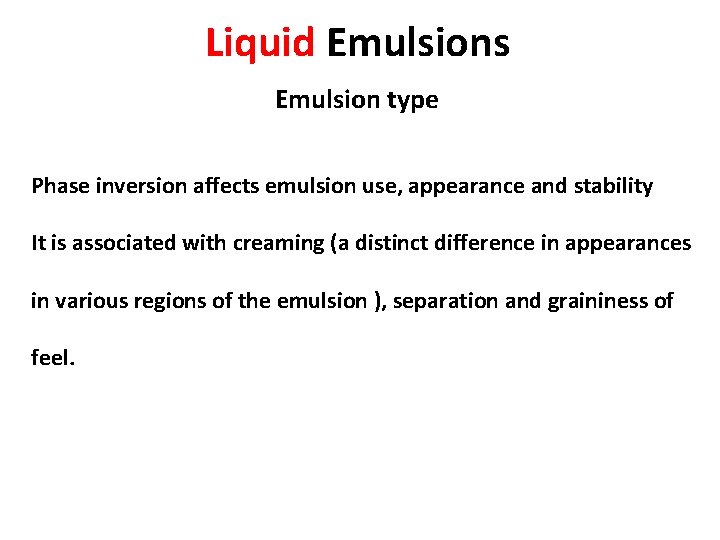
Liquid Emulsions Emulsion type Phase inversion affects emulsion use, appearance and stability It is associated with creaming (a distinct difference in appearances in various regions of the emulsion ), separation and graininess of feel.
Liquid Emulsions Electrical conductivity This indicate the state of dispersion of an emulsion system If significant changes were recorded over short periods of time, then the emulsion system is not satisfactory
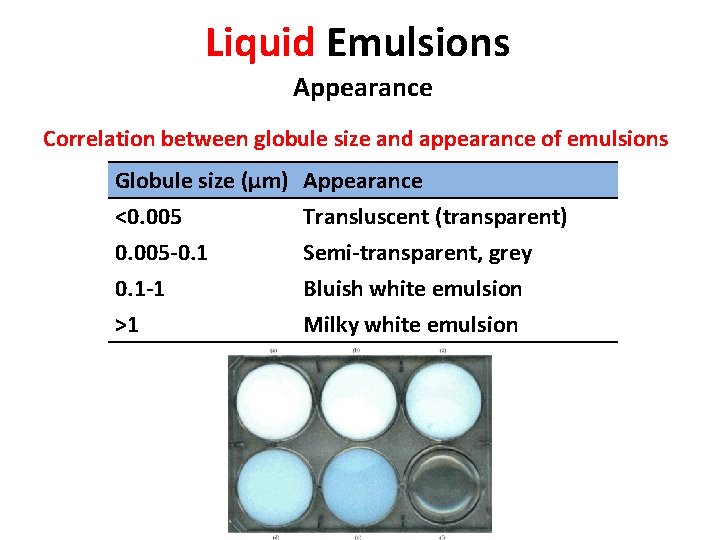
Liquid Emulsions Appearance Correlation between globule size and appearance of emulsions Globule size (µm) <0. 005 -0. 1 -1 Appearance Transluscent (transparent) Semi-transparent, grey Bluish white emulsion >1 Milky white emulsion
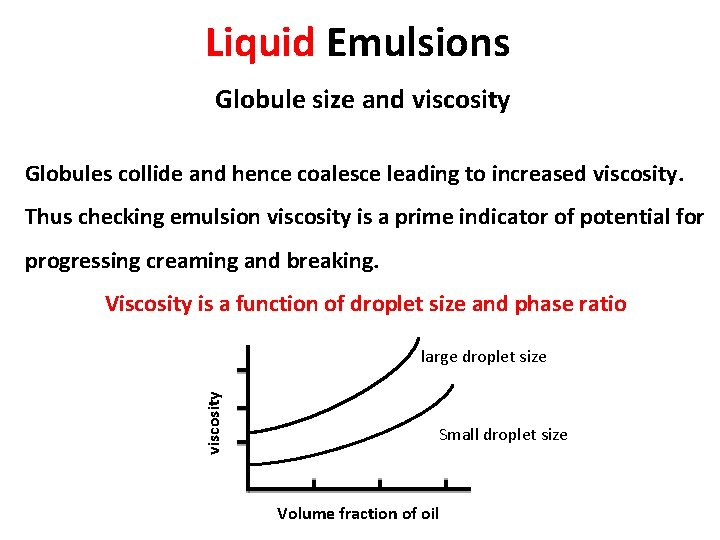
Liquid Emulsions Globule size and viscosity Globules collide and hence coalesce leading to increased viscosity. Thus checking emulsion viscosity is a prime indicator of potential for progressing creaming and breaking. Viscosity is a function of droplet size and phase ratio viscosity large droplet size Small droplet size Volume fraction of oil
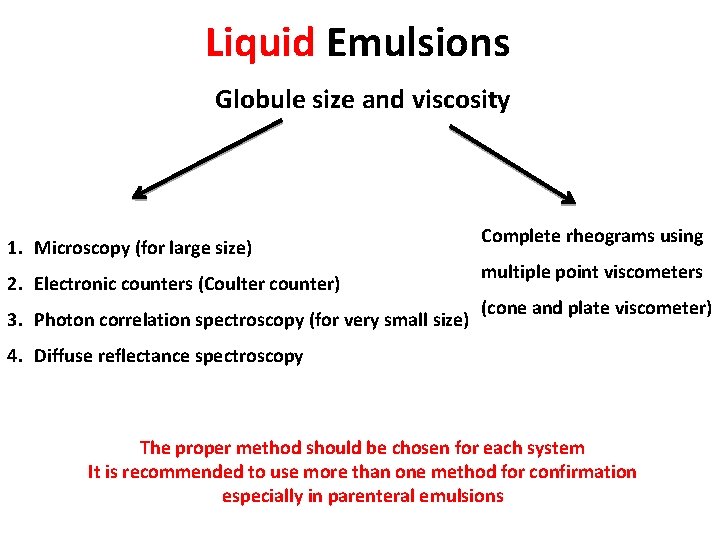
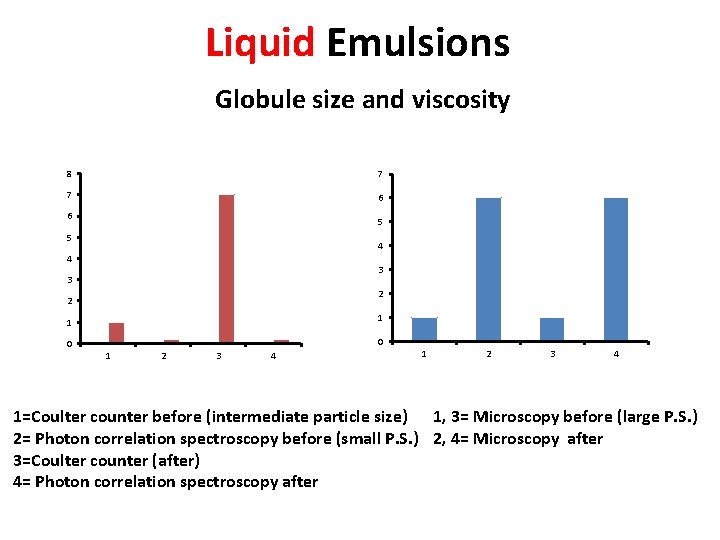
Liquid Emulsions Globule size and viscosity 1. Microscopy (for large size) 2. Electronic counters (Coulter counter) 3. Photon correlation spectroscopy (for very small size) Complete rheograms using multiple point viscometers (cone and plate viscometer) 4. Diffuse reflectance spectroscopy The proper method should be chosen for each system It is recommended to use more than one method for confirmation especially in parenteral emulsions
Liquid Emulsions Globule size and viscosity 8 7 7 6 6 5 5 4 4 3 3 2 2 1 1 0 0 1 2 3 4 1=Coulter counter before (intermediate particle size) 1, 3= Microscopy before (large P. S. ) 2= Photon correlation spectroscopy before (small P. S. ) 2, 4= Microscopy after 3=Coulter counter (after) 4= Photon correlation spectroscopy after
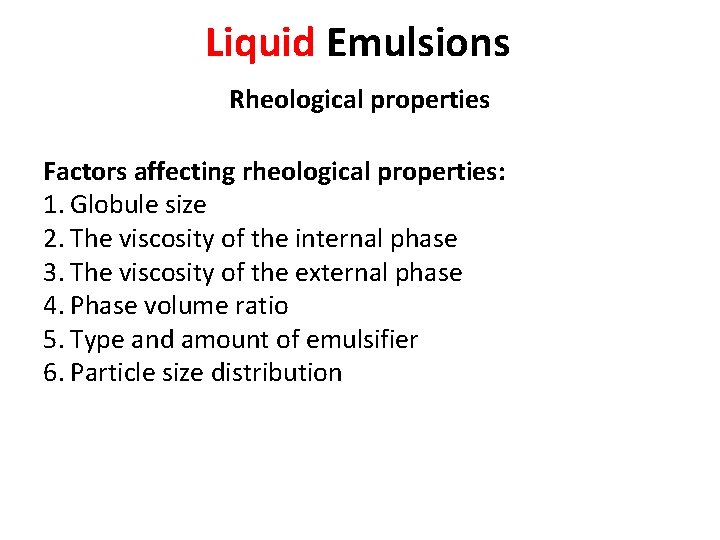
Liquid Emulsions Rheological properties Factors affecting rheological properties: 1. Globule size 2. The viscosity of the internal phase 3. The viscosity of the external phase 4. Phase volume ratio 5. Type and amount of emulsifier 6. Particle size distribution
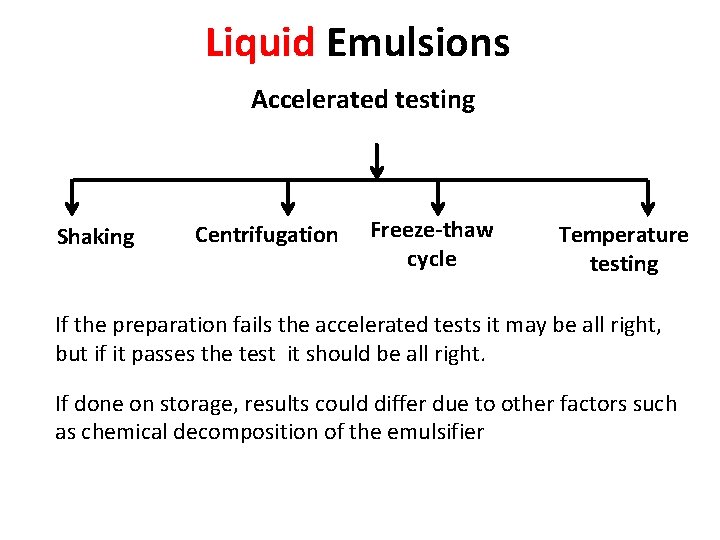
Liquid Emulsions Accelerated testing Shaking Centrifugation Freeze-thaw cycle Temperature testing If the preparation fails the accelerated tests it may be all right, but if it passes the test it should be all right. If done on storage, results could differ due to other factors such as chemical decomposition of the emulsifier
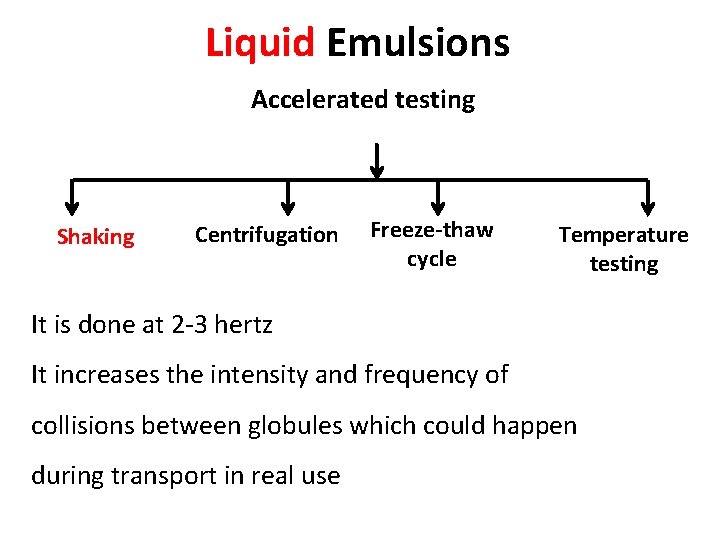
Liquid Emulsions Accelerated testing Shaking Centrifugation Freeze-thaw cycle Temperature testing It is done at 2 -3 hertz It increases the intensity and frequency of collisions between globules which could happen during transport in real use
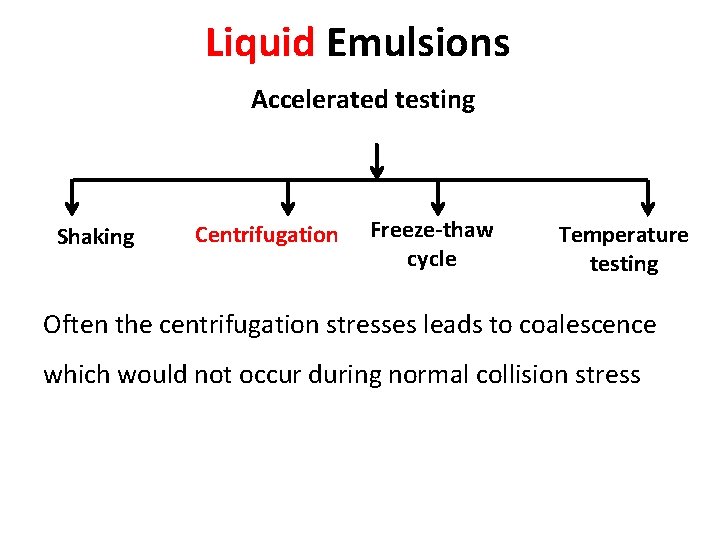
Liquid Emulsions Accelerated testing Shaking Centrifugation Freeze-thaw cycle Temperature testing Often the centrifugation stresses leads to coalescence which would not occur during normal collision stress
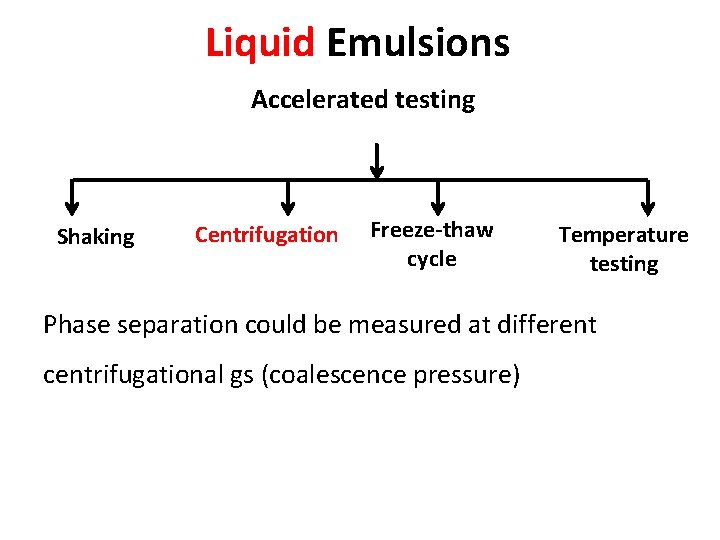
Liquid Emulsions Accelerated testing Shaking Centrifugation Freeze-thaw cycle Temperature testing Phase separation could be measured at different centrifugational gs (coalescence pressure)
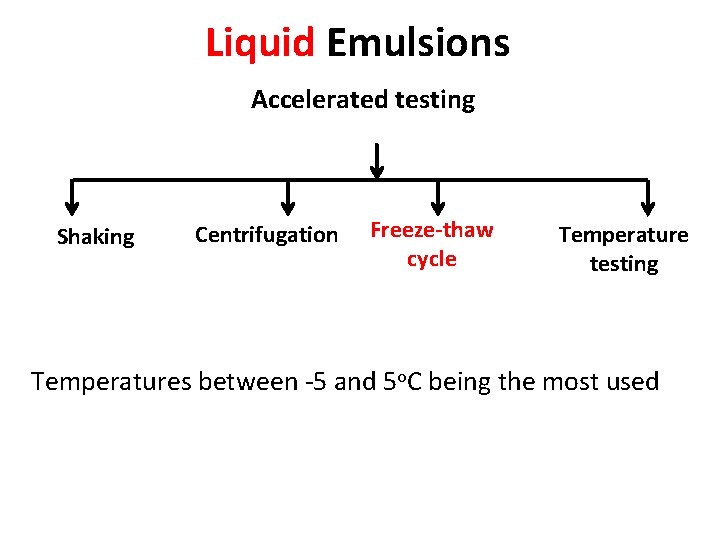
Liquid Emulsions Accelerated testing Shaking Centrifugation Freeze-thaw cycle Temperature testing Temperatures between -5 and 5 o. C being the most used
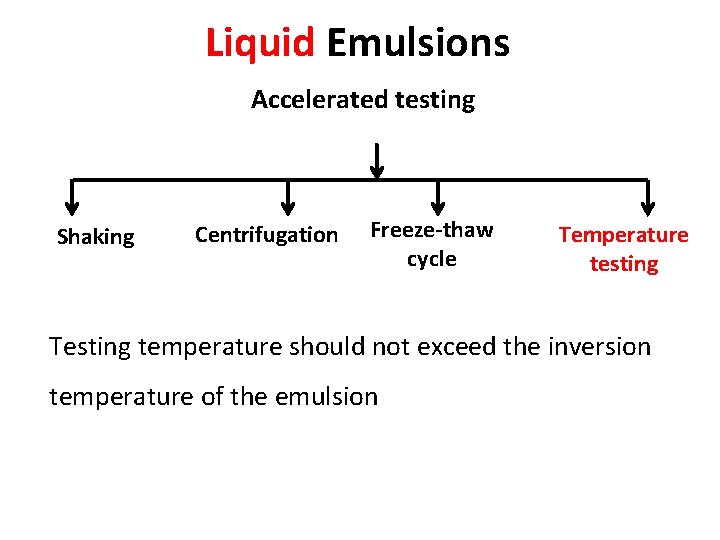
Liquid Emulsions Accelerated testing Shaking Centrifugation Freeze-thaw cycle Temperature testing Testing temperature should not exceed the inversion temperature of the emulsion
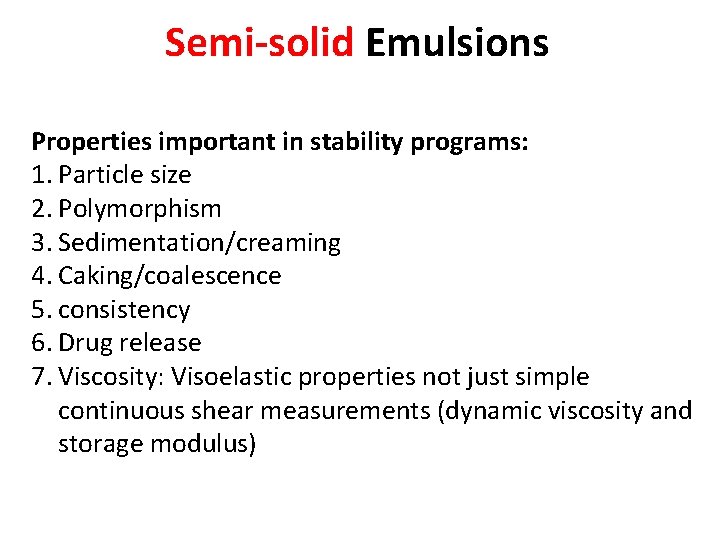
Semi-solid Emulsions Properties important in stability programs: 1. Particle size 2. Polymorphism 3. Sedimentation/creaming 4. Caking/coalescence 5. consistency 6. Drug release 7. Viscosity: Visoelastic properties not just simple continuous shear measurements (dynamic viscosity and storage modulus)
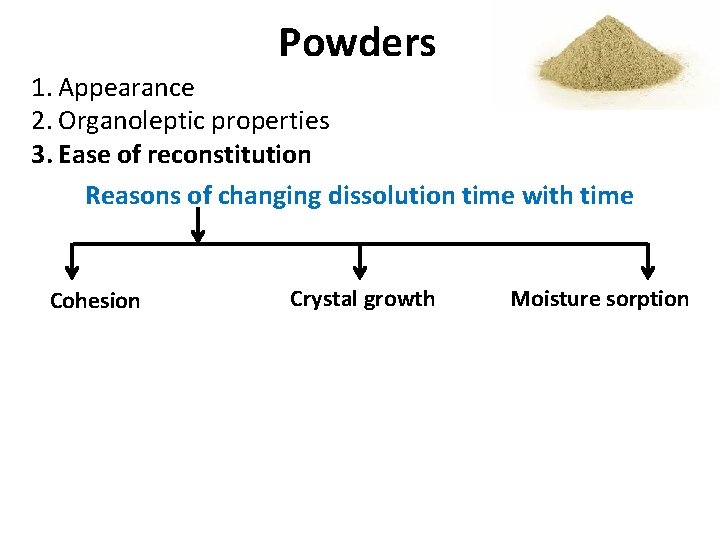
Powders 1. Appearance 2. Organoleptic properties 3. Ease of reconstitution Reasons of changing dissolution time with time Cohesion Crystal growth Moisture sorption
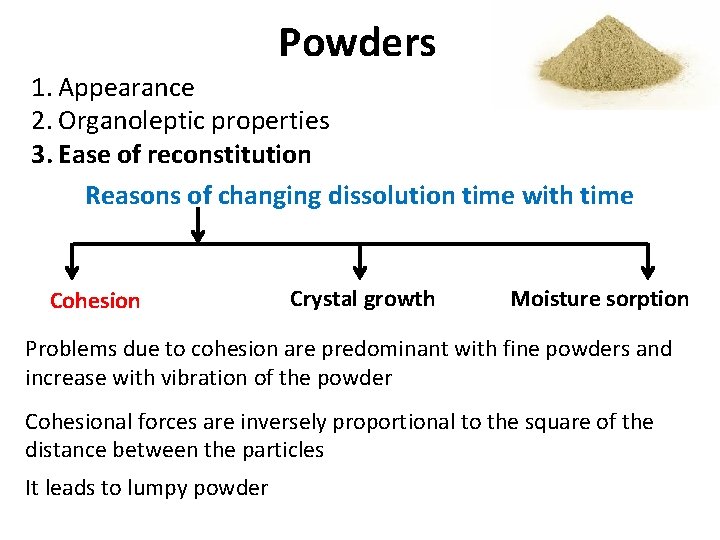
Powders 1. Appearance 2. Organoleptic properties 3. Ease of reconstitution Reasons of changing dissolution time with time Cohesion Crystal growth Moisture sorption Problems due to cohesion are predominant with fine powders and increase with vibration of the powder Cohesional forces are inversely proportional to the square of the distance between the particles It leads to lumpy powder
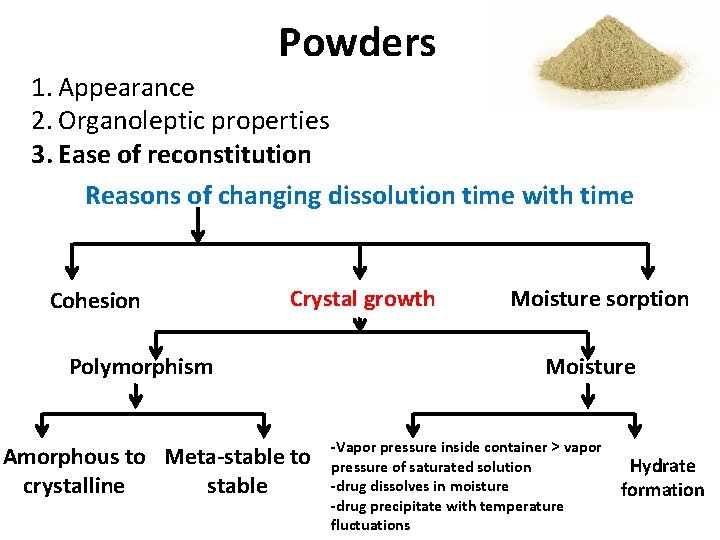
Powders 1. Appearance 2. Organoleptic properties 3. Ease of reconstitution Reasons of changing dissolution time with time Cohesion Crystal growth Polymorphism Amorphous to Meta-stable to crystalline stable Moisture sorption Moisture -Vapor pressure inside container > vapor pressure of saturated solution -drug dissolves in moisture -drug precipitate with temperature fluctuations Hydrate formation
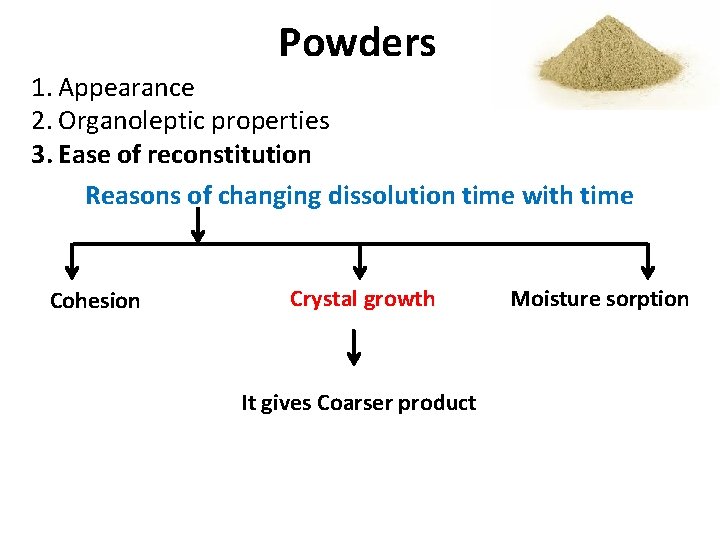
Powders 1. Appearance 2. Organoleptic properties 3. Ease of reconstitution Reasons of changing dissolution time with time Cohesion Crystal growth It gives Coarser product Moisture sorption
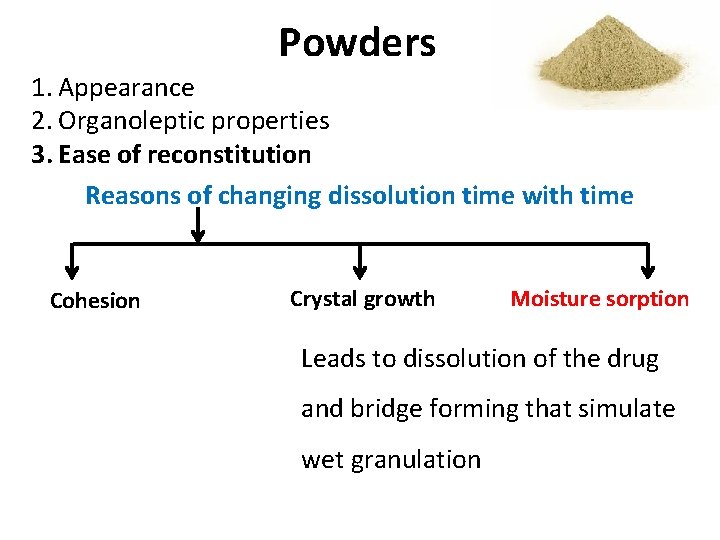
Powders 1. Appearance 2. Organoleptic properties 3. Ease of reconstitution Reasons of changing dissolution time with time Cohesion Crystal growth Moisture sorption Leads to dissolution of the drug and bridge forming that simulate wet granulation
Powders How to test ease of reconstitution The test is subjective & done by a tester who records the length of time required for reconstitution. Measures to minimize bias in evaluation Screening of operators for reconstitution testing in a blind manner
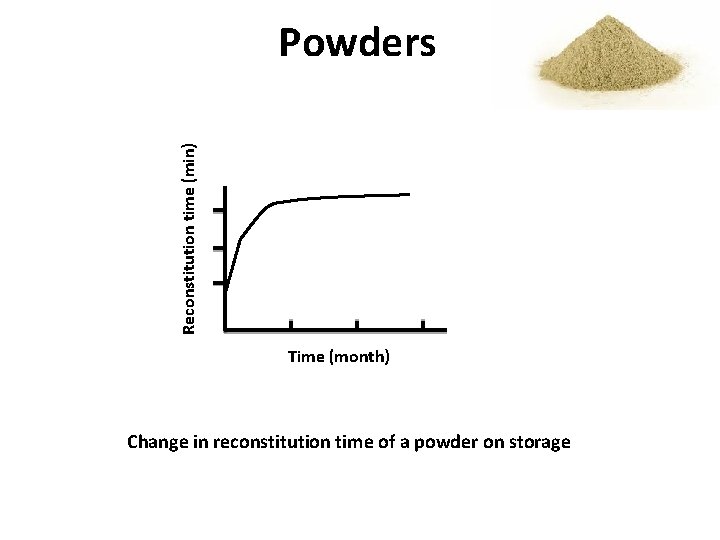
Reconstitution time (min) Powders Time (month) Change in reconstitution time of a powder on storage
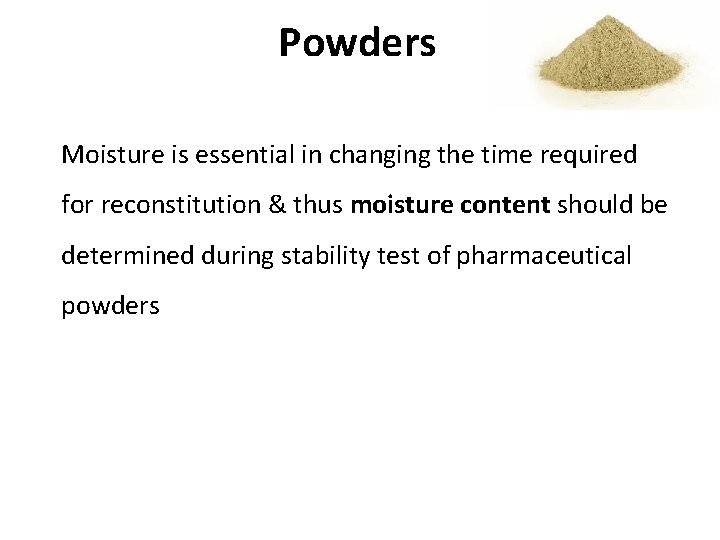
Powders Moisture is essential in changing the time required for reconstitution & thus moisture content should be determined during stability test of pharmaceutical powders
Aerosols are solutions, primary emulsions or suspensions of active principle in chlorinated hydrocarbons contained in a pressure can Physical instabilities of aerosols can lead to changes in: 1. Total drug delivered per dose 2. Total number of doses that may be obtained from the container 3. Delivery to their target in body
Aerosols Testing: 1. Unit spray content 2. Color and odor 3. Rate of leakage 4. Moisture and trace catalytical substances 5. Particle size distribution 6. Spray characteristics 7. p. H 8. Delivery rate 9. Microbial limit tests 10. Container compatibility