
v CECPD Initial type testing ITT To determine












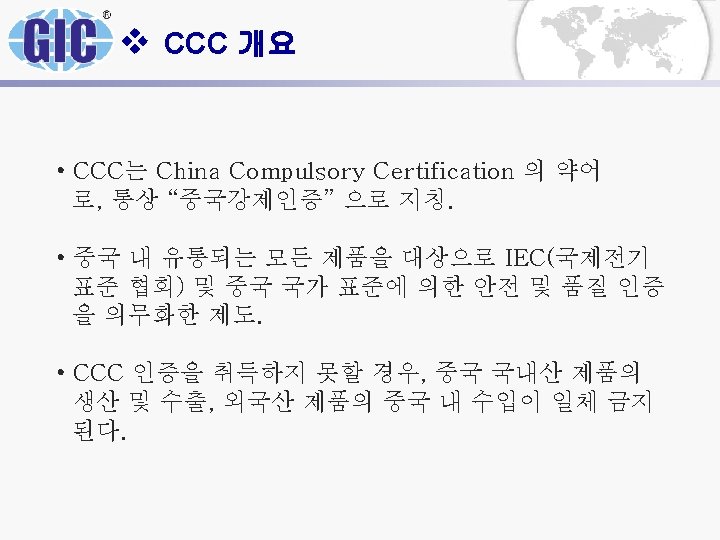
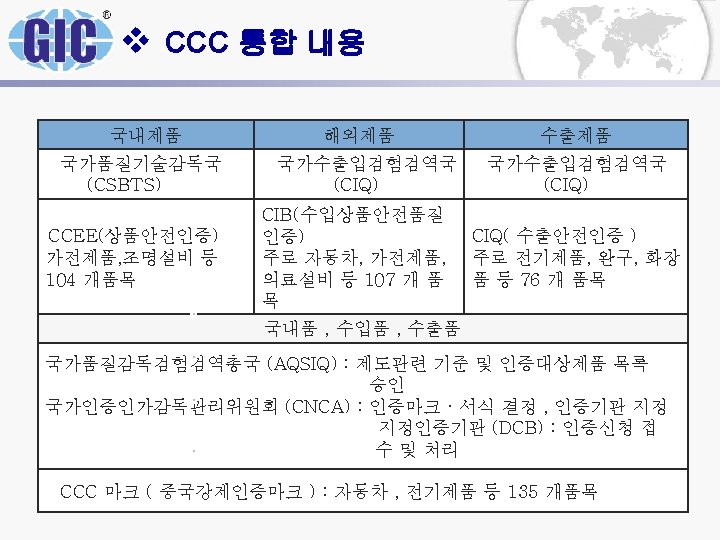
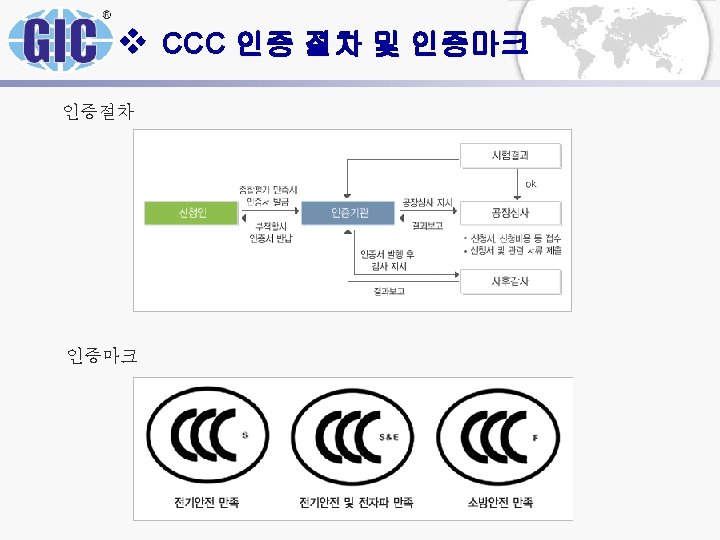
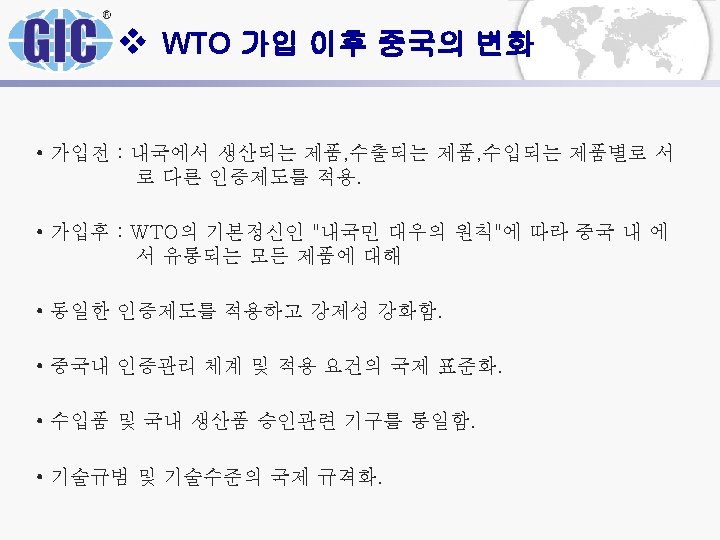

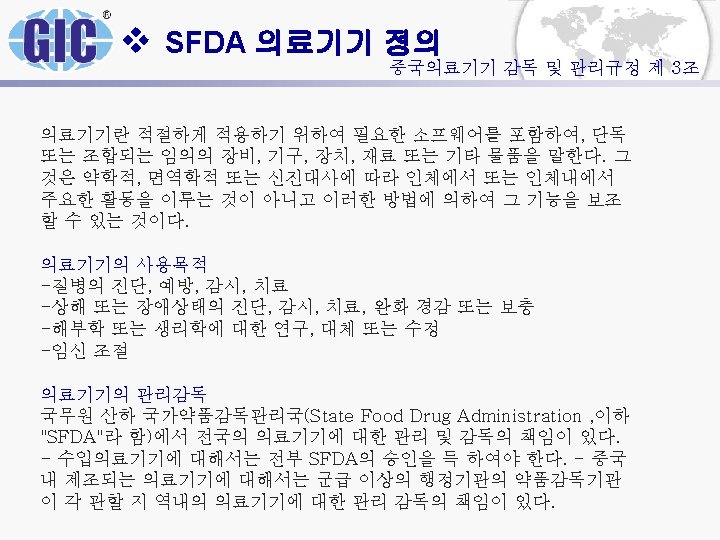
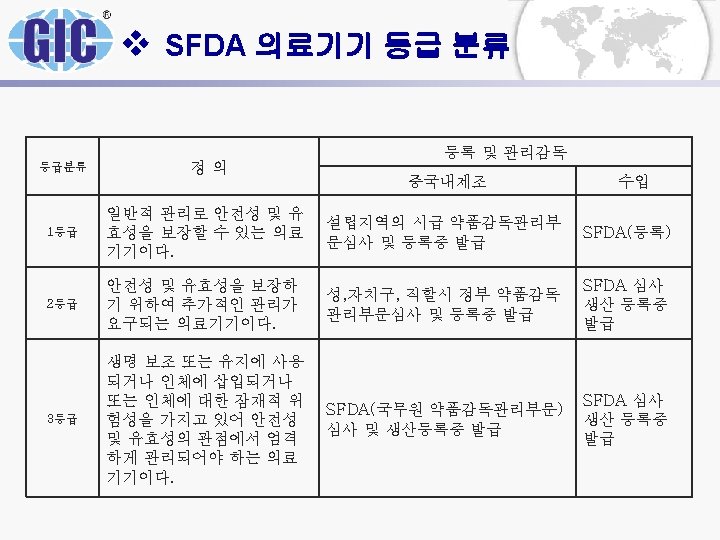
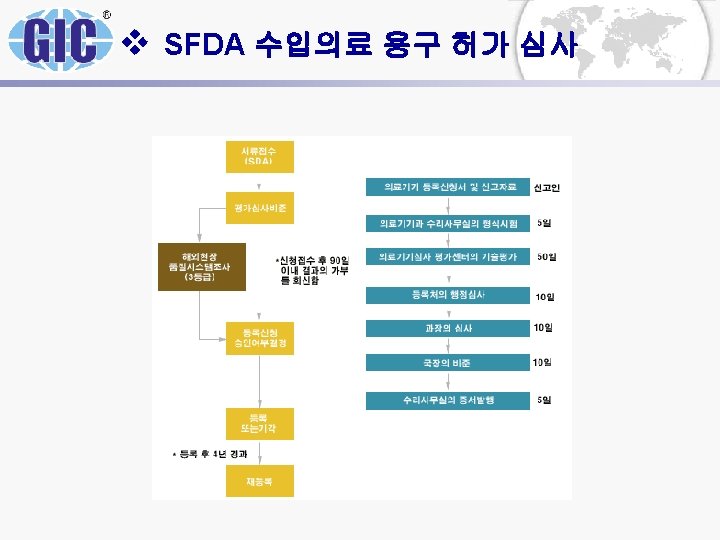
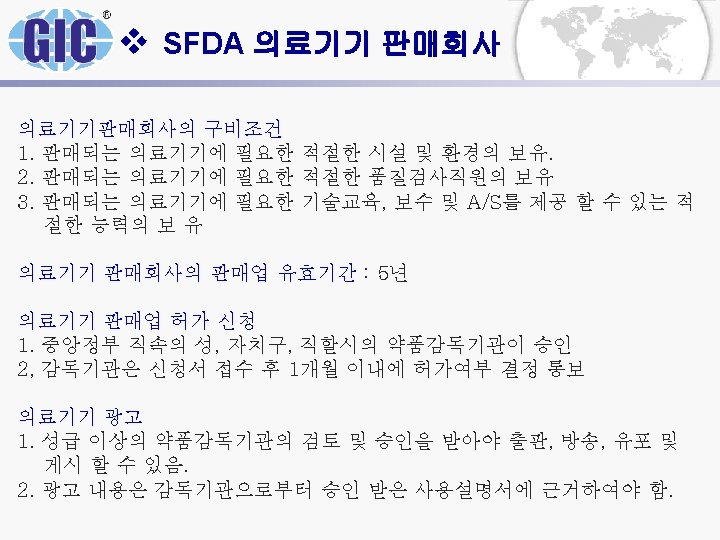




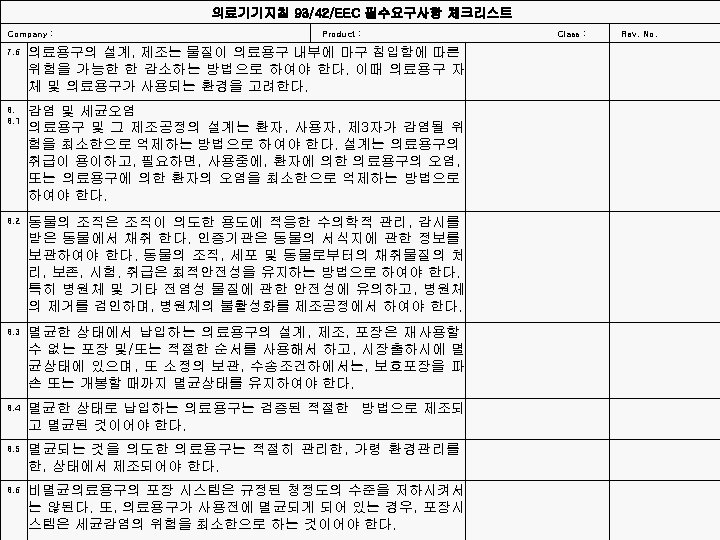
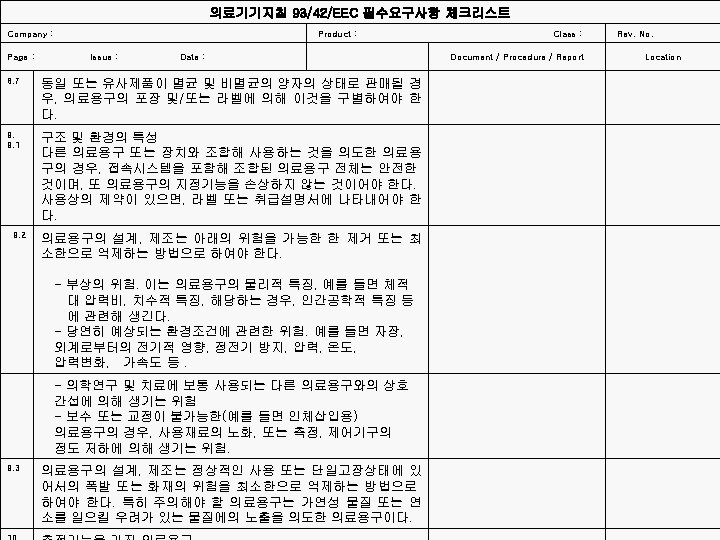
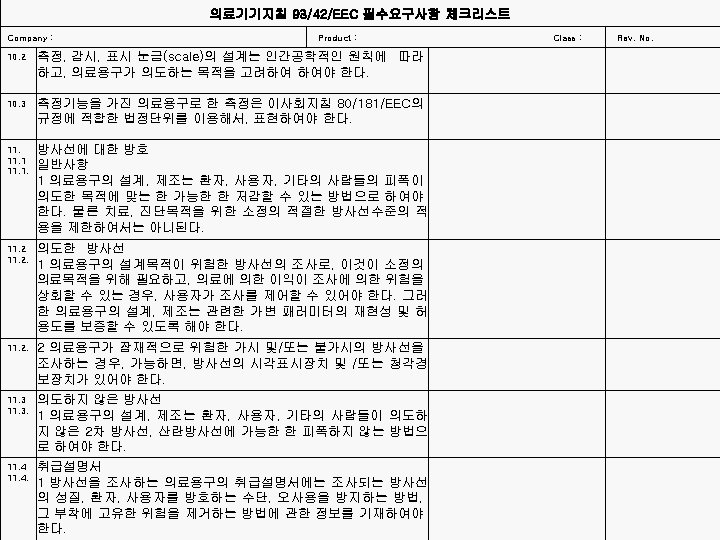
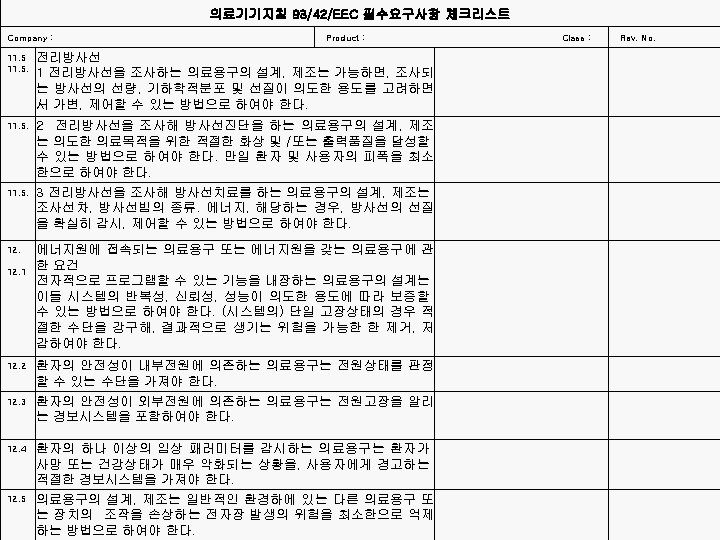

- Slides: 152
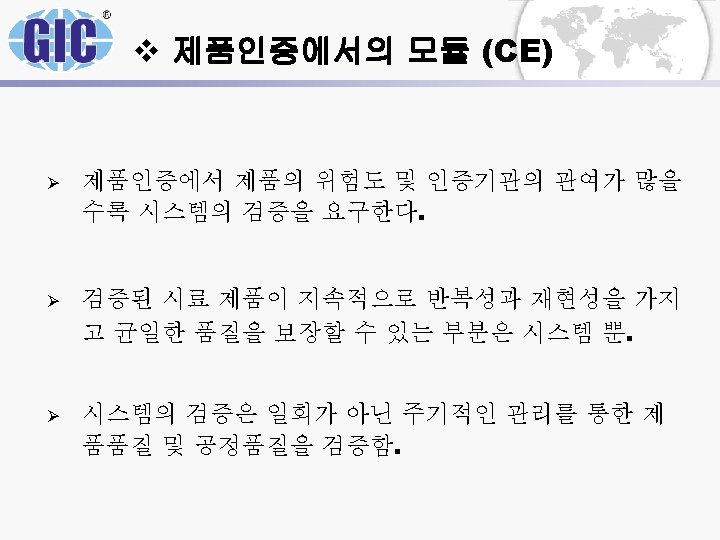
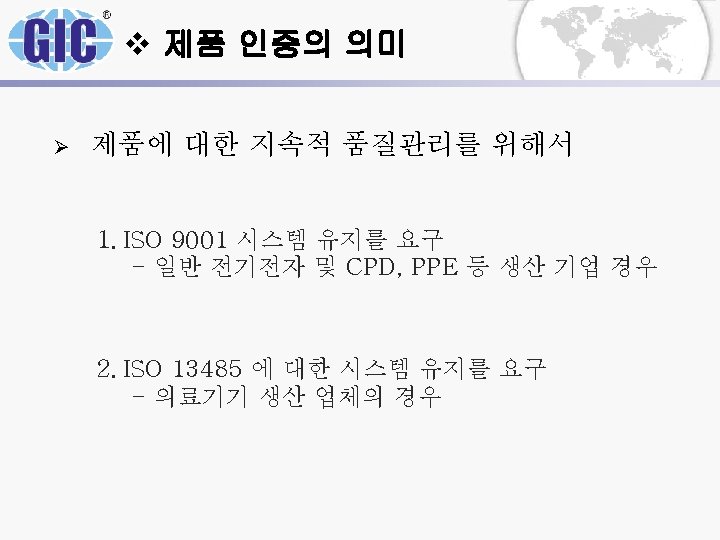
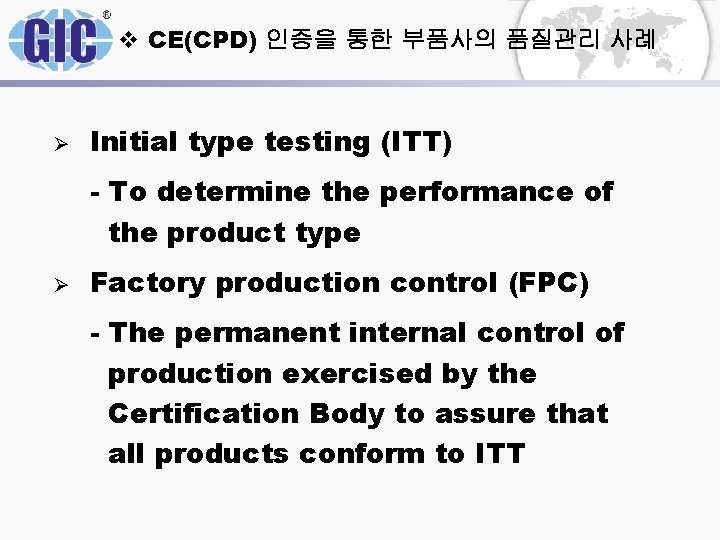
v CE(CPD) 인증을 통한 부품사의 품질관리 사례 Ø Initial type testing (ITT) - To determine the performance of the product type Ø Factory production control (FPC) - The permanent internal control of production exercised by the Certification Body to assure that all products conform to ITT
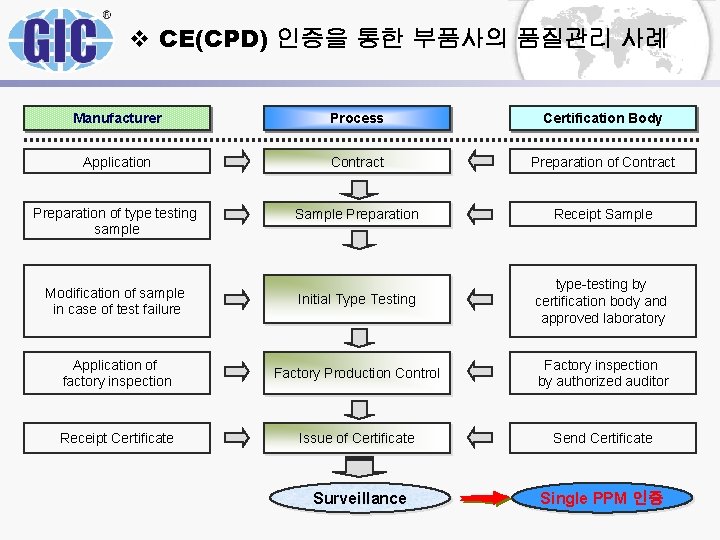
v CE(CPD) 인증을 통한 부품사의 품질관리 사례 Manufacturer Process Certification Body Application Contract Preparation of type testing sample Sample Preparation Receipt Sample Modification of sample in case of test failure Initial Type Testing type-testing by certification body and approved laboratory Application of factory inspection Factory Production Control Factory inspection by authorized auditor Receipt Certificate Issue of Certificate Send Certificate Surveillance Single PPM 인증
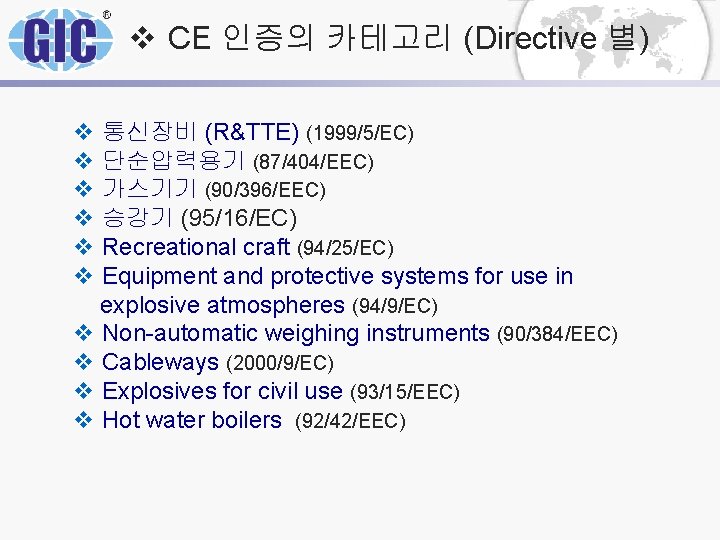
v CE 인증의 카테고리 (Directive 별) v 통신장비 (R&TTE) (1999/5/EC) v 단순압력용기 (87/404/EEC) v 가스기기 (90/396/EEC) v 승강기 (95/16/EC) v Recreational craft (94/25/EC) v Equipment and protective systems for use in explosive atmospheres (94/9/EC) v Non-automatic weighing instruments (90/384/EEC) v Cableways (2000/9/EC) v Explosives for civil use (93/15/EEC) v Hot water boilers (92/42/EEC)
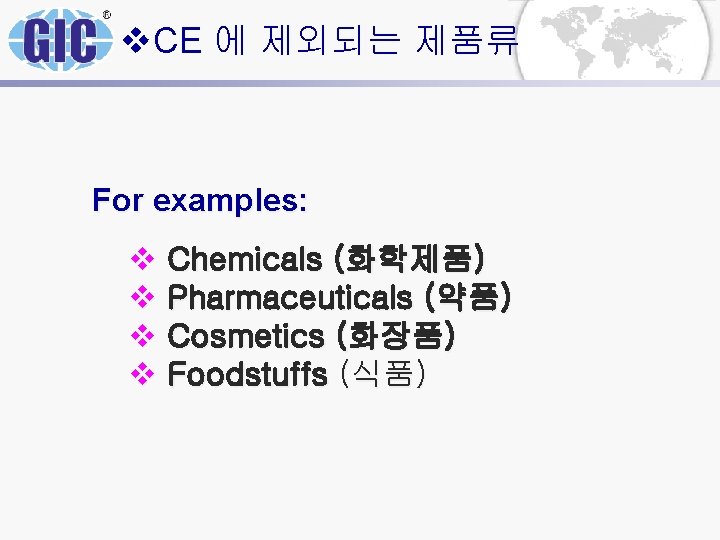
v. CE 에 제외되는 제품류 For examples: v Chemicals (화학제품) v Pharmaceuticals (약품) v Cosmetics (화장품) v Foodstuffs (식품)
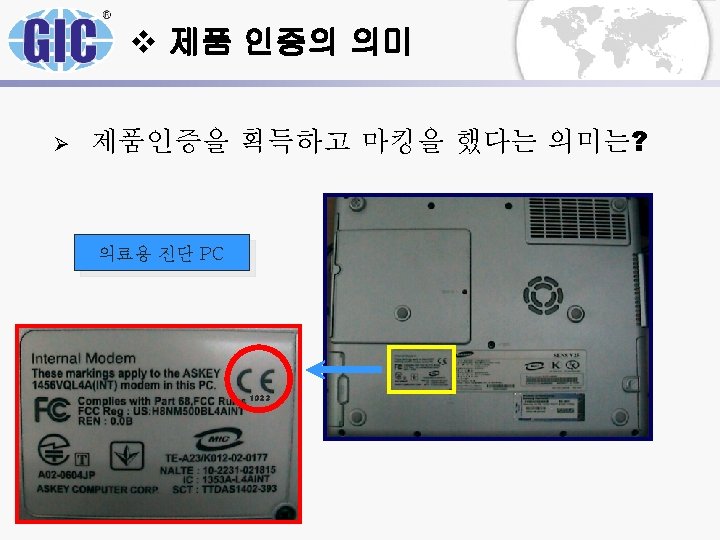
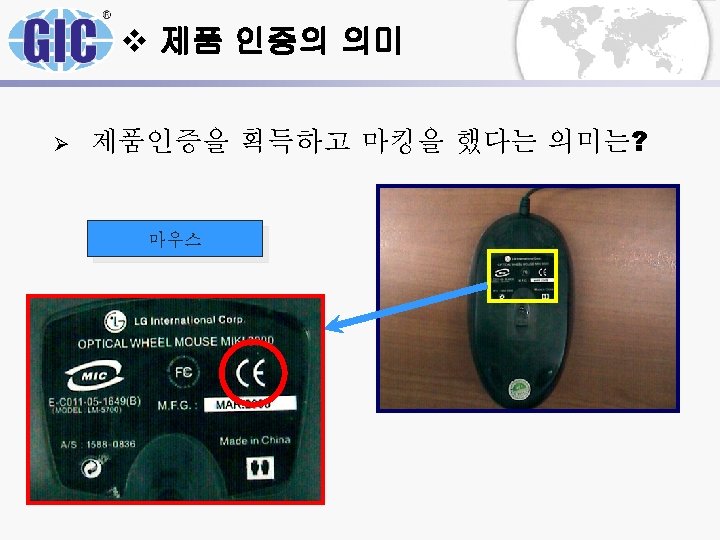
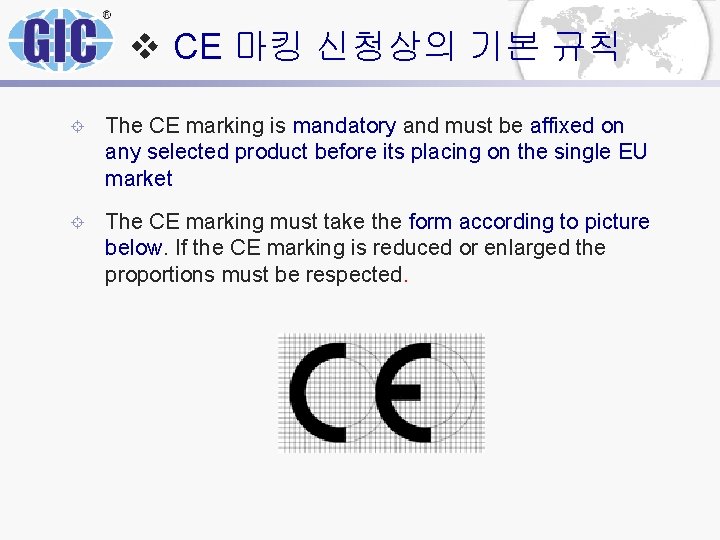
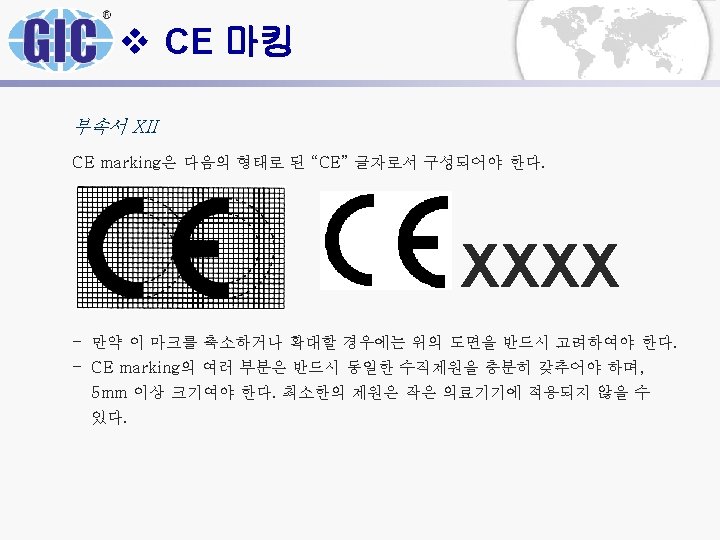
v CE 마킹 신청상의 기본 규칙 ± The CE marking is mandatory and must be affixed on any selected product before its placing on the single EU market ± The CE marking must take the form according to picture below. If the CE marking is reduced or enlarged the proportions must be respected.
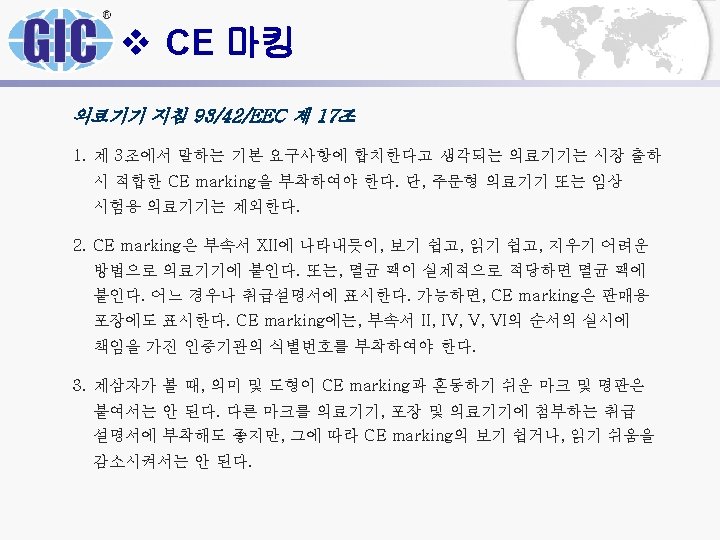
v CE 마킹 신청상의 기본 규칙 ± The CE marking must be affixed visibly, legibly and indelibly to the product or to its data label. A minimum height of the CE marking is required 5 mm. ± If according to the applicable directives is involved Notified Body participation in the production control phase, must affix its identification number near CE marking.
v 유럽연합시장의 조사 ± The main goal of the New Approach directives is to assure that products which freely circulate in the EU market have a proper level of safety. ± Principle responsibility of manufacturers in the field conformance with requirements of applied directives. ± Market surveillance is a necessary element to correctly implement the above mentioned principles. ± Rules of the market surveillance are particular in individual EU member states.
v 유럽연합시장의 조사 ± The member state must provide by means of National authorities the necessary legal and administrative implement to assure the compliance of the products on the market with the directives. ± National authorities are responsible for ensuring the implementation of a proper market surveillance mechanism. ± For communication between National authorities has been installed database RAPEX - a rapid exchange of information about dangers consumer products.
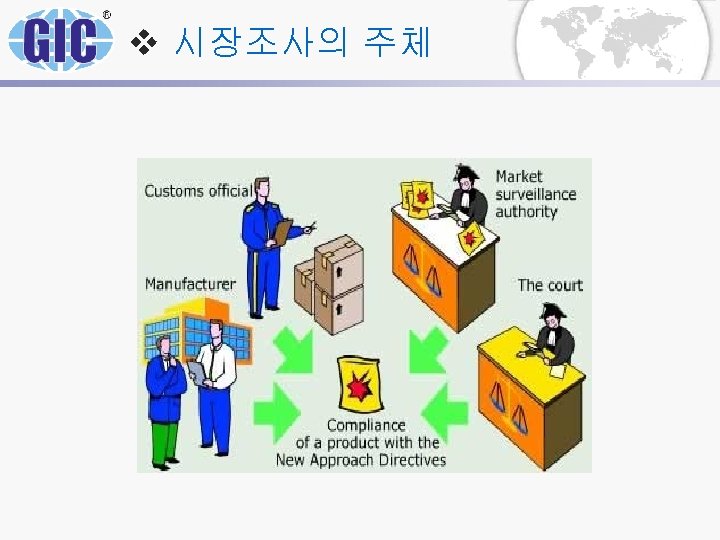
v 시장조사의 주체 Actors for checking of product compliance with the New Approach directives: ± ± The manufacturer checks product before its launching (placing) on the market The customs official checks products at the origin import from outside the EU The market surveillance authority checks products during its live in the market The court, checks products when an incident occurs
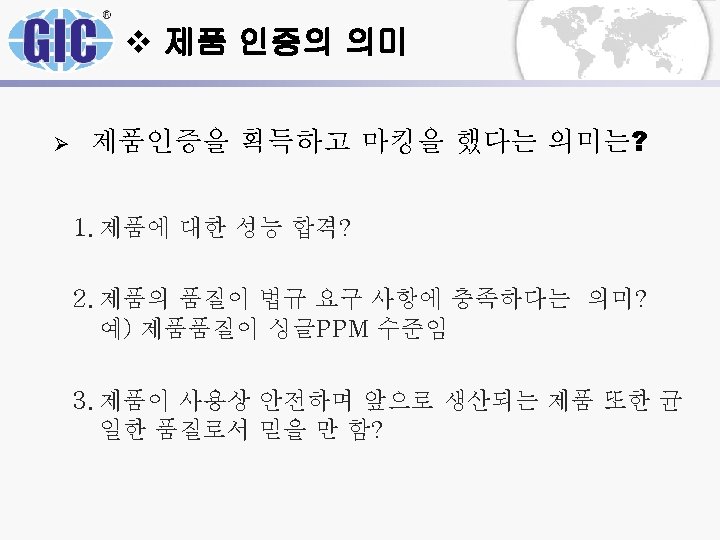
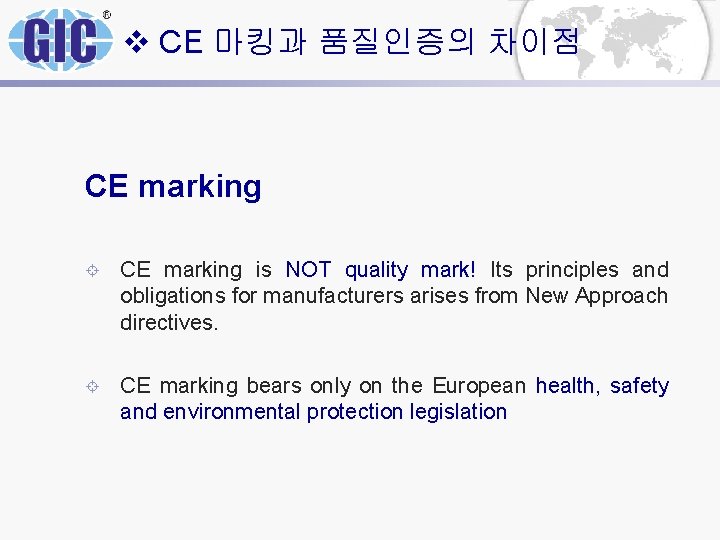
v CE 마킹과 품질인증의 차이점 CE marking ± CE marking is NOT quality mark! Its principles and obligations for manufacturers arises from New Approach directives. ± CE marking bears only on the European health, safety and environmental protection legislation
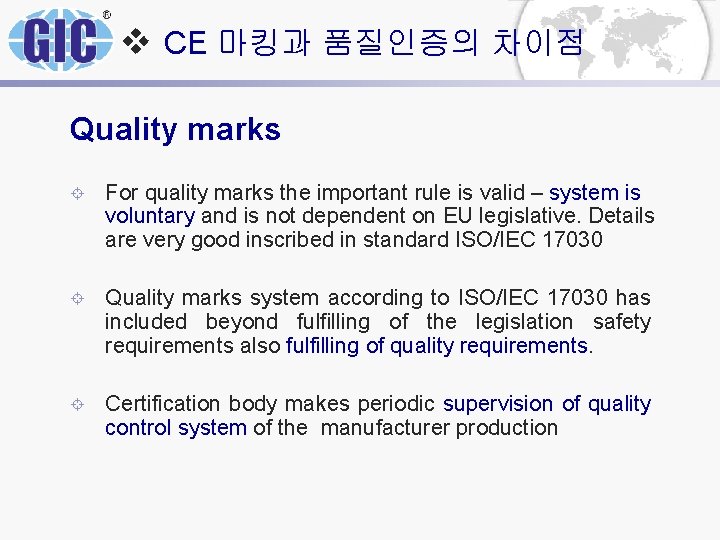
v CE 마킹과 품질인증의 차이점 Quality marks ± For quality marks the important rule is valid – system is voluntary and is not dependent on EU legislative. Details are very good inscribed in standard ISO/IEC 17030 ± Quality marks system according to ISO/IEC 17030 has included beyond fulfilling of the legislation safety requirements also fulfilling of quality requirements. ± Certification body makes periodic supervision of quality control system of the manufacturer production
3. New and Global Approach to technical harmonization The main objects and bodies involved into products’ conformity assessment in EU
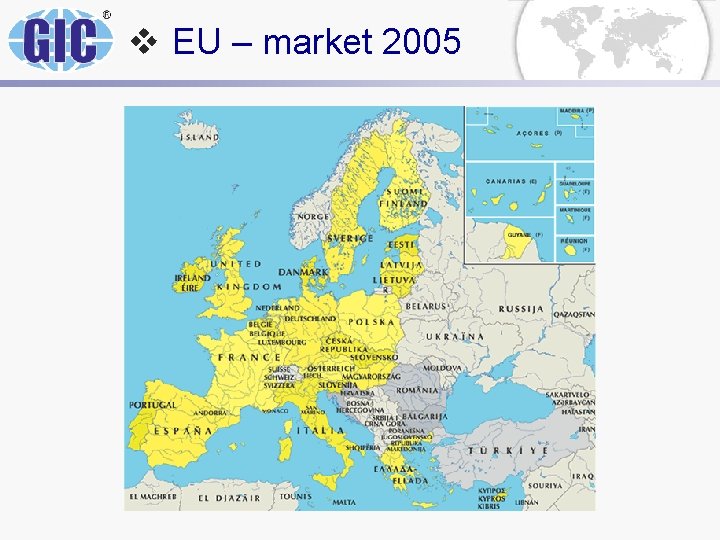
v EU – market 2005
v Harmonised sphere ± Products that are harmonised at Community level (30 % goods in EU): a) there are common EU technical rules (Old and New Approach Directives) b) selected products must have the CE mark affixed
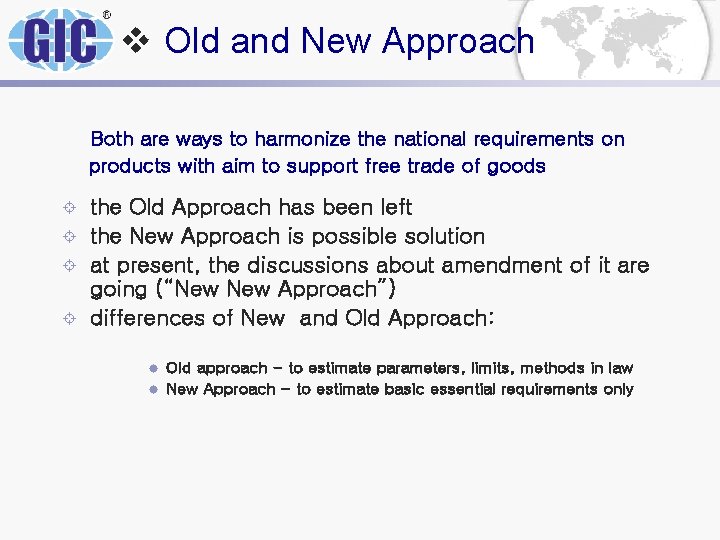
v Old and New Approach Both are ways to harmonize the national requirements on products with aim to support free trade of goods ± ± the Old Approach has been left the New Approach is possible solution at present, the discussions about amendment of it are going (“New Approach”) differences of New and Old Approach: Old approach - to estimate parameters, limits, methods in law ® New Approach - to estimate basic essential requirements only ®
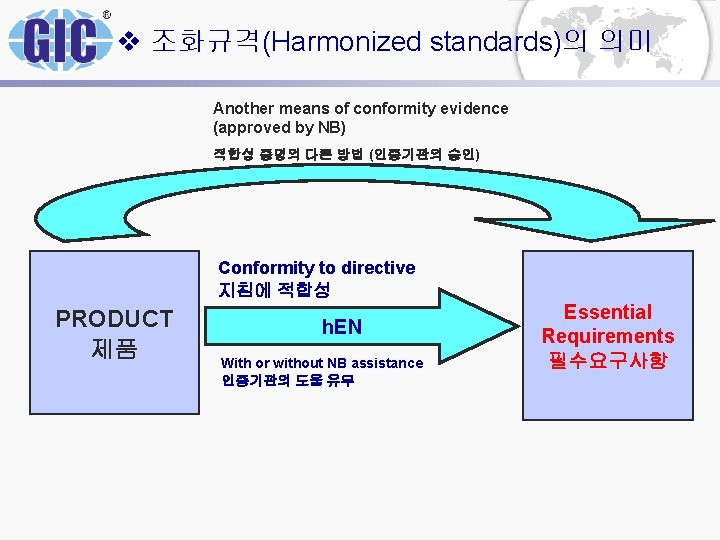
v 조화규격(Harmonized standards)의 의미 Another means of conformity evidence (approved by NB) 적합성 증명의 다른 방법 (인증기관의 승인) Conformity to directive 지침에 적합성 PRODUCT 제품 h. EN With or without NB assistance 인증기관의 도움 유무 Essential Requirements 필수요구사항
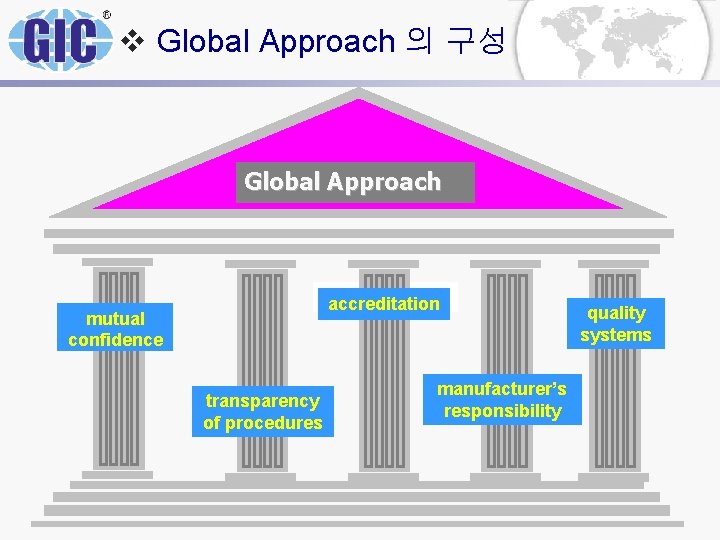
v Global Approach 의 구성 GLOBÁLNÍ PŘÍSTUP Global Approach accreditation mutual confidence transparency of procedures manufacturer’s responsibility quality systems
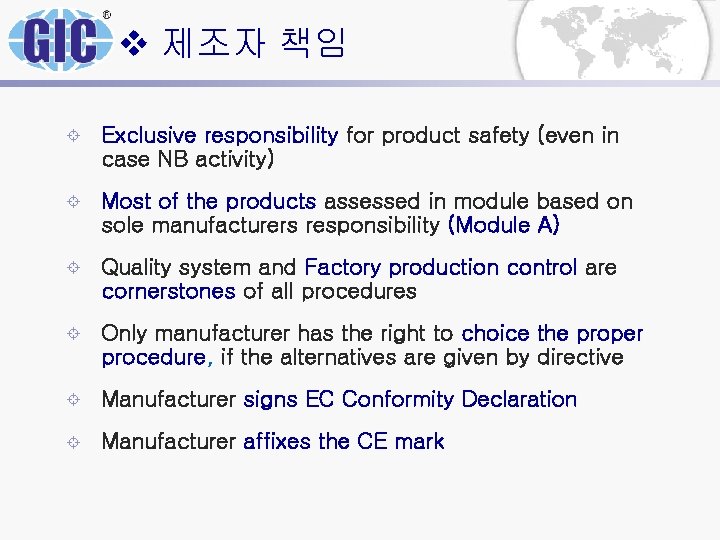
v 제조자 책임 ± Exclusive responsibility for product safety (even in case NB activity) ± Most of the products assessed in module based on sole manufacturers responsibility (Module A) ± Quality system and Factory production control are cornerstones of all procedures ± Only manufacturer has the right to choice the proper procedure, if the alternatives are given by directive ± Manufacturer signs EC Conformity Declaration ± Manufacturer affixes the CE mark
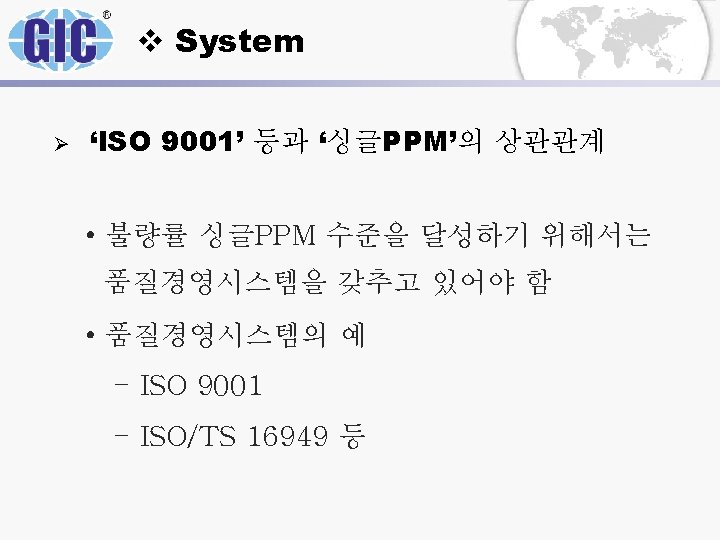
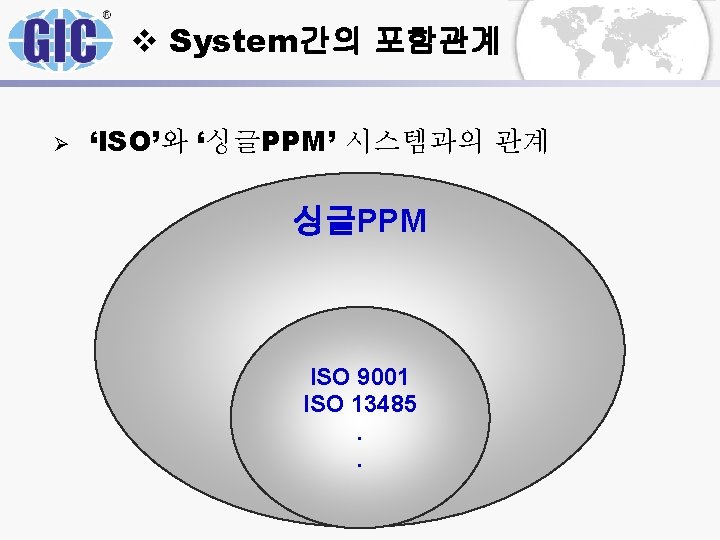
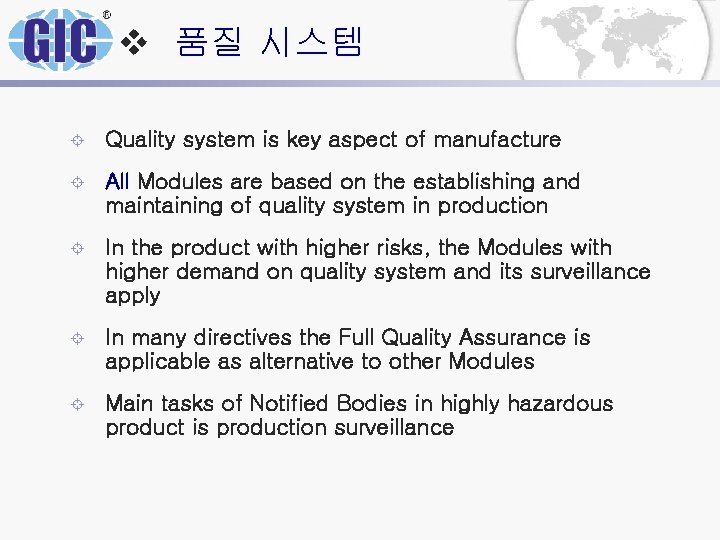
v 품질 시스템 ± Quality system is key aspect of manufacture ± All Modules are based on the establishing and maintaining of quality system in production ± In the product with higher risks, the Modules with higher demand on quality system and its surveillance apply ± In many directives the Full Quality Assurance is applicable as alternative to other Modules ± Main tasks of Notified Bodies in highly hazardous product is production surveillance
4. 적합성 평가모듈 Variety of conformity assessment procedures
v 모듈 시스템의 개요 n modules for the various phases of the conformity assessment procedures which are intended to be used in the technical harmonization directives • Council Decision 90/683/EEC: n the rules for the affixing and use of the CE conformity marking
v 모듈 시스템의 기본원칙 ± Modular system is based on two principles of Conformity assessments ® on the intervention of a first party (manufacturer) OR ® on the intervention of a neutral (third) party (notified body)
v 관련 적합성평가 부분 the product design phase OR ± the product manufacturing phase OR ± both above mentioned phases at the same time ± Every module specifies the obligations of the manufacturer and, if applicable, of the notified body. An overview of the modules shows the necessary complimentarity between the two phases of conformity assessment in the design phase and in the manufacturing phase of the product.
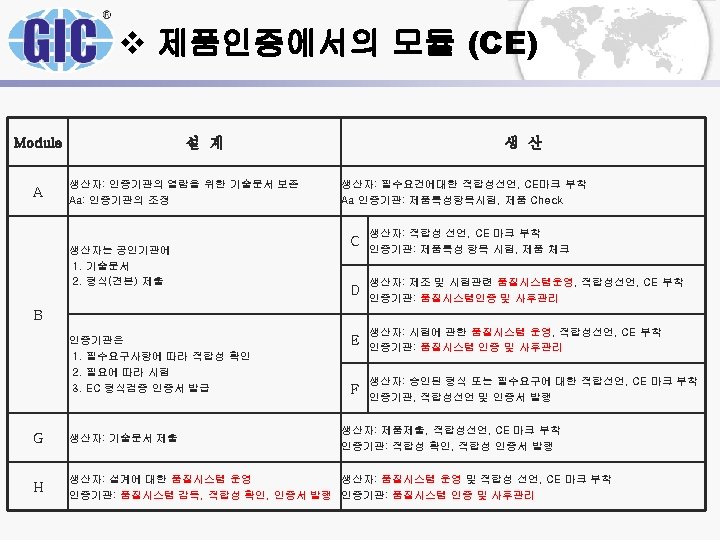
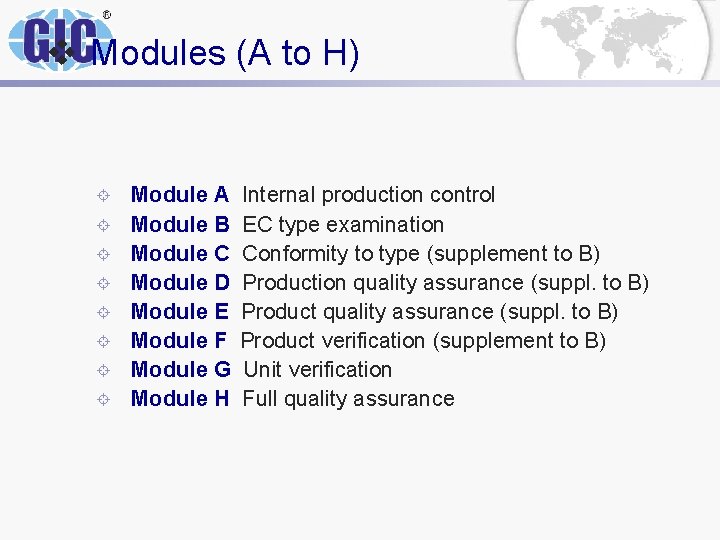
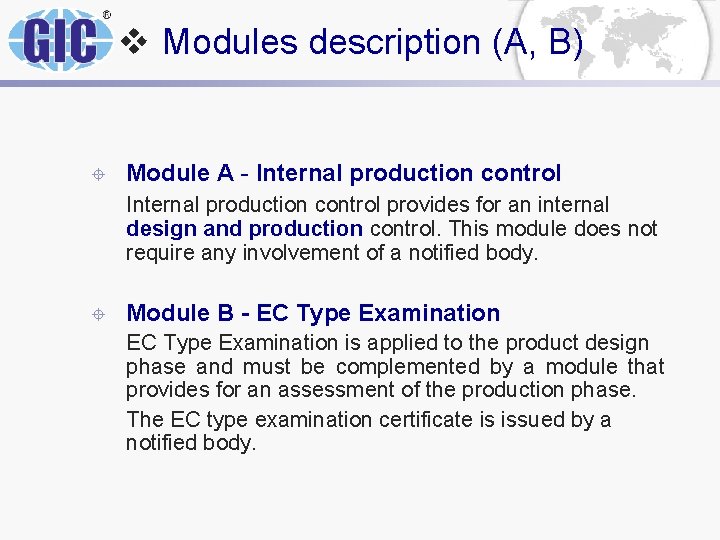
v Modules (A to H) ± ± ± ± Module A Internal production control Module B EC type examination Module C Conformity to type (supplement to B) Module D Production quality assurance (suppl. to B) Module E Product quality assurance (suppl. to B) Module F Product verification (supplement to B) Module G Unit verification Module H Full quality assurance
v Modules description (A, B) ± Module A - Internal production control provides for an internal design and production control. This module does not require any involvement of a notified body. ± Module B - EC Type Examination is applied to the product design phase and must be complemented by a module that provides for an assessment of the production phase. The EC type examination certificate is issued by a notified body.
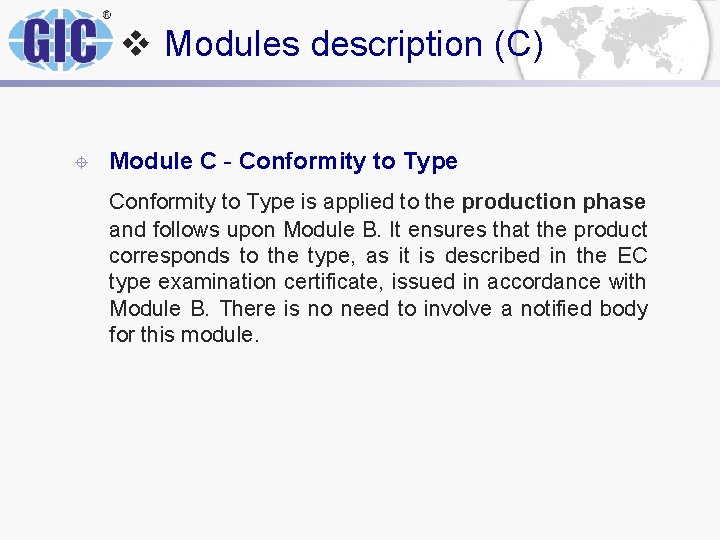
v Modules description (C) ± Module C - Conformity to Type is applied to the production phase and follows upon Module B. It ensures that the product corresponds to the type, as it is described in the EC type examination certificate, issued in accordance with Module B. There is no need to involve a notified body for this module.
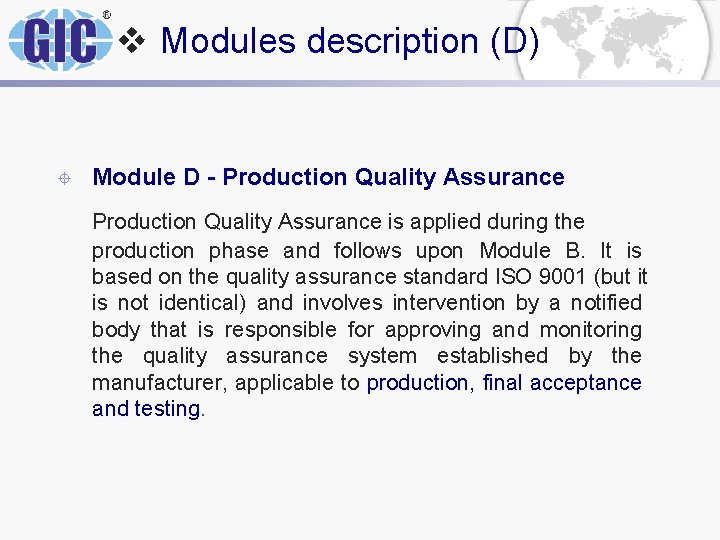
v Modules description (D) ± Module D - Production Quality Assurance is applied during the production phase and follows upon Module B. It is based on the quality assurance standard ISO 9001 (but it is not identical) and involves intervention by a notified body that is responsible for approving and monitoring the quality assurance system established by the manufacturer, applicable to production, final acceptance and testing.
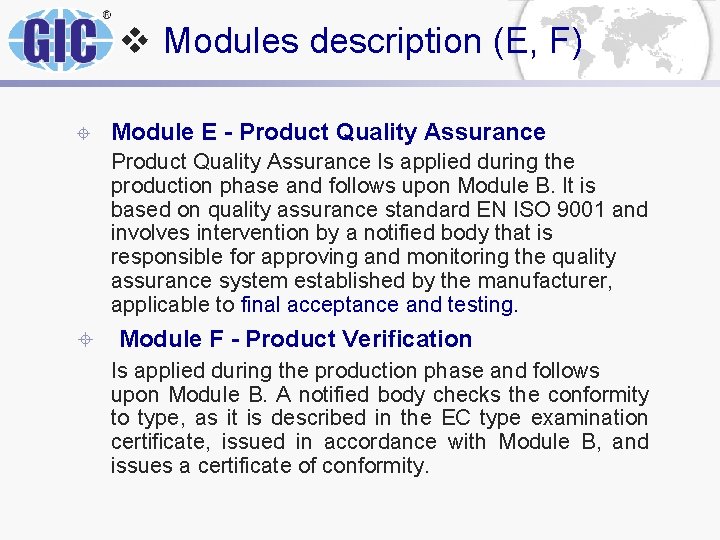
v Modules description (E, F) ± Module E - Product Quality Assurance Is applied during the production phase and follows upon Module B. It is based on quality assurance standard EN ISO 9001 and involves intervention by a notified body that is responsible for approving and monitoring the quality assurance system established by the manufacturer, applicable to final acceptance and testing. ± Module F - Product Verification Is applied during the production phase and follows upon Module B. A notified body checks the conformity to type, as it is described in the EC type examination certificate, issued in accordance with Module B, and issues a certificate of conformity.
v Modules description (G, H) ± Module G - Unit Verification Is applied during the design and production phase. Every product is examined by a notified body, which issues a certificate of conformity. ± Module H - Full Quality Assurance Is applied during the design and production phase. It is based on quality assurance standard EN ISO 9001 and involves a notified body that is responsible for approving and monitoring the quality assurance system established by the manufacturer, applicable to design, production, final acceptance and testing. Note: The ISO 9001 Certificate is not satisfactory document for modules D, E, G, H.
v Introduction ± ± Non harmonized sphere creates approximately 70 % goods in EU. Non – harmonized sphere is very interesting area for development of different procedures with participation of the third - party Voluntary procedures in the EU states – inspection, certification, granting of the mark Mark affixed on the product gives to consumers information about added value of goods and focuses attention to its differences.
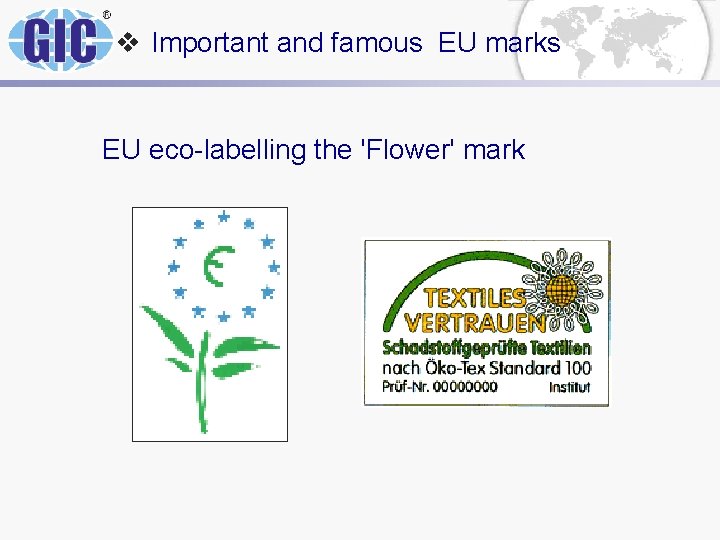
v Important and famous EU marks EU eco-labelling the 'Flower' mark
v EU eco-labelling 'Flower' mark ± Aim - to award a Community Eco-label to products and services with reduced environmental impacts. ± The scheme is VOLUNTARY. ± Criteria are established for individual product groups, (the total number of product categories covered by the scheme was in year 2004 about 30 )
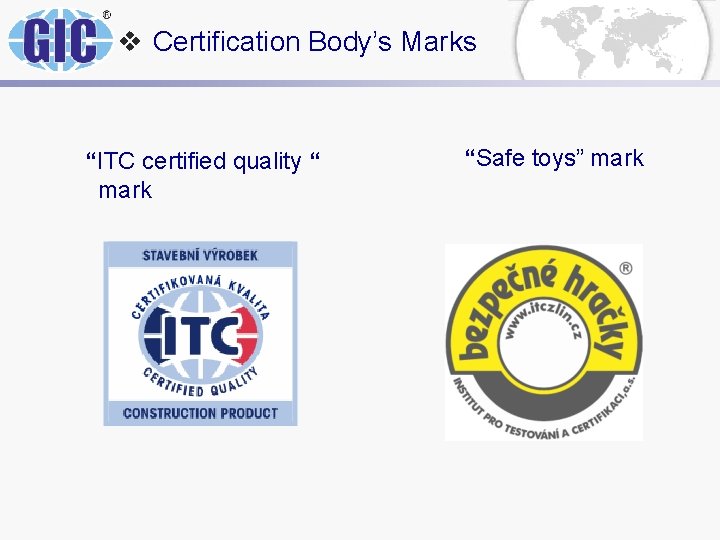
v Certification Body’s Marks “ITC certified quality “ mark “Safe toys” mark
v “Certification Body own quality” Mark ± ITC certified quality mark is applicable to affixing on product, documents and publication where indicates conformity with specific requirements. ± Rules are in the accordance with ISO/IEC 17030 (Conformity assessment – General requirements for third-party marks of conformity)
v Scope of LVD directive 73/23/EEC ± As regard to LVD directive, it relates to all electrical equipment designed for use with a voltage rating between 50 V and 1000 V of the alternating current (AC) or between 75 V and 1500 V of the direct current (DC). Therefore the battery operated electrical instruments are not covered by this directive in majority of cases. In addition, the following equipments are excluded from the force of LVD (as they are covered by other more specific directives taking also into account the electrical safety): ± ± ± ± for use in the explosive atmosphere for medical use for lifts electricity meters plugs and socket outlets for domestic use electric fences specialized equipment used in ships, aircrafts and railways (as they are subject of specific legislation) radio-electrical interference.
v 기타 CE 마킹 대상 제품들 ± Examples are the radio and TV sets powered from electricity distribution network, electromotors and any instruments driven by electromotors, transformers, electrical fuses, capacitors, resistors and another electrical parts, switches, dimmers, power supplies, battery chargers, household home appliances (like vacuum cleaners, washing machines, steam irons, dryers, hair dryers, electric cookers), lights, electrical hobby tools, industrial equipment powered by electricity and their driving and controlling units, computers, printers, measuring instruments, etc. For the LVD is typical, that obligation of conformity assessment relates both to parts (as semiconductor parts or capacitors) and to complete assembled product (as a TV set). It is necessary to prevent confusion by CE marking of parts and products.
v 전자파 지침의 범위 ± EMC directive relates to any electrical and electronic equipment (including electronic components), liable to cause electromagnetic disturbances (sources of disturbance) or performance of which is liable to be affected by such disturbance (products sensitive to disturbance or electromagnetic interference). As no voltage limit is applied; the battery operated equipments are also objects of the EMC directive. Excluded is military equipment. Practically each common electric and/or electronic appliance (including individual electronic components) shall be evaluated from viewpoint of EMC. In addition to this, the products powered by voltage higher than 50 V (AC) / 75 V (DC) shall be assessed for compliance to LVD (electrical safety).
v 개인용 보호장구지침의 적합성 평가 ± PPE is defined as ‘‘any device or appliance designed to be worn or held for protection against one or more safety and health hazards’’. ± Directive does not differentiate between PPE used for work activities and for leisure. All protective equipment is required to comply, whether it is intended for use at work or in the home, even at sporting activities. ± Responsibility for deciding if a product is PPE or not rests with the manufacturer (or his authorized representative).
v Simple PPE – Category I Article 8. 3 of the Directive defines the ‘PPE of simple design‘ exclusively as the PPE intended to protect the wearer against: ± mechanical action whose effects are superficial (gardening gloves, thimbles etc. ); cleaning materials of weak action and easily reversible effects (gloves affording protection against diluted detergents, aprons etc. ); ± risks encountered in the handling of hot components which do not expose the user to a temperature exceeding 50 degrees C, or to dangerous impacts (gloves, aprons for professional use etc. ); ± atmospheric agents of a neither exceptional nor extreme nature (headgear, seasonal clothing, footwear etc. ); ± ± minor impacts and vibrations etc. which do not affect vital areas of the body and whose effects cannot cause irreversible lesions (light anti-scalping helmets, gloves, light footwear etc. ); sunlight (sunglasses).
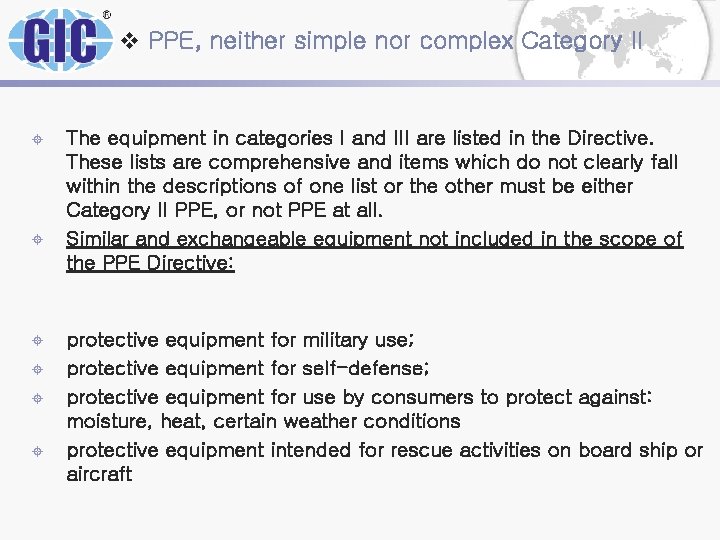
v PPE, neither simple nor complex Category II ± ± ± The equipment in categories I and III are listed in the Directive. These lists are comprehensive and items which do not clearly fall within the descriptions of one list or the other must be either Category II PPE, or not PPE at all. Similar and exchangeable equipment not included in the scope of the PPE Directive: protective equipment for military use; protective equipment for self-defense; protective equipment for use by consumers to protect against: moisture, heat, certain weather conditions protective equipment intended for rescue activities on board ship or aircraft
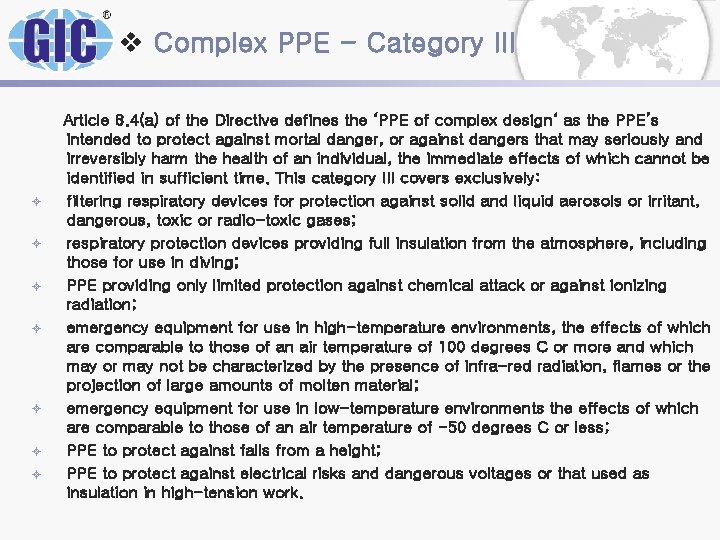
v Complex PPE - Category III ± ± ± ± Article 8. 4(a) of the Directive defines the ‘PPE of complex design‘ as the PPE’s intended to protect against mortal danger, or against dangers that may seriously and irreversibly harm the health of an individual, the immediate effects of which cannot be identified in sufficient time. This category III covers exclusively: filtering respiratory devices for protection against solid and liquid aerosols or irritant, dangerous, toxic or radio-toxic gases; respiratory protection devices providing full insulation from the atmosphere, including those for use in diving; PPE providing only limited protection against chemical attack or against ionizing radiation; emergency equipment for use in high-temperature environments, the effects of which are comparable to those of an air temperature of 100 degrees C or more and which may or may not be characterized by the presence of infra-red radiation, flames or the projection of large amounts of molten material; emergency equipment for use in low-temperature environments the effects of which are comparable to those of an air temperature of -50 degrees C or less; PPE to protect against falls from a height; PPE to protect against electrical risks and dangerous voltages or that used as insulation in high-tension work.
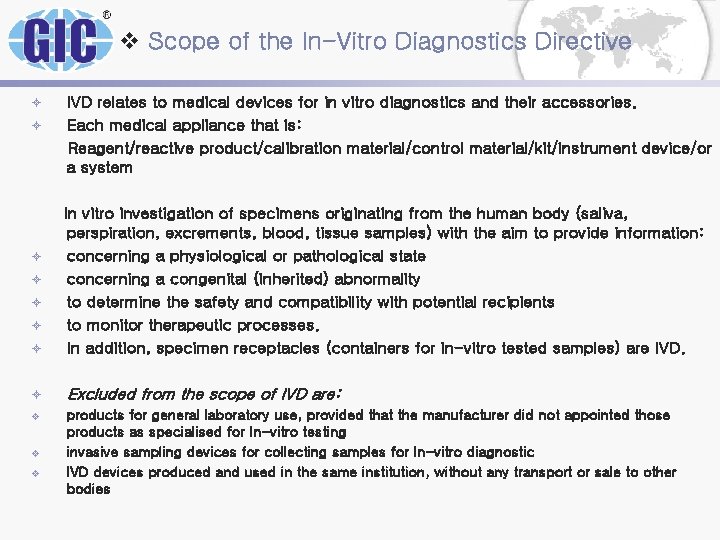
v Scope of the In-Vitro Diagnostics Directive ± ± IVD relates to medical devices for in vitro diagnostics and their accessories. Each medical appliance that is: Reagent/reactive product/calibration material/control material/kit/instrument device/or a system ± In vitro investigation of specimens originating from the human body (saliva, perspiration, excrements, blood, tissue samples) with the aim to provide information: concerning a physiological or pathological state concerning a congenital (inherited) abnormality to determine the safety and compatibility with potential recipients to monitor therapeutic processes. In addition, specimen receptacles (containers for in-vitro tested samples) are IVD. ± Excluded from the scope of IVD are: ± products for general laboratory use, provided that the manufacturer did not appointed those products as specialised for In-vitro testing invasive sampling devices for collecting samples for In-vitro diagnostic IVD devices produced and used in the same institution, without any transport or sale to other bodies ± ± ±
v Classification of IVD ± ± The Directive recognises 4 categories of IVDs. The level of regulatory control applied to an IVD is proportional to the degree of risk connected with the IVD application. In following indents, the categories of IVD are ordered according to increasing risk level: ® General IVDs ® IVDs for self testing, i. e. test kits used in a home environment (excluding self test devices covered by Annex II) ® IVDs in Annex II, List B of the Directive, e. g. test kits for rubella, Chlamydia, CMV, PSA, or the major tissue typing groups ® IVDs in Annex II List A of the Directive, e. g. test kits for HIV, hepatitis B, C, or D, HTLV and the major blood groups.
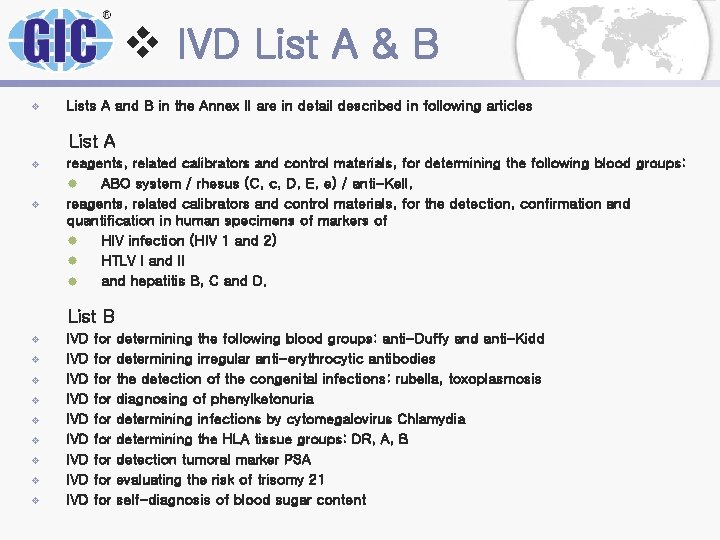
v IVD List A & B ± Lists A and B in the Annex II are in detail described in following articles List A ± ± reagents, related calibrators and control materials, for determining the following blood groups: ® ABO system / rhesus (C, c, D, E, e) / anti-Kell, reagents, related calibrators and control materials, for the detection, confirmation and quantification in human specimens of markers of ® HIV infection (HIV 1 and 2) ® HTLV I and II ® and hepatitis B, C and D. List B ± ± ± ± ± IVD IVD IVD for for for determining the following blood groups: anti-Duffy and anti-Kidd determining irregular anti-erythrocytic antibodies the detection of the congenital infections: rubella, toxoplasmosis diagnosing of phenylketonuria determining infections by cytomegalovirus Chlamydia determining the HLA tissue groups: DR, A, B detection tumoral marker PSA evaluating the risk of trisomy 21 self-diagnosis of blood sugar content
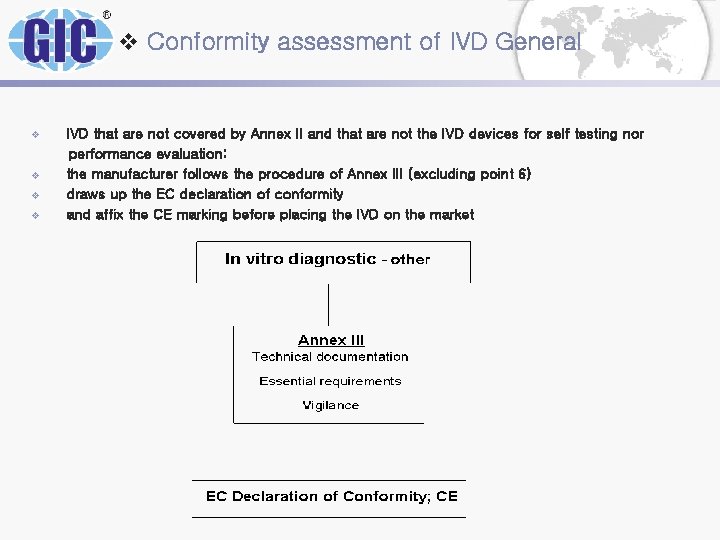
v Conformity assessment of IVD General ± ± IVD that are not covered by Annex II and that are not the IVD devices for self testing nor performance evaluation: the manufacturer follows the procedure of Annex III (excluding point 6) draws up the EC declaration of conformity and affix the CE marking before placing the IVD on the market
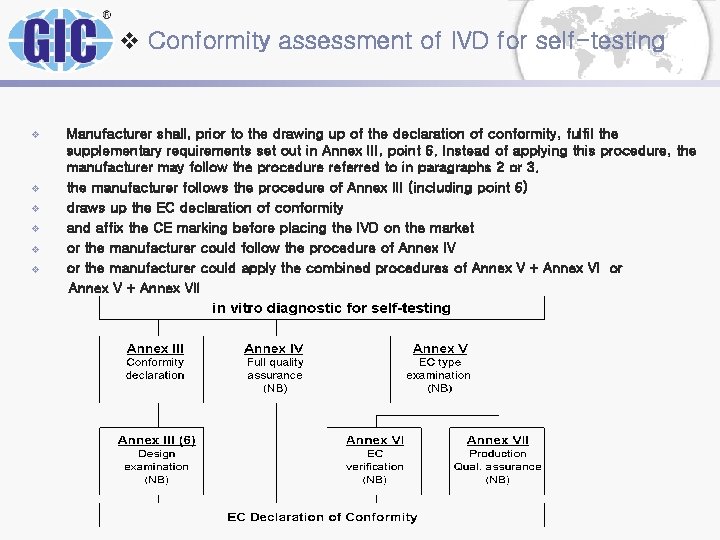
v Conformity assessment of IVD for self-testing ± ± ± Manufacturer shall, prior to the drawing up of the declaration of conformity, fulfil the supplementary requirements set out in Annex III, point 6. Instead of applying this procedure, the manufacturer may follow the procedure referred to in paragraphs 2 or 3. the manufacturer follows the procedure of Annex III (including point 6) draws up the EC declaration of conformity and affix the CE marking before placing the IVD on the market or the manufacturer could follow the procedure of Annex IV or the manufacturer could apply the combined procedures of Annex V + Annex VI or Annex V + Annex VII
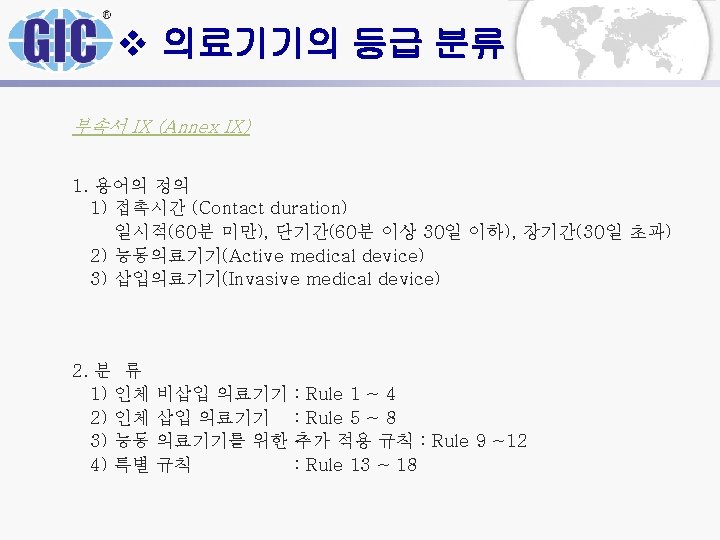
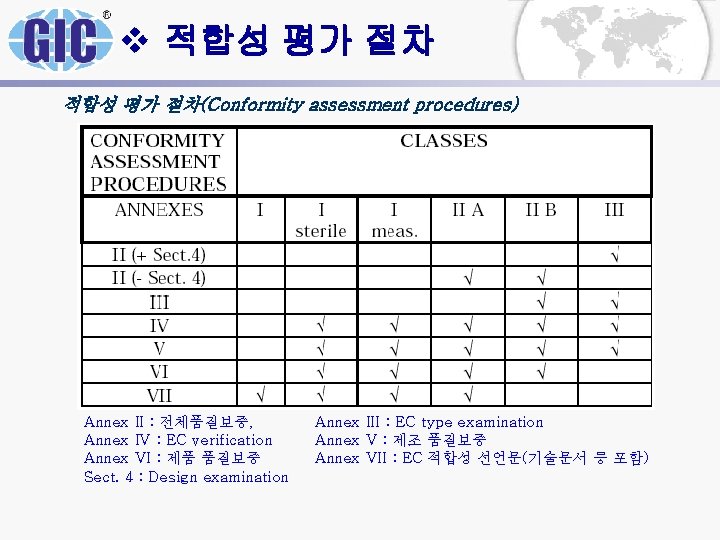
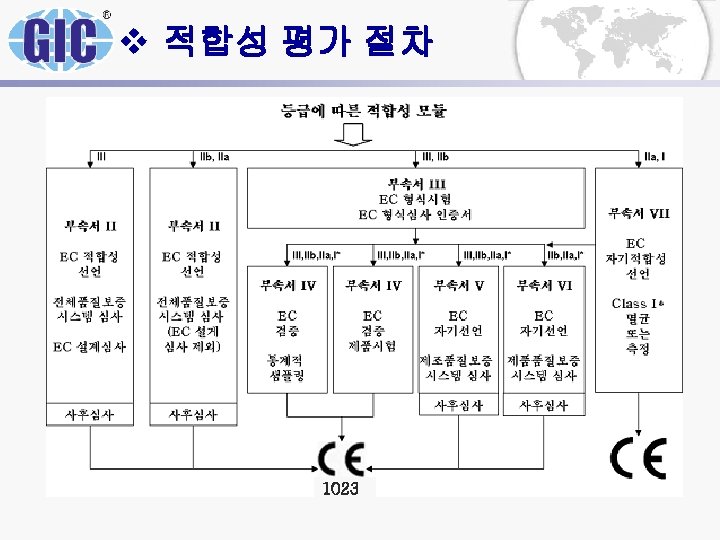
v 적합성 평가 절차(Conformity assessment procedures) Annex II : 전체품질보증, Annex IV : EC verification Annex VI : 제품 품질보증 Sect. 4 : Design examination Annex III : EC type examination Annex V : 제조 품질보증 Annex VII : EC 적합성 선언문(기술문서 등 포함)
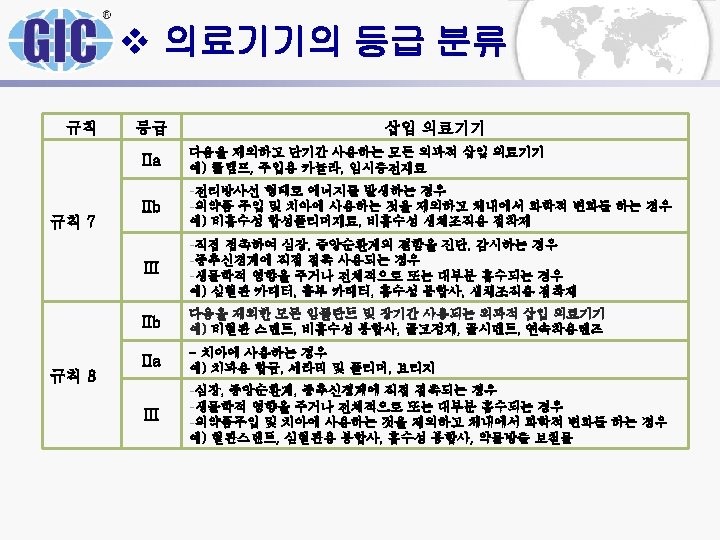
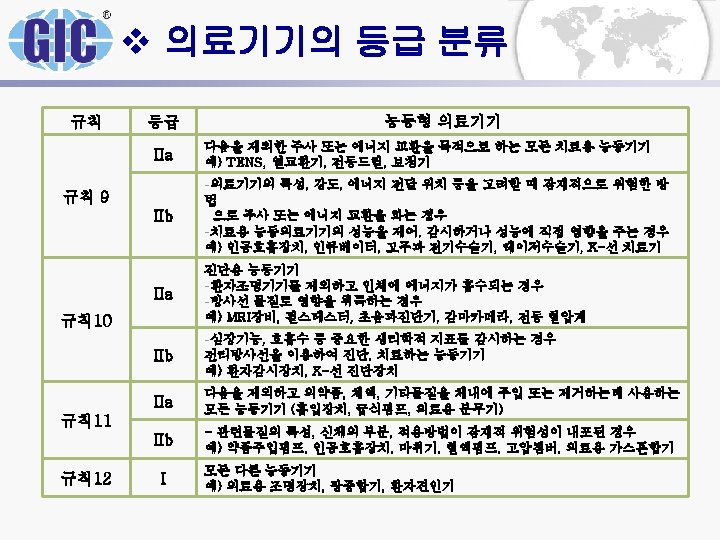
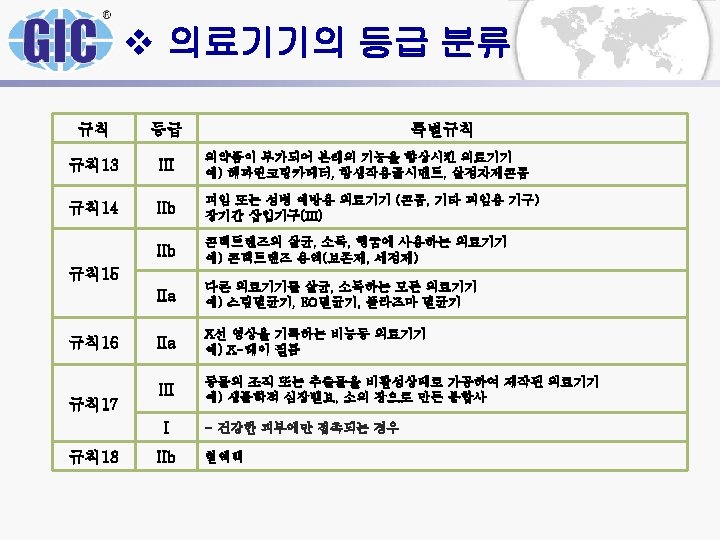
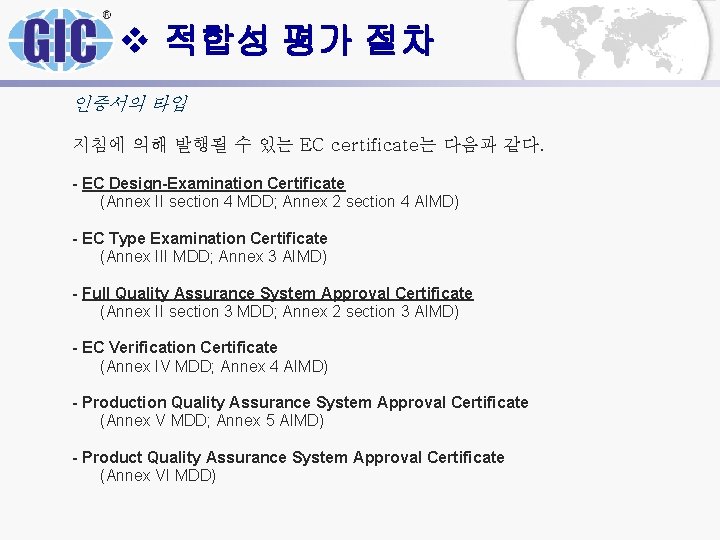
v 적합성 평가 절차 인증서의 타입 지침에 의해 발행될 수 있는 EC certificate는 다음과 같다. - EC Design-Examination Certificate (Annex II section 4 MDD; Annex 2 section 4 AIMD) - EC Type Examination Certificate (Annex III MDD; Annex 3 AIMD) - Full Quality Assurance System Approval Certificate (Annex II section 3 MDD; Annex 2 section 3 AIMD) - EC Verification Certificate (Annex IV MDD; Annex 4 AIMD) - Production Quality Assurance System Approval Certificate (Annex V MDD; Annex 5 AIMD) - Product Quality Assurance System Approval Certificate (Annex VI MDD)
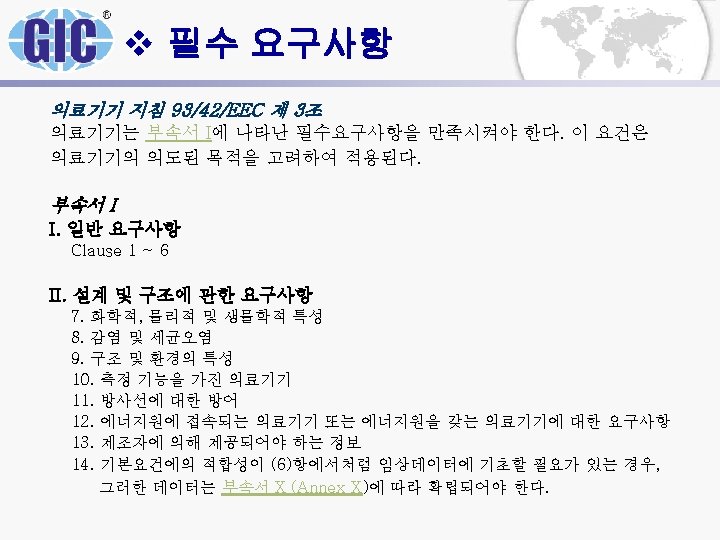
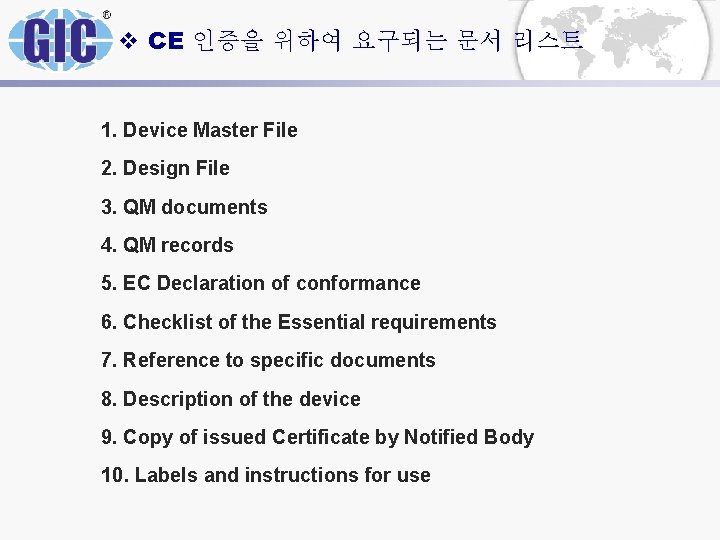
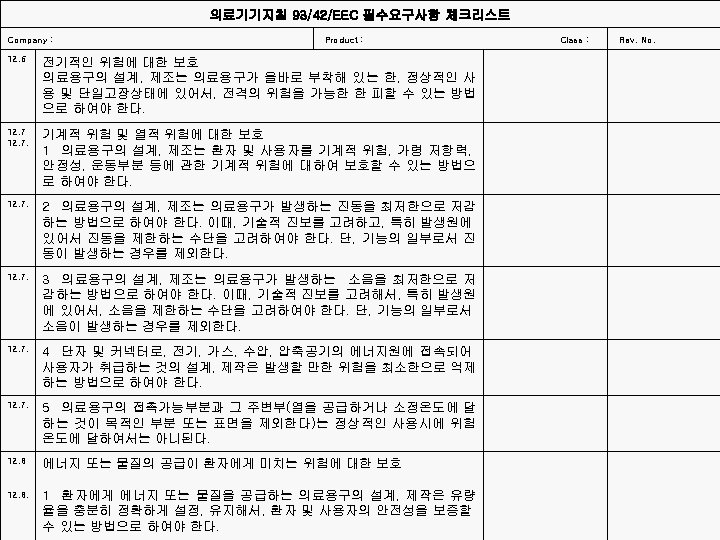
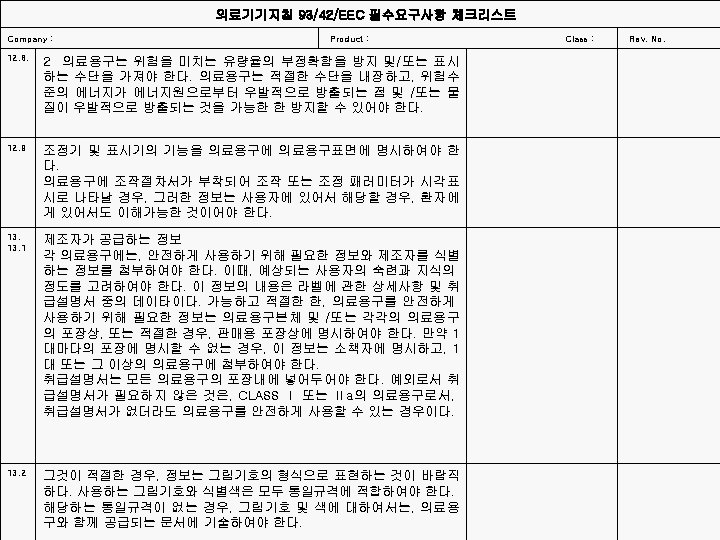
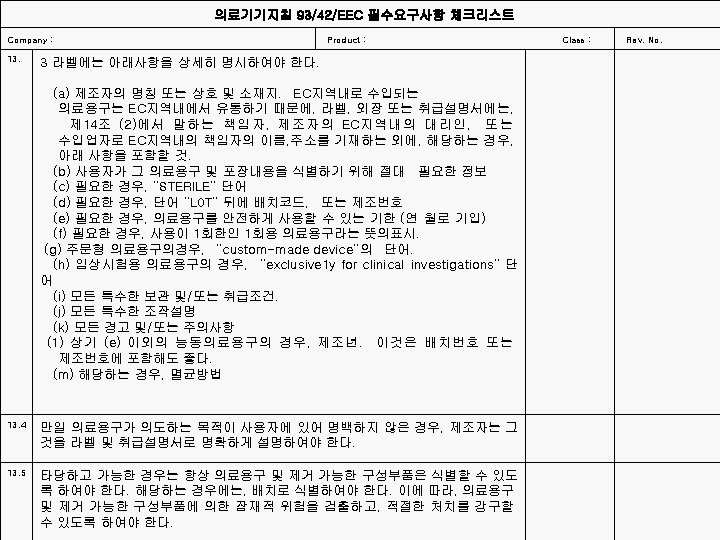
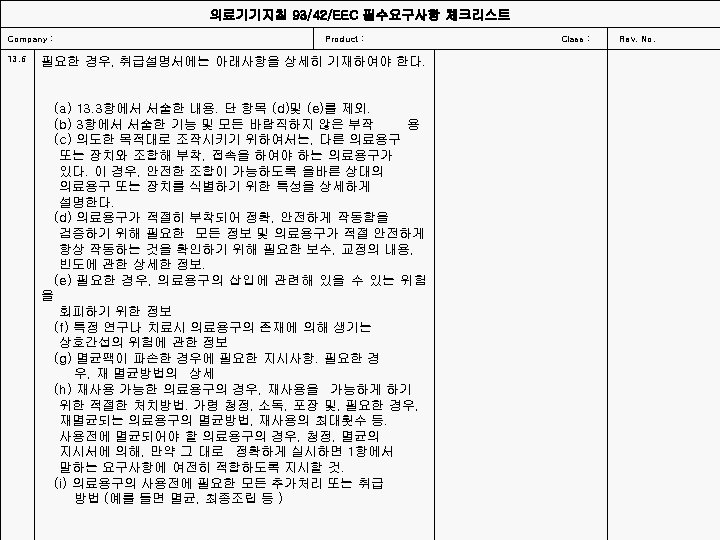
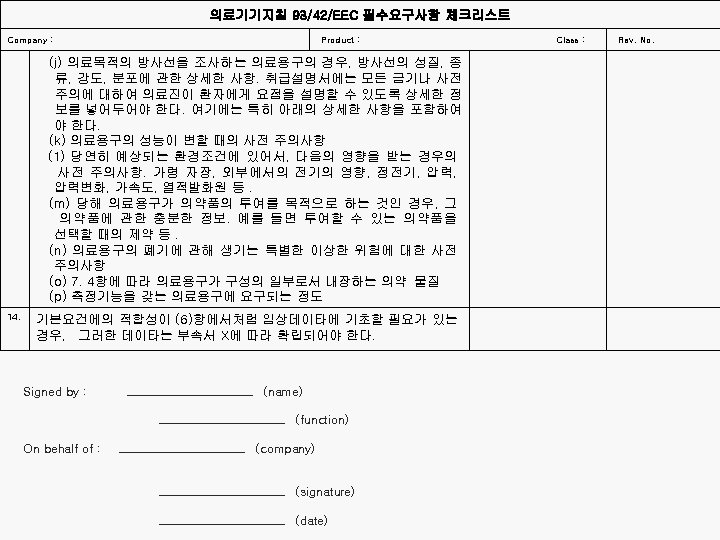
v CE 인증을 위하여 요구되는 문서 리스트 1. Device Master File 2. Design File 3. QM documents 4. QM records 5. EC Declaration of conformance 6. Checklist of the Essential requirements 7. Reference to specific documents 8. Description of the device 9. Copy of issued Certificate by Notified Body 10. Labels and instructions for use
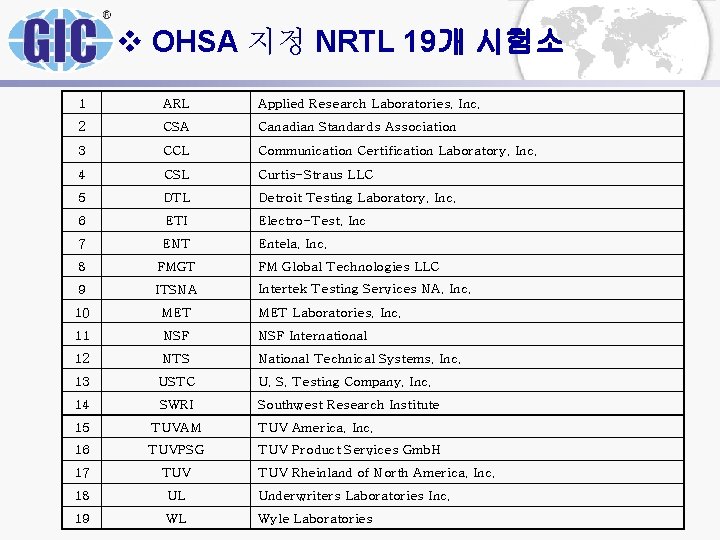
v OHSA 지정 NRTL 19개 시험소 1 ARL Applied Research Laboratories, Inc. 2 CSA Canadian Standards Association 3 CCL Communication Certification Laboratory, Inc. 4 CSL Curtis-Straus LLC 5 DTL Detroit Testing Laboratory, Inc. 6 ETI Electro-Test, Inc 7 ENT Entela, Inc. 8 FMGT FM Global Technologies LLC 9 ITSNA Intertek Testing Services NA, Inc. 10 MET Laboratories, Inc. 11 NSF International 12 NTS National Technical Systems, Inc. 13 USTC U. S. Testing Company, Inc. 14 SWRI Southwest Research Institute 15 TUVAM TUV America, Inc. 16 TUVPSG TUV Product Services Gmb. H 17 TUV 18 UL Underwriters Laboratories Inc. 19 WL Wyle Laboratories TUV Rheinland of North America, Inc.