Petrucci Harwood Herring Madura GENERAL CHEMISTRY Ninth Edition
- Slides: 59
Petrucci • Harwood • Herring • Madura GENERAL CHEMISTRY Ninth Edition Principles and Modern Applications Chapter 24: Complex Ions and Coordination Compounds Philip Dutton University of Windsor, Canada Prentice-Hall © 2007 1 General Chemistry: Chapter 24 Prentice-Hall © 2007
Contents 24 -1 24 -2 24 -3 24 -4 24 -5 24 -6 24 -7 2 Werner’s Theory of Coordination Compounds: An Overview Ligands Nomenclature Isomerism Bonding in Complex Ions: Crystal Field Theory Magnetic Properties of Coordination Compounds and Crystal Field Theory Color and the Colors of Complexes General Chemistry: Chapter 24 Prentice-Hall © 2007
Contents 24 -8 24 -9 24 -10 24 -11 Aspects of Complex-Ion Equilibria Acid-Base Reactions of Complex Ions Some Kinetic Considerations Applications of Coordination Chemistry Ø Focus On Colors in Gemstones 3 General Chemistry: Chapter 24 Prentice-Hall © 2007
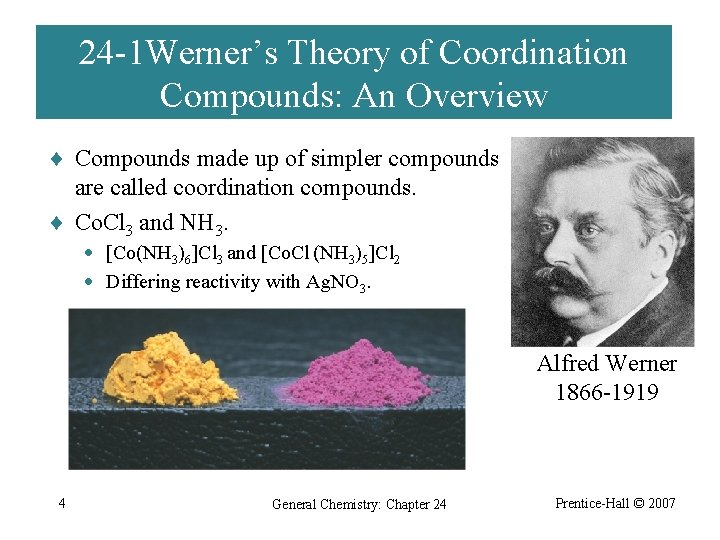
24 -1 Werner’s Theory of Coordination Compounds: An Overview ¨ Compounds made up of simpler compounds are called coordination compounds. ¨ Co. Cl 3 and NH 3. · [Co(NH 3)6]Cl 3 and [Co. Cl (NH 3)5]Cl 2 · Differing reactivity with Ag. NO 3. Alfred Werner 1866 -1919 4 General Chemistry: Chapter 24 Prentice-Hall © 2007
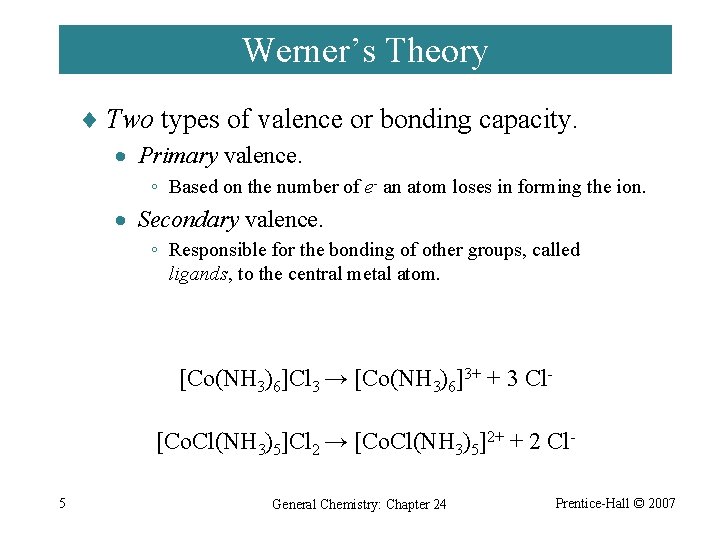
Werner’s Theory ¨ Two types of valence or bonding capacity. · Primary valence. ◦ Based on the number of e- an atom loses in forming the ion. · Secondary valence. ◦ Responsible for the bonding of other groups, called ligands, to the central metal atom. [Co(NH 3)6]Cl 3 → [Co(NH 3)6]3+ + 3 Cl[Co. Cl(NH 3)5]Cl 2 → [Co. Cl(NH 3)5]2+ + 2 Cl 5 General Chemistry: Chapter 24 Prentice-Hall © 2007
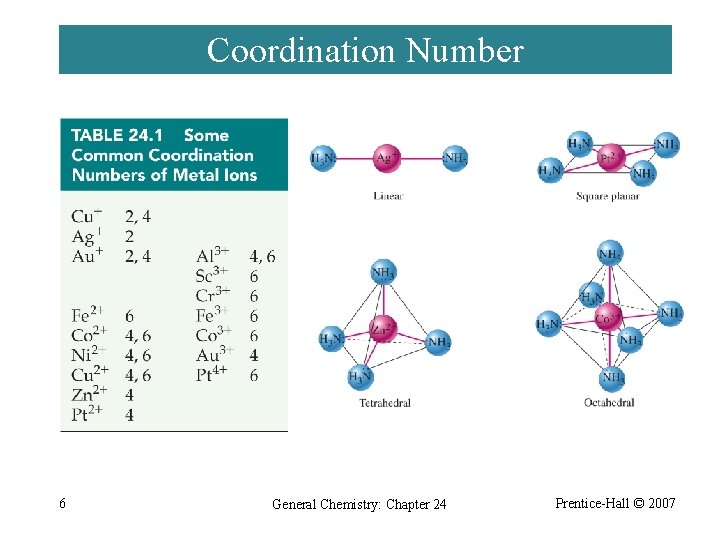
Coordination Number 6 General Chemistry: Chapter 24 Prentice-Hall © 2007
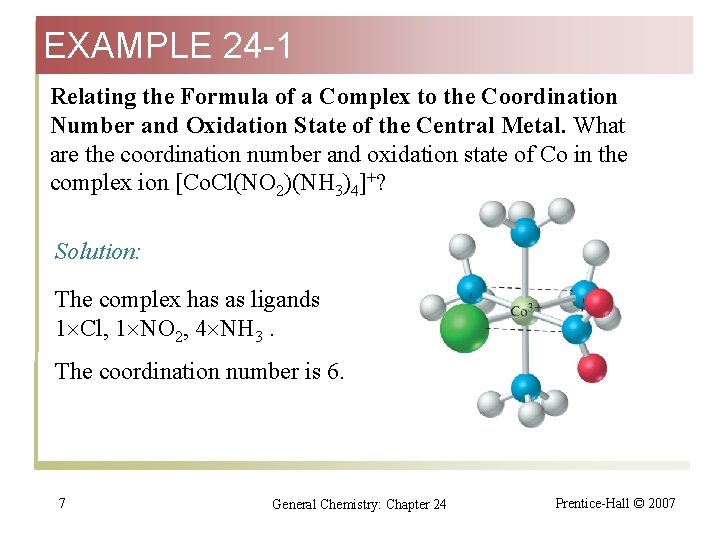
EXAMPLE 24 -1 Relating the Formula of a Complex to the Coordination Number and Oxidation State of the Central Metal. What are the coordination number and oxidation state of Co in the complex ion [Co. Cl(NO 2)(NH 3)4]+? Solution: The complex has as ligands 1 Cl, 1 NO 2, 4 NH 3. The coordination number is 6. 7 General Chemistry: Chapter 24 Prentice-Hall © 2007
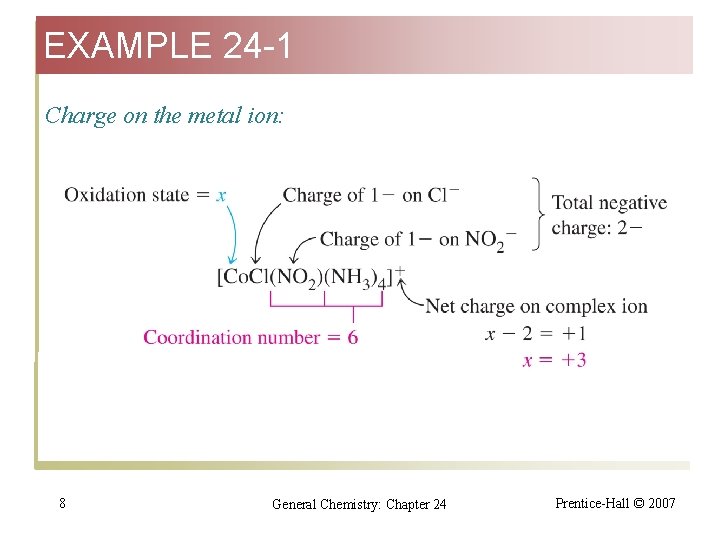
EXAMPLE 24 -1 Charge on the metal ion: 8 General Chemistry: Chapter 24 Prentice-Hall © 2007
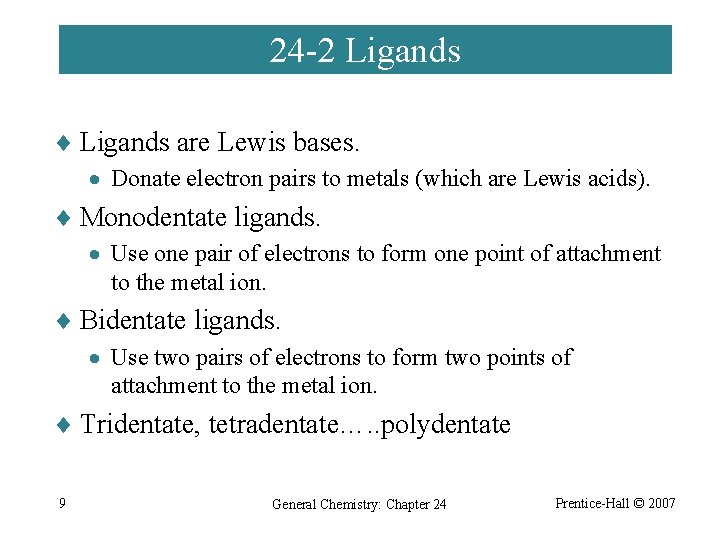
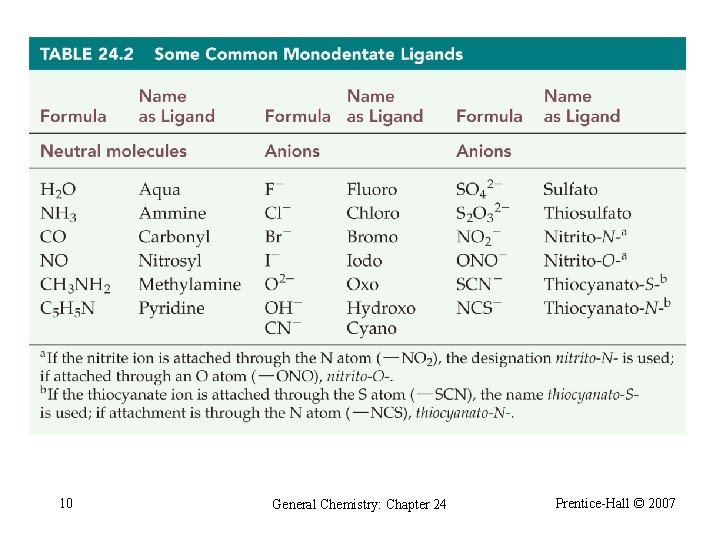
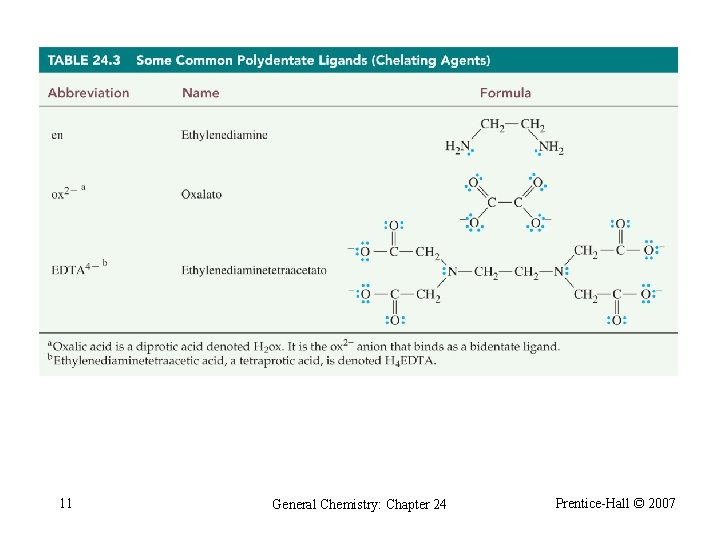
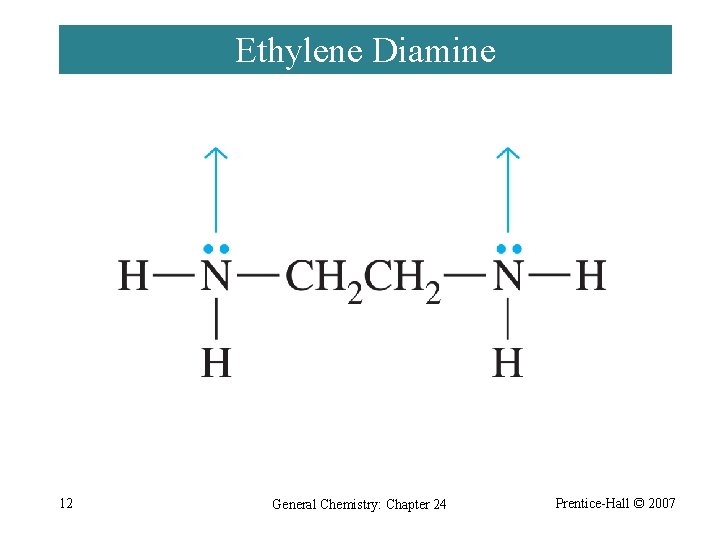
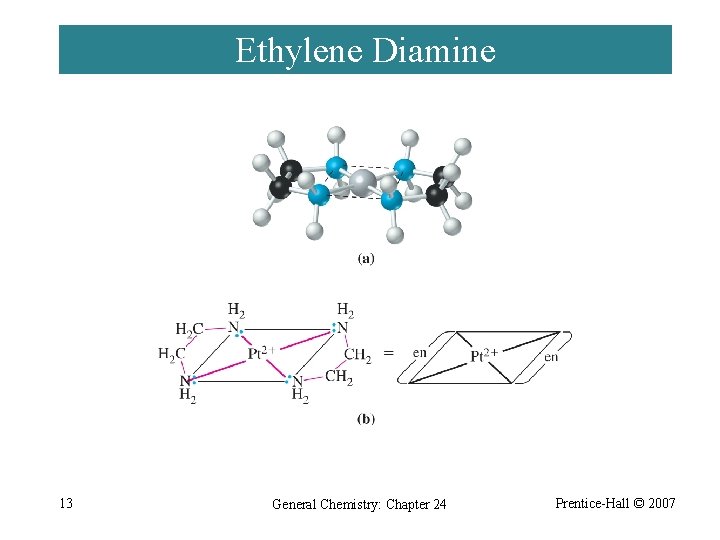
24 -2 Ligands ¨ Ligands are Lewis bases. · Donate electron pairs to metals (which are Lewis acids). ¨ Monodentate ligands. · Use one pair of electrons to form one point of attachment to the metal ion. ¨ Bidentate ligands. · Use two pairs of electrons to form two points of attachment to the metal ion. ¨ Tridentate, tetradentate…. . polydentate 9 General Chemistry: Chapter 24 Prentice-Hall © 2007
Table 24. 2 Some Common Monodentate Ligands. 10 General Chemistry: Chapter 24 Prentice-Hall © 2007
Table 24. 3 Some Common Polydentate Ligands (Chelating Agents) 11 General Chemistry: Chapter 24 Prentice-Hall © 2007
Ethylene Diamine 12 General Chemistry: Chapter 24 Prentice-Hall © 2007
Ethylene Diamine 13 General Chemistry: Chapter 24 Prentice-Hall © 2007
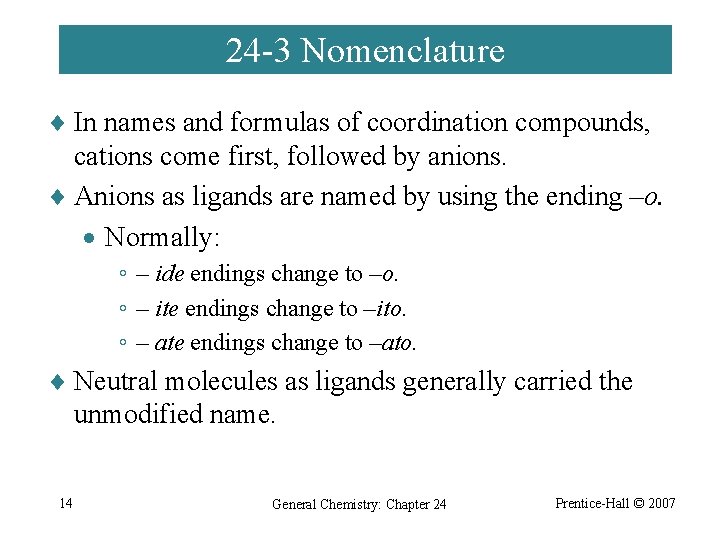
24 -3 Nomenclature ¨ In names and formulas of coordination compounds, cations come first, followed by anions. ¨ Anions as ligands are named by using the ending –o. · Normally: ◦ – ide endings change to –o. ◦ – ite endings change to –ito. ◦ – ate endings change to –ato. ¨ Neutral molecules as ligands generally carried the unmodified name. 14 General Chemistry: Chapter 24 Prentice-Hall © 2007
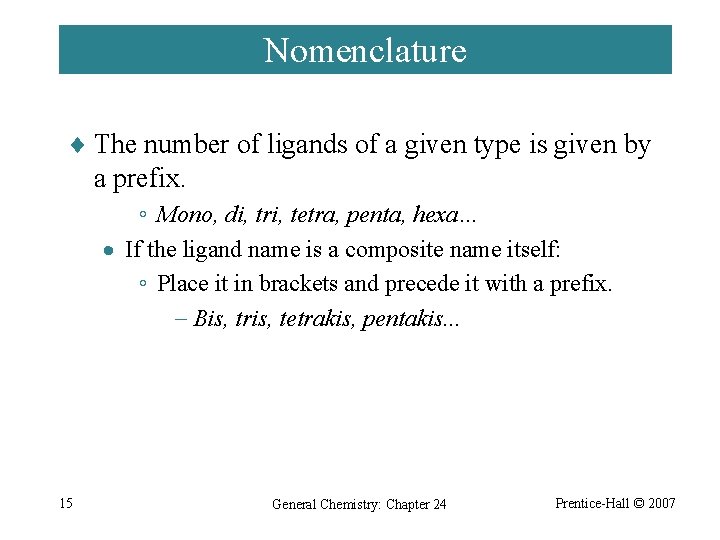
Nomenclature ¨ The number of ligands of a given type is given by a prefix. ◦ Mono, di, tri, tetra, penta, hexa… · If the ligand name is a composite name itself: ◦ Place it in brackets and precede it with a prefix. - Bis, tris, tetrakis, pentakis. . . 15 General Chemistry: Chapter 24 Prentice-Hall © 2007
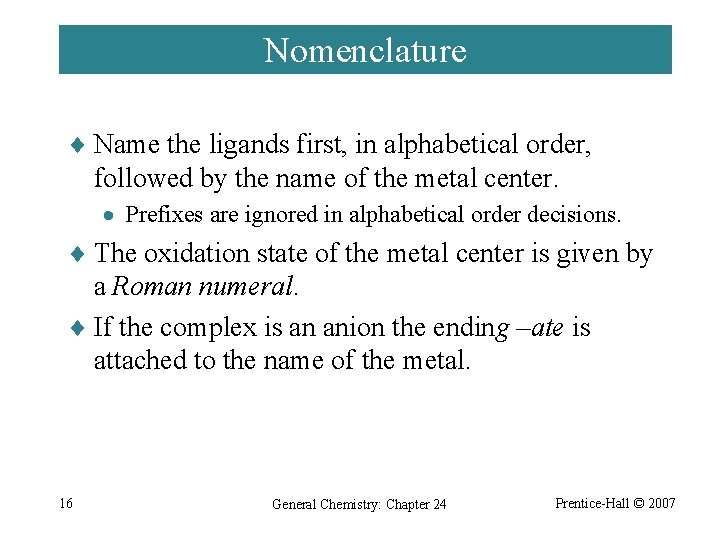
Nomenclature ¨ Name the ligands first, in alphabetical order, followed by the name of the metal center. · Prefixes are ignored in alphabetical order decisions. ¨ The oxidation state of the metal center is given by a Roman numeral. ¨ If the complex is an anion the ending –ate is attached to the name of the metal. 16 General Chemistry: Chapter 24 Prentice-Hall © 2007
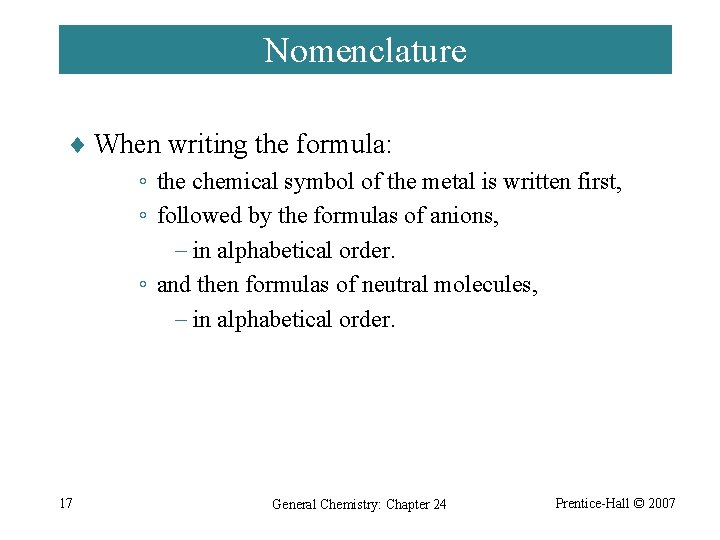
Nomenclature ¨ When writing the formula: ◦ the chemical symbol of the metal is written first, ◦ followed by the formulas of anions, - in alphabetical order. ◦ and then formulas of neutral molecules, - in alphabetical order. 17 General Chemistry: Chapter 24 Prentice-Hall © 2007
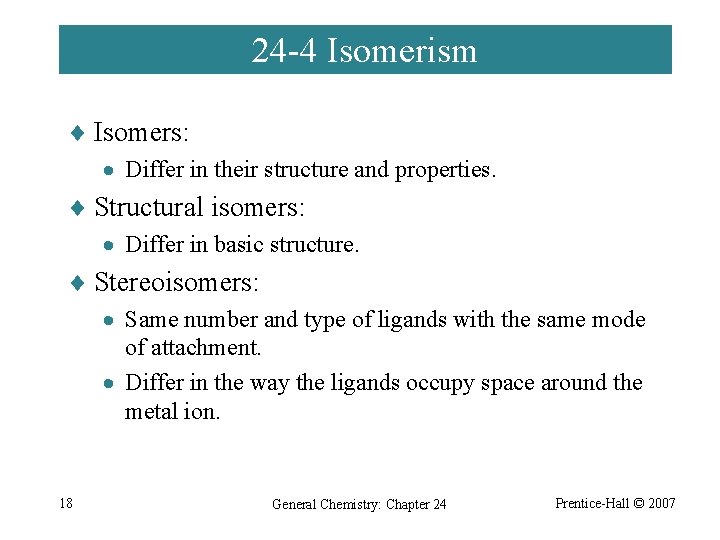
24 -4 Isomerism ¨ Isomers: · Differ in their structure and properties. ¨ Structural isomers: · Differ in basic structure. ¨ Stereoisomers: · Same number and type of ligands with the same mode of attachment. · Differ in the way the ligands occupy space around the metal ion. 18 General Chemistry: Chapter 24 Prentice-Hall © 2007
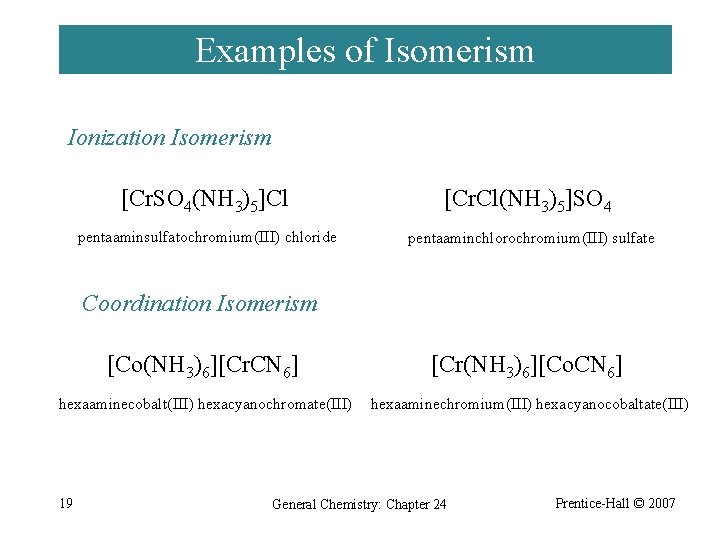
Examples of Isomerism Ionization Isomerism [Cr. SO 4(NH 3)5]Cl [Cr. Cl(NH 3)5]SO 4 pentaaminsulfatochromium(III) chloride pentaaminchlorochromium(III) sulfate Coordination Isomerism [Co(NH 3)6][Cr. CN 6] [Cr(NH 3)6][Co. CN 6] hexaaminecobalt(III) hexacyanochromate(III) hexaaminechromium(III) hexacyanocobaltate(III) 19 General Chemistry: Chapter 24 Prentice-Hall © 2007
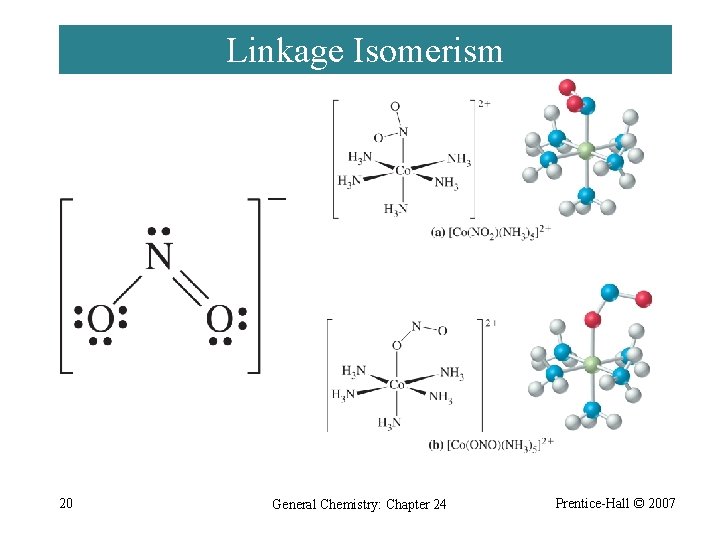
Linkage Isomerism 20 General Chemistry: Chapter 24 Prentice-Hall © 2007
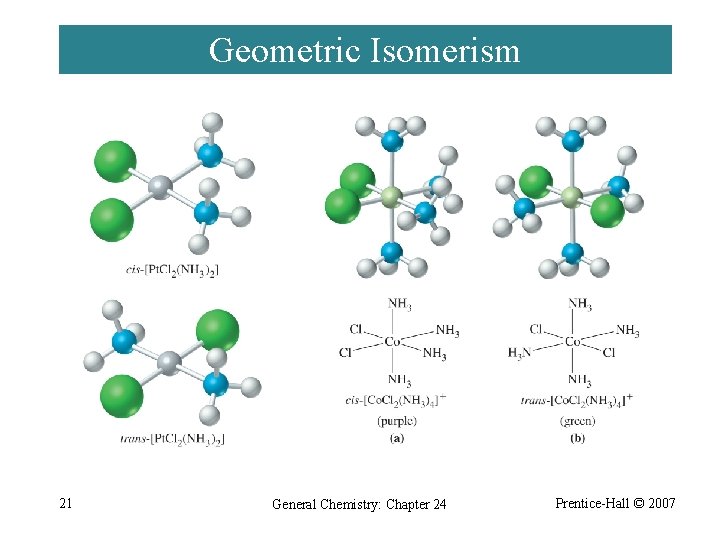
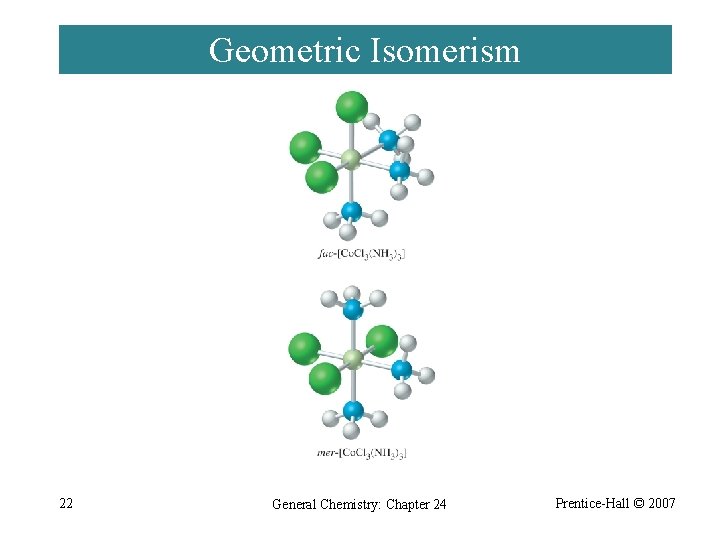
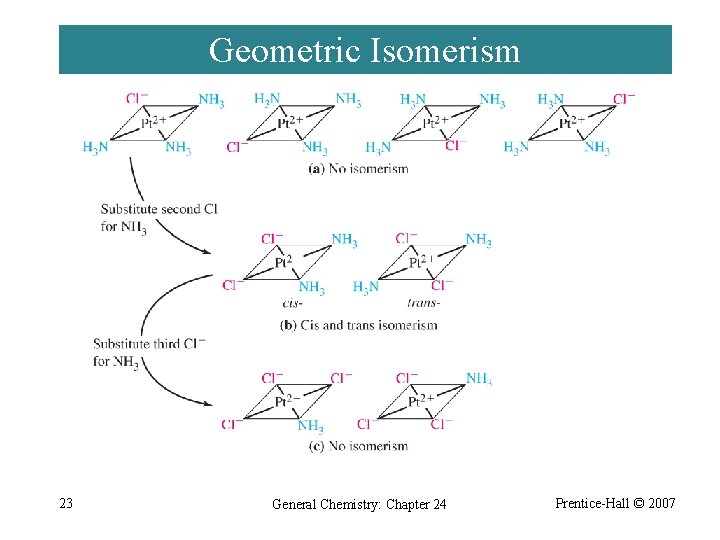
Geometric Isomerism 21 General Chemistry: Chapter 24 Prentice-Hall © 2007
Geometric Isomerism 22 General Chemistry: Chapter 24 Prentice-Hall © 2007
Geometric Isomerism 23 General Chemistry: Chapter 24 Prentice-Hall © 2007
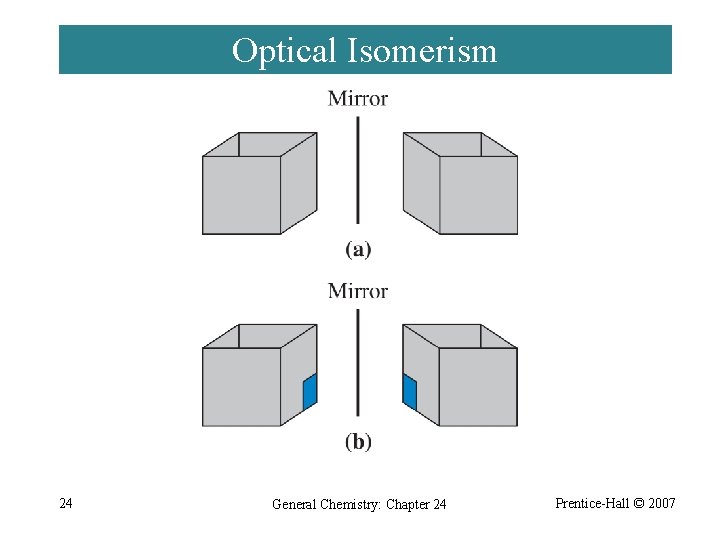
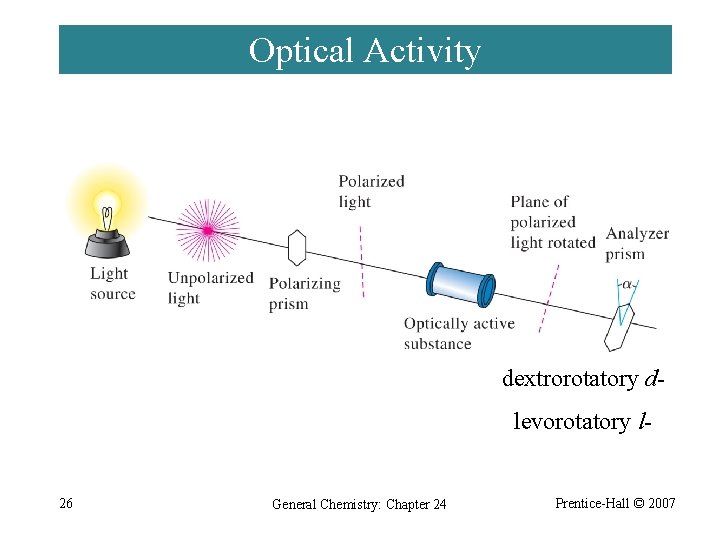
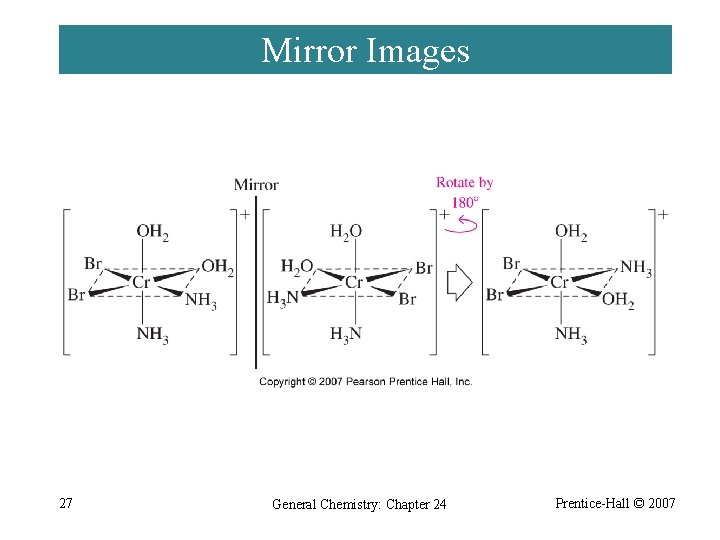
Optical Isomerism 24 General Chemistry: Chapter 24 Prentice-Hall © 2007
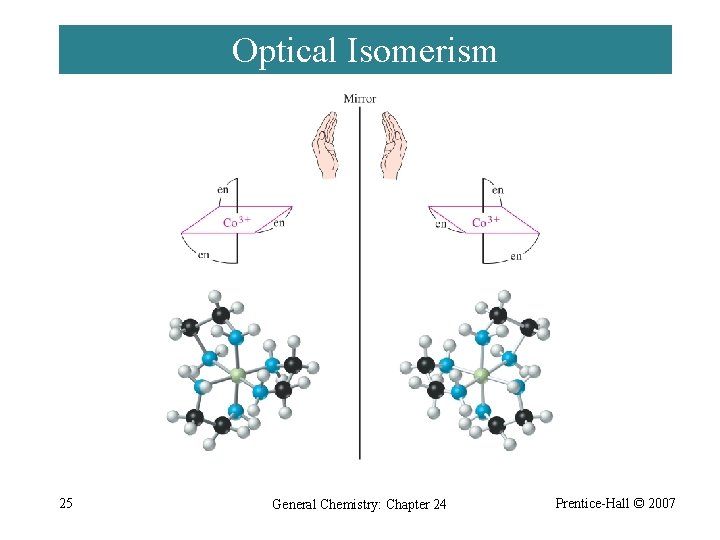
Optical Isomerism 25 General Chemistry: Chapter 24 Prentice-Hall © 2007
Optical Activity dextrorotatory dlevorotatory l- 26 General Chemistry: Chapter 24 Prentice-Hall © 2007
Mirror Images 27 General Chemistry: Chapter 24 Prentice-Hall © 2007
24 -5 Bonding in Complex Ions: Crystal Field Theory ¨ Consider bonding in a complex to be an electrostatic attraction between a positively charged nucleus and the electrons of the ligands. · Electrons on metal atom repel electrons on ligands. · Focus particularly on the d-electrons on the metal ion. 28 General Chemistry: Chapter 24 Prentice-Hall © 2007
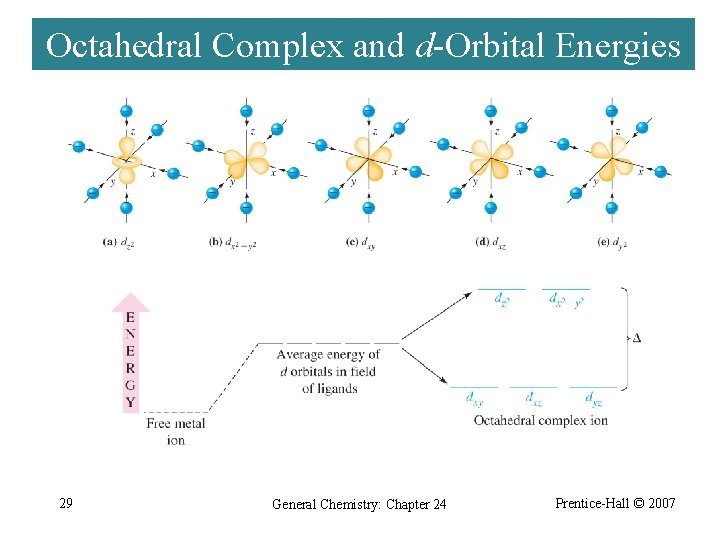
Octahedral Complex and d-Orbital Energies 29 General Chemistry: Chapter 24 Prentice-Hall © 2007
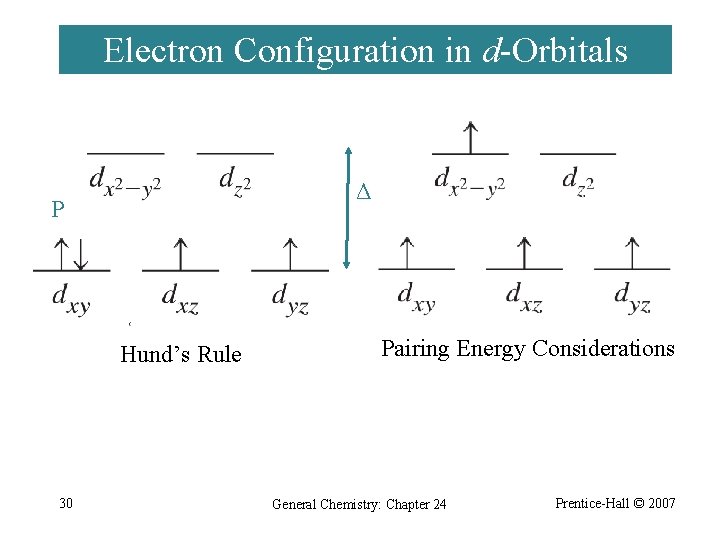
Electron Configuration in d-Orbitals Δ P Hund’s Rule 30 Pairing Energy Considerations General Chemistry: Chapter 24 Prentice-Hall © 2007
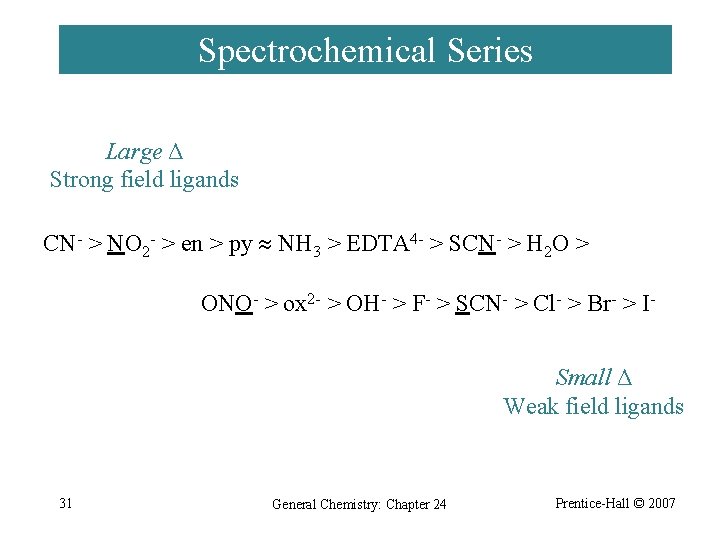
Spectrochemical Series Large Δ Strong field ligands CN- > NO 2 - > en > py NH 3 > EDTA 4 - > SCN- > H 2 O > ONO- > ox 2 - > OH- > F- > SCN- > Cl- > Br- > ISmall Δ Weak field ligands 31 General Chemistry: Chapter 24 Prentice-Hall © 2007
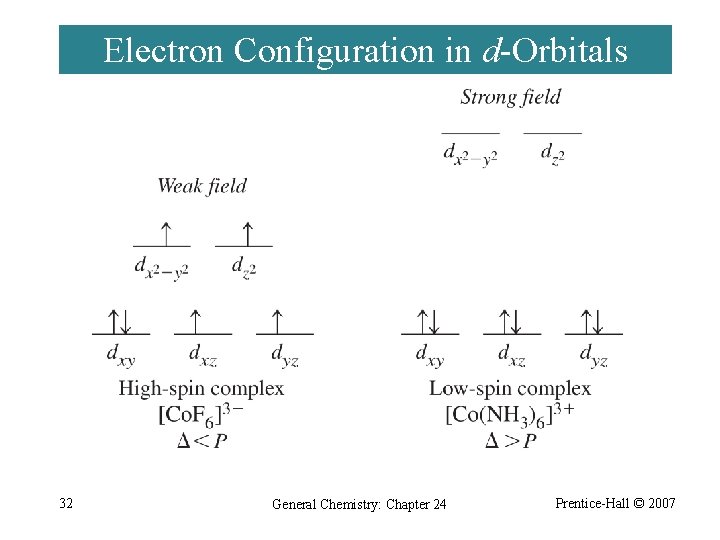
Electron Configuration in d-Orbitals 32 General Chemistry: Chapter 24 Prentice-Hall © 2007
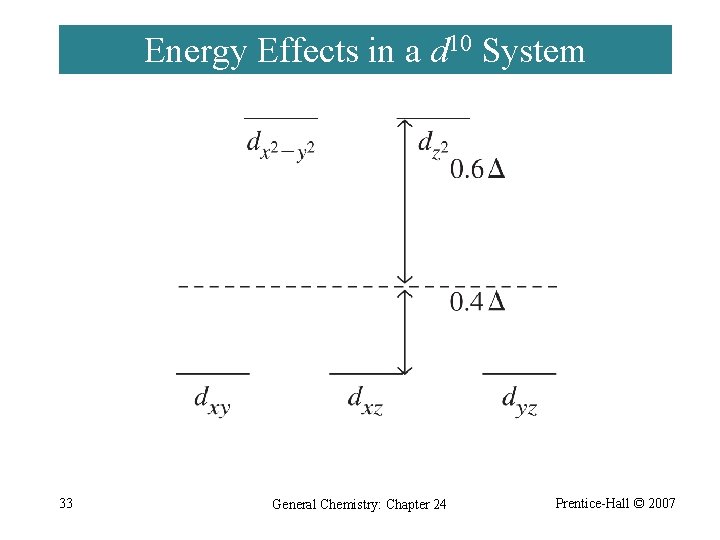
Energy Effects in a d 10 System 33 General Chemistry: Chapter 24 Prentice-Hall © 2007
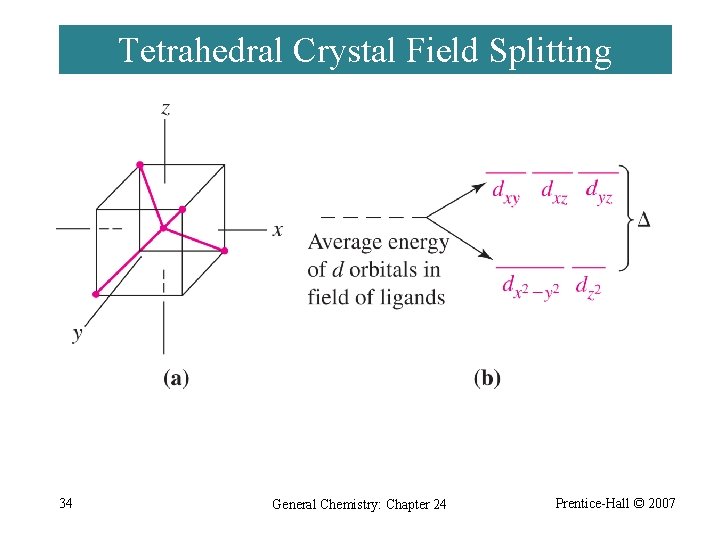
Tetrahedral Crystal Field Splitting 34 General Chemistry: Chapter 24 Prentice-Hall © 2007
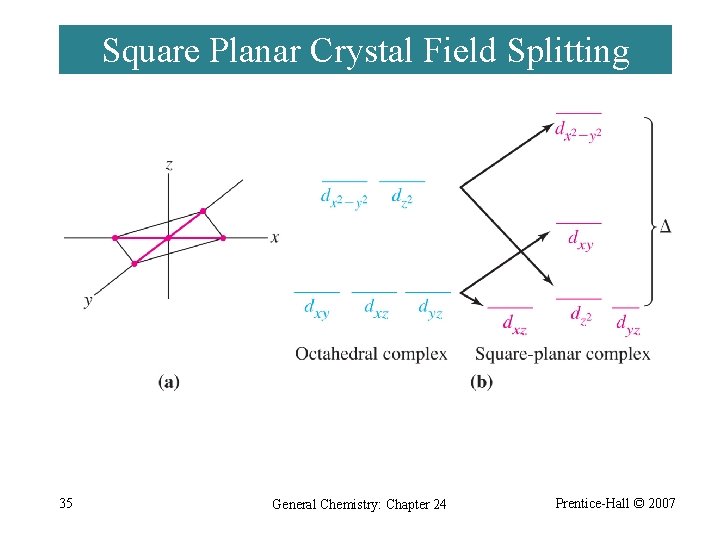
Square Planar Crystal Field Splitting 35 General Chemistry: Chapter 24 Prentice-Hall © 2007
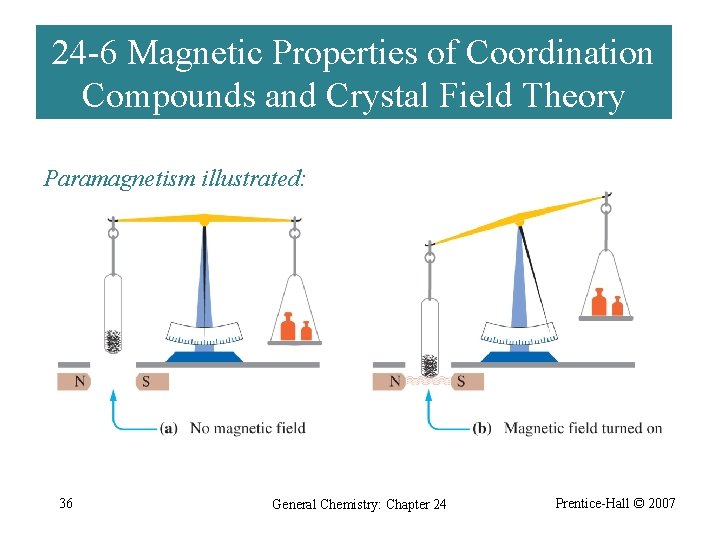
24 -6 Magnetic Properties of Coordination Compounds and Crystal Field Theory Paramagnetism illustrated: 36 General Chemistry: Chapter 24 Prentice-Hall © 2007
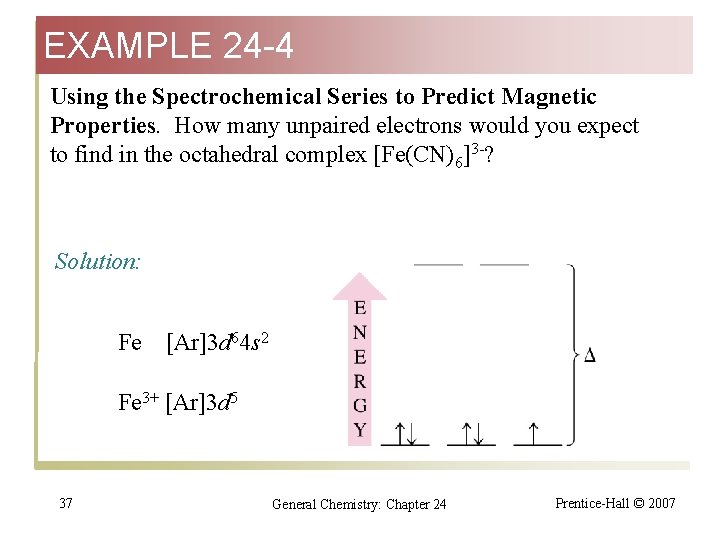
EXAMPLE 24 -4 Using the Spectrochemical Series to Predict Magnetic Properties. How many unpaired electrons would you expect to find in the octahedral complex [Fe(CN)6]3 -? Solution: Fe [Ar]3 d 64 s 2 Fe 3+ [Ar]3 d 5 37 General Chemistry: Chapter 24 Prentice-Hall © 2007
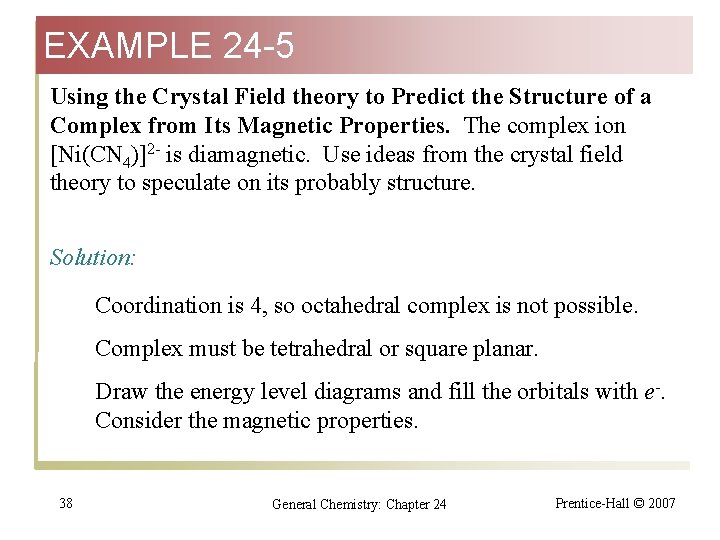
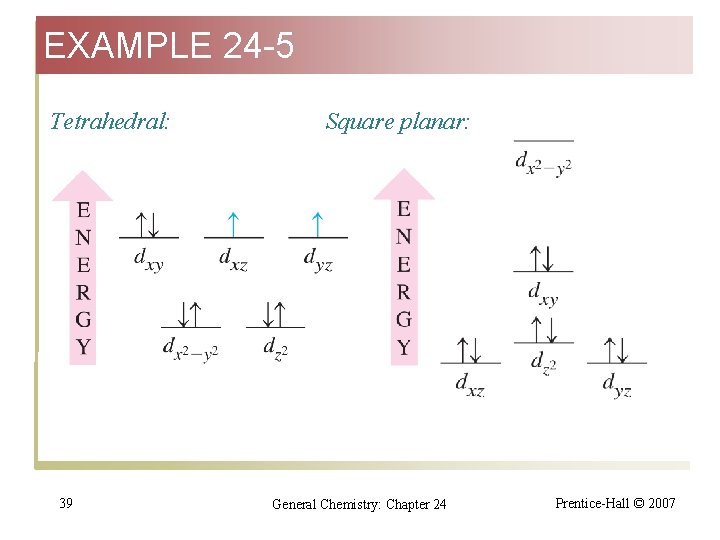
EXAMPLE 24 -5 Using the Crystal Field theory to Predict the Structure of a Complex from Its Magnetic Properties. The complex ion [Ni(CN 4)]2 - is diamagnetic. Use ideas from the crystal field theory to speculate on its probably structure. Solution: Coordination is 4, so octahedral complex is not possible. Complex must be tetrahedral or square planar. Draw the energy level diagrams and fill the orbitals with e-. Consider the magnetic properties. 38 General Chemistry: Chapter 24 Prentice-Hall © 2007
EXAMPLE 24 -5 Tetrahedral: 39 Square planar: General Chemistry: Chapter 24 Prentice-Hall © 2007
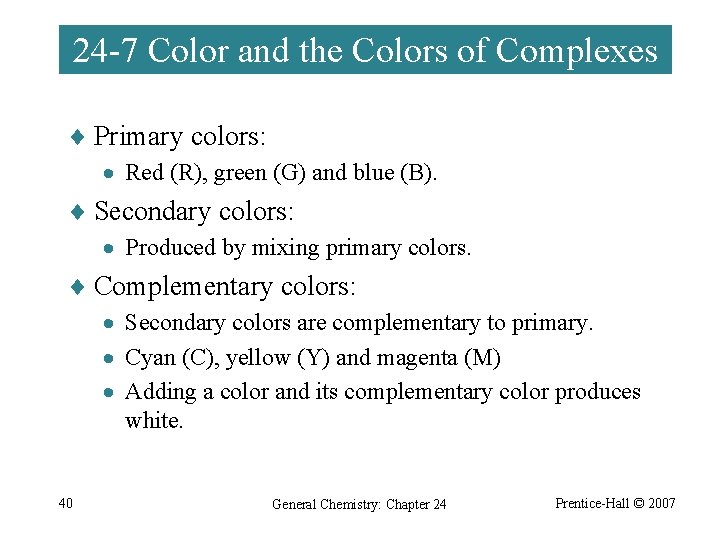
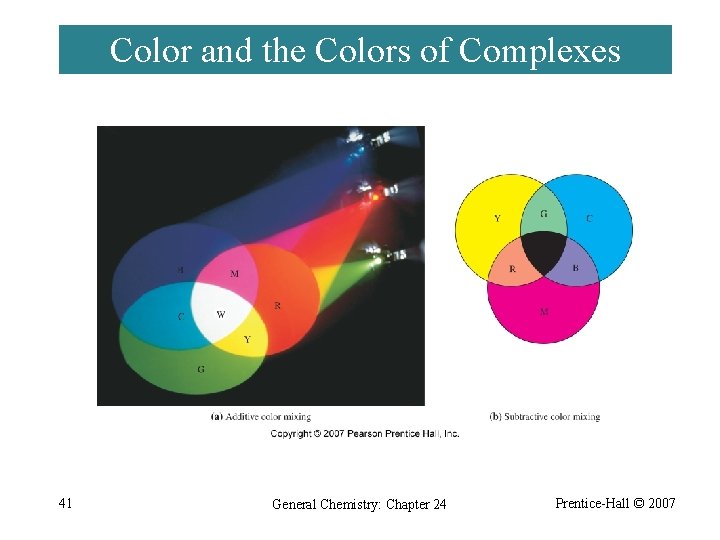
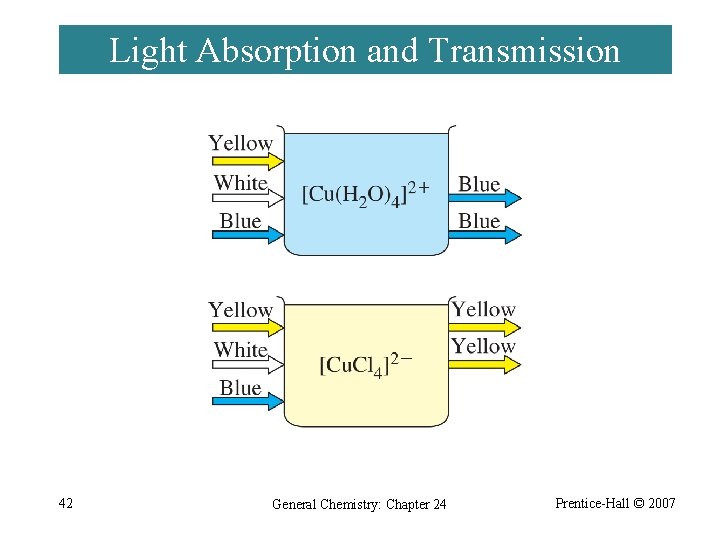
24 -7 Color and the Colors of Complexes ¨ Primary colors: · Red (R), green (G) and blue (B). ¨ Secondary colors: · Produced by mixing primary colors. ¨ Complementary colors: · Secondary colors are complementary to primary. · Cyan (C), yellow (Y) and magenta (M) · Adding a color and its complementary color produces white. 40 General Chemistry: Chapter 24 Prentice-Hall © 2007
Color and the Colors of Complexes 41 General Chemistry: Chapter 24 Prentice-Hall © 2007
Light Absorption and Transmission 42 General Chemistry: Chapter 24 Prentice-Hall © 2007
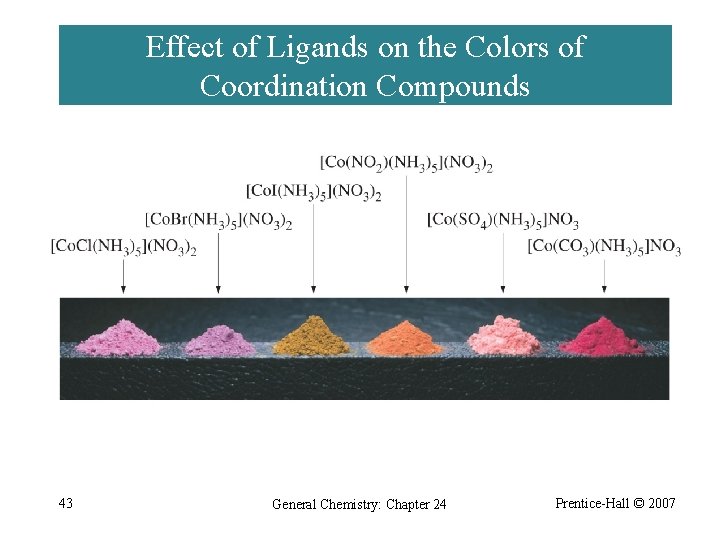
Effect of Ligands on the Colors of Coordination Compounds 43 General Chemistry: Chapter 24 Prentice-Hall © 2007
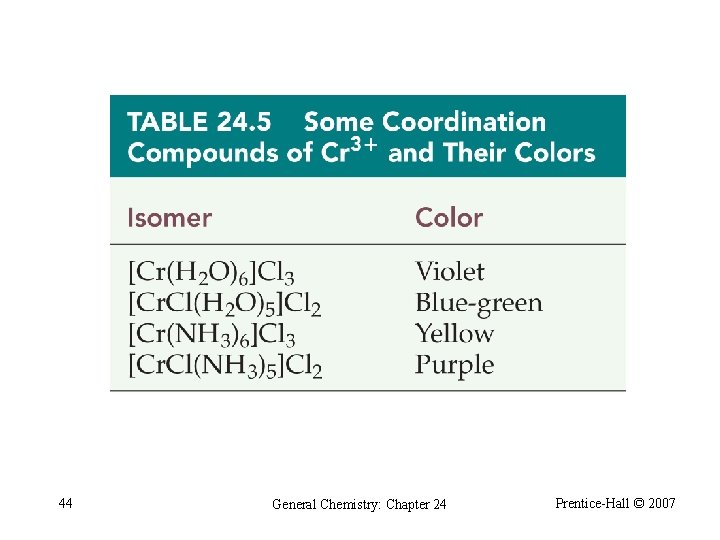
Table 24. 5 Some Coordination Compounds of Cr 3+ and Their Colors 44 General Chemistry: Chapter 24 Prentice-Hall © 2007
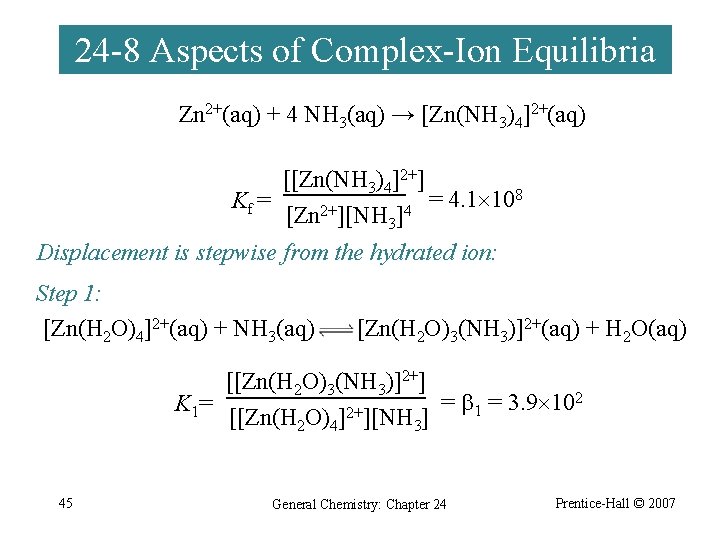
24 -8 Aspects of Complex-Ion Equilibria Zn 2+(aq) + 4 NH 3(aq) → [Zn(NH 3)4]2+(aq) Kf = [[Zn(NH 3)4]2+] [Zn 2+][NH 3]4 = 4. 1 108 Displacement is stepwise from the hydrated ion: Step 1: [Zn(H 2 O)4]2+(aq) + NH 3(aq) K 1= 45 [Zn(H 2 O)3(NH 3)]2+(aq) + H 2 O(aq) [[Zn(H 2 O)3(NH 3)]2+] [[Zn(H 2 O)4]2+][NH 3] = 1 = 3. 9 102 General Chemistry: Chapter 24 Prentice-Hall © 2007
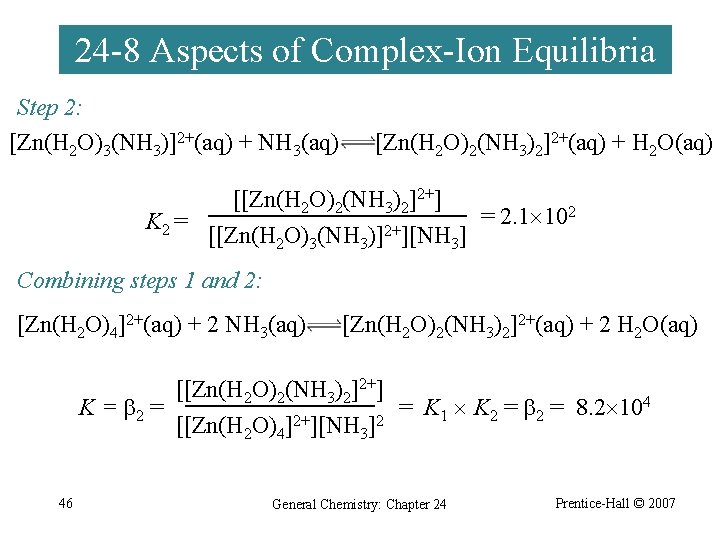
24 -8 Aspects of Complex-Ion Equilibria Step 2: [Zn(H 2 O)3(NH 3)]2+(aq) + NH 3(aq) K 2 = [Zn(H 2 O)2(NH 3)2]2+(aq) + H 2 O(aq) [[Zn(H 2 O)2(NH 3)2]2+] [[Zn(H 2 O)3(NH 3)]2+][NH 3] = 2. 1 102 Combining steps 1 and 2: [Zn(H 2 O)4]2+(aq) + 2 NH 3(aq) K = 2 = 46 [Zn(H 2 O)2(NH 3)2]2+(aq) + 2 H 2 O(aq) [[Zn(H 2 O)2(NH 3)2]2+] [[Zn(H 2 O)4]2+][NH 3]2 = K 1 K 2 = 8. 2 104 General Chemistry: Chapter 24 Prentice-Hall © 2007
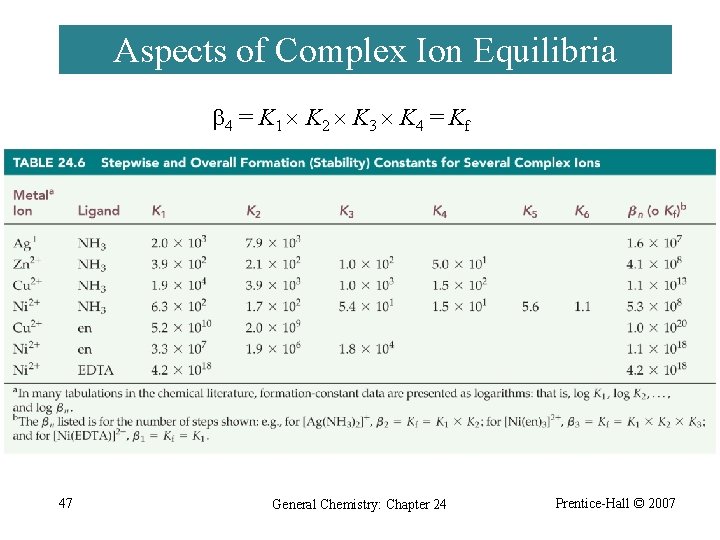
Aspects of Complex Ion Equilibria 4 = K 1 K 2 K 3 K 4 = Kf 47 General Chemistry: Chapter 24 Prentice-Hall © 2007
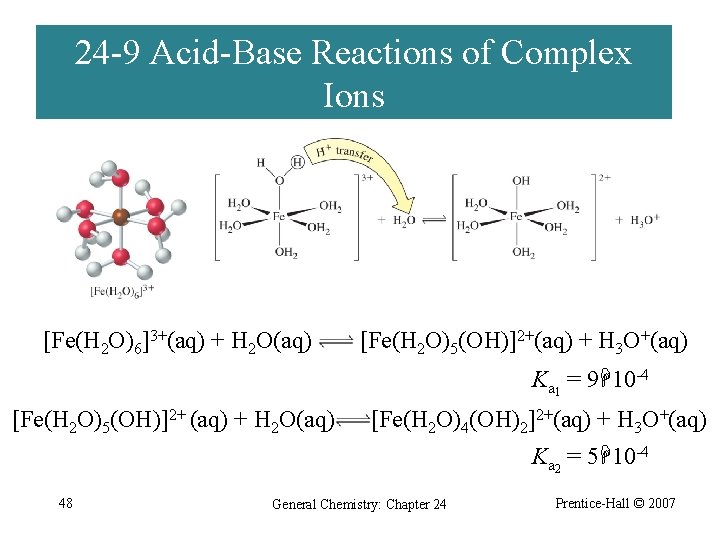
24 -9 Acid-Base Reactions of Complex Ions [Fe(H 2 O)6]3+(aq) + H 2 O(aq) [Fe(H 2 O)5(OH)]2+(aq) + H 3 O+(aq) Ka 1 = 9 10 -4 [Fe(H 2 O)5(OH)]2+ (aq) + H 2 O(aq) [Fe(H 2 O)4(OH)2]2+(aq) + H 3 O+(aq) Ka 2 = 5 10 -4 48 General Chemistry: Chapter 24 Prentice-Hall © 2007
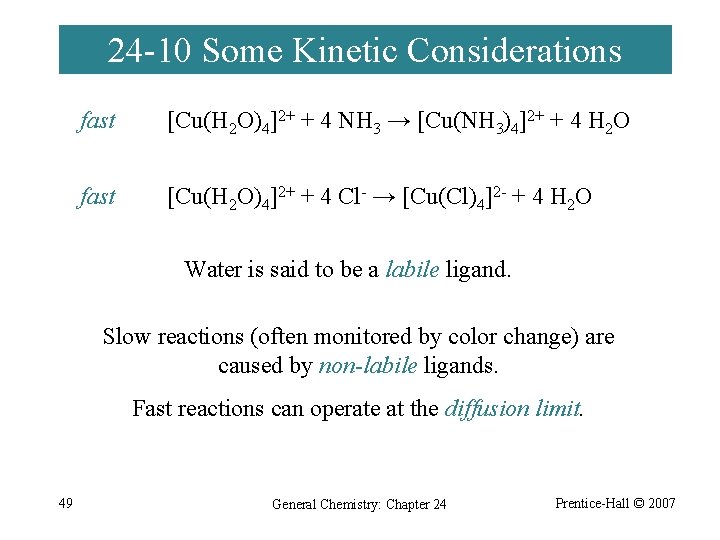
24 -10 Some Kinetic Considerations fast [Cu(H 2 O)4]2+ + 4 NH 3 → [Cu(NH 3)4]2+ + 4 H 2 O fast [Cu(H 2 O)4]2+ + 4 Cl- → [Cu(Cl)4]2 - + 4 H 2 O Water is said to be a labile ligand. Slow reactions (often monitored by color change) are caused by non-labile ligands. Fast reactions can operate at the diffusion limit. 49 General Chemistry: Chapter 24 Prentice-Hall © 2007
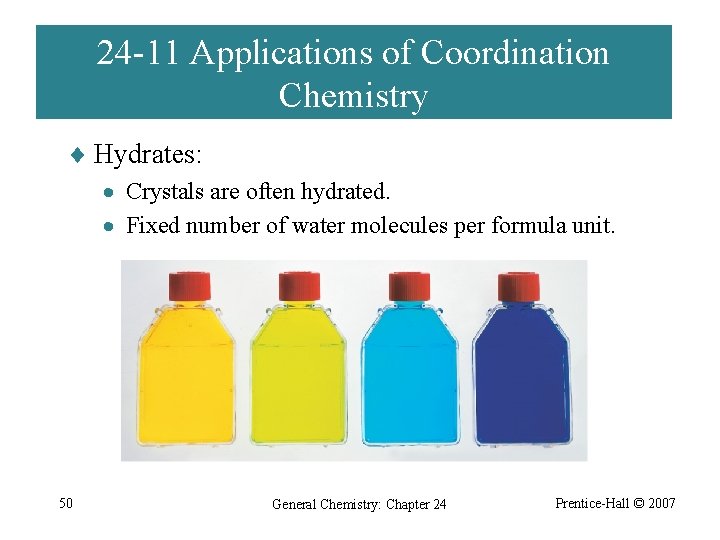
24 -11 Applications of Coordination Chemistry ¨ Hydrates: · Crystals are often hydrated. · Fixed number of water molecules per formula unit. 50 General Chemistry: Chapter 24 Prentice-Hall © 2007
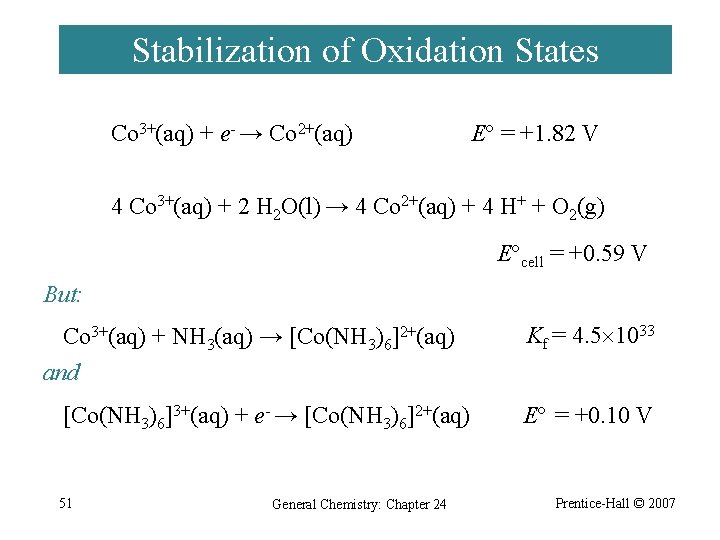
Stabilization of Oxidation States Co 3+(aq) + e- → Co 2+(aq) E° = +1. 82 V 4 Co 3+(aq) + 2 H 2 O(l) → 4 Co 2+(aq) + 4 H+ + O 2(g) E°cell = +0. 59 V But: Co 3+(aq) + NH 3(aq) → [Co(NH 3)6]2+(aq) and [Co(NH 3)6]3+(aq) + e- → [Co(NH 3)6]2+(aq) 51 General Chemistry: Chapter 24 Kf = 4. 5 1033 E° = +0. 10 V Prentice-Hall © 2007
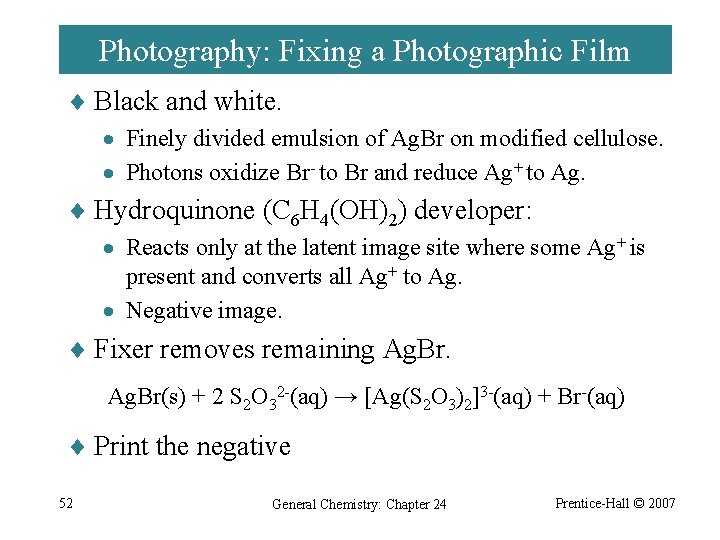
Photography: Fixing a Photographic Film ¨ Black and white. · Finely divided emulsion of Ag. Br on modified cellulose. · Photons oxidize Br- to Br and reduce Ag+ to Ag. ¨ Hydroquinone (C 6 H 4(OH)2) developer: · Reacts only at the latent image site where some Ag+ is present and converts all Ag+ to Ag. · Negative image. ¨ Fixer removes remaining Ag. Br(s) + 2 S 2 O 32 -(aq) → [Ag(S 2 O 3)2]3 -(aq) + Br-(aq) ¨ Print the negative 52 General Chemistry: Chapter 24 Prentice-Hall © 2007
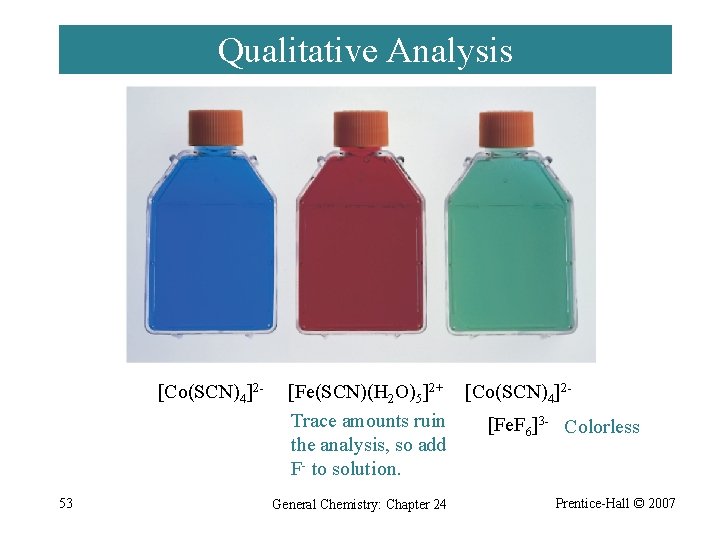
Qualitative Analysis [Co(SCN)4]2 - 53 [Fe(SCN)(H 2 O)5]2+ [Co(SCN)4]2 Trace amounts ruin [Fe. F 6]3 - Colorless the analysis, so add F- to solution. General Chemistry: Chapter 24 Prentice-Hall © 2007
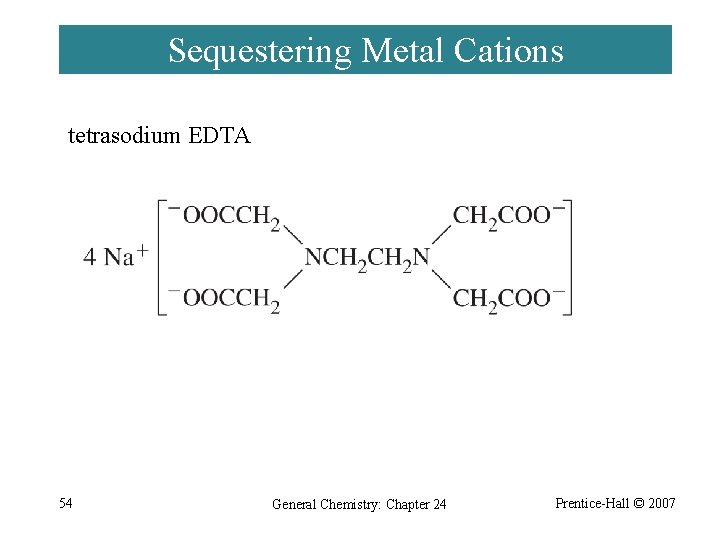
Sequestering Metal Cations tetrasodium EDTA 54 General Chemistry: Chapter 24 Prentice-Hall © 2007
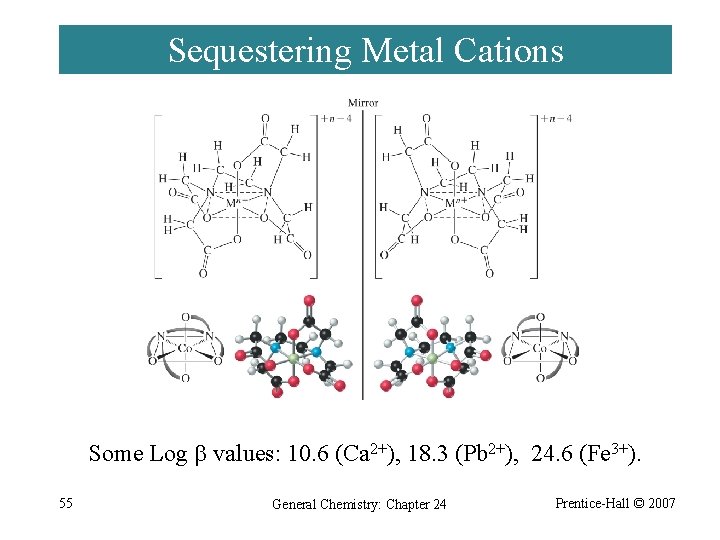
Sequestering Metal Cations Some Log values: 10. 6 (Ca 2+), 18. 3 (Pb 2+), 24. 6 (Fe 3+). 55 General Chemistry: Chapter 24 Prentice-Hall © 2007
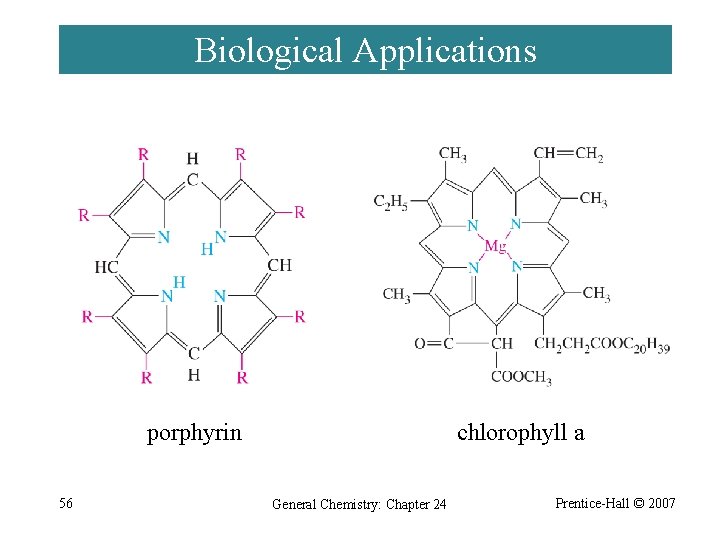
Biological Applications porphyrin 56 chlorophyll a General Chemistry: Chapter 24 Prentice-Hall © 2007
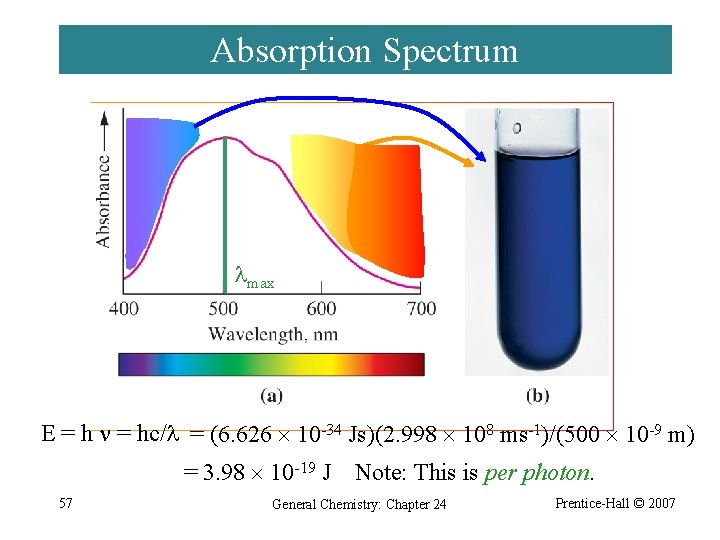
Absorption Spectrum max E = hc/ = (6. 626 10 -34 Js)(2. 998 108 ms-1)/(500 10 -9 m) = 3. 98 10 -19 J 57 Note: This is per photon. General Chemistry: Chapter 24 Prentice-Hall © 2007
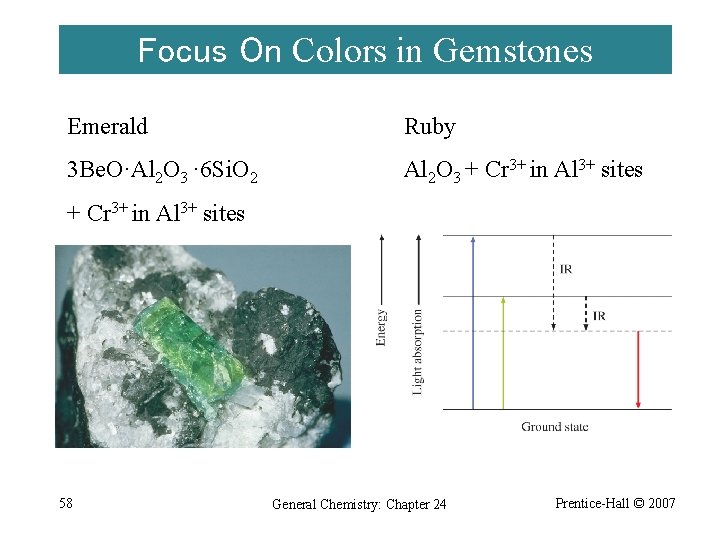
Focus On Colors in Gemstones Emerald Ruby 3 Be. O·Al 2 O 3 · 6 Si. O 2 Al 2 O 3 + Cr 3+ in Al 3+ sites 58 General Chemistry: Chapter 24 Prentice-Hall © 2007
End of Chapter Questions ¨ Break problems down into managable pieces. ¨ Solve each zone “independently”. ¨ Iterate as information from one zone moves back into another. ¨ Effective use of variables is important. 59 General Chemistry: Chapter 24 Prentice-Hall © 2007