Petrucci Harwood Herring Madura GENERAL CHEMISTRY Ninth Edition
- Slides: 17
Petrucci • Harwood • Herring • Madura GENERAL CHEMISTRY Ninth Edition Principles and Modern Applications Chapter 14: Chemical Kinetics 1
Contents 14 -1 The Rate of a Chemical Reaction 14 -3 Effect of Concentration on Reaction Rates: The Rate Law 14 -4 Zero-Order Reactions 14 -5 First-Order Reactions 14 -6 Second-Order Reactions 14 -7 Reaction Kinetics: A Summary 2
Contents 14 -8 Theoretical Models for Chemical Kinetics 14 -9 The Effect of Temperature on Reaction Rates 14 -10 Reaction Mechanisms 14 -11 Catalysis 3
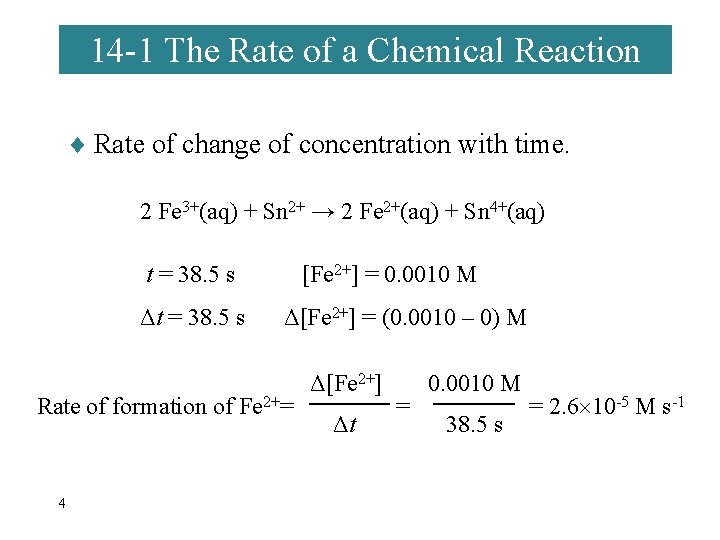
14 -1 The Rate of a Chemical Reaction ¨ Rate of change of concentration with time. 2 Fe 3+(aq) + Sn 2+ → 2 Fe 2+(aq) + Sn 4+(aq) t = 38. 5 s Δt = 38. 5 s [Fe 2+] = 0. 0010 M Δ[Fe 2+] = (0. 0010 – 0) M Rate of formation of Fe 2+= 4 Δ[Fe 2+] Δt = 0. 0010 M 38. 5 s = 2. 6 10 -5 M s-1
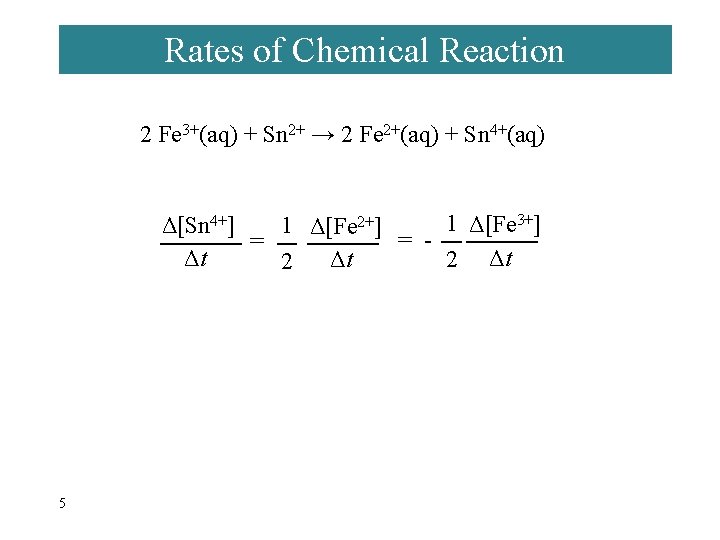
Rates of Chemical Reaction 2 Fe 3+(aq) + Sn 2+ → 2 Fe 2+(aq) + Sn 4+(aq) 1 Δ[Fe 3+] Δ[Sn 4+] 1 Δ[Fe 2+] = = Δt Δt 2 5
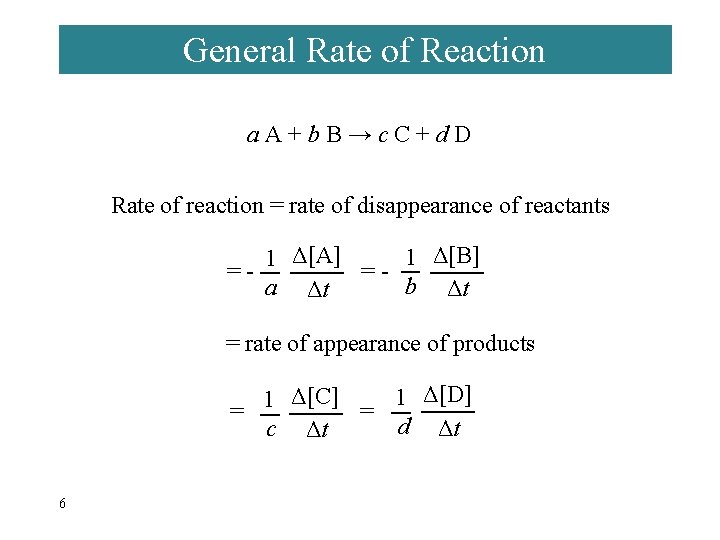
General Rate of Reaction a. A+b. B→c. C+d. D Rate of reaction = rate of disappearance of reactants 1 Δ[B] 1 Δ[A] ==b Δt a Δt = rate of appearance of products 1 Δ[D] 1 Δ[C] = = d Δt c Δt 6
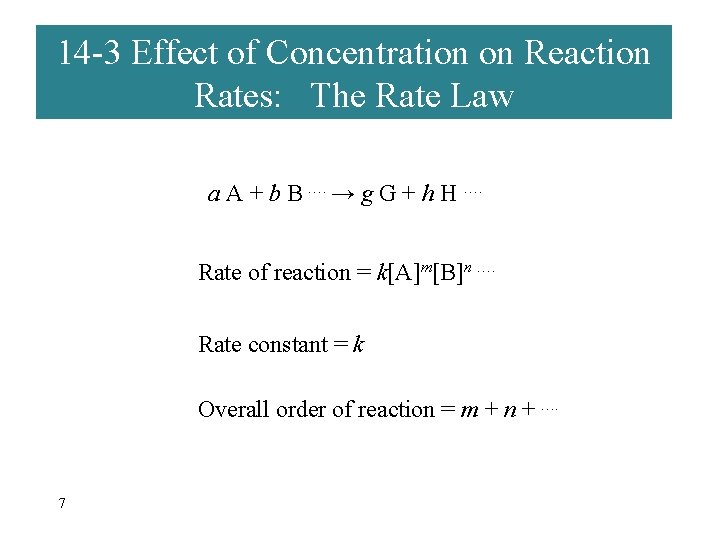
14 -3 Effect of Concentration on Reaction Rates: The Rate Law a A + b B …. → g G + h H …. Rate of reaction = k[A]m[B]n …. Rate constant = k Overall order of reaction = m + n + …. 7
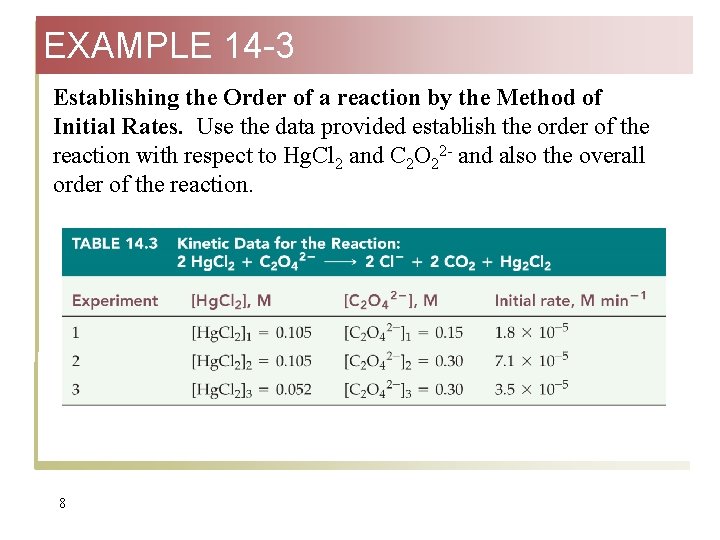
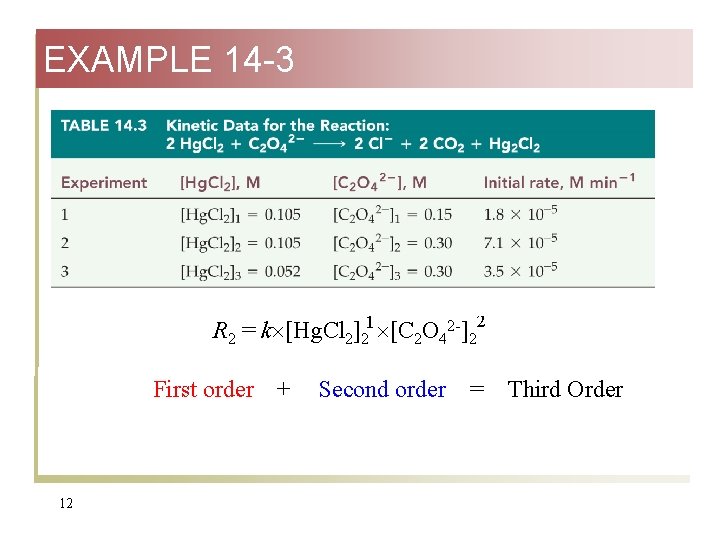
EXAMPLE 14 -3 Establishing the Order of a reaction by the Method of Initial Rates. Use the data provided establish the order of the reaction with respect to Hg. Cl 2 and C 2 O 22 - and also the overall order of the reaction. 8
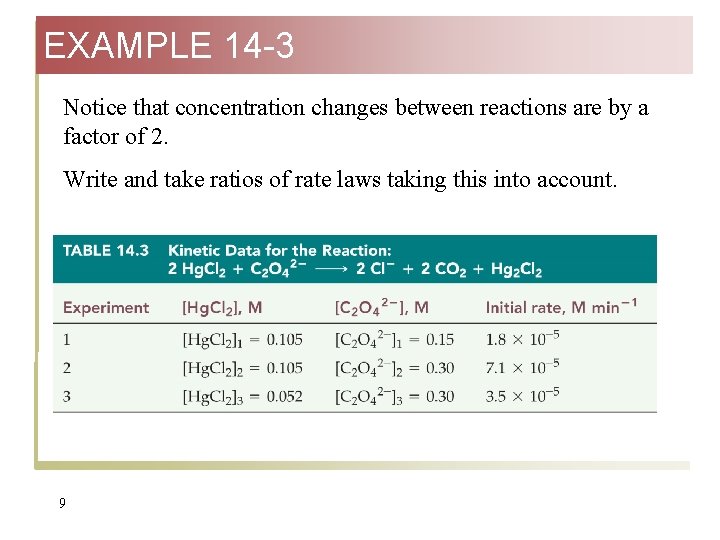
EXAMPLE 14 -3 Notice that concentration changes between reactions are by a factor of 2. Write and take ratios of rate laws taking this into account. 9
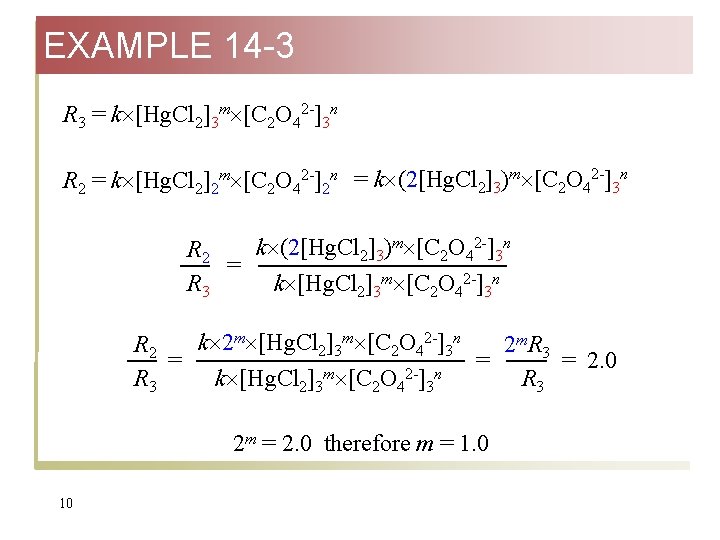
EXAMPLE 14 -3 R 3 = k [Hg. Cl 2]3 m [C 2 O 42 -]3 n R 2 = k [Hg. Cl 2]2 m [C 2 O 42 -]2 n = k (2[Hg. Cl 2]3)m [C 2 O 42 -]3 n R 2 = R 3 k [Hg. Cl 2]3 m [C 2 O 42 -]3 n k 2 m [Hg. Cl 2]3 m [C 2 O 42 -]3 n R 2 2 m. R 3 = = = 2. 0 m 2 n R 3 k [Hg. Cl 2]3 [C 2 O 4 ]3 R 3 2 m = 2. 0 therefore m = 1. 0 10
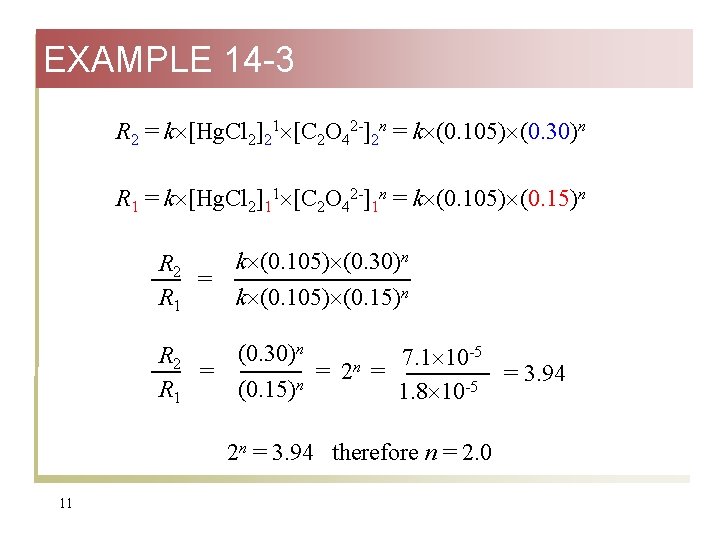
EXAMPLE 14 -3 R 2 = k [Hg. Cl 2]21 [C 2 O 42 -]2 n = k (0. 105) (0. 30)n R 1 = k [Hg. Cl 2]11 [C 2 O 42 -]1 n = k (0. 105) (0. 15)n R 2 = R 1 k (0. 105) (0. 30)n k (0. 105) (0. 15)n R 2 = R 1 (0. 30)n (0. 15)n = 2 n 7. 1 10 -5 = = 3. 94 -5 1. 8 10 2 n = 3. 94 therefore n = 2. 0 11
EXAMPLE 14 -3 R 2 = k [Hg. Cl 2]21 [C 2 O 42 -]2 2 First order + 12 Second order = Third Order
¨ Worked Examples Follow: 13
14
¨ CRS Questions Follow: 15
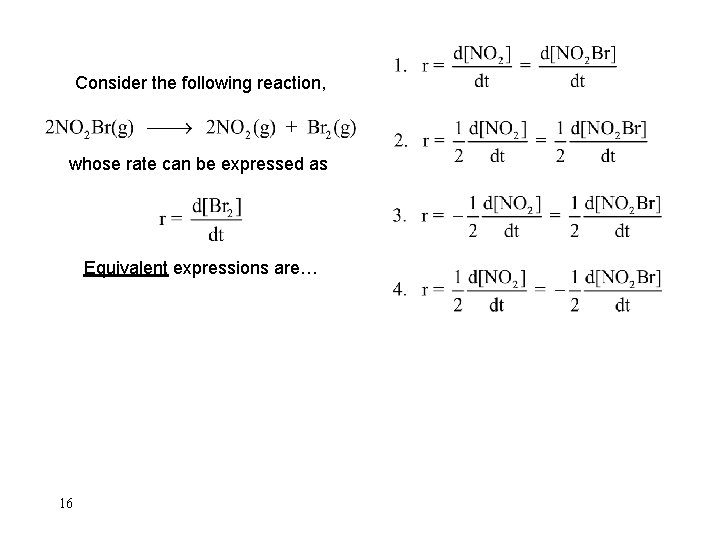
Consider the following reaction, whose rate can be expressed as Equivalent expressions are… 16
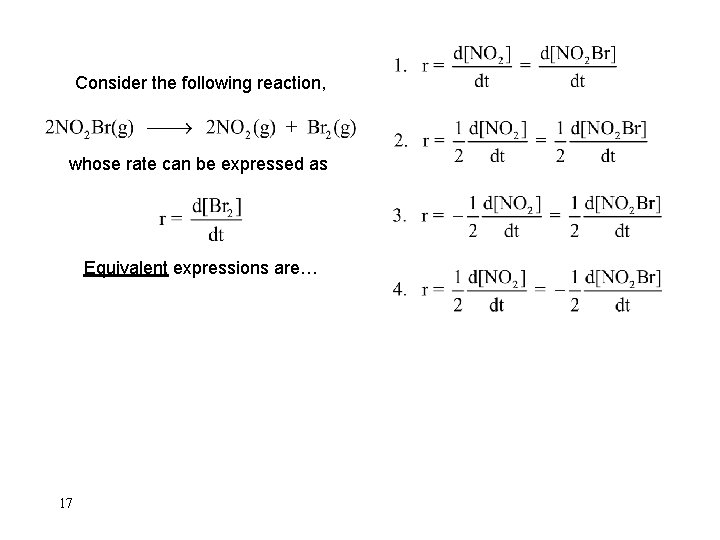
Consider the following reaction, whose rate can be expressed as Equivalent expressions are… 17