
Gwen Harwood Presentation By Jordan Mikayla and Aaron
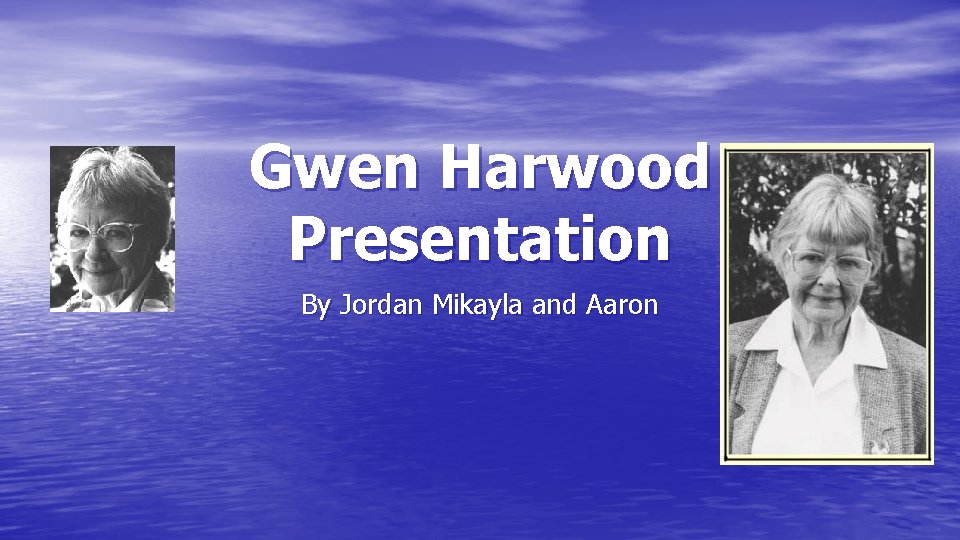
Gwen Harwood Presentation By Jordan Mikayla and Aaron
Contents • Selves and Voices • Music, art and language • Childhood, family and memory • Experience- ordinariness and otherness • Romanticism and Eros • Art and immortality • Poetic Style • End

Selves and Voices • Using different personas, both male and female, made Harwood a • • • controversial cultural figure in the 60’s and 70’s. Prize-giving - Dramatization is a main convention of the poem. It is used to satirise pomposity and pretension. Nightfall - “Francis Geyer” writes about Professor Krote’s in direct voice as he strolls through the urban streets, looking for inspiration and reminiscing about his lost European past. In the park and Home of Mercy - As “Walter Lehmann” She gives a male insight into exhausted mothers and the institutional life of “ruined girls”.
Music, art and language • New Music - Celebrating new music as ‘love’ - The exhilarating power of music - To Music -directly addresses music and sounds - “music, made of the very air we breathe”
Childhood, family and memories: • Blessed City - Wrote about her happy childhood - Resonant memory and celebration of early years • The Violets - Childhood family memories • Mother Who Gave Me Life - Celebrations of generations • The Secret Life of Frogs - Childs perception Harwood’s poems ‘The Violets’ and ‘Mother Who Gave Me Life’ alludes that motherhood is fulfilling and worthwhile.
Experience- ordinariness and otherness -human experience -desire -fear • Suburban Sonnet and In The Park - Exposes the mixed blessing of children - Darker side of motherhood • In the Father and Child pair, Barn Owl - Rise and resolution of youthful violent urges Harwood’s poems express difficulty of balancing motherhood and writing. etc ‘In The Park’. The poems reflect on her life’s journey and the times she’s experienced in her life.

Romanticism and Eros • One of the most common themes for poems, love. Poems have had romantic links for centuries but what separates Harwood’s romantic work is her power to convey the deep and raw emotions that are vividly engrained in readers’ minds. • This can be seen through “The Lion’s Bride” describing the “carnal” actions that can be shared.
Art and Immortality Harwood has immense respect and ties to classical and traditional conventions. She utilizes the art of poetry and interest for music to mark and convey all milestones, celebrating new life and death, leaving a legacy behind in her poems. Harwood continually highlights the “desire for something larger” and higher powers. The inevitable fate and natural occurrences of life that we cannot control. Feelings we harbour which we cannot express because of circumstances, leaving a holistic/resonating effect on its readers due to the cliché nature of universal events. - She died.
Poetic Style Some words to capture Hardwood’s style of writing: -Challenging -Defiant -Confronting -Complex -Melancholic -Passionate.

The End~~ • Bibliography: -Unit 4 Booklet
- Slides: 10