PERSONNEL MANAGEMENT DEPT OF PMRA HINDU COLLEGE OF

- Slides: 60
PERSONNEL MANAGEMENT DEPT. OF PMRA HINDU COLLEGE OF PHARMACY GUNTUR
PERSONNEL MANAGEMENT
PERSONNEL MANAGEMENT Definition Personnel Management is the • Planning, • Organizing, • Directing and • Controlling Of the • Procurement, Development, • Compensation, Integration, • Maintenance & Separation Of human resources to the end that individual, organizational, and societal objectives are accomplished.
What is Personnel Management ? • It is defined as obtaining, using and maintaining a satisfied workforce. • It is the planning, organizing, compensation, integration and maintenance of people for the purpose of contributing to organizational, individual and societal goals. • It is that part which is primarily concerned with human resource of organization.
The Role of the Personnel Manager The Personnel Manager has Exclusive responsibility of – • Personnel records, • Insurance Benefits administration • Unemployment compensation administration • Personnel Research The Heart of a Personnel Programme itself requires considerable coordination, as well as coordination with units in the remainder of the organization.
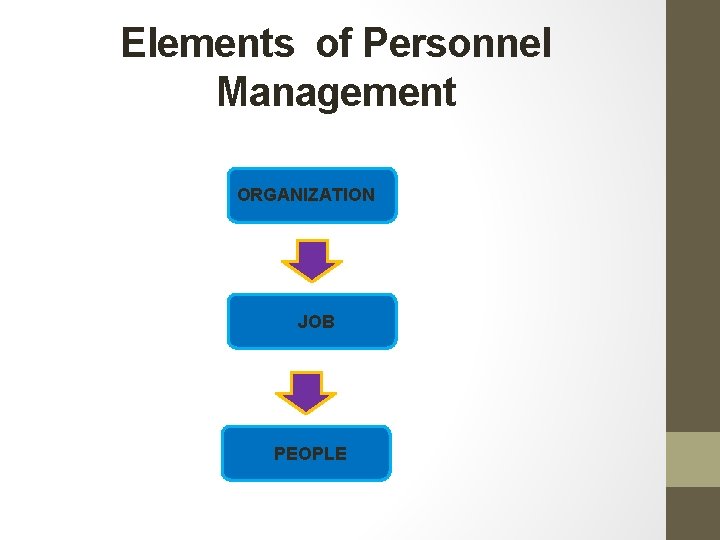
Elements of Personnel Management ORGANIZATION JOB PEOPLE
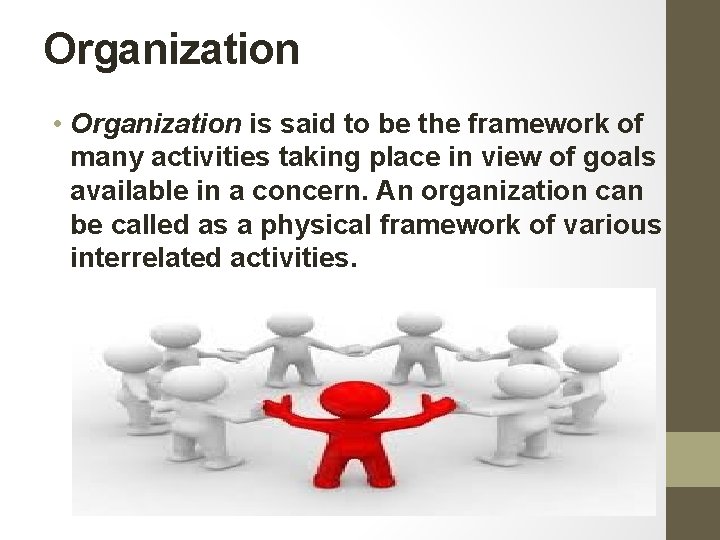
Organization • Organization is said to be the framework of many activities taking place in view of goals available in a concern. An organization can be called as a physical framework of various interrelated activities.
Job • The second element, i. e. , jobs tell us the activities to be performed in the organization. It is said that the goals of an enterprise can be achieved only through the functional department in it.
People § The last and foremost element in Personnel Management is people. In a organizational structure, where the main aim is to achieve the goals, the presence of manpower becomes vital.
Personnel Manager • Personnel manager is the head of personnel department. • He performs both managerial and operative functions of management.
Roles of a Personnel Manager • Personnel manager provides assistance to top management • The top management are the people who decide and frame the primary policies of the concern. All kinds of policies related to personnel or workforce can be framed out effectively by the personnel manager. • He advices the line manager as a staff specialist • Personnel manager acts like a staff advisor and assists the line managers in dealing with various personnel matters.
Roles of a Personnel Manager • As a counselor • • Personnel manager attends problems and grievances of employees and guides them. He tries to solve them in best of his capacity. As a mediator • • He is a linking pin between management and workers. As a spokesman • Since he is in direct contact with the employees, he is required to act as representative of organization in committees appointed by government. He represents company in training programs.
Approaches to Personnel Management • Mechanical Approach • Paternalism • Social System
Mechanical Approach toward Personnel • Labour must be classified with capital and land. • Personnel are controllable, predictable, and interchangeable. • Techniques such as time study, incentive wages were introduced. • Problems incurred were • Loss of jobs through development of new machines or work techniques • Decreased economic security leading to formation of labour organizations • Labour organizations grew at a very slow pace • Decreased pride in work
Paternalism • Management must assume a • fatherly and • protective attitude Toward employees. • Activities such as • Company stores • Company homes and • Recreational facilities were started
Social System • The firm is viewed as a complex central system operating within a complex environment which can be termed as “outer-extended system” • The central system cannot be closed & directed in a mechanistic fashion. • Options are available to central system members with the aid of labour unions, government, and various public groups.
Organizing the Personnel Unit • Bases of Departmentation • Procurement (employment) • Development (training) • Compensation (wage & salary administration) • Integration (labor relations) • Maintenance (safety) • Separation (employee services, retirement)
Personnel Management Functions 1. Manpower Planning 2. Recruitment 3. Employee Selection 4. Training
Manpower Planning • is also called as Human Resource Planning • consists of putting the right number of people, the right kind of people at the right place, at the right time, doing the right things for which they are suited for the achievement of goals of the organization.
Recruitment 2 Types of Recruitment • Internal Recruitment • is a recruitment which takes place within the concern or organization. Internal sources of recruitment are readily available to an organization. Internal recruitment sources are primarily : • Transfers • Promotions (through Internal Job Postings) • Re-employment of ex-employees
Recruitment • External sources of recruitment have to be solicited from outside the organization. Some external recruitment sources are : • Advertisement • Employment Agencies • Educational Institutions • Recommendations • Labor Contractors
Recruiting Employees • Recruiting • Types of: • Internal • External • Goal of recruiting: increase the ratio of employee applications to those actually hired. How to recruit n Promote from within n Use staff to recruit n Use armed services n Use construction industry n Farming/agriculture background n Apprenticeship training programs n Universities & technical schools n Internet
The Goal of Hiring: • The goal of filling a vacant position is not to fill the position, it is to fill the position with the right person. • Hiring the right person helps to keep your turnover rate low.
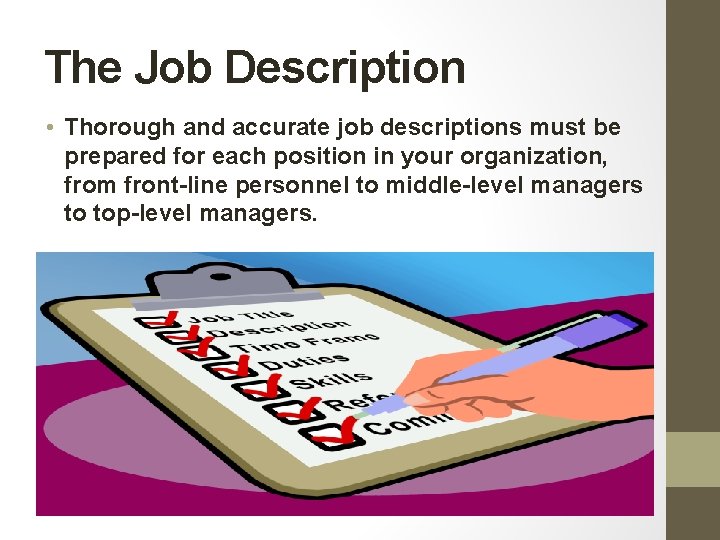
The Job Description • Thorough and accurate job descriptions must be prepared for each position in your organization, from front-line personnel to middle-level managers to top-level managers.
What to Include In a Job Description: • Title • Listing of responsibilities and functions • Required knowledge and skills • Minimum acceptable education level, certification requirements and previous experience • Physical or medical standards.
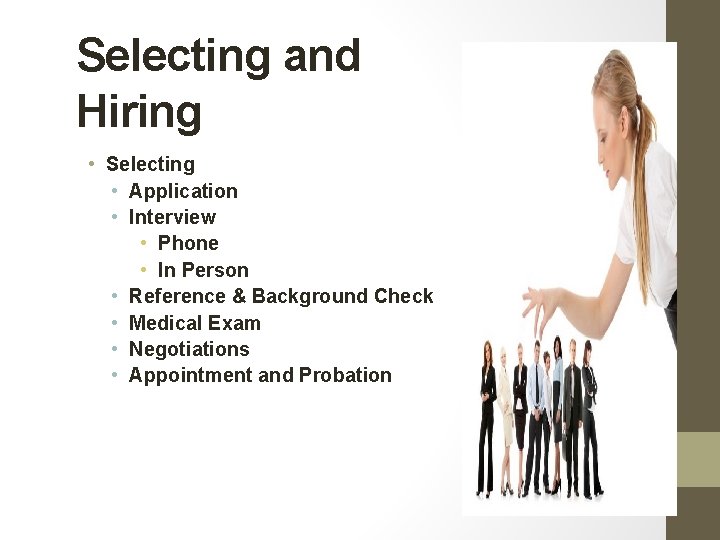
Selecting and Hiring • Selecting • Application • Interview • Phone • In Person • Reference & Background Check • Medical Exam • Negotiations • Appointment and Probation
Employee Selection • It is the process of putting right men on the right job. It is a procedure of matching organizational requirements with the skills and qualifications of people. • Effective selection can be done only when there is effective matching. By selecting best candidate for the required job, the organization will get quality performance of employees.
Employee Selection Process • Preliminary Interview • It is used to eliminate those candidates who do not meet the minimum eligibility criteria laid down by the organization. • Written Tests • Various written tests conducted during selection procedure aptitude test, intelligence test, reasoning test, personality test, etc. These tests are used to objectively assess the potential candidate. • Employment Interviews • It is a one to one interaction between the interviewer and the potential candidate. It is used to find whether the candidate is best suited for the required job or not.
Employee Selection Process • Medical examination • Medical tests are conducted to ensure physical fitness of the potential employee. It will decrease chances of employee absenteeism. • Appointment Letter • A reference check is made about the candidate selected and then finally he is appointed by giving a formal appointment letter.
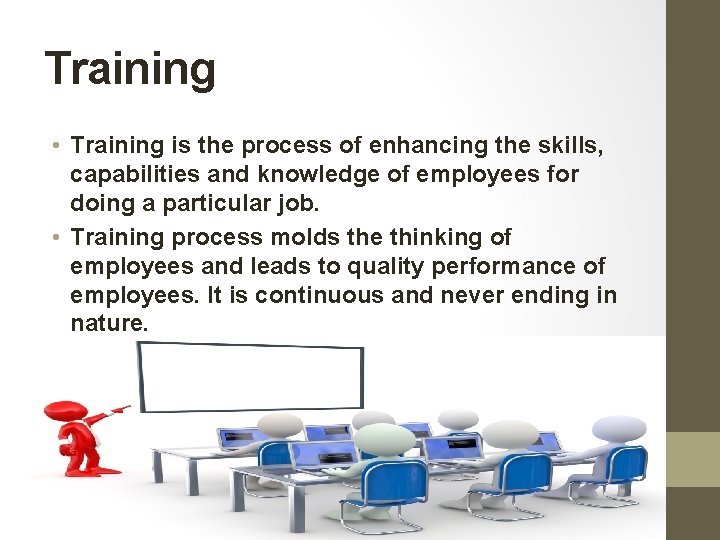
Training • Training is the process of enhancing the skills, capabilities and knowledge of employees for doing a particular job. • Training process molds the thinking of employees and leads to quality performance of employees. It is continuous and never ending in nature.
Benefits of Training • Improves morale of employees • Training helps the employee to get job security and job satisfaction. The more satisfied the employee is and the greater is his morale, the more he will contribute to organizational success and the lesser will be employee absenteeism and turnover. • Less Supervision • A well trained employee will be well acquainted with the job and will need less of supervision. Thus, there will be less wastage of time and efforts. • Fewer Accidents • Errors are likely to occur if the employees lack knowledge and skills required for doing a particular job. The more trained an employee is, the less are the chances of committing accidents in job and the more proficient the employee becomes.
Benefits of Training • Chances of promotion • Employees acquire skills and efficiency during training. They become more eligible for promotion. They become an asset for the organization. • Increased productivity • Training improves efficiency and productivity of employees. Well trained employees show both quantity and quality performance. There is less wastage of time, money and resources if employees are properly trained.
Methods of Training • On The Job Training • On the job training methods are those which are given to the employees within the everyday working of a concern. The motto of such training is “learning by doing. ” • Off The Job Training • Off the job training methods are those in which training is provided away from the actual working condition. Off the job training is also called as vestibule training, i. e. , the employees are trained in a separate area( may be a hall, entrance, reception area, etc. known as a vestibule) where the actual working conditions are duplicated.
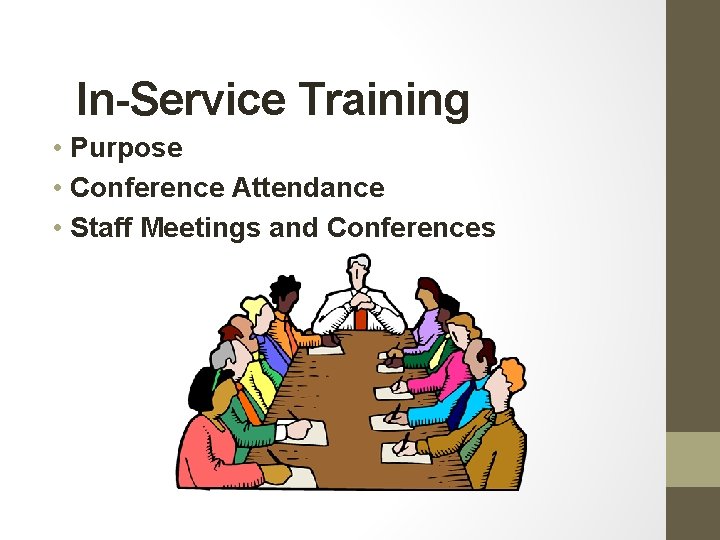
In-Service Training • Purpose • Conference Attendance • Staff Meetings and Conferences
Training • Training formats. • Skills training. • Coaching. • Formal or informal classroom instruction. • Sensitivity or “T-group” training. • Job rotation. • Special conferences and seminars. • Modeling, games, and seminars. • Exchange and sabbatical programs.
Training • Thorough orientation • Introduction to the agency and its personnel and program practices. • • • Tour of facilities Exposure to its various divisions and functions Introduction to personnel Outline of responsibilities and procedures Overview of organizational climate/environment • On-site training/Apprenticeship • “Scrimmage games” – Mock work environment
Employee Relations • Employee relations generally deal with avoiding and resolving issues concerning individuals which might arise out of or influence the work scenario. • Healthy employee relations lead to more efficient, motivated and productive employees which further lead to increase in sales level.
Employee Relations • Employee Indiscipline • It is when the employees do not behave as per the accepted norms of behavior. Absenteeism, change in employee’s behavior, slow performance and grievances are all forms of employee indiscipline. • Employee Grievance • The employees also expect from the management to provide them a safe working environment, fair treatment, proper incentives, participation in decisions, and needs satisfaction. The failure on part of management to meet these expectations is termed as employee grievance. • Employee Stress • It is when the employees fail to meet their own expectations whether in terms of personal goals, career goals, performance, self-respect, etc
Improving Employee Relations • Employee has expectation of fair and just treatment by the management. Thus, management must treat all employees as individuals and must treat them in a fair manner. Employee favoritism should be avoided. • Do not make the employees’ job monotonous. Keep it interesting. Make it more challenging. This can be done by assigning employees greater responsibilities or indulging them in training programs. • Maintain a continuous interaction with the employees. Keep them updated about company’s policies, procedures and decisions. • Employees must be rewarded and appreciated for a welldone job or for achieving/over-meeting their targets. This will boost them and they will work together as a team.
Improving Employee Relations • Encourage employee feedback. This feedback will make the employers aware of the concerns of employees, and their views about “you” as an employer. • Give the employees competitive salary. They should be fairly paid for their talents, skills and competencies. • Be friendly but not over-friendly with the employees. Build a good rapport with the employee. The employee should feel comfortable with the manager/supervisor rather than feeling scared.
Supervising Working Conditions to Maintain and Effectively Utilize Personnel • Working conditions refers to the working environment and to the non-pay aspects of an employee’s terms and conditions of employment. • It covers such matters as the organization of work and work activities; training, skills and employability; health, safety and well-being.
Various Services and Benefits to Workers • Health Services or Programs • Physical Examination • Employee Services • According to the Employee Services Management Association, employee services encompass "recreation programs, community services, recognition programs, event planning, childcare/eldercare services, convenience services, and travel offerings. "
Maintaining Personnel Records & Personnel Research • Personnel Records are records pertaining to employees of an organization. These records are accumulated, factual and comprehensive information related to concern records and detained. • Such records are helpful to a manager in various decision -making areas.
Types of Personnel Record 1. 2. 3. 4. 5. Records of employment contain applicants past records, list sources, employees progress, medical reports, etc. Wages and salaries records contains pay roll records, methods of wages and salaries, leave records, turnover records and other benefit records. Training and development contains appraisal reports, transfer cases, training schedule, training methods. Health and safety records include sickness reports, safety provisions, medical history, insurance reports, etc. Service Records are the essential records containing biodata, residential and family information, academic qualifications, marital status, past address and employment records.
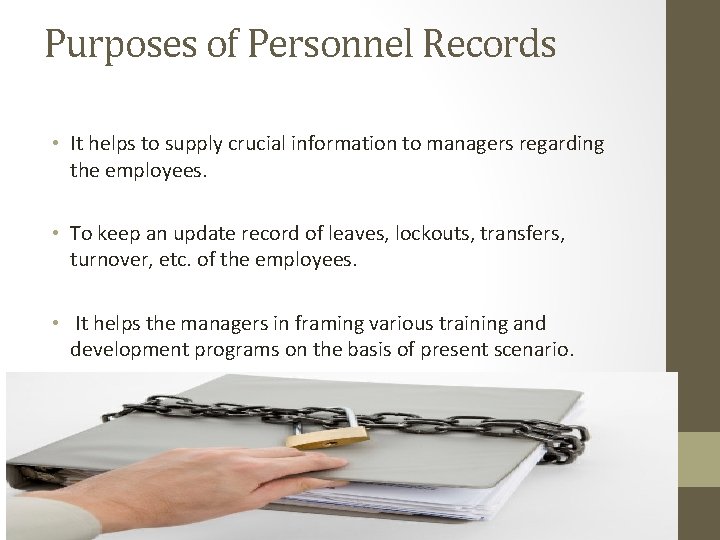
Purposes of Personnel Records • It helps to supply crucial information to managers regarding the employees. • To keep an update record of leaves, lockouts, transfers, turnover, etc. of the employees. • It helps the managers in framing various training and development programs on the basis of present scenario.
Purposes of Personnel Record • It helps the government organizations to gather data in respect to rate of turnover, rate of absenteeism and other personnel matters. • It helps the managers to make salary revisions, allowances and other benefits related to salaries. • It also helps the researchers to carry in- depth study with respect to industrial relations and goodwill of the firm in the market.
REMUNERATIONS • Full-time • Seasonal • Salaried • Exempt • Non-Exempt
Hours of Week: • Workweek • Full-time salaried • Full-time hourly • Work schedules
Compensation & Benefits • Salary classification • Pay periods and time reports • Deductions • Holidays • Overtime • Vacation • Insurance • Retirement • Credit Union
Rules of conduct • Dress and appearance • Employee cooperation • Reporting for duty
Relations between employeesdepartment-community • Employee-administrator relations • Employee-community relations • Gifts • Solicitation of funds • Management of funds • Publicity releases • Employee-patron relations • Accidents to patrons
Employee Manuals • A good employee manual will not just include personnel policies but will also serve as a reference with the details of more complicated or less frequently performed tasks. • It will present a numbered sequence of operations, in order, for each of these tasks.
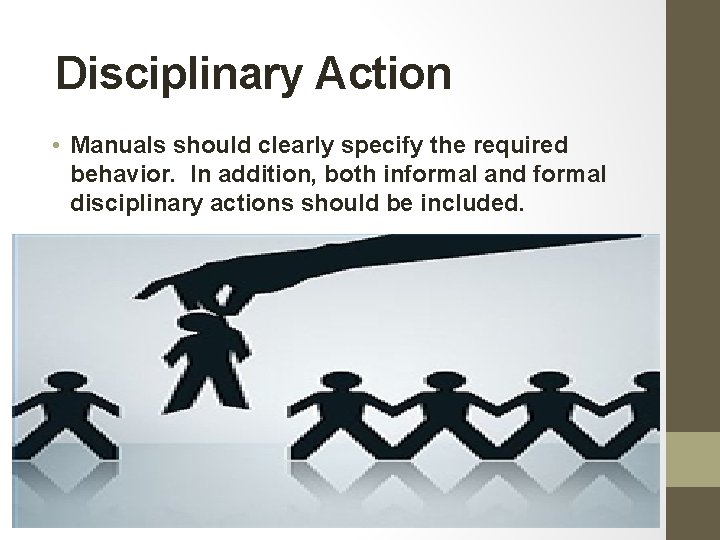
Disciplinary Action • Manuals should clearly specify the required behavior. In addition, both informal and formal disciplinary actions should be included.
Guidelines for Effective Counseling: • Listen patiently - without interrupting • Refrain from criticizing or offering hasty advice • Never argue with employees while counseling them • Give them your undivided attention while they are talking • Look beyond the mere words of what they are saying
Employee Motivation • Reinforcement techniques: • Positive reinforcers – add something good to the employee’s life • Negative reinforcers – remove something unpleasant, such as a distasteful task or schedule, from the employee’s life • Punishers or deterrents – adds something unpleasant or removes something good. • Reinforcement techniques are considered to be far superior in producing lasting behavioral changes.
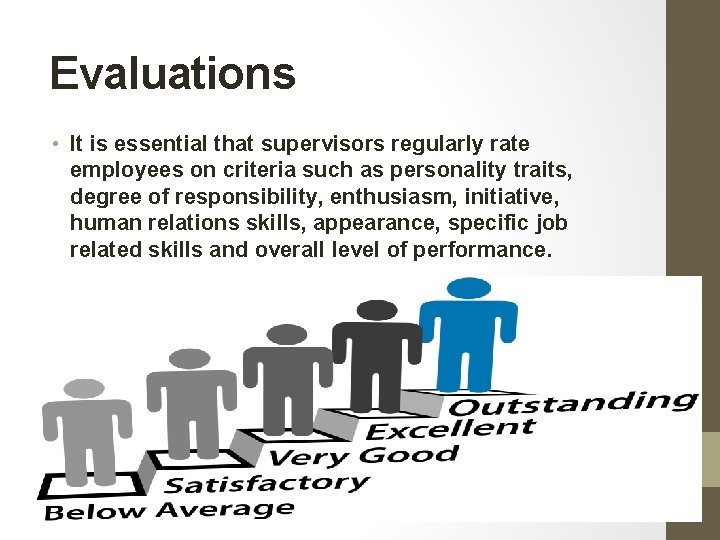
Evaluations • It is essential that supervisors regularly rate employees on criteria such as personality traits, degree of responsibility, enthusiasm, initiative, human relations skills, appearance, specific job related skills and overall level of performance.
Special Maintenance Employee Issues • Occupational Safety and Health Act • Maintenance related safety problems
Special Employee Safety Problems: • Temporary and seasonal employees • Language barriers to safety • Workers in isolated locations • Vehicles and traffic hazards • Tools and equipment • Protective equipment • Rubbish removal
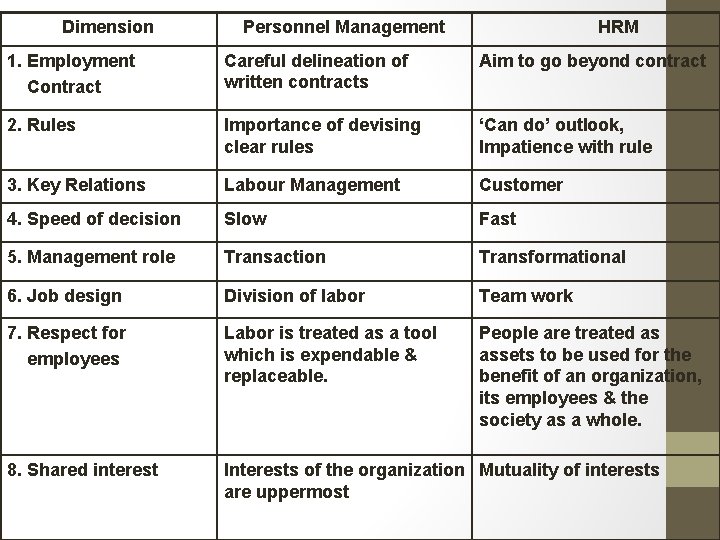
Dimension Personnel Management HRM 1. Employment Contract Careful delineation of written contracts Aim to go beyond contract 2. Rules Importance of devising clear rules ‘Can do’ outlook, Impatience with rule 3. Key Relations Labour Management Customer 4. Speed of decision Slow Fast 5. Management role Transaction Transformational 6. Job design Division of labor Team work 7. Respect for employees Labor is treated as a tool which is expendable & replaceable. People are treated as assets to be used for the benefit of an organization, its employees & the society as a whole. 8. Shared interest Interests of the organization Mutuality of interests are uppermost