Periodic Trends Summary Properties Atomic Radius size of
- Slides: 14
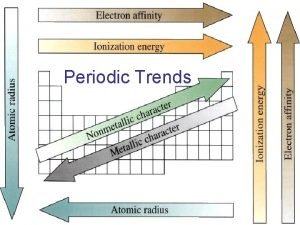
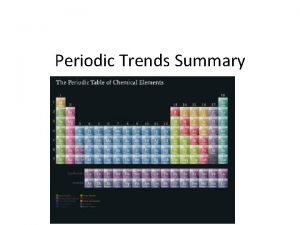
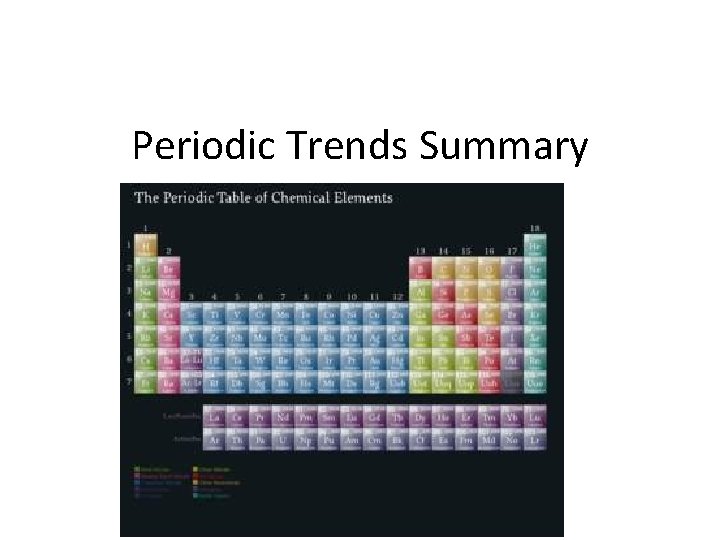
Periodic Trends Summary
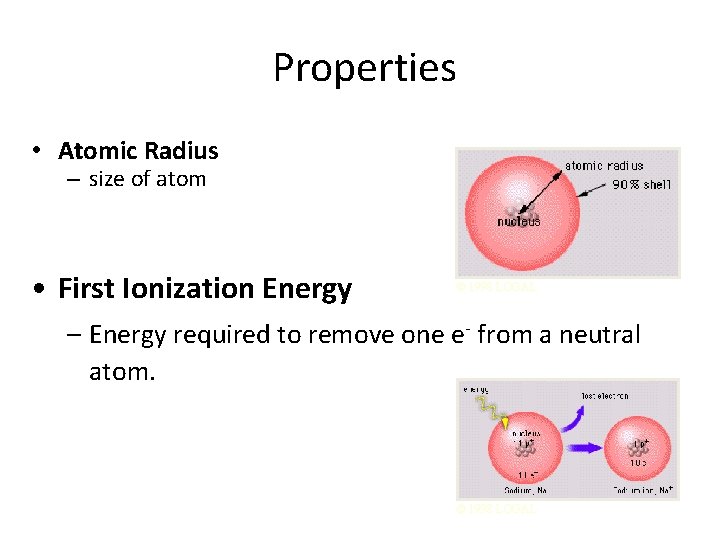
Properties • Atomic Radius – size of atom • First Ionization Energy © 1998 LOGAL – Energy required to remove one e- from a neutral atom. © 1998 LOGAL
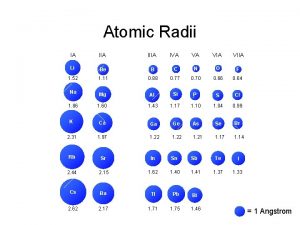
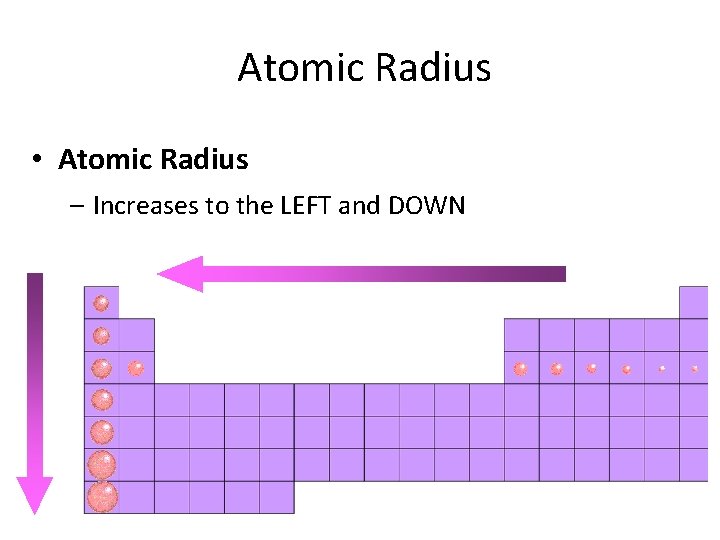
Atomic Radius • Atomic Radius – Increases to the LEFT and DOWN
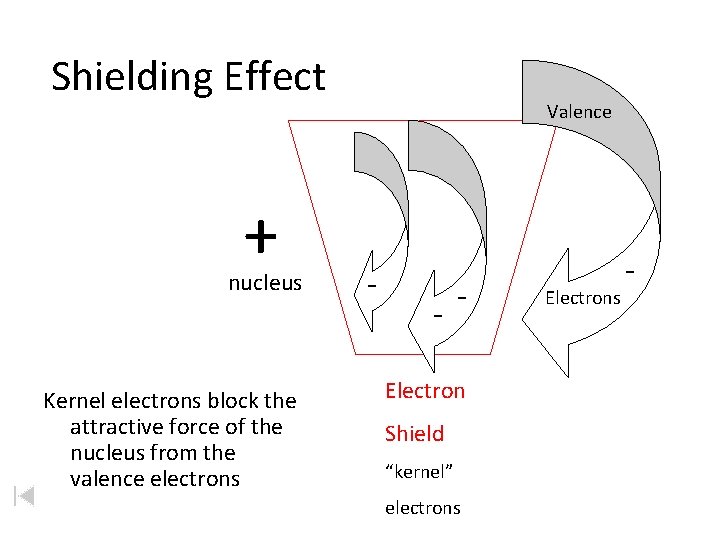
Atomic Radius • Why larger going down? – Higher energy levels have larger orbitals – Shielding - core e- block the attraction between the nucleus and the valence e- • Why smaller to the right? – Increased nuclear charge without additional shielding pulls e- in tighter
Shielding Effect + nucleus Kernel electrons block the attractive force of the nucleus from the valence electrons Valence - - - Electron Shield “kernel” electrons Electrons -
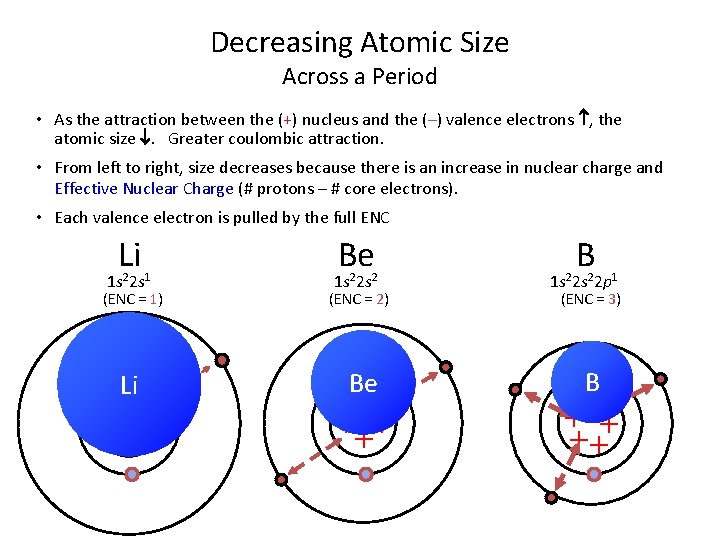
Decreasing Atomic Size Across a Period • As the attraction between the (+) nucleus and the (–) valence electrons , the atomic size . Greater coulombic attraction. • From left to right, size decreases because there is an increase in nuclear charge and Effective Nuclear Charge (# protons – # core electrons). • Each valence electron is pulled by the full ENC Li 1 s 22 s 1 Be 1 s 22 s 2 (ENC = 1) (ENC = 2) Li Be ++ + + B 1 s 22 p 1 (ENC = 3) B +++ ++
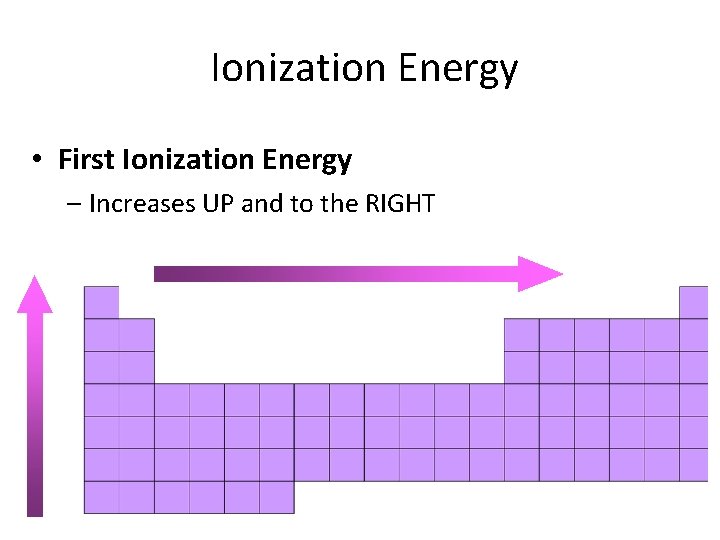
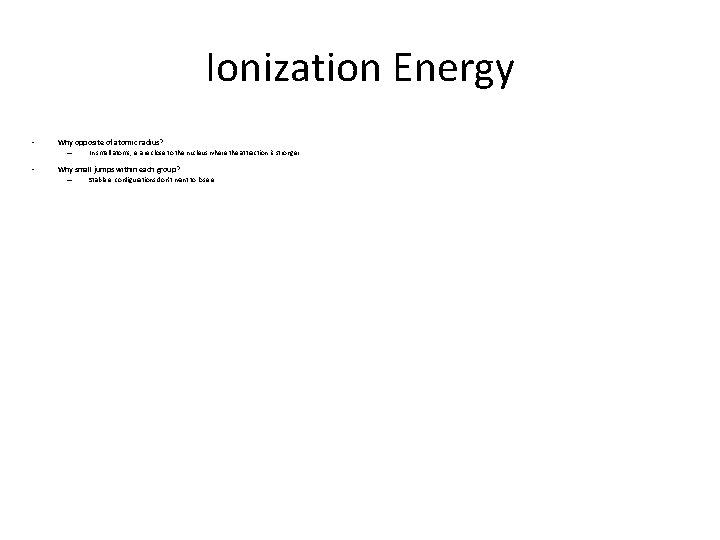
Ionization Energy • First Ionization Energy – Increases UP and to the RIGHT
Ionization Energy • Why opposite of atomic radius? – • In small atoms, e - are close to the nucleus where the attraction is stronger Why small jumps within each group? – Stable e- configurations don’t want to lose e -
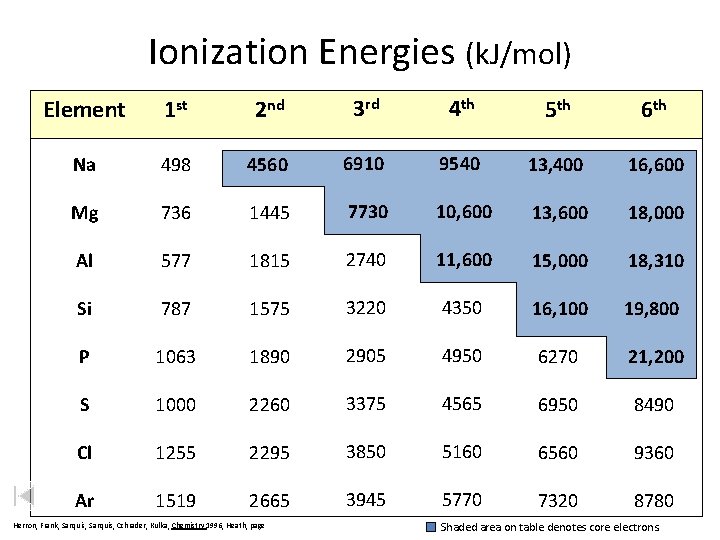
Ionization Energies (k. J/mol) Element 1 st 2 nd 3 rd 4 th 5 th 6 th Na 498 4560 6910 9540 13, 400 16, 600 Mg 736 1445 7730 10, 600 13, 600 18, 000 Al 577 1815 2740 11, 600 15, 000 18, 310 Si 787 1575 3220 4350 16, 100 19, 800 P 1063 1890 2905 4950 6270 21, 200 S 1000 2260 3375 4565 6950 8490 Cl 1255 2295 3850 5160 6560 9360 Ar 1519 2665 3945 5770 7320 8780 Herron, Frank, Sarquis, Cchrader, Kulka, Chemistry 1996, Heath, page Shaded area on table denotes core electrons.
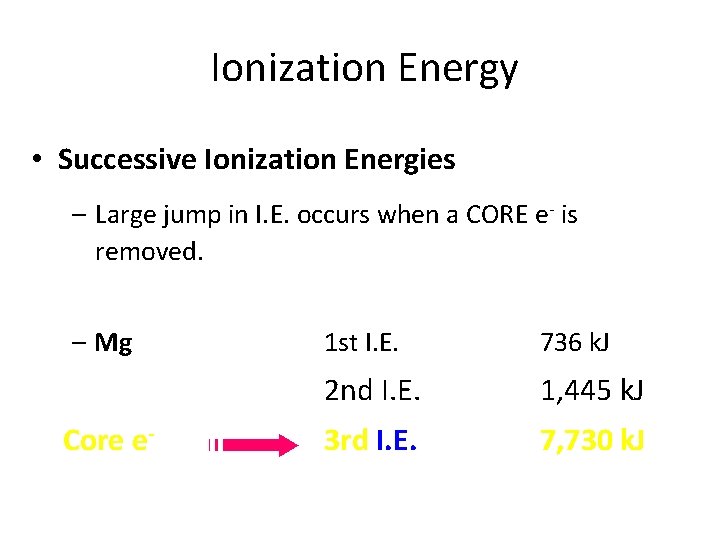
Ionization Energy • Successive Ionization Energies – Large jump in I. E. occurs when a CORE e- is removed. – Mg Core e- 1 st I. E. 736 k. J 2 nd I. E. 1, 445 k. J 3 rd I. E. 7, 730 k. J
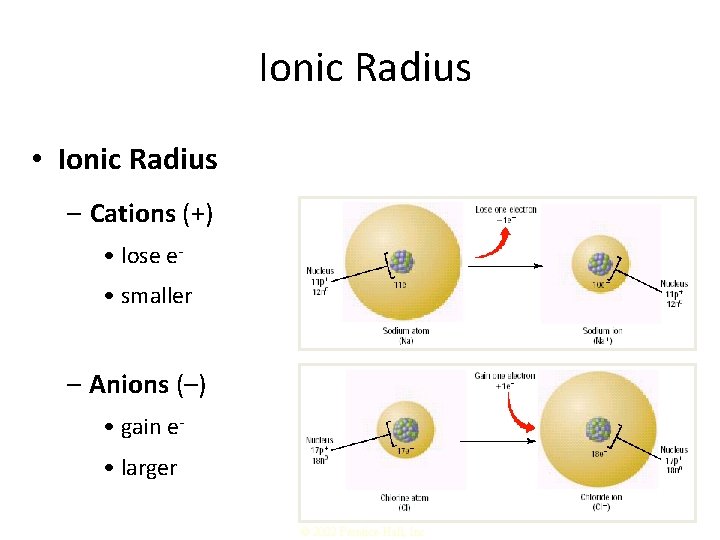
Ionic Radius • Ionic Radius – Cations (+) • lose e • smaller – Anions (–) • gain e • larger © 2002 Prentice-Hall, Inc.
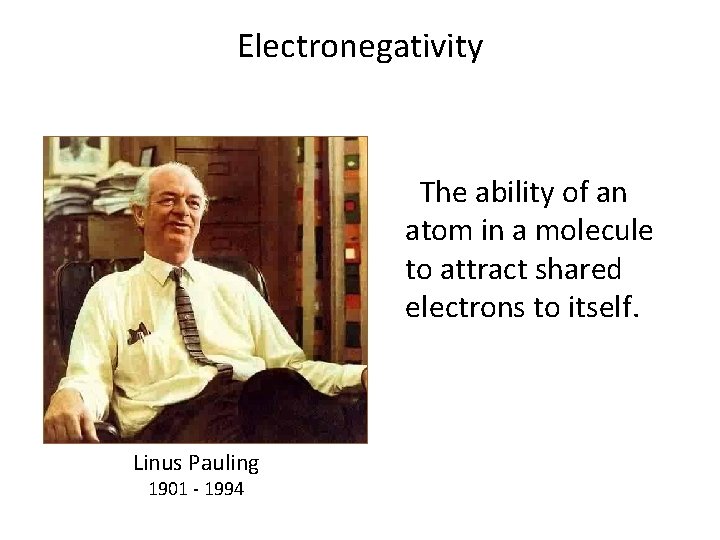
Electronegativity The ability of an atom in a molecule to attract shared electrons to itself. Linus Pauling 1901 - 1994
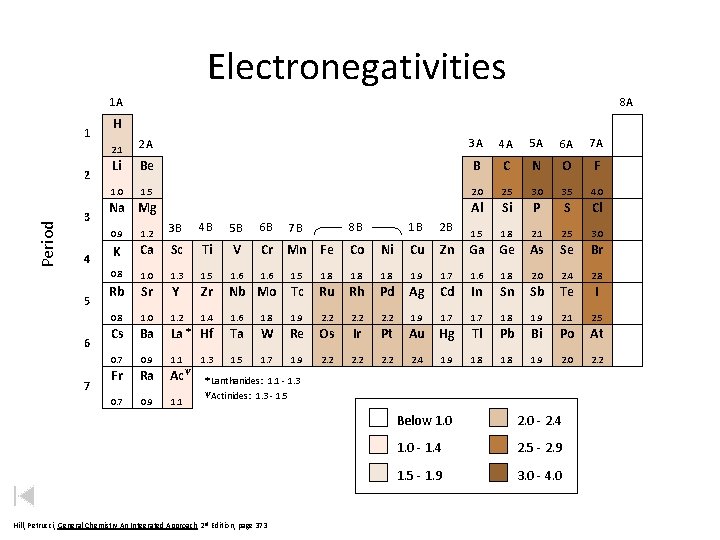
Electronegativities 1 A 1 Period 2 3 4 5 6 7 8 A H 2. 1 2 A 3 A 4 A 5 A 6 A 7 A Li Be B C N O F 1. 0 1. 5 2. 0 2. 5 3. 0 3. 5 4. 0 Al Si P S Cl 1. 5 1. 8 2. 1 2. 5 3. 0 Na Mg 1 B 2 B Ni Cu Zn Ga Ge As Se Br 1. 8 1. 9 1. 7 1. 6 1. 8 2. 0 2. 4 2. 8 Ru Rh Pd Ag Cd In Sn Sb Te I 1. 9 2. 2 1. 9 1. 7 1. 8 1. 9 2. 1 2. 5 W Re Os Ir Pt Au Hg Tl Pb Bi Po At 1. 7 1. 9 2. 2 2. 4 1. 9 1. 8 1. 9 2. 0 2. 2 0. 9 1. 2 3 B 4 B 5 B 6 B 7 B 8 B K Ca Sc Ti V Cr Mn Fe Co 0. 8 1. 0 1. 3 1. 5 1. 6 1. 5 1. 8 Rb Sr Y Zr Nb Mo Tc 0. 8 1. 0 1. 2 1. 4 1. 6 1. 8 Cs Ba La * Hf Ta 0. 7 0. 9 1. 1 1. 3 1. 5 Fr Ra Ac 0. 7 0. 9 1. 1 y * Lanthanides: 1. 1 - 1. 3 - 1. 5 y. Actinides: Hill, Petrucci, General Chemistry An Integrated Approach 2 nd Edition, page 373 Below 1. 0 2. 0 - 2. 4 1. 0 - 1. 4 2. 5 - 2. 9 1. 5 - 1. 9 3. 0 - 4. 0
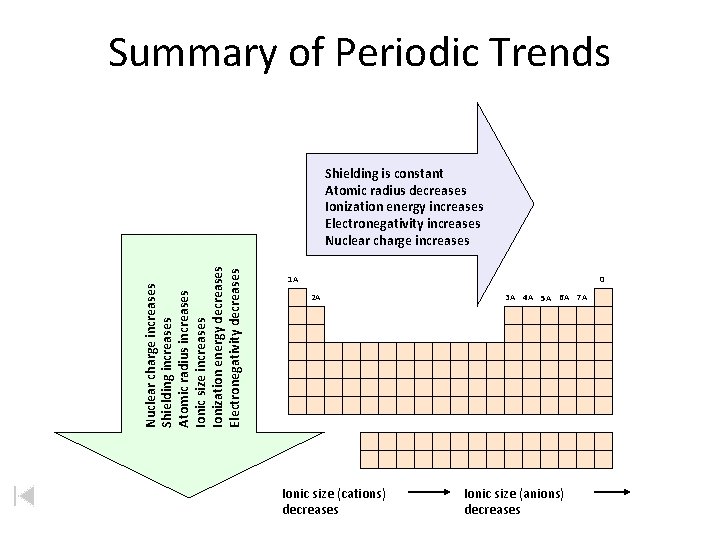
Summary of Periodic Trends Nuclear charge increases Shielding increases Atomic radius increases Ionic size increases Ionization energy decreases Electronegativity decreases Shielding is constant Atomic radius decreases Ionization energy increases Electronegativity increases Nuclear charge increases 1 A 0 2 A Ionic size (cations) decreases 3 A 4 A 5 A 6 A 7 A Ionic size (anions) decreases