
Electrons in Atoms Why do ions have the
- Slides: 85
Electrons in Atoms
• Why do ions have the charges they have? Like Al 3+ or Fe 2+ or Fe 3+ or O 2 • Why does an atom become an ion in the first place? • Why are the Br. INCl. HOF elements the only ones that make molecules with themselves? Why don’t any other elements do that? • How do fireworks make colors when they explode? • How do fluorescent lights work? • How do we know hot the sun is? • How is there life on this planet? • The electrons in atoms can answer all of these questions and so many others. • It all happens because of electrons……. .
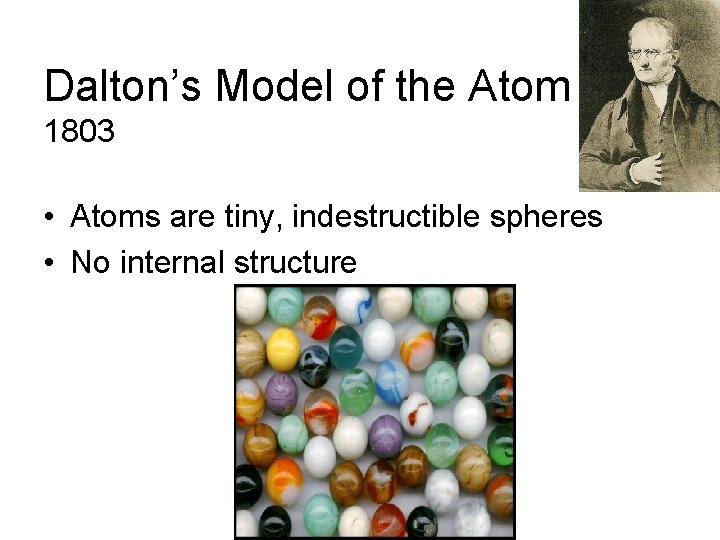
Dalton’s Model of the Atom 1803 • Atoms are tiny, indestructible spheres • No internal structure
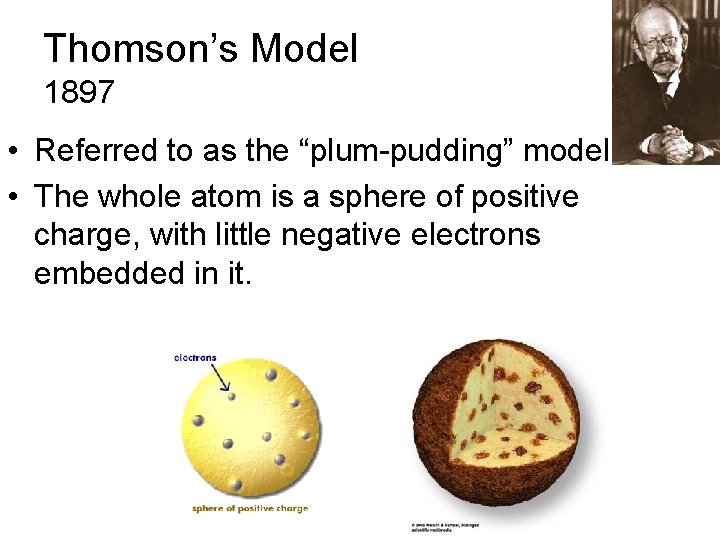
Thomson’s Model 1897 • Referred to as the “plum-pudding” model. • The whole atom is a sphere of positive charge, with little negative electrons embedded in it.
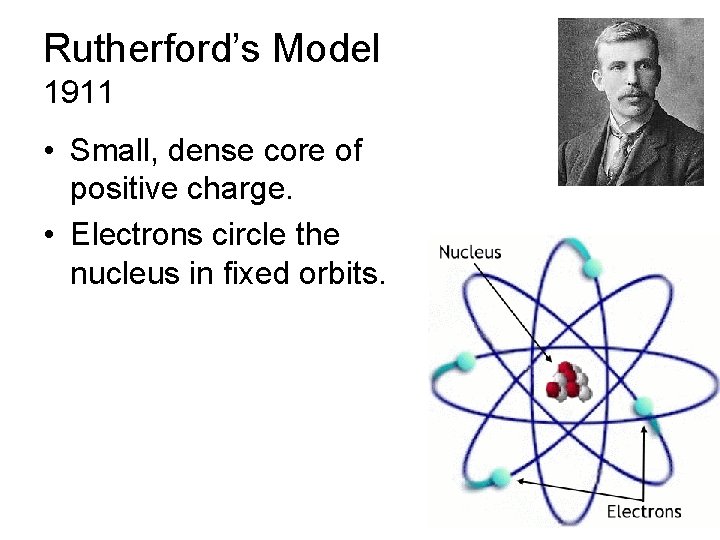
Rutherford’s Model 1911 • Small, dense core of positive charge. • Electrons circle the nucleus in fixed orbits.
Rutherford’s Model • Electrons revolve around the nucleus like planets around the sun (fixed orbits). • This model failed to explain some properties of atoms.
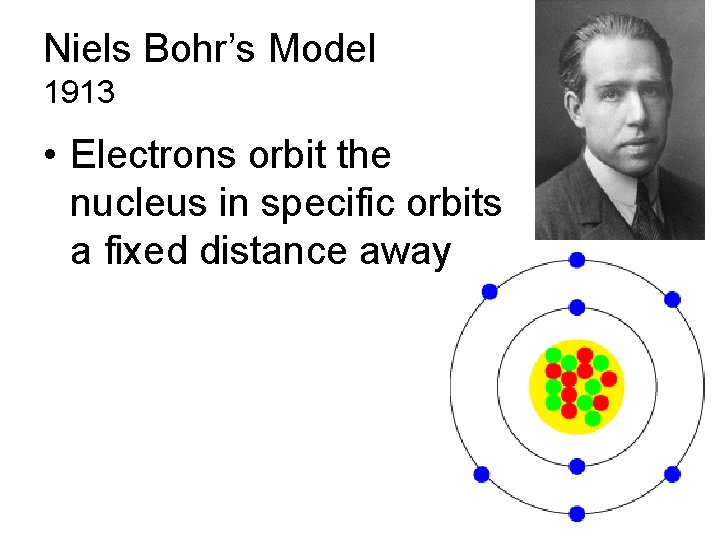
Niels Bohr’s Model 1913 • Electrons orbit the nucleus in specific orbits a fixed distance away.
Neils Bohr’s Model (1913) • They orbit at a particular energy level. They can move to a higher level, but they need energy to do so. • A quantum of energy is the required amount to move an e- to a higher level. Exactly this amount, no in-between.
Neils Bohr’s Model (1913) • This model of the atom had shortcomings. It failed to explain some phenomenon in nature. • So, a better version was still out there waiting to be discovered…. .
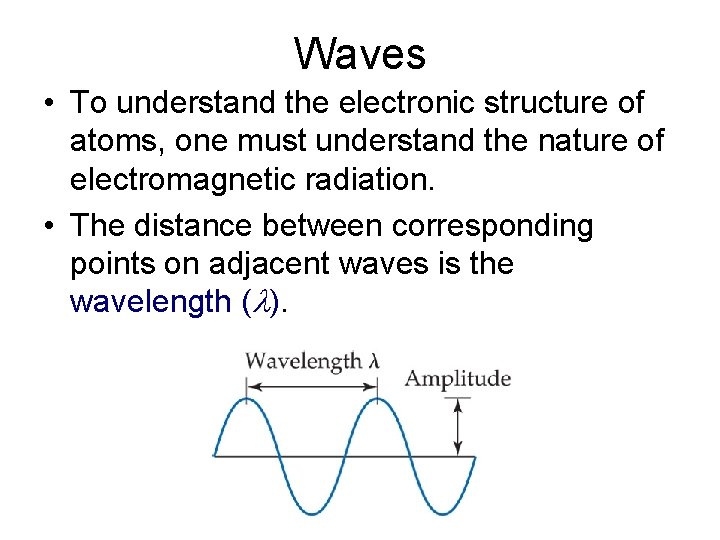
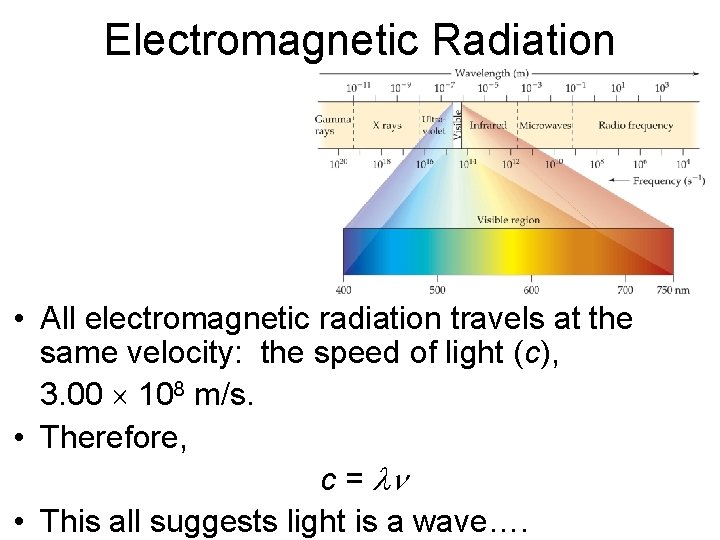
Waves • To understand the electronic structure of atoms, one must understand the nature of electromagnetic radiation. • The distance between corresponding points on adjacent waves is the wavelength ( ).
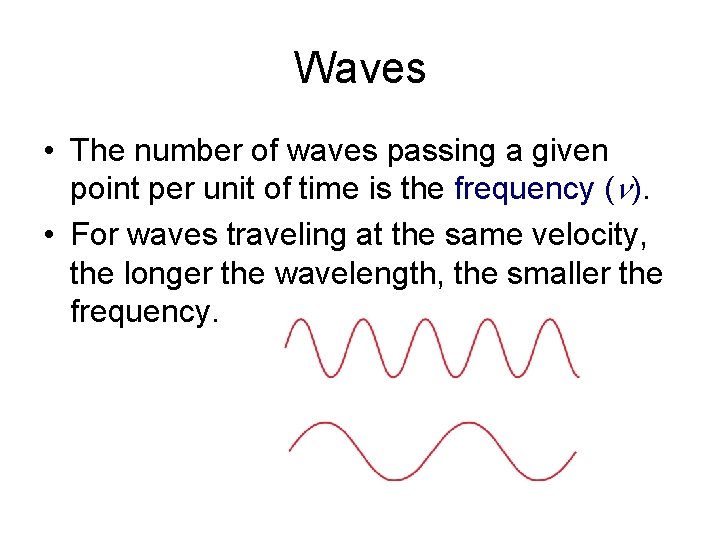
Waves • The number of waves passing a given point per unit of time is the frequency ( ). • For waves traveling at the same velocity, the longer the wavelength, the smaller the frequency.
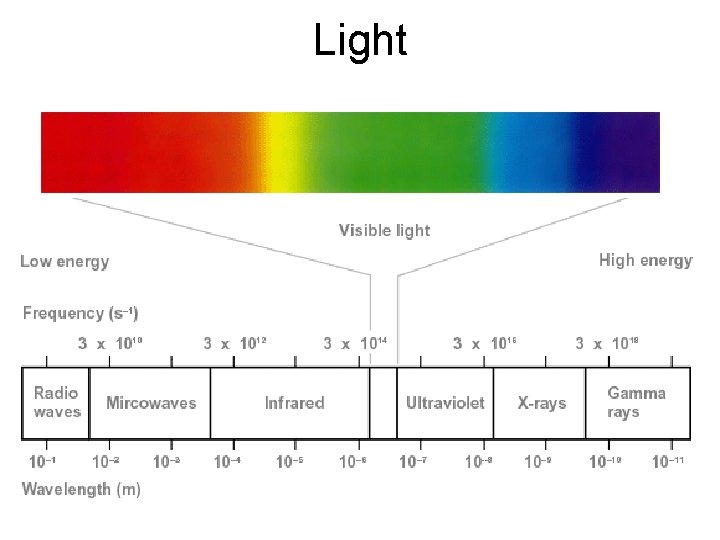
Light
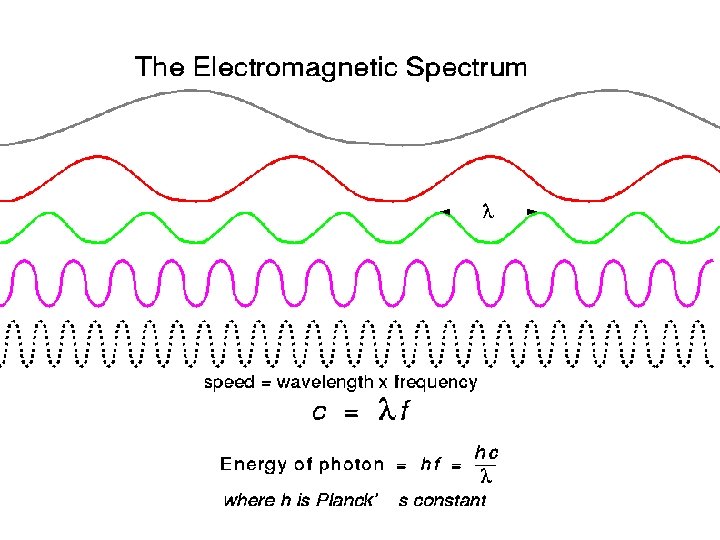
Electromagnetic Radiation • All electromagnetic radiation travels at the same velocity: the speed of light (c), 3. 00 108 m/s. • Therefore, c = • This all suggests light is a wave….
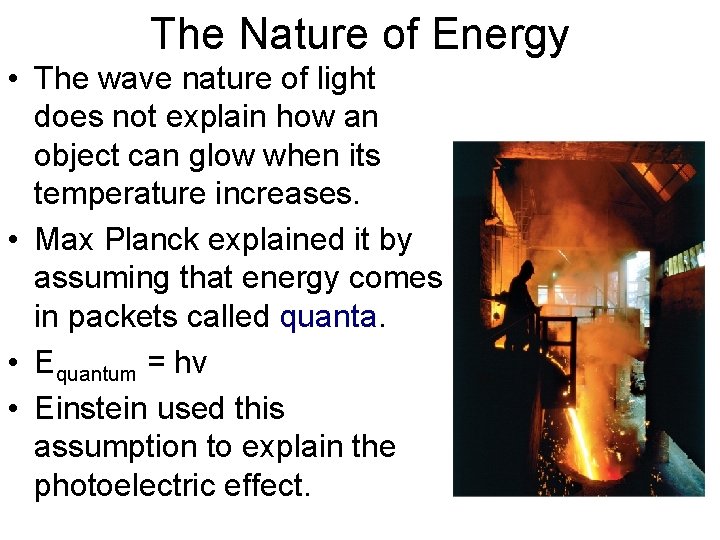
The Nature of Energy • The wave nature of light does not explain how an object can glow when its temperature increases. • Max Planck explained it by assuming that energy comes in packets called quanta. • Equantum = hν • Einstein used this assumption to explain the photoelectric effect.
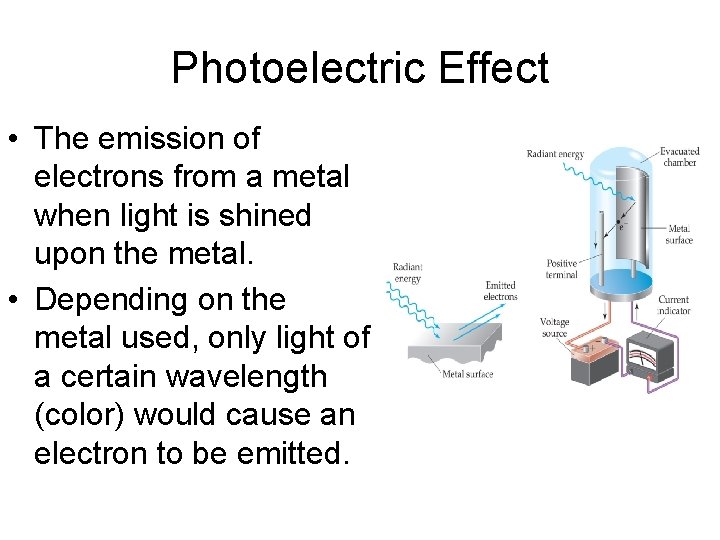
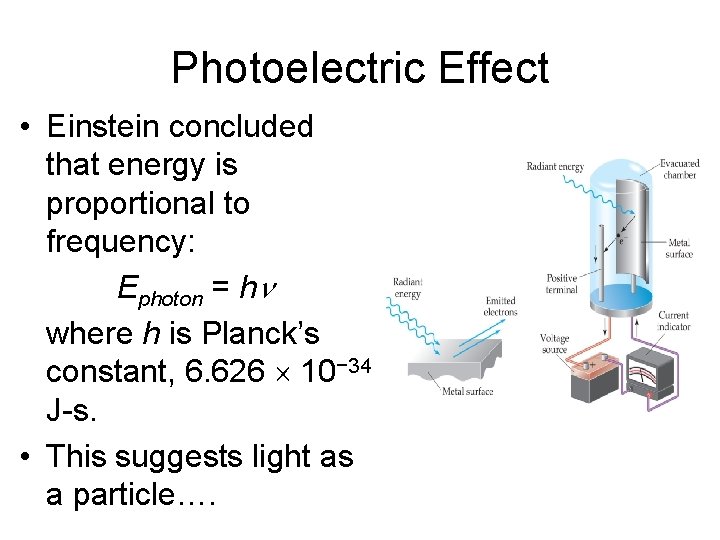
Photoelectric Effect • The emission of electrons from a metal when light is shined upon the metal. • Depending on the metal used, only light of a certain wavelength (color) would cause an electron to be emitted.
Photoelectric Effect • Einstein concluded that energy is proportional to frequency: Ephoton = h where h is Planck’s constant, 6. 626 10− 34 J-s. • This suggests light as a particle….
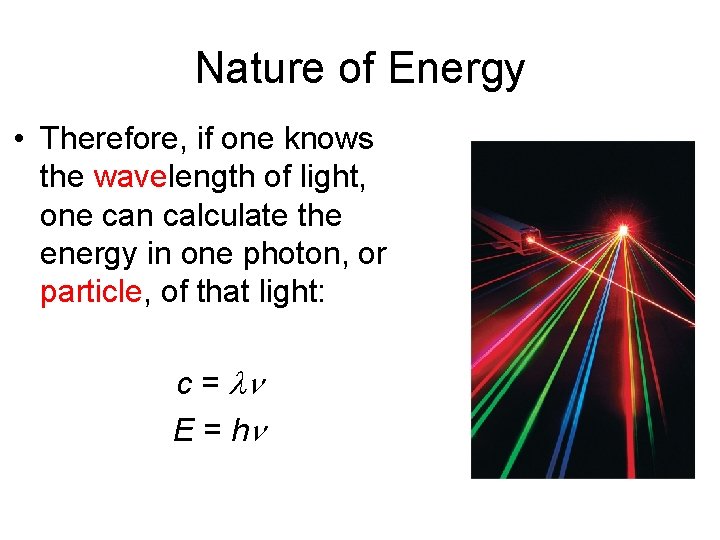
Nature of Energy • Therefore, if one knows the wavelength of light, one can calculate the energy in one photon, or particle, of that light: c = E = h
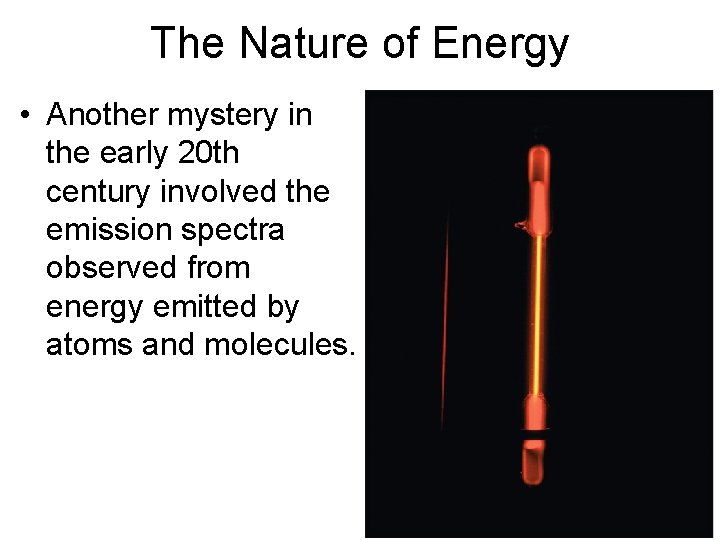
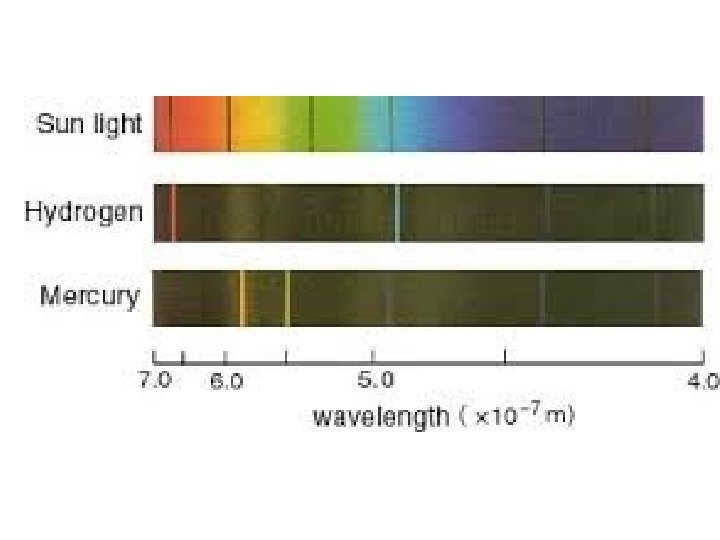
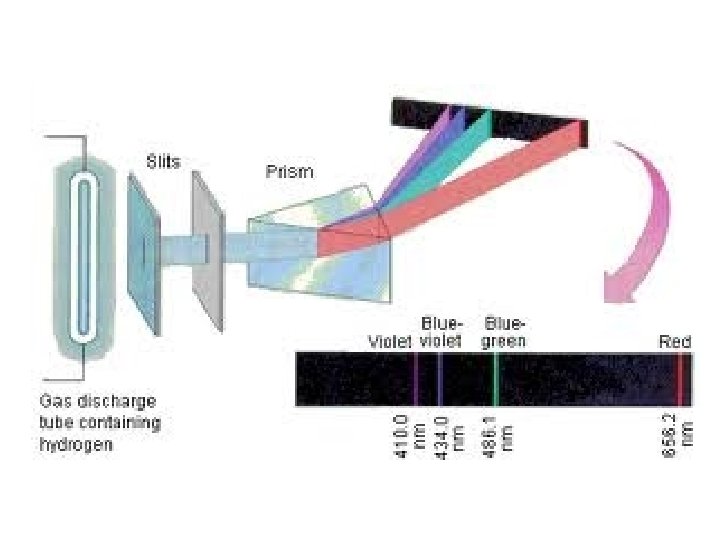
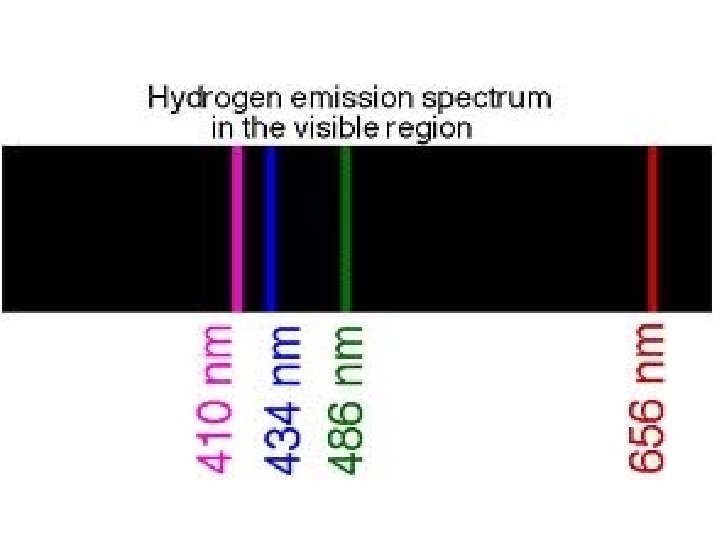
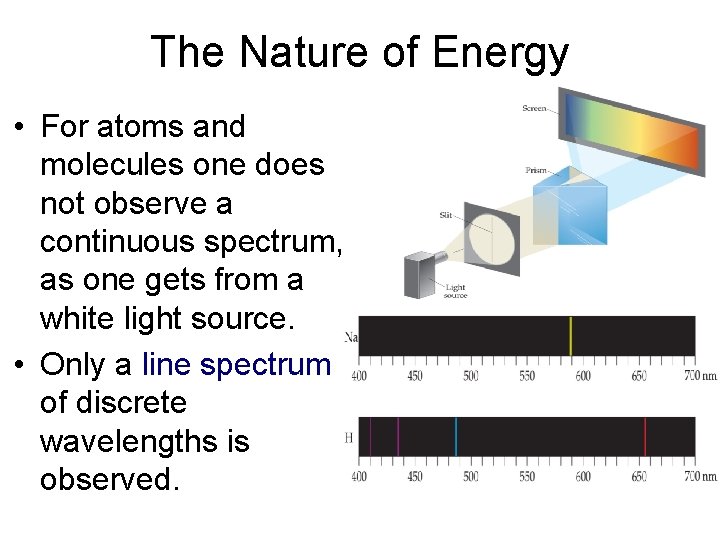
The Nature of Energy • Another mystery in the early 20 th century involved the emission spectra observed from energy emitted by atoms and molecules.
The Nature of Energy • For atoms and molecules one does not observe a continuous spectrum, as one gets from a white light source. • Only a line spectrum of discrete wavelengths is observed.
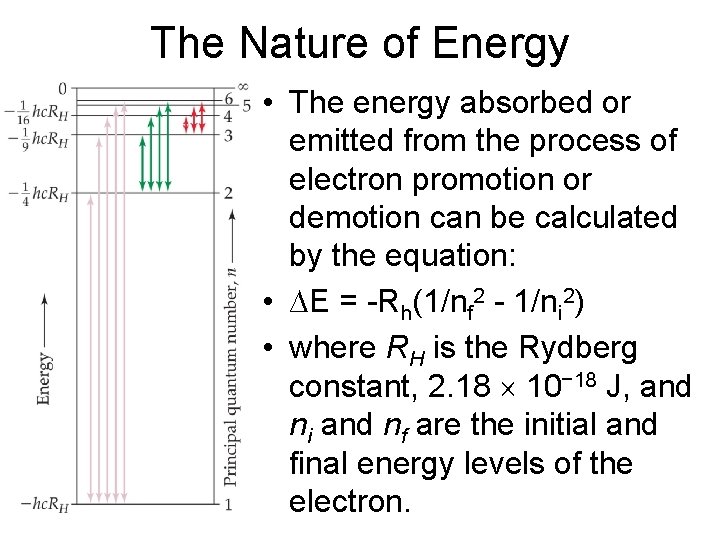
The Nature of Energy • Niels Bohr adopted Planck’s idea of quanta and explained these phenomena in this way: 1. Electrons in an atom can only occupy certain orbits (corresponding to certain energies). 2. Electrons in permitted orbits have specific, “allowed” energies; these energies will not be radiated from the atom. 3. Energy is only absorbed or emitted in such a way as to move an electron from one “allowed” energy state to another; the energy is defined by E = h
The Nature of Energy • The energy absorbed or emitted from the process of electron promotion or demotion can be calculated by the equation: • ∆E = -Rh(1/nf 2 - 1/ni 2) • where RH is the Rydberg constant, 2. 18 10− 18 J, and ni and nf are the initial and final energy levels of the electron.
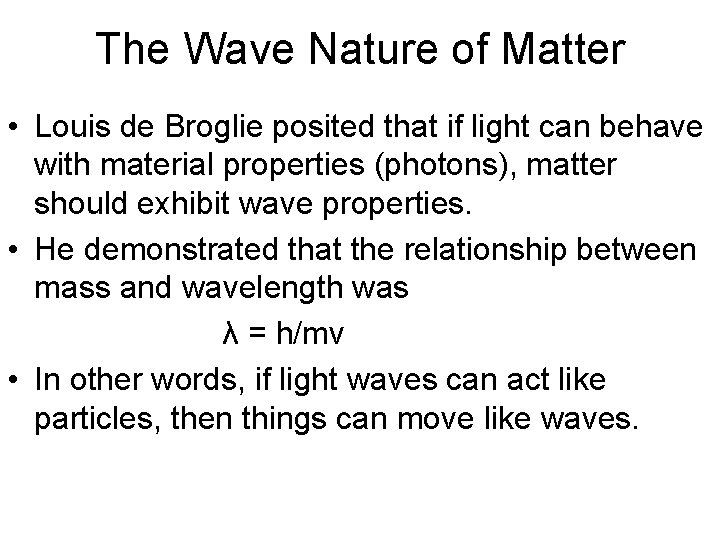
The Wave Nature of Matter • Louis de Broglie posited that if light can behave with material properties (photons), matter should exhibit wave properties. • He demonstrated that the relationship between mass and wavelength was λ = h/mv • In other words, if light waves can act like particles, then things can move like waves.
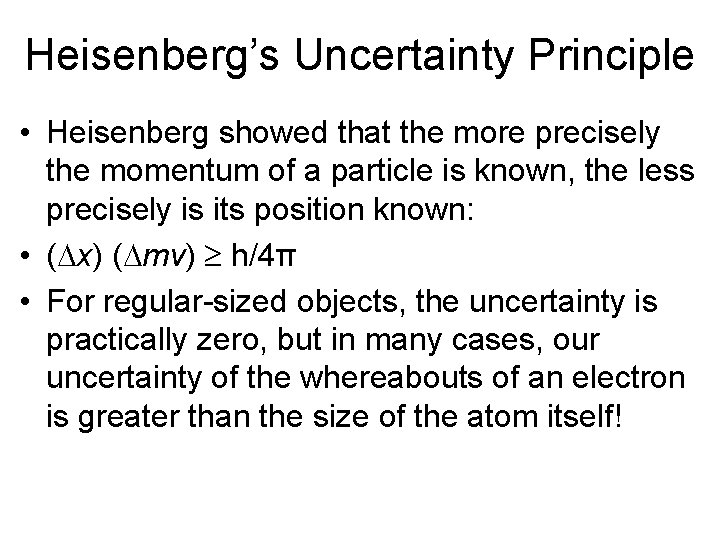
Heisenberg’s Uncertainty Principle • Heisenberg showed that the more precisely the momentum of a particle is known, the less precisely is its position known: • ( x) ( mv) h/4π • For regular-sized objects, the uncertainty is practically zero, but in many cases, our uncertainty of the whereabouts of an electron is greater than the size of the atom itself!
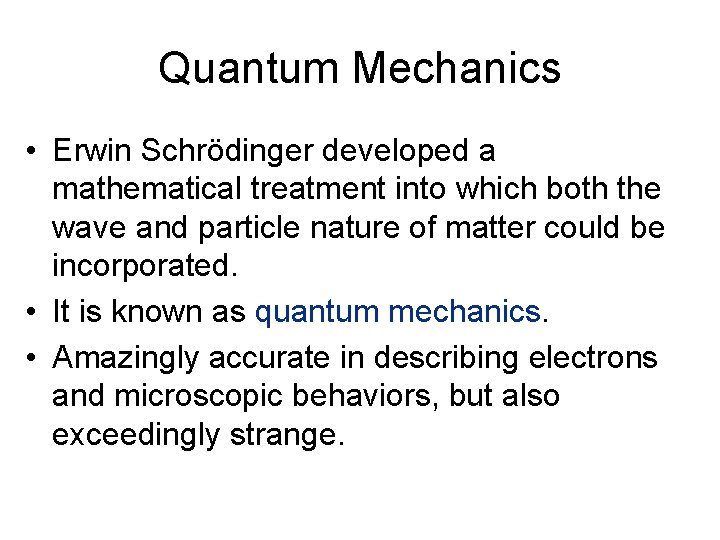
Quantum Mechanics • Erwin Schrödinger developed a mathematical treatment into which both the wave and particle nature of matter could be incorporated. • It is known as quantum mechanics. • Amazingly accurate in describing electrons and microscopic behaviors, but also exceedingly strange.
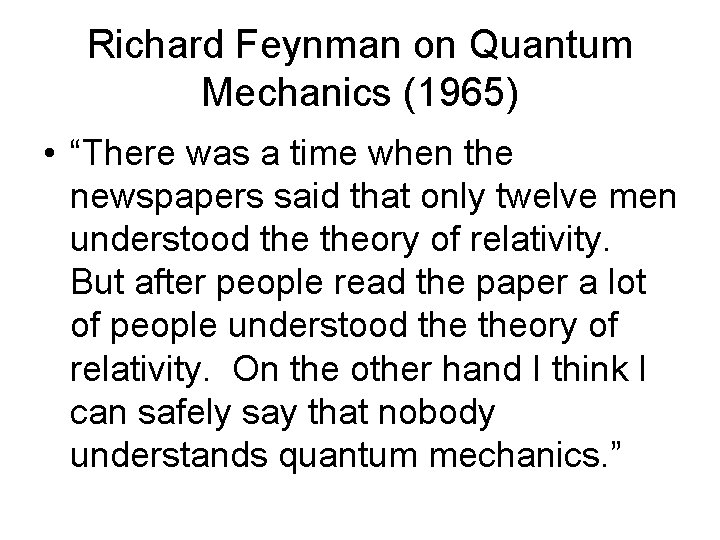
Richard Feynman on Quantum Mechanics (1965) • “There was a time when the newspapers said that only twelve men understood theory of relativity. But after people read the paper a lot of people understood theory of relativity. On the other hand I think I can safely say that nobody understands quantum mechanics. ”
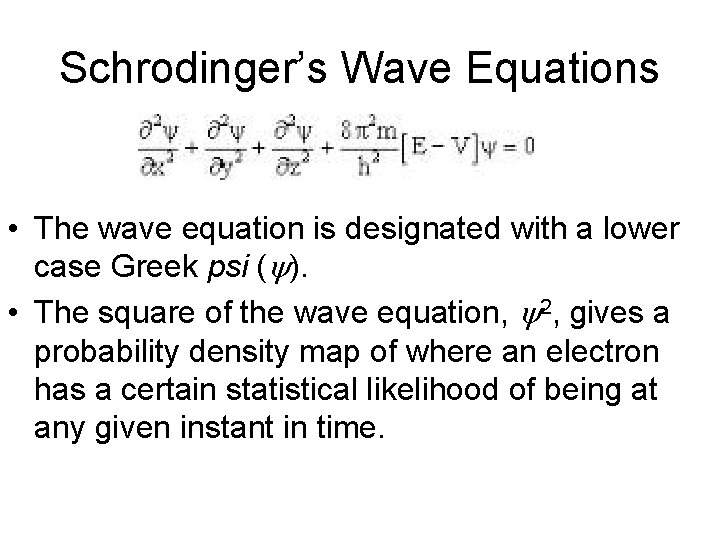
Schrodinger’s Wave Equations • The wave equation is designated with a lower case Greek psi ( ). • The square of the wave equation, 2, gives a probability density map of where an electron has a certain statistical likelihood of being at any given instant in time.
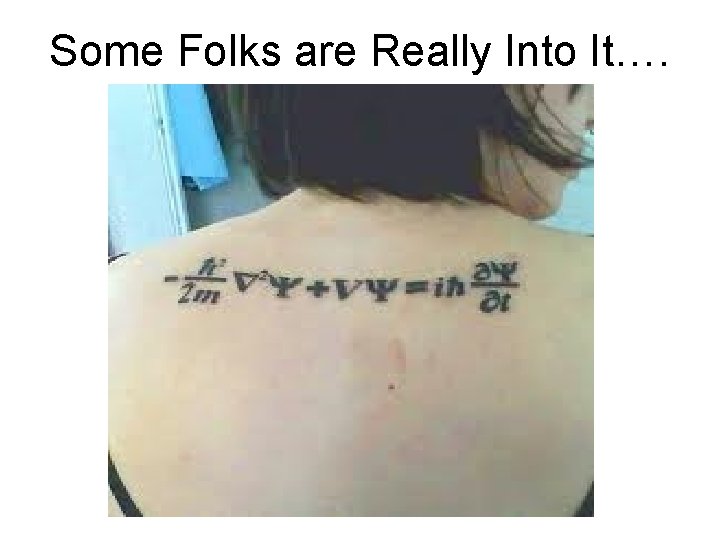
Some Folks are Really Into It….
Quantum Numbers • Solving the wave equation gives a set of wave functions, or orbitals, and their corresponding energies. • Each orbital describes a spatial distribution of electron density. • An orbital is described by a set of three quantum numbers.
Principal Quantum Number, n • The principal quantum number, n, describes the energy level on which the orbital resides. • The values of n are integers ≥ 1. • n also describes the relative size of the orbital, 2 larger than 1, and so on.
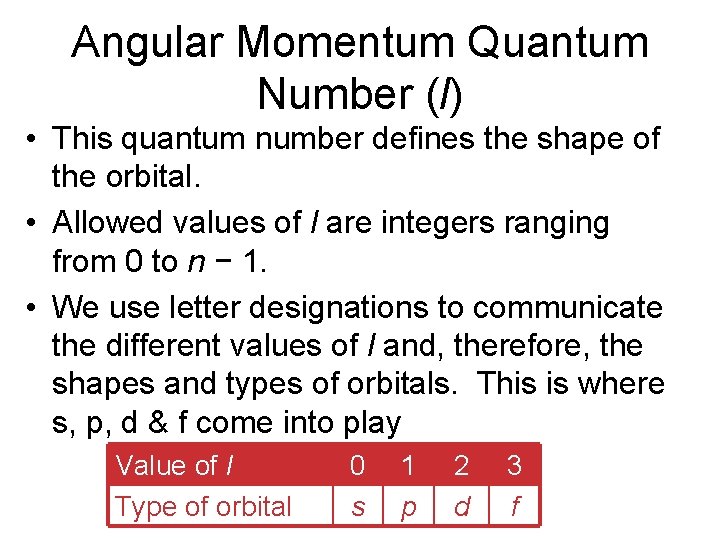
Angular Momentum Quantum Number (l) • This quantum number defines the shape of the orbital. • Allowed values of l are integers ranging from 0 to n − 1. • We use letter designations to communicate the different values of l and, therefore, the shapes and types of orbitals. This is where s, p, d & f come into play Value of l Type of orbital 0 s 1 p 2 d 3 f
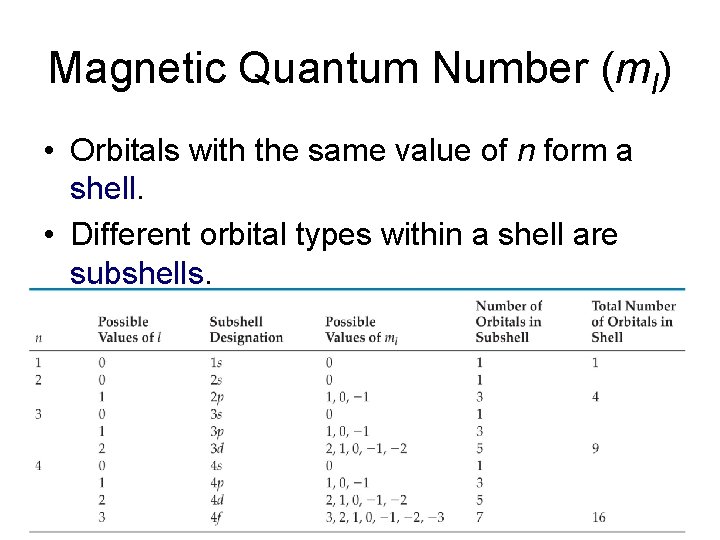
Magnetic Quantum Number (ml) • The magnetic quantum number describes the three-dimensional orientation of the orbital. • Allowed values of ml are integers ranging from -l to l: −l ≤ ml ≤ l. • Therefore, on any given energy level, there can be up to 1 s orbital, 3 p orbitals, 5 d orbitals, 7 f orbitals, etc.
Magnetic Quantum Number (ml) • Orbitals with the same value of n form a shell. • Different orbital types within a shell are subshells.
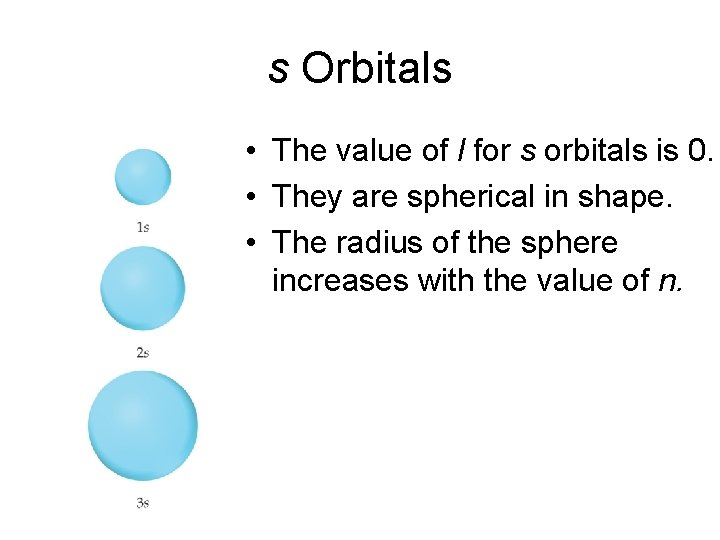
s Orbitals • The value of l for s orbitals is 0. • They are spherical in shape. • The radius of the sphere increases with the value of n.
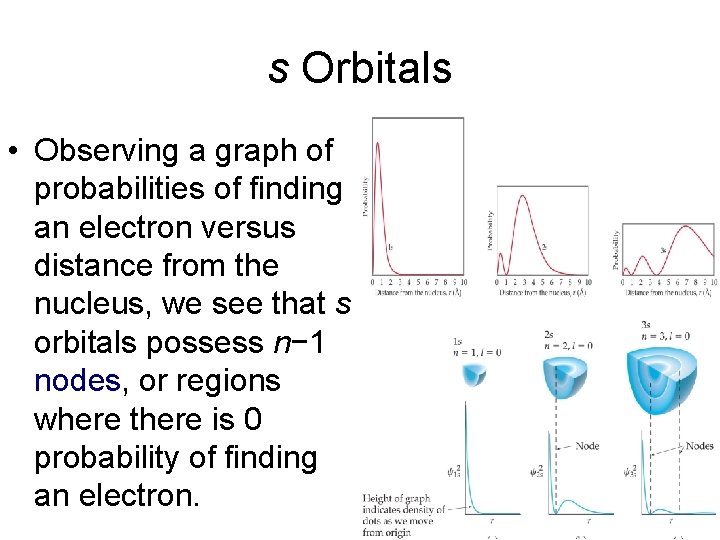
s Orbitals • Observing a graph of probabilities of finding an electron versus distance from the nucleus, we see that s orbitals possess n− 1 nodes, or regions where there is 0 probability of finding an electron.
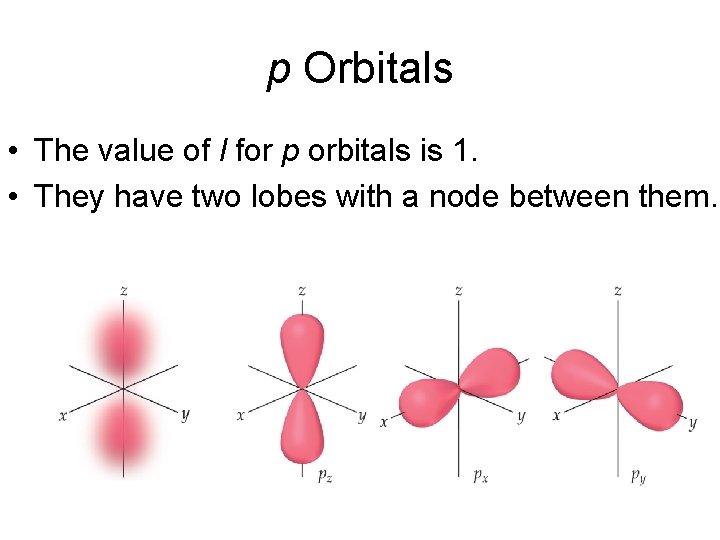
p Orbitals • The value of l for p orbitals is 1. • They have two lobes with a node between them.
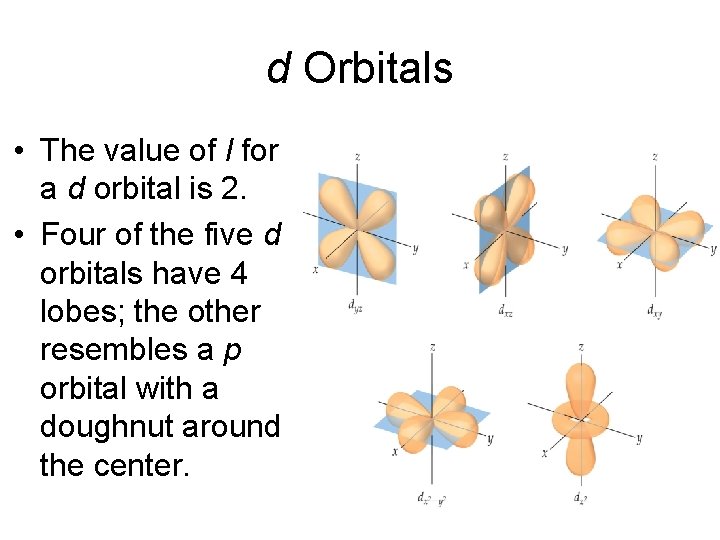
d Orbitals • The value of l for a d orbital is 2. • Four of the five d orbitals have 4 lobes; the other resembles a p orbital with a doughnut around the center.
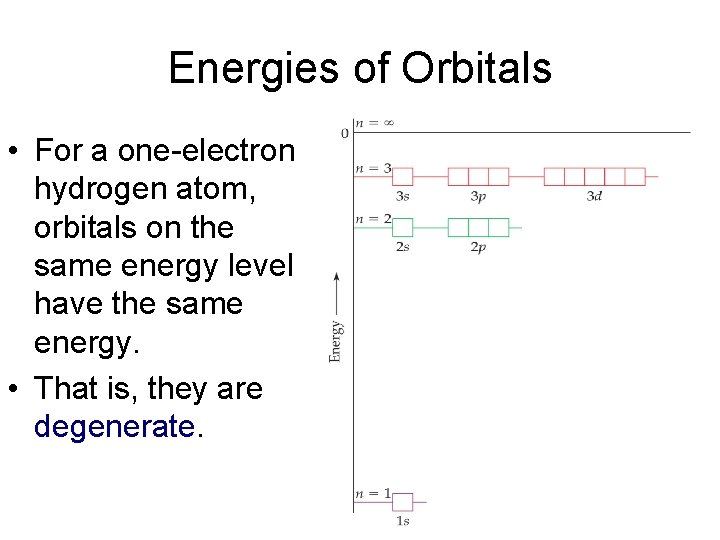
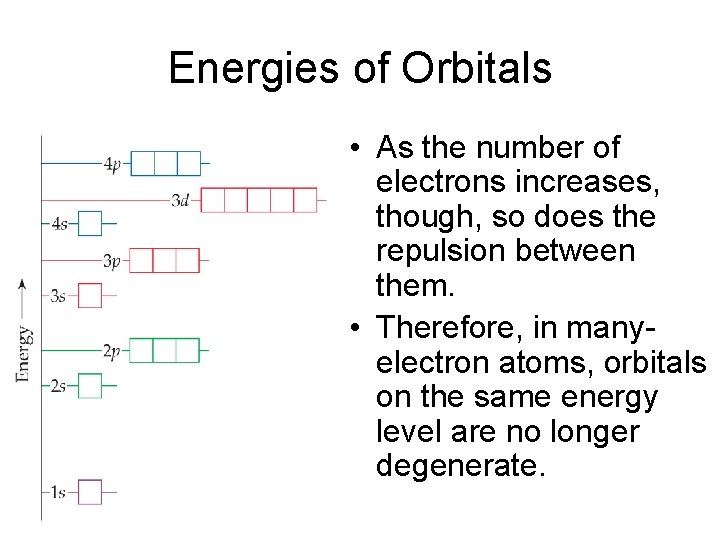
Energies of Orbitals • For a one-electron hydrogen atom, orbitals on the same energy level have the same energy. • That is, they are degenerate.
Energies of Orbitals • As the number of electrons increases, though, so does the repulsion between them. • Therefore, in manyelectron atoms, orbitals on the same energy level are no longer degenerate.
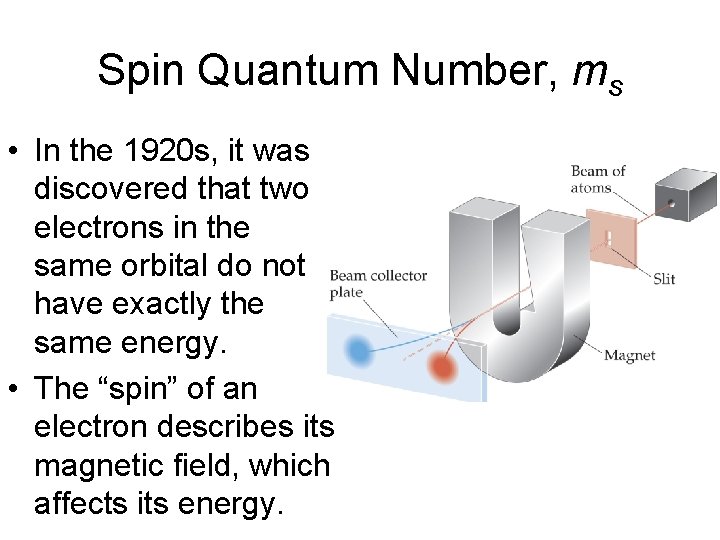
Spin Quantum Number, ms • In the 1920 s, it was discovered that two electrons in the same orbital do not have exactly the same energy. • The “spin” of an electron describes its magnetic field, which affects its energy.
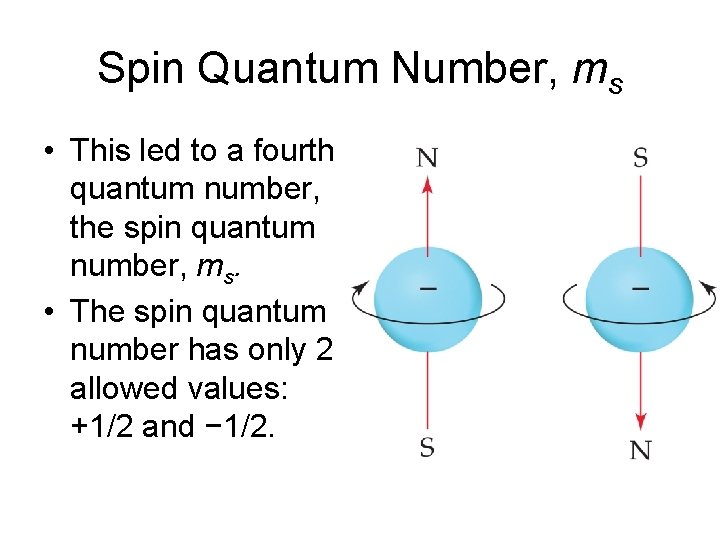
Spin Quantum Number, ms • This led to a fourth quantum number, the spin quantum number, ms. • The spin quantum number has only 2 allowed values: +1/2 and − 1/2.
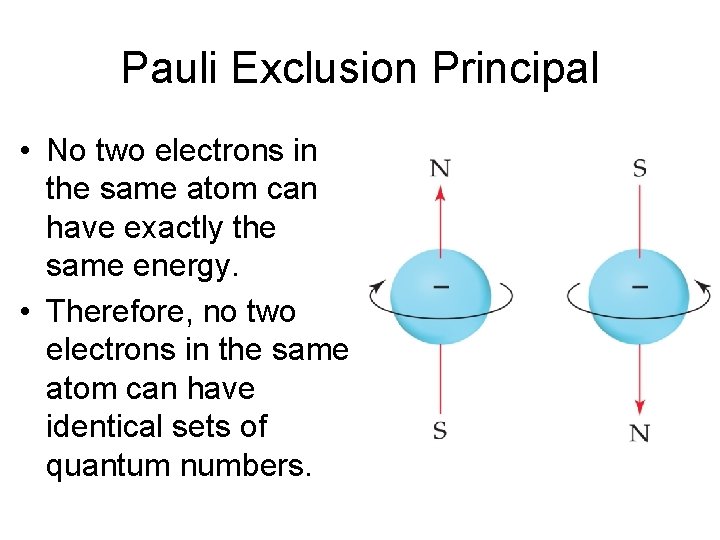
Pauli Exclusion Principal • No two electrons in the same atom can have exactly the same energy. • Therefore, no two electrons in the same atom can have identical sets of quantum numbers.
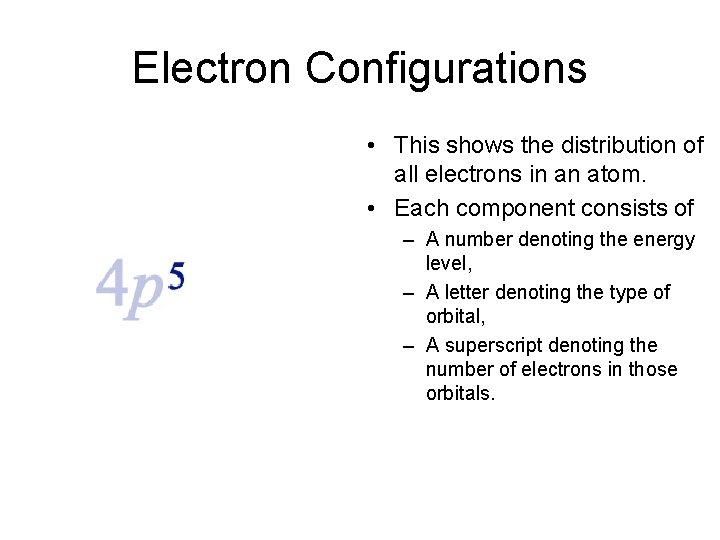
Electron Configurations • This shows the distribution of all electrons in an atom. • Each component consists of – A number denoting the energy level, – A letter denoting the type of orbital, – A superscript denoting the number of electrons in those orbitals.
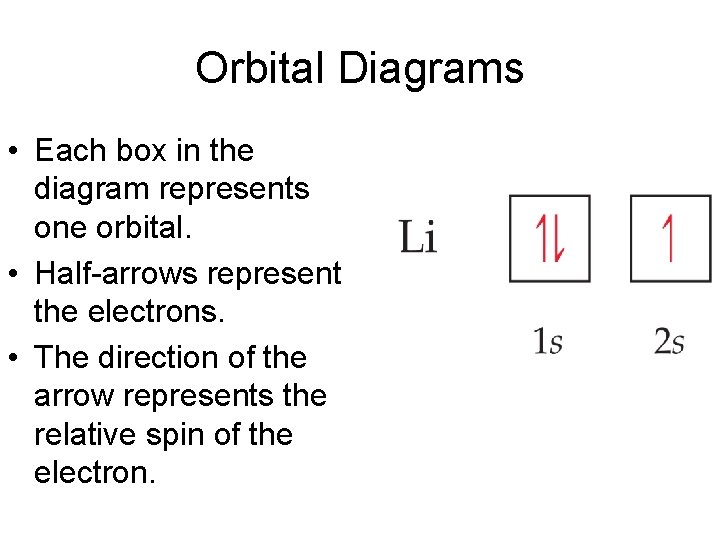
Orbital Diagrams • Each box in the diagram represents one orbital. • Half-arrows represent the electrons. • The direction of the arrow represents the relative spin of the electron.
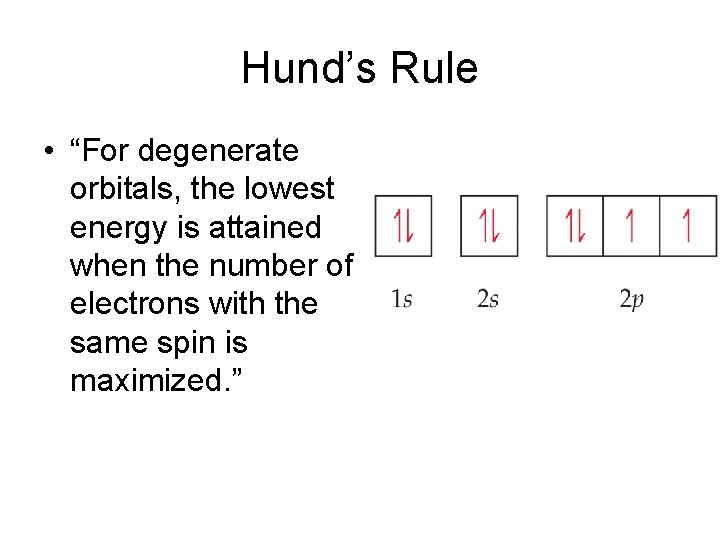
Hund’s Rule • “For degenerate orbitals, the lowest energy is attained when the number of electrons with the same spin is maximized. ”
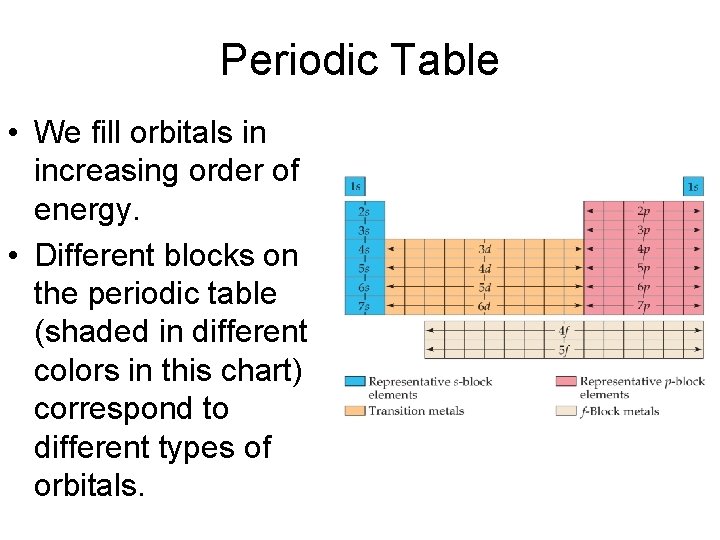
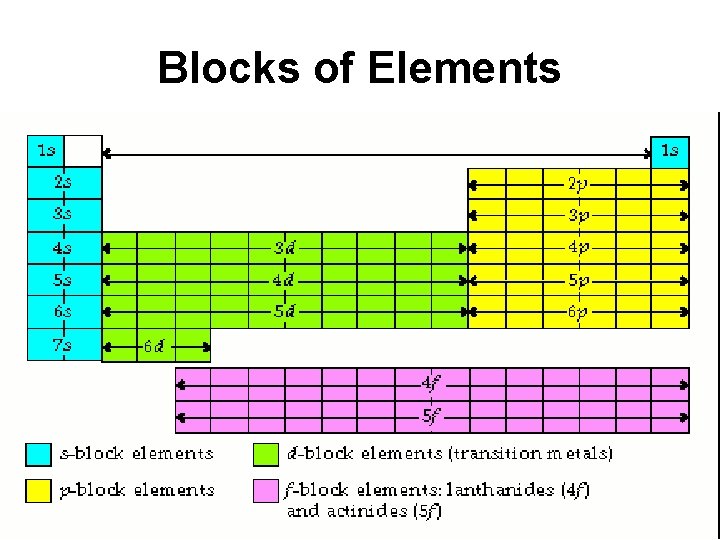
Periodic Table • We fill orbitals in increasing order of energy. • Different blocks on the periodic table (shaded in different colors in this chart) correspond to different types of orbitals.
Atomic Orbitals • Region of space where there is a high probability of finding an electron. • Principal Quantum #(n) --denotes the energy level of electrons (1, 2, 3, 4, etc. ) • Also denotes the # of sublevels at that energy level (s, p, d, f) • Sublevels describe the shapes and sizes of orbitals where e- may be found.
Shapes of Orbitals • s-spherical, with nucleus at the center • p-dumbbell, or figure-8, with nucleus at the center • d—as shown • f—as shown • As you increase energy levels, the shape of each remains the same, but size gets larger.
Electron Configurations • Orbitals of an atom will fill so that the atom is in its most stable state. There are 3 rules that govern this: • Aufbau Principle- e- occupy lowestenergy orbitals first • Pauli Exclusion Principle- 2 e- in same orbital must have opposite spin • Hund’s Rule- e- occupy orbitals of the same energy so that there’s a max # of same spin e-
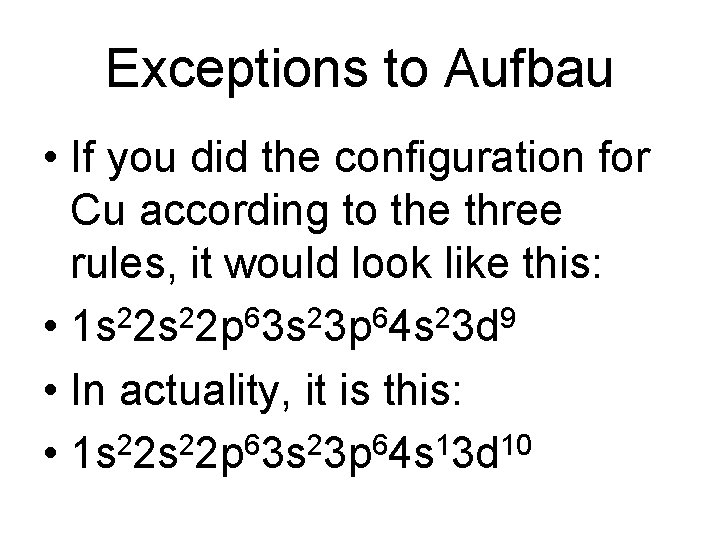
Exceptions to Aufbau • If you did the configuration for Cu according to the three rules, it would look like this: • 1 s 22 p 63 s 23 p 64 s 23 d 9 • In actuality, it is this: 2 2 6 1 10 • 1 s 2 s 2 p 3 s 3 p 4 s 3 d
Another… • Chromium, Cr, also is an exception to the Aufbau Principle • According to Aufbau, Cr should have this configuration: • 1 s 22 p 63 s 23 p 64 s 23 d 4 • But it actually has this: • 1 s 22 p 63 s 23 p 64 s 13 d 5
Why Would an Atom Do This? • Because a filled shell is the most stable arrangement, and a half-filled shell is the next best arrangement.
Valence Electrons • The electrons that exist in the outermost energy level of an atom are valence electrons. • A full shell or a half-filled shell is the most stable arrangement. • Noble gases always have a full valence, or a full outer shell, which is what every other element is trying to achieve. (Max. of 8 valence electrons)
• What does the term orbital describe? • A region around the nucleus where an electron is most likely to be found. • What does an element’s electron configuration describe? • All of the orbitals that the element’s electrons occupy, and how those electrons are distributed.
• We do not need to focus on all the electrons that an atom has, we really only need to focus on the valence electrons. Why? • Because they are the outermost electrons, and they are the only electrons that can possibly interact with other atoms. • How many valence electrons does Oxygen have? • 6
• Why are the alkali metals so reactive? • They all have an s 1 electron (1 valence electron) that they are trying to lose. • Noble gases are also called inert gases. Why are the noble gases so unreactive? • Because they have a full outer shell (eight valence electrons) and do not need any more or less electrons.
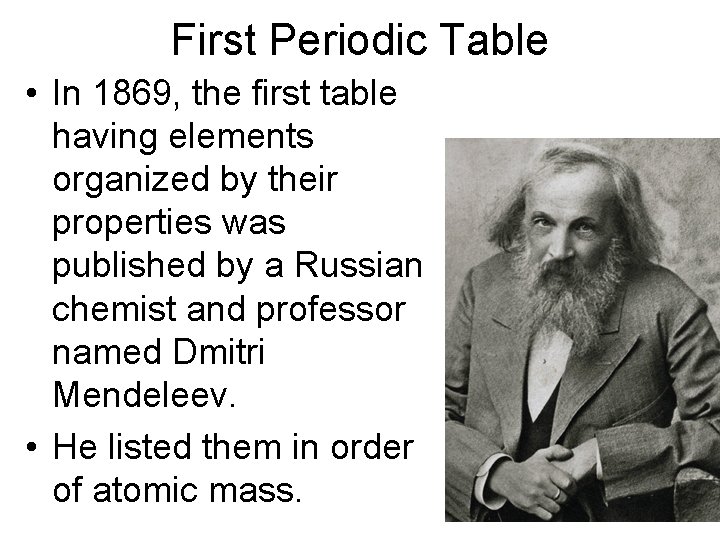
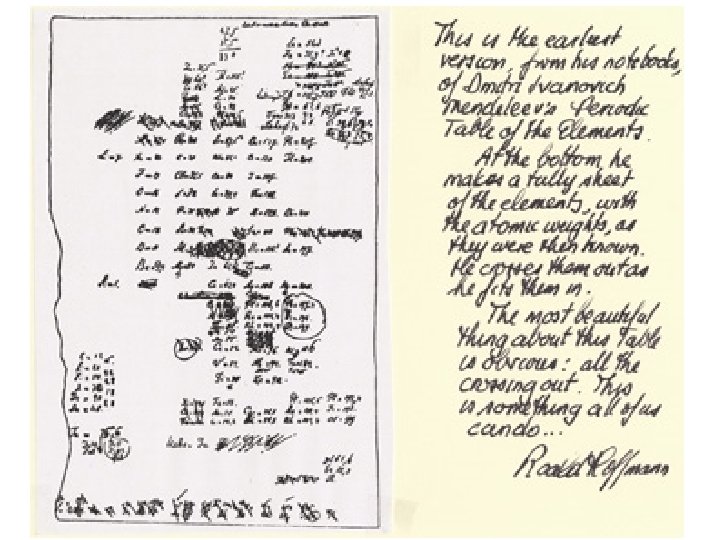
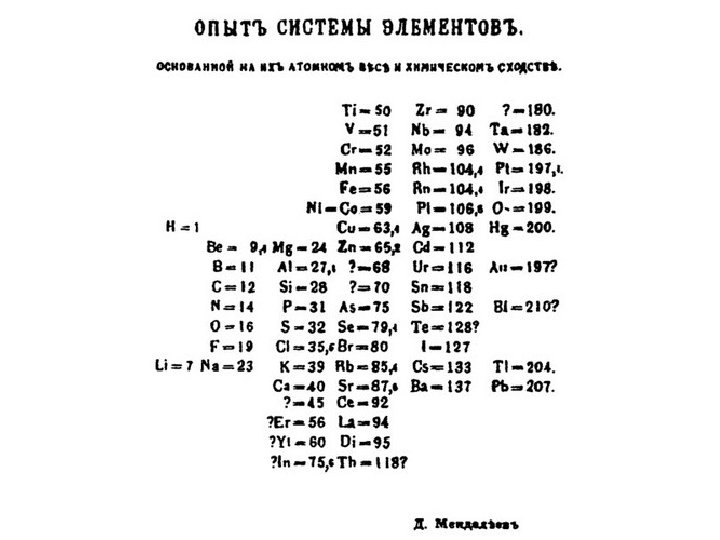
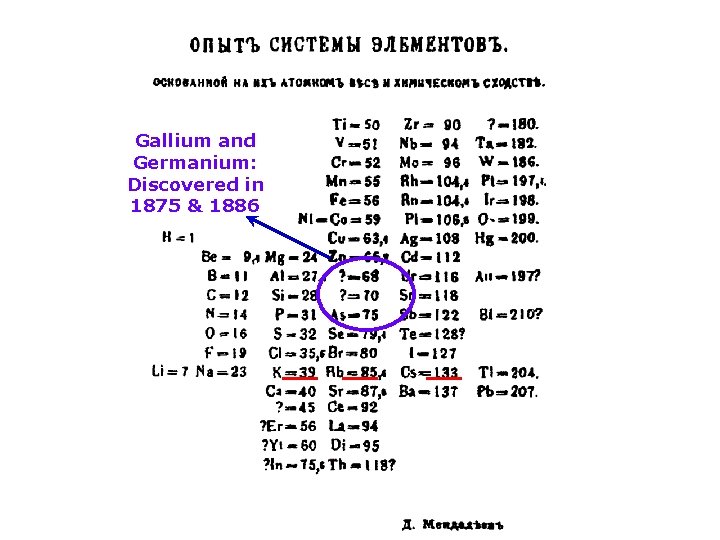
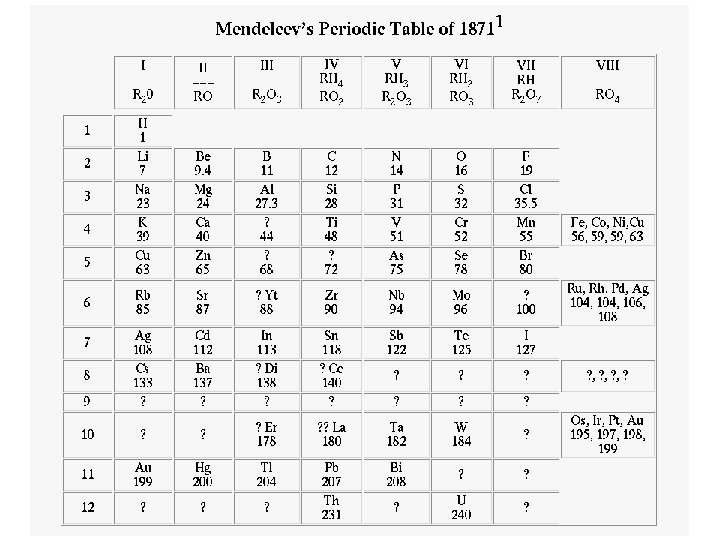
First Periodic Table • In 1869, the first table having elements organized by their properties was published by a Russian chemist and professor named Dmitri Mendeleev. • He listed them in order of atomic mass.
Gallium and Germanium: Discovered in 1875 & 1886
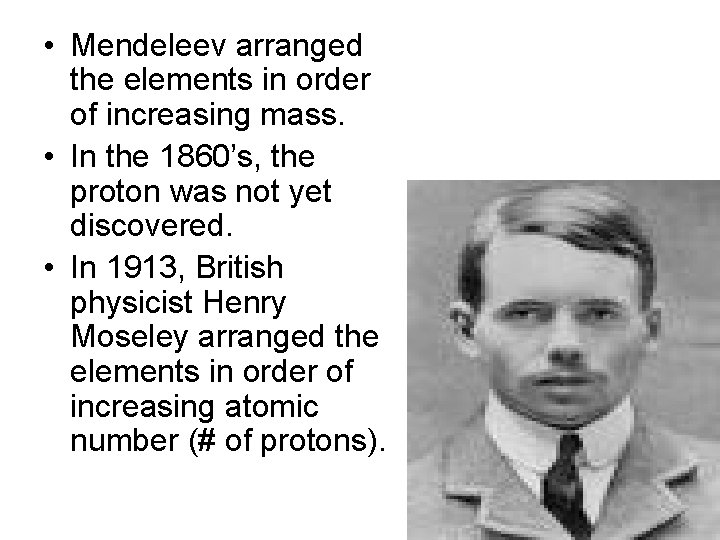
• Mendeleev arranged the elements in order of increasing mass. • In the 1860’s, the proton was not yet discovered. • In 1913, British physicist Henry Moseley arranged the elements in order of increasing atomic number (# of protons).
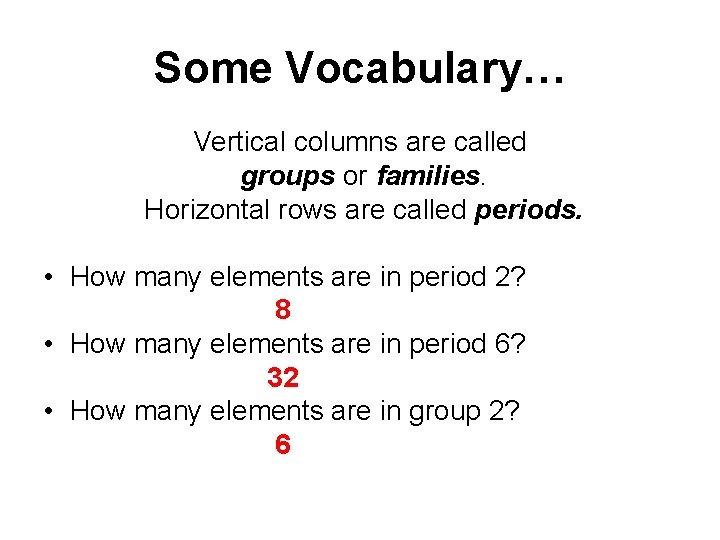
Some Vocabulary… Vertical columns are called groups or families. Horizontal rows are called periods. • How many elements are in period 2? 8 • How many elements are in period 6? 32 • How many elements are in group 2? 6
The Periodic Law (Cont. ) • Elements within a column of a group have similar properties. • Properties in a period change as you move across a period from left to right. • The pattern of properties within a period repeats as you move form one period to the next. • Periodic Law: When elements are arranged in order of increasing atomic number, there is a periodic repetition of their physical and chemical properties.
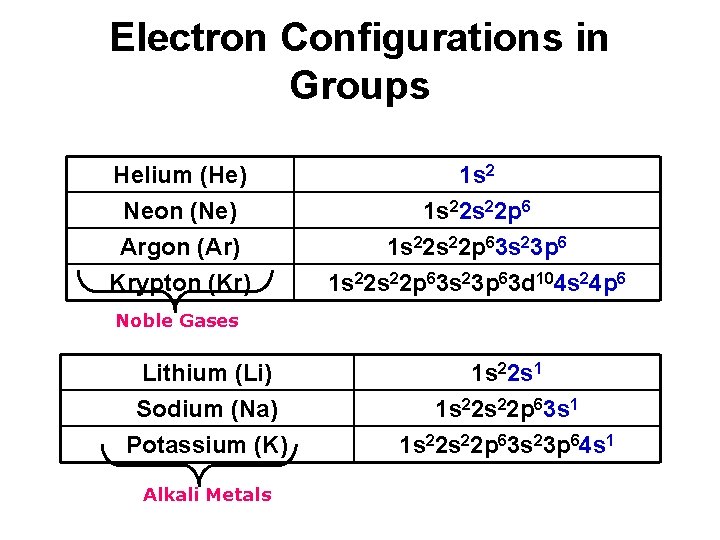
Electron Configurations in Groups Helium (He) Neon (Ne) Argon (Ar) Krypton (Kr) 1 s 22 s 22 p 63 s 23 p 63 d 104 s 24 p 6 Noble Gases Lithium (Li) Sodium (Na) 1 s 22 s 1 1 s 22 p 63 s 1 Potassium (K) 1 s 22 p 63 s 23 p 64 s 1 Alkali Metals
Blocks of Elements
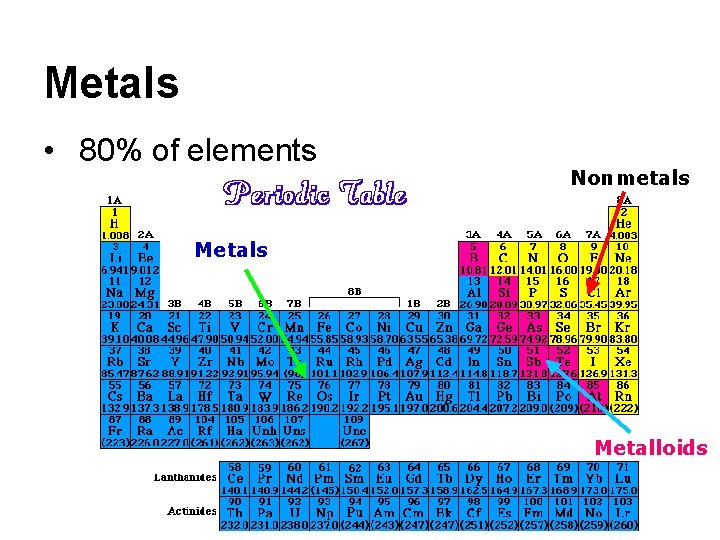
Metals • 80% of elements Nonmetals Metalloids
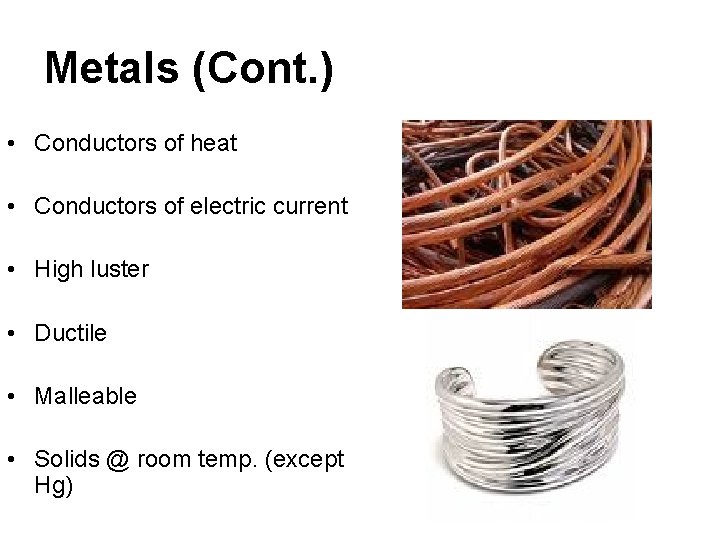
Metals (Cont. ) • Conductors of heat • Conductors of electric current • High luster • Ductile • Malleable • Solids @ room temp. (except Hg)
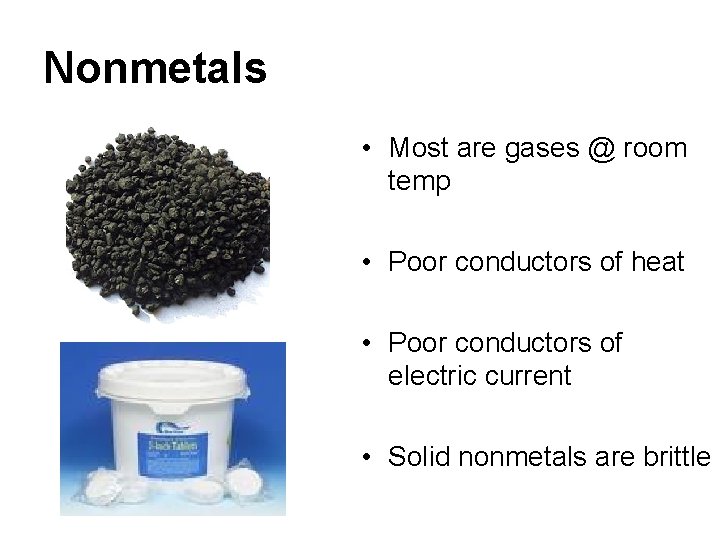
Nonmetals • Most are gases @ room temp • Poor conductors of heat • Poor conductors of electric current • Solid nonmetals are brittle
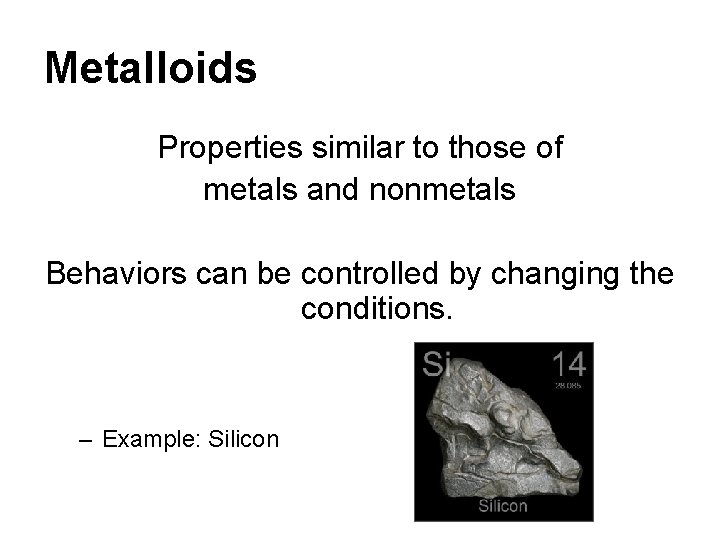
Metalloids Properties similar to those of metals and nonmetals Behaviors can be controlled by changing the conditions. – Example: Silicon
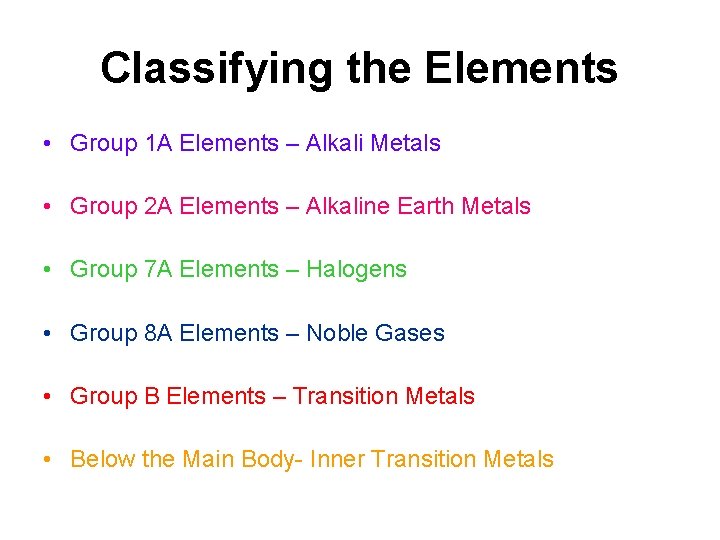
Classifying the Elements • Group 1 A Elements – Alkali Metals • Group 2 A Elements – Alkaline Earth Metals • Group 7 A Elements – Halogens • Group 8 A Elements – Noble Gases • Group B Elements – Transition Metals • Below the Main Body- Inner Transition Metals
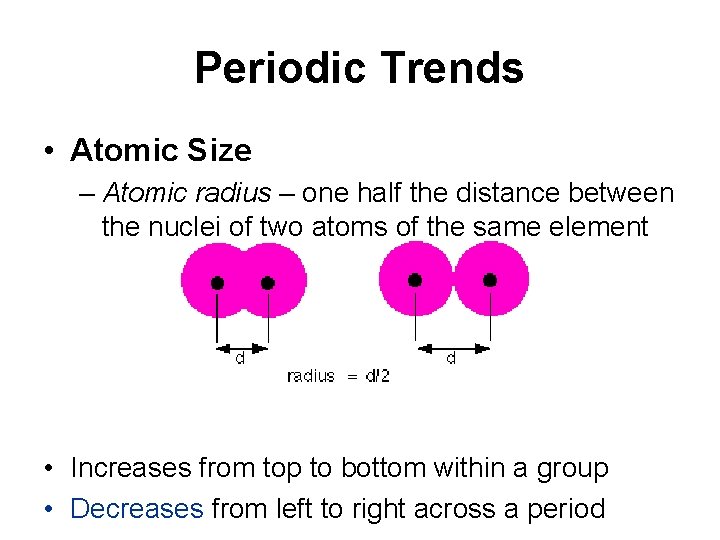
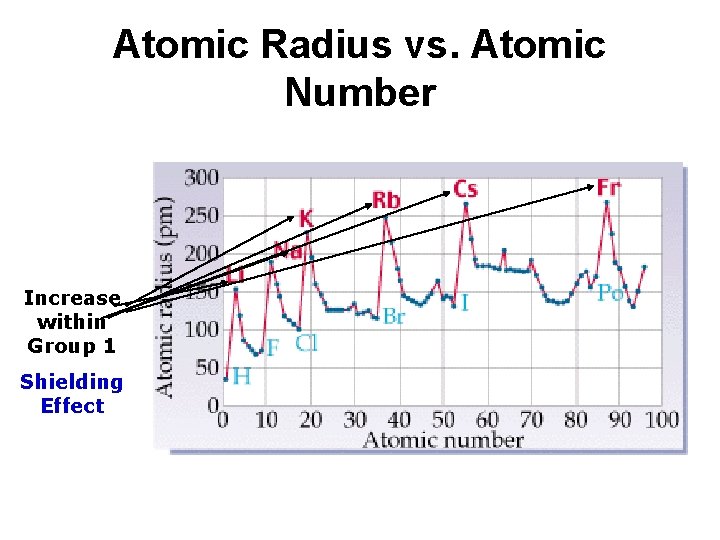
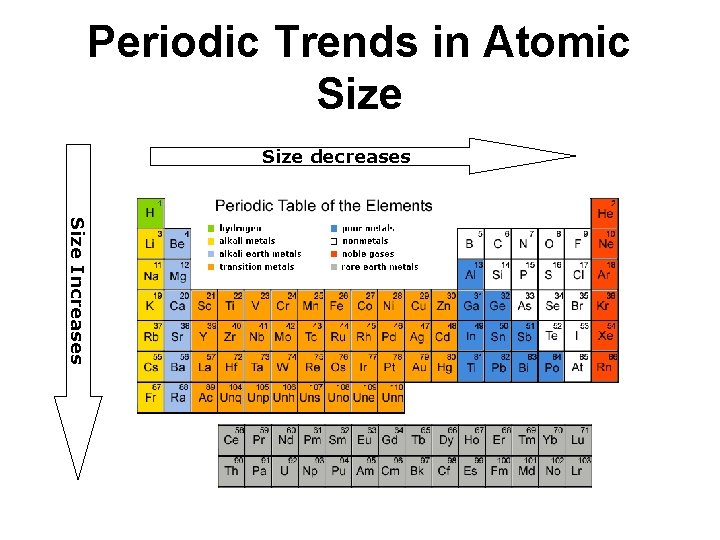
Periodic Trends • Atomic Size – Atomic radius – one half the distance between the nuclei of two atoms of the same element • Increases from top to bottom within a group • Decreases from left to right across a period
Atomic Radius vs. Atomic Number Increase within Group 1 Shielding Effect
Periodic Trends in Atomic Size decreases Size Increases
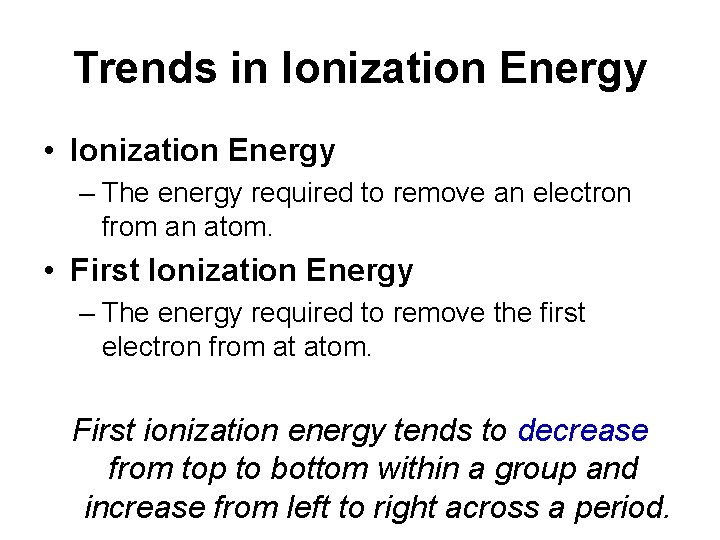
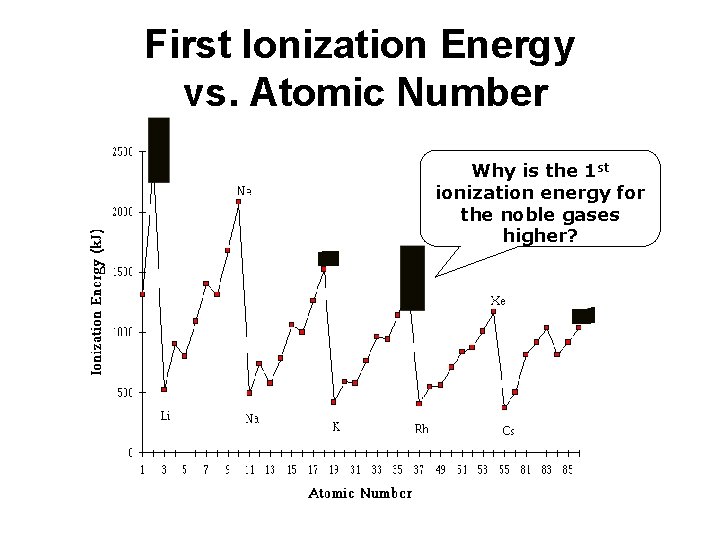
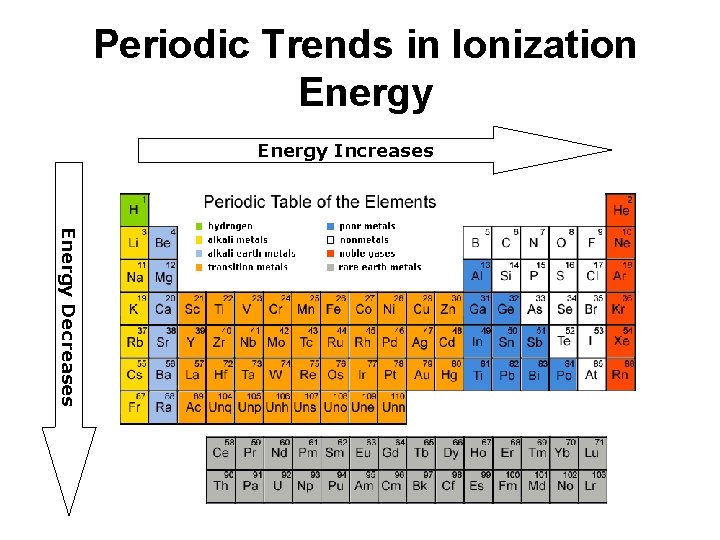
Trends in Ionization Energy • Ionization Energy – The energy required to remove an electron from an atom. • First Ionization Energy – The energy required to remove the first electron from at atom. First ionization energy tends to decrease from top to bottom within a group and increase from left to right across a period.
First Ionization Energy vs. Atomic Number Why is the 1 st ionization energy for the noble gases higher?
Periodic Trends in Ionization Energy Increases Energy Decreases
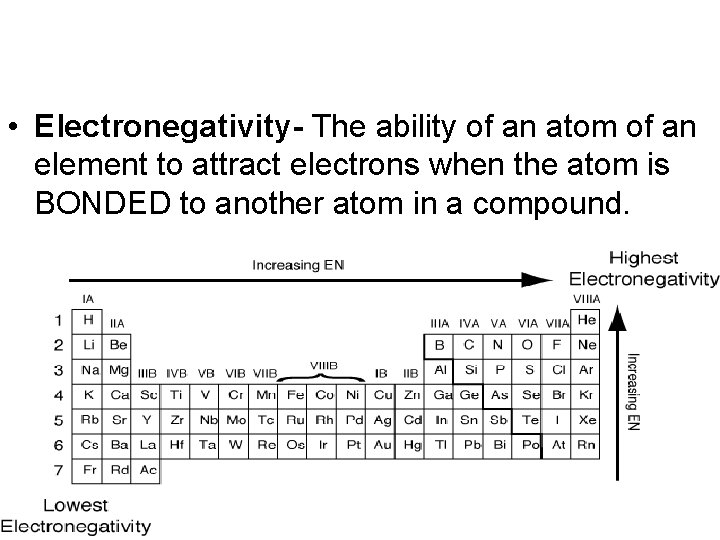
• Electronegativity- The ability of an atom of an element to attract electrons when the atom is BONDED to another atom in a compound.
Periodic Trends • Metallic properties—as shown. As you approach the nonmetals, metallic properties decrease.