Overview of Regulatory Compliance at NC State University



- Slides: 54
Overview of Regulatory Compliance at NC State University
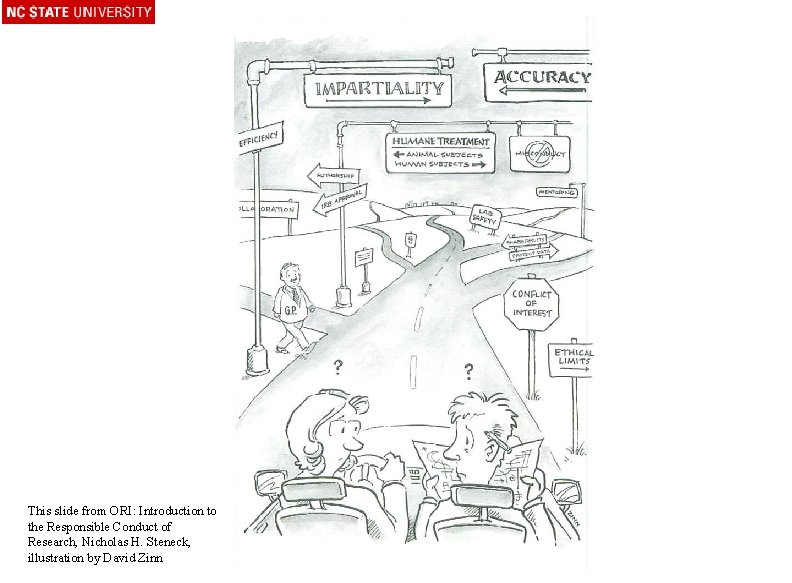
This slide from ORI: Introduction to the Responsible Conduct of Research, Nicholas H. Steneck, illustration by David Zinn
Introduction • Regulatory Compliance § § § § Human Subjects Animal Subjects Conflicts of Interest Export Controls Chemical and Biological Safety Hazardous Waste Radiation Safety • Research Integrity - Scientific Misconduct
Human Subjects An Overview of Human Subjects and IRB (Institutional Review Board)
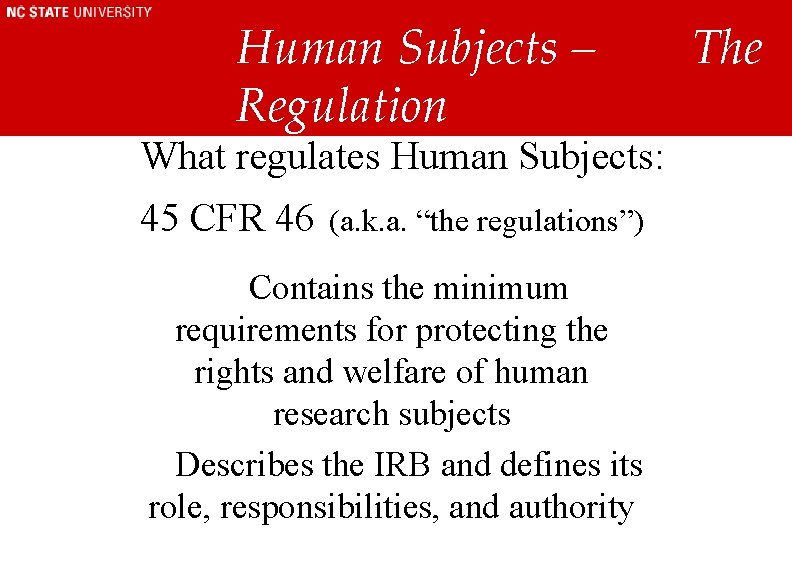
Human Subjects – Regulation What regulates Human Subjects: 45 CFR 46 (a. k. a. “the regulations”) Contains the minimum requirements for protecting the rights and welfare of human research subjects Describes the IRB and defines its role, responsibilities, and authority The
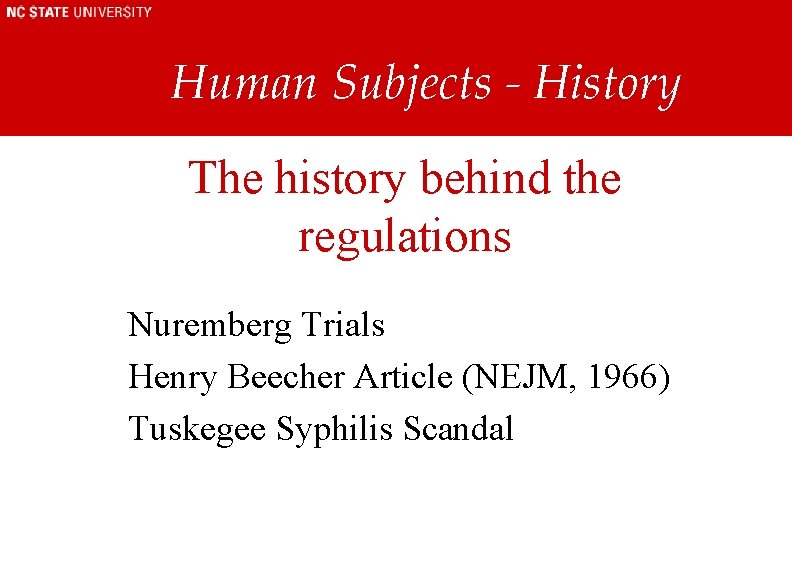
Human Subjects - History The history behind the regulations Nuremberg Trials Henry Beecher Article (NEJM, 1966) Tuskegee Syphilis Scandal
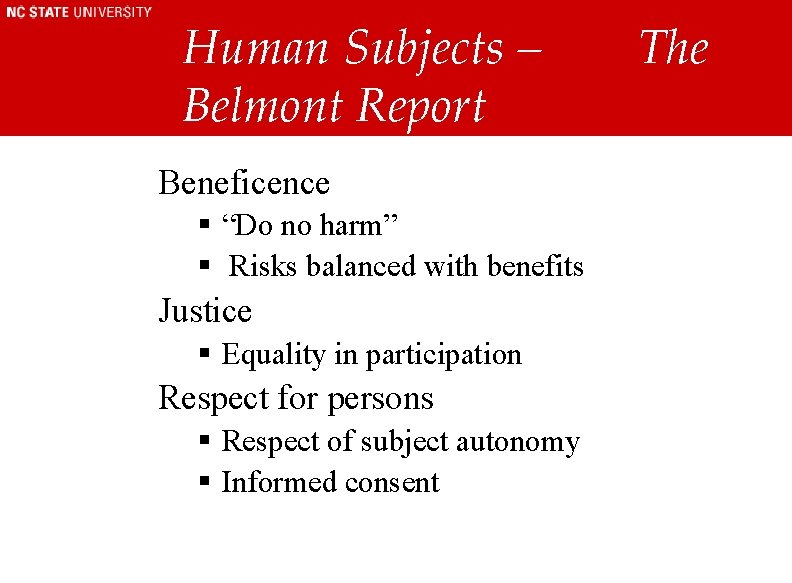
Human Subjects – Belmont Report Beneficence § “Do no harm” § Risks balanced with benefits Justice § Equality in participation Respect for persons § Respect of subject autonomy § Informed consent The
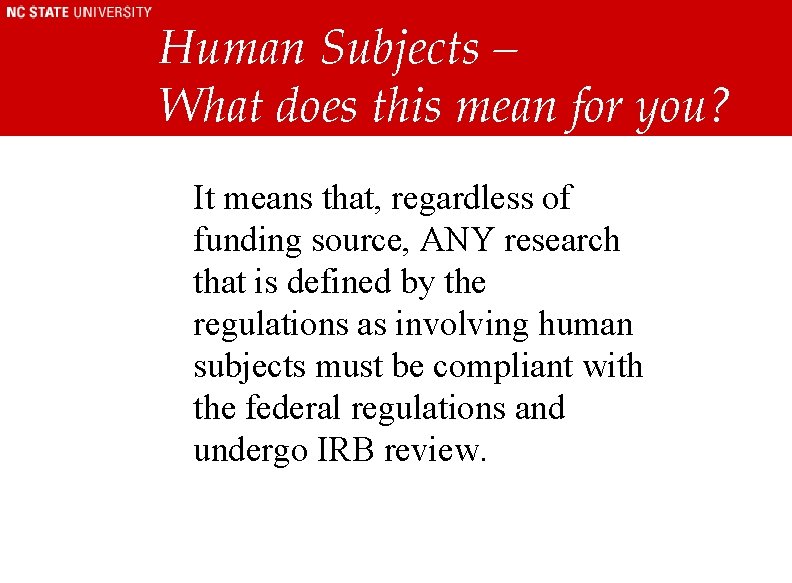
Human Subjects – What does this mean for you? It means that, regardless of funding source, ANY research that is defined by the regulations as involving human subjects must be compliant with the federal regulations and undergo IRB review.
Human Subjects Definition of human subject A living individual about whom an investigator (whether professional or student) conducting research obtains: 1) data through intervention or interaction with the individual, or 2) identifiable private information
Human Subjects Responsibilities The responsibility for running a study in an ethical and compliant manner is ultimately the Investigator’s: § IRB approval must be obtained before any contact with potential subjects is made § ANY changes to the research must be approved by the IRB prior to their implementation § IRB approval is good for one year at most – it must be renewed yearly if the project is ongoing • Expedited and full board review only • Analysis of identified data is considered ongoing research § Unanticipated problems must be promptly reported to the IRB § Consent must be adequately documented and retained
Human Subjects – Basic Components of IRB Review Risks to subjects are minimized Risk are balanced with benefits Selection of subjects is equitable Informed consent will be sought and documented Adequate provisions are made to protect the privacy of subjects and to maintain the confidentiality of data Additional safeguards are in place for research involving vulnerable populations § § § Children Prisoners Pregnant women and fetuses Employees/Students Others
Animal Care and Use & IACUC An Overview of Animal Care and Use & the IACUC (Institutional Animal Care and Use
IACUC – Why do Universities need IACUCs? Laws (Animal Welfare Act – AWA), Regulations (USDA – Code of Federal Regulations), and Policies (Public Health Service) - Institutions were required to establish IACUCs in accordance with the Animal Welfare Act (1966, 1970) and the 1976, 1985, and 1990 AWA Amendments
IACUC - Responsibilies § Review of research and teaching activities involving the use of vertebrate animals § Review/monitor welfare of vertebrate animals maintained by the institution (housing and care) § Monitoring compliance with federal and state regulations and institutional policies on animal welfare and use § Conduct a review of the animal care and use program once every six months and submit a report to the Institutional Official
IACUC - Operations IACUCs Monitor the Care and Use of Animals Used in Research and Teaching § Protocol Review § Animal Housing and Use Area Inspections and Reporting § Post Approval Compliance Monitoring (passive or active) § Program Review
IACUC - Considerations * The rationale for using animals * The appropriateness of the species to be used * For animal use that involves pain and/or distress, whether or not it is relieved by anesthetics, analgesics or other palliative therapies * The investigator’s Consideration of Alternatives - should include consideration of the “Three Rs” • Replacement • Reduction • Refinement - And typically includes a literature search § Document search methods used § Summarize and justify findings of the search
IACUC – Resources / Guidelines • NCSU Animal Subjects Tutorial - http: //www. ncsu. edu/iacuc/training. html • IACUC - http: //www. ncsu. edu/iacuc/ • United States Department of Agriculture (USDA)-Regulations • Animal Welfare Act (AWA) • U. S. Public Health Service (PHS) • Guide for the Care and Use of Laboratory Animals • Guide for the Care and Use of Agricultural Animals in Agricultural Research and Teaching • AVMA Guidelines on Euthanasia (American Veterinary Medical Association 2007)
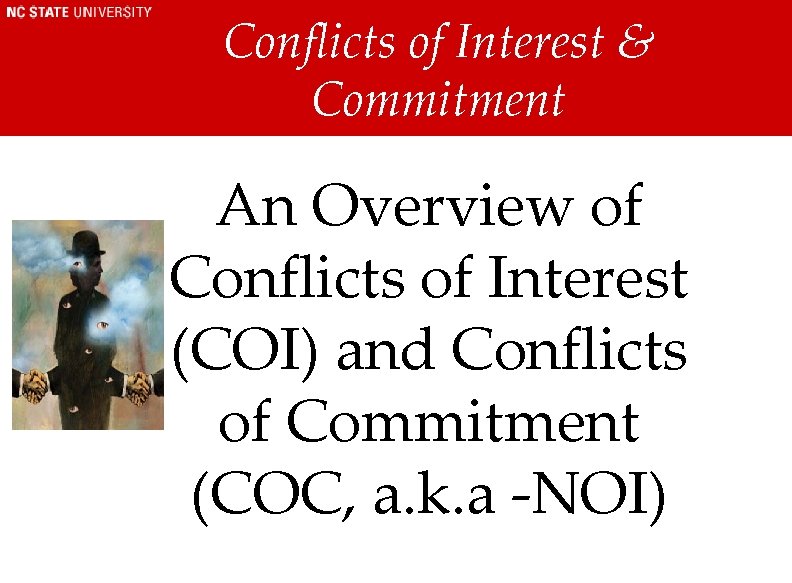
Conflicts of Interest & Commitment An Overview of Conflicts of Interest (COI) and Conflicts of Commitment (COC, a. k. a -NOI)
COI - What does it mean? ? What is a conflict of interest? Where “financial or other personal considerations may compromise, may involve the potential for compromising, or may have the appearance of compromising an employee's objectivity in meeting University duties or responsibilities. ”
COIs – Inherent in our mission • Mission of the university – Transfer of knowledge • Entrepreneurial Spirit – Encourage faculty’s outside endeavors • COI is not bad; we just have to manage it. – Assure our objectivity in decision-making – (no bias because of competing interests) – Wearing “two hats”
COI - Why Disclose? • Protect the integrity/respect • Mitigate (reduce) the risk to of our research and faculty disclosing party and institution members • Required by federal sponsors • Preserve the public’s trust in • The criminal statute of NC, the University and its NIH and NSF guidelines and research findings; UNC System Policy • Guard the University’s continued public support and funding for academic science; • Protection of human subjects
What is disclosed? Significant financial interests: § Anything of monetary value o Salary or other payments for services (consulting fees or honoraria, for example) § Equity interests o Stocks, stock options, or other ownership interests § Intellectual property rights o Patents, copyrights, and royalties from such rights § Single entity valued at +$10 K or more than 5% equity § Associations o Professional - related to University employment § Textbooks, other classroom materials you author and require in your courses § IP owned by disclosing party and licensed TO THE UNIVERSITY § Note: Disclosure encompasses employee or family member living in same household
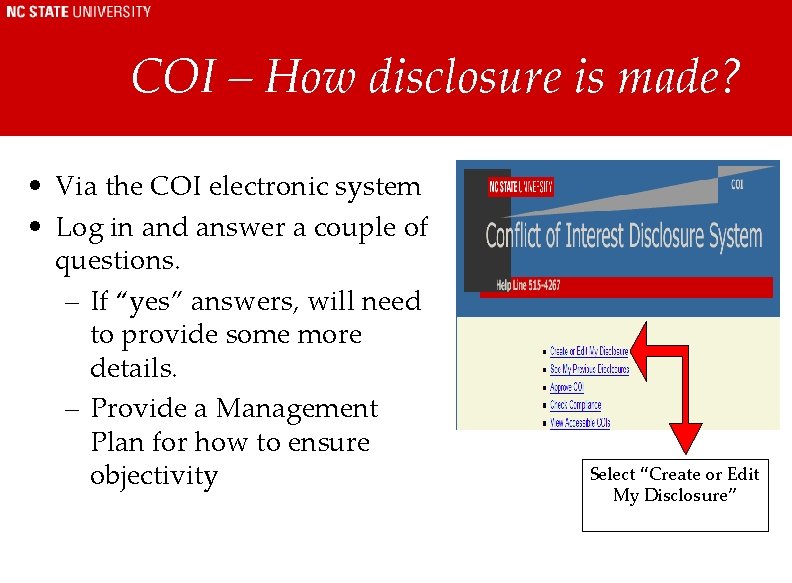
COI – How disclosure is made? • Via the COI electronic system • Log in and answer a couple of questions. – If “yes” answers, will need to provide some more details. – Provide a Management Plan for how to ensure objectivity Select “Create or Edit My Disclosure”
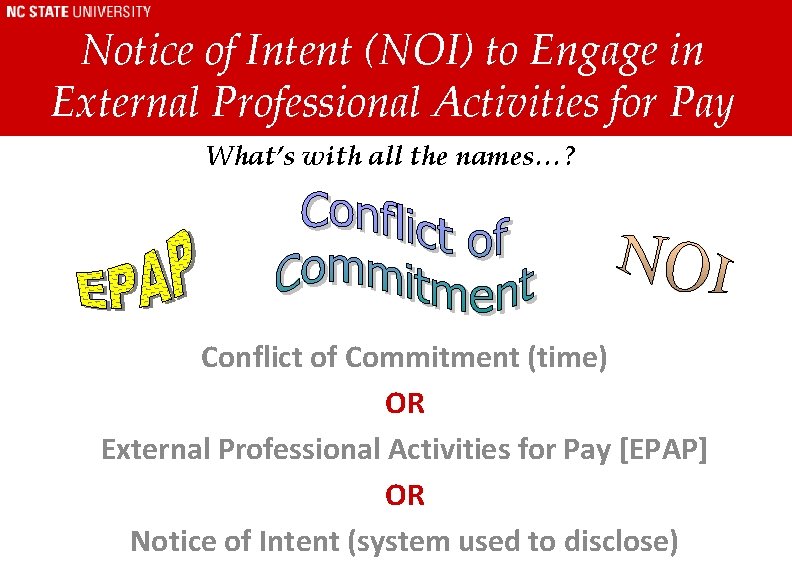
Notice of Intent (NOI) to Engage in External Professional Activities for Pay What’s with all the names…? Conflict of Commitment (time) OR External Professional Activities for Pay [EPAP] OR Notice of Intent (system used to disclose)
NOI – Why Request Permission for EPAP? • State of NC rules prohibit EPAP without justification and consideration by the dept. /unit head • EPAP is a privilege enjoyed by academic institutions and must be carefully monitored
NOI - When to Request Permission? • At least 10 calendar days prior • Exceptional circumstances – can’t meet the 10 day rule, make certain to submit the request anyway for consideration by administration. – After the fact, still need to do it but need extra-ordinary justification.
NOI – What To Look Out For? • Overly committed to an outside entity – Impact on your responsibilities to NCSU • Consulting obligations should not conflict with BOG Conflict of Interest & Commitment policy or the employee’s normal research and teaching duties – reference Attachment 2 • Consulting should be advisory in nature. • Concern for any Intellectual Property developed – consulting agreement must be consistent with University policy on ownership of inventions
When to Request Permission? • At least 10 calendar days prior • Exceptional circumstances – can’t meet the 10 day rule, make certain to submit the request anyway for consideration by administration. – After the fact, still need to do it but need extra-ordinary justification.
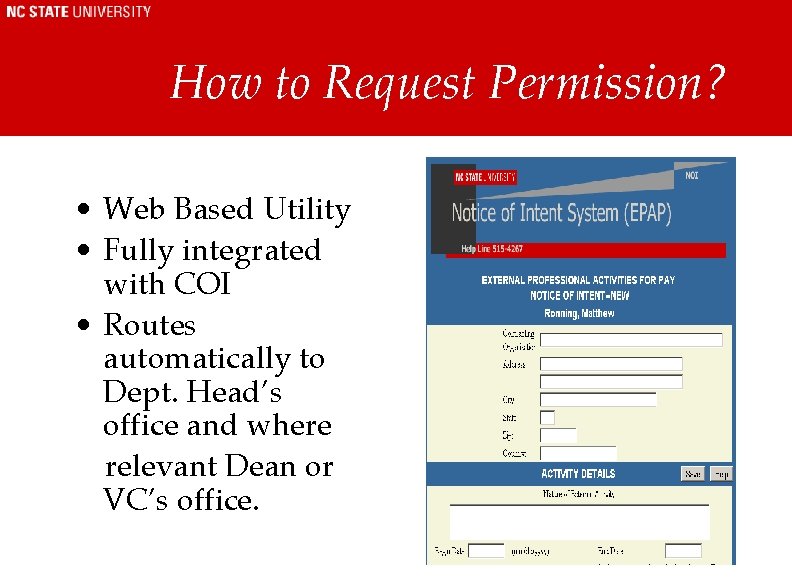
How to Request Permission? • Web Based Utility • Fully integrated with COI • Routes automatically to Dept. Head’s office and where relevant Dean or VC’s office.
COI & NOI are ongoing processes Contact info if you have questions/concerns or need help. Debbie Hunt @ 515 -7512 or debbie_hunt@ncsu. edu
Export Controls An Overview of Export Controls
Export Controls – What Is It? • An Export is the shipment or transmission of items outside of the United States. • An item is defined as commodities, software (source code), and technology (technical information).
Export Controls – Why We Care? Federal laws restricting the export of goods and technology currently implemented by the U. S. Department of Commerce through its Export Administration Regulations (EAR), the U. S. Department of State through its International Traffic in Arms Regulations (ITAR), and the U. S. Department of Treasury through its Office of Foreign Assets Control (OFAC).
Export Controls - What’s a Controlled Export? • Transfers of controlled information, including technical information, to persons and entities outside the United States; • Shipment of controlled physical items, such as scientific equipment, that require export licenses from the U. S. to a foreign country; • Verbal, written, electronic, and/or visual disclosures of controlled scientific and technical information related to export controlled items to foreign national outside or inside the United States (“deemed exports”).
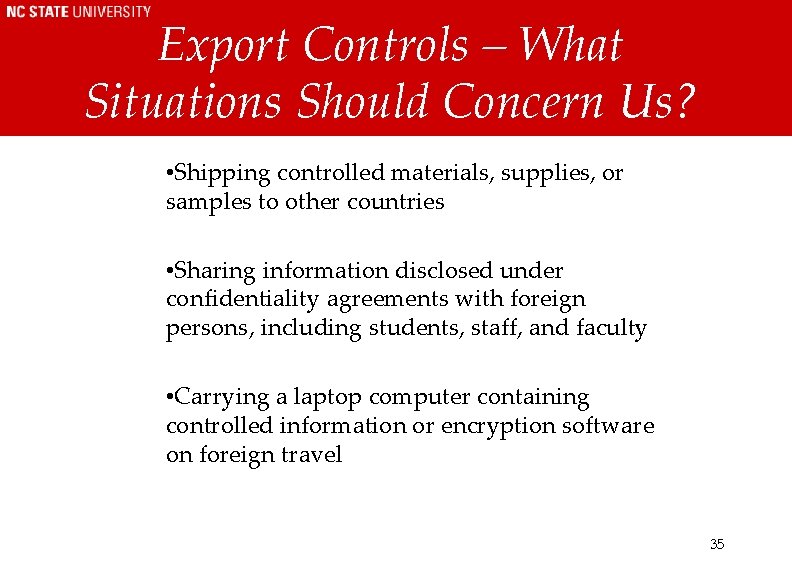
Export Controls – What Situations Should Concern Us? • Shipping controlled materials, supplies, or samples to other countries • Sharing information disclosed under confidentiality agreements with foreign persons, including students, staff, and faculty • Carrying a laptop computer containing controlled information or encryption software on foreign travel 35
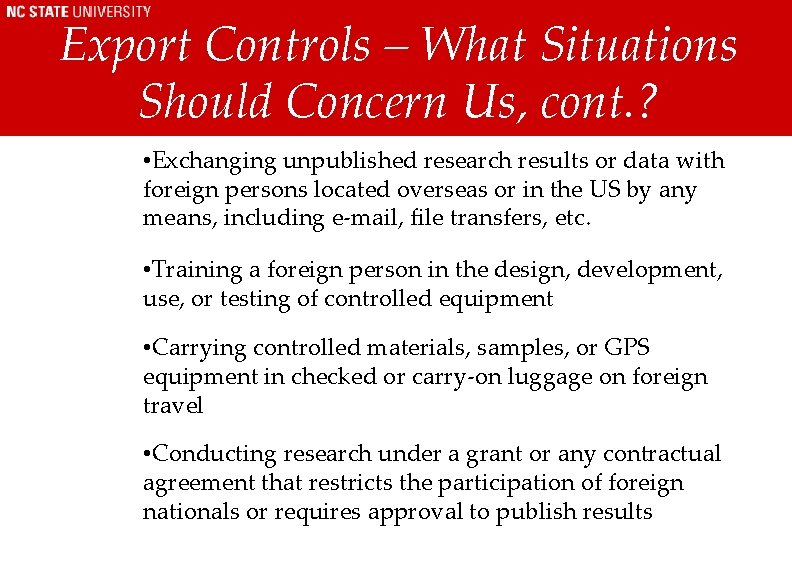
Export Controls – What Situations Should Concern Us, cont. ? • Exchanging unpublished research results or data with foreign persons located overseas or in the US by any means, including e-mail, file transfers, etc. • Training a foreign person in the design, development, use, or testing of controlled equipment • Carrying controlled materials, samples, or GPS equipment in checked or carry-on luggage on foreign travel • Conducting research under a grant or any contractual agreement that restricts the participation of foreign nationals or requires approval to publish results
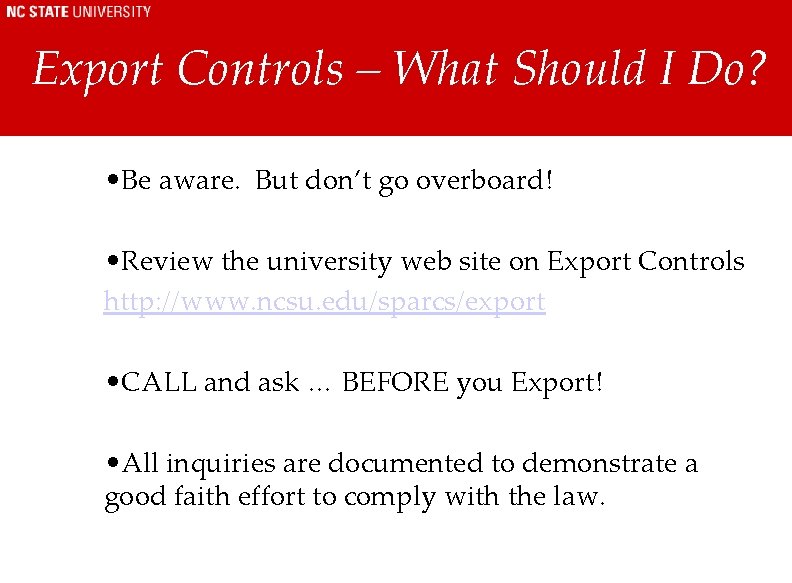
Export Controls – What Should I Do? • Be aware. But don’t go overboard! • Review the university web site on Export Controls http: //www. ncsu. edu/sparcs/export • CALL and ask … BEFORE you Export! • All inquiries are documented to demonstrate a good faith effort to comply with the law.
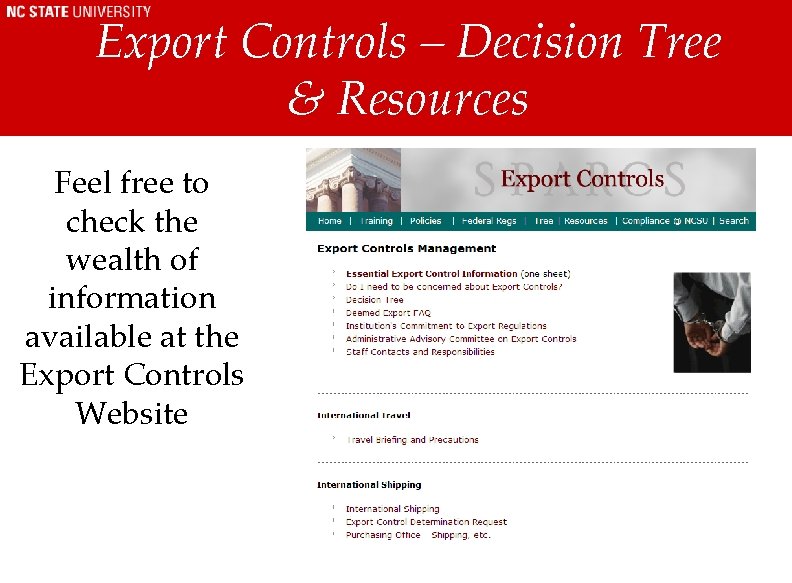
Export Controls – Decision Tree & Resources Feel free to check the wealth of information available at the Export Controls Website
Environmental (EHS)/ Lab Safety An Overview of Environmental / Lab Safety
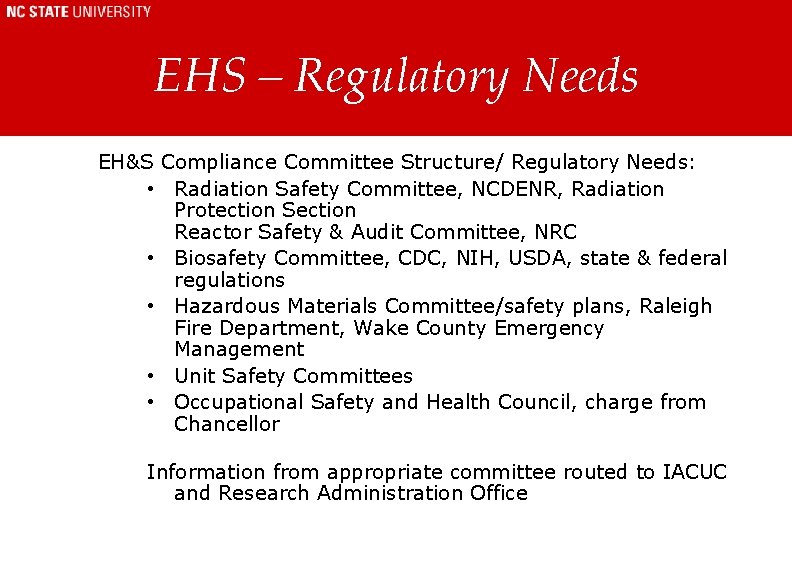
EHS – Regulatory Needs EH&S Compliance Committee Structure/ Regulatory Needs: • Radiation Safety Committee, NCDENR, Radiation Protection Section Reactor Safety & Audit Committee, NRC • Biosafety Committee, CDC, NIH, USDA, state & federal regulations • Hazardous Materials Committee/safety plans, Raleigh Fire Department, Wake County Emergency Management • Unit Safety Committees • Occupational Safety and Health Council, charge from Chancellor Information from appropriate committee routed to IACUC and Research Administration Office
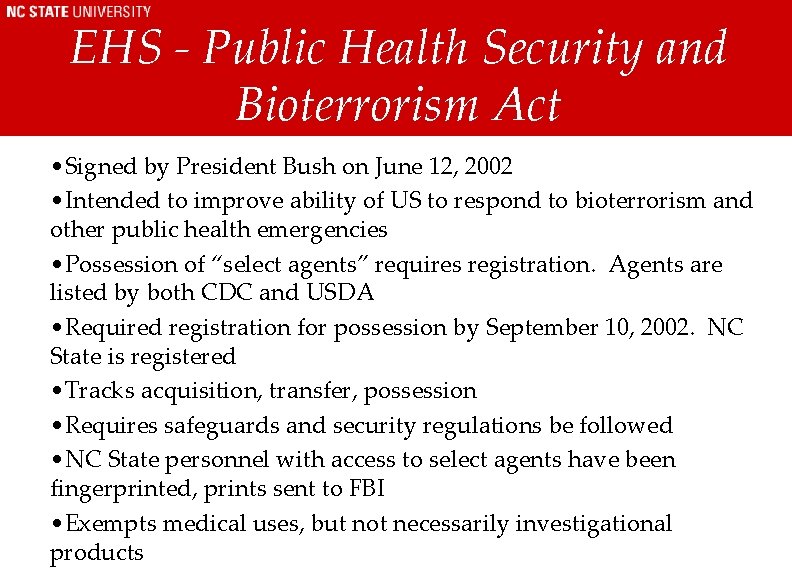
EHS - Public Health Security and Bioterrorism Act • Signed by President Bush on June 12, 2002 • Intended to improve ability of US to respond to bioterrorism and other public health emergencies • Possession of “select agents” requires registration. Agents are listed by both CDC and USDA • Required registration for possession by September 10, 2002. NC State is registered • Tracks acquisition, transfer, possession • Requires safeguards and security regulations be followed • NC State personnel with access to select agents have been fingerprinted, prints sent to FBI • Exempts medical uses, but not necessarily investigational products
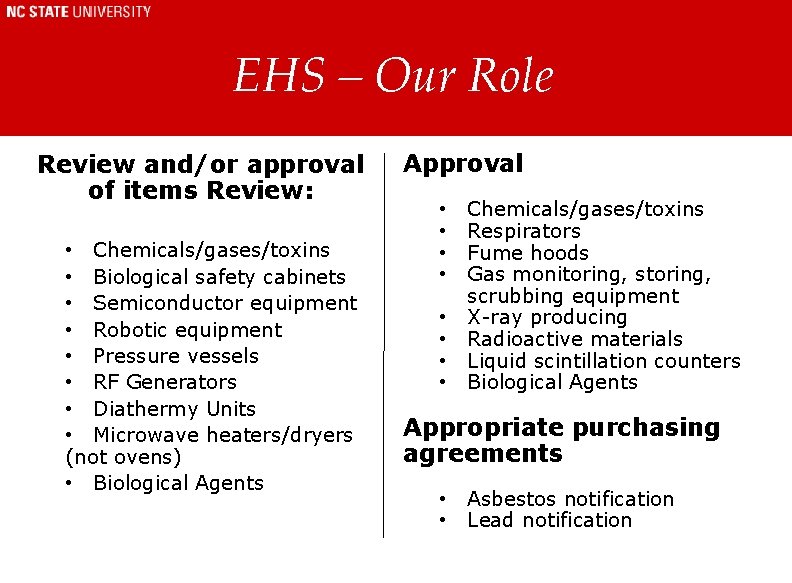
EHS – Our Role Review and/or approval of items Review: • Chemicals/gases/toxins • Biological safety cabinets • Semiconductor equipment • Robotic equipment • Pressure vessels • RF Generators • Diathermy Units • Microwave heaters/dryers (not ovens) • Biological Agents Approval • • Chemicals/gases/toxins Respirators Fume hoods Gas monitoring, scrubbing equipment X-ray producing Radioactive materials Liquid scintillation counters Biological Agents Appropriate purchasing agreements • • Asbestos notification Lead notification
EHS – Upcoming Federal Requirements • Regulations from the Nuclear Regulatory Commission, via Homeland Security, require increased security control measures for all radioactive material quantities of concern • Unescorted access requires background checks, character reference validation • Escorted access requires visitor logs and surveillance • Additional barriers erected, card access installed • Next steps: fingerprinting for unrestricted access, increased security controls for chemicals, technically specific training and chemical inventory and tracking
EHS – Safety Plans • Required for any area (laboratory, storeroom, extension facility, teaching laboratories, agricultural research facility, shared facilities, etc. ) in which "Hazardous Materials" are used • "Hazardous Materials" includes all physical, biological, chemical, and hazardous processes such as those employing high voltage, high pressure or other hazards • Required by the Occupational Safety and Health Administration (OSHA) regulation 29 CFR 1910. 1450 • OSHA Hazard Communication Standard, 29 CFR 1910. 1200, requires awareness training • Also used for emergency response information, door signage, inspection frequency and process hazard reviews • Safety plan are electronic, completed online, revised annually or as needed to satisfy intent of rule
EHS – Access via My. Pack Portal Each Lab Safety Plan Contains: • Chemical inventory • Emergency procedures & evacuation map • Security checklist, self-audit checklist, waste minimization checklist • Process descriptions • Description of hazards • PPE used in laboratory • Lab diagram (layout of furniture & equipment)
EHS - Resources Environmental Health and Safety Website www. ncsu. edu/ehs Index of services Staff Directory Safety plan database web address: www. ncsu. edu/ehs/safetyplan/index. html
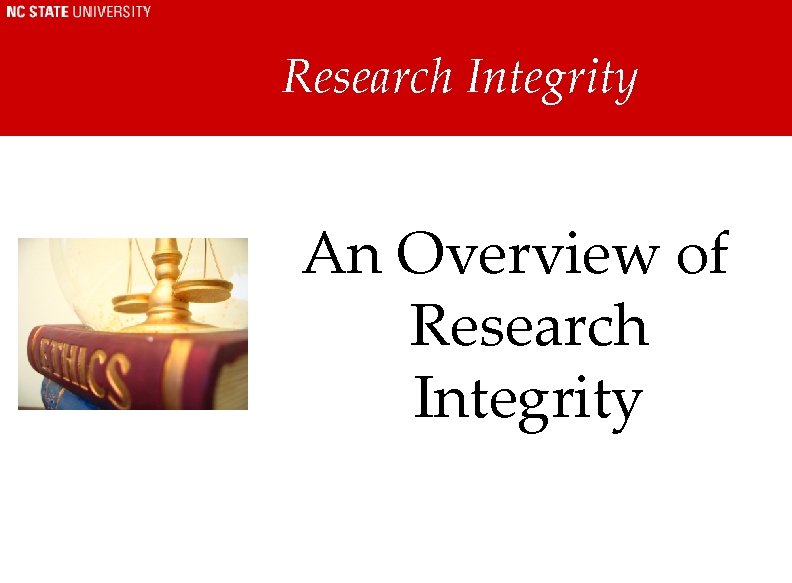
Research Integrity An Overview of Research Integrity
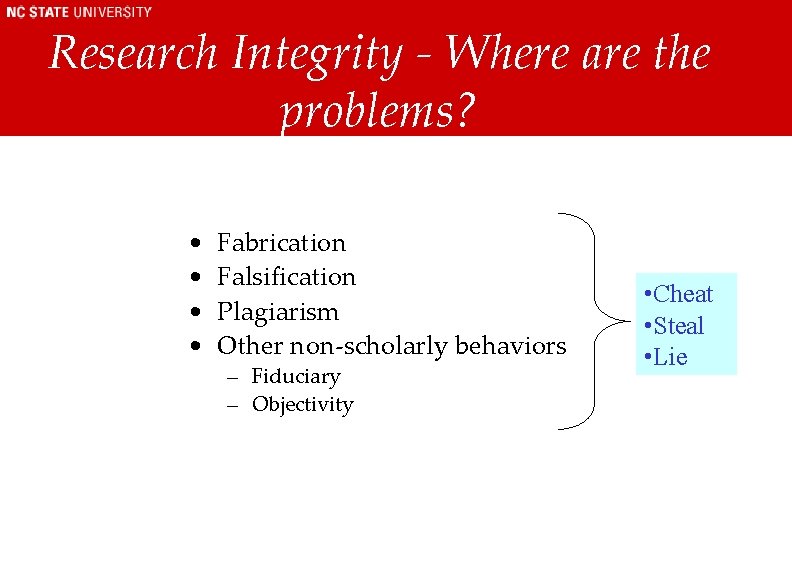
Research Integrity. Definitions - Where are the problems? • • Fabrication Falsification Plagiarism Other non-scholarly behaviors – Fiduciary – Objectivity • Cheat • Steal • Lie
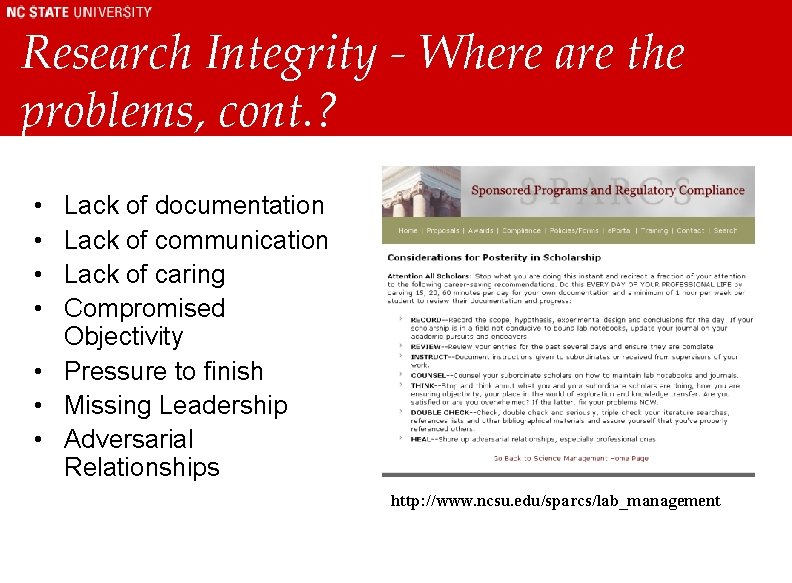
Research Integrity - Where are the problems, cont. ? • • Lack of documentation Lack of communication Lack of caring Compromised Objectivity • Pressure to finish • Missing Leadership • Adversarial Relationships http: //www. ncsu. edu/sparcs/lab_management
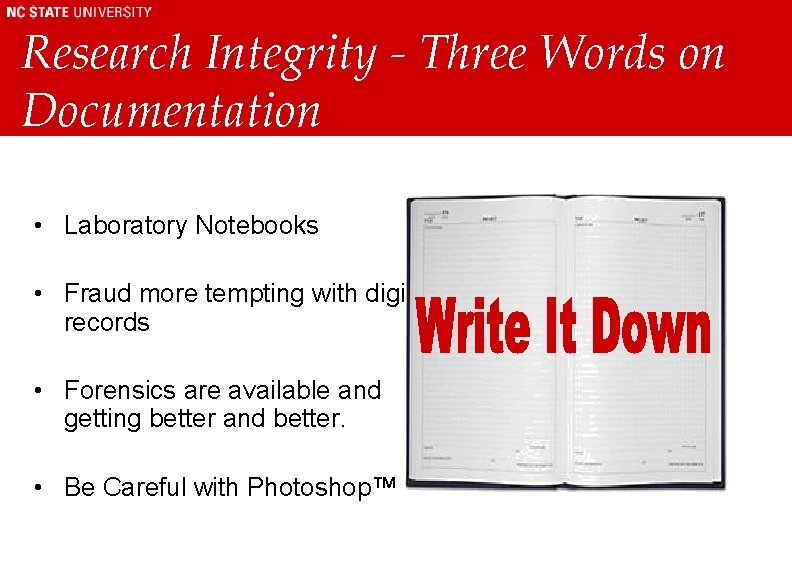
Research Integrity - Three Words on Documentation • Laboratory Notebooks • Fraud more tempting with digital records • Forensics are available and getting better and better. • Be Careful with Photoshop™
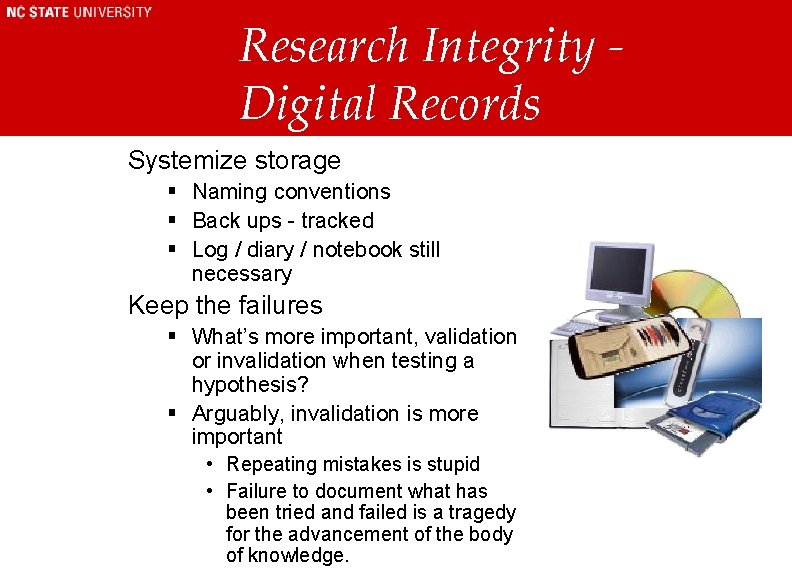
Research Integrity Digital Records Systemize storage § Naming conventions § Back ups - tracked § Log / diary / notebook still necessary Keep the failures § What’s more important, validation or invalidation when testing a hypothesis? § Arguably, invalidation is more important • Repeating mistakes is stupid • Failure to document what has been tried and failed is a tragedy for the advancement of the body of knowledge.
Set Standards • Set Standards (for documentation, communication of mistakes, errors and failures, questioning success, etc. ) • Discuss Standards in Person – Group Meetings, individual reviews • Follow-up with written standards • Require through encouragement and support, attendance of ethics courses/symposia • Evaluate Understanding of Standards and Instructions § Ask for a reiteration back § Ensure standards are applied systematically
Research Integrity - Pay Attention to YOU Record – Keep it clean and be religious about it Review – Remind yourself what you did the last few days. Instruct – Document instructions given and received. Share docs. Counsel – Let your subordinates and others know how to behave. Think! – Stop for a moment and think about where you’ve been and where you are headed Double Check – Lit search is not a one-stop shopping spree
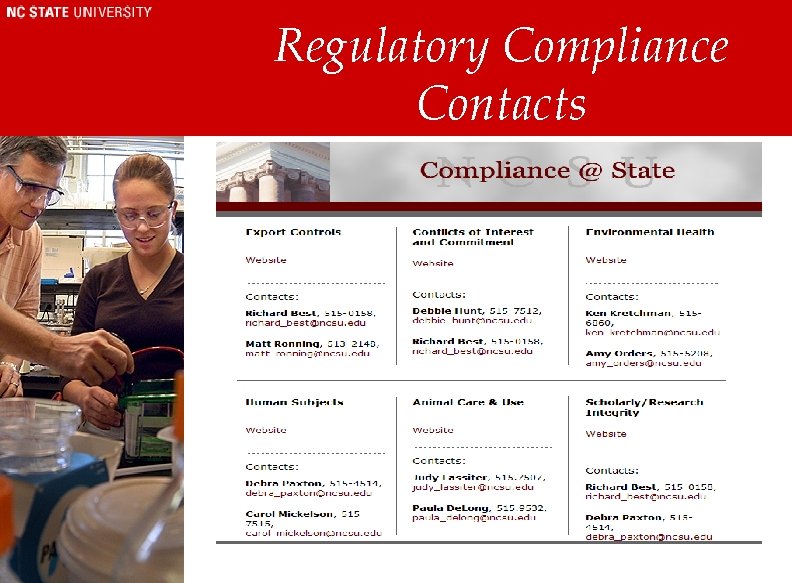
Regulatory Compliance Contacts