On the Complexity of Approximating the VC Dimension


- Slides: 16
On the Complexity of Approximating the VC Dimension Chris Umans, Microsoft Research joint work with Elchanan Mossel, Microsoft Research June 2001
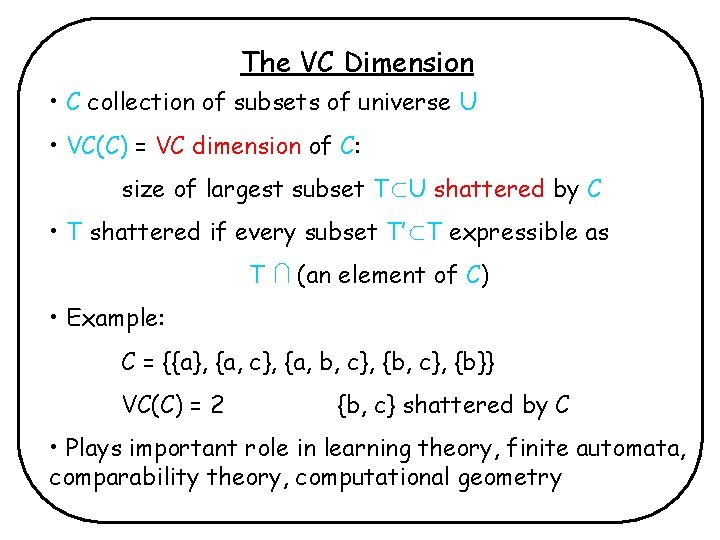
The VC Dimension • C collection of subsets of universe U • VC(C) = VC dimension of C: size of largest subset T U shattered by C • T shattered if every subset T’ T expressible as T (an element of C) • Example: C = {{a}, {a, c}, {a, b, c}, {b}} VC(C) = 2 {b, c} shattered by C • Plays important role in learning theory, finite automata, comparability theory, computational geometry
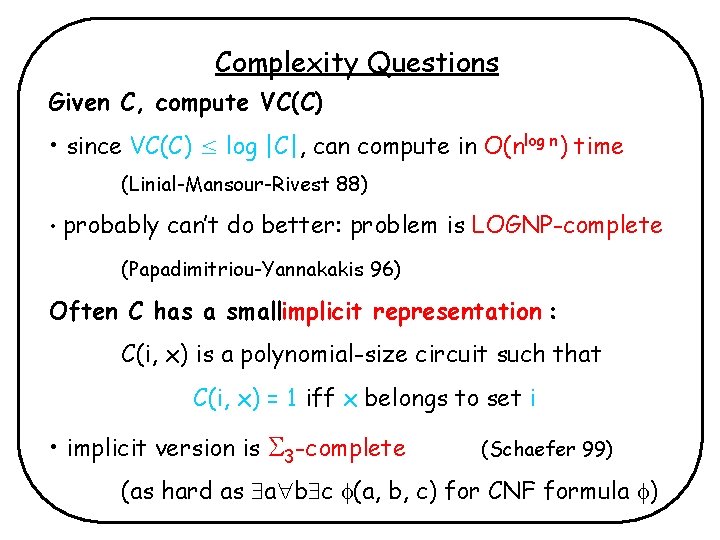
Complexity Questions Given C, compute VC(C) • since VC(C) log |C|, can compute in O(nlog n) time (Linial-Mansour-Rivest 88) • probably can’t do better: problem is LOGNP-complete (Papadimitriou-Yannakakis 96) Often C has a smallimplicit representation : C(i, x) is a polynomial-size circuit such that C(i, x) = 1 iff x belongs to set i • implicit version is 3 -complete (Schaefer 99) (as hard as a b c (a, b, c) for CNF formula )
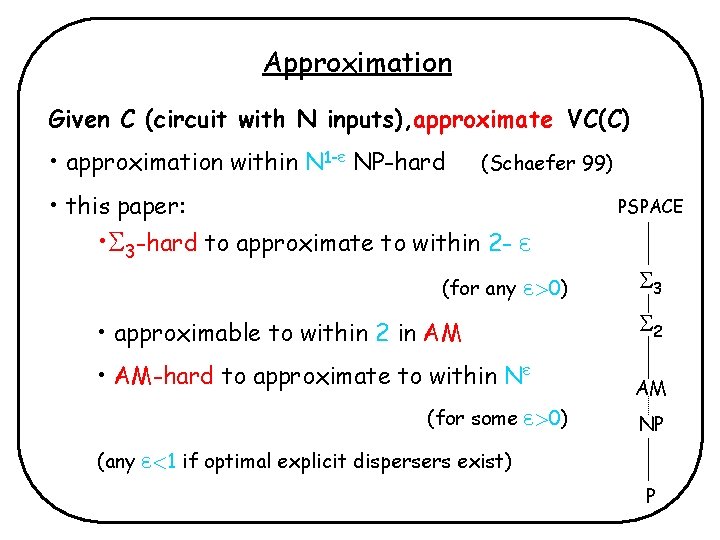
Approximation Given C (circuit with N inputs), approximate VC(C) • approximation within N 1 - NP-hard (Schaefer 99) • this paper: • 3 -hard to approximate to within 2 - (for any 0) • approximable to within 2 in AM • AM-hard to approximate to within N (for some 0) PSPACE 3 2 AM NP (any 1 if optimal explicit dispersers exist) P
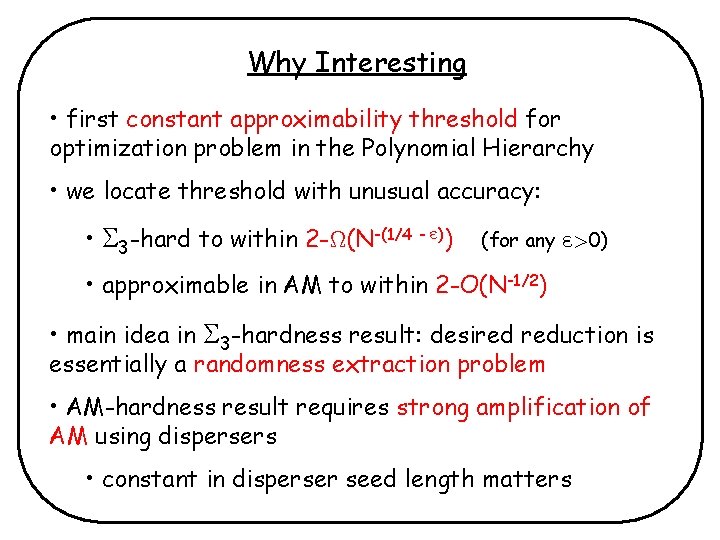
Why Interesting • first constant approximability threshold for optimization problem in the Polynomial Hierarchy • we locate threshold with unusual accuracy: • 3 -hard to within 2 - (N-(1/4 - )) (for any 0) • approximable in AM to within 2 -O(N-1/2) • main idea in 3 -hardness result: desired reduction is essentially a randomness extraction problem • AM-hardness result requires strong amplification of AM using dispersers • constant in disperser seed length matters
Outline for Rest of Talk • Arthur-Merlin protocol for 2 -approximation • 3 -hardness • Schaefer’s 3 -completeness proof • why we need “randomness extraction” • dispersers for simple distributions using listdecodable codes • AM-hardness • conclusions
2 -approximation in AM Sauer-Shelah(-Perles) Lemma: Let C be a collection of subsets of [n] such that |C| m n ( j) j=0 . Then VC(C) m+1. Mutual input: circuit C(i, x) (= 1 iff x in set i) • Merlin sends set of k elements X = {x 0, x 1, . . . , xk-1} • Arthur replies with a random k-bit string s • Merlin sends an index i Accept iff C(i, xj) = sj for j = 0, 1, 2, . . . , k-1 VC(C) k/2 ⇒ VC(C ∩ X) k/2 ⇒ Pr[C accepted] 1/2
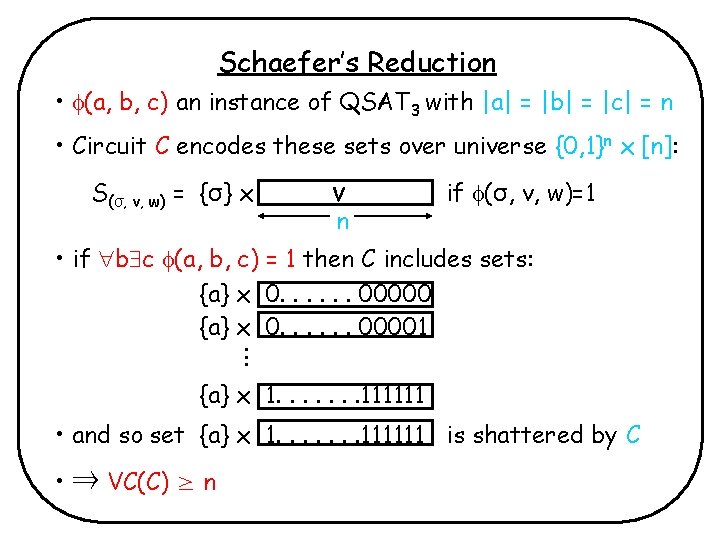
Schaefer’s Reduction • (a, b, c) an instance of QSAT 3 with |a| = |b| = |c| = n • Circuit C encodes these sets over universe {0, 1}n x [n]: S( , v, w) = { } x v n if ( , v, w)=1 • if b c (a, b, c) = 1 then C includes sets: {a} x 0. . . 00000 {a} x 0. . . 00001 {a} x 1. . . . 111111 • and so set {a} x 1. . . . 111111 is shattered by C • ⇒ VC(C) n
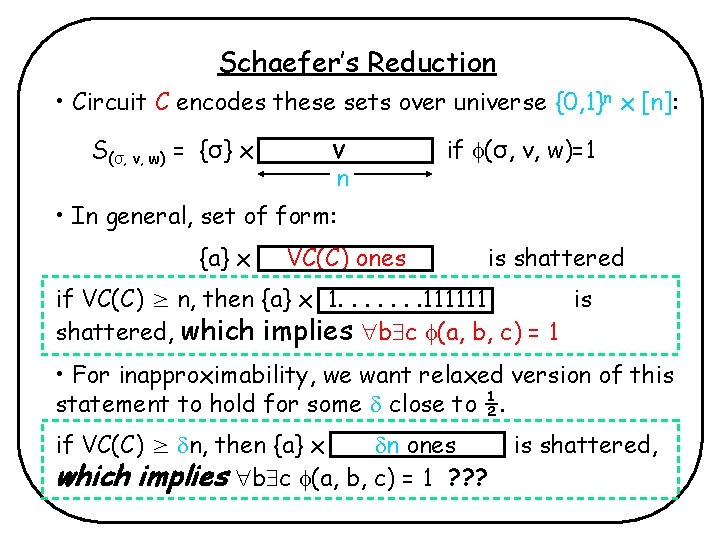
Schaefer’s Reduction • Circuit C encodes these sets over universe {0, 1}n x [n]: S( , v, w) = { } x v n if ( , v, w)=1 • In general, set of form: {a} x VC(C) ones is shattered if VC(C) n, then {a} x 1. . . . 111111 is shattered, which implies b c (a, b, c) = 1 • For inapproximability, we want relaxed version of this statement to hold for some close to ½. if VC(C) n, then {a} x n ones which implies b c (a, b, c) = 1 ? ? ? is shattered,
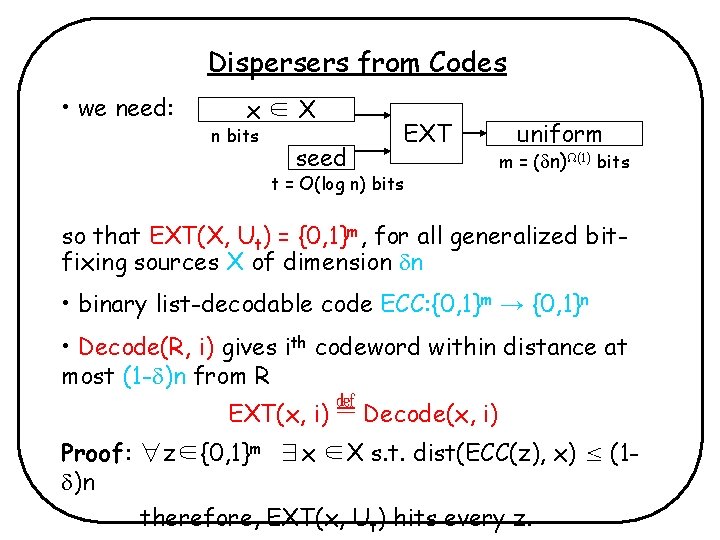
A Randomness Extraction Problem • we have a distribution X ⊂ {0, 1}n with n entropy • we need: x∈X n bits seed EXT O(log n) bits uniform m = ( n) (1) bits • this gives us: c) (x ∈ X) c Note: ∧ (a, EXT(x, y), c) ⇔ b c (a, b, y • we only need a disperser • we need zero-error ! (need to hit all of {0, 1}m) BUT, X is in a special class of distributions. . .
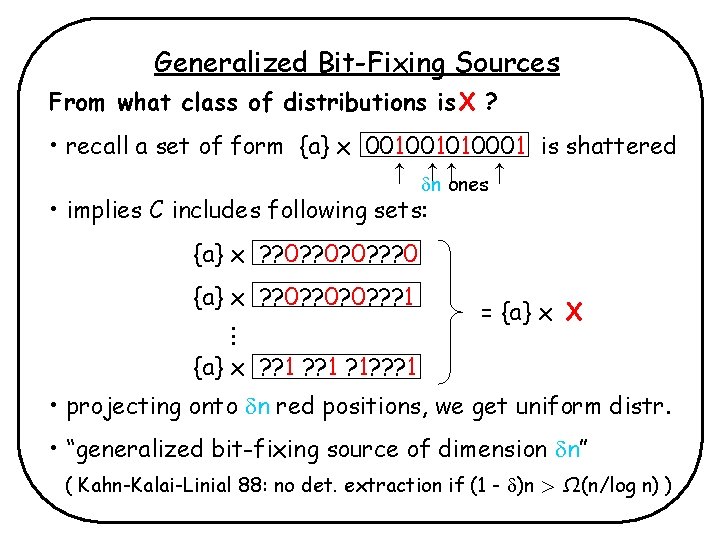
Generalized Bit-Fixing Sources From what class of distributions is X ? • recall a set of form {a} x 001001010001 is shattered ↑ ↑↑ ↑ n ones • implies C includes following sets: {a} x ? ? 0? 0? ? ? 0 {a} x ? ? 0? 0? ? ? 1 {a} x ? ? 1 ? 1? ? ? 1 = {a} x X • projecting onto n red positions, we get uniform distr. • “generalized bit-fixing source of dimension n” ( Kahn-Kalai-Linial 88: no det. extraction if (1 - )n Ω(n/log n) )
Dispersers from Codes • we need: x∈X n bits seed EXT t = O(log n) bits uniform m = ( n) (1) bits so that EXT(X, Ut) = {0, 1}m, for all generalized bitfixing sources X of dimension n • binary list-decodable code ECC: {0, 1}m → {0, 1}n • Decode(R, i) gives ith codeword within distance at most (1 - )n from R EXT(x, i) ≝ Decode(x, i) Proof: ∀z∈{0, 1}m ∃x ∈X s. t. dist(ECC(z), x) (1 )n therefore, EXT(x, Ut) hits every z.
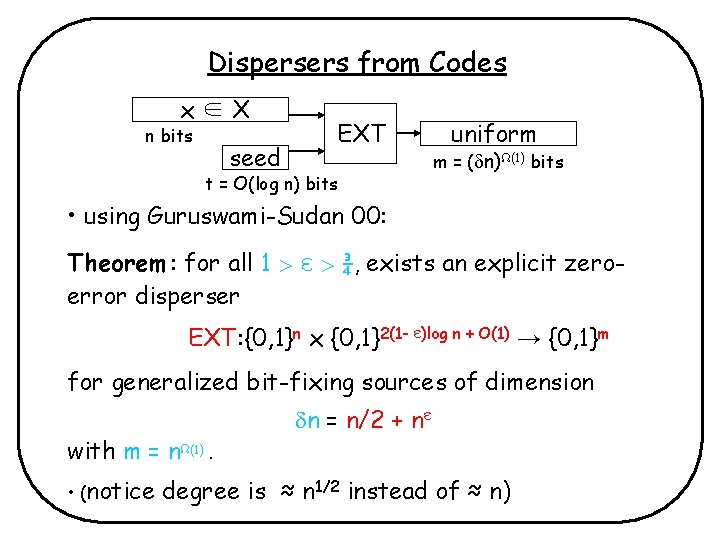
Dispersers from Codes x∈X n bits seed EXT t = O(log n) bits uniform m = ( n) (1) bits • using Guruswami-Sudan 00: Theorem : for all 1 ¾, exists an explicit zeroerror disperser EXT: {0, 1}n x {0, 1}2(1 - )log n + O(1) → {0, 1}m for generalized bit-fixing sources of dimension with m = n (1). • (notice n = n/2 + n degree is ≈ n 1/2 instead of ≈ n)
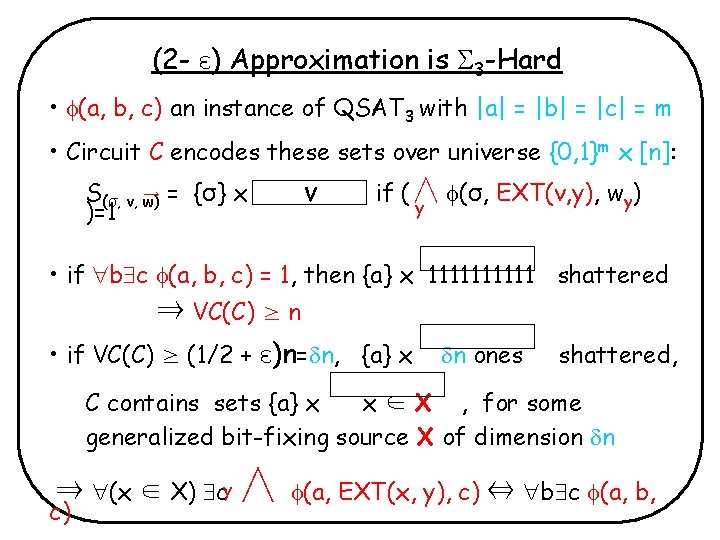
(2 - ) Approximation is 3 -Hard • (a, b, c) an instance of QSAT 3 with |a| = |b| = |c| = m • Circuit C encodes these sets over universe {0, 1}m x [n]: → = { } x S( , v, w) )=1 v if (∧ ( , EXT(v, y), wy) y • if b c (a, b, c) = 1, then {a} x 11111 shattered ⇒ VC(C) n • if VC(C) (1/2 + )n= n, {a} x n ones shattered, C contains sets {a} x x ∈ X , for some generalized bit-fixing source X of dimension n ⇒ (x ∈ X) cy ∧ (a, EXT(x, y), c) ⇔ b c (a, b, c)
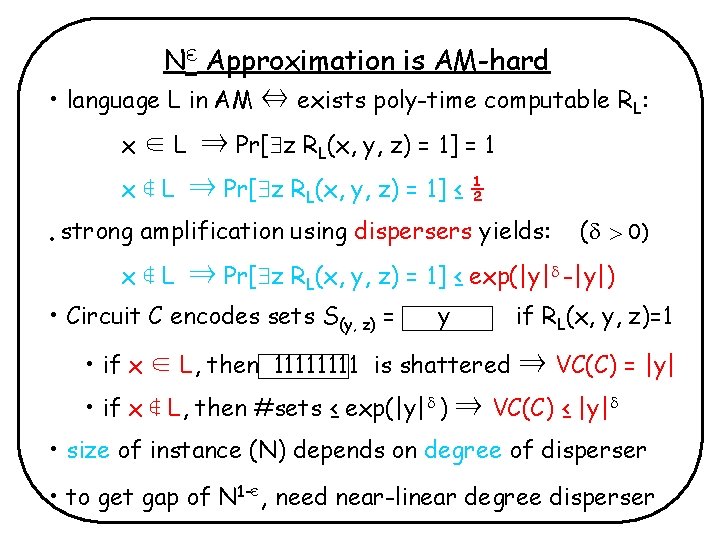
N Approximation is AM-hard • language L in AM ⇔ exists poly-time computable RL: x ∈ L ⇒ Pr[ z RL(x, y, z) = 1] = 1 x ∉ L ⇒ Pr[ z RL(x, y, z) = 1] ≤ ½ • strong amplification using dispersers yields: ( 0) x ∉ L ⇒ Pr[ z RL(x, y, z) = 1] ≤ exp(|y| -|y|) • Circuit C encodes sets S(y, z) = y if RL(x, y, z)=1 • if x ∈ L, then 1111 is shattered ⇒ VC(C) = |y| • if x ∉ L, then #sets ≤ exp(|y| ) ⇒ VC(C) ≤ |y| • size of instance (N) depends on degree of disperser • to get gap of N 1 - , need near-linear degree disperser
Conclusions • fairly complete picture of approximability of VC dimension • list-decodable binary codes yield zero-error dispersers for a non-trivial class of distributions • Some improvements and generalizations: • Ta-Shma-Zuckerman-Safra 01 construct nearlinear degree dispersers (available on ECCC) • Using q-ary list-decodable codes, and generalization of Sauer’s Lemma, we obtain approximability threshold of q for a generalization of VC dimension (in final version)