NRQCD as an Effective Field Theory Ron Horgan

- Slides: 34
NRQCD as an Effective Field Theory Ron Horgan DAMTP, University of Cambridge Royal Society Meeting Chicheley
Outline u Wilson flow and idea of effective field theory. u Lattice action and NRQCD as an effective field theory u Radiative improvement of NRQCD using background field approach. u Some results.
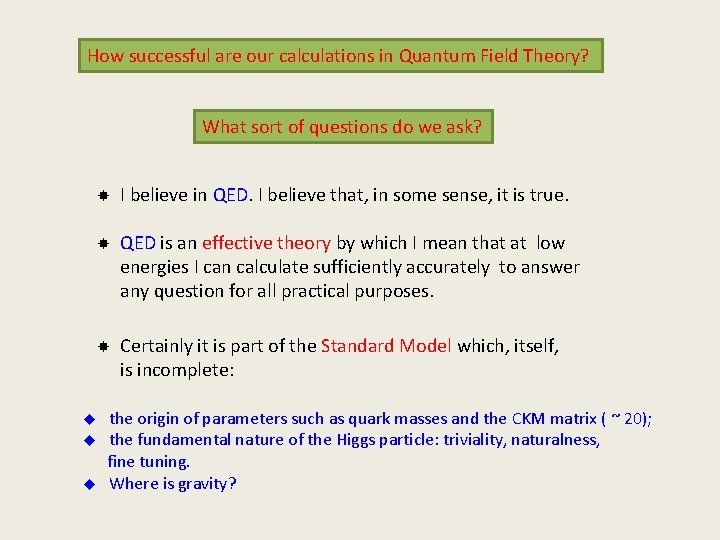
How successful are our calculations in Quantum Field Theory? What sort of questions do we ask? u u u I believe in QED. I believe that, in some sense, it is true. QED is an effective theory by which I mean that at low energies I can calculate sufficiently accurately to answer any question for all practical purposes. Certainly it is part of the Standard Model which, itself, is incomplete: the origin of parameters such as quark masses and the CKM matrix ( ~ 20); the fundamental nature of the Higgs particle: triviality, naturalness, fine tuning. Where is gravity?
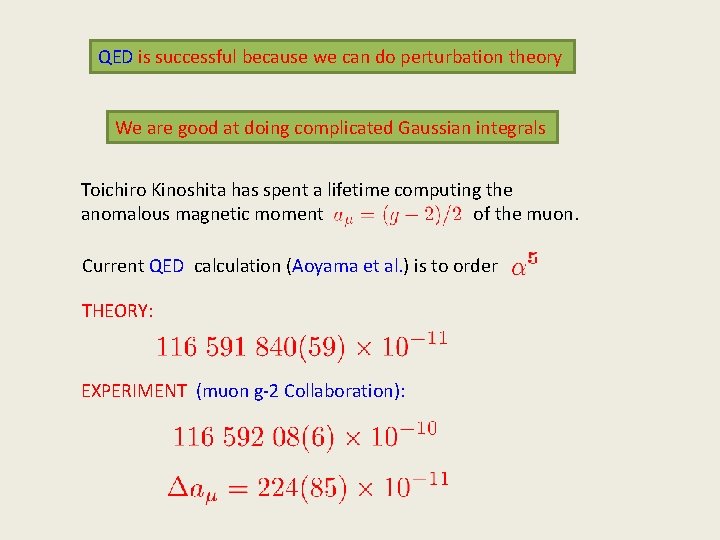
QED is successful because we can do perturbation theory We are good at doing complicated Gaussian integrals Toichiro Kinoshita has spent a lifetime computing the anomalous magnetic moment of the muon. Current QED calculation (Aoyama et al. ) is to order THEORY: EXPERIMENT (muon g-2 Collaboration):
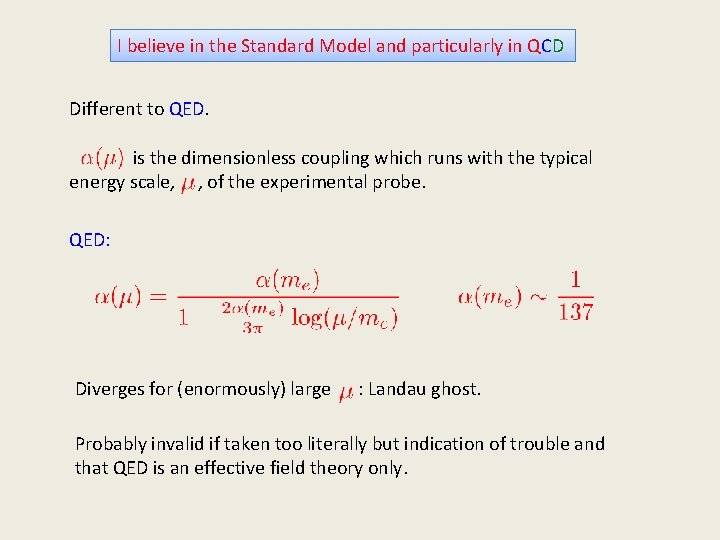
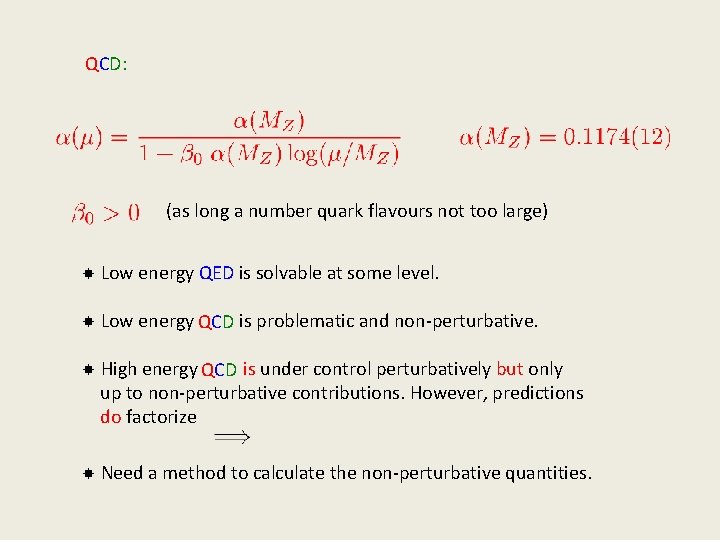
I believe in the Standard Model and particularly in QCD Different to QED. is the dimensionless coupling which runs with the typical energy scale, , of the experimental probe. QED: Diverges for (enormously) large : Landau ghost. Probably invalid if taken too literally but indication of trouble and that QED is an effective field theory only.
QCD: (as long a number quark flavours not too large) Low energy QED is solvable at some level. Low energy QCD is problematic and non-perturbative. High energy QCD is under control perturbatively but only up to non-perturbative contributions. However, predictions do factorize Need a method to calculate the non-perturbative quantities.
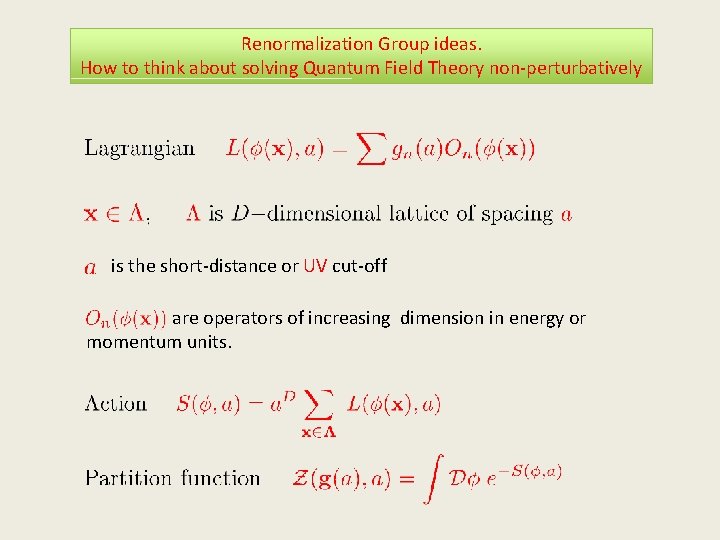
Renormalization Group ideas. How to think about solving Quantum Field Theory non-perturbatively is the short-distance or UV cut-off are operators of increasing dimension in energy or momentum units.
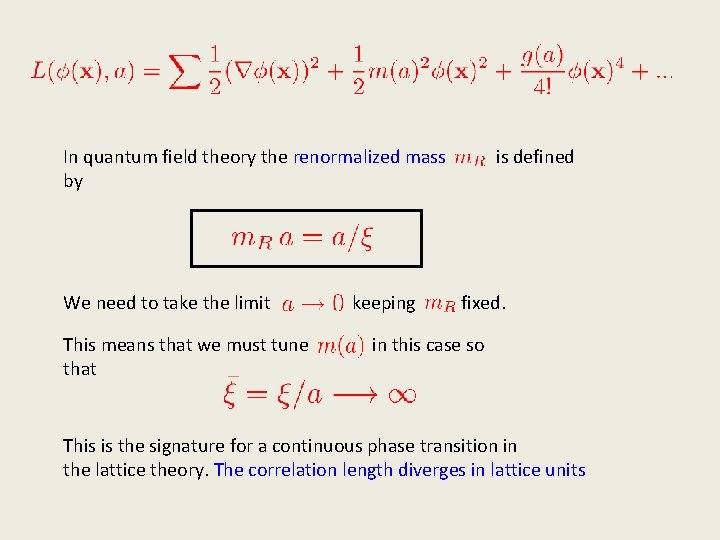
In quantum field theory the renormalized mass by We need to take the limit This means that we must tune that keeping is defined fixed. in this case so This is the signature for a continuous phase transition in the lattice theory. The correlation length diverges in lattice units
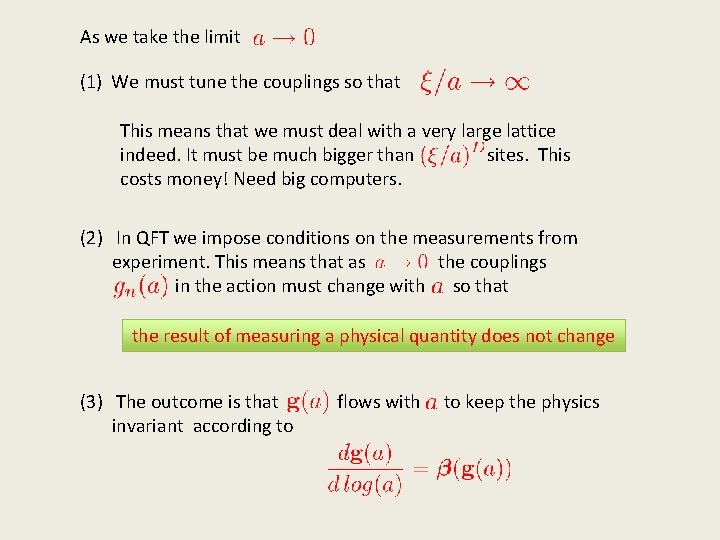
As we take the limit (1) We must tune the couplings so that This means that we must deal with a very large lattice indeed. It must be much bigger than sites. This costs money! Need big computers. (2) In QFT we impose conditions on the measurements from experiment. This means that as the couplings in the action must change with so that the result of measuring a physical quantity does not change (3) The outcome is that invariant according to flows with to keep the physics
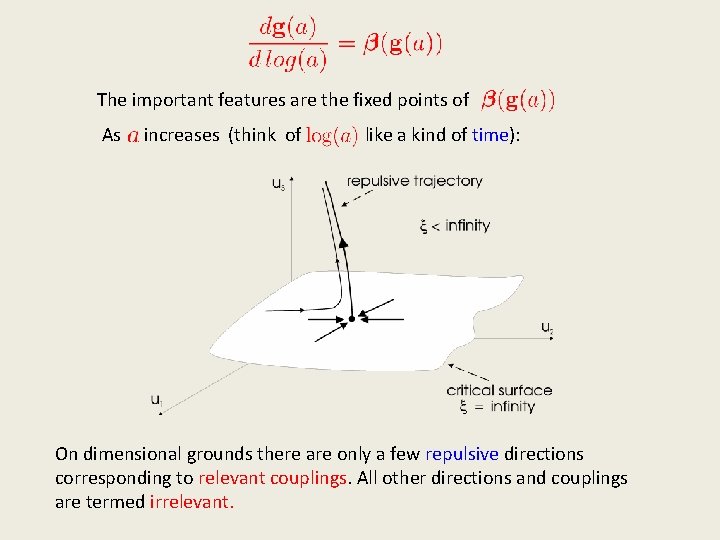
The important features are the fixed points of As increases (think of like a kind of time): On dimensional grounds there are only a few repulsive directions corresponding to relevant couplings. All other directions and couplings are termed irrelevant.
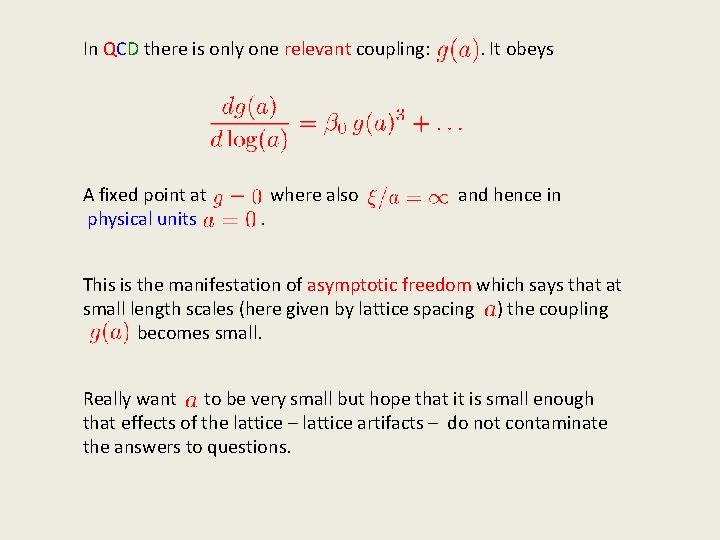
In QCD there is only one relevant coupling: A fixed point at physical units . where also . It obeys and hence in This is the manifestation of asymptotic freedom which says that at small length scales (here given by lattice spacing ) the coupling becomes small. Really want to be very small but hope that it is small enough that effects of the lattice – lattice artifacts – do not contaminate the answers to questions.
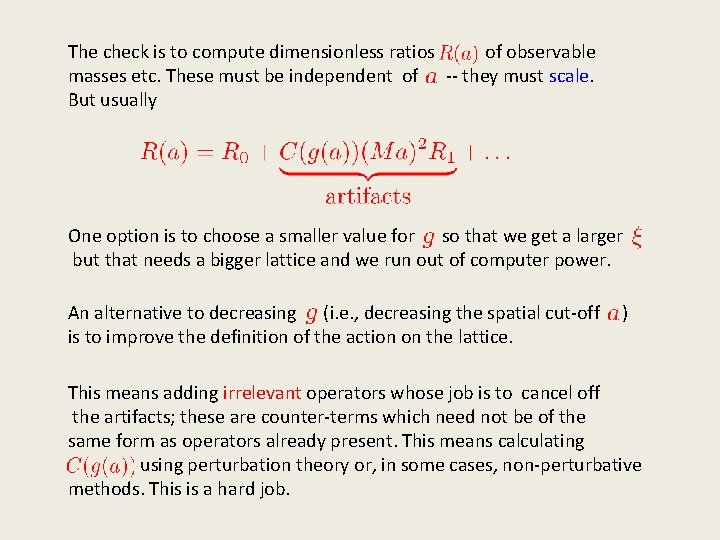
The check is to compute dimensionless ratios of observable masses etc. These must be independent of -- they must scale. But usually One option is to choose a smaller value for so that we get a larger but that needs a bigger lattice and we run out of computer power. An alternative to decreasing (i. e. , decreasing the spatial cut-off is to improve the definition of the action on the lattice. ) This means adding irrelevant operators whose job is to cancel off the artifacts; these are counter-terms which need not be of the same form as operators already present. This means calculating using perturbation theory or, in some cases, non-perturbative methods. This is a hard job.
All theories on a given trajectory predict the same physics
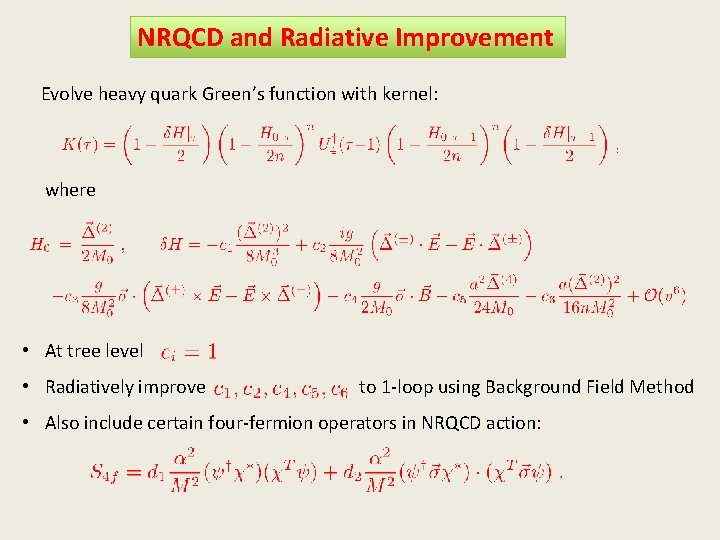
NRQCD and Radiative Improvement Evolve heavy quark Green’s function with kernel: where • At tree level • Radiatively improve to 1 -loop using Background Field Method • Also include certain four-fermion operators in NRQCD action:
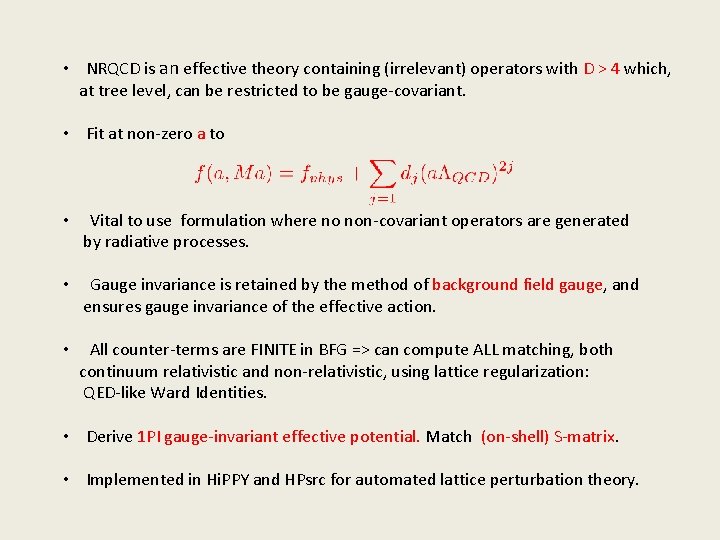
• NRQCD is an effective theory containing (irrelevant) operators with D > 4 which, at tree level, can be restricted to be gauge-covariant. • Fit at non-zero a to • Vital to use formulation where no non-covariant operators are generated by radiative processes. • Gauge invariance is retained by the method of background field gauge, and ensures gauge invariance of the effective action. • All counter-terms are FINITE in BFG => can compute ALL matching, both continuum relativistic and non-relativistic, using lattice regularization: QED-like Ward Identities. • Derive 1 PI gauge-invariant effective potential. Match (on-shell) S-matrix. • Implemented in Hi. PPY and HPsrc for automated lattice perturbation theory.
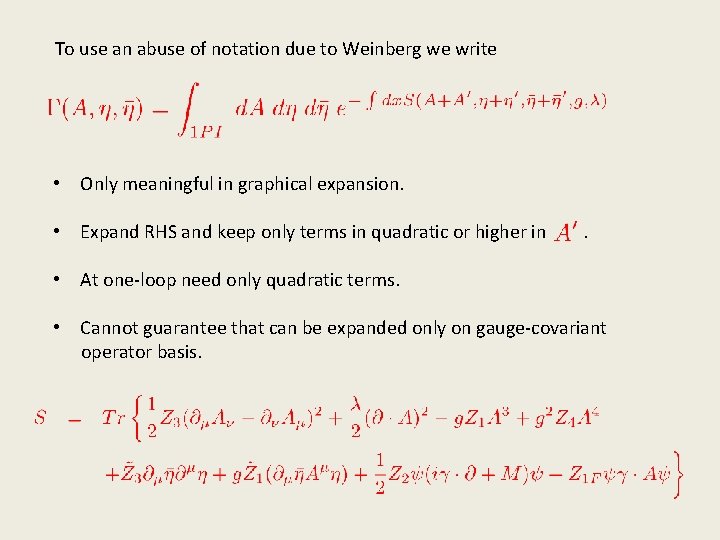
To use an abuse of notation due to Weinberg we write • Only meaningful in graphical expansion. • Expand RHS and keep only terms in quadratic or higher in . • At one-loop need only quadratic terms. • Cannot guarantee that can be expanded only on gauge-covariant operator basis.
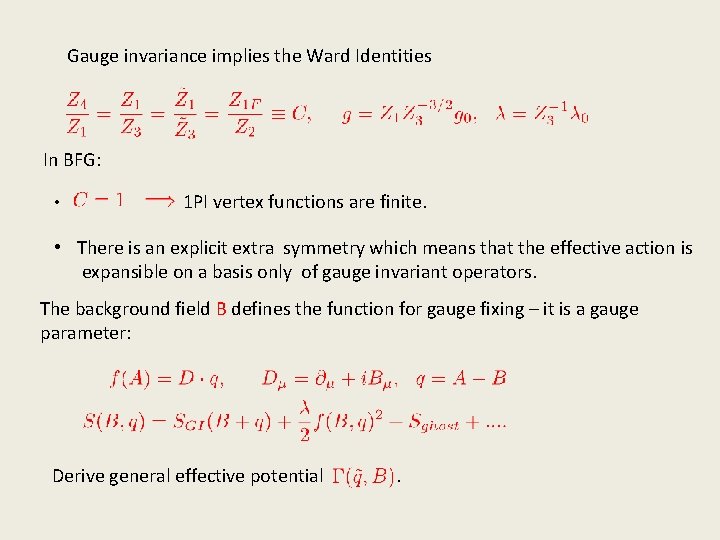
Gauge invariance implies the Ward Identities In BFG: • 1 PI vertex functions are finite. • There is an explicit extra symmetry which means that the effective action is expansible on a basis only of gauge invariant operators. The background field B defines the function for gauge fixing – it is a gauge parameter: Derive general effective potential .
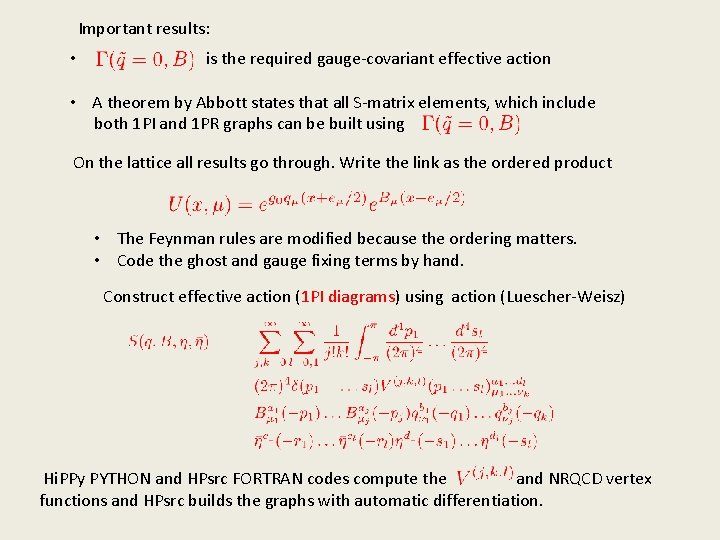
Important results: • is the required gauge-covariant effective action • A theorem by Abbott states that all S-matrix elements, which include both 1 PI and 1 PR graphs can be built using On the lattice all results go through. Write the link as the ordered product • The Feynman rules are modified because the ordering matters. • Code the ghost and gauge fixing terms by hand. Construct effective action (1 PI diagrams) using action (Luescher-Weisz) Hi. PPy PYTHON and HPsrc FORTRAN codes compute the and NRQCD vertex functions and HPsrc builds the graphs with automatic differentiation.
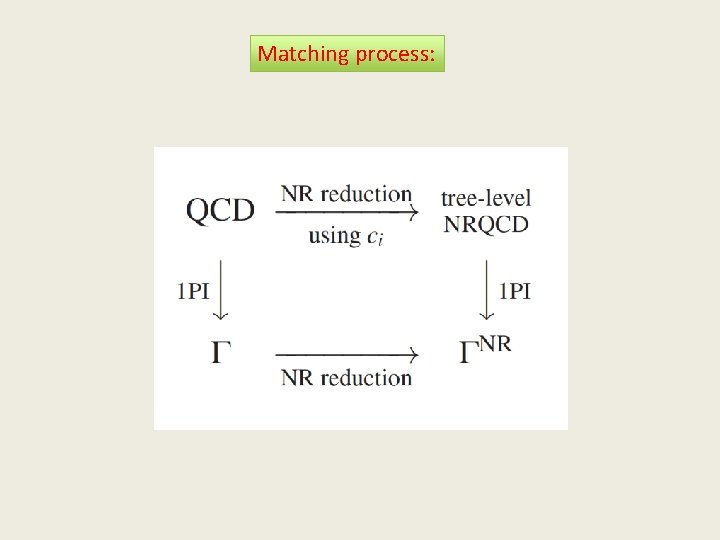
Matching process:
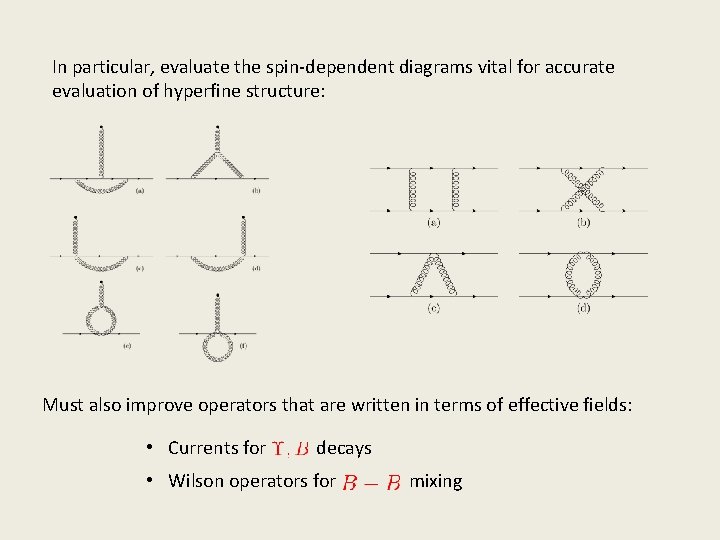
In particular, evaluate the spin-dependent diagrams vital for accurate evaluation of hyperfine structure: Must also improve operators that are written in terms of effective fields: • Currents for decays • Wilson operators for mixing
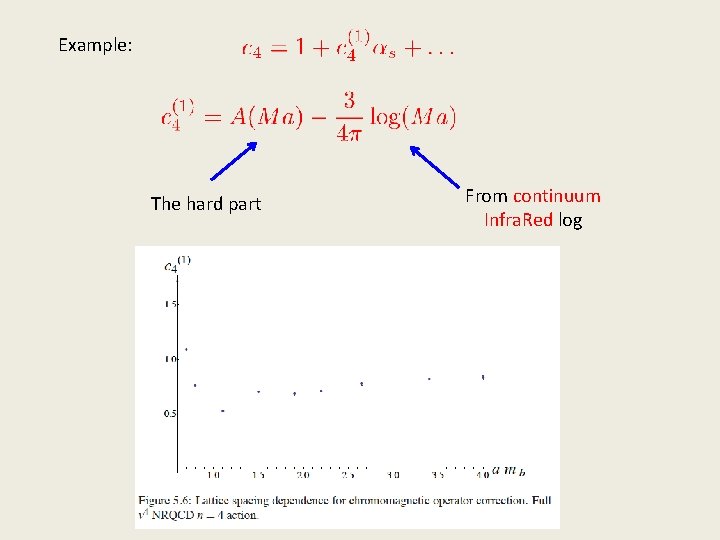
Example: The hard part From continuum Infra. Red log
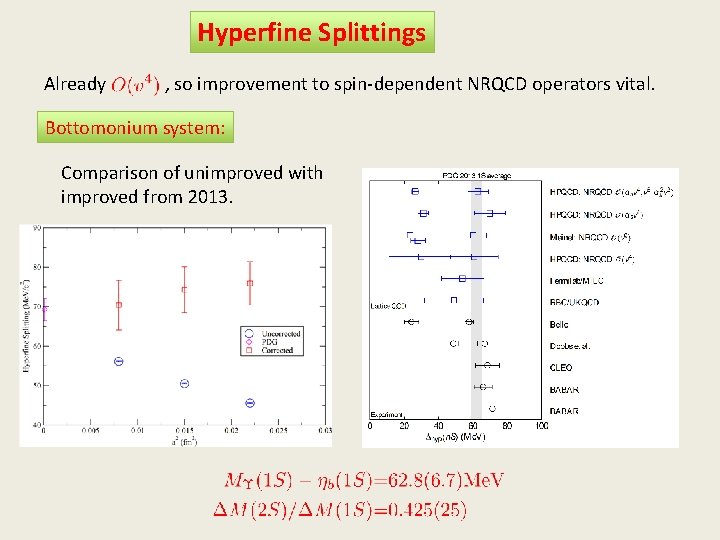
Hyperfine Splittings Already , so improvement to spin-dependent NRQCD operators vital. Bottomonium system: Comparison of unimproved with improved from 2013.
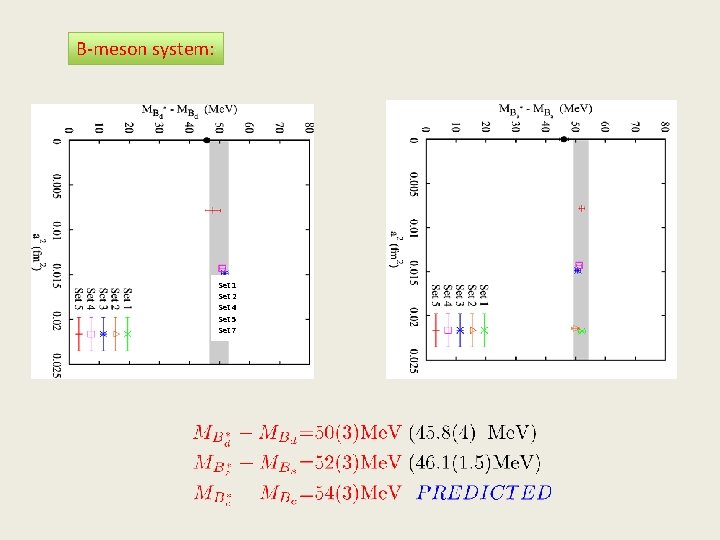
B-meson system: Set 1 Set 2 Set 4 Set 5 Set 7
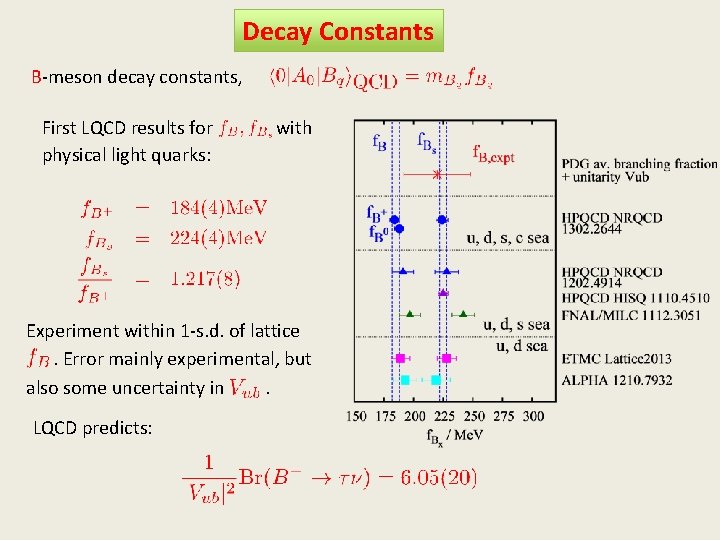
Decay Constants B-meson decay constants, First LQCD results for physical light quarks: with Experiment within 1 -s. d. of lattice. Error mainly experimental, but also some uncertainty in. LQCD predicts:
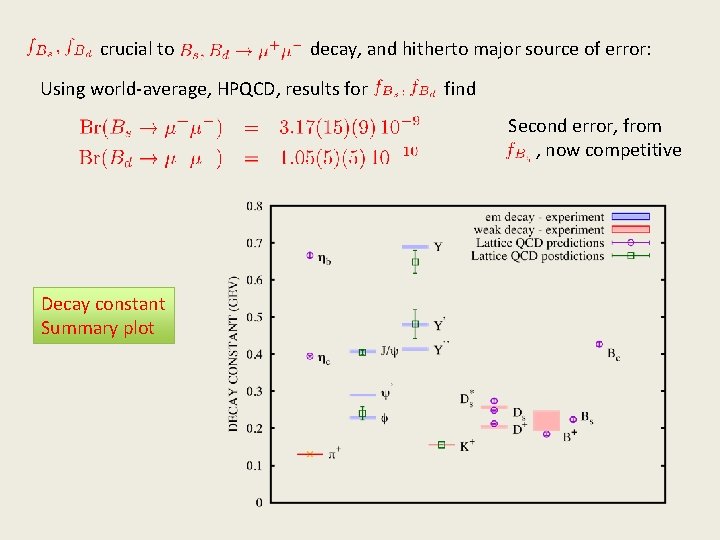
crucial to decay, and hitherto major source of error: Using world-average, HPQCD, results for find Second error, from , now competitive Decay constant Summary plot
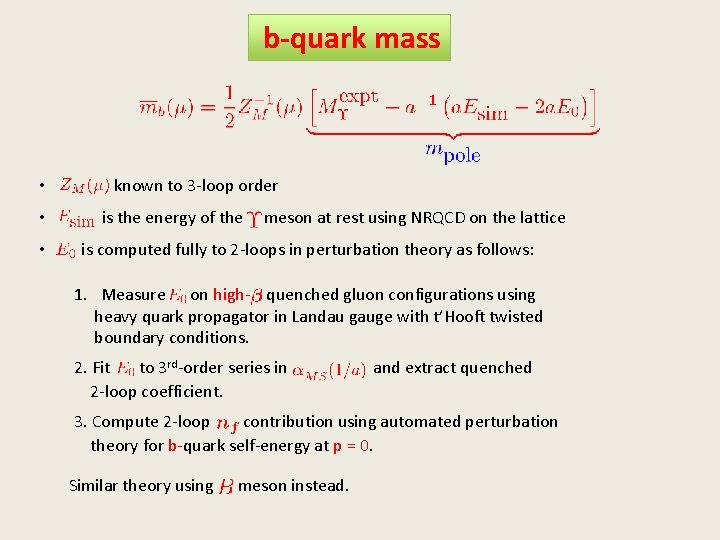
b-quark mass • • • known to 3 -loop order is the energy of the meson at rest using NRQCD on the lattice is computed fully to 2 -loops in perturbation theory as follows: 1. Measure on high- quenched gluon configurations using heavy quark propagator in Landau gauge with t’Hooft twisted boundary conditions. 2. Fit to 3 rd-order series in 2 -loop coefficient. and extract quenched 3. Compute 2 -loop contribution using automated perturbation theory for b-quark self-energy at p = 0. Similar theory using meson instead.
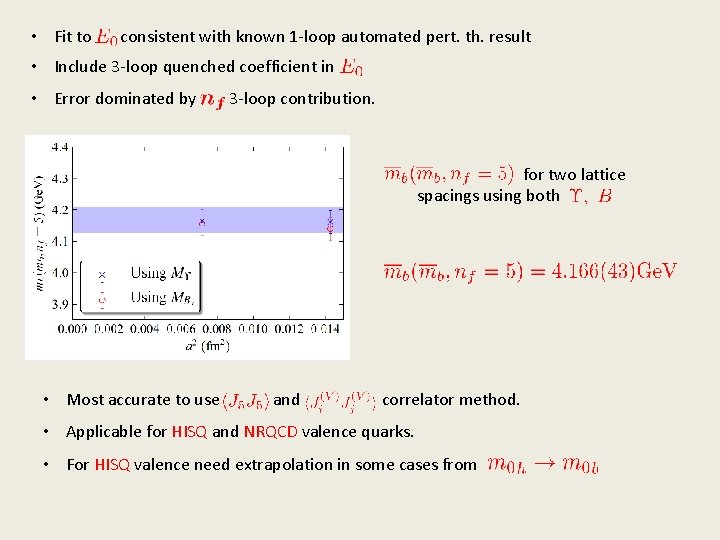
• Fit to consistent with known 1 -loop automated pert. th. result • Include 3 -loop quenched coefficient in • Error dominated by 3 -loop contribution. for two lattice spacings using both • Most accurate to use and correlator method. • Applicable for HISQ and NRQCD valence quarks. • For HISQ valence need extrapolation in some cases from
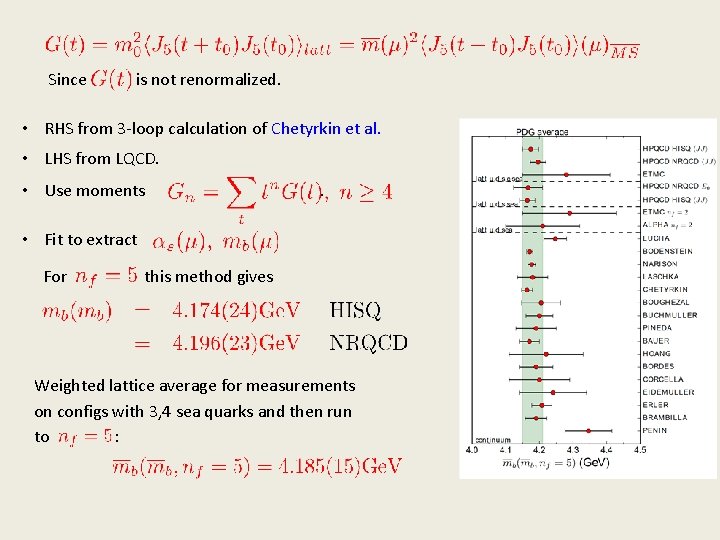
Since is not renormalized. • RHS from 3 -loop calculation of Chetyrkin et al. • LHS from LQCD. • Use moments • Fit to extract For . . this method gives Weighted lattice average for measurements on configs with 3, 4 sea quarks and then run to :
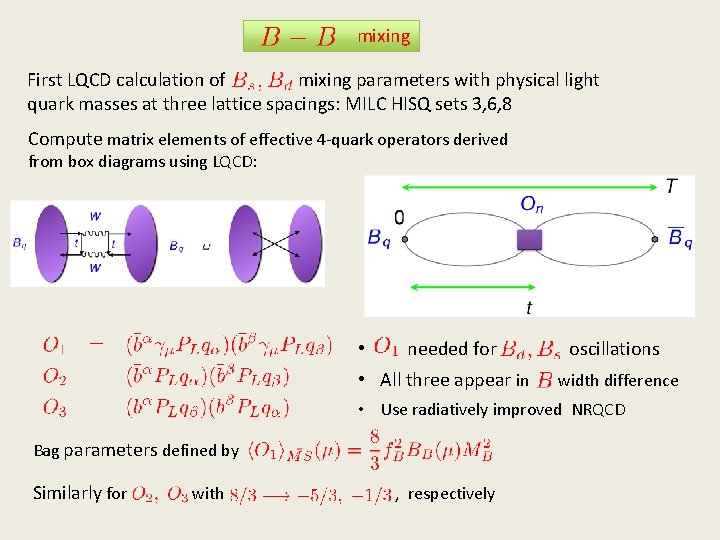
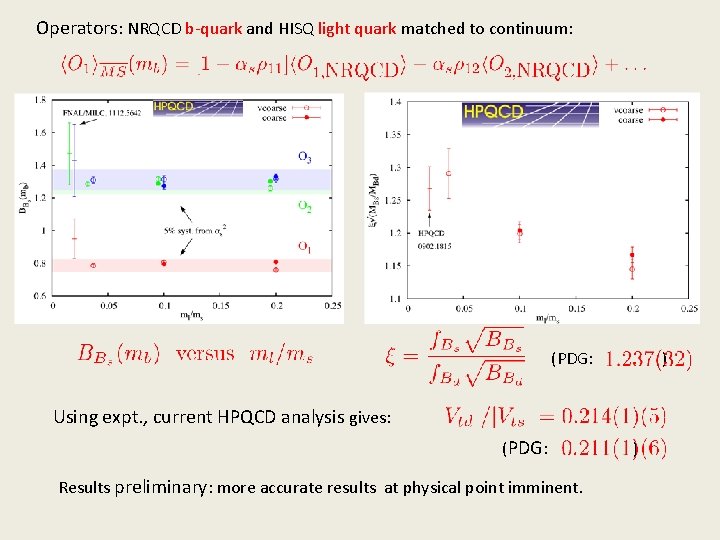
mixing First LQCD calculation of mixing parameters with physical light quark masses at three lattice spacings: MILC HISQ sets 3, 6, 8 Compute matrix elements of effective 4 -quark operators derived from box diagrams using LQCD: • needed for • All three appear in oscillations width difference • Use radiatively improved NRQCD Bag parameters defined by Similarly for with , respectively
Operators: NRQCD b-quark and HISQ light quark matched to continuum: (PDG: ) Using expt. , current HPQCD analysis gives: (PDG: Results preliminary: more accurate results at physical point imminent. )
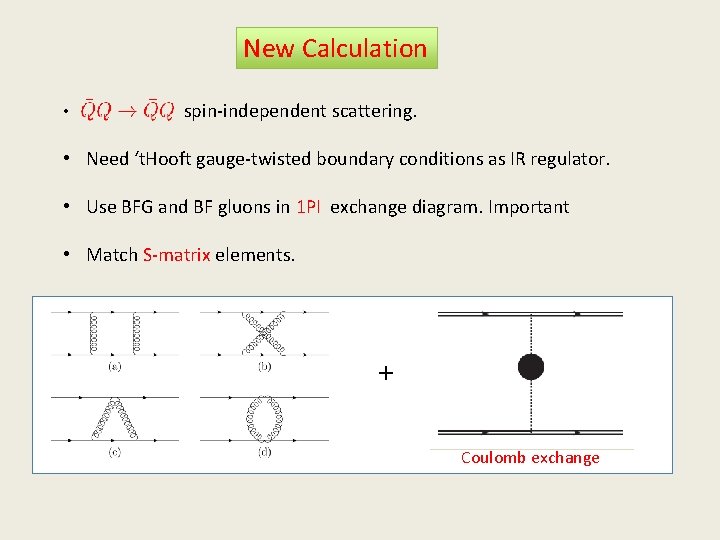
New Calculation • spin-independent scattering. • Need ‘t. Hooft gauge-twisted boundary conditions as IR regulator. • Use BFG and BF gluons in 1 PI exchange diagram. Important • Match S-matrix elements. + Coulomb exchange
moving NRQCD
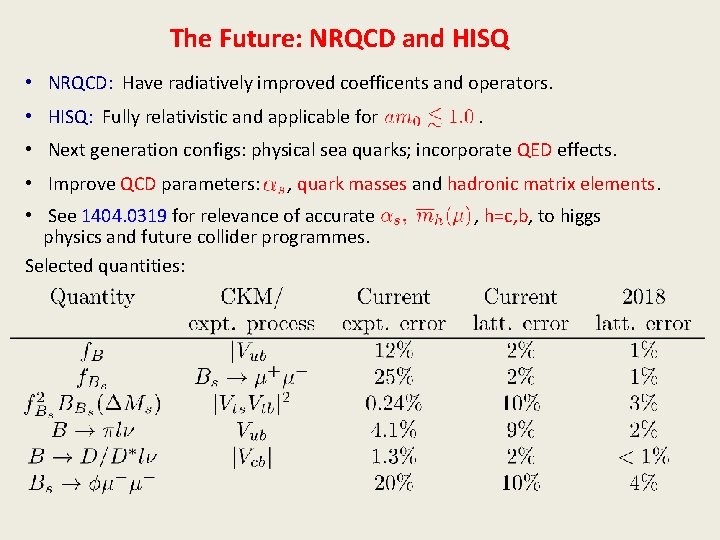
The Future: NRQCD and HISQ • NRQCD: Have radiatively improved coefficents and operators. • HISQ: Fully relativistic and applicable for . • Next generation configs: physical sea quarks; incorporate QED effects. • Improve QCD parameters: , quark masses and hadronic matrix elements. • See 1404. 0319 for relevance of accurate physics and future collider programmes. Selected quantities: , h=c, b, to higgs
HPQCD: recent past and present C. Davies, J. Koponen, B. Chakraborty, B. Colquhoun, G. Donald, B. Galloway (Glasgow) G. P. Lepage (Cornell) G. von Hippel (Mainz) C. Monahan (William and Mary) A. Hart (Edinburgh) C. Mc. Neile (Plymouth) RRH, R. Dowdall, T. Hammant, A. Lee (Cambridge) J. Shigemitsu (Ohio State) K. Hornbostel (Southern Methodist Univ. ) H. Trottier (Simon Fraser) E. Follana (Zaragoza) E. Gamiz (CAFPE, Granada)