Generalized Dynamical Mean Field Theory for Strongly Correlated
- Slides: 41
Generalized Dynamical Mean - Field Theory for Strongly Correlated Systems E. Z. Kuchinskii 1, I. A. Nekrasov 1, M. V. Sadovskii 1, 2 1 Institute for Electrophysics and 2 Instutute for Metal Physics , Russian Academy of Sciences, Ekaterinburg, Russia
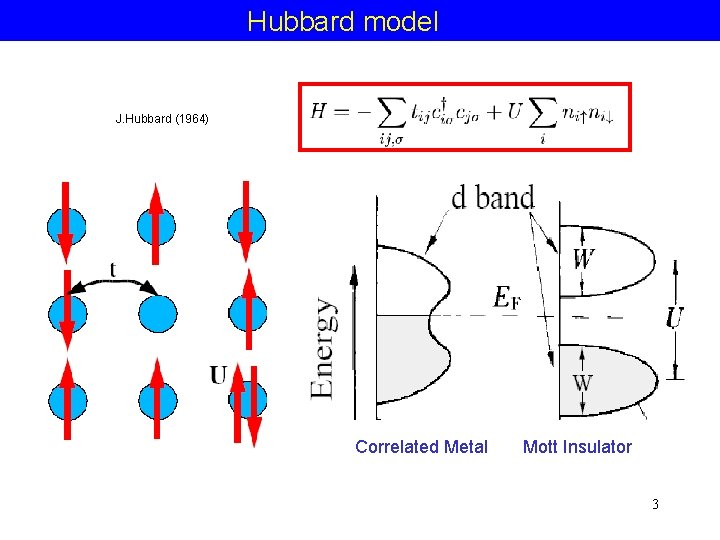
Hubbard model J. Hubbard (1964) Correlated Metal Mott Insulator 3
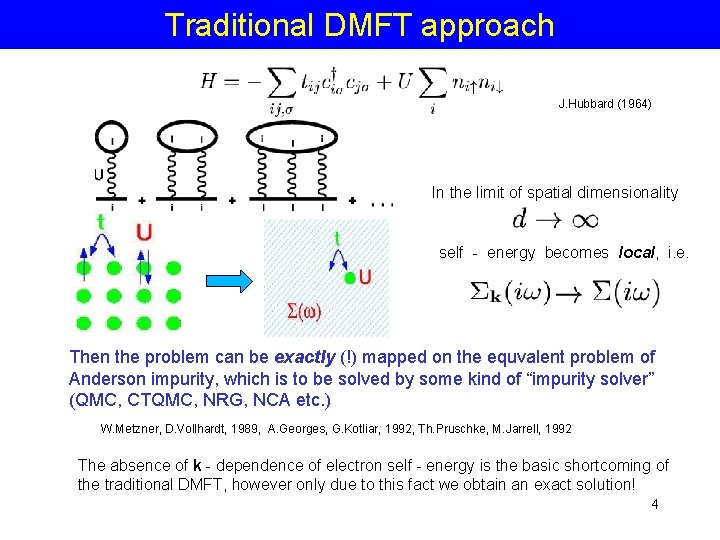
Traditional DMFT approach J. Hubbard (1964) In the limit of spatial dimensionality self - energy becomes local, i. e. Then the problem can be exactly (!) mapped on the equvalent problem of Anderson impurity, which is to be solved by some kind of “impurity solver” (QMC, CTQMC, NRG, NCA etc. ) W. Metzner, D. Vollhardt, 1989, A. Georges, G. Kotliar, 1992, Th. Pruschke, M. Jarrell, 1992 The absence of k - dependence of electron self - energy is the basic shortcoming of the traditional DMFT, however only due to this fact we obtain an exact solution! 4
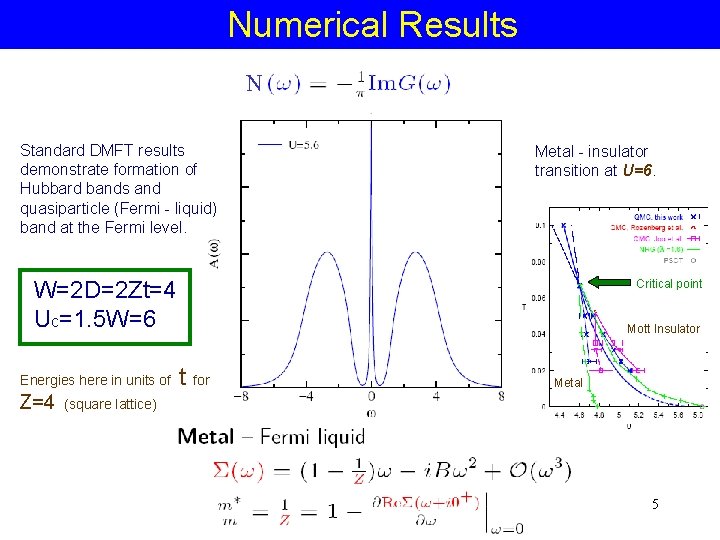
Numerical Results N Standard DMFT results demonstrate formation of Hubbard bands and quasiparticle (Fermi - liquid) band at the Fermi level. Metal - insulator transition at U=6. W=2 D=2 Zt=4 Uc=1. 5 W=6 Energies here in units of Z=4 Critical point Mott Insulator t for Metal (square lattice) 5
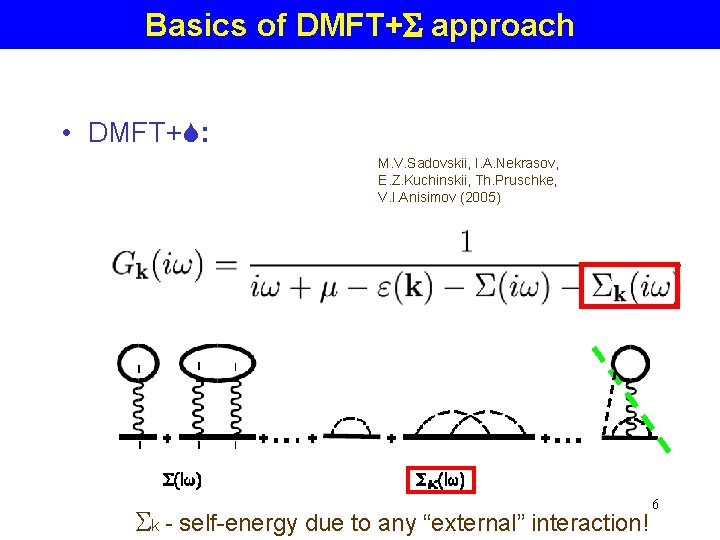
Basics of DMFT+ approach • DMFT+ : M. V. Sadovskii, I. A. Nekrasov, E. Z. Kuchinskii, Th. Pruschke, V. I. Anisimov (2005) k - self-energy due to any “external” interaction! 6
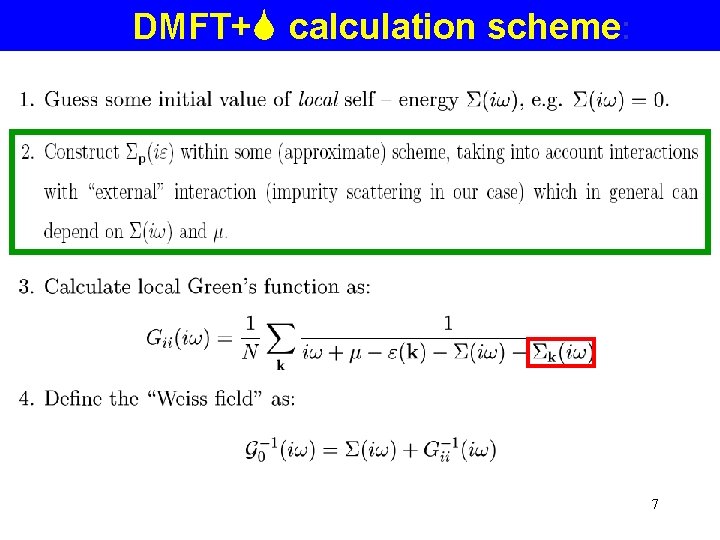
DMFT+ calculation scheme: 7
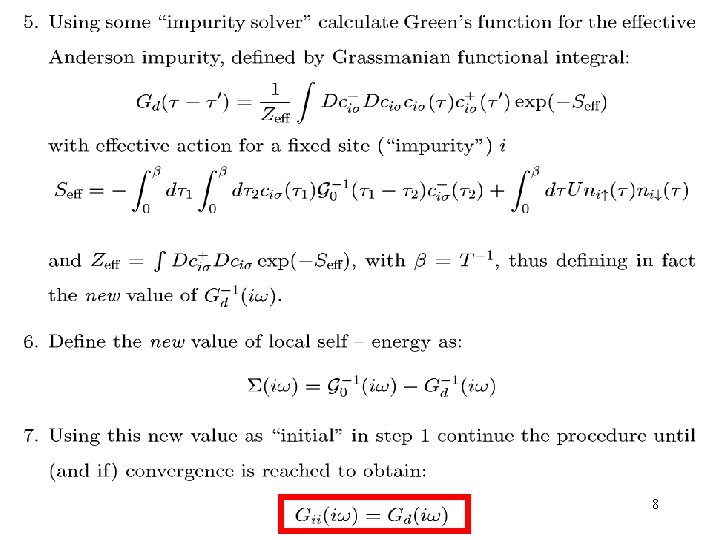
8
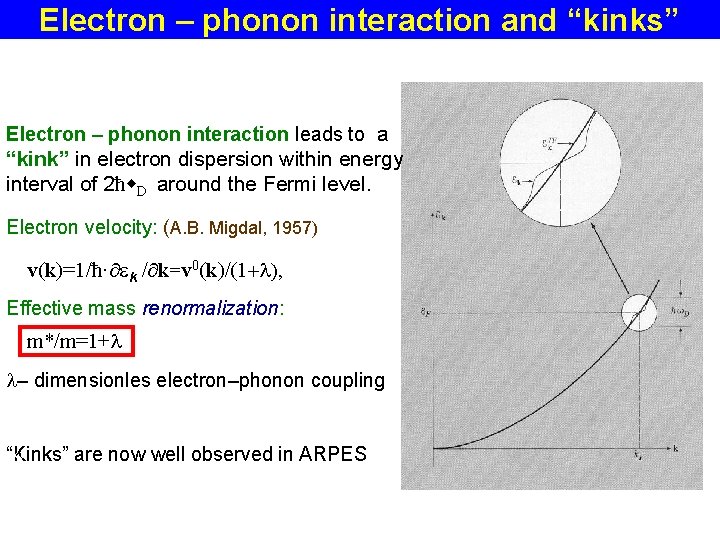
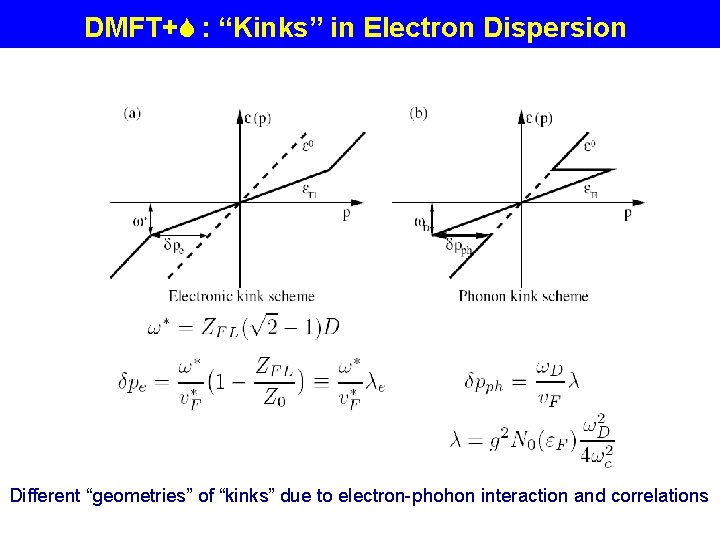
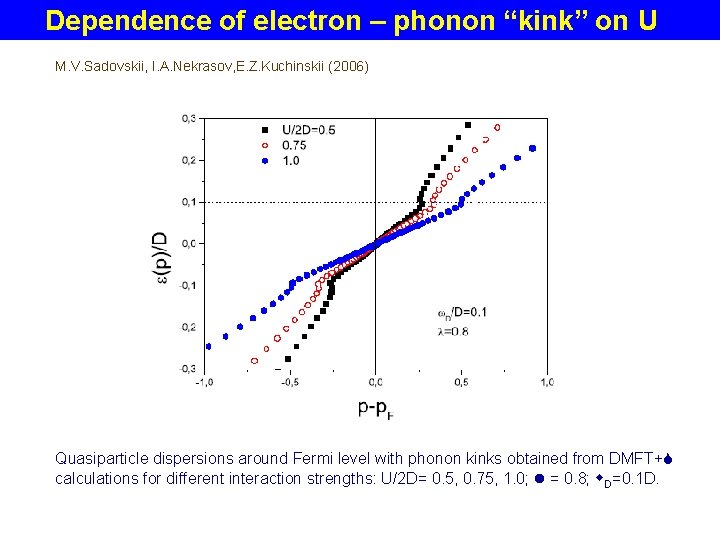
Electron – phonon interaction and “kinks” Electron – phonon interaction leads to a “kink” in electron dispersion within energy interval of 2ħ D around the Fermi level. Electron velocity: (A. B. Migdal, 1957) v(k)=1/ħ· ek / k=v 0(k)/(1+l), Effective mass renormalization: m*/m=1+l l– dimensionles electron–phonon coupling “Kinks” are now well observed in ARPES “
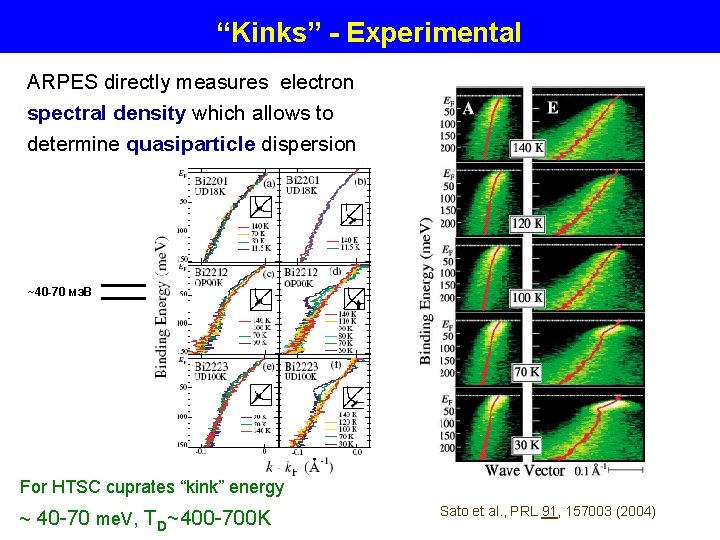
“Kinks” - Experimental ARPES directly measures electron spectral density which allows to determine quasiparticle dispersion ~40 -70 мэ. В For HTSC cuprates “kink” energy ~ 40 -70 me. V, TD~400 -700 K Sato et al. , PRL 91, 157003 (2004)
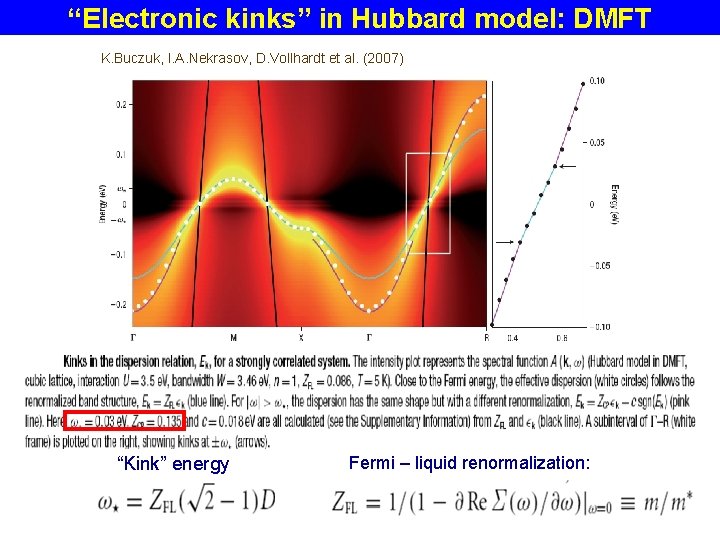
“Electronic kinks” in Hubbard model: DMFT K. Byczuk et al. Nature Phys. 3, 168 () K. Buczuk, I. A. Nekrasov, D. Vollhardt et al. (2007) “Kink” energy Fermi – liquid renormalization:
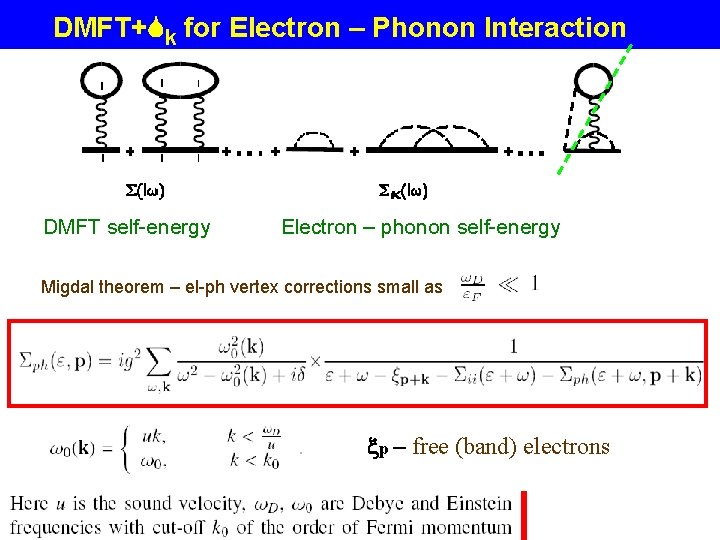
DMFT+ k for Electron – Phonon Interaction Dph + DMFT self-energy Electron – phonon self-energy Migdal theorem – el-ph vertex corrections small as xp – free (band) electrons
DMFT+ : “Kinks” in Electron Dispersion Different “geometries” of “kinks” due to electron-phohon interaction and correlations
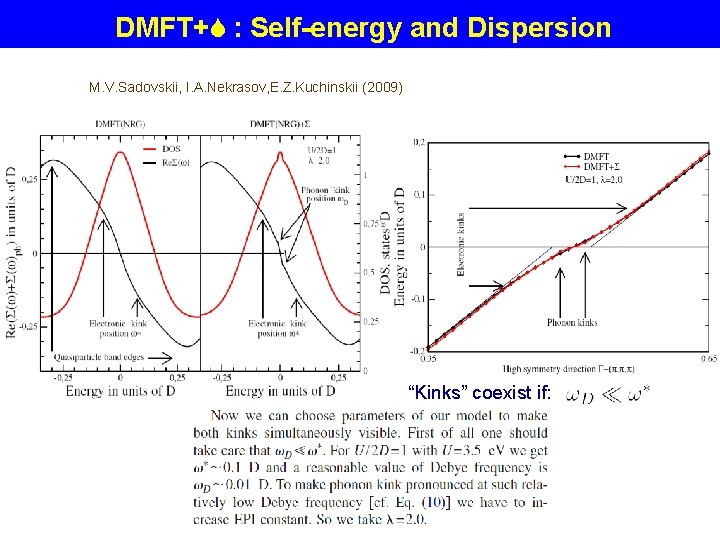
DMFT+ : Self-energy and Dispersion M. V. Sadovskii, I. A. Nekrasov, E. Z. Kuchinskii (2009) “Kinks” coexist if:
Dependence of electron – phonon “kink” on U M. V. Sadovskii, I. A. Nekrasov, E. Z. Kuchinskii (2006) Quasiparticle dispersions around Fermi level with phonon kinks obtained from DMFT+ calculations for different interaction strengths: U/2 D= 0. 5, 0. 75, 1. 0; = 0. 8; D=0. 1 D.
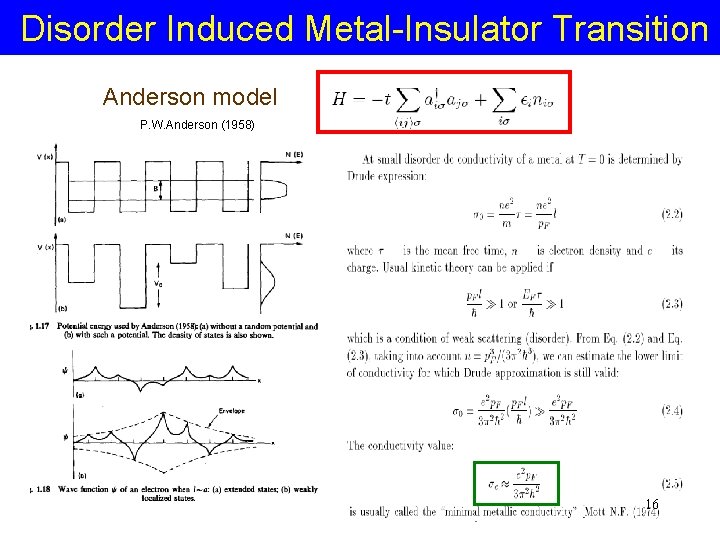
Disorder Induced Metal-Insulator Transition Anderson model P. W. Anderson (1958) 16
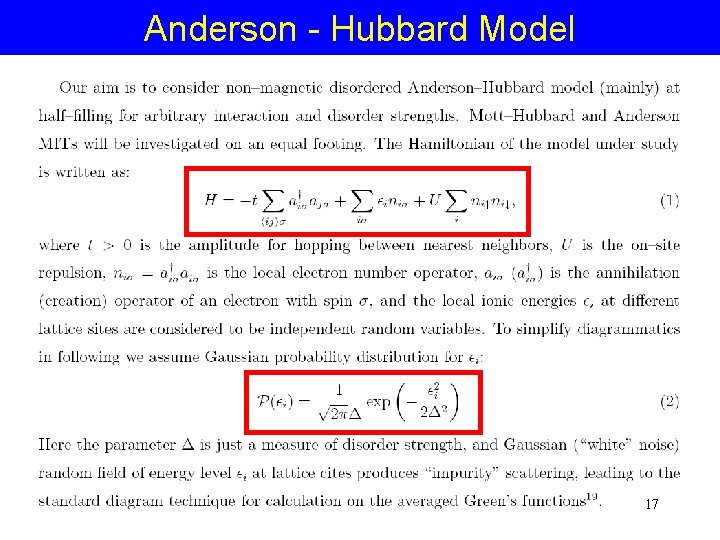
Anderson - Hubbard Model 17
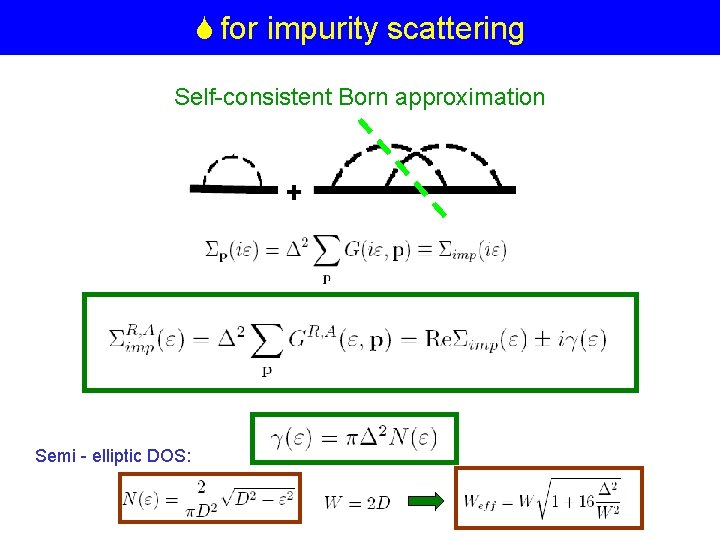
for impurity scattering Self-consistent Born approximation Semi - elliptic DOS:
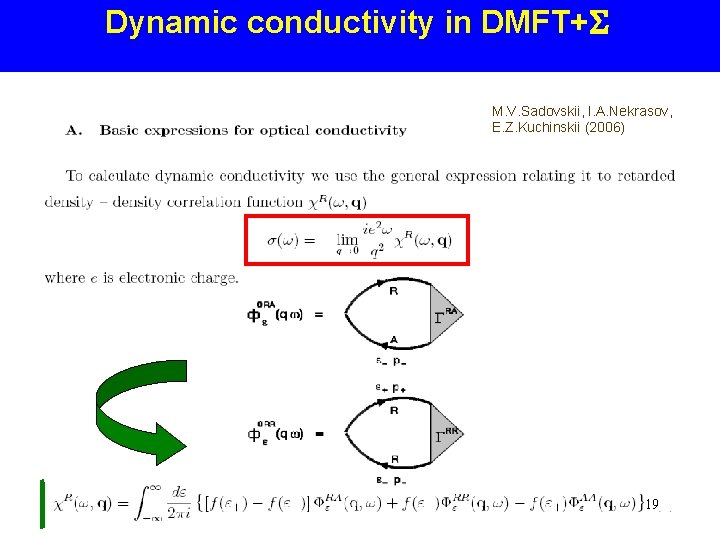
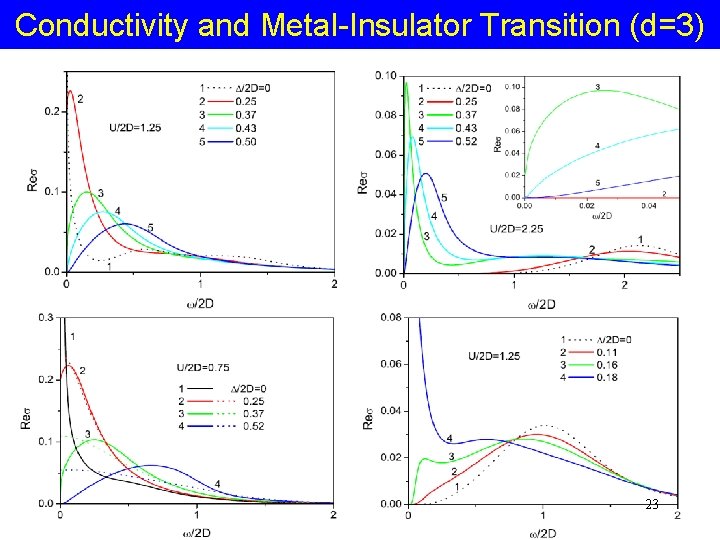
Dynamic conductivity in DMFT+ M. V. Sadovskii, I. A. Nekrasov, E. Z. Kuchinskii (2006) 19
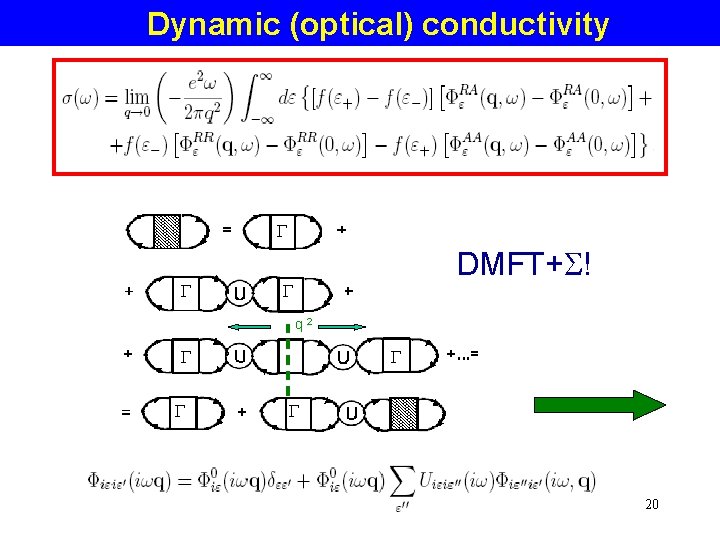
Dynamic (optical) conductivity DMFT+ ! q 2 20
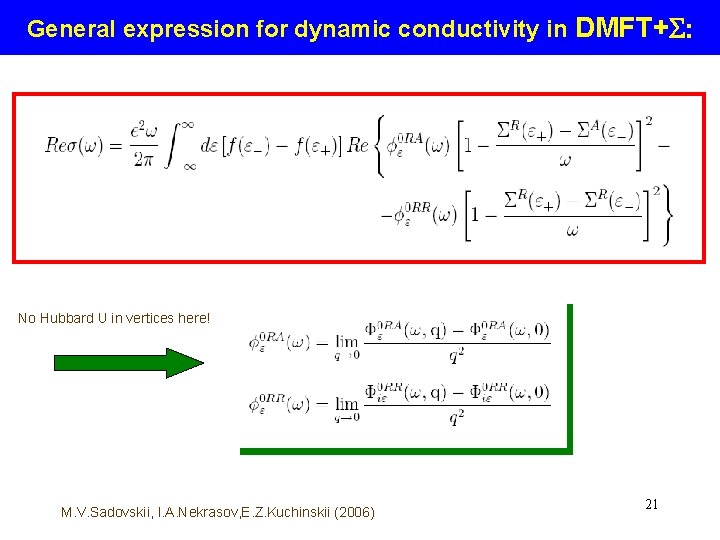
General expression for dynamic conductivity in DMFT+ : No Hubbard U in vertices here! M. V. Sadovskii, I. A. Nekrasov, E. Z. Kuchinskii (2006) 21
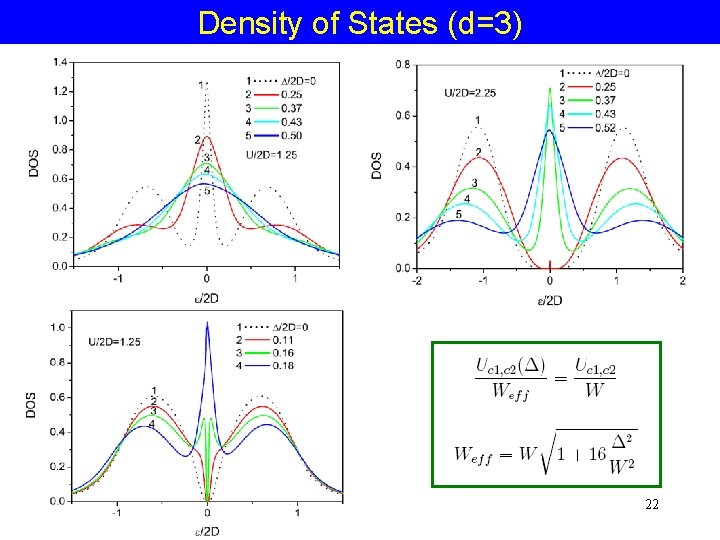
Density of States (d=3) 22
Conductivity and Metal-Insulator Transition (d=3) 23
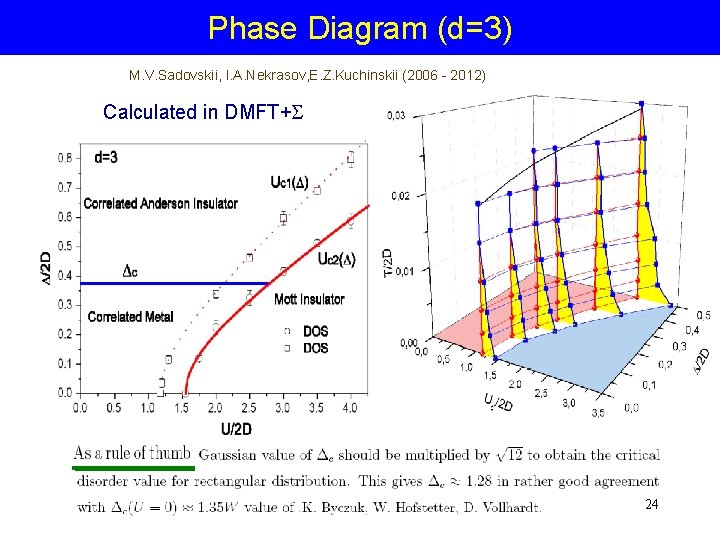
Phase Diagram (d=3) M. V. Sadovskii, I. A. Nekrasov, E. Z. Kuchinskii (2006 - 2012) Calculated in DMFT+ 24
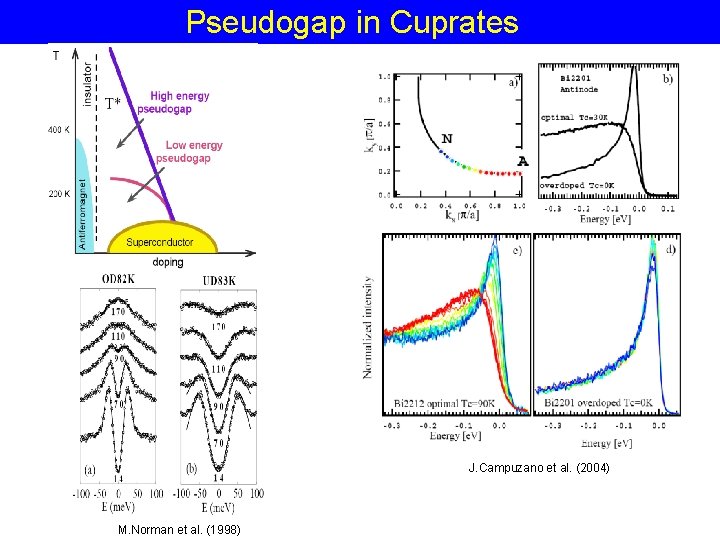
Pseudogap in Cuprates J. Campuzano et al. (2004) M. Norman et al. (1998)
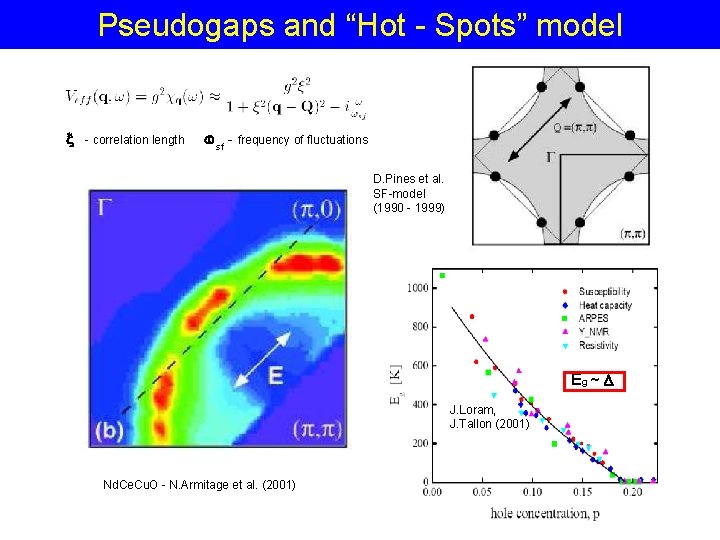
Pseudogaps and “Hot - Spots” model x - correlation length w sf - frequency of fluctuations D. Pines et al. SF-model (1990 - 1999) J. Campuzano et al. (2004) Eg ~ D J. Loram, J. Tallon (2001) Nd. Ce. Cu. O - N. Armitage et al. (2001)
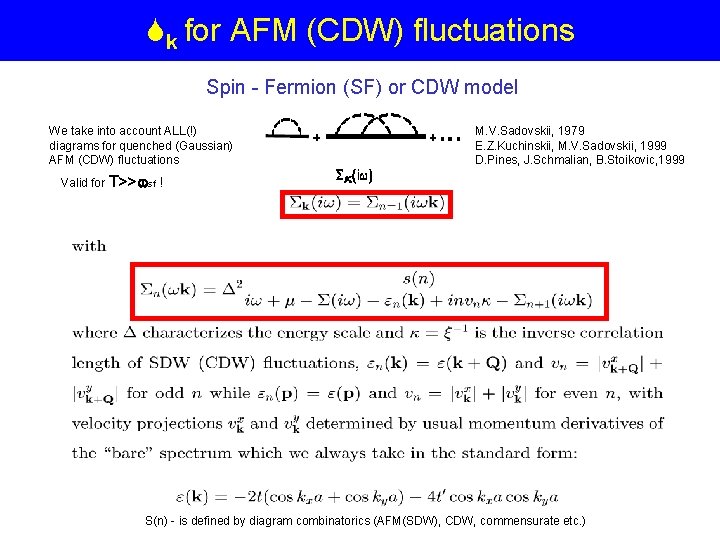
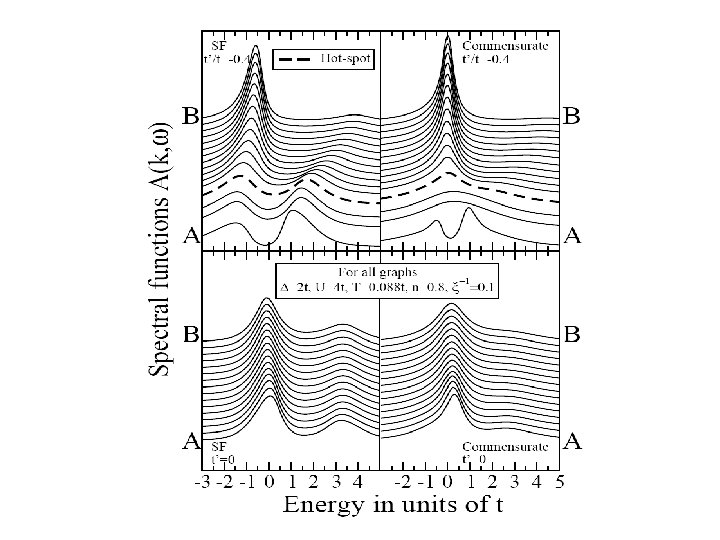
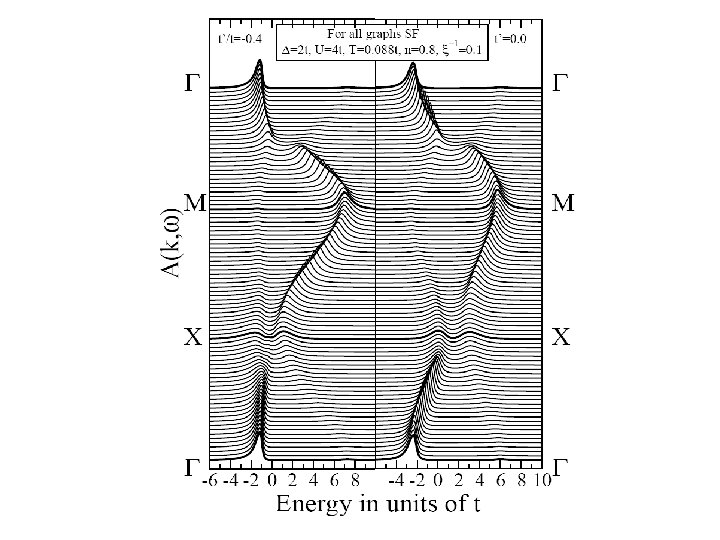
k for AFM (CDW) fluctuations Spin - Fermion (SF) or CDW model We take into account ALL(!) diagrams for quenched (Gaussian) AFM (CDW) fluctuations Valid for M. V. Sadovskii, 1979 E. Z. Kuchinskii, M. V. Sadovskii, 1999 D. Pines, J. Schmalian, B. Stoikovic, 1999 T>>wsf ! S(n) - is defined by diagram combinatorics (AFM(SDW), CDW, commensurate etc. )
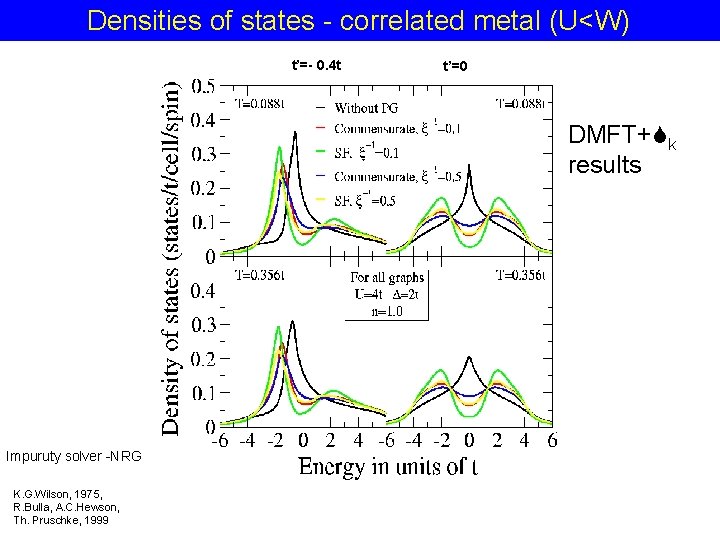
Densities of states - correlated metal (U<W) t’=- 0. 4 t t’=0 DMFT+ k results Impuruty solver -NRG K. G. Wilson, 1975, R. Bulla, A. C. Hewson, Th. Pruschke, 1999
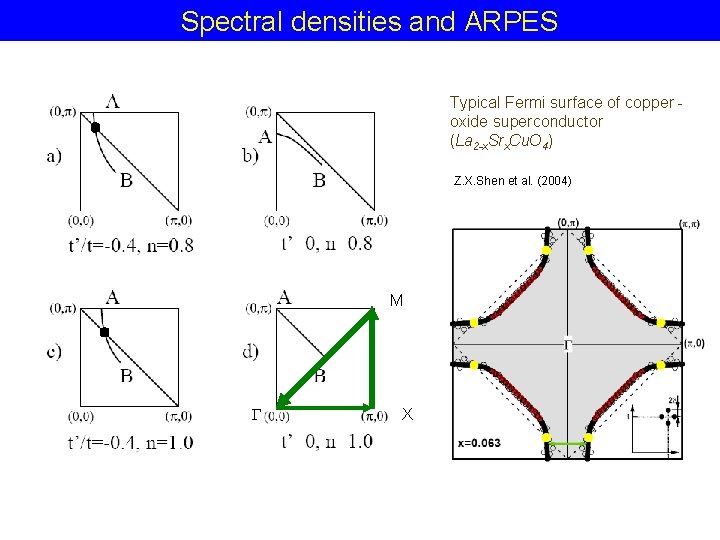
Spectral densities and ARPES Typical Fermi surface of copper oxide superconductor (La 2 -x. Srx. Cu. O 4) Z. X. Shen et al. (2004) M X
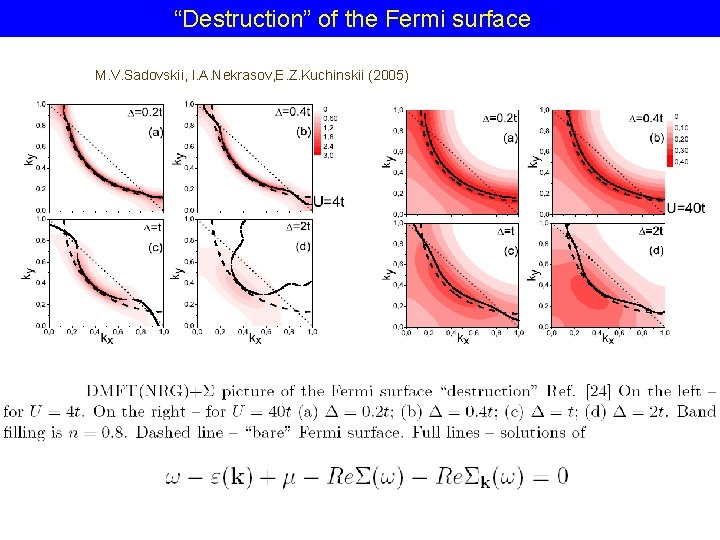
“Destruction” of the Fermi surface M. V. Sadovskii, I. A. Nekrasov, E. Z. Kuchinskii (2005)
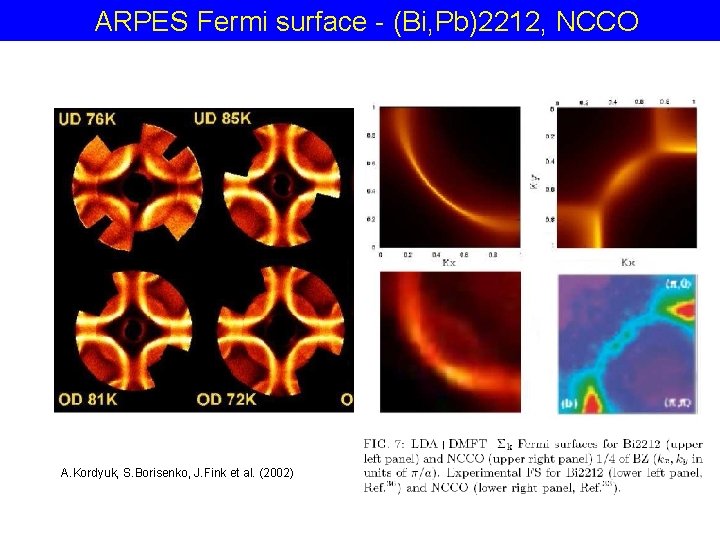
ARPES Fermi surface - (Bi, Pb)2212, NCCO A. Kordyuk, S. Borisenko, J. Fink et al. (2002)
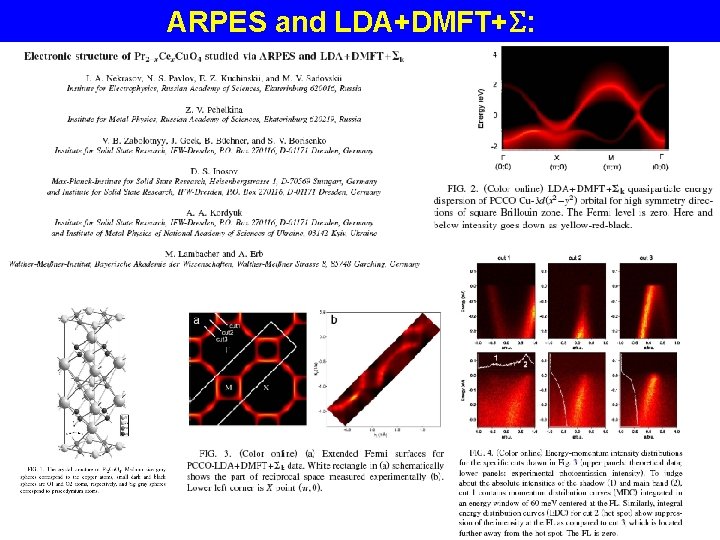
ARPES and LDA+DMFT+ :
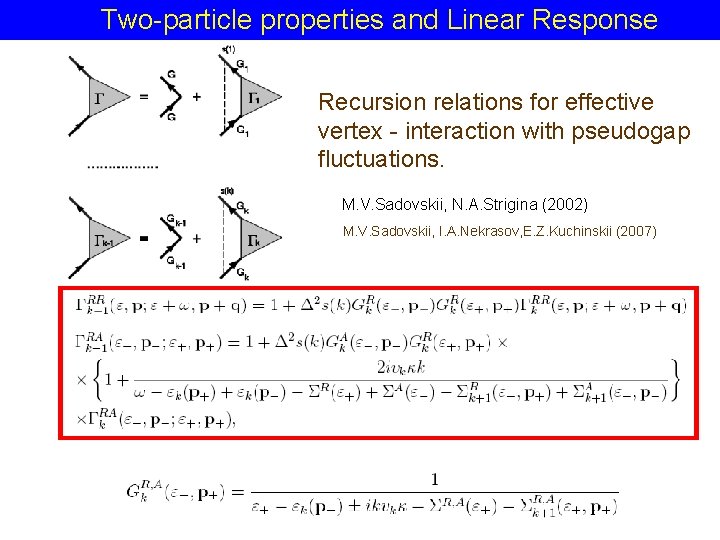
Two-particle properties and Linear Response Recursion relations for effective vertex - interaction with pseudogap fluctuations. M. V. Sadovskii, N. A. Strigina (2002) M. V. Sadovskii, I. A. Nekrasov, E. Z. Kuchinskii (2007)
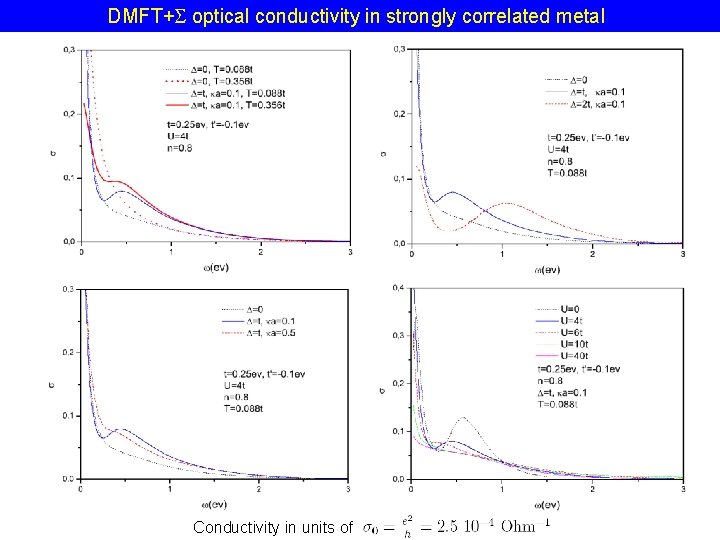
DMFT+ optical conductivity in strongly correlated metal Conductivity in units of
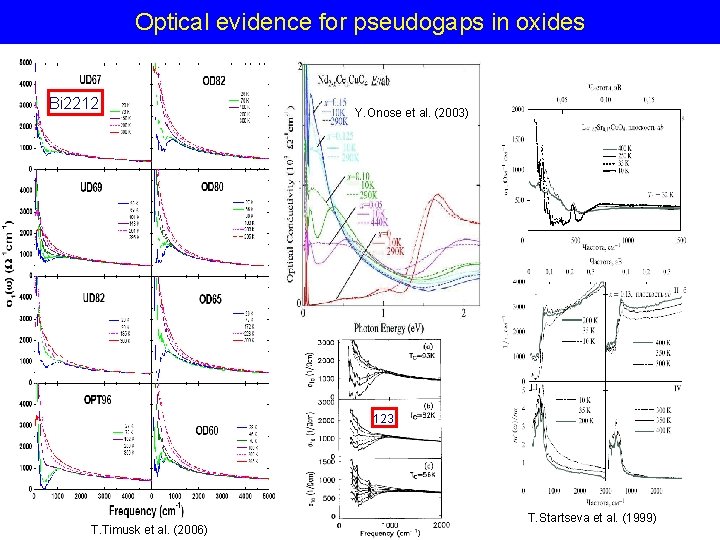
Optical evidence for pseudogaps in oxides Bi 2212 Y. Onose et al. (2003) 123 J. Loram, J. Tallon et al. (1997) T. Timusk et al. (2006) T. Startseva et al. (1999)
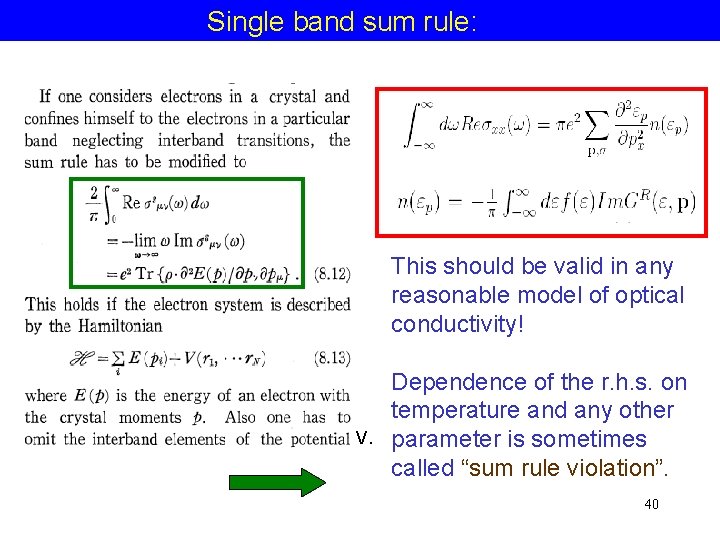
Single band sum rule: This should be valid in any reasonable model of optical conductivity! V. Dependence of the r. h. s. on temperature and any other parameter is sometimes called “sum rule violation”. 40
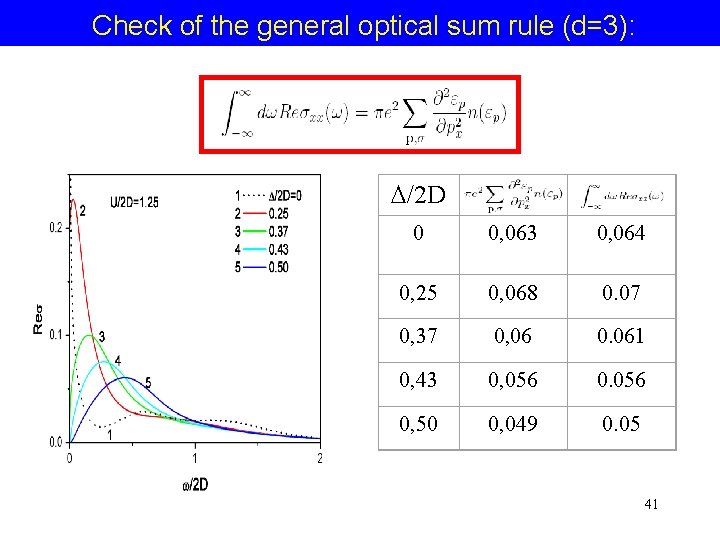
Check of the general optical sum rule (d=3): /2 D W SR 0 0, 063 0, 25 0, 068 0, 064 0. 07 0, 37 0, 06 0. 061 0, 43 0, 056 0. 056 0, 50 0, 049 0. 05 41
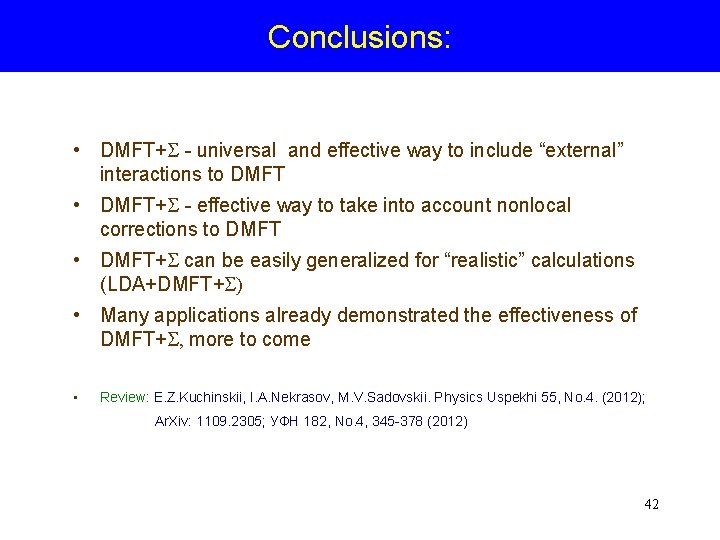
Conclusions: • DMFT+ - universal and effective way to include “external” interactions to DMFT • DMFT+ - effective way to take into account nonlocal corrections to DMFT • DMFT+ can be easily generalized for “realistic” calculations (LDA+DMFT+ ) • Many applications already demonstrated the effectiveness of DMFT+ , more to come • Review: E. Z. Kuchinskii, I. A. Nekrasov, M. V. Sadovskii. Physics Uspekhi 55, No. 4. (2012); Ar. Xiv: 1109. 2305; УФН 182, No. 4, 345 -378 (2012) ET 42