
Commitment to Correlated Strategies Dima Vincent Conitzer Dmytro


- Slides: 20
Commitment to Correlated Strategies Dima [Vincent Conitzer, Dmytro Korzhyk. Commitment to Correlated Strategies. In AAAI-2011. ]
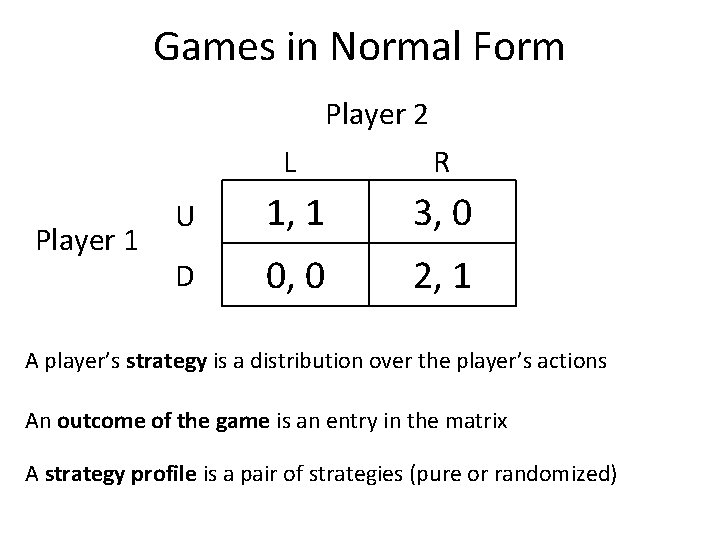
Games in Normal Form Player 2 Player 1 L R U 1, 1 3, 0 D 0, 0 2, 1 A player’s strategy is a distribution over the player’s actions An outcome of the game is an entry in the matrix A strategy profile is a pair of strategies (pure or randomized)
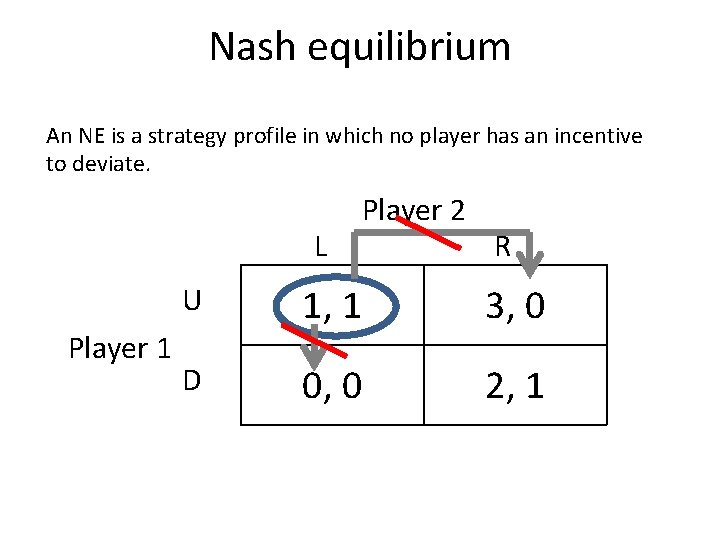
Nash equilibrium An NE is a strategy profile in which no player has an incentive to deviate. L Player 1 Player 2 R U 1, 1 3, 0 D 0, 0 2, 1
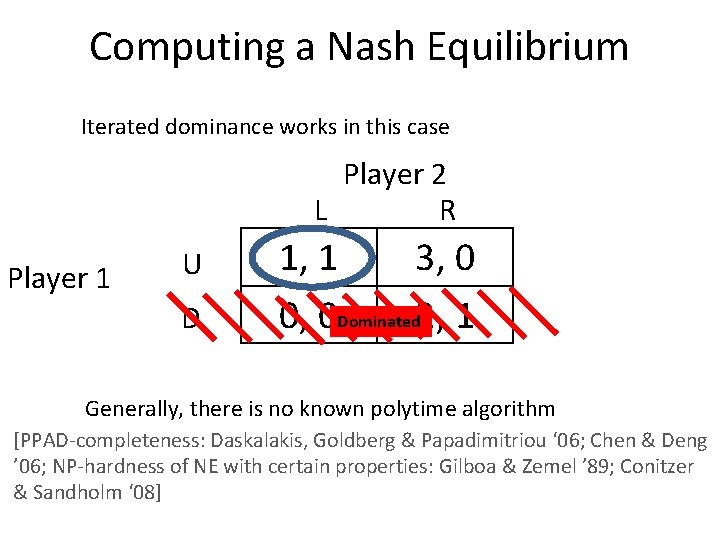
Computing a Nash Equilibrium Iterated dominance works in this case Player 2 L R Player 1 U D 1, 1 3, 0 0, 0 Dominated 2, 1 Generally, there is no known polytime algorithm [PPAD-completeness: Daskalakis, Goldberg & Papadimitriou ‘ 06; Chen & Deng ’ 06; NP-hardness of NE with certain properties: Gilboa & Zemel ’ 89; Conitzer & Sandholm ‘ 08]
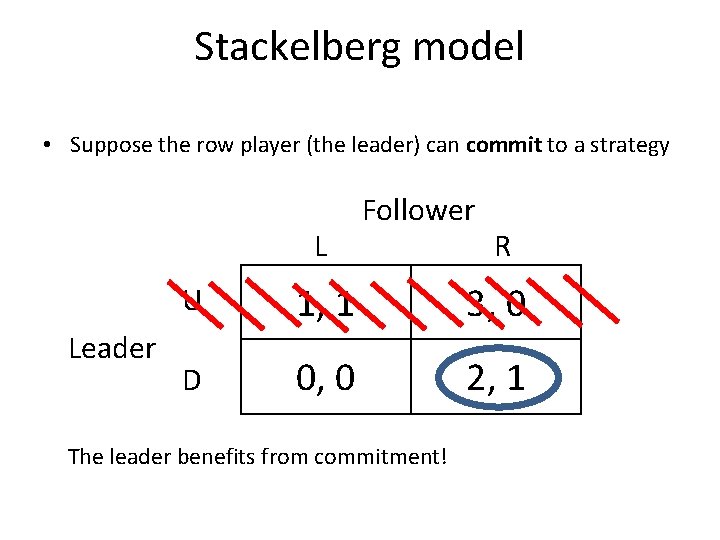
Stackelberg model • Suppose the row player (the leader) can commit to a strategy L Leader Follower R U 1, 1 3, 0 D 0, 0 2, 1 The leader benefits from commitment!
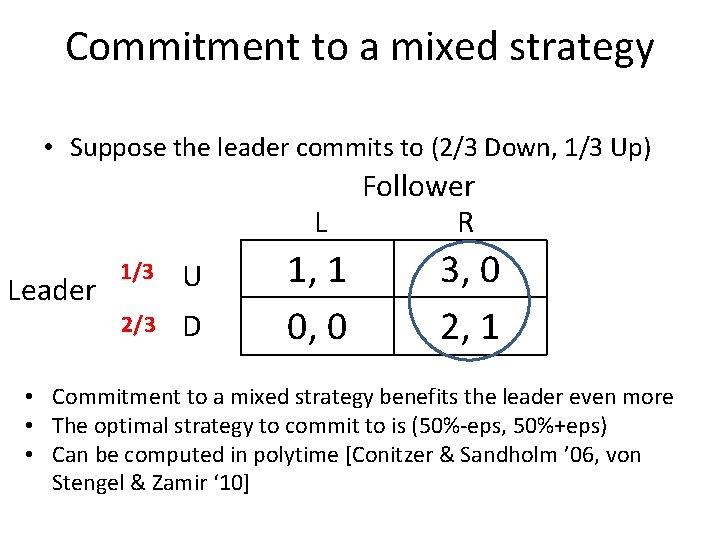
Commitment to a mixed strategy • Suppose the leader commits to (2/3 Down, 1/3 Up) L Leader 1/3 U 2/3 D 1, 1 0, 0 Follower R 3, 0 2, 1 • Commitment to a mixed strategy benefits the leader even more • The optimal strategy to commit to is (50%-eps, 50%+eps) • Can be computed in polytime [Conitzer & Sandholm ’ 06, von Stengel & Zamir ‘ 10]
Applications of the Stackelberg model • Resource allocation for airport security [Pita et al. , AI Magazine ‘ 09] • Scheduling of federal air marshals Photo STL airport [Tsai et al. , AAMAS ‘ 09] • GUARDS system for TSA resource allocation [Pita et al. , AAMAS ’ 11] Photo AP
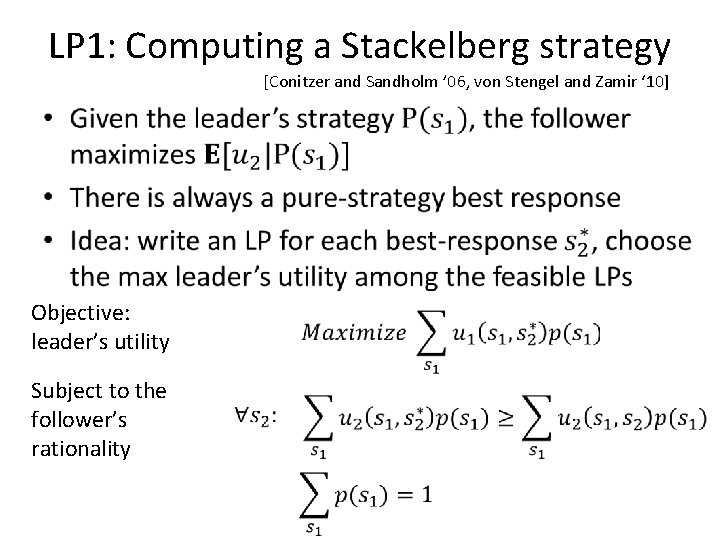
LP 1: Computing a Stackelberg strategy [Conitzer and Sandholm ’ 06, von Stengel and Zamir ‘ 10] • Objective: leader’s utility Subject to the follower’s rationality
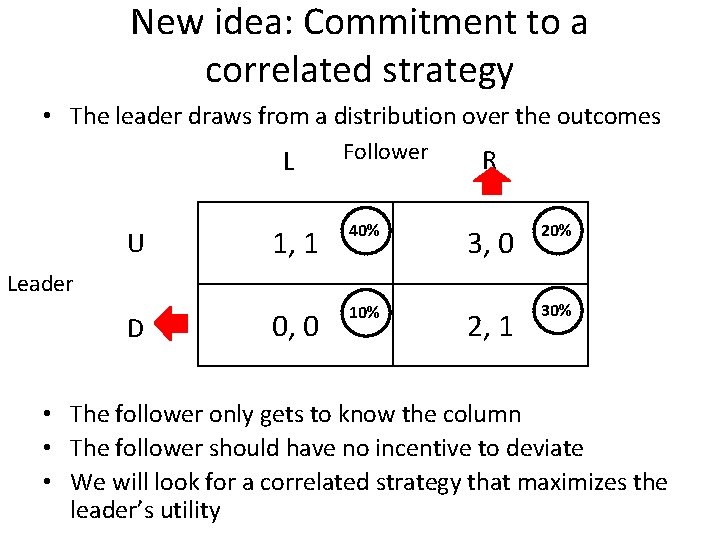
New idea: Commitment to a correlated strategy • The leader draws from a distribution over the outcomes L U Follower 1, 1 40% 0, 0 10% R 3, 0 20% 2, 1 30% Leader D • The follower only gets to know the column • The follower should have no incentive to deviate • We will look for a correlated strategy that maximizes the leader’s utility
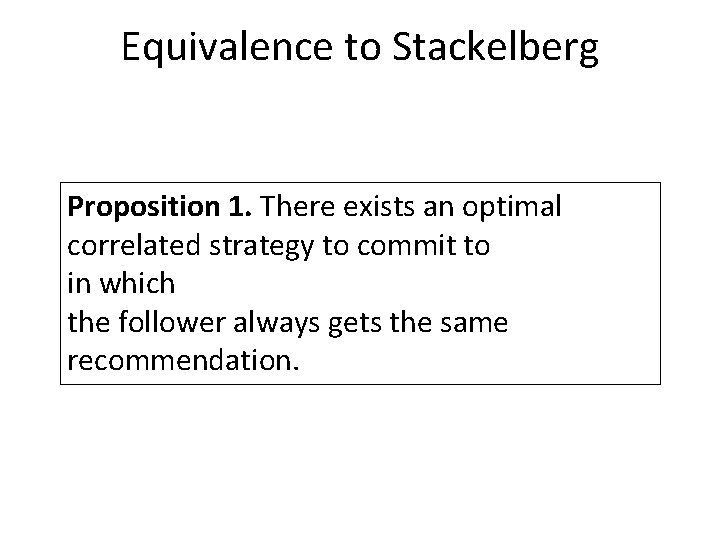
Equivalence to Stackelberg Proposition 1. There exists an optimal correlated strategy to commit to in which the follower always gets the same recommendation.
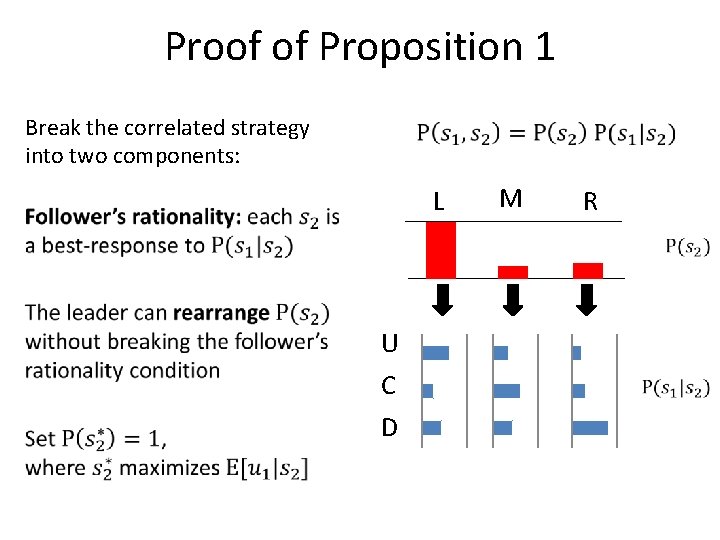
Proof of Proposition 1 Break the correlated strategy into two components: L M R U C D
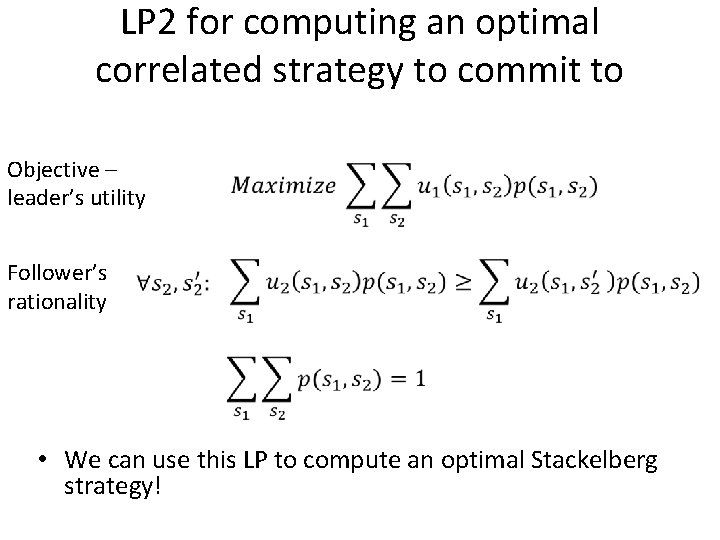
LP 2 for computing an optimal correlated strategy to commit to Objective – leader’s utility Follower’s rationality • We can use this LP to compute an optimal Stackelberg strategy!
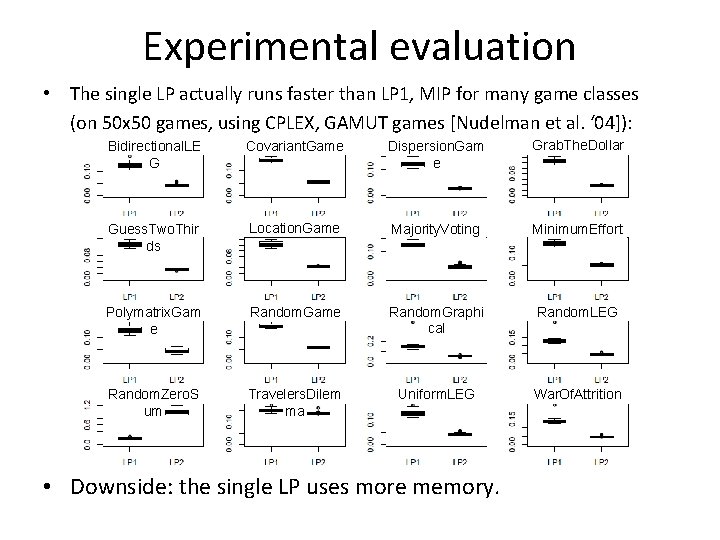
Experimental evaluation • The single LP actually runs faster than LP 1, MIP for many game classes (on 50 x 50 games, using CPLEX, GAMUT games [Nudelman et al. ‘ 04]): Bidirectional. LE G Covariant. Game Dispersion. Gam e Grab. The. Dollar Guess. Two. Thir ds Location. Game Majority. Voting Minimum. Effort Polymatrix. Gam e Random. Game Random. Graphi cal Random. LEG Random. Zero. S um Travelers. Dilem ma Uniform. LEG War. Of. Attrition • Downside: the single LP uses more memory.
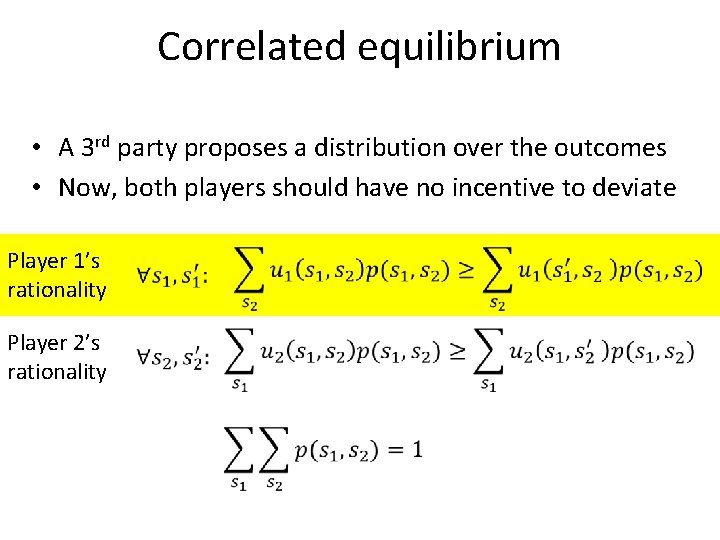
Correlated equilibrium • A 3 rd party proposes a distribution over the outcomes • Now, both players should have no incentive to deviate Player 1’s rationality Player 2’s rationality
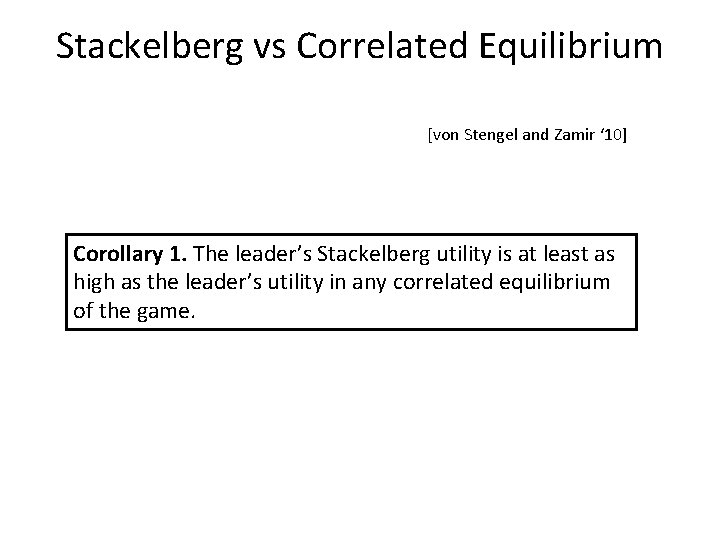
Stackelberg vs Correlated Equilibrium [von Stengel and Zamir ‘ 10] Corollary 1. The leader’s Stackelberg utility is at least as high as the leader’s utility in any correlated equilibrium of the game.
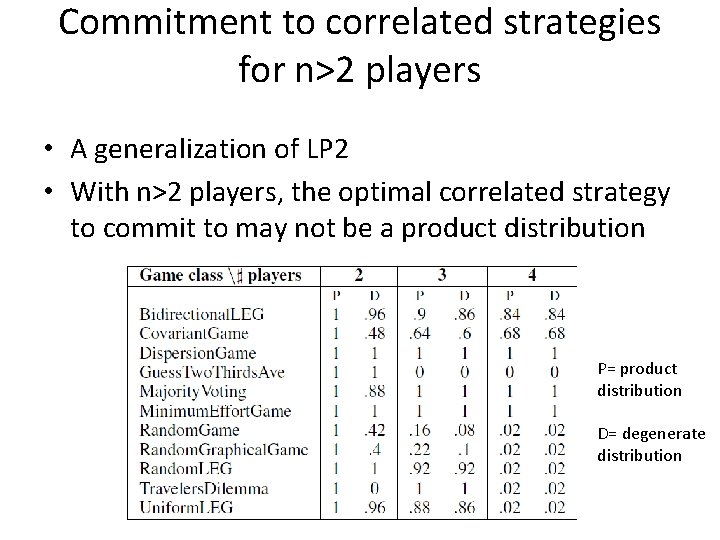
Commitment to correlated strategies for n>2 players • A generalization of LP 2 • With n>2 players, the optimal correlated strategy to commit to may not be a product distribution P= product distribution D= degenerate distribution
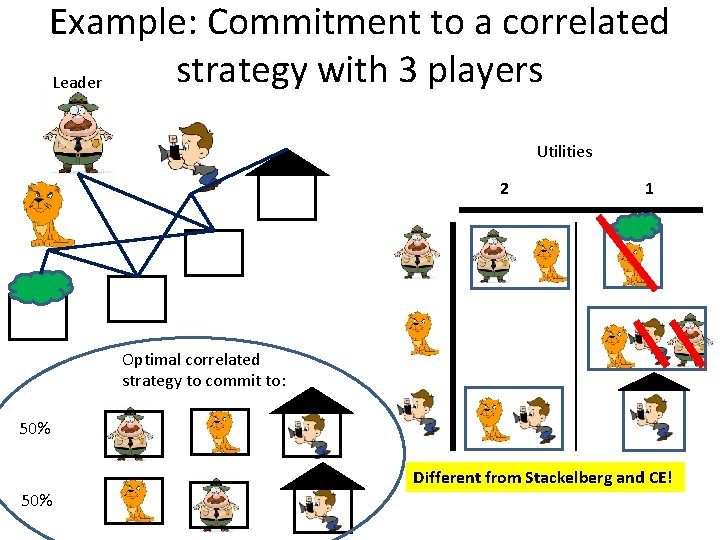
Example: Commitment to a correlated strategy with 3 players Leader Utilities 2 1 Optimal correlated strategy to commit to: 50% Different from Stackelberg and CE! 50%
Advantages of commitment to a correlated equilibrium • Same as Stackelberg for n=2 players • Well defined for n>2 players (unlike the Stackelberg model) • Easy to compute for any number of players
Overview of contributions • A single LP for Stackelberg (for 2 players) • Easy proof of relationship between Stackelberg and correlated equilibrium (for 2 players) • Model for commitment to a correlated strategy (for n≥ 2 players) • LP for commitment to a correlated strategy (for n≥ 2 players)
Thank you!