New Physics with Dijets at CMS Selda Esen







- Slides: 42
New Physics with Dijets at CMS Selda Esen and Robert M. Harris Fermilab Kazim Gumus and Nural Akchurin Texas Tech Physics Colloquium at Texas Tech April 20, 2006 Robert Harris, Fermilab 1
Outline l Introduction to the Physics l CMS Jet Trigger and Dijet Mass Distribution l CMS Sensitivity to Dijet Resonances l CMS Sensitivity to Quark Contact Interactions l Conclusions Robert Harris, Fermilab 2
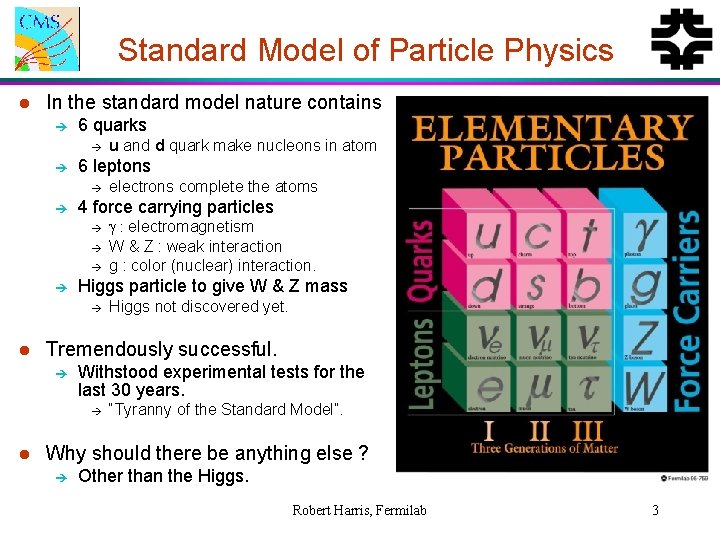
Standard Model of Particle Physics l In the standard model nature contains è 6 quarks à è 6 leptons à è à à Higgs not discovered yet. Tremendously successful. è Withstood experimental tests for the last 30 years. à l g : electromagnetism W & Z : weak interaction g : color (nuclear) interaction. Higgs particle to give W & Z mass à l electrons complete the atoms 4 force carrying particles à è u and d quark make nucleons in atom “Tyranny of the Standard Model”. Why should there be anything else ? è Other than the Higgs. Robert Harris, Fermilab 3
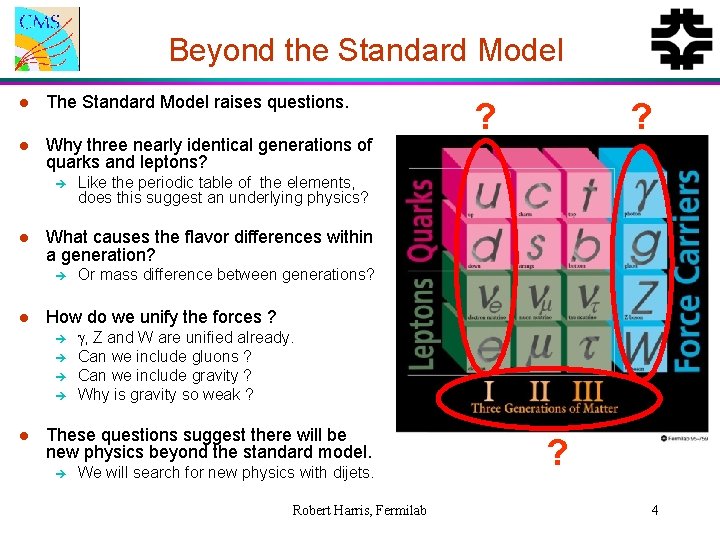
Beyond the Standard Model l The Standard Model raises questions. l Why three nearly identical generations of quarks and leptons? è l Like the periodic table of the elements, does this suggest an underlying physics? Or mass difference between generations? How do we unify the forces ? è è l ? What causes the flavor differences within a generation? è l ? g, Z and W are unified already. Can we include gluons ? Can we include gravity ? Why is gravity so weak ? These questions suggest there will be new physics beyond the standard model. è We will search for new physics with dijets. Robert Harris, Fermilab ? 4
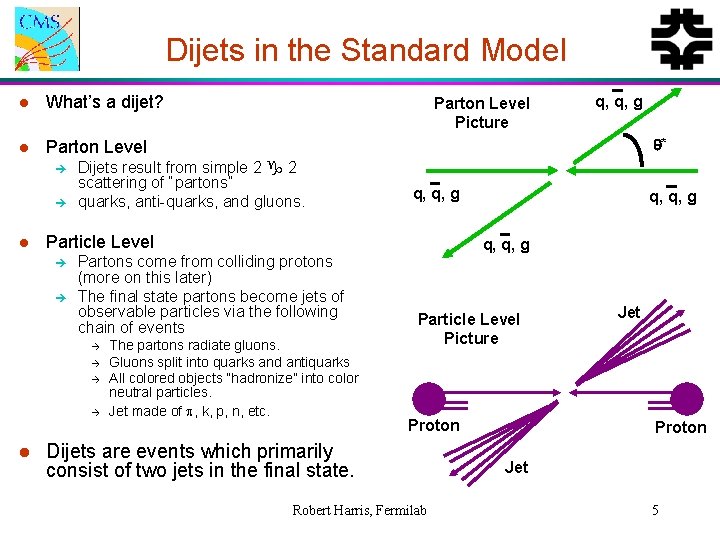
Dijets in the Standard Model l What’s a dijet? l Parton Level è è l è Dijets result from simple 2 g 2 scattering of “partons” quarks, anti-quarks, and gluons. Partons come from colliding protons (more on this later) The final state partons become jets of observable particles via the following chain of events à à q, q, g q* q, q, g Particle Level è l Parton Level Picture The partons radiate gluons. Gluons split into quarks and antiquarks All colored objects “hadronize” into color neutral particles. Jet made of p, k, p, n, etc. q, q, g Particle Level Picture Proton Dijets are events which primarily consist of two jets in the final state. Robert Harris, Fermilab Jet Proton Jet 5
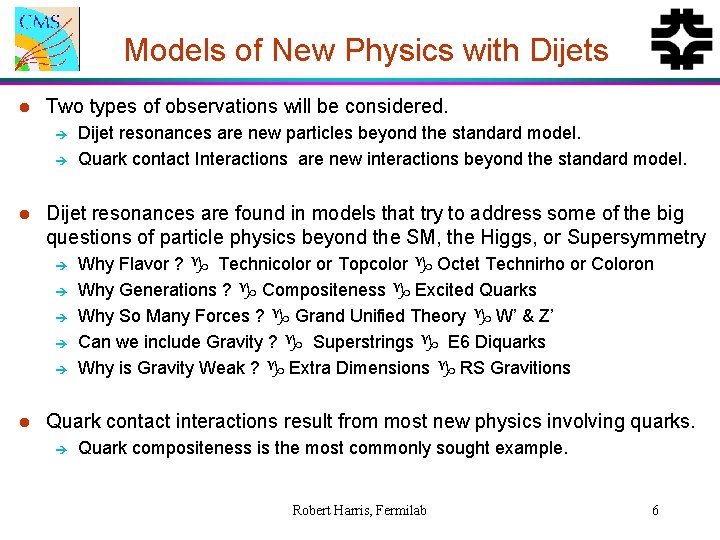
Models of New Physics with Dijets l Two types of observations will be considered. è è l Dijet resonances are found in models that try to address some of the big questions of particle physics beyond the SM, the Higgs, or Supersymmetry è è è l Dijet resonances are new particles beyond the standard model. Quark contact Interactions are new interactions beyond the standard model. Why Flavor ? g Technicolor or Topcolor g Octet Technirho or Coloron Why Generations ? g Compositeness g Excited Quarks Why So Many Forces ? g Grand Unified Theory g W’ & Z’ Can we include Gravity ? g Superstrings g E 6 Diquarks Why is Gravity Weak ? g Extra Dimensions g RS Gravitions Quark contact interactions result from most new physics involving quarks. è Quark compositeness is the most commonly sought example. Robert Harris, Fermilab 6
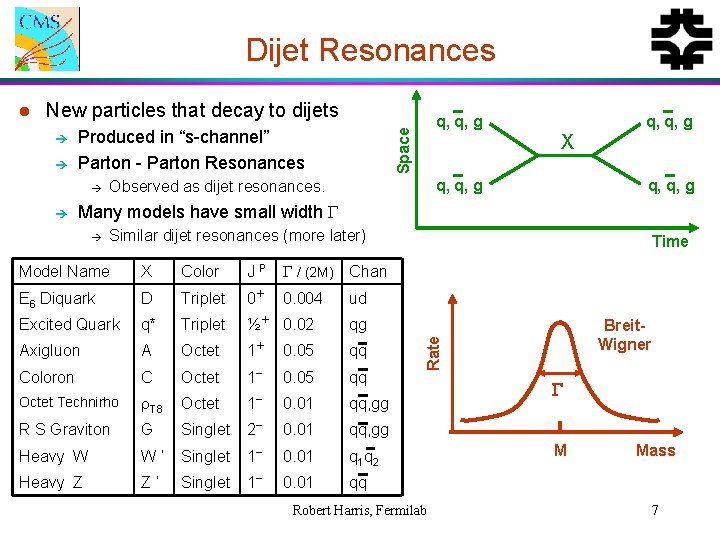
Dijet Resonances New particles that decay to dijets è Produced in “s-channel” Parton - Parton Resonances à è q, q, g X q, q, g Observed as dijet resonances. q, q, g Many models have small width G à Similar dijet resonances (more later) Model Name X Color JP G / (2 M) Chan E 6 Diquark D Triplet 0+ 0. 004 Excited Quark q* Triplet ½+ 0. 02 qg Axigluon A Octet 1+ 0. 05 qq Coloron C Octet 1 - 0. 05 qq 0. 01 qq, gg Time ud Octet Technirho r. T 8 Octet 1 - R S Graviton G Singlet 2 - 0. 01 qq, gg Heavy W W‘ Singlet 1 - 0. 01 q 2 Heavy Z Z‘ Singlet 1 - 0. 01 qq Breit. Wigner Rate è q, q, g Space l Robert Harris, Fermilab G M Mass 7
Quark Contact Interactions l New physics at large scale L è è l Composite Quarks q q M~L New Interactions M~L Modelled by contact interaction è l Composite Quarks New Interactions Intermediate state collapses to a point for dijet mass << L. q q Dijet Mass << L Observable Consequences è è Has effects at high dijet mass. Higher rate than standard model. Angular distributions can be different from standard model. We will use a simple measure of the angular distribution at high mass (more later). Quark Contact Interaction q q Robert Harris, Fermilab L q q 8
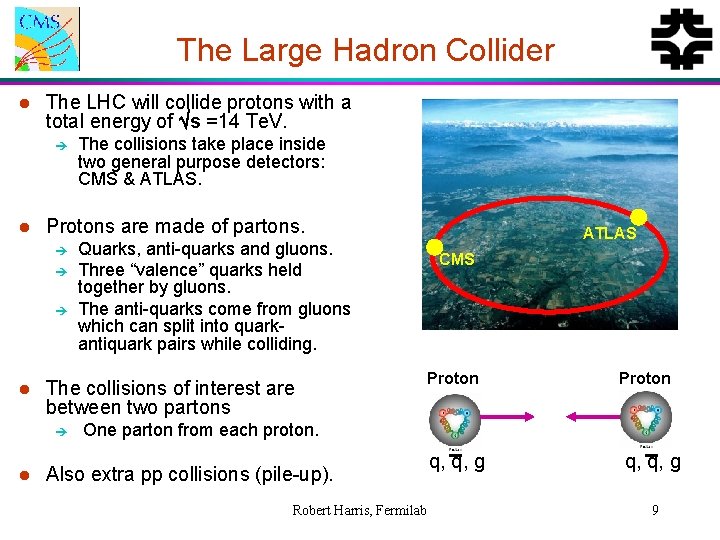
The Large Hadron Collider l The LHC will collide protons with a total energy of s =14 Te. V. è l Protons are made of partons. è è è l Quarks, anti-quarks and gluons. Three “valence” quarks held together by gluons. The anti-quarks come from gluons which can split into quarkantiquark pairs while colliding. The collisions of interest are between two partons è l The collisions take place inside two general purpose detectors: CMS & ATLAS CMS Proton One parton from each proton. Also extra pp collisions (pile-up). Robert Harris, Fermilab q, q, g 9
Dijet Cross Sections at the LHC Jet 1 Te. V Jet 2 l Product of 3 probabilities è è è l fa(xa): parton of type a with fractional momentum xa. fb(xb): parton of type b with fractional momentum xb ^ s(a b g 12): subprocess cross section to make dijets. Falls rapidly with total collision energy, equal to final state mass, m. Robert Harris, Fermilab 10
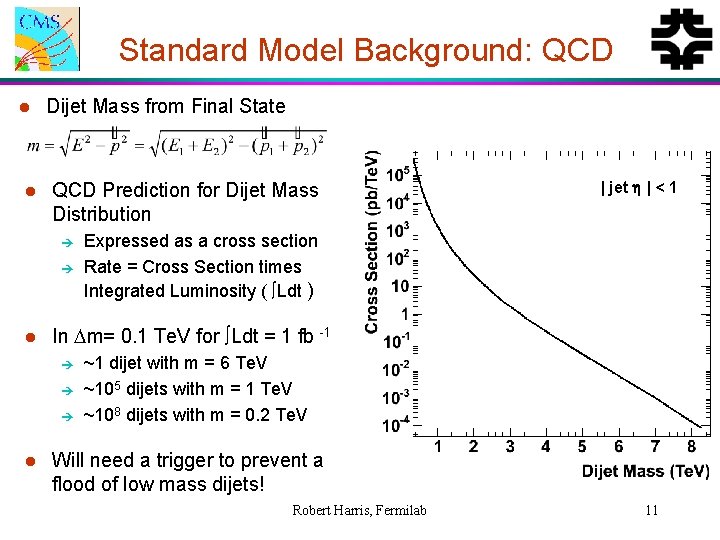
Standard Model Background: QCD l l Dijet Mass from Final State QCD Prediction for Dijet Mass Distribution è è l Expressed as a cross section Rate = Cross Section times Integrated Luminosity ( ∫Ldt ) In Dm= 0. 1 Te. V for ∫Ldt = 1 fb -1 è è è l | jet h | < 1 ~1 dijet with m = 6 Te. V ~105 dijets with m = 1 Te. V ~108 dijets with m = 0. 2 Te. V Will need a trigger to prevent a flood of low mass dijets! Robert Harris, Fermilab 11
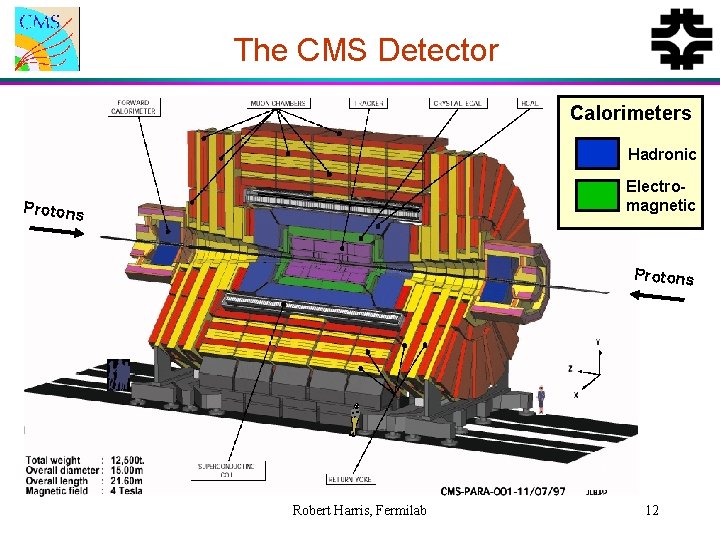
The CMS Detector Calorimeters Hadronic Electromagnetic Protons Robert Harris, Fermilab 12
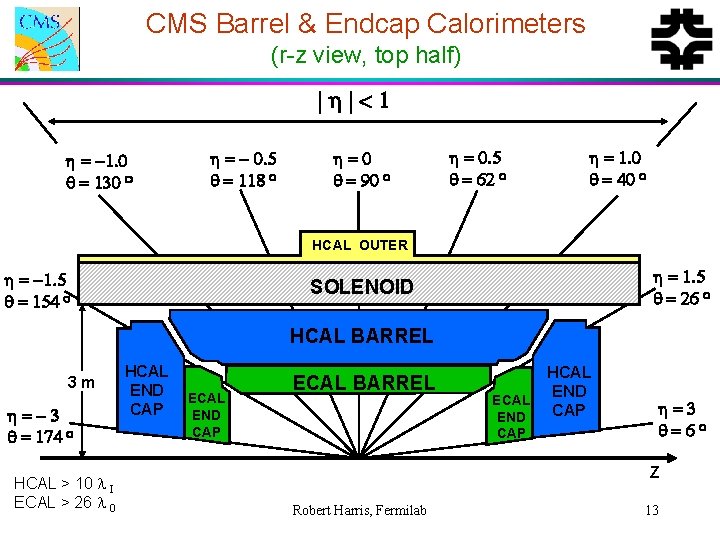
CMS Barrel & Endcap Calorimeters (r-z view, top half) |h|<1 h = -1. 0 q = 130 o h = - 0. 5 q = 118 o h=0 q = 90 o h = 0. 5 q = 62 o h = 1. 0 q = 40 o HCAL OUTER h = -1. 5 q = 154 o h = 1. 5 q = 26 o SOLENOID HCAL BARREL 3 m h=-3 q = 174 o HCAL > 10 l I ECAL > 26 l 0 HCAL END CAP ECAL BARREL ECAL END CAP HCAL END CAP h=3 q=6 o Z Robert Harris, Fermilab 13
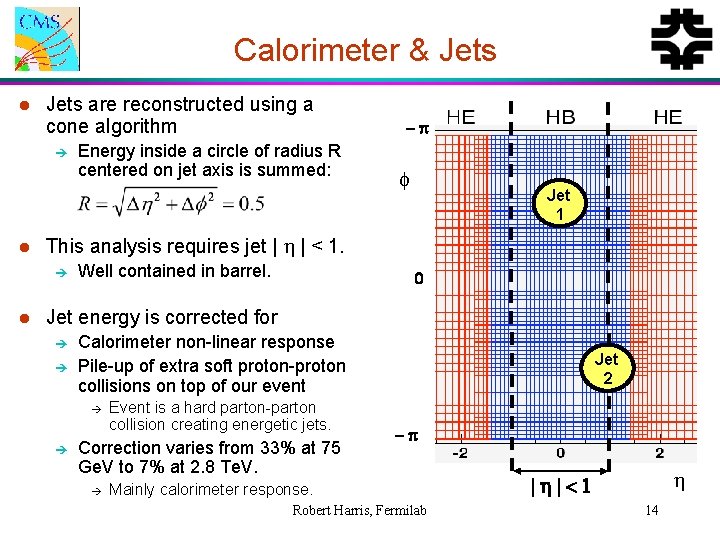
Calorimeter & Jets l Jets are reconstructed using a cone algorithm è l f Jet 1 This analysis requires jet | h | < 1. è l Energy inside a circle of radius R centered on jet axis is summed: -p Well contained in barrel. 0 Jet energy is corrected for è è Calorimeter non-linear response Pile-up of extra soft proton-proton collisions on top of our event à è Event is a hard parton-parton collision creating energetic jets. Correction varies from 33% at 75 Ge. V to 7% at 2. 8 Te. V. à Jet 2 -p Mainly calorimeter response. Robert Harris, Fermilab h |h|<1 14
CMS Jet Trigger & Dijet Mass Distribution Robert Harris, Fermilab 15
Trigger l Collision rate at LHC is expected to be 40 MHz è è l 40 million events every second ! CMS cannot read out and save that many. Trigger chooses which events to save è Event Selection CMS Detector 4 x 10⁷ Hz Only the most interesting events can be saved L 1 Trigger l Two levels of trigger are used è Level 1 (L 1) is fast custom built hardware à è l Reduces rate to 100 KHz: chooses only 1 event out of 400 High Level Trigger (HLT) is a PC farm à Reduces rate to 150 Hz: chooses only 1 event out of 700. Trigger selects events with high energy objects è è 1 x 10⁵ Hz Jet trigger at L 1 uses energy in a square Dh x Df = 1 x 1 Jet trigger at HLT uses same jet algorithm as analysis. Robert Harris, Fermilab HLT Trigger 1. 5 x 10² Hz Saved for Analysis 16
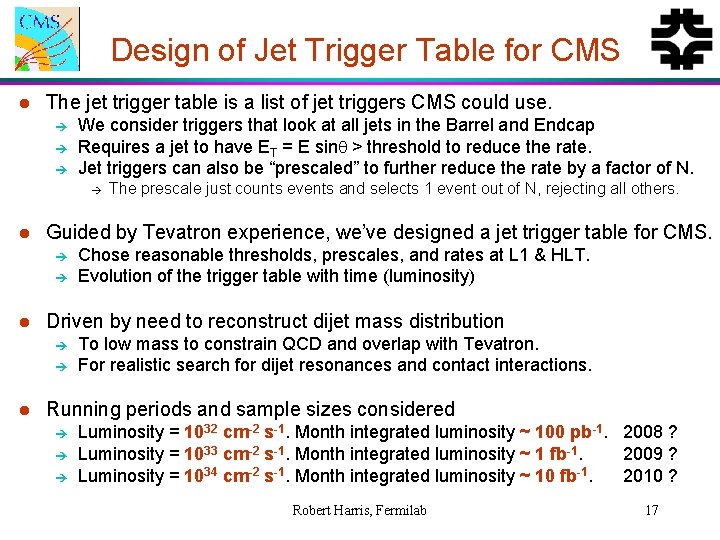
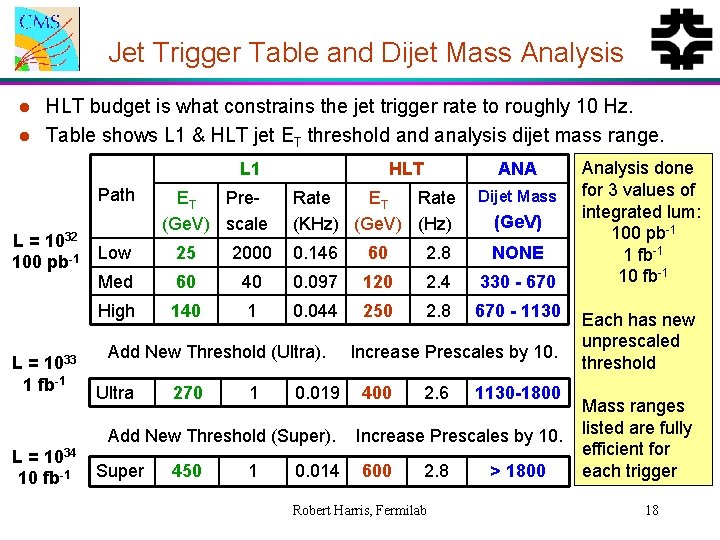
Design of Jet Trigger Table for CMS l The jet trigger table is a list of jet triggers CMS could use. è è è We consider triggers that look at all jets in the Barrel and Endcap Requires a jet to have ET = E sinq > threshold to reduce the rate. Jet triggers can also be “prescaled” to further reduce the rate by a factor of N. à l Guided by Tevatron experience, we’ve designed a jet trigger table for CMS. è è l Chose reasonable thresholds, prescales, and rates at L 1 & HLT. Evolution of the trigger table with time (luminosity) Driven by need to reconstruct dijet mass distribution è è l The prescale just counts events and selects 1 event out of N, rejecting all others. To low mass to constrain QCD and overlap with Tevatron. For realistic search for dijet resonances and contact interactions. Running periods and sample sizes considered è è è Luminosity = 1032 cm-2 s-1. Month integrated luminosity ~ 100 pb-1. 2008 ? Luminosity = 1033 cm-2 s-1. Month integrated luminosity ~ 1 fb-1. 2009 ? Luminosity = 1034 cm-2 s-1. Month integrated luminosity ~ 10 fb-1. 2010 ? Robert Harris, Fermilab 17
Jet Trigger Table and Dijet Mass Analysis l l HLT budget is what constrains the jet trigger rate to roughly 10 Hz. Table shows L 1 & HLT jet ET threshold analysis dijet mass range. L 1 Path L = 1032 100 pb-1 L = 1033 1 fb-1 ET Pre(Ge. V) scale HLT Rate ET Rate (KHz) (Ge. V) (Hz) Dijet Mass (Ge. V) Low 25 2000 0. 146 60 2. 8 NONE Med 60 40 0. 097 120 2. 4 330 - 670 High 140 1 0. 044 250 2. 8 670 - 1130 Add New Threshold (Ultra). Ultra 270 1 0. 019 Add New Threshold (Super). L = 1034 10 fb-1 ANA Super 450 1 0. 014 Increase Prescales by 10. 400 2. 6 1130 -1800 Increase Prescales by 10. 600 2. 8 Robert Harris, Fermilab > 1800 Analysis done for 3 values of integrated lum: 100 pb-1 1 fb-1 10 fb-1 Each has new unprescaled threshold Mass ranges listed are fully efficient for each trigger 18
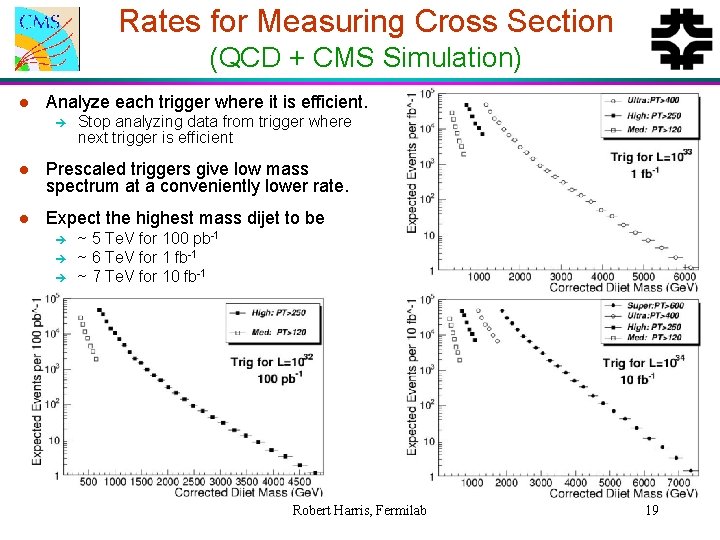
Rates for Measuring Cross Section (QCD + CMS Simulation) l Analyze each trigger where it is efficient. è Stop analyzing data from trigger where next trigger is efficient l Prescaled triggers give low mass spectrum at a conveniently lower rate. l Expect the highest mass dijet to be è è è ~ 5 Te. V for 100 pb-1 ~ 6 Te. V for 1 fb-1 ~ 7 Te. V for 10 fb-1 Robert Harris, Fermilab 19
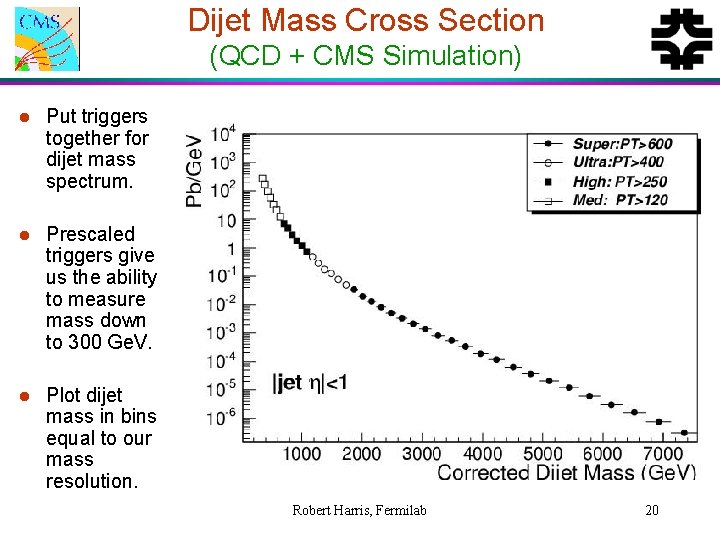
Dijet Mass Cross Section (QCD + CMS Simulation) l Put triggers together for dijet mass spectrum. l Prescaled triggers give us the ability to measure mass down to 300 Ge. V. l Plot dijet mass in bins equal to our mass resolution. Robert Harris, Fermilab 20
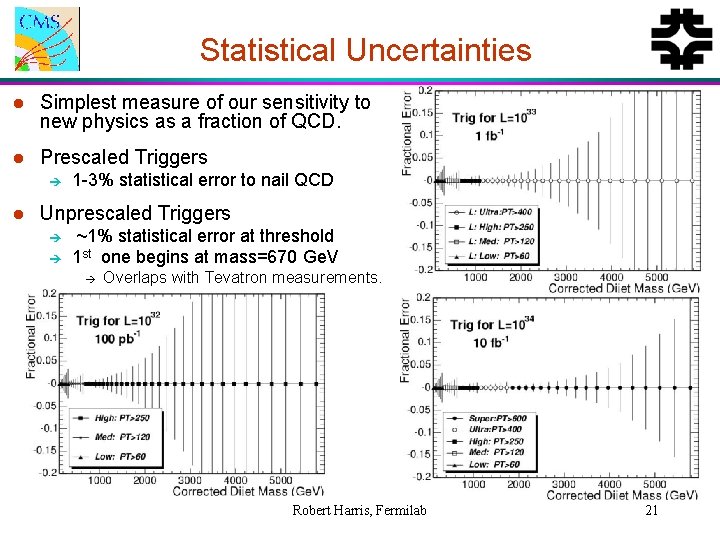
Statistical Uncertainties l Simplest measure of our sensitivity to new physics as a fraction of QCD. l Prescaled Triggers è l 1 -3% statistical error to nail QCD Unprescaled Triggers è è ~1% statistical error at threshold 1 st one begins at mass=670 Ge. V à Overlaps with Tevatron measurements. Robert Harris, Fermilab 21
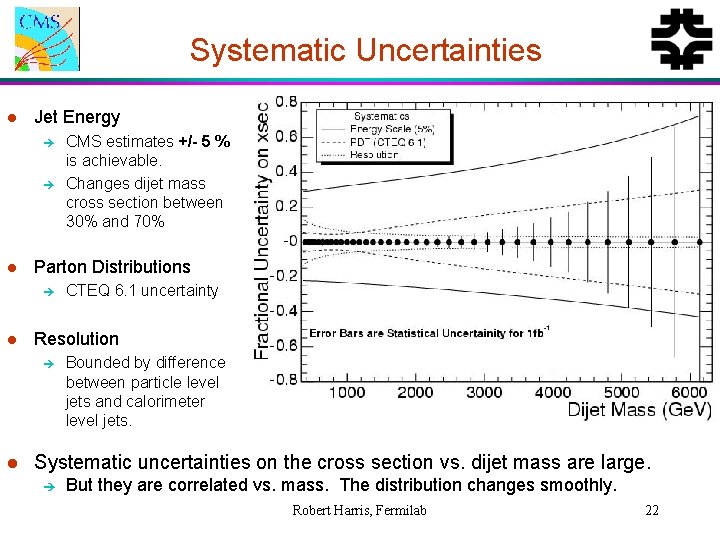
Systematic Uncertainties l Jet Energy è è l Parton Distributions è l CTEQ 6. 1 uncertainty Resolution è l CMS estimates +/- 5 % is achievable. Changes dijet mass cross section between 30% and 70% Bounded by difference between particle level jets and calorimeter level jets. Systematic uncertainties on the cross section vs. dijet mass are large. è But they are correlated vs. mass. The distribution changes smoothly. Robert Harris, Fermilab 22
CMS Sensitivity to Dijet Resonances Robert Harris, Fermilab 23
Motivation l Theoretical Motivation è è l The many models of dijet resonances are ample theoretical motivation. But experimentalists should not be biased by theoretical motivations. . . Experimental Motivation è The LHC collides partons (quarks, antiquarks and gluons). à à LHC is a parton-parton resonance factory in a previously unexplored region The motivation to search for dijet resonances is intuitively obvious. ð è We should search for generic dijet resonances, not specific models. à è We must do it. Nature may surprise us with unexpected new particles. It wouldn’t be the first time … One search can encompass ALL narrow dijet resonances. à Resonances more narrow than the jet resolution all produce similar line shapes. Robert Harris, Fermilab 24
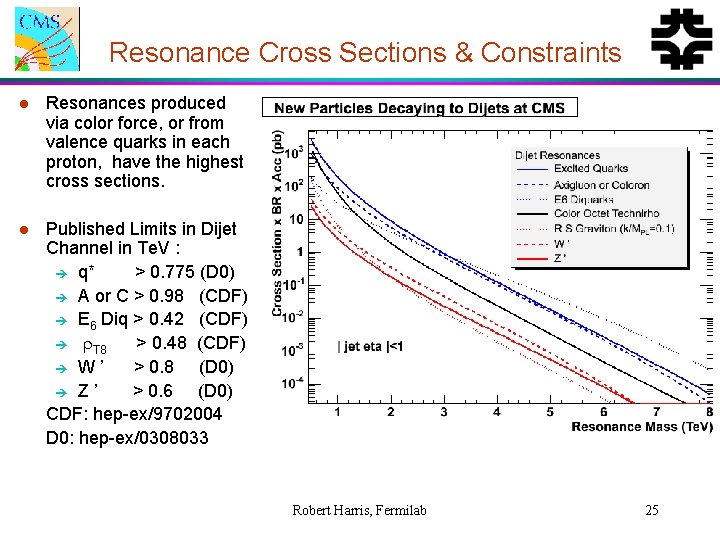
Resonance Cross Sections & Constraints l Resonances produced via color force, or from valence quarks in each proton, have the highest cross sections. l Published Limits in Dijet Channel in Te. V : è q* > 0. 775 (D 0) è A or C > 0. 98 (CDF) è E 6 Diq > 0. 42 (CDF) è r. T 8 > 0. 48 (CDF) è W ’ > 0. 8 (D 0) è Z ’ > 0. 6 (D 0) CDF: hep-ex/9702004 D 0: hep-ex/0308033 Robert Harris, Fermilab 25
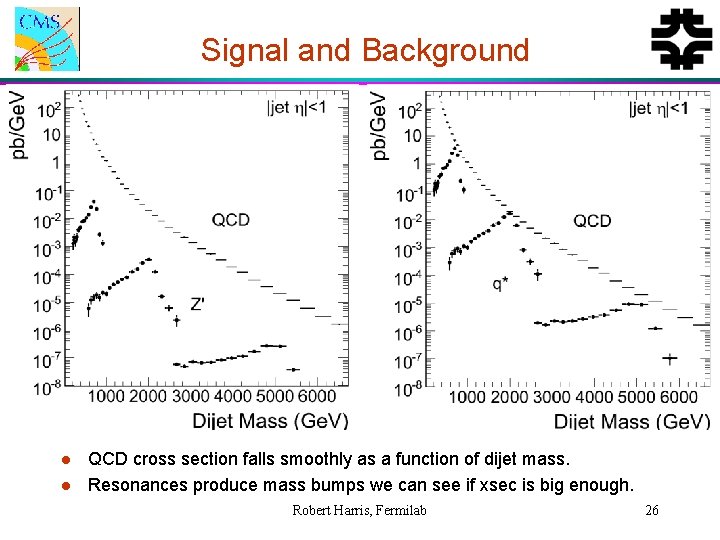
Signal and Background l l QCD cross section falls smoothly as a function of dijet mass. Resonances produce mass bumps we can see if xsec is big enough. Robert Harris, Fermilab 26
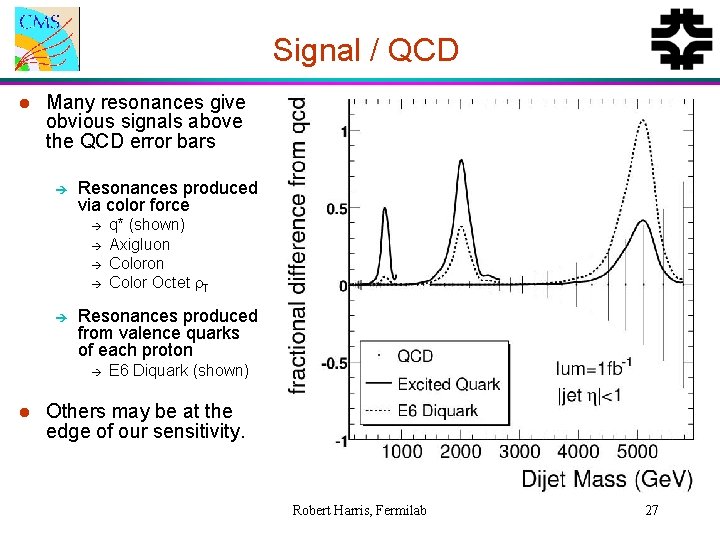
Signal / QCD l Many resonances give obvious signals above the QCD error bars è Resonances produced via color force à à è Resonances produced from valence quarks of each proton à l q* (shown) Axigluon Color Octet r. T E 6 Diquark (shown) Others may be at the edge of our sensitivity. Robert Harris, Fermilab 27
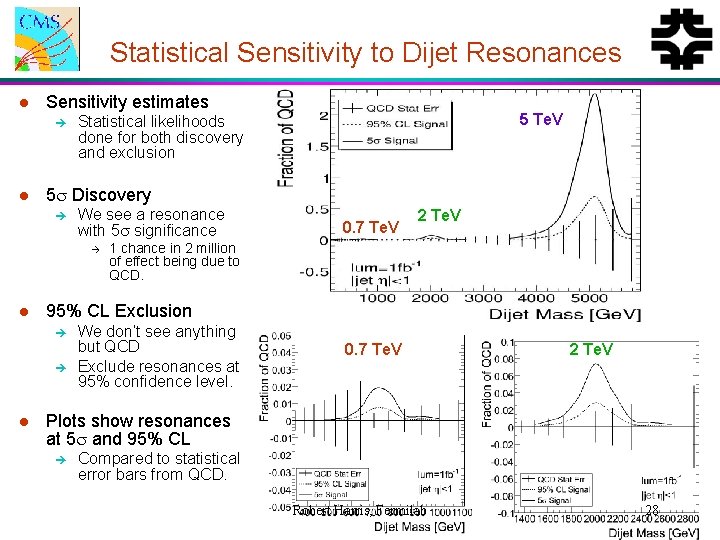
Statistical Sensitivity to Dijet Resonances l Sensitivity estimates è l 5 s Discovery è We see a resonance with 5 s significance à l 0. 7 Te. V 2 Te. V 1 chance in 2 million of effect being due to QCD. 95% CL Exclusion è è l 5 Te. V Statistical likelihoods done for both discovery and exclusion We don’t see anything but QCD Exclude resonances at 95% confidence level. 0. 7 Te. V 2 Te. V Plots show resonances at 5 s and 95% CL è Compared to statistical error bars from QCD. Robert Harris, Fermilab 28
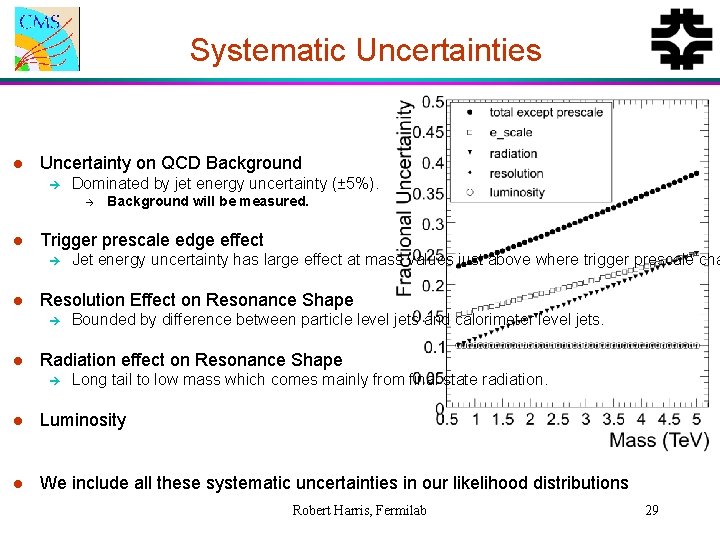
Systematic Uncertainties l Uncertainty on QCD Background è Dominated by jet energy uncertainty (± 5%). à l Trigger prescale edge effect è l Jet energy uncertainty has large effect at mass values just above where trigger prescale cha Resolution Effect on Resonance Shape è l Background will be measured. Bounded by difference between particle level jets and calorimeter level jets. Radiation effect on Resonance Shape è Long tail to low mass which comes mainly from final state radiation. l Luminosity l We include all these systematic uncertainties in our likelihood distributions Robert Harris, Fermilab 29
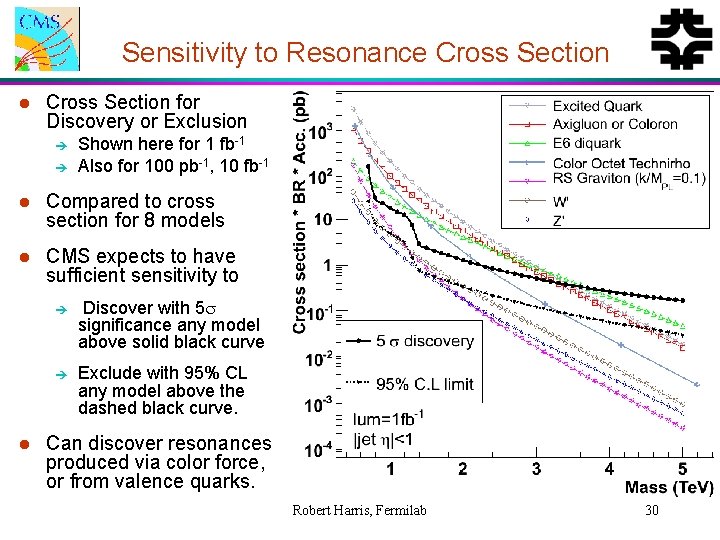
Sensitivity to Resonance Cross Section l Cross Section for Discovery or Exclusion è è Shown here for 1 fb-1 Also for 100 pb-1, 10 fb-1 l Compared to cross section for 8 models l CMS expects to have sufficient sensitivity to l è Discover with 5 s significance any model above solid black curve è Exclude with 95% CL any model above the dashed black curve. Can discover resonances produced via color force, or from valence quarks. Robert Harris, Fermilab 30
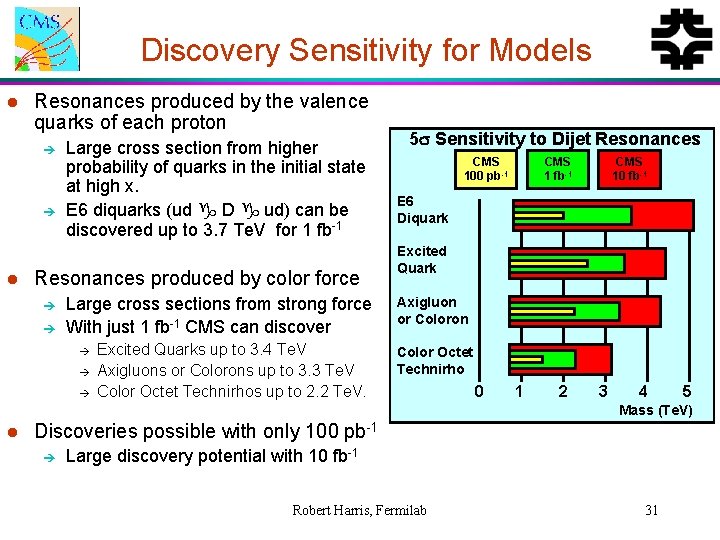
Discovery Sensitivity for Models l Resonances produced by the valence quarks of each proton è è l Large cross section from higher probability of quarks in the initial state at high x. E 6 diquarks (ud g D g ud) can be discovered up to 3. 7 Te. V for 1 fb-1 Resonances produced by color force è è Large cross sections from strong force With just 1 fb-1 CMS can discover à à à Excited Quarks up to 3. 4 Te. V Axigluons or Colorons up to 3. 3 Te. V Color Octet Technirhos up to 2. 2 Te. V. 5 s Sensitivity to Dijet Resonances CMS 100 pb-1 CMS 1 fb-1 CMS 10 fb-1 E 6 Diquark Excited Quark Axigluon or Coloron Color Octet Technirho 0 1 2 3 4 5 Mass (Te. V) l Discoveries possible with only 100 pb-1 è Large discovery potential with 10 fb-1 Robert Harris, Fermilab 31
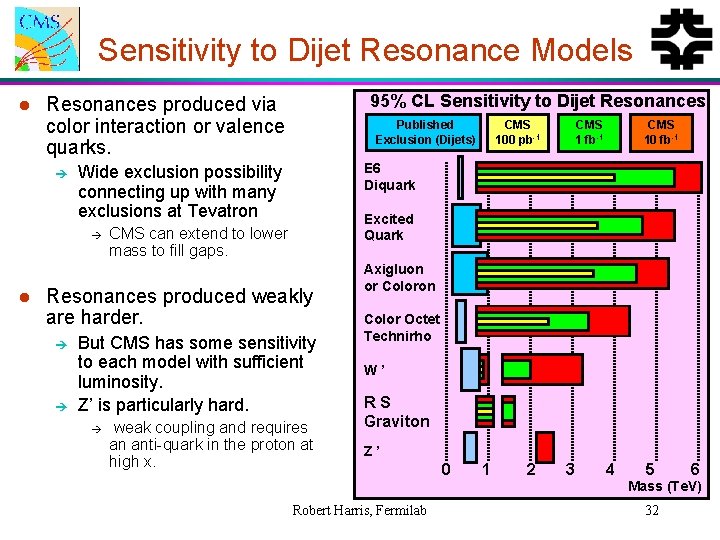
Sensitivity to Dijet Resonance Models l è Published Exclusion (Dijets) è CMS can extend to lower mass to fill gaps. But CMS has some sensitivity to each model with sufficient luminosity. Z’ is particularly hard. à CMS 1 fb-1 CMS 10 fb-1 Excited Quark Resonances produced weakly are harder. è CMS 100 pb-1 E 6 Diquark Wide exclusion possibility connecting up with many exclusions at Tevatron à l 95% CL Sensitivity to Dijet Resonances produced via color interaction or valence quarks. weak coupling and requires an anti-quark in the proton at high x. Axigluon or Coloron Color Octet Technirho W’ RS Graviton Z’ 0 1 2 3 4 5 6 Mass (Te. V) Robert Harris, Fermilab 32
CMS Sensitivity to Quark Contact Interactions Robert Harris, Fermilab 33
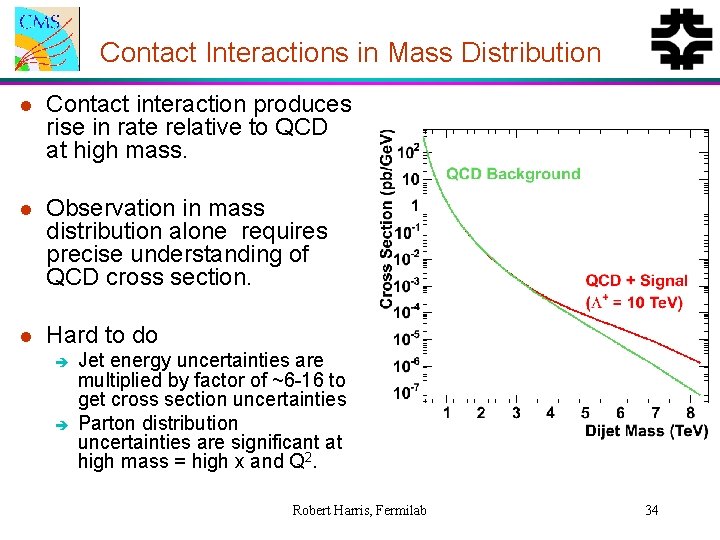
Contact Interactions in Mass Distribution l Contact interaction produces rise in rate relative to QCD at high mass. l Observation in mass distribution alone requires precise understanding of QCD cross section. l Hard to do è è Jet energy uncertainties are multiplied by factor of ~6 -16 to get cross section uncertainties Parton distribution uncertainties are significant at high mass = high x and Q 2. Robert Harris, Fermilab 34
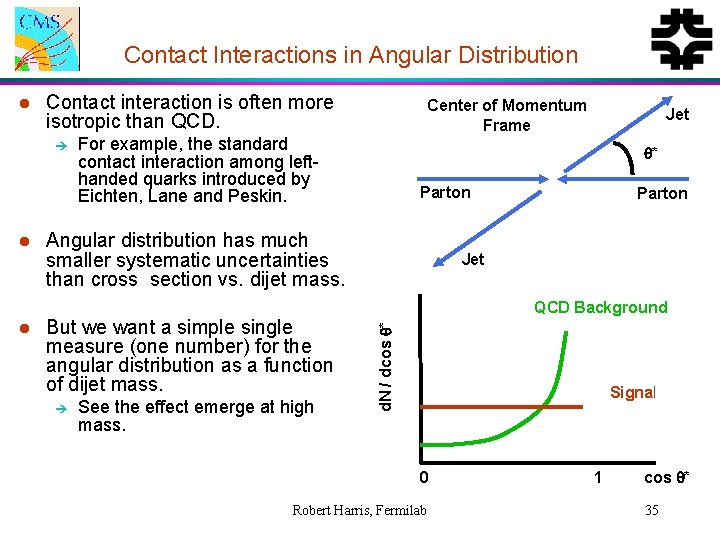
Contact Interactions in Angular Distribution Contact interaction is often more isotropic than QCD. è l l Center of Momentum Frame For example, the standard contact interaction among lefthanded quarks introduced by Eichten, Lane and Peskin. q* Parton Angular distribution has much smaller systematic uncertainties than cross section vs. dijet mass. But we want a simple single measure (one number) for the angular distribution as a function of dijet mass. è See the effect emerge at high mass. Jet Parton Jet QCD Background d. N / dcos q* l Signal 0 Robert Harris, Fermilab 1 cos q* 35
Sensitive Variable for Contact Interactions l Dijet Ratio is the variable we use è è è l h = -1 - 0. 5 è 1. 0 Jet 1 Simple measure of the most sensitive part of the angular distribution. We measure it as a function of mass. It was first introduced by D 0 (hep-ex/980714). z Numerator |cos q*| ~ 0 Jet 2 Dijet Ratio = N(|h|<0. 5) / N(0. 5<|h|<1) è 0. 5 Jet 1 Number of events in which each leading jet has |h|<0. 5, divided by the number in which each leading jet has 0. 5<|h|<1. 0 We will show systematics on the dijet ratio are small. z |cos q*| ~ 0. 6, usually or Jet 2 Robert Harris, Fermilab Denominator Jet 2 (rare) 36
Dijet Ratio l Lowest order (LO) calculation. è l Same code as used by CDF in 1996 paper è è l Both signal and background. hep-ex/9609011 but with modern parton distributions (CTEQ 6 L). Signal emerges clearly at high mass è QCD is pretty flat Robert Harris, Fermilab 37
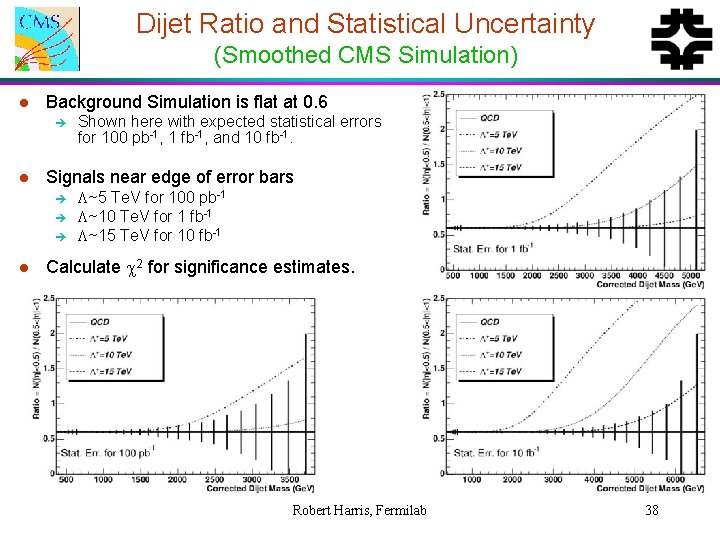
Dijet Ratio and Statistical Uncertainty (Smoothed CMS Simulation) l Background Simulation is flat at 0. 6 è l Signals near edge of error bars è è è l Shown here with expected statistical errors for 100 pb-1, 1 fb-1, and 10 fb-1. L~5 Te. V for 100 pb-1 L~10 Te. V for 1 fb-1 L~15 Te. V for 10 fb-1 Calculate c 2 for significance estimates. Robert Harris, Fermilab 38
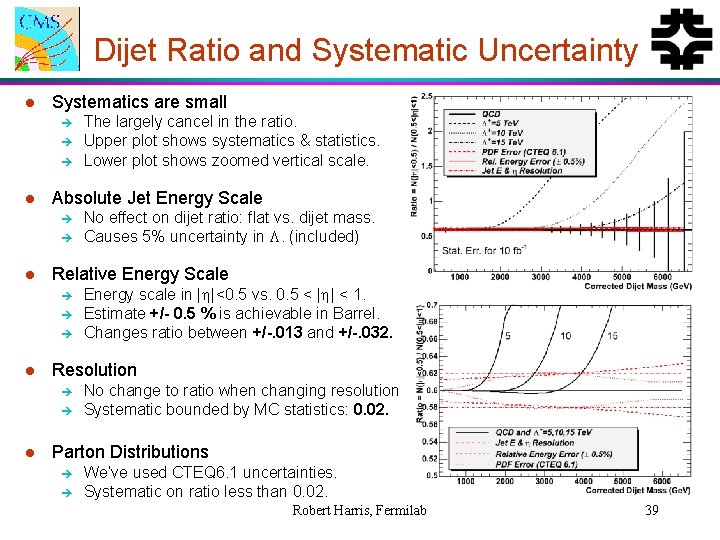
Dijet Ratio and Systematic Uncertainty l Systematics are small è è è l Absolute Jet Energy Scale è è l è è Energy scale in |h|<0. 5 vs. 0. 5 < |h| < 1. Estimate +/- 0. 5 % is achievable in Barrel. Changes ratio between +/-. 013 and +/-. 032. Resolution è è l No effect on dijet ratio: flat vs. dijet mass. Causes 5% uncertainty in L. (included) Relative Energy Scale è l The largely cancel in the ratio. Upper plot shows systematics & statistics. Lower plot shows zoomed vertical scale. No change to ratio when changing resolution Systematic bounded by MC statistics: 0. 02. Parton Distributions è è We’ve used CTEQ 6. 1 uncertainties. Systematic on ratio less than 0. 02. Robert Harris, Fermilab 39
Significance of Contact Interaction Signal l Significance found from c 2 è è l 5 s Discoveries 95% CL Exclusions Effect of dijet ratio systematics on the significance is small. Robert Harris, Fermilab 40
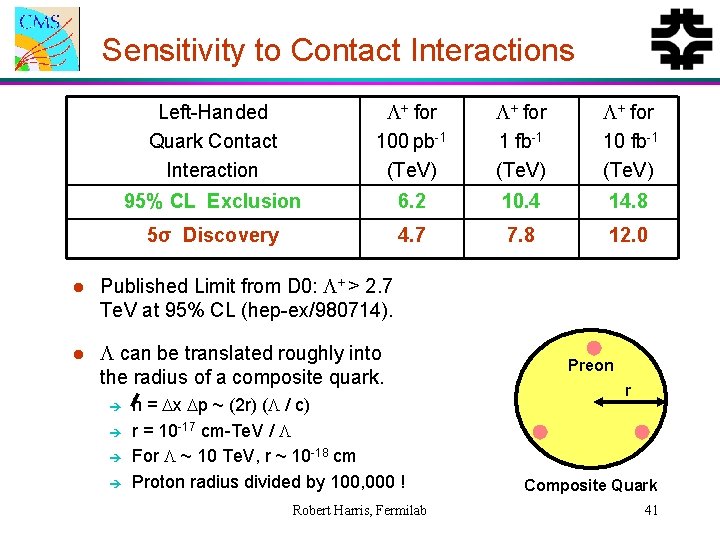
Sensitivity to Contact Interactions Left-Handed Quark Contact Interaction L+ for 100 pb-1 (Te. V) L+ for 1 fb-1 (Te. V) L+ for 10 fb-1 (Te. V) 95% CL Exclusion 6. 2 10. 4 14. 8 5σ Discovery 4. 7 7. 8 12. 0 l Published Limit from D 0: L+ > 2. 7 Te. V at 95% CL (hep-ex/980714). l L can be translated roughly into the radius of a composite quark. è è h = Dx Dp ~ (2 r) (L / c) r = 10 -17 cm-Te. V / L For L ~ 10 Te. V, r ~ 10 -18 cm Proton radius divided by 100, 000 ! Robert Harris, Fermilab Preon r Composite Quark 41
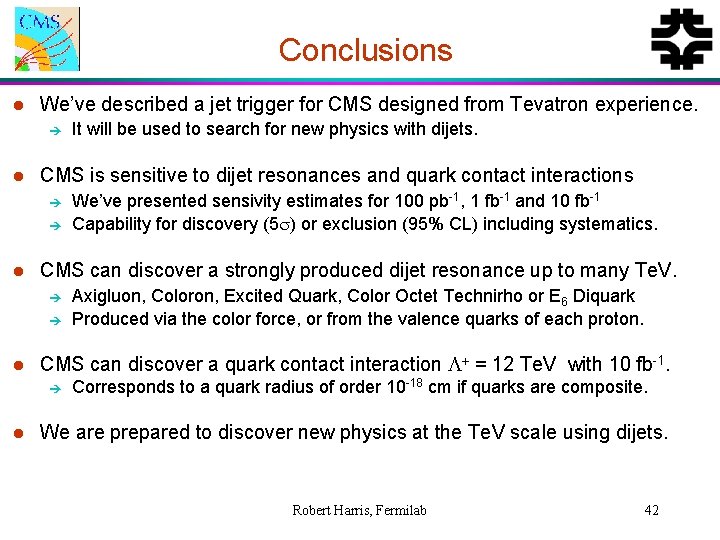
Conclusions l We’ve described a jet trigger for CMS designed from Tevatron experience. è l CMS is sensitive to dijet resonances and quark contact interactions è è l è Axigluon, Coloron, Excited Quark, Color Octet Technirho or E 6 Diquark Produced via the color force, or from the valence quarks of each proton. CMS can discover a quark contact interaction L+ = 12 Te. V with 10 fb-1. è l We’ve presented sensivity estimates for 100 pb-1, 1 fb-1 and 10 fb-1 Capability for discovery (5 s) or exclusion (95% CL) including systematics. CMS can discover a strongly produced dijet resonance up to many Te. V. è l It will be used to search for new physics with dijets. Corresponds to a quark radius of order 10 -18 cm if quarks are composite. We are prepared to discover new physics at the Te. V scale using dijets. Robert Harris, Fermilab 42