NEW NUCLEAR POWER Ed Cummins Westinghouse Electric Company
- Slides: 41
NEW NUCLEAR POWER Ed Cummins Westinghouse Electric Company June 29, 2006 Doc. ppt Slide 1 0144
A Nuclear Renaissance is Beginning l l l Major Driving Factor - Price of natural gas more than doubled. - Volatility of natural gas prices - High long-term projections for natural gas prices Additional Considerations – Energy security – Uncertainty in the future emissions regulations (monetization of airborne pollutants such as carbon and mercury) – Availability of advanced nuclear plant designs – Relative stability of regulatory environment – Public policy (political) support (Energy Legislation in the U. S. ) Challenges - Spent fuel disposal - Resource availability (human and supply chain) - Project Management Doc. ppt Slide 2 0144
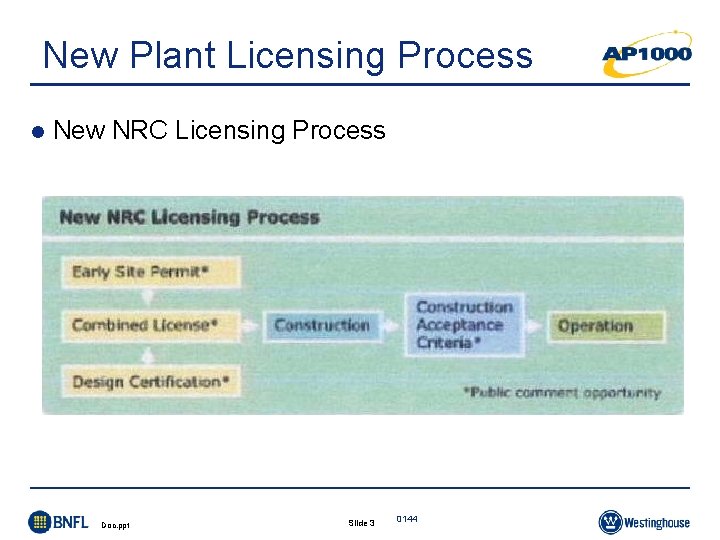
New Plant Licensing Process l New NRC Licensing Process Doc. ppt Slide 3 0144
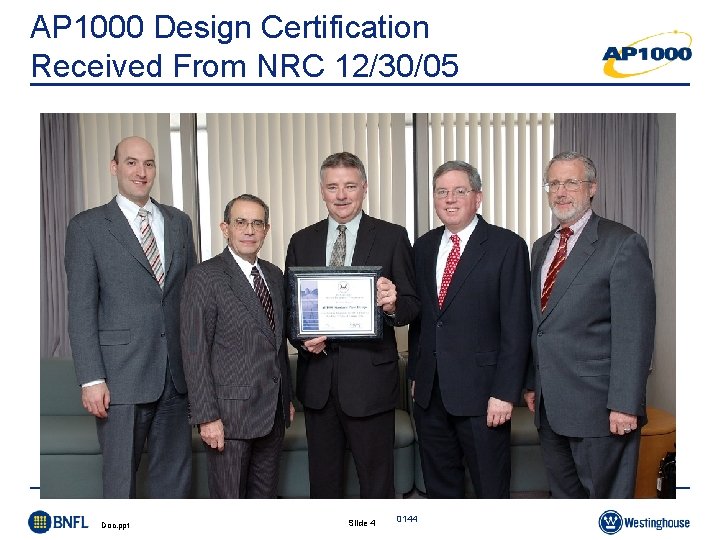
AP 1000 Design Certification Received From NRC 12/30/05 Doc. ppt Slide 4 0144
U. S. Government Support “To build a secure energy future, we need to expand production of safe, clean nuclear power. ” President George W. Bush Doc. ppt Slide 5 0144
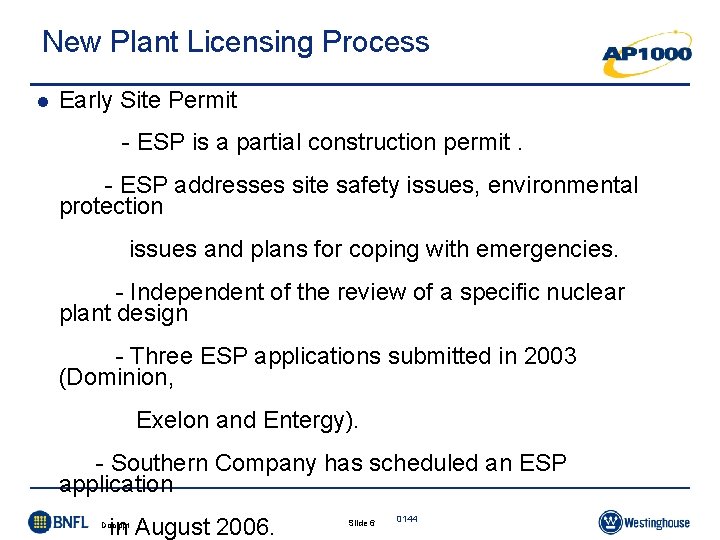
New Plant Licensing Process l Early Site Permit - ESP is a partial construction permit. - ESP addresses site safety issues, environmental protection issues and plans for coping with emergencies. - Independent of the review of a specific nuclear plant design - Three ESP applications submitted in 2003 (Dominion, Exelon and Entergy). - Southern Company has scheduled an ESP application in August 2006. Doc. ppt Slide 6 0144
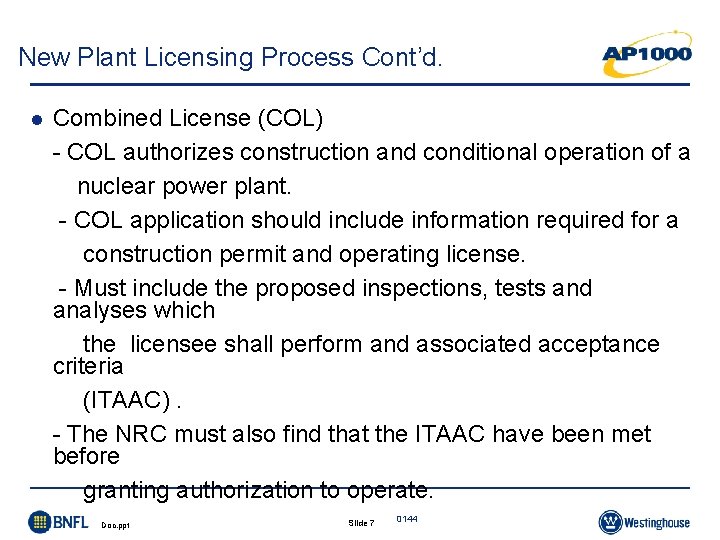
New Plant Licensing Process Cont’d. l Combined License (COL) - COL authorizes construction and conditional operation of a nuclear power plant. - COL application should include information required for a construction permit and operating license. - Must include the proposed inspections, tests and analyses which the licensee shall perform and associated acceptance criteria (ITAAC). - The NRC must also find that the ITAAC have been met before granting authorization to operate. Doc. ppt Slide 7 0144
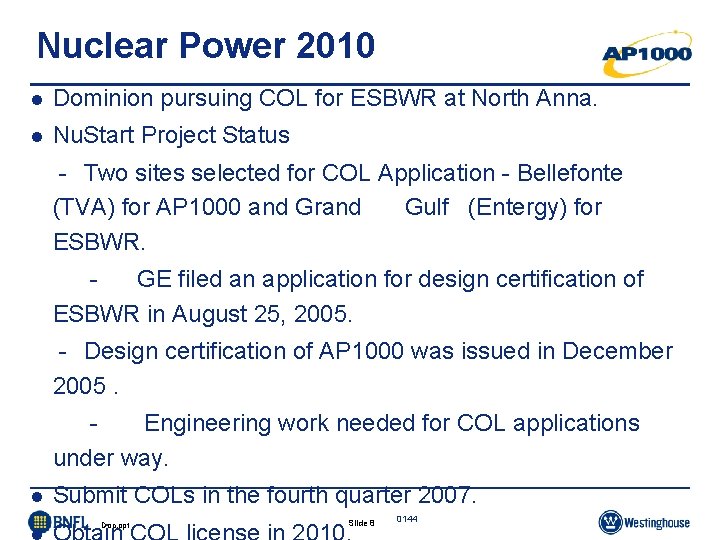
Nuclear Power 2010 l Dominion pursuing COL for ESBWR at North Anna. l Nu. Start Project Status - Two sites selected for COL Application - Bellefonte (TVA) for AP 1000 and Grand Gulf (Entergy) for ESBWR. GE filed an application for design certification of ESBWR in August 25, 2005. - Design certification of AP 1000 was issued in December 2005. Engineering work needed for COL applications under way. l Submit COLs in the fourth quarter 2007. Doc. ppt Slide 8 0144
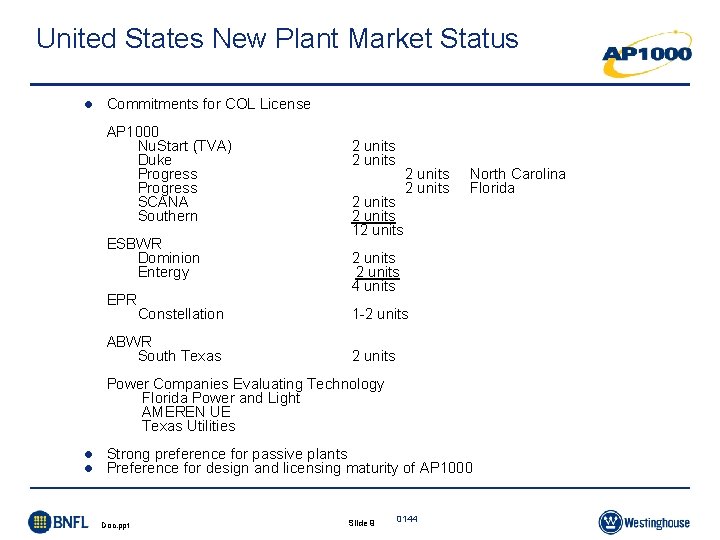
United States New Plant Market Status l Commitments for COL License AP 1000 Nu. Start (TVA) Duke Progress SCANA Southern ESBWR Dominion Entergy EPR Constellation ABWR South Texas 2 units 12 units North Carolina Florida 2 units 4 units 1 -2 units Power Companies Evaluating Technology Florida Power and Light AMEREN UE Texas Utilities l l Strong preference for passive plants Preference for design and licensing maturity of AP 1000 Doc. ppt Slide 9 0144
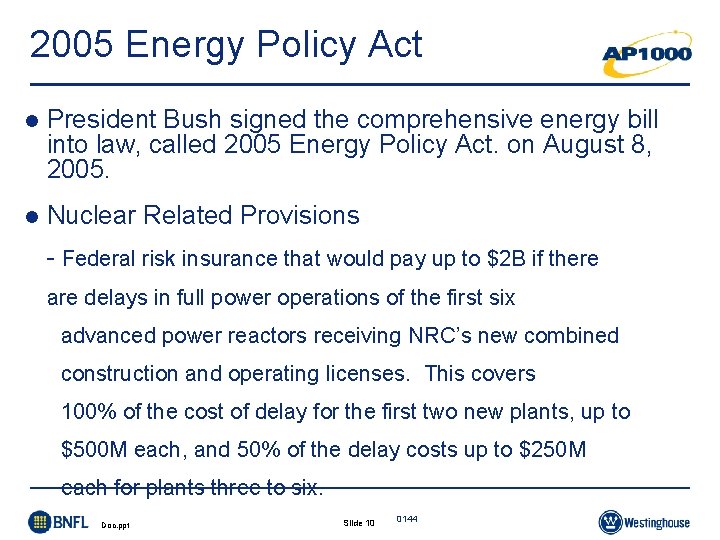
2005 Energy Policy Act l President Bush signed the comprehensive energy bill into law, called 2005 Energy Policy Act. on August 8, 2005. l Nuclear Related Provisions - Federal risk insurance that would pay up to $2 B if there are delays in full power operations of the first six advanced power reactors receiving NRC’s new combined construction and operating licenses. This covers 100% of the cost of delay for the first two new plants, up to $500 M each, and 50% of the delay costs up to $250 M each for plants three to six. Doc. ppt Slide 10 0144
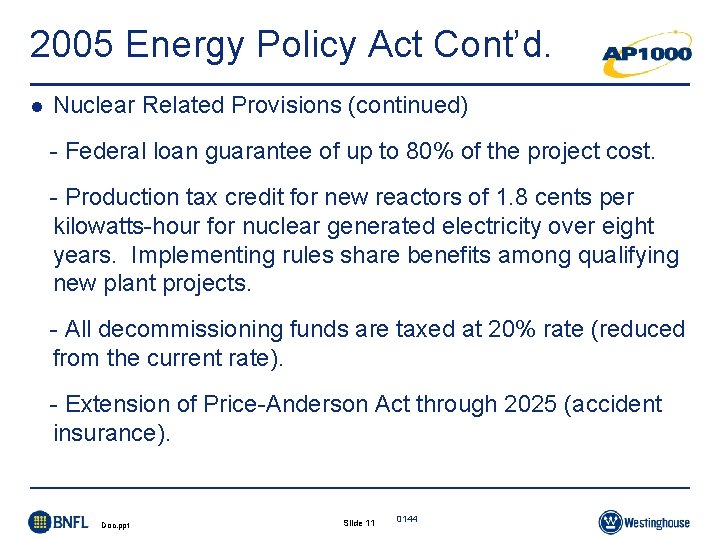
2005 Energy Policy Act Cont’d. l Nuclear Related Provisions (continued) - Federal loan guarantee of up to 80% of the project cost. - Production tax credit for new reactors of 1. 8 cents per kilowatts-hour for nuclear generated electricity over eight years. Implementing rules share benefits among qualifying new plant projects. - All decommissioning funds are taxed at 20% rate (reduced from the current rate). - Extension of Price-Anderson Act through 2025 (accident insurance). Doc. ppt Slide 11 0144
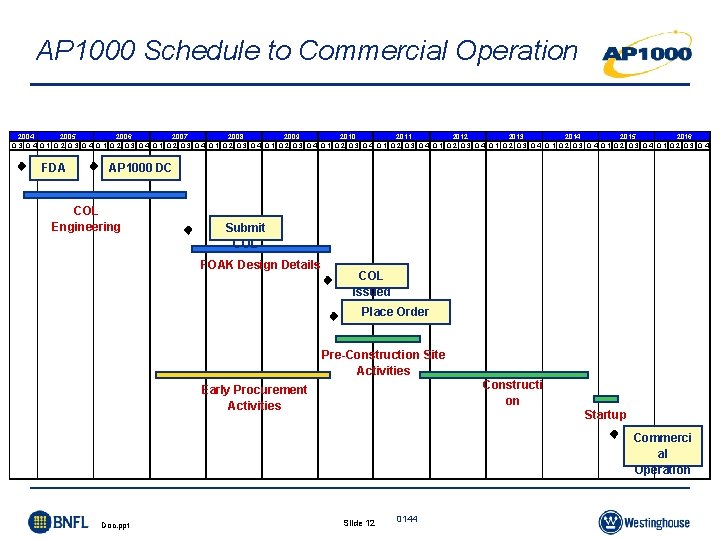
AP 1000 Schedule to Commercial Operation 2004 2005 2006 2007 2008 2009 2010 2011 2012 2013 2014 2015 2016 Q 3 Q 4 Q 1 Q 2 Q 3 Q 4 Q 1 Q 2 Q 3 Q 4 Q 1 Q 2 Q 3 Q 4 Q 1 Q 2 Q 3 Q 4 FDA AP 1000 DC COL Engineering Submit COL FOAK Design Details COL Issued Place Order Pre-Construction Site Activities Constructi on Early Procurement Activities Startup Commerci al Operation Doc. ppt Slide 12 0144
Westinghouse Fifteen Year Investment in Passive Technology Westinghouse developed AP 600, its first passive safety reactor l system in the early 1990 s (1, 300 man-years of design and testing). NRC issued AP 600 design certification in 1999 following extensive l licensing review of more than 130 man-years and independent confirmatory testing of critical systems. Westinghouse embarked on AP 1000 development to improve cost l competitiveness. l Half billion dollars and over 15 years invested in the Doc. ppt Slide 13 0144
AP 1000: No Technology Risk l AP 1000 power generation systems (fuel, NSSS, turbine generator, support systems) are of “traditional design” and involve no new or novel technology. Operating experience is directly applicable. l “Passive” safety systems are, in general, very simple consisting largely of tanks, pipes and a few air or DC operated valves. l Expected performance under accident conditions validated by extensive testing (>$40 MUSD) and regulatory review. l Modular construction techniques well proven in non-nuclear applications (ship building, off-shore drilling platforms) l Mature in design and licensing – 60% complete Doc. ppt Slide 14 0144
AP 1000 Design Features Doc. ppt Slide 15 0144
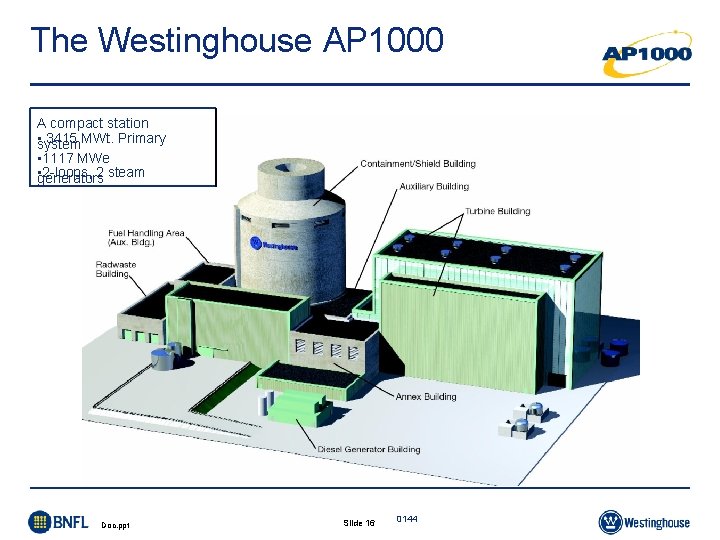
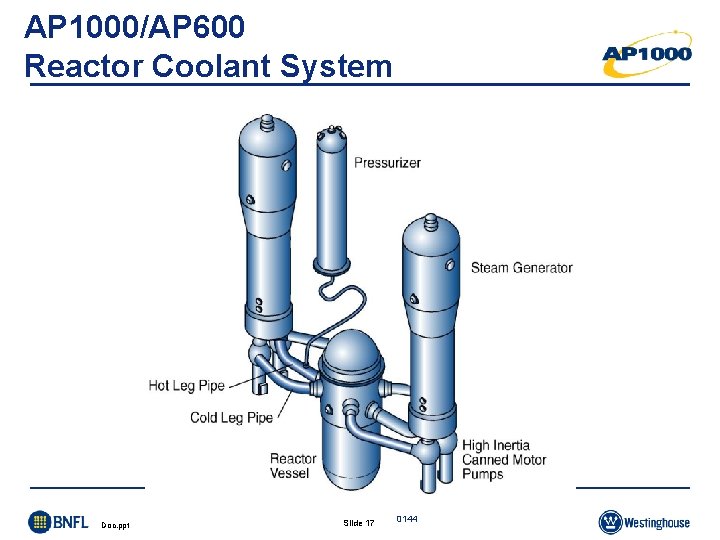
The Westinghouse AP 1000 A compact station • system 3415 MWt. Primary • 1117 MWe • generators 2 -loops, 2 steam Doc. ppt Slide 16 0144
AP 1000/AP 600 Reactor Coolant System Doc. ppt Slide 17 0144
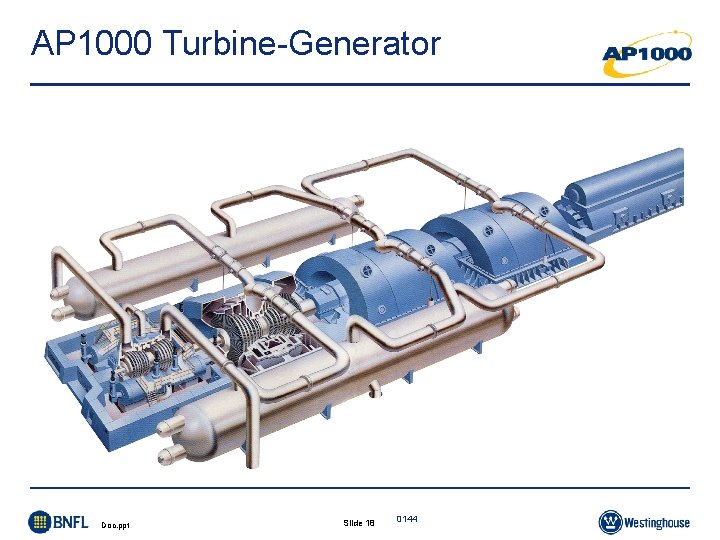
AP 1000 Turbine-Generator Doc. ppt Slide 18 0144
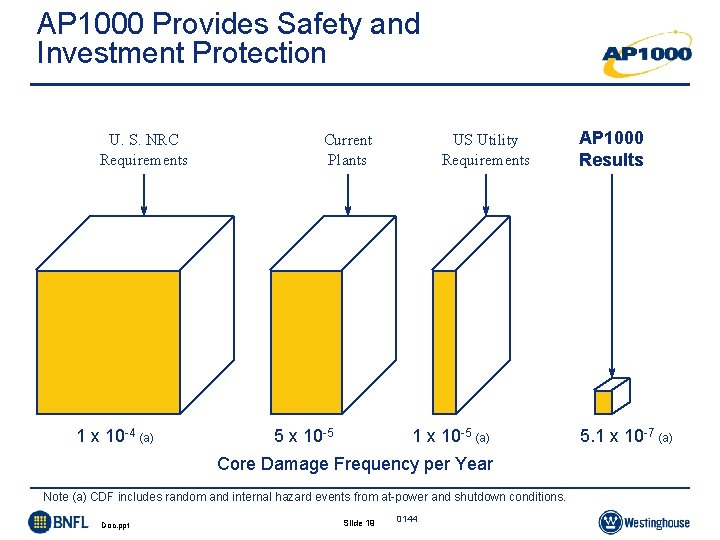
AP 1000 Provides Safety and Investment Protection U. S. NRC Requirements 1 x 10 -4 (a) Current Plants 5 x 10 -5 US Utility Requirements 1 x 10 -5 (a) Core Damage Frequency per Year Note (a) CDF includes random and internal hazard events from at-power and shutdown conditions. Doc. ppt Slide 19 0144 AP 1000 Results 5. 1 x 10 -7 (a)
AP 1000 Simplifications l l l Safety – Use of passive safety systems Design – Reduced number of components and bulk commodities Procurement – Standardization of components Construction – Extensive use of modules reduces on-site construction – Multiplexed I&C communication reduces cables Operation and Maintenance – Use of proven systems and components – Man-machine interface advancements Doc. ppt Slide 20 0144
Passive Safety – What is it all about? l Passive Safety Systems utilizes naturally occurring physical phenomena such as natural circulation of air, water and steam. l Gravity and gas pressure drive the flow of cooling water. l Natural heat transfer occurs through conduction, convection and evaporation. l Flow and cooling occur in accordance with nature’s laws – There are no pumps and motor-operated valves. l A few valves align the passive safety systems upon actuation signals. l Greatly reduced operator dependency l AC electrical power is not required for plant safety. Doc. ppt Slide 21 0144
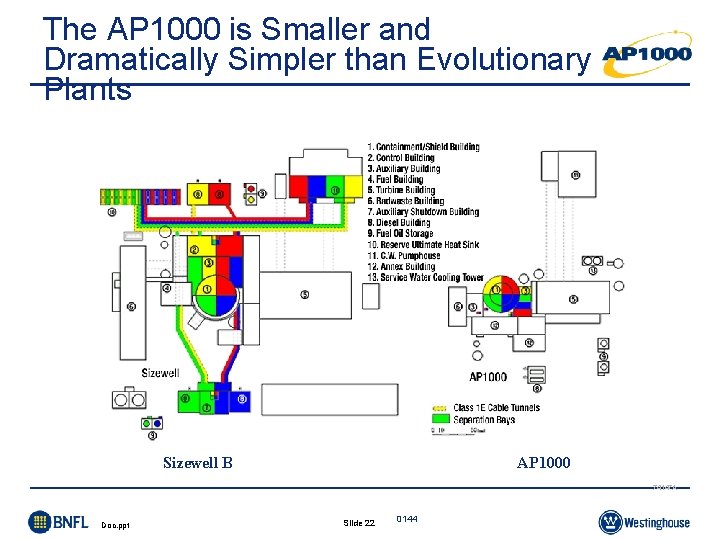
The AP 1000 is Smaller and Dramatically Simpler than Evolutionary Plants Sizewell B AP 1000 74147 A Doc. ppt Slide 22 0144
Standardization l Standardization has been a key element of New Plant Commercialization for 20 years – NPOC Strategic Plan. l The Utility Requirements Document standardized the Power Company requirements for New Plants. l Design Certification commits the Plant Supplier and the Nuclear Regulatory Commission to a “Standard Plant”. l NRC approach to Design Centered Combined Construction and Operating License (COL) enhances standardization. l NRC will “punish” departure from Design Centered review with “extended” licensing schedule. l Economics provide incentives for Standardization Beyond Design: – Operations - Supply Chain – Engineering - Maintenance Doc. ppt Slide 23 0144
Standard Plant Design Scope l Since the start of the AP 600 program, Westinghouse has maximized the scope of the Standard Plant: – Forced Draft Cooling Tower for non-safety related Essential Service Water System – Spring Mounted Turbine Table Top is not sensitive to Site Soil Conditions. – Use of Broad Set of Environmental interface criteria established by the URD (snow, rain, temperatures, wind, soil conditions)’ l Standard Plant is described in AP 1000 Design Control Document, Chapter 1. 2. l The Scope of Standardization includes the entire plant. l Passive Plant Standardization is enhanced by: – No need for Safety Related AC Power – No need for Safety Related Ultimate Heat Sink (Intake Structure) Doc. ppt Slide 24 0144
Standard Plant Market Approach l Reduced risk to both buyers and sellers l Lower power generation cost l Shorter construction schedules l Enhanced public confidence l Smoother regulatory review l Improved perception/ acceptance of financial markets Doc. ppt Slide 25 0144
Impact of New Nuclear Plants on Wholesale Electricity Costs Doc. ppt Slide 26 0144
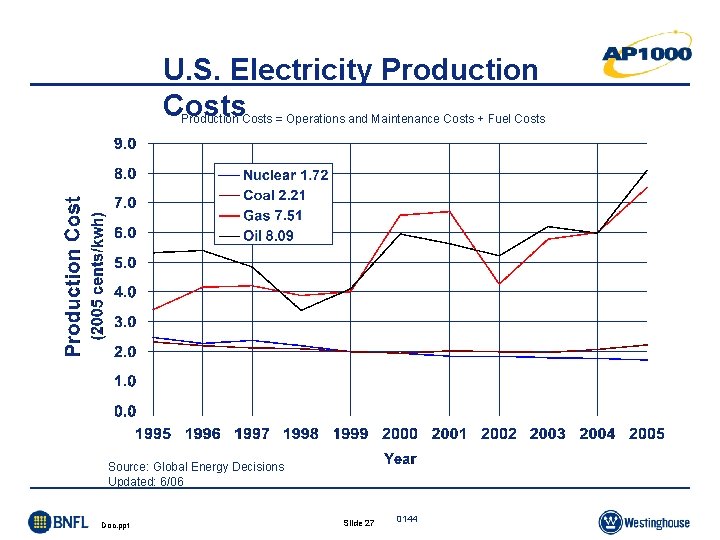
U. S. Electricity Production Costs = Operations and Maintenance Costs + Fuel Costs Source: Global Energy Decisions Updated: 6/06 Doc. ppt Slide 27 0144
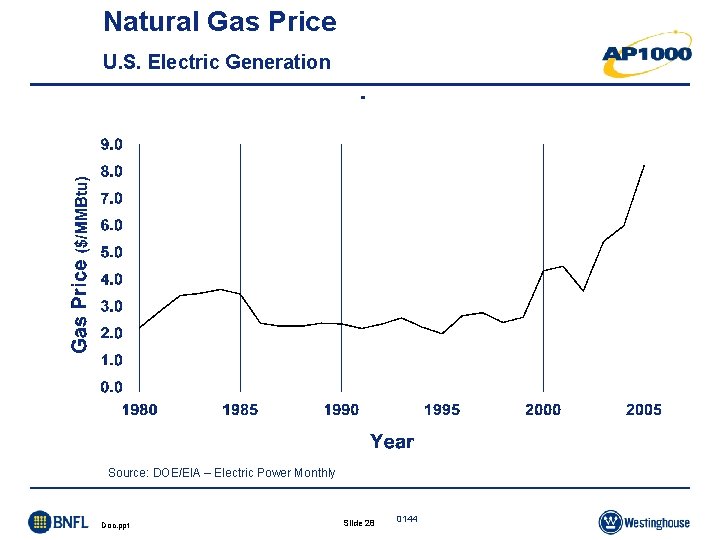
Natural Gas Price U. S. Electric Generation Source: DOE/EIA – Electric Power Monthly Doc. ppt Slide 28 0144
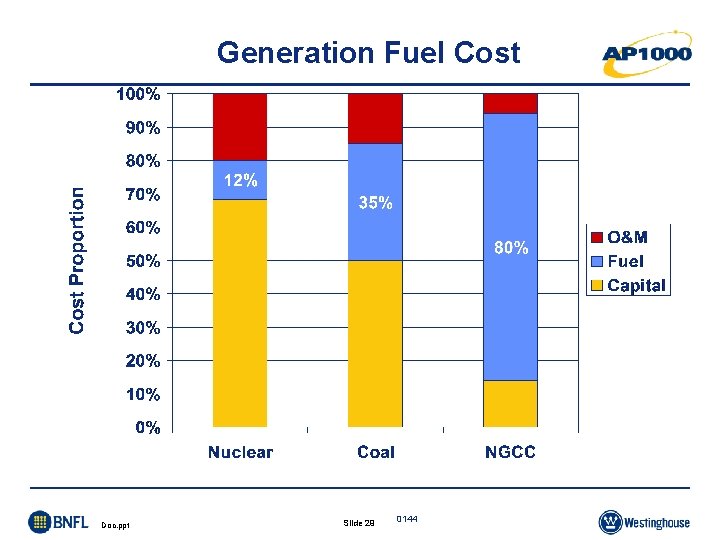
Generation Fuel Cost Doc. ppt Slide 29 0144
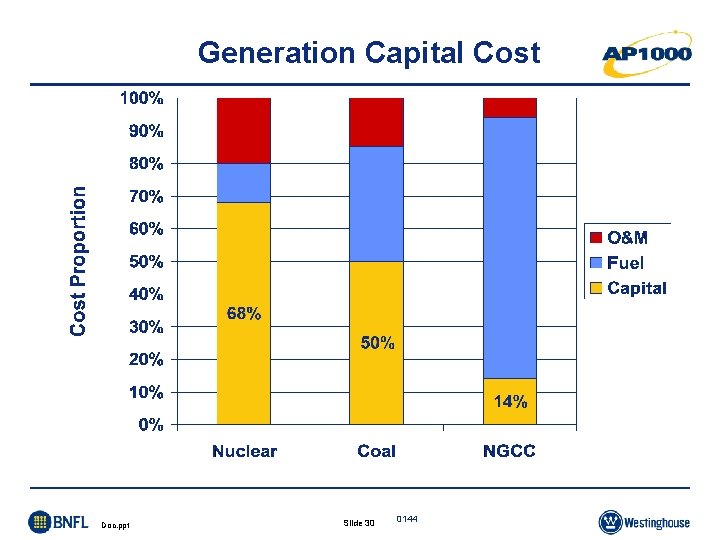
Generation Capital Cost Doc. ppt Slide 30 0144
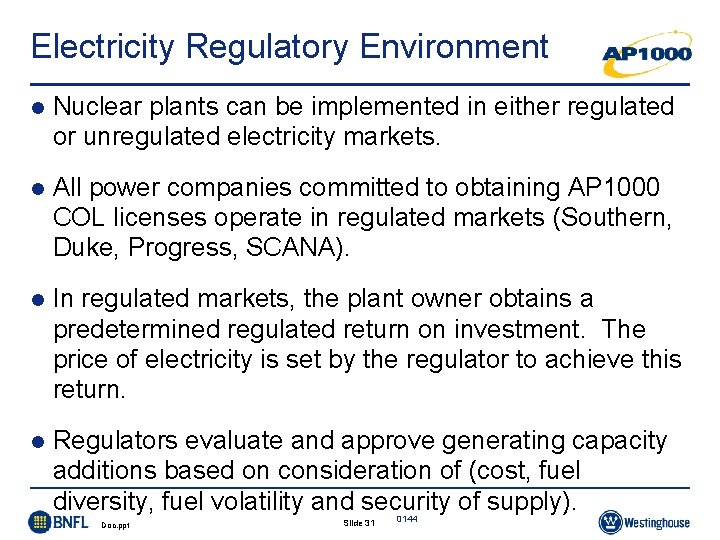
Electricity Regulatory Environment l Nuclear plants can be implemented in either regulated or unregulated electricity markets. l All power companies committed to obtaining AP 1000 COL licenses operate in regulated markets (Southern, Duke, Progress, SCANA). l In regulated markets, the plant owner obtains a predetermined regulated return on investment. The price of electricity is set by the regulator to achieve this return. l Regulators evaluate and approve generating capacity additions based on consideration of (cost, fuel diversity, fuel volatility and security of supply). Doc. ppt Slide 31 0144
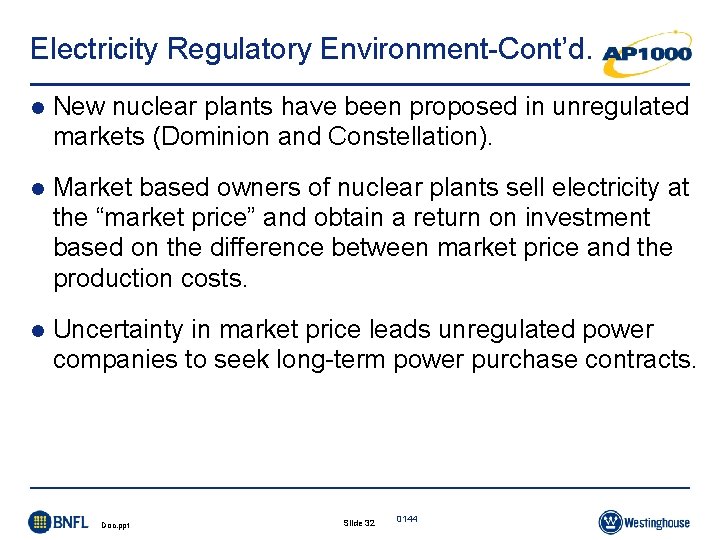
Electricity Regulatory Environment-Cont’d. l New nuclear plants have been proposed in unregulated markets (Dominion and Constellation). l Market based owners of nuclear plants sell electricity at the “market price” and obtain a return on investment based on the difference between market price and the production costs. l Uncertainty in market price leads unregulated power companies to seek long-term power purchase contracts. Doc. ppt Slide 32 0144
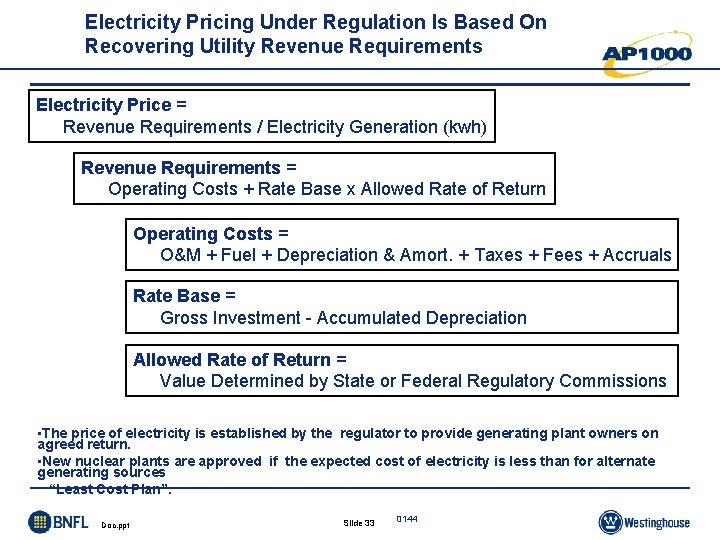
Electricity Pricing Under Regulation Is Based On Recovering Utility Revenue Requirements Electricity Price = Revenue Requirements / Electricity Generation (kwh) Revenue Requirements = Operating Costs + Rate Base x Allowed Rate of Return Operating Costs = O&M + Fuel + Depreciation & Amort. + Taxes + Fees + Accruals Rate Base = Gross Investment - Accumulated Depreciation Allowed Rate of Return = Value Determined by State or Federal Regulatory Commissions • The price of electricity is established by the regulator to provide generating plant owners on agreed return. • New nuclear plants are approved if the expected cost of electricity is less than for alternate generating sources “Least Cost Plan”. Doc. ppt Slide 33 0144
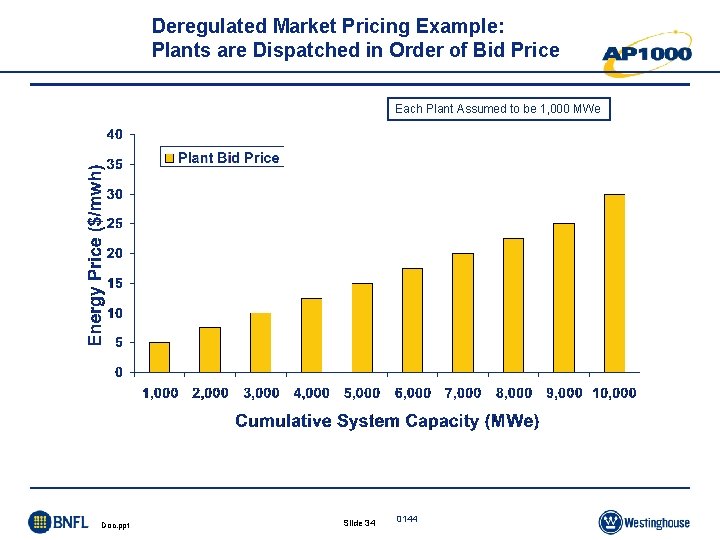
Deregulated Market Pricing Example: Plants are Dispatched in Order of Bid Price Each Plant Assumed to be 1, 000 MWe Doc. ppt Slide 34 0144
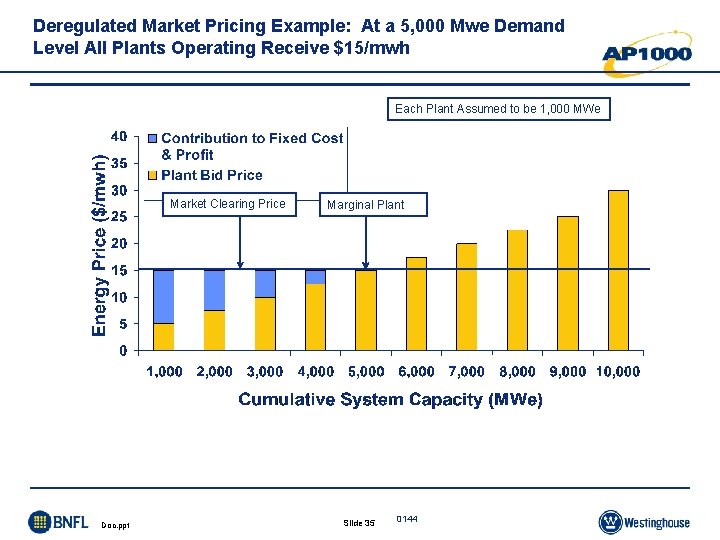
Deregulated Market Pricing Example: At a 5, 000 Mwe Demand Level All Plants Operating Receive $15/mwh Each Plant Assumed to be 1, 000 MWe Market Clearing Price Doc. ppt Marginal Plant Slide 35 0144
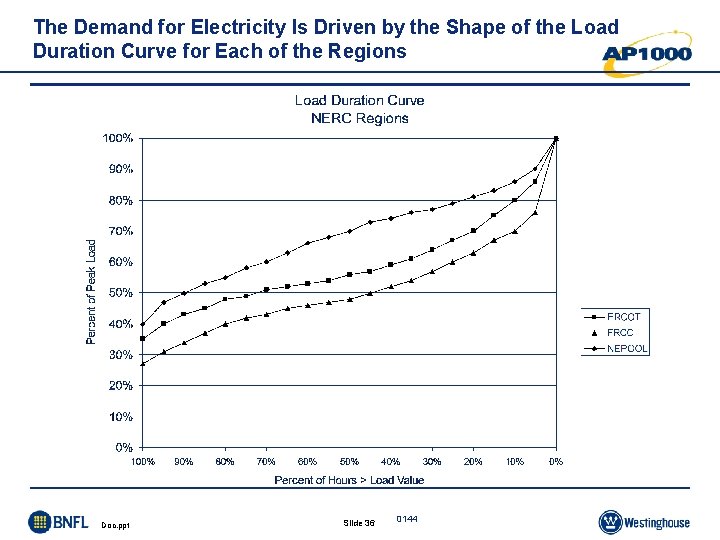
The Demand for Electricity Is Driven by the Shape of the Load Duration Curve for Each of the Regions Doc. ppt Slide 36 0144
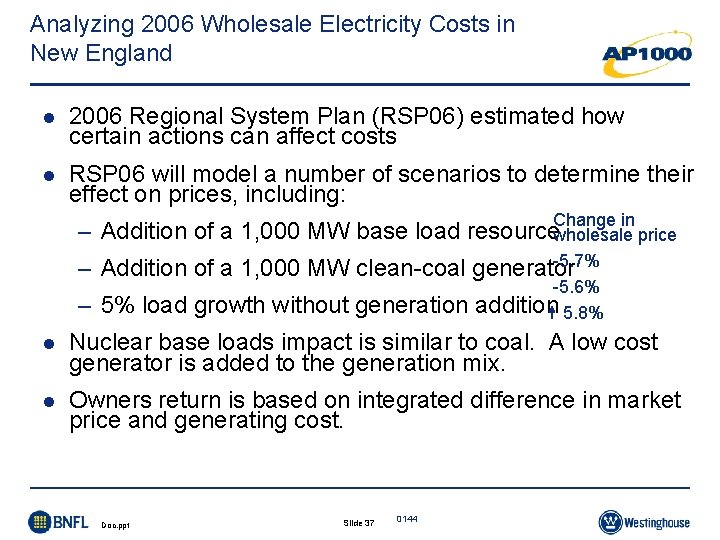
Analyzing 2006 Wholesale Electricity Costs in New England l 2006 Regional System Plan (RSP 06) estimated how certain actions can affect costs l RSP 06 will model a number of scenarios to determine their effect on prices, including: Change in – Addition of a 1, 000 MW base load resourcewholesale price -5. 7% – Addition of a 1, 000 MW clean-coal generator – 5% load growth without generation -5. 6% addition 5. 8% l Nuclear base loads impact is similar to coal. A low cost generator is added to the generation mix. l Owners return is based on integrated difference in market price and generating cost. Doc. ppt Slide 37 0144
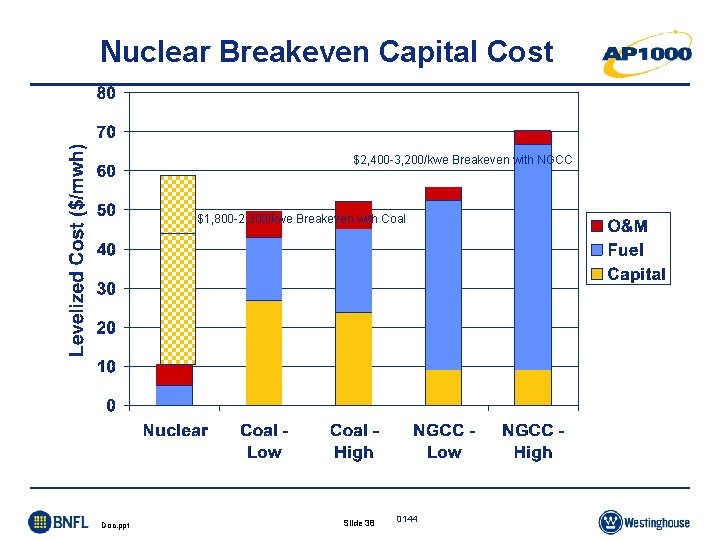
Nuclear Breakeven Capital Cost $2, 400 -3, 200/kwe Breakeven with NGCC $1, 800 -2, 300/kwe Breakeven with Coal Doc. ppt Slide 38 0144
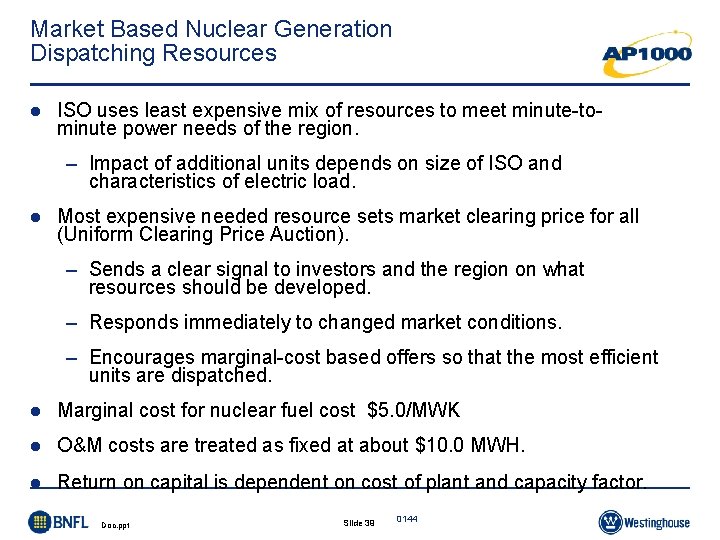
Market Based Nuclear Generation Dispatching Resources l ISO uses least expensive mix of resources to meet minute-tominute power needs of the region. – Impact of additional units depends on size of ISO and characteristics of electric load. l Most expensive needed resource sets market clearing price for all (Uniform Clearing Price Auction). – Sends a clear signal to investors and the region on what resources should be developed. – Responds immediately to changed market conditions. – Encourages marginal-cost based offers so that the most efficient units are dispatched. l Marginal cost for nuclear fuel cost $5. 0/MWK l O&M costs are treated as fixed at about $10. 0 MWH. l Return on capital is dependent on cost of plant and capacity factor. Doc. ppt Slide 39 0144
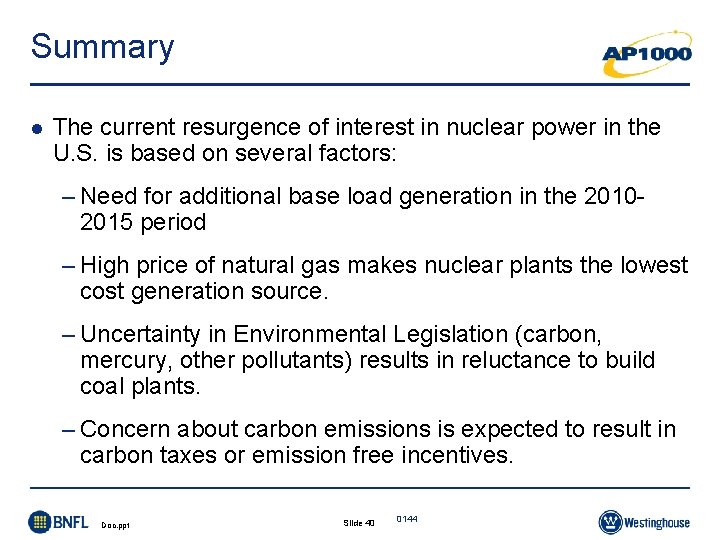
Summary l The current resurgence of interest in nuclear power in the U. S. is based on several factors: – Need for additional base load generation in the 20102015 period – High price of natural gas makes nuclear plants the lowest cost generation source. – Uncertainty in Environmental Legislation (carbon, mercury, other pollutants) results in reluctance to build coal plants. – Concern about carbon emissions is expected to result in carbon taxes or emission free incentives. Doc. ppt Slide 40 0144
Summary – Cont’d. l The Energy Act of 2005 provides very attractive incentives for the first few nuclear plants. l The AP 1000 is attractive as the only advanced plant that has completed Design Certification. l Prediction: There will be AP 1000 plants operating in the U. S. by 2015. Doc. ppt Slide 41 0144