
Tritium Release Reduction based on Release Trend Analysis
Tritium Release Reduction based on Release Trend Analysis JASON SHIN Korea Hydro & Nuclear Power co.
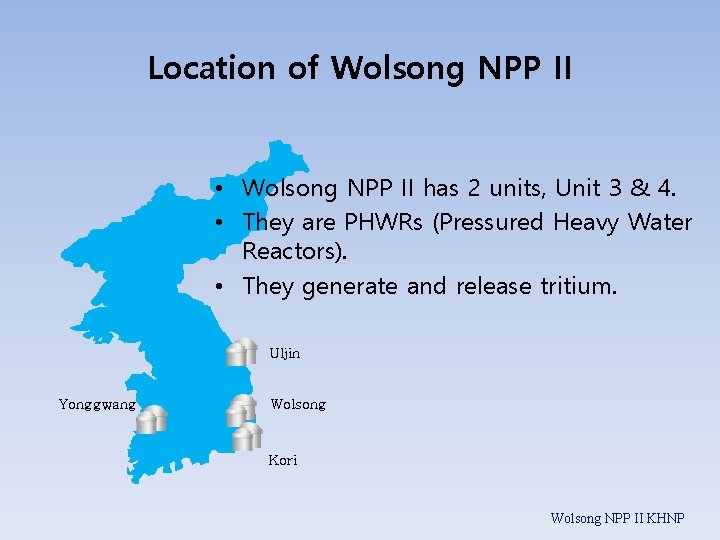
Location of Wolsong NPP II • Wolsong NPP II has 2 units, Unit 3 & 4. • They are PHWRs (Pressured Heavy Water Reactors). • They generate and release tritium. Uljin Yonggwang Wolsong Kori Wolsong NPP II KHNP
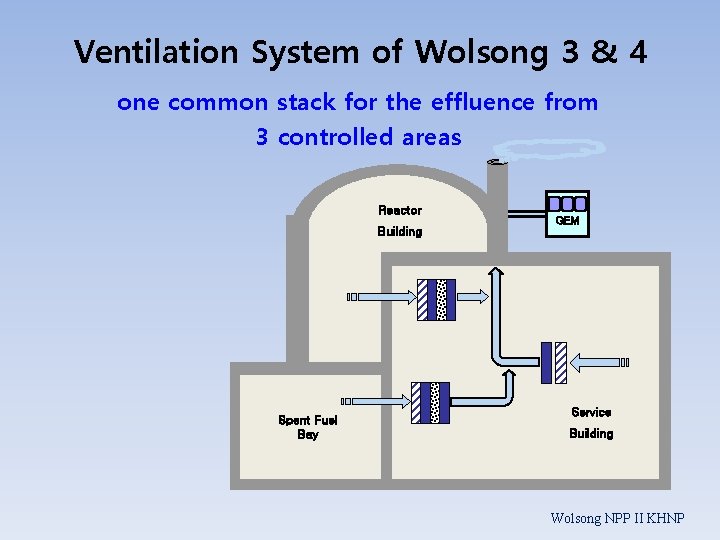
Ventilation System of Wolsong 3 & 4 one common stack for the effluence from 3 controlled areas Reactor Building Spent Fuel Bay GEM Service Building Wolsong NPP II KHNP
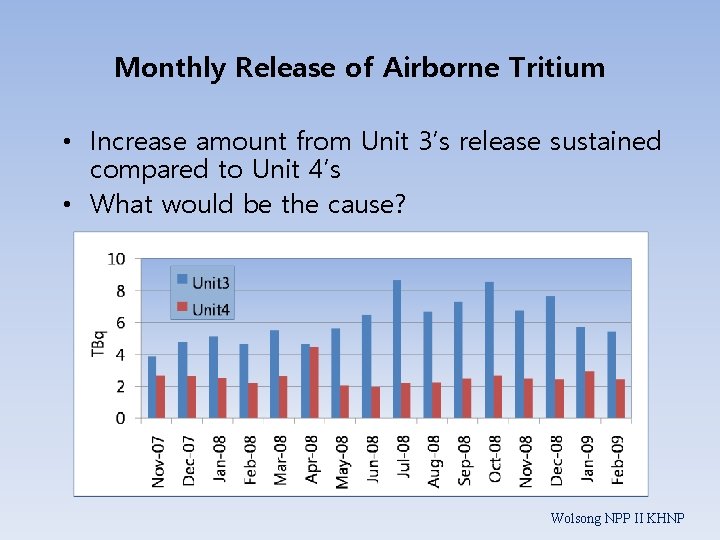
Monthly Release of Airborne Tritium • Increase amount from Unit 3’s release sustained compared to Unit 4’s • What would be the cause? Wolsong NPP II KHNP
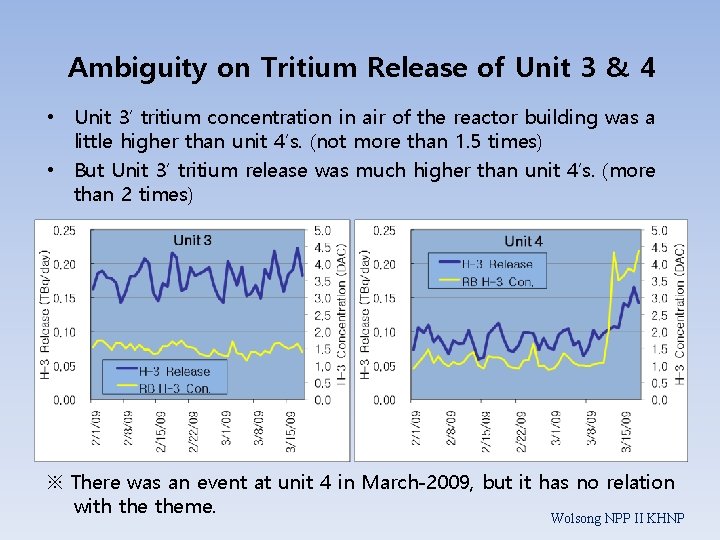
Ambiguity on Tritium Release of Unit 3 & 4 • Unit 3’ tritium concentration in air of the reactor building was a little higher than unit 4’s. (not more than 1. 5 times) • But Unit 3’ tritium release was much higher than unit 4’s. (more than 2 times) ※ There was an event at unit 4 in March-2009, but it has no relation with theme. Wolsong NPP II KHNP
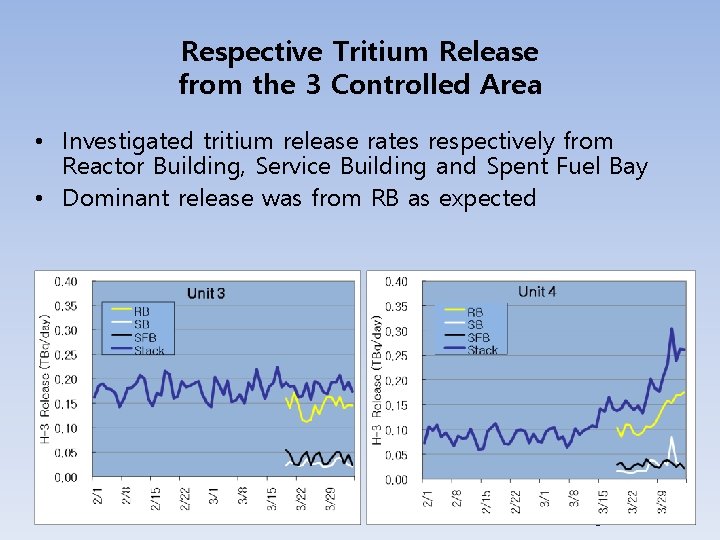
Respective Tritium Release from the 3 Controlled Area • Investigated tritium release rates respectively from Reactor Building, Service Building and Spent Fuel Bay • Dominant release was from RB as expected Wolsong NPP II KHNP
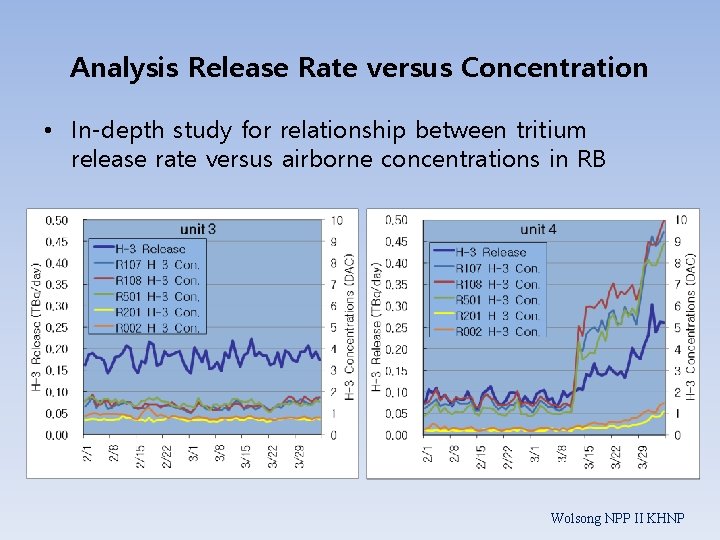
Analysis Release Rate versus Concentration • In-depth study for relationship between tritium release rate versus airborne concentrations in RB Wolsong NPP II KHNP
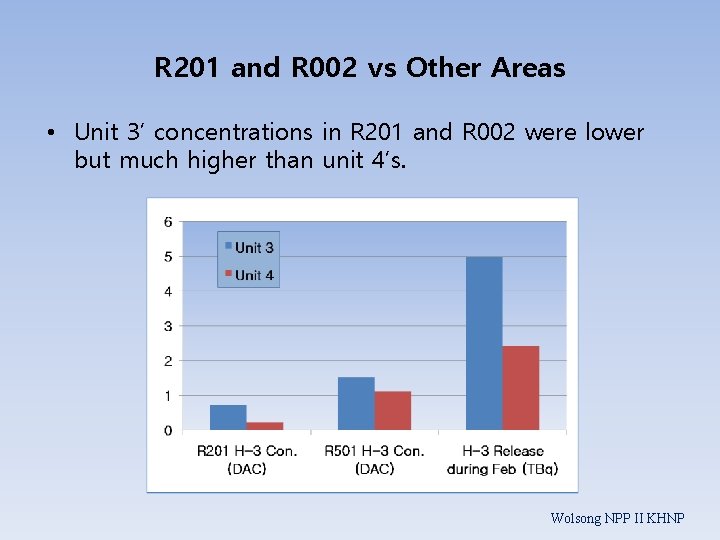
R 201 and R 002 vs Other Areas • Unit 3’ concentrations in R 201 and R 002 were lower but much higher than unit 4’s. Wolsong NPP II KHNP
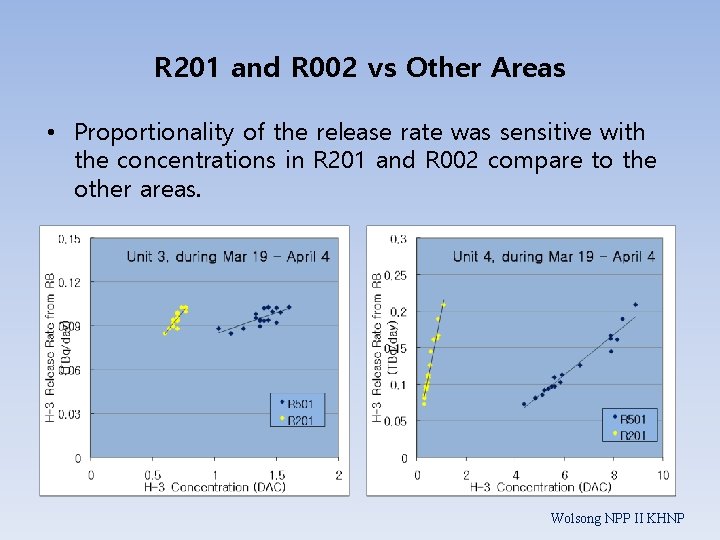
R 201 and R 002 vs Other Areas • Proportionality of the release rate was sensitive with the concentrations in R 201 and R 002 compare to the other areas. Wolsong NPP II KHNP
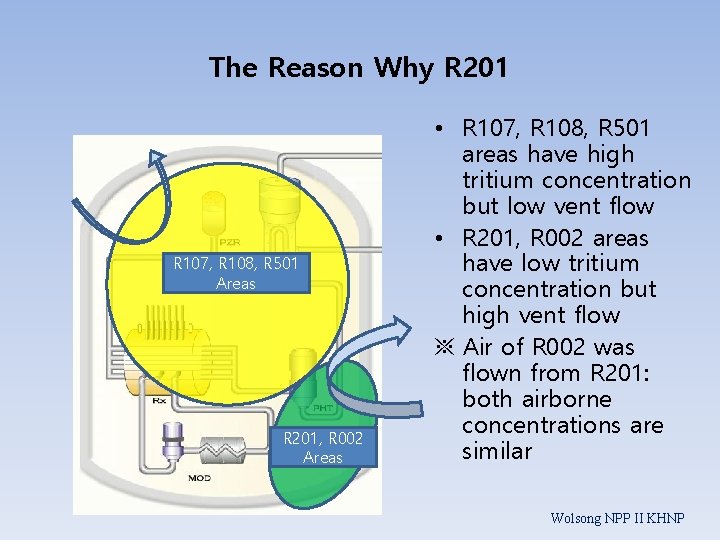
The Reason Why R 201 R 107, R 108, R 501 Areas R 201, R 002 Areas • R 107, R 108, R 501 areas have high tritium concentration but low vent flow • R 201, R 002 areas have low tritium concentration but high vent flow ※ Air of R 002 was flown from R 201: both airborne concentrations are similar Wolsong NPP II KHNP
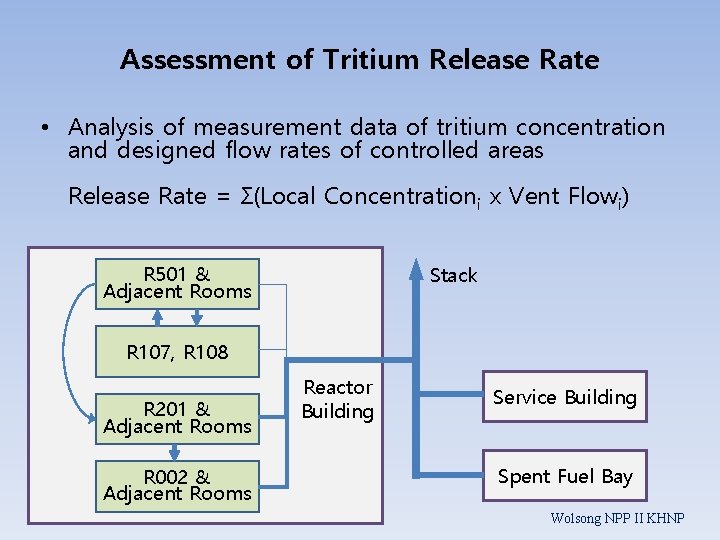
Assessment of Tritium Release Rate • Analysis of measurement data of tritium concentration and designed flow rates of controlled areas Release Rate = Σ(Local Concentrationi x Vent Flowi) R 501 & Adjacent Rooms Stack R 107, R 108 R 201 & Adjacent Rooms R 002 & Adjacent Rooms Reactor Building Service Building Spent Fuel Bay Wolsong NPP II KHNP
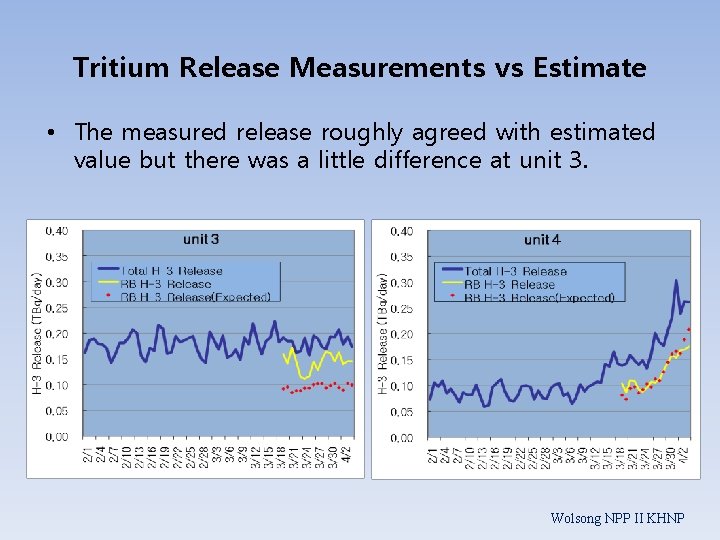
Tritium Release Measurements vs Estimate • The measured release roughly agreed with estimated value but there was a little difference at unit 3. Wolsong NPP II KHNP
Possible Assumption • leak of heavy water containing lots amount tritium in R 201 – Some small leak as 0. 1 L of heavy water could cause dominant portion of daily tritium release, especially with the Moderator. • The leak should be near ventilations. – This could explain the difference between the measurement and the estimate for release rate. Wolsong NPP II KHNP
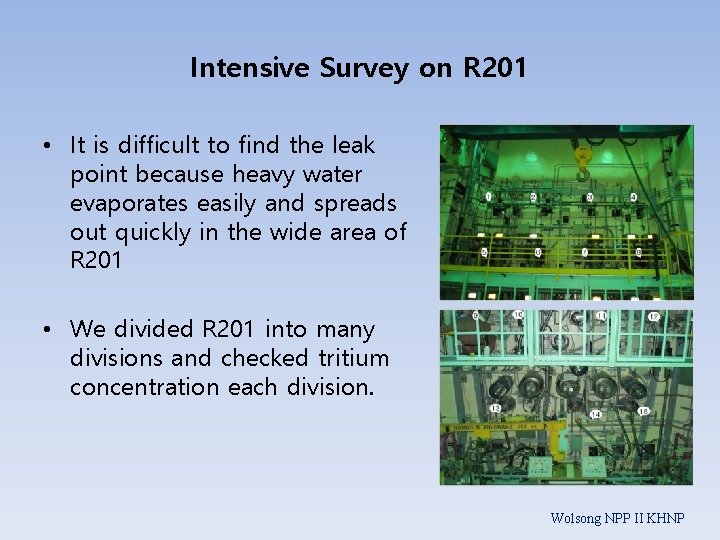
Intensive Survey on R 201 • It is difficult to find the leak point because heavy water evaporates easily and spreads out quickly in the wide area of R 201 • We divided R 201 into many divisions and checked tritium concentration each division. Wolsong NPP II KHNP
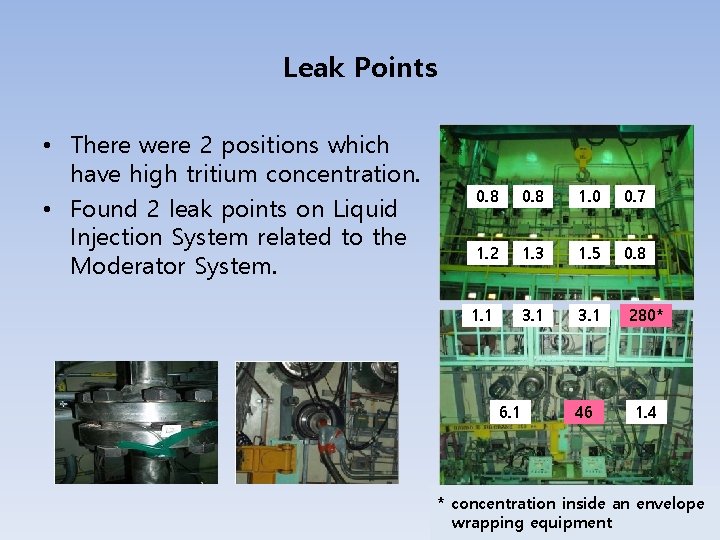
Leak Points • There were 2 positions which have high tritium concentration. • Found 2 leak points on Liquid Injection System related to the Moderator System. 0. 8 1. 0 0. 7 1. 2 1. 3 1. 5 0. 8 3. 1 1. 1 6. 1 46 280* 1. 4 * concentration inside an envelope Wolsong NPP II KHNP wrapping equipment
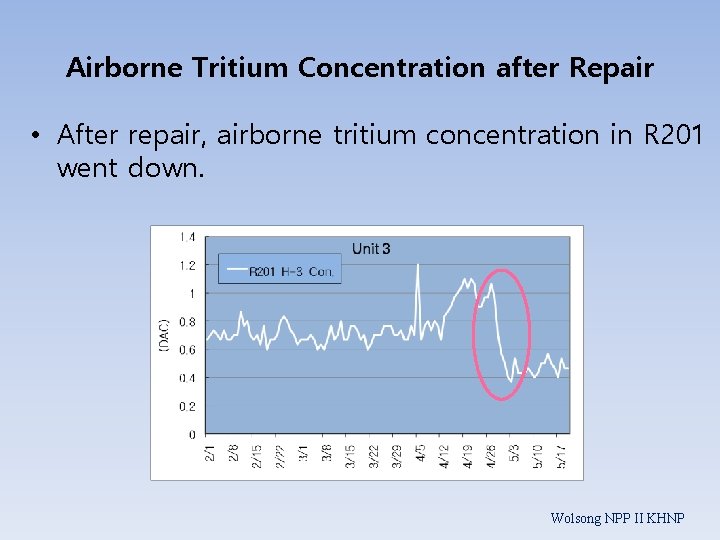
Airborne Tritium Concentration after Repair • After repair, airborne tritium concentration in R 201 went down. Wolsong NPP II KHNP
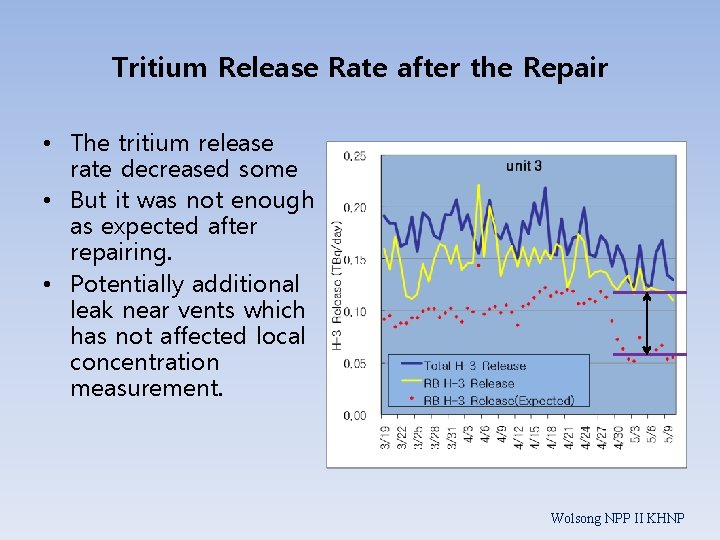
Tritium Release Rate after the Repair • The tritium release rate decreased some • But it was not enough as expected after repairing. • Potentially additional leak near vents which has not affected local concentration measurement. Wolsong NPP II KHNP
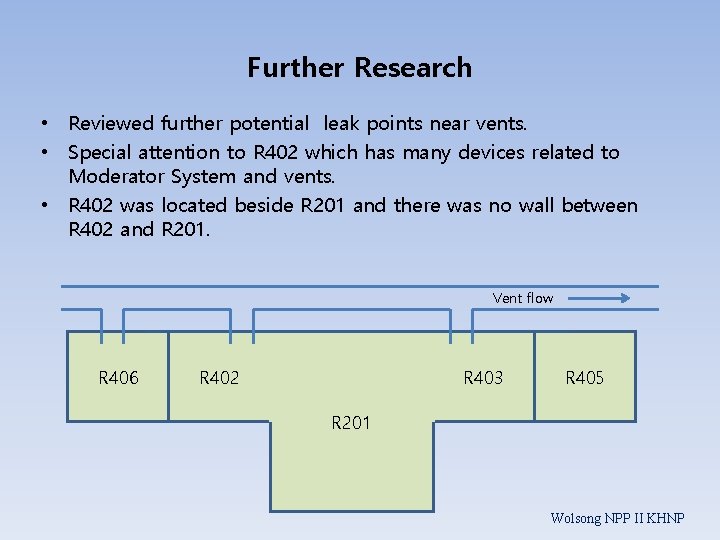
Further Research • Reviewed further potential leak points near vents. • Special attention to R 402 which has many devices related to Moderator System and vents. • R 402 was located beside R 201 and there was no wall between R 402 and R 201. Vent flow R 406 R 402 R 403 R 405 R 201 Wolsong NPP II KHNP
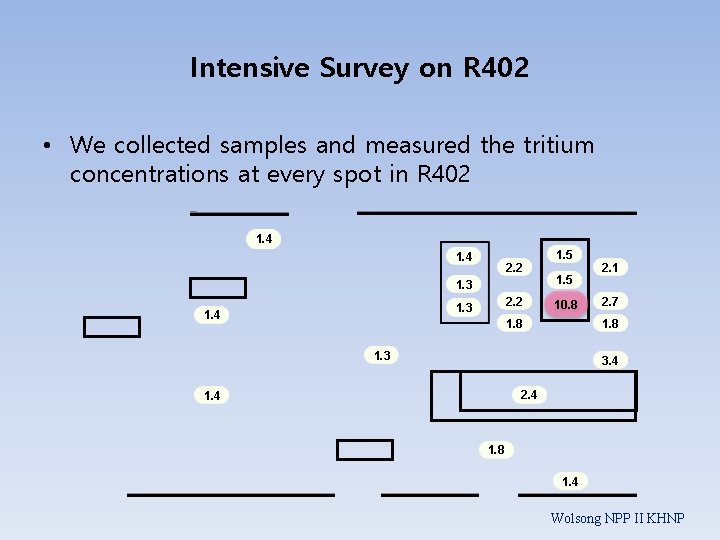
Intensive Survey on R 402 • We collected samples and measured the tritium concentrations at every spot in R 402 1. 4 2. 2 1. 3 1. 4 1. 5 10. 8 1. 8 2. 1 2. 7 1. 8 1. 3 3. 4 2. 4 1. 8 1. 4 Wolsong NPP II KHNP
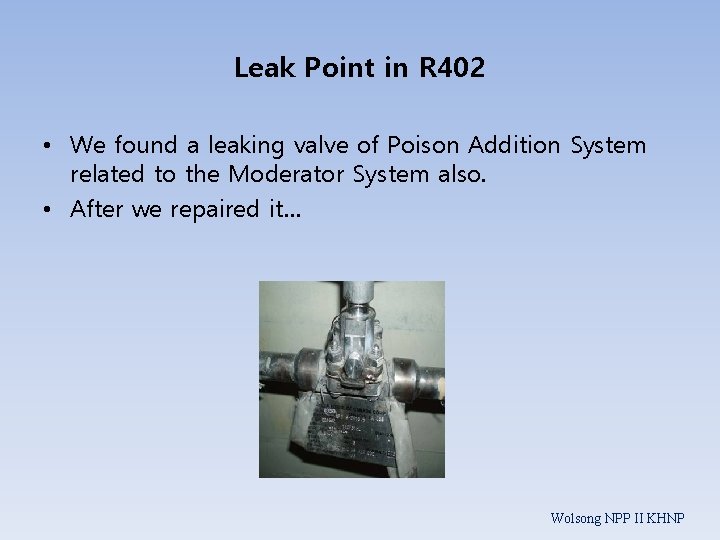
Leak Point in R 402 • We found a leaking valve of Poison Addition System related to the Moderator System also. • After we repaired it… Wolsong NPP II KHNP
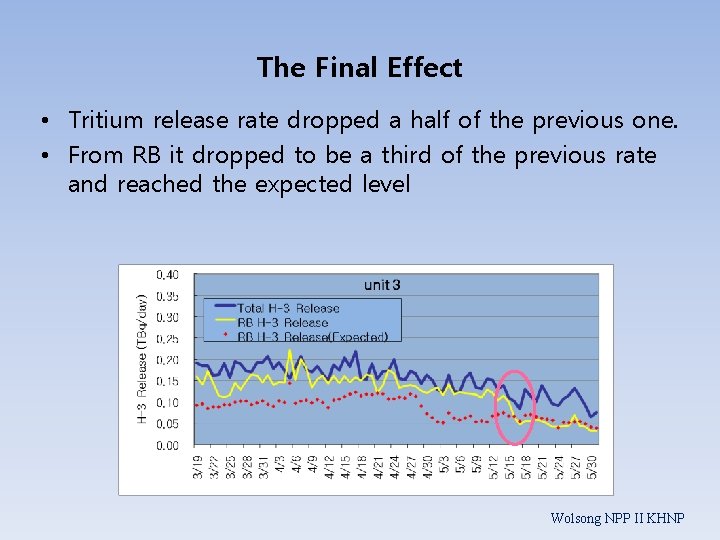
The Final Effect • Tritium release rate dropped a half of the previous one. • From RB it dropped to be a third of the previous rate and reached the expected level Wolsong NPP II KHNP
Conclusion • We can evaluate the release rate of radioactive material using regular measurements of local concentration with comparing to the designed vent flow rates. • This method is useful to search leak points and lead to reduce the release rate. Wolsong NPP II KHNP

Thanks for your attention. Do you have any questions? Wolsong NPP II KHNP
- Slides: 23