Nasya Karma Introduction The nose is the doorway





- Slides: 32
Nasya Karma
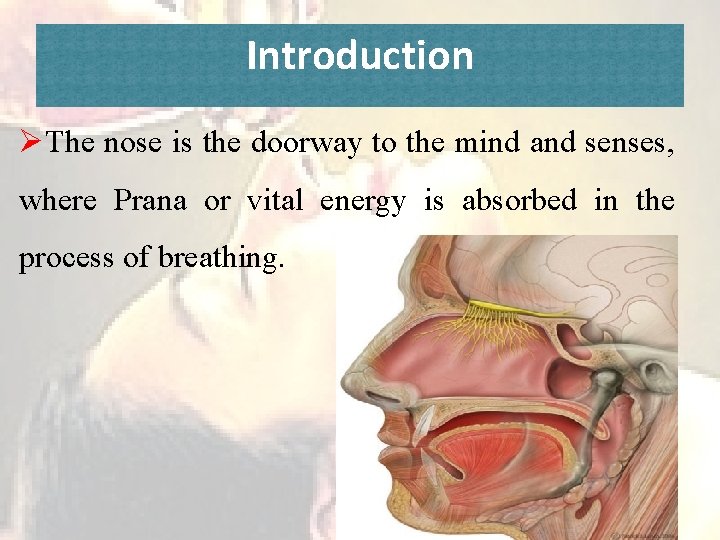
Introduction ØThe nose is the doorway to the mind and senses, where Prana or vital energy is absorbed in the process of breathing.
NASYA (Shirovirechana Karma) • Definition: • Medicine or Medicated oil administered through Nasal passage is known as Nasya. • Involves the cleansing of the nasal passage by the administration of oils, powders, herbal juices, infusions or smoke. • Nasya also means beneficial to nose.
SIGNIFICANCE OF NASYA • In the diseases of the head and supraclavicular diseases Nasya is the best and most specific procedure. • ‘Nasa Hi Siraso Dwaram’ Nasal passage is the gateway of the head and the drugs given through this passage mitigate the various vitiated Doshas and cure the diseases. •
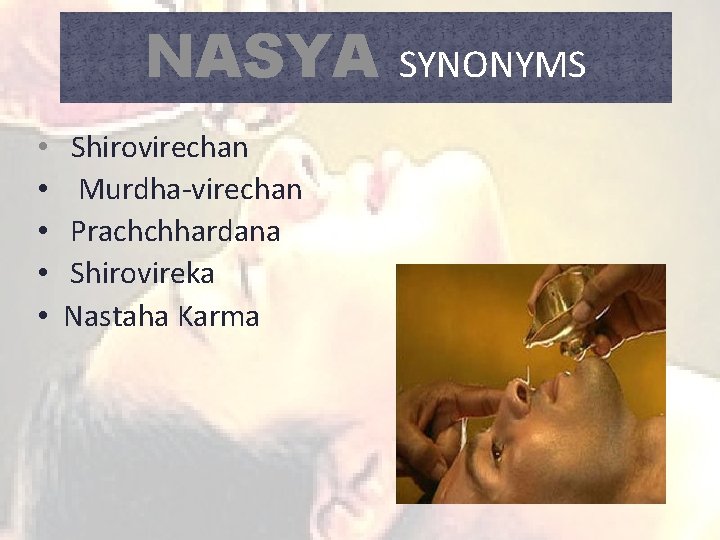
NASYA • Shirovirechan • Murdha-virechan • Prachchhardana • Shirovireka • Nastaha Karma SYNONYMS
NASYA CLASSIFICATION OF NASYA Nasya is of 5 types, viz 1. Navan nasya (using oils & ghee) 2. Avapida nasya ( uses herbal extracts, juices) 3. Dhmapan nasya (Insufflation) 4. Dhooma nasya (Inhalation) 5. Pratimarsh nasya
NASYA CLASSIFICATION OF NASYA According to action: ØPurification (Shodhana) to eliminate doshas ØPalliation (Shamana) to reduce dosha provocation ØTonifying (Brimhana) to strengthen Vata. According to dose: ØPratimarsha - 2 drops in each nostril ØMarsha - 8 - 32 drops in each nostril
Indications • Nasya indicated in various diseases of the supraclavicular region such as • • • Stiff neck and jaw, Graying of hair, Baldness, Facial palsy Sinusitis, rhinitis, Earache. • Stammering or alteration of voice, Hoarseness of voice, • Corrhyza, • Tonsillitis
Indications Diseases of Nose Diseases of Ear Diseases of eye Diseases of Head and skull, Headache, Migraine. • Hysteria • Tetnus • Goitre • • • Catract • Diseases of eye lid • Pigmented face • Diseases of neck • Diseases of shoulder • Diseases of Mouth
Contraindication Nasya should be avoided in patients who have • • • Acute fevers Acute corrhyza Purgation Fast Indigestion • Severe digestive disorders • immediately after physical exertion • Pregnant women • Children under 7 years.
NASYA DESCRIPTION OF NASYA • Age : Nasya should be administered to patients who are 7 to 80 years old. • Time of Administration: In Kapha Roga – Fore Noon In Pittaja Roga – Noon In Vataj Roga – After noon
Ritu Evum Kala (Season And Time) Pravrita, Sharda(autumn) and Vasant(spring) are the best seasons for nasya administration. Whether should neither be too hot nor too cold. • In Summer ---- Nasya should be given before noon. • In Autumn ------- Nasya should be given afternoon. • In Rains ----- Nasya should be given on a clear day i. e. non- cloudy.
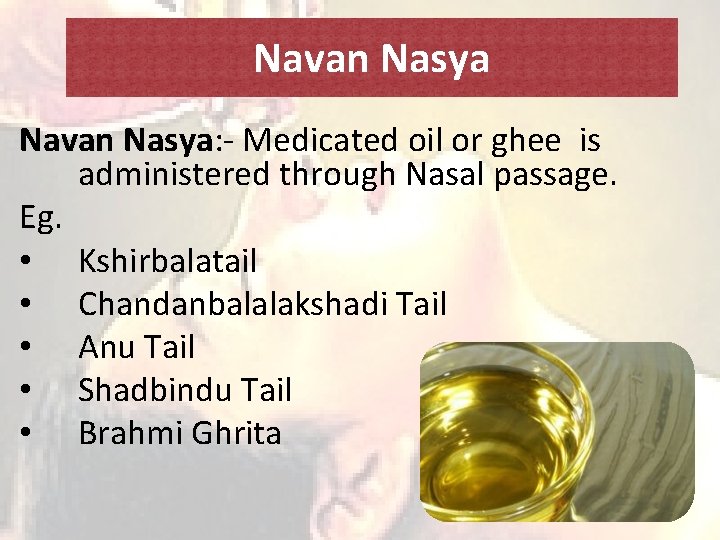
Navan Nasya: - Medicated oil or ghee is administered through Nasal passage. Eg. • Kshirbalatail • Chandanbalalakshadi Tail • Anu Tail • Shadbindu Tail • Brahmi Ghrita
Avapida Nasya Juice of drugs / Kalka is administer through Nasal passage. • Stambhana (to check the flow ): Ikshu-rasa, Milk, Ghrita. • Shodhana: Saindhavpiplyadi Kalka. • Sanghya-Prabhodhaka : Nasya should be given to restore senses in case of snake bite, Vishpidita (Intoxicated), Apsamara.
Avapida Nasya Dose Hina Matra (minimum dose) – 4 drops Madhyama Matra – 6 drops Uttama Matra (maximum dose) – 8 drops Note : Bindu (drop): Dip the index finger in the medicated oil up to two parts and quantity of oil that falls off the finger is known as drop of oil.
Dhmapana/Pradhamana Nasysa Churana i. e. powered drug is blown into the nostril with the help of a 6 finger long Nadi-Ynatra (pipe). It is a specific shohdana Nasya. Eg. Katphala churna, Trikatu Churna. Indications: - • • Mental Disorders Intoxicated. Dose: - One Muchyuti i. e. A pinch [i. e. drug taken between thumb and fore finger]
Dhoom Nasya Medicated smoke inhaled through nostrils and exhaled through buccal cavity is known as Dhooma inhaled through nostrils should be exhaled through buccal cavity but it is not advisable to take Dhoom orally and exhale through Nostrils, as it is harmful to eyes. Indications: - 1. diseases of head 2. diseases of eye 3. diseases of nose
Marsh-Pratimarsh Nasya Pratimarsh Nasya: • it is well tolerated and very convenient to use. • Can be given in all seasons. • Should be given twice daily i. e. in morning and evening. • It strengthens the body. • It can be given throughout the life i. e. from birth till death. • Dose: - 2 drops Indications: It is indicated especially in Children, old age, Weak and injured person.
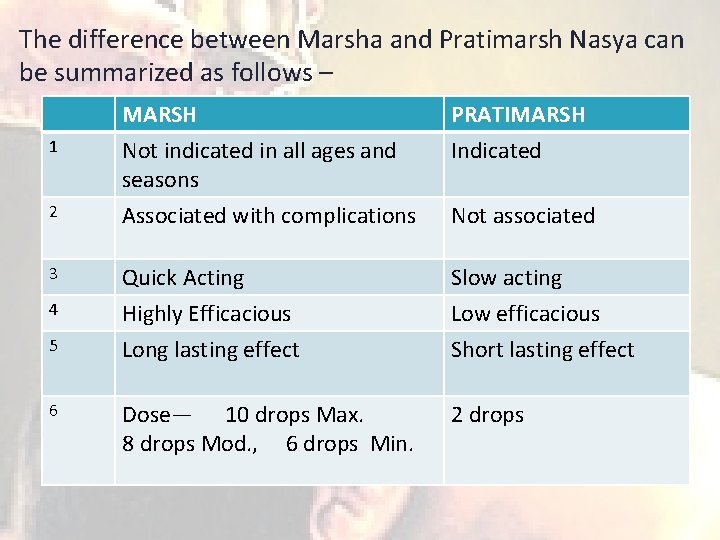
The difference between Marsha and Pratimarsh Nasya can be summarized as follows – 1 MARSH Not indicated in all ages and seasons PRATIMARSH Indicated 2 Associated with complications Not associated 3 4 Quick Acting Highly Efficacious Slow acting Low efficacious 5 Long lasting effect Short lasting effect 6 Dose— 10 drops Max. 2 drops 8 drops Mod. , 6 drops Min.
NASYA PROCEDURE OF NASYA • Purva karma(Preparatory Phase) • Pradhana karma (Operative Phase) • Pashchat karma (Post-op-phase)
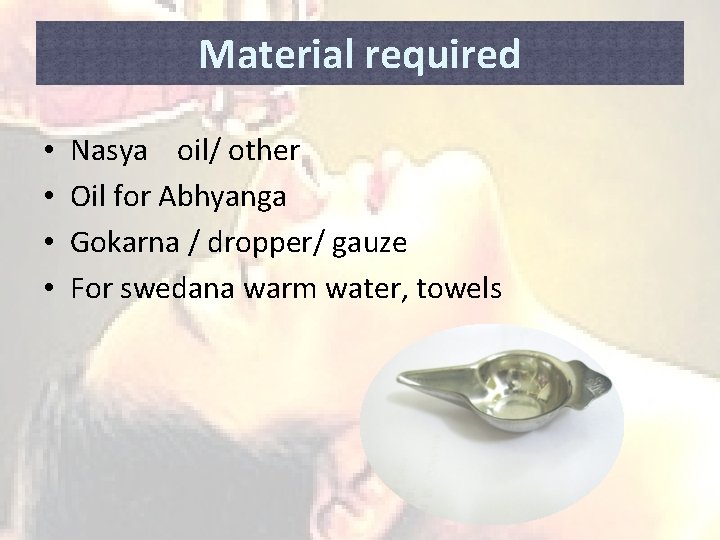
Material required • • Nasya oil/ other Oil for Abhyanga Gokarna / dropper/ gauze For swedana warm water, towels
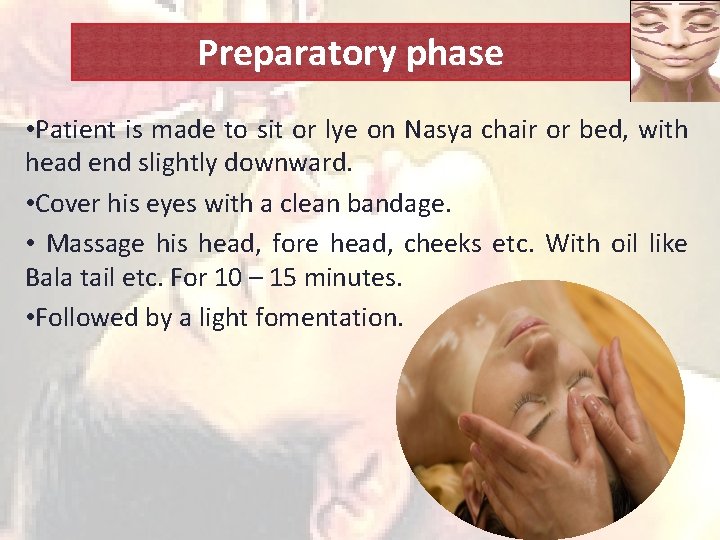
Preparatory phase • Patient is made to sit or lye on Nasya chair or bed, with head end slightly downward. • Cover his eyes with a clean bandage. • Massage his head, fore head, cheeks etc. With oil like Bala tail etc. For 10 – 15 minutes. • Followed by a light fomentation.
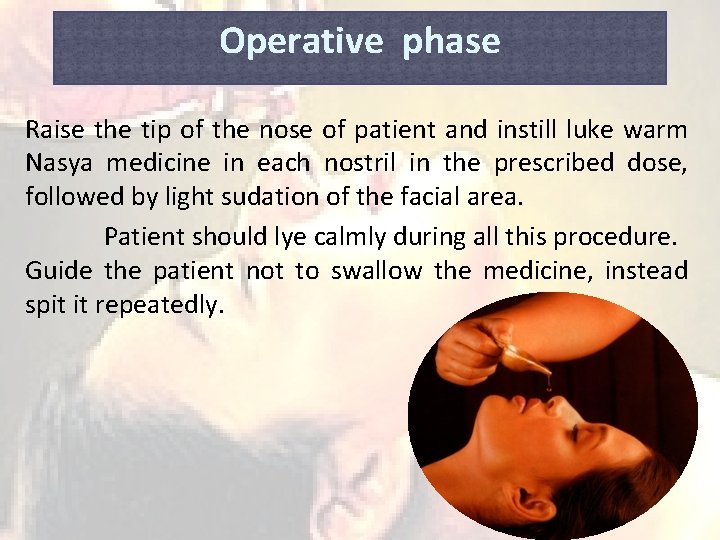
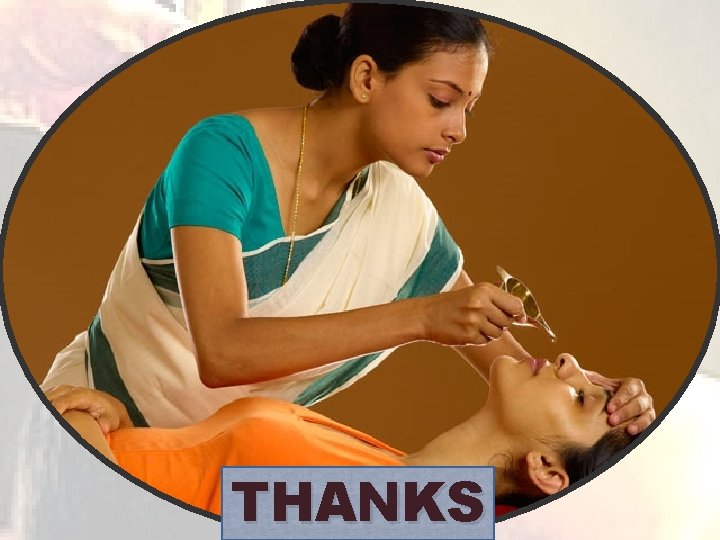
Operative phase Raise the tip of the nose of patient and instill luke warm Nasya medicine in each nostril in the prescribed dose, followed by light sudation of the facial area. Patient should lye calmly during all this procedure. Guide the patient not to swallow the medicine, instead spit it repeatedly.
Post-op-phase • Wait for 2 to 3 min (100 Matra : patient should lie supine for time interval consumable for counting numbers up to 100) • Fomentation , Warm gargles • Dhoompana • Light diet Duration : Maximum for 21 day or till the appearance of adequate effect. Minimum for 7 days.
Assessment of symptoms (A) Features of Samyak Nasya (Adequate Nasya) 1. Shiro laghava – lightness of head 2. Sukh Swapana – Sound Sleep 3. Vikaro Prashama – Remission of the disease 4. Mana Prasanta – Mental happiness 5. Sroto Shudhi – Cleansing of Channels. 6. Laghava – Lightness in the body 7. Indriya Shudhi – Cleansing of senses.
(B) Features of Atiyoga of Nasya (Excessive Nasya) 1. Kapha Praseka -- Excessive Salivation 2. Shiro Guruta – Heaviness of head 3. Indriya Vibhrama – Confusion. 4. Shiro – Shoonyata -- Emptiness of head. 5. Vata Vridhi – Vitiation of Vata Treatment: Kapha Vata Suppressive (Shamaka) treatment should be done.
(C) Features of Hina Yoga of Nasya (Inadequate Nasya) 1. Vata Vigunta – vitiation of Vata 2. Indriya-Rukshata – dryness of senses 3. Kandu – Itching 4. Sroto-guruta – Heaviness of Channels 5. Kapha-srava —Excessive Secretions of Eye, Nose and Mouth Treatment - Repeated Nasya In Hina Yoga or give Tishna nasya
Do’s and Dont’s Patient Should Avoid • • Cold water Sunlight, dust, smoke & direct air. Incompatible diet, unctuous substance. Alcohol. Anger. Bath by head Travelling.
NASYA MODE OF ACTION 1. LOCAL EFFECTS 2. SYSTEMIC EFFECTS
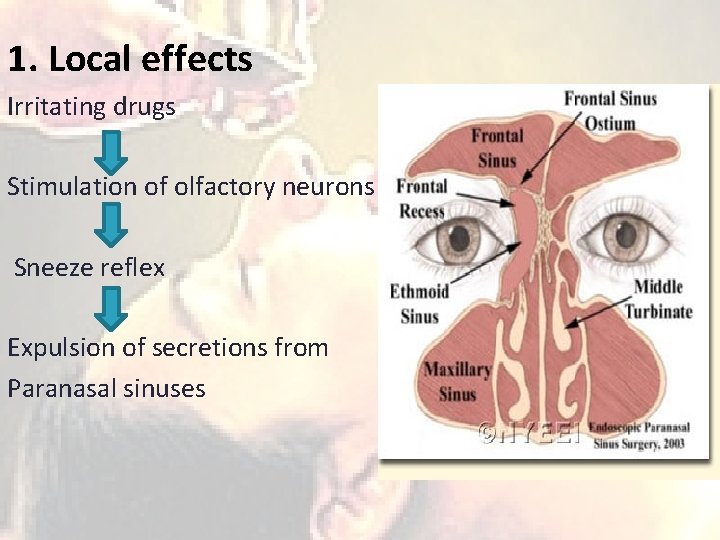
1. Local effects Irritating drugs Stimulation of olfactory neurons Sneeze reflex Expulsion of secretions from Paranasal sinuses
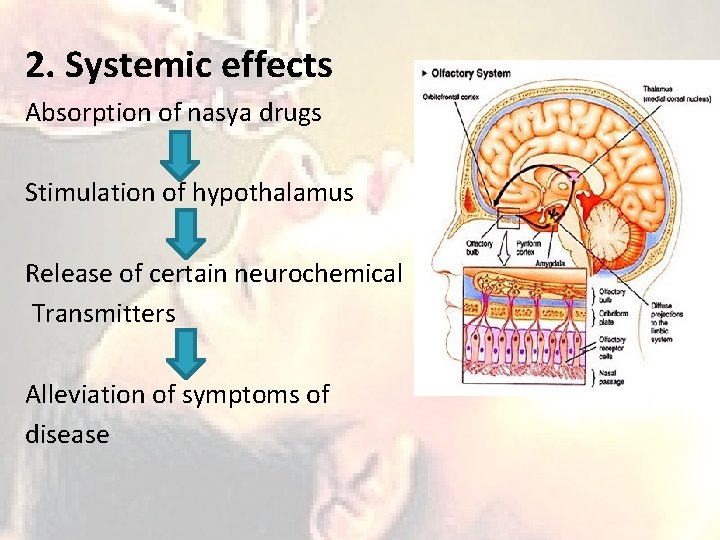
2. Systemic effects Absorption of nasya drugs Stimulation of hypothalamus Release of certain neurochemical Transmitters Alleviation of symptoms of disease
THANKS