Karma Quiz What does karma mean A Emotion

- Slides: 31
Karma Quiz
What does karma mean? A. Emotion B. Solution C. Action
Wrong! • In Sanskrit karma (Pali: kamma) means ‘action’. It is found within many forms of Indian religion including Buddhism, Hinduism and Jainism. Next Question
Correct! • In Sanskrit karma (Pali: kamma) means ‘action’. It is found within many forms of Indian religion including Buddhism, Hinduism and Jainism. Next Question
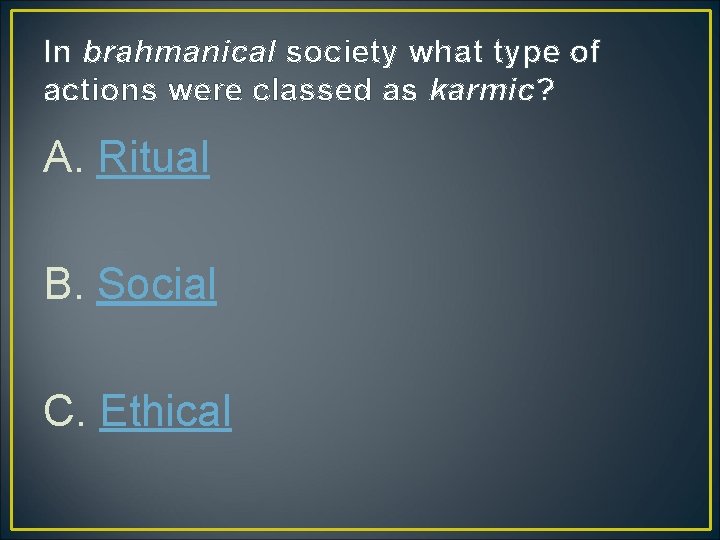
In brahmanical society what type of actions were classed as karmic? A. Ritual B. Social C. Ethical
Wrong! • In brahmanical society karma was understood in terms of ritual sacrifice. Individuals, dependent upon their social status and needs would perform certain rituals acts. These ritual acts would generate a specific result in this life or even the next. Next Question
Correct! • In brahmanical society karma was understood in terms of ritual sacrifice. Individuals, dependent upon their social status and needs would perform certain rituals acts. These ritual acts would generate a specific result in this life or even the next. Next Question
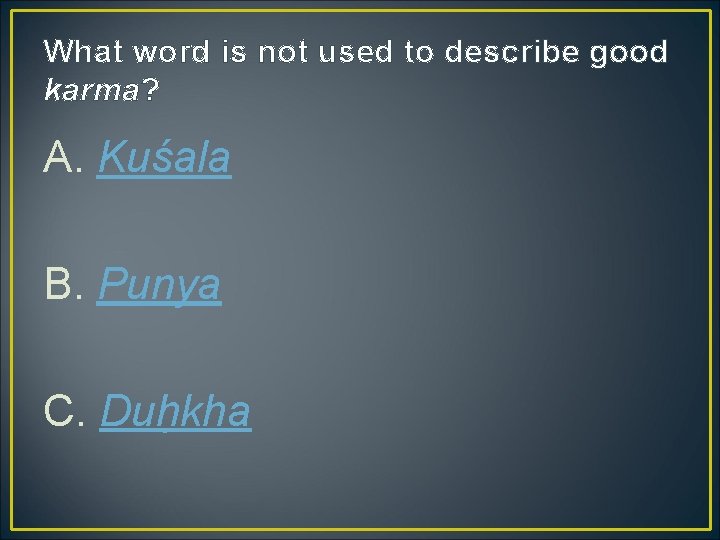
What word is not used to describe good karma? A. Kuśala B. Puṇya C. Duḥkha
Wrong! • Actions that are considered to be wholesome (Sanskrit: kuśala/ Pali: kusala) will have pleasant results (vipāka). • Good karma is also known as merit (puṇya/puñña). The production of merit is important as it can have positive effects on the lives of individuals, generate desirable rebirths and also allow one to access higher levels of spiritual attainment. • Duḥkha can be translated as ‘dis-ease’ or ‘suffering’. Next Question
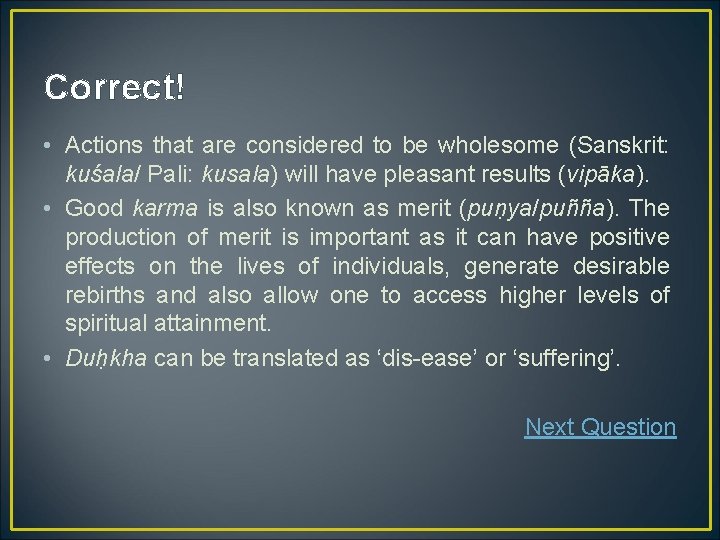
Correct! • Actions that are considered to be wholesome (Sanskrit: kuśala/ Pali: kusala) will have pleasant results (vipāka). • Good karma is also known as merit (puṇya/puñña). The production of merit is important as it can have positive effects on the lives of individuals, generate desirable rebirths and also allow one to access higher levels of spiritual attainment. • Duḥkha can be translated as ‘dis-ease’ or ‘suffering’. Next Question
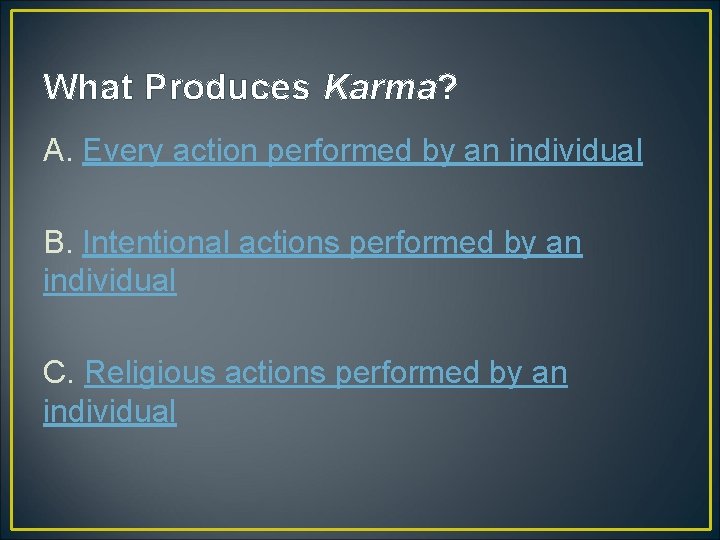
What Produces Karma? A. Every action performed by an individual B. Intentional actions performed by an individual C. Religious actions performed by an individual
Wrong! • Intentional actions are the root of karma. • “It is ‘intention’ that I call kamma; having willed or formed the intention, one performs acts by the body, speech and mind. ” Anguttara Nikaya iii, 415 Translation from Rupert Gethin, Foundations of Buddhism (Oxford: Oxford University Press, 1998), p. 120. Next Question
Correct! • Intentional actions are the root of karma. • “It is ‘intention’ that I call kamma; having willed or formed the intention, one performs acts by the body, speech and mind. ” Anguttara Nikaya iii, 415 Translation from Rupert Gethin, Foundations of Buddhism (Oxford: Oxford University Press, 1998), p. 120. Next Question
How many types of action can produce karma? A. 3 B. 4 C. 8
Wrong • Actions that produce karmic results can be split into three categories: Mental action Bodily action Vocal action These categories can be split into further groups, but any karmic action will fall into one of the three types as seen above. Next Question
Correct! • Actions that produce karmic results can be split into three categories: Mental action Bodily action Vocal action These categories can be split into further groups, but any karmic action will fall into one of the three types as seen above. Next Question
Karma does not disappear at death? True False
Wrong! • When a person is alive they generate karma, this does not simply disappear at death. Instead, due to the remaining karmic seeds a new being is caused into existence so that remaining karmic results may take place. Next Question
Correct! • When a person is alive they generate karma, this does not simply disappear at death. Instead, due to the remaining karmic seeds a new being is caused into existence so that remaining karmic results may take place. Next Question
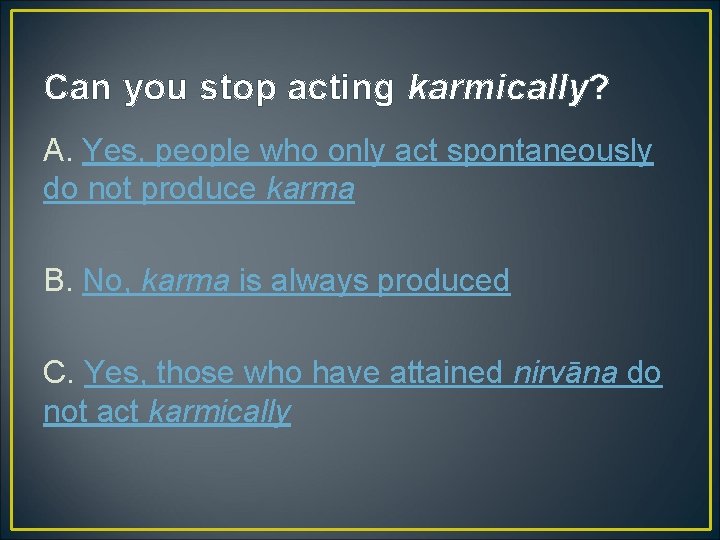
Can you stop acting karmically? A. Yes, people who only act spontaneously do not produce karma B. No, karma is always produced C. Yes, those who have attained nirvāṇa do not act karmically
Wrong! • Upon enlightenment a person no longer experiences saṃsāric existence. This means that they no longer produce karmic seeds. They will experience the results of past karma but will not produce any more and will therefore not cause any future beings into existence. Next Question
Correct! • Upon enlightenment a person no longer experiences saṃsāric existence. This means that they no longer produce karmic seeds. They will experience the results of past karma but will not produce any more and will therefore not cause any future beings into existence. Next Question
According to the Abhidharma what type of karma is most likely to influence a person’s rebirth? A. Weighty B. Proximate C. Habitual
Wrong! • In the Abhidharma karma, at the time of death, is divided into a hierarchy of four basic types: weighty, proximate, habitual, and performed. The nature of one’s death is conditioned by one’s karma. If a deed that is deemed to be ‘weighty’ has been performed it is that particular action that determines the state of mind of the individual at the time of death. If there is a lack of such deeds then the next level of karma will come to the fore and condition rebirth. Next Question
Correct! • In the Abhidharma karma, at the time of death, is divided into a hierarchy of four basic types: weighty, proximate, habitual, and performed. The nature of one’s death is conditioned by one’s karma. If a deed that is deemed to be ‘weighty’ has been performed it is that particular action that determines the state of mind of the individual at the time of death. If there is a lack of such deeds then the next level of karma will come to the fore and condition rebirth. Next Question
Karma has a causative nature? True False
Wrong! • In Buddhist thought karma has a causative nature. The actions that are intentionally performed by the individual will have a particular karmic result. Well-intentioned good deeds will result in a pleasant and favourable karmic result whilst malicious and hurtful misdeeds will result in a poor and unfavourable karmic result Next Question
Correct! • In Buddhist thought karma has a causative nature. The actions that are intentionally performed by the individual will have a particular karmic result. Well-intentioned good deeds will result in a pleasant and favourable karmic result whilst malicious and hurtful misdeeds will result in a poor and unfavourable karmic result Next Question
Bad karma always perpetuates bad karma? True False
Wrong! • Whilst the effects of bad karma are unpleasant they do not perpetuate further bad karma. Instead it is the way in which one deals with it that will produce either good or bad karma.
Correct! • Whilst the effects of bad karma are unpleasant they do not perpetuate further bad karma. Instead it is the way in which one deals with it that will produce either good or bad karma.