
Motivation Emotion Stress Motivation AP PSYCHOLOGY UNIT IX
- Slides: 50
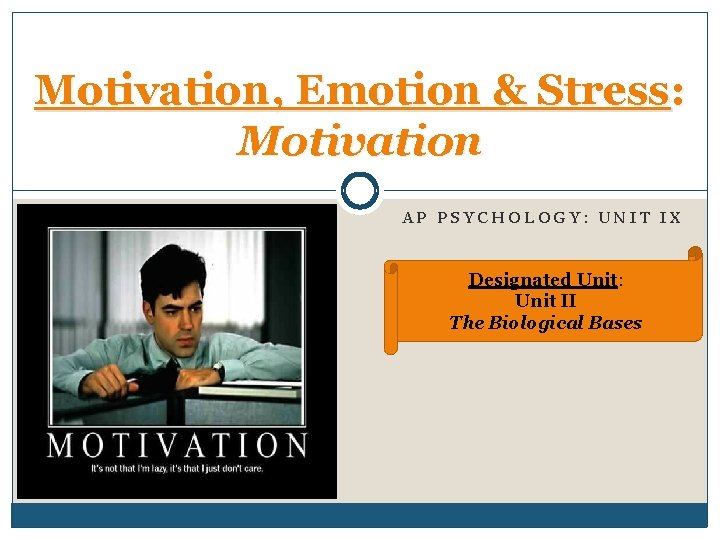
Motivation, Emotion & Stress: Motivation AP PSYCHOLOGY: UNIT IX Designated Unit: Unit II The Biological Bases
Introduction: Fact or Falsehood? Humans who have had ulcerated/cancerous stomachs removed do not experience hunger False Part of knowing when to eat is the memory of our last meal True People are less willing to try novel animal-based foods than novel vegetable-based foods True
Introduction: Fact or Falsehood? Men’s descriptions of the feelings that accompany sex cannot be distinguished from those of women True Normal fluctuations in sex hormones have significant effect on human sexual desire False Homosexuality is linked with problems in a child’s relationship with parents False
Introduction: Fact or Falsehood? When asked “what is it that makes your life meaningful? ” most people mention “meaningful work” before anything else False Married people are less at risk for depression, suicide and early death than are unattached people True
Introduction: Fact or Falsehood? People report the greatest enjoyment of life when they are quietly relaxing False The most satisfied and successful people spend more time correcting their deficiencies than accentuating their strengths False
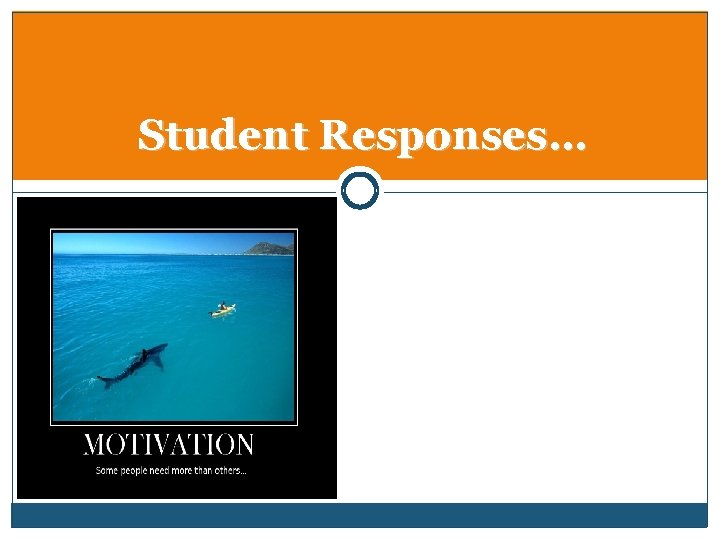
Student Responses…
I get up for school in the morning… Because I have to…(x at least 50…) So I don’t get kicked out of school… Because I want to – can’t waste days cause you don’t know which will be your last… Because I like to see my friends & socialize… Because I have to be educated in order to get a good job in the future. And also, my mom will kick me out if I don’t… To get an education. Even if school wasn’t compulsory I would still go because knowledge is a pillar of success. So that I can get in to a good college… Because I can’t miss AP Psych… I usually do it cause I know I can make coffee and take a hot shower…if I didn’t have those two things I really wouldn’t get up in the morning…school sucks…
I workout… To stay healthy and fit… To be more attractive… To get that bikini-ready body, spring break people! To release stress and to feel better about myself Social standards/pressure to look a certain way… Because it’s a hobby; without physical challenge, life, to me, would be boring… To enhance my performance in the sport I play I workout because I enjoy looking fit, but I don’t need to be a tough macho guy to be satisfied. To keep my heart healthy – I want to live a long time! I don’t (x at least 30…)
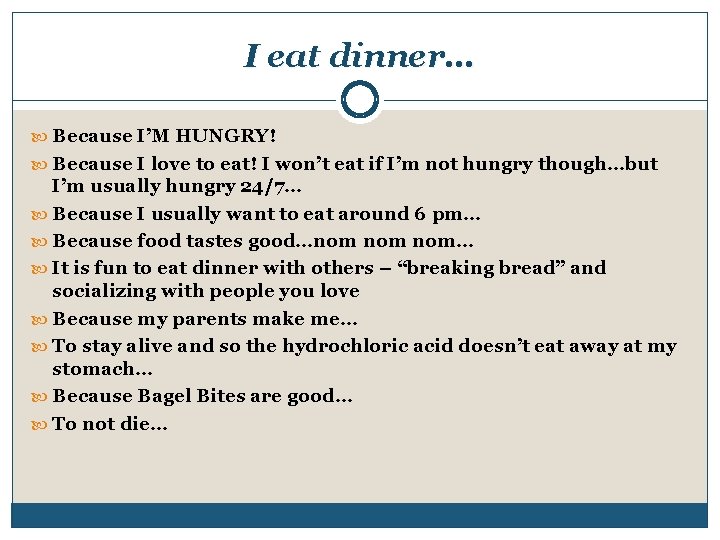
I eat dinner… Because I’M HUNGRY! Because I love to eat! I won’t eat if I’m not hungry though…but I’m usually hungry 24/7… Because I usually want to eat around 6 pm… Because food tastes good…nom nom… It is fun to eat dinner with others – “breaking bread” and socializing with people you love Because my parents make me… To stay alive and so the hydrochloric acid doesn’t eat away at my stomach… Because Bagel Bites are good… To not die…
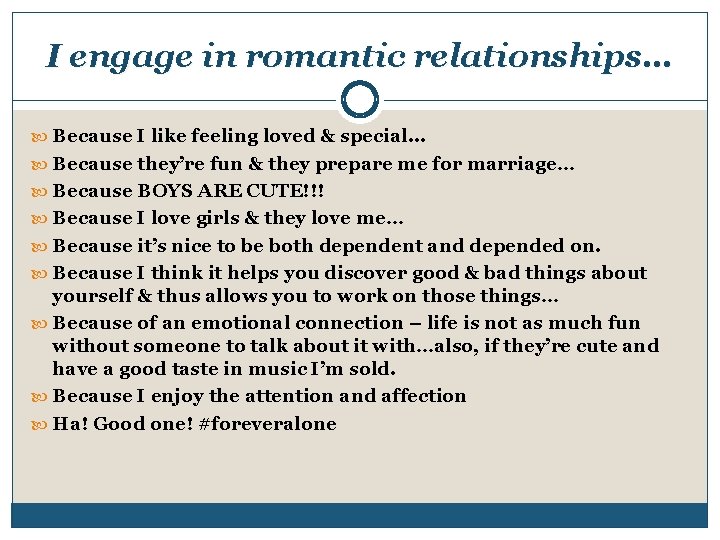
I engage in romantic relationships… Because I like feeling loved & special. . . Because they’re fun & they prepare me for marriage… Because BOYS ARE CUTE!!! Because I love girls & they love me… Because it’s nice to be both dependent and depended on. Because I think it helps you discover good & bad things about yourself & thus allows you to work on those things… Because of an emotional connection – life is not as much fun without someone to talk about it with…also, if they’re cute and have a good taste in music I’m sold. Because I enjoy the attention and affection Ha! Good one! #foreveralone
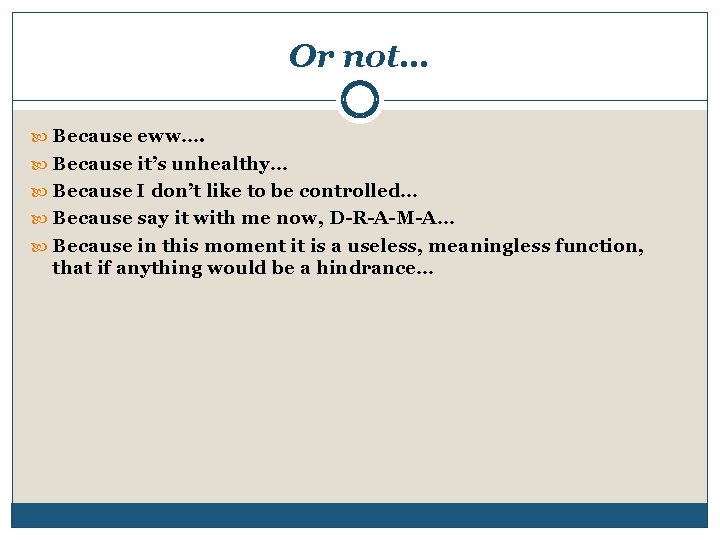
Or not… Because eww…. Because it’s unhealthy… Because I don’t like to be controlled… Because say it with me now, D-R-A-M-A… Because in this moment it is a useless, meaningless function, that if anything would be a hindrance…
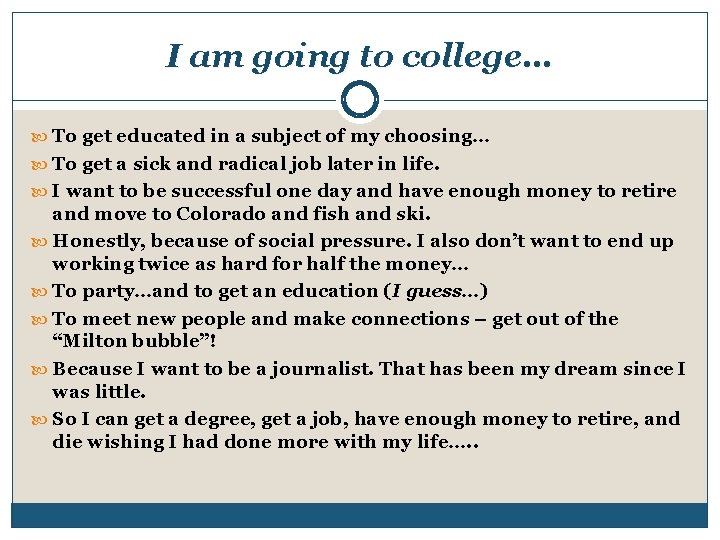
I am going to college… To get educated in a subject of my choosing… To get a sick and radical job later in life. I want to be successful one day and have enough money to retire and move to Colorado and fish and ski. Honestly, because of social pressure. I also don’t want to end up working twice as hard for half the money… To party…and to get an education (I guess…) To meet new people and make connections – get out of the “Milton bubble”! Because I want to be a journalist. That has been my dream since I was little. So I can get a degree, get a job, have enough money to retire, and die wishing I had done more with my life…. .
I don’t engage in illegal activities… Because they are against the law… Because karma. Because I don’t want to ruin my life! Because it is against my moral code & ethical standards. . . Hmm…I don’t want to go to jail because they have gross food there & the people are creepy & scary, plus I don’t want to mess up my life by doing stupid things like drugs… ‘Cause the prison toilets are out in the open for everyone to see. Because I want to be a good role model for my younger sibling. Coach, I can’t answer this one because you are framing it in order to reinforce a representative heuristic that we don’t like to indulge in acts of savagery. I’m a good kid but bad things happen from time to time.
Motivation: The Basics PART ONE
Motivation: The Basics Motivation A need or desire that energizes behavior and directs it towards a goal Influences that account for the initiation, direction, intensity and persistence of behavior Sources of Motivation • Biological, Emotional, Cognitive & Social Factors
Motivation: The Basics Extrinsic Motivation A desire to perform a behavior because of promised rewards or threats of punishment Example Studying for a test (to get an A or to avoid an F) Problem Behaviors maintained by extrinsic motivation will not be effectively sustained once the reward is removed Behavior levels may be lower than before the reward was given
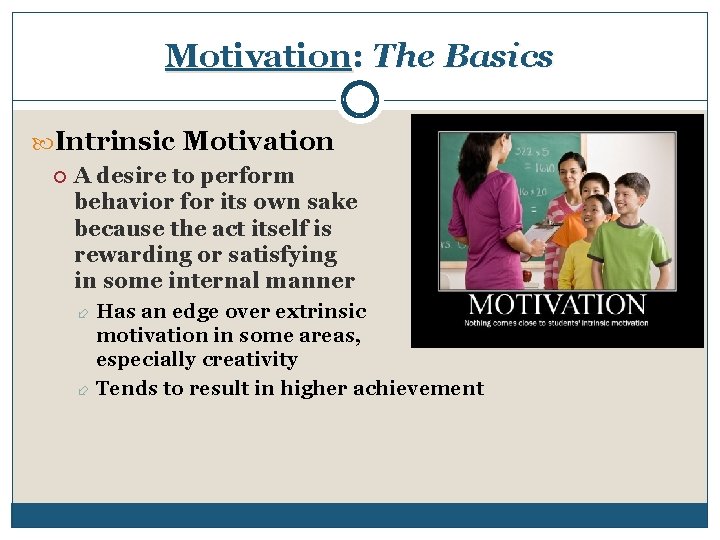
Motivation: The Basics Intrinsic Motivation A desire to perform behavior for its own sake because the act itself is rewarding or satisfying in some internal manner Has an edge over extrinsic motivation in some areas, especially creativity Tends to result in higher achievement a
Motivation: Theories of Motivation PART TWO
Theories: Instinct Theory A theory of motivation that asserts that human behavior is guided by innate biological instincts Instinct Examples A fixed pattern that occurs without learning; rigidly patterned within a species Imprinting, salmon spawning, rooting reflex Basic human instincts?
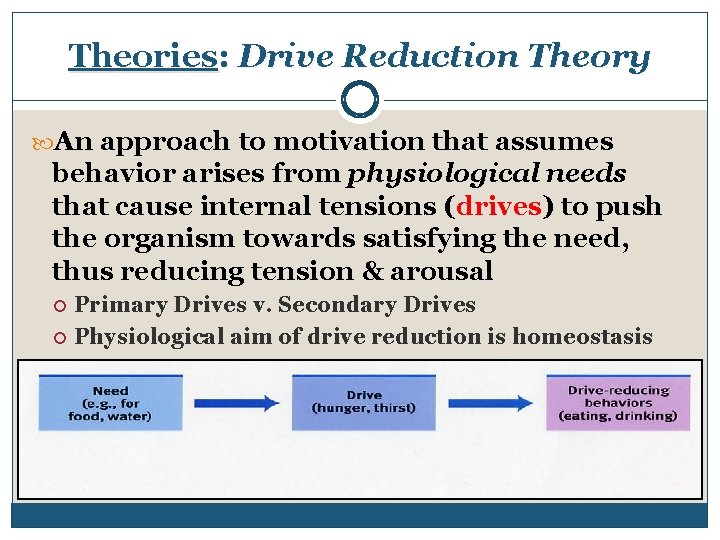
Theories: Drive Reduction Theory An approach to motivation that assumes behavior arises from physiological needs that cause internal tensions (drives) to push the organism towards satisfying the need, thus reducing tension & arousal Primary Drives v. Secondary Drives Physiological aim of drive reduction is homeostasis
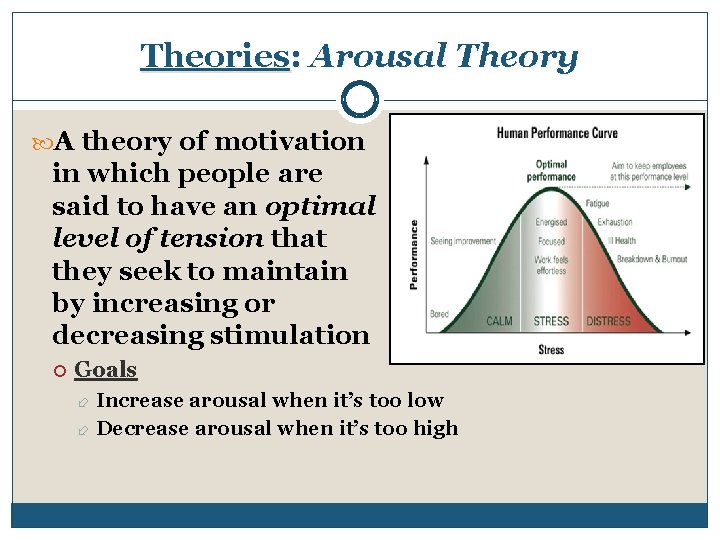
Theories: Arousal Theory A theory of motivation in which people are said to have an optimal level of tension that they seek to maintain by increasing or decreasing stimulation Goals Increase arousal when it’s too low Decrease arousal when it’s too high
Theories: Arousal Theory (Example) It’s Friday night & you’re sitting at a restaurant with 3 friends who are all taking the SAT in the morning. . . Friend A: “You know, I don’t really care about the test. I’m going to a trade school and I’m only taking the test because my parents want me to. Can I have some of your fries? ” Friend B: “I want to do well, but if I screw up on this test, it’s not going to permanently ruin my life. I’ll give it my best shot. Where’s the ketchup? ” Friend C: “It’s all on the line tomorrow. If I don’t get a good score, it will change my life forever. I’m so nervous, I can’t eat…”
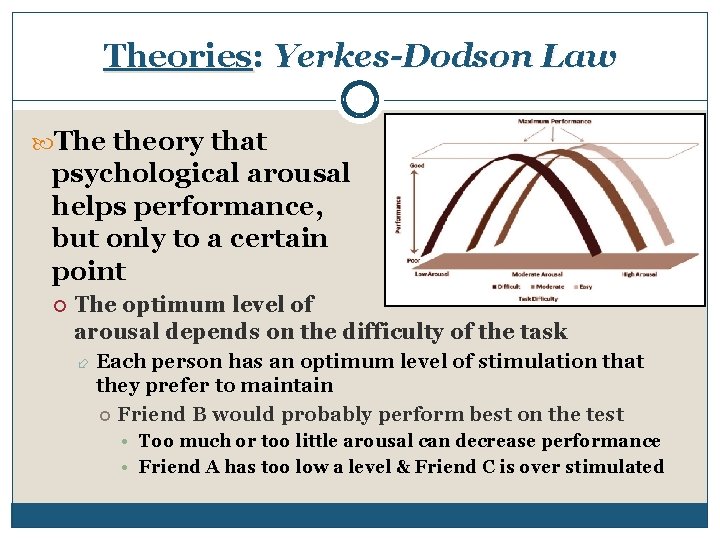
Theories: Yerkes-Dodson Law The theory that psychological arousal helps performance, but only to a certain point The optimum level of arousal depends on the difficulty of the task Each person has an optimum level of stimulation that they prefer to maintain Friend B would probably perform best on the test • Too much or too little arousal can decrease performance • Friend A has too low a level & Friend C is over stimulated
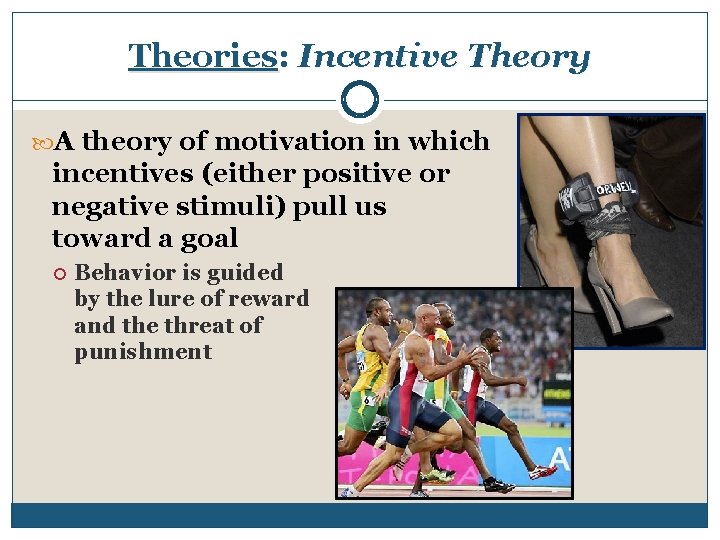
Theories: Incentive Theory A theory of motivation in which incentives (either positive or negative stimuli) pull us toward a goal Behavior is guided by the lure of reward and the threat of punishment
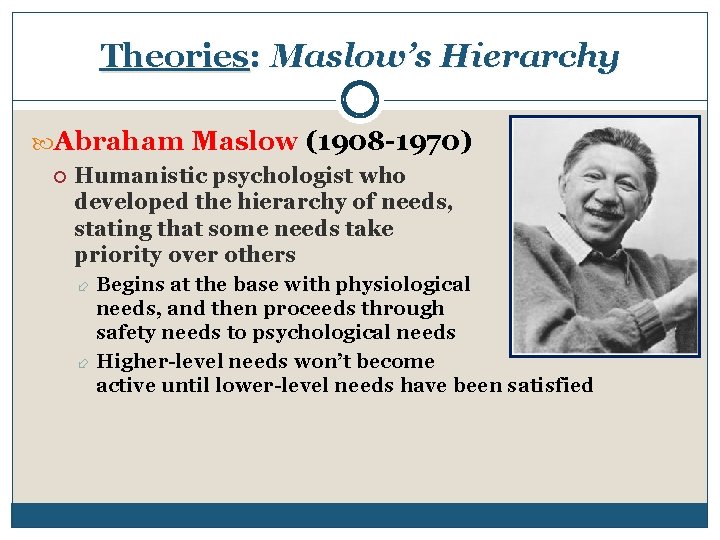
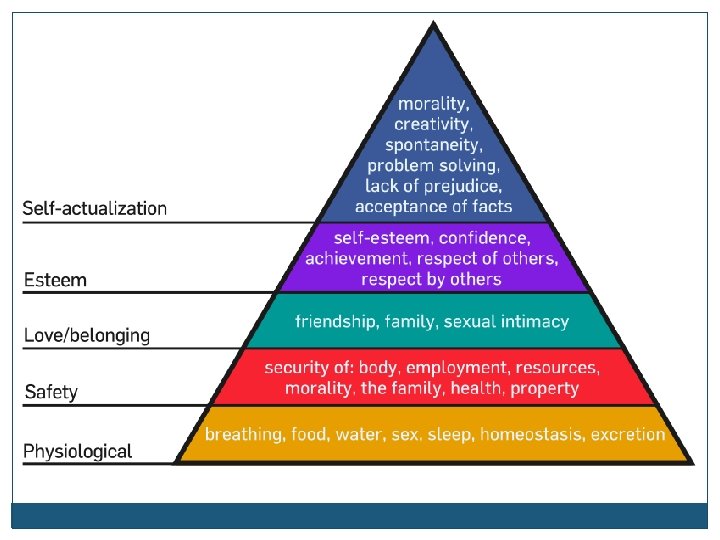
Theories: Maslow’s Hierarchy Abraham Maslow (1908 -1970) Humanistic psychologist who developed the hierarchy of needs, stating that some needs take priority over others Begins at the base with physiological needs, and then proceeds through safety needs to psychological needs Higher-level needs won’t become active until lower-level needs have been satisfied
Motivation: Hunger PART THREE “Hunger does something to you that’s hard to describe…”
The Biological Bases of Hunger
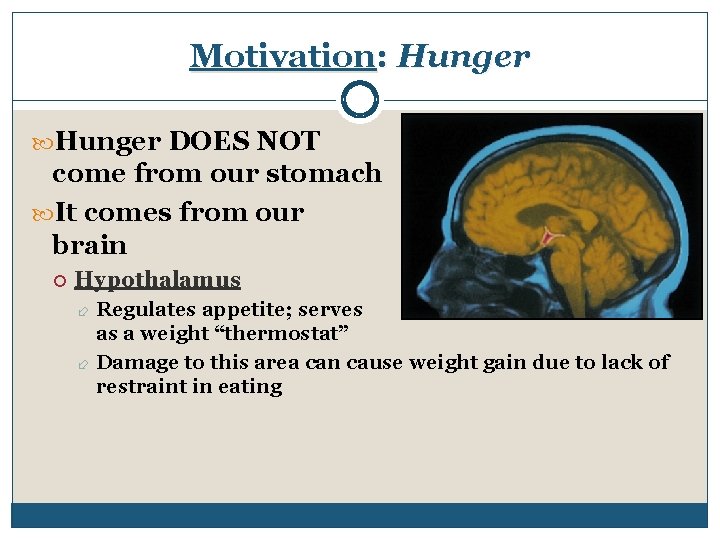
Motivation: Hunger DOES NOT come from our stomach It comes from our brain Hypothalamus Regulates appetite; serves as a weight “thermostat” Damage to this area can cause weight gain due to lack of restraint in eating
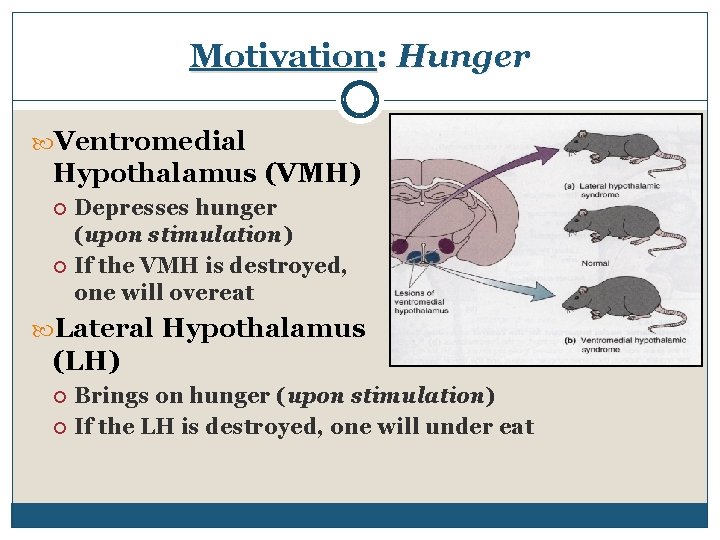
Motivation: Hunger Ventromedial Hypothalamus (VMH) Depresses hunger (upon stimulation) If the VMH is destroyed, one will overeat Lateral Hypothalamus (LH) Brings on hunger (upon stimulation) If the LH is destroyed, one will under eat
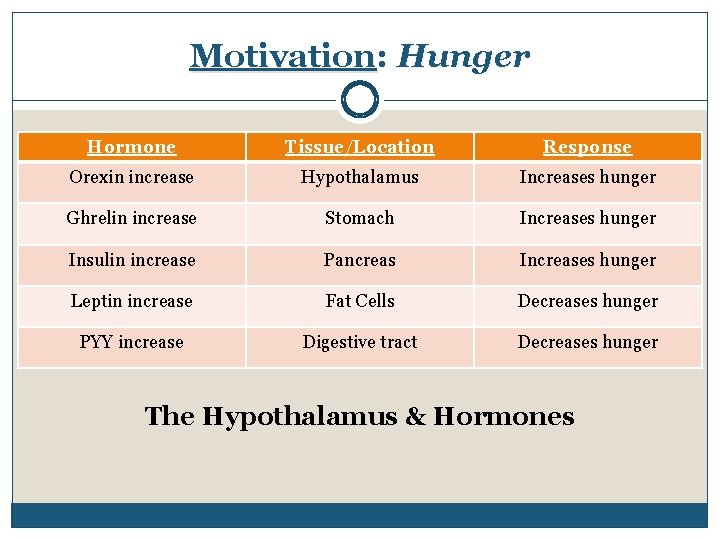
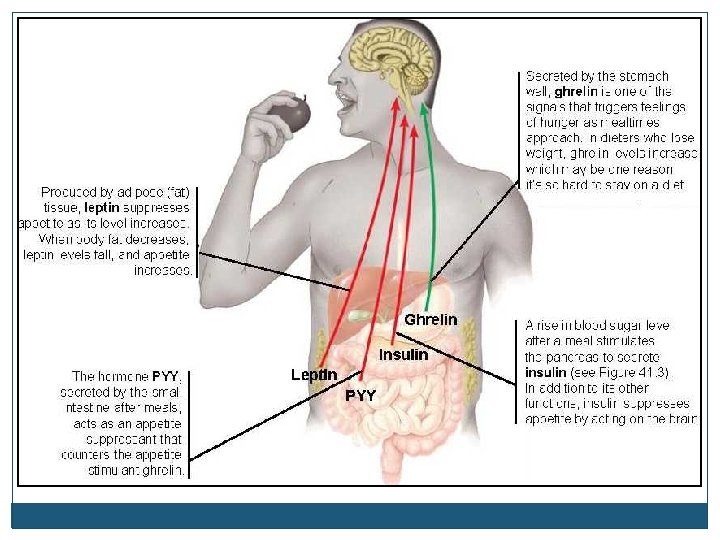
Motivation: Hunger Hormone Tissue/Location Response Orexin increase Hypothalamus Increases hunger Ghrelin increase Stomach Increases hunger Insulin increase Pancreas Increases hunger Leptin increase Fat Cells Decreases hunger PYY increase Digestive tract Decreases hunger The Hypothalamus & Hormones
Motivation: Hunger Weight Set Point The point at which an individual’s weight thermostat is supposedly set Basal Metabolic Rate (BMR) The rate at which the body burns energy when the organism is resting When the body falls below the set point, increased hunger and a lower BMR may act to restore the lost weight…
Motivation: Hunger Implications for Dieting A “normal” weight person who overeats will experience an increase in metabolism, thus preventing weight gain A “normal” weight person who under eats will experience a decrease in metabolism, thus preventing weight loss The body reacts as if it is in starvation mode…
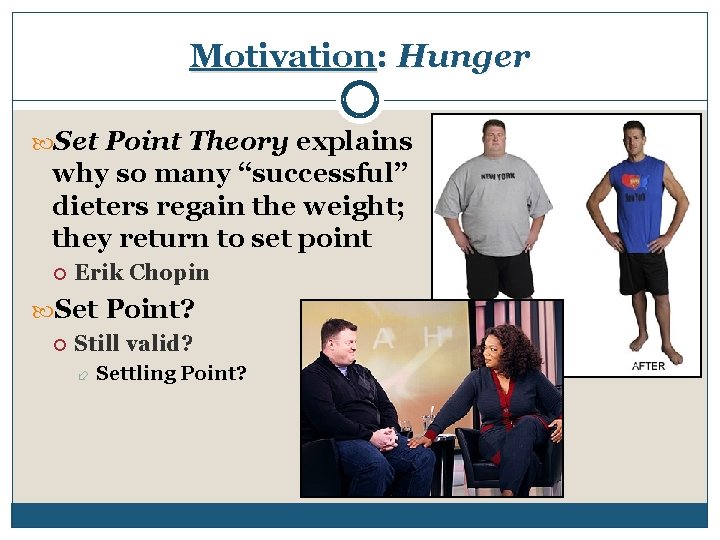
Motivation: Hunger Set Point Theory explains why so many “successful” dieters regain the weight; they return to set point Erik Chopin Set Point? Still valid? Settling Point?
The Psychology of Hunger
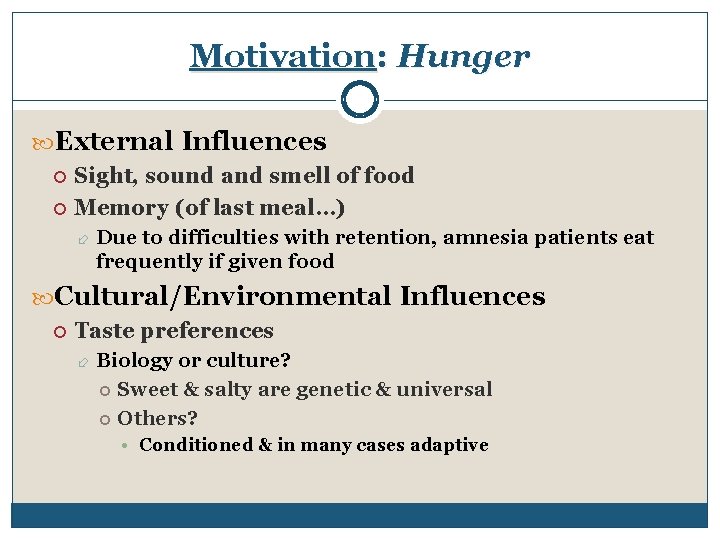
Motivation: Hunger External Influences Sight, sound and smell of food Memory (of last meal…) Due to difficulties with retention, amnesia patients eat frequently if given food Cultural/Environmental Influences Taste preferences Biology or culture? Sweet & salty are genetic & universal Others? • Conditioned & in many cases adaptive
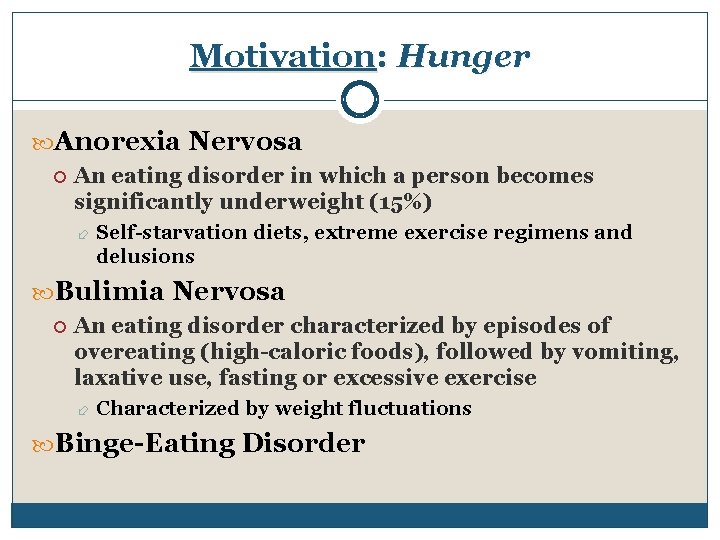
Motivation: Hunger Anorexia Nervosa An eating disorder in which a person becomes significantly underweight (15%) Self-starvation diets, extreme exercise regimens and delusions Bulimia Nervosa An eating disorder characterized by episodes of overeating (high-caloric foods), followed by vomiting, laxative use, fasting or excessive exercise Characterized by weight fluctuations Binge-Eating Disorder
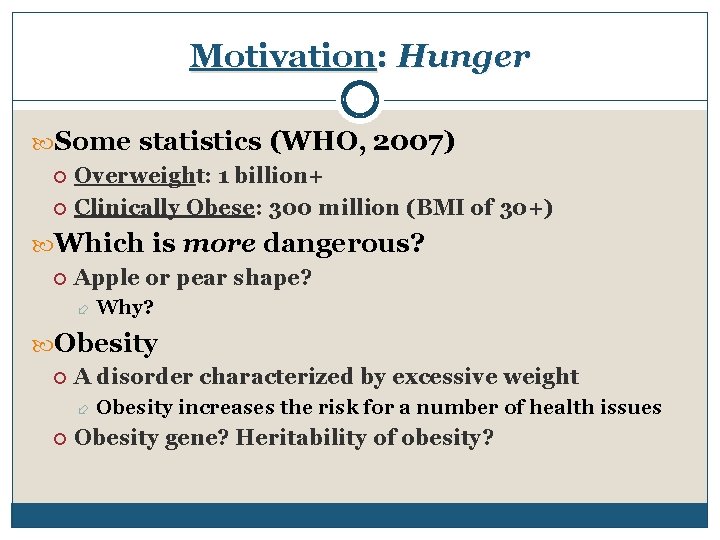
Motivation: Hunger Some statistics (WHO, 2007) Overweight: 1 billion+ Clinically Obese: 300 million (BMI of 30+) Which is more dangerous? Apple or pear shape? Why? Obesity A disorder characterized by excessive weight Obesity increases the risk for a number of health issues Obesity gene? Heritability of obesity?
Motivation: Sex PART FOUR
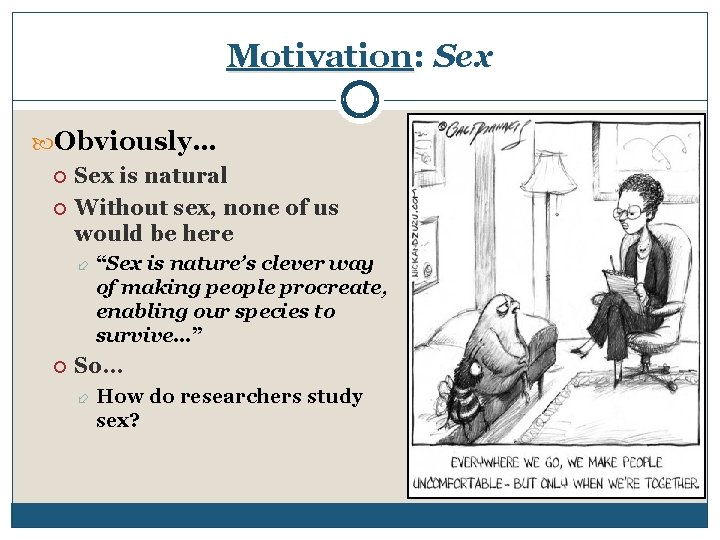
Motivation: Sex Obviously… Sex is natural Without sex, none of us would be here “Sex is nature’s clever way of making people procreate, enabling our species to survive…” So… How do researchers study sex?
The Biological Bases of Sex
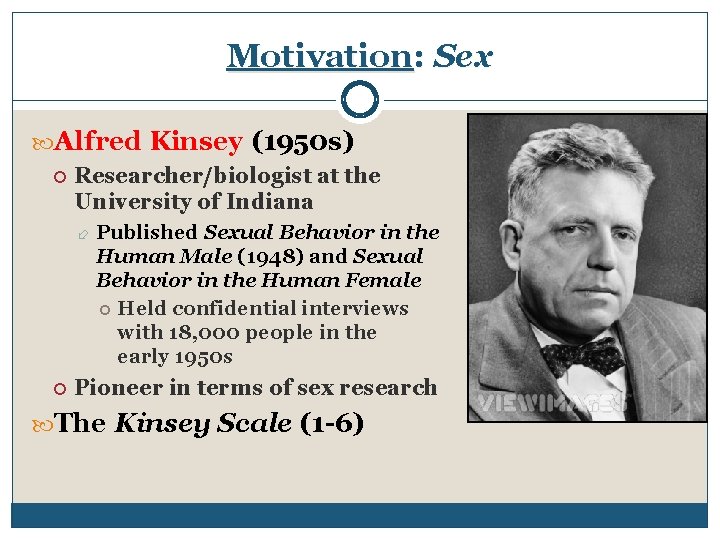
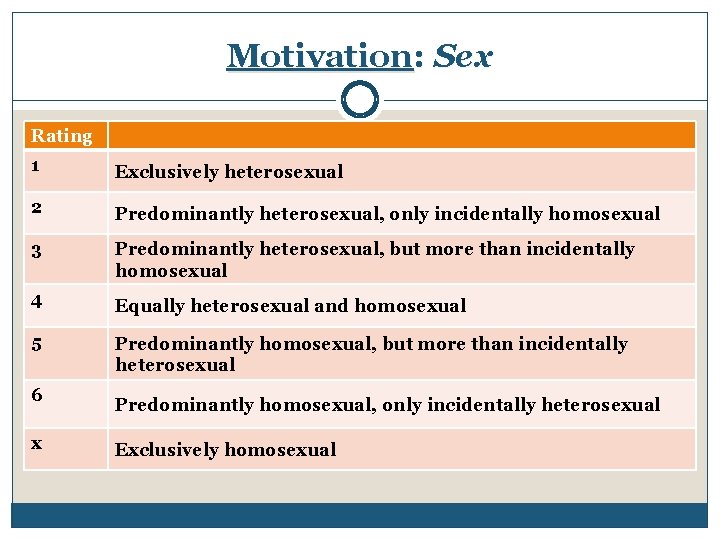
Motivation: Sex Alfred Kinsey (1950 s) Researcher/biologist at the University of Indiana Published Sexual Behavior in the Human Male (1948) and Sexual Behavior in the Human Female Held confidential interviews with 18, 000 people in the early 1950 s Pioneer in terms of sex research The Kinsey Scale (1 -6)
Motivation: Sex Rating 1 Exclusively heterosexual 2 Predominantly heterosexual, only incidentally homosexual 3 Predominantly heterosexual, but more than incidentally homosexual 4 Equally heterosexual and homosexual 5 Predominantly homosexual, but more than incidentally heterosexual 6 x Predominantly homosexual, only incidentally heterosexual Exclusively homosexual
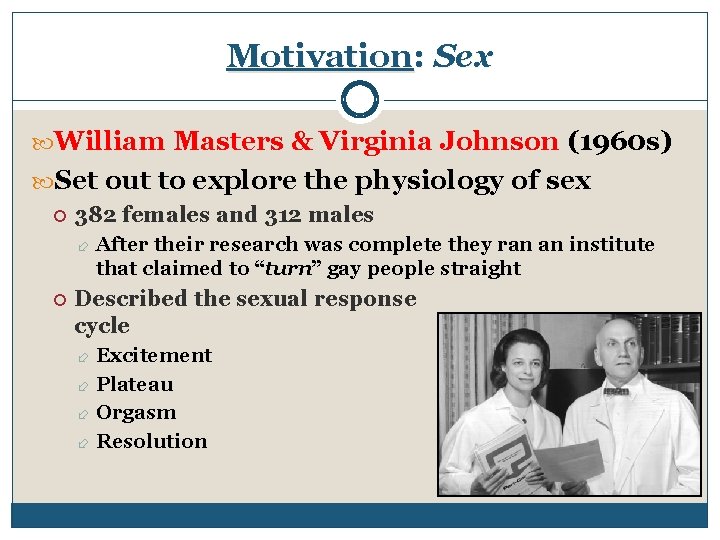
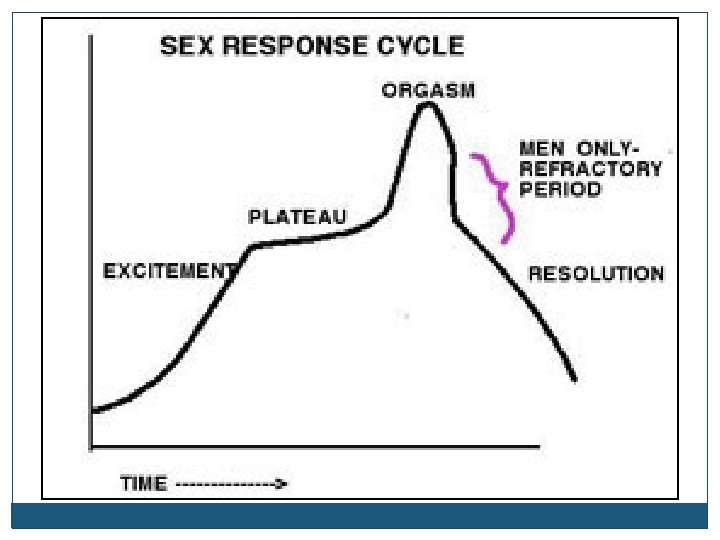
Motivation: Sex William Masters & Virginia Johnson (1960 s) Set out to explore the physiology of sex 382 females and 312 males After their research was complete they ran an institute that claimed to “turn” gay people straight Described the sexual response cycle Excitement Plateau Orgasm Resolution
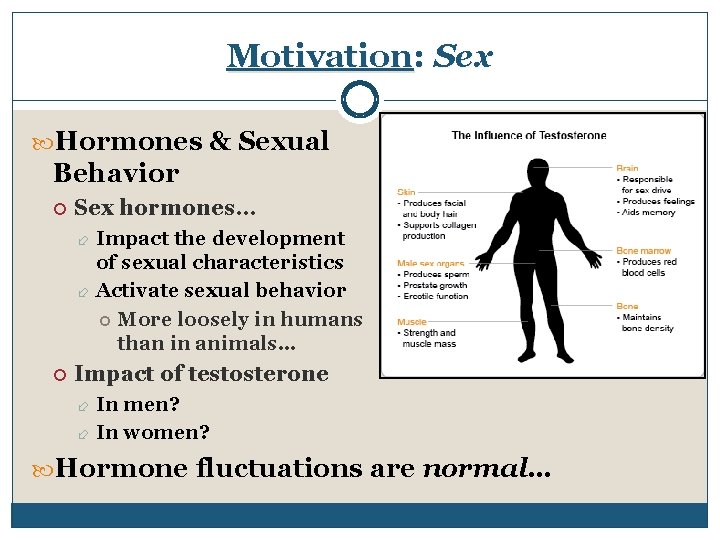
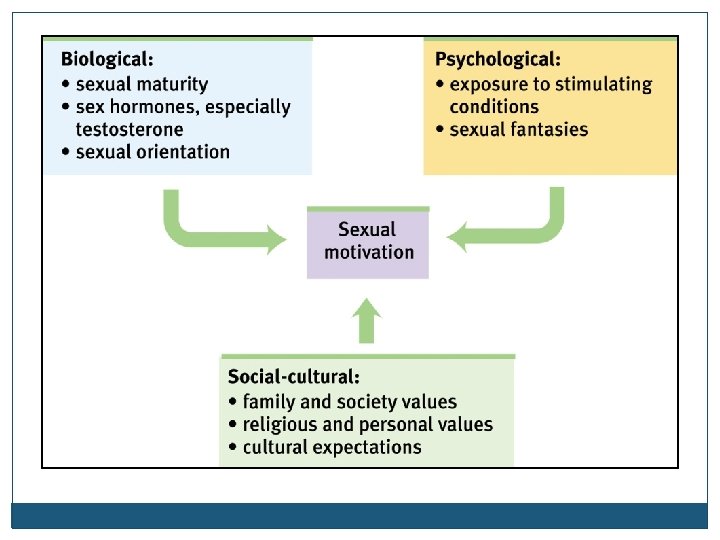
Motivation: Sex Hormones & Sexual Behavior Sex hormones… Impact the development of sexual characteristics Activate sexual behavior More loosely in humans than in animals… Impact of testosterone In men? In women? Hormone fluctuations are normal…
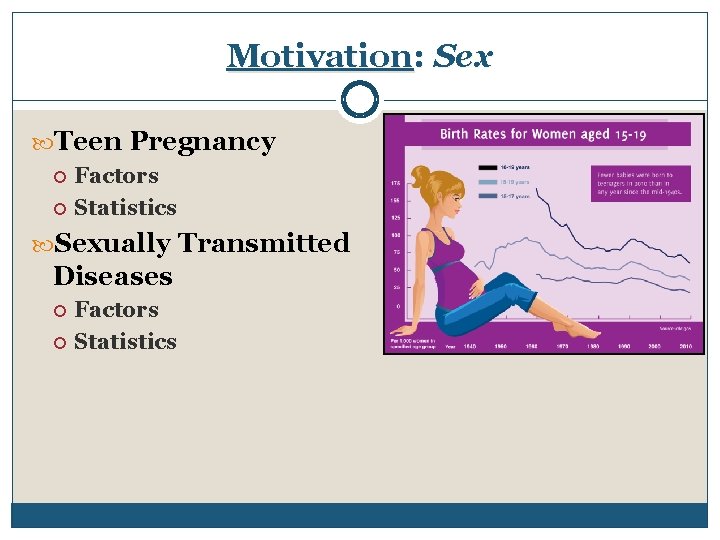
Motivation: Sex Teen Pregnancy Factors Statistics Sexually Transmitted Diseases Factors Statistics
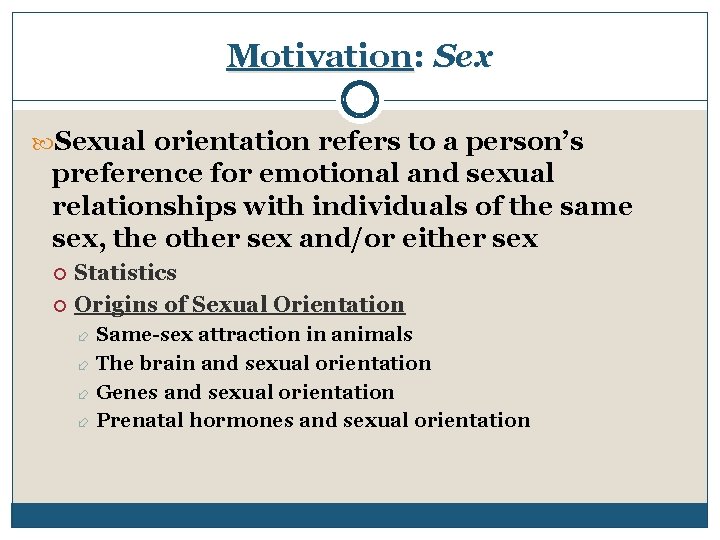
Motivation: Sexual orientation refers to a person’s preference for emotional and sexual relationships with individuals of the same sex, the other sex and/or either sex Statistics Origins of Sexual Orientation Same-sex attraction in animals The brain and sexual orientation Genes and sexual orientation Prenatal hormones and sexual orientation