Mr Vivek Deep Assistant Professor School of Earth
- Slides: 49
Mr. Vivek Deep Assistant Professor School of Earth Sciences Banasthali Vidyapith, Rajasthan
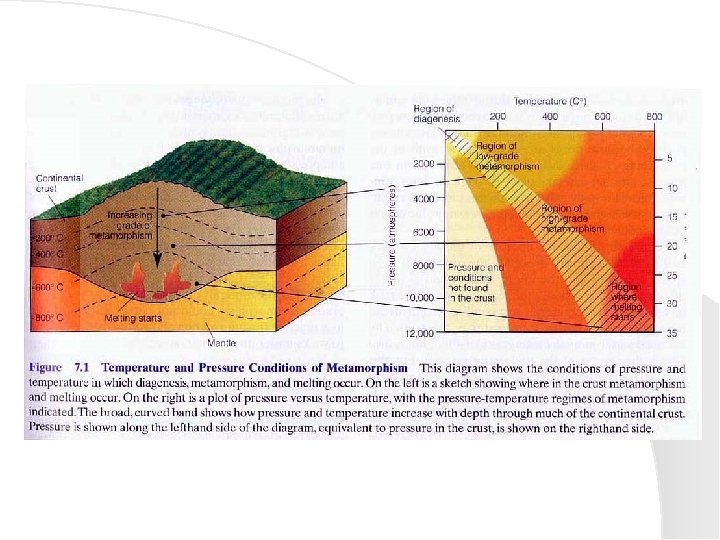
Metamorphism Is the process that occur in rocks due to the effects of l High temperature l High pressure l Chemically active fluids
Metamorphism Definition Metamorphism (Meta=change, Morph=form or metamorphism means to change form or character). So, It is define as a subsolidus process leading to change in mineralogy, structures (textures) and/or chemical composition of an igneous, sedimentary, or prior metamorphic rocks. These changes were made due to subjection of these rocks to physicochemical conditions (P, T, active chemical fluids) higher than those occurring in the zone of weathering, cementation and diagenesis Features of Metamorphism - It principally formed in solid state and before melting, - Metamorphism can be considered to be isochemical, except perhaps for removal or addition of volatiles (H 2 O, CO 2), - The process of extensive chemical changes during transformation is known as metasomatism.
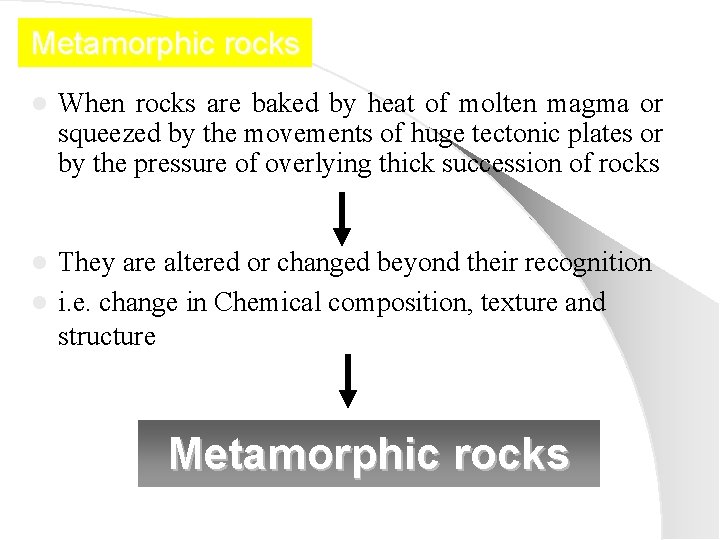
Metamorphic rocks l When rocks are baked by heat of molten magma or squeezed by the movements of huge tectonic plates or by the pressure of overlying thick succession of rocks They are altered or changed beyond their recognition l i. e. change in Chemical composition, texture and structure l Metamorphic rocks
Temperature l The source of temperature is either from magma or due to the depth factor l Metamorphism usually result into change in min. comp. and texture of rocks (Ig. and Sed. ) which are subjected to temp. > 1000 C and pressure > 1000’s Mpa. l Low-grade metamorphism: Occurs at about 1000 C to 5000 C. l High-grade metamorphism: Occurs at > 5000 C
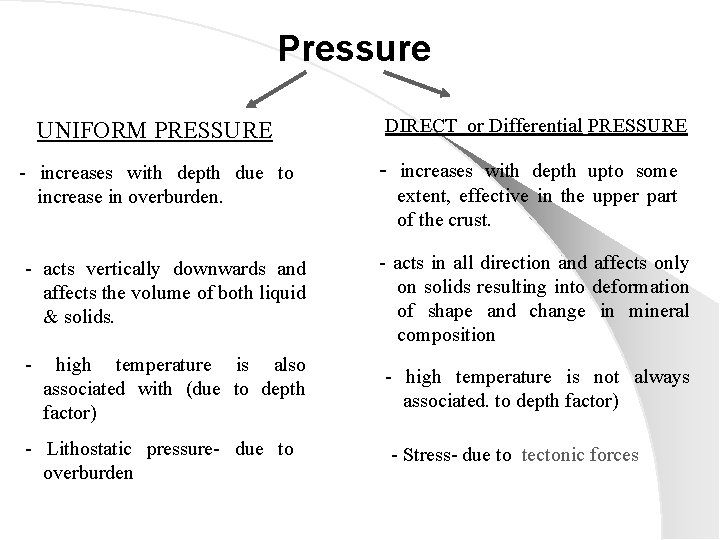
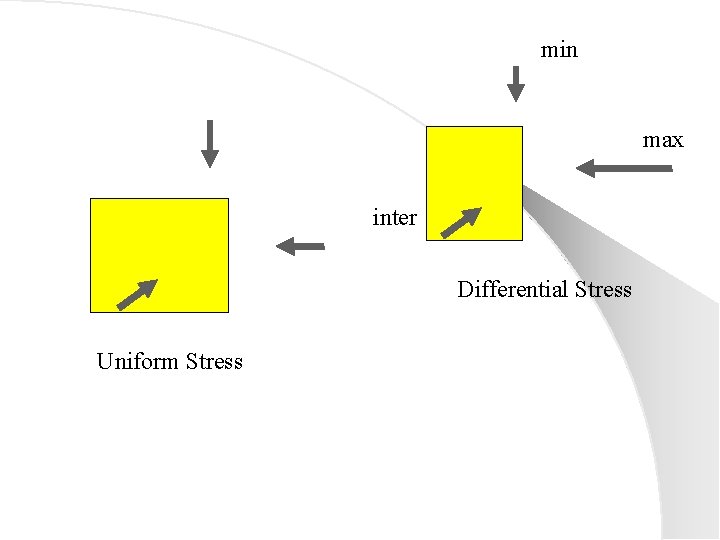
Pressure UNIFORM PRESSURE DIRECT or Differential PRESSURE - increases with depth due to increase in overburden. - increases with depth upto some - acts vertically downwards and affects the volume of both liquid & solids. - acts in all direction and affects only on solids resulting into deformation of shape and change in mineral composition - high temperature is also associated with (due to depth factor) - Lithostatic pressure- due to overburden extent, effective in the upper part of the crust. - high temperature is not always associated. to depth factor) - Stress- due to tectonic forces
min max inter Differential Stress Uniform Stress
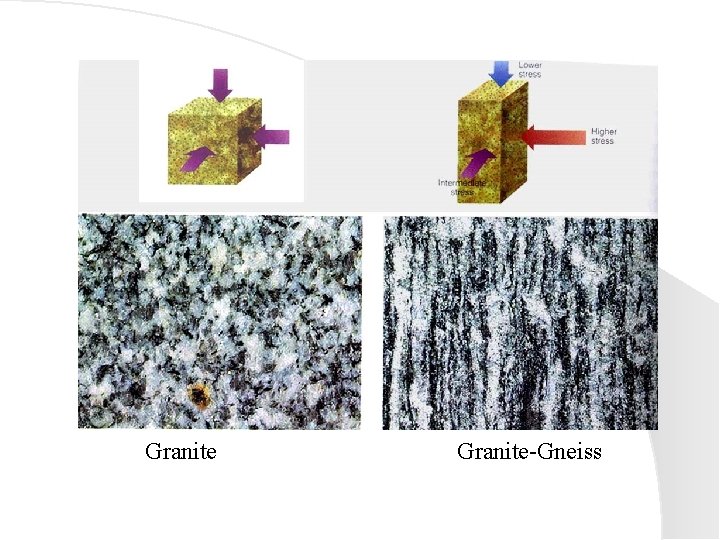
Granite-Gneiss
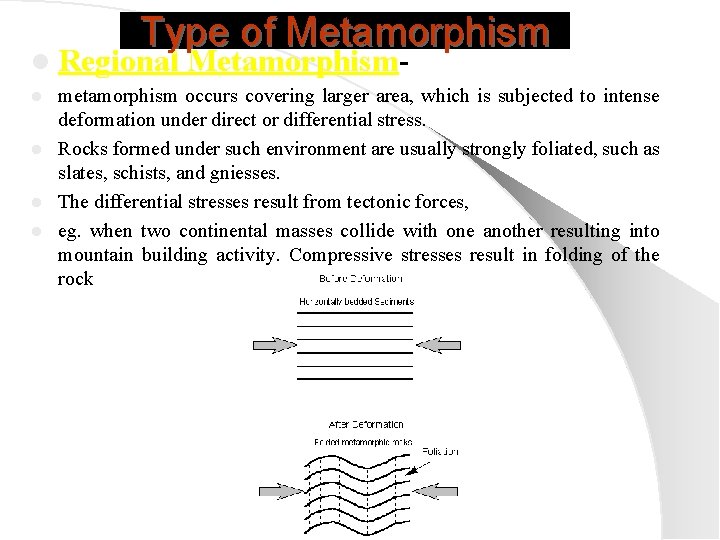
Type of Metamorphism l Regional Metamorphism- metamorphism occurs covering larger area, which is subjected to intense deformation under direct or differential stress. l Rocks formed under such environment are usually strongly foliated, such as slates, schists, and gniesses. l The differential stresses result from tectonic forces, l eg. when two continental masses collide with one another resulting into mountain building activity. Compressive stresses result in folding of the rock l
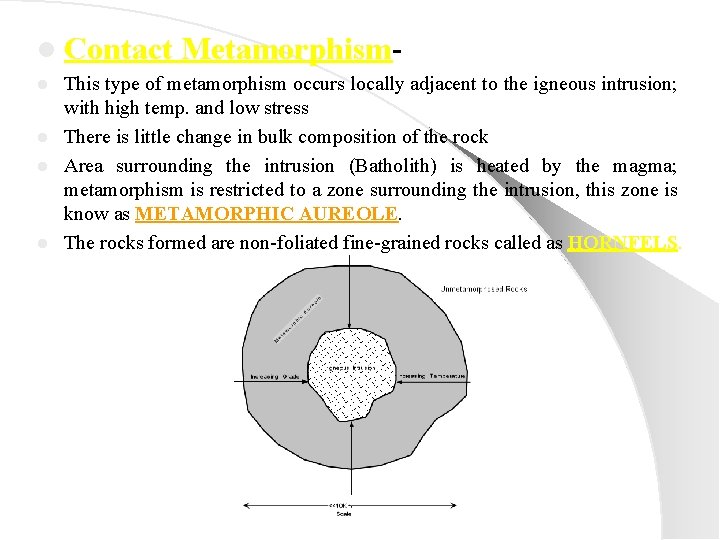
l Contact Metamorphism- This type of metamorphism occurs locally adjacent to the igneous intrusion; with high temp. and low stress l There is little change in bulk composition of the rock l Area surrounding the intrusion (Batholith) is heated by the magma; metamorphism is restricted to a zone surrounding the intrusion, this zone is know as METAMORPHIC AUREOLE. l The rocks formed are non-foliated fine-grained rocks called as HORNFELS. l
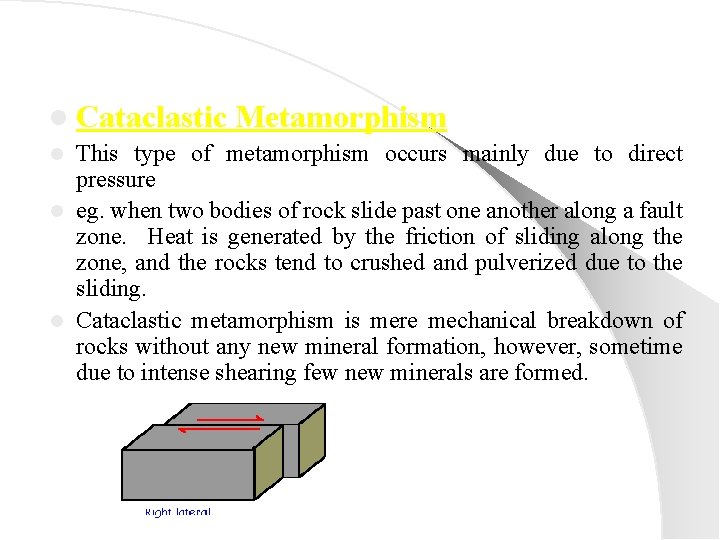
l Cataclastic Metamorphism This type of metamorphism occurs mainly due to direct pressure l eg. when two bodies of rock slide past one another along a fault zone. Heat is generated by the friction of sliding along the zone, and the rocks tend to crushed and pulverized due to the sliding. l Cataclastic metamorphism is mere mechanical breakdown of rocks without any new mineral formation, however, sometime due to intense shearing few new minerals are formed. l
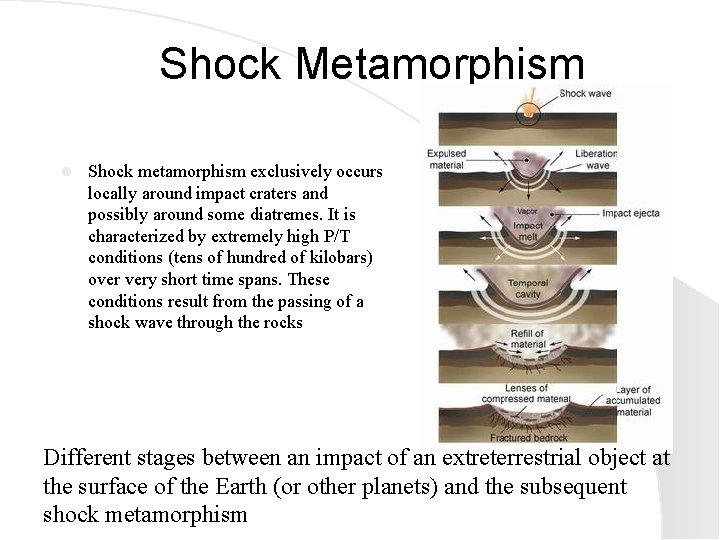
Shock Metamorphism l Shock metamorphism exclusively occurs locally around impact craters and possibly around some diatremes. It is characterized by extremely high P/T conditions (tens of hundred of kilobars) over very short time spans. These conditions result from the passing of a shock wave through the rocks Different stages between an impact of an extreterrestrial object at the surface of the Earth (or other planets) and the subsequent shock metamorphism
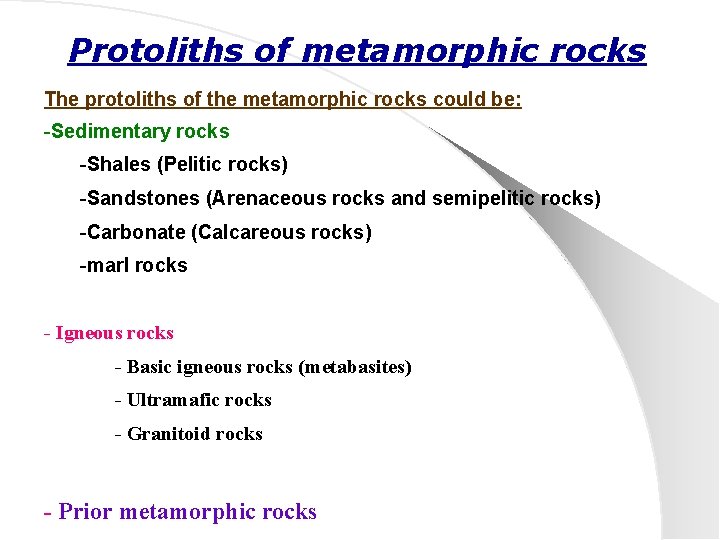
Protoliths of metamorphic rocks The protoliths of the metamorphic rocks could be: -Sedimentary rocks -Shales (Pelitic rocks) -Sandstones (Arenaceous rocks and semipelitic rocks) -Carbonate (Calcareous rocks) -marl rocks - Igneous rocks - Basic igneous rocks (metabasites) - Ultramafic rocks - Granitoid rocks - Prior metamorphic rocks
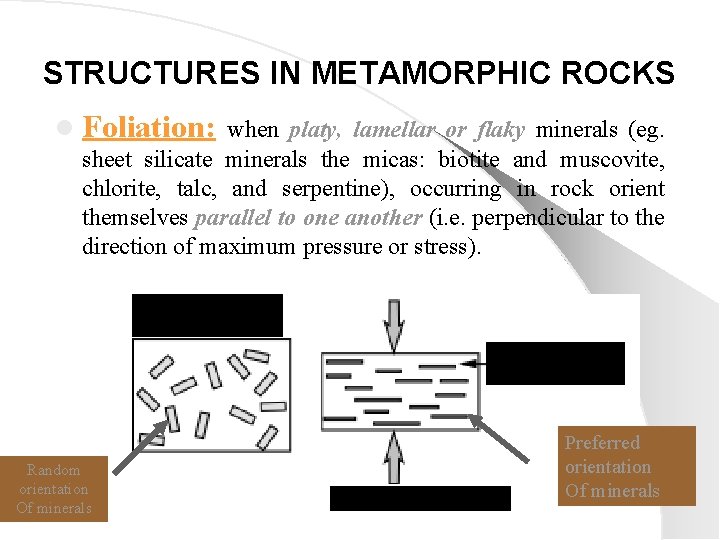
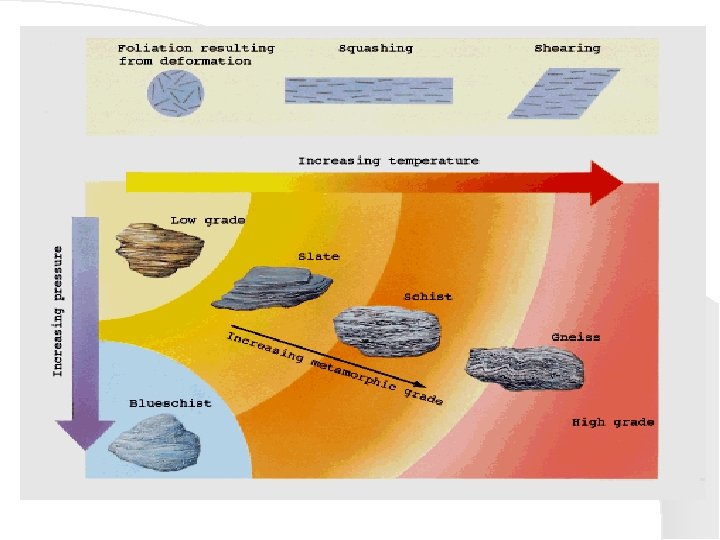
STRUCTURES IN METAMORPHIC ROCKS l Foliation: when platy, lamellar or flaky minerals (eg. sheet silicate minerals the micas: biotite and muscovite, chlorite, talc, and serpentine), occurring in rock orient themselves parallel to one another (i. e. perpendicular to the direction of maximum pressure or stress). Random orientation Of minerals Preferred orientation Of minerals
l Lineation: when prismatic or rod-like minerals (eg. Hornblende, tourmaline etc. ) occurring in a rock orient themselves parallel to one another (perpendicular to direction of maxi. Pressure or stress)
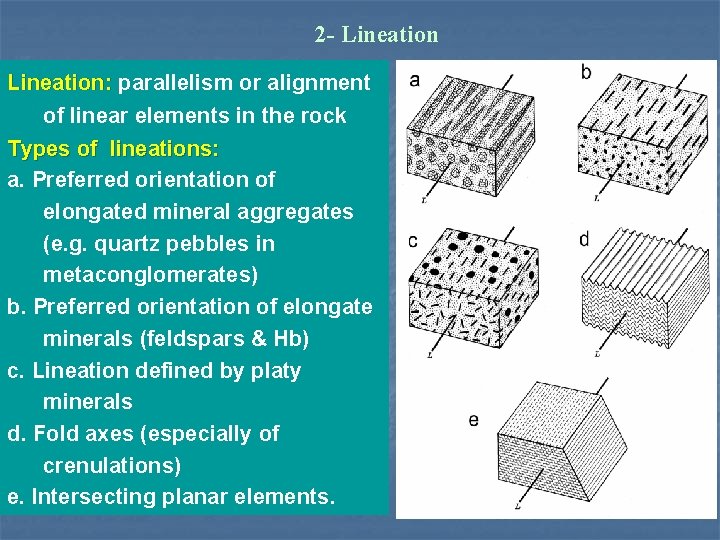
2 - Lineation: parallelism or alignment of linear elements in the rock Types of lineations: a. Preferred orientation of elongated mineral aggregates (e. g. quartz pebbles in metaconglomerates) b. Preferred orientation of elongate minerals (feldspars & Hb) c. Lineation defined by platy minerals d. Fold axes (especially of crenulations) e. Intersecting planar elements.
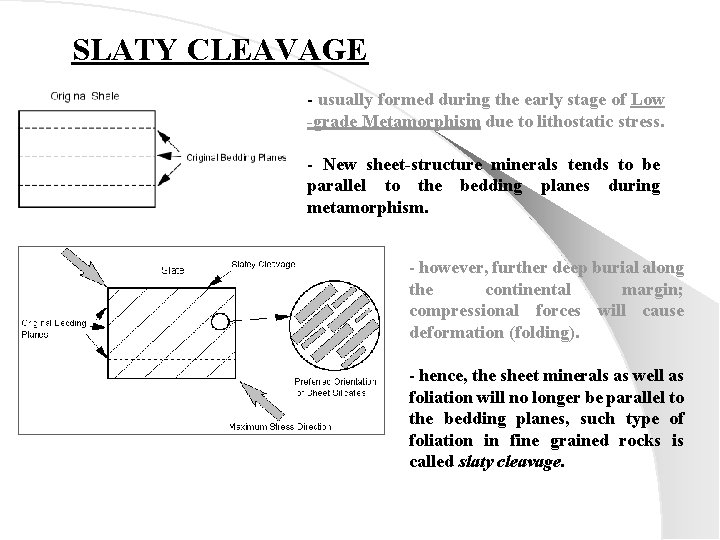
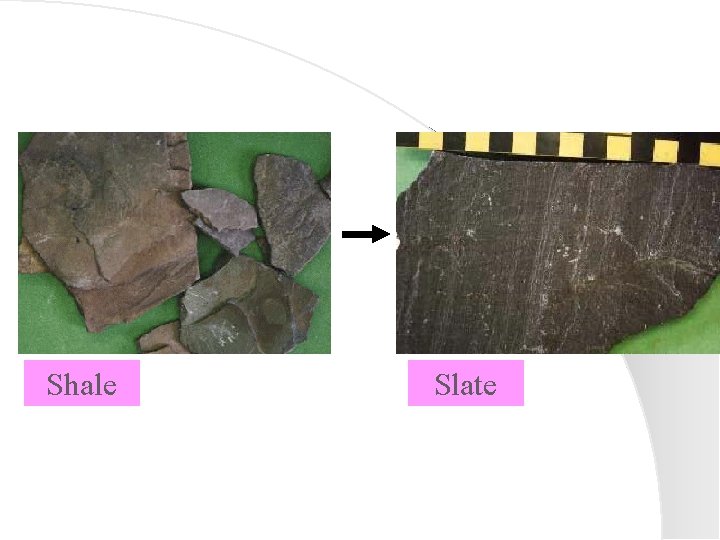
SLATY CLEAVAGE - usually formed during the early stage of Low -grade Metamorphism due to lithostatic stress. - New sheet-structure minerals tends to be parallel to the bedding planes during metamorphism. - however, further deep burial along the continental margin; compressional forces will cause deformation (folding). - hence, the sheet minerals as well as foliation will no longer be parallel to the bedding planes, such type of foliation in fine grained rocks is called slaty cleavage.
Shale Slate
PHYLLITES - usually associated with intermediate grade of metamorphism; where the mineral grains grows large in size as compare to that seen in slates -This develops a pronounced foliation where the preferred oriented minerals are seen.
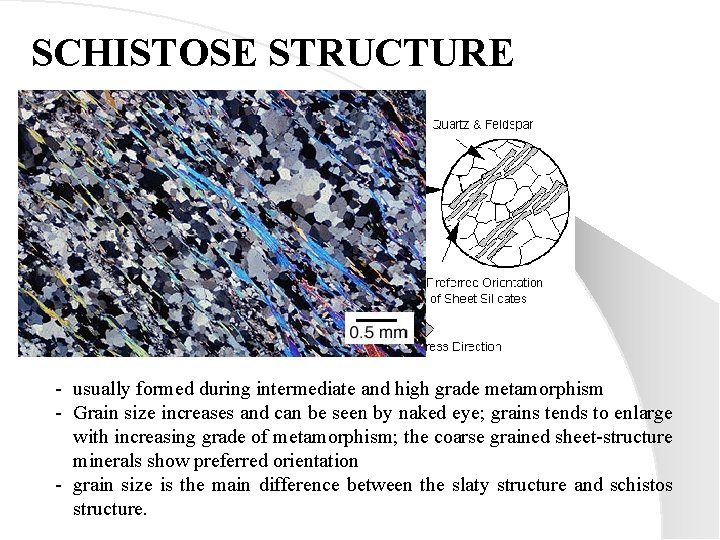
SCHISTOSE STRUCTURE - usually formed during intermediate and high grade metamorphism - Grain size increases and can be seen by naked eye; grains tends to enlarge with increasing grade of metamorphism; the coarse grained sheet-structure minerals show preferred orientation - grain size is the main difference between the slaty structure and schistos structure.
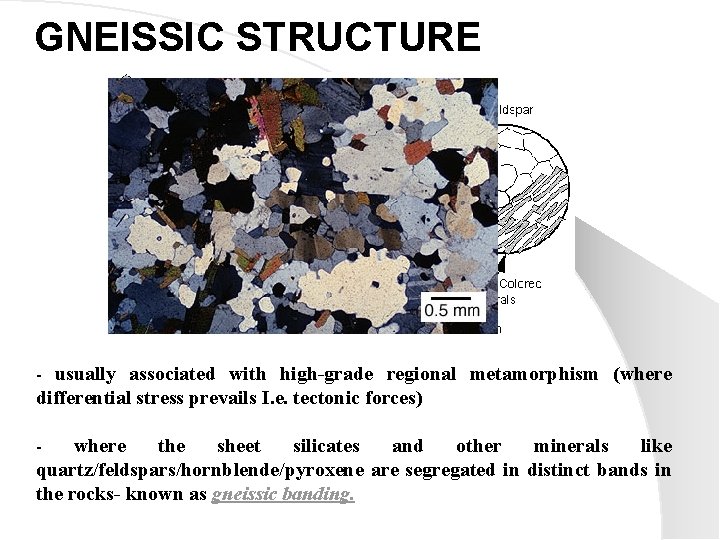
GNEISSIC STRUCTURE - usually associated with high-grade regional metamorphism (where differential stress prevails I. e. tectonic forces) where the sheet silicates and other minerals like quartz/feldspars/hornblende/pyroxene are segregated in distinct bands in the rocks- known as gneissic banding. -
Classification of Metamorphic rocks based on texture/structures SLATE -strongly cleaved rock -cleavage planes are developed due to orientation of fine phyllosilcate grains eg. Muscovite, biotite, chlorite etc. -individual grains too fine to be visible with naked eye -overall dull appearance PHYLLITE -similar to slate, but slightly coarser phyllosilicate grains -grains can be seen in hand specimen, giving silk appearance to cleavage surfaces -often cleavage planes less perfectly planar than slates
SCHIST -parallel alignment of moderately coarse grains (fabric=schistocity) -grains are visible by eye -mainly phyllosilicates and other minerals such as hornblende, kyanite etc. GNEISS -coarse grained rock (grain size several millimetres) and -foliated (planar fabric: either schistosity or compositional layering) -tendency for different minerals to segregate into layers parallel to foliation (gneissic layering): typically quartz and feldspar rich layers tend to separate from micaceous layers. Varieties: --Orthogneiss: rocks formed from Igneous rocks -- paragneiss: rocks formed from Sedimentary rocks -metasedimentary gneisses
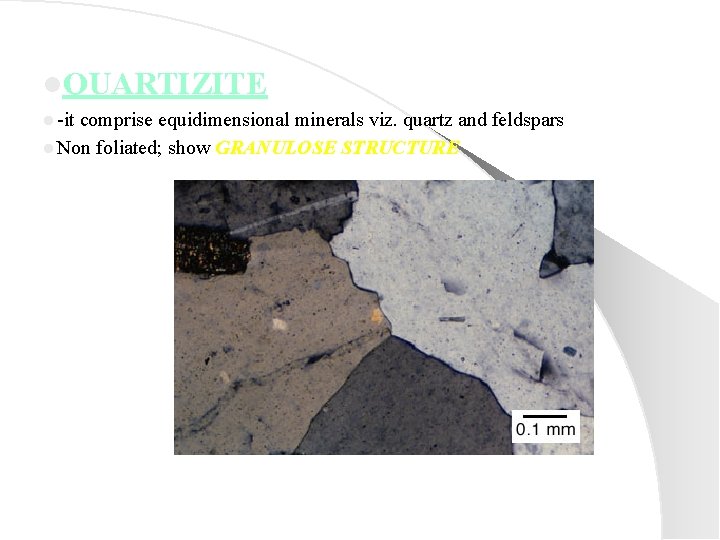
l. QUARTIZITE l -it comprise equidimensional minerals viz. quartz and feldspars l Non foliated; show GRANULOSE STRUCTURE
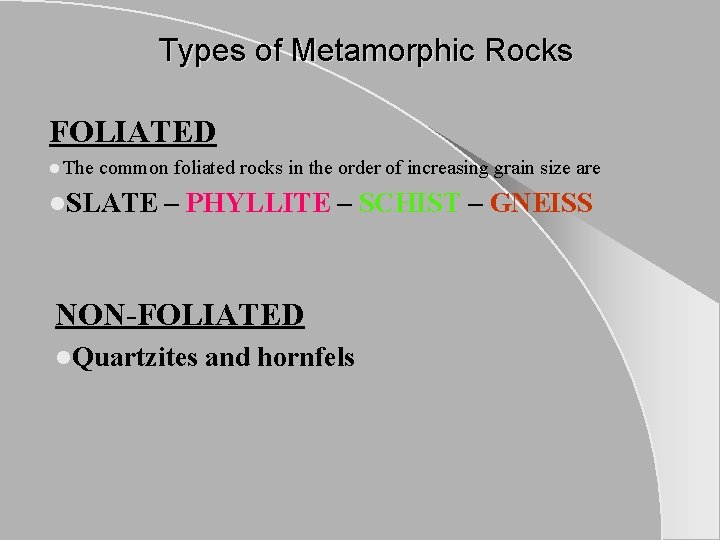
Types of Metamorphic Rocks FOLIATED l The common foliated rocks in the order of increasing grain size are l. SLATE – PHYLLITE – SCHIST – GNEISS NON-FOLIATED l. Quartzites and hornfels
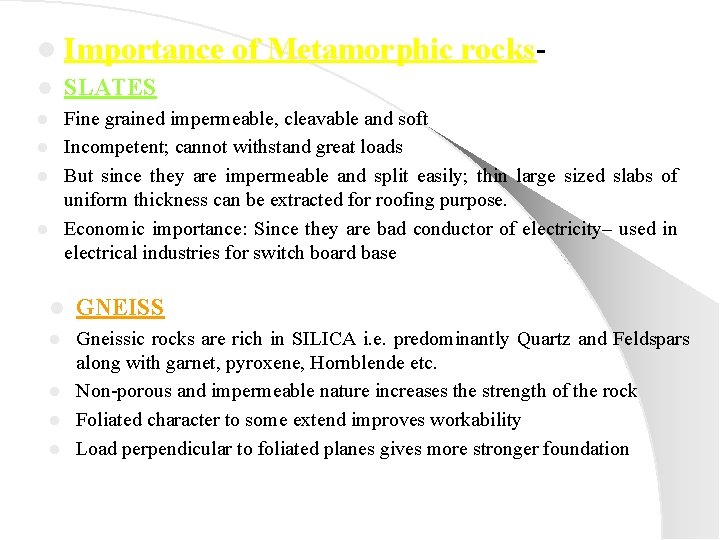
l Importance l of Metamorphic rocks- SLATES Fine grained impermeable, cleavable and soft l Incompetent; cannot withstand great loads l But since they are impermeable and split easily; thin large sized slabs of uniform thickness can be extracted for roofing purpose. l Economic importance: Since they are bad conductor of electricity– used in electrical industries for switch board base l l GNEISS Gneissic rocks are rich in SILICA i. e. predominantly Quartz and Feldspars along with garnet, pyroxene, Hornblende etc. l Non-porous and impermeable nature increases the strength of the rock l Foliated character to some extend improves workability l Load perpendicular to foliated planes gives more stronger foundation l
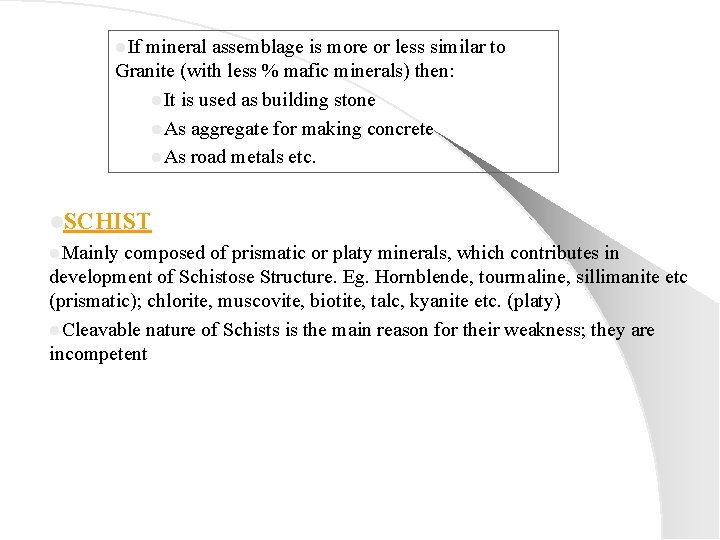
l. If mineral assemblage is more or less similar to Granite (with less % mafic minerals) then: l. It is used as building stone l. As aggregate for making concrete l. As road metals etc. l. SCHIST l. Mainly composed of prismatic or platy minerals, which contributes in development of Schistose Structure. Eg. Hornblende, tourmaline, sillimanite etc (prismatic); chlorite, muscovite, biotite, talc, kyanite etc. (platy) l. Cleavable nature of Schists is the main reason for their weakness; they are incompetent
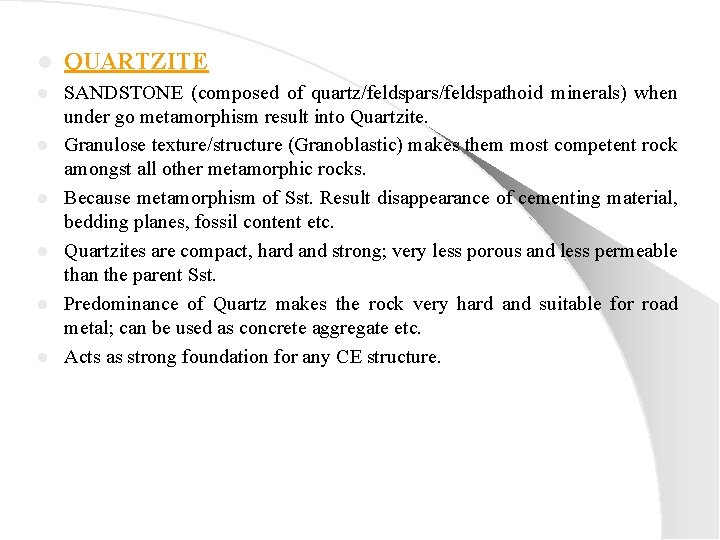
l QUARTZITE l SANDSTONE (composed of quartz/feldspars/feldspathoid minerals) when under go metamorphism result into Quartzite. Granulose texture/structure (Granoblastic) makes them most competent rock amongst all other metamorphic rocks. Because metamorphism of Sst. Result disappearance of cementing material, bedding planes, fossil content etc. Quartzites are compact, hard and strong; very less porous and less permeable than the parent Sst. Predominance of Quartz makes the rock very hard and suitable for road metal; can be used as concrete aggregate etc. Acts as strong foundation for any CE structure. l l l
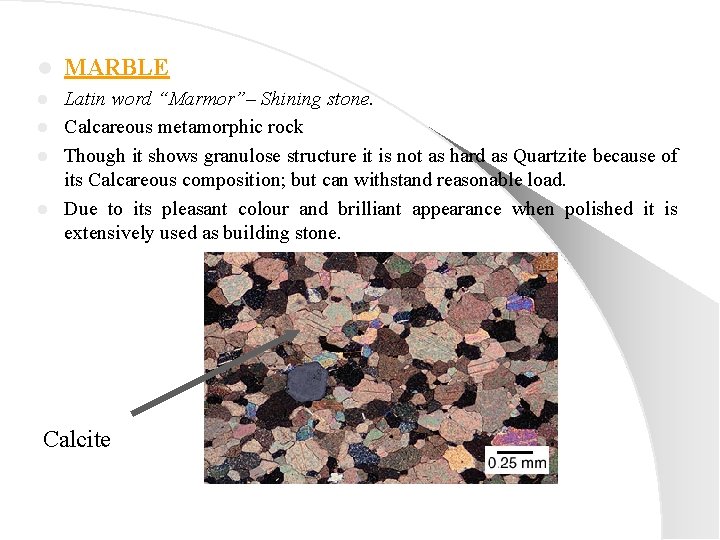
l MARBLE Latin word “Marmor”– Shining stone. l Calcareous metamorphic rock l Though it shows granulose structure it is not as hard as Quartzite because of its Calcareous composition; but can withstand reasonable load. l Due to its pleasant colour and brilliant appearance when polished it is extensively used as building stone. l Calcite
Metamorphic fabric and textures Texture (grain-grain relationships) refer to: 1) shape and size of the individual grains 2) orientation of the individual grains 3) arrangements of the mineral grains in metamorphic rock structure used for large features _Fabric refer to the complete spatial and configuration of textural and structural elements geometric _Importance of textures in metamorphic rocks to: 1) decipher the order of crystallization of minerals, 2) sequence of events involved in forming the metamorphic rocks, 3) Intensity of P-T condition during metamorphism, and 4) used to nominate the metamorphic rocks
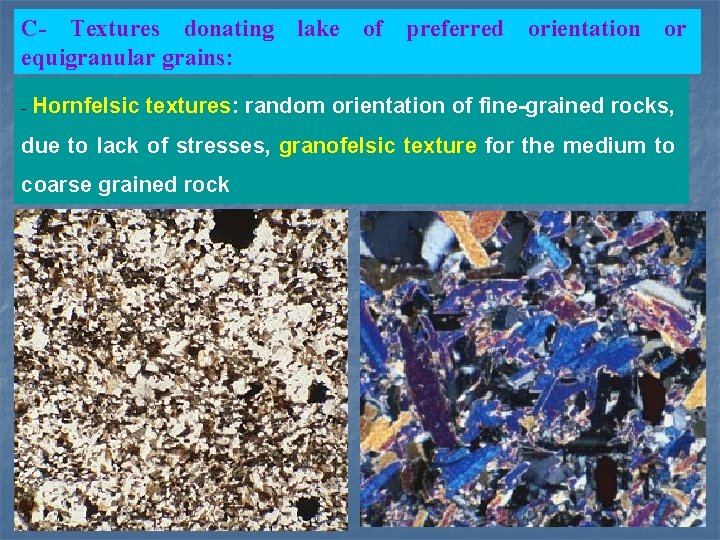
C- Textures donating lake of preferred orientation or equigranular grains: - Hornfelsic textures: random orientation of fine-grained rocks, due to lack of stresses, granofelsic texture for the medium to coarse grained rock
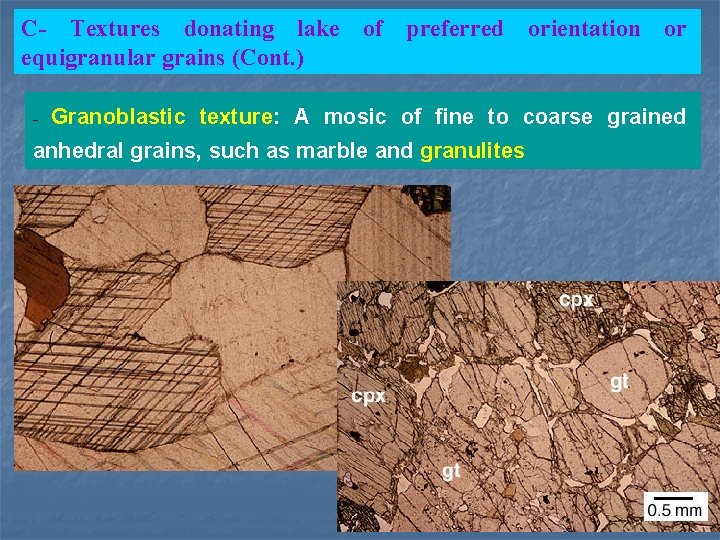
C- Textures donating lake of preferred orientation or equigranular grains (Cont. ) - Granoblastic texture: A mosic of fine to coarse grained anhedral grains, such as marble and granulites
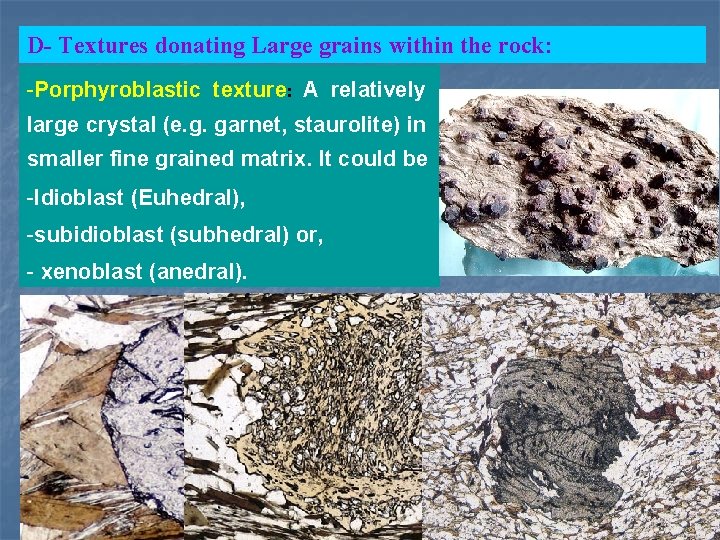
D- Textures donating Large grains within the rock: -Porphyroblastic texture: A relatively large crystal (e. g. garnet, staurolite) in smaller fine grained matrix. It could be -Idioblast (Euhedral), -subidioblast (subhedral) or, - xenoblast (anedral).
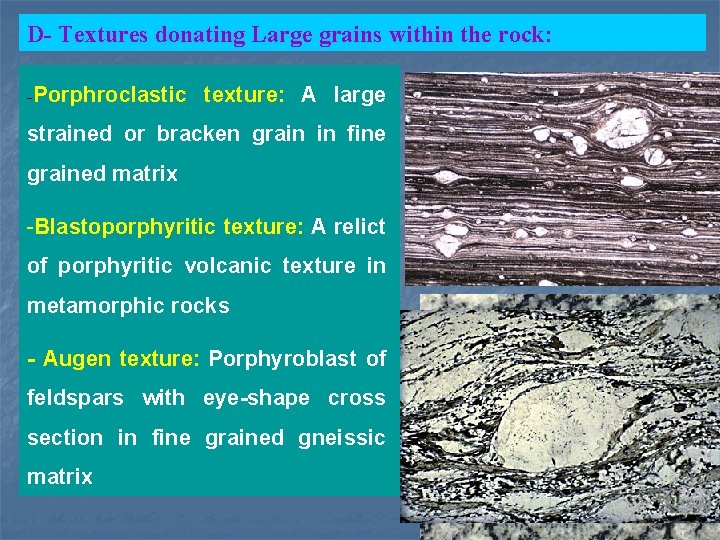
D- Textures donating Large grains within the rock: -Porphroclastic texture: A large strained or bracken grain in fine grained matrix -Blastoporphyritic texture: A relict of porphyritic volcanic texture in metamorphic rocks - Augen texture: Porphyroblast of feldspars with eye-shape cross section in fine grained gneissic matrix
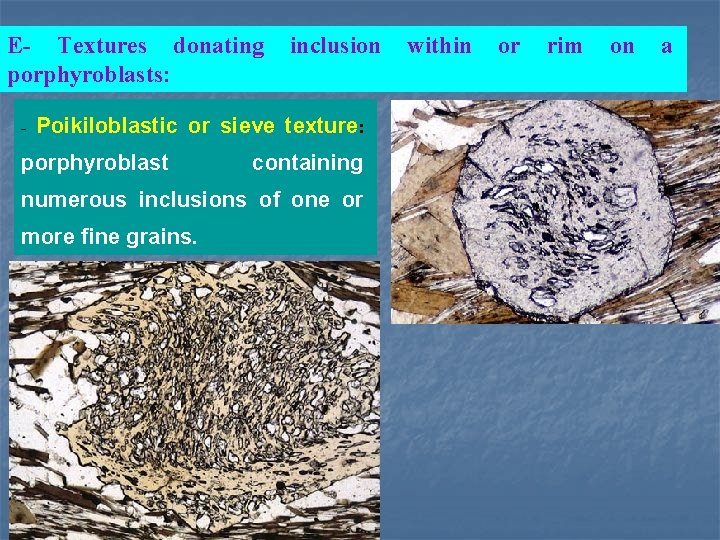
E- Textures donating porphyroblasts: inclusion - Poikiloblastic or sieve texture: porphyroblast containing numerous inclusions of one or more fine grains. within or rim on a
METAMORPHIC GRADE & FACIES CONCEPT
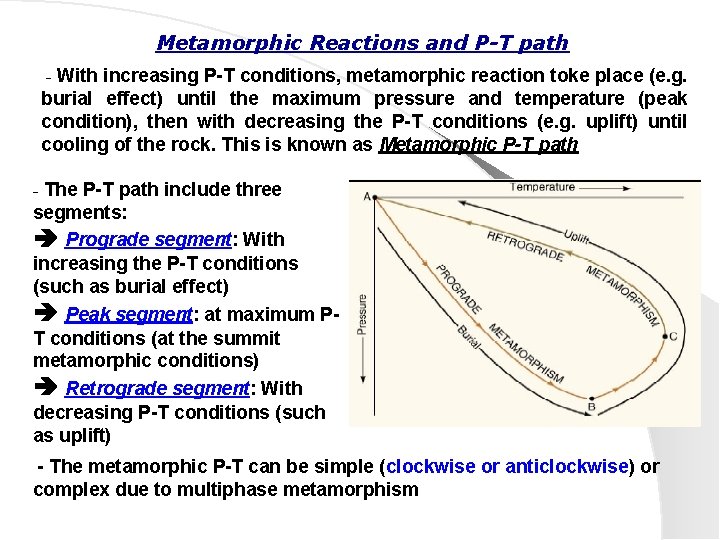
Metamorphic Reactions and P-T path - With increasing P-T conditions, metamorphic reaction toke place (e. g. burial effect) until the maximum pressure and temperature (peak condition), then with decreasing the P-T conditions (e. g. uplift) until cooling of the rock. This is known as Metamorphic P-T path - The P-T path include three segments: Prograde segment: With increasing the P-T conditions (such as burial effect) Peak segment: at maximum PT conditions (at the summit metamorphic conditions) Retrograde segment: With decreasing P-T conditions (such as uplift) - The metamorphic P-T can be simple (clockwise or anticlockwise) or complex due to multiphase metamorphism
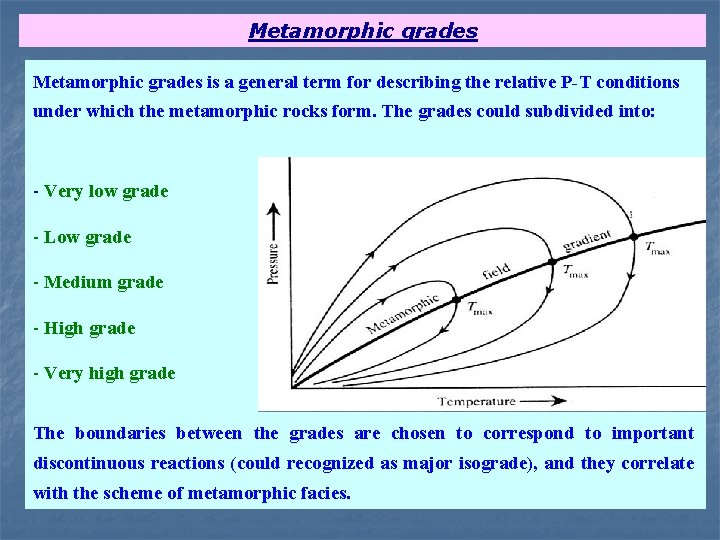
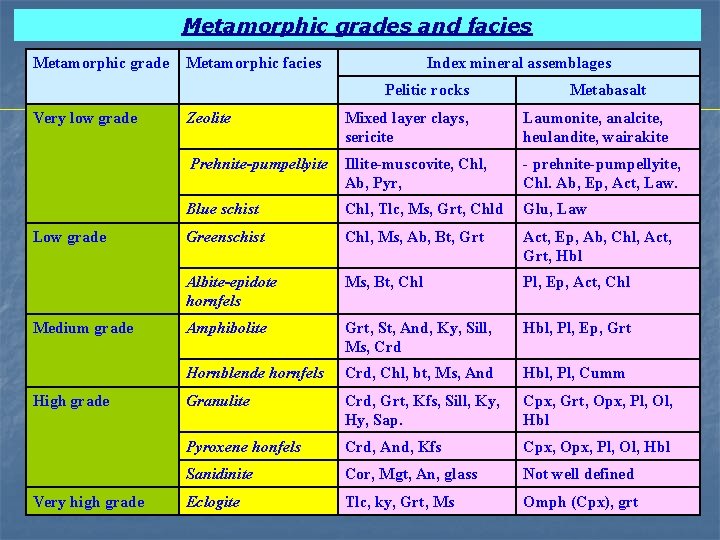
Metamorphic grades is a general term for describing the relative P-T conditions under which the metamorphic rocks form. The grades could subdivided into: - Very low grade - Low grade - Medium grade - High grade - Very high grade The boundaries between the grades are chosen to correspond to important discontinuous reactions (could recognized as major isograde), and they correlate with the scheme of metamorphic facies.
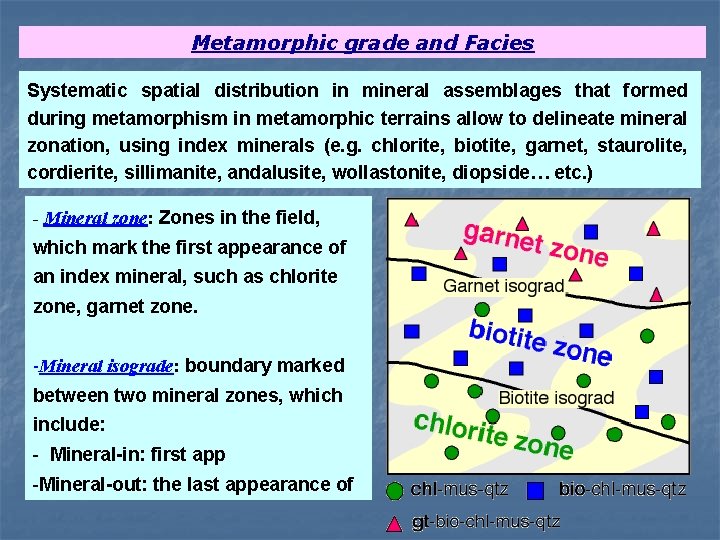
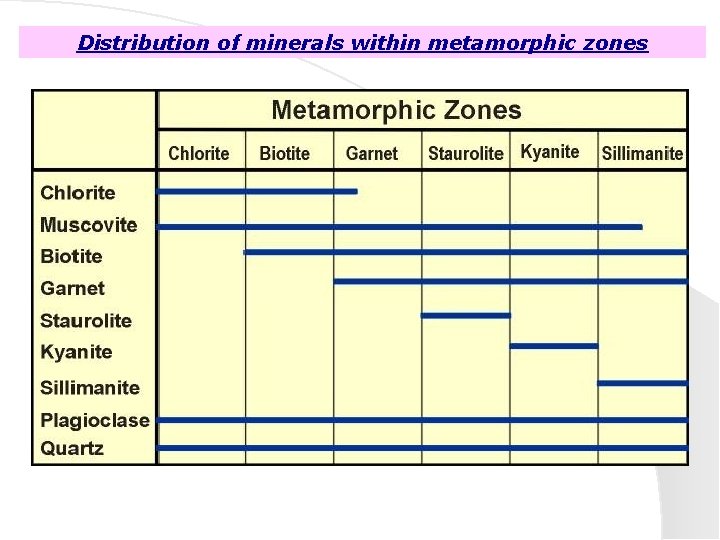
Metamorphic grade and Facies Systematic spatial distribution in mineral assemblages that formed during metamorphism in metamorphic terrains allow to delineate mineral zonation, using index minerals (e. g. chlorite, biotite, garnet, staurolite, cordierite, sillimanite, andalusite, wollastonite, diopside… etc. ) - Mineral zone: Zones in the field, which mark the first appearance of an index mineral, such as chlorite zone, garnet zone. -Mineral isograde: boundary marked between two mineral zones, which include: - Mineral-in: first app -Mineral-out: the last appearance of
Distribution of minerals within metamorphic zones
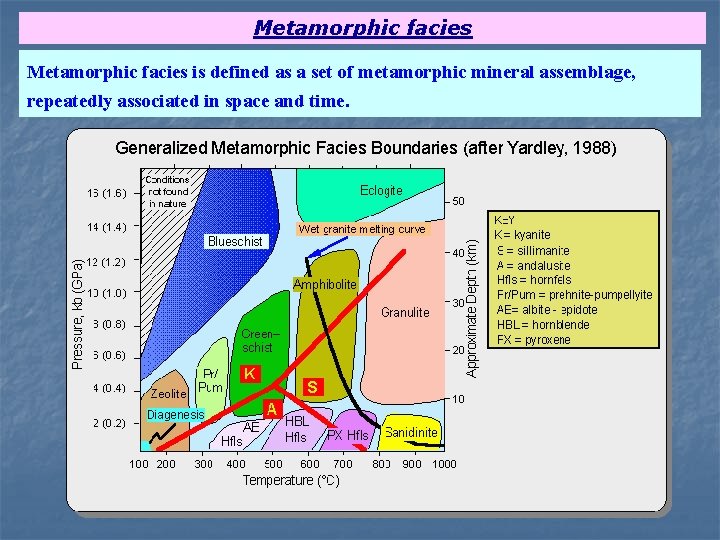
Metamorphic facies is defined as a set of metamorphic mineral assemblage, repeatedly associated in space and time.
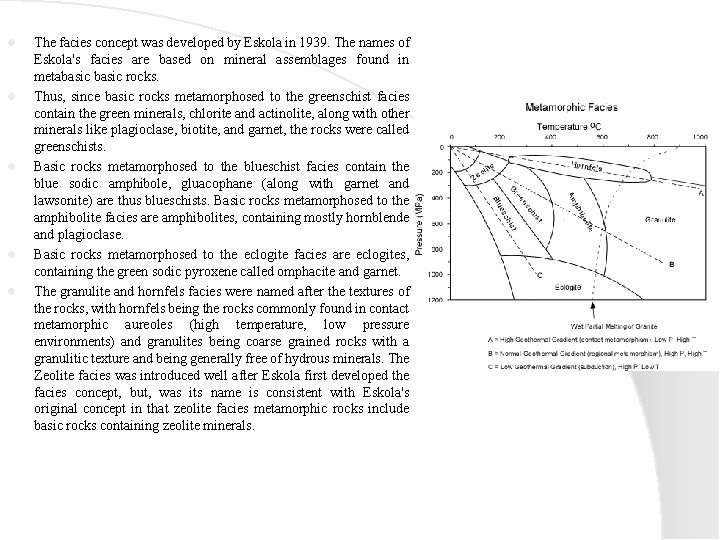
l l l The facies concept was developed by Eskola in 1939. The names of Eskola's facies are based on mineral assemblages found in metabasic rocks. Thus, since basic rocks metamorphosed to the greenschist facies contain the green minerals, chlorite and actinolite, along with other minerals like plagioclase, biotite, and garnet, the rocks were called greenschists. Basic rocks metamorphosed to the blueschist facies contain the blue sodic amphibole, gluacophane (along with garnet and lawsonite) are thus blueschists. Basic rocks metamorphosed to the amphibolite facies are amphibolites, containing mostly hornblende and plagioclase. Basic rocks metamorphosed to the eclogite facies are eclogites, containing the green sodic pyroxene called omphacite and garnet. The granulite and hornfels facies were named after the textures of the rocks, with hornfels being the rocks commonly found in contact metamorphic aureoles (high temperature, low pressure environments) and granulites being coarse grained rocks with a granulitic texture and being generally free of hydrous minerals. The Zeolite facies was introduced well after Eskola first developed the facies concept, but, was its name is consistent with Eskola's original concept in that zeolite facies metamorphic rocks include basic rocks containing zeolite minerals.
Metamorphic grades and facies Metamorphic grade Metamorphic facies Index mineral assemblages Pelitic rocks Very low grade Low grade Medium grade High grade Very high grade Metabasalt Zeolite Mixed layer clays, sericite Laumonite, analcite, heulandite, wairakite Prehnite-pumpellyite Illite-muscovite, Chl, Ab, Pyr, - prehnite-pumpellyite, Chl. Ab, Ep, Act, Law. Blue schist Chl, Tlc, Ms, Grt, Chld Glu, Law Greenschist Chl, Ms, Ab, Bt, Grt Act, Ep, Ab, Chl, Act, Grt, Hbl Albite-epidote hornfels Ms, Bt, Chl Pl, Ep, Act, Chl Amphibolite Grt, St, And, Ky, Sill, Ms, Crd Hbl, Pl, Ep, Grt Hornblende hornfels Crd, Chl, bt, Ms, And Hbl, Pl, Cumm Granulite Crd, Grt, Kfs, Sill, Ky, Hy, Sap. Cpx, Grt, Opx, Pl, Ol, Hbl Pyroxene honfels Crd, And, Kfs Cpx, Opx, Pl, Ol, Hbl Sanidinite Cor, Mgt, An, glass Not well defined Eclogite Tlc, ky, Grt, Ms Omph (Cpx), grt
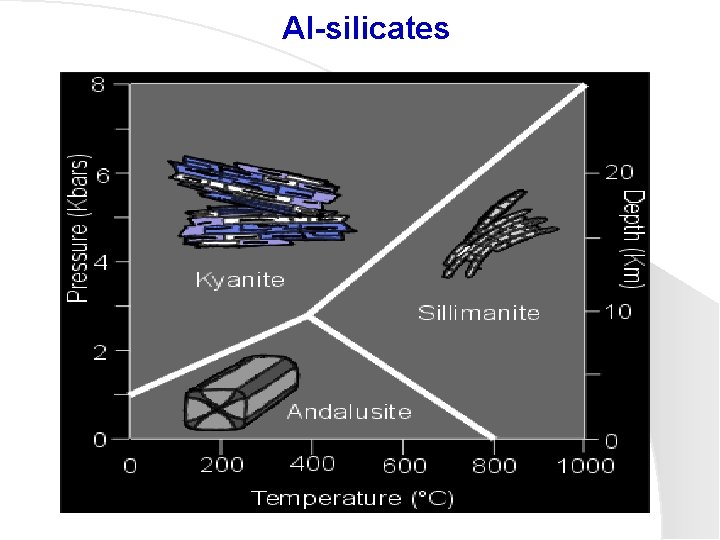
Al-silicates
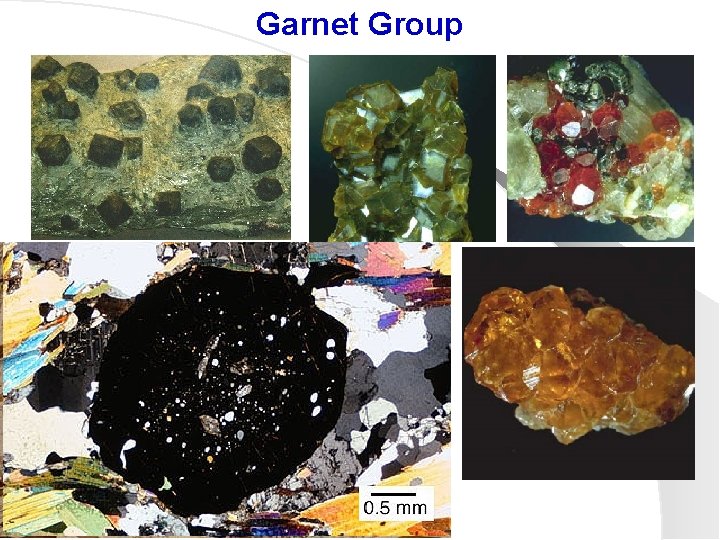
Garnet Group
l REFERENCES l l l Best, M. G. (2002). Igneous and Metamorphic Petrology (2 nded. ). Oxford, UK: Blackwell Science. Billings, M. P. (1972). Structural Geology (3 rded. ). New York, NY: Prentice Hall. Blatt, H. , & Tracy, R. J. (1996). Petrology: Igneous, Sedimentary, Metamorphic (2 nded. ). New York, NY: W. H. Freeman and Co. Collins, J. D. , & Thompson, D. B. (1982). Sedimentary Structures. London, UK: George Allen &Unwin. Ehlers, E. G. , & Blatt, H. (1982). Igneous, Sedimentary and Metamorphic Petrology. New Delhi, India: CBS.