Monogastric Digestive System Matching Species n Cow n


- Slides: 63
Monogastric Digestive System
Matching… Species n Cow n Pig n Kangaroo n Sheep n Horse n Dog n Chicken Digestive System n Ruminant n Monogastric n Pre-gastric Fermentation n Post-gastric Fermentation n Herbivore n Carnivore n Omnivore
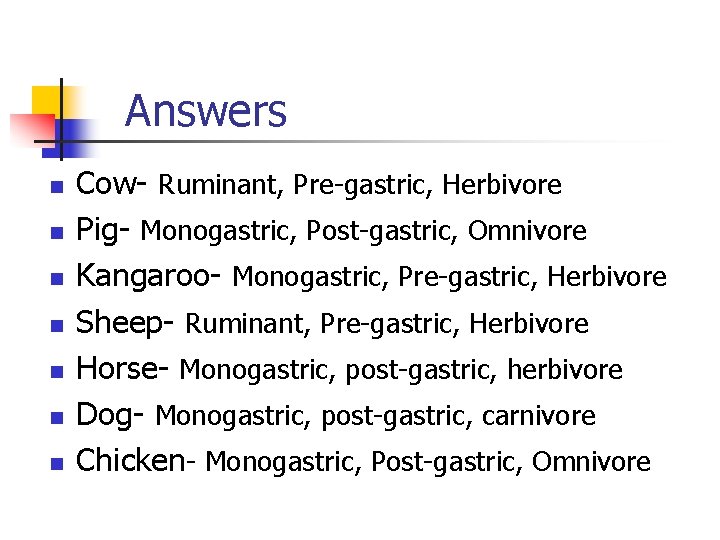
Answers n n n n Cow- Ruminant, Pre-gastric, Herbivore Pig- Monogastric, Post-gastric, Omnivore Kangaroo- Monogastric, Pre-gastric, Herbivore Sheep- Ruminant, Pre-gastric, Herbivore Horse- Monogastric, post-gastric, herbivore Dog- Monogastric, post-gastric, carnivore Chicken- Monogastric, Post-gastric, Omnivore
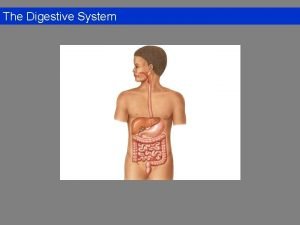
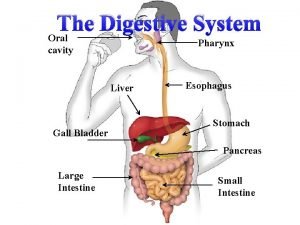
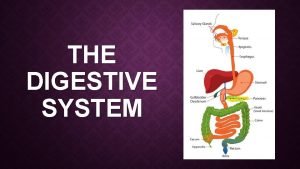
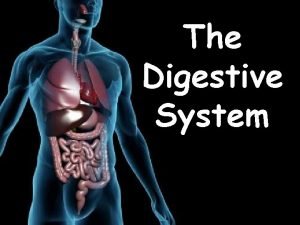
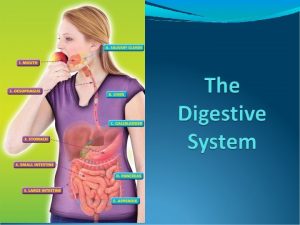
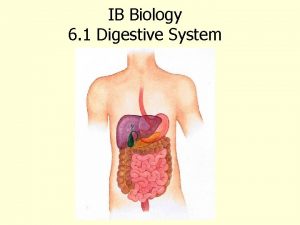
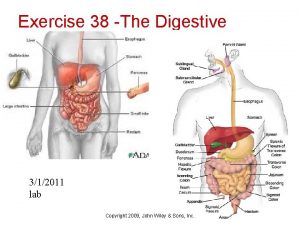
Basic Organization n n n Mouth Esophagus Stomach Small intestine Large intestine Anus
Associated Structures n n Pancreas Contribute to small Liver intestinal digestion Gallbladder Salivary glands
Structures in Mouth n n Lips Teeth Tongue Salivary glands
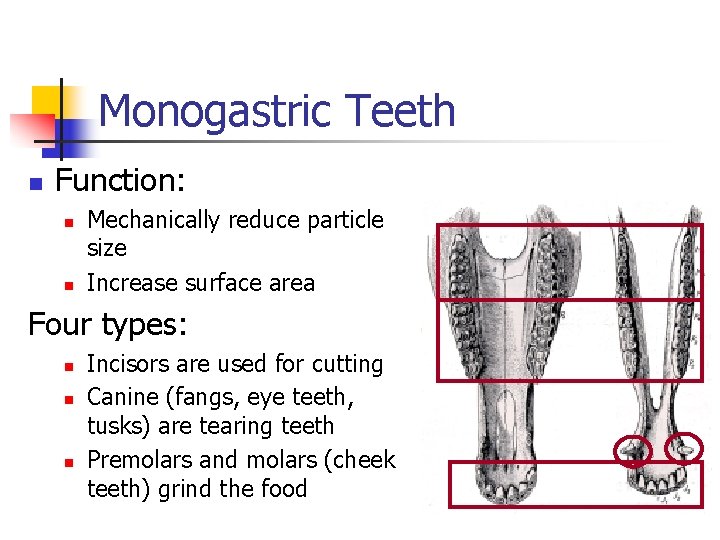
Monogastric Teeth n Function: n n Mechanically reduce particle size Increase surface area Four types: n n n Incisors are used for cutting Canine (fangs, eye teeth, tusks) are tearing teeth Premolars and molars (cheek teeth) grind the food
Monogastric Tongue Function: n n Comprised of three muscles Maneuvers food in the mouth n n Moves feed to teeth for grinding and to the back of the mouth for swallowing Can distinguish between feed and toxins by papillae or taste buds
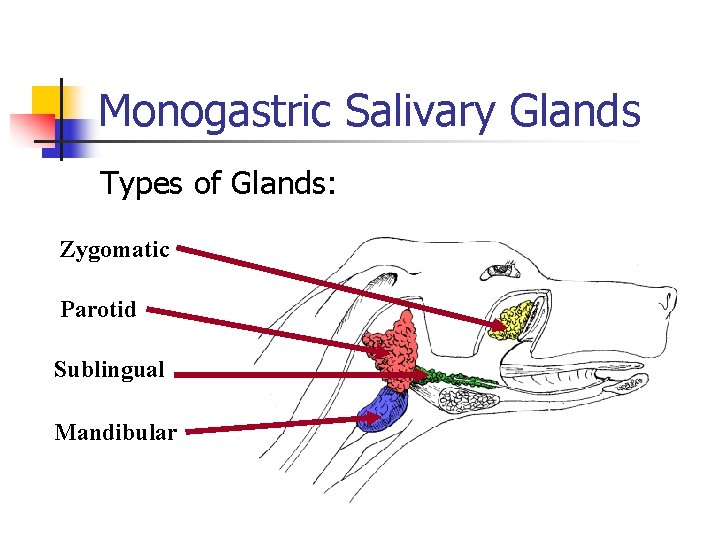
Monogastric Salivary Glands Types of Glands: Zygomatic Parotid Sublingual Mandibular
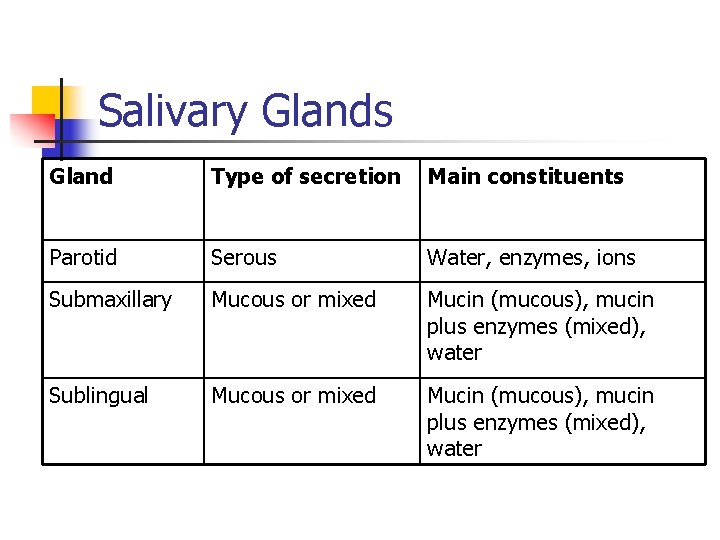
Salivary Glands Gland Type of secretion Main constituents Parotid Serous Water, enzymes, ions Submaxillary Mucous or mixed Mucin (mucous), mucin plus enzymes (mixed), water Sublingual Mucous or mixed Mucin (mucous), mucin plus enzymes (mixed), water
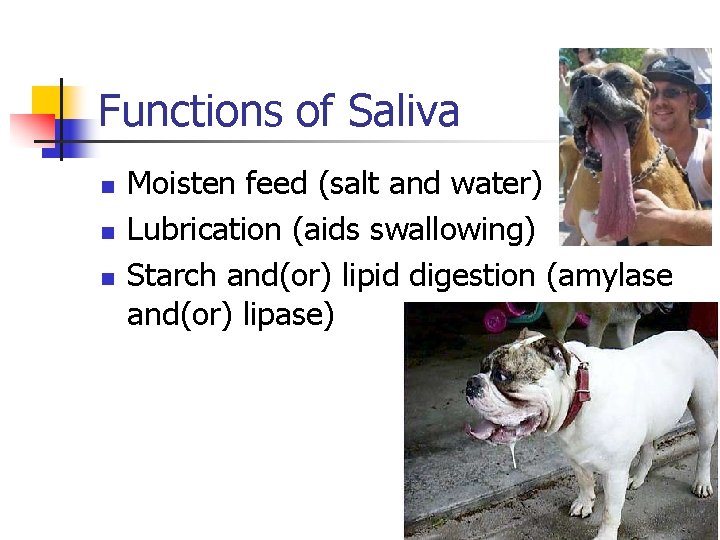
Functions of Saliva n n n Moisten feed (salt and water) Lubrication (aids swallowing) Starch and(or) lipid digestion (amylase and(or) lipase)
Monogastric Salivary Glands n Flow rate affected by: n Parasympathetic nervous system n n n Sympathetic nervous system n n n Increased tone = Increased flow = Increased dilution Increased tone = Decreased flow = Increased concentration Volume of saliva n n 1 - 1. 5 L/d man and pig 7 - 10 L/d horse
Monogastric Esophagus n n n Transport of food from mouth to stomach Uses peristaltic contractions (wave contractions) Horse/Pig: n n n Striated muscles for first 2/3 Smooth muscles for last 1/3 In horse, esophagus joins stomach at an oblique angle and cardiac sphincter (the valve between the stomach and esophagus) only allows one-way flow n n MOST horses cannot belch out gas or vomit Dog: n Striated muscles throughout allow GREAT control of digesta movement both directions
Deglutition (Swallowing) n n Reflex initiated by presence of food in pharnyx Propulsion of food to stomach by esophageal peristalsis
Gastric Digestion n Functions n Reservoir for controlled release of digesta to small intestine n n Mixing food Mechanical breakdown of feed Hydrolytic digestion by acid and enzymes n n Horse has small capacity – requires increased number of smaller sized meals Mainly protein Kill bacteria Secrete intrinsic factor: needed for vitamin B 12 absorption Hormone production
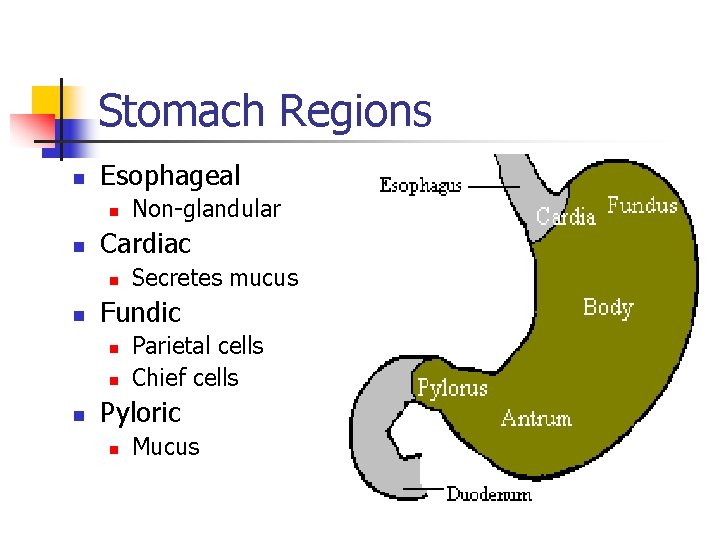
Stomach Regions n Esophageal n n Cardiac n n Secretes mucus Fundic n n n Non-glandular Parietal cells Chief cells Pyloric n Mucus
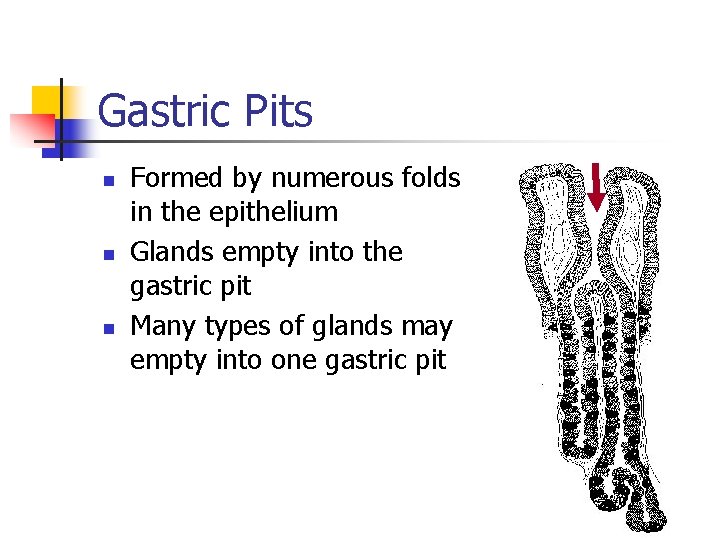
Gastric Pits n n n Formed by numerous folds in the epithelium Glands empty into the gastric pit Many types of glands may empty into one gastric pit
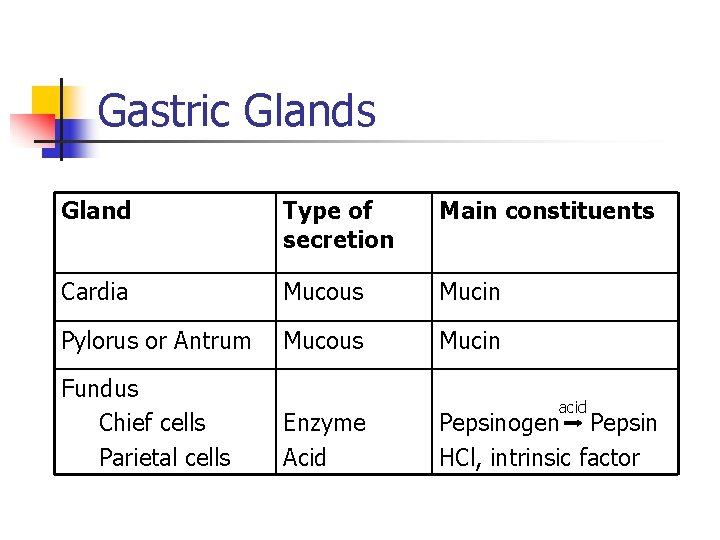
Gastric Glands Gland Type of secretion Main constituents Cardia Mucous Mucin Pylorus or Antrum Mucous Mucin Fundus Chief cells Parietal cells Enzyme Acid acid Pepsinogen Pepsin HCl, intrinsic factor
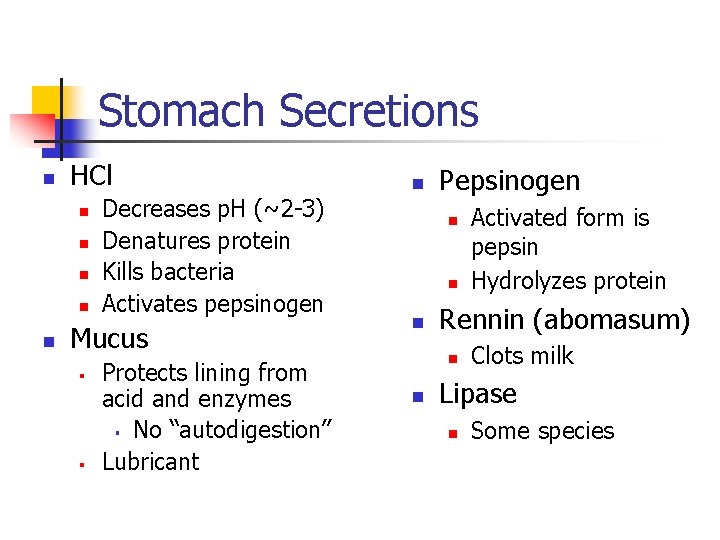
Stomach Secretions n HCl n n n Decreases p. H (~2 -3) Denatures protein Kills bacteria Activates pepsinogen Mucus § § Protects lining from acid and enzymes § No “autodigestion” Lubricant n Pepsinogen n Rennin (abomasum) n n Activated form is pepsin Hydrolyzes protein Clots milk Lipase n Some species
Gastric Motility and Emptying n Motility aids mixing, mechanical and hydrolytic reduction of feed to chyme n n acid pulp Emptying is stimulated by distension of antral wall and presence of liquid chyme
Control of Gastric Secretions and Gastric Motility n n n Cephalic phase Gastric phase Intestinal phase
Cephalic Phase n Vagal reflex n n n Parasympathetic innervation Increases gastric motility, enzyme secretion Small increase in HCl secretion
Gastric Phase n n Local reflex, depends on presence of feed in stomach Mainly mediated by gastrin n Increases HCl secretion
Intestinal Phase n n Stimulated by duodenal distension, p. H, osmolarity, nutrients (fat) Pancreozymin-cholecystokinin (PZ-CCK) is released by the small intestine n Decreases HCl secretion and gastric motility
Gastrointestinal Hormones n Gastrin n n Origin: Stomach, Abomasum Stimulus: Food in stomach Function: Stimulates HCl & pepsinogen secretion, increases stomach motility Secretin n Origin: Duodenum Stimulus: Acid Function: Stimulates pancreatic secretions. Slows stomach motility and acid production
Gastrointestinal Hormones n Cholecystokinin (CCK) n n n Origin: Duodenum Stimulus: Fat & protein in duodenum Function: Stimulates bile and pancreatic secretions n n Also regulates appetite and feed intake Gastric Inhibitory Protein (GIP) n n n Origin: Duodenum Stimulus: Fats and bile Function: Inhibit stomach motility and secretion of acid and enzymes
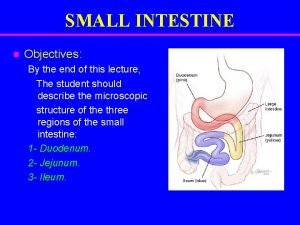
Small Intestine n Composed of 3 segments (proximal to distal) n Duodenum n n n Jejunum n n Active site of nutrient absorption Ileum n n The Releases bile and pancreatic secretions Active site of digestion Active site of nutrient absorption n Most water, vitamins & minerals Some bacterial presence n Fermentation p. H of the small intestine increases towards 7. 0 as food moves from the duodenum to the ileum
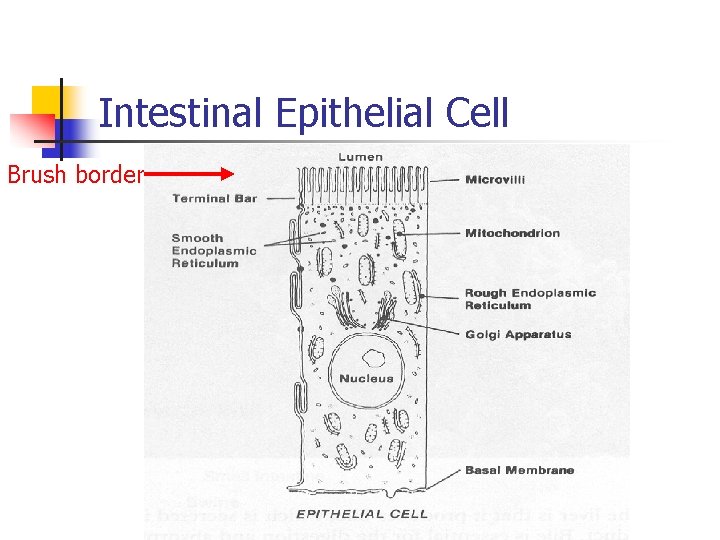
Intestinal Epithelial Cell Brush border
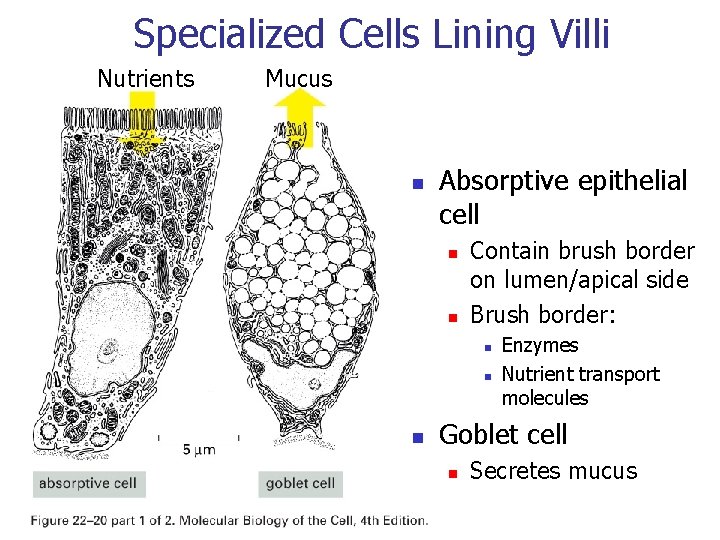
Specialized Cells Lining Villi Nutrients Mucus n Absorptive epithelial cell n n Contain brush border on lumen/apical side Brush border: n n n Enzymes Nutrient transport molecules Goblet cell n Secretes mucus
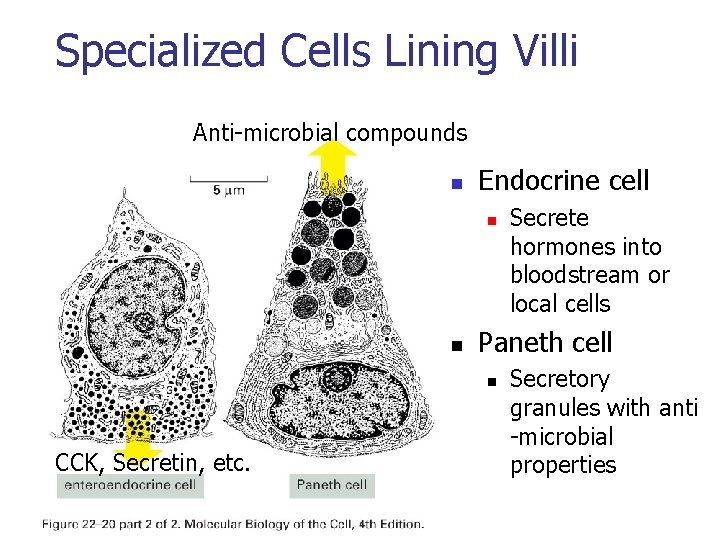
Specialized Cells Lining Villi Anti-microbial compounds n Endocrine cell n n Paneth cell n CCK, Secretin, etc. Secrete hormones into bloodstream or local cells Secretory granules with anti -microbial properties
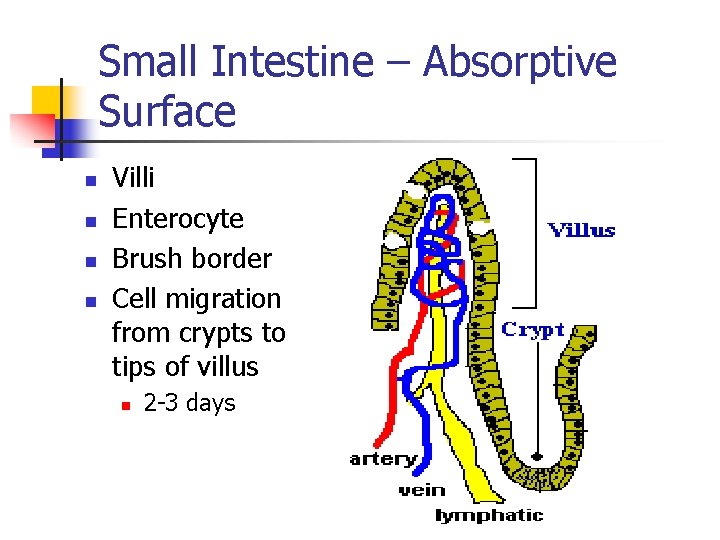
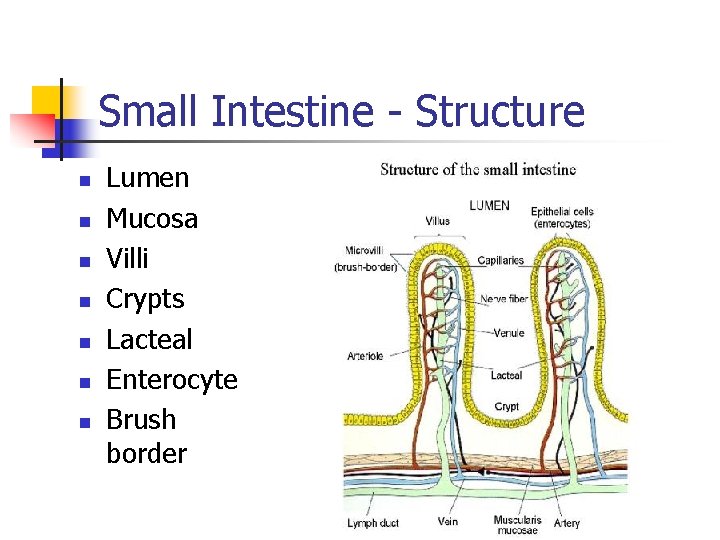
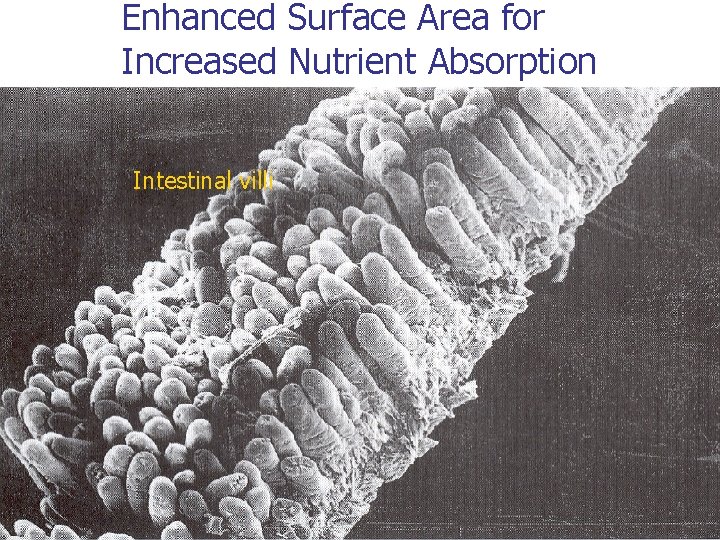
Small Intestine – Absorptive Surface n n Villi Enterocyte Brush border Cell migration from crypts to tips of villus n 2 -3 days
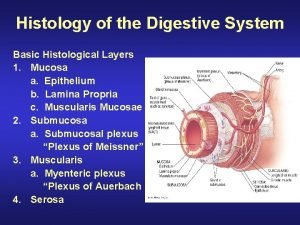
Small Intestine - Structure n n n n Lumen Mucosa Villi Crypts Lacteal Enterocyte Brush border
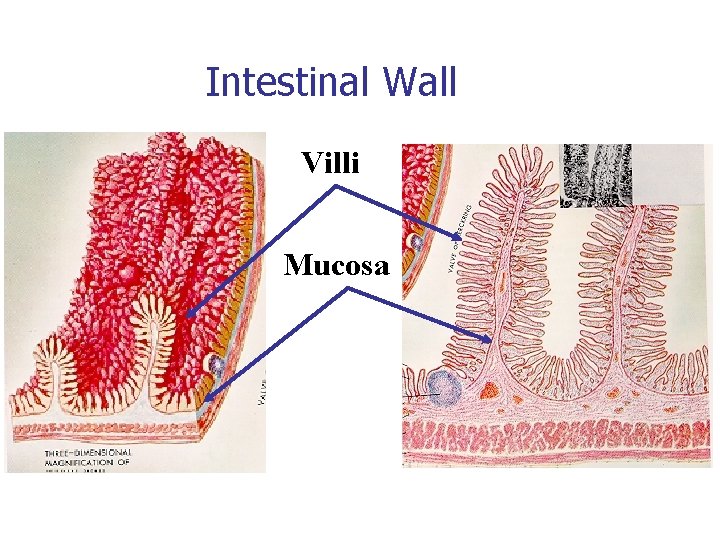
Intestinal Wall Villi Mucosa
Enhanced Surface Area for Increased Nutrient Absorption Intestinal villi
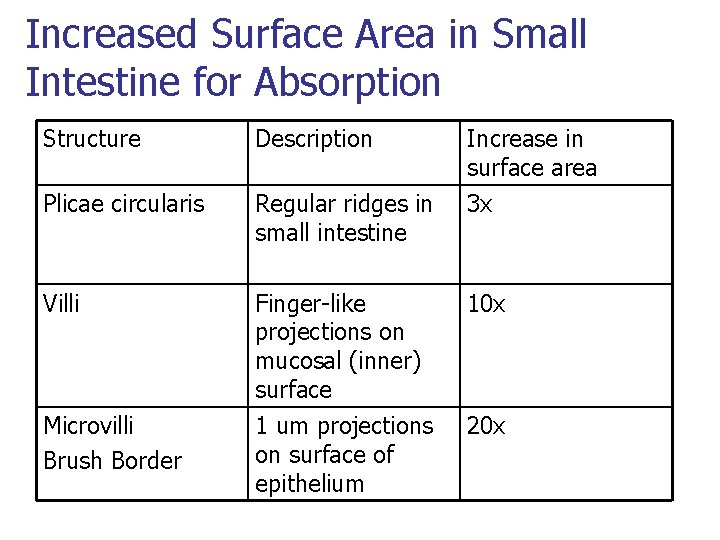
Increased Surface Area in Small Intestine for Absorption Structure Description Plicae circularis Regular ridges in small intestine Villi Finger-like projections on mucosal (inner) surface 1 um projections on surface of epithelium Microvilli Brush Border Increase in surface area 3 x 10 x 20 x
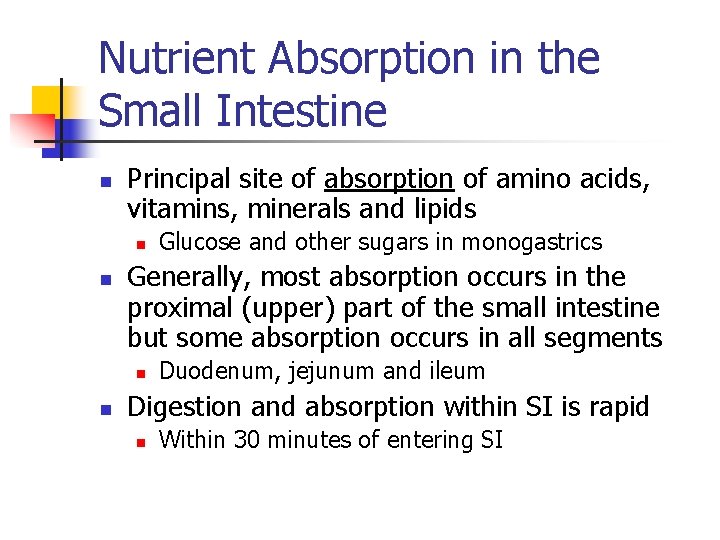
Nutrient Absorption in the Small Intestine n Principal site of absorption of amino acids, vitamins, minerals and lipids n n Generally, most absorption occurs in the proximal (upper) part of the small intestine but some absorption occurs in all segments n n Glucose and other sugars in monogastrics Duodenum, jejunum and ileum Digestion and absorption within SI is rapid n Within 30 minutes of entering SI
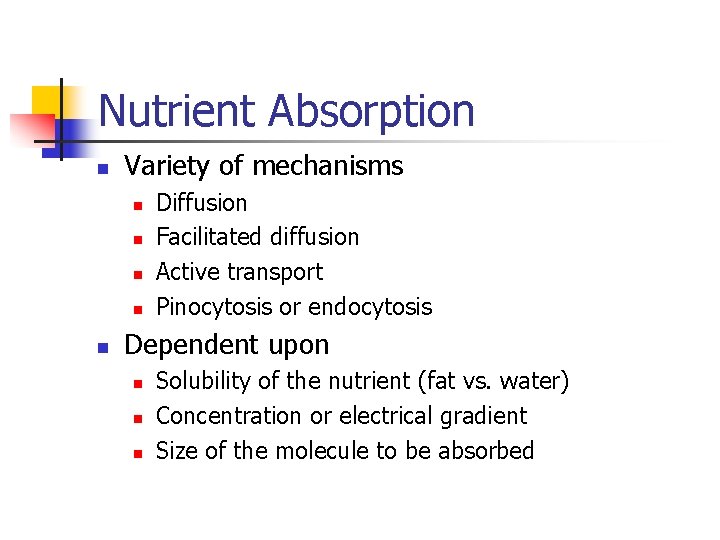
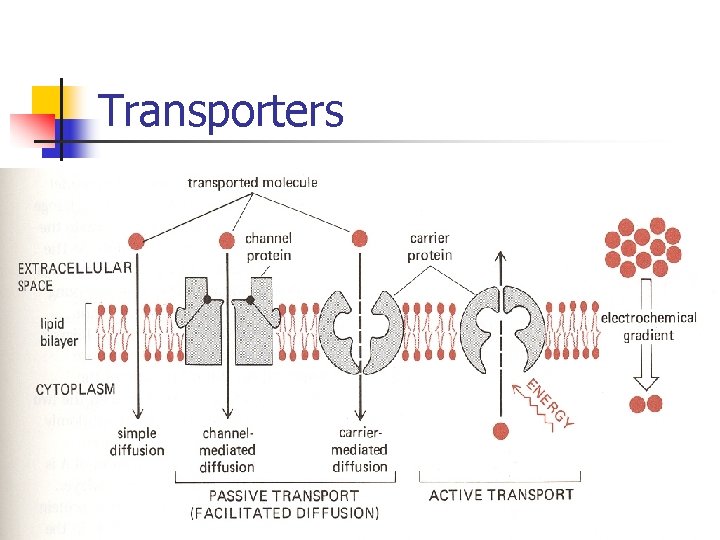
Nutrient Absorption n Variety of mechanisms n n n Diffusion Facilitated diffusion Active transport Pinocytosis or endocytosis Dependent upon n Solubility of the nutrient (fat vs. water) Concentration or electrical gradient Size of the molecule to be absorbed
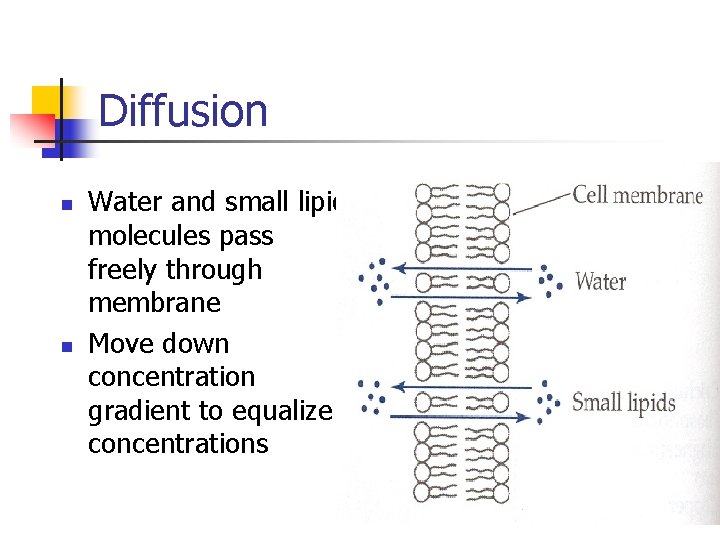
Diffusion n n Water and small lipid molecules pass freely through membrane Move down concentration gradient to equalize concentrations
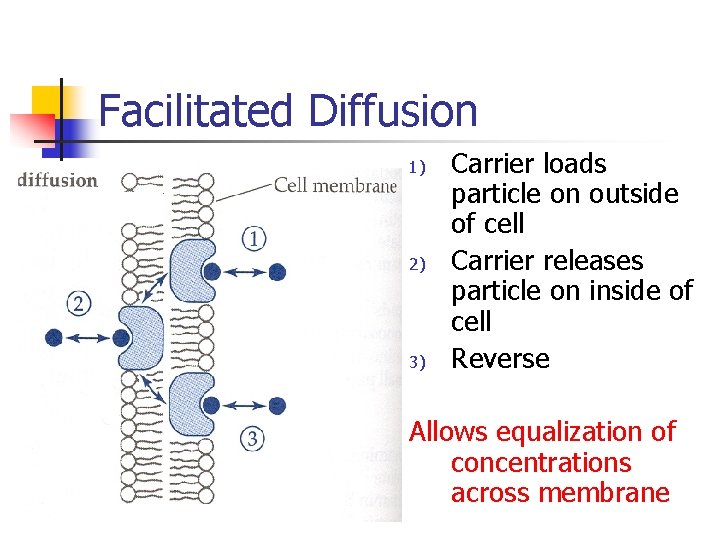
Facilitated Diffusion 1) 2) 3) Carrier loads particle on outside of cell Carrier releases particle on inside of cell Reverse Allows equalization of concentrations across membrane
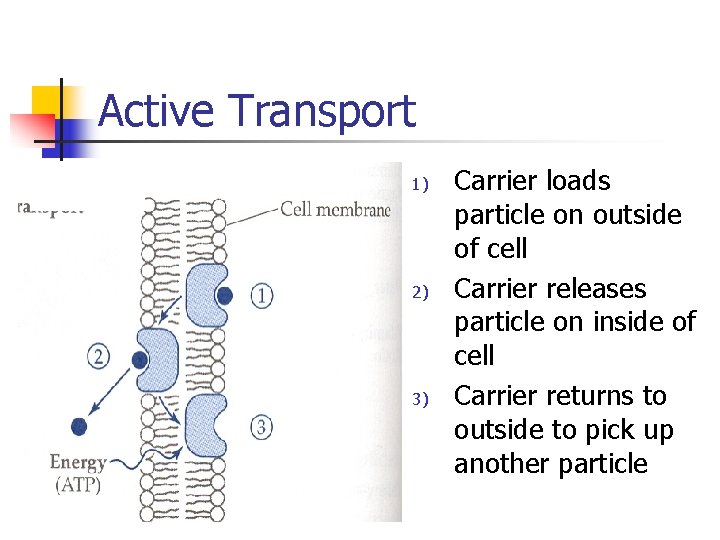
Active Transport 1) 2) 3) Carrier loads particle on outside of cell Carrier releases particle on inside of cell Carrier returns to outside to pick up another particle
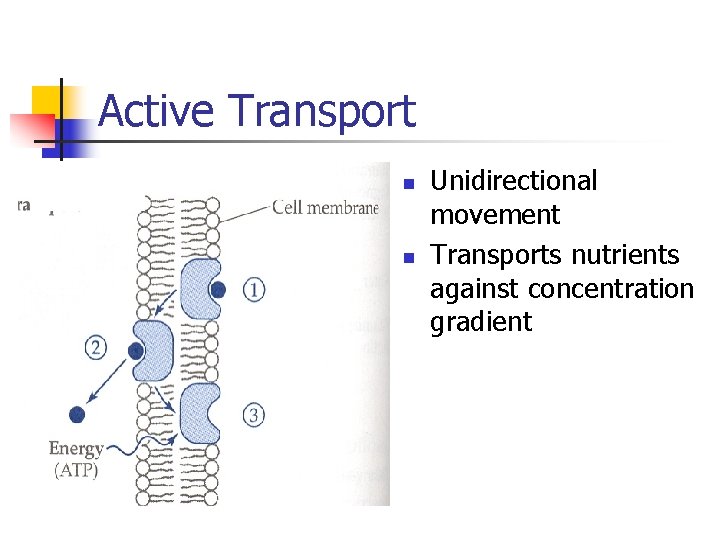
Active Transport n n Unidirectional movement Transports nutrients against concentration gradient
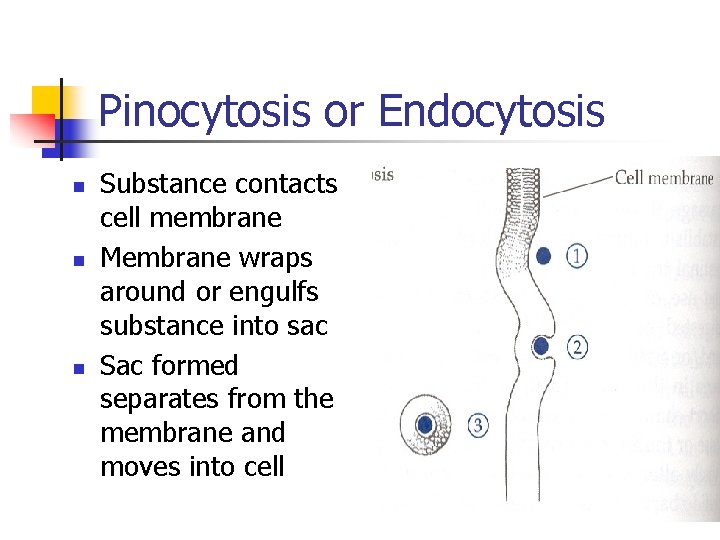
Pinocytosis or Endocytosis n n n Substance contacts cell membrane Membrane wraps around or engulfs substance into sac Sac formed separates from the membrane and moves into cell
Transporters
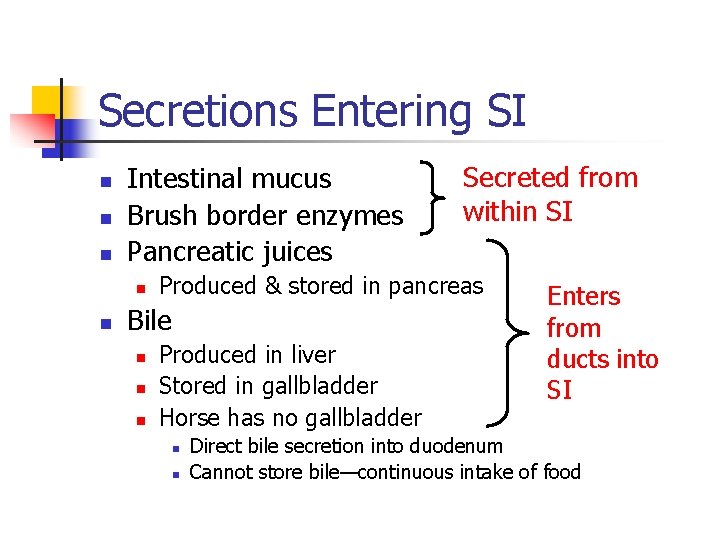
Secretions Entering SI n n n Intestinal mucus Brush border enzymes Pancreatic juices n n Produced & stored in pancreas Bile n n n Secreted from within SI Produced in liver Stored in gallbladder Horse has no gallbladder n n Enters from ducts into SI Direct bile secretion into duodenum Cannot store bile—continuous intake of food
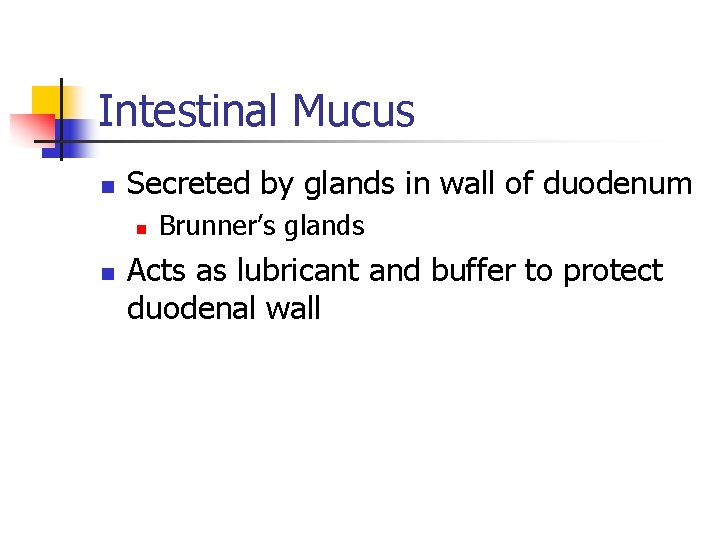
Intestinal Mucus n Secreted by glands in wall of duodenum n n Brunner’s glands Acts as lubricant and buffer to protect duodenal wall
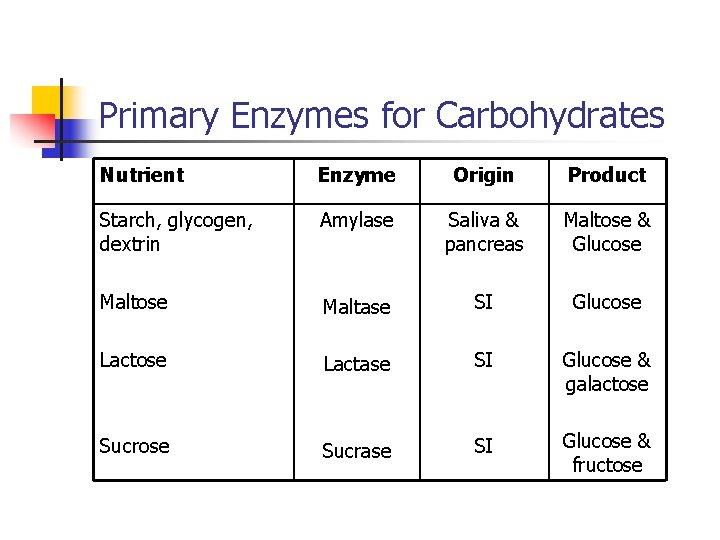
Primary Enzymes for Carbohydrates Nutrient Enzyme Origin Product Starch, glycogen, dextrin Amylase Saliva & pancreas Maltose & Glucose Maltase SI Glucose Lactase SI Glucose & galactose Sucrase SI Glucose & fructose
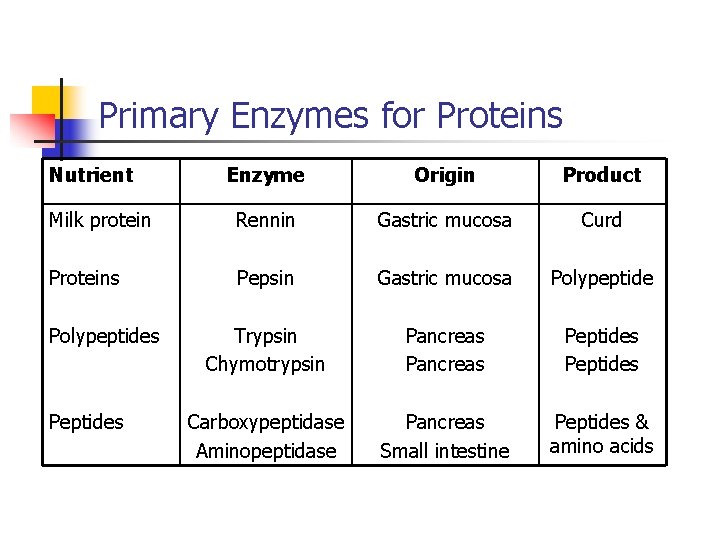
Primary Enzymes for Proteins Nutrient Enzyme Origin Product Milk protein Rennin Gastric mucosa Curd Proteins Pepsin Gastric mucosa Polypeptide Trypsin Chymotrypsin Pancreas Peptides Carboxypeptidase Aminopeptidase Pancreas Small intestine Peptides & amino acids Polypeptides Peptides
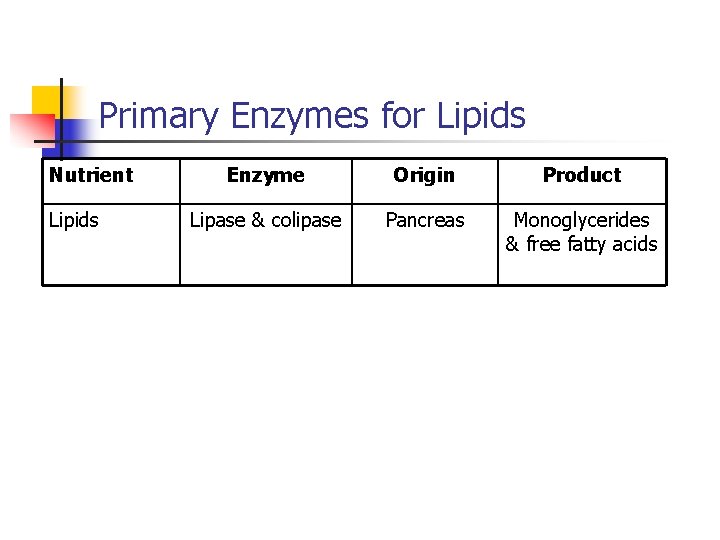
Primary Enzymes for Lipids Nutrient Lipids Enzyme Origin Product Lipase & colipase Pancreas Monoglycerides & free fatty acids
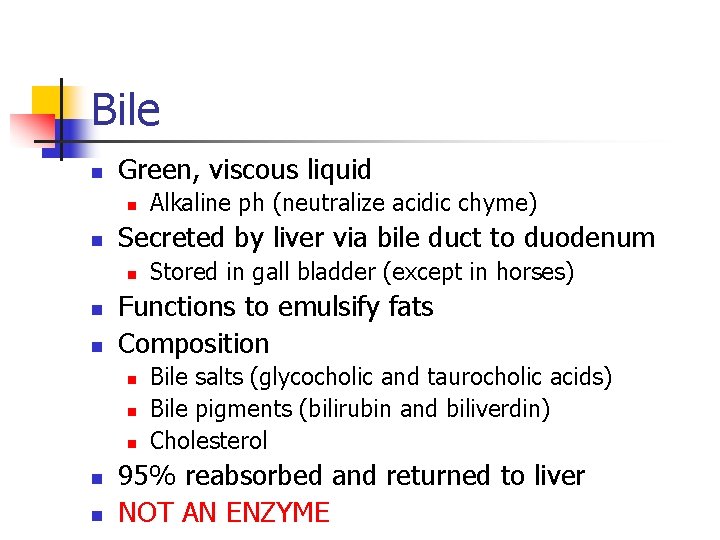
Bile n Green, viscous liquid n n Secreted by liver via bile duct to duodenum n n n Stored in gall bladder (except in horses) Functions to emulsify fats Composition n n Alkaline ph (neutralize acidic chyme) Bile salts (glycocholic and taurocholic acids) Bile pigments (bilirubin and biliverdin) Cholesterol 95% reabsorbed and returned to liver NOT AN ENZYME
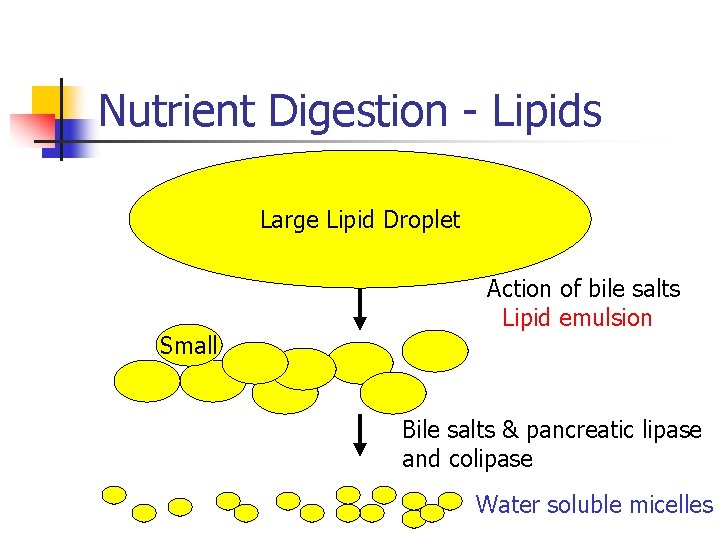
Nutrient Digestion - Lipids Large Lipid Droplet Small Action of bile salts Lipid emulsion Bile salts & pancreatic lipase and colipase Water soluble micelles
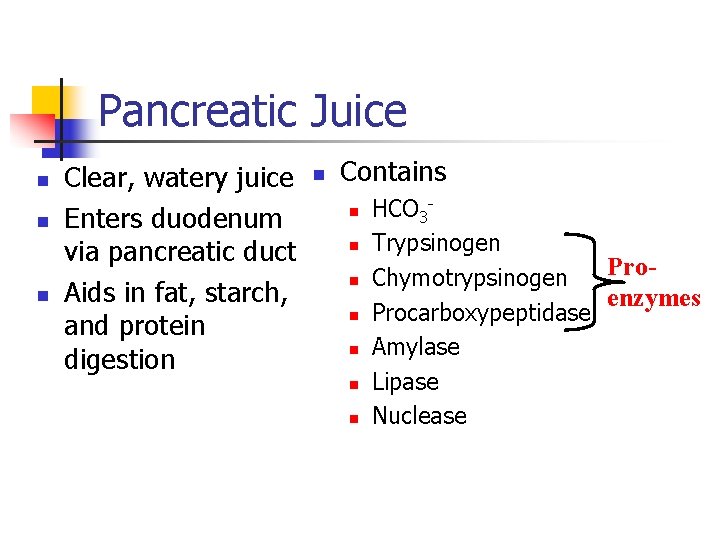
Pancreatic Juice n n n Clear, watery juice Enters duodenum via pancreatic duct Aids in fat, starch, and protein digestion n Contains n n n n HCO 3 Trypsinogen Pro. Chymotrypsinogen enzymes Procarboxypeptidase Amylase Lipase Nuclease
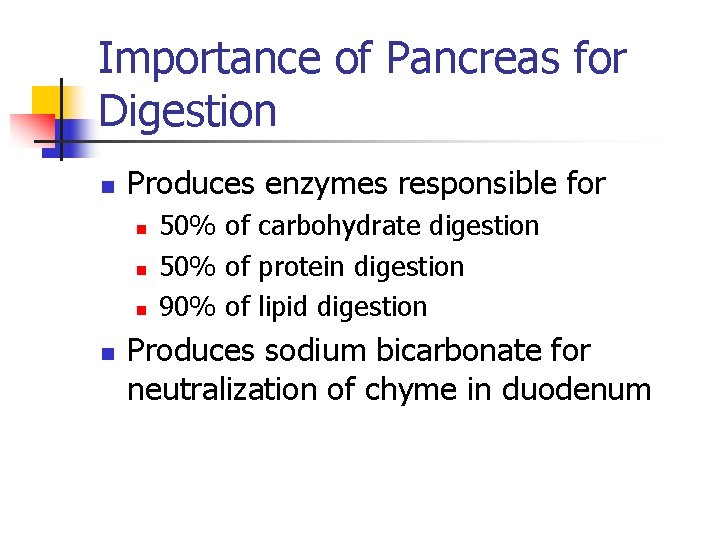
Importance of Pancreas for Digestion n Produces enzymes responsible for n n 50% of carbohydrate digestion 50% of protein digestion 90% of lipid digestion Produces sodium bicarbonate for neutralization of chyme in duodenum
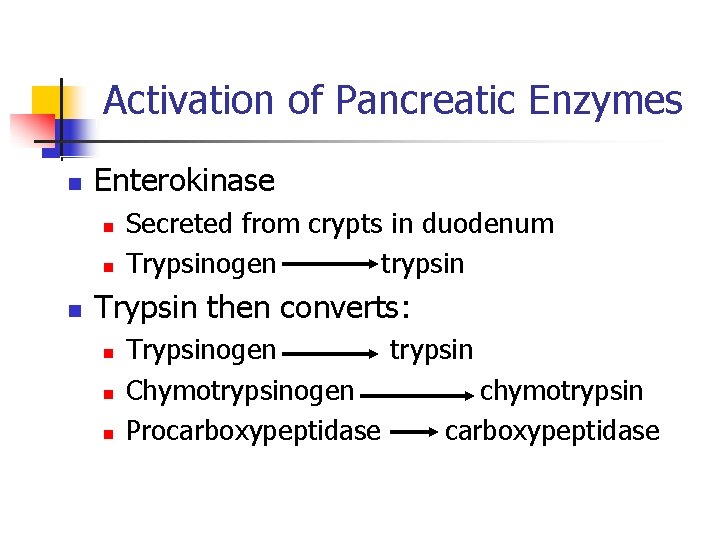
Activation of Pancreatic Enzymes n Enterokinase n n n Secreted from crypts in duodenum Trypsinogen trypsin Trypsin then converts: n n n Trypsinogen trypsin Chymotrypsinogen chymotrypsin Procarboxypeptidase
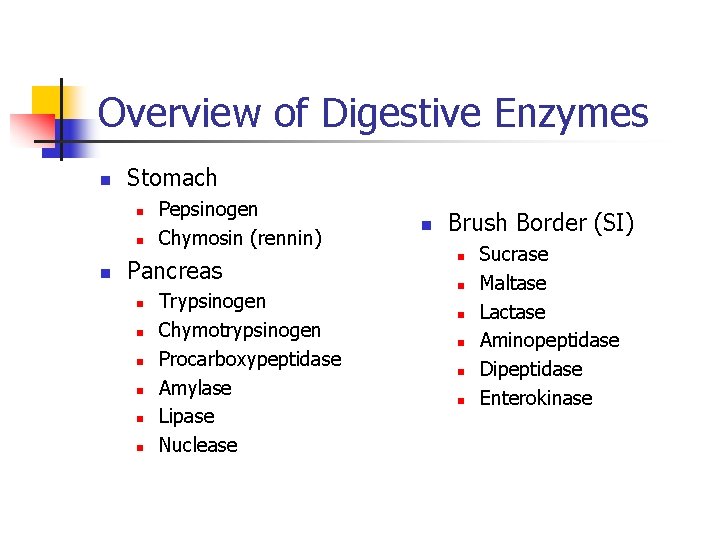
Overview of Digestive Enzymes n Stomach n n n Pepsinogen Chymosin (rennin) Pancreas n n n Trypsinogen Chymotrypsinogen Procarboxypeptidase Amylase Lipase Nuclease n Brush Border (SI) n n n Sucrase Maltase Lactase Aminopeptidase Dipeptidase Enterokinase
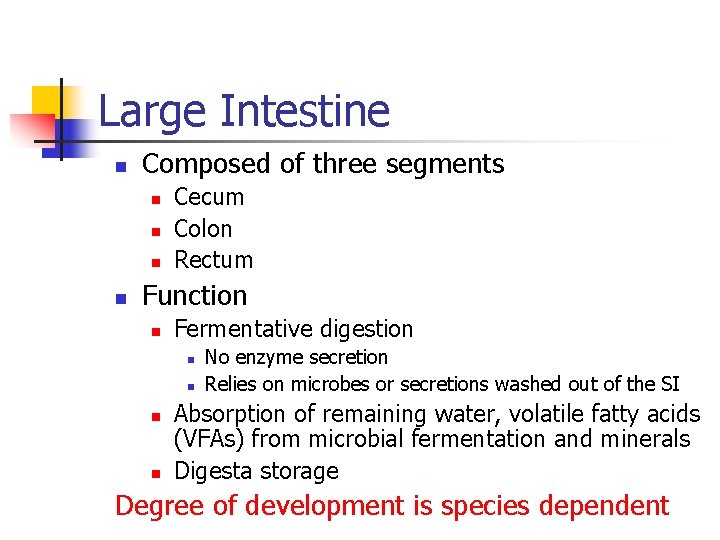
Large Intestine n Composed of three segments n n Cecum Colon Rectum Function n Fermentative digestion n n No enzyme secretion Relies on microbes or secretions washed out of the SI Absorption of remaining water, volatile fatty acids (VFAs) from microbial fermentation and minerals Digesta storage Degree of development is species dependent
Monogastric Cecum n n Located at junction of small and large intestine Function similar to rumen in ruminants n Microbial activity and digestion of feeds n n Contains a microbial population similar to the rumen n Cellulolytic & hemicelluloytic bacteria Since cecum is located AFTER major site of nutrient absorption (small intestine), then microbial cell proteins are not available to the animal n Fecal loss
Monogastric Large Intestine n Function: n n n Absorption of liquid Mass movements move fecal matter to anus Usually only a few times a day n Associated with defecation
Bacteria n n n Cellulolytic – digest cellulose (forages) Amylolytic – digest starches and sugars (concentrates or grains) Other types: n Proteolytic n n n Clostridium Organic acid utilizers Methanogens n Produce CO 2, H 2, formate, CH 4
Rectum n Muscular area of large intestine used for storage of feces and ultimately for defecation n Feces includes sloughed cells, undigested food and microbial matter
Avians (Poultry) Mouth No teeth, rigid tongue Poorly developed salivary glands n n Saliva contains amylase Beak is adapted for prehension and mastication
Avians (Poultry) Esophagus n Enlarged area called crop n n n Ingesta holding and moistening Location for breakdown of carbohydrate by amylase Fermentation Proventriculus (stomach) n n Release of HCl and pepsin (gastric juices) Ingesta passes through very quickly (14 seconds)
Avians (Poultry) Gizzard (ventriculus) n Muscular area with a hardened lining reduces particle size n n n Muscular contractions every 20 -30 seconds Includes action of grit HCl and pepsin secreted in proventriculus Small intestine n n Similar to other monogastrics No Lacteals
Avians (Poultry) Ceca and large intestine n n Contain two ceca instead of one as in other monogastrics Large intestine is very short (2 -4 in) and empties into cloaca where fecal material will be voided via the vent n n n Water resorption Fiber fermentation by bacteria H 2 O soluble vitamin synthesis by bacteria