Ministry of Education ELT General Supervision Private education


- Slides: 47
Ministry of Education ELT General Supervision Private education supervision Differentiated learning theory and practice April 2018
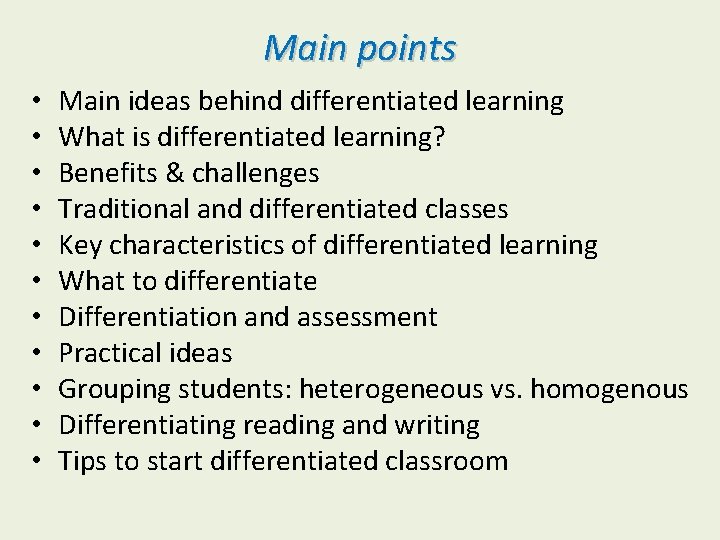
Main points • • • Main ideas behind differentiated learning What is differentiated learning? Benefits & challenges Traditional and differentiated classes Key characteristics of differentiated learning What to differentiate Differentiation and assessment Practical ideas Grouping students: heterogeneous vs. homogenous Differentiating reading and writing Tips to start differentiated classroom
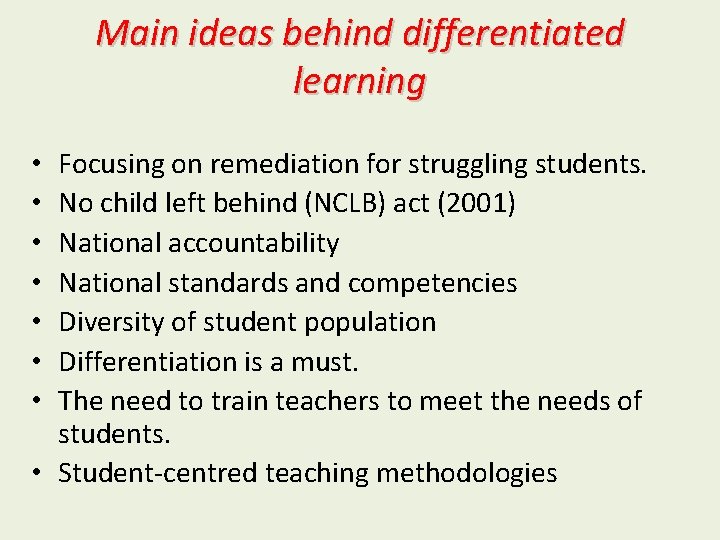
Main ideas behind differentiated learning Focusing on remediation for struggling students. No child left behind (NCLB) act (2001) National accountability National standards and competencies Diversity of student population Differentiation is a must. The need to train teachers to meet the needs of students. • Student-centred teaching methodologies • •
No child left behind (NCLB) objectives • Developing standards for all students and for students with disabilities. • Time limit for the plan 12 years • Adequately Yearly Progress (AYP) AYP must be based on national assessment • Preparing highly-qualified teachers for all students • Every three years data is evaluated • Increased accountability based on standards (funding, closing & transfer)
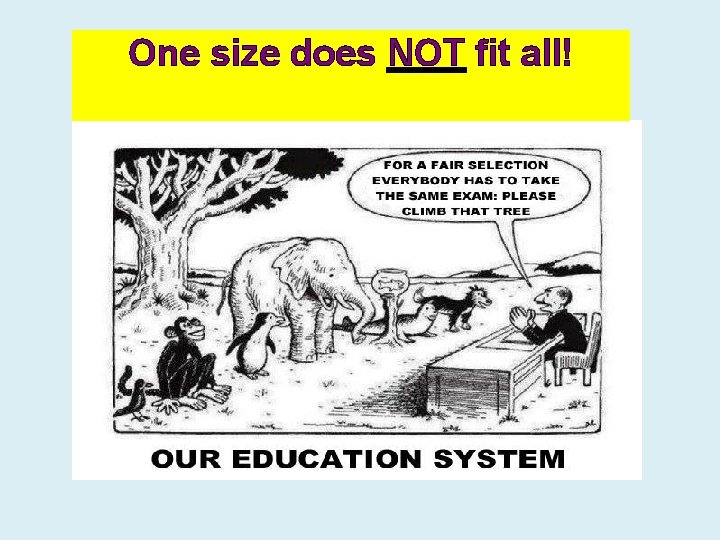
One size does NOT fit all!
Task 1 ( 2 min. ) • Define differentiated learning in no more than two sentences. • Share your ideas with the teacher next to you. • Give one example of teachers’ differentiating in the classroom.
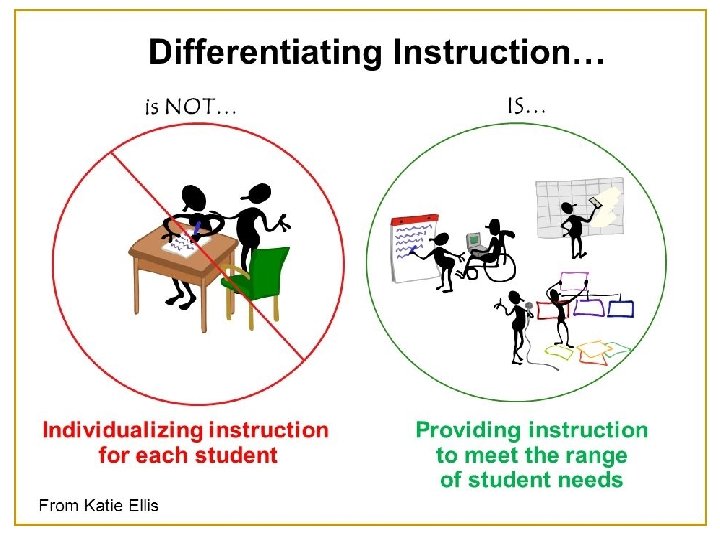
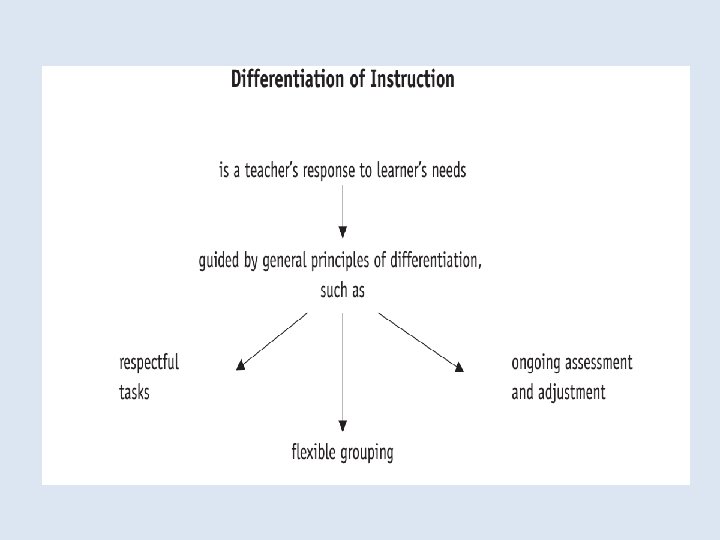
What is differentiated instruction? Differentiated Instruction is a mixture of wholeclass, group, and independent learning, learning where there is continuous reflection and everything is constantly adjusted to help students learn well. Differentiation is not really a method; it’s a way of thinking about teaching and learning and there are many ways a teacher can do that (Blaz, 2006).
Carol A. Tomlinson defines differentiation at its most basic level as the efforts of teachers to respond to variance among learners in the classroom, classroom "Whenever a teacher reaches out to an individual or small group to vary his or her teaching in order to create the best learning experience possible, possible that teacher is differentiating instruction.
Benefits of differentiated learning • • • Directed teaching Greater freedom to experiment new strategies Easier formative assessment Students ownership of learning Teaching the same material in different ways.
Challenges to implementing differentiated learning • Teacher workload ( time and planning) • Understanding children’s individual differences ( weaknesses and strengths) • Keeping tabs on students’ progress • Material preparation • Curriculum demands • Proper training • Understanding the concepts of individualized learning ( resistance)
3 questions to evaluate differentiated learning • Does applying differentiated instruction require doable demands ? • Can you plan for the differentiated lesson without extra work? • Do you need extra time and extra effort inside the classroom? • Does it work well without extra work?
Task 2 • Do you know your students well? What are the tools that help you to do so? Open discussion • How can you help your students struggling with literacy skills? • What are some of the things that make it more difficult for these learners to succeed?
Task 3 • How are teachers helping high achievers? • Are they working to their maximum ability and being challenged? (Enrichment activities) • What if : Ten strongest students were removed from the class, would planning, teaching and learning would be easier?
Watch the following video Reflect and discuss
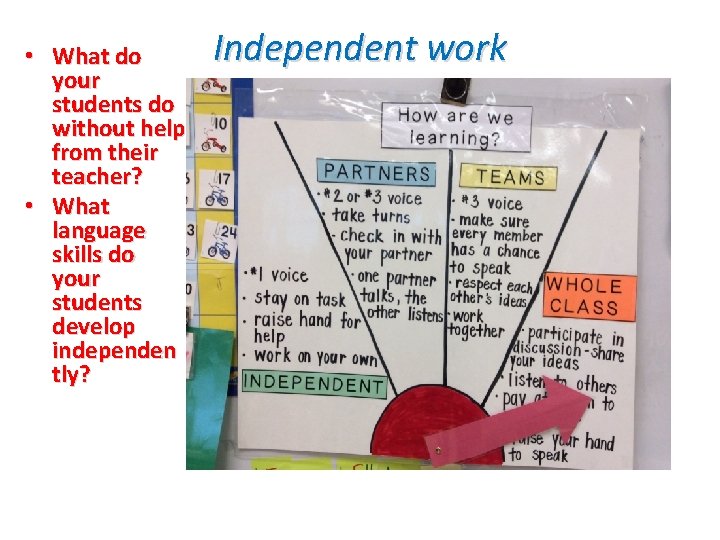
• What do your students do without help from their teacher? • What language skills do your students develop independen tly? Independent work
Task 4 ( 4 minutes) • What activities require teacher support? Review the first 8 pages of Unit 6/book 7 in your textbook. For each activity, note: • If it requires active teacher involvement for your high students. • How much hands on teacher time is required during the activity. • What the teacher needs to do.
• Task 5 • Complete the following statement: The key to differentiated learning is to teach students how to …………
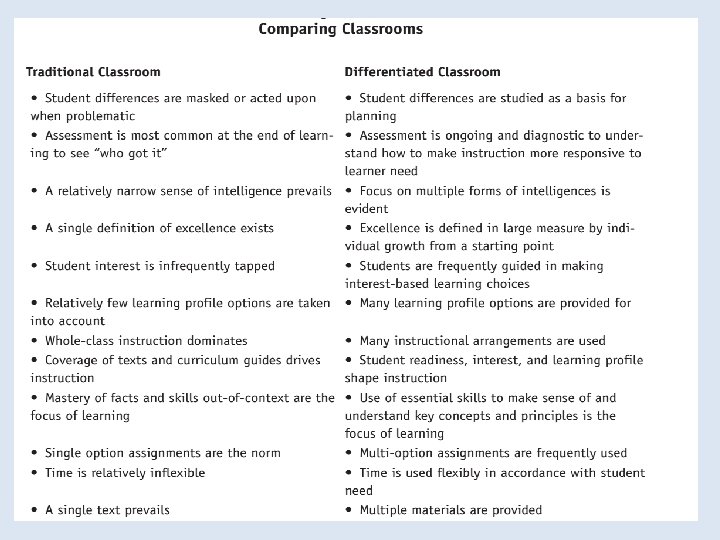
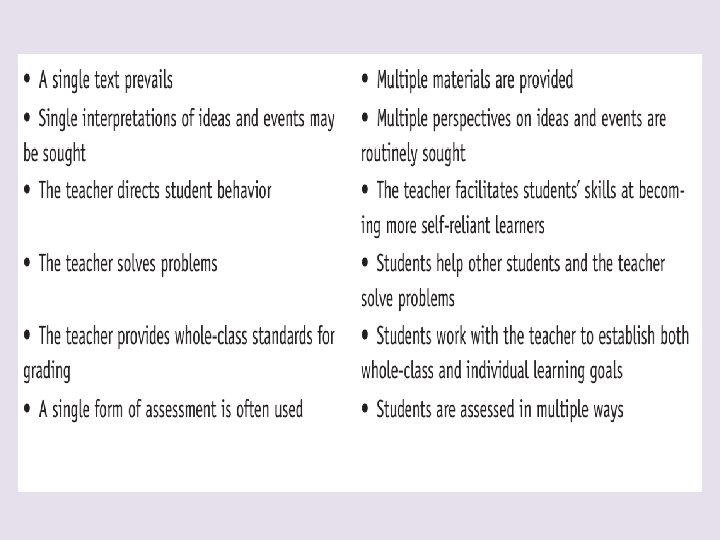
Differences between traditional classroom and differentiated classroom
Tiered activities When teachers tier content, content all students complete the same activity (e. g. , a worksheet, report), but the content varies in difficulty. When teachers tier process, process the activities by which the students learn information vary in complexity. One way to differentiate process for heterogeneous classrooms is to design tiered lessons
Learning stations Stations are different spots in the classroom where students work on various tasks simultaneously. They can be used with students of every age and in all subjects. They can be a frequent or occasional part of the learning process. They can be formal or informal. They can be distinguished by signs, symbols, or colors, or the teacher simply can ask groups of students to move to particular parts of the room
RAFT activities role, audience, form & topic This is a great strategy that integrates reading and writing in a non-traditional way. It asks that students take what they have read and create a new product that illustrates their depth of understanding; understanding it may be used with fiction or nonfiction texts. The format is incredibly flexible and offers limitless opportunities for creativity for both you and your students. It helps students understand their role as a writer, the audience they will address, the varied formats for writing, and the expected content
Flipped classroom A flipped classroom is one where students are introduced to content at home, home and practice working through it at school. This doubles student access to teachers-once with the videos at home, and again in the classroom, increasing the opportunity for personalization and more precise guiding of learning In the flipped classroom model, students practice under the guidance of the teacher, teacher while accessing content on their own.
Features of differentiated instruction
Features of differentiated instruction • 1. Differentiated classroom is a learning environment that supports learners and learning in every possible way. • 2. Students feel that the teacher respects and supports them and believes in their skills to learn • 3. The teacher also accepts that every student is different and pays attention to these differences actively while planning and teaching a class. • 4. In a differentiated classroom, there is clarity about the essential and important things students are expected to learn.
Features of differentiated instruction/2 • Students have a choice, they can influence what and how they learn and also how they show what they have learned. • New things that students are learning should be connected to their interests or something that the students have previously learned or experienced. Connection to something familiar helps the learning process. • It is important to make students learn to see their own strengths and weaknesses weaknesse and to teach them learning strategies. • Groups are not fixed but flexible, flexible the students are regrouped based on ongoing assessments of how the students are learning, behaving, and performing
Differentiated learning and assessment
Differentiated instruction and assessment • Assessment is a key element in differentiated instruction. It is used to know where the learner is going and what his/her needs are. • Assessment is also used to modify the lesson and to differentiate instructions • Three types of assessment are employed: preassessment, assessment formative assessment and summative assessment. • Pre-assessment: Pre-assessment A teacher can collect information about his or her students through tests and assessment but also by observing and discussing with them.
• Formative assessment : It is important to assess the learning of the students throughout the instructional process. It allows the teacher to check student progress and receive information on how to instruct and to differentiate. • Tools: The teacher can use small-group discussions, whole-class discussions, ask students’ opinions or interests using surveys, observe the students, or let the students write journal entries, portfolio entries, pretests, homework assignments (Tomlinson, 2014).
• Summative assessment : It is used to record more formally what students have learned and how well they have achieved the learning goals after a shorter or a larger unit. It should be done many times during a course or a marking period, not just at the very end, and it is important to use varied means of assessment (Tomlinson & Moon, 2013) • Tools: Differentiated summative assessment allows, for example, some students to use drawings in addition to writing, have more time to complete the tasks, or listen to the same texts rather than read them
What to differentiate: • Content: Content refers to what is taught and what the students are hoped to learn, or the materials or tools students use to learn that information • Process: Process is used to describe what activities the students are designed to use to make sense of and apply the essential knowledge and understandings. • Product: Product refers to how the students demonstrate and extend what they have learned
Practical ideas how to know your students • Testing and collecting homework • Individual meetings with students • Thumbs up & thumbs down (students raise their thumbs up to the side or down depending on how well they understood the concepts. ) • Fist of five (formative assessment tool that let teachers know how well students understand the topic and get immediate feedback to modify on the spot).
Grouping students • Heterogeneous groups: groups Some teachers consider working in heterogeneous groups the best, groups where students of different readiness level work together. • Students can be resources for each other and differentiation can be made more easily. • Advanced learners profit as well since one needs to process the material well and often from different perspectives to teach it to others. • Students could, of course, build groups themselves, themselves but most of the teachers found it good to assign students to different groups deliberately
• Heterogeneous groups might work well especially when students are reading texts, texts for example, more challenging texts. • Most students, even the more advanced students find texts like that challenging and they can benefit from working together • The more advanced students usually enjoy the challenge of reading them, and they can provide a lot of help for students who struggle with the vocabulary
Grouping students /2 • Homogenous groups: groups Grouping students sometimes by ability enables the teacher to teach specific things to specific groups and differentiate that way. Using homogenous groups makes it possible for students to move on at a pace that is more suitable for them but still work together. • Many teachers use this kind of grouping when they feel the need to reteach a topic to students who need more assistance. • Homogenous groups can work extremely well when teaching grammar. • Most teachers emphasize that regrouping students is important – it is not ideal to make students always work in the same groups
Giving students choice • It is useful to offer the students different alternatives, alternatives whether they are different texts, activities, how to work, where to work, etc. • Giving the choice to the students and letting them influence what they do not only help to differentiate the activities, activities but also motivate the students if they can work on something they are interested in, and if they can influence what they are doing. • With freedom to choose comes responsibility It is important to encourage students to challenge themselves to try more demanding activities especially when they are given the chance to choose their tasks.
Differentiating reading activities • • • Using different texts or modifying texts Modifying questions Letting students make their own questions Jigsaw technique Helping students who find reading challenging
• When reading texts and practicing reading comprehension, students can be given different versions of the same text The teachers had made easier versions of the same texts by replacing more difficult words with simpler synonyms or by using in other ways simplified language. • Some English teachers give students a variety of novels to choose from. All the novels have a similar structure and the same topic or theme, but they might differ in the difficulty level. leve The teachers let the students work with the same assignments and questions, and basically analyze and learn similar things, but by using different novels
Jigsaw technique The material, for example, a text, is divided into different parts such as parts A, B, C, D, and given to different students. The students can first work in their expert groups, groups where students with the same part work together and read and study the material together. Later they move to their home groups. with a representative from each group A, B, C, D. Students can present and teach their expert area to the other home group members. The home groups can, for example, be named using different colors such as the red, blue, yellow, and green team.
Differentiating writing activities • RAFT activities • Giving oral feedback to individual students • Helping students who find writing challenging
RAFT activities • The students are given a table with different choices for the Role of the writer, the Audience of the text, the Format (e. g. letter, complaint, diary, note, postcard), and the Topic of the text. The students can choose the combination they like best. By varying the format and the topic, for example, the activity can be differentiated for various students based on their interests and readiness levels.
Tips to start your differentiated classroom • Begin with self-reflection • Share your beliefs and ideas bout differentiation with your class • Develop a set of guidelines for your classroom • Prepare assessment tools • Create a system of instructional strategies • Finally enjoy the journey