
Ministry of Education Mubarak Al Kabeer Educational Area
Ministry of Education Mubarak Al Kabeer Educational Area ELT Supervision ﻭﺯﺍﺭﺓ ﺍﻟﺘﺮﺑﻴﺔ ﺍﻹﺩﺍﺭﺓ ﺍﻟﻌﺎﻣﺔ ﻟﻤﻨﻄﻘﺔ ﻣﺒﺎﺭﻙ ﺍﻟﻜﺒﻴﺮ ﺍﻟﺘﻌﻠﻴﻤﻴﺔ ﺍﻟﺘﻮﺟﻴﻪ ﺍﻟﻔﻨﻲ ﻟﻠﻐﺔ ﺍﻹﻧﺠﻠﻴﺰﻳﺔ TOEFL i. BT Reading Prepared and presented by: ELT Supervisor: Mrs. Hanan Burezq
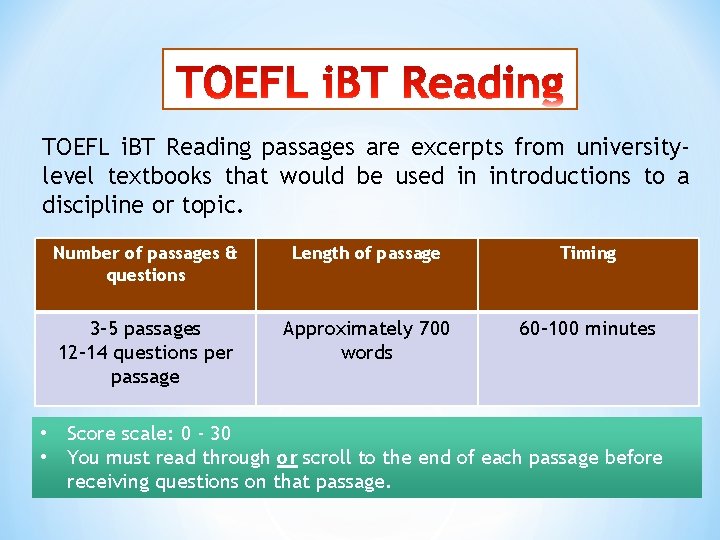
TOEFL i. BT Reading passages are excerpts from universitylevel textbooks that would be used in introductions to a discipline or topic. Number of passages & questions Length of passage Timing 3– 5 passages 12– 14 questions per passage Approximately 700 words 60– 100 minutes • Score scale: 0 - 30 • You must read through or scroll to the end of each passage before receiving questions on that passage.
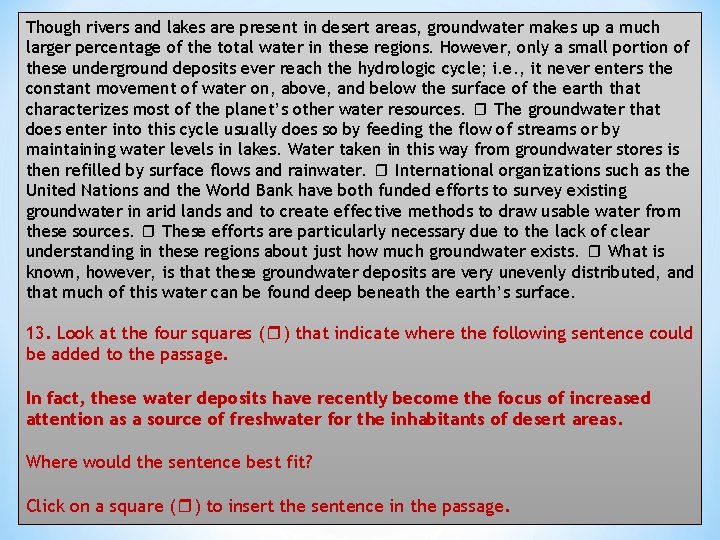
Though rivers and lakes are present in desert areas, groundwater makes up a much larger percentage of the total water in these regions. However, only a small portion of these underground deposits ever reach the hydrologic cycle; i. e. , it never enters the constant movement of water on, above, and below the surface of the earth that characterizes most of the planet’s other water resources. ❒ The groundwater that does enter into this cycle usually does so by feeding the flow of streams or by maintaining water levels in lakes. Water taken in this way from groundwater stores is then refilled by surface flows and rainwater. ❒ International organizations such as the United Nations and the World Bank have both funded efforts to survey existing groundwater in arid lands and to create effective methods to draw usable water from these sources. ❒ These efforts are particularly necessary due to the lack of clear understanding in these regions about just how much groundwater exists. ❒ What is known, however, is that these groundwater deposits are very unevenly distributed, and that much of this water can be found deep beneath the earth’s surface. * Questions with four choices and a single answer in traditional multiple-choice format. * Questions with four choices and a single answer that asks test takers to “insert a sentence” where 13. Look at the four squares (❒) that indicate where the following sentence could fitsto best in a passage. be it added the passage. In fact, these“reading water deposits recently become the focus increased New tohave learn” questions withof more attention as a source of freshwater for the inhabitants of desert areas. than four choices and more than one possible Where would the sentence best fit? * correct answer. Click on a square (❒) to insert the sentence in the passage.
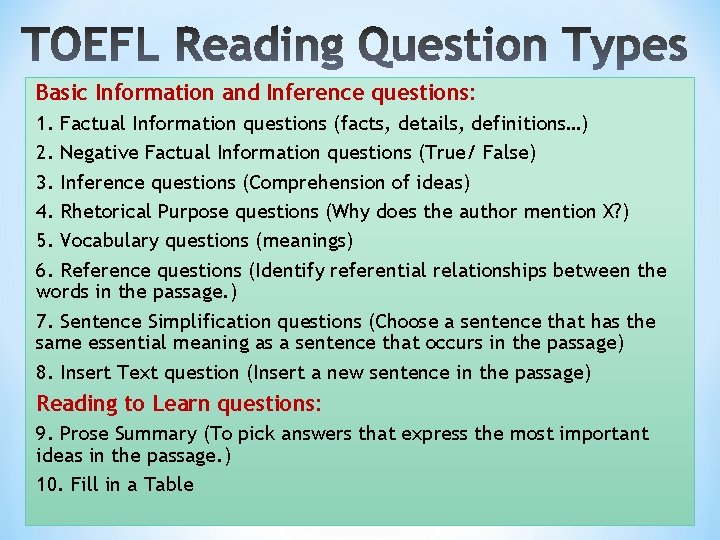
Basic Information and Inference questions: 1. Factual Information questions (facts, details, definitions…) 2. Negative Factual Information questions (True/ False) 3. Inference questions (Comprehension of ideas) 4. Rhetorical Purpose questions (Why does the author mention X? ) 5. Vocabulary questions (meanings) 6. Reference questions (Identify referential relationships between the words in the passage. ) 7. Sentence Simplification questions (Choose a sentence that has the same essential meaning as a sentence that occurs in the passage) 8. Insert Text question (Insert a new sentence in the passage) Reading to Learn questions: 9. Prose Summary (To pick answers that express the most important ideas in the passage. ) 10. Fill in a Table
Most of the passages in TOEFL i. BT will try to do the following: *To Explain: to present the information on a specific topic in explanatory manner. These texts contain mostly factual information. *To Resolve: it aims at finding solution for some sort of dilemmas or questions that need answers. Usually there would be a debate. *To convince: to persuade the reader of the validity of certain viewpoint or idea. There would be opinions and support with evidence in those types of passages.
Instructions: *The purpose of the passage in most of the readings is embedded in the introductory paragraph which is one of the most important paragraphs in the text. *The passage contains all the information needed to answer the questions. *The definition of difficult words or phrases in the passage may be provided. If test takers click on the underlined word, a definition appears in the lower left part of the screen.
*A clock on the screen will show much time you have. Once it hits 0, your answers will be recorded and you will move on to the listening section never to return to the reading again. *As you answer, you will always be able to jump to different questions. *After you go to the next passage, you may not return to a previous passage. *You would have 20 minutes to read each passage and answer its questions.
How to answer: *First, read the questions. *Practise skimming quickly to get a general impression of the main idea. *After skimming a passage, read it again more carefully and write down the main idea, major points and important facts. (Take notes) *Guess the meanings of unfamiliar words from the context (surrounding sentences). *If the passage describes the order of a process, create an outline of the steps in the process. *Read all the alternatives before choosing one.
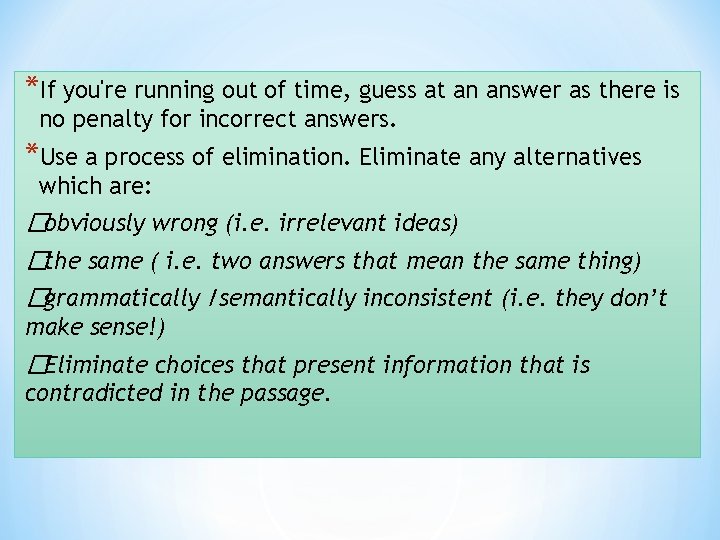
*If you're running out of time, guess at an answer as there is no penalty for incorrect answers. *Use a process of elimination. Eliminate any alternatives which are: �obviously wrong (i. e. irrelevant ideas) �the same ( i. e. two answers that mean the same thing) �grammatically /semantically inconsistent (i. e. they don’t make sense!) �Eliminate choices that present information that is contradicted in the passage.
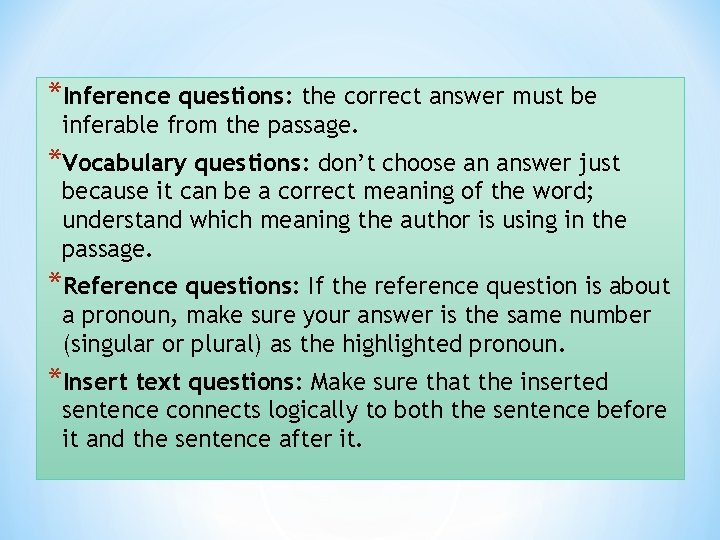
*Inference questions: the correct answer must be inferable from the passage. *Vocabulary questions: don’t choose an answer just because it can be a correct meaning of the word; understand which meaning the author is using in the passage. *Reference questions: If the reference question is about a pronoun, make sure your answer is the same number (singular or plural) as the highlighted pronoun. *Insert text questions: Make sure that the inserted sentence connects logically to both the sentence before it and the sentence after it.
- Slides: 10